Is AI Technology Use a Poison or a Benefit?
Apr 19, 2026 - Peace Foundation Regular Workshop (Gyeongju Tour), Travel to Seoul
Hello. Today is the second day of the Peace Foundation regular workshop held at Dubuk Jungto Retreat Center (두북수련원).
Sunim began his day with early morning practice and meditation. Since he planned to travel to Seoul (서울) in the afternoon, he packed his belongings simply. After having breakfast with the Peace Foundation committee members, they had tea time together. As they continued various conversations they couldn’t finish yesterday, it was already 9 AM. Sunim and the committee members packed their belongings and boarded two vehicles for the Gyeongju tour (경주 탐방). The final schedule of the workshop was to tour around Gyeongju, have lunch, and then conclude the workshop.
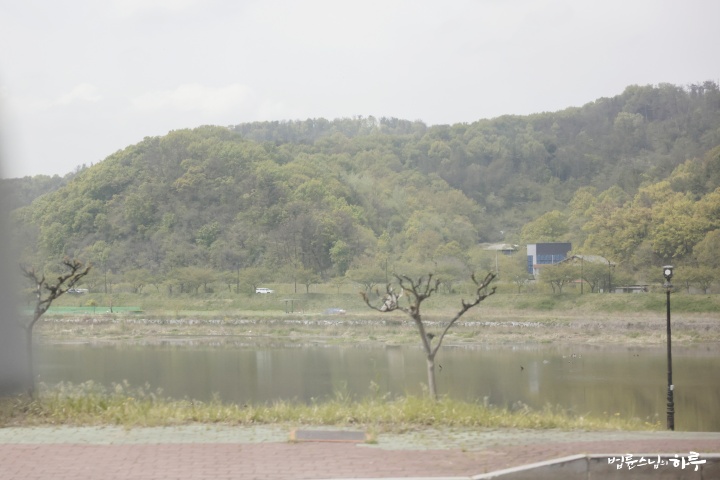
Although the cherry blossoms had all fallen, the azaleas and flowers bloomed brilliantly, and the light green foliage made the surrounding mountains lush, allowing everyone to fully enjoy the freshness of spring.
Sunim made a suggestion to the Peace Foundation committee members about today’s Gyeongju tour.
“Today’s Gyeongju outing will be a walk around the Samneung (삼릉) area, and then depending on time, we’ll go to Yongdamjeong (용담정)
. After lunch, we don’t have much time for walking before the train departure. Today is really just a walking course, so please enjoy spring while walking around Gyeongju.”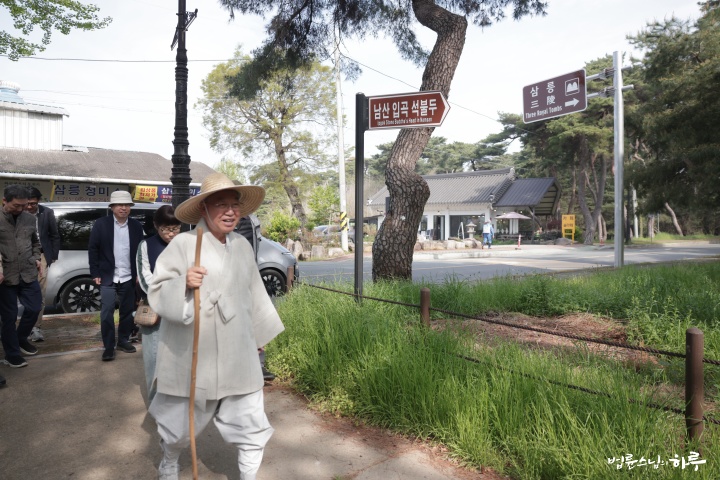
At 9:20 AM, they arrived at Samneung, the first destination of the Gyeongju tour.
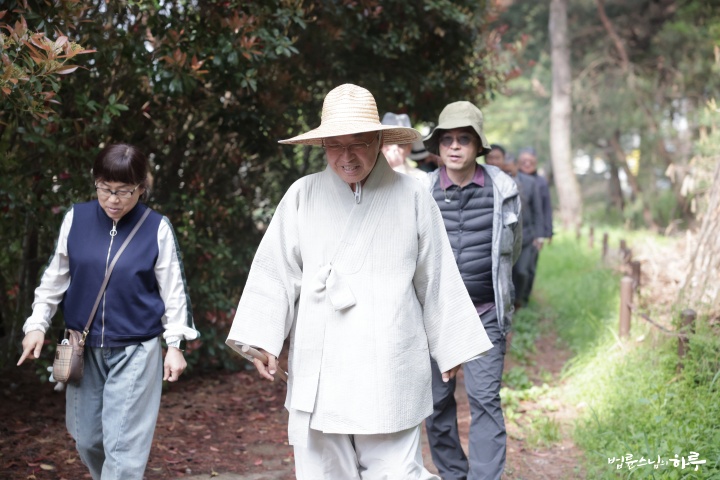
They went to the place where the stone Buddha heads are located at the entrance valley of Mt. Namsan (남산) in Gyeongju. They had to walk inside from the road and climb up the mountain path to see the stone Buddha heads. Since there were no detailed signs from the main road to where the relics were located, it seemed difficult for first-time visitors to find.
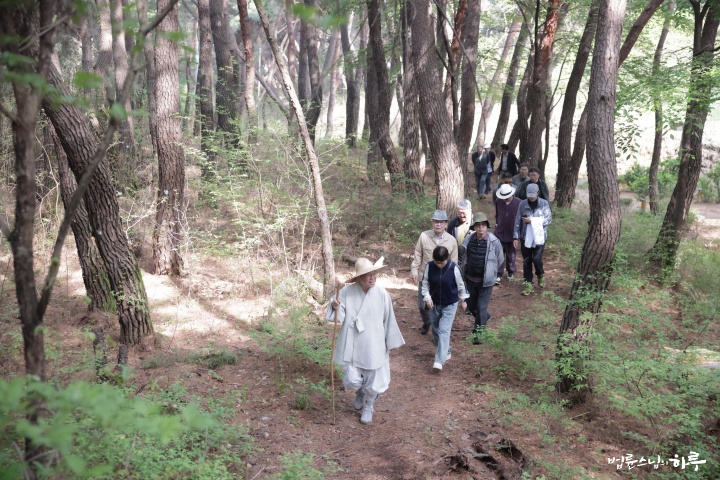
Sunim shared with the committee members about how difficult it was to find this place during his previous visit because the path wasn’t clear.
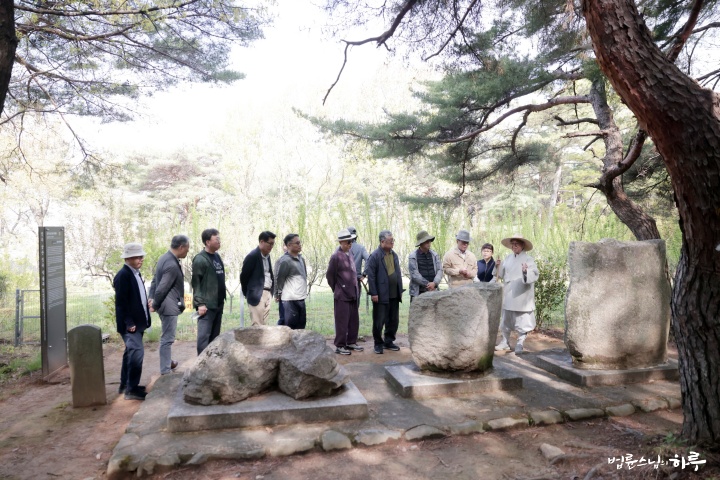
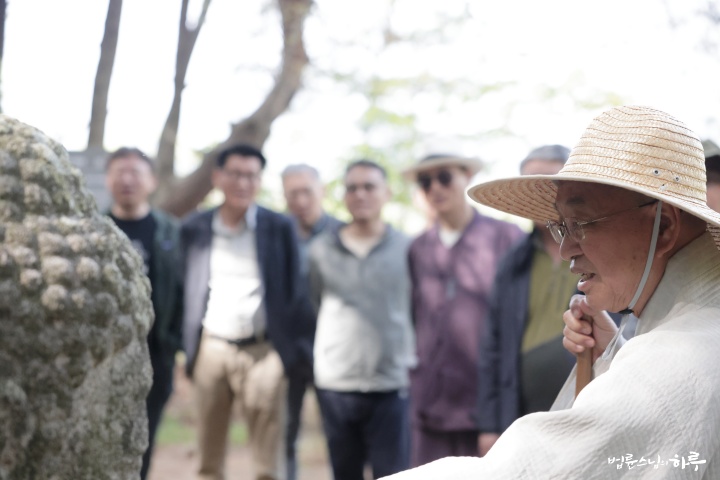
While walking and talking, they soon arrived at the location of the stone Buddha heads (석불두). The characteristic of this relic is that the Buddha statue, which was divided into head, chest, lower body, and pedestal parts, has been gathered in one place.
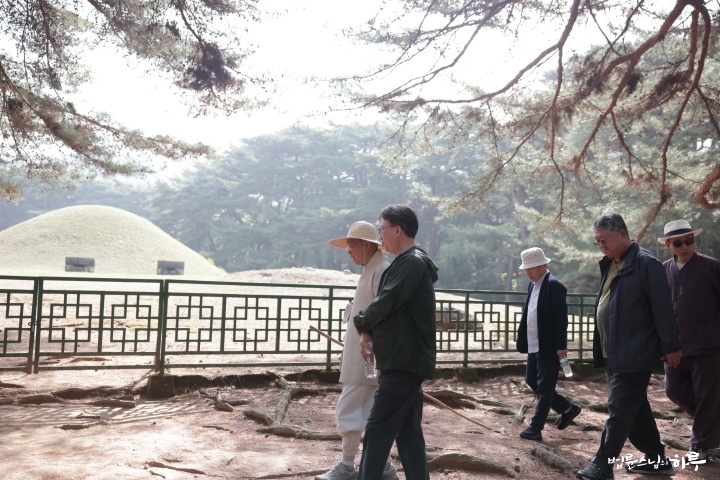
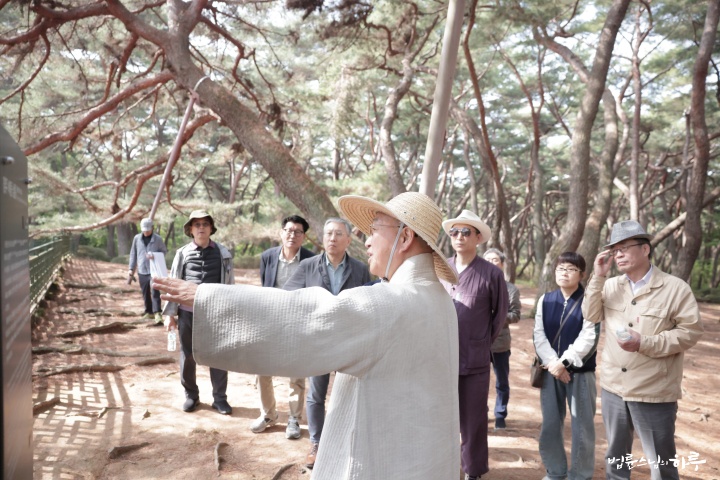
After a brief look around, they moved to another location. They visited the tomb of King Gyeongae (경애 왕릉), the 55th king of Silla. Afterward, they took a leisurely walk to Samneung. It’s called Samneung because the tombs of three kings – the 8th king Adalla (아달다), 53rd king Sindeok (신덕왕), and 54th king Gyeongmyeong (경명왕)of Silla – are located together. The light green grass on the royal tombs was dazzling. After passing Samneung, they slowly walked along the mountain path.
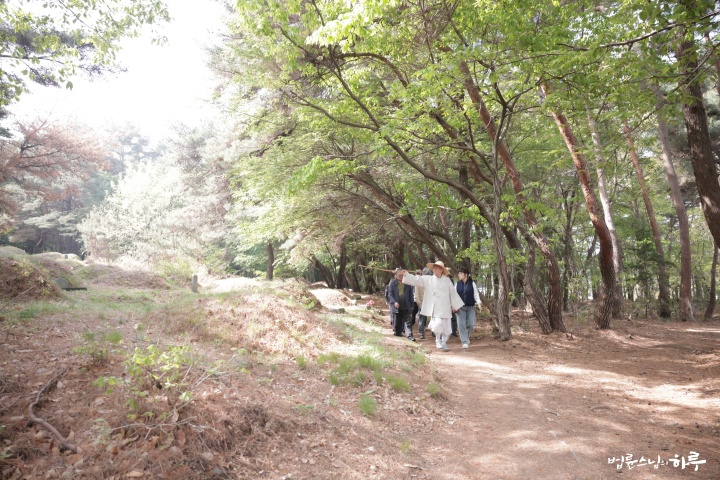
As they walked, they passed through a cemetery and talked about stories related to tombs. Soon Mangwolsa Temple (망월사) appeared. Sunim told old stories about establishing and operating the Yeongnam (영남) Buddhist Education Center here.
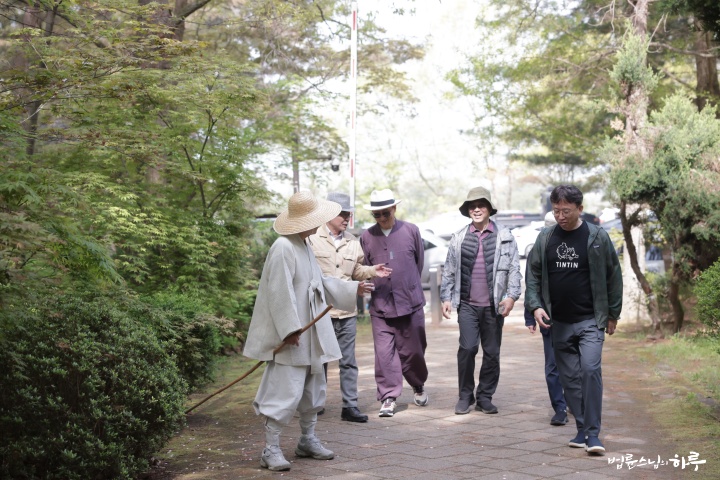
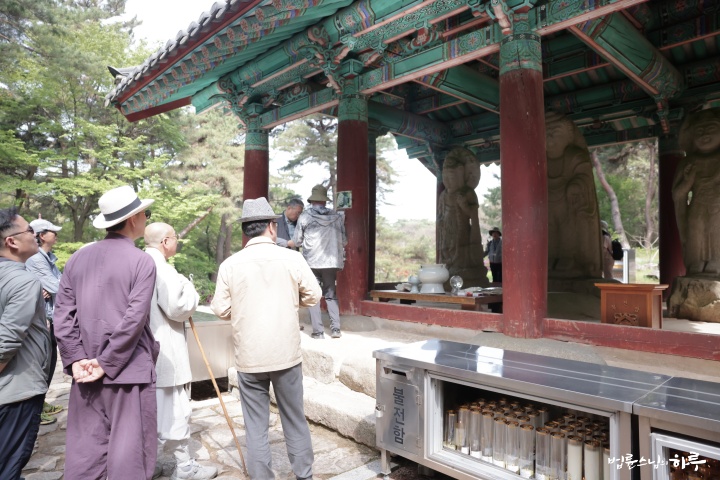
Going up a bit further, they came to the place where the Stone Standing Buddha Triad (석조여래삼존입상) is located. They paid respects to this stone Buddha statue, which is characterized by its childlike smile.
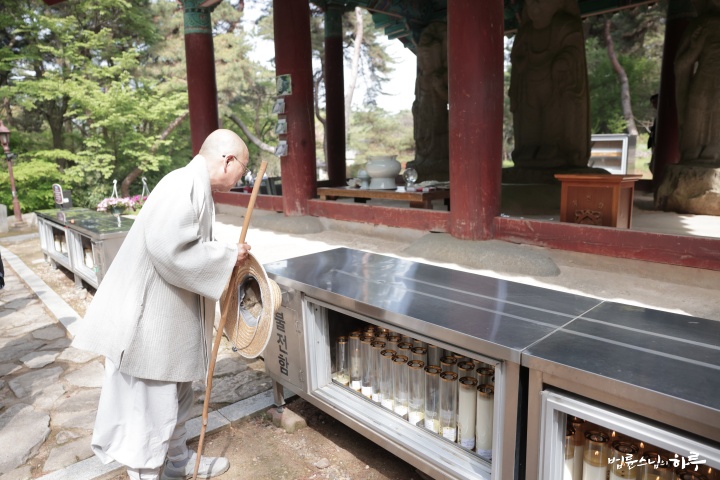
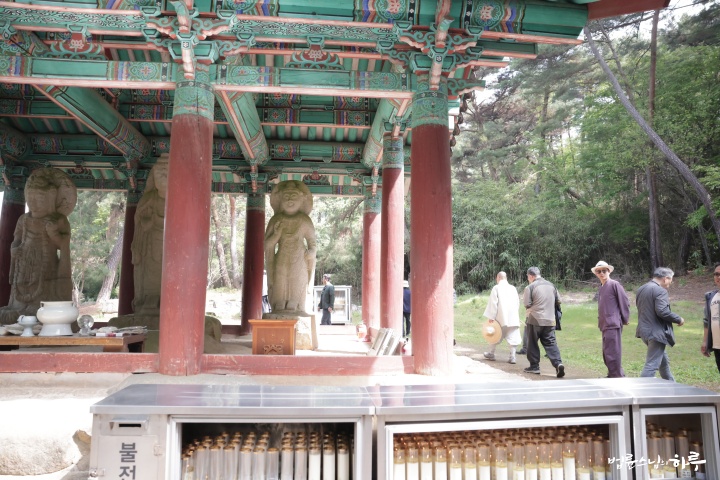
Sunim put an offering in the donation box and walked around the stone Buddha statue with the committee members. After touring the Samneung area, an hour had passed.
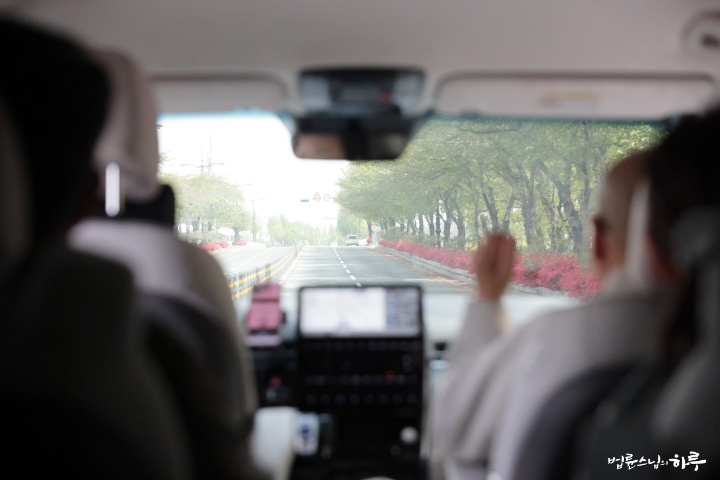
At 10 AM, they headed to Yongdamjeong, the second destination. Even in the car from Sambulsa (삼불사) to Yongdamjeong, Sunim introduced the visible historical sites and specific places in Gyeongju to the committee members.
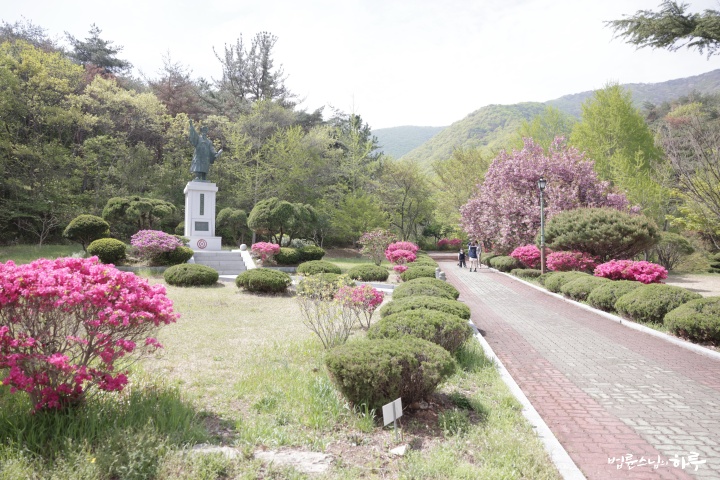
Located in Gajeong-ri (가정리), Hyeongok-myeon (현곡면), about 12km from downtown Gyeongju, Yongdamjeong is where Choe Je-u (최 제우), the founder of Cheondogyo (천도교), attained enlightenment and is the birthplace of Donghak (동학의 발상지). As the highest sacred site of Cheondogyo, many pilgrims visit here. The Yongdam Training Center at Yongdamjeong is equipped with facilities for many people to practice. Not only is it historically significant, but it’s also considered one of the must-visit places in Gyeongju due to its beautiful natural scenery. Near Yongdamjeong is also the birthplace of Suun Choe Je-u (수운 최제우 선생).
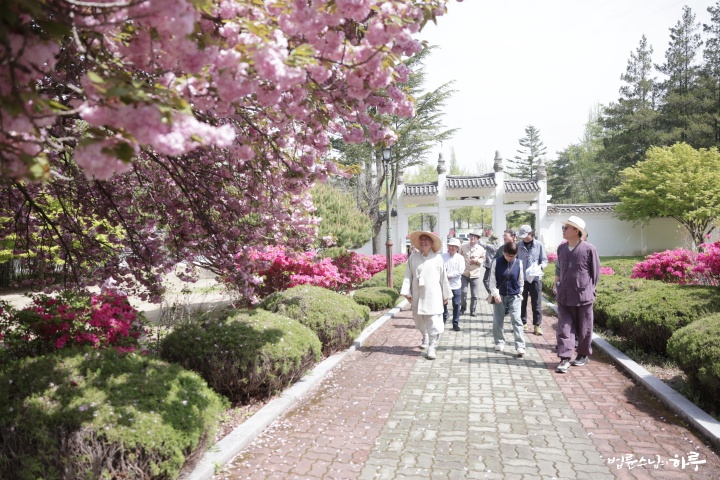
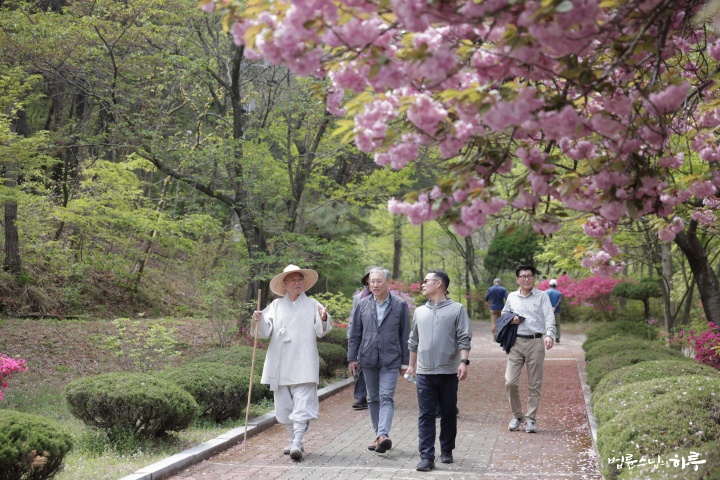
After passing through the entrance to Yongdamjeong, there was a statue of Suun Choe Je-u on the left, and double cherry blossoms were in full bloom on the right.
Sunim and the committee members shared stories about Suun Choe Je-u while walking up to Yongdamjeong.
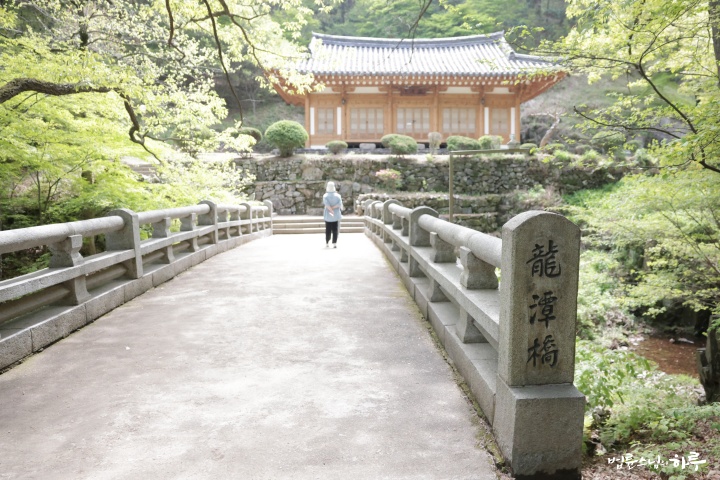
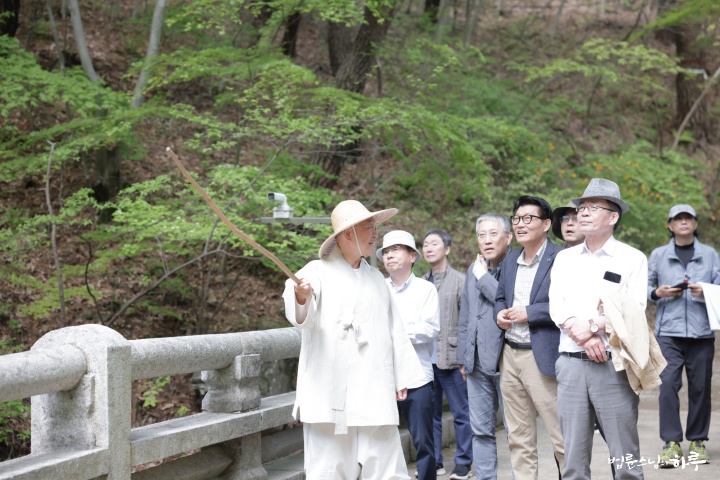
After crossing Yongdam Bridge (용담교), they reached Yongdamjeong.
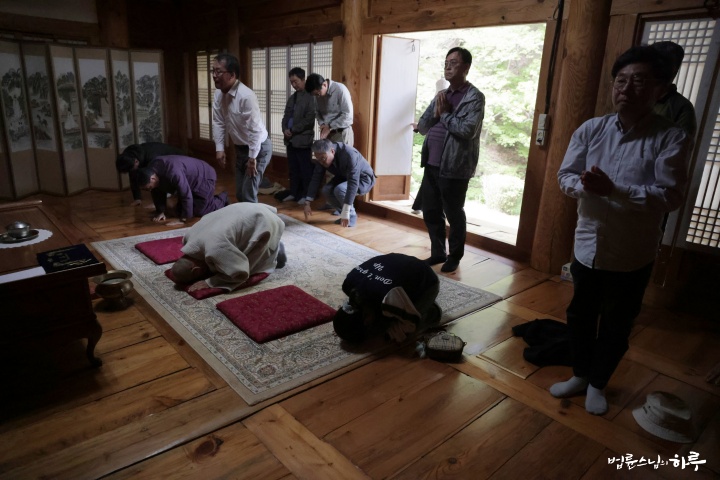
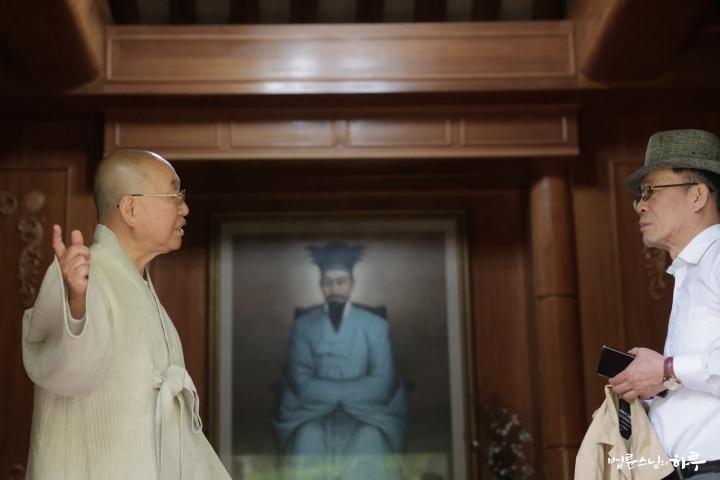
The door seemed firmly closed, but when they opened it, they found the portrait of Suun Choe Je-u.
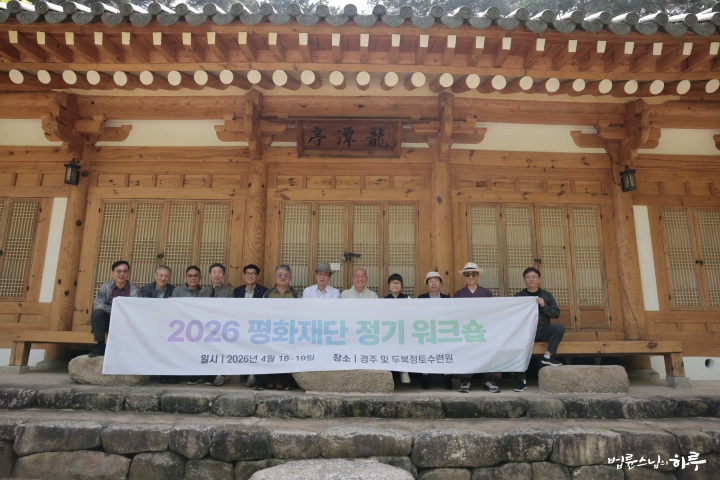
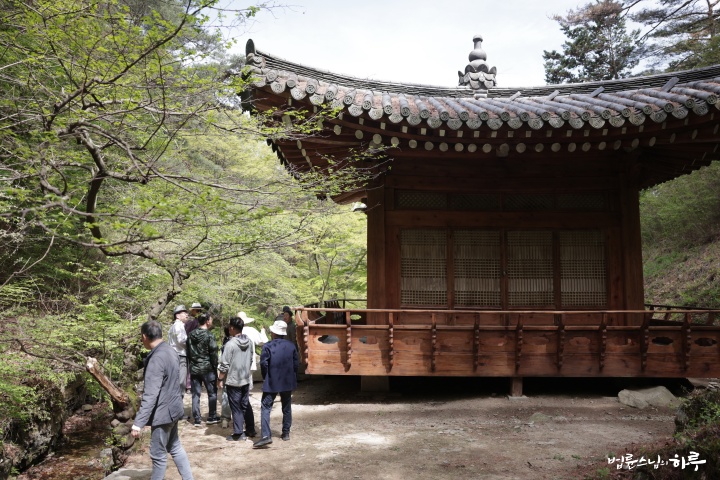
Everyone paid their respects and took a group photo in front of the veranda of Yongdamjeong. After looking around Yongchugak (용추각) above Yongdamjeong, Sunim and the committee members went down to the Yongdamjeong parking lot.
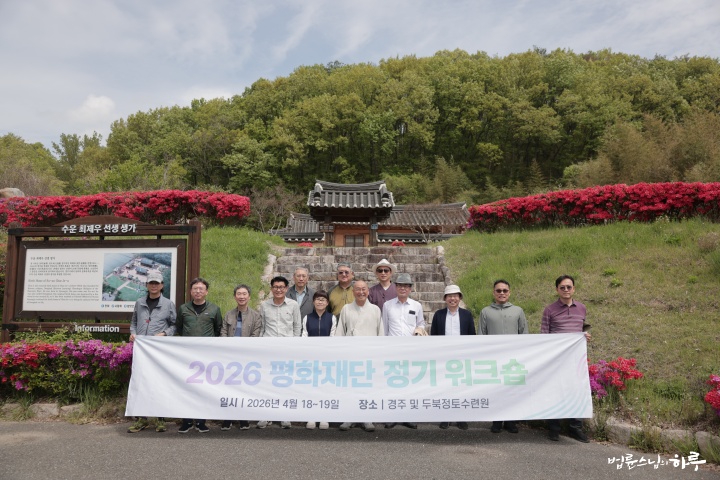
Considering lunch time and train time, they didn’t have much time, but Sunim suggested visiting Choe Je-u’s birthplace. Since it wasn’t far from Yongdamjeong, they quickly looked around and returned. They took a group photo in front of the birthplace.
As the restaurant reservation time approached, Sunim and the committee members boarded the vehicles and headed to the restaurant. They had lunch with temple food bibimbap (비빔밥). After lunch, they had about 30 minutes of free time.
“Did you enjoy your meal? It looks like everyone has finished. We have about 30 minutes left. There’s King Muyeol’s tomb (무열왕릉) near this restaurant. Would you like to look around there? Or would you prefer to have tea at the restaurant and then go to the train station?”They thought lunch time would be tight, but since they had time left, Sunim asked the committee members if they wanted to take a walk. Since the weather was nice and they had filled their stomachs with hearty bibimbap, everyone agreed it would be good to take a walk. Sunim and the committee members went for a walk to King Muyeol’s tomb near the restaurant.
After buying tickets and passing through the entrance to King Muyeol’s tomb, the first thing they saw was the turtle-shaped monument of King Taejong Muyeo (태종 무열)l. A little further on, they could see King Muyeol’s tomb, the tomb of the 29th king of Silla (신라).
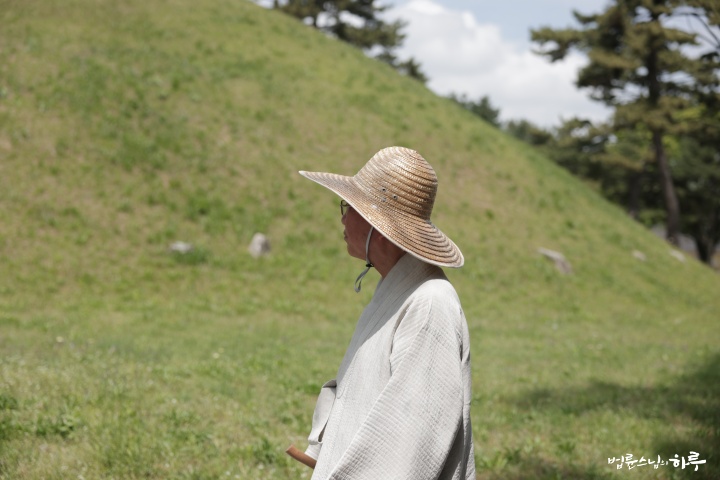
Sunim also talked about the stones visible at the bottom of the royal tomb. He explained that when building the tomb, stones were placed all around to prevent the soil from collapsing, but much of the tomb soil had slid down, covering the retaining wall and exposing some stones. After hearing Sunim’s explanation and looking at the royal tomb, they could indeed see stones embedded all around.
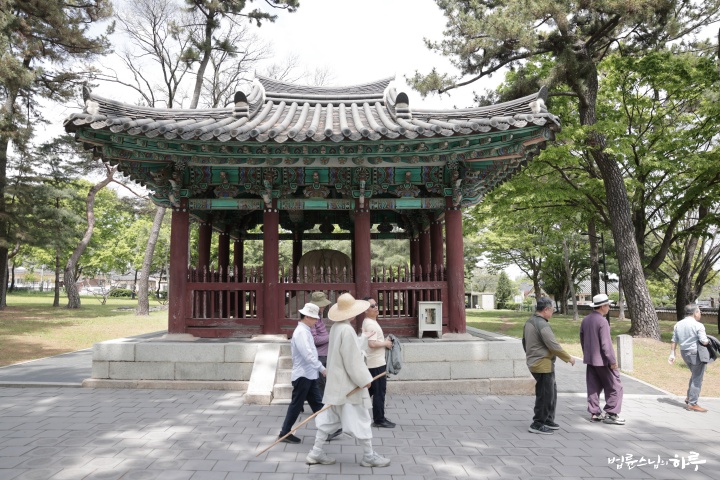
Due to train time constraints, they couldn’t tour the entire King Muyeol’s tomb park and had to leave after seeing about half. While walking around King Muyeol’s tomb, the research committee members shared memories of sliding down tombs on fertilizer bags and cardboard boxes as children, bursting into laughter. The midday temperature had risen quite high, enough to take off their outer clothes.
As the time to go to the train station approached, they hurriedly boarded the vehicles.
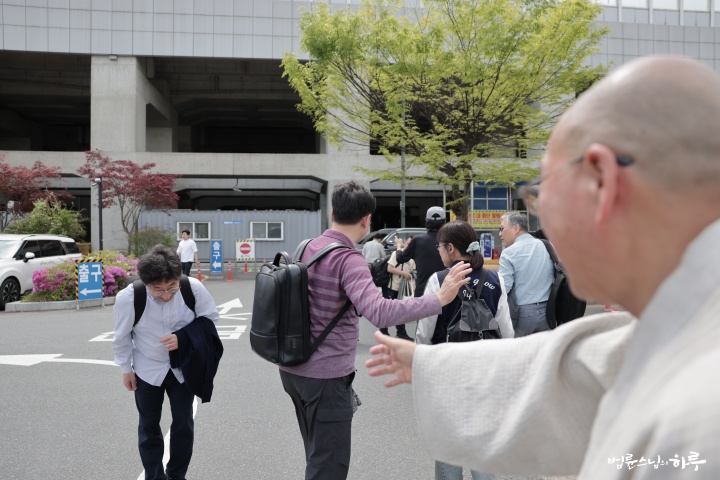
The Peace Foundation research committee members decided to travel to Seoul by train from Gyeongju Station. The committee members got off at Gyeongju Station (경주역), said goodbye to Sunim, and hurried into the train station. It was fortunate that they arrived before the train departure time.
Sunim left Gyeongju Station for Seoul around 1 PM. He had a dinner appointment with a guest at 6 PM at the Jungto Social and Cultural Center (정토사회문화회관). He was worried the highway might be congested on a Sunday afternoon, but fortunately, there wasn’t much traffic.
Sunim arrived at Seocho-dong (서초동) Jungto Center, unpacked, did some quick preparations, and went straight to the basement restaurant of the Jungto Social and Cultural Center.
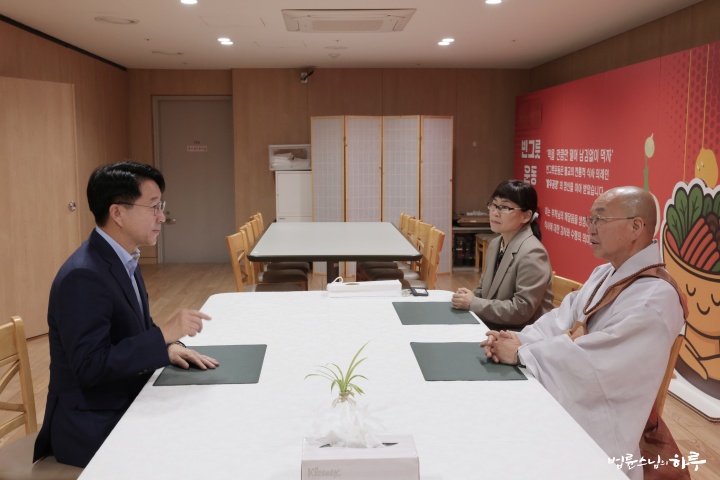
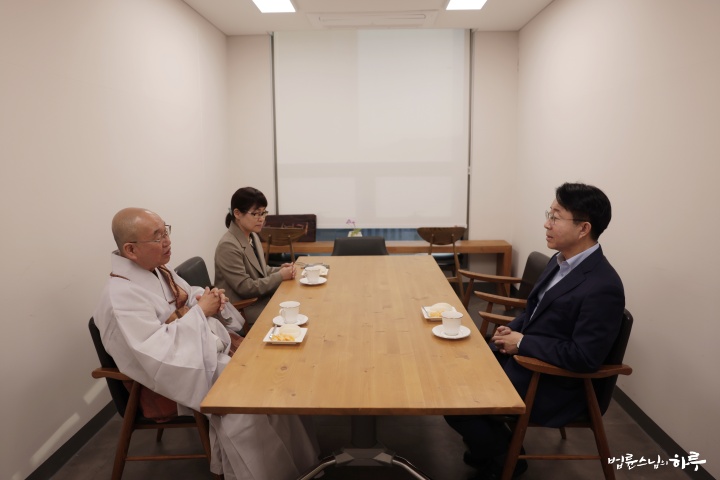
At 6 PM, he had dinner with Assemblyman Cho Jung-sik (조 정식 의원) and then moved to the reception room for a meeting.
After the meeting ended, Sunim saw off Assemblyman Cho Jung-sik, returned to the office to briefly handle some work, and concluded his day. Tomorrow, he has an early morning departure to China and plans to travel to Incheon Airport (인천공항).
Since there was no Dharma talk today, this post concludes with content from a previous Dharma Q&A session held in Daegu.
Is AI Technology a Poison or a Benefit?
“I run an AI startup in Seoul. As AI advances these days, it seems young people prefer communicating with AI over communicating with people. Since AI caters to their desires, conversations with AI seem to have become more comfortable than with people, creating this side effect. On the other hand, I think AI technology could also be used in positive ways. For example, if AI learns from Venerable Pomnyun Sunim’s usual teachings and words, people could listen to Sunim’s Dharma Q&A at home without having to come all the way here. I’m curious whether Sunim sees this technology as helpful to people or as an illusion we should be wary of.”
“I think it’s both.”“If I want to create something using AI technology, would it be out of my greed or good intention? I think it’s probably both.”
“That’s also both. You have the desire to make money, and you also want to contribute through research. Dynamite is useful when used for developing mines. When you blast instead of digging with pickaxes, mining efficiency greatly increases. But when it’s used in war, enormous numbers of people die. It has two sides. It’s like asking whether we should eliminate explosives because they’re bad when used in war, or whether we can use them unconditionally because they’re useful. Explosives are useful, but we must be cautious about using them for harmful purposes. When a knife is very sharp, it helps with kitchen work. But there’s a risk of cutting your hand. So you need to be careful when using it. Artificial intelligence certainly has its conveniences. It’s fine to use those, but the side effects are proportional to the usefulness. Just as explosives have significant side effects proportional to their usefulness, and the dangers of atomic bombs are proportional to the usefulness of nuclear power generation, you should understand that the side effects of artificial intelligence will be equally significant if it’s truly efficient.”“I experimentally tried using AI to provide counseling like Venerable Pomnyun Sunim. It was really good. So I’m thinking about popularizing this. When my parents nag me about getting married, or for various issues, when I ask the AI that counsels like Venerable Pomnyun Sunim, it gives good advice.”
“So you’re saying to create an avatar of Venerable Pomnyun Sunim by inputting a thousand or ten thousand pieces of Dharma Q&A data. Then everyone would install that app on their smartphones. Always carrying it in hand, whenever they have a chance, they’d ask, ‘I’m suffering from this, what should I do?’ It seems convenient, right? I received such proposals already 10 years ago. There are two reasons why I didn’t accept them. First, because there are countless possible scenarios in life. When I meet a woman or a man and have conflicts, are there a hundred possible solutions, a thousand, ten thousand, or countless? What I’ve counseled on is only a thousand cases out of all possibilities. So it might not fit each individual perfectly. It might be similar, but in some cases, it might not fit exactly. If we provide counseling using AI like this, there’s a risk of it becoming about finding the right answer. Life has no correct answers, but if we say ‘do this in this situation, do that in that situation,’ then I’d be creating correct answers. This would create side effects. I engage in dialogue, not give answers. But if you use an AI counseling app, you’re looking for answers. You’re not developing self-awareness; you’re seeking answers. Also, AI cannot detect subtle differences in each case. This creates side effects. Second, you must become the master of your own life. The goal of practice is for you to become someone who doesn’t get angry, to become a free person through dialogue with Venerable Pomnyun Sunim, gradually becoming the master of your own life. My goal isn’t for you to become my slaves who only listen to what I say. I’m helping through dialogue so that each of you becomes your own master. But if you ask Venerable Pomnyun Sunim every time you have a worry, you become a slave to Venerable Pomnyun Sunim. It seems convenient, but before you know it, you become a slave. You lose self-consciousness. You’ll ask Venerable Pomnyun Sunim about every decision. Then you ultimately contradict Buddha’s teaching about becoming the master of your own life.Concerns About Side Effects When Excessive
Using AI is indeed helpful initially. But when excessive, side effects occur. People who ask me questions only once are the best. The more you ask, the less you should need to ask. If you keep asking and asking because asking Sunim helps, thinking there’s more and more to ask, before you know it, you have to follow Sunim’s opinion on everything. That’s why when you ask ‘Should I buy stocks?’ I don’t answer. If I answer, you become dependent on me. If you hit the jackpot following my words, you’ll want to ask again and again, and self-awareness doesn’t arise. Dharma Q&A is meant to help you realize Buddha’s teachings, but it makes you increasingly dependent. For these two reasons, I don’t accept AI development proposals. However, many have already been developed. We’re tracking down through lawyers those who have created fake Venerable Pomnyun Sunim and are using it. You’ll probably get caught by me soon too. This is illegal. These days, with deepfakes, videos circulate featuring me with my voice copied exactly. Has anyone seen the fake Venerable Pomnyun Sunim video saying that placing 7 red beans in front of your door on the spring equinox brings great fortune? It circulated enormously. There are many fake videos, and it’s been difficult to catch them. We still haven’t caught a few. Their base is in Vietnam. We can resolve ones uploaded from Korea within a week, but those from abroad take a long time to resolve. This is a crime. They’ll continue to appear, and we’ll have to keep catching them. So uploading Venerable Pomnyun Sunim’s dharma talks on your site is just copyright infringement, but creating and distributing a fake Venerable Pomnyun Sunim enters the realm of crime. Beyond copyright infringement, you risk committing a crime if you’re not careful.”“Actually, I think how AI responds can be sufficiently controlled depending on what data is input. Technology has advanced considerably to provide just principles rather than answers, and I believe such technology will soon be commercialized.”
“I agree with that too.””I’d like to suggest that Sunim try positive attempts with a more open mind.”
“There are two opinions within Jungto Society as well. Whether Sunim does it or not, since the data is already public, it will inevitably emerge. They say we ultimately won’t be able to catch everything. In that case, rather than using ten thousand pieces of public data, let’s input a hundred thousand pieces of unpublished data to make it more sophisticated and authoritative. However, there’s also the opinion that this risks becoming a format that gives answers. If we always say life has no correct answers while telling people to do this in this situation and that in that situation, it doesn’t align with our principles. So it’s better not to do it. I’m telling you that even within Jungto Society, opinions conflict like this.”“Yes, I understand.”