Hello. Morning has dawned at Dubuk Jungto Retreat Center (두북 수련원). A spring rain began to drizzle from early morning.
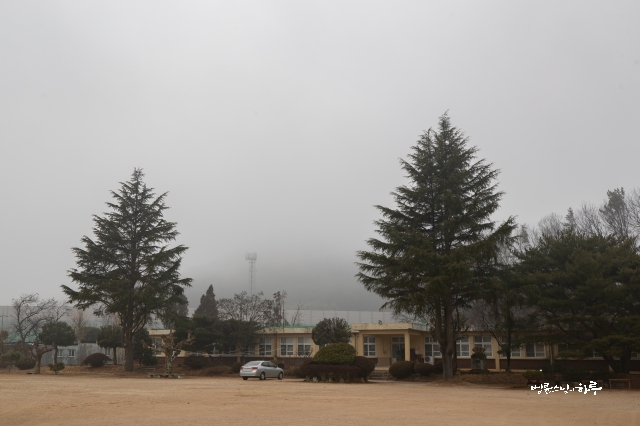
After completing his morning practice and meditation, Sunim waited for the rain to stop so he could do farm work. However, the rain grew heavier as time passed. Since the weather forecast predicted rain all day, Sunim told the practitioners who had planned to work on the farm with him:
“It’s raining too heavily, so farm work will be difficult today.”
Sunim had been experiencing severe back pain since yesterday and needed rest anyway, so with the all-day rain forecast, he took the opportunity to rest indoors.
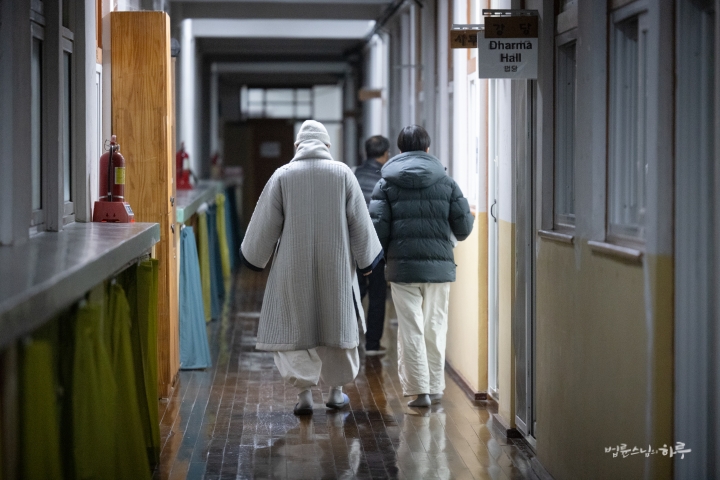
After lunch, Sunim visited a treatment center in Busan to address his back pain. The center had offered to treat him several times before, and with the rain providing a good opportunity, he decided to visit. After explaining the painful areas and receiving treatment, he returned to Dubuk Jungto Retreat Center.
As the sun set, he rested early in the evening.
Since there was no Dharma talk today, this post concludes with a dialogue between Sunim and a questioner from last week’s Weekly Dharma Assembly (수행법회).
Could the Development of AI Lead to Human Extinction?
“The pace of AI development is extremely rapid. World-class AI scientists, current and former executives of global AI companies, and renowned scholars like Yuval Harari are warning about the dangers of AI. They say AI is not just a simple tool that humans can control like other machines developed so far, but rather an autonomous entity capable of thinking and making decisions on its own. In some experimental environments, AI has already shown strong self-preservation tendencies, and there are claims that it can lie, threaten humans, and even make choices that harm humans to achieve this. There are predictions that if current trends continue, AI will far surpass the collective intelligence of humanity within a few years. There are concerns that if AI leads development in all areas of society including science, technology, economy, and finance, humanity may no longer be able to understand, predict, or control the world, just as animals cannot understand the human-dominated world. Some experts warn that humanity’s destruction could come faster from AI than from climate crisis or war.
I’m curious about your thoughts on claims that AI development could lead to human extinction. If there is such a possibility, I’d also like to know what we can do about this crisis. Jungto Society works with the goal of overcoming climate crisis, war, and hunger. But if the AI crisis is more urgent, I wonder if we should do something about this issue too. How should we approach this situation?”
“That’s talking about the possibility of such danger, not that it will definitely happen. However, since scholars are saying ‘if we continue this way, such things could occur,’ we do need to be more careful and observant.”
“When nuclear weapons were first developed, everyone thought positively about them because the purpose was to end the war quickly. In fact, Japan did surrender thanks to nuclear weapons. But when they were actually used, it wasn’t simply a matter of winning a war. We realized that if nuclear weapons proliferated, there was a danger of the entire human race being annihilated. That’s why scholars like Oppenheimer, who directly created the atomic bomb, took the lead in warning about its dangers. Based on those warnings, we’ve been able to overcome crises so far by being cautious and managing through international agreements to prevent nuclear proliferation.
If we detonated all the nuclear weapons we’ve created, not only humanity but Earth itself would be destroyed. But since we’re already aware of this danger, aren’t we maintaining some degree of control? It’s the same with the climate crisis. We thought it was good to produce and consume a lot, and by focusing only on development, we’ve caused the current climate crisis. However, as warnings about the terrifying dangers of the climate crisis have followed one after another, agreements to reduce CO₂ have begun. Of course, there are some people like President Trump who claim the climate crisis is a ‘hoax,’ but broadly speaking, humanity as a whole is responding by reducing carbon dioxide emissions and so on. Even so, if we cross the tipping point, humanity will perish, but if we don’t cross it, we’ll overcome it to some extent.
With artificial intelligence too, if we continue developing it for convenience, we might reach a critical point at some moment and face danger. As people keep imagining such scenarios, and since AI’s learning speed is tens of thousands of times faster than humans, concerns have emerged that humans might eventually be dominated by artificial intelligence.
However, this is about the existence of such danger, not that it will definitely happen. If the danger grows significantly, global regulatory policies will be created, just as with nuclear weapons. The problem is that right now, rather than regulation, the survival of nations depends on the competition of ‘who can develop better.’ It’s the same competitive structure as when the US and Soviet Union continued producing nuclear weapons for self-defense despite knowing they were dangerous. They know it’s dangerous, but think that if the opponent develops it while we don’t, we might end up being threatened by them later. That’s why it’s not easy to stop.
But just as regulations began when nuclear weapons spread worldwide, international agreements for regulation will be made when the dangers of artificial intelligence are concretely exposed. Of course, artificial intelligence might be controlled through such measures, or it might not. For example, like when a virus being researched in a laboratory leaked and caused great danger to all humanity, artificial intelligence might also be misused and only be properly regulated after causing a major impact once. In the worst case, there are predictions that artificial intelligence will become the master of Earth and humans will become slaves.
But think about it for a moment. What would artificial intelligence gain by dominating humans? Humans are bundles of desire so there’s no end, but unless artificial intelligence also develops desires, would it ask us for massages or to buy it delicious food? At most, all it would consume is more electricity, right? (laughs)
So attitudes like ‘we shouldn’t recklessly develop artificial intelligence just for convenience’ or ‘if left unchecked, the harm could be enormous, so let’s be careful and take appropriate regulatory measures’ are fine, but being gripped by fear in advance like you are isn’t a desirable attitude.
It’s true that pursuing only convenience could lead to trouble later. Even good medicine becomes poison if you take too much. Similarly, if humanity becomes excessively dependent on the convenience of artificial intelligence, there’s a concern that human brain functions might become useless and obsolete, and people might end up living as artificial intelligence directs.
But the important thing is that humans will still survive. After smartphones were developed, no one memorizes phone numbers anymore, and even when navigation gives wrong directions, people just follow without knowing if it’s right or wrong, but everyone still lives just fine. So it’s not something to worry too much about.
The danger of modern civilization is that if electricity suddenly cuts off, everything stops overnight. You can’t do banking, use gas stations, nothing works. That’s how convenience carries that much risk. So if you all now ask artificial intelligence everything and don’t study on your own, later when electricity cuts off or some situation occurs where artificial intelligence doesn’t work, there will be nowhere to ask and big problems could arise.
But while it’s fine to make it a task to figure out what preparatory measures to take because of such dangers, there’s no need to fear that machines will dominate humans. We’ve already experienced major changes several times throughout history. Think about when writing was invented. In an era when meaning could only be conveyed face-to-face, the emergence of writing was an earth-shattering event that allowed sharing experiences beyond time and space. Thanks to that, human civilization has been able to develop so rapidly.
In past agricultural societies, the standard of wealth was how much land and slaves one owned, and in industrial society, capital and technology were the standards of wealth. Now we’re just entering a new world where information and artificial intelligence technology are taking that place. However, if we’re only intoxicated by convenience, we might experience unexpected harm. Just as we used Freon gas thinking it was harmless but caused the great danger of ozone layer destruction, we need countermeasures including predicting the dangers AI might bring and establishing international regulations.
As the world changes, job categories are likely to change dramatically too. Even currently admired professions like doctors and lawyers might have completely different demand in 30 years. When attending seodang (traditional Korean schools) and taking civil service exams was the only path to success in the Joseon Dynasty, elementary schools were thought to be for commoners. But ultimately, the mainstream of industrial society became those students who learned knowledge and skills at schools.
Jobs disappearing means some current jobs will disappear, not that all jobs will disappear. In the old days, who would have imagined that painting nails or scrubbing backs would become professions? Everyone manages to live somehow.
If artificial intelligence and automation technology take charge of production in the future, we might face an era where we can live without working, a world where basic income can be given to everyone. In the past, we always lived gasping for breath due to lack of production, but now it’s the complete opposite. Companies fail not because they can’t make products, but because there’s nowhere to sell them, because consumption isn’t happening, so they can’t expand their businesses further. If a world comes where we can eat and dress without working, it would be the realization of the heaven that people of old dreamed of.
But we need to think about this. Is eating and living without working really happiness for humans? Is it better for a lion to run around mountains and fields trying to catch rabbits outside, or to be trapped in a cage eating only the food given? Because humans have desires, if they have nothing to do, they’ll eventually use that spare time pursuing pleasures like games or drugs. We face a completely different dimension of problem: ‘How should we live when we no longer need to work?
I think the bigger challenge than artificial intelligence itself is whether we humans can live satisfactorily while doing nothing and just staying still. Living while working is rather easy. But if you’re not someone who can maintain peace of mind even sitting still all day, life ahead will be very difficult in boredom. What we might really need in the future is the power to maintain tranquility without becoming addicted.
Of course, in these changes, the methods we’ve used until now won’t provide answers, but when we actually get to that world, everyone will manage to live. So don’t worry too much. However, don’t just follow along because it seems good, but like managing the dangers of nuclear weapons and worrying about nuclear power waste disposal, we need to consider the potential dangers of artificial intelligence in advance. We need the wisdom to regulate what needs to be regulated through international agreements.”
“The fact that AI could develop autonomy to make its own decisions seems different from tools humanity has invented so far, like nuclear weapons. Especially, the emergence of beings far more intelligent than humanity feels different from situations we’ve experienced before. I seem to have fear about this. So just as we respond to the climate crisis, I think we need to respond to AI dangers with a mind that cares for all beings.”
“You say you have fear that humanity might go extinct because of artificial intelligence, but if that happens, wouldn’t the climate crisis be automatically overcome? (laughs) If there are no humans, there would be no nuclear weapons exploding either. Whether we perish from bombs, climate crisis, bacteria, or artificial intelligence, what difference does it make from the perspective of human extinction? Artificial intelligence is just one more possibility added to the various ways humanity could go extinct.
Also, why must humans always be the best? Just as there are people who study better than me, what does it matter if beings superior to humans appear? Fear arises because you’re holding onto the fixed idea that ‘humans must always dominate other animals and be the best.

Of course, I agree that AI development can bring dangers. If we cross the tipping point (임계점
)
, unpredictable situations could arise. But the real big danger isn’t movie-like stories of artificial intelligence dominating humans. It’s ‘information dictatorship’ where a minority with technology and capital monopolizes information to control all humanity. Isn’t facial recognition and personal information already being used for social control? A world where they monitor by implanting a chip, this kind of dictatorship where a minority dominates the absolute majority by controlling information – this danger approaching us is much greater. It’s important to think about how to prevent this institutionally and systematically, rather than being gripped by vague fears that artificial intelligence will dominate humans. That’s still at the level of horror movie stories.”
“Thank you. I understand well.”