Atopic Dermatitis Has Worsened and I’ve Lost My Normal Life
June 25, 2024 Shenyang, China ▶ Osaka, Japan
Hello. Today marks the end of Sunim’s 4-night, 5-day tour of China, as he travels to Japan via Incheon Airport.
After completing morning practice and meditation, Sunim left the accommodation at 7 AM and arrived at Shenyang Airport. At the airport, he met the daughter of an acquaintance who has been helping with North Korean humanitarian aid projects.

The young mother mentioned that she often listens to Sunim’s Dharma talks while working and expressed her desire to invite Sunim for a meal during his next visit to China. She thanked him, saying his books have provided much guidance in her life. They took a commemorative photo together before parting ways.
Sunim also took photos and exchanged farewells with Mr. Joshin and Mr. Jinshin, who had driven and accompanied him during the 4-night, 5-day tour, as they had to catch an early flight to Korea.

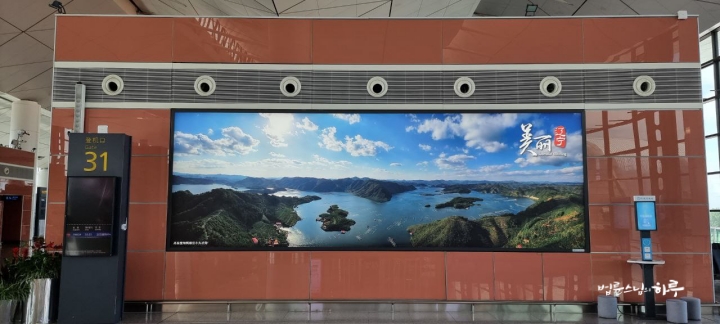
In one corner of Shenyang Airport, a photograph of the Yalu River flowing majestically was displayed in a rather grand manner.
The plane arrived safely at Incheon Airport, where Sunim bid farewell to the Good Friends volunteers who had completed the tour with him.

Though briefly stopping in Korea, Sunim immediately began his journey to Japan upon arriving at Incheon Airport. He went straight to the transit gate and joined the volunteers who would accompany him to Japan.

At the airport, they moved to the boarding gate for Osaka, but the departure was delayed by 1 hour and 10 minutes. During the waiting time, Sunim meticulously edited the manuscript on Practical Buddhist Thought in front of the boarding gate.

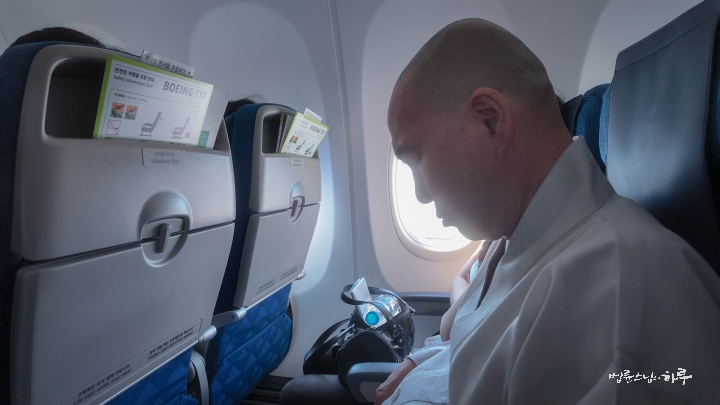
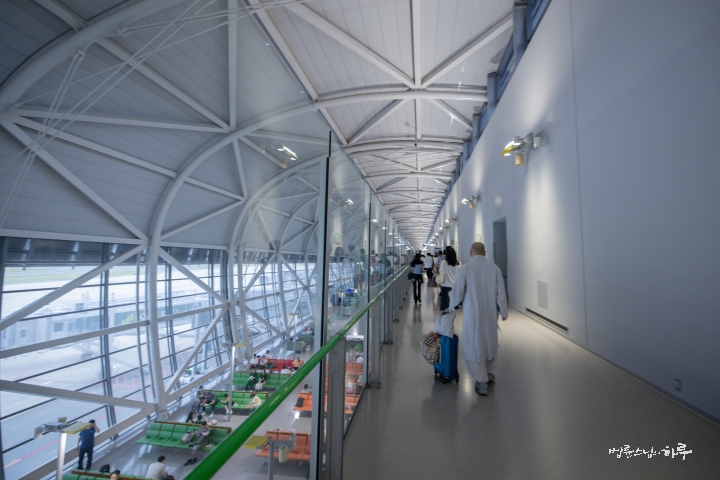
At 4 PM, the plane took off powerfully toward Osaka, Japan. Even on the plane, Sunim was absorbed in editing the manuscript and briefly closed his eyes to rest. After a 1 hour and 50 minute flight, they arrived at Kansai Airport in Japan.

Sunim said with a voice full of emotion.
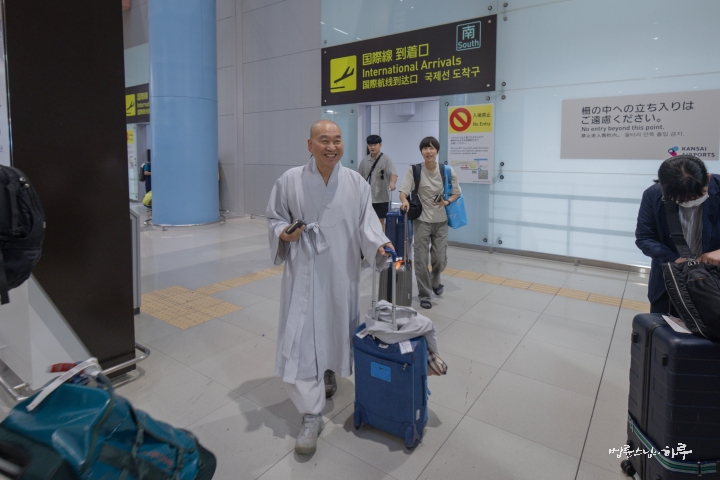
After completing immigration procedures, Jungto Society members Lee Joo-eun and Kim Jung-nam greeted him with bright smiles and bouquets.
“Sunim, welcome!”
“Thank you.”“It’s been so long since we’ve seen you. You last came to Osaka in 2017, so it’s been 7 years. We’re truly grateful that you’ve come to visit us.”

Osaka is Japan’s second-largest city after Tokyo, the capital. It is where the largest population of Korean residents in Japan lives.
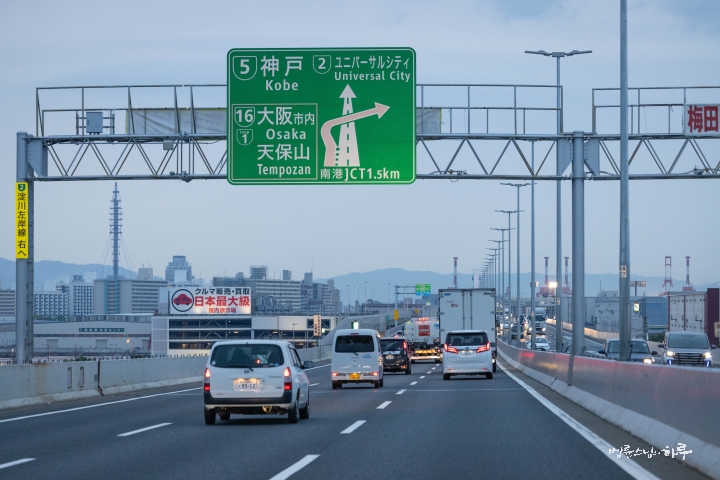
After driving for an hour along the coastal road, they arrived at Shin-Osaka Station. Looking at the scenery of Osaka from the car, Sunim said:
“When I came to Japan in the past, I couldn’t eat udon because it cost 500 yen. There’s still 399-yen udon in Japan, but after 20 years, Korean prices have become more expensive.”

After arriving in Osaka and finishing dinner at a restaurant, it was past 9 PM when they reached the accommodation. Since he needs to travel to Tokyo after meetings and lectures tomorrow, Sunim decided to stay at an accommodation near Shin-Osaka Station.
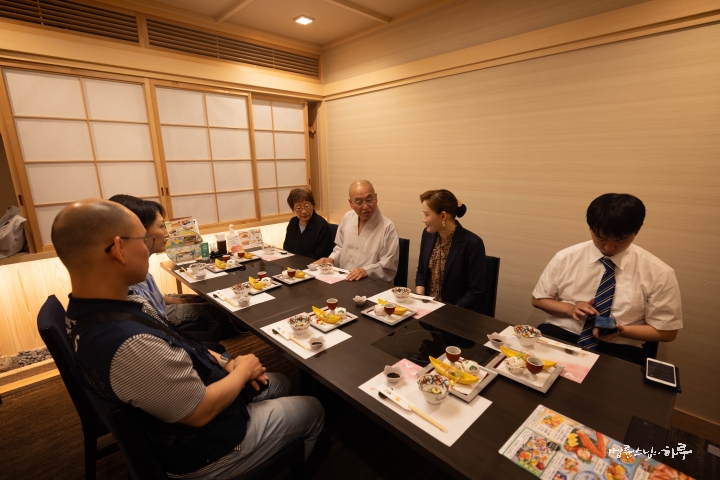
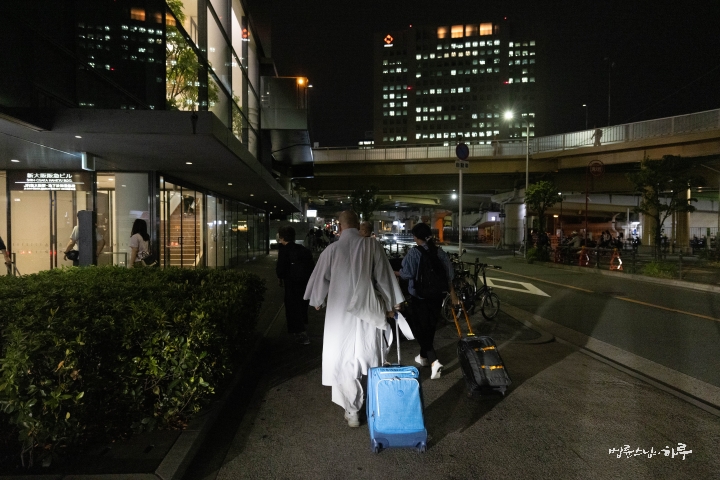
Since there was no Dharma talk today, I’ll conclude by sharing a dialogue between Sunim and a questioner from the Friday Dharma Q&A held online on the 14th.

Atopic Dermatitis Has Worsened and I’ve Lost My Normal Life
“I’m a 29-year-old woman who has been suffering from chronic recurrent atopic dermatitis for 28 years. Thanks to my mother’s sacrifices throughout my life, I managed my atopic dermatitis well. But after becoming an adult, I lived obsessively pursuing my desires through work, studies, and relationships, which caused my condition to worsen severely, leading me to quit my job. I ended my relationship and now live in the countryside, focusing solely on treating my atopic dermatitis. The condition isn’t improving as expected and is actually getting worse, making me more worried about my career. I feel like atopic dermatitis will hold me back no matter what I do, and dreaming of a normal life seems like a luxury. I’m wondering whether I should do nothing until my skin completely heals or try things for my career while paying less attention to my skin. I’m also curious about how to let go of my obsession with a normal life, and I’d like to ask about ways to better control and discipline myself, as I often struggle to maintain my diet and exercise routine since moving to the countryside.”
“You are living a normal daily life right now. If you think drinking alcohol and eating stimulating, greasy foods freely like others is normal, you’re mistaken. A normal daily life means eating when it’s time to eat, working hard, coming home in the evening to wash up and sleep comfortably. Humanity has lived this way for 5,000 years until now. It’s only recently that we’ve come to eat and live a bit better. Among 8 billion people, those who live as you expect are actually in the minority. Our current lifestyle isn’t normal. We’re living special lives. Using the Joseon Dynasty as an example, it’s like living the life of royalty. For aristocrats, going to gisaeng houses to play and eat might be normal daily life, but it’s not daily life for ordinary people. Young people in South Korea today might consider living like this as daily life, but among the world’s 8 billion people, only a small number in wealthy countries live what you call a normal life. So the life you’re living now is a normal life. The only thing that’s not normal about you is that you’re dependent on your parents and not self-sufficient. In terms of just eating and sleeping, it’s no different from ancient aristocrats. So you need to change your thinking. Having atopic dermatitis on your skin is constitutional. It’s not a sin from a past life, nor is it punishment from God. Some people get hives when they eat peaches, and some can’t drink even a drop of alcohol because they lack alcohol-decomposing enzymes. It’s natural that people have different bodily reactions even when eating the same food. If you have a peach allergy, you just don’t eat peaches. But you’re thinking wrongly: ‘Why can’t I eat peaches when everyone else can?’ Others can eat peaches, but it’s natural that you can’t. When you go to the mountains, there are many wild berries – some that humans can eat and some they can’t. Having atopic dermatitis is like getting an allergy from eating peaches. Just as there are foods that are fine for animals but become toxic for humans, you just don’t eat those foods – it’s not some special problem. You don’t have to be able to eat peaches to be a normal person. If something doesn’t suit your constitution, don’t eat it. You should live according to your constitution too. Most people only have minor side effects from eating foods with seasonings, the symptoms aren’t severe, but people with atopic dermatitis react very sensitively. I also have a cold allergy. Every winter, my skin gets so itchy that it bleeds. When I go from a cold place to a hot place, I get hives all over my body. Since these symptoms are constitutional, there’s no special solution. When winter comes and it gets itchy, I either scratch and live with it, or be more careful with my diet and lifestyle. If there’s any food that might cause even a little itching, I shouldn’t eat it in winter. And I always make sure cold air doesn’t touch my skin. This is how you live according to your constitution. If your nose runs profusely just from opening the window a little in spring, prepare in advance. If you have a pollen allergy, take medicine, wear a mask, or just let your nose run – decide and prepare according to your current conditions. When it’s hot, wear less clothing; when it’s cold, wear more. Saying ‘Why do I have to wear thin clothes when everyone else is bundled up?’ or ‘Why do I have to wear thick clothes when everyone else is dressed lightly?’ is too self-centered. Living according to your constitution is truly a natural and normal life. People with atopic dermatitis experience worse itching when the air is bad, water is bad, or food contains many seasonings. Such people should move to the countryside and, if possible, grow organic vegetables themselves and eat them close to raw without cooking processes – their condition will improve significantly. You might want to live in the city, but that’s not normal for you. It’s because your constitution doesn’t match the urban environment and food. Even if you move to the countryside, if you spray herbicides or use fertilizers and pesticides when farming, your allergies will worsen. These are all chemical products. So first, grow what you eat organically, then cultivate more to sell for income. Otherwise, you could take on internet projects to earn living expenses. If your parents can provide some help, they might support you in getting a room in the countryside. This is how you should live – atopic dermatitis isn’t such a big deal. I hope you can have the perspective that it’s not a big deal. No matter how physically healthy someone is, there are people who have to work all day just to get one meal. Yet thinking it’s such a big deal to have some atopic dermatitis seems rather childish, doesn’t it? Rather, think ‘I’m someone with a nature-friendly constitution. So artificial things don’t suit me.’ Try to live leisurely in nature as much as possible, come up with ideas there to find work that can generate income. If itching symptoms still appear, you’ll have to live with some itching – what else can you do? I’ve had a cold that hasn’t gone away for several months now. But I don’t think ‘It’s hard to keep lecturing while sick with a cold.’ If it gets really bad, I’ll go to the hospital. Recently, I guided a six-hour hike on Namsan Mountain in Gyeongju, and now my knee hurts so much it’s hard to walk. At first, I thought it would get better soon. I’d never experienced this before. But after a week passed and it hurt more than initially, I finally went to the hospital for an X-ray. They said there was no particular fluid build-up or abnormality, so I decided to wait a bit longer. While waiting, if there are measures I can take, I’ll take them. If this condition continues, I just won’t go to the mountains. If it gets worse, what option is there besides a wheelchair? There’s no need to keep thinking about the past regarding things that can only be done this way, thinking ‘Why can’t I go hiking when everyone else can?’ Living according to your age, health, and condition is a normal life. So don’t worry too much. Everyone has illnesses. We live with illnesses bit by bit while preventing what we can prevent. Even if you want to eat certain foods, if they make you itchy, you should think ‘This food might be delicious to others, but it’s poison to me’ and not eat it. If you live with that perspective, there’s no problem right now. You can see, you can hear. You must accept what’s given to you and live. There’s no need to keep looking at others thinking ‘That person isn’t itchy, why am I the only one who’s itchy?’ Rather, I hope you’ll live with positive thoughts that you were born with a constitution for a future-oriented life in the climate crisis era, living on raw foods in an eco-friendly natural ecosystem.”“I want to strictly control my diet and exercise, but it’s very difficult.”
“The act that it’s not working well is proof that life is manageable even without diet control or exercise. Even if your skin is itchy, it seems bearable. No matter how delicious food looks, if someone says ‘There’s poison in this,’ no one would say ‘Can’t I just eat a little?’ Regardless of type, colour, or taste, if it contains poison, that should be the end of it. If exercise improves your body, you exercise. If you need to eat raw foods, you eat raw foods. There’s no need to say you’re trying but it’s not working well. If it doesn’t work, just live as it is. If you don’t know how and can’t do it, I can teach you, but there’s no solution for knowing what’s good but not doing it. Even if God or Buddha came, it couldn’t be solved. What can you do if you don’t want to? If you don’t want to, don’t do it. What happens if you don’t? You’ll either die or continue being sick. Then what should you do to not die? You shouldn’t be bound by not wanting to do it. What’s so important about not wanting to? If it’s good to do something, just do it. If you still don’t want to, just suffer. There’s no third way. If you borrow money, you must repay it with interest. Once you’ve experienced how difficult it is to repay money, you should avoid borrowing no matter how desperate you are. What you’re asking is essentially the same as ‘Is there a way to borrow money and not pay it back?’ If some religion says, ‘There’s a way to borrow money without repaying it. Just believe and borrow,’ that’s fraud. It doesn’t make sense. There’s no need to ask questions like ‘Is there a way to commit terrible sins and not go to hell?’ We don’t know if there’s a hell you go to for committing sins, but if you believe in it, then if you don’t want to go to hell, you shouldn’t commit sins. And if you’ve committed sins, you should rightfully go to hell and receive punishment. There must be another reason why you keep asking such questions. Don’t try to wriggle out of this like a loach, young person. When you say certain foods make you itchy, you have two choices: eat them and deal with the itchiness, or don’t eat them if you don’t want to be itchy. There’s no need to ask, ‘Is there a way to eat them without getting itchy?’ I get diarrhea immediately when I eat ice cream, so I rarely eat it no matter how much people offer. But sometimes when someone says, ‘Sunim, this is really delicious. Please try it,’ I might have a few spoonful. When that happens, I just go straight to the bathroom. You make your choice and accept the consequences.”“Thank you.”
Tomorrow morning, Sunim will conduct a live broadcast of the Weekly Dharma Assembly from his accommodation. In the afternoon, he has a meeting scheduled with representatives from the Japan Peace and Unification Alliance. In the evening, after completing a Dharma Q&A for Korean residents in Osaka, he will travel to Tokyo by night train.