Is There Such a Thing as Truth or Fact?
Apr 13, 2026 - Arrival in Korea, Meetings
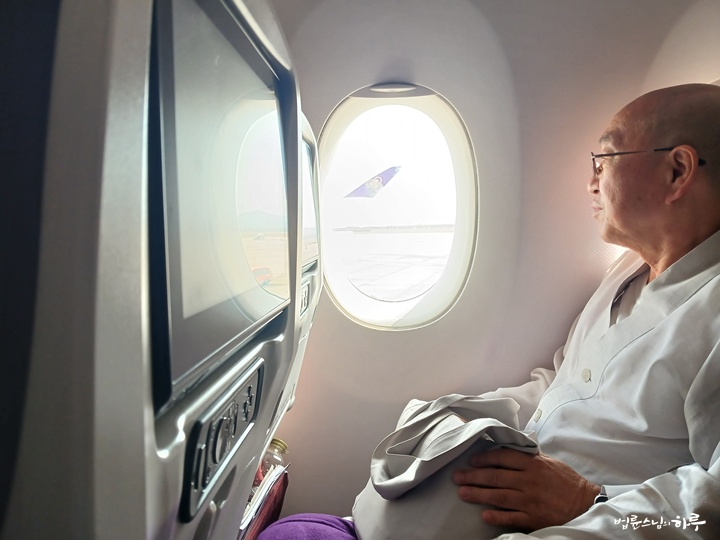
Hello. Yesterday, Sunim flew overnight from India to Korea via Bangkok. Even while waiting to board at the transit airport, Sunim continued proofreading manuscripts.


After the long flight, Sunim arrived at Incheon Airport at 3:30 PM Korean time.
After collecting luggage and leaving Incheon Airport, the journey to Seoul Jungto Center in Seocho-dong was slowed by rush hour traffic. Sunim continued working in the car without rest. Sunim arrived at the center after 5 PM, where he unpacked and had dinner.
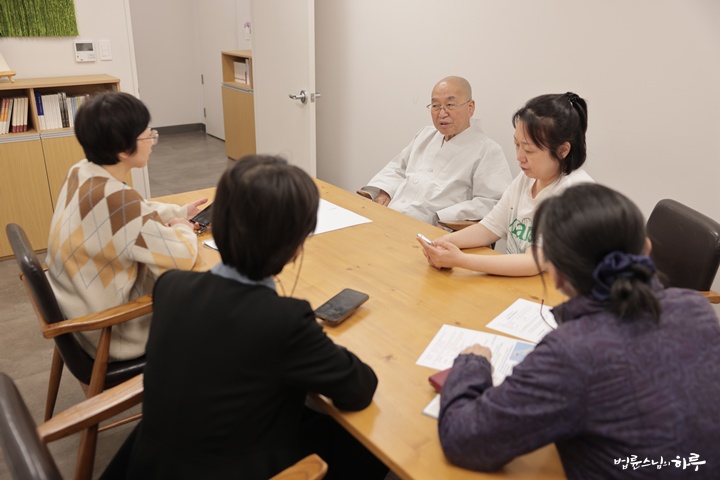
Sunim immediately went to the office for a 7 PM meeting. At 8 PM, a brief working-level meeting was held with four staff members to review the INEB Study Tour and Sri Lankan religious leaders’ visit program. Another meeting followed at 9 PM.
Sunim concluded the day’s schedule at 10 PM after the meetings.
Tomorrow, Sunim will travel to Bongamsa Temple in the morning to attend the memorial service for the late Venerable Seoam, visit Mungyeong Jungto Retreat Center and the training center, and give a Dharma Q&A lecture at Kyungpook National University’s main auditorium in Daegu in the evening.
Since there was no Dharma talk today, this post concludes with content from a previous Dharma Q&A session.

Is There Such a Thing as Truth or Fact?
“Sunim, thank you for taking my question. Before I took the Jungto Buddhism Course, I thought Buddhism would offer a new way of observing human perception. However, after reading books and listening to your Dharma talks, I began to wonder if there might be something more, something I don’t know about. That is, does some objective fact exist? Like the wall we all see is there, even though we each look at it through our own colored glasses. So my question is: what is truth, what is fact, and could you talk about what this world considers good, or virtue? Is there something beyond truth, something worth doing even if it causes suffering? And while we study the mind and practice to eliminate suffering, I wonder if there might be something more important than that.”
“While we use words like ‘fact’ and ‘truth,’ there is actually nothing that can be definitively determined as fact or truth. We know many things, but in reality, we often misunderstand facts. What’s important is to realize, ‘Ah, I misunderstood.’ When we misunderstand something, suffering arises from that misunderstanding. But when we become aware of our misunderstanding and let it go, the suffering disappears. That’s all there is to it. Yet people keep thinking, ‘Then what is the real fact beyond that mistake?’ and thus fall into mysticism. Let’s say I fall while walking down the street. First, I need to be aware that I’ve fallen. Then, if necessary, I can get up from the ground. But most of us remain on the ground thinking, ‘How nice it would have been if I hadn’t fallen!’ Or we get angry, saying, ‘I fell because of you!’ So when you fall, simply be aware ‘I’ve fallen’ and get up. That’s all. To go a step further, we might need to be a bit careful to avoid falling again. That is, finding the cause of the fall. Not searching for the cause while sitting on the ground, but getting up first and then learning from the fall to prevent it from happening again. Getting up from a fallen state means the suffering has disappeared. In a state without suffering, to prevent future suffering, we may need to identify certain causes. But most of us try to find ways to escape suffering while still in a state of suffering, which is why the suffering persists. Let me give a concrete example. I fell while going down the stairs and injured one leg. Is this a good thing or a bad thing? Most people think it’s bad. But what if I had fallen and injured both legs? Compared to that, this is a better situation. So injuring one leg isn’t a bad situation in itself; it’s bad compared to before the fall. But compared to having both legs broken, having only one broken leg is actually a good situation. In this case, having one broken leg is neither good nor bad. It’s just the situation. This is what we call fact. Philosophically, we call this ’emptiness’ (空). But when I perceive it by comparing it to an unbroken state, it’s perceived as a bad situation. So whether something is bad or good isn’t in the objective situation but in subjective perception. In other words, ‘having a broken leg is a bad situation’ is not a fact. The fact is simply that it’s broken – it’s a broken situation. So I’m misunderstanding and misperceiving. In this situation, what I need to do is go to the hospital for treatment. There’s only physical pain, not mental suffering. Most of us think situations are bad based on subjective comparisons or misconceptions, so we keep focusing on changing situations that have already occurred. If we are awakened people, when we fall and get hurt, we first go to the hospital for treatment, then examine whether there’s a risk of falling on these stairs again, whether I was careless, or whether there’s a problem with the stairs themselves. If someone fell because they weren’t paying attention, they need to be careful when going down stairs in the future. If the problem is lack of lighting on the stairs, then lights should be installed. You asked what ‘fact’ is. ‘Fact’ isn’t ‘a state where something wrong has happened,’ but rather ‘a state where wrong thinking has disappeared.’ Fact doesn’t exist separately; it’s the state where my misperception has disappeared, the state of knowing ‘Ah, I misperceived!’ So we must always remain awake and aware of reality. We must free ourselves from mistaken thinking and continually face reality as it is.”“I understand. Thank you.”