What Can I Do When I Clash with My Sibling Who Has Mental Illness?
Apr 8, 2026 - Weekly Dharma Assembly, Departure for India
Hello. This morning, Sunim gave a Dharma talk at the Weekly Dharma Assembly, and in the afternoon, he traveled to Incheon Airport for his business trip to India.
Sunim began his day with diligent practice and meditation. Today was the day of the Weekly Dharma Assembly, where Jungto practitioners gather once a week to listen to Sunim’s Dharma talk and examine their practice perspectives.
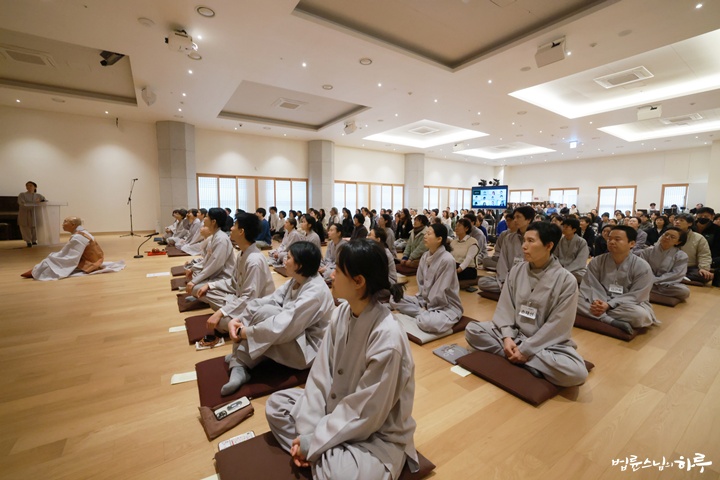
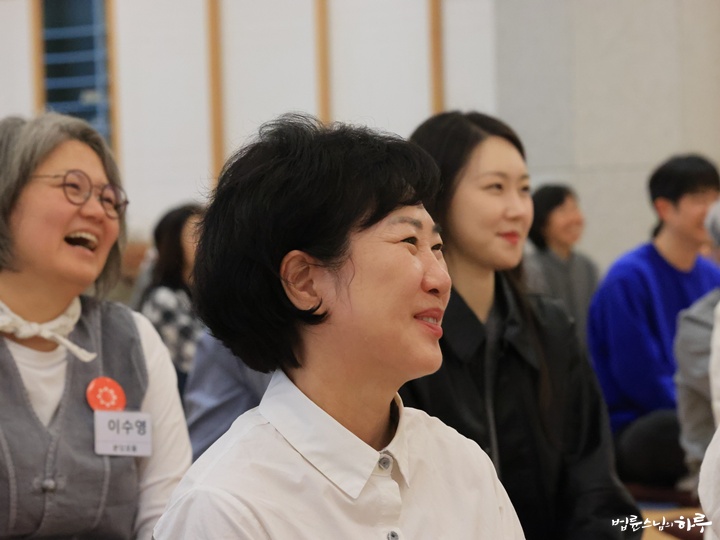
At 10 AM, about 120 members of the Sangha gathered in the Dharma Hall. After reciting the Three Refuges and the Heart Sutra, they watched a video titled “Weekly News of Jungto Practitioners,” which featured activities carried out by Jungto practitioners at various regional practice sites and main temples throughout the week. The assembly requested a Dharma talk from Sunim through chanting and three prostrations.
After meditation ended, Sunim gave a Dharma talk to the assembly. Sunim expressed concern about the ongoing attacks that are no different from acts of aggression by major powers, even on this beautiful day when spring flowers are blooming. He spoke about what we can do in the current situation where oil prices are rising.
What We Can Practice During Times of Soaring Oil Prices
“Currently, due to the war between the United States and Iran, the Strait of Hormuz has been blocked, causing both international and domestic oil prices to rise. While oil prices in our country have risen by about 10% due to government policy, Europe has seen an increase of nearly 40%. This is not because our country’s oil supply is smooth, but because the government has chosen not to fully reflect the international oil price increase in domestic prices, as a sharp rise in oil prices could place a significant burden on people’s lives. Oil prices include government tax revenue, and the government has chosen to partially exempt this portion or compensate for deficits later. Therefore, during times like these, we shouldn’t simply think that oil prices haven’t risen much; rather, citizens need to make voluntary efforts to conserve energy. For example, we can achieve significant savings simply by not turning on unnecessary lights during the day or unplugging electrical outlets that aren’t in use. Additionally, using public transportation instead of private cars, walking short distances, avoiding unnecessary drives for stress relief, and utilizing carpooling are all good methods. While it may seem like small savings to individuals, if all citizens reduce their electricity usage by just 10%, it can bring about tremendous savings on a national level. Therefore, if Jungto Society members inform not only themselves but also their families and those around them about the current difficult national energy supply situation and launch a movement to join in energy conservation, they can set an example as citizens. However, in reality, despite daily broadcasts emphasizing the difficulties in energy supply and the government implementing policies to suppress oil price increases to reduce the burden on citizens, many people continue to consume energy without much awareness of the problem. If oil prices are raised significantly at the national level, the use of private cars will decrease due to the cost burden, and energy consumption will naturally decrease as well. However, if voluntary participation by individuals takes place, such measures may not be necessary. If citizens voluntarily engage in conservation even when the government is suppressing prices, we can achieve much more desirable results.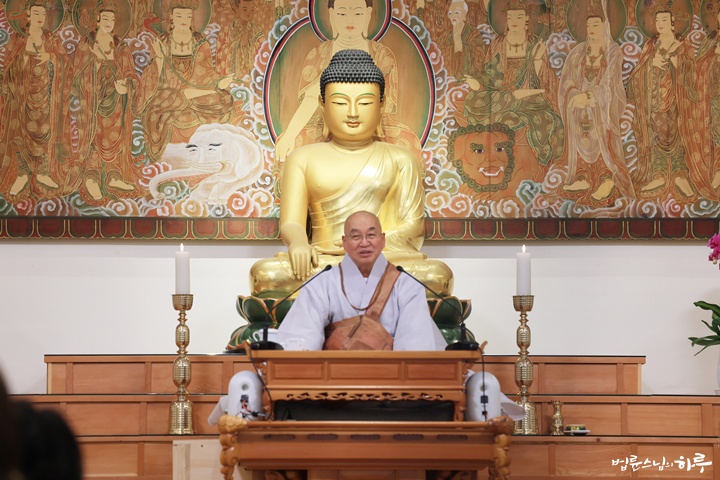
Individual Freedom First? Or National Control First?
Looking back at the COVID-19 pandemic, in Europe, where individual freedom is highly valued, many people resisted mask mandates, questioning why the government should interfere. As attitudes spread that each person should make their own decisions, significant chaos ensued. This demonstrates that overemphasizing individual freedom in democratic societies can lead to major disruptions in the community. In contrast, China implemented strict controls in the name of national interest, severely restricting citizens’ movements, while North Korea sealed its borders for about three years and even limited domestic travel. While these measures helped these nations navigate the pandemic relatively stably at the national level, individual citizens had to endure significant inconvenience and hardship. Meanwhile, South Korea resolved the issue through cooperation between the government and citizens. Despite the government not implementing comprehensive controls, citizens voluntarily participated in disease prevention efforts, creating an exemplary case. Although there were some issues, Korea’s medical response received praise in Europe as a model approach. Of course, some European liberals interpreted this success as possible due to Korean society’s familiarity with control culture, attributing it to Confucian traditions or military culture influences. However, overall, positive evaluations were more prevalent. The community-centered participation demonstrated in Korea, Japan, and Taiwan during the COVID-19 pandemic showed that Western societies cannot necessarily be considered superior to Eastern societies.Wisely Resolving Energy and Security Issues
Based on these experiences, the harmonious roles of state and individuals are crucial for energy issues as well. The government should strive to stabilize prices through various policies such as tax exemptions to reduce citizens’ burden. At the same time, individuals should actively participate in energy conservation with the awareness of solving national difficulties together, rather than simply approaching it as a price issue. This attitude represents the ideal society we should aspire to. The same applies to security issues. When others invade us, we must have a strong defense system that won’t back down under any circumstances. However, we should simultaneously avoid showing aggressive attitudes first or taking actions that provoke other nations. To prevent conflicts from escalating into clashes, efforts to maintain friendly relations with neighboring countries are always necessary. Some hardliners criticize this as a weak stance. However, this is not weakness but a strategy to prevent war. We must be prepared to defend with strong military power while preventing war in advance by not creating hostile relationships with neighboring countries. From this perspective, we must always think with peace at the center.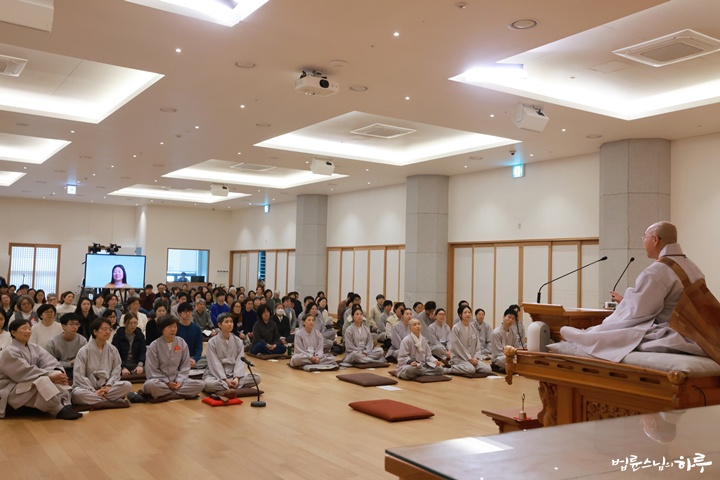
The Darker the Night, the Brighter a Small Candle Shines
In times of confusion, rather than being swept away by the chaos, we must maintain a proper perspective and adopt an attitude of contributing, even if just a little, to solving problems. During the day, even if you light a candle, its light is barely noticeable, but the darker the night, the more even a small candle illuminates its surroundings. Similarly, the more difficult the world becomes, the more those who live righteously shine. Therefore, difficult times in the world are not necessarily all bad. While brightness is good, even in difficult times we can engage in activities that shine even brighter. If we adopt this attitude, we will be able to live without losing hope in any situation.”Sunim urged everyone to maintain a proper perspective and live without losing hope, especially in times of confusion. In today’s Weekly Dharma Assembly, there were two pre-registered questioners who participated online and had conversations with Sunim. Here is one of the Dharma Q&A sessions.
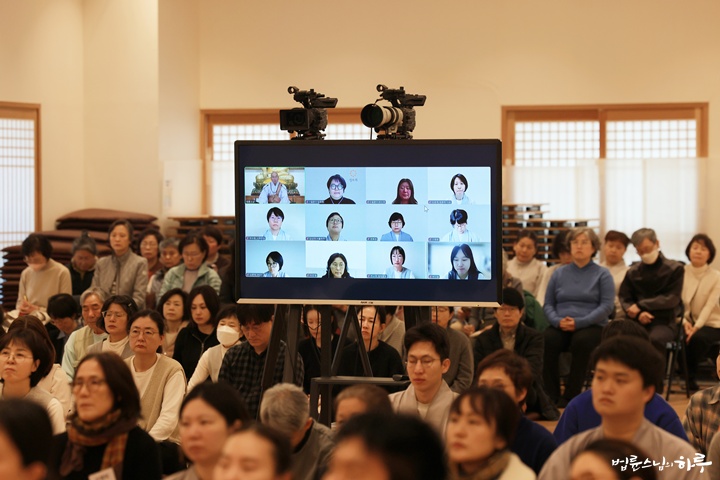
I Have Conflicts with My Brother Who Has Mental Illness. What Can I Do?
“I visit my parents in Korea once a year with my husband and two children. Every time, I feel emotionally burdened because of my only younger brother who lives with my parents and has mental illness. My brother kept insisting we go to a seafood course restaurant, saying it was for my family, even though none of us like seafood. I refused several times, but he kept insisting. I felt like I was being too stubborn, so I agreed to his request, thinking we could just order à la carte at the restaurant. However, when we got there, it turned out to be a place where you had to order course meals based on the number of adults, and seeing the expensive prices, I finally lost my temper and lashed out at my brother with irritation and nagging. Sometimes I interfere with and get angry about my brother taking his medication, telling my parents who can’t properly manage his medication schedule to ‘make him take his medicine in front of you’ using his credit card as leverage. While talking with a close friend, she said that among all the people she knows, I’m the most stubborn. She said it seems more like obstinacy than stubbornness. Hearing this made me reflect – looking at my brother’s persistent nature and my obstinacy, it seems to run in the family. I was told that when this clashes with my tendency to save money and buy cheaper things, it creates a synergy effect that makes my obstinacy even stronger, which made me look at myself again. Sunim, how can I let go of this obstinacy? Is trying to save money also an attachment to money? And when my brother doesn’t save my mother’s money and doesn’t take his medicine, what can I do and what kind of mindset should I have?”
How to Respond Wisely
“The best solution is not to visit home. If you don’t go home, there’s no need to go to course restaurants, you don’t have to worry about whether your brother takes his medicine, and you don’t have to worry about your parents. You can just use video calls to see your parents online and greet them. If you want to come to Korea, don’t go home but spend your time in Korea and visit your mother the day before returning to France. If they suggest eating together, you can only do it once at most, so there’s also the method of just going along with what they want. Rather than being frugal and eating three times, it might be more effective to skip those three times and treat them once the way they want. We think it’s better to save money and eat three times, but that depends on the person. In Jungto Society, there are also two cases. When entertaining guests, should we entertain them abundantly, or is it better to show them what we learned in Jungto Society with one meal and three side dishes? This is always a dilemma. For people who come to tour Jungto Society, it’s appropriate to show them how we do things and help them practice together, but for other guests, it’s appropriate to treat them as guests. The biggest issue is the senior citizens’ feast. About twice a year, we host a feast for the elderly in Dubuk. When we have a senior citizens’ feast, we need to prepare abundant food. However, since Jungto Society practices the Empty Bowl movement where we take only what we can eat and try not to generate food waste, staff members who have practiced this tend to serve small portions at the senior citizens’ feast – one piece of tofu, small portions of other side dishes. For elderly people from the old days, even if there aren’t many types of side dishes, you need to give them a full bowl of soup, and even if they don’t finish all the rice, you need to serve it generously. But people who actively practice the Empty Bowl movement, worried about leftover food and throwing it away, only put a little in the bowl. Even if one bowl of rice is left over, elderly people feel they’ve eaten heartily only when served generously. If you serve a little and say ‘please have more if you’d like,’ it’s difficult for guests to ask for more. In situations where you need to entertain guests like this, while the Empty Bowl movement is important, flexibility is needed.Keep Principles but Be Flexible According to the Situation
In such situations, if you serve abundant food, you might be criticized for going against Jungto Society principles, so volunteers preparing the senior citizens’ feast get confused. Sometimes when there’s a lot of food, Sunim says “Why are you wasting so much food!” and when there’s little food, he says “Why are you treating guests like this!” They say it’s confusing because it’s not consistent. Now we need to look at the situation carefully – when it’s rural elderly people, even if there’s some leftover food, serve generously; when it’s young people, keep it simple to show frugal living; when foreign visitors come to tour and the purpose is to show how Jungto Society lives, do that; but when simply entertaining visitors, prepare appropriately for entertainment. We need to judge according to the situation with these standards and prepare accordingly. The reason I’m telling this story now is to match the nature of the situation. After experiencing your brother for several years, you know how your brother is, how your mother is. If I live with them and can manage giving my brother his medicine, then I should do it. If you complain to your mother about not properly giving your brother his medicine, you’re likely to hear ‘Then you do it.’Everyone Has Their Own Reasons
So you shouldn’t nag about things you can’t do yourself. There are reasons for everything that doesn’t work out. You might think that if Sunim’s legs hurt, he shouldn’t go to the mountains, but from Sunim’s perspective, there are reasons to go even when in pain. Everyone has their reasons. While we should respect everyone’s formed karma and habits, when they cause suffering to oneself or bring suffering, they should be changed or stopped. No matter how good the karma or habit. We don’t need to eliminate everything unconditionally. After observing for several years, there are cases where nothing can be done. Sometimes in Dharma Q&A, I also say ‘Just live as you are.’ People live in conflict with each other because it’s bearable. But just because I, as an outsider, don’t like it and get angry and irritated, nagging about it is not right in my view. Rather than nagging like that, it’s better not to visit.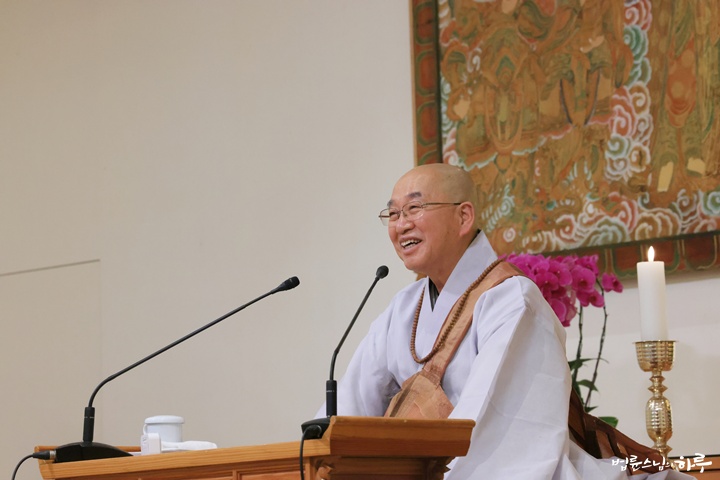
If You Want to Improve Things, You Must Set an Example
The questioner says she visits Korea for her mother, but in reality, she visits because she misses her parents and family. So if the purpose is to meet them because she misses them, she shouldn’t focus on other things. And if she wants to improve things, she needs to go there and set an example. Whether for a year, two years, or even just a month or two, she should live with them and show them ‘This is how it should be done.’ Even then, it’s uncertain whether her mother would follow suit. But for the questioner to live abroad and come to Korea once a year just to nag is not an appropriate attitude. So first, it’s best not to interfere with her parents and younger brother if possible. It’s better not to visit her parents’ home. Even if she visits, she shouldn’t interfere. But once she’s there, it’s difficult not to interfere. In that case, when coming to Korea, instead of visiting her parents’ home first, she should complete all her schedules in Korea and visit her parents’ home just before returning abroad. Instead of having three meals, have just one, and accommodate their wishes for that one meal. It’s better to respond according to the circumstances like this. This way, the questioner’s inner suffering might be lessened.Adapt to the Situation Like When Singing
When we sing, sometimes we need to raise the pitch, sometimes lower it. Sometimes we need to sing loudly, sometimes softly. It’s the same principle. So while an ordinary person might eat three or four times with a reasonable amount, in this case, think of it as eating once with a slightly higher amount. Don’t think of it as expensive food. Think of it as eating once with the amount that could cover four meals. If each meal cost 15,000 won, how much is it for four meals? 60,000 won, right? Think of it as eating once with that amount and treating them that way. This isn’t about the brother’s problem or the mother’s problem, but about how I should respond to having such a mother and brother – this should be seen as my problem. If I stand from the perspective of ‘How will I respond in this case?’, I don’t see it as a big problem. It would be a big problem if you had to live together every day, but if it’s a conflict that occurs once a year when the questioner visits, it’s not a big problem. I hope you can take that perspective.”“Yes, Sunim, Thank you.”
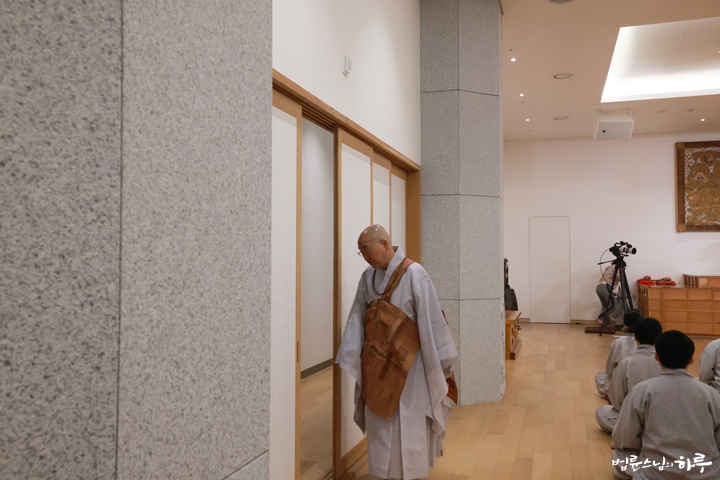
When Sunim’s Dharma talk concluded, the assembly meditated, and after announcements, the Weekly Dharma Assembly ended with chanting, offerings, and the Four Great Vows.
Sunim had a simple lunch and packed his belongings for his visit to the JTS project sites in India. He is scheduled to have activities in India from today until the 13th.