How Should I Approach Writing with a Beginner’s Mind When Faced with Malicious Comments and Harsh Criticism?
Apr 6, 2026. Travel to Seoul, Gilbeot Invited Dharma Assembly
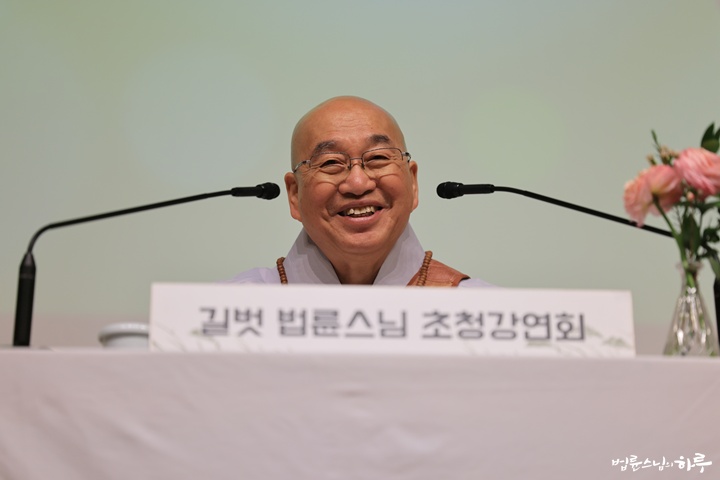
Hello. Today, Sunim was invited to give a Dharma Q&A session for ‘Gilbeot,’ a gathering of broadcasting, film, theater, and arts professionals.
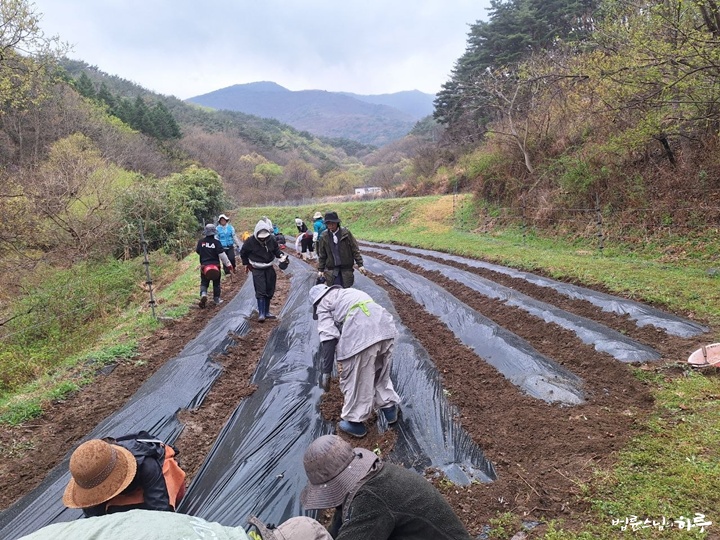
It was the third day of the lay Sangha retreat. In the morning, the lay Sangha members engaged in farming work. The Dharma Teachers removed weeds from the peony field in the upper plot, while another team went to the Gamedal field to prepare mulching for planting peanuts. The kitchen duty team remained at Dubuk Jungto Retreat Center to prepare lunch and trim vegetables. Due to severe leg pain, Sunim received treatment at an oriental medicine hospital in Busan and had an MRA scan at an orthopedic hospital in Gyeongju. The severe leg pain was caused by a herniated disc in his back. With an upcoming trip to India after the lay Sangha retreat, this was the only time available for hospital visits.
After lunch and completing a thorough cleaning of Dubuk Jungto Retreat Center, the lay Sangha members waited for Sunim. Members from the Seoul and Mungyeong lay Sanghas were preparing to greet Sunim before departing to their respective locations. Around 1 PM, Sunim arrived at Dubuk Jungto Retreat Center after finishing his hospital appointments.
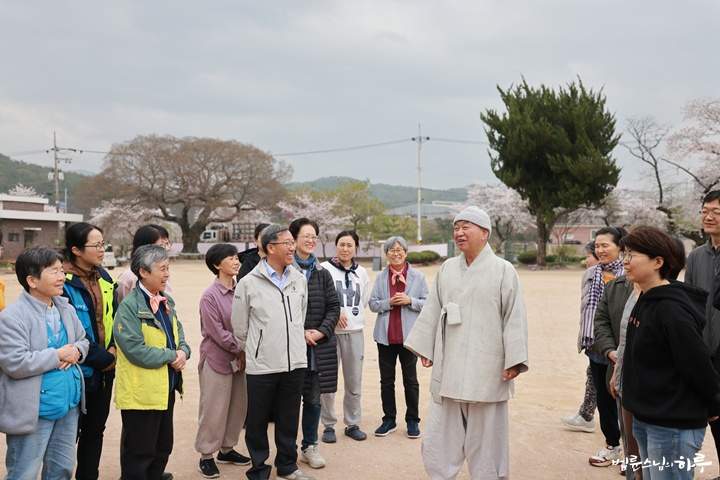
When Sunim got out of the vehicle, the members of the Sangha applauded and cheered. Sunim explained that he had just returned from the hospital, where he was diagnosed with a long-standing compressed nerve in his lumbar spine that would be difficult to correct. He apologized for not being able to participate in the morning work together.
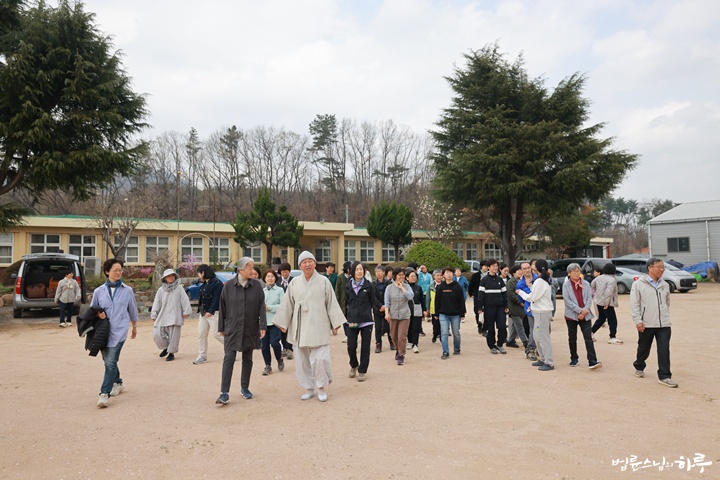
Sunim asked the members of the Sangha how the morning work went and whether they had a good time during the retreat. He suggested taking one last photo with the cherry blossom trees as a backdrop to conclude the retreat.
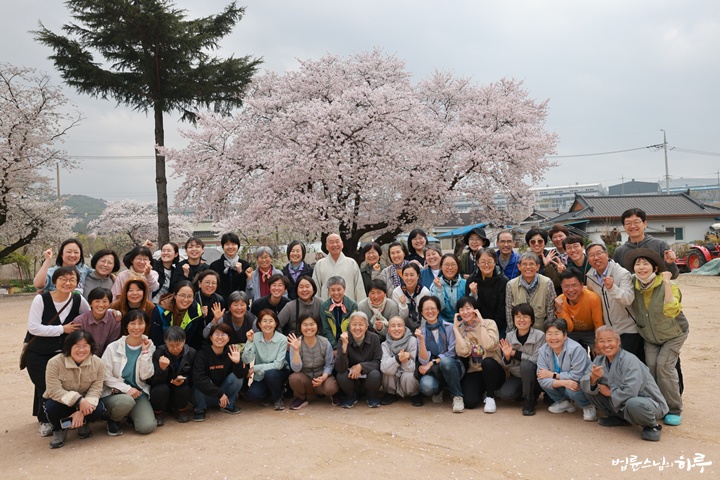
The lay Sangha members took a commemorative photo with Sunim in front of the most beautifully blooming cherry tree at Dubuk Jungto Retreat Center. Afterward, the Seoul lay Sangha members departed for Seoul, and the Mungyeong lay Sangha members left for Mungyeong.

After lunch, Sunim departed from Dubuk Jungto Retreat Center for Seoul around 2:30 PM. The Gilbeot Dharma Q&A session was scheduled for 7 PM in the underground auditorium of Jungto Social and Cultural Center. Sunim rested in the car on the way to Seoul.
Sunim arrived in Seoul at 6 PM. When he arrived at Jungto Social and Cultural Center, volunteers preparing for the Gilbeot assembly recognized him and greeted him. Sunim had a simple dinner in the underground cafeteria before moving to the underground auditorium.
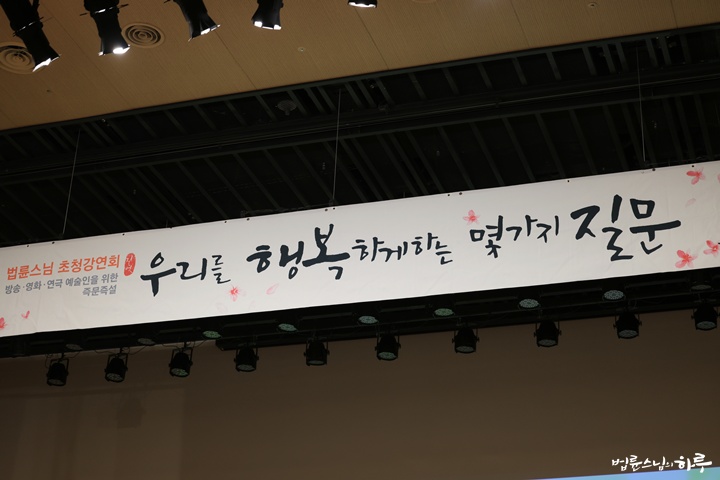
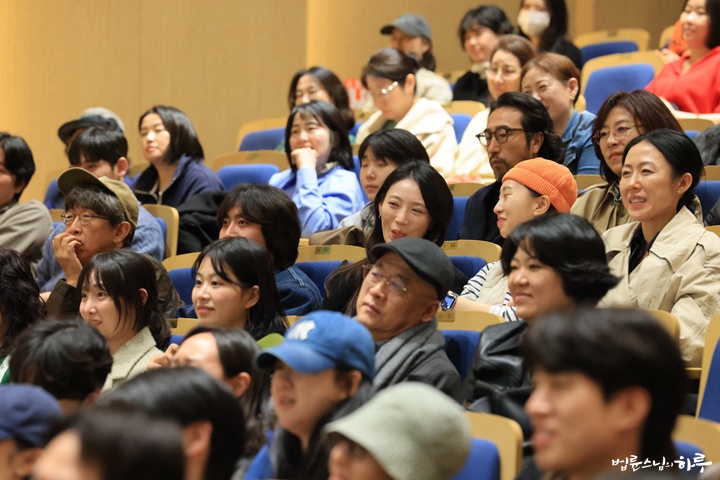
As the sun set and the lecture time approached, people from the broadcasting and arts industries began arriving one by one. About 400 people filled the auditorium.
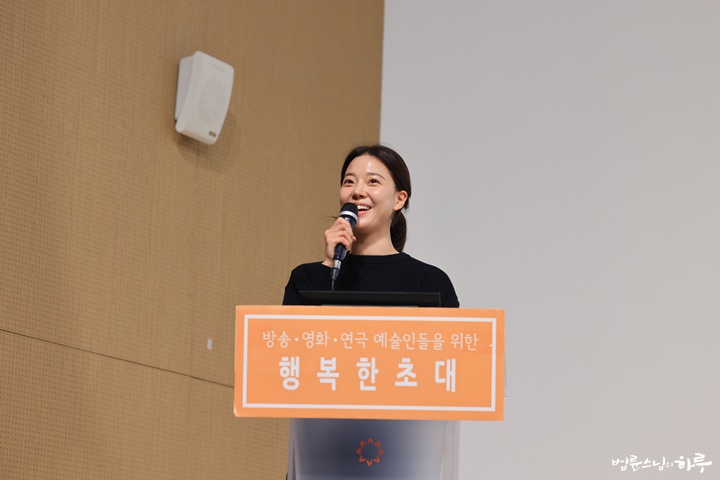
Today’s session was hosted by actress Im Se-mi.
“These days, we live without really knowing how to build our mental muscles. So today, we’re here to find ways to build the mental muscles that protect us through Venerable Pomnyun Sunim’s wisdom. Welcome to this invited lecture by Venerable Pomnyun Sunim. First, let’s hear opening remarks from Representative Noh Hee-kyung. Please welcome her with applause.”
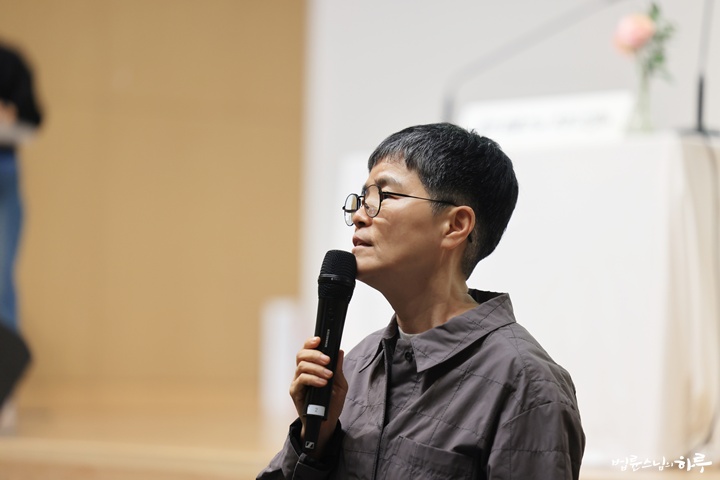
“Hello, I’m Noh Hee-kyung. There’s a line in the National Education Charter that says, ‘We were born in this land with the historical mission of national revival.’ But when I look at our Gilbeot members, when I look at artists, the Dharma Teacher once said, ‘These people were born in this land to suffer.’ (Laughter) They suffer when things go well, they suffer thinking they have to do well next time, they suffer when things don’t go well, and when they’re happy, they suffer wondering if they deserve to be happy. They’re always looking for reasons to suffer. He once lamented that they don’t look for reasons to be happy or ways to become happy.
I think I was always suffering too. I felt like I had to write in an unhappy state to really write. That’s when work felt meaningful. When I was happy, I felt out of sorts, so I realized I had become a slave to my work, that work was my master. I wondered if nothing could make me happy… Can’t I be the master of my own life? Can’t I work happily?
That’s why I started studying the mind, and now I’m incredibly happy while working. (Audience applause)
I hope today becomes a time of awakening for all of you – that we too can be happy, that we too can live happily. I believe Venerable Pomnyun Sunim’s words will be the beginning of that. Welcome. I’m glad you’re here.”
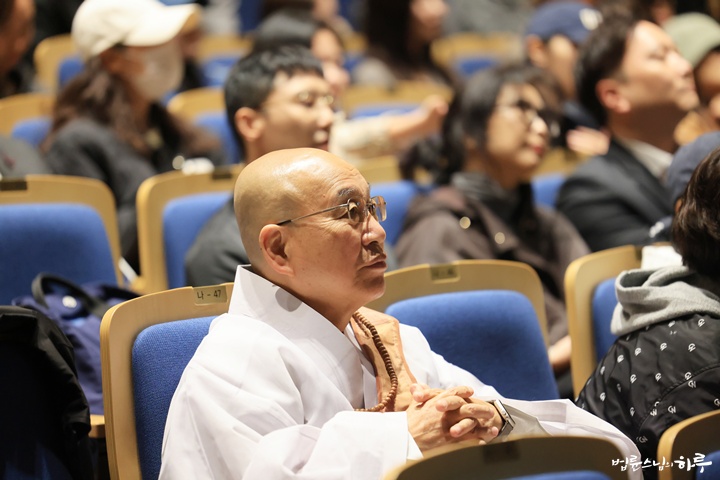
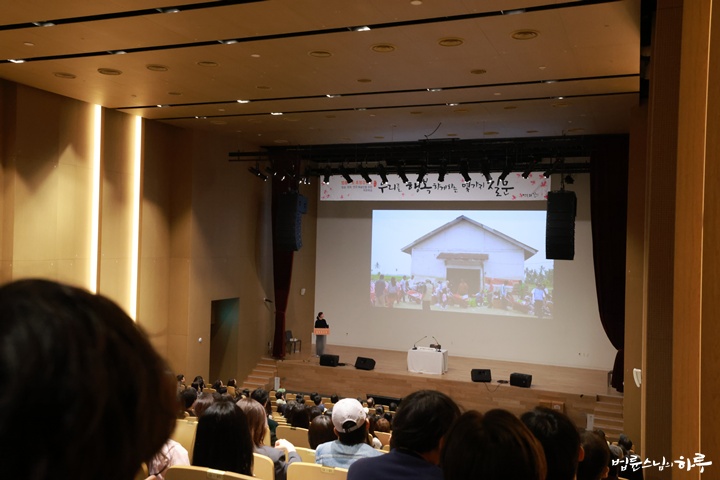
Before the lecture, the audience watched a video of Sunim’s relief activities in Indonesia. Sunim then came up on stage and greeted everyone.
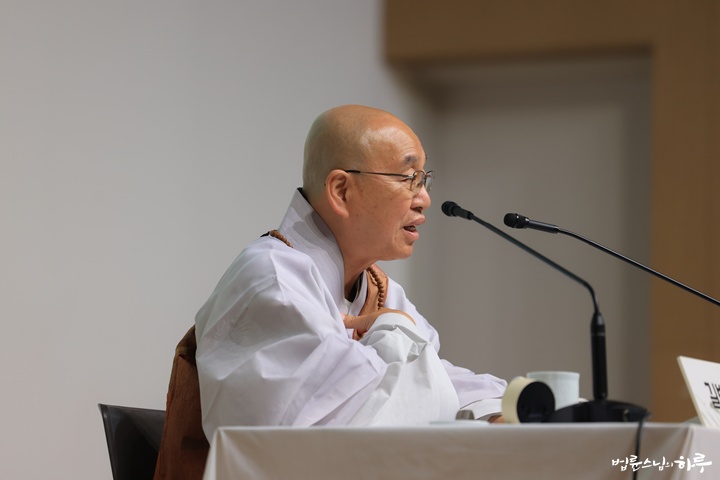
Sunim added some explanation about the Indonesia relief activities shown in the video. He explained that the Aceh region of Indonesia is a strongly Muslim area where support is difficult even for international relief organizations and within Indonesia itself. Near the flood-affected area, there are mountains over 3,000 meters high where large-scale plantation farming is conducted at 2,000-meter elevations. Heavy rains caused landslides, and mudflows filled village homes with soil, raising all farmland by 1-2 meters. He explained that JTS provided cleaning supplies and kitchen utensils during this relief effort. He also shared that the residents of Aceh who received the relief supplies were pure and bright, and despite being a Muslim area, they thanked the relief team and shook hands as they received the supplies.
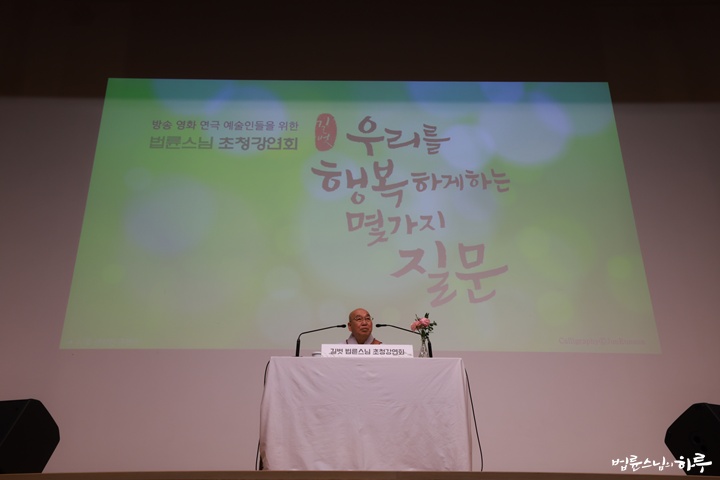
Sunim explained what to keep in mind during the Q&A session.
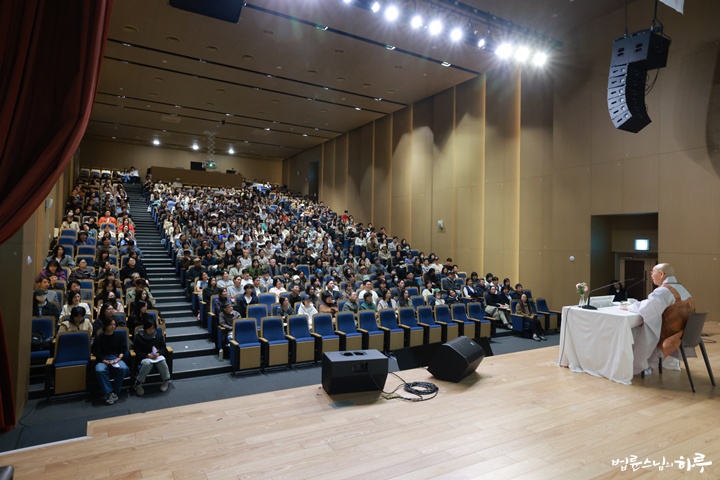
After Sunim’s opening remarks, he began the dialogue session with the audience in earnest.
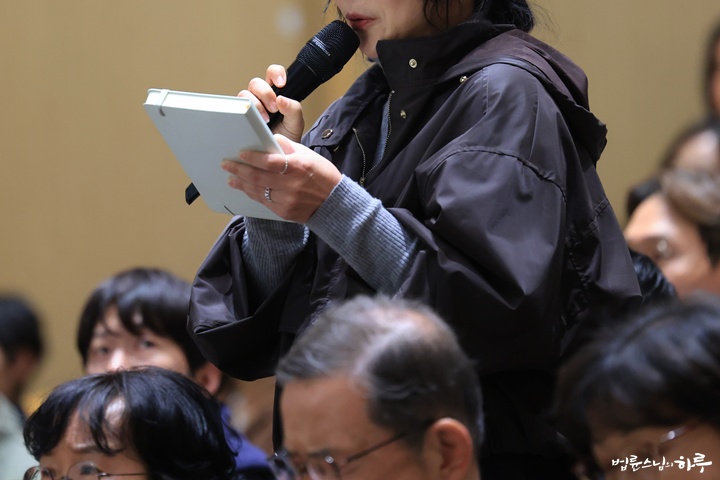
How Should I Approach Writing with a Beginner’s Mind When Faced with Malicious Comments and Harsh Criticism?
“I was a serious problem child until middle and high school. But as I studied film and came to love it, I’ve now settled down and am living a second life. After studying film steadily for over 10 years, a good opportunity came through a competition, and I got to make an independent feature film myself. Through that opportunity, I managed to complete the film with difficulty, screen it at international film festivals, and even got a chance for domestic release.
After the film’s release, I received malicious comments, which were more shocking than I expected. It wasn’t just one or two but hundreds, which made me feel quite disillusioned, but I managed to get through that. Then I was deeply hurt when I received harsh criticism from a well-known critic in Korea.
I tried to brush it off at first, but people around me kept asking, ‘Did you see that critic’s review?’ They tried to comfort me, and even though I tried not to care, it didn’t work well. Since that critic is so famous, even when I try not to look, I keep seeing their face whenever I go online, causing much mental anguish.
I believe that good writing can only be conveyed when written with a good heart, so I diligently do 108 prostrations, but that critic keeps coming to mind, and I end up writing with a vengeful heart thinking ‘I’ll show you that you’re wrong!’ This prevents good writing from emerging, and I feel swept away by mental afflictions.
I miss the times when I wrote and prepared works with a good heart, wanting to grow in this world and share with audiences. I would appreciate your guidance on how I can return to that state.”
“I think having the opportunity to earn and pay back is better.”
“Even if the creditors take everything you earn?”“Still, if I can pay it back, I can clear my karma, so that would be better.”
“So is it better to succeed even if you use all your earnings to pay debts? Or is it better to fail because you don’t want to pay? (Audience laughter)”“It’s better to succeed even if I have to pay.”
“What did you realize from this story? Did you not understand? Should I explain again? Is this enough for you to say ‘Ah! I understand,’ or is it still unclear?”“It’s a bit unclear, but I understand.”
“To put it directly, when I was young in school, I beat up my friends, stole their money, and did bad things. Many people were hurt, but after graduation, if I never become famous and just farm in the countryside, become a company employee, or run a business, almost no one brings up or makes an issue of what I did wrong in the past. Right now I have a lot of debt, but if I continue not making money, I feel bad, but people don’t ask me for money. But if I succeed at something and become popular, and then I see someone who used to beat me up and always took my money, they’ll ask for money, right? So is it better to succeed and receive this criticism? Or is it better to not succeed at all and not receive criticism?”“It’s better to receive criticism.”
“Then is this a good thing or a bad thing?”“It’s a good thing.”
“If it’s a good thing, what’s there to worry about? It’s a good thing. The stronger the criticism, the more it proves that what you’re currently doing is successful. If the criticism is quiet, it means what you’re doing isn’t significant. Do you understand what I mean?”“Yes. I understand.”
“So you don’t need to be bound by that. ‘Alright, let’s take the criticism’ this level of thinking is like repaying a debt to someone who told you to pay it back once you succeed. It’s an ethical standard. But if you feel wronged by this, you need to look inward. What does it mean to feel wronged?” “Back in my school days, I may think ‘what’s the big deal about stealing a few thousand won or hitting someone a couple of times?’ But the wound inflicted on the child who suffered that harm was immense. That child carries emotional scars as deep as if their arm had been broken, or as if their entire fortune had been stolen. This is why the perpetrator and the victim always have fundamentally different understandings of the harm caused. We suffered tremendous harm under Japanese colonial rule. But Japanese conservatives think: ‘Sure, we caused them some harm! But we also built roads, laid railways, established schools, and educated them, isn’t the foundation of their prosperity today ultimately something we created?’ That’s how they see it. So even their apologies are forced and halfhearted. They slip past it like a snake sliding over a wall. They never truly say, with genuine remorse, that what they did was deeply wrong. There is an enormous gap between how much a perpetrator recognizes the harm they have inflicted and how much the victim perceives the harm they have suffered. Our sense of the harm we endured is not objective either. Nor is it objective when the other side says ‘we only did this much harm.’ If the actual harm done was 100, the perpetrator thinks they caused only 10, while the victim feels they suffered 1,000. The gap between 10 and 1,000 is vast. And that is precisely why no resolution can ever be reached.”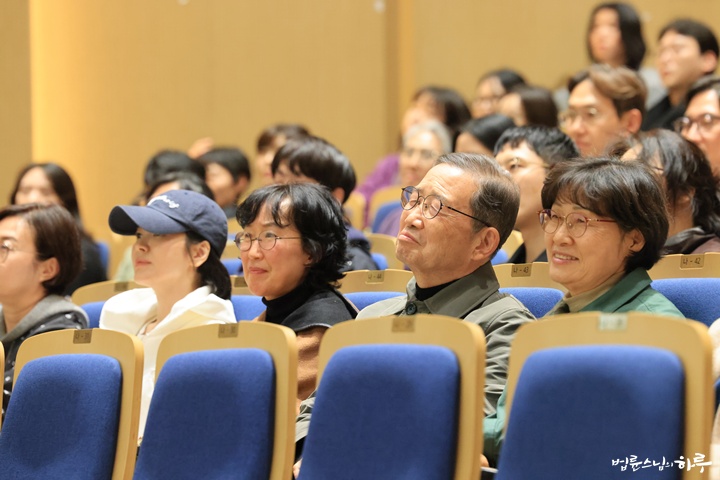
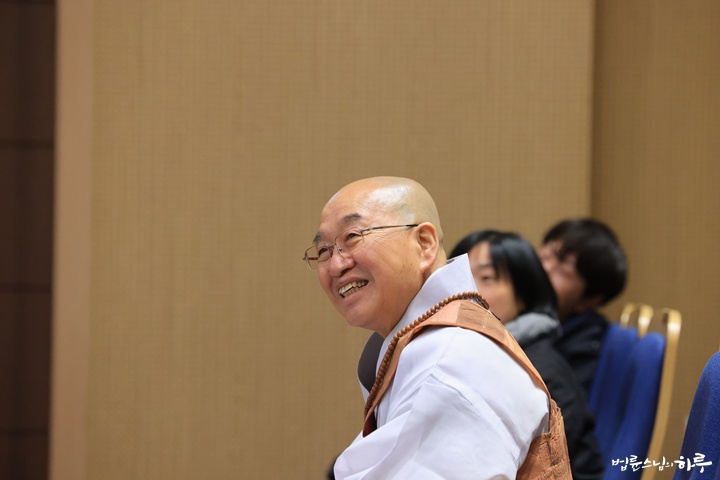
“Yes. Thank you, Sunim. I also experienced mental illness for about 4-5 years. I took a lot of medication during that time, but by continuously listening to your Dharma talks, I’m now completely recovered, and three years later, I’m living happily. My parents, younger sister, my future spouse, and I are all living comfortably while listening to your Dharma talks, and I deeply thank you for that.”
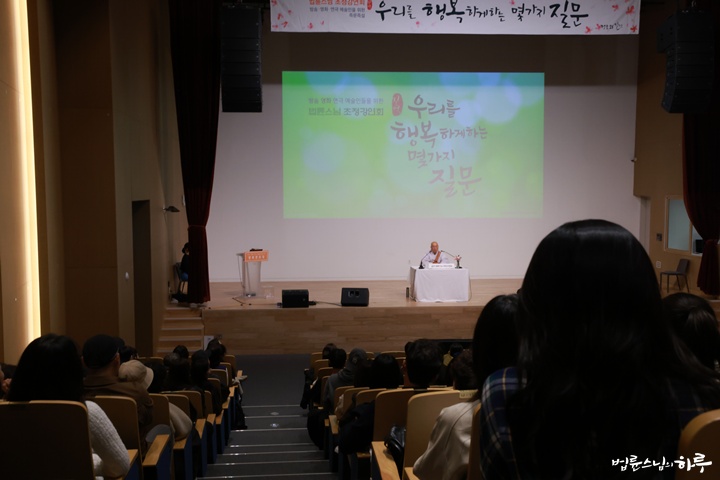
Six people who had submitted questions in advance had conversations with Sunim. As the questioners honestly shared their stories, Sunim was able to speak specifically to their situations. The atmosphere became focused yet punctuated with laughter, and the mood of the lecture gradually warmed up.
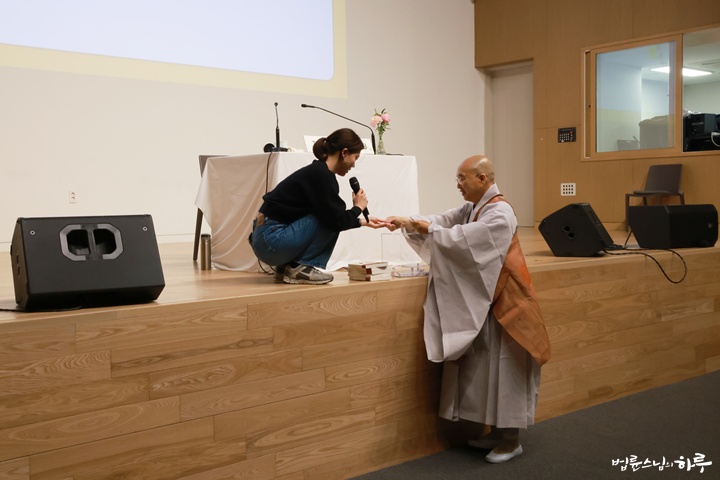
After the lecture ended, there was an event where attendees could receive Sunim’s books as gifts through a lottery drawing. Sunim personally drew numbers from the box.
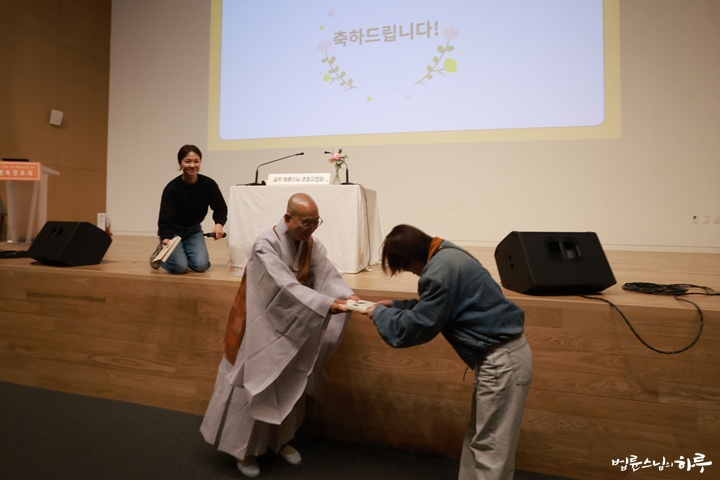
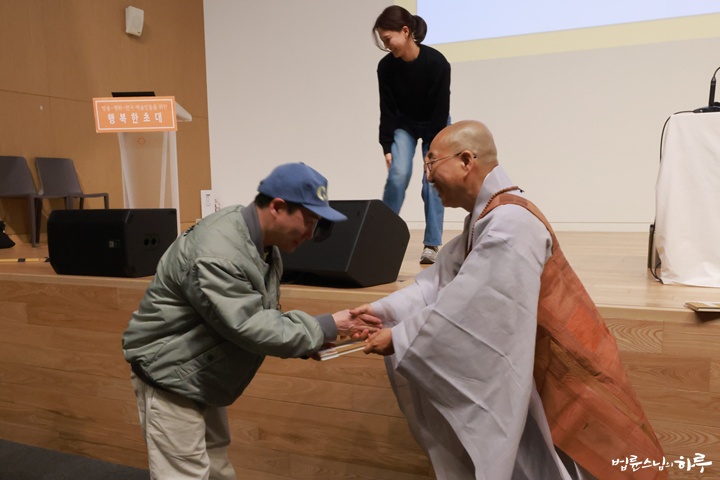
The winners joyfully rushed to the stage to receive Sunim’s books.
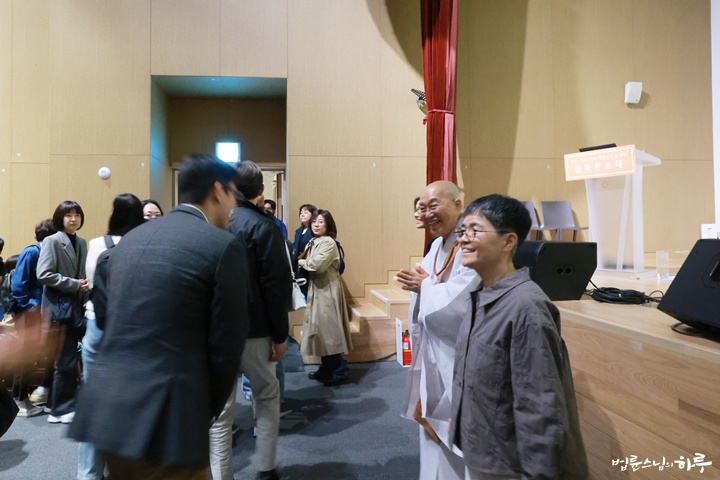
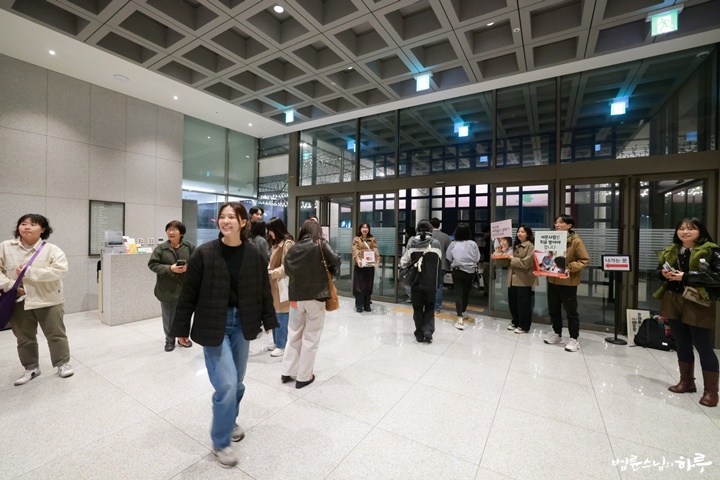
The lecture came to an end. Sunim stood near the exit to greet the audience members as they left.
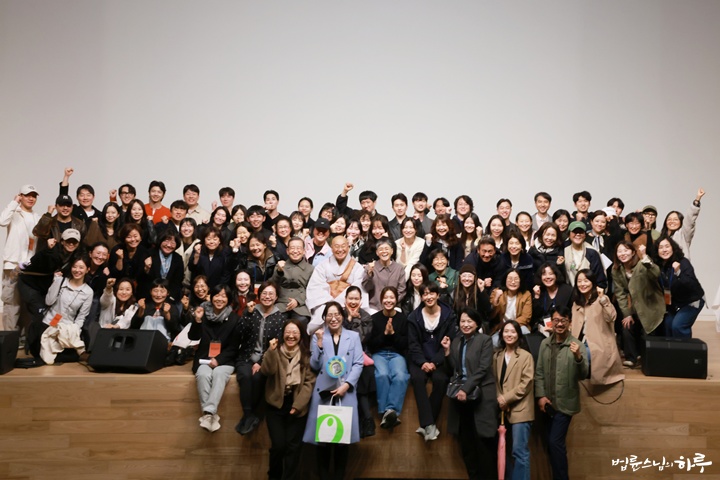
Finally, the Gilbeot members took a commemorative photo with Sunim on stage. The Gilbeot members then cleaned up and tidied the venue after the lecture.
Sunim briefly returned to the office to wrap up some work and concluded the day’s activities.
Tomorrow, Sunim has meetings with various people throughout the day, will visit the hospital in the afternoon, and plans to pack for his trip to India.