Hello. Today marks the day of returning to Korea after completing relief activities in Sri Lanka.
Sunim boarded a plane at 8:20 PM yesterday evening and departed from Colombo’s Bandaranaike Airport for Korea. He caught some sleep in the night sky.
After traveling for 6 hours and 45 minutes, the plane arrived at the intermediate stop, Shanghai Pudong Airport, at 5:35 AM local time.

He waited at the airport for 8 hours and 50 minutes to transfer flights. After having breakfast at a restaurant in the airport, he held an evaluation meeting with JTS volunteers who had accompanied him on this Sri Lanka relief mission, and discussed the future direction of JTS projects.
Sunim first pointed out the changed field conditions observed during this visit. The large-scale food distribution method led to confusion, and attempts to maintain order resulted in the unintended consequence of being harsh with residents. Based on this, Sunim outlined the future direction of the project.
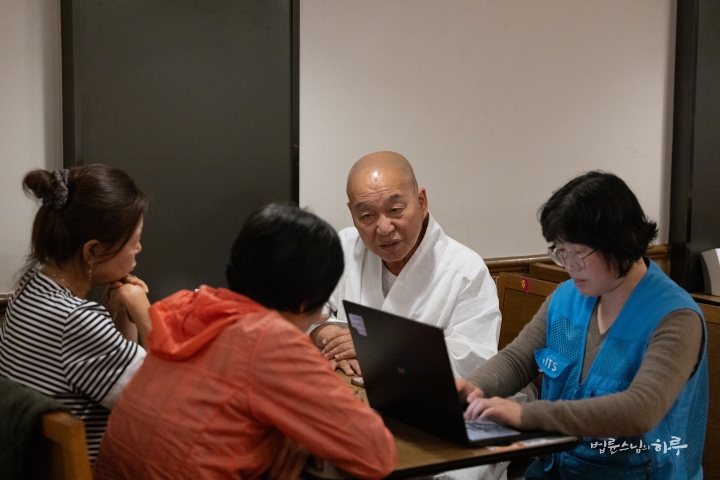
“As Sri Lanka’s economy has recovered to some extent, we need to reduce the mass support approach. Even when providing support, we should select those who are truly in need and do it on a small scale, quietly at the village level, without connecting it to school events. Going forward, we should base our work on the sustainable development models attempted in Bhutan, such as housing improvements, irrigation channels, drinking water, and roads, but first examine whether these are truly necessary projects, whether residents have the will to do it themselves, and whether they can accomplish it on their own. Our goal is not to show what we have done, but to help them create communities where they cooperate with each other.”
Sunim also shared his long-term vision. He planned to create JTS groups centered around young Sri Lankans and establish a Korean Buddhist Cultural Center where they could learn Korean language, taekwondo (태권도), and meditation together.
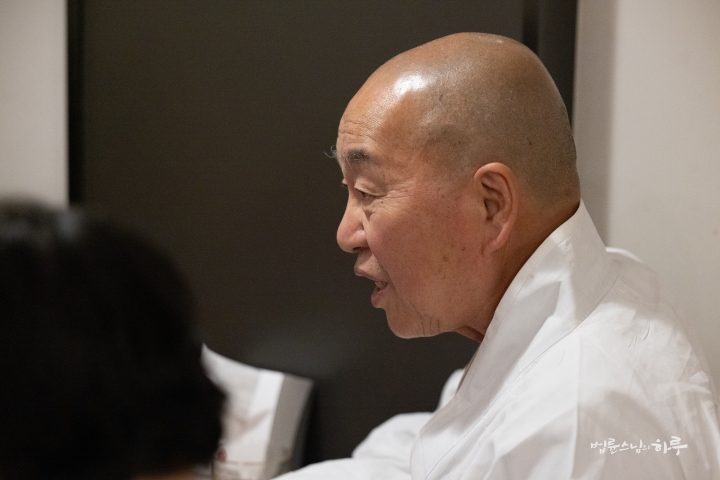
“I’m not saying we should do this right away. We always need to have the big picture so that when the opportunity arises, we can execute it. Others might think we’re doing things spontaneously, but that’s not the case. We need to draw pictures looking at least 10 to 20 years ahead.”
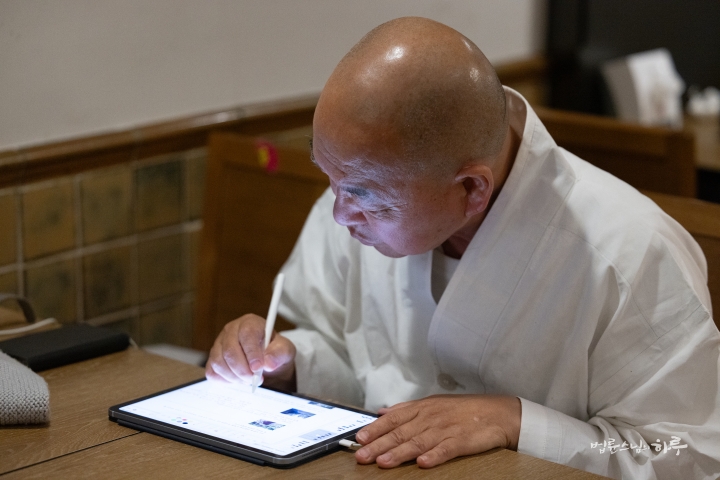
After the meeting, he spent the waiting time proofreading manuscripts and catching up on pending work.
When the long wait was over and it was time to depart, he headed to the boarding gate.
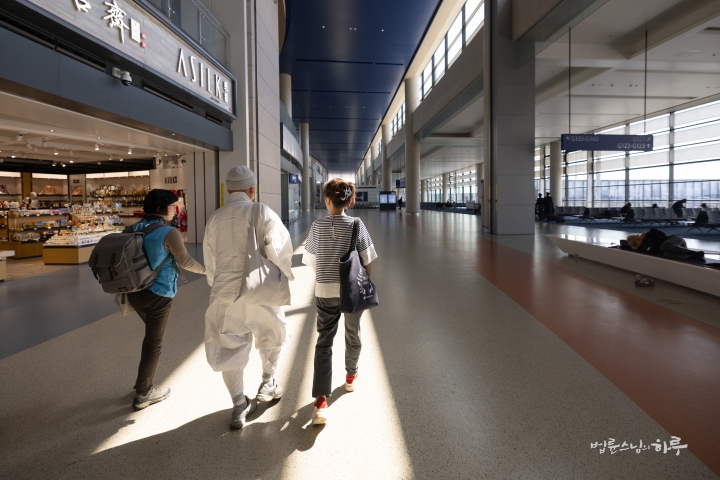
The plane departed Shanghai Pudong Airport at 2:25 PM and after a 2-hour flight, landed at Incheon Airport (인천 공항) at 5:25 PM Korean time. This marked the successful completion of the 6-day, 5-night relief activities in Sri Lanka.

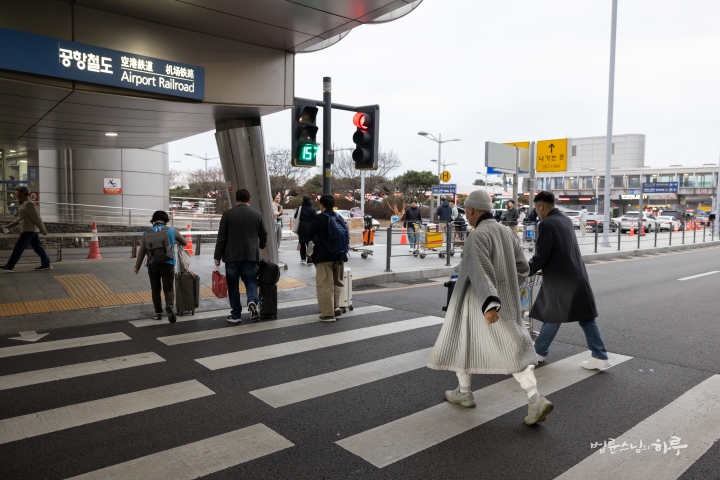
After completing immigration procedures and leaving the airport, he headed straight to the funeral hall.
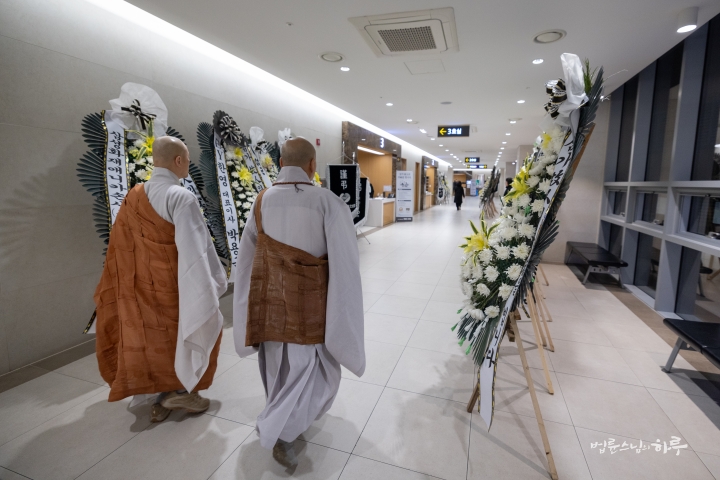
He had received news that Dr. Park Sang-eun (박 상은), who had served as the primary physician for the lay Sangha members since the early days of Jungto Society and had cared for the sick with a compassionate heart, had passed away at the age of 80. Since it happened to be the day of his return to Korea, he went to pay his respects immediately.

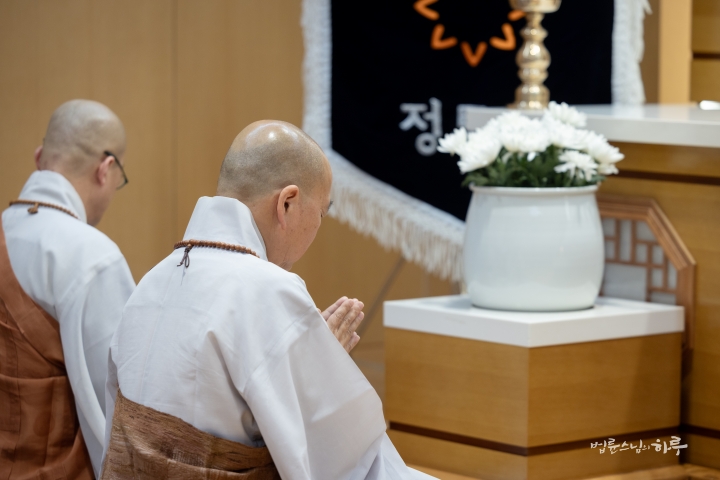
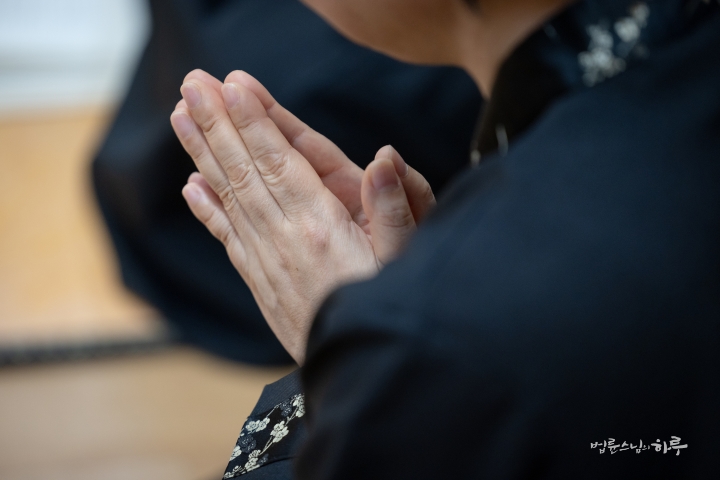
Arriving at the funeral hall at 7:30 PM, Sunim first offered three bows before Dr. Park Sang-eun’s memorial portrait and honored his memory.
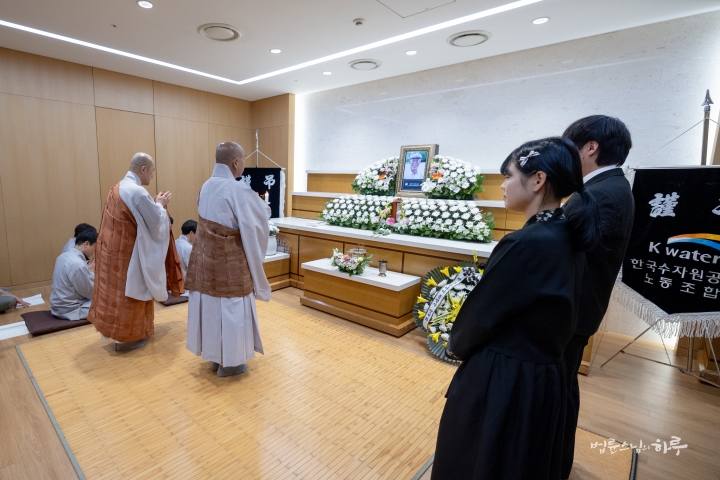
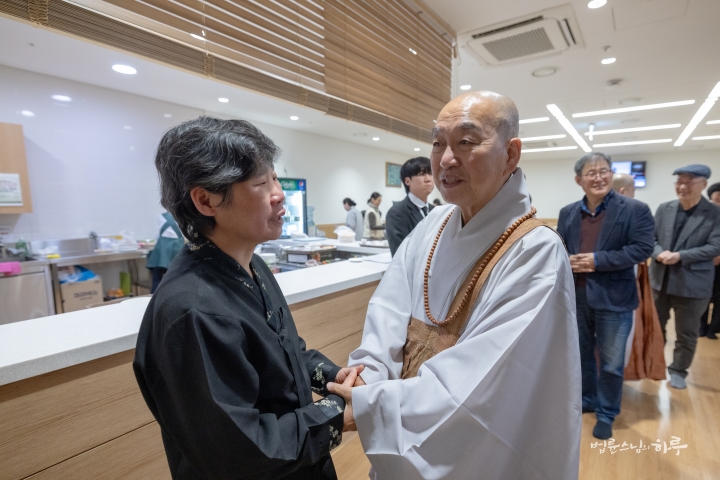
Sunim then firmly held the hands of the family members who were unable to contain their grief.
“Did he pass away peacefully?”

“Yes, he passed away peacefully. My mother went through a lot taking care of him.”
“You’ve worked hard.”
Soon after, Sunim performed a prayer for the deceased’s spirit together with the Jungto Society members.
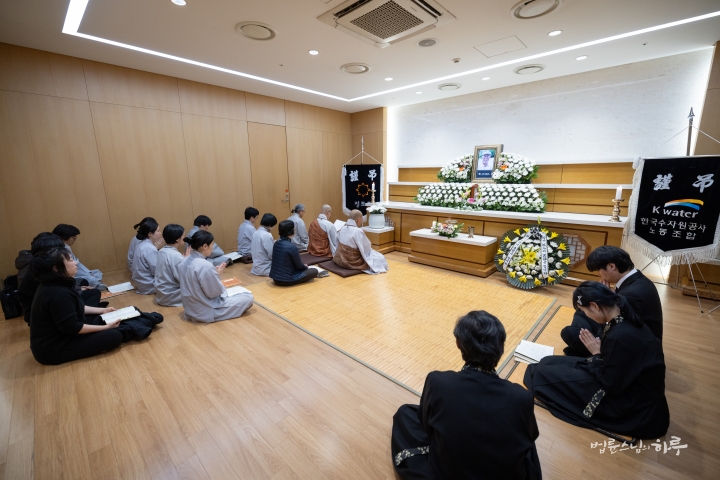
Dr. Park had spent 20 years and 7 months in prison under false accusations. During his long imprisonment, Dr. Park learned medical skills in prison. After his release, he gave back what he had learned through service, continuing to volunteer by directly treating many Jungto Society members. Despite being falsely accused, he chose giving over resentment in his life.
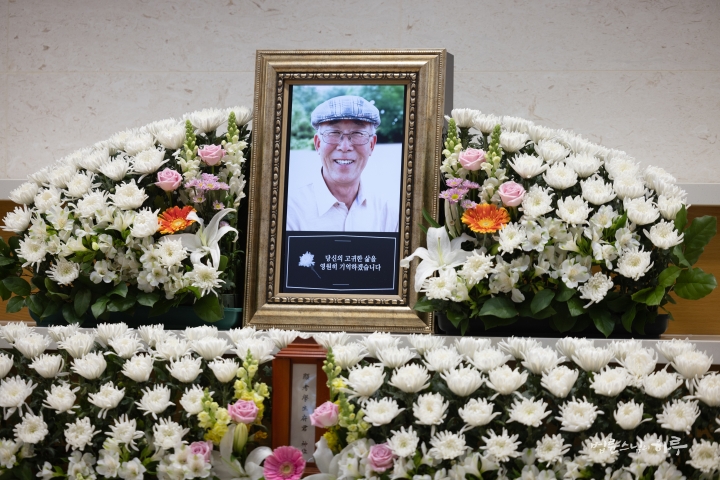
After performing the memorial service to comfort Dr. Park’s spirit, Sunim gave a Dharma talk for the deceased.
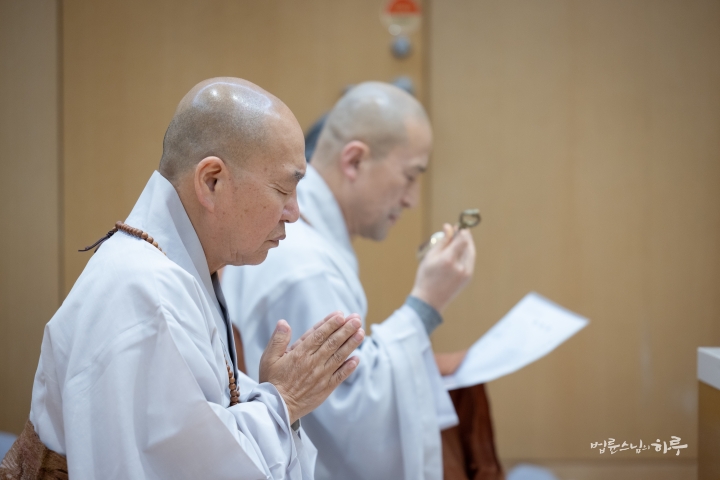
“Spirit of Park Sang-eun! Looking back on your eighty years of life, in your twenties when you harbored great ambitions, one day, as if lightning struck from the sky, an unjust and bitter incident occurred, and you spent twenty years—as long as you had lived—in resentment, anger, and sorrow. When you first met this Dharma teacher, you were anxious about being over forty. However, by praying to the Buddha and using your talents to serve sentient beings, through that connection you met a good spouse and had these wonderful children. Looking back now, that bad karma actually became good karma, allowing you to complete your life as well as anyone around you.
When We Look at Life from a Long Perspective, There Are No Separate Good or Bad Events
Spirit, when we look at each moment, there are good and bad events; when we look at people, there are good and bad people, enemies and friends. But when we look back over eighty years like this, there are bad things within good things and good things within bad things. Thus, we can realize the Buddha’s teaching that ‘originally there is nothing that is either good or bad.’
Through much effort, your bitter resentment was somewhat resolved and you were able to live comfortably, but then illness struck your body, causing us to part a little early like this. So please listen carefully to this Dharma teacher’s talk today, and if you realize that life is originally empty, you will immediately reach the world of nirvana where there is no life or death. If you still hold resentment, grudges, affection, and attachment, you will have no choice but to repeat the cycle of suffering and pleasure as you have lived until now. So spirit, please concentrate on this Dharma teacher’s words and attain enlightenment immediately to realize liberation and nirvana.
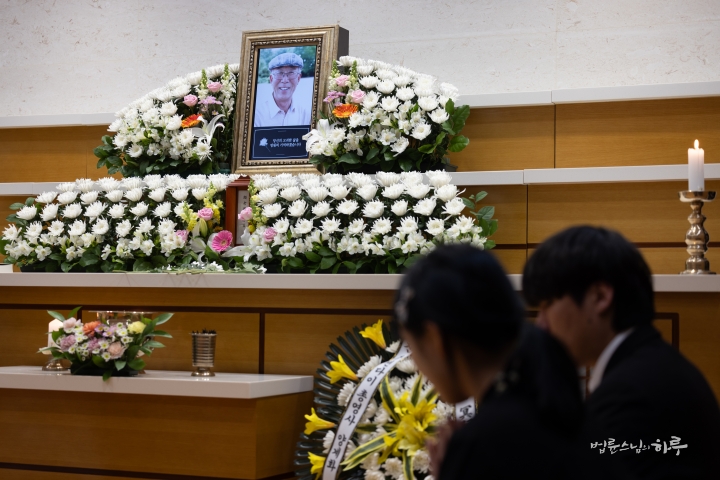
Dear departed spirit! During your lifetime, you saw with your eyes, heard with your ears, smelled with your nose, tasted with your tongue, touched with your hands, and thought with your mind, claiming ‘This is me,’ ‘This is mine,’ ‘I am right.’ But now, when you can no longer see, hear, taste, smell, touch, or think, what is your original face? What can you now call ‘I’? What can you call ‘mine’? What can you call ‘right’ or ‘wrong’?
If you can answer this Dharma teacher’s question with clarity and ease, then funeral ceremonies and 49-day memorial services are all meaningless, for you have already transcended life and death and attained liberation and nirvana. However, if there is hesitation, uncertainty, or frustration in response to this Dharma teacher’s question, then through the sincere and devoted chanting of all those gathered here today who have karmic connections with you, may you be reborn in the Pure Land where Amitabha Buddha (아미타 부처님
)
resides, meet the Buddha directly, hear the Buddha’s teachings in person, and ultimately attain liberation and nirvana (열반).”
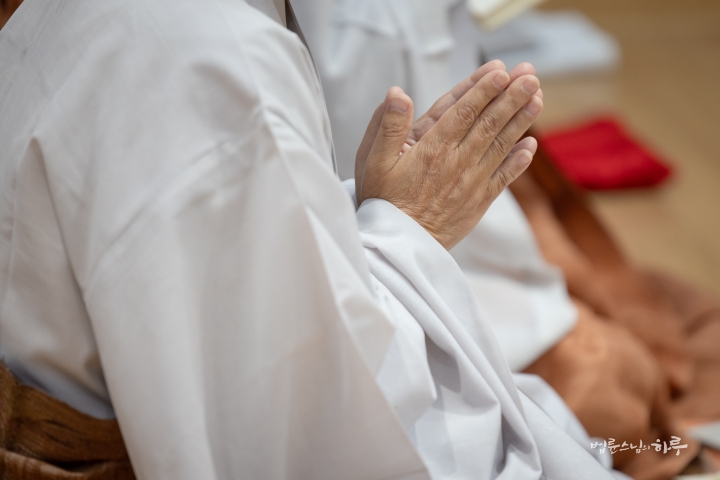
Finally, after earnestly chanting the liberation mantra (해탈주) for the deceased spirit with heartfelt devotion, the memorial service was completed.
Sunim once again offered words of comfort to the family before leaving the funeral hall.
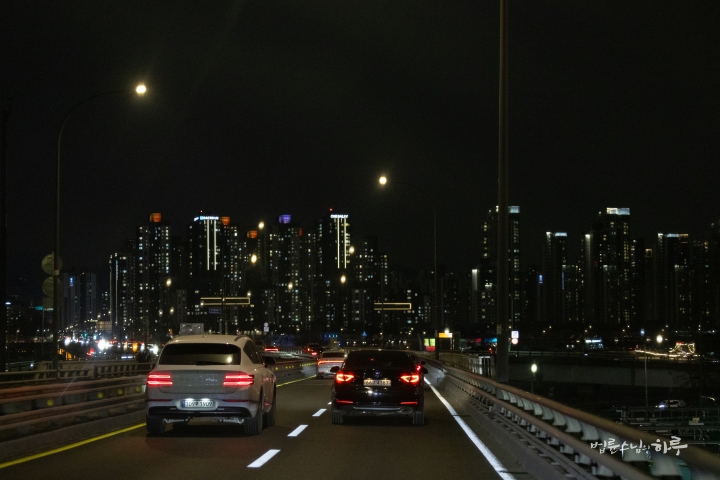
After an hour’s drive, he arrived at Seoul Jungto Center (서울 정토회관) at 9:30 PM and concluded the day’s activities.
Tomorrow morning, Sunim will hold the opening ceremony for the 2-2nd 1000-Day Practice. In the afternoon, he will attend the Special Division Members’ Day (특별지부 회원의 날) event at Jungto Social and Cultural Center, and in the evening, he will meet with SBS broadcasting officials before heading to Dubuk Jungto Retreat Center (두북 수련원).
Since there was no Dharma talk today, this post concludes with a dialogue between Sunim and a questioner from a Dharma Q&A held in Amsterdam last September.
How Should I Live After the Death of a Loved One?
“Two years ago, my father took his own life. I attempted the same choice but failed, which is why I’m here today. For the past two years, I’ve been receiving both hospital treatment and counseling therapy, and I transferred to a counseling psychology program and am now about to graduate. However, I don’t think I’ll ever be okay. I’m just living day by day – when I open my eyes, I live through a day, and when I close them, another day passes. Although my father’s death is in the past, in my life, it’s still ongoing. To be honest, living with death isn’t easy. Is it even possible to live a life alongside death?”
“Living is actually quite simple. Insects live, rabbits live, squirrels live. No living creature says it’s too hard to go on living. That’s because life is naturally meant to continue. Do we really need an answer to ‘why do we live?’ Can we explain why grass grows or why trees grow?
All things in the universe go through cycles of being born, growing, disappearing, and continuing again. We distinguish between ‘living’ and ‘dying’ only because we view these processes separately. When you plant a seed, it sprouts, grows, and blooms. The flower withers and falls to the ground, becomes a seed again, and blooms into another flower. If you filmed this entire process and played it back at a thousand times the speed, could you clearly distinguish between birth and death? It would probably look like an object simply rising and falling repeatedly.
Think of ocean waves. Looking at individual waves, they seem to appear and disappear, but looking at the ocean as a whole, it’s just undulating. Life and death are the same – just rising and falling like undulating waves. But worrying ‘why rise when I’ll eventually fall’ when rising, or ‘why fall when I’ll rise again’ when falling – these are pathological thoughts. When rising, simply rise; when falling, simply fall.
In nature, when something is born, it grows; when it’s time to die, it dies. This is the law of nature. But when mental illness develops, thoughts like ‘What’s the point of living if I’m going to die anyway? I might as well die now’ arise. Recently, someone asked me, ‘Why should I live?’ I replied, ‘You’re probably going to commit suicide soon.’ Life has no inherent predetermined meaning. But if you keep searching for that meaning and find none, you feel empty, and being consumed by that emptiness can lead to extreme choices.
However, you can give meaning to life yourself. For me, I could find meaning in spreading the Dharma widely. It’s not something given from the beginning – it’s something I decide for myself. Concepts like heaven and hell also originate from human imagination.
If you truly want to die, you may. In fact, Switzerland recognizes the right to self-determination and allows euthanasia. However, it’s only permitted when the person makes a clear decision with a sound mind – such as when someone is suffering extreme pain from illness or when an elderly person who has completed their life’s work chooses to die with dignity. But most suicides are related to mental illness. When people lose the meaning of life or become deeply consumed by thoughts like ‘I’m worthless,’ it leads to extreme choices.
This is where medication plays a crucial role. Taking medications like antidepressants significantly reduces the likelihood of making extreme choices. While medication doesn’t completely eliminate depression, it can prevent dangerous moments of decision. That’s why treatment is absolutely necessary. In Eastern medicine, mental illness is viewed as a state where energy rushes upward, overheating the head – a state of being ‘overheated.’ That’s why lower body exercise is important. By walking a lot or doing prostrations, you cool the head and warm the hands and feet, which helps prevent mental illness.
The reason mental illness is increasing nowadays is that we barely move our bodies while constantly using our heads. Energy concentrates only in the head while the lower body weakens, causing severe overheating and consequently more mental illness. Therefore, first, receive medical consultation and treatment. Second, heal trauma through counseling. Third, lower body exercise and sufficient sleep are necessary. Just doing prostrations or walking more than 10,000 steps a day can help to some extent. For work, if possible, jobs that involve physical movement are better than those requiring mental work, and you need sufficient sleep. This is because mental illness is directly connected to insomnia. If you make these efforts while maintaining a light attitude of ‘let’s just live as long as I can,’ most people end up living their natural lifespan.
Everyone dies eventually. When you’re alive, living is the easiest thing; when it’s time to die, dying is the easiest thing. Suicide requires forcing a living being to die, which requires much preparation and effort. How troublesome is that? I’m too lazy to even attempt it. Conversely, trying to force someone who’s already dying to stay alive also requires much work. That’s why not only suicide and murder but also meaningless life-prolonging treatments are anti-life. They go against the principles of nature.
The way to live life comfortably is to accept the fact that when it’s time to die, we die, and when we’re alive, we simply let ourselves be alive. Deliberately trying to decide on death is an illness. In fact, if someone is determined enough to want to die, there’s actually no reason they can’t live. This is because dying is something that can be done at any time. Whatever suffering we experience, isn’t it all experienced while we’re alive? Even the fear of death is a problem that arises because we’re alive.
Thinking ‘I should get up’ means you’re still lying down, and thinking ‘I should go’ means you haven’t gone yet. Struggling and making an effort means you haven’t done it yet. If you just get up, there’s no need to struggle to get up. Practice is like this – just getting up. Struggling to get up is not practice. Religious faith is the same. Thinking ‘I should believe’ means you don’t believe yet. If you don’t believe, then don’t believe. Why try to force yourself to believe something you don’t believe? When you understand the principle, belief comes naturally. When you see, hear, and confirm directly, you naturally believe, so there’s no need to make a resolution.
Your late father had the right to decide his own life. Whether he passed away from illness in old age or ended his life himself, there’s no need to dwell excessively on that fact. You can cheerfully let him go, thinking he left because he wanted to. Strictly speaking, suicide falls within the category of illness. It can occur when there are triggers such as intense competition or broken relationships. Mentally healthy people don’t think about dying even when difficulties arise. They may suffer for a few days after failing an exam, experiencing a breakup, or facing fierce competition. However, when mental illness develops, even small factors can easily lead to extremes.
What’s needed in such times is social improvement. It’s about changing the environment so that illness is less likely to manifest in people with internal vulnerabilities. On the other hand, practice is about developing the strength to protect oneself regardless of the environment. It’s like building immunity. Just as having immunity prevents illness even when tuberculosis bacteria are present. This is practice. However, when immunity is weak, protection like a sterile room is needed. But that’s a life confined within certain boundaries. Practice enables one to protect oneself in any environment and live freely.
Living fully when alive and not clinging to life-sustaining treatment when it’s time to die is actually easier. It’s fine to temporarily use oxygen respirators or pacemakers after a traffic accident injury. That’s part of the treatment process. However, when one is elderly or in a brain-dead state with no possibility of recovery, it’s necessary to let go cleanly. Whether someone is a terminal cancer patient or suffering from mental illness, ultimately what’s needed is to live as long as one lives.”
“Thank you. I understand well.”