

Mar 7, 2026. Jungto Society Joint Meeting
Hello. Today is the day when all Jungto Society executives gather for a full-day joint meeting.
After completing morning practice and meditation, Sunim headed to the broadcasting room at Dubuk Jungto Retreat Center (두북수련원) to attend the joint meeting.
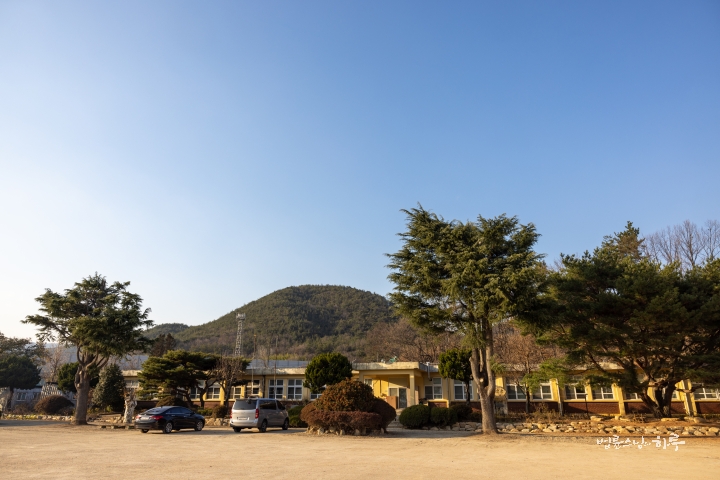
At exactly 9:00 AM, the Jungto Society joint meeting began after reciting the Three Refuges (삼귀의) and Words for Practice (수행문) together. The Jungto Society joint meeting is where executives from all organizations under Jungto Society, including the Lay Member Group, lay Sangha, and Social Activities Committee, gather to share and discuss each unit’s projects. Participants had thoroughly reviewed the materials in advance before attending today’s meeting.
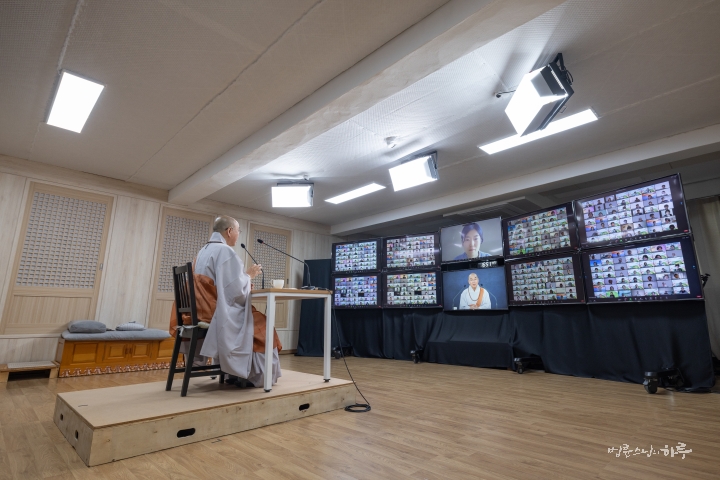
Before officially starting the meeting, Sunim gave an opening Dharma talk. He urged the second-generation volunteers who have newly taken on responsibilities to focus on project implementation while also nurturing the next generation to ensure Jungto Society’s sustainability.
“Next week marks the beginning of the second 1000-Day Practice. Today’s joint meeting has been organized around the new executive team ahead of the new 1000-Day Practice opening ceremony. I would first like to congratulate the newly appointed President of Jungto Society, as well as all division heads, chapter heads, secretary generals, directors, and team leaders. I ask for your dedicated service over the next three years.
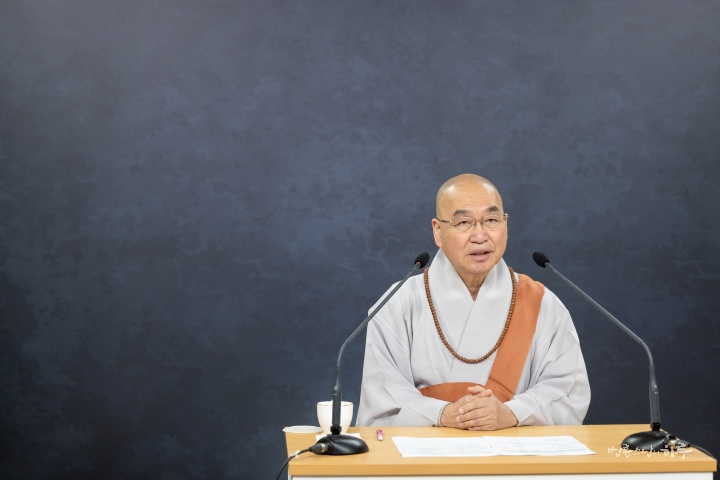
Everything changes with the passage of time. Society changes, and as the older generation retires, the younger generation grows. During the first half of the first 10,000-Day Practice, Jungto Society was operated primarily by resident Dharma Teachers who lived and worked with me. From the second half, newly grown lay volunteers took over that central role. While volunteers who joined midway have been listening to Dharma talks directly, they received guidance from first-generation resident Dharma Teachers during training programs such as the ‘Awakening Retreat’ (깨달음의 장) and the ‘Jung-il-sa’ (정일사, Intensive Retreat for Committed Practitioners), as well as through practical education and training.
From Second to Third Generation, For a Sustainable Jungto Society
Young people who began their activities at the start of the first 10,000-Day Practice have now reached their mid-50s after 30 years. Of course, many young people left along the way, and those remaining now are few. Looking at the newly elected or appointed presidents, division heads, secretary generals, directors, and current Dharma Teacher group, most have been consistently active since the middle of the first 10,000-Day Practice. Given this personnel composition, Jungto Society can be said to be genuinely transitioning from the first to the second generation.
Looking at the volunteers who have taken on major responsibilities this time, those who have been active for about 30 years since the beginning of the first 10,000-Day Practice form the foundation. Additionally, those who joined midway and have been active also hold major positions. On average, they have been active for about 20 years. The advantage of the current personnel composition is that key position holders have fully internalized Jungto Society’s identity and direction of activities. There seems to be no need for additional detailed education or training, and the conditions are in place for stable organizational operation.
On the other hand, what concerns me somewhat is the ‘lack of pioneering spirit.’ Second-generation volunteers have the strength of having contributed greatly to Jungto Society’s expansion. However, since they have been active on the foundation laid by early volunteers, their pioneering spirit may be somewhat lacking. While their capacity to inherit, maintain, and manage existing projects is excellent, their capacity to pioneer new projects may be relatively insufficient. This doesn’t mean I’m asking you to immediately demonstrate creativity and pioneer new projects. Now is an important time for Jungto Society to spread more rapidly. Of course, volunteer training and organizational restructuring must follow according to specific project plans.
Please fully demonstrate the capabilities you have built up in this direction. During the period when the first generation was active, much time was spent coordinating opinions. The process of people who had been working separately coming together as one organization called Jungto Society was necessary, and it was difficult to say that volunteers had fully internalized Jungto Society’s perspective of ‘unity of practice and social action.’ There were many people with strong personalities, leading to ongoing conflicts, and the direction of activities sometimes wavered. Through such processes, today’s Jungto Society was formed.
I hope that those of you who will be central volunteers at the beginning of the second 10,000-Day Practice will focus more on project implementation rather than opinion coordination. This doesn’t mean you should push forward unilaterally with only majority opinions while ignoring minority views. Rather, I’m saying that since your capabilities have grown sufficiently through numerous activities and education/training, you won’t need to spend much time coordinating different opinions.
Additionally, preparing for the generational transition to the third generation must begin now. While this is a task that should be focused on more during the third 1000-Day Practice, preparations for the next generational transition should be carried out in parallel during this second 1000-Day Practice period as well. I believe that even when first-generation volunteers retire, second-generation volunteers will be able to operate Jungto Society well with the right perspective. However, there are some concerns about the transition to the third generation. By then, there’s a possibility that Jungto Society’s identity and direction of activities might be interpreted differently, causing the organization to drift in other directions, or volunteers’ autonomy might decrease. Therefore, please also work on strengthening the capabilities of newly initiated volunteers who have joined within the last 10 years.
The current second-generation-centered personnel composition will face a transition period to the third generation within the next 10 years. When planning and executing projects, always keep the next generation in mind. Moving beyond the narrow perspective of ‘as long as our generation does well,’ we must work to ensure Jungto Society’s sustainability while conducting next-generation cultivation and education in parallel. If we overlook this point, even if Jungto Society expands quantitatively, it may contract at some point. If it continues on a small scale, that might be fine, but as the organization grows larger, this risk also increases. If we cannot maintain Jungto Society’s original perspective, expansion could actually become a weakness, increasing the risk of decline. I urge you to fully consider these points when making project plans.”
Sunim then emphasized the need to revive the vitality of experience and practice that has weakened due to the online transition, and to reshape Jungto Society’s direction of activities to suit the changing times.
“It’s true that Jungto Society’s operations have become much more convenient since transitioning online. However, as most people now practice online while sitting at their desks, the synergistic effects of practice gained from gathering together to bow and meditate, as well as the passion for spreading the Dharma, have somewhat cooled.
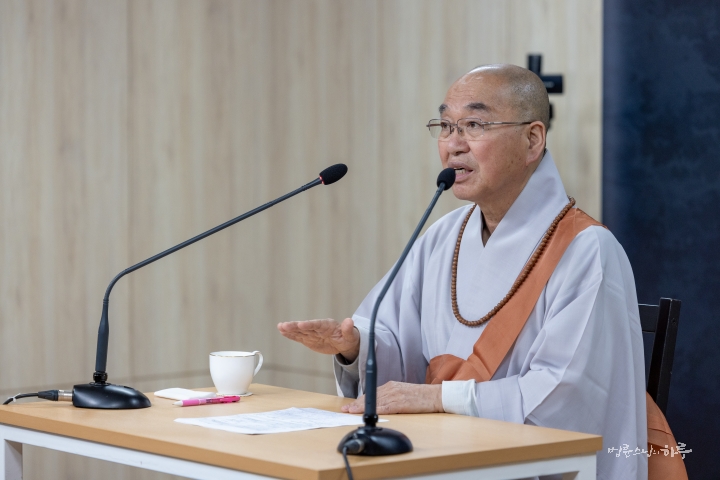
When Buddhism initially spread throughout the world, there were many difficulties. However, the passion for spreading the Dharma was equally tremendous. Later, with the invention of writing, Buddhist teachings were organized in written form, and spreading the Dharma became much more efficient. Books could be sent to convey teachings without people having to go in person, and content that was difficult to convey verbally could be summarized in writing. On the other hand, people encountering Buddhism for the first time began to place greater emphasis on sitting at desks reading and understanding books. Like studying at school, how much one read and understood became the center of practice. Gradually, direct experiential practice and the sense of mission for spreading the Dharma weakened. Practice became increasingly individualized, being accepted as a means for psychological, physical, and illness healing. While this process had the effect of spreading meditation and other practices beyond religious boundaries, it also created limitations where the depth became shallow and people would quit once healing was complete. Over time, combined with faith seeking worldly benefits, Buddhism transformed into something not much different from general religions.
In This Changing Era, What Path Should Jungto Society Take?
Jungto Society was started to overcome these ills. It was founded with the intention of vigorously spreading the Dharma centered on experience and practice, and has reached where it is today. We have come this far through the power of the lay community, without traditional temples or monks. However, as Jungto Society transitioned online, while we overcame the difficulties of infrastructure shortage, whether it’s Dharma Q&A (즉문즉설) or Jungto Dharma School (정토불교대학), sitting at desks looking at screens has become routine. The personal influence transmitted through person-to-person meetings, the experience of overcoming difficulties while working together, and the vitality of social practice have dropped significantly compared to before. Social practice also tends to be dealt with only at the level of knowledge rather than being carried out in actual life. Although we call ourselves a ‘community of practitioners (수행 공동체),’ in reality, the ailment of becoming sluggish in movement is gradually appearing.
To overcome these ills, there need to be more opportunities to directly experience what has been learned. This is why offline practical activities need to be supplemented more. Jungto Dharma School should not stop at listening to lectures and mindful sharing, but practical spaces and foundations need to be established so that social practice activities can be reinforced. Places can be rented, and if necessary, establishing offices again at the division level can be considered. Even if not in fixed locations, foundations for practical activities in each region need to be supplemented for Jungto Society to become more vibrant.
Particularly among Jungto Society’s activities, environmental movements are tasks that must be strengthened in the future, never to be weakened. While relief activities may decrease somewhat domestically, internationally the demand is growing. As traditional vulnerable group welfare such as absolute poverty has improved significantly domestically, we now need to prepare alternatives for problems newly emerging in developed society, such as drug proliferation, discrimination against foreign workers, and aging. New domestic welfare activities need to be developed regarding what alternatives Jungto Society will propose and practice for social problems arising from developed society.
Regarding the unification movement, in the current international situation and inter-Korean relations, it’s not easy to carry out activities with unification at the forefront. However, since situations can change at any time, we must harbor deep aspirations for unification and be prepared to step forward whenever opportunities arise. This doesn’t mean abandoning aspirations for unification. It just means that now it’s difficult to put unification at the forefront externally. Rather, putting peace more at the forefront now seems more necessary both domestically and internationally. If unification is a domestic issue, peace is an international issue. Among these two values, we need to change our activities by increasing the weight of peace now while steadily preparing for unification behind the scenes. We must respond actively to such changing circumstances.
To respond quickly to changing circumstances, past experience might actually work as a limitation. Therefore, we need an attitude of reflecting on whether our consciousness is settling into past methods. Rather than accepting new problem-raising as secularization or confusion, we need an attitude of accepting them as good ideas for doing work more needed in the world. While maintaining and transmitting what Jungto Society has done so far is important, we must continuously accept new methods and new perspectives.
Monastic-centered Buddhism may not have a very long lifespan in Korean society going forward. Dharma Q&A is also possible not because I am a monk, but can be done perfectly well without being a monk. The era of authority that was possible because one was a monk, pastor, or priest is rapidly collapsing. Now is an era where practical life alternatives and practical experience become more central. Rather than Jungto Society simply following directions provided by the Lead Dharma Teacher or Dharma Teacher group, all practicing members must prepare while looking ahead to the future themselves.
Please discuss thoroughly today with this awareness. If you have questions, I will participate again in the afternoon for dialogue.”
The chairperson of the Standing 1000-Day Preparatory Committee then declared the meeting open and reported on 2025 project results and settlement, and announced 2026 project plans and budget. After completing the report, various questions, suggestions, and proposals poured out during the Q&A session.
Next, after having division-level discussion time on the topic ‘What activities can I, the chapter, and the division do within the project direction of the second 1000-Day Practice?’, everyone gathered again to share discussion results. Through the discussions, various plans could be made for projects that divisions could focus on.
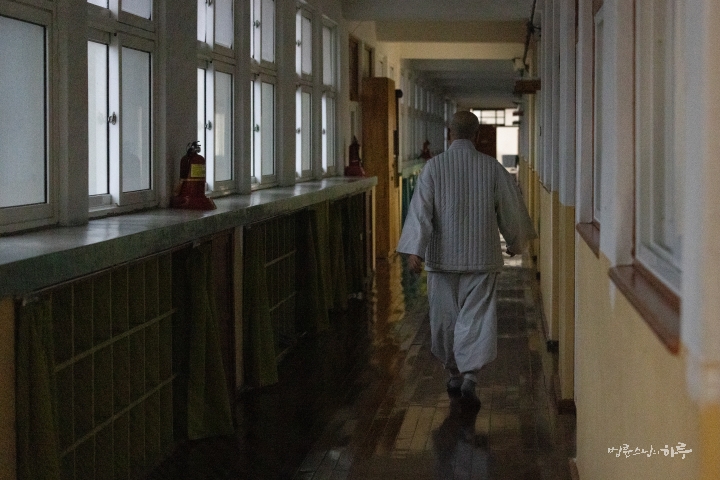
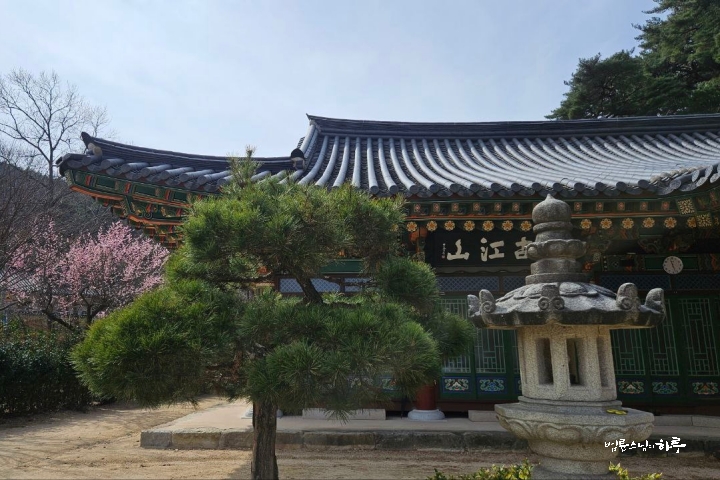
Meanwhile, after finishing the opening Dharma talk, Sunim headed to Tongdosa Temple (통도사). He arrived at Tongdosa Temple at 10:30 AM. Plum blossoms were in full bloom throughout Tongdosa Temple.
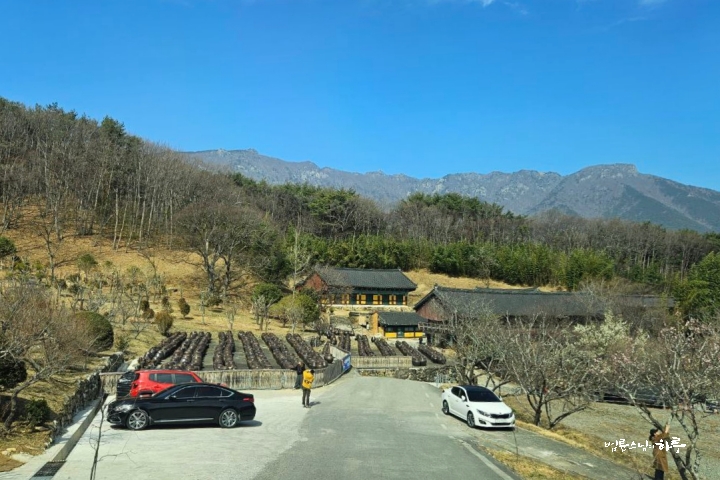
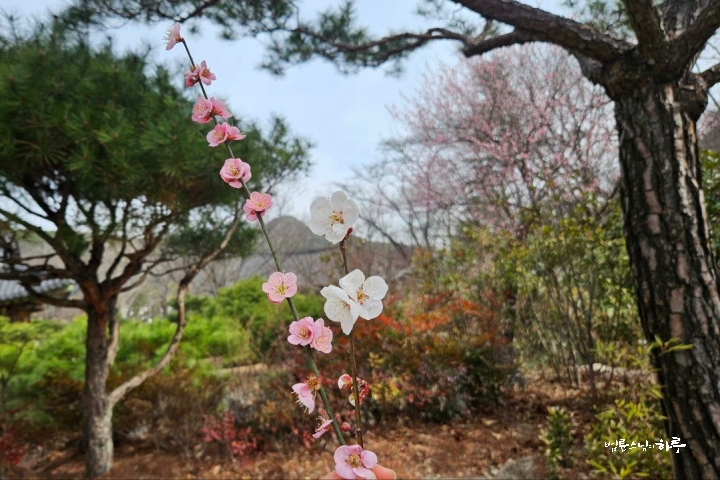
First, he visited Sitapjeon (시탑전 : 侍塔殿). Sitapjeon is the residence of senior monks located below the five-story stone pagoda at Sajamok (사자목) across the Tongdosa valley. When he knocked on the door of Sitapjeon, Venerable Beopsan (법산 스님) warmly welcomed him.
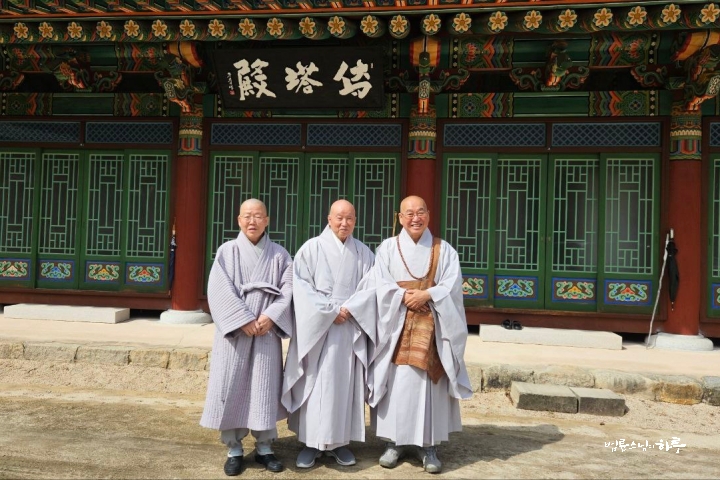
He had deep conversations with the senior monk about methods for reviving Indian Buddhism and Korea-India Buddhist cultural exchanges. After an hour of tea conversation, he toured the temple grounds and left Tongdosa at noon.
He then revisited Yangji Village (양지 마을), which he had briefly toured yesterday. After examining whether it would be suitable to create a memorial park in a sunny location, he returned to Dubuk Jungto Retreat Center at 2 PM.
Meanwhile, joint meeting participants were taking a brief rest after finishing long discussions. From 3:45 PM, they had time to ask Sunim questions and have dialogue about their curiosities. Jungto Society executives asked Sunim various questions that arose during discussions.
For an hour, six people asked Sunim about the overall project direction of Jungto Society. One of them asked what perspective to have in order to push work forward passionately while not exhausting fellow practitioners working together.
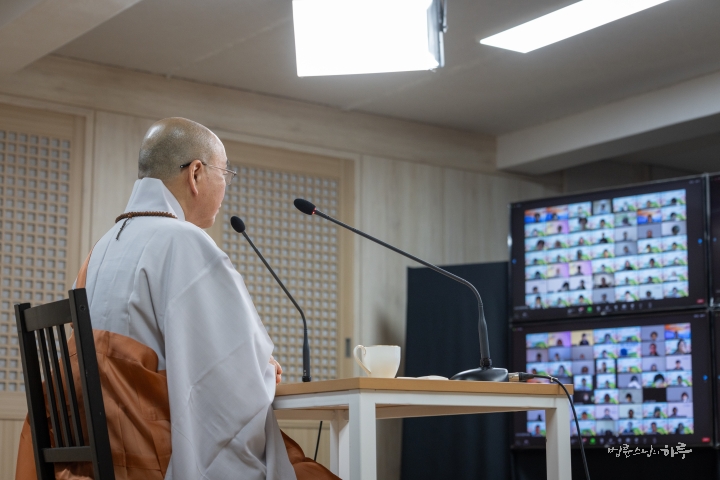
When Pushing Forward with Work, When Should We Push and When Should We Step Back?
“From your perspective, is Sunim someone who pushes things forward or someone who steps back?”
“Sunim tends to push things forward. I also follow Sunim in pushing forward.”
“Since we work based on our vows, we fundamentally need to have driving force. However, if one person advances too far ahead and no one can follow, it becomes meaningless. Conversely, if we’re too cautious and only watch others’ reactions without moving forward, that’s also meaningless. One should have the unwavering strength to push forward despite any difficulties, while adjusting the pace according to the state of the Sangha members. We need to push forward and when there’s resistance, slow down the tempo for a while, then when things improve, push forward again, and when there’s resistance again, slow down the tempo – this kind of adjustment is necessary.
Fundamentally, one shouldn’t push forward according to their own will. However, if Jungto Society has set a direction within the larger framework, I must propose it first regardless of whether others do it or not. We should move forward with the attitude that our group, our Buddhism Course students, and our local chapter will try it. If there’s resistance because people aren’t familiar with it yet or haven’t overcome it, we should push forward despite some resistance. This is because things often improve once we get past that point.
However, if we push forward oppressively, as if we’re superior and pushing things through alone, people are more likely to be hurt and fall away rather than achieving results. Sometimes pushing forward is effective, and sometimes slowing down the tempo is effective. We have no choice but to adjust the pace ourselves while experiencing these situations. If you feel you’ve gone too far while doing something, those working together will make suggestions. When the local chapter head or division head says ‘Please adjust a bit,’ you can say ‘I understand’ and slow down. There’s no need to think you’ve been rebuked or criticized. Accept it thinking ‘I didn’t pay enough attention,’ then proceed while continuing dialogue. It would be good to have the attitude of trying first and solving problems as they arise.”
“Thank you. I understand well.”
Questions continued to follow.
When focusing on activating local practice, there’s concern about losing the perspective of practice and flowing like general cultural center programs. What points should we be careful about to help the community while not losing sight of practice?
While preparing to operate the Jungto Social and Cultural Center Special Division, additional activities like leading member Dharma assemblies and Tongil Euibyung (통일의병) activities have been added, creating a burden for volunteers to attend more than three times a week. How should we adjust the monthly leading member Dharma assemblies and Tongil Euibyung activities between online and offline?
In a situation where Dharma centers have decreased and we’ve become online-centered, I’ve realized through donation activities that local Jungto chapters need to make their name known and put down roots in the community to survive. Couldn’t we expand Jungto’s local activities by donating part of Jungto’s budget to local communities?
I believe Sunim’s teaching of interdependent worldview should be at the center of Dharma propagation, welfare, peace, and environmental activities. To achieve this, I think it’s most important to more actively spread ‘A Day in the Life of Sunim’ content. Couldn’t we change the name of unification prayer to Korean Peninsula peace prayer and spread ‘A Day in the Life of Sunim’ more systematically by connecting it with Dharma propagation?
The last questioner talked about concerns regarding which projects the youth division should prioritize in a situation where enthusiasm overflows but capacity is limited.
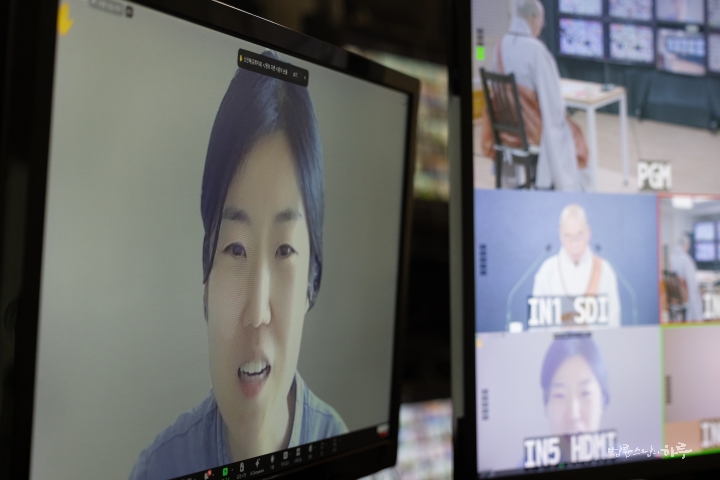
There’s So Much I Want to Do, but What Should I Do First?
“If a concrete proposal comes up saying ‘we want to do these 10 things,’ I can advise on which ones to focus on more. However, if you vaguely ask what to focus on among the countless things in this world, it’s difficult to answer.
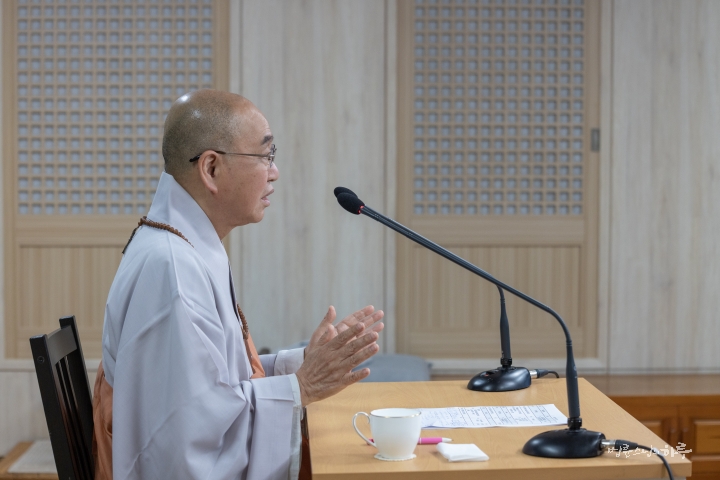
Jungto Society has already established its direction. First is environmental practice to preserve the global environment, second is welfare practice to help those in need, and third is peace practice to prevent war and conflict and achieve peace. These three main focuses are included in the ten key tasks to concentrate on these areas. If asked which specific areas of environmental practice would be good to pursue, first, we need to examine the specific nature of the proposed projects, and second, we need to consider whether we have the capacity to handle them. Having many things we want to do without sufficient capacity is greed. While it could be positively expressed as enthusiasm, struggling with plans for tasks we cannot handle is greed.
There is a significant difference between aspiration (원: 願) and greed. Greed leads to exhaustion, while aspiration means getting up and trying again when you fall, and trying again when you fall once more. If one person starts alone and over time ten people join together, gradually increasing the capacity for realization, then even if it’s somewhat overwhelming at first, it can be called aspiration. However, if someone starts with great enthusiasm but becomes exhausted and gives up when things don’t go well, that’s merely greed. Practice is about letting go of greed, not indulging in it.
So I can say that we should first focus on environmental practice, welfare practice, and peace practice. Beyond these, one issue that could become important in Korean society is the drug problem. It’s important to eradicate drugs, prevent people from becoming involved with drugs, and identify and prevent areas where drug access might be possible. While Korean society hasn’t yet deeply fallen into drug problems, they are spreading quite rapidly. Once drugs become established throughout society, eradication becomes extremely difficult. When anything becomes normalized, it becomes part of life and the sense of guilt disappears. Once it spreads in schools, students tend to accept it as normal. While society as a whole maintains awareness about drugs, boundaries are rapidly loosening among young people. We need to look at this more carefully, and I think this is an area that young people need to newly explore.
Looking back to when I started Jungto Society over 30 years ago, at that time the only movements young people were involved in were farmers’ movements, labor movements, student movements, and democratization movements. So after the June Struggle ended and direct presidential elections were established, I pondered what would become important issues in our society over the next 30 years. Through that process, I came to focus on environmental and welfare issues. Although orphan issues were more urgent at the time, I foresaw that elderly issues would become bigger, so I focused on elderly welfare rather than running orphanages. I also believed we should take responsibility not just for Korea’s internal problems but for the world, and that we should care about third world and poor countries. That’s why JTS began overseas activities even when our capacity wasn’t sufficient. These were things we started while predicting the future at that time.
In the future, not only drug problems but also mental health issues appearing among young people, such as depression, could become important challenges. Also, looking at society’s overall atmosphere these days, speculation has become normalized under the names of investment or financial management. Making money through speculative investments is being accepted as natural under the names of coin investment and stock investment. While the mindset spreads that buying land and profiting when it rises, or buying stocks and profiting when they rise, is natural, money earned through work is considered barely enough to make ends meet. I think both the previous and current governments are spreading rather than raising awareness about this mindset. Spreading this to young people as the trend of the times will become a major problem in the future.
The same goes for welfare issues. Once welfare is expanded, it’s extremely difficult to reverse, so it must be addressed with great care. If expanded recklessly, we could face a situation like France where it becomes impossible to stop even in a fiscal crisis. Everyone resists.
These are the issues we need to be concerned about together and find alternatives for. Above all, I think we need to launch new movements to help young people develop healthier consciousness rather than illusory ideas. While we need to find out through discussion what specific problems young people face, asking vaguely what issues would be good is too abstract. We need to use these issues as starting points to explore together.”
“Thank you. I understand well.”
After resolving questions through dialogue, Sunim gave concluding remarks. Sunim urged everyone not to hesitate in the newly beginning second 1000-Day Practice, to move forward while taking good care of their health.

“If there were areas where we hesitated or wandered during the first 1000-Day Practice period, in the newly beginning second 1000-Day Practice period, we should no longer hesitate but maintain an attitude of moving forward. Since we always have to work online and spend a lot of time sitting in front of computers, many people suffer from deteriorating eyesight or neck disc problems. Please everyone take care of your health.
I too have been experiencing over the past month that when one area improves, another area hurts, and when that area gets better, another area becomes uncomfortable, repeating this cycle. It feels like a car ready for the scrap heap – fix one thing and two days later another part breaks down, fix that and another part breaks down.
So while working on computers, please stand up occasionally to stretch and do exercises, taking care of your health while working.”
Taking Sunim’s words to heart, the Jungto Society joint meeting concluded with the Four Great Vows (사홍서원).

After sunset, Sunim spent the evening indoors proofreading manuscripts and handling various tasks before concluding the day’s activities.
Tomorrow morning, Sunim will further survey additional sites for the memorial park, then in the afternoon will participate online in the Jungto Dharma Practitioner Assembly to give an opening Dharma talk before traveling to Seoul.


My master
I gladly saw your article in English Version in this moments not many times
But it’s very good to see nicely and
I touched positively same like Korean version.
Thanks