Hello. Today is the day for the Balsim Practitioner ordination ceremony for those who have completed the leading member education over the past year.

After completing morning practice and meditation, Sunim rested in the morning as his health continued to be poor. The overseas corporation board meeting scheduled for the morning was postponed to the evening.
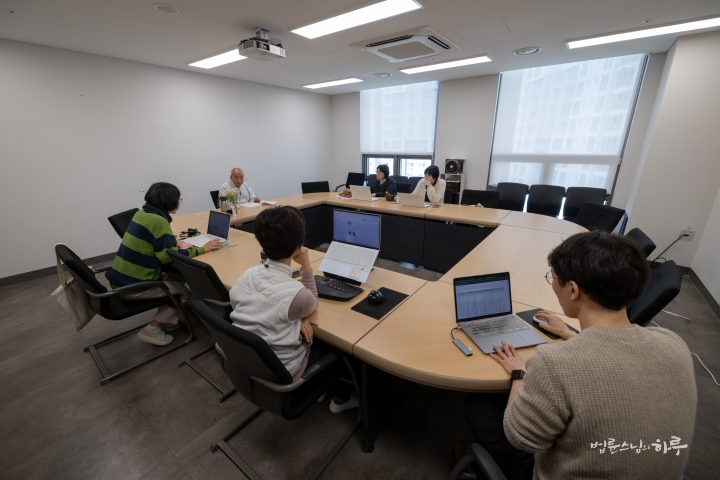
In the afternoon, Sunim recovered and headed to the Jungto Social and Cultural Center. At 1 PM, he held a meeting with staff members preparing for the ‘World Meditation Day’ forum. The staff had refined the detailed program based on yesterday’s meeting content. After thoroughly reviewing the event plans once more with Sunim, the meeting concluded.
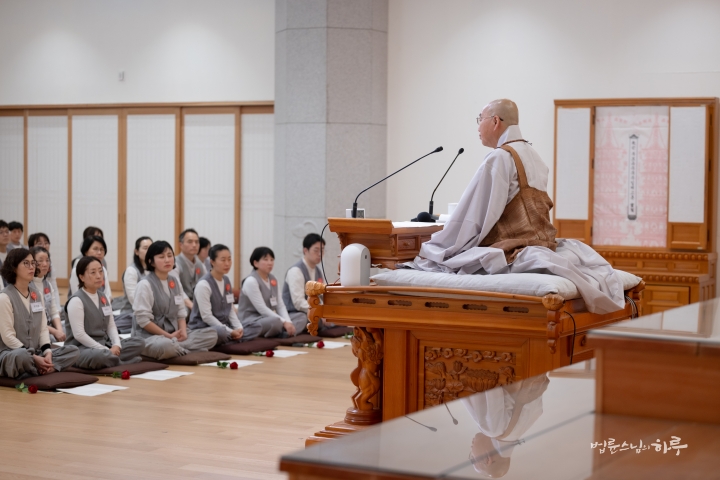
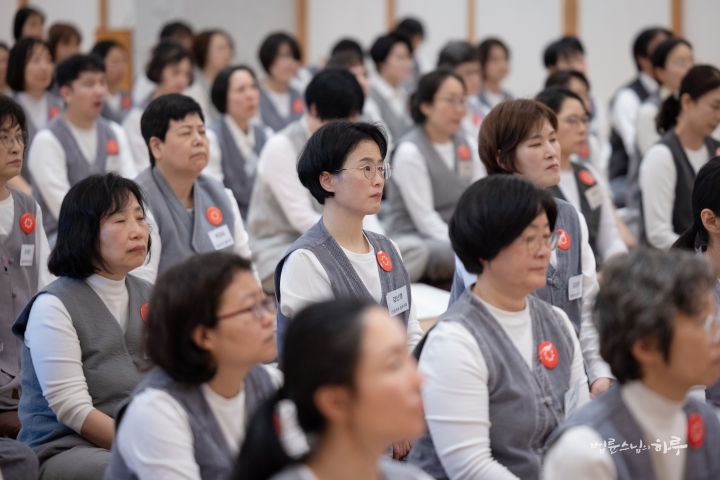
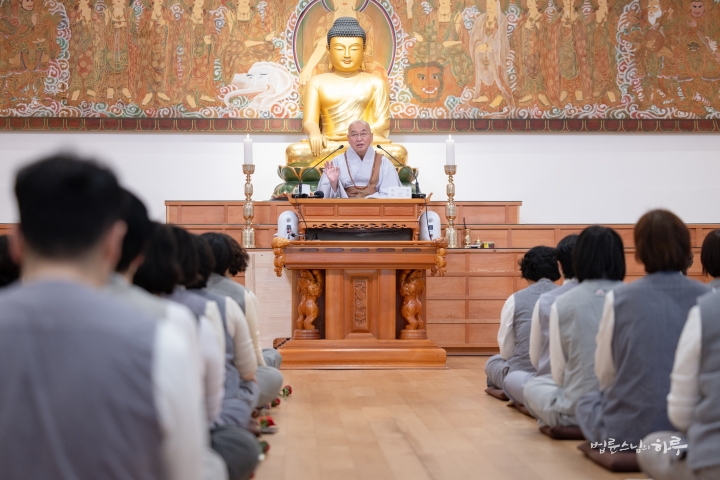
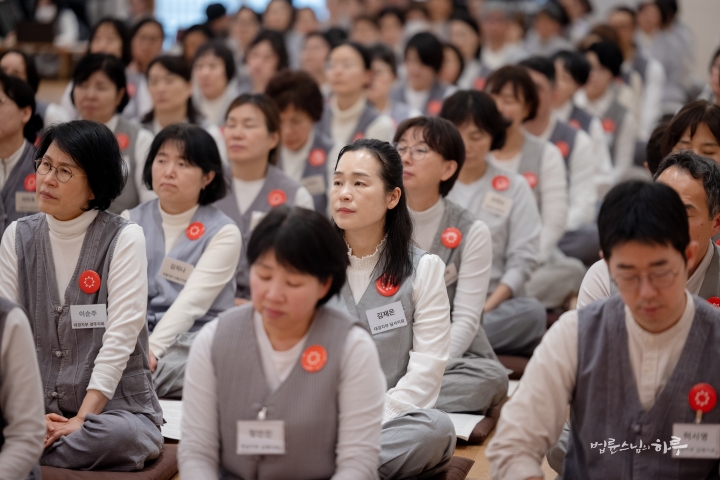
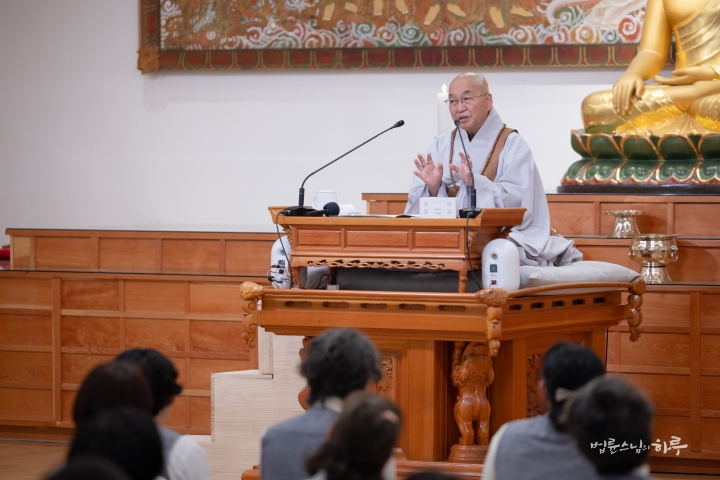
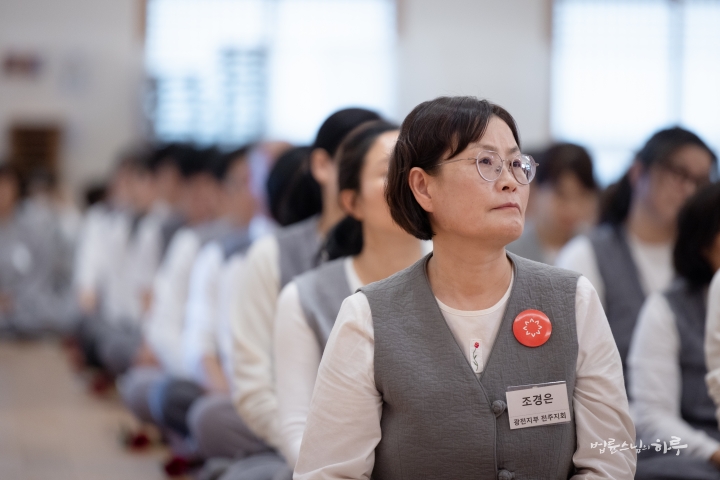
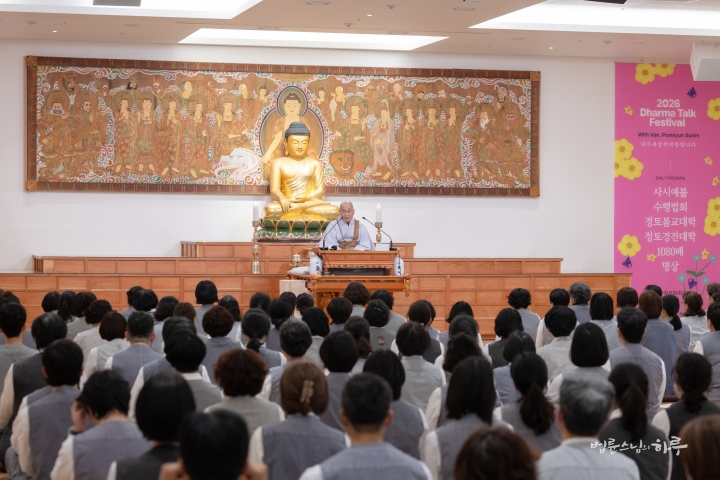
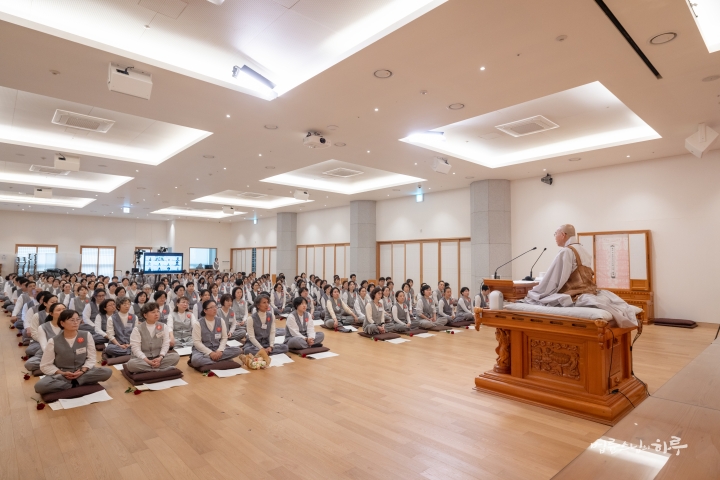
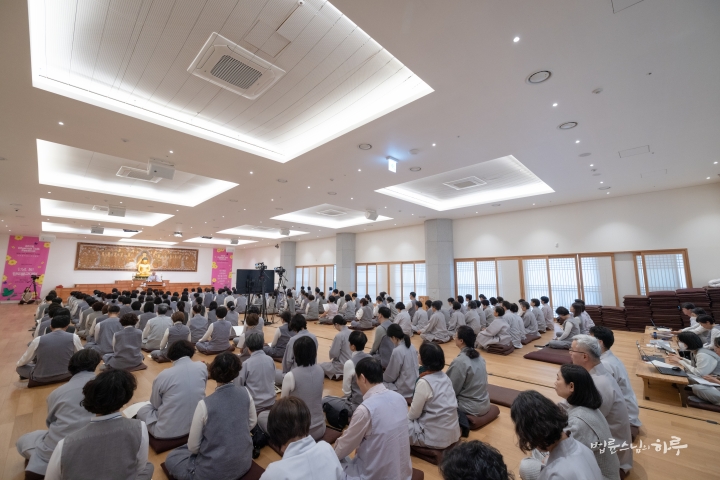
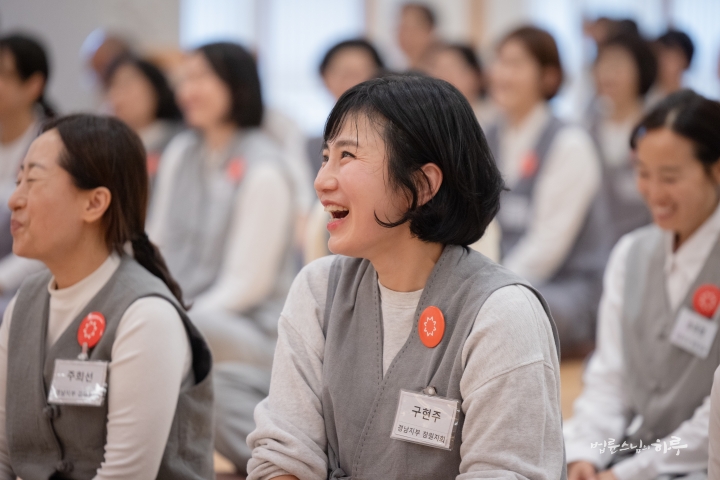
After the meeting, Sunim headed to the Dharma Hall on the third floor for the Balsim Practitioner ordination ceremony. About 120 ordinands were seated in the Dharma Hall. Around 10 ordinands from overseas branches participated online.
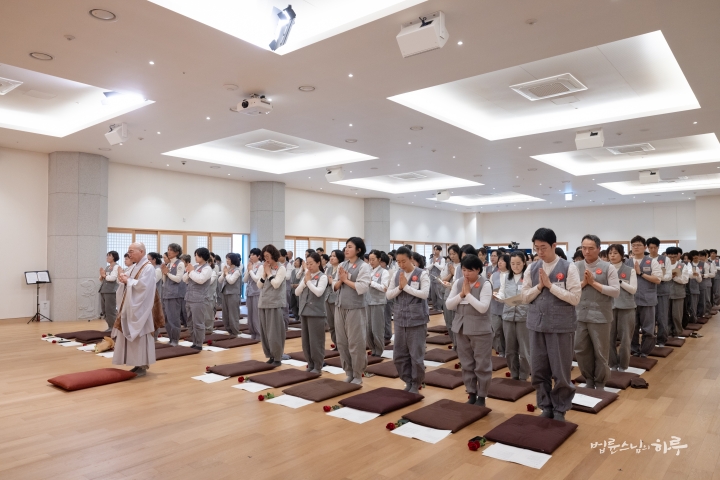
At exactly 2 PM, the Balsim Practitioner ordination ceremony began with the ringing of the bell, chanting, and recitation of the Heart Sutra.
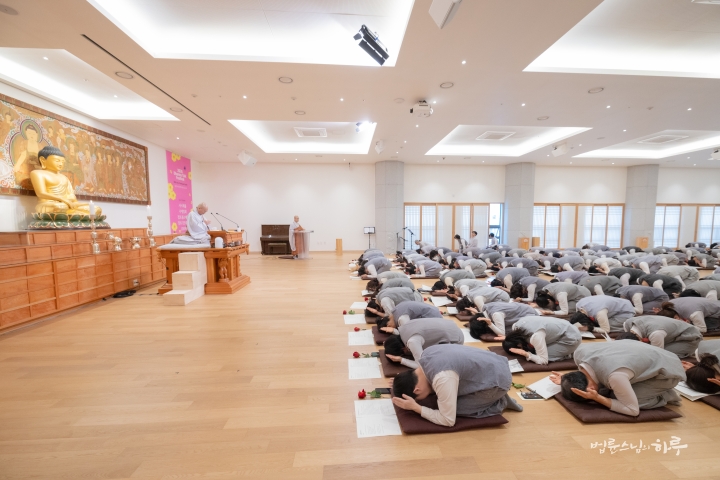
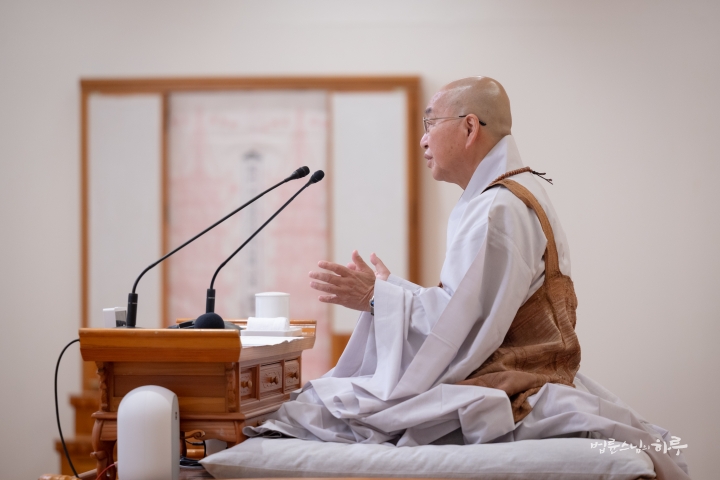
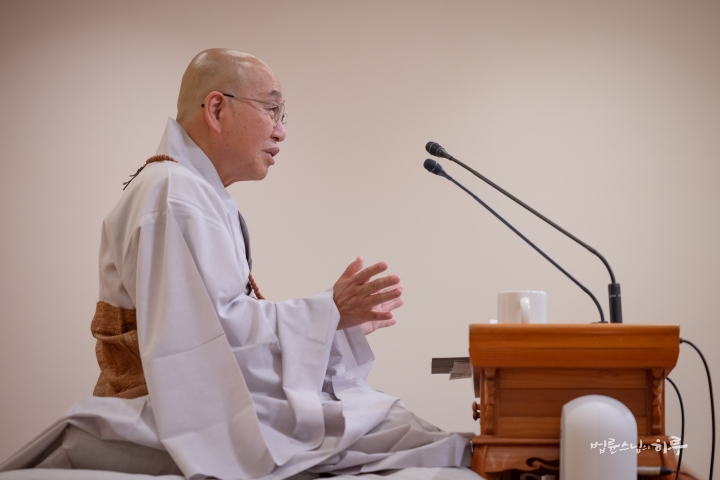
When the new Balsim Practitioners requested a Dharma talk with three prostrations, Sunim explained the meaning of the Three Refuges and Five Precepts, and then spoke about what practical virtues they should uphold as Balsim Practitioners going forward.
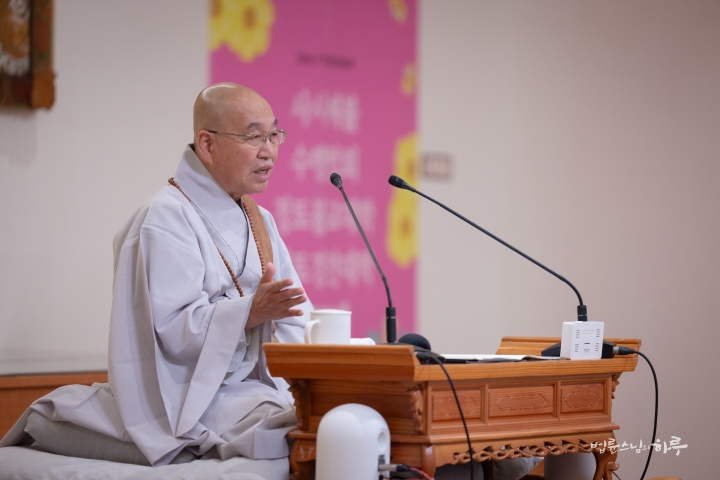
“For lay practitioners, there are certain principles that must be upheld under any circumstances. In other words, even though they don’t ordain and maintain their families, there are minimum standards that must be met to be called a practitioner. When we carefully examine the precepts taught by the Buddha, we can see that they are based on ‘principles of natural ecology’ and ‘minimum social ethics.’
Why Do Precepts Prioritize “Not Harming” Over “Helping”?
The first precept is ‘Do not strike or kill other living beings.’ Even small insects live on their own without asking other insects to ‘save them.’ All life in nature is designed to maintain itself independently. However, no matter how small an insect may be, it does not want to be struck or killed by someone. Since no living being wishes to be harmed, the Buddha taught us ‘Do not harm other living beings.’ This doesn’t mean we must unconditionally help other beings, but at the very least, we should not harm them. This is why for practitioners, ‘not harming others’ is the minimum standard rather than ‘helping others’ being a mandatory requirement.
However, there was a time when secular values considered it acceptable to strike or even kill others when necessary. In the past, parents and teachers hit children for disciplinary reasons, masters beat disobedient servants, and husbands beat their wives. Such violence was socially tolerated under the belief that ‘beating makes things right.’ When husbands beat their wives, no one could interfere, and when masters beat servants or parents and teachers beat children, it was accepted as ‘necessary for education.’
What’s worth noting is that while we now recognize it’s wrong for husbands to beat their wives, some people still believe that parents hitting their children ‘may be necessary for education.’ Generally, people consider it unjust when they are beaten, yet easily justify beating others. The frequent scenes in historical dramas where masters beat or kill servants reflect such period attitudes. In East Asia, parents beating their children was taken for granted as ‘family law,’ and husbands beating their wives was customarily tolerated. It was precisely in such times that the Buddha clearly stated that practitioners should not engage in striking or killing for any reason.
A world rampant with violence and murder is the most painful world humans can experience. This is why humanity has depicted hell as a terrible place where people are cut with knives, pierced with spears, burned with fire, and immersed in boiling water. A place that inflicts suffering through violence and killing is hell itself. While perpetrators may feel pleasure for various reasons, for the victims, it is truly a living hell.
The second precept is ‘Do not take what is not given.’ Even wild animals fiercely resist when someone tries to take their food. Even if they don’t die from physical violence, they will eventually starve to death if their food is taken away. If violence and death are the greatest sufferings for living beings, then the next greatest suffering is having what is necessary for survival taken away. This precept is also based on the principles of natural ecology.
This might be misunderstood as ‘Buddhism recognizing capitalist private property,’ but it should be understood from the perspective of ‘protecting basic human survival rights.’ Since people must eat to maintain life, it means one should not carelessly take or steal what is directly related to another person’s basic survival.
What Must Be Observed First When Becoming a Practitioner
The third precept is ‘Do not engage in sexual misconduct.’ Forced sexual abuse is not only a problem in human society but also appears to occur in natural ecosystems. I recently came across a research report. It was about investigating the cause of many female turtles dying from falling off cliffs on an uninhabited island. According to the investigation results, on that island, there were far more males than females. When the females’ ovulation period arrived, males would attach themselves all at once, becoming entangled with each other, and the females would repeatedly flee to avoid them. At first, it appeared they simply lost their footing while avoiding the males, but upon closer examination, patterns similar to human suicide were observed. The interpretation emerged that females, extremely exhausted from the males’ constant approaches during the breeding process, were choosing to go toward the cliffs themselves. While we cannot determine how accurate this research is, there were accompanying reports that females showed similar behavior even in limited experimental environments. Through this, we can surmise that sexual stress can occur even among wild animals.
Sexual issues can bring pleasure to those who desire them, but they can cause immense suffering to those who do not. Especially in human society, when combined with social conventions called ethics, this suffering can be greatly amplified. The psychological pain from sexual abuse can be greater and last longer than losing property or injuring a part of the body. Therefore, practitioners must not engage in sexual acts that the other person does not want. This is now called ‘sexual assault.’ Forcibly touching someone’s body is called ‘sexual harassment.’ While the perpetrator may think it’s trivial, it causes tremendous suffering to the victim. Through numerous Dharma Q&A sessions, I have often witnessed how deep and long-lasting the psychological damage from sexual abuse can be. There are many cases where childhood experiences significantly affect married life even after becoming an adult. This is why ‘prohibiting sexual harassment and sexual assault’ is the core of the third precept.
Sexual relations between spouses are permitted for lay practitioners. This is because forming a family is allowed. However, even for lay practitioners, forced sexual acts against someone’s will are prohibited. This is wrong both socially and from the perspective of natural ecology.
Additionally, there are three cases that constitute ‘sexual misconduct’ even when both parties consent. First, when the other person is a minor. Even with consent, it becomes a crime if the person is a minor. Second, relationships with someone who has a spouse. Such relationships cause great suffering to the other person’s spouse. Imagine if your wife or husband had an affair. You can imagine how great that suffering would be.
Many acts that are problematic from the perspective of human ethics or ecological ethics are also defined as crimes. Among ethical issues, some constitute criminal offenses while others do not. Now that adultery laws have been abolished, adultery is no longer a criminal offense. However, since it breaks the promise of marriage, it can be grounds for divorce, and since it causes emotional harm to one’s spouse, one may face claims for damages. Nevertheless, it is not subject to arrest or criminal punishment. This also reflects the perspective that adults have the freedom to decide how to use their own bodies. If one continues an affair, they must bear the resulting losses, but they will not be punished as a criminal.
Thus, the legal judgment of adultery varies by era and society. In Muslim societies, it could be considered a serious crime. However, forced sexual acts violate both the principles of the ecosystem and nature in any society. Even with consent, if the other party is a minor or married person, this violates the basic ethics of human society. Therefore, practitioners should not engage in such improper sexual conduct.
Lay practitioners, you may have families and work at jobs. You may live freely with money earned honestly. However, under no circumstances should you hit or kill others. Watching and enjoying violent movies or sports is also something practitioners should be cautious about. Even if you gain profit through business or investment, if in the process you cause harm to others or take or steal from them, you are not qualified as a practitioner. Even if you have a family, you must not force sexual acts on your partner, and even if there is mutual attraction, the same applies if the other person is a minor or already has a spouse. These are the minimum precepts that lay practitioners must observe.”
Sunim then explained in detail the fourth precept ‘Do not lie’ and the fifth precept ‘Do not become intoxicated’ with specific examples.
Finally, he presented the Five Precepts as ‘the minimum promise to protect oneself and purify society,’ emphasizing that becoming a Balsim Practitioner means becoming an owner of the practice community who takes on responsibilities, not just rights.
“If just these five precepts are well observed, our society will become a peaceful and good place to live. No one will live violently, even when seeking profit they won’t harm others, under no circumstances will they commit sexual harassment against someone’s will, they won’t deceive or curse others, and they won’t become intoxicated with alcohol or drugs. Then we can trust such people. Perhaps most crimes in the world stem from violating these five precepts. Therefore, the precepts are not only a path that prevents my disasters and leads me to happiness, but also a path to purify our society.
Yet today, we don’t even keep these basic things and rationalize breaking precepts by saying ‘Well, they’re only human.’ Doing bad things is not a characteristic of being human. The true characteristic of being human lies in living righteously. Yet after violating something, we justify ourselves saying ‘Well, humans can be like that.’
The Five Promises: A Path to Protect Oneself and Purify the World
As practitioners, we must guard these five precepts as if they were our lives. Just as the householder Guriga in the sutras vowed ‘I will keep them with my body and life’ when receiving the precepts. We should be grateful just for being allowed to live as lay practitioners without leaving home. Compared to leaving home to practice, why would keeping these precepts be difficult? If you think it’s nothing compared to leaving home to practice, you can gladly keep the precepts. If instead you view the precepts as ‘something that binds me,’ then your perspective on practice is not yet properly established.
In Jungto Society, you enter the category of practitioner only after receiving the Five Precepts. Even if you graduate from Jungto Dharma School and come to Jungto Society, you can only be called a practitioner if you strive to keep the precepts and have a mind of repentance when you fail to keep them. If you haven’t received the precepts, or have received them but have no intention to keep them, it’s difficult to call you a practitioner.
Since Jungto Society started as a ‘community of practitioners’ from its founding, the principle was that all members would keep the precepts. However, as time passed, the number of people who only liked listening to Dharma talks but found practice difficult increased. So a choice was necessary. Those who want to participate freely without regard to precepts are considered general members, while only those who promise to keep the precepts are called ‘Balsim Practitioners’ or ‘regular members.’ Balsim Practitioner means someone who has aspired to become a practitioner. Today, you are becoming exactly that – Balsim Practitioners.
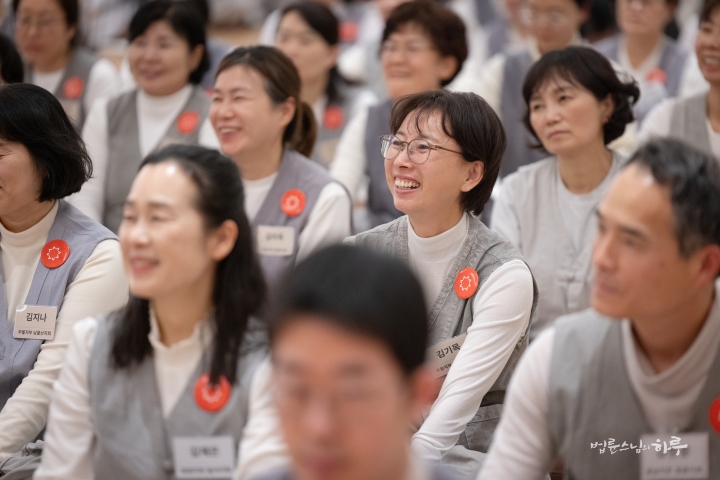
Becoming a Balsim Practitioner in Jungto Society means becoming a full-fledged member of the community of practitioners. From this point on, practice becomes both a right and an obligation. As an owner of Jungto Society, you are given all decision-making rights, including voting rights. Rights come with responsibilities, and responsibilities come with rights. Conversely, if someone says, ‘I want to come and go as I please, do what I want when I want, and be free,’ it would be difficult to have any rights as a member.”
This was followed by repentance, offerings, and the precept-taking ceremony.
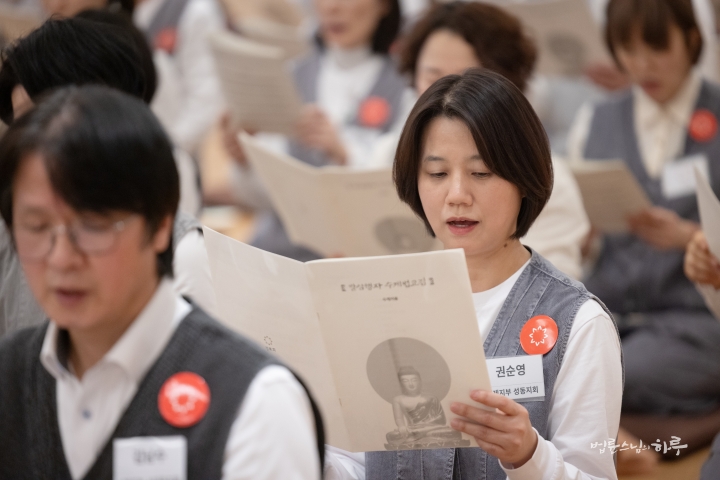
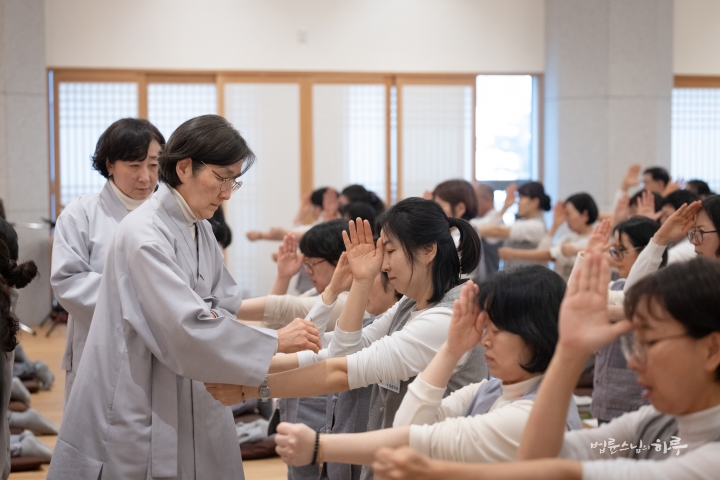
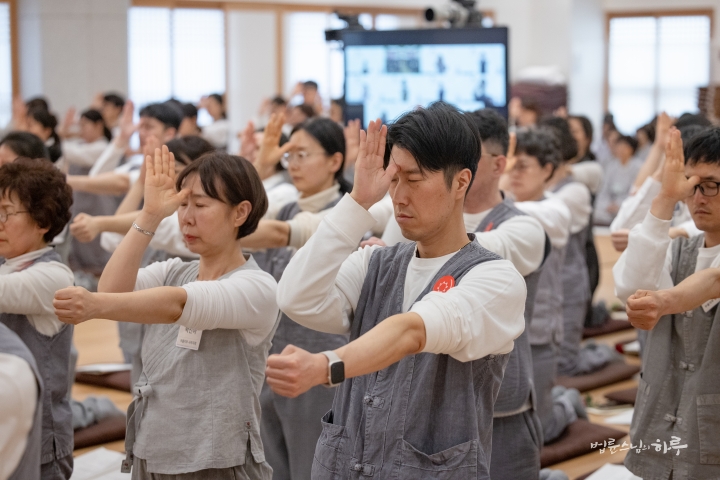
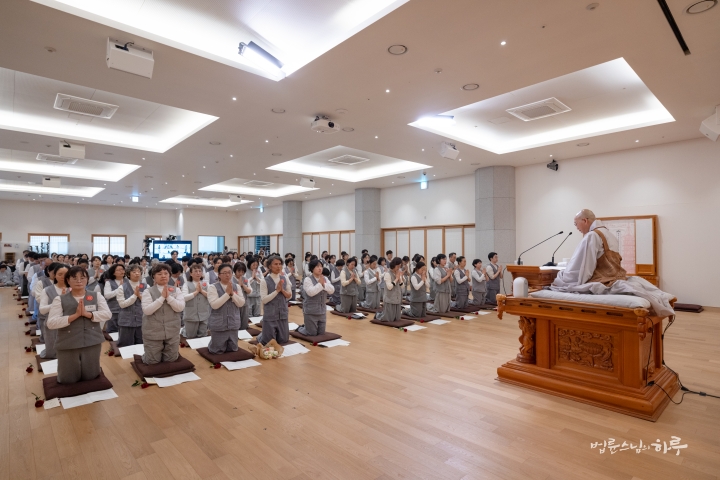
“We, your disciples receiving the precepts, repent with utmost sincerity. From time immemorial until today, before knowing the Buddha’s teachings, we have committed countless bodily transgressions of killing, stealing, and sexual misconduct. Now we vow to discipline our body, speech, and mind and repent with utmost sincerity.”
The precept recipients who promised to keep the Five Precepts went forward to the altar to offer flowers.
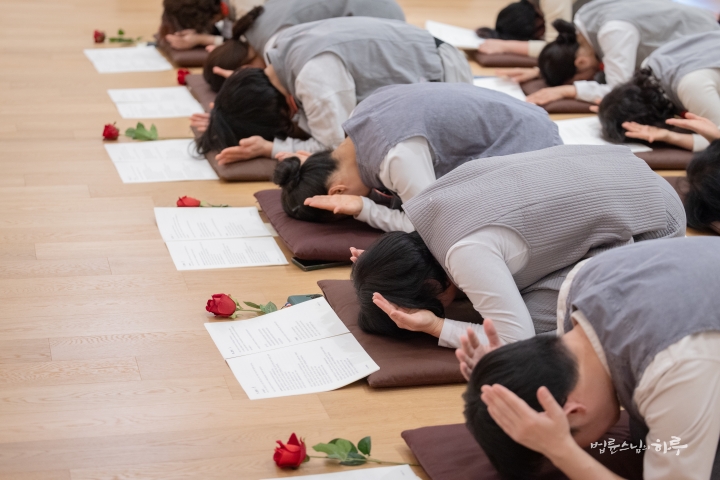
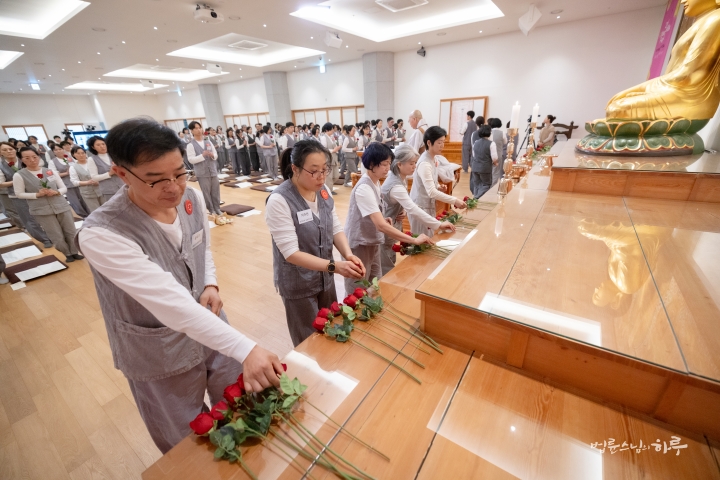
Sunim offered a heartfelt prayer for the Balsim Practitioners who were making a new start as lead volunteers.
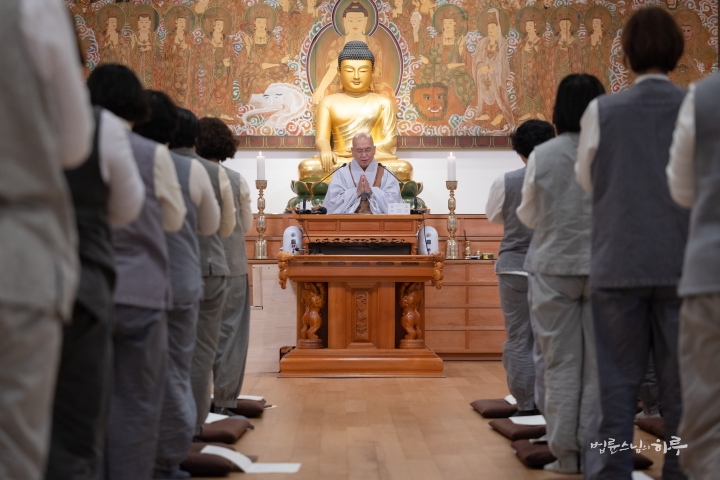
“Today, Jungto practitioners who have been practicing diligently from all over the country have vowed to follow the Buddha’s teachings, maintain pure precepts, and practice steadfastly. They have taken refuge in the Three Jewels, received and vowed to keep the Five Precepts, and committed to practice sincerely as practitioners. This is truly a precious and valuable connection.
We sentient beings have been caught in ignorance for countless ages, creating karma and receiving its consequences while repeating the cycle of birth and death. Until now, we have not properly reflected on where our suffering comes from, instead making all kinds of excuses and blaming others – saying it’s because we had the wrong parents, made the wrong friends, married the wrong spouse, committed many sins in past lives, or have bad fortune according to our birth chart.
We Will Rise Again Even If We Fall
Now that we have encountered the Buddha’s true Dharma and examined things as they are, we have come to know that all sentient beings were originally born to live without suffering. We have also realized that if we eliminate the three poisons of greed, anger, and ignorance within our minds, we too can live without suffering like the Buddhas and Bodhisattvas. Now we clearly know in which direction we should live our lives.
However, the ignorance and bad habits accumulated over countless ages will not disappear overnight. When we fall, we will rise again; when we fall again, we will rise once more, continuing our practice without stopping, moving forward. Though we make this commitment again and again today, there may be times when foolish thoughts capture us, making us forget when we even resolved to practice, living according to our old habits while feeling regret or self-blame. At such times, may Avalokitesvara Bodhisattva not turn away from us but look upon us with compassion, guiding us back to the original aspiration we made today. May we be able to practice diligently until we reach the Pure Land we wish to create.”
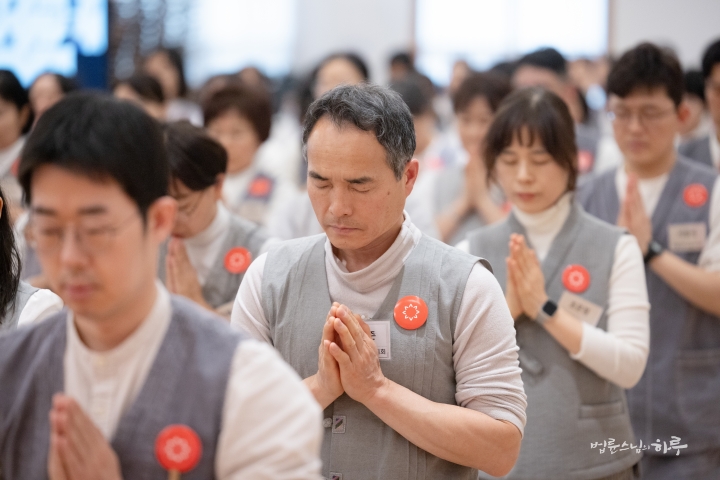
Next, the precept certificates were presented. Sunim presented a certificate to one representative on behalf of all participants. He then presented certificates virtually to those attending online.
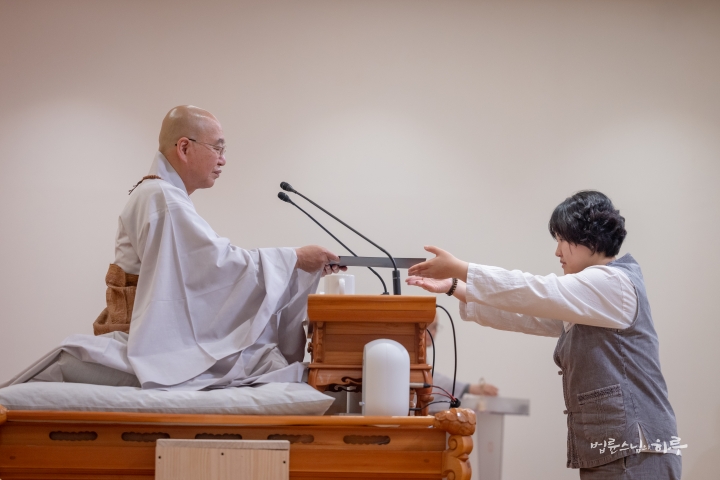
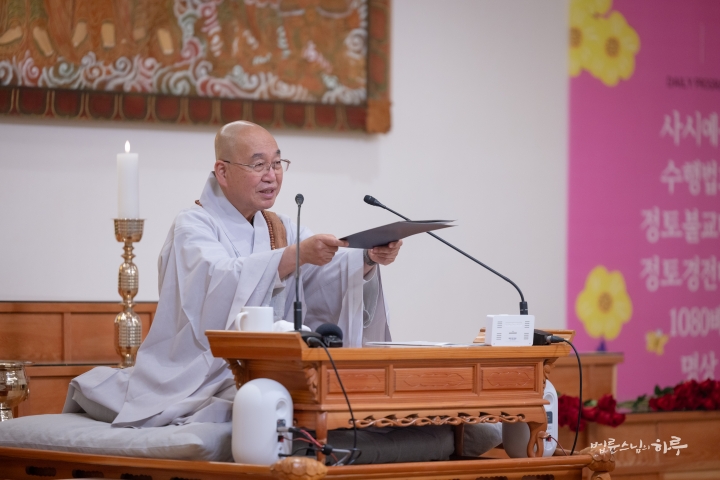
Sunim explained the meaning of receiving the prediction of future Buddhahood and a Buddha name for those who had vowed to uphold the Five Precepts, as well as how these names are determined.
You Will Become a Future Buddha
“As lay practitioners, you have promised to uphold the Five Precepts, which form the most fundamental basis. By taking this first step on the path of the Buddha, you receive the prediction that ‘You will become a Buddha in the future.’ Receiving this prediction means receiving your Buddha name. Through steady practice, you will eventually attain enlightenment, so you are receiving in advance the name you will have when you become a Buddha. However, since you are not yet a Buddha, you are called a ‘Bodhisattva,’ meaning ‘one who walks the path of the Buddha.’
So how is this Buddha name determined? The Tripitaka contains the names of ten thousand Buddhas who have already attained enlightenment or will attain it in the future. This is called the ‘Sutra of Ten Thousand Buddha Names.’ Your Buddha name is determined by creating a karmic connection between you and one of the Buddhas listed in this sutra. That’s why your precept certificate records something like ‘Your Buddha name is the such-and-such numbered name in the Sutra of Ten Thousand Buddha Names.’
There is no good or bad among the Buddha’s names. They are all names of the Buddha. Moreover, many of these names were not created by the Buddha himself, but rather have been passed down as names that people in the world have called him. For example, Shakyamuni Buddha was called ‘Shakyamuni’ meaning a sage from the Shakya clan. Some names are related to places of origin, tribes, or countries. Additionally, if one’s wisdom shines like the sun, they are called ‘Ilgwangbul’ (Sun Light Buddha); if it is gentle like moonlight, ‘Wolgwangbul’ (Moon Light Buddha); if one accumulates merit like a great mountain for sentient beings, ‘Gongdeoksangbul’ (Merit Mountain Buddha). Thus, the names that have been called through people’s connections and perceptions have become Buddha names.
Among the Buddha’s names, characters like ‘ji’ (wisdom), ‘il’ (sun), ‘wol’ (moon), ‘gwang’ (light), and ‘deung’ (lamp) symbolize wisdom, while ‘ja’ (compassion) and ‘gongdeok’ (merit) often indicate names that reveal merit bestowed for sentient beings. In cases where one lived very purely even in a turbid world, characters like ‘yeon’ (lotus) or ‘hyang’ (fragrance) may be included. Just as the same person appears differently according to their connections, names are also passed down with various meanings according to karmic connections.”
Following this, the Dharma Teachers presented ordination certificates to each person one by one.
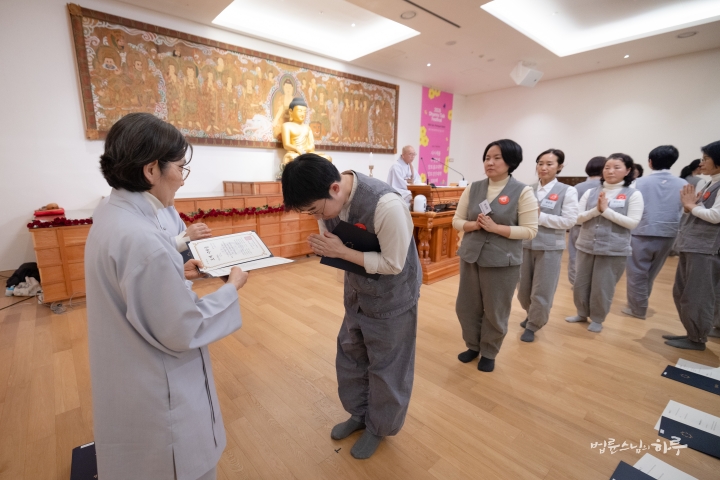
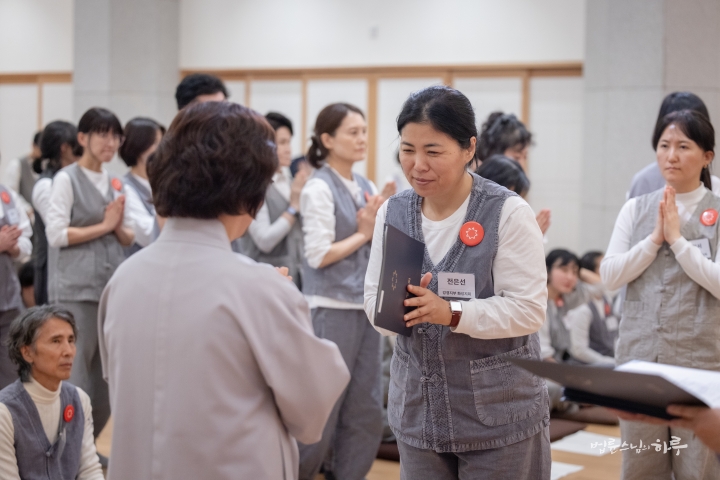
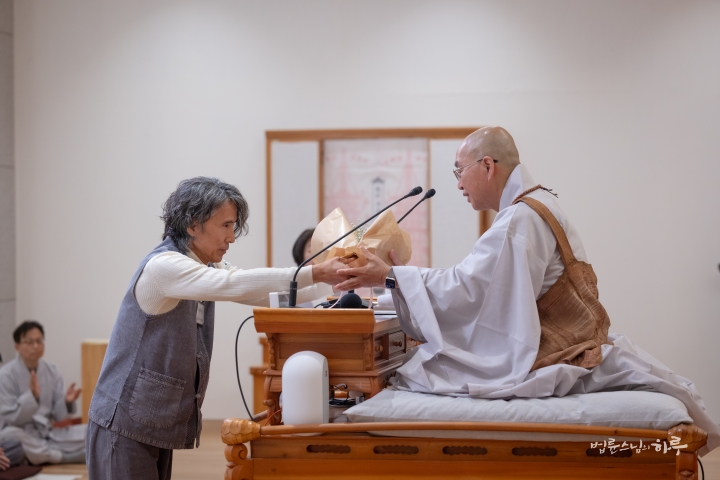
After all the ordinands received their certificates and took their seats, Sunim explained about leading members. The ordained assembly presented flowers to Sunim with gratitude and offered three prostrations for guiding them on the right path.
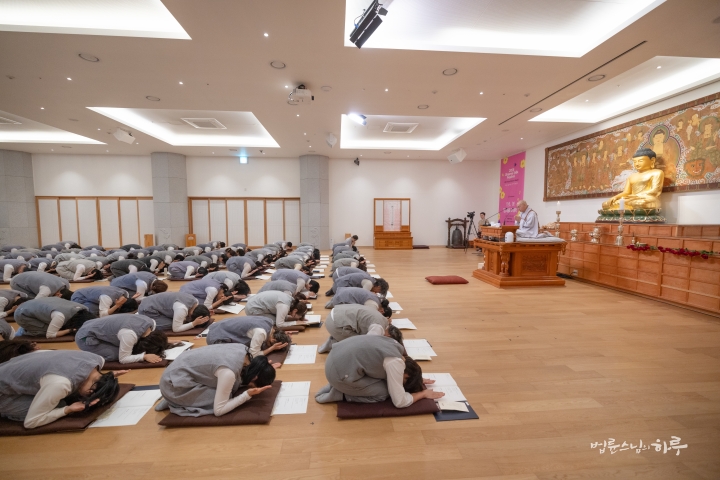
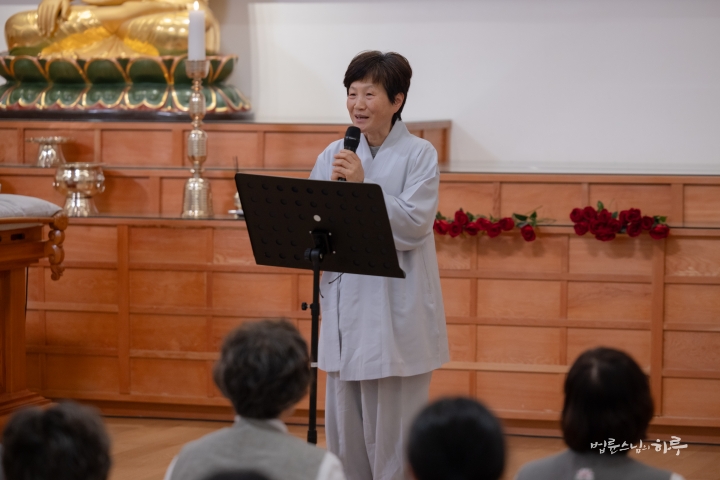
After Dharma Teacher Seonju, the head of the Dharma Teacher group, gave a welcoming address to the newly ordained assembly, the ordination ceremony concluded with the Four Great Vows.
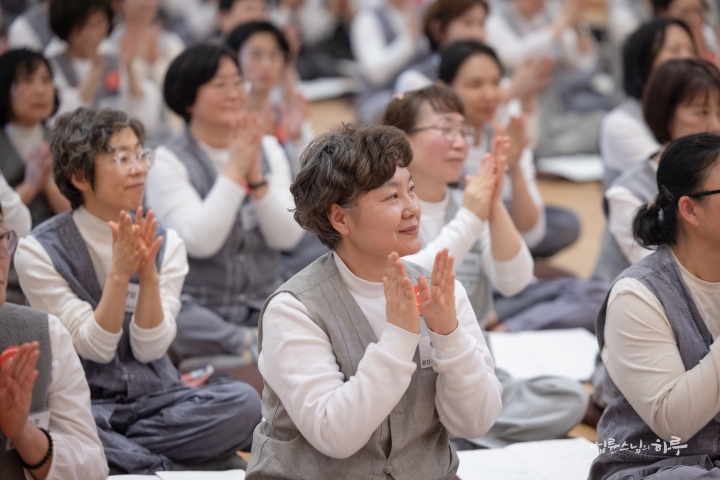
Finally, the ordinands took a commemorative photo with Sunim.
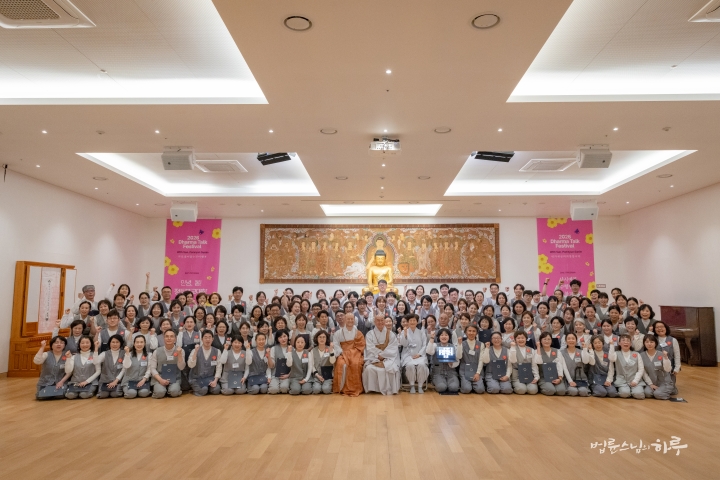
In the continuing second part of the program, participants shared their reflections. Sunim headed to the reception room for a meeting.

At 5 PM, Sunim discussed with the JTS Secretary General how to prepare for the Bhutanese government officials’ invitation event scheduled for late March.

They decided to arrange a program for Bhutanese government officials to visit various sites in Korea where eco-friendly agriculture, cooperative operations, and community-based self-reliance models are being practiced. They reviewed the itinerary including visits to Hongseong Ecological Community Village, Cheongyang County, Imsil Cheese Cooperative, Silsangsa Temple Rural Community, and Jeju tangerine farms, then concluded the meeting.

In the evening, Sunim participated online in overseas corporation board meetings. At 7 PM, he attended the German Jungto Society board meeting to review and approve the 2025 business report and settlement, as well as the 2026 business plan and budget. Subsequently at 8 PM, he attended the US Jungto Society board meeting to review business reports, plans, and budgets. At 9 PM, he participated in the Good Friends USA and Washington DC Jungto Center board meetings to reflect on the past year and review and approve this year’s business plans. By the time all overseas corporation board meetings were completed, it was 10 PM.
Tomorrow morning, a special Dharma assembly commemorating the 107th anniversary of the March 1st Independence Movement will be held at the main hall of Jungto Social and Cultural Center, and in the afternoon, the 19th Korean Minutemen for Peace and Unification Assembly will be conducted online.