How Can I Suffer Less When Love Leads to Attachment?
Feb 22, 2026 - Dharma Q&A with English Interpretation, Joint Graduation Ceremony for Jungto Dharma School and Sutra Course
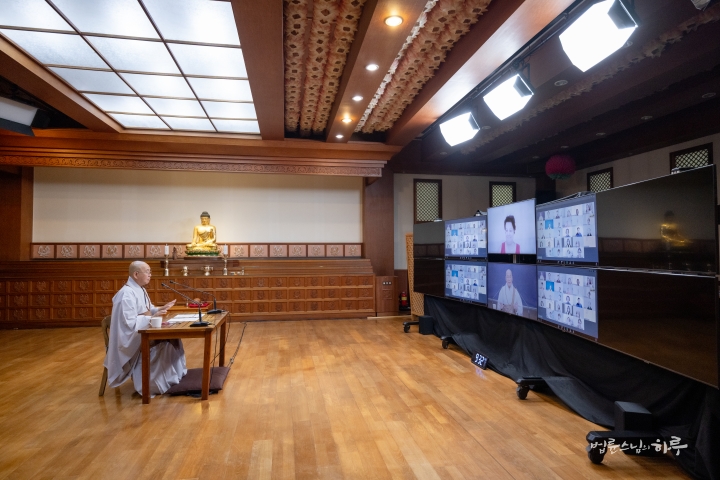
Hello. Starting today, various activities are scheduled in Seoul. Sunim departed from Dubuk Retreat Center(두북 수련원) at 3 AM and headed to Seoul. After a three-and-a-half-hour drive, he arrived at Seoul Jungto Center (서울 정토회관) at 6:30 AM.
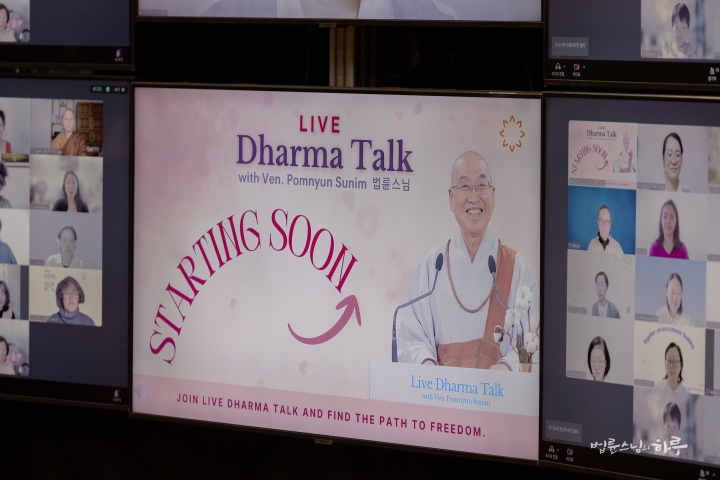
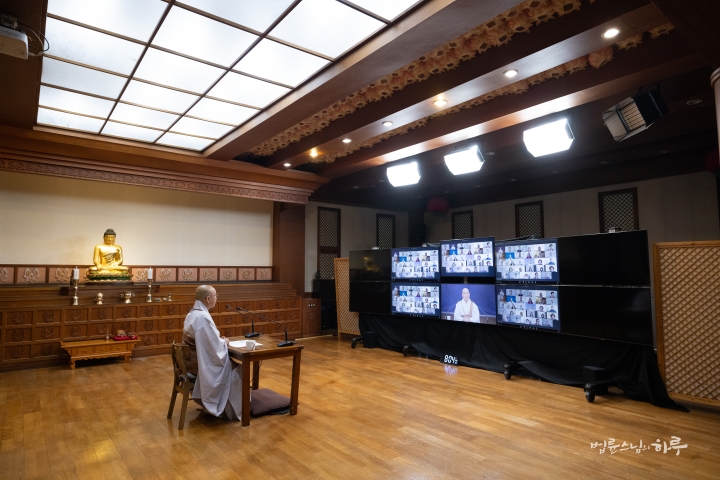
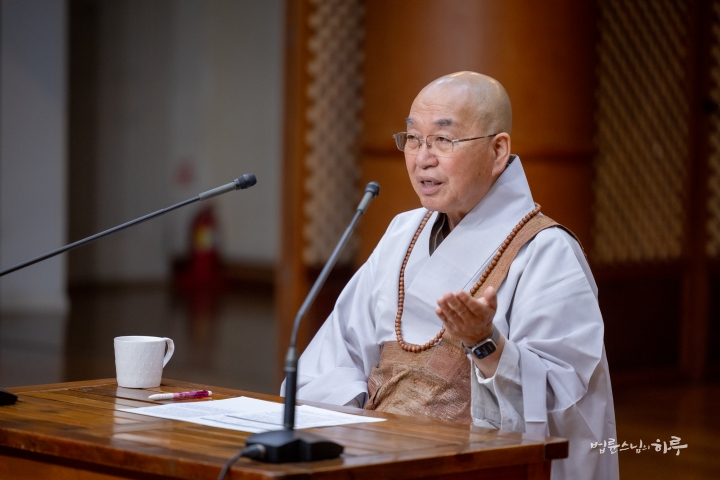
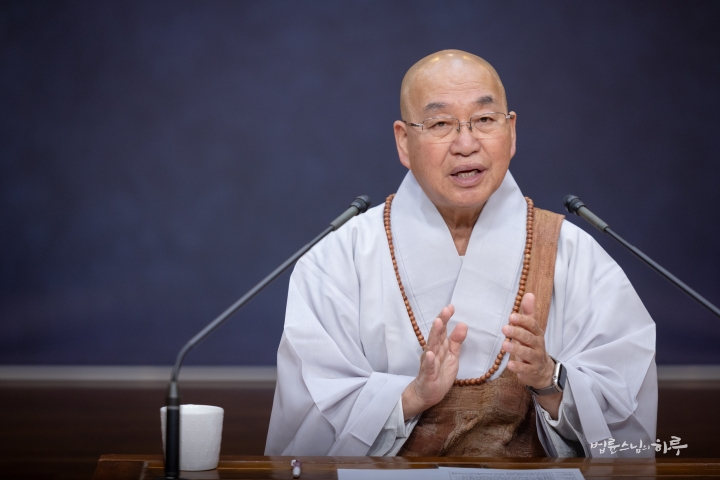
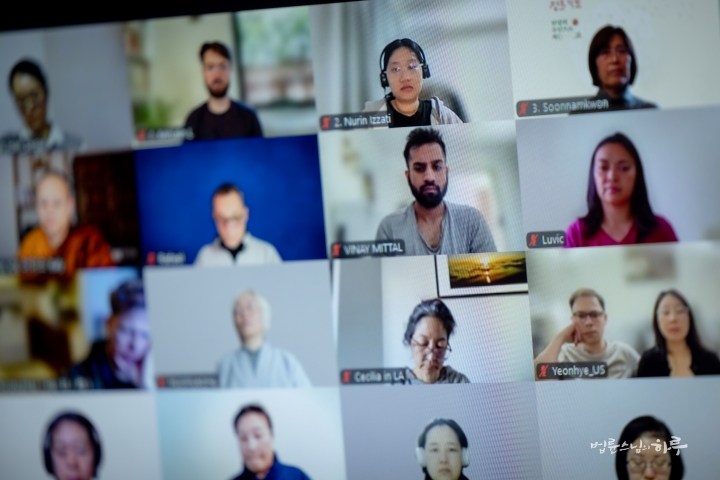
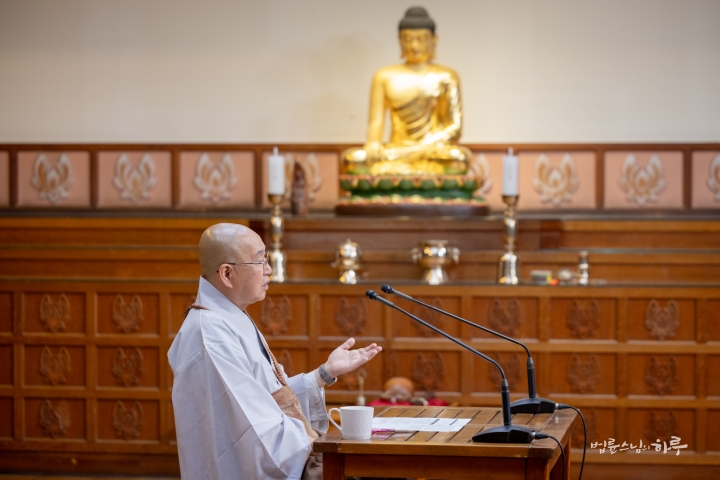
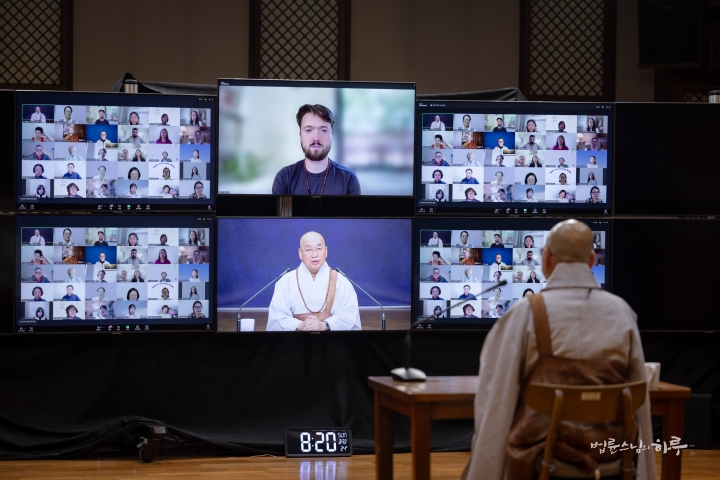
At 8 AM, Sunim took his seat in front of the camera in the broadcasting room at Jungto Center for the Live Dharma Talk. With about 200 English-speaking Jungto members from various countries including the United States, Canada, Europe, and Asia connected to the video conference, Sunim gave his opening remarks.
“Korea has been unusually cold this winter. I don’t know how the weather has been in your areas. However, the cold is now passing, and when I went to the countryside, I saw flowers already blooming despite the sub-zero (영하) temperatures.
Like Flowers in the Snow, Happiness Returns
When winter is bitterly cold, we sometimes wonder, ‘Will spring really come?’ But when the time comes, spring unfailingly arrives. The same is true for our lives. When difficulties pile up, we might think, ‘Will I ever be happy?’ But disasters and suffering eventually pass, just as winter passes. And happiness returns to our lives again.
Last December, a cyclone of unprecedented strength in 100 years struck the Indian Ocean region, causing severe damage in Sri Lanka, Indonesia, and other areas. In the Aceh region of Sumatra, landslides occurred that completely buried villages and farmland. The Aceh region is known as home to conservative Muslims and has a history of fighting for independence from Indonesia. Perhaps because of this background, the region has been neglected by the international community and relatively marginalized within Indonesia. When I visited the affected areas, there was almost no external support. So I personally visited the region to assess the situation and provided emergency relief several times. Let’s watch a short video of my visit to deliver relief supplies.”
A video was then shown of Sunim’s emergency relief activities for flood victims in Indonesia last January.
After the video ended, Sunim continued speaking.
“Did you watch the video well? Your small contributions became great help and strength to those people. There are many people in difficult situations in places we don’t know about and can’t see with our own eyes. Even if we save just a little of the money we use conveniently and donate it, it becomes significant help that enables them to sustain their lives. Your donations are being used so preciously like this. Once again, I deeply thank you.”
Those who had submitted questions in advance then took turns asking Sunim questions. For one hour and forty minutes, five people asked questions and had conversations with Sunim. One of them shared concerns about how the more they love, the greater their attachment becomes, ultimately leading to more suffering, and asked how to handle this.
How Can I Suffer Less When Love Leads to Attachment?
“This week’s Wednesday Dharma talk on breakup really resonated with me, because when I love someone, I tend to become deeply attached. You said that we simply need to feel the pain of a breakup, and there is no other way around it. As a monk, you don’t live within romantic relationships, so I wonder how you can offer such wise and comforting advice. Do you experience similar forms of attachment and loss in other ways? Or does your insight come from deep observation, meditation, or something else? I’m curious how this kind of wisdom is gained, and how I might learn to suffer less.”
“How we can be free from suffering is the core of Buddha’s teaching. Whether it’s romantic love or family affection, psychologically they are all similar. While there are slight psychological differences depending on each situation, these differences are very small and the commonalities are far greater. It’s like how we think humans and chimpanzees are completely different, but when we compare their genes, 99% are the same and only 1% is different. When we like something and become attached to it, whether the object is a person or a thing, and whoever the person might be, there are fundamentally far more commonalities, and the differences that appear in each case are very minimal. When trying to break free from any attachment, if we discover these commonalities—in other words, if we look deeply into the causes of attachment—we can become free.However, to help others with their suffering, discovering commonalities alone is not enough. We must be able to examine the differences, the specific aspects of each case, before we can truly help others. To express this in Buddhist teaching: We think that every being has an essence that makes it necessarily what it is. But in fact, there is no such essence. In early Buddhism, this is called ‘non-self’ (무아 :無我-anatta), and in Mahayana Buddhism, it’s called ’emptiness’ (공 : 空 -śūnyatā). When we realize that ‘all dharmas are empty,’ our own afflictions disappear. This is called the wisdom of the śrāvaka.However, while people’s suffering is the same in broad terms, there are slight differences depending on the type of suffering and the person. We need to understand each of these differences to properly help others. The wisdom of ‘all dharmas are empty’ that I mentioned earlier is called ‘insight wisdom'(통찰지 : 洞察智 -prajñā), which is the wisdom that frees oneself from suffering. On the other hand, to save sentient beings, we need discriminating wisdom ( 분별지 : 分別智) that comprehensively grasps the problems that vary in each case. This is called ‘the eyes of a bodhisattva’ or ‘the wisdom of a bodhisattva.’What we know through knowledge cannot exceed the limits of what we know. So we only have wisdom to the extent of our knowledge. However, wisdom gained through experience, when much experience accumulates, gives rise to insight wisdom that can predict beyond the experience. Simply put, if you’ve accumulated a hundred pieces of knowledge, you only know about those hundred things. But wisdom accumulated through experience means that if you’ve had a hundred experiences, you don’t just know those hundred things—you can predict most of hundreds of other things as well. In Chinese, this is expressed as ‘the principle has opened up .’ It describes the moment when what you know suddenly expands, and you can see even things you haven’t directly experienced. For example, in the case of a traditional medicine doctor who has treated many people through extensive experience, when experience accumulates sufficiently, they can roughly guess what illness a patient has just by seeing their complexion and hearing their voice the moment they enter. Of course, this cannot be said to be 100% accurate, so they listen to the patient’s story and check the pulse to confirm before treatment, but they’ve already grasped 99% from the moment the patient enters. When experience accumulates to a certain point and crosses a threshold, wisdom opens that allows one to know without having experienced it.
There’s no need to view this as something mystical. Insight is like science. It’s similar to big data. When enough data accumulates, you reach a stage where you can grasp the whole picture. They say that artificial intelligence, once it surpasses a certain stage, can develop on its own. Experts predict that when AI crosses this threshold in the future, it will bring benefits but also pose many dangers. Until now, AI has operated only within the programs created by humans and the information input by humans, but when this accumulates beyond a certain critical point, it will leave human control and begin to work independently, almost like a human. While there are positive aspects, there are also extremely dangerous ones.So when you meet someone and fall in love or break up, instead of thinking “If it feels good to be together, we must stay together” or “If it hurts to be apart, I should meet them again to escape the pain,” you should be able to observe: “This is the feeling that arises when I meet someone” and “This is the suffering that follows when we part.” You should also examine what the cause might be, and if you don’t know the cause, you need to keep investigating it by meeting new people and parting from them. You must study, as if conducting academic research, how your mind moves in meetings and partings with people, and what causes these feelings and suffering. After experiencing this several times, you can understand the principles of how the mind works.A practitioner is someone who explores the workings of the mind. From this perspective, one could say that you are greedy and lazy. For example, when raising a child, you want the child to study well, listen to you, and turn out exactly as you wish. Yet you don’t research at all why the child behaves this way or why they resist.
For another example, let’s say you’ve been married for 20 years and your spouse becomes interested in someone else. We typically want our spouse to love only us, or we get angry, or we just cry, but we don’t research why this happened. Yet this is an excellent subject for research, isn’t it? When something unexpected or unusual happens in our lives, it all becomes a subject for research. When this happens, we need to have more detailed conversations with our spouse, talk with the other person involved, and continuously research why this occurred. Through this process, we can discover what problems existed.This is not something to get angry about but rather a subject to research. Once the research reveals the cause, we can either fulfill the needs that led our spouse to become interested in someone else, or if it’s something beyond our capability, we can wish them well and go our own way. We should make decisions based on the results of our research. It’s exactly like when a car breaks down – we examine the cause of the breakdown and decide whether it’s better to fix it or to scrap it and buy a new car. However, instead of conducting this research, you just get angry and cry, emotionally wasting energy by only hoping they’ll come back.If you adopt this research-oriented attitude and experience about a hundred such cases, you’ll be able to analyze how human psychology works and how it varies depending on the other person. Then you’ll be able to predict how you’re likely to react when something happens to you in the future. When you reach this level, you can say that you know yourself.Instead of constantly hoping for only good results, you need to adopt a research-oriented attitude. Then you’ll develop insight. When you have insight, you’ll be able to make your own choices about any problem. And you’ll also develop the attitude to take responsibility for the results of your choices.
If a middle school student becomes a troublemaker, you could research this and become an expert on youth problems. If you write about it, it could even become a bestseller. If your husband has an affair, you could research this and understand the psychology of middle-aged men. But why miss such good opportunities? Isn’t having a research case much more important than the fact that your husband met another woman? You can see that you have no interest in what’s truly important and are always anxious about trivial matters.A practitioner must always maintain an attitude of observing and researching how the mind moves in each situation. When you have a research mindset, the results of any situation don’t come to you as suffering. ‘This approach doesn’t work. What’s the cause? Then shall I try that way?’ When you always maintain this research attitude, the matter no longer comes to you as suffering.”
“Thanks for the perfect answer.”
Questions continued to follow.
As various questions and Sunim’s answers continued, it became 9:40 PM and the dialogue came to an end.
Sunim’s throat had been swollen for several days, and his health had not recovered. Although he managed to give the Dharma talk, it seemed difficult to continue with another talk in the afternoon. So even though it was Sunday, he went to a hospital that was open and received urgent treatment. After finishing the treatment, Sunim returned to the Jungto Social and Cultural Center.
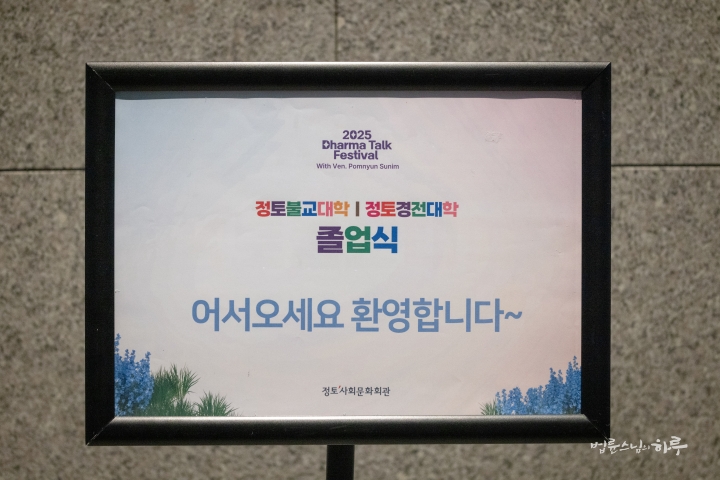
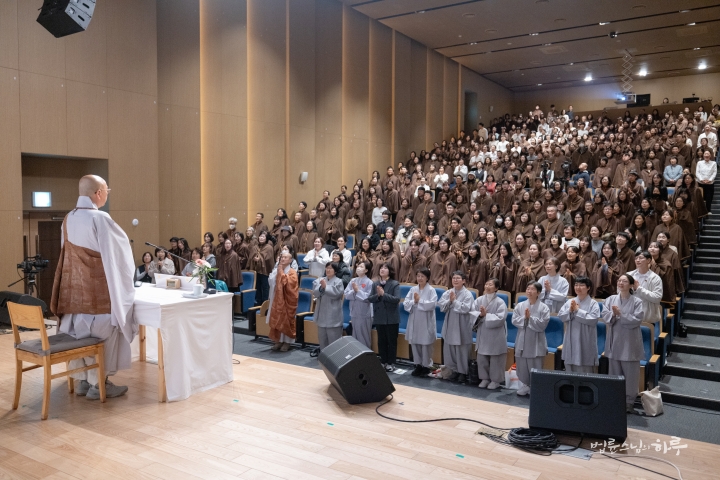
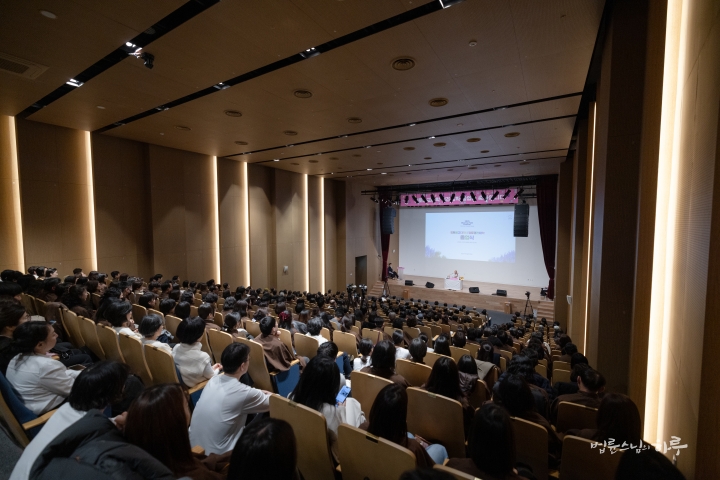
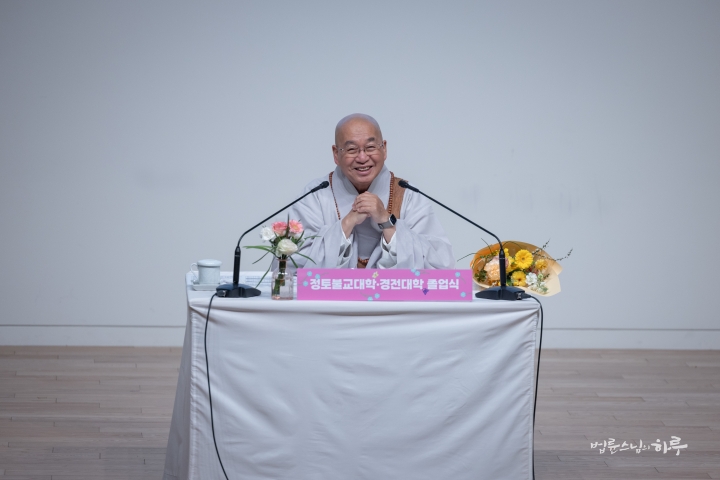
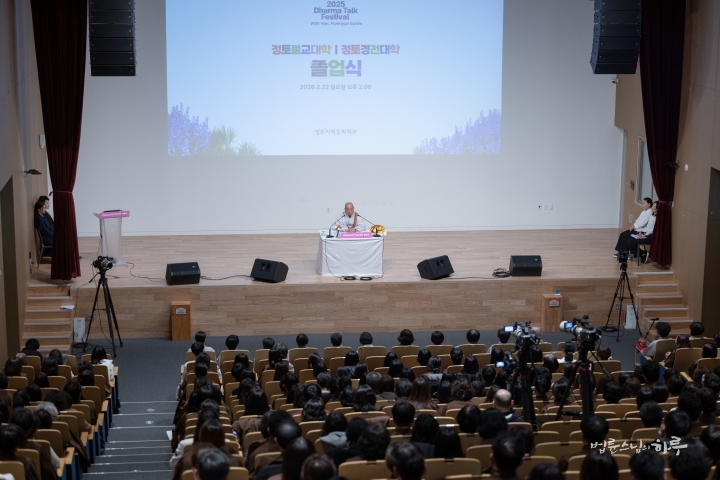
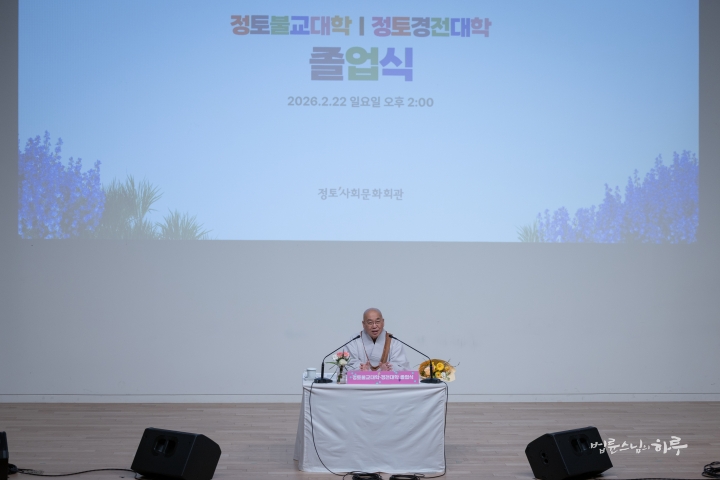
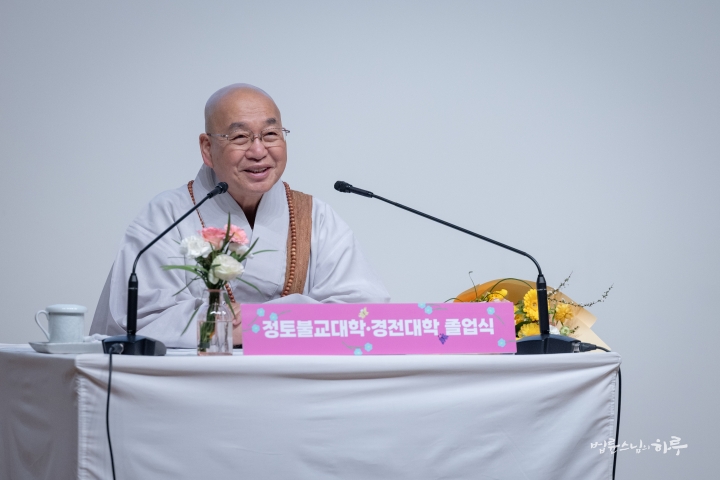
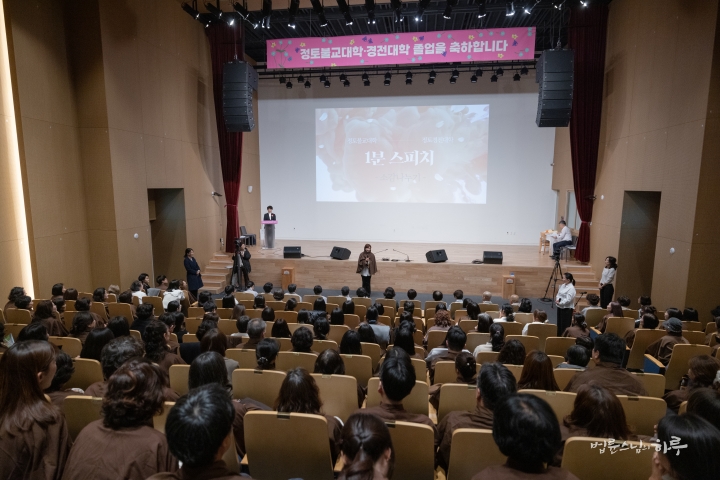
From 2 PM, he attended the joint graduation ceremony for Jungto Dharma School and Sutra Course held in the underground auditorium.
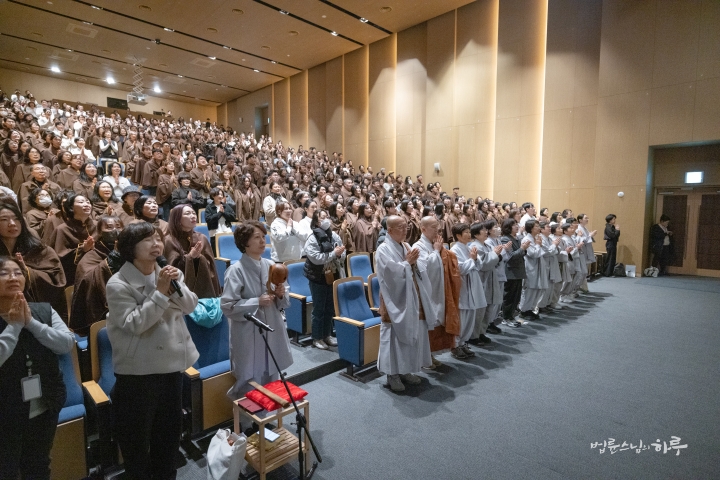
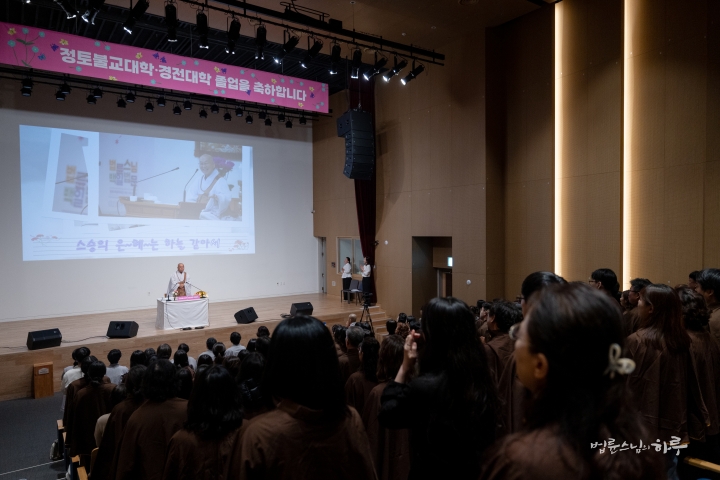
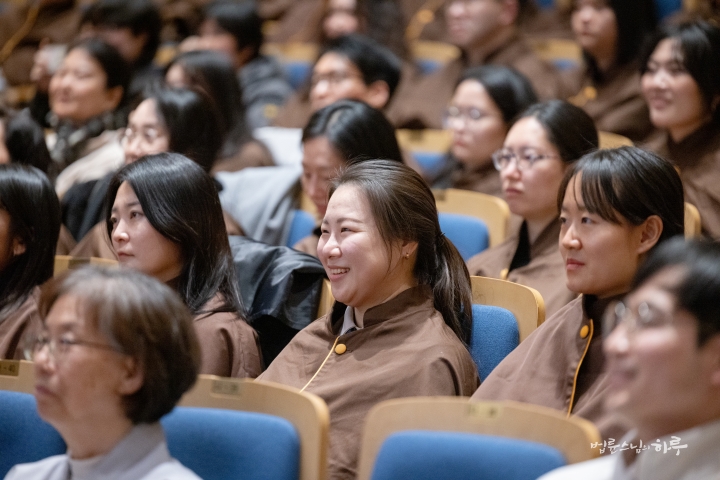
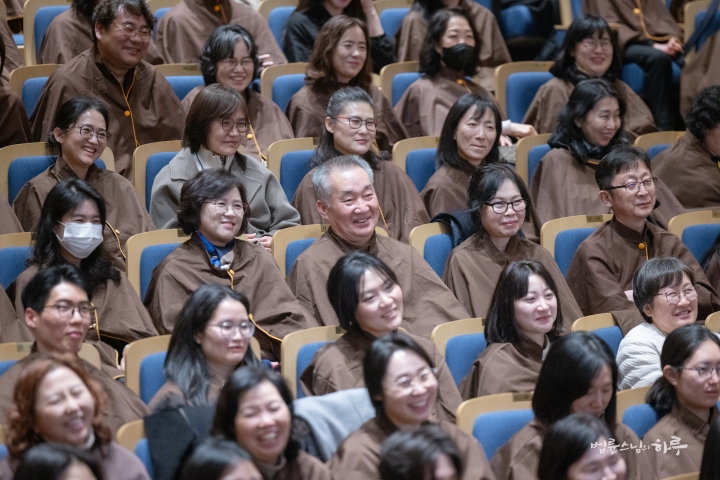
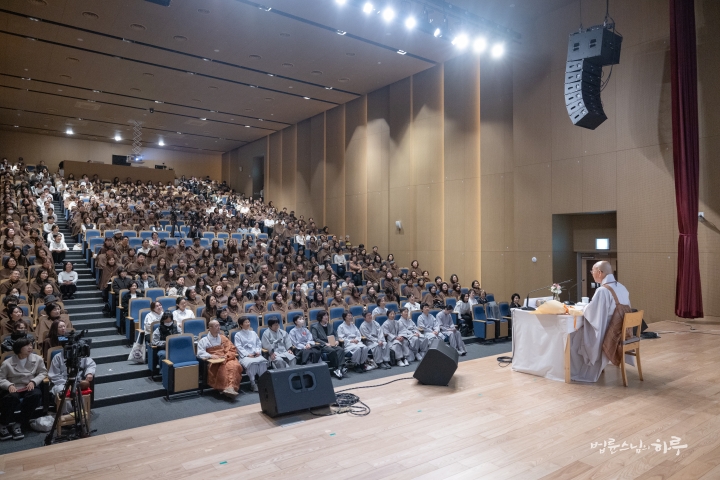
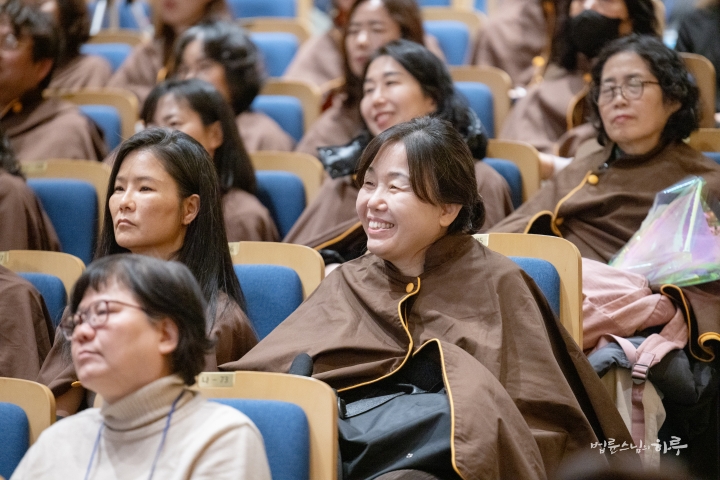
Today is a meaningful day marking the completion of five months of study and the beginning of a new journey. About 400 people, including offline class graduates and online class perfect attendance award recipients, filled the underground auditorium.
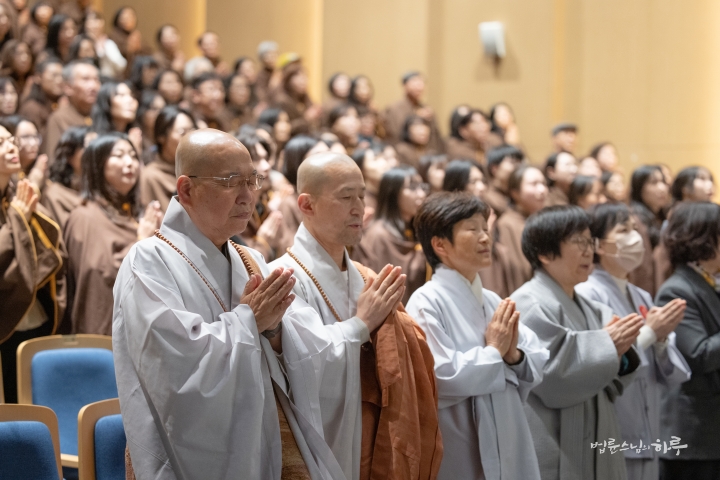
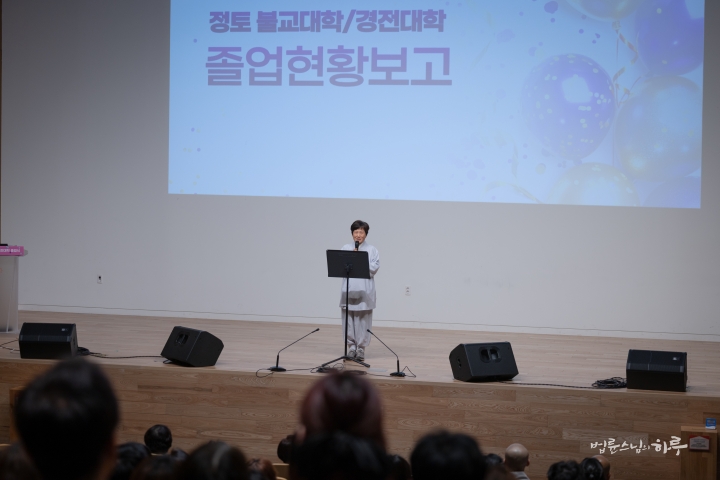
After reciting the Three Refuges (삼귀의) and Words for Practice (수행문), Dharma Teacher Seonju (선주 법사님), the head of the Dharma Teacher group, gave congratulatory remarks and reported on the graduation status.
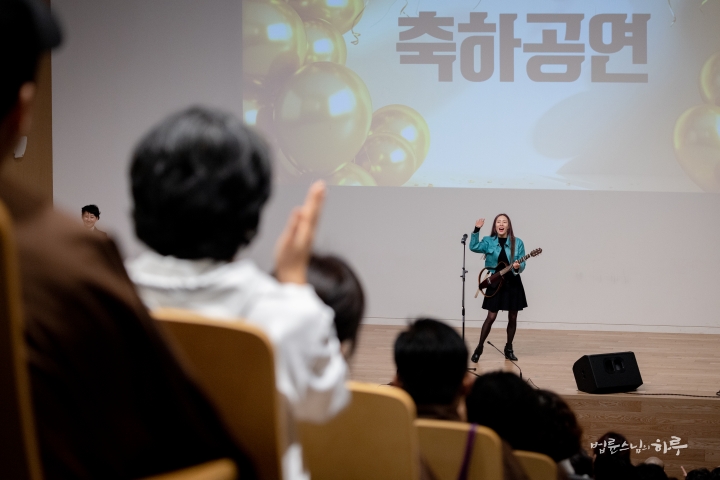
Next, as a congratulatory performance, Shin Soo-yeon (신 수연), an offline Jungto Dharma School student, sang Cho Yong-pil (조 용필)’s “Short Hair (단발 머리)” energetically and received great applause.
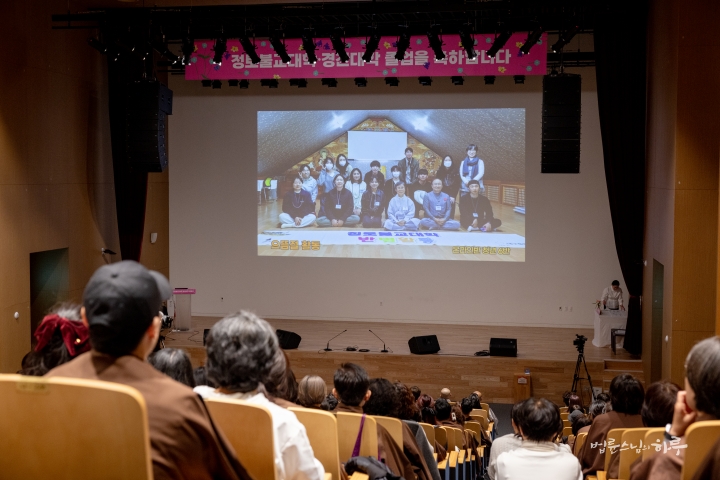
Next, everyone watched a video titled “Our Story” looking back on the past five months of Jungto Dharma School and Sutra Course.
Meeting each shining face of the graduates filling the screen one by one was deeply moving. It was a heartwarming time as the past five months of laughing and studying together flashed by.
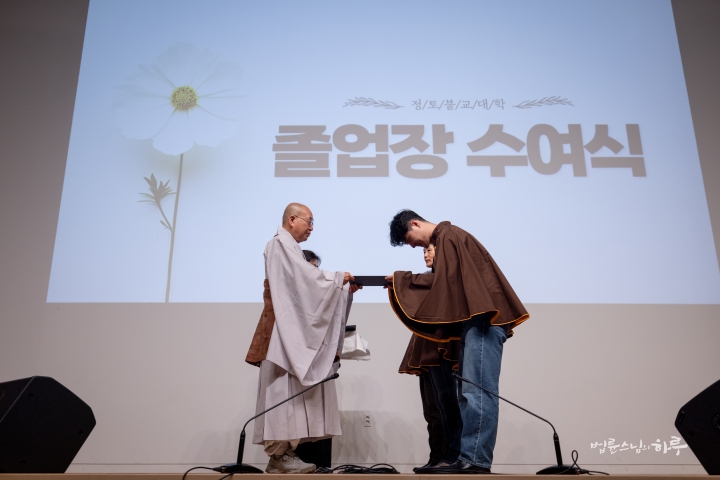
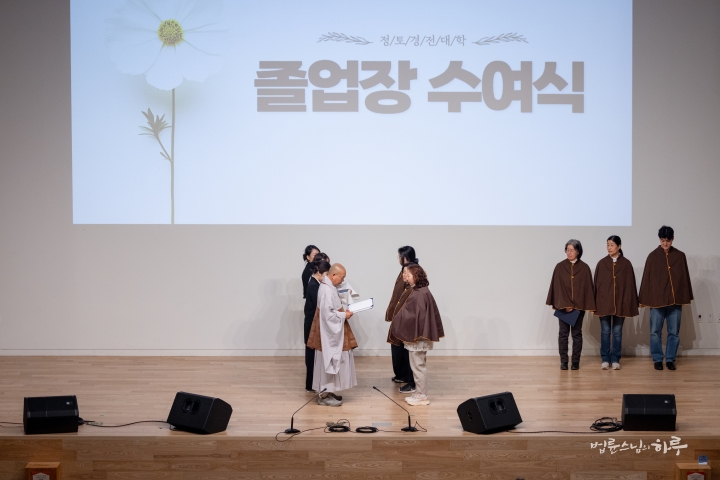
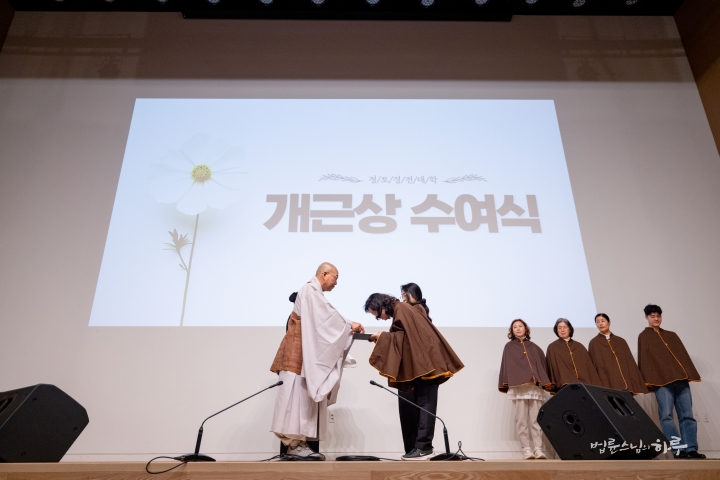
Next was the diploma presentation ceremony. This year’s Jungto Dharma School graduates total 1,482, including those overseas. The Jungto Sutra Course graduates total 886, including those overseas. The awards were presented by Venerable Pomnyun Sunim, the dean of Jungto Dharma School.
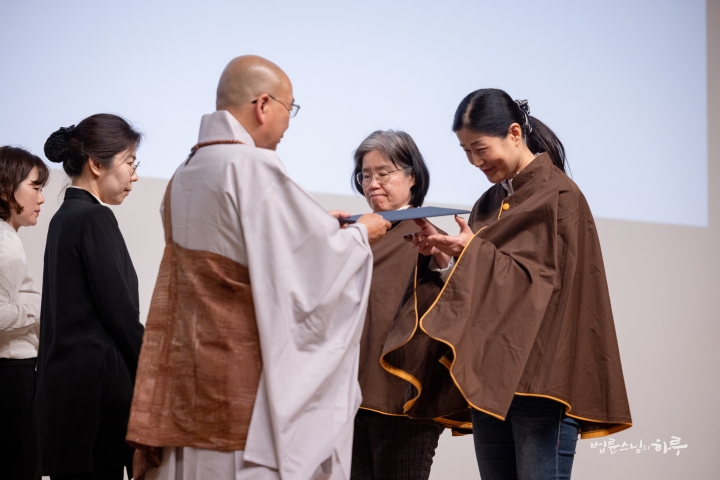
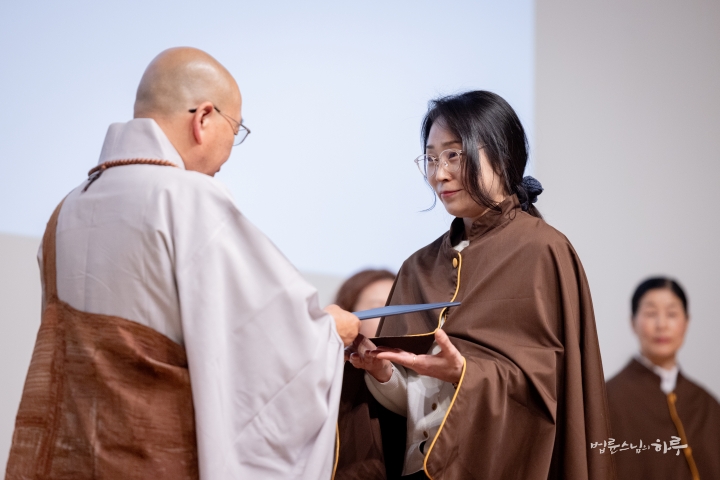
As the representative recipients came up on stage, Sunim presented the diplomas and offered handshakes.
Next, perfect attendance and regular attendance awards (개근, 정근상) were presented to each representative recipient.
Finally, there was time to present diplomas, perfect attendance awards, and regular attendance awards to the Dharma School graduates participating online. When Sunim said “Congratulations on your graduation,” everyone responded “Thank you” and received their certificates.
Next was the Sutra Course diploma (경전대학 졸업장) presentation ceremony. As the representative recipients came up on stage, Sunim presented the diplomas and offered handshakes.
Next, perfect attendance and regular attendance awards for the Sutra Course were presented to each representative recipient.
Finally, there was time to present diplomas, perfect attendance awards, and regular attendance awards to the Sutra Course graduates participating online.
“Congratulations on your graduation.”
“Thank you.”
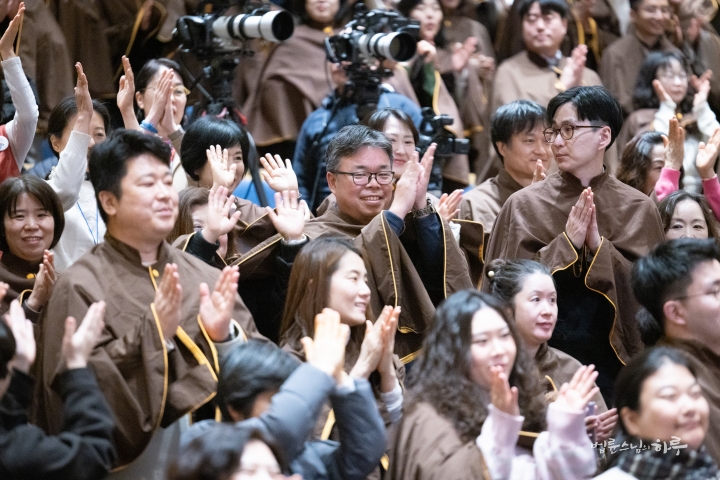
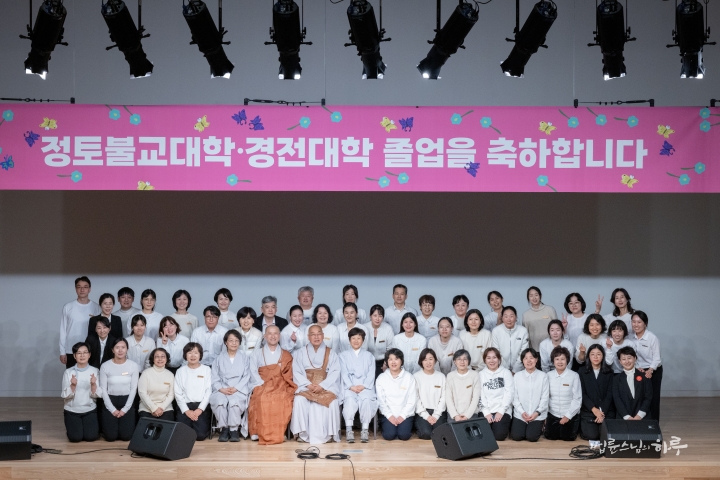
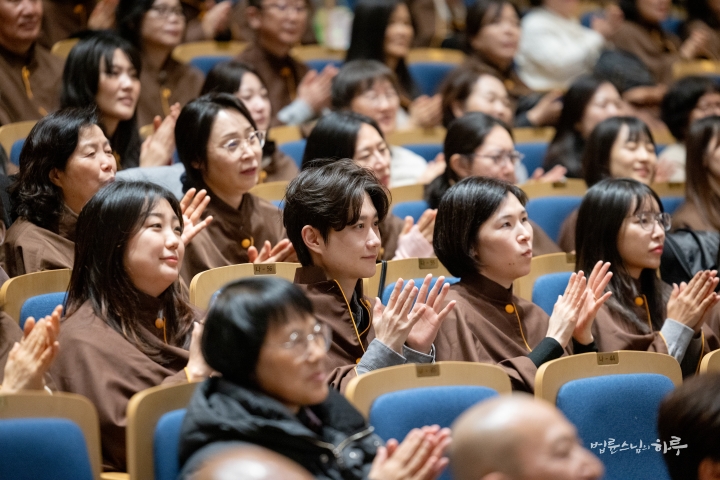
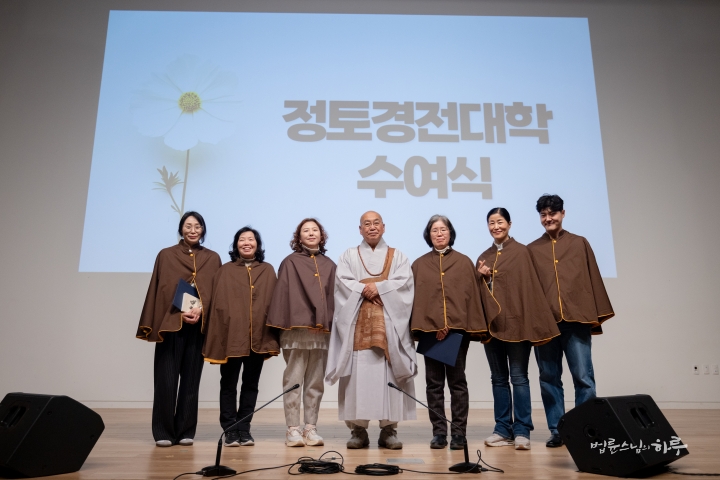
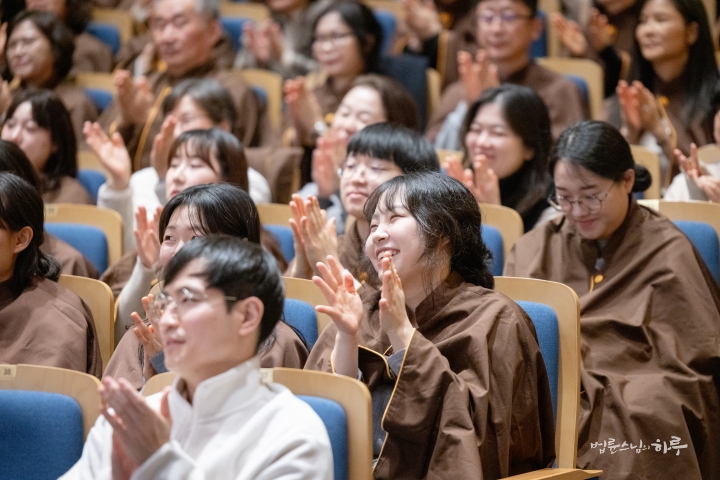
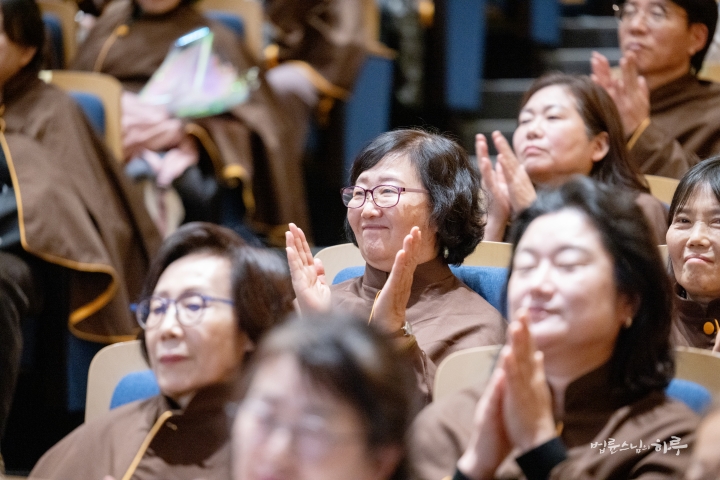
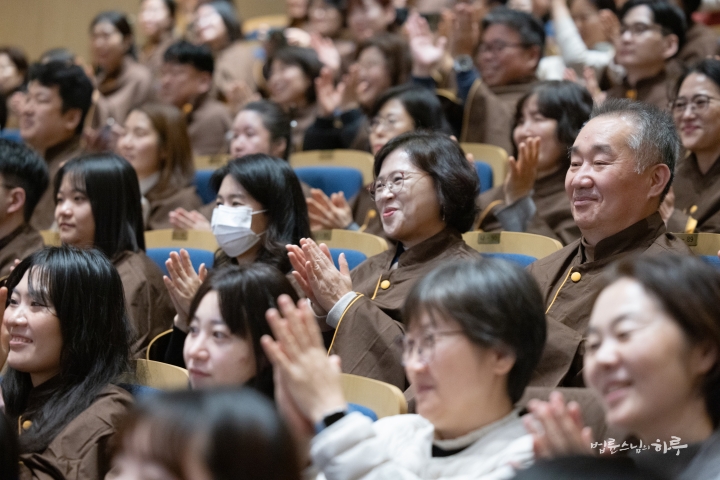
Next, the representative recipients gathered in the center of the stage to take a commemorative photo with Sunim. The audience also gave congratulatory applause to each other for graduating from Jungto Dharma School and Sutra Course.
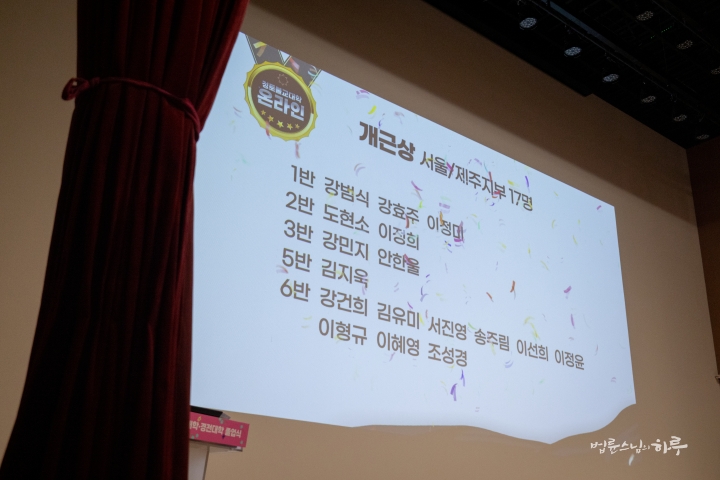
Next, they viewed on screen the list of 197 perfect attendance award recipients and 190 regular attendance award recipients from the Dharma School. They also viewed the list of 118 perfect attendance award recipients and 112 regular attendance award recipients from the Sutra Course.
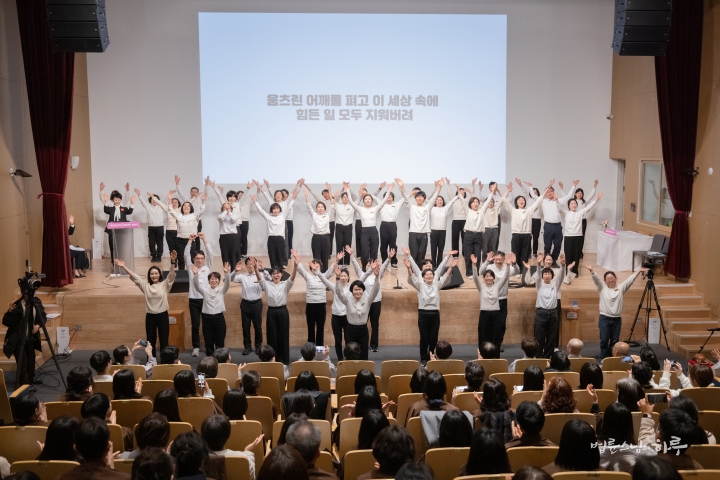
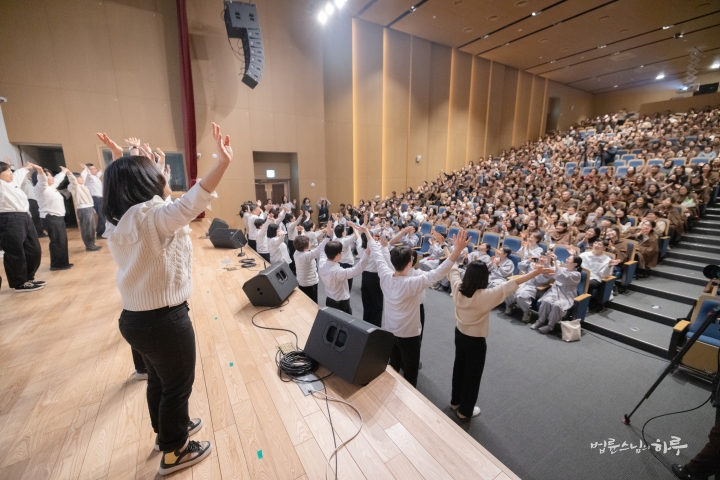
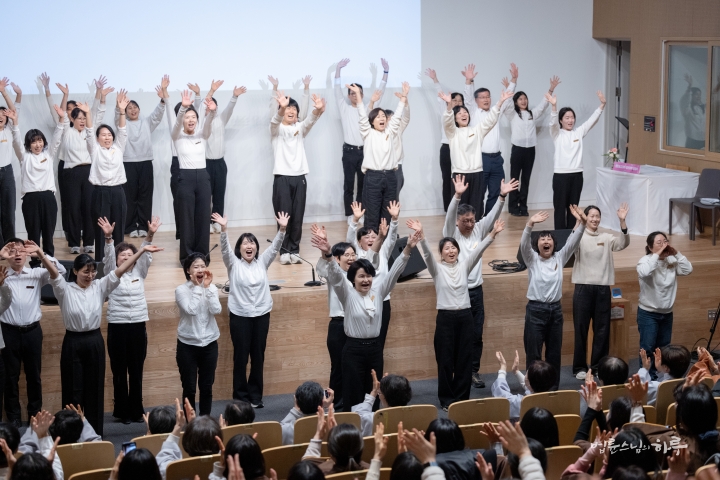
Next, the volunteers who spent five months with the graduates presented a congratulatory performance for the graduates. As an exciting dance performance unfolded to Uhm Jung-hwa’s “Festival,” everyone gave loud applause and cheers.
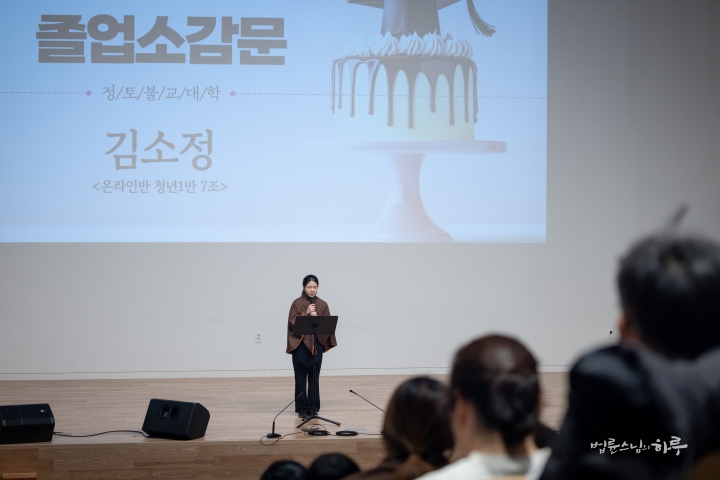
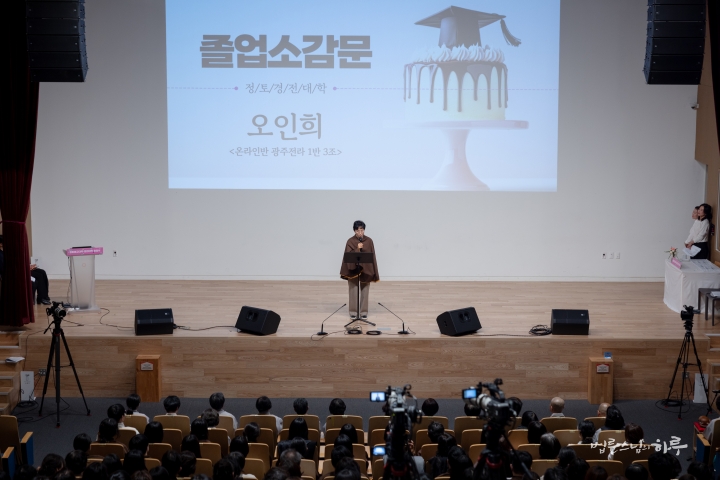
With this unique and wonderful performance, the graduation hall instantly transformed into a festival venue. Amid thunderous applause, there was time to hear graduation reflections from four people who experienced life changes while attending Jungto Dharma School and Sutra Course.
“Through sharing, as I revealed more of what I wanted to hide, I was able to embrace my childhood self, thinking ‘Ah, so that’s why.’ When I realized that my parents were also beings with the same suffering, that realization became courage. Using practice exercises as an excuse, I spoke the word ‘love’ to my parents for the first time. After that, my skepticism of ‘What’s the point of me changing?’ transformed into the conviction that ‘The world changes when I change’…”
“I began to see myself confining others within images I had created – thinking parents should be this way, teachers should be that way, clergy should act like this, at least humans should do this much – and criticizing and getting angry whenever they stepped outside those images. I hadn’t realized this was the result of thinking I was right and others were wrong within the framework I had created. I began to think that there could be ‘some reason’ for anything in the world that I didn’t know about. Coming to Dharma School, I realized truths I had never known in my life, and I wanted to live as a different person than before…”
“While praying, I wanted to follow the Buddha’s life and get even a little closer, but the way I had lived seemed so far removed that I felt deep frustration. However, by repeatedly listening to Sunim’s Dharma talks on repentance and continuing to pray, I was able to accept my past self who had lived wrongly and felt myself becoming lighter little by little. Every moment spent with the Sutra Course became warm comfort for my past full of regrets and remorse, and gave me hope and courage that I could live well in the time remaining…”
“If I’m okay now, then all the things that happened in the past and all the people I encountered helped make me who I am today, so they’re all people to be grateful for. My past life of trying to be happy by gaining something was like trying to catch fish on a mountain. I learned that focusing on my mind being okay now, regardless of when, where, or what happens, is most important for freedom and happiness…”
These were moving reflections from four people who looked deeply into themselves and honestly shared their life transformations.
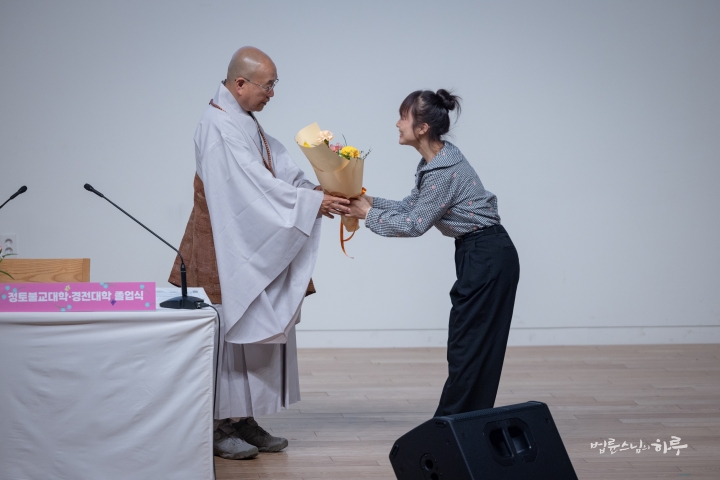
Next, a bouquet was presented to Venerable Pomnyun Sunim with the grateful hearts of the Jungto Dharma School and Sutra Course students. The students also expressed their gratitude with loud applause.
Next, everyone sang “Teacher’s Grace (스승의 은혜)” together with grateful hearts for Venerable Pomnyun Sunim who guided them with the right Dharma. The graduates attending in person all stood up and expressed their gratitude with loud applause.
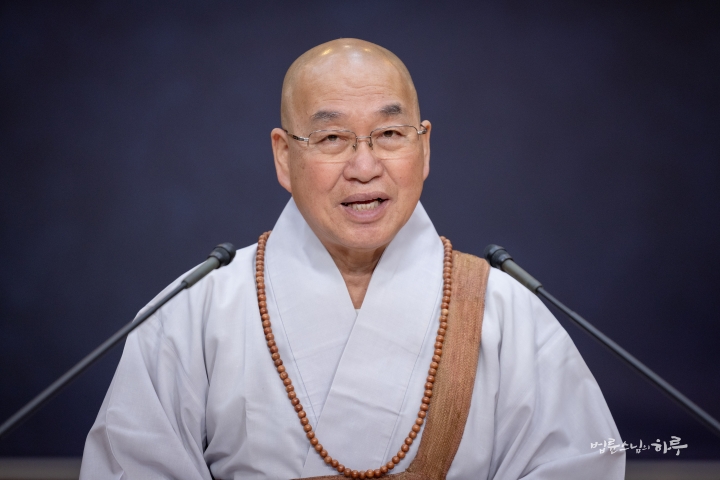
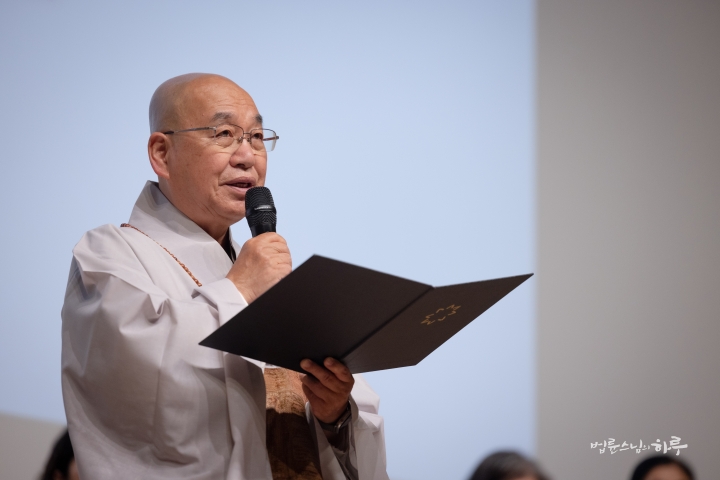
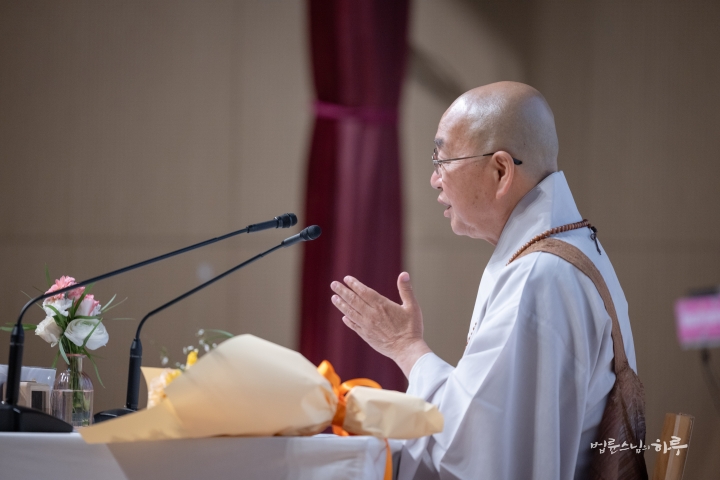
The graduates requested a graduation Dharma talk from Sunim, the dean of Jungto Dharma School and Sutra Course, with three prostrations. Sunim first gave a commemorative Dharma talk for the Jungto Dharma School graduates. He spoke about not wasting energy on suffering, and how living humbly and frugally leads to self-reliance and creates space in life.
“Congratulations on graduating from Jungto Dharma School. I also sincerely congratulate the Sutra Course graduates.As we go through life, we encounter many difficulties. Difficulty is when things don’t work out despite our efforts. When faced with such difficulties, most of you suffer. You get angry, irritated, despair, or complain.
When we say ‘a practitioner has no suffering,’ this doesn’t mean ‘there are no difficult things’ or ‘everything happens by itself.’ It means that while difficulties exist equally, we solve those difficulties without suffering. For example, if a brick falls and injures your head while walking, you go to the hospital for treatment. Suffering doesn’t heal the injury. First get treatment, then investigate the cause to prevent it from happening again. Looking for the cause, it might have been brick debris left from construction, or if a sign fell, it might be because the sign was old. Once you know the cause, you should improve our lives by warning people to replace signs after a certain period, or not to leave dangerous objects like stones or bricks on building rooftops. If you fail an exam, it means you need to study more, so study again. That’s not something to suffer about.Looking at life from this perspective, you can live the ‘life without suffering’ that the Buddha spoke of. However, we use most of our energy to torment ourselves. We should use some leftover energy for others after living our own lives, but we feel we lack energy even for our own lives. Since we use our energy to torment ourselves, we keep asking for help. We ask parents and siblings for help, ask the world for help, and pray to people, God, and Buddha. Since most religions say ‘if you want it, we’ll help you,’ people visit here and there, prefer places that help more, call such places ‘miraculous,’ and flock around wondering which is better. But such people are not self-reliant.
Are You Using Your Energy to Suffer?
Even small insects gnaw on leaves and live their own lives. They don’t say “please help me.” However, they can say “please don’t harm me,” which is why the Buddha taught us not to harm living beings carelessly. All life in nature lives independently and self-sufficiently. Is it harder for a young rabbit to survive in the forest, or for humans to live in this world? The rabbit in the forest has a much harder time. Yet rabbits live well in the forest, avoiding various dangers. They don’t ask anyone for help. But we humans, despite having far greater abilities than rabbits, constantly ask for help. Beings who live by receiving help like this are called sentient beings.Those who can live on their own without any help and even help others – these are bodhisattvas, or practitioners. Practitioners aren’t this way because they have superior abilities. The amount of energy they have isn’t much different. The difference lies in where they use that energy. When people don’t use their energy to torment themselves, they have energy left over. Rabbits neither receive help nor have much ability to help others. But humans have the ability to help, so they can be self-sufficient and also help others a little. When this happens, they become bodhisattvas who practice “benefiting oneself and others (자리이티)” – making themselves and others better off.
Self-reliance doesn’t mean having to demonstrate some special ability. All people are designed to receive help only during their birth and growth period, and once they become adults, they no longer need assistance. This is how all ecosystems work. If someone still cannot be self-reliant, it’s because they have lived foolishly and incorrectly. However, some religions gather these people who cannot be self-reliant and say, “We’ll help you if you want,” which further undermines their self-reliance, makes them more dependent, and makes them even more foolish. This is why there’s a difference between practice and religion. Our very existence is designed for self-reliance, but because of foolishness, we waste our energy on tormenting ourselves, which is why self-reliance becomes difficult.When something doesn’t work out, we can look for different methods instead of suffering. If something has collapsed, we can rebuild it—there’s no need to suffer. Suffering doesn’t make it rebuild itself. Yet most of us waste our energy on suffering. Instead of thinking about rebuilding, we complain “Why are you giving me this difficult task?” or get angry, irritated, or suffer while wasting our energy. Rather, we should use our energy to think “What should I do?” and try again. While it may be a bit difficult at first, self-reliance naturally develops over time. But because you waste most of your energy, you can’t even maintain your basic life well and end up constantly struggling.When we stop wasting energy like this, we can live frugally and humbly. Living frugally and humbly is good for the global environment. Also, since we have surplus even with our current income, we don’t struggle economically. It costs money to show off wherever you go. But when you live humbly, energy waste is greatly reduced. When you live humbly, there are far fewer occasions to get angry or irritated. When you’re arrogant, the world doesn’t acknowledge you, so you always have irritation, anger, and dissatisfaction in your heart. Happiness doesn’t come from something special changing—the key is how you use the energy you currently have. You waste energy tormenting yourself as if taking out loans from a bank to buy luxury goods, do drugs, and smoke cigarettes. That’s why you always become a debtor who has to ask for help.However, when you live life from a humble and frugal perspective, the energy you have is more than enough for yourself with some left over. This doesn’t mean abandoning yourself. Because you have surplus, you can help others a little when they need it. There’s no need to interfere by offering help when no one asks for it. It means eating a little less of your own meal and sharing it. Why would you give food to someone who doesn’t want to eat? When someone says “I’m hungry,” you can give them a spoonful of the rice you were eating. Because you can survive even with one less spoonful.
As you gradually grasp these teachings, you will come to realize how precious your life is. You will be grateful for waking up alive in the morning, grateful for the air you can breathe, grateful for the food you can eat, and grateful for having a car to take you places. When such feelings take root in your heart, your face will naturally brighten.This is not an era where it matters which religion or philosophy you follow. What matters is that your life becomes whole. When you’re alone and still, you feel anxious, don’t you? That’s because your life is not complete. You should be able to be alone and still without feeling anything wrong. That comes first. Being “busy” means you have many roles and there are things that need you. If you’re needed, you should do it even if it means losing sleep. On the other hand, being “idle” means no one needs you. Then you should enjoy the idleness instead of wandering around looking for something to do. Ancient sages expressed this as “When water meets a cliff, it becomes a waterfall; when it meets a lake, it rests in stillness.” This means living according to conditions. You don’t complain about being so busy you could die, nor do you say you’re so bored you could die. You don’t say which is better. You simply live as conditions arise.Through the Jungto Dharma School, you have studied how our minds work, why suffering arises, and how to become free from suffering. By studying the Buddha’s life, you saw how one person lived without suffering and spread the path of freedom from suffering to people in the world, giving you the confidence that “I can do this too.” Please don’t let your learning end here, but continue to verify and practice it in your daily life.”
Following this, Sunim gave a commemorative Dharma talk for the graduates of the Sutra Course.
“In the Sutra Course, you have studied mainly Mahayana Buddhism among the various Buddhist traditions. Mahayana Buddhism is a curriculum that delves deeper into the study of the mind. After studying the mind, everyone naturally comes to think that helping others is better than harming them. However, as time passes, this becomes a fixed rule: ‘One must help others.’ When it becomes fixed like this, side effects arise. This is because those who don’t help others are viewed as bad people. Helping others is a choice. While it’s good to help, not helping doesn’t make someone a bad person. In this way, Mahayana Buddhism is a teaching that breaks through when the teachings of Theravada Buddhism become conceptualized. It breaks the perspective that there is some fixed truth. There is no truth that is fixed as the truth. However, this doesn’t mean there is no truth. Truth arises according to causes and conditions. That’s why you studied ‘No Everlasting Abiding Dharma’ in the Diamond Sutra and the concept of ’emptiness (공 : 空)’ in the Heart Sutra (반야 심경). This is what you have been studying.”
When There Is No Fixed Right, the Mind Becomes Free
The most important thing is to apply what you’ve learned in daily life. For example, let’s say there was serious conflict because your husband leaves his clothes anywhere every day. But after studying, you realize it’s all about habits. There is no inherent law about ‘how things should be placed.’ We decided ‘let’s hang clothes on hangers,’ but that’s not absolute. Whether he lived alone since childhood or grew up in poverty, he didn’t live a life of putting clothes in the closet and organizing them – he just took them off and left them anywhere. So it doesn’t change easily. From the wife’s perspective, she might think, ‘What’s so hard about hanging clothes on a hanger?’, ‘Why don’t you hang towels on the towel rack?’, ‘Why do you leave rags anywhere?’ However, while he might be able to do these things when he comes to the temple because he’s tense, at home he relaxes and lives according to his habits. He’s not trying to give his wife a hard time on purpose. He’s just doing what he’s always done. That’s where the conflict arises.When you study the mind like this, you gradually come to understand others. Instead of thinking ‘That person is bad,’ you understand ‘They’re like that because that’s how they’ve lived.’ Here, there are two actions I can take. First, let your husband live according to his habits. If I need to, I can hang up the clothes he’s left out, put towels he’s thrown anywhere on the towel rack, and put rags back in their place. If the benefits my husband gives me are 100, these things aren’t even 1 or 2. But many of you fight over that 1 or 2 and lose the 100. Second, there may be a need to change your husband’s habits. Then send your husband to the ‘Awakening Retreat (깨달음의 장)’ first. (Laughter)
This is how we must either understand, acknowledge, and accept others, or provide opportunities in ways that suit them to help them improve. Being distressed won’t solve anything, nor will fighting. It’s not something that can be resolved by saying it once or twice. In the past, there might have been the option of beating someone into compliance. However, violence is not permitted in today’s society. It’s their habit, their custom, and in some ways, it might be their preference. It’s not right to try to change someone’s preferences through violence. Today, whether a teacher hits a student, a parent hits a child, or an employer hits an employee, it all constitutes school violence, domestic violence, or workplace violence. Setting an example or resolving issues through dialogue is wisdom. To exercise wisdom, there must be no anger in our hearts. Without anger, it becomes easier to understand others and find solutions. Having anger and irritation in our hearts means we’re clinging to the belief that “my way is right.” This makes it very difficult to find new approaches.After studying the scriptures like this, we must now gradually apply them in our daily lives so that changes occur in our own lives. Our studies must become part of us. Through this, we must first become self-reliant, and then learn to share what little surplus we have with the world and our neighbors. However, one person alone cannot make a significant difference. That’s why Jungto Society promotes the movement to become a “Mosaic Buddha,” believing that “when we gather many small contributions of money and effort, they can become a great force.”
Now, those who have graduated from Jungto Dharma School will proceed to the Sutra Course. Additionally, upon graduating from Jungto Dharma School, they can become members of Jungto Society. With membership, they can participate in the Awakening Retreat, go on pilgrimages to sacred sites in India, and join meditation retreats. They can sign up for membership, attend the Sutra Course, or do both. If their schedule is too busy, they can obtain membership later and attend the Sutra Course first. After graduating from the Sutra Course, they can become members and attend the Weekly Dharma Assemblyㅜ(수행 법회) every Wednesday, or continue with other retreats and volunteer work.So those who have graduated from the Sutra Course should not think ‘it’s all over now.’ Please become members of Jungto Society and continue participating in retreats. If you have both time and enthusiasm, please also participate in the leading member (전법 회원) training. Once again, congratulations on your graduation. I hope you will continue your learning and practice steadily.”
The graduates took Sunim’s Dharma talk deeply to heart.
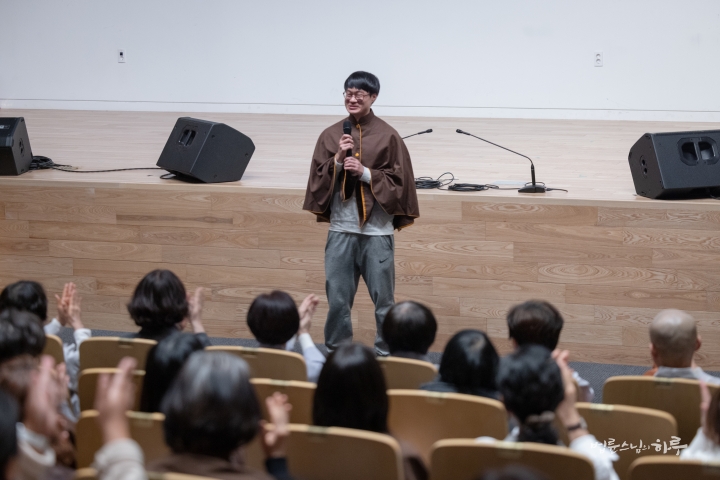
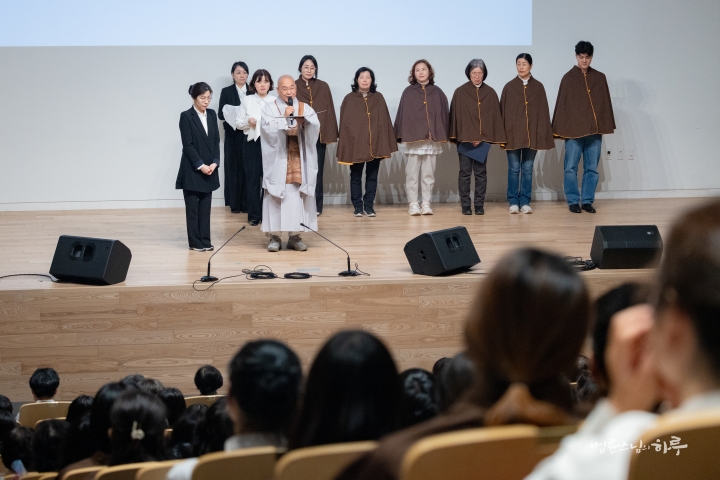
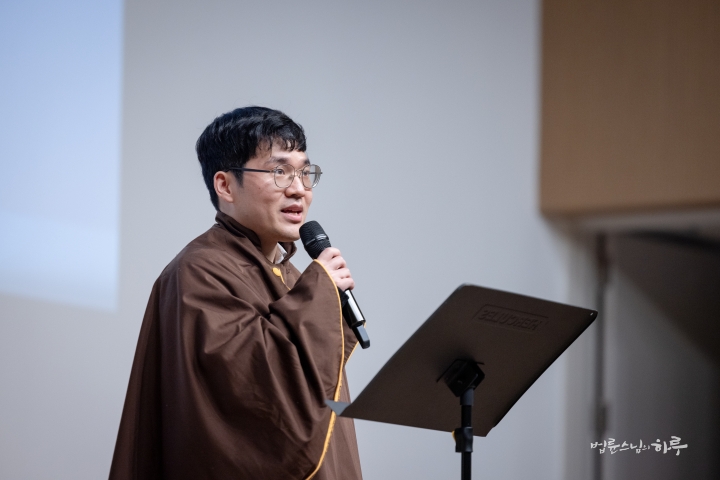
Next was time for one-minute speeches from the graduates. They shared their graduation reflections on site. With microphones prepared below the stage, anyone could come forward and freely share their feelings.
“The saying that having just one good teacher can guide you on the right path – I always think about this while teaching children. I have been able to live truly happily after meeting Venerable Pomnyun Sunim, who is such an excellent teacher. I’ll see you at the Sutra Course.””I’ve been listening to Venerable Pomnyun Sunim’s Dharma talks consistently since 2011, but I couldn’t resolve things on my own, so I came out into the world through the Awakening Retreat. I’m so grateful for guiding me from that dark cave into the bright light. Through Jungto Dharma School, I’ve come to realize that I’m living through everyone’s grace. I’ve matured too late, but I’m so grateful now.”
“I had been thinking of the graduation ceremony as something grand, but listening to Sunim’s words, I started thinking about my current daily life, how to empty the things piled up in my house, and how to steady my mind. Thinking about these things made me feel lighter and more at ease.””Instead of wrestling with Venerable Pomnyun Sunim’s teachings, I wrestled with drowsiness, and before I knew it, I’ve graduated. However, I know that even if I don’t achieve enlightenment, just being able to go through this process together at Jungto Society is a great practice for me. Jungto Society doesn’t seem like a religious organization. It seems like a very important organization that should be established as a government ministry and promoted nationally.” “I used to make excuses because of severe depression and anxiety, but while studying at Jungto Dharma School and the Sutra Course, my depression has improved a lot and my anxiety symptoms have been greatly alleviated. Before knowing Jungto Society, it would have been really difficult for me to speak in front of people with a microphone like this, but I’m so happy to share my thoughts today.”
“I am a Catholic. I asked Sunim about my concerns in New York 15 years ago. At that time, I was worried about my career path, and Sunim told me I could do anything, so I gave everything up and came to Korea to start anew. After that, I went through various hardships in the secular world for 10 years, going from Catholic church to Protestant church, and finally to the Sutra Course. I will make myself a lamp and make the Dharma a lamp to become an awakened person. Amen.”
Many people wanted to share their thoughts, but it was time to conclude the graduation ceremony. They promised to meet again in various programs of Jungto Society after graduation and ended the ceremony with the Four Great Vows (사홍 서원).
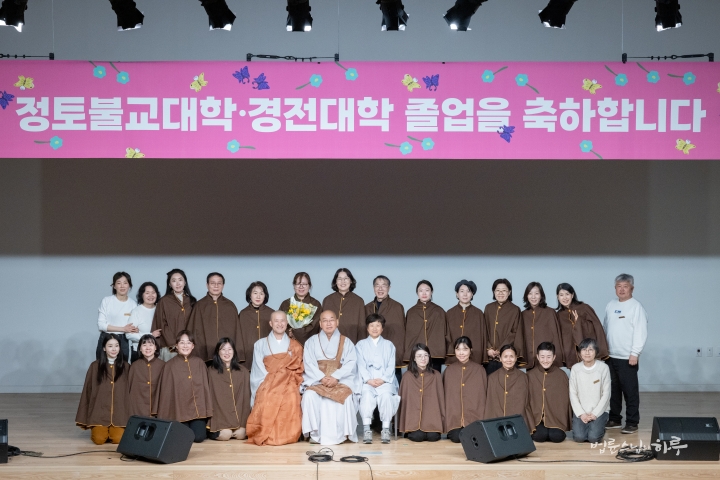
After ending the live broadcast and taking a group photo, they took class photos on stage.
After taking group photos consecutively from online classes to offline classes, they finally took a commemorative photo with the volunteers.
As the sun set, Sunim proofread manuscripts in the evening and went to bed early due to feeling unwell.
Tomorrow, Sunim will attend the board meetings of Seattle Jungto Society and Columbus Jungto Society online early in the morning, conduct a live broadcast of the morning leading members’ Dharma assembly (전법회원 법회), have consecutive meetings with guests visiting the Peace Foundation in the afternoon, and conduct a live broadcast of the evening leading members’ Dharma assembly in the evening.

 “Through sharing, as I revealed more of what I wanted to hide, I was able to embrace my childhood self, thinking ‘Ah, so that’s why.’ When I realized that my parents were also beings with the same suffering, that realization became courage. Using practice exercises as an excuse, I spoke the word ‘love’ to my parents for the first time. After that, my skepticism of ‘What’s the point of me changing?’ transformed into the conviction that ‘The world changes when I change’…”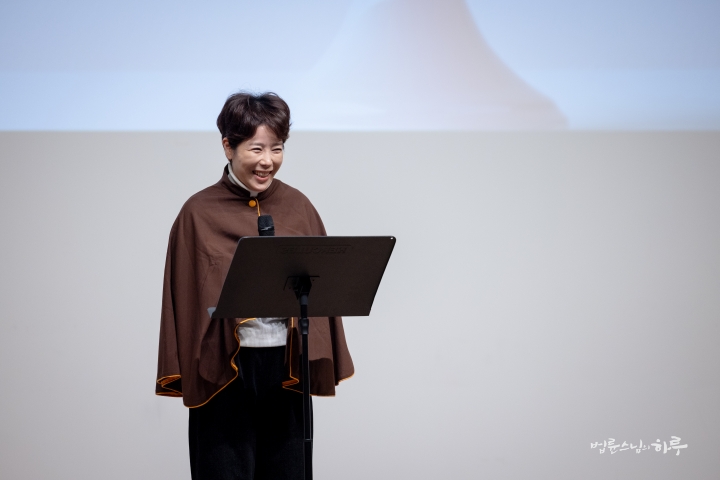
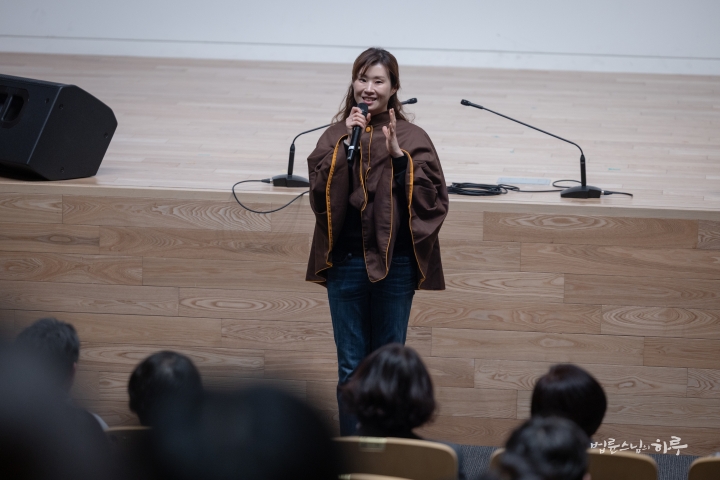 “I had been thinking of the graduation ceremony as something grand, but listening to Sunim’s words, I started thinking about my current daily life, how to empty the things piled up in my house, and how to steady my mind. Thinking about these things made me feel lighter and more at ease.””Instead of wrestling with Venerable Pomnyun Sunim’s teachings, I wrestled with drowsiness, and before I knew it, I’ve graduated. However, I know that even if I don’t achieve enlightenment, just being able to go through this process together at Jungto Society is a great practice for me. Jungto Society doesn’t seem like a religious organization. It seems like a very important organization that should be established as a government ministry and promoted nationally.”
 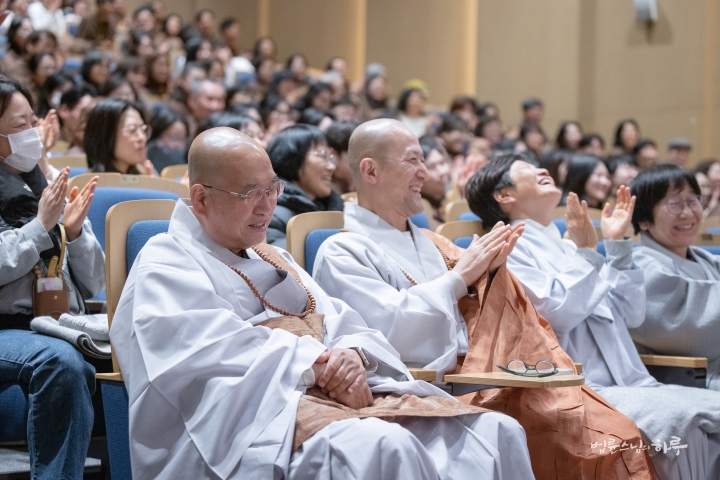 “I used to make excuses because of severe depression and anxiety, but while studying at Jungto Dharma School and the Sutra Course, my depression has improved a lot and my anxiety symptoms have been greatly alleviated. Before knowing Jungto Society, it would have been really difficult for me to speak in front of people with a microphone like this, but I’m so happy to share my thoughts today.”