Why Are We So Desperate About Our Own Problems, Yet Silent About the World’s Suffering?
February 21, 2026, Day 3 of Jeongcho (New Year’s) Prayer, Closing Dharma Talk
Hello. Morning has dawned at Dubuk Jungto Retreat Center (두북수련원).
Today is the third and final day of Jeongcho (New Year’s) Prayer (정초기도). After morning practice and meditation, Sunim headed to the broadcasting room at Dubuk Jungto Retreat Center for Jeongcho Prayer.
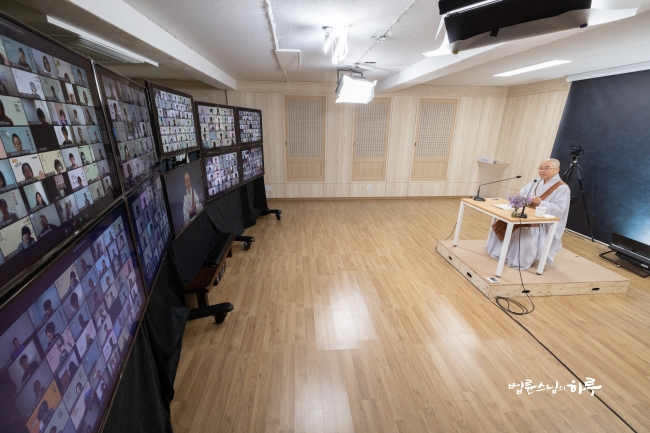
At exactly 10 AM, the third day of Jeongcho Prayer began. Once all Jungto Society members entered the video conference room, the live broadcast started. Today marks the completion of the three-day Jeongcho Prayer. The members of the Sangha requested a closing Dharma talk (회향 법문) from Sunim with three prostrations.
On this final day of Jeongcho Prayer, Sunim emphasized that a practitioner’s earnestness should extend beyond one’s personal desperation to encompass a world free from war, environmental destruction, and discrimination.
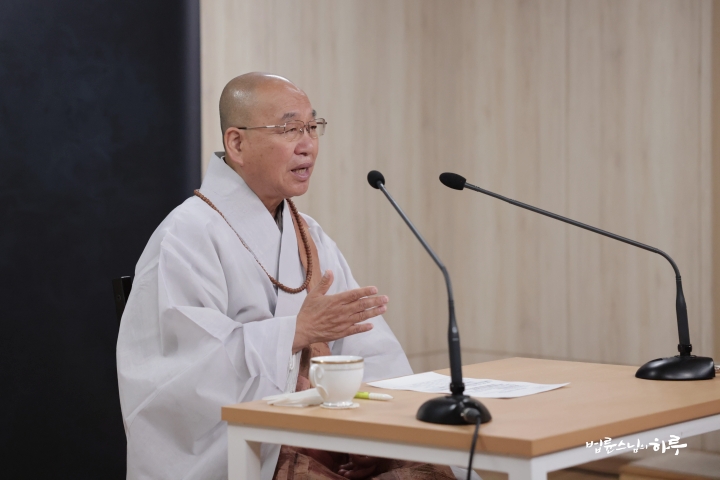
Transforming One Person’s Desperation into Earnestness for All Life
While we become earnest about our own lives or our family members’ lives, our aspiration that ‘there should never be war on this land again’ doesn’t become equally earnest. We especially lack earnestness about preventing the destruction of nature that kills countless lives. That’s why such activities easily fizzle out. Therefore, second, we must never support not only war but also reckless development that indiscriminately destroys the natural environment, and we must earnestly cultivate the desire to preserve nature. We must stop or reduce excessive consumption that emits large amounts of CO₂ in our daily lives. Additionally, microplastics have emerged as a major problem today. Microplastics flow into the ocean, are consumed by fish, and as we eat those fish, they ultimately threaten future life. Therefore, we must minimize plastic use. If we must use it, we shouldn’t throw it away after one use but should use it as long as possible. When we’re done using it, we must collect it for recycling and minimize indiscriminate disposal. While not using it at all would be best, plastic is so useful that it’s not easy to completely eliminate it from real life. Then we must strictly follow the principle: ‘Don’t use it if possible, and if you do use it, make sure to collect it.’ Environmental protection is directly connected to our lives, so we should naturally be earnest about it. However, because we lack that earnestness, our actions become lax and our activities fizzle out.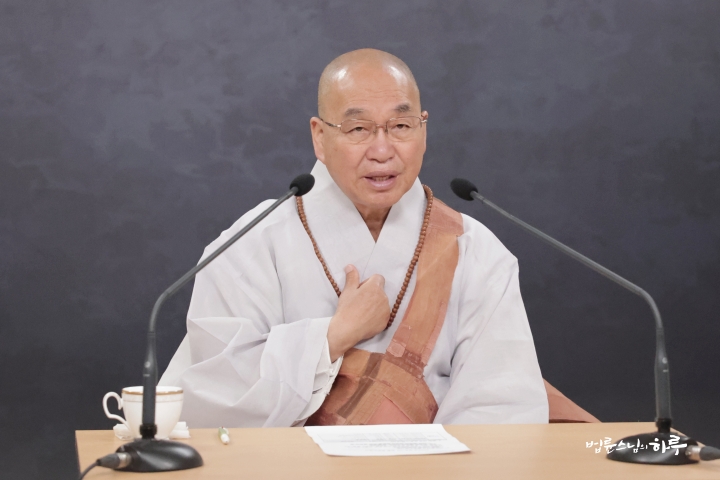
Where Should a Practitioner’s Earnestness Be Directed?
For practitioners, first, they should be earnest in maintaining pure precepts. Second, they should be earnest in cultivating Samadhi (선정 : 禪定) to calm mental agitation and maintain tranquility. Third, they should be earnest in attaining wisdom (지혜 : 智慧) that penetrates the principles of life. When we pray to the Buddha with such earnestness, we say we offer ‘the fragrance of precepts (계향 : 戒香),’ ‘the fragrance of meditation (정향 : 定香),’ and ‘the fragrance of wisdom (혜향 : 慧香).’ Practitioners must cultivate their own character and offer the fragrance of that character to the Buddha. Only when we bow our heads with such earnest hearts can we achieve what we desire. We must be earnest in protecting and sustaining life. We must not carelessly take life. Furthermore, to sustain human life, we need at least the basic necessities—food, clothing, and shelter—so we must not steal or take these from others. Moreover, since humans are not animals, we must not degrade others’ dignity or discriminate against them. These are the basic precepts, and we must be earnest in observing them. This ultimately brings peace and leads to a world without suffering—toward ‘nirvana,’ the Buddhist ideal. The purpose of our earnest prayers is ultimately for all of us to live peacefully and happily. If we thought ‘it’s fine to live however, carelessly,’ we wouldn’t need such earnestness. However, we aspire to a world without conflict, where basic life is guaranteed. We want a society without discrimination based on gender, class, race, physical disability, or sexual orientation. We call a world without discrimination, suffering, and poverty the ‘Pure Land (불국정토)
,’ and we have gathered to create it. We hope not only to become free and happy ourselves but for all of us to live in a world of freedom and happiness. The aspiration of ‘jatailsisung-buldo (자타일시성불도 : 自他一時成佛道)’—’wishing not just for myself but for all beings to attain enlightenment together’—is embedded throughout traditional Buddhism. However, without properly understanding its meaning, it’s easy to fall into thinking ‘as long as I’m doing well,’ ‘as long as I’m comfortable,’ or ‘as long as I’m well-fed.’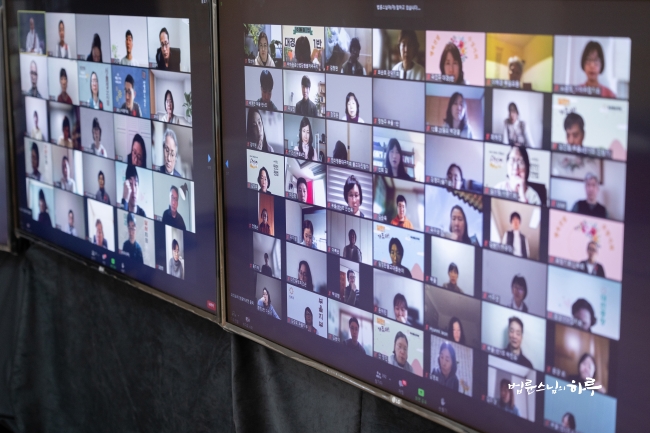
Why Are We So Desperate About Our Own Problems, Yet Silent About the World’s Suffering?
For someone who smokes, buying ‘good cigarettes’ is important. Even if expensive, they worry about ‘how to buy better cigarettes.’ However, non-smokers don’t spend money on cigarettes at all. A person addicted to drugs spends their money on better drugs when they have it. But someone not addicted to drugs doesn’t spend money in that direction. Yet we easily become addicted not only to things like alcohol, cigarettes, and drugs, but also to what we call ‘preferences.’ Someone with a taste for tea will scrimp on other things but buy tea worth several tens of thousands of dollars. A person obsessed with cars buys cars worth hundreds of thousands of dollars. Someone with a preference for coffee seeks coffee worth several thousand US dollar, and someone with a taste for alcohol buys liquor worth thousands of dollars. And they enjoy it while boasting to others. However, practitioners who are not attached to such things don’t feel envious when they see them. Given the same time, money, and abilities, they value ‘the path that liberates me and helps more people become free and happy.’ They find greater fulfillment in peace that prevents war, environmental movements that stop nature’s destruction, welfare activities that help the poor, and volunteer work. This is because they have the aspiration that not just themselves, but everyone should be happy. We practice diligently like this to move toward ‘benefiting oneself and others (자리이타 : 自利利他) – a world that is beneficial for both ourselves and others. The reason your practice lacks earnestness is because this kind of ‘aspiration (원 : 願)’ is insufficient. Because you’re still attached to the small self that thinks ‘mine’ and ‘as long as I’m doing well,’ you only become desperate when you face difficulties. When money is urgently needed, when illness strikes, or when cornered by crisis, you cling desperately, thinking ‘If only you help me, I’ll do anything next time.’ But once the problem is resolved, you quickly become lazy and lose interest. So faith rises and falls repeatedly, making the mind boil like porridge.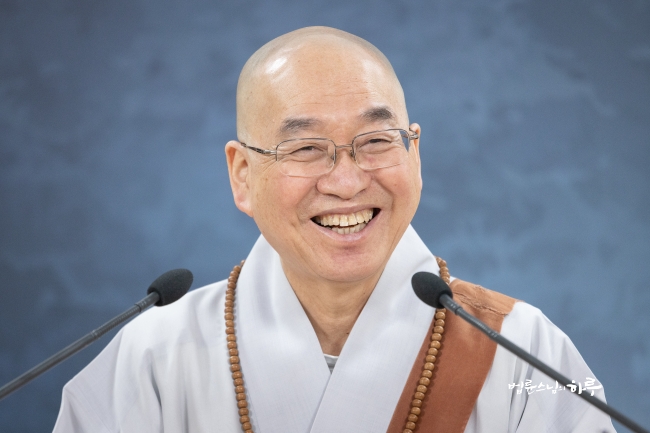
From Prayers for Myself to Prayers for the World
If I am precious, I must know that others are precious too. If my family is precious, I must know that other families are precious as well. If my country is precious, I must know that other countries are precious too. If I don’t want to be discriminated against, I must not discriminate against others. We must have this “interdependent perspective that doesn’t distinguish between self and others,” examining ourselves to understand others, and simultaneously examining others to reflect on ourselves. From this perspective, we must together embrace “aspirations for all.” If war seems imminent, we must work to prevent it. When war breaks out, not everyone can flee. So we must let go of the thought that “I just need to evacuate” and first put our greatest effort into preventing war. If we cannot prevent war despite our efforts, we must strive to minimize casualties, prevent escalation, and work diligently to restore peace as soon as possible. After the war ends, we must work on reconstruction so that those who fled can return, and help with the repatriation of prisoners and treatment of the wounded. Of course, the most important thing is to eliminate the root causes in advance to prevent war from occurring. But if we ultimately fail to prevent it, we must work to keep the war from expanding or prolonging. As situations become more difficult, we must find what needs to be done at each moment and do our best. If we give up because we couldn’t prevent war, that cannot be considered a “genuine aspiration.” People must live, and while alive, they must continue practices that benefit themselves and society, even if just small acts. If we pray consistently in daily life with such earnest aspirations, we can prevent future disasters in advance. Prayers made only during difficult times tend to remain reactive measures. Those who have had such experiences must now move toward “preventive prayer.” We must practice diligently in ordinary times so that disasters don’t occur again. This way, even if difficulties arise again, we will have cultivated the strength to respond immediately. In this sense, Jungto practitioners engage in peace activities that save human lives. They also engage in environmental activities to save all living beings, and work to alleviate the suffering of those in absolute poverty through poverty eradication activities. They are also working to realize social justice to ease the suffering of those who face discrimination. We must always live with consideration not only for ourselves but for others as well. We must not become like frogs who have forgotten their tadpole days. Since we have all experienced childhood, we must understand the situation of children. This doesn’t mean unconditionally taking the children’s side. It means solving problems while understanding their circumstances.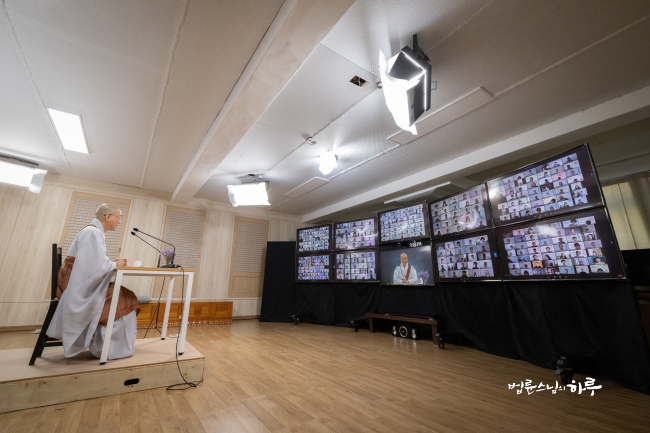
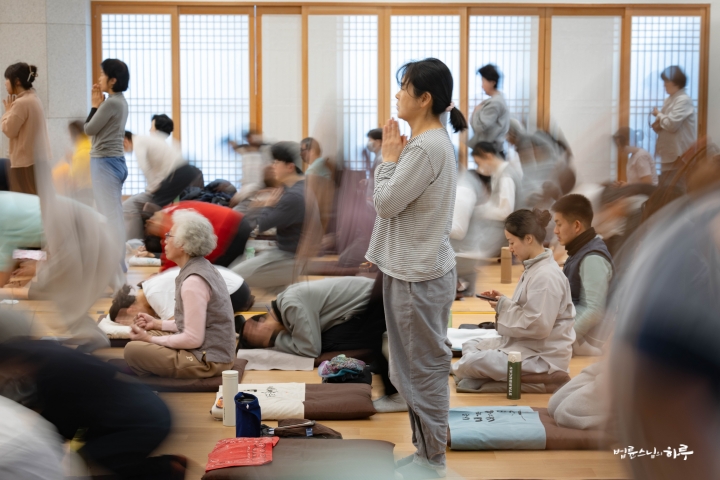
After the closing Dharma talk ended, the members chanted with resounding voices and performed their final 300 prostrations. With each bow, they offered their sincere devotion, praying that their earnest hearts would reach those who are suffering and alleviate their pain.
After completing the practice, participants entered video conference rooms by group for mindful sharing, connecting with fellow practitioners about what they felt during the practice. With this, the Jeongcho Prayer ceremony concluded.
Despite receiving treatment at the hospital yesterday afternoon, Sunim’s throat condition showed little improvement. After the ceremony, Sunim rested again today.
Tomorrow, Sunim will travel to Seoul early in the morning to conduct a live Dharma Talk broadcast for English-speaking members at 8 AM. In the afternoon, he will attend the joint graduation ceremony for Jungto Dharma School (정토불교대학) and Sutra Course (경전대학) at the underground auditorium of Jungto Social and Cultural Center.
“