What Should I Do When Delusions Arise During Prostrations to Maintain Good Practice?
Feb 19, 2026 - Day 1 of Jeongcho Prayer, Opening Dharma Talk
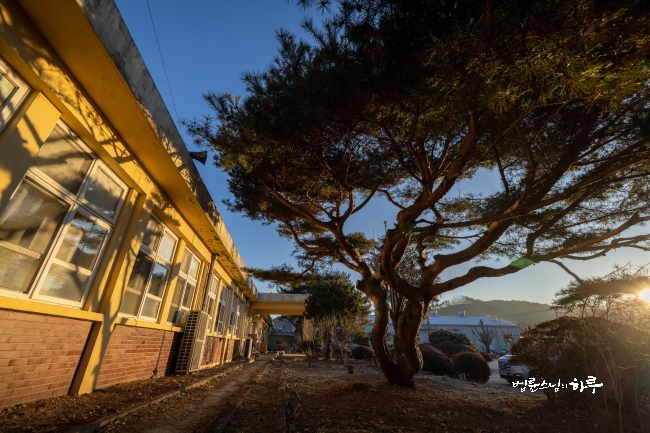
Hello. Dawn has broken at Dubuk Jungto Retreat Center (두북수련원). Starting today, Jungto Society will hold a three-day Jeongcho (New Year’s) Prayer (정초기도) to welcome the new year. Participants will listen to Sunim’s daily Dharma talks about how to approach the year ahead, practice 300 prostrations, and engage in mindful sharing with fellow practitioners.
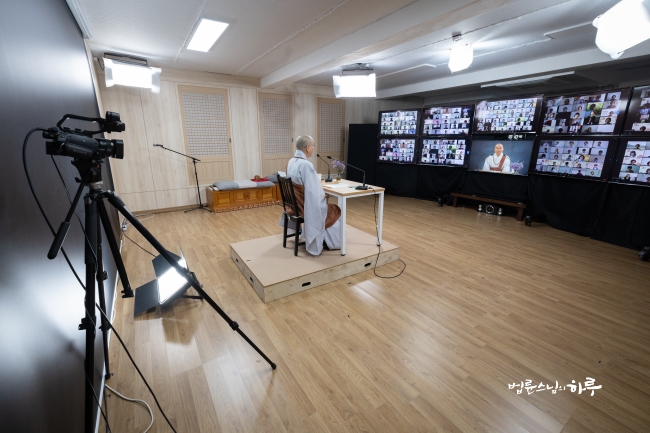
After completing morning practice and meditation, Sunim took his seat in front of the camera in the broadcasting room at exactly 10 AM. The members of the Sangha offered three bows to Sunim and requested the opening Dharma talk for the Jeongcho Prayer. Sunim began his talk by discussing the original meaning of the prayers that people in the past offered at temples during the New Year.
What Is the Real Reason for Going to Temples to Pray in the New Year?
At temples located in towns or near villages, people could pray at the proper times like we do today, but in the old days, temples were in the mountains, requiring a full day’s walk. People would stay at these mountain temples for three, five, or seven days while praying.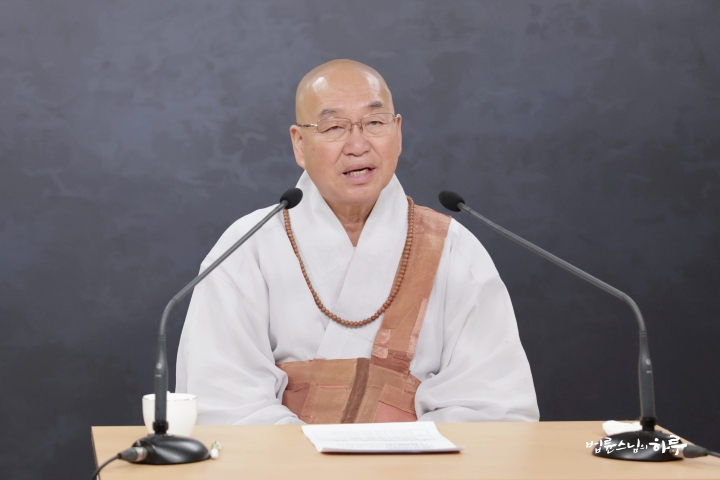
Why We Use the Term ‘Practice’ Rather Than ‘Prayer’
While prayers in the past involved modest wishes and settling one’s mind, recently prayers have often become based not on modest wishes but on greed—the desire (탐심 : 貪心), anger (진심 : 嗔心), and ignorance (치심 : 癡心) that the Buddha warned against. They have deteriorated into seeking worldly benefits, such as passing entrance exams to good universities without studying, being cured of illnesses, seeing stock or land prices rise, or having business prosper just through prayer. Due to this phenomenon, on one hand, many people were attracted to prayer, and during periods of economic growth, large amounts of money flowed into churches and temples under the belief that ‘offering large prayer donations brings spiritual efficacy (영험)
.’ However, as a result of prayer flowing in this direction of seeking worldly benefits, today many people have become skeptical about prayer itself and have developed negative views. Even today, if you visit economically growing countries like China or Vietnam, you’ll still see countless people making offerings, building temples, creating Buddha statues, and erecting pagodas while praying for blessings, chasing after the merit and spiritual efficacy of prayer. Such practices can be said to be far from the Buddha’s teachings. The Buddha’s teaching is a ‘teaching of wisdom.’ Rather than unconditionally denying the three poisons of greed, anger, and ignorance that humans possess, the Buddha’s teaching awakens us to the fact that while sentient beings may give rise to such minds due to their ignorance, all suffering originates from precisely these minds. Therefore, when such minds arise, responding wisely and not being bound by them is the path from suffering to happiness. The core of the Buddha’s teaching is that the cause of our suffering lies in the three poisons of greed, anger, and ignorance (탐진치 삼독)
, and only when we control these minds can we reach nirvana, which is true happiness. Yet today, Buddhism has flowed toward trying to make the impossible possible through prayer and achieving everything according to one’s temperament. We must be wary and cautious of such forms of prayer. These phenomena of seeking worldly benefits, regardless of religion, make sentient beings foolish, cause social controversies, and create capitalist ills. We must approach prayer with a mindset that goes beyond the original spirit of prayer handed down from ancient times, pursuing nirvana (열반) and awakening (깨달음). Recently, since the word ‘prayer’ has been used with many negative connotations, today’s younger generation sometimes feels resistance to the term itself. However, in Jungto Society, rather than abandoning the word prayer, we keep the term while filling it with correct content instead of incorrect content. Especially from the perspective of practice, we sometimes use the word ‘practice’ instead of ‘prayer.’ The word ‘practice’ carries a stronger meaning of maintaining one’s mind in a fully awakened state. Therefore, when we do Jeongcho Prayer, we also use the term ‘practice (정진)’ because it contains the mindset of ‘practicing diligently.’What Should I Do When Delusions Arise During Prostrations to Maintain Good Practice?
The practice theme for this year’s Jeongcho Prayer is the ‘Noble Eightfold Path (팔정도 : 八正道).’ The fundamental root of all suffering is the three poisons: greed, anger, and ignorance. When the mind is stained with these toxins, it causes the disease of suffering. To remove these toxins, we must keep our precepts (계행 : 戒行) pure to eliminate greed, cultivate meditation (선정 : 禪定)to eliminate anger, and attain wisdom (지혜 : 智慧) to eliminate ignorance. This is called the ‘threefold training (삼학 : 三學)’ of precepts (계) , meditation (정), and wisdom (혜).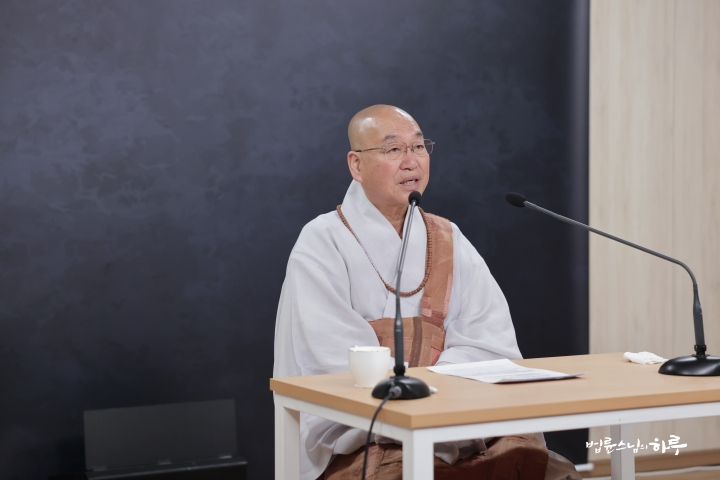
)
.’ To cultivate meditation, first, the body and mind must be at ease. When stress accumulates, the mind cannot be at ease and remains in a constant state of tension. Therefore, it is most important to first settle the body and mind into comfort. Second, one must concentrate the mind firmly in one place. Modern people are extremely scattered. As they try to pay attention to multiple things simultaneously, their minds tend to disperse. Even when conversing with young people these days, they often mix various topics to the point where it’s difficult to grasp the main point due to their scattered nature. There are various methods of concentration. A representative method of concentrating on sound is mantra recitation. Concentrating on sounds like ‘Om Mani Padme Hum’ is called mantra recitation (주력)
, while chanting involves concentrating on sound but also focusing the mind on the sacred image of Avalokiteshvara Bodhisattva (관세음보살)
or on the Bodhisattva’s great compassion. Other concentration methods include meditation practices ( 선 : 禪 수행) like Seon meditation or Vipassana. Korean Seon meditation mainly concentrates on the hwadu ( 화두 critical phrase) ‘What is this?’ and when practicing breathing meditation, one concentrates solely on one’s breath. The important point to note here is that this is not ‘thinking.’ If thoughts continue, they become ‘delusions.’ One must maintain only an awakened state through concentration, that is, maintain awareness. Thus, while the names differ—Seon meditation, mantra recitation, chanting—depending on the object of concentration such as breath, hwadu, sound, or form, the essence is the same: ‘concentrating while remaining at ease.’ This is the same whether sitting, standing, or even when doing prostrations. When doing prostrations, one should also relax the tension in body and mind and concentrate comfortably. However, many people grit their teeth and force themselves through prostrations because they find them difficult. While this can be a practice for developing patience, it’s hard to call it a practice for cultivating meditation. When doing prostrations, it’s good to keep the body and mind at ease and practice while concentrating on the Words to Remember.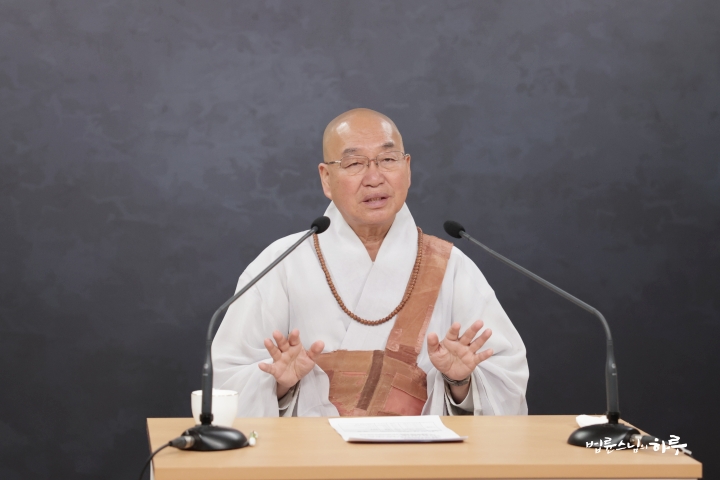
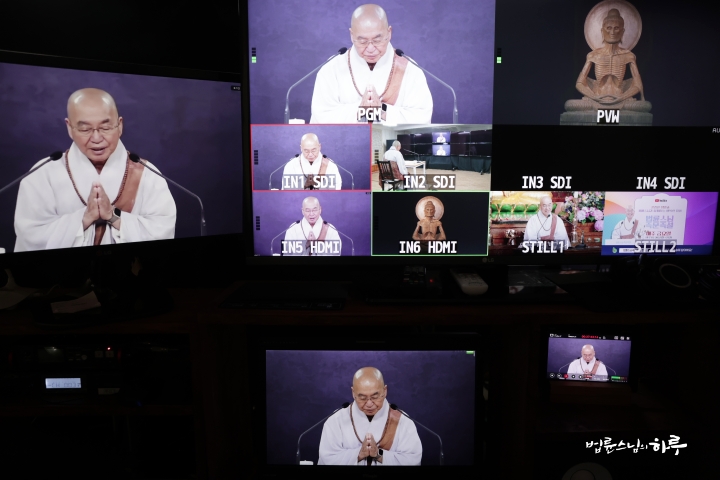
After the opening Dharma talk concluded, there was a brief moment to organize the space before beginning the 300-bow prayer practice.
“With broad and deep vows, practicing the bodhisattva path again and again, to save suffering beings, manifesting in this saha world… Avalokiteshvara Bodhisattva, Avalokiteshvara Bodhisattva, Avalokiteshvara Bodhisattva…”
As the resonant chanting began under the guidance of Venerable Yusu (유수스님), the images on the monitors showed all participants bowing in unison.
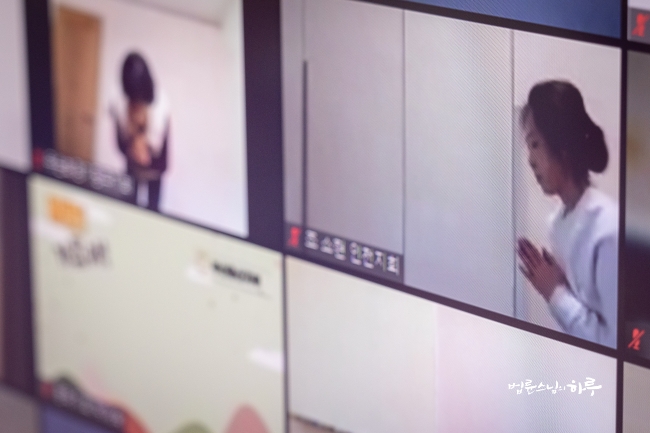
The earnest sound of chanting spread across the nation through the internet connection.
After an hour of prayer practice, participants entered video conference rooms by group for a mindful sharing session.
Following the completion of the Jeongcho Prayer, Sunim rested throughout the afternoon. Due to his poor health following an extended overseas trip, he decided to focus on rest while staying at Dubuk Jungto Retreat Center.
Tomorrow marks the second day of the Jeongcho Prayer. In the morning, there will be a live broadcast of Dharma talk and practice session, followed by a live Friday Dharma Q&A in the evening.