Donate
Contact Us
Jungto Society
Jungto Society Newsletter Sign up
  • Get Started
  • About
    • Jungto Society
    • Ven. Pomnyun Sunim (법륜스님)
    • Our NGOs
    • Find Us Online
    • Visit Us
    • Contact Us
  • Articles
    • A Day in the Life of Sunim
    • Jungto News
    • Press & Media
  • Library
    • Dharma Q&A
    • Meditation Q&A
    • Wisdom Note
    • Practice Resources
  • Online Programs
    • Live Dharma Talk
    • Happiness Workshop
    • Jungto Dharma School – Introduction to Buddhism I
    • 정토담마스쿨 – 근본불교
    • Jungto Dharma School – Introduction to Buddhism II
    • 정토담마스쿨 – 인간붓다
    • 1000-Day Practice
    • Sunday Meditation
  • Offline Programs
    • Half-Day Temple Stay
    • In-Person Casual Conversation with Ven. Pomnyun Sunim in 2025
    • Dubuk Jungto Retreat Center Volunteering
Resources by Language
  • Get Started
  • About
    • Jungto Society
    • Ven. Pomnyun Sunim (법륜스님)
    • Our NGOs
    • Find Us Online
    • Visit Us
    • Contact Us
  • Articles
    • A Day in the Life of Sunim
    • Jungto News
    • Press & Media
  • Library
    • Dharma Q&A
    • Meditation Q&A
    • Wisdom Note
    • Practice Resources
  • Online Programs
    • Live Dharma Talk
    • Happiness Workshop
    • Jungto Dharma School – Introduction to Buddhism I
    • 정토담마스쿨 – 근본불교
    • Jungto Dharma School – Introduction to Buddhism II
    • 정토담마스쿨 – 인간붓다
    • 1000-Day Practice
    • Sunday Meditation
  • Offline Programs
    • Half-Day Temple Stay
    • In-Person Casual Conversation with Ven. Pomnyun Sunim in 2025
    • Dubuk Jungto Retreat Center Volunteering
No Result
View All Result
Jungto Society
  • Resources by Language
  • Dharma School
  • Live Dharma Talk
Home A Day in the Life of Sunim

Banner
Should I Give Up Pleasure to Find True Happiness?

February 9, 2026
0
0
VIEWS
Share on FacebookShare on Email

Feb 7, 2026. Lecture at Delhi University, India Pilgrimage Evaluation Meeting

Hello. Today, Sunim gave a lecture to local university students at Delhi University, held an evaluation meeting for the India pilgrimage, and then traveled to Sankasia.

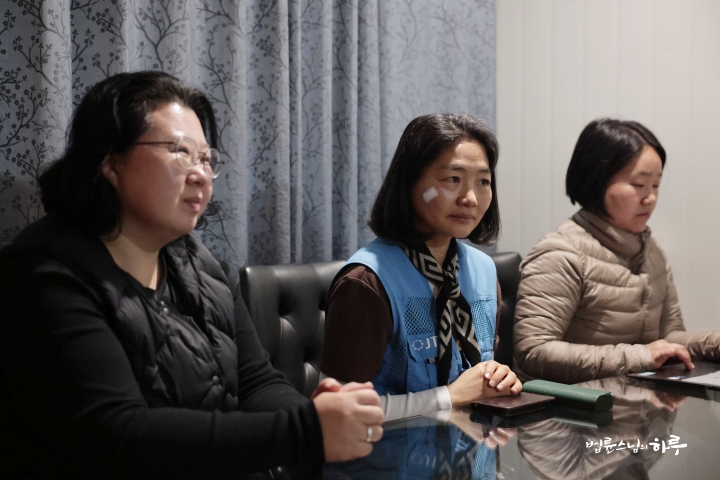
After completing his morning meditation and practice, Sunim began a meeting at 6 AM about the denture support project for Bhutanese residents. Two field workers active in Bhutan and two medical professionals from Jungto Society had conducted medical examinations for 172 people and visited 3 hospitals in 6 chiwogs of Trongsa and Zhemgang districts from January 23 to February 4. Today’s meeting was to review the results and establish future directions.
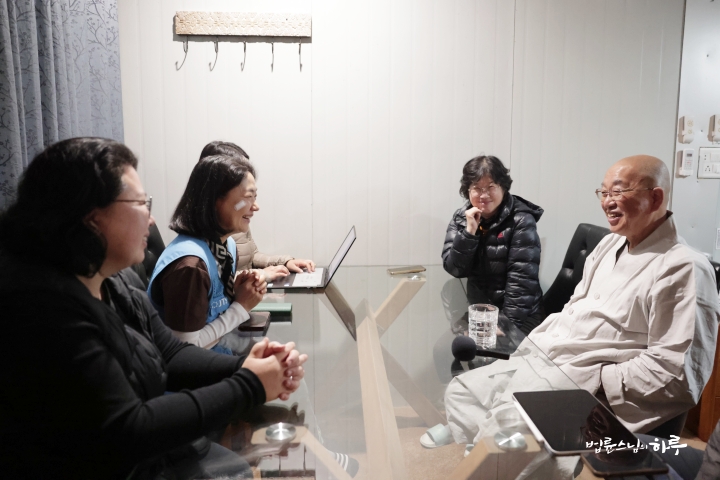
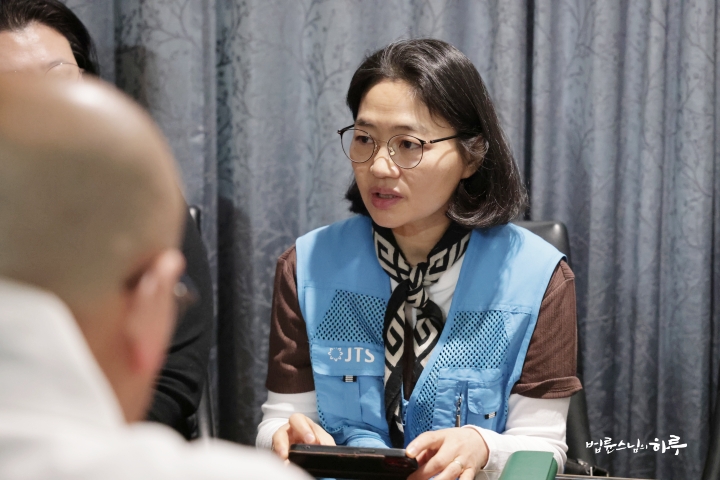
Dr. Choo Hee-sook, a dentist, first reported the survey results. Even considering it was a rural area, the residents’ oral health conditions were extremely poor. Although people with bad teeth came for treatment, among the 172 people, none had all 28 teeth intact, and most had gum inflammation. Additionally, due to the shortage of medical personnel, dental hygienists were performing duties that should be done by dentists, and even the existing personnel were gradually leaving for Australia. The residents rarely brushed their teeth, and chewing tobacco was making their dental conditions even worse. However, the hospital in the capital Thimphu was of a high standard comparable to Korean hospitals, indicating that Bhutan’s overall medical standards were not low.
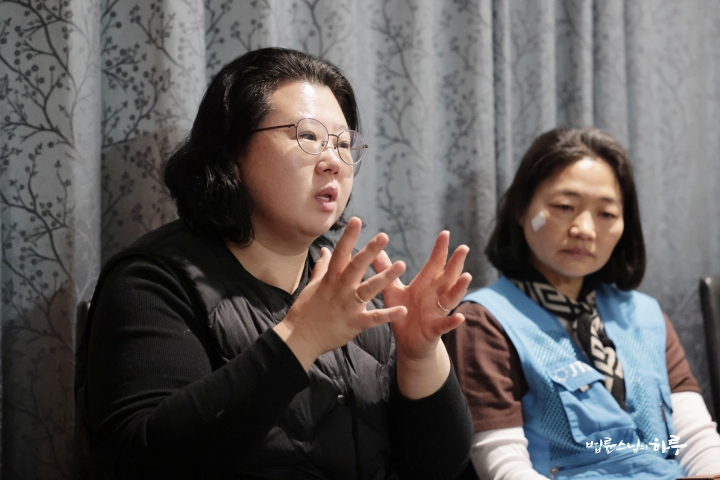
Dental technician Shim Jae-jung reported that the conditions for denture production were poor and that residents’ gums were deteriorating. The key concern was determining what level of support should be provided.
After listening to the survey report for about 30 minutes, Sunim spoke.
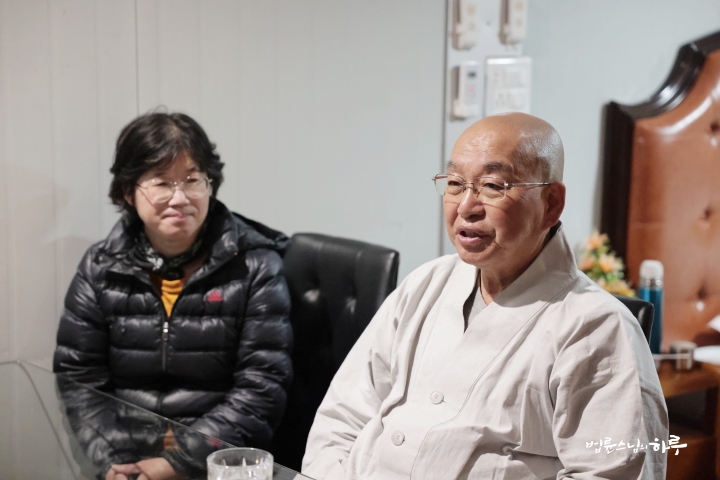
“Thank you for your hard work. In Korea too, in the old days, there were people who made dentures at the township level in rural areas. Without dentists, technicians just made dentures. When I went to Bhutan and saw the elderly people’s teeth, they either had no teeth at all or only small portions of the crowns remained. I wondered if they could chew food with those teeth. That’s why I conceived the denture support project, thinking we should at least help the elderly eat their meals.”

He pointed out the fundamental dilemma of this project. The Bhutanese central government was requesting that regional areas receive treatment at the same level as Thimphu. However, to achieve that level would require establishing a hospital. This was different from the initial concept of ‘helping a few people who are really in need.’

“For JTS to receive good evaluations, we need to put effort into each person and provide high-quality care. However, from the perspective of helping those who are truly in need, instead of helping one person, we could help 10 or 20 people. We need to choose whether to focus on receiving praise for doing well or on helping those in dire need.”
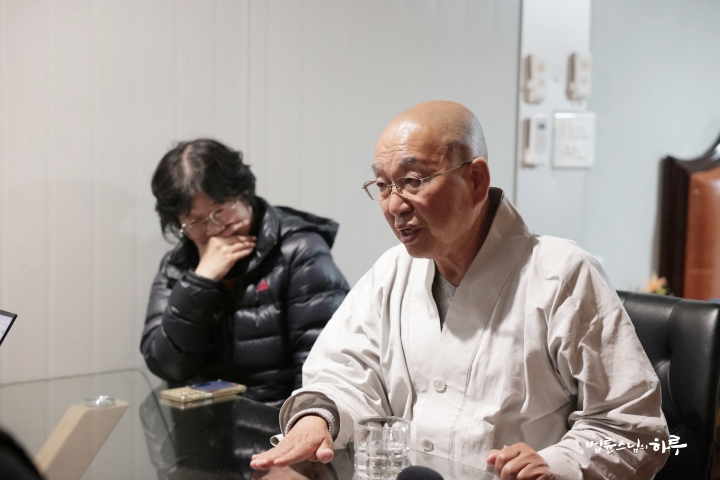
Sunim presented three options. First, not doing it at all. Second, proceeding in a way that fits JTS’s reality, providing benefits to many people even at a lower standard, considering it’s better than nothing. Third, conducting a pilot project targeting residents of just one village first and then making a judgment. The survey team suggested conducting a pilot project in Jangbi Chiwog, which had the most inadequate conditions. He agreed to first test it in Jangbi Chiwog and then would decide on expansion and level adjustments based on the results.

“People who are truly in difficulty just endure and live on. If we lower our standards but set our direction to benefit many people, it will help the majority. However, if we say we’ll properly treat a small number of people, we’ll hear complaints asking why we’re only helping that village and not ours. Either way, we can’t avoid criticism. Is that okay with you?”

“Yes, we want to try it.”

Sunim asked one person to investigate the list of dental equipment needed at the Trongsa District Hospital. He requested another person to plan the budget and personnel needed for the denture production process. After finishing the meeting at 8 AM, he hurriedly had breakfast. A lecture was scheduled at Delhi University at 10 AM. He left the accommodation at 8:30 AM and arrived at Delhi University around 9:45 AM.
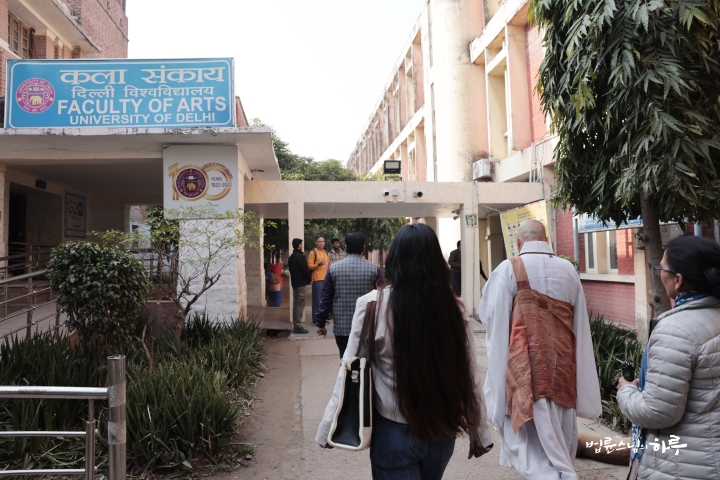
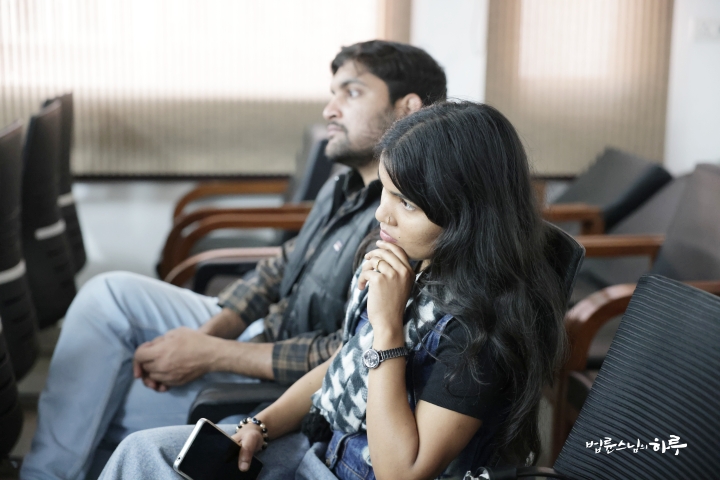
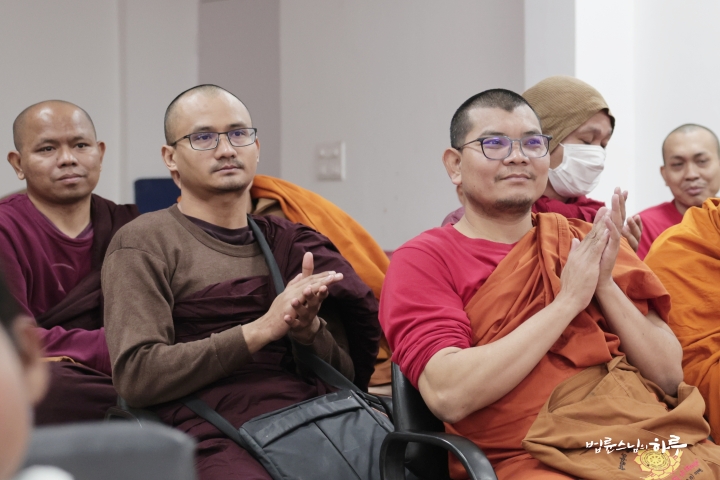
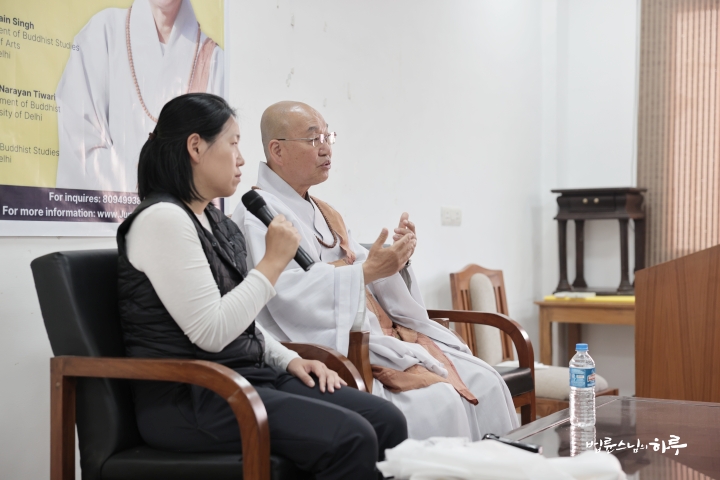
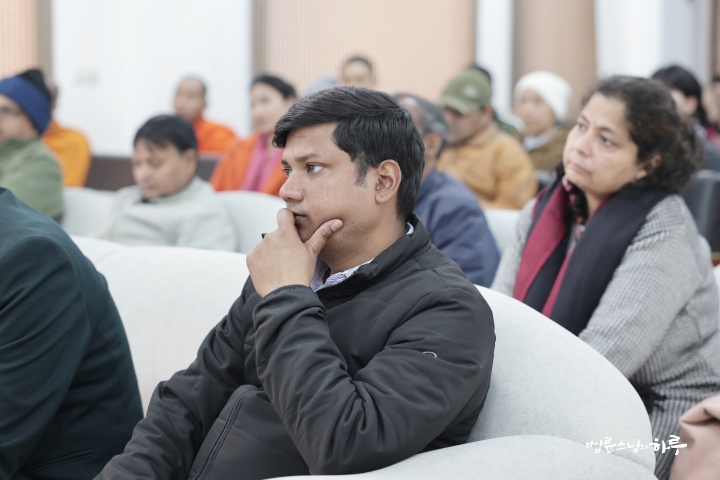
About 30 people, including faculty, students, and monks from Southeast Asia, were seated in the lecture hall. A Thai monk who had participated in the pilgrimage also came with a fellow monk.
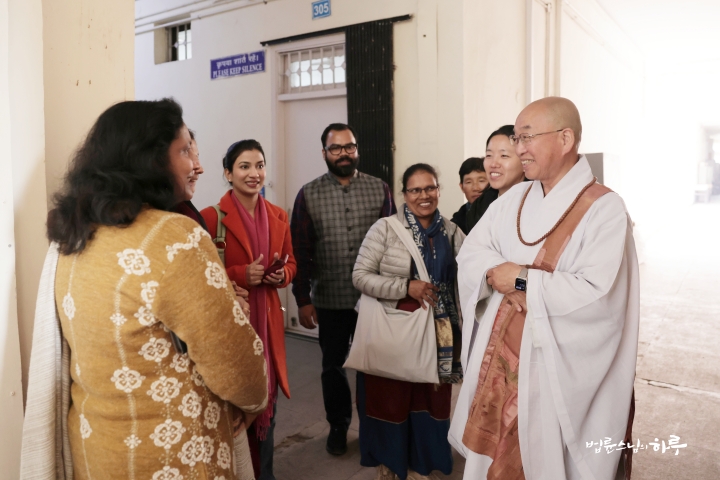
However, due to delays in lecture preparation, the start time was postponed to 10:30 AM. Sunim took a brief walk around the campus before returning to the lecture hall.
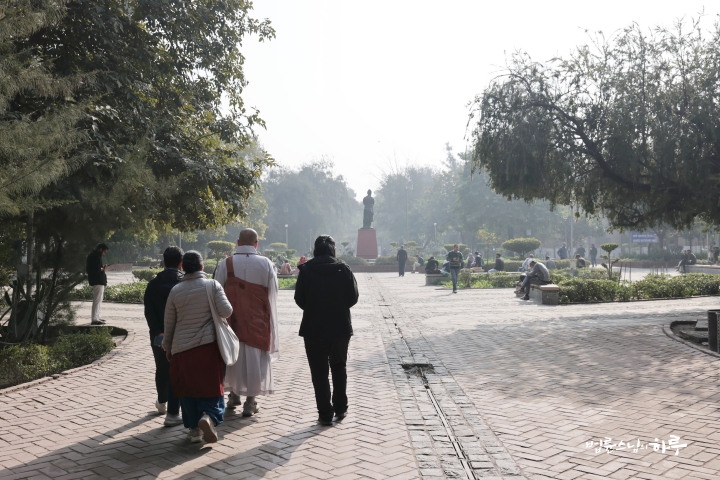
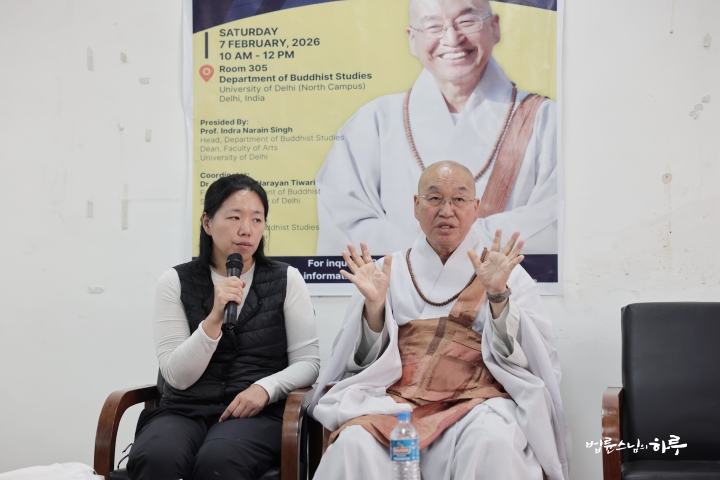
The lecture began at 10:30 AM. He started the conversation by discussing what kind of life we should live in the era of climate crisis and artificial intelligence.
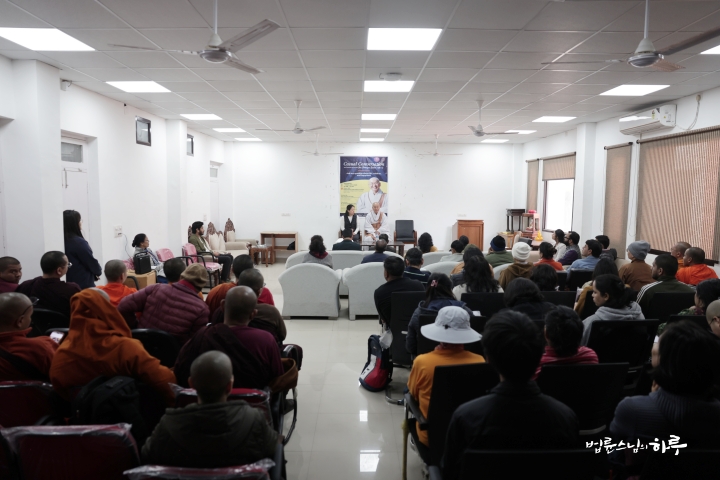
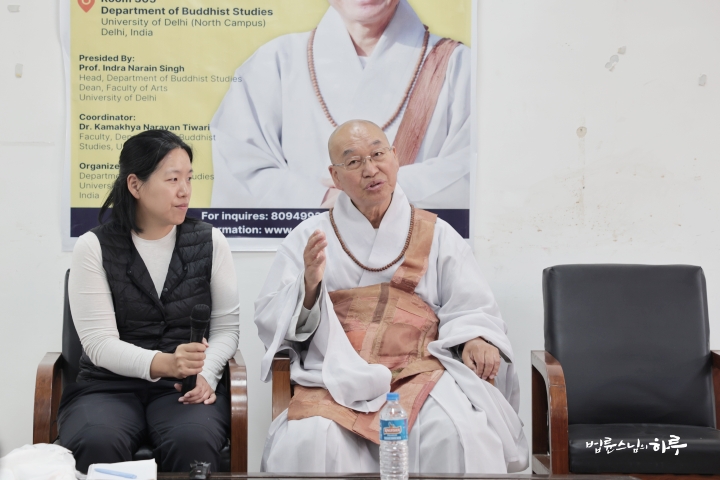
“Today, we are living in an era of great change, completely different from the past. The first change is the era of climate and environmental crisis. For about the past 5,000 years, humanity has developed civilization with the perspective that ‘producing more and consuming more means living well.’ However, we now face serious problems like the climate crisis as a side effect. There are even assessments that it will be difficult to continue maintaining this civilization in the current way. So now we must reconsider what kind of life we should live to enable a sustainable life for our descendants.”

“The second change is the development of artificial intelligence. In the past, there was always a shortage in producing the goods necessary for our lives. It was an era when production volume was the issue. But now the situation has completely changed. Now it’s not that production is insufficient, but rather there aren’t enough people to consume. With artificial intelligence and robots, sufficient production is possible with only a very small number of people. From past standards, if production can occur without us working, that would arguably be a ‘good world.’ We are now in an era very close to that.”

However, this raises a new question. If we were to live a life where we receive only basic survival goods without working, would that truly be a happy life? This question fundamentally challenges the concept we have taken for granted: ‘This is what it means to live well.’ Therefore, we must now find a new path. Many stories based on past experiences are no longer providing sufficient answers.

In the Era of Climate Crisis and AI, What Kind of Life Should We Choose?

The reason for discussing Buddhism, which originated 2,600 years ago, in this context is that the circumstances of that time are remarkably similar to our current era. At that time, the Indian subcontinent had been dominated for over a thousand years by what was called Brahman civilization or Aryan civilization—a traditional civilization. However, during the time when the Buddha appeared, this traditional system began to collapse. The existing Brahman thought could no longer explain the changing world.

As a result, new thinkers emerged who sought to explain the transformed world. These emerging thinkers let go of existing lifestyles—family, home, status, and honor—and retreated into the forests to contemplate, striving to understand and explain this changing world they were living in. Though their philosophies differed, this movement was called ‘Samana’ in India. Gautama Siddhartha also joined this movement.

However, after attaining enlightenment, he saw that both the Brahman path and the Samana path were biased to one side. So he proposed a new path that transcended both, which we call the ‘Middle Way.’ Because he discovered this new path and showed people a way to escape from suffering, we need to examine what answers or hints we can gain from the experiences of that era for the problems we face today.
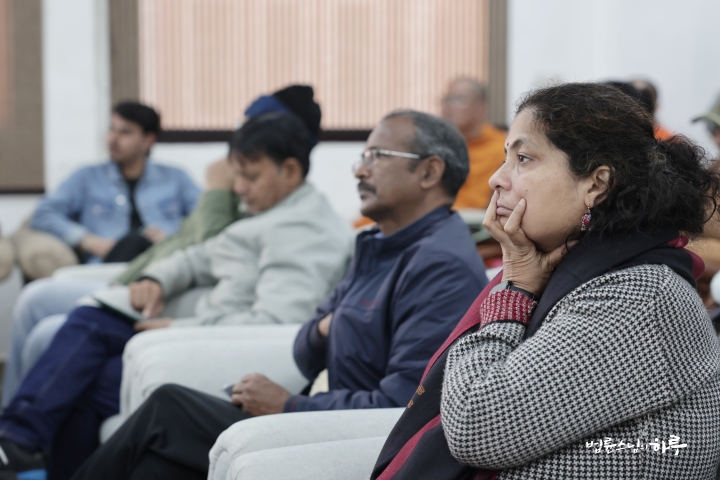
The conversation I wish to share with you today is not about Buddhism or Buddhist philosophy itself. Rather, it is about seeking hints from the Buddha’s experience to explore how we can solve the social and global problems we currently face. I would like to begin today’s dialogue from this perspective.

Any topic is welcome. However, I hope we can engage together with an understanding of this dialogue’s purpose. There is no need to focus solely on specific Buddhist doctrines or philosophies. The essence of the Buddha’s teaching lies in how those who suffer can escape from their suffering and attain liberation and nirvana. Therefore, any questions and conversations we have as suffering beings seeking to escape our anguish can all be considered Buddhism.

Buddhism is not established merely by speaking certain doctrines or terminology. I hope you understand that all sincere questions and explorations aimed at escaping suffering are Buddhism itself. Now, please feel free to bring any questions or concerns you have had in your life to this dialogue. I am here not as someone who provides answers, but as someone who thinks and converses together with you.”

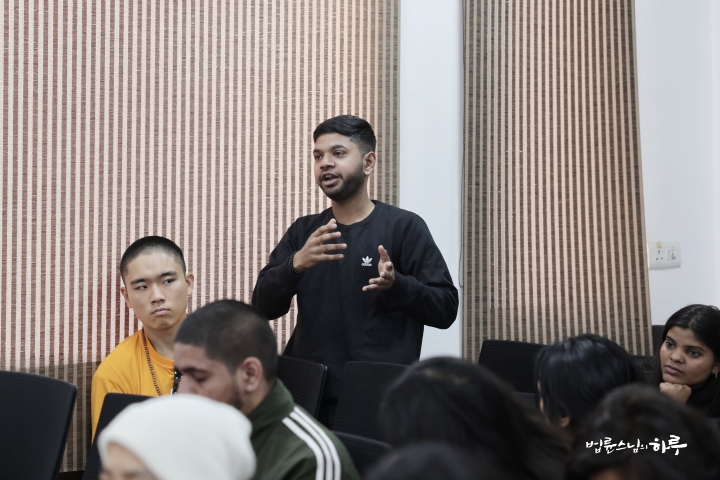
Following this, anyone could raise their hand and ask Sunim about their curiosities or personal concerns. During the 75-minute lecture, eight people engaged in dialogue with him.
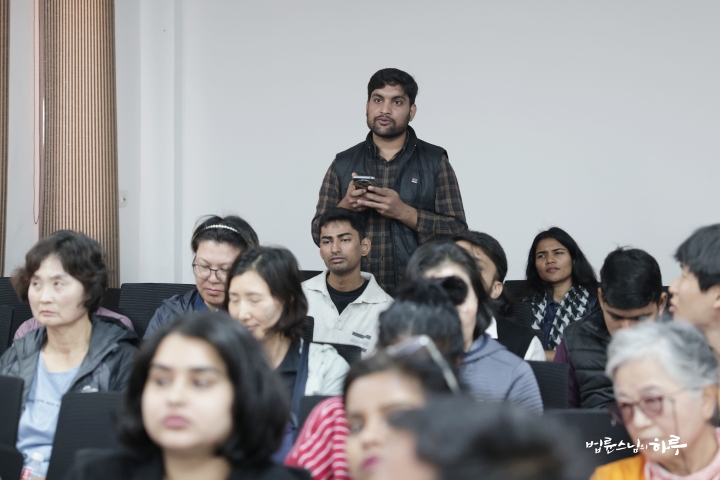
One person asked why Buddhism teaches us to let go of emotional attachment when attachment also provides us with stability and comfort. Sunim explained the structure of comfort that attachment provides and the bondage that comes with it, using the metaphor of a house.

Attachment Gives Us Stability, So Why Should We Let It Go?

“Buddhism teaches that in order to attain peace of mind, one should let go of attachment. However, attachment gives us a sense of stability—so why does Buddhism tell us to abandon it? I’m curious about the reason.”
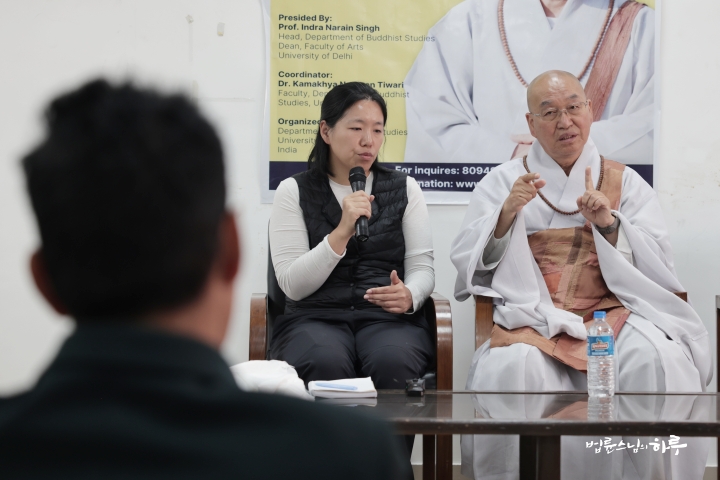
“Let me first use this building as an example. When we are inside, we are protected from the outside environment. The floor blocks the cold air rising from the ground. The walls block the blowing wind, and the roof blocks the sun and rain. So we feel comfortable inside. In other words, a house serves to protect us from the outside environment.

However, at the same time, a house also confines us because all sides are blocked. So a house has both the character of a ‘sanctuary’ and a ‘prison.’ When we seek comfort, bondage inevitably follows. And when we abandon that bondage, the comfort disappears simultaneously.

The attachment you mentioned is the same. Attachment provides comfort, but it also becomes bondage. When the Buddha said to ‘burn down the house,’ he meant ‘become free from attachment.’ Usually, when we are in a house, we feel confined and become frustrated, so we run out. Then after some time, when we feel lonely or threatened again, we look for another house to enter. Then we feel comfortable again.

Most of us live by repeating this process. What the Buddha called ‘samsara’ refers to a life that cannot escape from this cycle and keeps repeating. So to escape from this life of samsara, he said we must burn down the ‘house’ itself.”

“I understand now. Thank you.”

The next questioner sought Sunim’s advice on how to establish universal justice that does not ignore human suffering when standards of morality and justice differ across cultures, religions, and regions. Sunim explained from the perspective of the Dharma how peace is possible in a world where different cultures and moralities coexist.

When Moral Standards Differ by Country, Is Peace Possible?

“What is the truth that applies equally to everyone when different cultures and religions disagree? If morality changes depending on where a person is born, on what basis can we say that something is just and apply it equally to all people?”
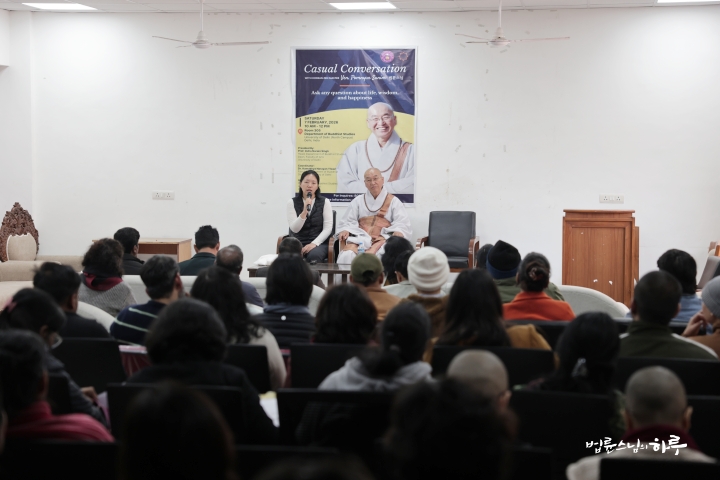
“The Buddha’s teaching on this is clear. There is nothing that is absolutely right or wrong. In other words, there is no absolute justice; things are just different. Therefore, we must acknowledge our differences. We also need to understand that ‘from their perspective, it could be that way.’ This recognition and understanding is the path to peace. If you have more questions, please feel free to ask.”

“Since morality differs by country, nationality, culture, and religion, how can we say, on a global level, ‘This is what peace is’?”

“When you go to a forest, there are large trees and small trees. There are trees of this kind and trees of that kind. They all come together to form a forest. When you go to a flower garden, there are various kinds of flowers. The flowers differ in size, color, and shape, but they come together to form one flower garden. Similarly, in this world, even though we have different races, ethnicities, religions, ideologies, and cultures, if we acknowledge and understand our differences, we can achieve harmony and bring peace, just as different flowers form a garden. This is the Dharma. It’s not about unifying everything into one.

That’s why I hope you will study the Dharma more deeply beyond religion. The Dharma is not the property of Buddhists alone but the property of all humanity. Therefore, even if we are not a Buddhist, I hope we can research and utilize what we can learn from the Dharma for the peace and development of humanity.
Buddhism originated in India but has spread throughout the world. This means that Buddhist teachings possess a universality that is not confined to any specific region, race, or ethnicity, but can be applied to all of humanity. Therefore, I believe that if Buddhist studies in India can go beyond merely researching the past and instead draw ideas from the Dharma to solve contemporary challenges such as peace issues and environmental crises, it will play a very significant role for the future.

I find the traditional approach  in established Buddhist countries to be somewhat limited. This is because people there only believe in Buddhism; they don’t study it to solve current problems. The older generation merely makes claims based on faith without trying to apply the Dharma based on reality. However, young people are different. How great the Buddha was is not that important. They approach it from the perspective of whether the Buddha’s teachings can truly help solve the problems they face. That’s why I came to this university with the hope that young people in India would study the Dharma more deeply.

In my experience, the Dharma is very similar to science. This is because it always explores with questions like “Why is that so?” Gautama Siddhartha first felt a sense of inquiry at the age of thirteen while participating in a plowing festival. Seeing a bird pecking at a worm, he wondered, “Why must one die for another to live?” Don’t we usually take such things for granted? However, this boy asked, “Why must one die for another to live? Isn’t there a way to live together?” He asked his teacher but couldn’t get an answer. It was considered a pointless thought. The teachings at that time were about “how to fight and win” and “how I can survive,” not about “how to coexist.” He couldn’t get an answer from anyone, and that became the very first step in his search for truth.

This kind of inquiry is very important. When you have doubts about something, that’s when it truly becomes your own. That’s why young people need to always maintain an attitude of asking ‘Why is that?’ You shouldn’t accept any authority as it is. The answer isn’t given to you – you must find it yourself. The Buddha also studied under teachers, but he didn’t get the answer from his teachers. In the end, he found the answer himself.

So when studying Buddhism, I hope you don’t just study it as a religion or study the past, but approach it from the perspective of finding ideas in Buddhism’s fundamental teachings for the path humanity should take in the future. You don’t necessarily have to major in Buddhist studies. No one can definitively say ‘This is the path humanity must take.’ We must search together from now on for how to solve these complex problems.

I’m seventy-three years old this year. My childhood began in extreme poverty when society was still undeveloped. However, in just 70 years, the world has undergone tremendous changes. Based on this experience, I believe the Dharma I’ve experienced greatly helps in unleashing human creativity and opening new paths. Unlike others, I didn’t receive much modern Western education. I entered a temple during high school and haven’t received formal schooling since then. Nevertheless, from my experience, the Buddha’s teachings provide something more creative than any school education. And just because it’s religion doesn’t mean we should reject science. We must comprehensively learn everything humanity has accumulated from the past – religion, philosophy, academics, and science.”

“Thank you. I understand well.”

Questions continued to follow.
The world defines success as money and status, but these alone don’t fill our hearts with peace or happiness. What is your definition of true success?

With conflicts like the war between Russia and Ukraine continuing around the world, can humanity create a peaceful world where everyone is happy together?

In the climate crisis era, we must protect the environment while pursuing technological advancement and sustainable development. Is there a way to achieve all of these together?

In modern society, people increasingly pursue material things. Can meditation actually help change this materialistic way of life?

With the US trying to purchase Greenland and other major powers ignoring international agreements to reshape the world through power politics, how should we view this situation from the Buddhist perspective of impermanence?

The last questioner asked Sunim for advice on whether a meaningful life could be called a happy life. Sunim talked about why suffering inevitably follows when we make pleasure our happiness, and what sustainable happiness is.

Do We Have to Give Up Pleasure to Attain True Happiness?

“Which is more important, a life of enjoyment or a life of meaning? Can a meaningful life be called a happy life? What is sustainable happiness in Buddhism? Do we have to give up pleasure in order to attain true happiness?”
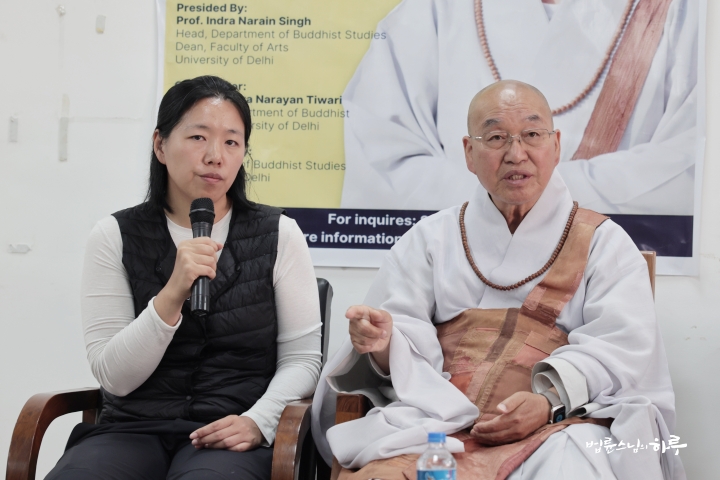
“If you make pleasure your happiness, any happiness will inevitably be followed by suffering. That’s why we cannot escape from the cycle of samsara where suffering and pleasure repeat. To escape from samsara, we must reach a state without suffering. This means giving up pleasure and becoming free from desire.

This doesn’t mean forcibly suppressing desire. It’s not denying desire either. It’s simply recognizing desire for what it is. Neither following desire nor suppressing it, but simply recognizing ‘Ah, this is desire.’ When this happens, peace of mind comes. This is the state of not cycling through samsara.

If you call this state happiness, then it is sustainable happiness. However, any form of pleasure, if you make pleasure your happiness, will inevitably be followed by suffering. In that case, you must accept even that suffering, because it is the consequence of pleasure.”

“Thank you.”

Many students wanted to ask more questions, but it was time to end the lecture. They agreed to meet again when Sunim visits India next time, and the lecture ended at 11:45 AM.
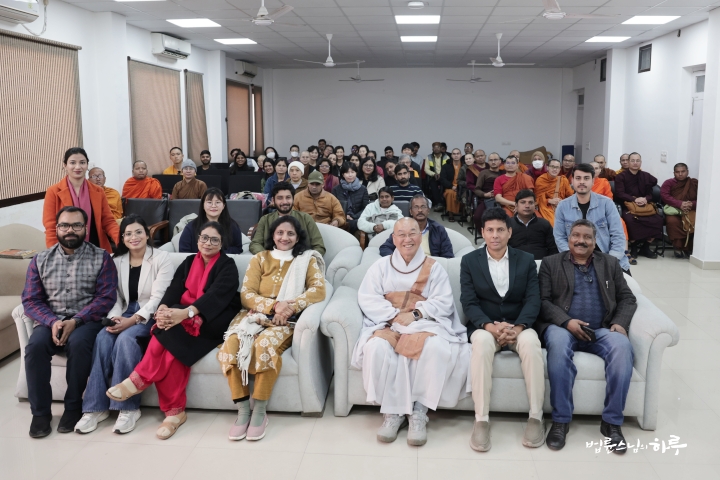
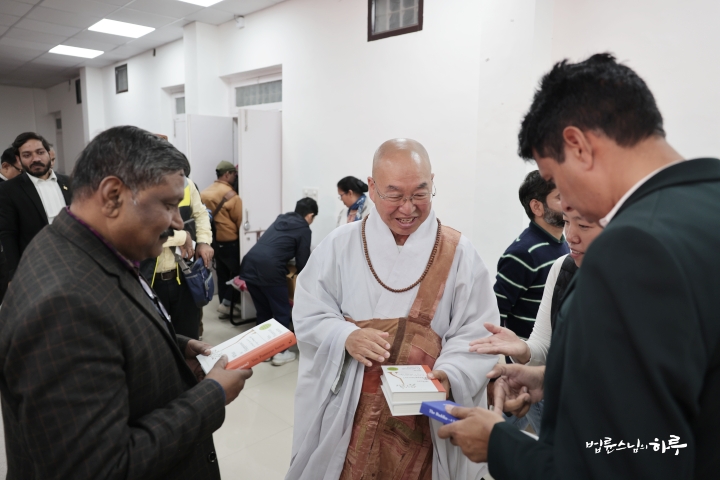
After taking a commemorative photo, Sunim presented the faculty with English editions of Revolution and Buddha and Happiness.

As Sunim left the lecture hall, the person who had invited him to today’s lecture greeted him. It was the person who had come all the way to Gaya last year to invite Sunim to the 30,000-person Dharma assembly of the Moriya clan.
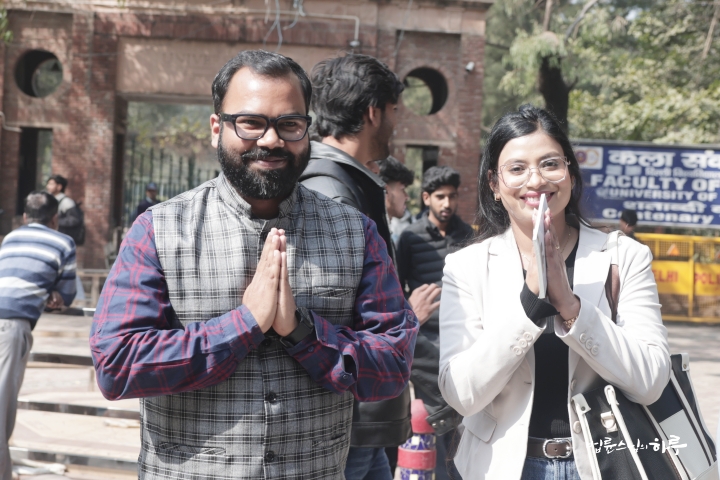
“Sunim, thank you for accepting our invitation to this lecture.”

“Yes, let’s meet again when the opportunity arises.”

Sunim took photos with those who had prepared the lecture and moved to his accommodation.
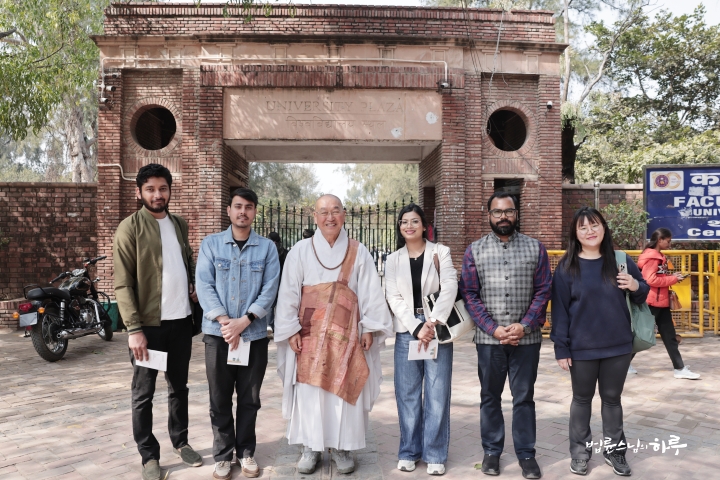
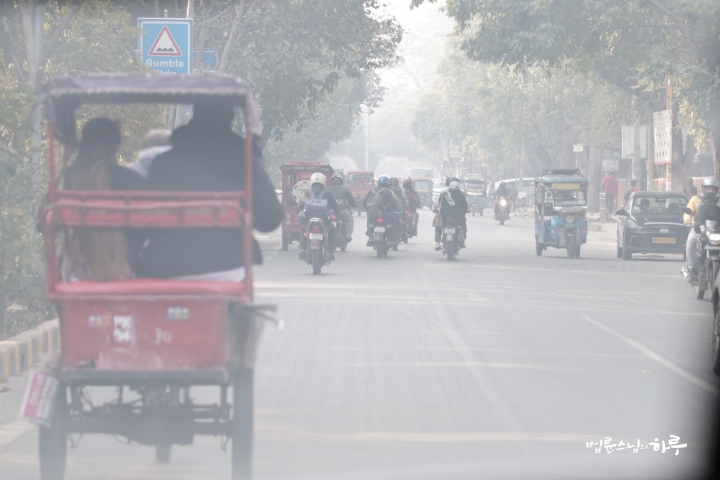
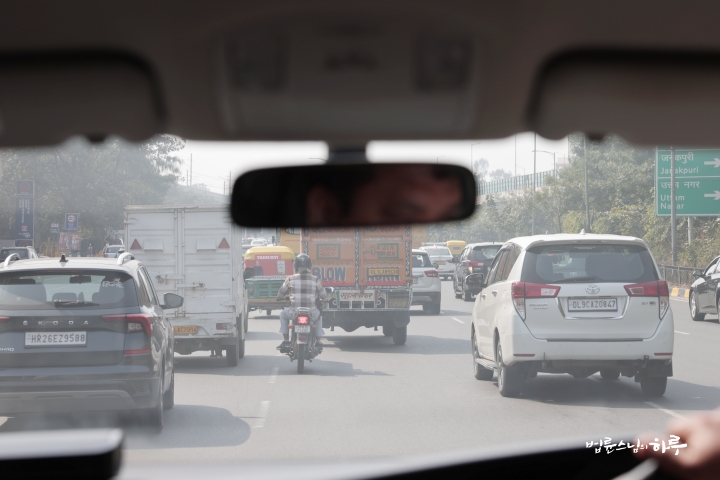
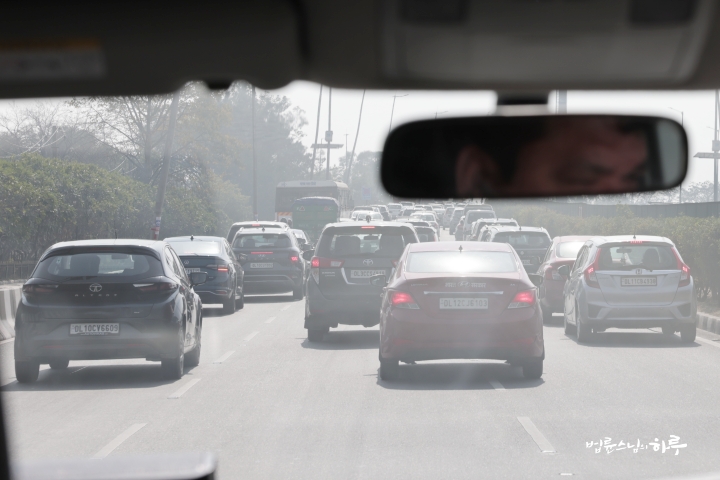
Although it should have been a one-hour journey, they spent two hours on the road due to heavy traffic.
When they arrived at the accommodation at 2 PM, the staff had been waiting for Sunim without eating. After having lunch together, they began the pilgrimage evaluation meeting. He first addressed the memorable points.
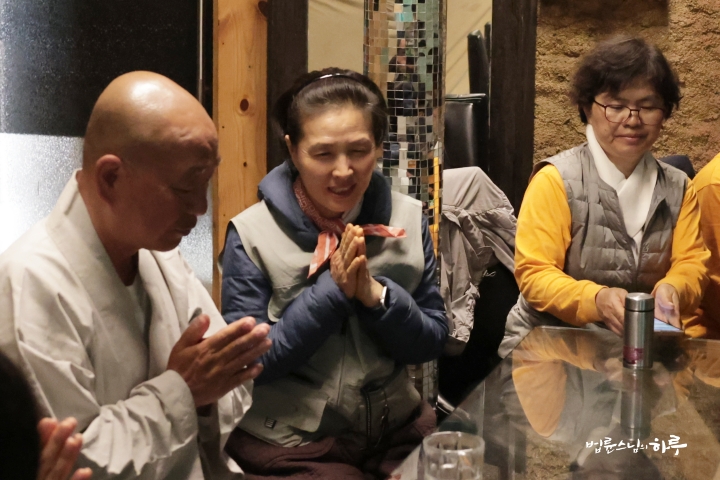
“For next year, first, let’s make sure to contract only buses manufactured after 2022. Second, when getting visa stamps, it would be good to provide guidance to check that the stamp has been properly affixed and that the date is correct.”

They also discussed the timing of the pilgrimage. This year, they scheduled it from late January to early February, which brought warm weather and fewer patients than usual. When they checked to schedule a similar period for next year, it overlapped with the Lunar New Year holiday. He suggested reconsidering the schedule and then carefully reviewed the accommodation situation at each sacred site.

As the meeting concluded, he made a request to the pilgrimage coordinator.

“When you return to Korea, please send thank-you letters to the Korean Embassy, the Nepalese Embassy, and the Indian Embassy. I heard that the ambassadors at the embassies were very helpful this time.”

“Yes, I understand.”

With the evaluation meeting complete, it truly felt like the pilgrimage had come to an end. The staff packed their belongings to return to Korea in the evening, while Sunim departed for Sankasia at 4 PM.
After traveling by car for about 5 hours and 30 minutes, he arrived at the Sankasia Dhamma Center at 9:35 PM.
Tomorrow, Sunim will conduct the India Jungto Society board meeting and a Dharma assembly for the Sakya clan in Sankasia.

Post Views: 1

Leave a Reply Cancel reply

Your email address will not be published. Required fields are marked *

Related Posts

Banner
Why Do I Feel Anxious Every Day About the Child I Desperately Wanted?">
Why Do I Feel Anxious Every Day About the Child I Desperately Wanted?

Banner
Why Do I Feel Anxious Every Day About the Child I Desperately Wanted?

February 8, 2026
0
62

Feb 6, 2026. National Museum of Delhi, Friday Dharma Q&A, Lecture for Korean Expatriates in India

Banner
What Should We Do When the Mind Keeps Wanting to Retreat?">
What Should We Do When the Mind Keeps Wanting to Retreat?

Banner
What Should We Do When the Mind Keeps Wanting to Retreat?

February 7, 2026
0
80

Febr 5, 2026 - Day 13 of the India Pilgrimage, Sankasia

Load More

Jungto Society is a community of Buddhist practitioners who seek to free themselves of suffering in their daily lives and to make the world a better place.

Donate
Subscribe to Newsletter

Subscribe to our Jungto Newsletter!
EVENTS & PROGRAMS
  • Live Dharma Talk
  • Sunday Meditation
  • 1000-Day Practice
  • Jungto Dharma School 2025
POSTS
  • A Day in the Life of Sunim New
  • Dharma Q&A
  • Meditation Q&A
  • Wisdom Note
  • Jungto News
ABOUT
  • Jungto Society
  • Ven. Pomnyun Sunim (법륜스님)
  • Our NGOs
  • Find Us Online
  • Visit Us
  • Contact Us
RELATED LINKS
Menu
  • Jungto Forum
  • JTS America
  • Pomnyun.com
  • Jungto Korea

Cookie Policy

Copyright © 2025 Jungto Society

Welcome Back!

Login to your account below

Forgotten Password?

Retrieve your password

Please enter your username or email address to reset your password.

Log In
No Result
View All Result
  • Home
  • Get Started
  • About
    • Jungto Society
    • Ven. Pomnyun Sunim (법륜스님)
    • Our NGOs
    • Find Us Online
    • Contact Us
    • Visit Us
  • Articles
    • A Day in the Life of Sunim
    • Jungto News
    • Press & Media
  • Library
    • Dharma Q&A
    • Meditation Q&A
    • Wisdom Note
    • Practice Resources
  • Online Programs
    • Live Dharma Talk
    • Happiness Workshop
    • Jungto Dharma School – Introduction to Buddhism I
    • 정토담마스쿨 – 근본불교
    • Jungto Dharma School – Introduction to Buddhism II
    • 정토담마스쿨 – 인간붓다
    • Sunday Meditation
    • 1000-Day Practice
  • Offline Programs
    • Half-Day Temple Stay
    • In-Person Casual Conversation with Ven. Pomnyun Sunim in 2025
    • Dubuk Jungto Retreat Center Volunteering
Subscribe to Newsletter
Donate
Contact us