Why Does My Mind Always Waver According to Conditions?
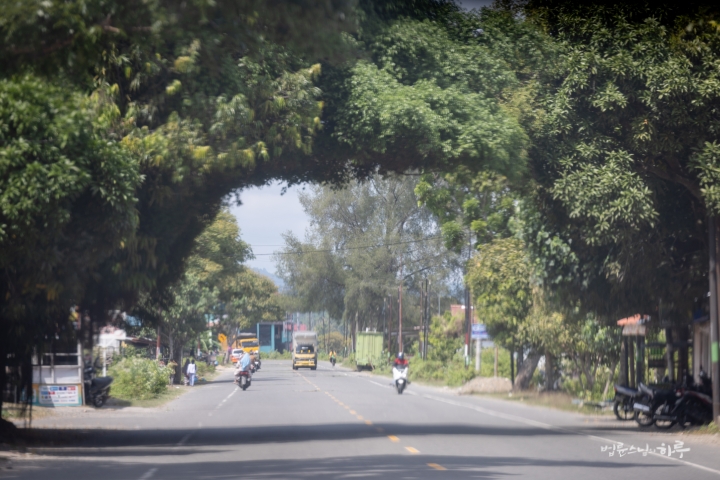
Jan 19, 2026. Day 3 of Indonesia Flood Emergency Relief, Departure from Banda Aceh
Hello. Today marks the third day since arriving in Indonesia for emergency relief activities. Sunim completed the relief work and traveled from Indonesia to Malaysia.

After completing morning practice and meditation, Sunim had breakfast at the accommodation at 7 AM. During the meal, he held a brief evaluation meeting with Park Gina, President of JTS, about the Indonesia emergency relief activities before leaving the accommodation at 9 AM.
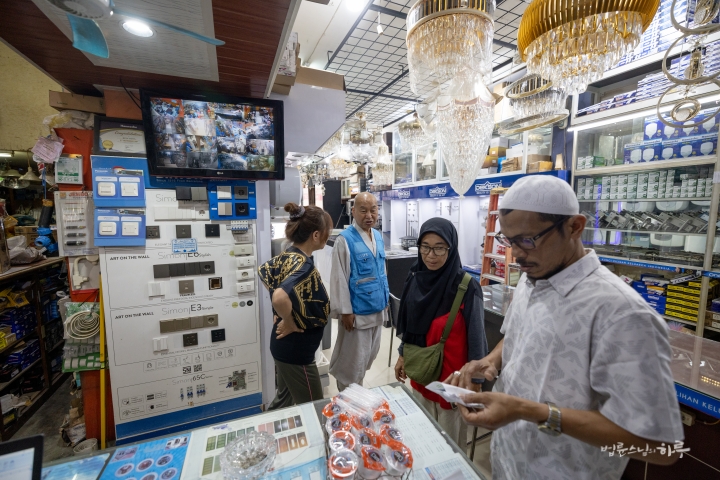
Before heading to the airport, Sunim visited a building materials store located in the center of Bireuën city. The store owner, who is Amir’s brother-in-law, helped transport the emergency relief supplies. Thanks to his wholehearted support in quickly moving large quantities of goods to the affected areas, the distribution was completed successfully.

Sunim expressed his gratitude and settled the transportation costs. Amir encouraged even his relatives and family members to actively participate in this emergency relief effort.
Next, they headed to the warehouse where the remaining supplies from the relief activities were stored. This warehouse was also lent by Amir for JTS’s use.
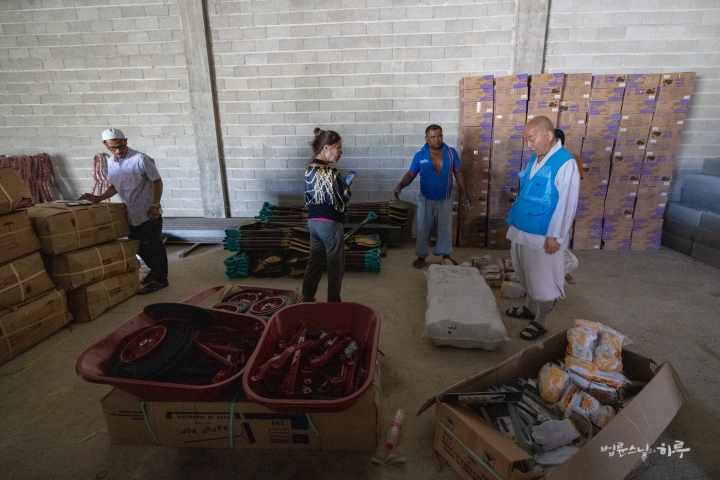
Sunim counted each item stored in the warehouse to verify the quantities. There were about 120 pieces each of wheelbarrows, shovels, hoes, push brooms, and gloves remaining.
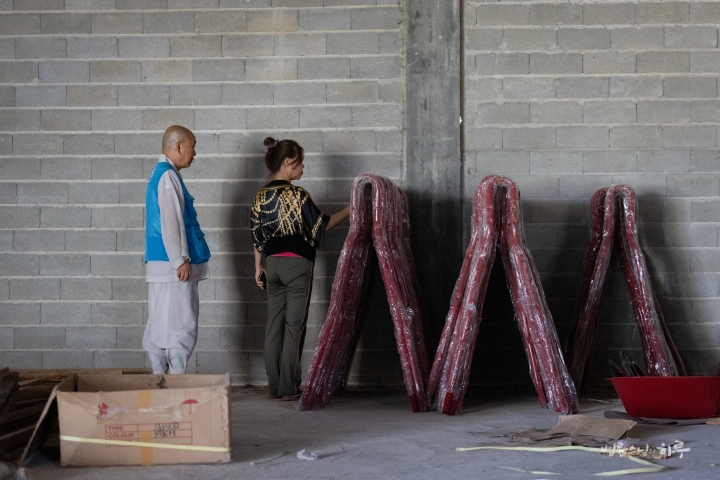
The remaining supplies will be stored here and distributed to residents during the second phase of support.

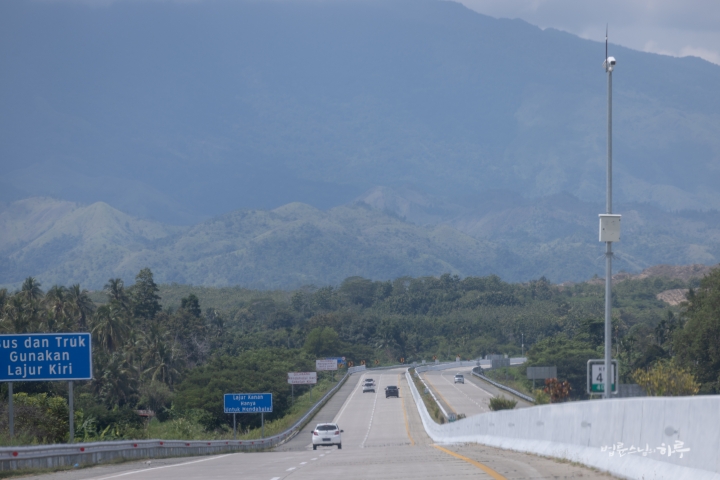
After taking a commemorative photo together, they departed from Bireuën at 9:50 AM and headed to Banda Aceh Airport. When they reached Sigli, Sunim made a suggestion.

Looking at the map, Sunim guided Amir to the ocean near the road. After leaving the highway and driving along country roads, the ocean soon came into view in the distance.


Boats shaped like rubber slippers floated leisurely on the blue ocean. Amir drove slowly. Everyone took in the ocean view through the car windows. It was a moment of respite for the group who had spent two days conducting relief activities in muddy villages.


After briefly viewing the ocean, they returned to the road and arrived at a restaurant near Banda Aceh Airport at 1 PM.
During lunch, they discussed future plans for Indonesia relief activities with Amir, who handled driving and local communication, Ayu, who served as interpreter, and Park Gina, President of JTS. They exchanged opinions on distributing the remaining supplies, providing kitchen utensils that couldn’t be distributed this time, and supporting seeds and seedlings to help resume farming.
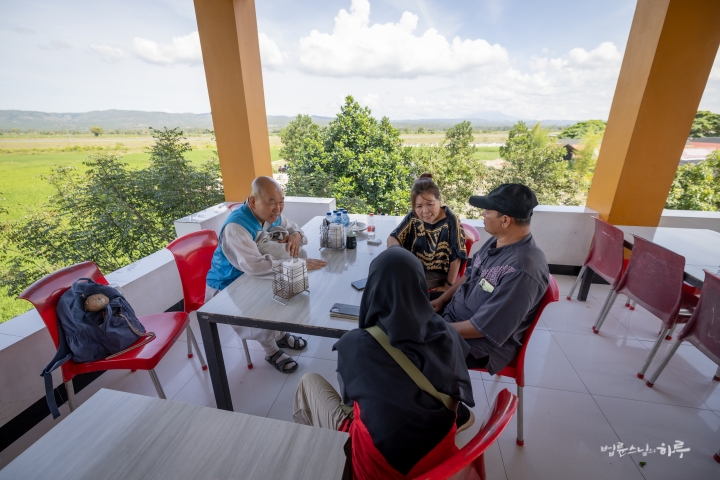
Before departing for the airport, Sunim expressed his gratitude to Amir and Ayu.
“Thanks to you, we were able to successfully complete the distribution of relief supplies. There’s still much work ahead, so please continue your support.”They arrived at Banda Aceh Airport at 2 PM. After saying farewell to Amir and Ayu, they entered the airport and went through departure procedures.
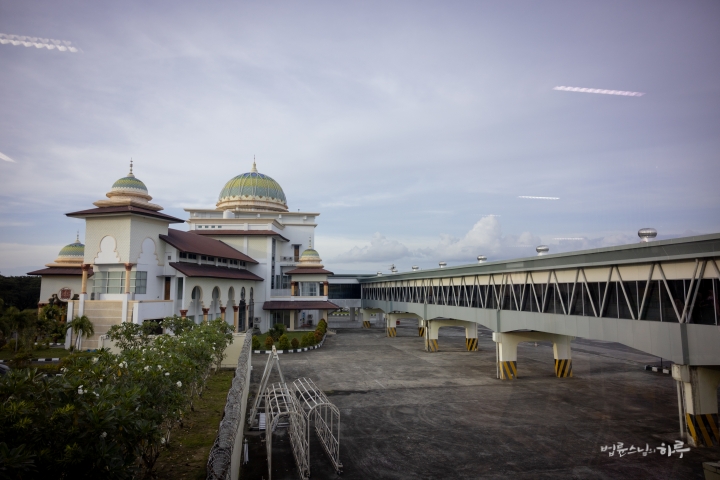
The itinerary involved flying from Banda Aceh to Kuala Lumpur, Malaysia, then transferring to a flight to Incheon. Being a budget airline with a short transfer time, they didn’t check any luggage, but carry-on bags were limited to 7kg per person. With lots of equipment including filming gear, they barely managed to board after distributing items into various vest pockets to reduce weight.
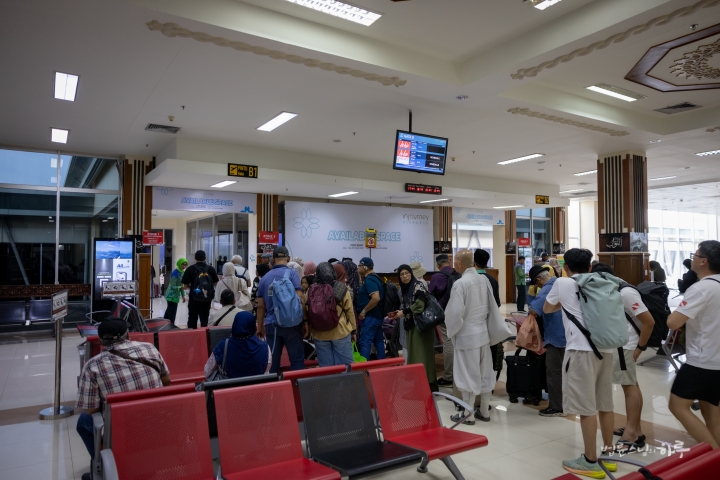
They boarded the AirAsia flight at 5:45 PM. Due to a 30-minute delay, the flight departed Banda Aceh Airport at 6:15 PM. Knowing the transfer time would be tight, Sunim hurriedly proofread manuscripts on the plane.

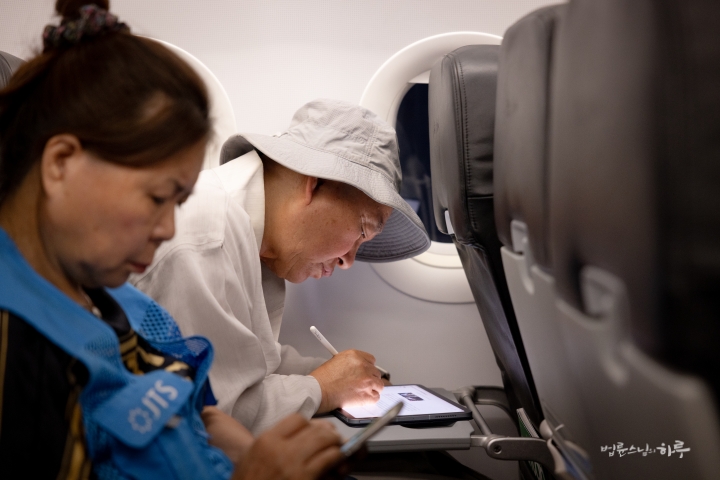
After a 1 hour and 20 minute flight, they arrived at Kuala Lumpur Airport at 8:35 PM local time. However, the flight scheduled to depart at 10:40 PM was delayed by 6 hours to 4:45 AM. They unexpectedly had to spend the night at the airport.
“We thought we wouldn’t even have time to collect our luggage, but suddenly we have plenty of time.”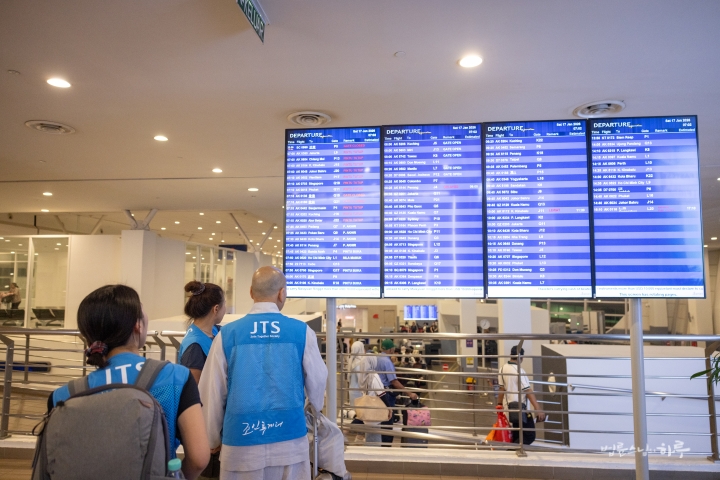
Sunim said with a smile. After a simple dinner of bread, he lay down in a corner of the restaurant to catch some sleep.

Tomorrow, they plan to depart Kuala Lumpur at 4:45 AM and return to Korea.
Since there was no Dharma talk today, this post concludes with a dialogue between Sunim and a questioner from a Happy Dialogue Dharma Q&A held in Singapore last July.
Why Does My Mind Always Waver According to Conditions?
“I am a sentient being who steadies my mind by watching Dharma Q&A whenever life gets difficult. I came to Singapore thinking I would try living abroad because I dislike Korean society’s excessive comparison culture and age-conscious culture. Even though I came prepared that living overseas wouldn’t be entirely pleasant, lately I want to return to Korea again. I felt that way until the day before yesterday, but today I think Singapore is livable, and I enjoy working with foreign colleagues. My mind keeps going back and forth like this depending on company situations or surrounding conditions. On hot days, I think ‘I can’t stand this heat, I should go to another country,’ but then immediately think ‘What would be different in another country? I’ll find things I dislike there too.’ I want to calm this mind somewhat. What mindset should I have to live satisfied with the present without being swayed by surrounding conditions?”
“We have a Korean saying: ‘The mind going to defecate is different from the mind after defecating.’ That’s how the human mind is. It would be nice if the mind remained the same whether going to or coming from the bathroom, but that’s just theory. The human mind is originally like that. Are you at the level of Buddha or Jesus?”“No, I’m not.”
“You need to know your level and live accordingly. Going back and forth is the nature of the human mind. But when you know that this mind originally wavers, you actually become less shaken. Even when you think ‘I absolutely can’t live with this person,’ your mind changes the next morning. Even when you think ‘I should go to Korea,’ your thoughts change the next day. Even couples say they’ll divorce when fighting, but their minds change the next day. Having various thoughts arise according to circumstances like this isn’t wrong. Everyone is like that. There’s a saying ‘fickleness bubbles like porridge.’ The mind originally has such a nature. Yet because you think your mind should always be constant, it feels like your mind is the problem. But the mind originally bubbles like porridge. So when you feel like doing something, just recognize ‘Ah, I want to do this now.’ When you feel like being somewhere, just know ‘Ah, I want to be here now.’ Then just live. While thinking ‘I should go to Korea,’ live here. While thinking ‘I should stay here,’ live here. While thinking ‘Ugh, I can’t stand seeing that person,’ live together. While thinking ‘I like you,’ live together. Because the mind originally goes back and forth and cannot be trusted. When a couple is getting along well, they say let’s live together in the next life too, but when they dislike each other even a little, they immediately talk about divorce. That’s how all minds are. No one lives married life with an unchanging mind. In the evening they say they can’t stand it, in the morning they say it’s fine. In the morning they say they can’t stand it, in the evening they say it’s fine. That’s how couples can live together. If the feeling of ‘I can’t stand this’ continues today and tomorrow, they’ll eventually separate. Both Koreans and Americans live saying ‘I can’t stand this.’ Many Americans are emigrating these days too. When Americans ask me ‘Should I just stay or emigrate to England?’ I answer ‘That’s up to your mind.’ If you stay in America, there’s the difficulty of having to improve the social environment. If you emigrate to avoid discomfort, there’s the difficulty of adapting to a new environment. For example, America has many Irish immigrants. When Ireland was struggling in the past, many people crossed over to America and adapted successfully. Now, 100 years later, Ireland has grown into a country with a per capita GDP exceeding about $100,000. So did those who went to America do well? Or did those who stayed do well? Looking at it long-term, no one can definitively say they did well. Korea has a similar case. When I was young, Korea was poor, so all the smart, talented people went to America. They made money in America and returned to Korea in their 40s and 50s acting important, but now in their 70s, it’s hard to say their living conditions are better than those who stayed in Korea from the beginning. That’s why we can’t conclude that living in any particular place is especially better.
“Yes.”
“Then you’d have to become a stone.” (laughter)“Isn’t there a difference in how much people waver?”
“Yes, it varies from person to person. But everyone’s mind goes back and forth. So there’s no need to criticize others for being inconsistent. Unless it’s criminal, human choices cannot be called bad. And when you understand that the nature of the mind is to waver, you become less affected by it. Then you can say that, as a result, you don’t waver. The mind reacts differently to the same stimulus according to karmic consciousness. Some people react sensitively, others react slowly. Some respond positively, others negatively. They’re just different, not good or bad. That’s why we say the mind cannot be trusted. This kind of mind shouldn’t be called our true nature. If we must find our true nature, there’s something we call conscience at the bottom of our mind. A mother’s mind caring for her newborn tends to be consistent. We could say it’s the first mind we’re influenced by after birth. But even that isn’t innate—it’s formed. It’s not created by God, nor given by fate. Until age three, when the ego is forming, the caregiver’s mind needs to be stable for the baby’s psychological security. When the mother’s psychology is anxious or withdrawn, the baby becomes anxious too. The mind naturally wavers. When you face this directly, you become less attached to the mind and waver less. Thus, even when your mind wavers, if you’re not affected by that wavering, others will see you as someone who remains consistent. Even if you want to go to Korea, live here. Even if you don’t want to go to work, go to work. Just live like that. Because the mind cannot be trusted. If you’ve decided to do something, do it. If you’ve decided to go somewhere, go. Meanwhile, observe your mind as it goes back and forth. Play with watching your mind that gets excited by small praise and upset by small criticism. It’s more entertaining than a movie. When you continuously observe your mind as it is, you’ll eventually live a life unaffected by the wavering mind.”“Thank you. I understand well.”