Memories of Being Bullied – I Thought I’d Forgotten, but Why Do They Keep Coming Back?
Jan 13, 2026 - Day 2 of Mindanao, Philippines Site Visit
Hello. Today marks the second day of the site visit to Mindanao, Philippines. Throughout the day, Sunim visited four indigenous schools and one special education school to survey potential school construction sites.
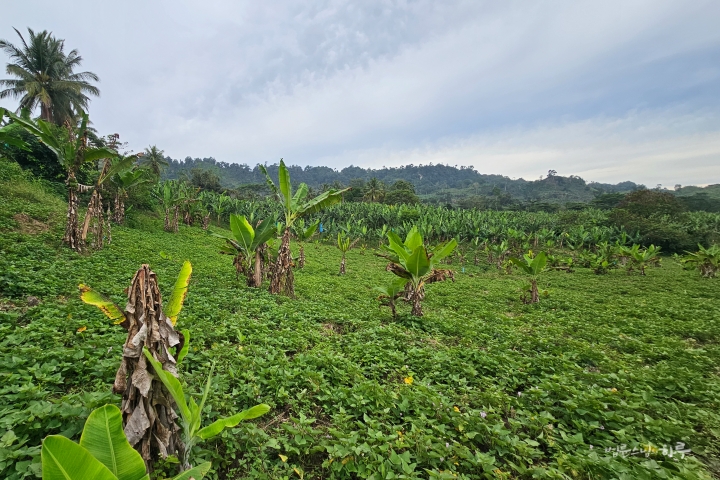
After completing morning practice and meditation, Sunim departed from the accommodation at 5:30 AM. It was still dark outside.
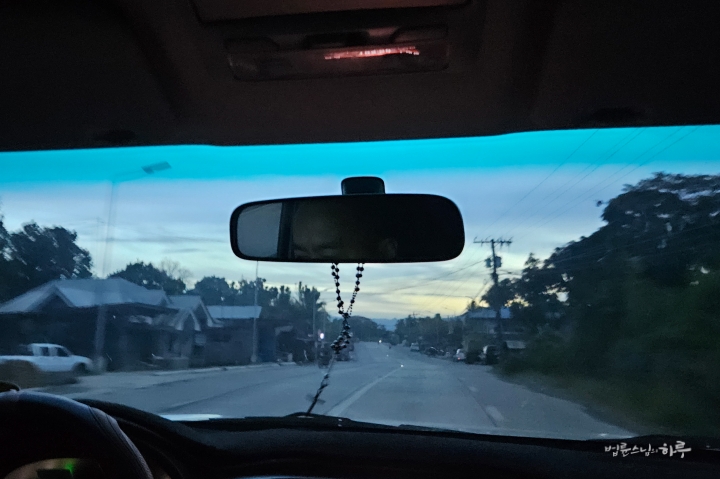
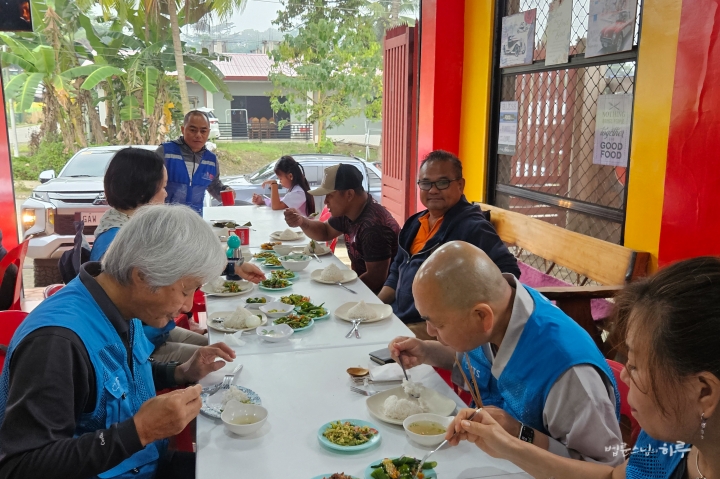
At 6:30 AM, after a simple breakfast at a roadside restaurant, Sunim headed to the first school.
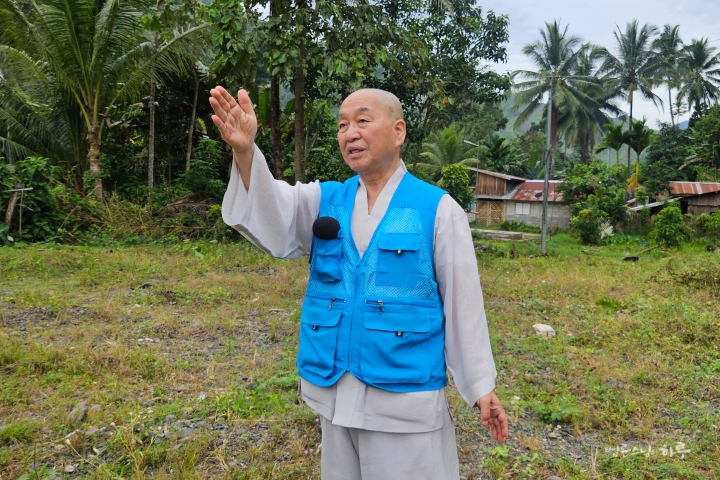
At 7:30 AM, Sunim arrived at the Lugawon indigenous school site in San Fernando municipality. This is a village where the Matisalug tribe lives.
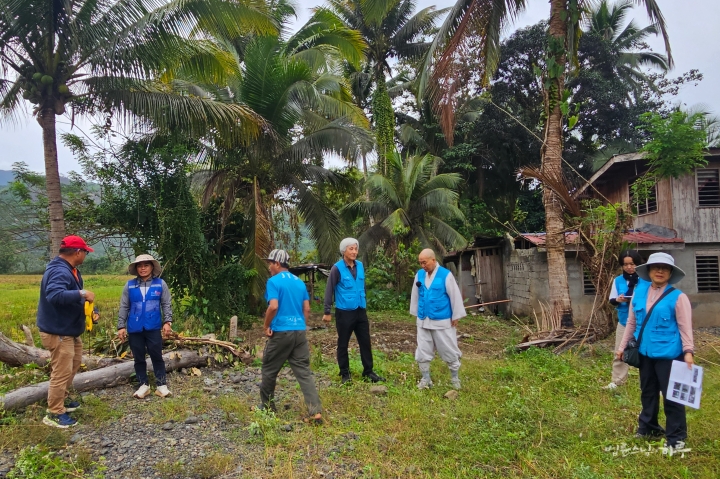
According to a JTS(Join Together Society) volunteer, the community’s unity had been remarkable from their first visit. Even then, under the morning sun, villagers were working together to cut bamboo and build a temporary school building. As Sunim surveyed the school site, he asked:
The Department of Education engineer replied:
“It would be best to align it straight and parallel to the road.”
Sunim and the JTS volunteers measured repeatedly with tape measures from various angles. The irregular shape of the land made it difficult to determine the building’s orientation. The measurement came out to 36 meters.
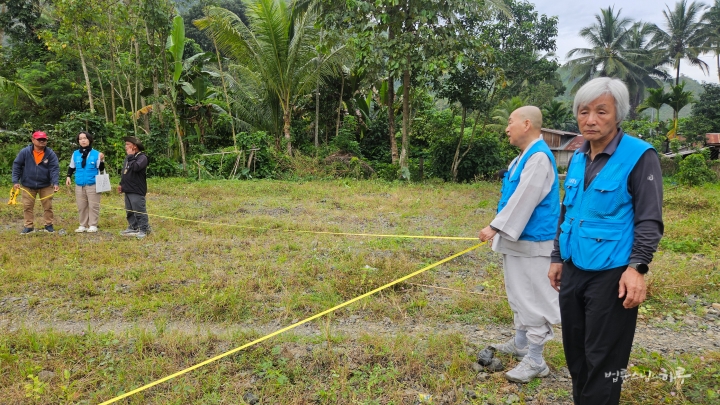
A JTS volunteer suggested:
“How about building the toilets directly attached to the classrooms? They do that nowadays for children’s safety.”
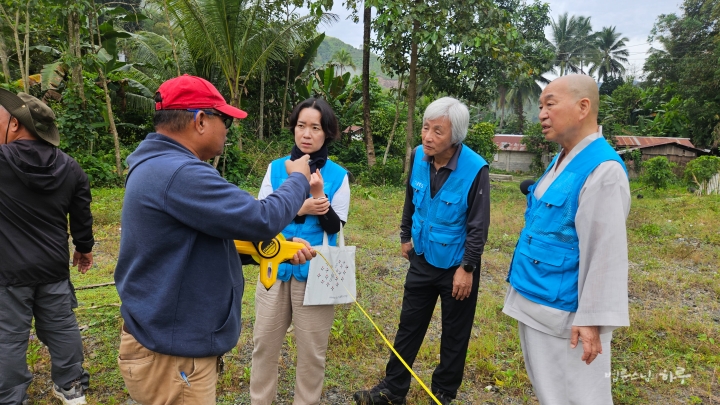
Sunim nodded.
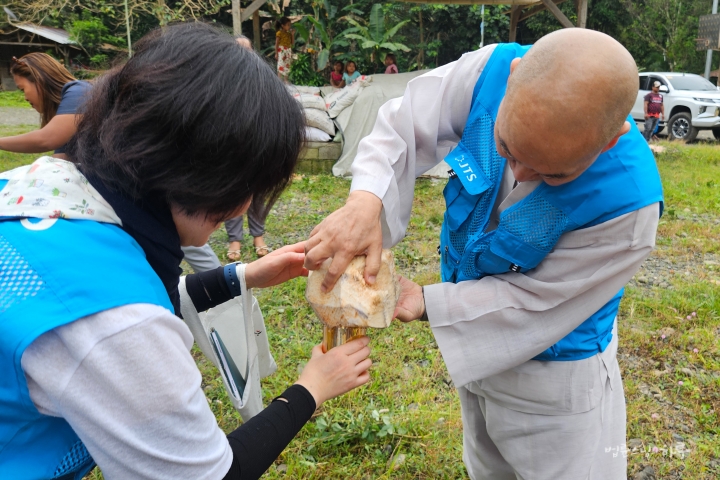
“That would work. We’ll just need a bit more land.”After surveying the site, the villagers offered coconuts they had picked themselves. Sunim poured coconut water into cups, saying
“If you pour it this way, you won’t spill a single drop.”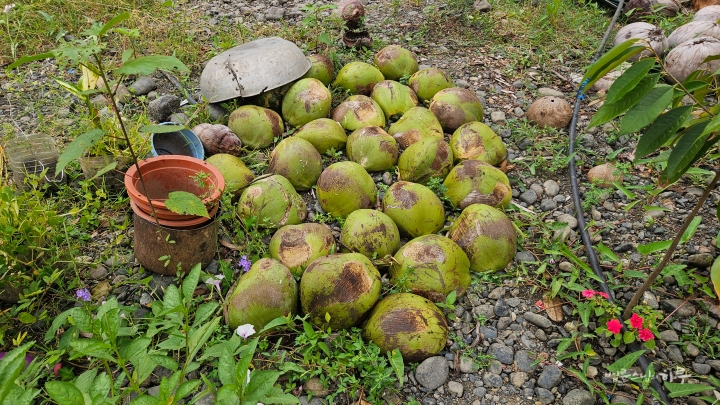
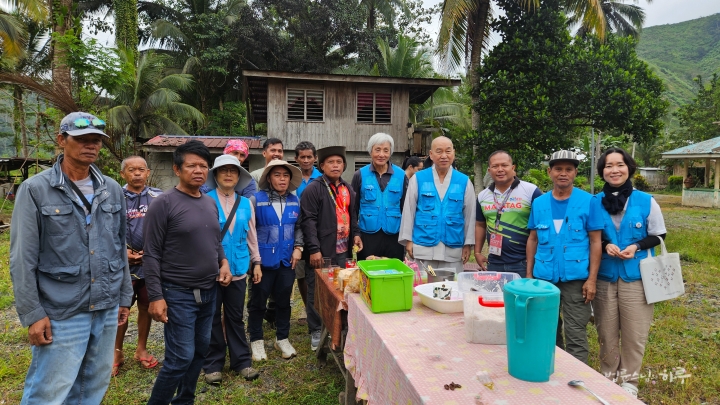
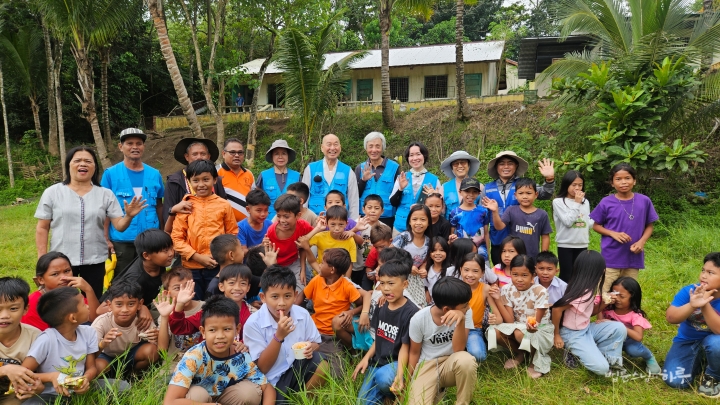
After refreshing themselves, Sunim took a warm commemorative photo with the villagers before leaving the village.
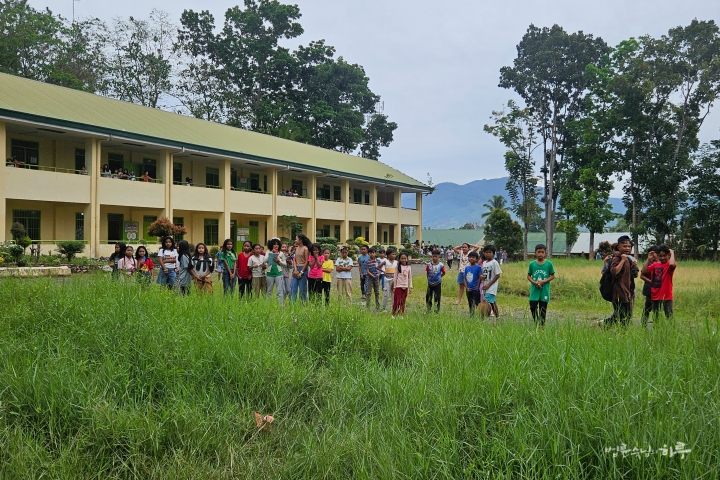
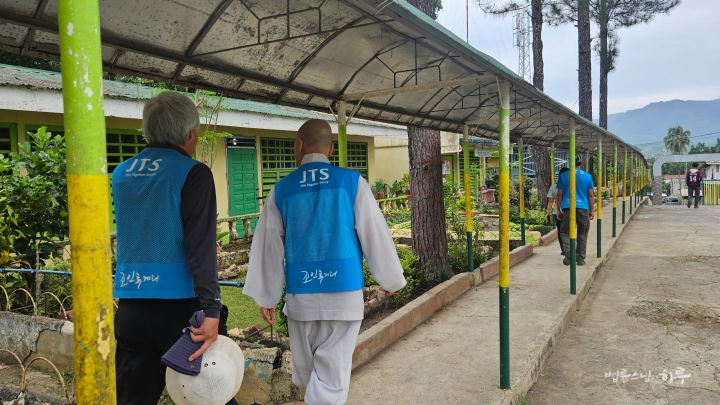
At 9:10 AM, Sunim arrived at Halapitan Central Elementary School. The school had covered walkways connecting the buildings to provide shelter from rain, and a wide lawn stretched out in front of the classrooms.
Here, Sunim met someone special.
“We have a teacher who is visually impaired. A doctor who visits on Thursdays is also visually impaired.”
A Department of Education staff member explained. Sunim greeted them with palms together.
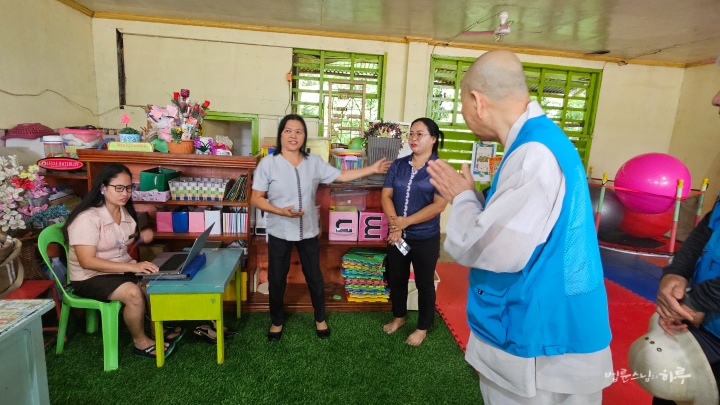
Sunim asked several questions to understand the special education school’s situation.
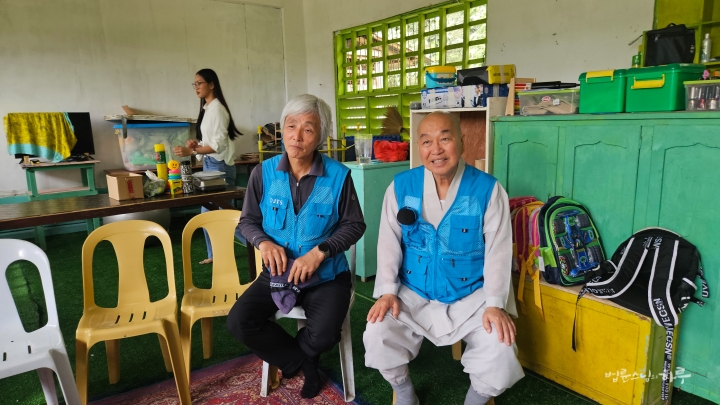
“There are 33 students total: 4 visually impaired, 8 hearing impaired, 3 with autism, and 8 with intellectual disabilities.”
“How many classrooms do you need?”The teacher replied:
“We need four classrooms – one each for Down syndrome, visual impairment, hearing impairment, and intellectual disabilities.”
Sunim suggested:
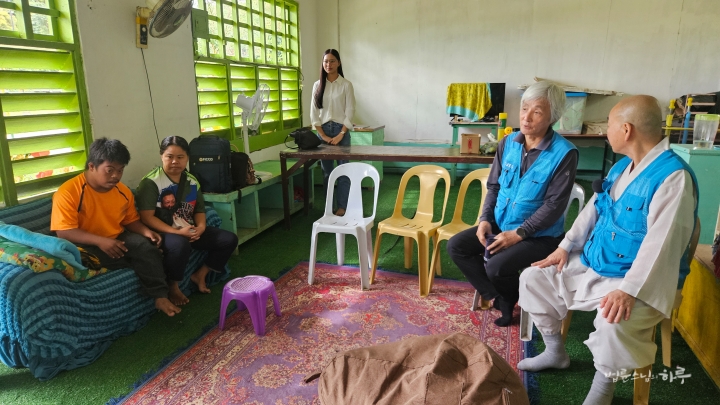
Discussion continued between Department of Education officials and JTS volunteers.
“Since we only have three teachers, three classrooms would be better.”
They ultimately decided on three classrooms. Sunim personally took the measuring tape and measured various spots to find the best location.
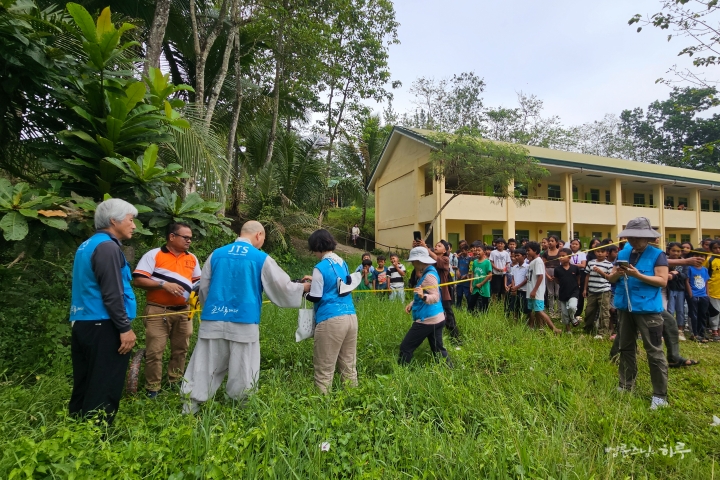
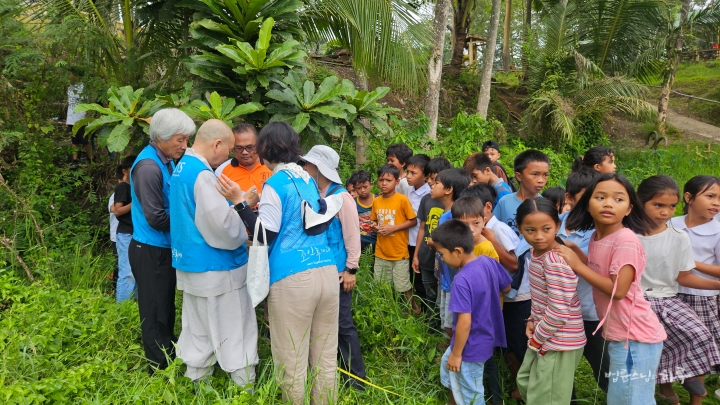
While determining the classroom location and size, children gathered around. After taking a commemorative photo with the children, Sunim left Halapitan Central Elementary School.
During the journey, Sunim stopped at a fruit shop to buy seasonal fruits. After lunch, he headed to the next survey location.

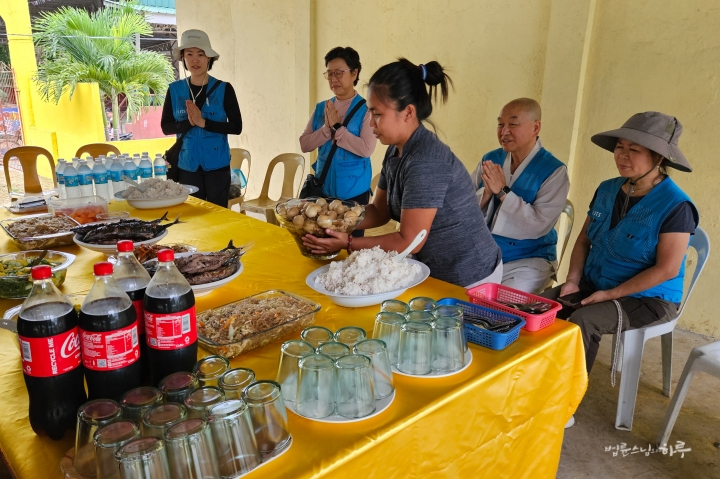
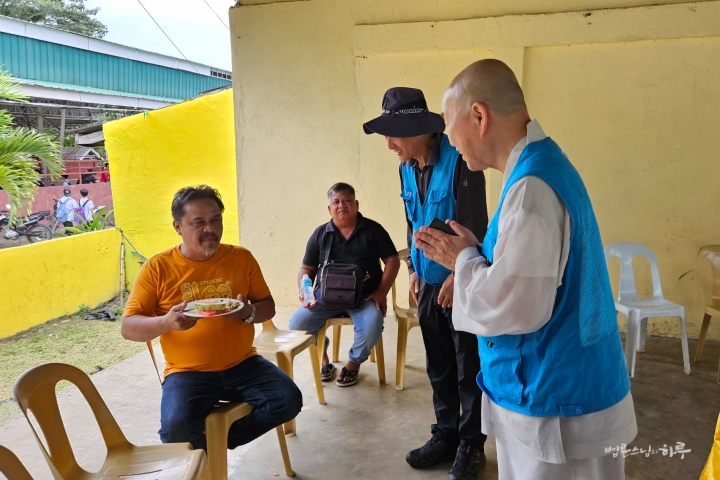
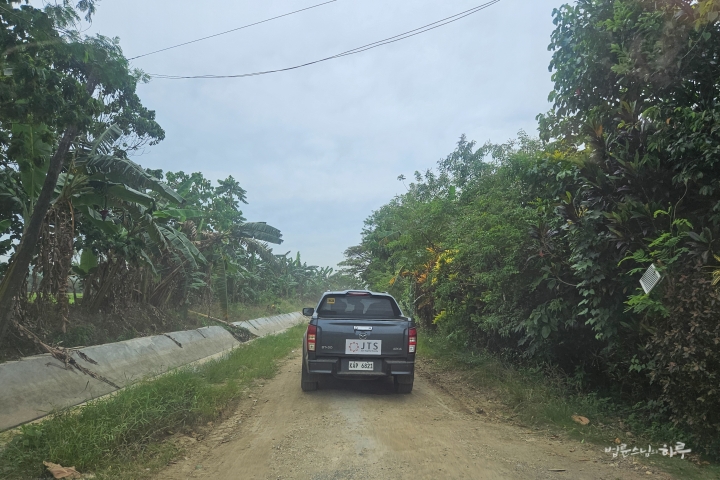
At 12:20 PM, Sunim arrived at Kolampyon indigenous school in Quezon municipality. Houses built 10 years ago through a government housing improvement project lined the area, but half were empty. Parents had left for work at sugarcane plantations, leaving only their children behind.
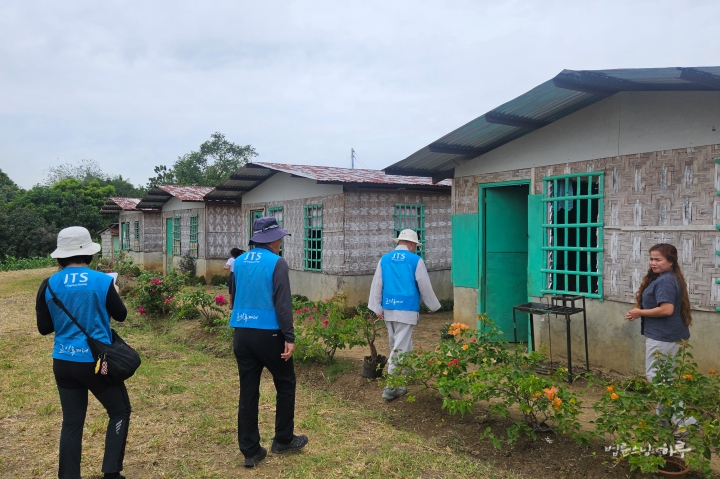

Sunim asked about the student situation.
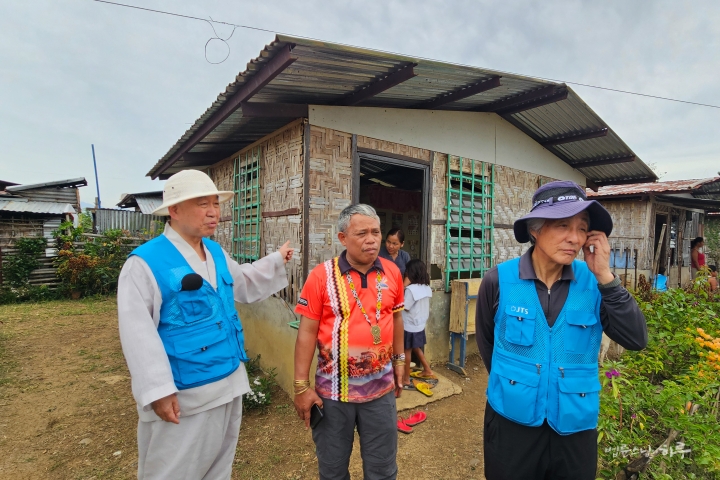
“There are 87 now, but it will increase to 250.”
“Why such an increase?”The principal explained:
“Children who were attending a school 7km away will transfer here. There was a private school 100 meters away, but it’s closing next year. Many children can’t attend the private school because it costs 300 pesos per month.”
Sunim fell into deep thought while measuring the site.
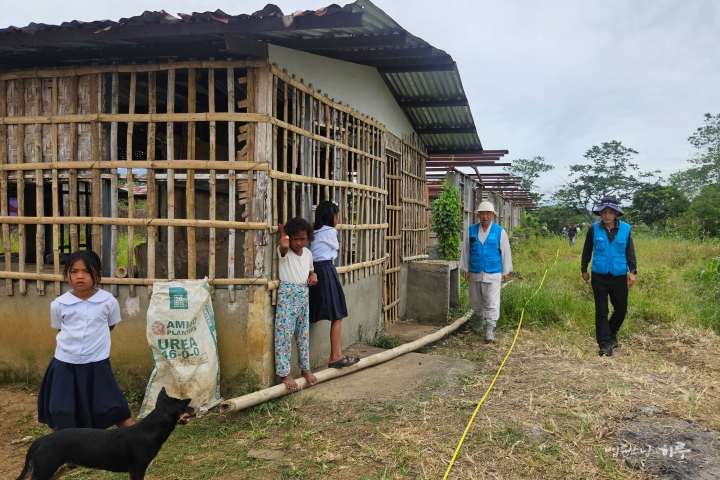
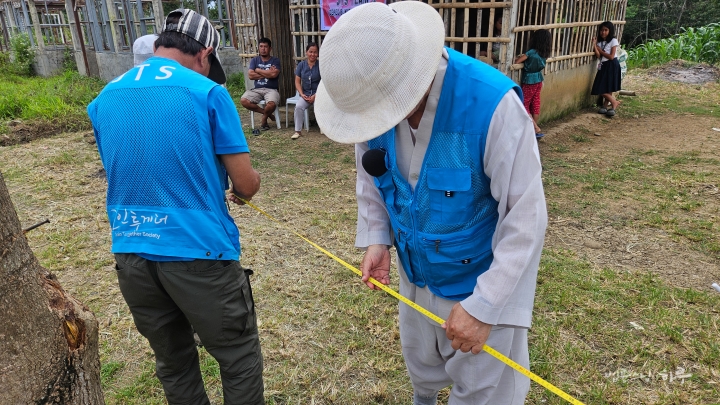
He reviewed various options with the engineer.
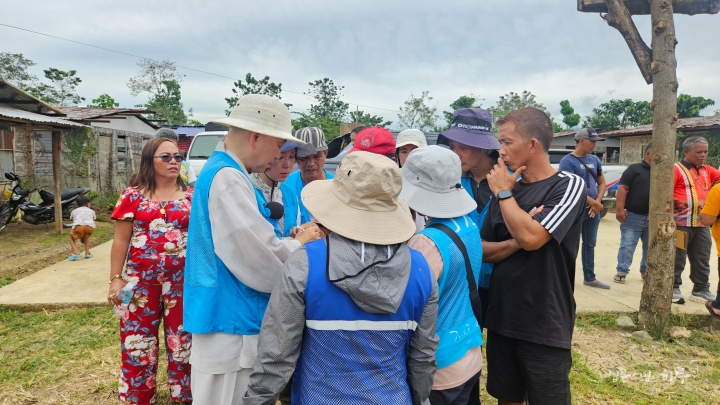
“Would it be okay if the classrooms become elongated?”
After much discussion, Sunim made a decision.
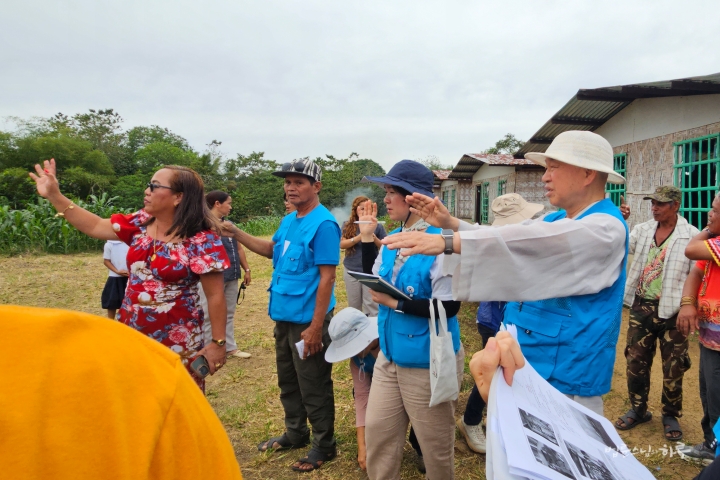
After finalizing the school location, Sunim took a commemorative photo with the children and teachers before leaving.
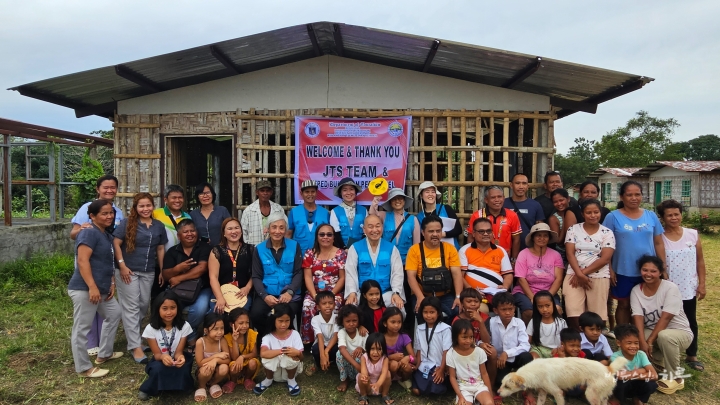
At 3:00 PM, Sunim arrived at Palasungan indigenous school in Kitaotao municipality. It took an hour and twenty minutes of driving on rough unpaved roads to reach the location. The school currently has 125 students, expected to increase to 157 soon.
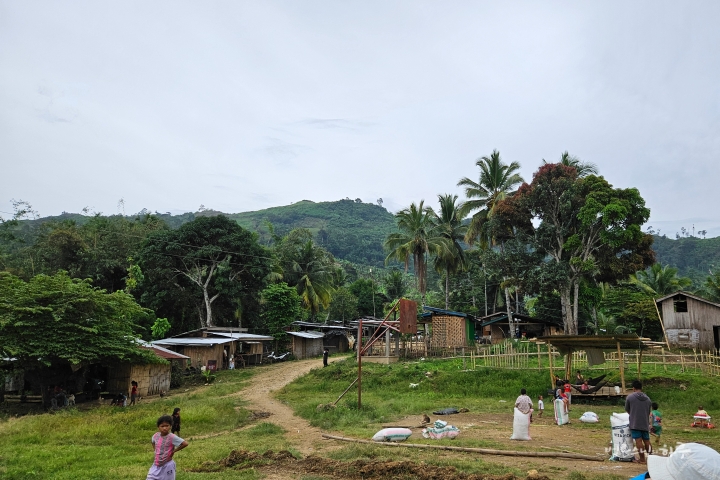

Entering the temporary classroom, Sunim saw bamboo-woven walls, dirt floors, and a blackboard made of wooden planks. Even for a temporary classroom, the conditions were extremely poor.
Sunim was shocked by the blackboard.
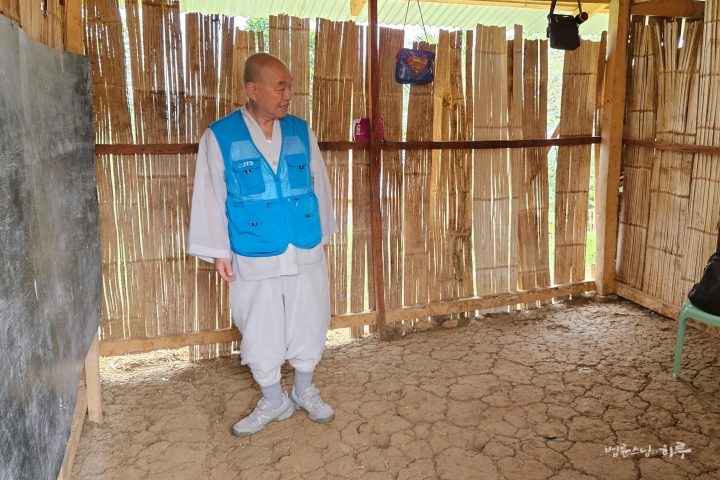
Sunim turned to the JTS volunteers and said:
“How can we not immediately help after seeing a blackboard like this? Let’s do it right away.”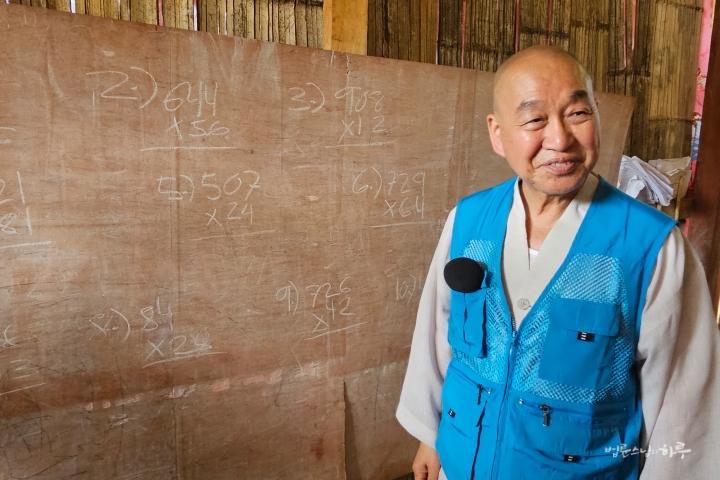
Meanwhile, children gathered around. After taking a commemorative photo together, Sunim went to survey the site for the new school building.


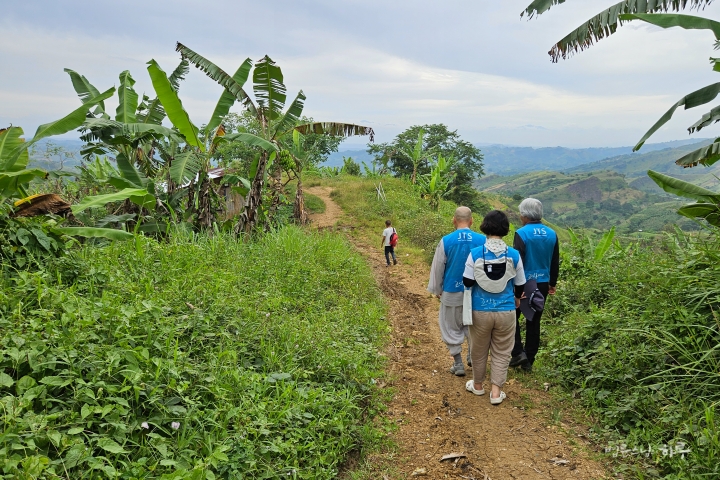
While surveying the construction site, Sunim pointed out the heavy equipment issue.
“This site needs a lot of work with an excavator to level the ground. We also need to build retaining walls. It will be difficult without support from the municipal office.”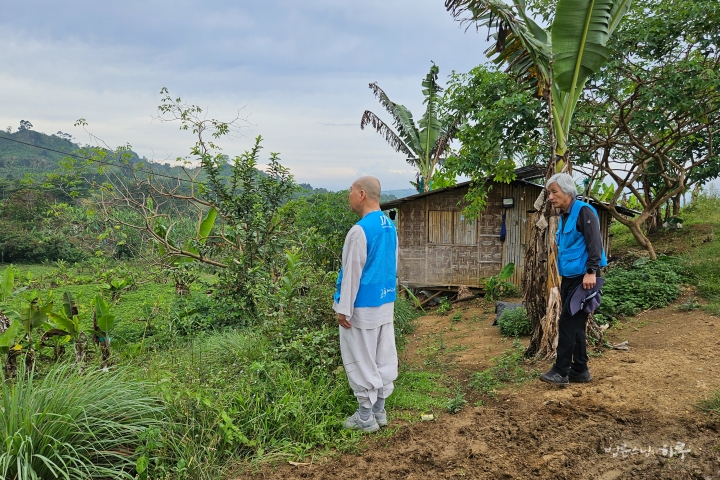
Sunim sought a practical alternative and suggested:
“How about moving four houses and building classrooms behind the community hall here?”The village representative replied:
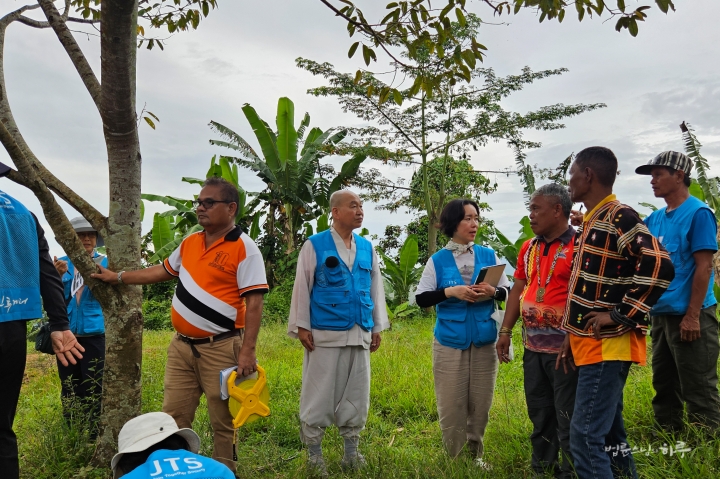
“We can move the houses for the students.”
Sunim promised:
“If you move the houses, JTS will provide roofing materials.”After looking inside the houses, Park Gina, JTS President, added:
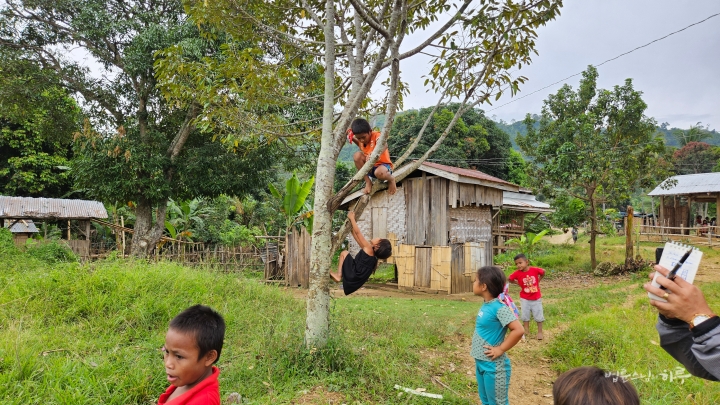
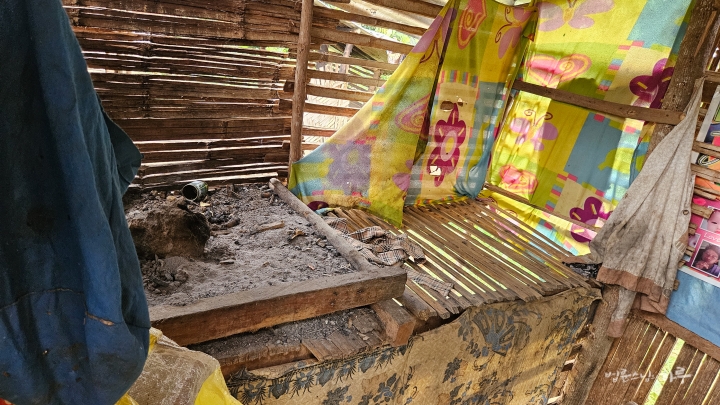
“The living conditions are also very poor. It seems we need not only schools but also housing improvements.”
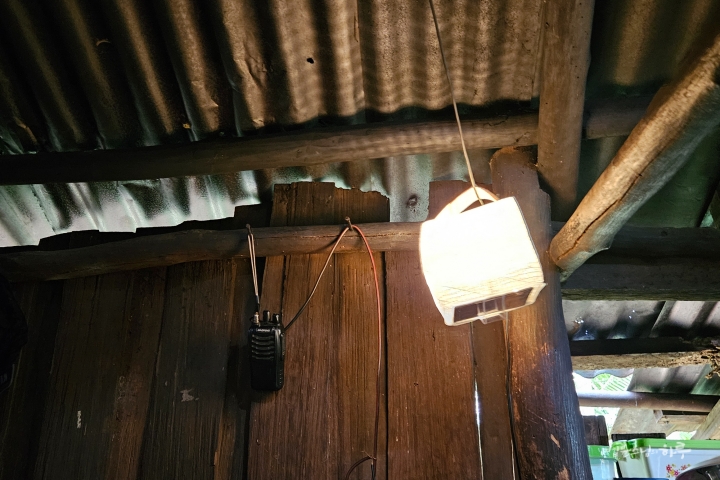
This was a place without electricity, unable to turn on lights even at night. The group also installed a sample solar light brought from Korea before leaving the village.
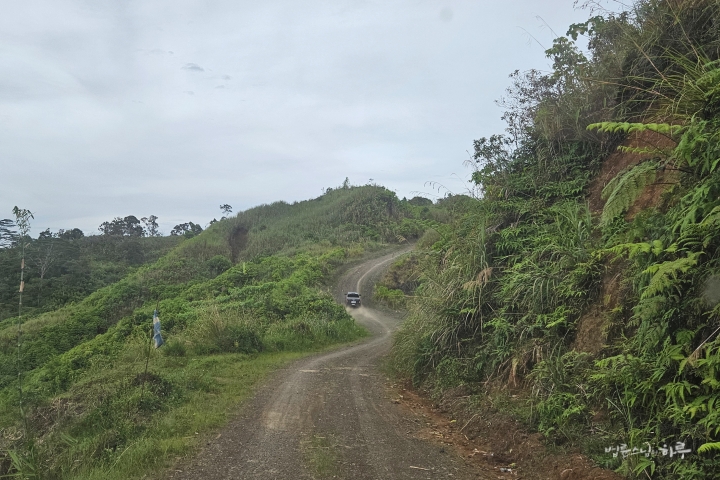
We arrived at the Pamalawan indigenous village at 5:30 PM. Since the sun was already setting behind the western mountains, we had to hurry.

The principal showed us the master plan.

“We have plans for 12 classrooms, but we intend to start with four for now.”
As dusk approached, we headed toward the site where the new school was to be built.
“How long does it take to get down to that site?”“It’s a three-minute walk.”
“It looks like it will take longer than that, but let’s head down for now.”The group hurried down the slope to inspect the land. Sunim pointed out issues with the incline.


The engineer agreed.
“If we make it 6m × 6m, the slope issue should be reduced a bit.”


We finished the inspection only after total darkness had fallen. Relying on the light from our mobile phones, we made our way back to the car.

At 6:30 PM, we had dinner at the nearby Sinuda Central Elementary School. During the meal, we summarized today’s field visits. Sunim said:


The representative from the Department of Education replied:
“Understood. We will assign a dedicated engineer, and the Department of Education will take full responsibility.”We arrived at our accommodation after 8:00 PM. Since the internet connection in his room was poor, Sunim came out to the common area to work on manuscript corrections and other tasks.


By visiting five schools today, we were able to directly witness the educational reality of each region. Tomorrow, we plan to visit four more locations: Sabang Indigenous School, Kibawe Special Education School, Kitaotao Special Education School, and Boc Boc Special Education School.
Since there was no Dharma talk today, we conclude this post with a conversation between Sunim and a questioner from a “Happy Conversation” Q&A session held in Bucheon (부천) last year (October 2025).

Memories of Being Bullied: Why Do They Keep Coming Back?
“I wonder what I should do to escape the painful memories and compulsions caused by bullying. I was bullied for over five years during my school days. I thought I was fine because I tried to forget and move on, but I realized it turned into a compulsion to ‘live a successful life.’ However, that compulsion doesn’t make me work harder; instead, it makes me lazy and stressed. I want to escape those bad memories. I’ve had counseling where they told me to ‘grieve enough.’ I wonder if that’s a good way, or if staying as I was—pretending it never happened—is best. I’d love to hear if you have any other recommendations.”
“Is smoking good for your health, or bad?”“It’s bad.”
“Suppose I don’t smoke, but five of my friends do. If those kids say, ‘Don’t play with that kid who doesn’t smoke’ and bully me, should I be sad about being bullied? Or should I think, ‘I don’t hang out with people who smoke,’ and ‘bully’ (exclude) them myself?”“I don’t think I need to be sad, but looking back, I think I was also a bit immature.”
“If you look closely at the experience of being bullied, there is often a hidden desire: ‘I wanted to belong to that group.’ Because those people looked cool and you wanted to be part of them, the pain of being excluded becomes greater. But we need to take a step back and think. Were those people really worthy of being so envied? Let me tell you a story. I, too, have had many experiences of being ignored and misunderstood within the Buddhist community for a long time. However, I didn’t take it as ‘they bullied me,’ but rather as ‘I chose a different path from them.’ This was because their way of life was not something I envied. For example, there were times at gatherings when I was invited to drink alcohol, enjoy consumerism, or do things that didn’t align with my values. But I didn’t feel that refusing was a loss or that I was falling behind. Rather, I considered it better to choose a life that met my own standards. Turning down an invitation to play golf isn’t a loss in life. The important thing is: ‘Is that choice truly meaningful to me?’ Feeling hurt doesn’t mean everything is the other person’s fault. It could be that ‘the heart that unconsciously envied them’ or ‘the expectation to belong to that group’ was at play. If it’s a truly enviable life, then try making that choice. But if you don’t want it in your heart yet continue to envy it, suffering arises from that gap. The reason it hurt to hear ‘I won’t be with you’ might not have been just because you were rejected, but because you wanted to remain in that relationship. But think again: what would you have learned and what kind of life would you have lived in that environment? Sometimes, distancing is not exclusion, but a choice to protect the path that fits you better. During the time I was misunderstood and excluded within the Buddhist community, I ended up meeting other religious leaders more often. I naturally began to interact with pastors, priests, bishops, and ministers who, despite different religions, were seriously concerned about life and society. Also, when my activities in Korea were restricted, I turned my gaze abroad and focused more on international relief work. In that process, I received unexpected evaluations. The meetings and cooperation across religions—which I wouldn’t have experienced if I had stayed only within the Buddhist community—led to the evaluation that I ‘broadened interreligious understanding.’ The relief work I did abroad because domestic activities were blocked led to the evaluation that I ‘broadened international understanding.’ As a result, I received the Ramon Magsaysay Award for Peace and International Understanding. Looking back, the experience of being excluded actually opened a new path. If there had been no difficulties then, such connections and experiences might never have happened. The reason I’m telling you this is to encourage you to look at your heart honestly. If memories of being bullied by friends left a scar, their attitude was certainly a problem. But at the same time, you need to examine whether there was a heart that thought, ‘I wanted to belong to that group,’ or ‘I envied them.’ It hurt more when you were rejected because that expectation existed. If so, you can ask again: Were they really that enviable? By not hanging out with them, did you perhaps avoid learning values or behaviors that didn’t suit you? If you change your perspective like this, you don’t have to see that experience entirely as a misfortune. Sometimes, there is room to say, ‘I’m glad I didn’t go down that path back then.’ Once a scar is formed, it remains in the heart like a habit for a long time. So, rather than trying to forcibly erase or deny that memory, you need a process of understanding why it hurt so much and what expectations or attachments were inside it. Once that understanding arises, the past experience is no longer a shackle that binds you, but can turn into an insight into life.”“Yes. But since it was my school days, I think I couldn’t help but be envious.”
“Is that being foolish, or being wise?”“Looking back now, I think it was foolish.”
“That’s right. You were young then, and because you were foolish, that’s how you felt. Smoking looked cool, acting tough looked strong—you didn’t really know what those things were, so you envied them. But as you get older and look back, you realize it’s nothing to be envious of. In fact, it was a good thing you didn’t turn out like that. When I was young, there was a shortage of rice, so I couldn’t eat properly. I dug up arrowroots, bellflower roots, and ate brier sprouts; many nights I went to sleep hungry. But looking back now, everything I ate back then was a natural health food. Also, because the school was far away, I walked every day. Because I walked so much, my legs became so strong that people said I walked as if I were using magic (chukjibup-축지법). So, when I go to places like Southeast Asia or Bhutan for relief work, people are surprised to see me adapt so quickly to the local situation. They say I know about farming and everything about daily life. When that happens, I jokingly say, ‘I did a lot of good deeds in my past life, so I was born into a poor family and received a proper early education.’ In reality, those life experiences have become a much greater asset than knowledge from books or multiple academic degrees. In this context, the experience of being bullied is the same. Depending on how you accept and use it, it can become a resource for life. Based on that experience, you can help other children avoid going through the same thing. When a child cries because they were bullied, don’t just see them as a pitiful object of protection; help them think for themselves about why those words hurt and if they were envying something. Helping them realize their own heart is the real help. This is also why I don’t often say words of comfort or soothing. A person should not be someone who is constantly protected, but someone who becomes the master of their own life. If you were hurt because you were immature when you were young, don’t deny it; acknowledge it by saying, ‘For who I was then, it could have happened.’ And the starting point is to realize, ‘This is a scar I received.’ From now on, you don’t have to be envious anymore. This is because you now have the eyes to discern what a truly valuable life is. Of course, the aftereffects of past experiences may not disappear completely. But that is not something to be treated as a problem to be eliminated; it is something to be understood and carried with you. When you do that, the past is no longer a memory that holds you back, but a foundation that makes your life solid.”“Thank you. Actually, it hasn’t been long since I started having these thoughts. I used to keep it buried deep down. In my case, even when I try to work hard, I’m naturally lazy, so working hard is difficult for me.”
“There is no need to struggle to live ‘hard’ (diligently). That thought itself might already be wrong. Does a rabbit say it lives hard? No. A rabbit just lives its own way. Even so, there’s no problem in its living. But why do we always think we ‘must live hard’? Because you have a standard of ‘living hard,’ if you fall short of it, you judge yourself as ‘lazy.’ Have you ever heard anyone call a cow lazy? No. But we don’t say ‘the cow lives hard’ either. The cow just lives like a cow. Words like ‘diligent’ or ‘lazy’ are not natural standards; they are artificial yardsticks created by humans. So, don’t push yourself and try to live hard by force. That thought only tortures you. Just live as much as you can right now, according to your circumstances. That in itself is enough.”“But I do need to get a job.”
“Of course you should get a job. You wake up in the morning, wash your face, eat, go to work, and come home when you’re done. Is that living ‘hard’? It’s just living. Does a cow eat grass ‘hard’? No. It just eats. What is so difficult about opening your eyes in the morning? If you don’t want to open your eyes, you can just die. What is so hard about washing, eating, and going to work? Think about a time when you couldn’t wash because there was no water. Being able to wash is a good thing. Think about a time when you couldn’t open your eyes because they hurt. Being able to open your eyes is something to be grateful for. Having ingredients for breakfast and being able to cook and eat is also something to be grateful for. Ultimately, it’s all a matter of perspective.”“But shouldn’t I make an effort to improve my abilities?”
“If you don’t have the ability, live without it. There’s a saying that if a crow-tit (뱁새) tries to walk like a stork (황새), it will break its legs. Just go to work casually. If the company tells you to leave, say ‘Okay’ and leave. There’s no need to walk on eggshells. To others, you look fine, but you always feel a deficiency, saying ‘I am lacking.’ That is not a problem of reality, but a psychological one. You can live well even if you live casually. You might even live longer than me.” (Laughter)“When I see my pathetic self, my self-esteem drops so much that I think, ‘Shouldn’t I be living harder?'”
“If you want to live hard, then live hard. Just as you quit smoking if it’s bad for your health even if you want to smoke, if you want to live hard but it doesn’t work, then just don’t live hard.”“But it’s so painful to see my incompetent self.”
“You weren’t originally someone ‘superior’ or ‘special.’ Why do you have that delusion? You have two eyes, right?”“I do.”
“You have a nose, right?”“Yes, I do.”
“You have a mouth and ears, too. That’s enough. Eyes are for seeing, a nose is for breathing, ears are for hearing, and a mouth is for eating and speaking. They all function properly, right?”“Yes, they function properly.”
“Then that’s enough. Does raising the bridge of your nose help you breathe better? Does opening your eyes wider help you see better? Does shaving your jaw help you eat better? You are miserable because you have those useless thoughts. There is no problem. Just live as you are right now.”“Yes. I understand. Thank you.”