If I Don’t Let Go of This Desire to Be Praised and Recognized, Will I Suffer?
Jan 11, 2026 - Day 4 of Surveying Flood-Affected Areas in Indonesia
Hello. Today is the day for conducting market research in Medan to secure relief supplies for the flood-affected areas in Indonesia.
After completing his morning practice and meditation, Sunim had a simple breakfast at the accommodation and started the day at 7:40 AM with a meeting with Andre to discuss the market research for relief supplies.
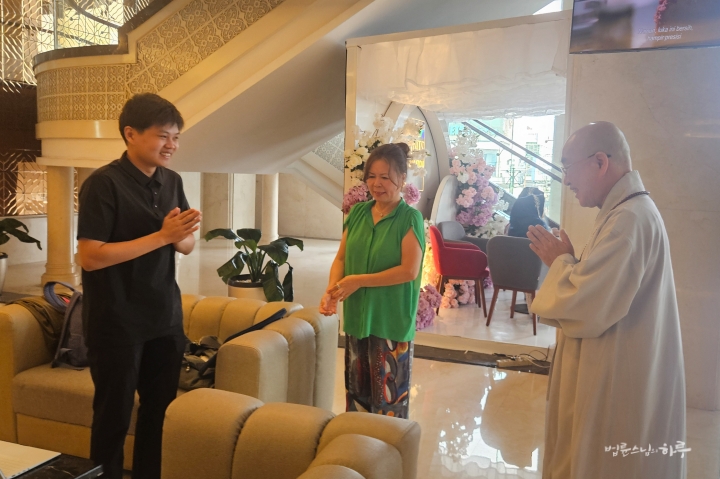
Andre is a young man of Chinese descent who grew up in a devout Buddhist family and runs a business in Medan helping his father. Yesterday, he provided great assistance when conducting market research for boots, shovels, hoes, and basins with JTS President Park Gina, and he agreed to join the survey throughout today as well.
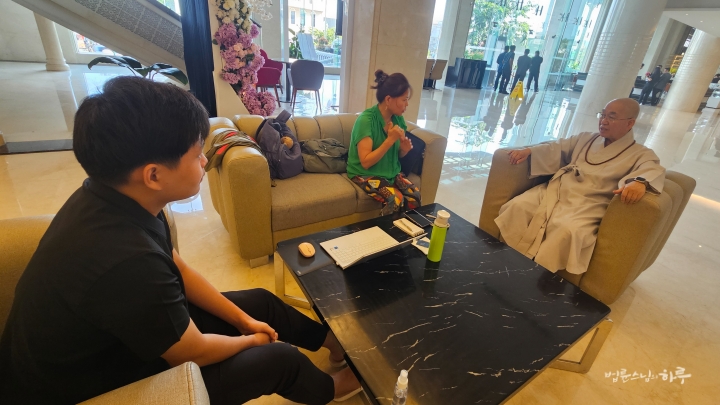
Sunim politely requested Andre’s cooperation.
“Aceh Province has a reputation as a region where hardline Muslims live, making it difficult to receive support from the international community. Since this is about helping people suffering from flood damage, please help us as much as you can, Andre.”Andre answered without hesitation.
“Yes, I understand. I’ll do my best to help.”
The meeting with Andre continued regarding today’s market research plan. Based on the site visits and compilation of residents’ requests up to yesterday, it was determined that 764 households needed cleaning supplies and 888 households needed kitchen supplies. Accordingly, they decided to conduct market research to purchase large quantities of major relief supplies including cleaning tools such as shovels, hoes, and squeegees, kitchen supplies such as rice cookers, dishes, and ladles, and sarongs (cloth garments), and concluded the meeting.
At 9:30 AM, they left the accommodation and headed to the downtown wholesale market to research kitchen supplies. However, since it was Sunday, most wholesalers were closed. Fortunately, Andre contacted a wholesale company he regularly dealt with, and they received a response that they would specially open their store, so they immediately headed to that shop.
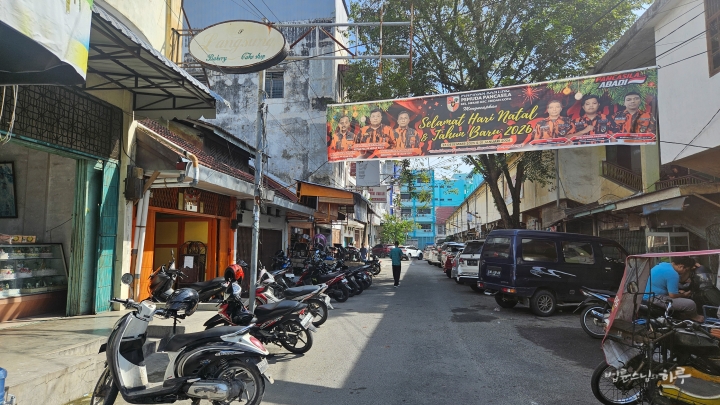
Normally, this would require visiting multiple stores in person and spending considerable time negotiating prices, but this emergency relief schedule lacked sufficient time. While there were some regrettable aspects, since this was the first round of support, they decided to start price negotiations immediately at the store visited today, based on trust in Andre and President Park Gina’s extensive relief experience.

They selected 10 kitchen items as the most urgently needed relief supplies on site. The selected items were spoons, plates, cups, soup bowls, frying pans, basins, spatulas, rice cookers, ladles, and slotted spoons. For spoons, plates, cups, and soup bowls, they decided to purchase 4,440 pieces of each item to distribute 5 pieces per household based on a 5-person household standard to 888 households. For frying pans, basins, spatulas, rice cookers, ladles, and slotted spoons, they decided to prepare 888 pieces of each item to provide one per household to 888 households.
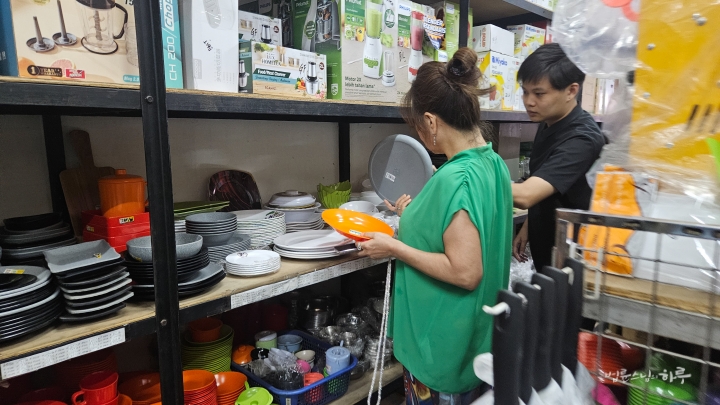
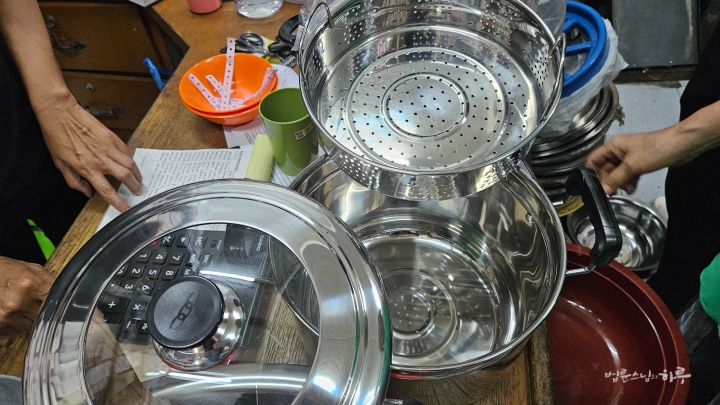
Since this was a bulk purchase, even a small reduction in unit price would allow them to support more residents with more supplies. However, the store owner offered a higher price than expected, so President Park Gina continued price negotiations for a long time.
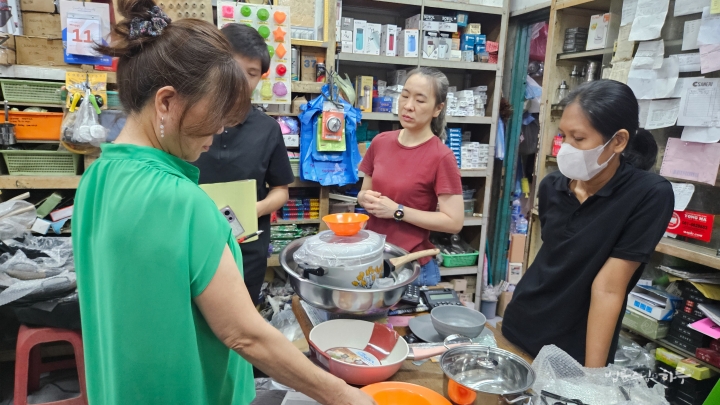
Additionally, since the supplies needed to arrive in Aceh Province by the 16th to be distributed to each village on the 17th, they also confirmed whether delivery was possible. The store owner promised to provide an exact schedule by tomorrow.
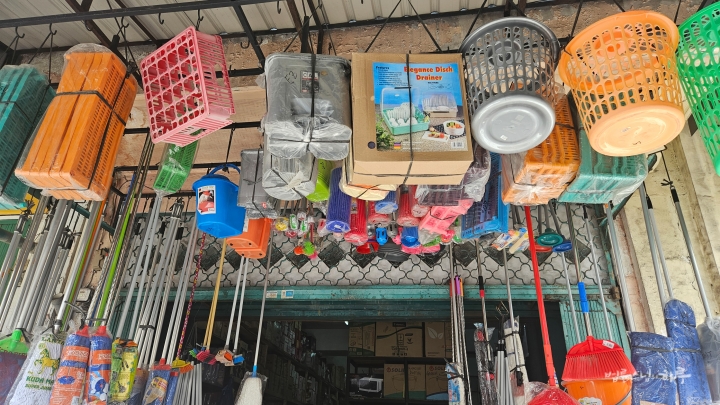
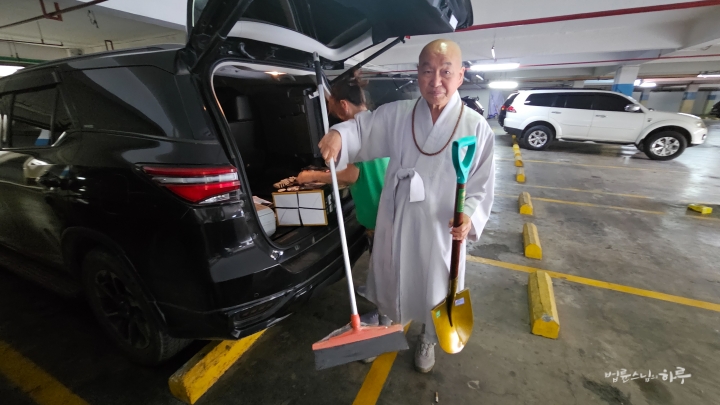
At 12:30 PM, they inspected the quality of cleaning supplies such as shovels, hoes, and gloves secured yesterday at Andre’s factory. Sunim personally lifted a shovel to check if it was sturdy.
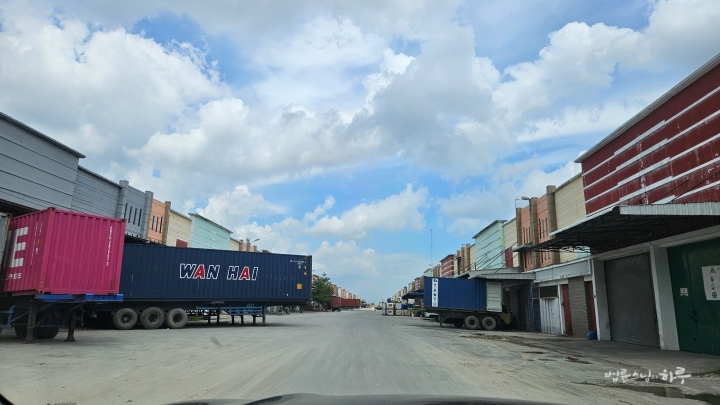
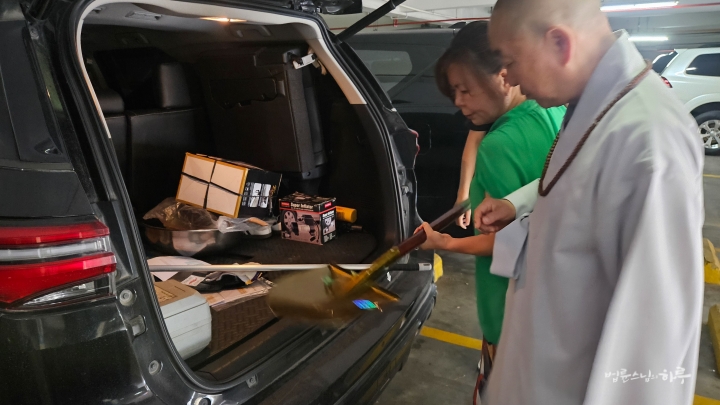
Andre reassured Sunim.
“Don’t worry. They’re sturdy.”
After inspecting each item, all were found to be in good condition and ready for immediate use.
At 1:30 PM, they returned to the accommodation and held a final review meeting for the distribution of relief supplies. Since the affected residents also requested wheelbarrows and gas stoves, they decided to provide these items as additional support.
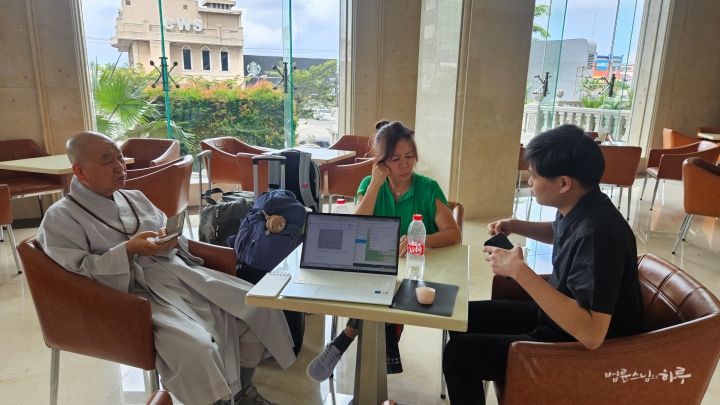
As a result of the quick survey of supplies over the past two days, it was confirmed that all the shovels, hoes, gloves, and wheelbarrows that Andre agreed to prepare could arrive in Aceh Province by the 16th. They decided to prepare and distribute only the daily necessities that could be ready by the 16th as scheduled first, and President Park Gina would stay on-site for an extra day or two to personally distribute any remaining items that arrived late. Finally, they concluded the meeting with Jungto members residing in Jakarta agreeing to help with the remittance of payment for the supplies.
With this, the 4-day, 3-night survey of the flood-affected areas in Aceh Province, Indonesia was completed. Sunim presented prayer beads as a gift to Andre, who came to see them off at the airport, expressing his gratitude.
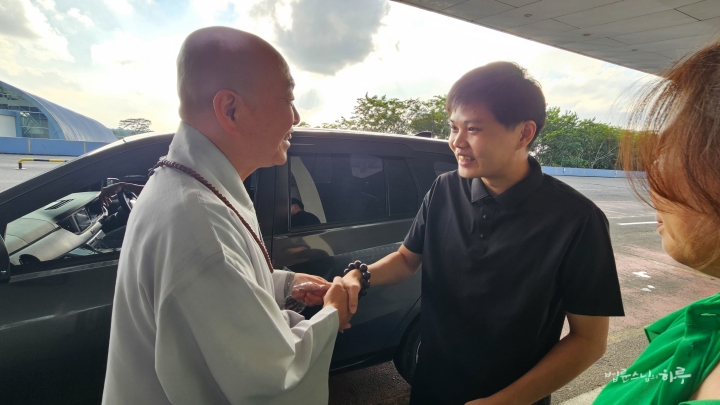
“It would be a great honor if you would do that.”
They took a commemorative photo together and headed to the airport.
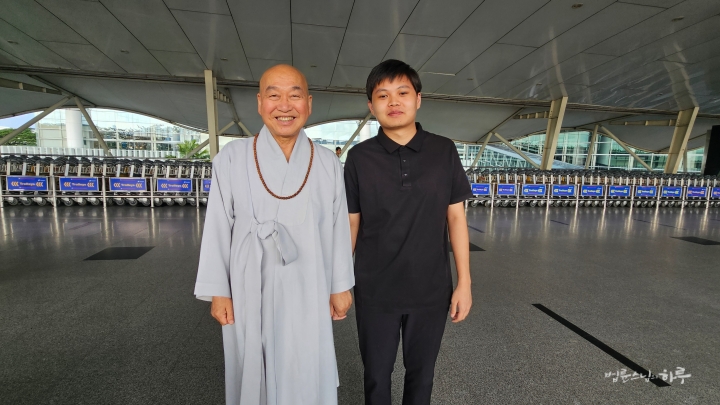
After having a late lunch at the airport and completing departure procedures, they departed from Medan Airport on the 6:50 PM flight.
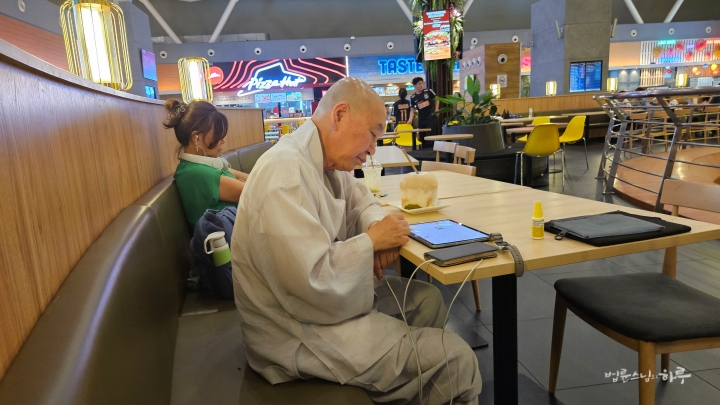
At 8:50 PM, they arrived at Kuala Lumpur Airport, the transit point, and waited for about 4 hours. During the wait, they had a simple dinner. Sunim said with a smile.
“We are amazing people. We had lunch in Indonesia, dinner in Malaysia, and tomorrow we’ll have breakfast in the Philippines.”After the meal, they spent time proofreading manuscripts and handling work at the boarding gate before departing from Kuala Lumpur Airport at 12:55 AM heading to the Philippines.
Tomorrow, they will arrive at Manila Airport in the Philippines at 5:00 AM and immediately travel to Cagayan de Oro in Mindanao to survey indigenous areas in Mindanao, Philippines all day.

Since there was no Dharma talk today, this post concludes with a dialogue between Sunim and a questioner from the Happy Conversation Dharma Q&A held in Bucheon last October.
If I Don’t Let Go of This Desire to Be Praised and Recognized, Will I Suffer?
“I heard that in your youth, you were ostracized and hated by the Buddhist community. These days, people around me also hate me, curse at me, and slander me. How can I not suffer in this situation?”
“When you get cursed at, you should be happy because it means you’ll live long. ‘I got cursed at today. I’ll live a long life,’ you can think like this. There’s a saying that if you do good deeds and get cursed at, you’ll live long. Among all blessings, the greatest blessing is a long life. If you do good deeds and receive praise, you use up all that blessing, so it doesn’t become a great blessing. But if you get cursed at instead of praised, that blessing becomes a great blessing. So when you get cursed at, you should be happy thinking, ‘This will become a great blessing.’ In Christian terms, the blessings received in this life for doing good deeds are small blessings, while the blessings received in heaven are great blessings. You should go to church a bit. (laughter) For example, the reason nuns can devote their entire lives at Sorok Island(소록도) is because they have no intention of being praised in this life. They can do such acts because they believe they’ll receive tremendously great blessings in heaven, burying such small blessings. However, to worldly people, it appears that they are working devotedly. In a similar sense, the Diamond Sutra (금강경) teaches about ‘giving without expecting anything in return (무주상보시-無住相布施).’ Also, in the ‘Never Disparaging Bodhisattva Chapter (상불경보살품-常不輕菩薩品)’ of the Lotus Sutra (법화경), there’s this saying: ‘Though people curse me, those who curse are themselves Buddha. Even if worldly people look down on me, I will not look down on them but treat them as Buddha.’ If I’ve done something wrong, I can listen to their criticism and reflect. If I haven’t done anything wrong but they criticize me, I can think of it as accumulating blessings instead. If you change your perspective like this, you might even wish they would curse a bit more, and it becomes no problem at all. The Diamond Sutra mentions ‘not receiving, not being greedy ,’ which means ‘creating blessings but not thinking of receiving blessings (불수불탐-不受不貪) .’ It means neither receiving nor being greedy for blessings. You just need to have this perspective.”“Then what should I do about wanting to be praised, recognized, and loved by people?”
“That’s a disease of craving, a love-starved disease. It’s the biggest disease of sentient beings that anyone can catch. Everyone wants to be praised and loved, but most only want to receive and don’t think about giving. Since everyone only wants to receive, there’s no possibility of receiving. So when you catch the love-starved disease, you only torment yourself with craving, but nothing actually goes down your throat. Because there’s no one to give. Just because you say ‘Please think well of me’ doesn’t mean people will actually think well of you. People see things their own way. That’s their freedom. It’s not my right but their right. How that person sees me should be left up to them. Why try to take away others’ rights?”“So is there no problem living without receiving others’ love or recognition?”
“Do rabbits live being loved and recognized? They just live. Do trees grow being recognized? They just grow. There’s no problem living without being loved and recognized. People find life difficult precisely because they want to be loved and recognized. Of course, it’s not easy to let go of the desire to be loved and recognized. It’s like how it’s difficult for an alcoholic to quit drinking or for a smoker to quit smoking. I understand that. But which is easier – smoking or not smoking? Not smoking is much easier. Not smoking requires doing nothing at all. On the other hand, to smoke you need money, you have to go buy them, put one in your mouth, light it, inhale and exhale smoke, and flick off the ash. There’s a lot of work involved. So why take the difficult path when you could take the easy path? It’s because of addiction, that is, habit. When you develop a habit, easy things become difficult and difficult things become easy. The easiest thing in the world is not doing something. Yet people say it’s difficult not to do it. Because they’re addicted. You have the ‘love-starved disease’ of wanting to be praised and loved, so you’re craving. But there’s no one to give love. Because everyone only wants to receive.”“But if I’m recognized and loved, there’s more I can gain, isn’t there? Should I give that up and live without being greedy?”
“When someone gives me something, they don’t give it because I say ‘please give.’ People give when they want to give and don’t give when they don’t want to. It doesn’t change based on my requests. But if someone gives when I didn’t say ‘please give,’ I feel good. Conversely, if I said ‘please give’ but they don’t give, I feel bad. So I’m telling you to abandon saying ‘please give.’ Will you starve to death if you don’t say ‘please give’? Not at all. There are people who won’t give even if you say ‘please give,’ and there are people who will give even if you say ‘I won’t accept it.’ Because giving or not giving is the other person’s right. That’s why it’s best not to desire. Whether you desire or not, what actually comes and goes is the same, but if you desire, it feels like you’re not loved, and if you don’t desire, it feels like you are loved.”“Yes, thank you.”
“Do you remember learning about probability in mathematics? When you roll a die, the probability of getting a 6 is one-sixth. This is called mathematical probability. But if you actually roll the die six times, will you always get a 6 exactly once? No. You might get a 6 all six times, or you might not get it at all. This is called experimental probability. However, if you roll the die a hundred times, a thousand times, or ten thousand times, the experimental probability gradually approaches the mathematical probability. In terms of limits, as n approaches infinity, it converges to one-sixth. Think of human relationships as having similar probabilities. There are two cases in my mind: either I hope ‘please help me’ or I think ‘you don’t have to help me.’ And in reality, the other person has two choices: ‘to help’ or ‘not to help.’ Combining these creates four possible outcomes. When I hope but don’t receive, when I hope and receive, when I don’t hope and don’t receive, and when I don’t hope but receive – these are the four cases. Let’s consider these situations. When I hope but don’t receive, I feel bad. When I hope and receive, I feel good. When I don’t hope but receive, I feel even better. When I don’t hope and don’t receive, I don’t feel bad. In the end, when I ‘don’t hope,’ I either feel better or at least not bad. But when I ‘hope,’ my feelings go up and down between good and bad. Which approach is more beneficial?”“Not hoping is more beneficial.”
“In this way, the Buddha’s teachings are mathematically precise. Not smoking is much easier, but because people are addicted to cigarettes, they cry out that not smoking is difficult. It’s the same thing. Just living is much easier, but people feel it’s difficult. Even if you understand my explanation today and think ‘I see,’ you won’t change immediately. That’s because habits are already formed. So even if you resolve, ‘Since hoping only brings me loss, I shouldn’t hope,’ because it’s become a habit, dissatisfaction like ‘why aren’t they giving?’ will arise unconsciously. Changing habits takes quite a long time, so you need to change them steadily. If you do this, anyone can live without suffering.”“Thank you. I understand well.”