Why Doesn’t My Mother, Who Told Me to Listen to Dharma Q&A, Change at All?
Jan 4, 2026. Day 2 of China Business Trip
Hello. Today marks the second day of Sunim’s visit to China.
After completing his morning practice and meditation, Sunim met with officials and continued discussions for peace on the Korean Peninsula.


After finishing the meeting, Sunim immediately headed to Shenyang Airport. Upon arriving at Shenyang (심양) Airport, he went through departure procedures and headed to the boarding gate. The plane departed from Shenyang Airport at 4:35 PM and after a two-hour flight, landed at Incheon Airport at 7:35 PM Korean time.


After leaving the airport, Sunim headed straight to the Jungto Social and Cultural Center.

From 9 PM, Sunim met with a North Korea expert in the Peace Foundation reception room to share recent developments in North Korea and had an in-depth conversation about ways to improve US-North Korea relations, inter-Korean relations, and Japan-North Korea relations. Later at 10 PM, he discussed with the JTS Secretary General about the schedule and programs for inviting Bhutanese government officials to Korea in the upcoming March, then concluded his day’s activities.
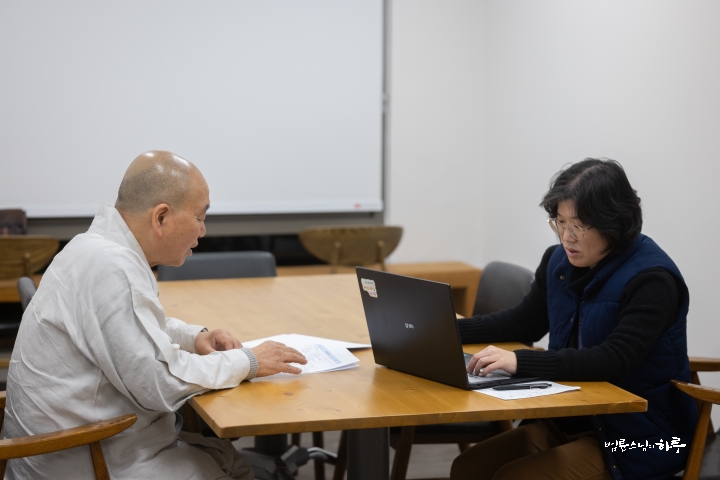
Tomorrow, Sunim plans to move to Dubuk Jungto Retreat Center (두북 수련원) early in the morning for treatment and a walk.
Since there was no dharma talk today, this post concludes with a dialogue from last year’s November 7th Youth Festa Dharma Q&A between a participant and Sunim.
**Why Doesn’t My Mother, Who Told Me to Listen to Dharma Q &A, Change at All? **
“My mother said my personality was too selfish and told me I must listen to Dharma Q&A, so that’s how I came to listen to it. After listening once by chance, I’ve been seeking it out and listening more on my own. Listening to Sunim’s words, my relationship with my husband has improved a bit, and I’ve learned how to manage my mind, which has helped a lot. But strangely, my mother who told me to listen to Dharma Q&A seems to remain the same. When my mother was young, she suffered a lot alone when my father made life difficult for the family due to his drinking problem. But now, my father passed away long ago, and although we’re living comfortably, she still seems to worry unnecessarily and can’t feel satisfied with her current life. She always compares me to others and says, ‘Why do you live like that?’ At first I try to be patient, but then I get angry and we end up fighting. I wish my mother would live her own life happily now. What should I do?”
“Mind practice is not about aiming for external changes like ‘Mother should change.’ It’s only natural that I would feel good if my mother changes. Just like how we feel good when the weather gets warm or cool. Such feelings come naturally to anyone without special practice. However, mind practice means reaching a state where I’m okay even when my mother nags, I’m okay even when my child doesn’t study, and I’m okay even when my husband comes home late. Having my husband come home early, my child study well, and my mother stop nagging is not the result of mind practice – it’s just a ‘good situation’ where things work out well. You think your mother should change to suit you, but such wishes cannot be resolved through mind practice. Mind practice is not about changing the world, but about becoming unshakeable in any situation. If your mind has become more comfortable than before even though your husband remains the same, your mother remains the same, and your child remains the same, that is mind practice. If your relationship with your husband improved through mind practice, it’s not that your husband changed, but that you yourself changed. But now you’re essentially demanding of your mother, ‘Mother, you should change too.’ In fact, your mother’s mind has become more comfortable than before through mind practice, and even when conflicts arise with her daughter, she doesn’t struggle as much as she used to. That’s probably why she recommended Dharma Q&A to her daughter, saying ‘You should try listening too.’ But you’re thinking, ‘If mother is recommending it to me, shouldn’t she change first? Why does she remain the same even though she listens to Dharma Q&A every day?’ This doesn’t align with the purpose of Dharma Q&A. Dharma Q&A is not about changing someone else. It’s about leaving the world as it is and becoming better myself – that’s what Dharma Q&A is. So if you’re judging what your mother is or isn’t doing, that’s not mind practice. While you used to fight with such a mother before, now that you’re practicing, you should be able to understand: ‘Ah, mother is originally that kind of person. She’s like that because she suffered a lot in the past.’ Even if the world has improved greatly now, people don’t change easily when past trauma remains. Let me give an example of someone who suffered from food problems in North Korea and came to South Korea through China. In South Korea now, there’s almost no need to worry about food, clothing, or shelter. It seems they should naturally be happy, but in reality, that’s often not the case. Even while eating now, memories of past hunger surface and they choke up, or they cry thinking of family members who still can’t eat. Like this, past experiences don’t disappear but continue to affect us in the present. So you shouldn’t approach it like ‘Mom, that’s an old story. Things are better now.’ You need to have an understanding heart: ‘Mother lived through such difficult times in the past, and although the situation has improved now, she’s still struggling because she’s living in those thoughts due to those experiences.’ Then who benefits? I become comfortable. Practice is something I do; there’s no need to judge what happens to mother. When a child doesn’t study, in the past you might have felt frustrated thinking ‘Students should study.’ But thinking again, you can accept: ‘All children hate studying and like to play. Yes, that’s how kids are.’ Thinking this way, your mind becomes more comfortable even when the child is playing. This doesn’t mean it’s okay for the child to just play. It means that understanding that children like to play makes my mind comfortable watching them. In this state, there’s a complete difference between suggesting to the child, ‘Dear, playing is fun, but wouldn’t it be a problem if you don’t study at all? How about trying to study a bit?’ versus scolding, ‘Why do you only play every day without studying?’ Without understanding, you get angry, your words become harsh, and the child easily looks hateful. Conversely, if you understand the child’s behavior, you can comfortably accept ‘Yes, playing is more fun when you’re young,’ while still gently saying, ‘But you can’t always play, so how about studying a little?’ Similarly, if you develop an understanding heart toward your mother, it’s not that your mother gets better, but your mind becomes comfortable. That’s mind practice.”“Thank you. As Sunim said, I’ve realized it’s a problem of my mind, not about whether my mother changes. From now on, I’ll try my best to understand my mother, so our relationship can improve.”
“Don’t make improving the relationship your goal. If the relationship improves and then worsens again, you’ll suffer that much more. Just aim for ‘Let me understand mother so I don’t suffer.’ That’s enough. Whether mother suffers or not, that’s mother’s business. You should understand ‘Mother can be like that because she suffered a lot in the past,’ and aim to live without suffering yourself. If you set a goal to improve the relationship, when it doesn’t improve as expected, problems arise again. Rather than judging whether the relationship is good or bad, you first need to become comfortable yourself.”
“I have a daughter too, and I don’t want to pass on my mother’s karma to her. To do that, I need to understand my mother more, right?”
“Just understand. Even if mother’s words or actions don’t please you, don’t question ‘Why is she like that?’ Instead, understand and move on: ‘Mother still has those habits because she suffered a lot before. Still, she worked so hard raising me alone.’ I’m saying don’t set a goal that ‘I must make our relationship good.'”“Sunim! Thank you so much.”