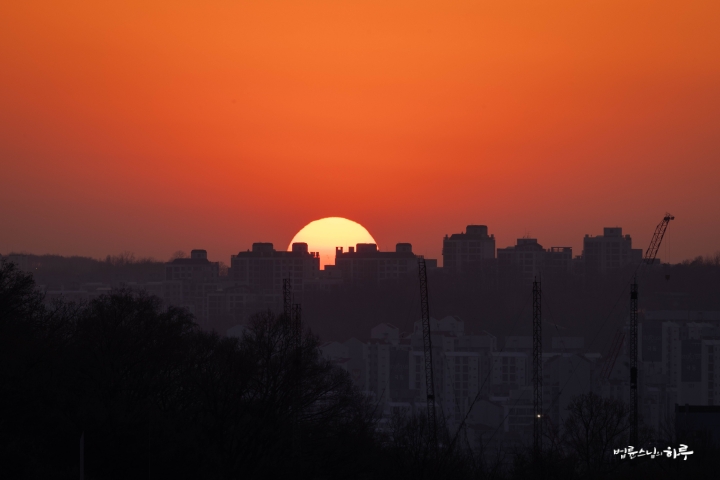
Hello. An eventful year is coming to an end. Today marks the winter solstice, the day with the longest night and shortest day of the year.
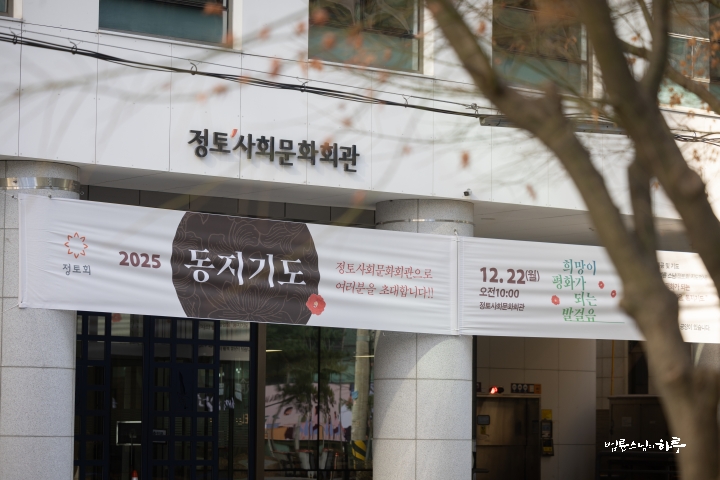
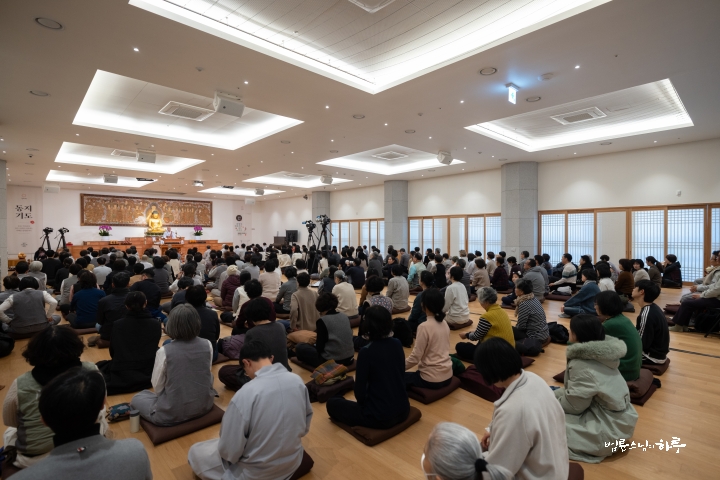
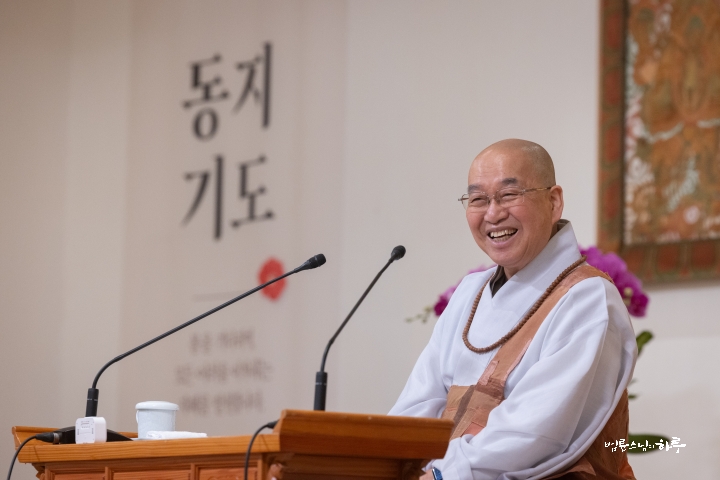
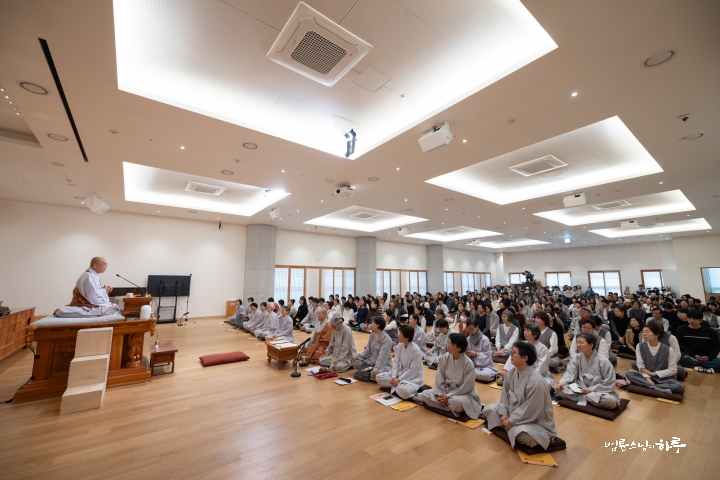
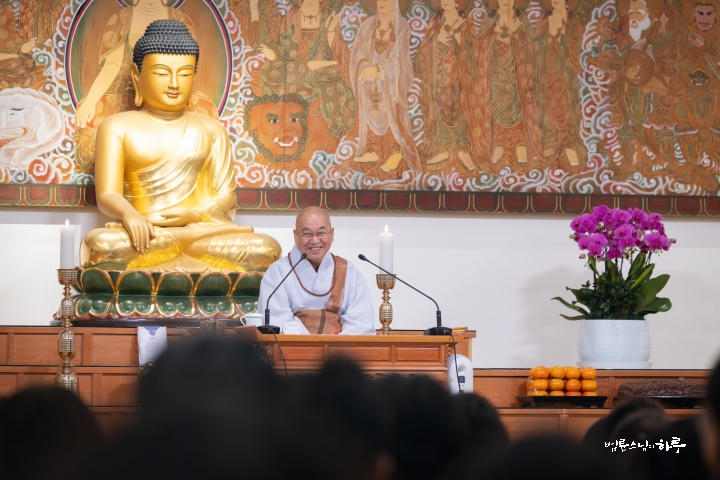
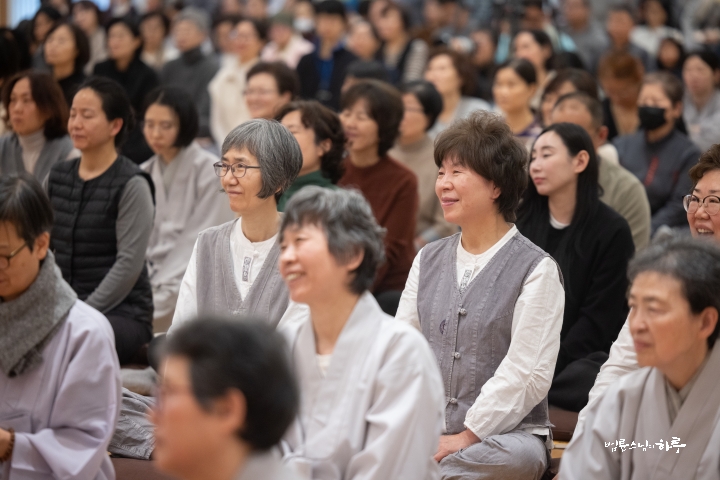
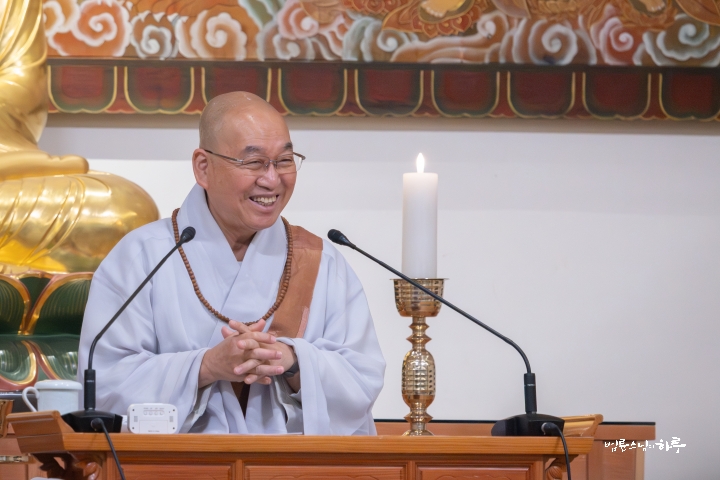
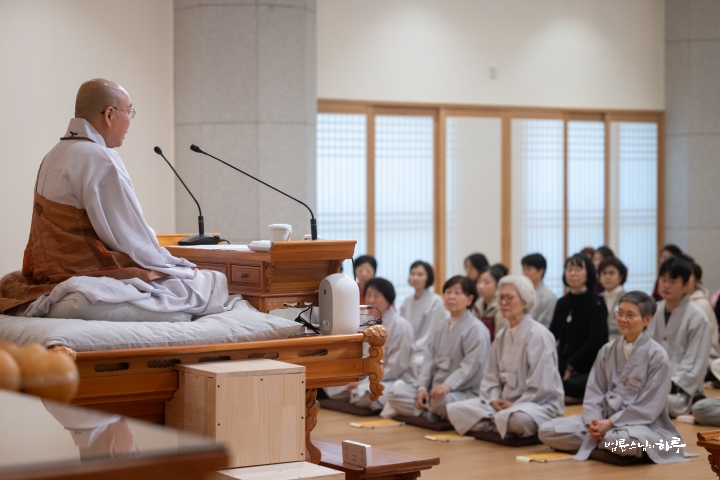
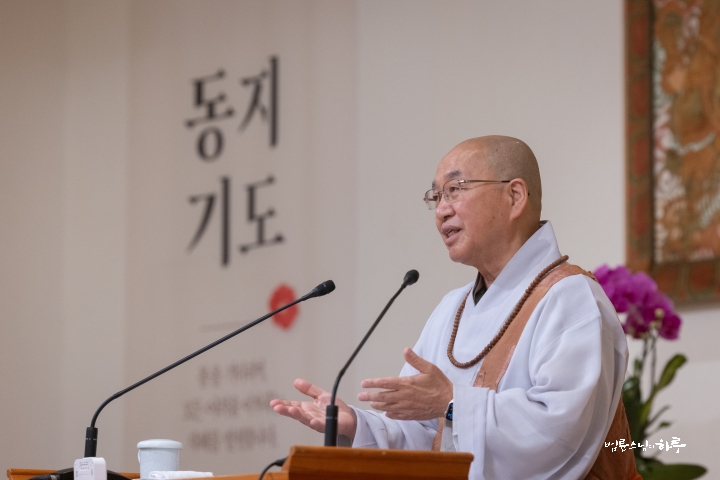
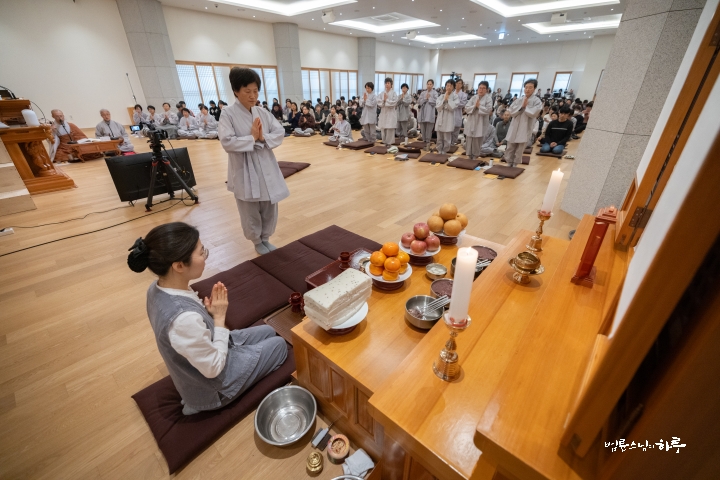
After completing morning practice and meditation, Sunim headed to the Jungto Social and Cultural Center to hold the Winter Solstice Dharma Assembly. The Dharma Hall on the third floor was filled with about 300 members of the Sangha who had gathered to pray in celebration of the day
Many members also gathered at main temples across the country, including Adomoryewon, Cheollyongsa, Jukrimjeongsa, and Mireuksa, to watch the live broadcast and participate in the Winter Solstice Dharma Assembly together.
Everyone requested a Dharma talk from Sunim with three prostrations. Sunim gave a Dharma talk on the spiritual significance of the ‘winter solstice.’
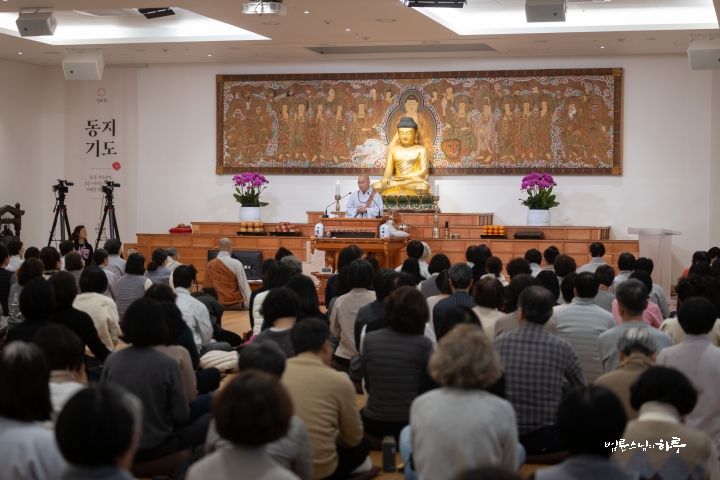
“Today is the winter solstice, the day of the year with the shortest day and longest night. Today, Jungto Society is holding a Winter Solstice Dharma Assembly and Winter Solstice Prayer to commemorate this day. You might wonder, ‘Why specifically the winter solstice? What does the winter solstice have to do with Buddhism?’ The winter solstice is not directly related to Buddhism. However, the winter solstice has been a day of prayer throughout our nation’s long history. This custom of praying on the winter solstice is not unique to our people but has been practiced simultaneously by cultures around the world. In other words, even before any sage appeared to spread teachings, humans have attributed meaning to natural phenomena and prayed according to that meaning.
Why Is the Winter Solstice Not the Darkest Day but a Day of New Beginning?
The shortest day means the longest night, which signifies the nadir-the darkest point. This state feels like a great difficulty to us. However, at the same time, ‘hitting rock bottom’ also means that nothing worse can happen from now on. While being in such a difficult position is very hard, the fact that ‘nothing worse can happen from now on’ actually gives us hope. If we are at our lowest point now, it means things will improve from here. Even if the situation worsens again, it will still be better than this.
There’s a Korean saying about seasons: ‘After passing through Sohan(Minor Cold) and Daehan(Major Cold), no one will freeze to death.’ Sohan and Daehan refer to the coldest periods of the year. However, it doesn’t mean it becomes warm immediately after these periods pass. The severe cold continues afterward. But if someone were to freeze to death, it would have already happened during the coldest time. In other words, those who have survived the peak of winter won’t freeze to death no matter how cold it gets afterward. So while the darkest point represents great difficulty on one hand, it becomes a new beginning on the other. When you say, ‘I’ve never had such a difficult time in my life,’ from another perspective, you can also say, ‘Nothing worse than this will happen from now on.’ This doesn’t mean ‘no more bad things will happen,’ but rather ‘nothing worse than this will happen.’ If you’ve endured this, what can’t you endure?
In this sense, the winter solstice becomes the beginning of the new year and a new starting point. From the winter solstice, the days begin to lengthen again. The sun comes back to life. That’s why countries like Rome called this day the ‘Festival of the Sun.’ It carries the meaning that the sun is reborn. Ancient people considered this the beginning of the year. They saw the shortest day as the end of the year, and from the next day, a new year begins. The same logic applies to the lunar cycle. When the moon completely disappears, it’s the end of that month, and from the next day, the moon begins to come back to life. That’s why it becomes the first day of the month.
Our seasons are mostly determined by the movement of the sun. That’s why seasonal divisions like the winter solstice, Sohan, Daehan, and the spring equinox are all determined according to the solar calendar based on the sun. On the other hand, daily life was mainly based on the moon. The moon clearly appears to grow and shrink to the eye, and since it rises about 50 minutes to an hour later each day on average, it’s easy to know the date and flow of daily life. The sun tells us about seasonal changes throughout the year, while the moon tells us about day-to-day changes. That’s why daily life was guided by the lunar calendar, and seasons through the solar calendar.

However, these two do not align perfectly. In the past, because the lunar calendar was used as the standard, the winter solstice would shift around in the lunar calendar. Nowadays, since we use the solar calendar as our standard, lunar anniversaries like birthdays or Buddha’s Birthday change every year. In the past, the winter solstice month was the 11th lunar month, but because it was based on the lunar calendar, the winter solstice could fall at the beginning, middle, or end of the 11th month. When the winter solstice came early, people would age a year sooner, which children liked, so it was called “Ae-dongji” (Children’s Winter Solstice). Conversely, when the winter solstice came late, people would age a year later, which the elderly preferred, so it was called “No-dongji” (Elderly Winter Solstice). When it fell somewhere in the middle, it was called “Jung-dongji” (Middle Winter Solstice). There are also stories that during Ae-dongji, people ate red bean rice cakes instead of red bean porridge. While there are no clear historical records, such customs are generally said to have existed. This might have come from the thought, ‘Wouldn’t rice cakes be better for children than porridge?’
These names arose because, when using the lunar calendar as the standard, the winter solstice according to the solar calendar would vary each year. Now that we live by the solar calendar, Buddha’s Birthday, which follows the lunar calendar, also shifts from early May to mid or late May. Ultimately, seasonal changes were determined by the solar calendar based on the length of days, while daily life was lived according to the lunar calendar based on the moon’s phases.
A Day to Ward Off Misfortune and Build New Hope
In any case, on this winter solstice day when darkness passes and the new year begins, people performed many rituals to ward off misfortune with the mindset of ‘Let’s end all bad things from this day forward!’ and ‘I hope only good things happen from tomorrow onward.’ In China particularly, it seems they believed that ghosts disliked the color red. When driving away evil spirits, they mainly used the color red. This is how the custom arose of making and eating red bean porridge on the winter solstice, and spreading or sprinkling it on walls to keep evil spirits away. Traditionally, when eating winter solstice red bean porridge, people would eat as many rice balls as their age. Think you can’t do it? Older people can make smaller rice balls, and younger people can make bigger ones. (Laughter)
When we connect this winter solstice culture to our practice, it becomes very meaningful. If you make a vow today, today becomes your winter solstice. So if you begin your practice from today, you will gain the strength to overcome any misfortune that may come your way. The spiritual meaning of winter solstice prayer is that by beginning your practice today, you will be able to overcome any calamity that may befall you in the future.
Traditionally, this was a day for warding off disasters, and Buddhism adopted this custom by conducting winter solstice prayers. In old customs, there was a practice called ‘dongji-geondae’ where people would bring rice in envelopes. Did you also bring rice today? You probably brought money instead. (Laughter) In the old days, currency wasn’t commonly used, so people brought rice in envelopes. Temples would use this rice as provisions for the entire year. Since it was not long after the autumn harvest, most people had some grain available, except for those without fields, making it relatively easy to offer rice. This was the custom of offering rice and praying on the winter solstice.
Of course, various ethnic customs may have included prayers at temples during Chilseok (the seventh day of the seventh lunar month), Dano (the fifth day of the fifth lunar month), or Chuseok (Korean Thanksgiving). However, while Chuseok remains an important folk holiday, it doesn’t hold significant meaning in Buddhism specifically connected to prayer. The prayers that have clear meaningful connections are the Jeongcho (New Year’s) Prayer, where people pray for a safe passage through the year at its beginning; prayers on Buddha’s Birthday, which are naturally observed; and Baekjung Prayer for the deliverance of ancestors. Additionally, on the winter solstice, Dongji Prayer has been practiced with the meaning of dispelling all misfortunes with a renewed heart and praying for future hope.
Some may wonder what relationship exists between Buddhism and the winter solstice, but our traditional culture already contains many traces of spiritual practice. Therefore, I believe that Jeongcho Prayer, Baekjung Prayer, and Dongji Prayer should be continued by all Korean people, not limited to those who follow Buddhism as a religion. In a way, the winter solstice is the most significant day for dispelling disasters and embracing new hope. To put it in colloquial terms, it’s the day when prayers are most likely to be answered. (Laughter)
Embracing New Hope on the Darkest Day
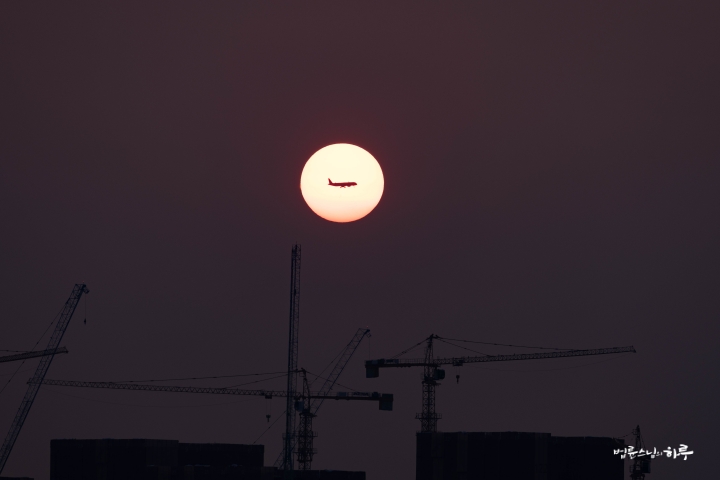
In ancient times, today was known as the Festival of the Sun. It marks the day when the sun begins to revive and shine again—a day when a ray of light emerges from the darkness. So today, in this place, I hope you too will embrace new hope.
What kind of hope should we embrace? While individuals may have their personal hopes, what about society as a whole? Currently, inter-Korean relations are completely blocked and could be described as being at their worst. However, being at rock bottom doesn’t necessarily mean it’s entirely bad. Why? Because there’s almost no possibility of things getting worse. What could be worse? War breaking out. As long as there’s no war, things can’t get much worse than this. So now we must consider how to reestablish emergency communication channels and gradually restore severed relationships one by one, working to improve the situation. Only when relations between North Korea and the United States, North Korea and Japan, and South and North Korea are normalized can all of East Asia achieve stability. Therefore, we can share the hope that the new year will mark the starting point for such changes.
What about domestic politics? The conflicts are extremely severe. Rather than collaborating through dialogue, we see extreme behavior focused on exposing each other’s faults and escalating conflicts. We can also hope that we’ll move away from such extremes and progress toward national unity through mutual cooperation and inclusiveness.
Looking at the nation as a whole, the economic situation is also difficult. While it may appear prosperous on the surface, the wealth gap continues to widen, and the lives of marginalized and vulnerable groups are becoming harder rather than improving. National policies should move toward reducing the wealth gap. However, rather than just waiting for policies, I hope we can voluntarily open our hearts and practice sharing for those in need around us and, furthermore, for people in difficulty around the world. Isn’t the world becoming increasingly cold these days? When such hearts of sharing accumulate, warm compassion will permeate society.
I hope that in the new year, peace will come to the Korean Peninsula, the nation will stabilize, and the people will unite so that their hearts become more at ease and their happiness increases. Rather than just hoping for this, I suggest that we all play our roles in our respective positions so that these wishes can become reality. By expanding the Jungto Dharma School, enabling more people to attend Dharma Q&A sessions, and encouraging more people to participate in the Happiness School, I hope we can play a role in helping people become even a little happier.
I also encourage each of you to set a small wish. Rather than praying for material gains like “Please let my child get into university,” I hope you will hold in your hearts a wish that reflects the direction of your own life and pray sincerely. Now that you have listened to the Dharma talk and understood the meaning of the winter solstice prayer, I hope you will prepare your minds to receive new light and approach this prayer with a heart that creates hope.
And if we have made such vows and prayers, we must dedicate the merit to all sentient beings. In particular, we should dedicate it to our ancestral spirits. Some younger people might think, ‘Do ancestral spirits even exist?’ But the meaning is clear. My existence here and now is due to the grace of my parents, the grace of my ancestors, and the grace of heaven, earth, and nature. In other words, it is the grace of our forebears. We are not beings who suddenly appeared from nowhere. We exist now upon countless previous karmic connections. That is why we must always have a heart of gratitude for these connections.
The same is true for Jungto Society. Although we are listening to Dharma talks in this warm Dharma hall today, it wasn’t always like this. There was a time when we held Dharma assemblies under small tents. The people who created these current conditions are those who came before us. We are enjoying the fruits of their efforts. So we should be grateful, and at the same time, we must create conditions for the next generation so they can practice more comfortably.
That’s why when we hold major events or especially when we pray, we always perform memorial services to dedicate the merit of our prayers. There’s no need to debate whether ghosts exist or not. It’s about having a heart of gratitude toward the past beings who made our present existence possible. Personally to our ancestors, nationally to our forebears, more broadly to the ancestors of all humanity, and to the spirits of heaven and earth – to the sky, earth, wind, water, and nature – having a heart of gratitude is what memorial services mean.”
Jungto Society members resolved to begin their practice with renewed hearts as they welcomed the winter solstice.
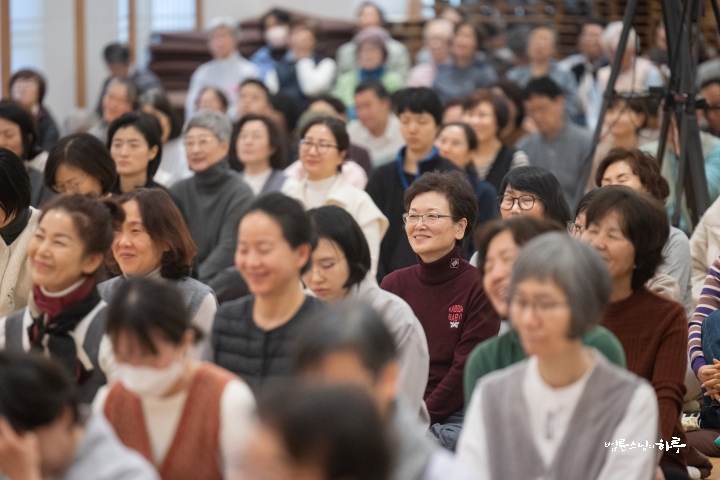
Next, Dharma Teacher Mubyeonsim led the winter solstice prayer. With each prostration, participants reflected on the past year and made resolutions for the new year.
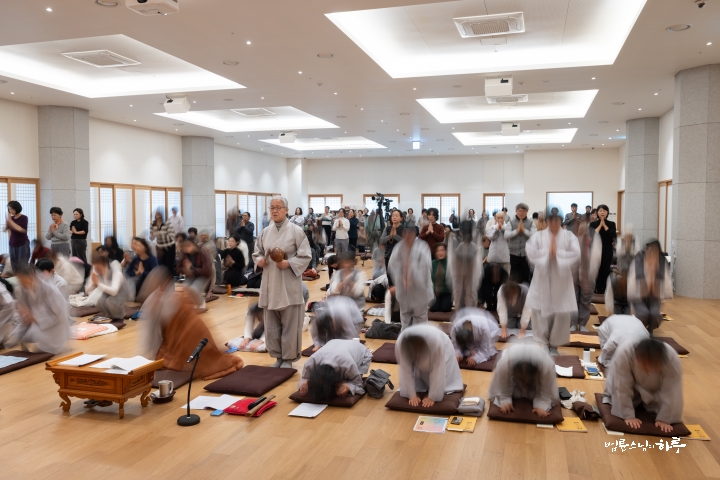
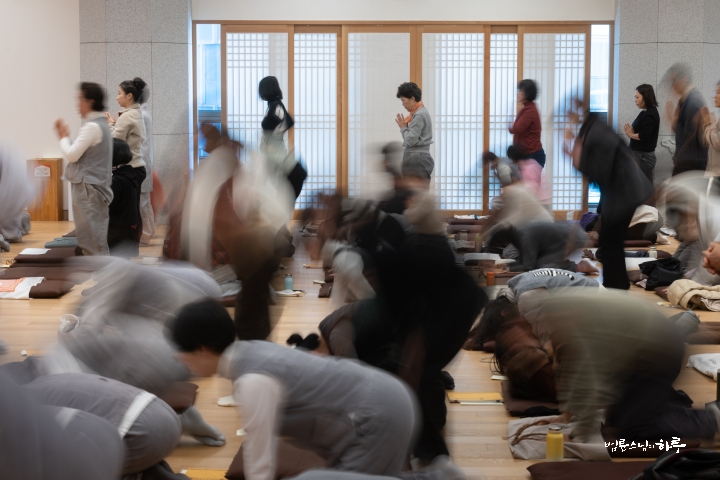
After completing the prayers, beads of sweat formed on their foreheads.
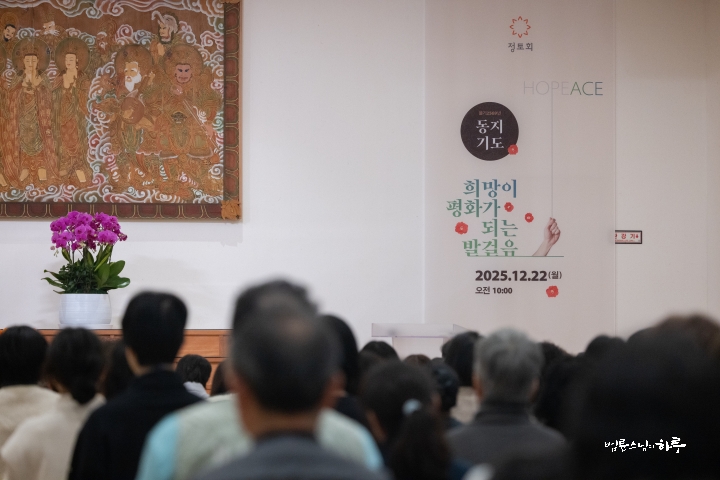
After catching their breath, participants gathered in small groups for mindful sharing. After sharing their reflections on the Dharma talk with fellow practitioners, they felt ready to start the new year afresh.
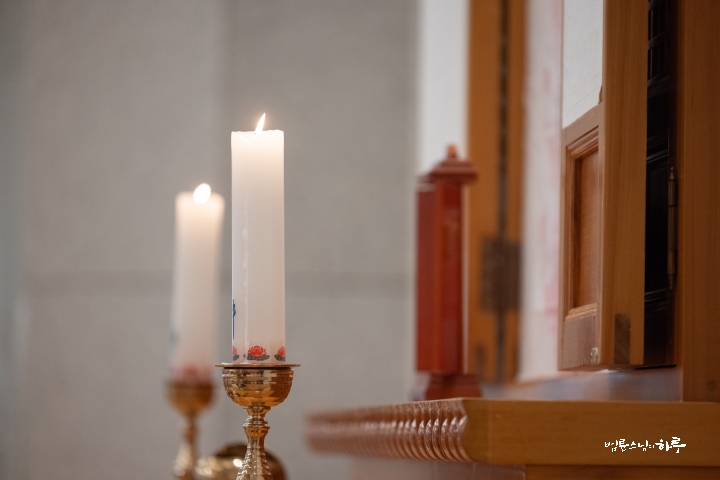
Following this, they performed a memorial service together for their ancestral spirits, concluding the winter solstice Dharma assembly.
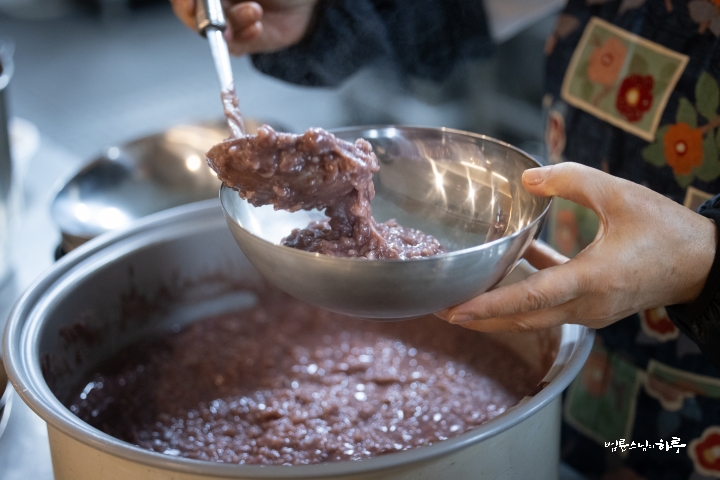
At the Jungto Social and Cultural Center, red bean porridge was served for lunch to mark the winter solstice.
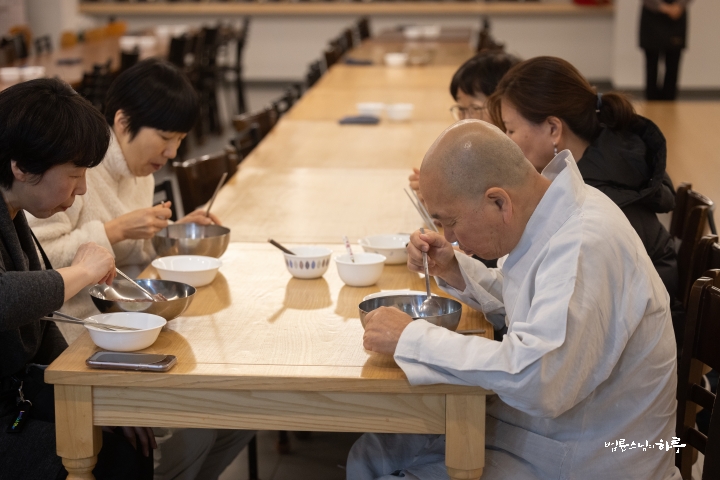
The assembly participants enjoyed the red bean porridge before returning home.
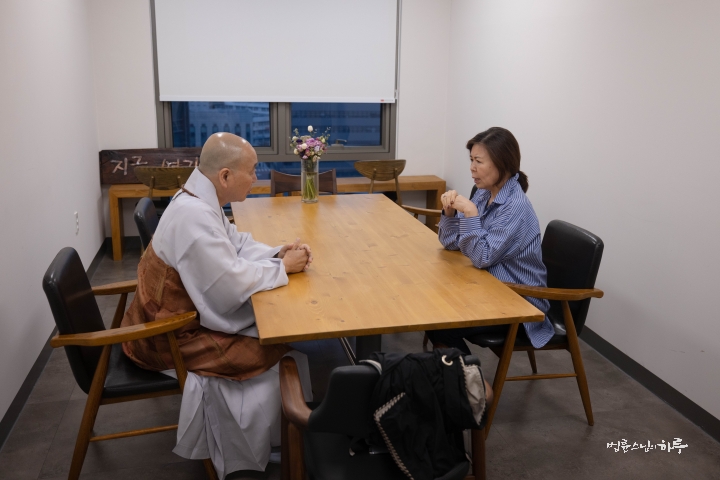
After lunch, Sunim held a meeting with Park Gina, JTS President, who had just returned from surveying Sumatra, Indonesia, which had suffered severe damage from recent heavy rains causing floods and landslides. The floods and landslides in three northern provinces of Sumatra had killed over 1,000 people and injured about 5,000 over two weeks. Aceh Province, the most severely affected area, was still without power, and temporary shelters crowded with displaced people lacked relief supplies such as drinking water and medicine. After discussing how to proceed with emergency relief efforts, the meeting concluded.
Sunim then headed to Gimpo Airport to participate in the lay Sangha Dharma Teacher retreat. Starting tomorrow, Sunim will conduct a five-day, four-night retreat with the lay Sangha Dharma Teachers.
Notice: A Day in the Life of Sunim Will Be Taking a Brief Hiatus During the Family Week
From December 23, 2025, to January 1, 2026, for 10 days and 9 nights, it will be Jungto Society’s family week. During this period, Jungto Society will not conduct business meetings, training sessions, or various events except for previously scheduled Dharma assemblies and academic activities.
While Sunim’s daily life continues, “A Day in the Life of Sunim” will also take a brief break in accordance with the 1000-Day Practice closing period family week. After a time of recharging, we plan to resume publication on Monday, January 5, 2026. We will catch our breath and return in the new year with even richer and more vivid stories. We ask for our subscribers’ generous understanding.