Am I Not in My Right Mind for Still Worrying About My Ex-Husband After Divorce?
Dec 19, 2025 - Buddhist Newspaper Interview, Friday Dharma Q&A
Hello. Today is the day of the Friday Dharma Q&A, which is open to all citizens.
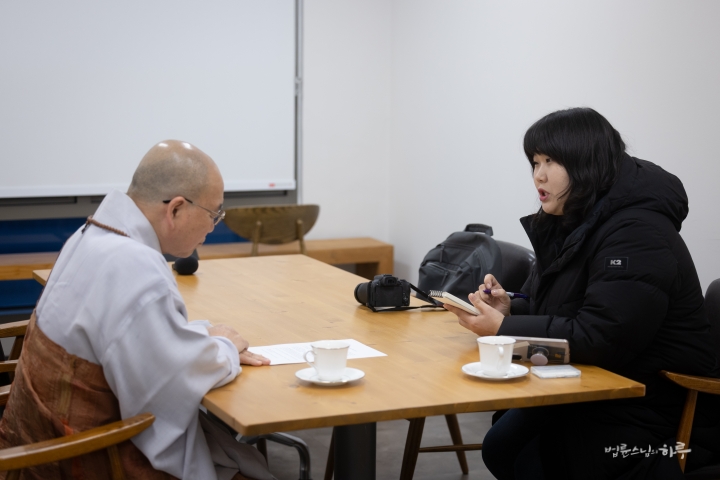
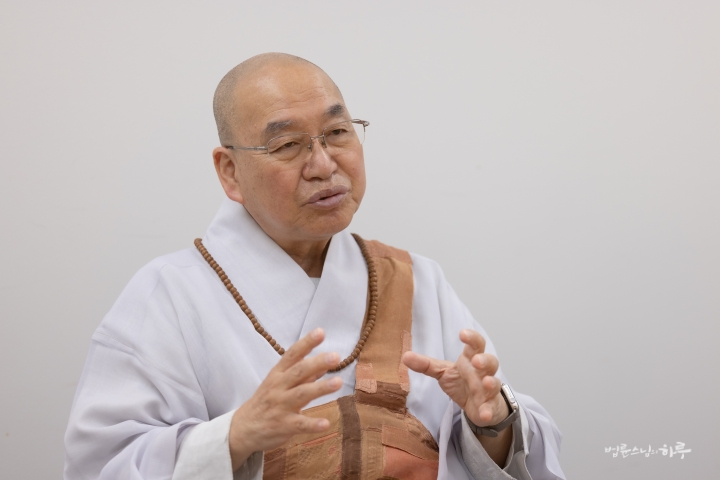
After completing his morning practice and meditation, Sunim headed to the Peace Foundation. Starting at 9 AM in the reception room, he conducted a New Year’s special interview with the Buddhist Newspaper.
They discussed various topics for an hour, including why Jungto Society particularly focuses on youth-centered events like ‘Youth Concert’ and ‘Youth Festa,’ the essence of young people’s anxiety, what hope exists for the younger generation, and practical methods of daily practice that young people can engage in. After this discussion, the interview concluded.
Afterward, Sunim took a rest due to shoulder and arm pain while attending to his work.
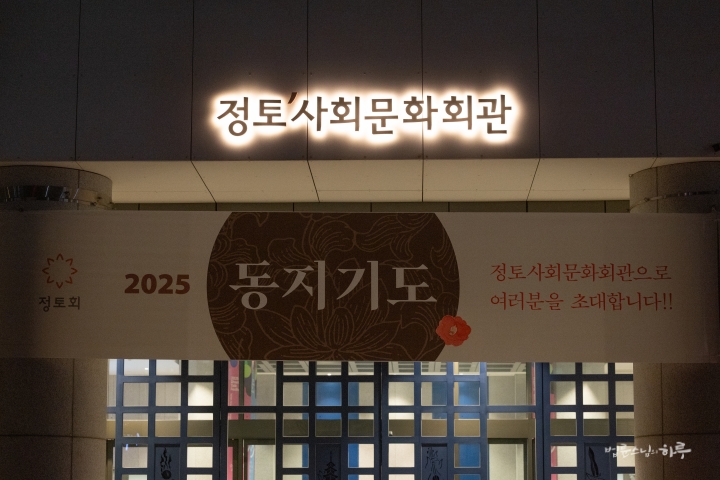
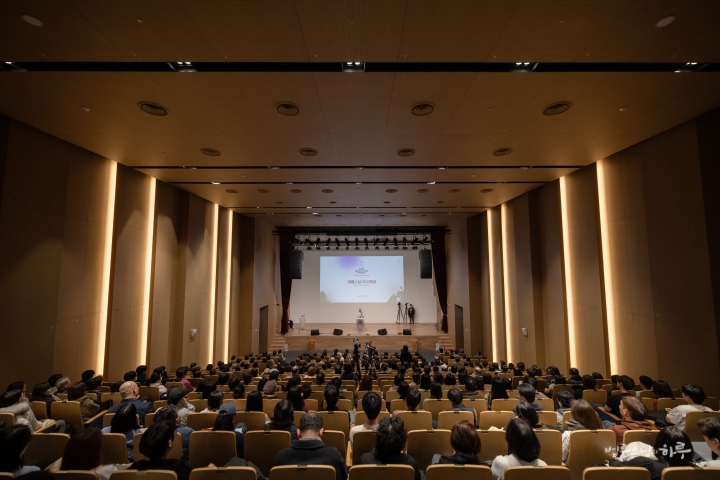
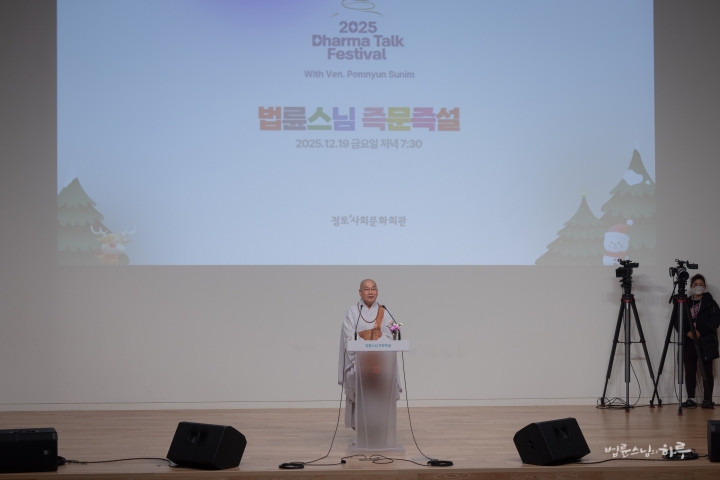
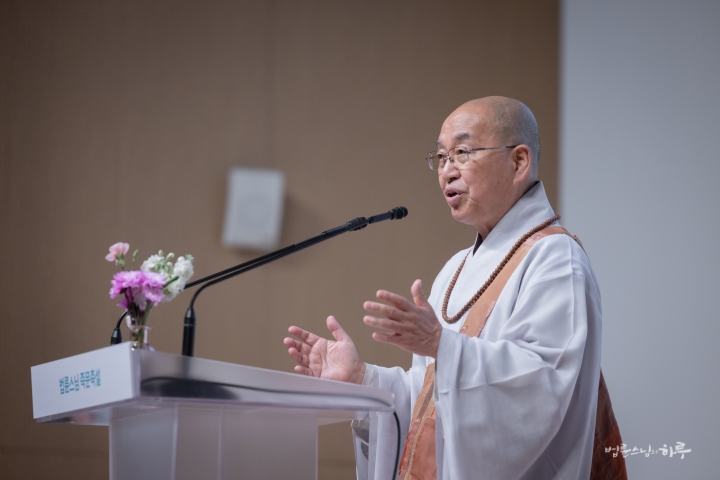
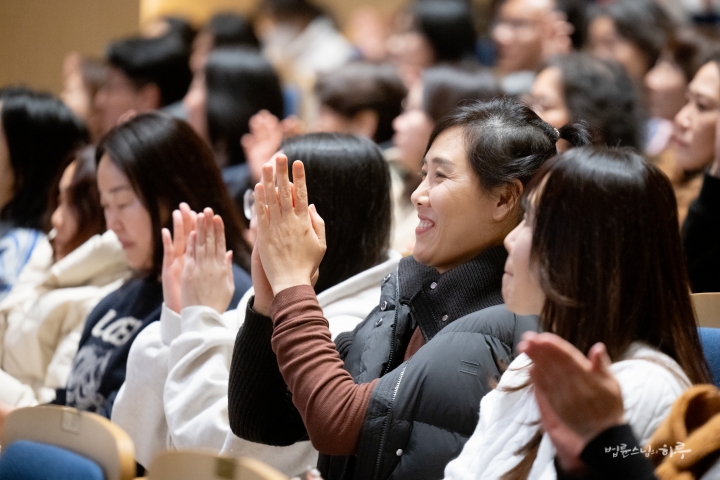
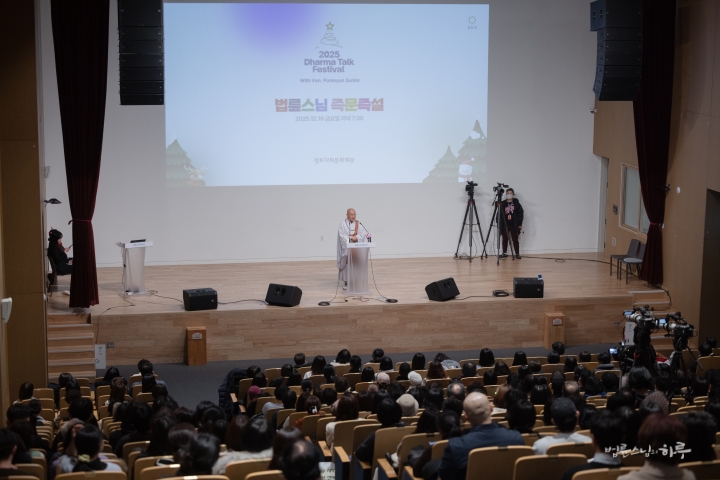
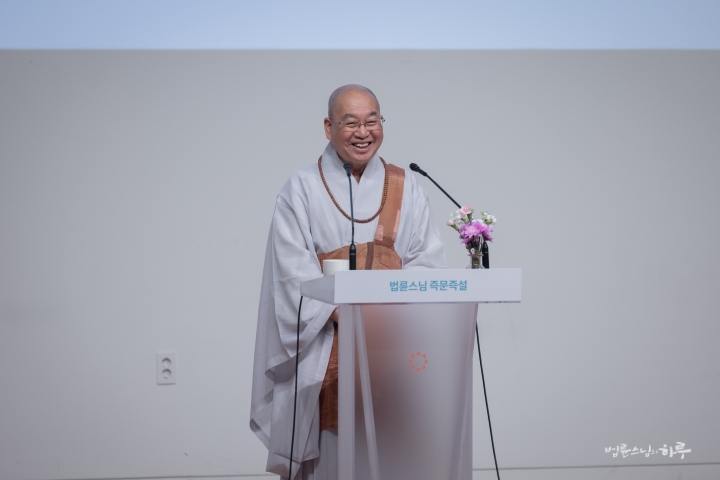
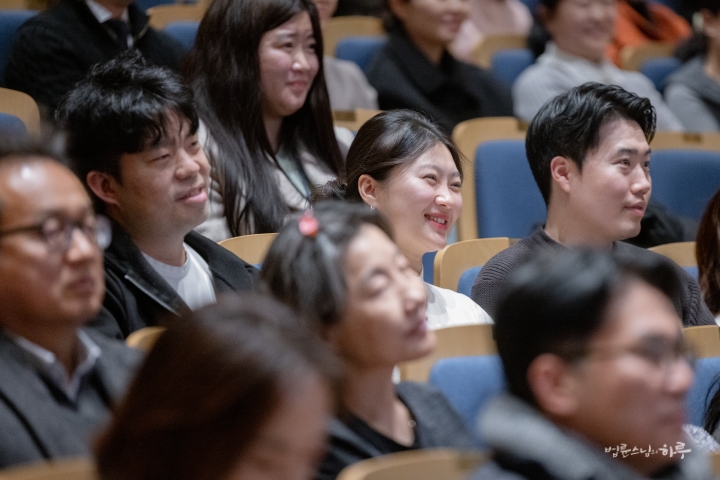
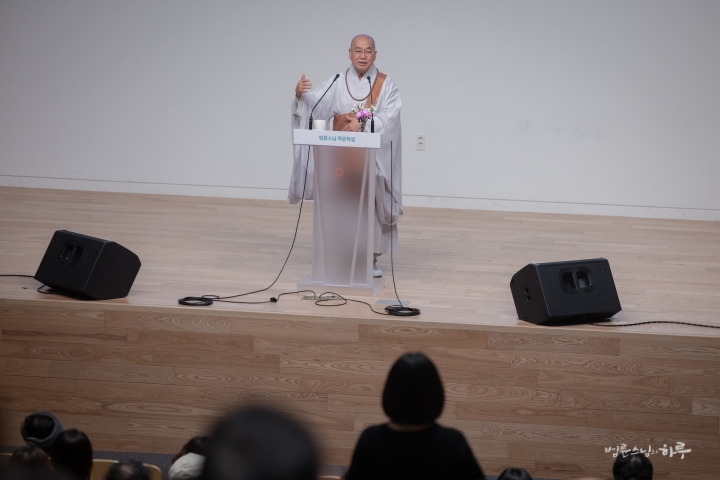
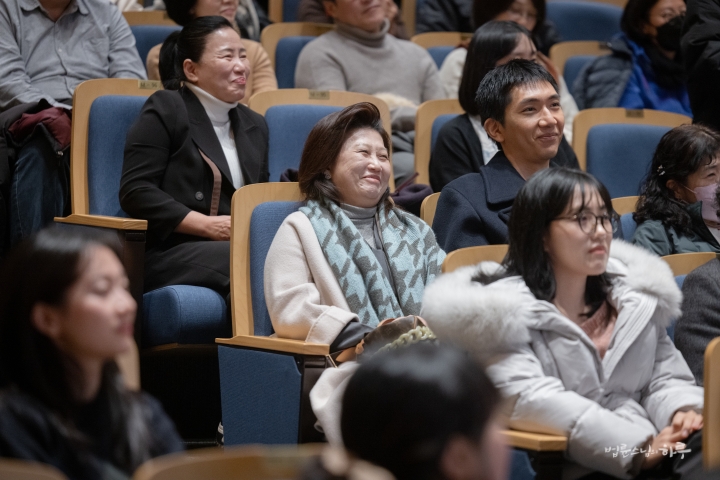
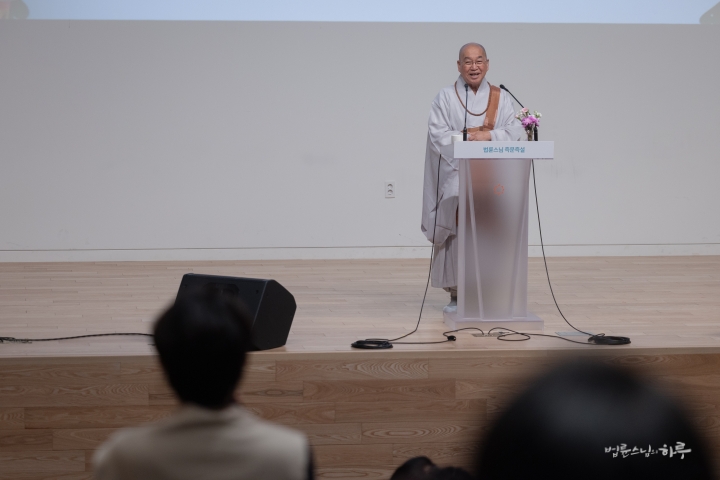
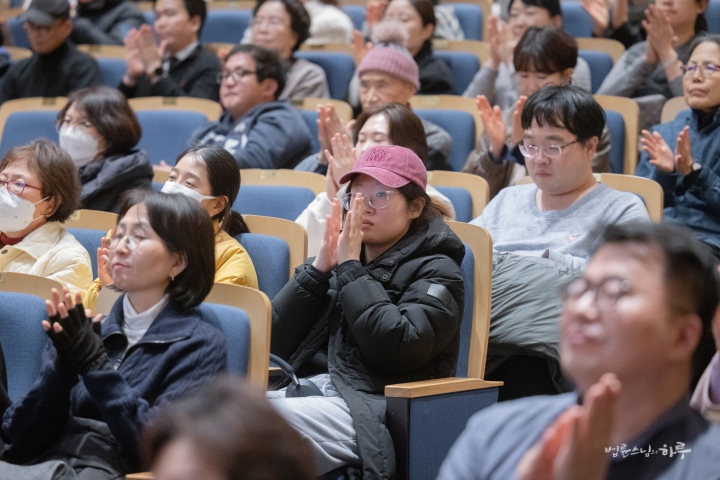
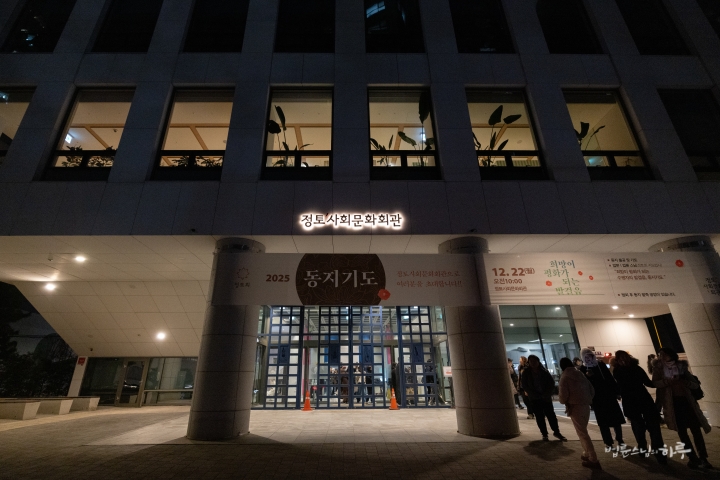
After sunset, starting at 7:30 PM, he gave a Friday Dharma Q&A lecture in the underground auditorium. With about 350 citizens in attendance and 4,500 people connected via YouTube live stream, Sunim gave his opening remarks.
“Today the weather has become much warmer. They say the temperature in Jeju Island will rise up to 20 degrees Celsius. People are asking why we’re having spring weather in winter. It looks like it will rain tomorrow, and after the rain, it will get cold again, so please take care of your health with these weather changes.I spent a week in Mindanao, Philippines last week. We are conducting educational support activities in the Mindanao region of the Philippines, mainly doing three things. First, we are building schools for indigenous children in remote mountainous areas who cannot receive school education. Small schools have 3 classrooms where 1st and 2nd graders, 3rd and 4th graders, and 5th and 6th graders study together. Large schools are built with up to 6 classrooms. Most schools have 3 or 4 classrooms.
Second, we are building one special school for children with disabilities in each county. In that region, the school in the town center of each county is called the ‘Central Elementary School,’ and we build special schools for children with disabilities within these Central Elementary Schools. Unlike in Korea where special schools for children with disabilities are built separately, we build them in the most central location within the school so that children can naturally interact with each other.In poor countries, even regular children lack educational opportunities, and children with disabilities have even fewer educational opportunities. So most of them can be said to be hidden away inside their homes, in their rooms. However, when special schools for children with disabilities are established, children who were confined to their rooms gradually start coming to school. At first, children of civil servants or relatively well-off families come out first, and gradually children from ordinary families also start attending.The same goes for indigenous children. When there is no school, education itself is impossible, but when a school is built, children come to school. Since most people in those areas practice slash-and-burn agriculture, parents sometimes move near the school. So villages where schools are built gradually grow larger and the number of children increases.
Third, schools are being built in conflict zones. These are areas where security cannot be maintained due to conflicts between rebel groups, making it difficult to operate schools. Schools were built after receiving promises from rebel groups to guarantee the safety of teachers. As a result, Muslim, Christian, and indigenous children now attend school together.This year, 15 schools were built in total: 10 indigenous schools and 5 schools for children with disabilities. During my recent visit, I attended the completion ceremonies of 8 schools over 4 days, with two ceremonies per day. Three indigenous schools already had their completion ceremonies in August, and 4 schools remain. Since construction is slightly incomplete, they are scheduled to be finished and inaugurated by mid-January next year.While it would be wonderful to show you all the schools, today I’d like to focus on one indigenous school to share how site surveys are conducted, how schools are built, and how joyful people are when they’re completed. You can understand that all other schools were built through the same process.To build a single school, our JTS volunteers must conduct on-site surveys and manage the location by walking there at least ten times. Since JTS doesn’t simply outsource to construction companies, building schools is never easy. Let’s watch a video of this process together and then have a discussion.”
Next, Sunim showed footage from last week’s visit to the remote village of Bangarayayan in the Philippines, where he attended the completion ceremony of an indigenous school, along with footage from a survey visit two years ago.
After the video ended, Sunim continued speaking.
“Did you watch it well?”
“Yes.”
“Your small donations come together to provide educational opportunities for those children and new hope for the villagers. The indigenous chief is called ‘Datu,’ and you could see them giving speeches, expressing joy that building a school in their village was their lifelong dream, and that dream has now been realized.This year, we built 15 schools. JTS does not use the funds you donate for office expenses or staff salaries. About 97 percent goes directly to support people who actually need help. Since all volunteers work without pay, there are no labor costs, and since we use Jungto Society buildings for free, there are almost no separate operating expenses. JTS continues to provide emergency and necessary support not only in Mindanao, Philippines, but throughout the world, especially focusing on Asia, including Southeast Asia, South Asia, West Asia, and regions like Syria.”
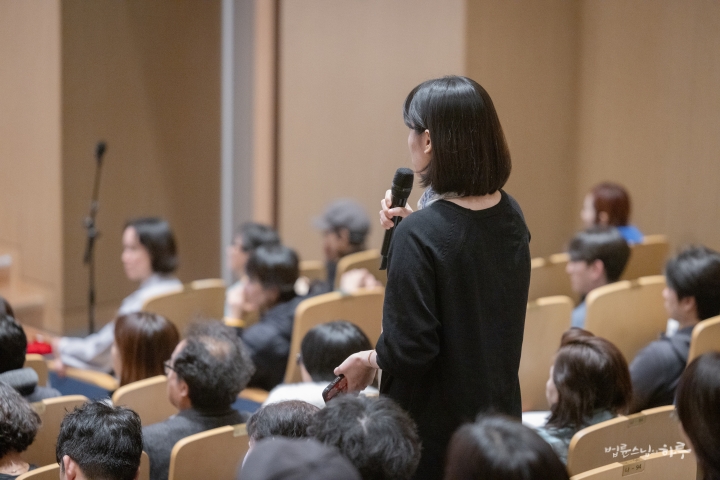
For the next hour and a half, eight people asked Sunim questions. The first questioner sought Sunim’s advice, wondering if she might not be in her right mind as she continues to worry about her ex-husband despite their divorce, unable to completely cut ties with him.
Am I Not in My Right Mind for Still Worrying About My Divorced Ex-Husband?
“I married my high school boyfriend despite opposition from those around us because I loved him so much. Seeing my husband, who didn’t grow up in a normal family during his childhood, I wanted to embrace him and be a strong support by his side. However, after marrying someone who had been enjoying nightlife since middle school and couldn’t even finish high school, and having a child with him, the word ‘reality’ hit me deeply. After enduring and enduring more, I eventually got divorced. Even after the divorce, we continued to stay in touch. Whenever something happened, he would call me his guardian – from police stations, and when he was taken to hospitals after accidents. When he went to police stations several times for dining and dashing due to alcohol problems or for assault incidents with his associates, I always received calls. After this repeated for several years, I tried cutting off contact coldly, then accepting calls again, and now I have him blocked. Although I’ve blocked him, I sometimes wonder if he’s living well and worry about him. Because of these issues, I’ve wondered if I might have mental problems and have received psychological counseling several times. Despite this, the same pattern repeats, which makes things very difficult for me. I’m confused whether I’m not in my right mind, and after hearing Sunim say that many people are mentally ill these days, I wonder if I should go to a hospital. Also, I’m doing 108 prostrations these days, and I’d like to hear Sunim’s wisdom on what mindset I should have while bowing to eliminate my karma.”
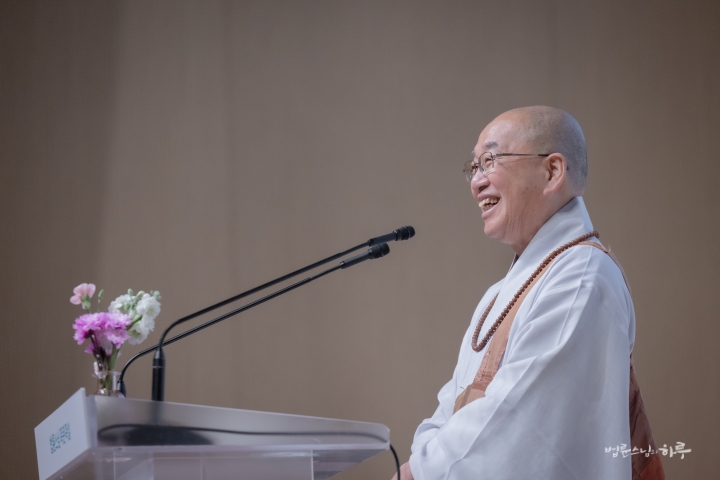
“You got into trouble by being too mature for your age. Instead of studying as a student, you were busy dating and got yourself into this mess, so now you’re suffering by your own choice. Since you created this situation, you’ll have to take responsibility for it.Don’t think of him as your husband, but think of him as an elementary school friend. If he were a friend, you’d help him when needed, right? Even if a friend becomes an alcoholic, you can help them, and if they go to prison, you can visit them. It becomes burdensome because you keep thinking of him as your ex-husband. Just think of him as a friend from your elementary school hometown. You liked that friend when you were young, didn’t you?If you wanted to have a child while living alone, you’d have to pay for sperm from a sperm bank, right? But you had a child with the sperm of someone you once loved, so the child is beautiful. Wouldn’t it be enough to just appreciate him to that extent? It becomes a very difficult problem when you think in terms of conventional marriage, husband, and father of your child. But if you let go of all those thoughts and think of him as a friend you liked in elementary school who now has various difficulties, you could be his guardian. If he’s at the police station, you could visit him; if he’s hospitalized, you could sign as his guardian. You feel bad because you think of him as your husband. Wouldn’t it work if you thought of him as an elementary school friend? Then you wouldn’t need to block him. Since he’s a friend, you can’t do everything for him, right? Do what you can do, and don’t do what you can’t. How about taking it lightly?Living with someone you liked in elementary school, middle school, or high school is a life many people dream of. Most people have such dreams, but very few actually realize them. You bravely made it happen.
When we’re young, we don’t care whether someone is good at studying or not, or whether they have money or not. We like them with a pure heart. But as we grow up, we start considering things like personality, money, and status, which makes marriage difficult. Those who are successful don’t look at me, and those who aren’t, I might accept as friends but not as marriage partners. That’s why it’s not easy to date or marry the friend you liked when you were young. But you’ve dated the friend you liked when you were young, you’ve married them, and you’ve had children together. In terms of marriage alone, he may not be a good husband, but I think it’s very successful in that you’ve realized a dream you had when you were young.So why not think of it with gratitude and take it lightly, just as helping a friend? Don’t think you have to be good to him, and don’t think you have to cut him off either. Since he’s a friend, do what you can do, and don’t do what you can’t. If you take it lightly like that, you won’t have to go to a psychiatric hospital. If you take it heavily thinking of him as your ex-husband, it becomes difficult to handle alone, so you end up needing the hospital’s help. Since you’re thinking about going to the hospital, you don’t need to go yet. It means you still have your sanity.”
“Yes, I understand well.”
“Among those who are married and living comfortably economically, there are many who spend their whole lives wanting to meet the person they liked when they were young, wondering ‘How are they doing?’ In that sense, you belong to those who have achieved that dream. However, there’s always a price to pay. Just as you pay back a loan with interest, if you dated when you were young, you have to pay that price. How about thinking that it was worth paying that price?If you’re okay living alone, live alone. If you think you should remarry, then remarry. He’s a friend, after all. You can just say, ‘I got married.’ Cutting him off means you’re taking it heavily. Thinking you have to do everything for him is also taking it heavily. With friends, you help if you can, meet when you have time, and don’t meet when you can’t. How about taking it lightly like that?”
“Thank you.”
Questions continued one after another. After answering all the questions, it was past 9 PM.
Although there were more people who wanted to ask questions, the lecture concluded with a promise for next time.
Tomorrow, Sunim will attend the Peace Foundation’s Tongil Euibyung regular general meeting in the morning for a dialogue session, and in the afternoon, he will attend the Jungto Society Seowon Practitioner ordination ceremony to give a Dharma talk.