Should I stay in an unhappy marriage for my children?
Dec 16, 2025 - Visit to Dorisa Temple and Adomorye-won in Gumi, Meeting for 2026 Schedule
Hello. Today, Sunim visited Dorisa Temple and Adomorye-won in Gumi, then traveled to Seoul to discuss next year’s schedule.

After completing morning practice and meditation followed by breakfast, Sunim departed from Dubuk Jungto Retreat Center at 9:10 AM, heading to Gumi.

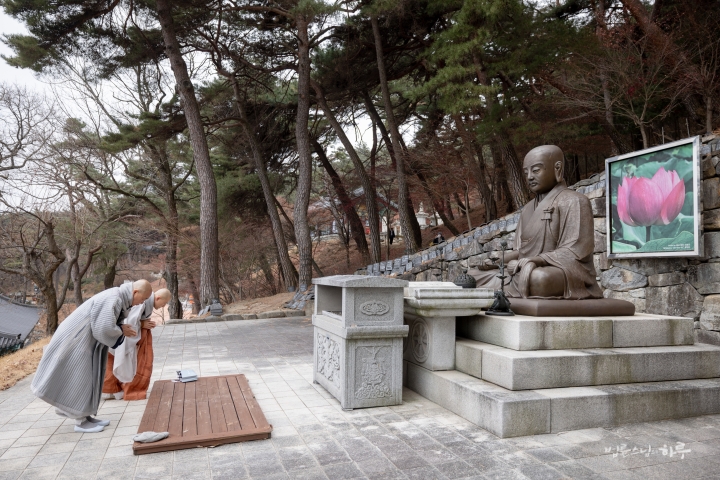
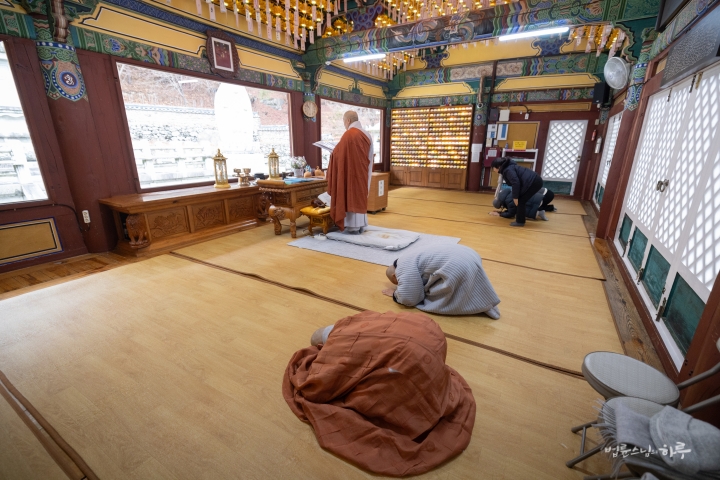
After about two hours of driving, Sunim arrived at Dorisa Temple in Gumi at 11:00 AM. Dorisa Temple is a historic temple founded by Venerable Ado during the Silla Dynasty, symbolizing the origins of Buddhism’s introduction to the Korean Peninsula. Sunim first visited the main hall to pay respects, then greeted Venerable Beopdeung, the head monk of Dorisa Temple, and had tea with Venerable Sugyeong.

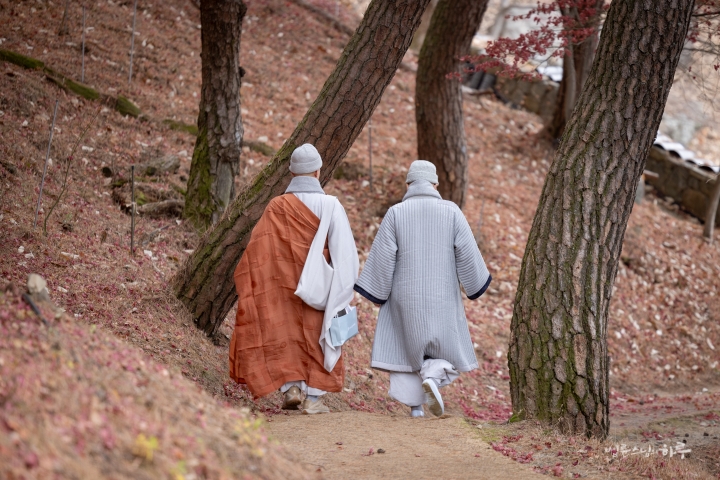
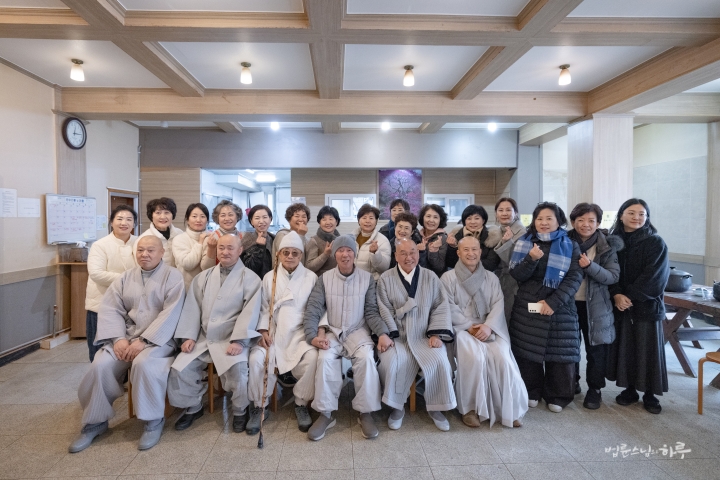
They then engaged in conversation for over an hour about various ways to develop Korean Buddhism, including the cultivation of sacred sites related to Buddhism’s introduction. After noon, they moved to the dining hall for lunch. At the request of visitors to Dorisa Temple and those who prepared the meal, they also took commemorative photos together.
After finishing the meal, at 12:50 PM, Sunim departed from Dorisa Temple and traveled with Venerable Sugyeong to Adomorye-won . Adomorye-won is known as the sacred site where Venerable Ado first introduced Buddhism to Silla, marking the initial turning of the Dharma wheel in Silla Buddhism. Jungto Society continues to maintain and cultivate this site to inherit the practice spirit of Venerable Ado.
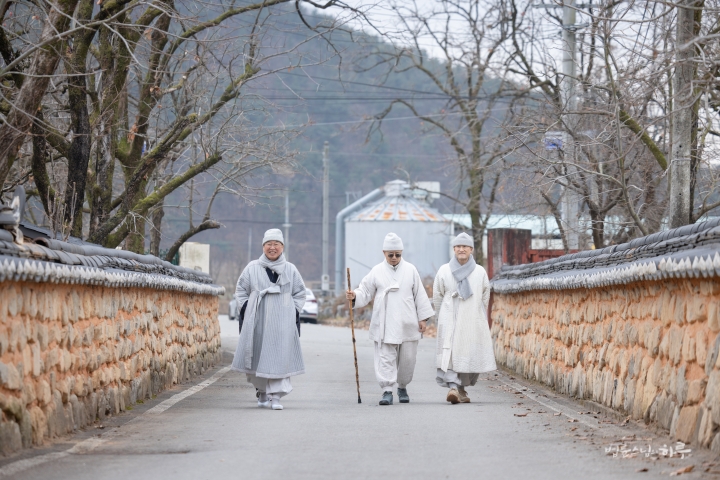
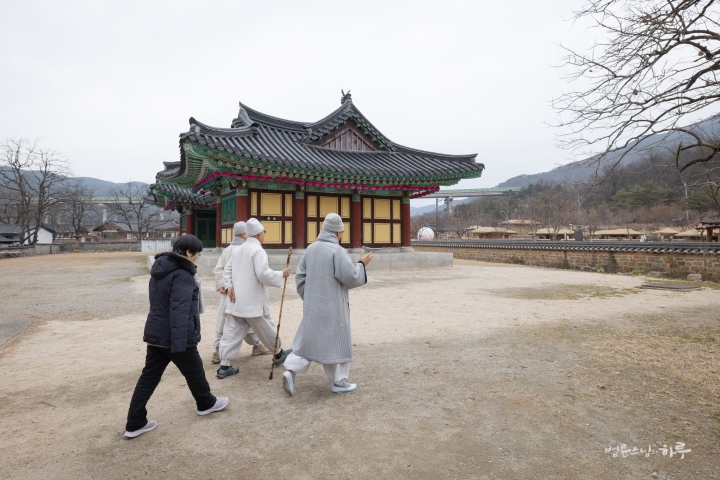
Sunim toured various parts of Adomorye-won with Venerable Sugyeong and exchanged opinions on how to develop this place as a sacred site.
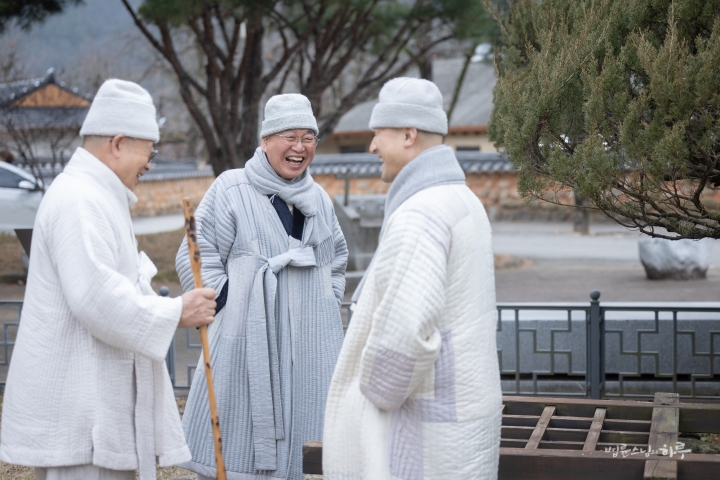

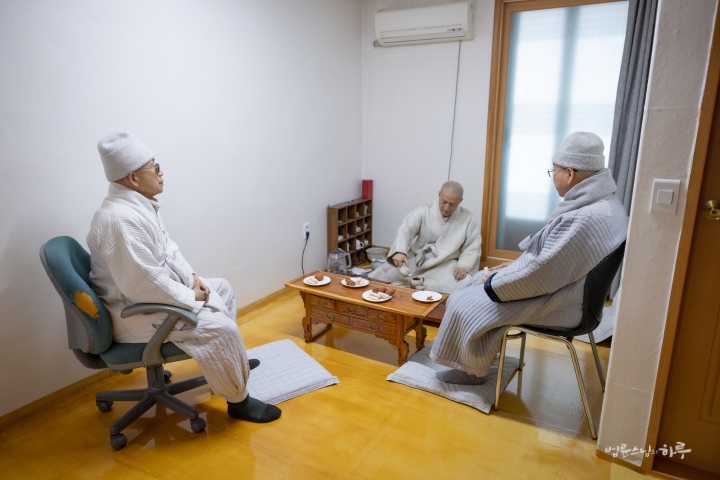
They continued to have tea with Venerable Sugyeong, engaging in deep conversation about the life and death of practitioners and the reality of Korean Buddhism. At the end of their conversation, they also discussed the World Meditation Symposium to be hosted by Jungto Society next year.

At 2:40 PM, after bidding farewell to Venerable Sugyeong, Sunim departed from Adomorye-won and headed to Seoul. While Sunim briefly dozed off in the car, the sun set.
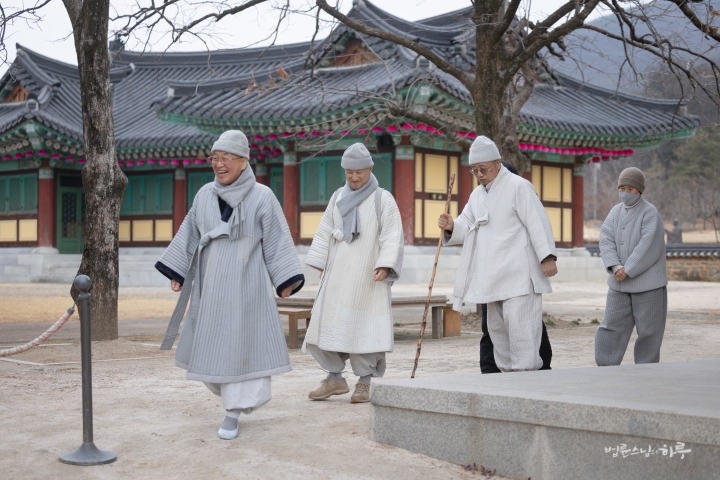

After three hours of driving, Sunim arrived at Seoul Jungto Center at 5:20 PM. After a simple dinner, from 6:00 PM, he participated in an online meeting to discuss the 2026 schedule. He reviewed next year’s plans and coordinated schedules with the heads of each division. Before beginning the discussion in earnest, Sunim said with a smile:
“If possible, let’s plan the schedule as if I were dead.” (laughter)
However, there were still many events that required Sunim’s attendance. The meeting became lengthy as they coordinated a year’s worth of schedules. The meeting finally concluded at 9:00 PM.
Tomorrow, Sunim will attend the Religious Leaders’ Meeting for National Reconciliation and Peace, hold a year-end Dharma assembly at Jungto Social and Cultural Center, and in the afternoon, meet with the Peace Foundation planning committee members.

Since there was no Dharma talk today, I’d like to share a conversation between Sunim and a questioner from the Happy Dialogue Dharma Q&A held in Goyang City on November 18th.
Should I stay in an unhappy marriage for my children?
“My husband and I are celebrating our 20th wedding anniversary this year. I know we should respect each other as we are, but sometimes my husband’s words and actions hurt my feelings. Since our children are still young, I desperately hope for my husband to change. Today, I asked him to come to this event with me, but he said no. I’ve tried sending text messages, writing letters, and sharing Sunim’s Dharma talks, but change hasn’t been easy. What should I do to maintain our remaining married life well?”
“At the recent APEC summit in Gyeongju, the whole world was curious whether Chairman Kim Jong-un and President Trump would meet. This was because Trump had subtly expressed his desire to meet several times. Doesn’t it seem a bit strange that the president of the world’s most powerful nation is courting the leader of the poorest country? But in the end, they didn’t meet. Even the world’s most powerful leader can’t always have his way, yet you’re trying to change your husband according to your will.”“I just want to have a conversation.”
“Trump wanted to have a conversation too, but the other party didn’t respond.”“Then should I negotiate too?” (laughter)
“You need to meet to negotiate. But he won’t meet. At least you get to meet your husband. It’s just that the conversation doesn’t go well. Your actions of asking him to come to today’s lecture or sending texts and letters weren’t done with pure intentions. The underlying meaning is ‘You’re the problem, so fix yourself.’ Your focus is solely on ‘My husband needs to change.’ What would Trump say if he met Kim Jong-un? It’s obvious he would demand ‘denuclearization,’ which is why Kim Jong-un has no intention of meeting. Similarly, since you think your husband needs to change, your husband feels ‘I have nothing to change.’ He thinks he has no problems, so why do you insist he does?”“Even the children think their father has problems.”
“That’s because the children have been influenced by you. You’ve set a goal to change your husband by any means necessary. Whether through fighting, coaxing, or getting him to listen to Sunim’s lectures, all your attention is focused there. Meanwhile, your husband avoids conversation altogether because he knows that talking to you will ultimately mean ‘You’re telling me to change.'”“But I actively ask him to tell me if he has any complaints. He says he doesn’t, but his expression suggests otherwise.”
“Of course he has complaints. But he doesn’t say them because he knows you won’t let it go. In the old military days, when higher-ups told soldiers ‘Tell me if you have any difficulties’ and asked them to write grievances, nobody wrote anything. Even though they said ‘Speak freely,’ they knew that actually speaking up would come back as a problem, so they didn’t write. After living together for 20 years, you both know this about each other better than anyone. That’s why your husband absolutely refuses to have conversations. To solve this problem, instead of demanding that your husband change, you need to change first. You need to change yourself first. But when you actually ask ‘What should I change?’ most people don’t know. It seems like you don’t have any particular problems. Your husband doesn’t know what his problems are either. What we know for certain today is that you think ‘My husband needs to change.’ So now, try not to think or demand that your husband should change.”“Should we change together then?”
“The word ‘together’ still means ‘You need to change.’ You’re making a deal saying ‘I’ll change if you change.’ You were saying ‘Only you need to change,’ but after hearing my talk, you’re now saying ‘If you change, I’ll change too.’ You shouldn’t make demands. If I can change, I should just change on my own. You shouldn’t make any demands on the other person.”“If I keep trying, will my husband eventually change?”
“There’s nothing to try – just leave him alone. Is your husband saying he doesn’t want to live with you?”“No. He absolutely will stay.”
“Don’t be too confident saying ‘absolutely.’ One day your husband might disappear. (laughter) You can’t help what happens outside your knowledge, but at least your husband isn’t having an affair, is he?”“Not at all.”
“Then, does he drink and spend money recklessly?”“No. He’s diligent and family-oriented, but he just doesn’t speak nicely.”
“How does he speak?”“For example, when he comes home after a long time and we’re eating, I made crab soup and he says ‘Why is the seasoning off?'”
“If the seasoning is off, what else should he say besides the seasoning is off?”“When I ask ‘Should I get you some salt?’ he asks the children ‘Are you all okay with it?'”
“Why is that a problem?”“Also, recently it was our anniversary and I had a coffee coupon, so I asked him to go have a cup of tea, and he said ‘Why should I?’ So I felt sad thinking ‘Am I someone who can’t even have a cup of tea with my husband?'”
“That’s not something to be sad about. You’re the one who suddenly asked to go have tea when it wasn’t a big deal. Listening to your story, your husband seems similar to me. If the seasoning is off, you should say the seasoning is off. I get indigestion if rice is undercooked, so I’m sensitive about rice. When I ask for it to be cooked thoroughly, word spreads that ‘Sunim likes mushy rice.’ (laughter) So sometimes they make it watery but bring undercooked rice. I mean they should let it steam a bit more. I don’t pay attention to other side dishes. But people say that’s the pickiest thing. Yet I’ve never thought of myself as picky about food. My only requirement is just to let the rice steam properly. These days, whether it’s kimbap or fried rice, the trend is to eat rice firm overall, so sometimes I can’t eat rice well. When the rice is too firm during meals, I just leave the rice and eat a few bites of side dishes before leaving. Yet they still don’t adjust the rice. My request is really simple. Just let the rice steam properly. How much work do I do going around everywhere? I’m so busy, can’t they just let the rice steam? (laughter) But the world doesn’t even do that well. I fully understand your feelings. You want to live more warmly together. By the way, which region is your husband from?”“Jeolla Province.”
“People from Jeolla Province are usually warm, but by bloodline, might he be from Gyeongsang Province?” (laughter)“People learn as they live, don’t they? I think I’ve learned and become much softer. So I want to resolve these issues through conversation, but my husband doesn’t seem ready yet. Since his personality feels like typical Korean characteristics, I keep getting angry.”
“That’s why it’s not your husband’s problem but your problem. You’re the one who has Korean characteristics.”“Of course I have those tendencies too.”

“He is enough as he is. Thank you.”
“Do you understand what I’m saying?”“Yes, I understand perfectly.”
“Your husband isn’t doing anything wrong. It’s just that he doesn’t do everything you want him to do. That isn’t a ‘bad’ thing, nor is it a problem that needs fixing. For example, if you ask someone to go to church on Sunday and they refuse, that doesn’t make them a bad person. You should let go of any thoughts of trying to change him through compromise, threats, or even seduction. If he says the food isn’t seasoned right, just think, ‘Ah, it needs more salt!’ and bring him the salt shaker.”“Yes, I see.”
“And if you suggest going out for tea and he asks, ‘Why would we go there?’, just laugh it off and say, ‘Well, I guess I’ll have to find another man to go with then!’ If he says, ‘We’re married, why act like we’re dating?’, you could joke back, ‘Is this even a marriage? Isn’t this just a roommate living arrangement?’ Learning to handle things with humor like this is essential.”“I will try to develop my sense of humor. I think the core message of today’s talk is humor. If everyone sharpened their sense of humor, I think the world would be a much brighter place. Thank you.”