How Can I Endure Someone I Really Can’t Stand at Work?
December 8, 2025, Day 1 in Mindanao, Philippines Hello. Today is a day of traveling to Mindanao, Philippines. For the ...
Hello. Today is a day of traveling to Mindanao, Philippines. For the next six days, Sunim will stay in Mindanao, Philippines, touring the schools built by JTS over the past year and holding completion ceremonies.

At 4 AM, Sunim departed from Seoul Jungto Center and headed to Incheon Airport. Upon arriving at the airport, he met and greeted those who would be joining this delegation. After completing departure procedures and checking in luggage, the group departed from Incheon Airport at 7:05 AM for the Philippines.

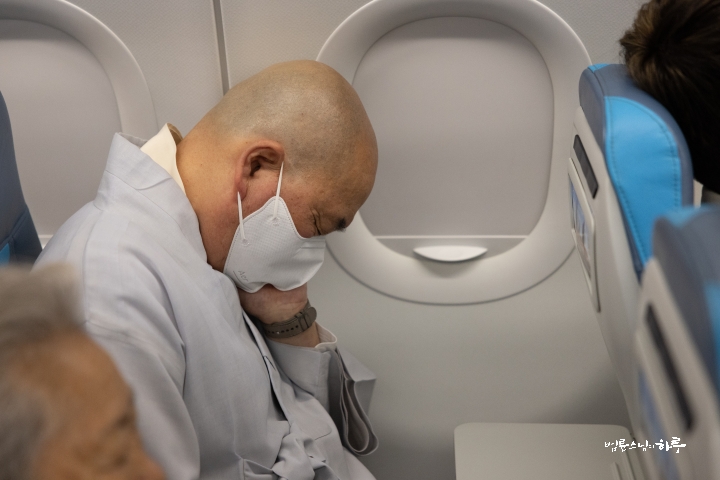
After a 4-hour and 25-minute flight, they arrived at Manila Airport at 10:30 AM local time. Upon exiting the airport, JTS Philippines President Noh Jae-guk and other JTS volunteers warmly welcomed Sunim.

After exchanging handshakes and hugs, they took a commemorative photo with the JTS volunteers who came to greet them.

Leaving Manila Airport, they went to the home of Lee Won-joo, former JTS Philippines President, for lunch. After the meal, they headed back to the airport to catch a domestic flight to Mindanao.

The airport was bustling with many people. After checking in their luggage, they boarded the plane at the scheduled time.

The domestic flight was originally scheduled to depart at 3:45 PM, but it was suddenly delayed. Although boarding was on time, they waited on the runway for 1 hour and 15 minutes before finally departing Manila Airport at 5 PM.

An hour after takeoff, Mindanao Island could be seen in the distance through the airplane window.

As they traveled, the sun set, and they arrived at Lagindingan Airport in Cagayan de Oro, Mindanao at 6:30 PM. Dharma Teacher Hyanghoon and other JTS Philippines volunteers warmly welcomed Sunim and the JTS delegation.
“Thank you for coming. Welcome to Mindanao.”
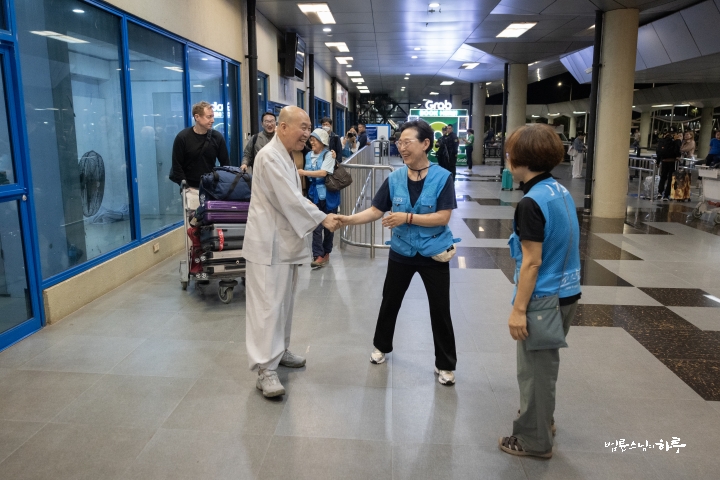

After loading the luggage and boarding the bus, JTS Philippines volunteers handed out kimbap and bananas to the delegation. Perhaps because everyone was hungry from taking budget airlines, the kimbap and bananas tasted exceptionally delicious.

As the bus departed, Dharma Teacher Hyanghoon, who serves as JTS Philippines Secretary General, briefed everyone on today’s schedule.

“Thank you all for making the long journey. From now, we’ll be traveling by bus for 4 hours from Cagayan de Oro Airport. We’ll probably arrive at our accommodation close to 11 PM. We’ve prepared lunch boxes, so please enjoy them and rest comfortably.”
About 20 people joined this delegation, including JTS President Park Gina, JTS Philippines President Noh Jae-guk, writer Kim Hong-shin who always supports and works with JTS, and Jungto Society Philippines volunteers. A detailed introduction of the delegation was scheduled for tomorrow evening, and everyone rested in the bus to recover from travel fatigue.

The bus departed from the airport at 7 PM and arrived at the accommodation in Valencia at 11 PM after a 4-hour journey.

Today, they traveled approximately 3,400 km by plane from Korea to Mindanao, Philippines. After the long journey, Sunim and the JTS delegation briefly set aside their tired bodies and fell into a deep sleep.
Tomorrow morning, they will hold the completion ceremony for Quezon Dumasilak School built for indigenous children, and in the afternoon, they will hold the completion ceremony for Dangkagan SPED (Special Education) School built for children with disabilities. In the evening, the entire JTS delegation will have time to introduce themselves and greet each other.
Since there was no Dharma talk today, I’ll conclude by sharing a conversation between Sunim and a questioner from the Happy Dialogue Dharma Q&A held in Chuncheon two days ago.

How Can I Endure Someone I Really Can’t Stand at Work?
“I have something that worries me and makes work difficult every day. There’s someone I really can’t stand seeing every time I go to work. It’s gotten so bad that it’s making me physically ill. I’ve spent almost this entire year like this.”
“How many people do you dislike?”“Just one person. I don’t usually dislike people like this. But this person is so annoying and manipulative. They take the work I’ve done and present it as their own. Since this is the first time I’ve met someone like this, I didn’t know how to handle it. I was raised by my Buddhist mother and grandmother. They say, ‘This is all karma from past lives, so you shouldn’t harm others. If you endure and get along well, you’ll meet good connections in the next life.’ Having received such education since childhood, even when I get angry, I hold it in and wonder, ‘Am I the problem?’ But when I really think about it, it doesn’t seem to be my problem. I made it through this year, and thankfully, I’m now separated from that person. But I need to keep working to make money. I might meet someone like that again, and it might not be just one person but several. How should I manage my mind then so I can live wisely without getting hurt?”
“Why are you trying to endure it?”“Because I need to make money.”
“Making money isn’t easy. If you want to make money, you have to handle at least that much.”“But it’s making me physically ill.”
“That’s because you’re too caught up in your feelings of dislike. If you were running a store, there would be difficult customers too. If they’re difficult but buy a lot, what would you do? Would you kick them out or accept them?”“I’d have to endure it.”
“You can’t just endure it. You have to think, ‘This is money!’ If you go to a government office’s civil service department, most people there are angry and cursing. Compliant people are rare. So why was the civil service department created? Why was it made independent when it could have been eliminated?”“To prevent bigger problems.”
“It was created to efficiently handle people with complaints by gathering them in one place. Whether it’s city hall or anywhere else, when people with complaints visit each department, work efficiency drops. It’s the same with Jungto Society. If people visit each department to raise issues, efficiency drops. So they created a civil service department saying, ‘If you have complaints, come here.’ When you work in the civil service department, the job itself is already about dealing with people who have complaints. Even if people come and curse at you, you don’t need to worry about ‘Do I need to endure this humiliation?’ That’s because it’s a department for dealing with such people. Every time you hear cursing, just think, ‘This is my salary!’ You get your salary because that person curses. If everyone was compliant, would you get a salary?”“That’s true.”
“If you’re getting a salary, it should be okay to hear cursing. Is making money ever that easy? In the story of Heungbu and Nolbu, there’s a part that says it’s okay to be hit with a ladle as long as you can eat. If someone offered to give you 10 million won for each slap on the cheek, would it be better to take one slap or two?”“It would be better to take one more.” (Laughter)
“The core of your worry is ultimately money. If you want to run a store or work at a company, you have to handle this much. When dealing with many people, there are always one or two difficult people anywhere. Even school teachers have one or two students in each class who curse at them. If you can’t work because of that difficulty, you can’t work at all. It’s good to set one standard. If there are five or seven people at work and only one is difficult, that’s very lucky. If you handle just that one person well, you can get along freely with everyone else. For example, even if that person occasionally takes your achievements, if you say, ‘I understand. Please take credit for it, senior,’ then it’s not stolen but becomes an act of generosity on your part. Being robbed feels bad, but giving is meritorious. Record how many times this happens – whether it’s a few times a year or a few times a month. If the loss is greater than your salary, move somewhere else. If it’s reasonable, think of it as a partial loss of salary. When I hear stories from people doing business in America, they say it’s hard to sell even one pair of sneakers in white neighborhoods. Customers try on five or six pairs just to buy one. But in black neighborhoods, they buy two or three pairs at once. Of course, one or two pairs might get stolen in the process. But overall, it’s much more profitable. Some people get furiously angry and curse ‘those damn blacks’ every day. So I say, ‘Instead of cursing like that, why don’t you move to a white neighborhood?’ They reply, ‘Business doesn’t work there.’ So even if a few pairs get stolen, business is good in black neighborhoods. When you calculate the costs, you can only sell fifty pairs in white neighborhoods but can sell a hundred pairs in black neighborhoods. Even if you lose a few pairs, if the overall profit remains, you should obviously do business in black neighborhoods. Similarly, instead of getting angry, if you think about ways to reduce losses, the overall profit becomes greater. If customers give you profit but you keep cursing them, that’s foolish behavior. Have a grateful heart toward customers and pay attention to small things like display and arrangement to reduce losses, and profits will be much greater. What I want to say is that it’s not a big deal. You also need an attitude of accepting some loss from the profit you receive. In the end, if you manage just one person well, you can get along well with everyone. Make this a practice challenge. If there’s one obstacle you can meet in human relationships, overcoming it allows you to get along freely with everyone. What’s important isn’t whether that person is good or bad, but developing your capacity to accept such people. However, if there are two such people, then you need to examine yourself.”“Yes, I understand.”
“If there are three people you dislike, it’s definitely your problem – then you need to go to the hospital. With one person, you can’t be sure if it’s my problem or their problem. Think of it as a practice challenge: ‘If I overcome just this, I can get along well with everyone.’ If there are two people you dislike, you need to look at yourself. But if there are three, you definitely need to go to the hospital. Not being able to handle that situation should be seen as your problem. The issue isn’t whether that person is good or bad, but that you’re not free because you can’t handle their personality. For example, if I can climb mountains up to 1,000 meters but can’t climb beyond that, it’s not the mountain’s problem but my physical fitness. To climb mountains over 1,000 meters, I need to practice more – the mountain isn’t the problem. It’s the same at work. If you overcome difficult people, even when others can’t work with them, you can get along well. It’s similar with Jungto Society. If nice people become members, there’s not much effect, but if someone with a bad temper who was a troublemaker improves after joining Jungto Society, word spreads quickly. People say, ‘They became a decent person at Jungto Society,’ and the ripple effect is tremendous. Should we kick such people out or keep them? We should keep them. Sometimes they’re troublesome, but if they change, it’s a huge success.” (Laughter)“Thank you.”