
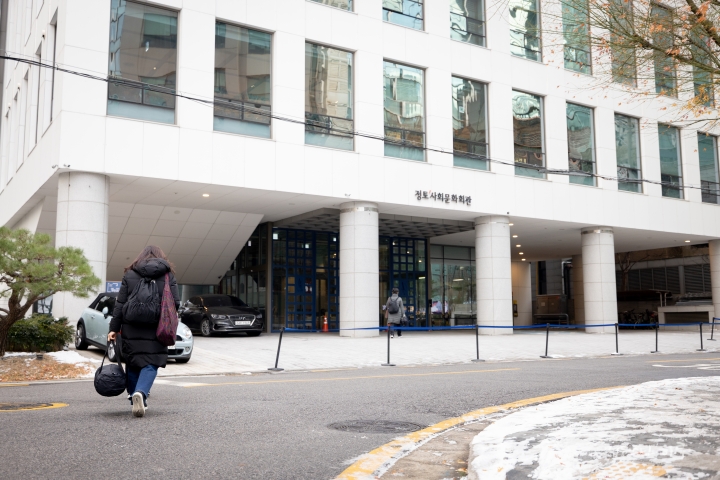
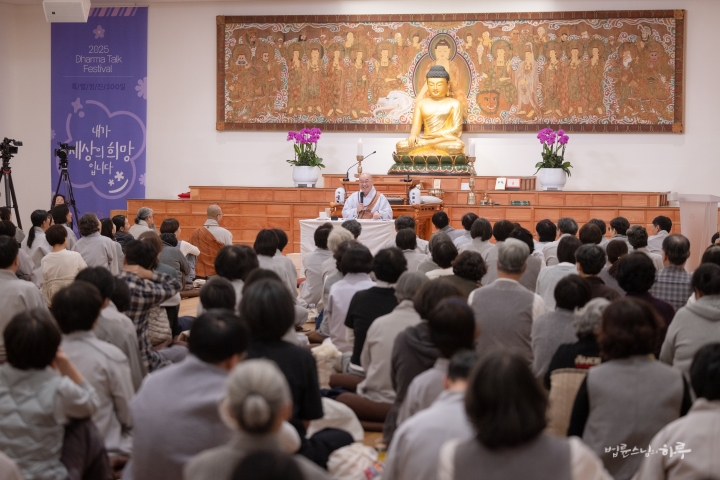
After completing morning practice and meditation, Sunim headed to the Jungto Social and Cultural Center for the closing retreat. The closing retreat was held simultaneously at main temples and practice centers nationwide. At the Seoul Jungto Social and Cultural Center and Seoul Jungto Center, a total of 570 members of the Sangha attended from Seoul-Jeju, Gangwon-Eastern Gyeonggi, Incheon-Western Gyeonggi, Special Youth Division, Special Happiness Movement Headquarters, and Community Division. From early morning, Jungto members began gathering at the center with sleeping bags to participate in the two-day, one-night retreat.
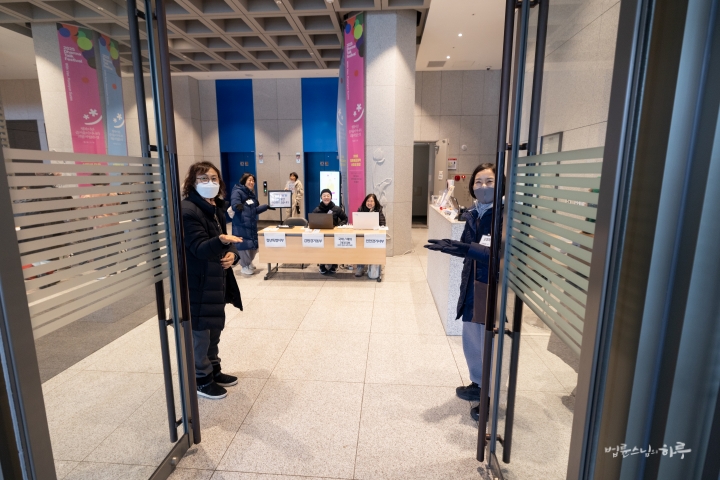
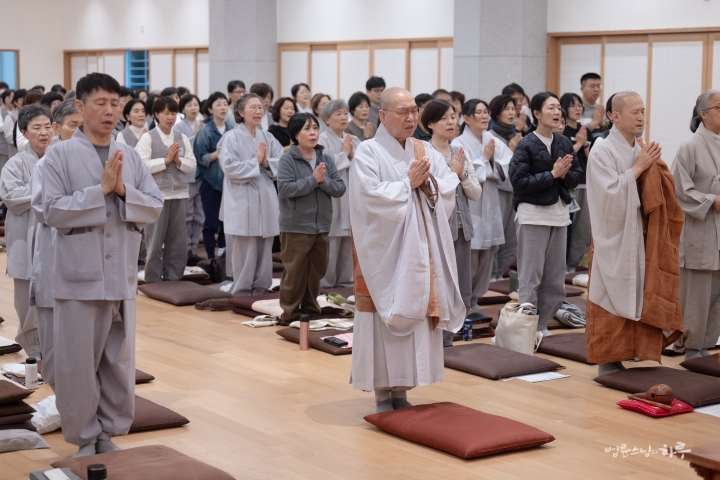
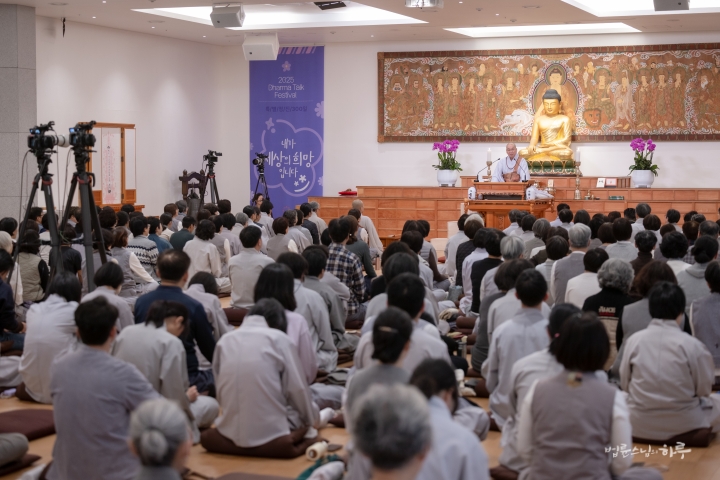
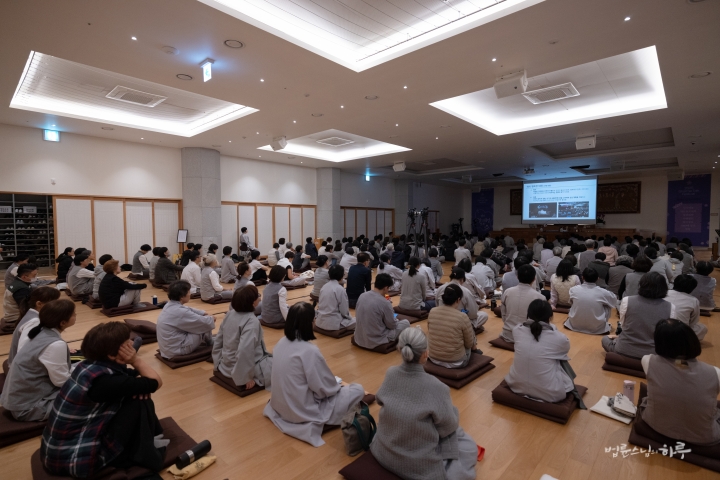
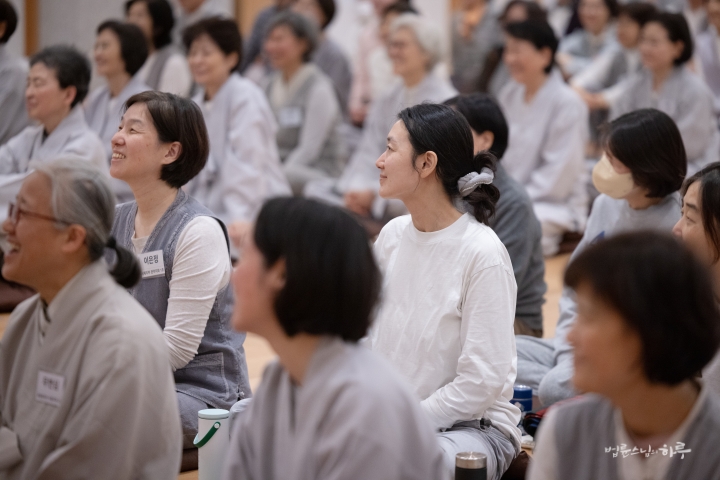
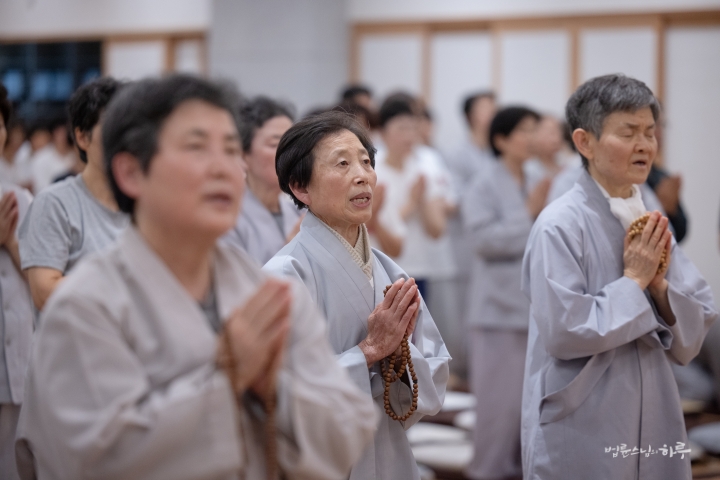
At 10 AM, with about 300 members of the Sangha seated in the third-floor Dharma Hall, the closing retreat began with the recitation of the Three Refuges and the Heart Sutra.
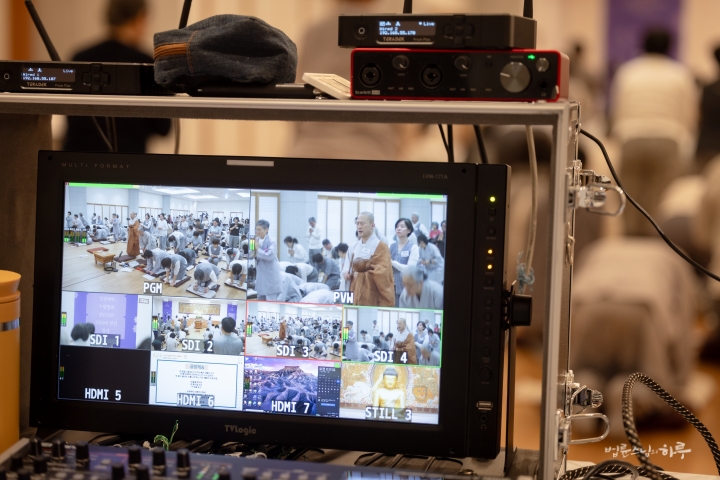
This was followed by participant introductions. Many members of the Sangha from main temples across the country joined the retreat by watching the online live broadcast, not just those at the Jungto Social and Cultural Center.
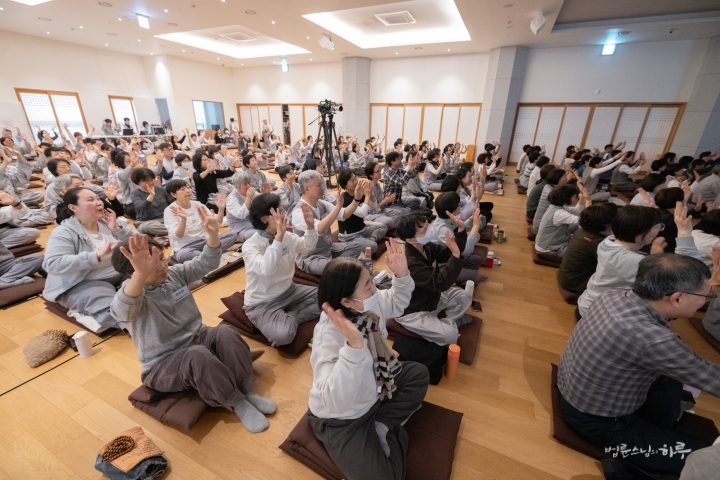
“Today’s closing retreat has a total of 1,286 participants joining from home and abroad. Let’s wave to each other and exchange warm greetings. Welcome!”
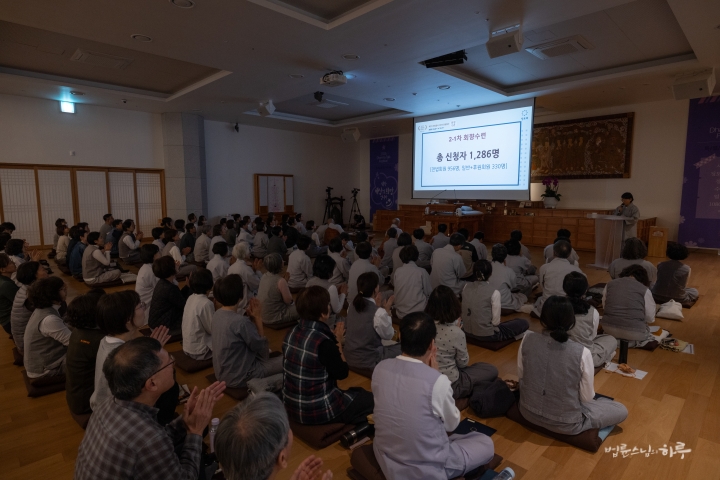
As the moderator spoke loudly, everyone waved their hands to welcome each other.
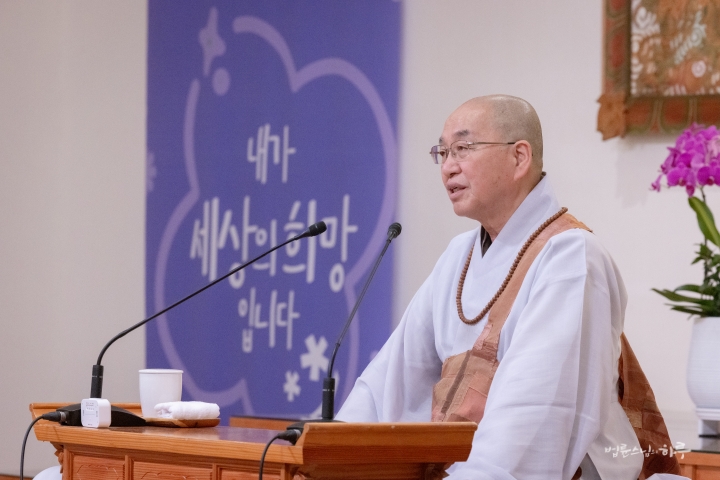
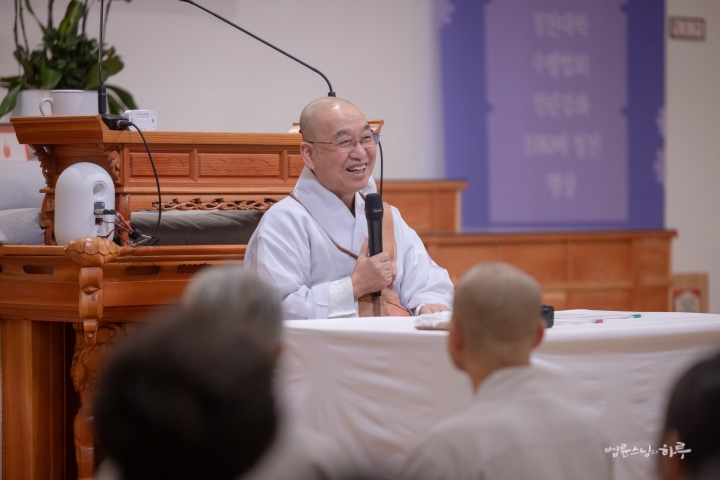
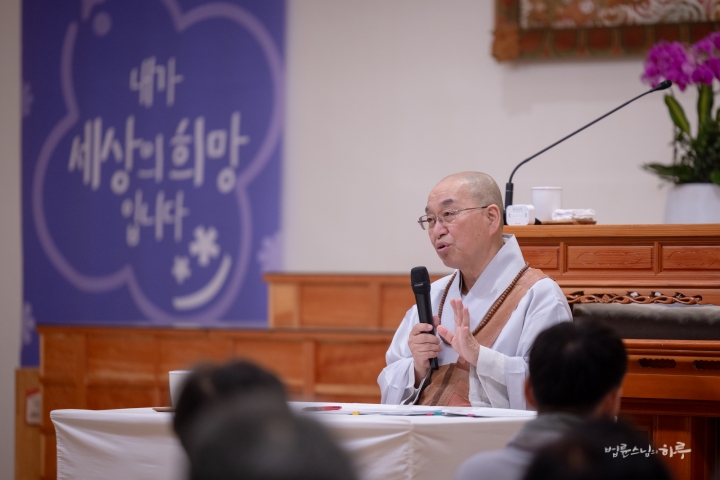
The assembly then requested a Dharma talk with three prostrations. Sunim reflected on the path Jungto Society has walked and spoke about how every moment of life is practice itself.
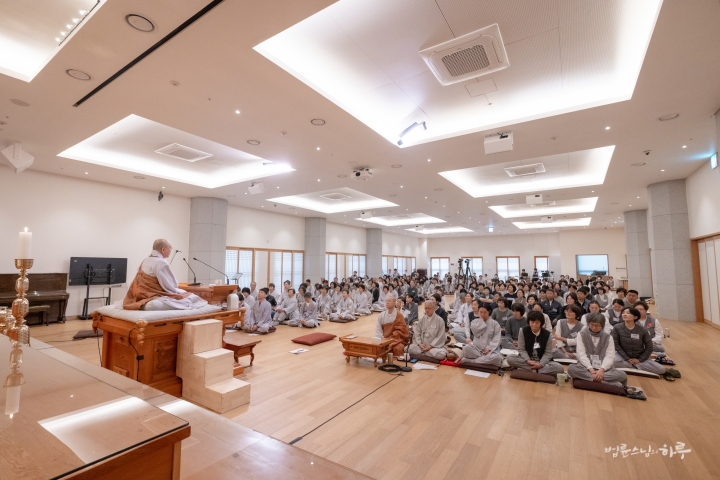
“Three years ago, we began the 1000-Day Practice with the vow to practice diligently every single day for a thousand days without missing even one. Now, those thousand days are nearly complete. Next week, we will hold the 1000-Day Practice closing ceremony. This two-day, one-night retreat has been arranged to mark the conclusion of our three years of practice.
When I think about it, we have already completed the first 10,000-Day Practice over the past 30 years. After concluding that practice three years ago, we immediately began the second 10,000-Day Practice, and now three years have passed. That makes a total of 33 years. But actually, even before that, there was about a 10-year preparation period before we started the first 10,000-Day Practice.
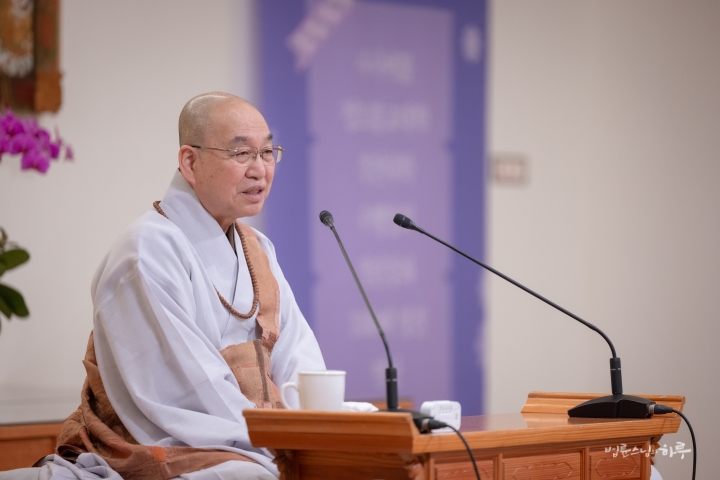
I first began my activities in Gyeongju, and later came to Seoul when I started guiding university students. At that time, I felt that Buddhism also needed a movement suited to the new era, which led me to establish the Youth Buddhist School. Initially, we just borrowed temple spaces for study, but gradually I felt that studying alone was insufficient. I realized we needed to live directly with the community while spreading the Dharma. So we recruited resident Haengja trainees and lived together with university students, combining practice with activities. During this time, we faced misunderstandings from some who accused us of being ‘activist students,’ and we were even expelled from temples. This made us resolve to get at least a small office space, and the first place we obtained was a 50 square meter room on the top floor of a building. Later, we established a Dharma center in Hongje-dong, where we were able to vow and prepare for the first 10,000-Day Practice. Since I came to Seoul in 1983, there was about a 10-year preparation period before we began the 10,000-Day Practice in 1993.
Practice Is Not About Results but About the Process
From the beginning, Jungto Society had nothing. Together with young people, we made up for what we lacked with our physical efforts, continuing small practices one by one to reach where we are today. This is how we established the Mungyeong Jungto Retreat Center. Therefore, it is not right to evaluate Jungto Society based on what buildings we own or how many members we have. Such evaluation is no different from the result-oriented, material-centered evaluation methods of the world. However, our practice is based on the Buddha’s teachings—the life of one who renounced royal status to become a monk. A practitioner focuses on the process, not the results. Living each day to the best of our ability in our given circumstances—this daily life itself is the result of practice. Therefore, Jungto Society’s activities should be viewed not as visible outcomes but as the process of sincerely living each moment of life we’ve been given. We have faced countless difficulties. However, the perspective that ‘we must overcome difficulties to achieve good results’ differs from the life of a practitioner. For a practitioner, the difficult process itself is practice, and within it lies the path to freedom and enlightenment.

During this overnight retreat, participants will also practice 1,000 prostrations. The sense of accomplishment felt upon completing all the prostrations is not the practice itself. When sweat pours down during prostrations, when legs ache, when the desire to quit arises – quietly enduring these feelings, being aware of the urge to give up while continuing forward – this itself is the practice. Living an awakened life without avoiding discomfort or complaints – this is the life of a practitioner that we aspire to.
It’s perfectly fine if there are no visible achievements when the overnight retreat ends. Simply being willing to stay aware while enduring discomfort for two days is practice itself. Through such training, one can move toward a freer life, less swayed by obstacles in daily living. Practice is not about completing a task; rather, the entire process of working through given challenges is the practice. Just as digestion is the practice, not the resulting excrement after eating and digesting food, every moment of life is practice. However, we typically live obsessed with the results – the “excrement” so to speak – such as fame, wealth, and achievements. Living life evaluating ourselves by their shape or quantity inevitably leads to a life full of regrets.
When people entering the autumn of their lives say “I haven’t achieved anything” or “I have no accomplishments,” it’s similar to saying “I ate well but I don’t know why the excrement isn’t accumulating.” However, practice means living each moment sincerely, and this very life right now is the result of practice.
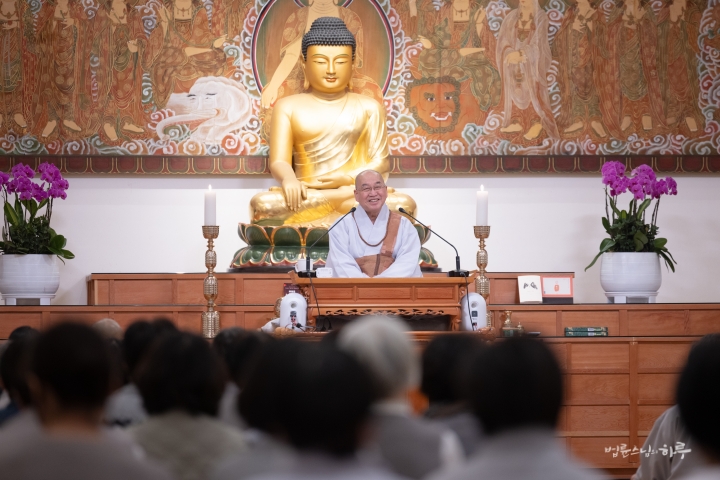
As we go through life, everyone encounters difficulties. What matters is not trying to avoid these difficulties, but cultivating the inner strength to live with them. When difficulties arise, we usually remain in fear, wondering ‘What will happen next?’ However, practice means observing our instinct to run away and staying awake without being swayed by those emotions. Even during the thousand-bow practice, thoughts like ‘Can I rest a bit?’, ‘Should I go take a shower?’, or ‘Should I grab something to eat from the dining hall?’ may arise. It’s okay to have these thoughts. What’s important is to observe yourself having these thoughts just as they are. When we’re caught up in uncomfortable emotions, we instinctively try to run away. But this isn’t necessarily bad. Like animals, we humans also have the instinct to flee when we encounter something stronger than ourselves.
However, if we’re only controlled by these instincts, we’ll spend our entire lives running away. To break free from this pattern, we need to practice observing that uncomfortable mind just as it is. The essence of practice is not trying to forcefully eliminate those emotions, not enduring them, but simply being aware of them.
When doing many bows, everyone feels tired and uncomfortable. Instead of trying to endure or avoid this, when we observe and accept our mind in that moment, we eventually experience freedom from that discomfort. This experience greatly helps us live a lighter and freer life in our daily lives as well.
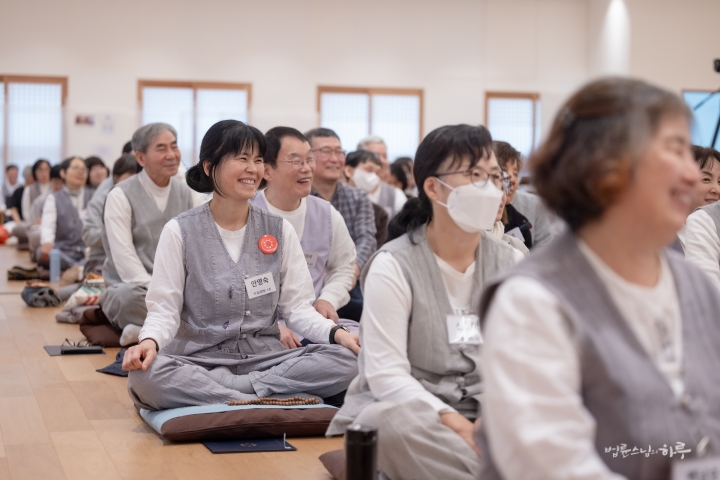
When people ask after completing a thousand prostrations, ‘How did you manage to do something so difficult?’ that’s a question viewed through worldly eyes. A practitioner doesn’t find such questions meaningful. We must remember that practice isn’t about overcoming challenges, but about living with awareness in each moment. This is the life of a practitioner.
We don’t ask someone, ‘How did you cook? How did you chew the hard parts? How did you eat the sour parts? How did you digest it?’ We prepare food, eat it, digest it, and eventually excrete it. And we don’t dwell on the results. Life flows the same way. We unnecessarily cling to the results of what we’ve already lived through.
The Camaraderie and Trust That Come from Shared Hardship
The same applies to honor, wealth, and knowledge. They’re all just ‘results’ accumulated through living and learning. Does this mean they’re useless? They may not be necessary for me, but they can be useful to the world. Just as excrement isn’t needed by me but becomes excellent fertilizer when spread on the ground. Sharing my knowledge for others, using my wealth for others, and utilizing my reputation or popularity for society’s benefit – this is like using excrement as fertilizer. These results may no longer have meaning for me, but they remain resources that can still be useful to the world.
The same goes for this building. What matters isn’t whether Jungto Society owns it, but how it’s being used beneficially for the community. Only when we practice from this perspective can we experience, even slightly, the liberation and nirvana that Buddha spoke of. Despite going to temples, studying Buddhism, and claiming to practice, life remains anxious because we constantly cling to results and try to avoid things. We try to evaluate life by the size of our excrement.
Practice is the training to let go of such attachments and standards of evaluation. While it’s difficult to overcome everything through a ‘2-day, 1-night retreat,’ there’s meaning in experiencing discomfort. When we reflect on the past three years of practice, share our stories, and endure the same hardships in the same space, we become true friends. If I just sit here giving dharma talks while you sit there listening, we won’t become friends even after ten years. However, when we farm together, do relief work together, or save each other from being swept away by water, we become friends. If you pull someone up from a cliff, in that moment, age, religion, and position don’t matter. We come to trust each other simply as ‘human beings.’
Group practice is about building camaraderie among fellow practitioners. Stories like ‘Remember when we collapsed during the 10,000 prostrations?’ become cherished memories that deepen relationships. The reason the resident Dharma Teachers seem so close isn’t because they’ve practiced more, but because they’ve endured hardships together. This is fundamentally different from suffering alone. Shared experiences create empathy and build trust.
This principle also applies to education that transforms children into adults. While it might be considered child abuse by today’s standards, the traditional approach would be to entrust sixth-grade children with third-graders and send them hiking. Just give them a map and say, ‘Follow this path and come back.’ In the process of bearing that responsibility, the sixth-grader instantly becomes an adult. At first, it’s annoying and difficult. When the younger children cry and refuse to follow, they have to carry them. But through this process, they develop a sense of responsibility: ‘They can’t do this without me.’ That’s why raising children makes you an adult. Whether you’re 17, 25, or 40 doesn’t matter. What matters is whether you’ve had the experience of taking responsibility and caring for others.
When You Care for Sentient Beings, You Become a Bodhisattva
The same applies to bodhisattvas. They don’t care for sentient beings because they’re already bodhisattvas; they become bodhisattvas by caring for sentient beings. People in their forties or fifties who don’t practice and live alone without anyone to care for still live like children. Why? Because they’ve never played the role of an adult. Without the experience of protecting someone with their life, they haven’t become true adults.

In this sense, difficulties are never bad. From a conventional perspective, we call it ‘overcoming,’ but from a practice perspective, we call it ‘accepting things as they are.’ That’s where true freedom opens up. Even if you came to this retreat because you couldn’t avoid it as a branch leader or felt pressured as a team leader, since you’re here, open your heart. We’re not asking for 10 years, just one night and two days – it’ll pass even if you hang upside down. If you shrink from discomfort, it becomes harder. When it’s cold, instead of suffering and saying ‘Oh, it’s cold,’ accept it by saying ‘How refreshing.’ This process of experiencing discomfort and difficulty will greatly help our entire lives later. Let’s practice together in this way.”
Taking Sunim’s words to heart, the opening ceremony concluded with the Four Great Vows.
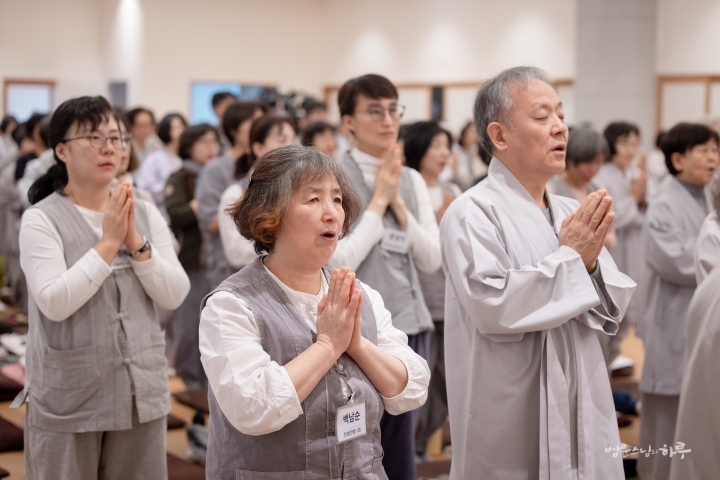
The 1,080 prostration practice began in earnest. First, they completed 300 prostrations in the first session.
“Setting broad and deep aspirations, cultivating the bodhisattva path again and again…”
Everyone prostrated together to the chanting of Venerable Yusu and Dharma Teacher Mubyeonshim.
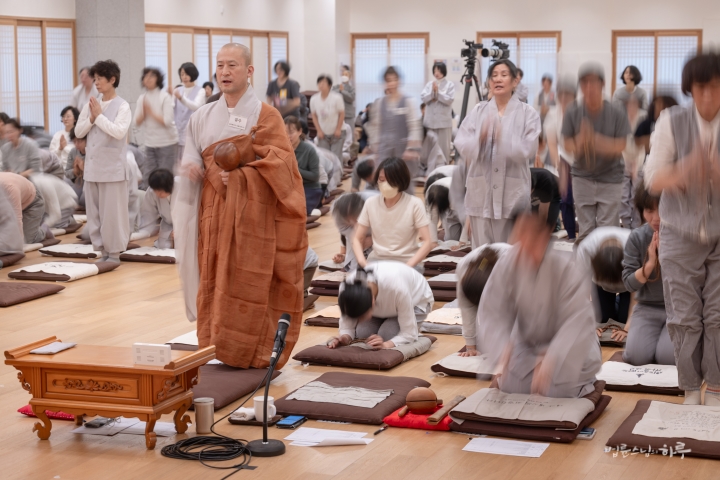
Over the past three years, there were moments of joy and difficulty while practicing with fellow practitioners, but all those times became a great source of strength. With each prostration, they recalled their initial aspiration and made resolutions to prepare for the second 1000-Day Practice.
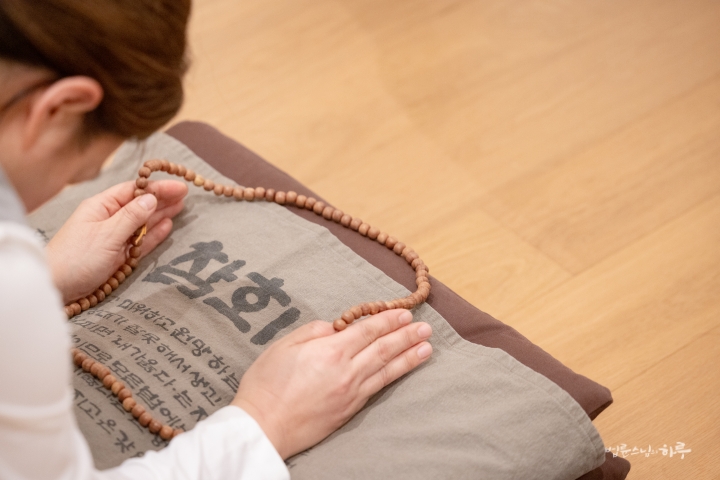
After completing 300 prostrations, they had lunch. People gathered in small groups and took out the lunch boxes they had brought from home.
After lunch, everyone gathered again at 1:30 PM. Today, between practice sessions, they planned to reflect on the past thousand days through three themes: practice, spreading the dharma, and social engagement. First, they watched a video reviewing the achievements and challenges of the past thousand days on the theme of ‘practice.’
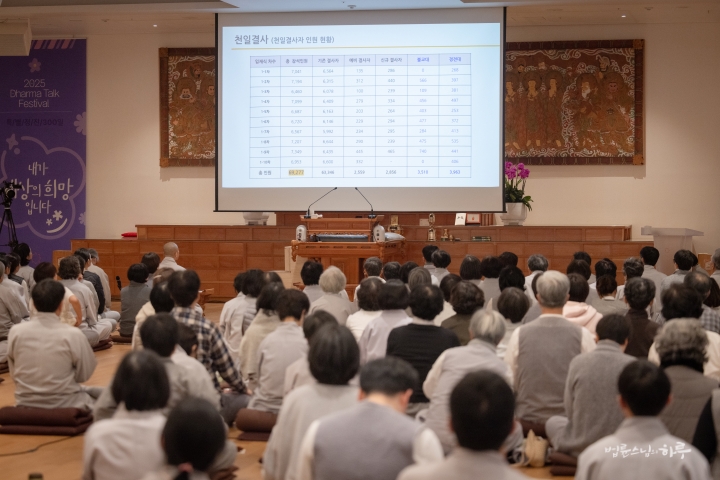
Next, they had time to hear moving practice stories from fellow practitioners. Three people who had practiced more diligently than anyone over the past three years came forward to share their stories honestly.
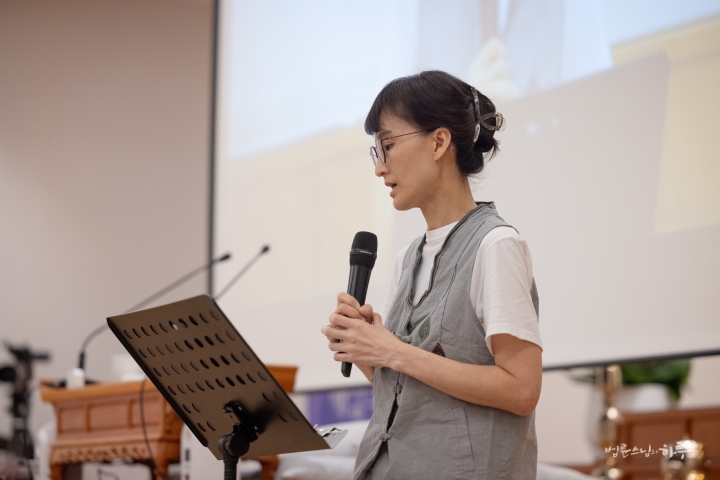
“I decided not to pass this karmic pattern to my children. Thinking each day was my last day of practice, I got up even when I fell. Then at some point, both the hatred I felt and the hatred directed at me disappeared. I met my younger self and embraced myself, saying ‘You weren’t a bad child, just a hurt one.’ Like water drops piercing rock, my life began to transform into happiness bit by bit…”
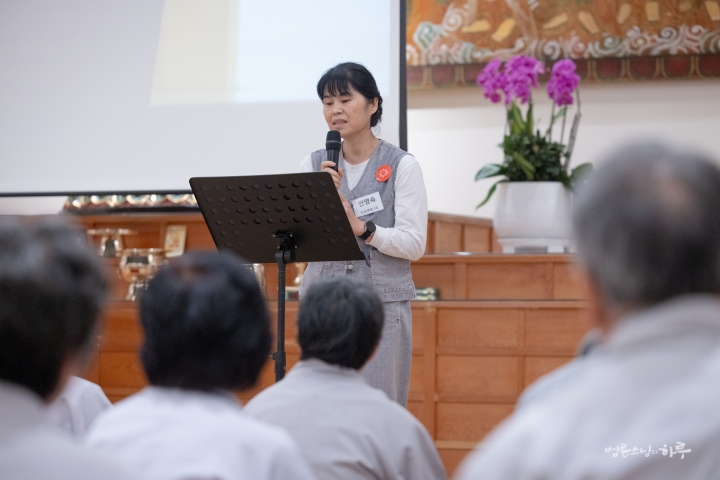
“Without practice, I would have been suffering in hatred and resentment, but thanks to our teacher’s guidance, I’ve come this far. The moment I heard that what seemed like big problems were ‘no big deal,’ gratitude bloomed in my heart. I realized there are no karmic connections that torment me; everything is my own issue. I like myself. I can do this. This is my prayer. Practice always helps me, and my life is gradually finding its place…”
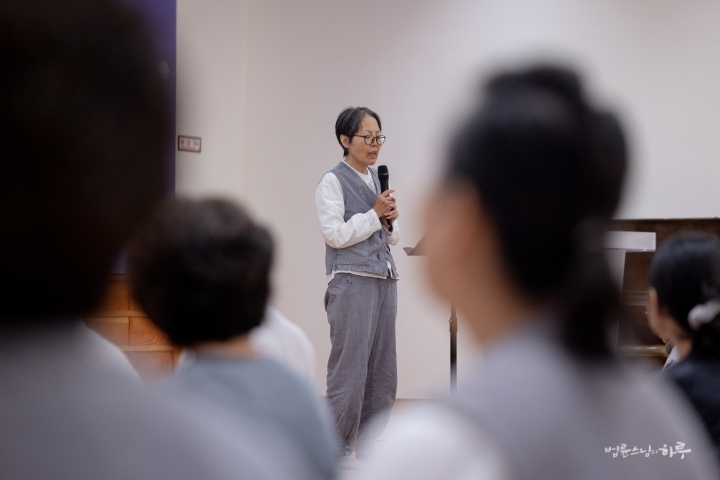
“The wounds and anger I suffered felt so unfair, but through practice, I decided for the first time that ‘I will protect myself.’ When my anger toward my father disappeared, any conflict in the world began to dissolve within a day or two. As each of my problems was resolved, my conviction deepened that all of Sunim’s teachings are truth. Now when I see anyone, understanding comes first: ‘They could be like that.’ I resolve again to walk the right path step by step like Sunim.”
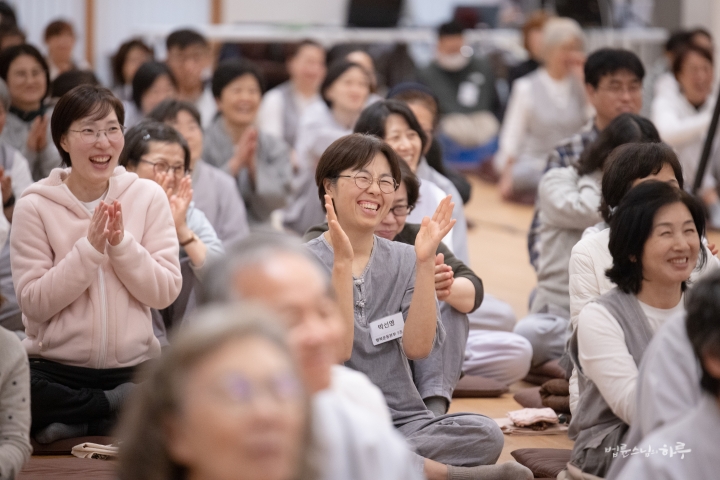
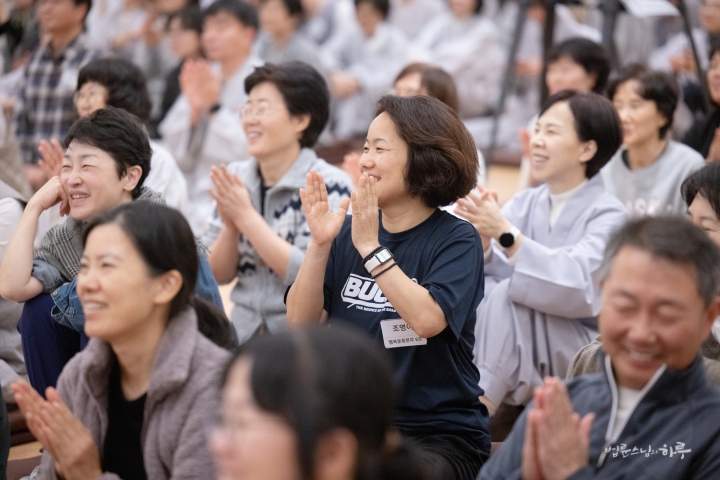
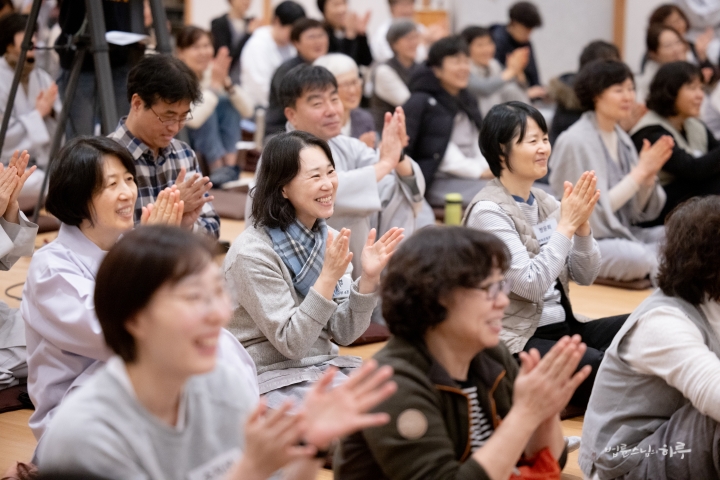
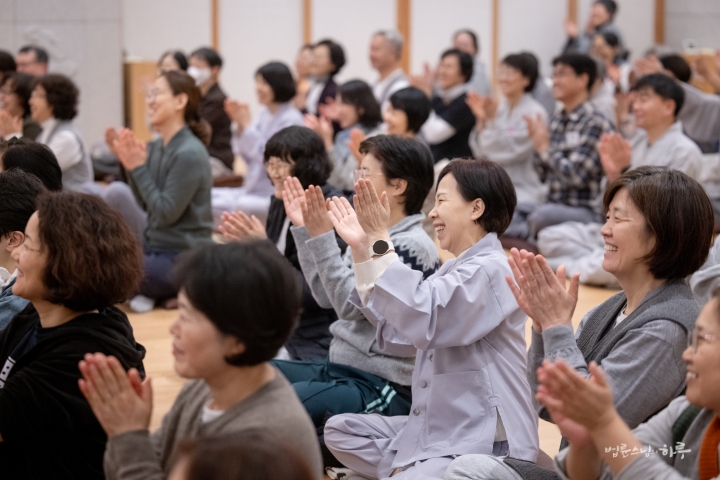
Everyone’s eyes welled up with tears and they gave thunderous applause for these moving stories of overcoming adversity through practice.

They began another 300 prostrations. Perhaps inspired by the moving stories from fellow practitioners, each prostration felt more energized.
“Avalokiteshvara Bodhisattva, Avalokiteshvara Bodhisattva, Avalokiteshvara Bodhisattva…”
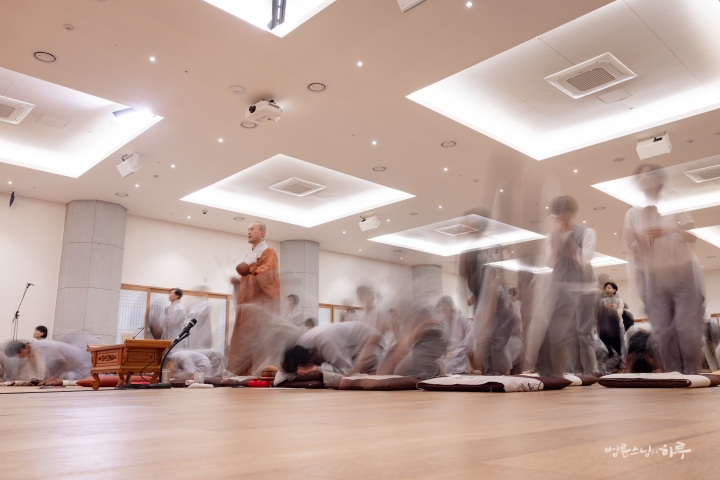
Sweat dripped from foreheads and backs.
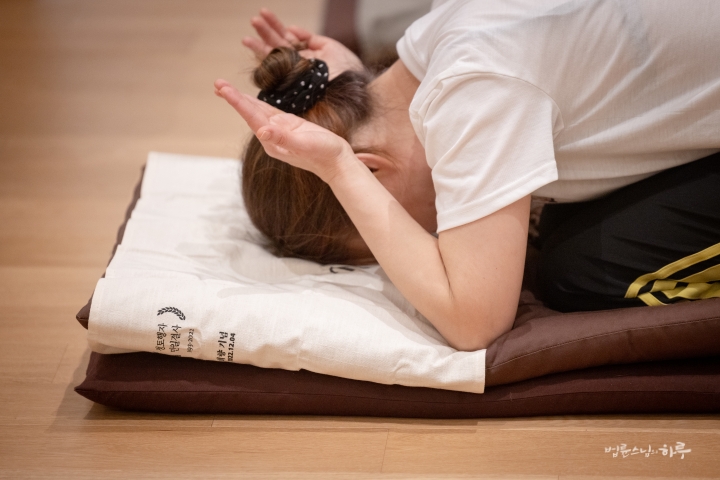
After completing 300 prostrations, they took a short break.
From 3:20 PM, for the second session, they watched a video reviewing the achievements and challenges of the past thousand days on the theme of ‘spreading the dharma.’ Through the video, they could examine the status of member cultivation and leading members, as well as identify remaining challenges.
Next, they had time to hear vivid experiences of dharma spreading activities from fellow practitioners.
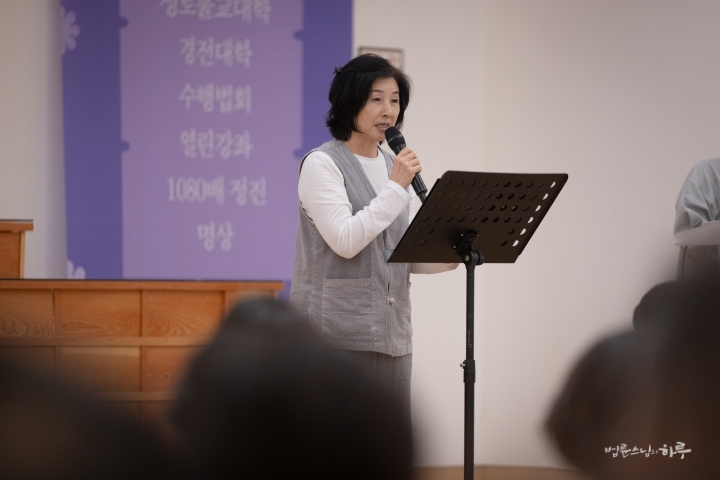
“What used to be promotional work done out of obligation has now transformed into a heartfelt wish that ‘everyone could be happy.’ As I smile and say ‘Please search for Happiness School’ to everyone I meet in daily life, spreading the dharma is no longer a burden. Just as we found happiness through the dharma, I share it lightly with the single wish that they too may find happiness. If everyone shares happiness this way, I have hope that the world will surely change for the better…”
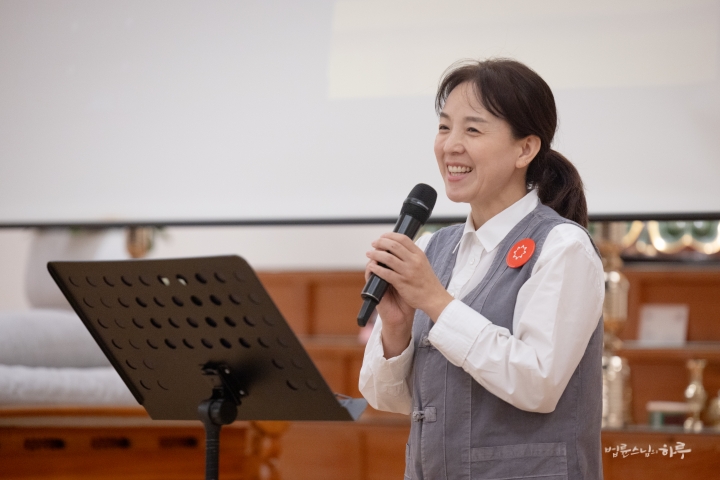
“I also took online classes lightly at first, but as I understood Jungto Society’s purpose and volunteer work, I realized that the students’ hearts were no different from mine. With the mindset of ‘I am listening to your story carefully,’ I nodded and smiled in front of the screen, being present with them. When I realized that the 70-minute class was good for both me and others, this responsibility never felt difficult even once. Though inadequate and clumsy, I’m simply grateful to be used in Jungto Society while discovering the taste of practice together…”
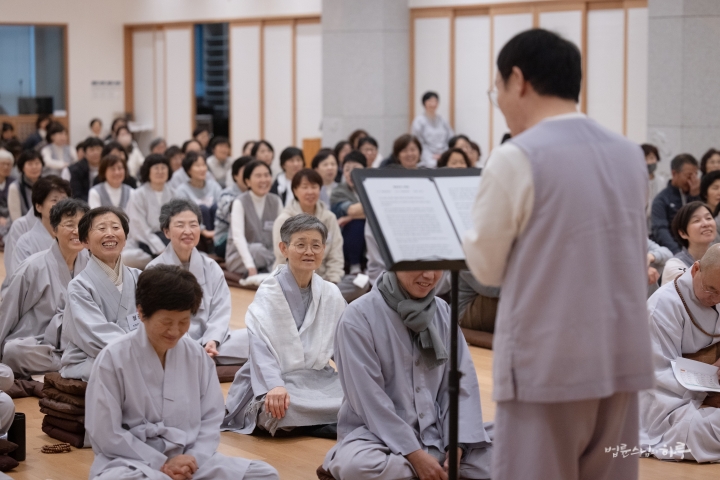
“Starting practice at Jungto Society and doing the 1000-day prayer and 3,000 prostrations, I experienced the miracle of almost completely losing my drinking habit that I thought I’d never quit. I, who used to feel uncomfortable being in the same space with women, now have opened my heart enough to converse more comfortably. Gratitude rises as I think ‘I can’t believe I’ve changed like this,’ and I want to walk this path with my friends too. Now in the prime of my life, I want to share this shining transformation more widely…”
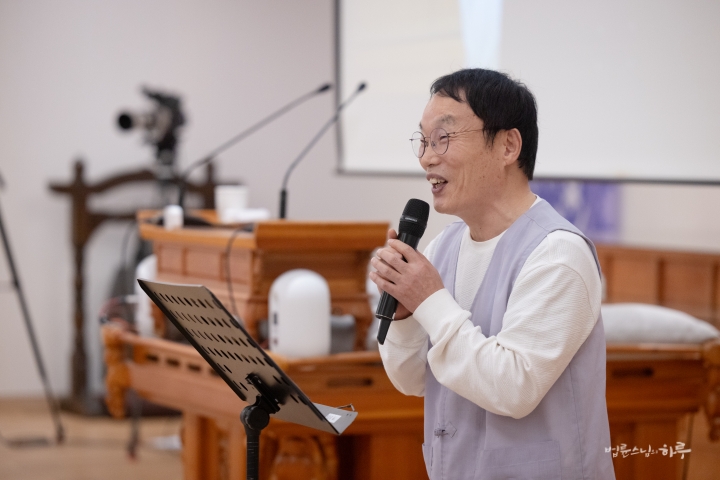
Through these three presentations, it became clear that the experience of becoming happy oneself is the greatest driving force for spreading the dharma. The assembly encouraged each other’s activities with loud applause.
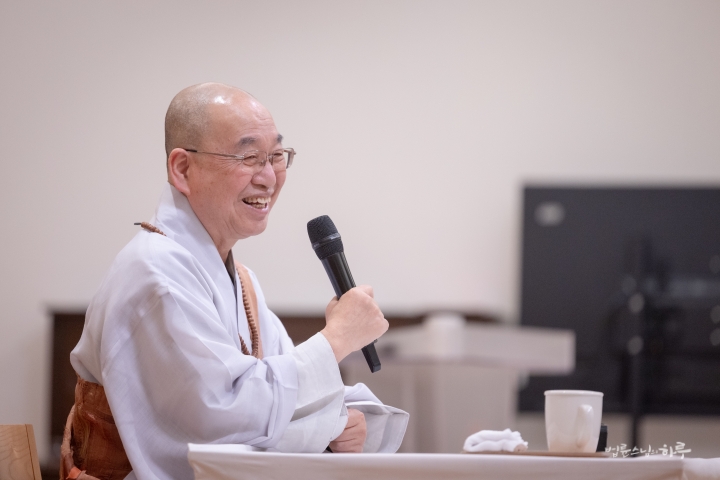
Next, Sunim gave concluding remarks about the practice and dharma spreading activities presented earlier.
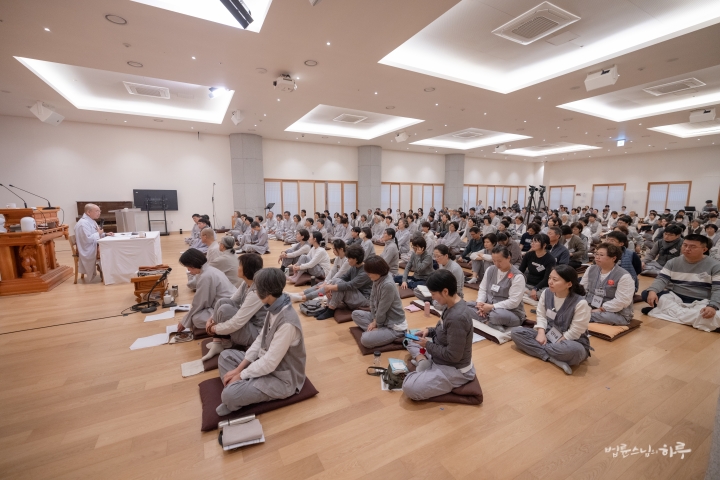
“This time is for reflecting on how much practice we’ve done over the past three years. However, practice cannot be evaluated by physical metrics. This is because practice is a matter of the mind.
Of course, many people say they’ve changed after listening to Dharma Q&A. When I sign books after lectures, many people say ‘Thank you. I was going to divorce but changed my mind,’ or ‘My life has changed after listening to your dharma talk.’ Many greet me warmly as if meeting an old acquaintance. When they say ‘I see you often,’ I joke back saying ‘I also see you often from inside the TV.’ While we can’t quantify it, it seems rare now to find someone who hasn’t watched Dharma Q&A at least once or twice.
The Path of Practice: Reflections and Challenges from Three Years at Jungto Society

Practice is self-transformation. Self-transformation comes from consistent practice. Through 100-day practice, you can know yourself; through 1000-day practice, you can experience self-transformation. In this regard, we need to further encourage the atmosphere of practice. When practicing together at the dharma center, even those who didn’t practice before are inspired to participate, but while online practice is convenient, it has the disadvantage of being difficult to maintain consistently. Many people stop midway. To compensate for these limitations, we need to find ways to continue practicing together offline, influencing and supporting each other.
Evaluating Jungto Society is difficult to explain simply through metrics like membership numbers. When outsiders ask ‘How many members does Jungto Society have?’ I sometimes find it difficult to answer. Looking at the activity level, many think there are about 100,000 members, and some think there are about 10,000 volunteers. So I just smile and say ‘It’s a secret.’ While this shows the enthusiasm of Jungto Society members, it also indicates that currently active members are overloaded. Moving forward, we need to increase the number of members and volunteers to distribute individual workloads and reduce burdens, which will enable Jungto Society’s sustainable development.

Recently, there has been an increase in executives requesting sick leave. This indicates that some volunteers are experiencing work overload. While Dharma Q&A sessions continue to be popular and needed by many people, they are becoming increasingly burdensome for me personally. As time passes, people’s demands grow, but my health is not what it used to be, making it difficult to maintain balance. Since I cannot stop doing them entirely, yet cannot handle everything, finding effective ways to respond and achieve harmony has become a major challenge for spreading the dharma.
Most NGO organizations depend on corporate sponsorship or government support. As a result, when administrations change, funding may be cut off, and they may be influenced by corporate interests. However, thanks to the steady support and heartfelt donations from our members, Jungto Society operates stably without being affected by political changes or current affairs. Even when the economy struggles, Jungto Society is not significantly impacted. In fact, when unemployment rises, we tend to have more volunteers. Since most donations are small amounts, we are less affected by external circumstances. I believe that Jungto Society’s ability to operate stably regardless of economic conditions is thanks to our members’ active practice, dharma spreading efforts, and generous donations.
Practice Without Anger, the Power of Compassionate Change
However, Jungto Society’s activities have not yet had sufficient impact compared to the needs of society as a whole. Some people say, ‘With Jungto Society’s leading members, couldn’t they at least provide phone counseling for people experiencing difficulties in society?’ Given the high suicide rate and the many people suffering from mental anguish, there are also suggestions that Jungto Society could operate counseling facilities for such individuals. While this is a task even the government finds difficult to handle, the proposal is that Jungto Society might be able to attempt it through a volunteer-based approach.
But the reality is not so simple. Jungto Society is currently struggling with a shortage of personnel even to operate the Jungto Dharma School. Nevertheless, as the number of Jungto Society members grows and activities expand, such social demands will naturally follow. When the government or local authorities want to pursue new projects, they always need a budget. During times of economic growth, there are surplus funds available to undertake new initiatives, but in the current situation where growth has entered a stagnant phase, even wealthy countries like the United States lack the capacity. Our country is already in a situation where it cannot operate national finances with tax revenue alone and the government is taking on debt. As a result, new projects are difficult to undertake, and budgets are only allocated to existing programs. To complement these areas, private organizations must take voluntary action.
Until now, Jungto Society has not stood out compared to the activities of organizations with substantial capital that can deploy money. However, a time will soon come when ‘a world where money cannot accomplish everything’ emerges. It will be a world where organizations with large capital cannot freely attempt new initiatives because their funds are already allocated for predetermined purposes. In such times, Jungto Society will shine even brighter. In fact, we are already hearing from various sectors of society that “this is possible because it’s Jungto Society,” and we are gradually moving in that direction.
The practice-integrated approach of Jungto Society members does not stop at pursuing individual happiness but can also play a significant role in realizing social justice. In this era where climate crisis and social conflicts are intensifying due to the side effects of economic growth and democratization, we must address these issues through Jungto Society’s approach. Rather than through struggle or resistance—the approach of ‘destroying the bad so the good can stand’—we must be like clear water continuously poured to dilute murky water, becoming the light that dispels darkness. By excelling ourselves, we become exemplars for people in the world, establishing what is right so that what is wrong naturally recedes. South Korea and the world urgently need Jungto Society’s approach at this very moment.
Fighting and achieving through self-centered demands ultimately creates more conflict. We must reflect on ourselves and awaken, while also taking bold action to realize social justice. Changing the world requires strength. However, we must be able to act without anger. While social movements have traditionally been based on anger-driven struggle, Jungto Society must change the world through practice based on compassion. This approach can become a new form of civic movement that anyone can participate in.
To achieve this, we must share this wonderful Dharma with more people, and those who have been transformed must gather together rather than scatter. Only when we come together can we generate power, and with that power, we can change the world. This is why Jungto Society’s second 10,000-Day Practice has adopted ‘practice, spreading the Dharma, and social action’ as its core directions.”
Taking Sunim’s words to heart, the participants continued their practice.
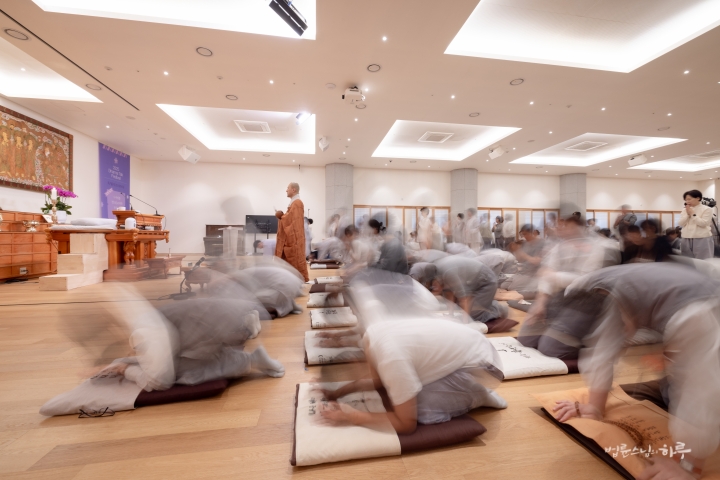
Starting at 4:40 PM, they practiced 400 prostrations for 90 minutes. This was the final practice session working toward the goal of 1,080 prostrations.
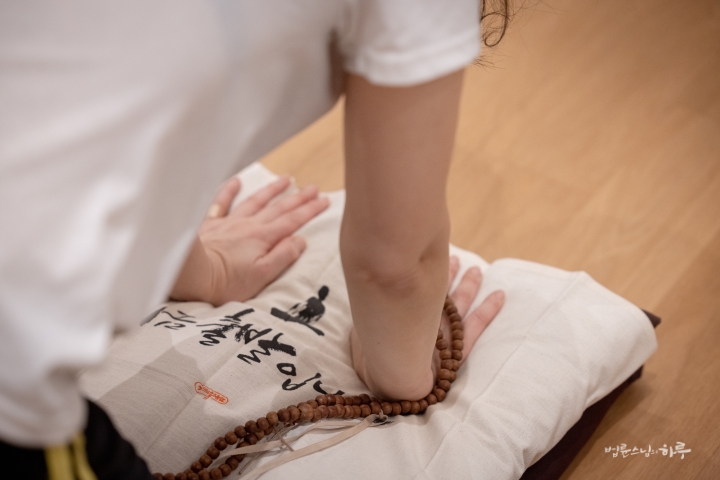
As the sun set and 6 PM arrived, they completed all 1,080 prostrations. After 10 minutes of meditation to calm their minds, they had dinner. Sunim, experiencing severe pain in his left shoulder and arm, asked for the assembly’s understanding and made an urgent visit to an orthopedic clinic.
After eating lunch boxes brought from home, everyone gathered again at 7:30 PM for evening chanting.
After the evening chanting, as the third segment, they watched a video summarizing the achievements and challenges of the past thousand days on the theme of ‘social action.’ Through the video, they could review the current activities of the practice and social action departments, as well as identify remaining challenges.
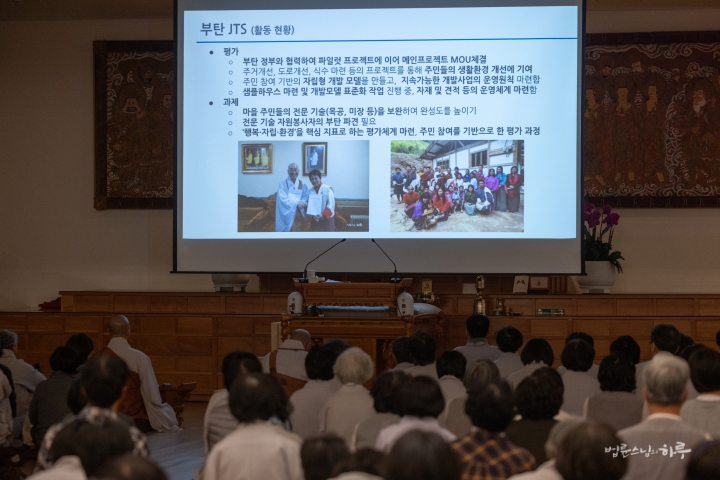
Next, they had time to hear testimonials from those who have been at the forefront of social action.
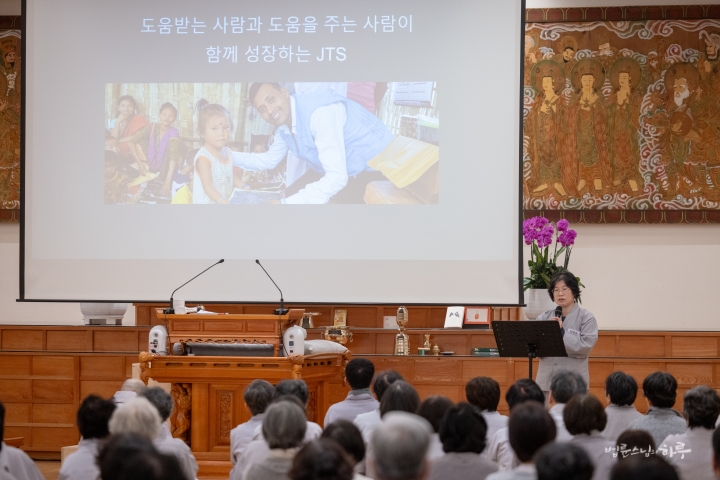
“Venerable Pomnyun Sunim’s words about hoping that people who have fallen into despair amid war and disaster can rise again, just as broken schools are rebuilt, encapsulate the entire meaning of JTS activities. Seeing the moments when despair turns to hope on the faces of those who receive support, we deeply felt that we who give help also grow together. Going beyond simple material support, moving forward together with those who receive and give help—this is the greatest value that JTS wants to convey to the world. That’s why I hold hope today that this change will continue…”
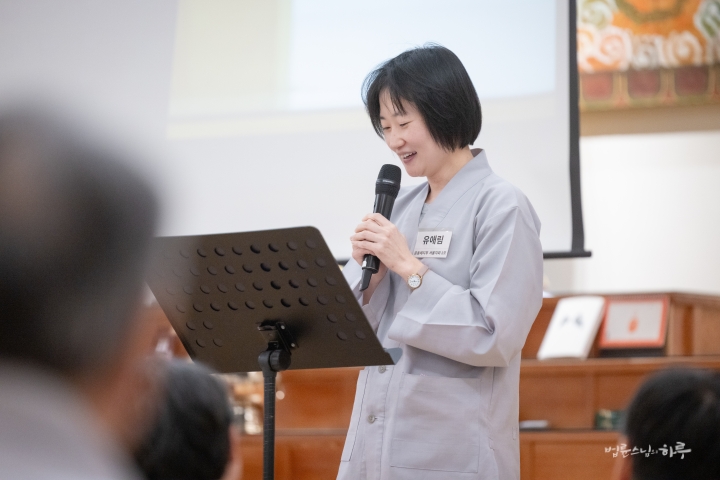
“When I transitioned from being just a participant to organizing symposiums and forums, a deep feeling of ‘Ah, this is truly an honor’ arose within me. Though the schedule is overwhelming with multiple events in a single day, I can feel that our steps toward peace continue without rest. Volunteering at the Peace Foundation has been a time of personal growth, helping me find what I can do for peace on the Korean Peninsula and world peace. A commitment naturally arose: ‘I will continue walking this path for peace’…”
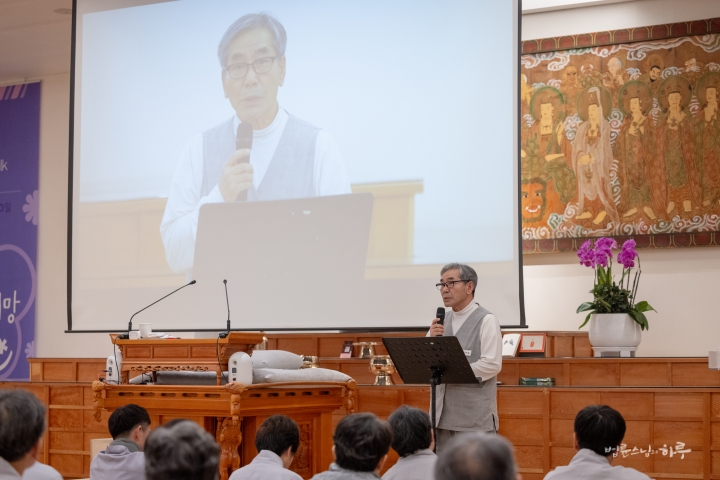
“We started with doubts about whether we, without professional skills, could properly manage the building. However, as we repeatedly inspected every corner from the 15th floor to the 5th basement floor together with fellow practitioners, everyone grew to become like experts. When various professionals see this and say ‘It’s impeccably well-managed,’ a deep sense of pride wells up from within. Whenever fellow practitioners of different colors come together to complete difficult tasks, I feel that the Dharma is not far away but right here among us. I love ‘Bodhi Tree,’ the building management team. I love that I am part of ‘Bodhi Tree’…”
Among the many social action activities, we could feel the sense of fulfillment and joy of the volunteers who worked hard to manage JTS, The Peace Foundation, and the Jungto Social and Cultural Center.
Leaving behind the moving testimonials, we invited Sunim back to share his closing remarks. Sunim emphasized that Jungto Society must create a new model of life in the era of climate crisis and create a culture unique to Jungto Society.
“You have completed your practice well. The testimonials from those who participated in practical activities were particularly moving for all of us. Among them, the presentation by the male lay practitioner managing the Jungto Social and Cultural Center delivered a profound resonance. Jungto Society has made possible what many would consider impossible. Among these, I believe managing the Jungto Social and Cultural Center is one of the most challenging tasks. I would like to take this opportunity to send heartfelt applause and express sincere gratitude to all the volunteers managing practice activity venues across the country, and especially to those who are responsibly operating the Jungto Social and Cultural Center.
Small but Leading Community: Jungto Society’s Experiments and Vision
Until now, most of Jungto Society’s social activities have been carried out primarily by members of the lay Sangha. This is because lay Sangha members can engage in full-time activities and can be dispatched overseas. However, as the scale of Jungto Society continues to expand, the lay Sangha personnel must also expand accordingly. Considering the scale of projects we undertook in the past, we now need at least 500 lay Sangha members for stable operations. However, the current lay Sangha size is only about 100 people, and recently, few new people are joining.
So I propose to you: If you take early retirement or reach mandatory retirement around your mid-50s, please consider joining Jungto Society and becoming active at that point. While volunteer personnel are needed domestically, it is also very important for those who can speak English or have social activity experience to engage in overseas activities. Currently, volunteers from the Lay Member Group are taking on various roles including accounting in the Philippines and India, and male lay practitioners are also going to Bhutan for two to three months of volunteer work. To expand Jungto Society’s overseas activities in the future, I believe overseas deployment of lay members is essential.
Another issue is disaster response. While the severity of disasters may not yet be felt acutely in Korea, the frequency and scale of disasters are rapidly increasing worldwide. Recently, in South Asian regions such as Indonesia, Vietnam, Thailand, and Sri Lanka, significant damage has occurred from simple heavy rains alone, not just from hurricanes or cyclones. To respond to such situations, JTS needs an independent organizational system for emergency disaster relief. Separate from fixed projects like school construction in the Philippines, a central-level emergency disaster response team is needed, and the Lay Member Groups rooted in overseas Korean communities around the world should take the lead in local disaster relief activities.
Along with this, offline spaces in major regional cities need to be expanded. If spaces are created that go beyond simple practice venues to serve multiple functions such as multicultural centers, social action spaces, and happiness centers, the role of engaged volunteers will become even more important accordingly.
Another area that hasn’t yet been properly established is the integration of farming and practice, namely Seon Farming Practice. Practice is essentially a consumptive activity, but during the COVID-19 pandemic, I went to the countryside to attempt to connect it with production and present a new model of practice. However, it was discontinued without properly taking root. This area could become a very important alternative in the era of climate crisis. The current Jungto Society model is at a level that European countries, rather than Southeast Asian ones, could learn from. Therefore, further developing a new model that combines practice and farming based on rural areas like Dubuk Retreat Center will help with global expansion. Currently, people come for a few hours a day to volunteer in a “time-filling” manner, but I hope those interested in farming will participate by taking on responsible roles after receiving training at Dubuk Retreat Center for a certain period. In the reality of lacking young community members, now is the time for middle-aged and older members to take the lead.
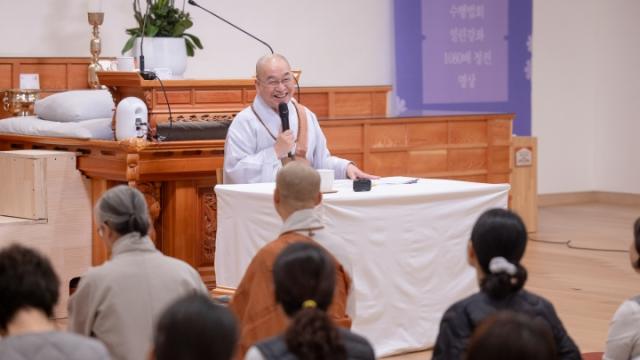
Experimenting with and pioneering how our way of life should change in the era of climate crisis is an important mission of Jungto Society. Moving forward, we need to strengthen responsible and regular volunteering, not just ‘a few hours of volunteering per week.’ There’s a teaching from Master Yongseong that says, ‘Have at least one of your sons or grandsons become a monk.’ But in today’s world where people have neither sons nor grandsons, the most certain way is to become a monastic yourself. (Laughter)
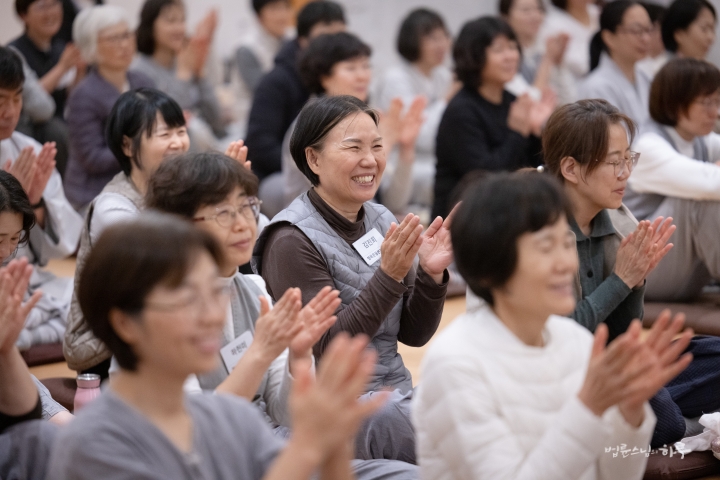
In this way, we must continuously research and experiment with new societies, new support systems, and new cultures. In the past, we could simply follow the models of developed countries, but now even developed nations have lost their way amid the climate crisis and aging populations. Now we must pioneer new paths ourselves. I believe that Jungto Society and South Korea should work together to take on the role of experimenting first and presenting models that the world can benchmark. Although Jungto Society is small in scale, it has always been a pioneering organization. Beyond simply healing people’s hearts, we must play a role in presenting new possibilities and models across various sectors of society.
In that sense, we must also create our own culture. While other areas have established some foundation, the cultural domain is one that hasn’t properly taken root in Jungto Society yet. This is partly due to my own lack of talent in culture. Moving forward, I hope we can create a new culture that is uniquely Jungto, rather than borrowing from others’ cultures.
You have all worked very hard over the past three years. Starting tomorrow, we will have time to discuss and share our thoughts on how to shape the next three years through dialogue.”
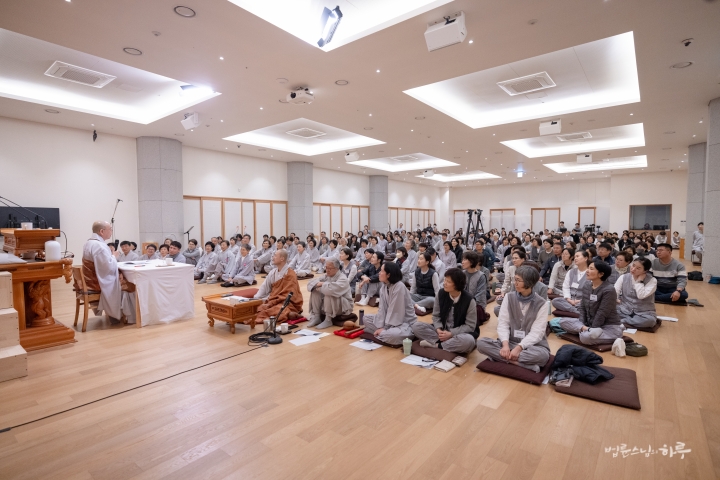
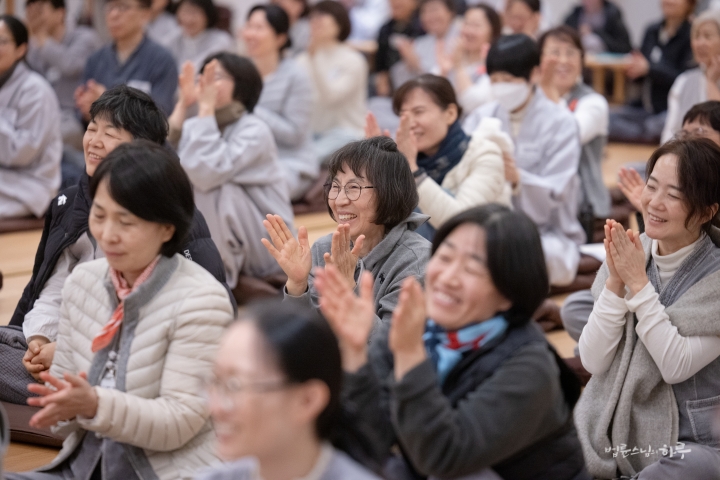
The first day of the Closing Ceremony Retreat concluded with loud applause.
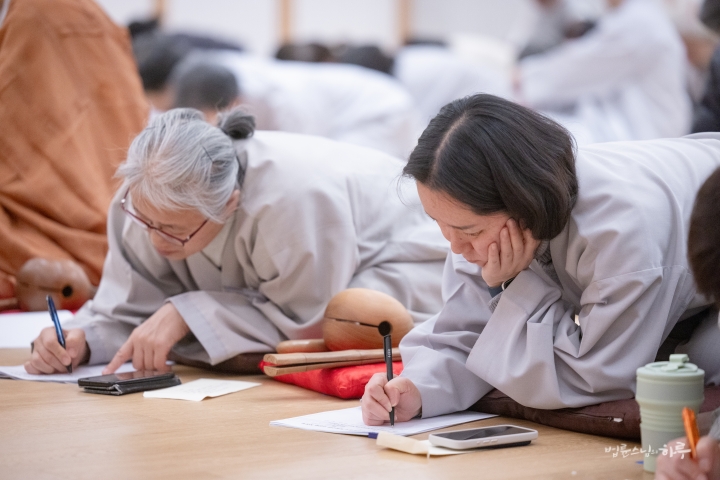
After completing all 1,080 prostrations, the members of the Sangha wrote down their reflections from today’s Closing Ceremony Retreat before going to bed. Even without gathering in person, over 1,200 members of the Sangha were able to connect online and reflect together on the past 10,000 days.
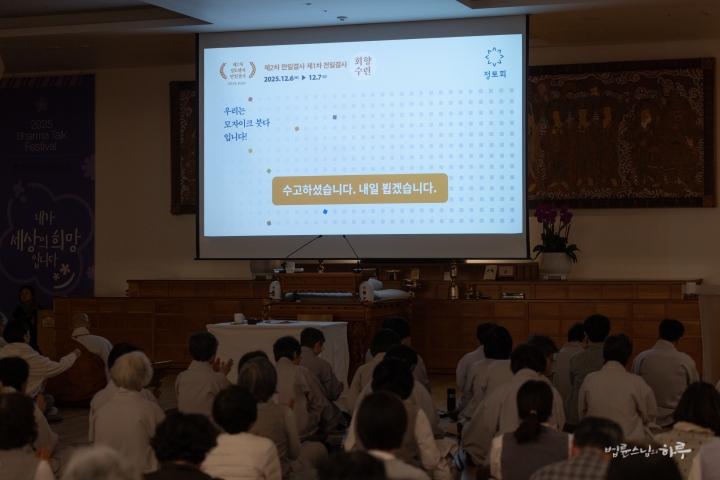
Tomorrow marks the second day of the Closing Ceremony Retreat. The day will begin with the 1000-Day Practice prayer, followed by group discussions and Dharma Q&A in the morning. In the afternoon, the closing ceremony will be held to conclude the Closing Ceremony Retreat.