He Set Aside His Own Story and Spent His Life Sharing His Teacher’s Teachings
December 4, 2025- Opening Ceremony of the Baek Yongseong Memorial Hall, Peace Leadership Academy Alumni Meeting
Hello. Today is the opening ceremony of the Baek Yongseong Memorial Hall at Jukrim Jeongsa Temple in Jangsu.
After completing his morning practice and meditation, Sunim departed from Seoul Jungto Center at 5:30 AM and headed to Jangsu, Jeollabuk-do.
As they traveled by car, the morning sun rose outside the window. After driving for 3 hours and 30 minutes, they arrived at Jukrim Jeongsa Temple at 9 AM.
First, Sunim took a tour of the Baek Yongseong Memorial Hall that was opening today.
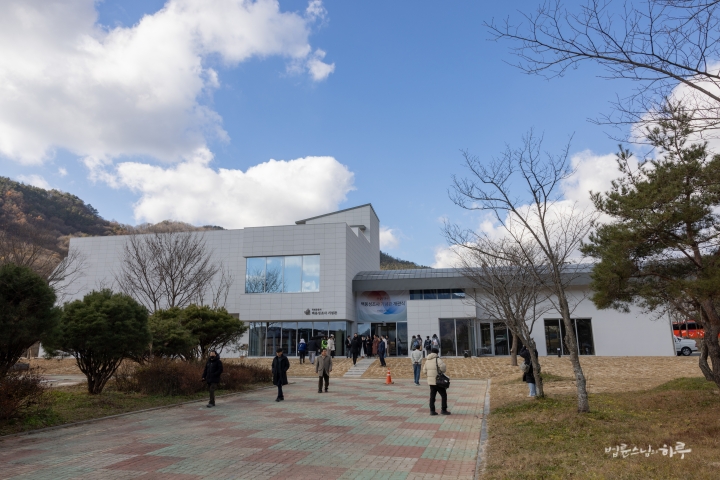
The first floor was designed with a café where visitors can enjoy comfortable relaxation and a multipurpose hall for various events, allowing visitors to stay and rest at leisure. The second floor was prepared as an exhibition space where visitors can encounter the precious materials collected throughout Venerable Bulsim Domun’s lifetime and the great achievements of Master Yongseong through various audiovisual materials.
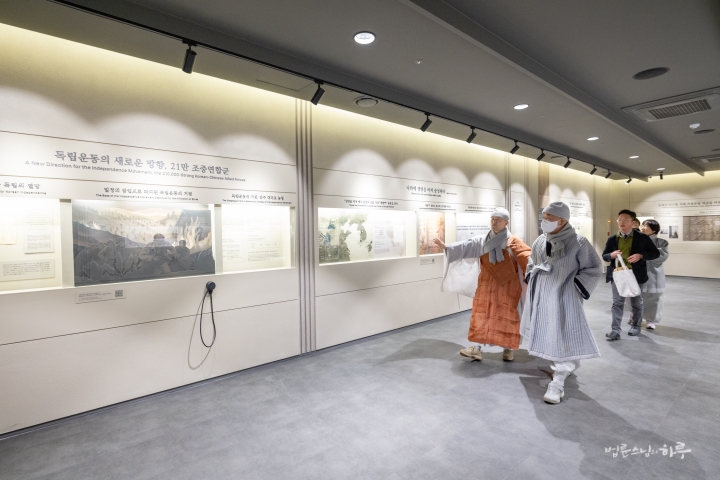
After checking the exhibits and movement routes to determine how best to guide the guests during the opening ceremony, Sunim headed to the living quarters.
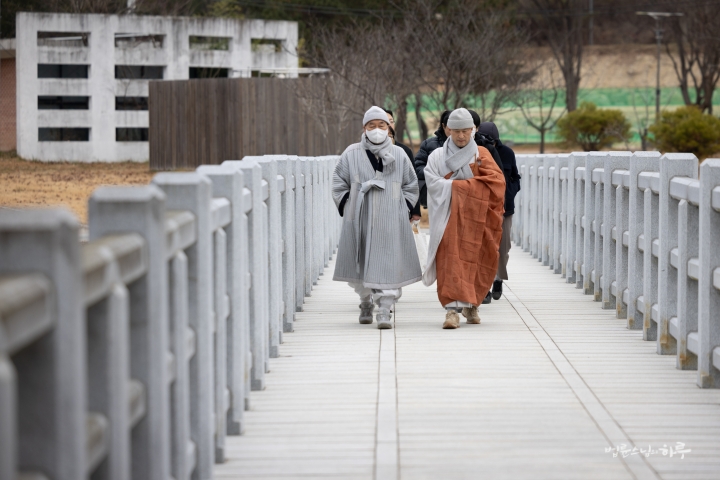
Sunim paid his respects to Venerable Bulsim Domun who was in the living quarters.
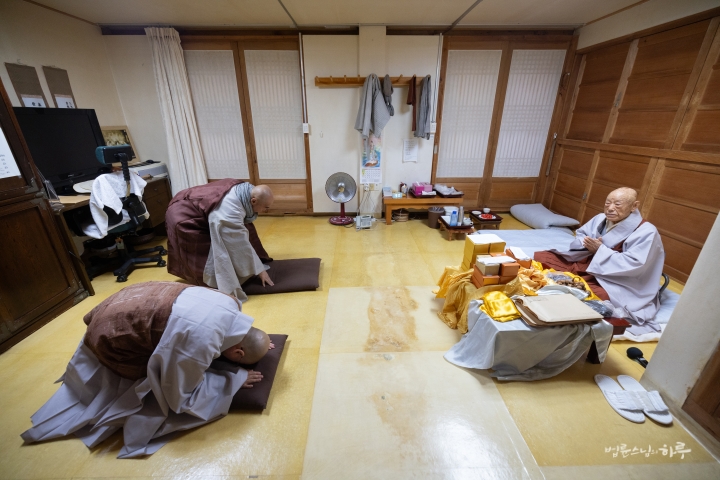
After offering three prostrations, the Venerable Master presented relics of Master Yongseong that he had kept all his life. As he unwrapped the tightly bound cloth, the Venerable Master personally explained the relics.
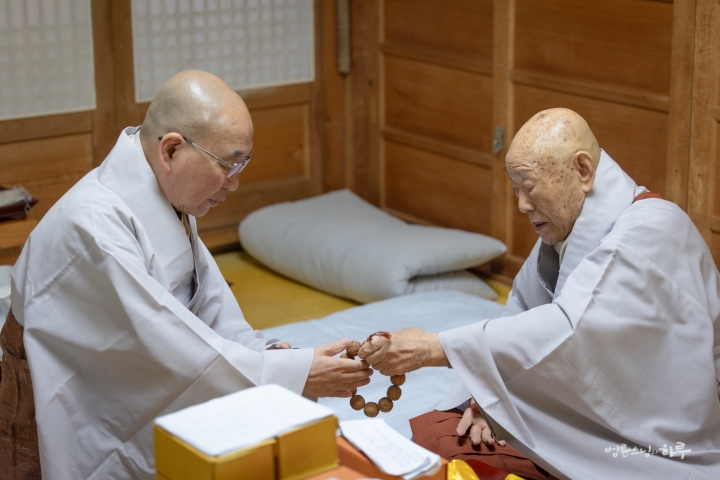
“These are the prayer beads and rosary that Master Yongseong used during his lifetime. These are the prayer beads and rosary that Master Dongheon used. These are the prayer beads and rosary that Dharma Teacher Domun used. This is a bottle containing Buddha’s relics. I had been keeping some of the relics that came out when Myanmar’s Shwedagon Pagoda collapsed in an earthquake. Since these are Buddha’s relics, please keep them well.”
“Thank you. I will keep them well.”Sunim then reported about the newly built Baek Yongseong Memorial Hall.
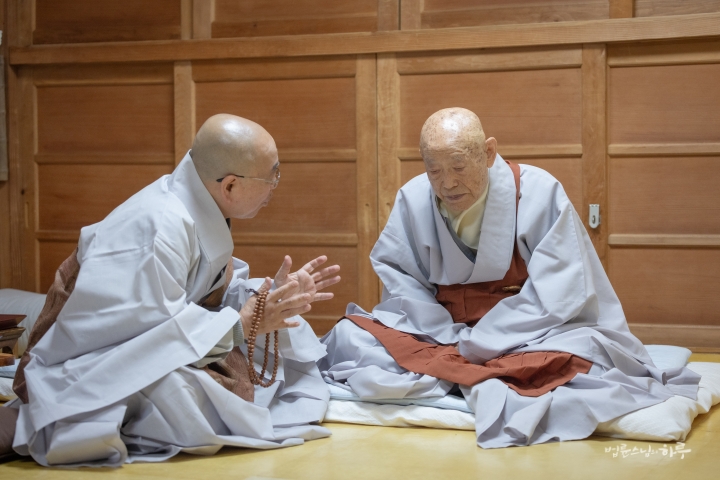
The Venerable Master repeatedly expressed his apologetic feelings.
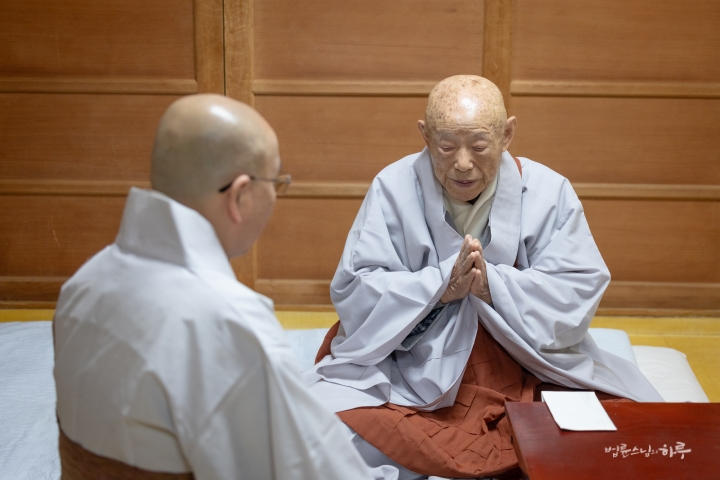
“I understand. Because I’ve lived so long, I’ve become too indebted to Venerable Pomnyun. I feel sorry that I’m leaving after starting all this work without being able to support it to the end.”
“Please don’t say such things anymore. Because you started the work, we can carry it on. Thanks to you planting the seeds, we just need to tend to them now. Cheollyongsa Temple has also received restoration permission, so you must come and give a Dharma talk at the dedication ceremony. That’s why you need to stay healthy and live long. What meaning would there be if we built a temple without you here? You must stay at least one day at the place where Master Yongseong’s wishes have been realized.”“Yes, I understand.”
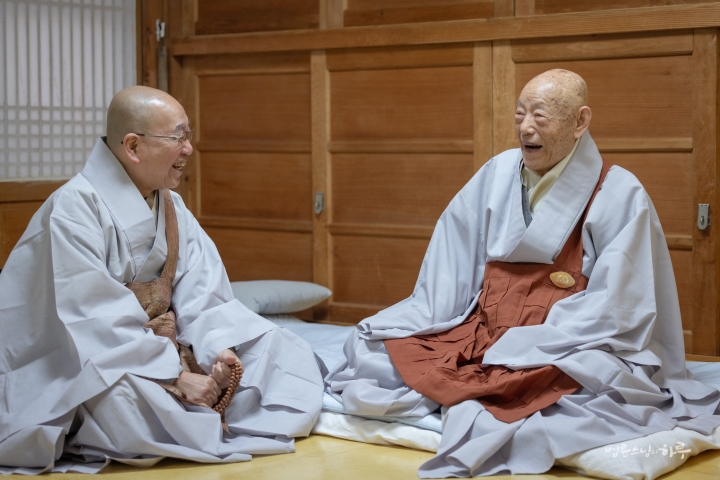
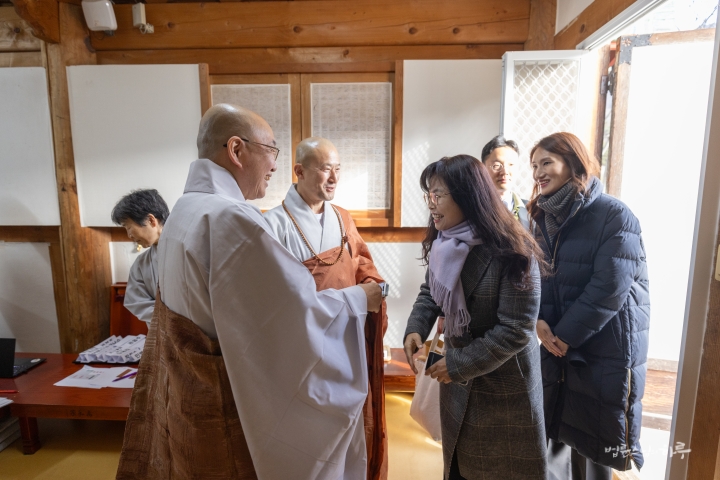
After letting the Venerable Master rest, Sunim welcomed the guests who had come to Jukrim Jeongsa Temple.
Venerable Jangsan, Chairman of Daegakhoe, also came and they exchanged warm greetings.
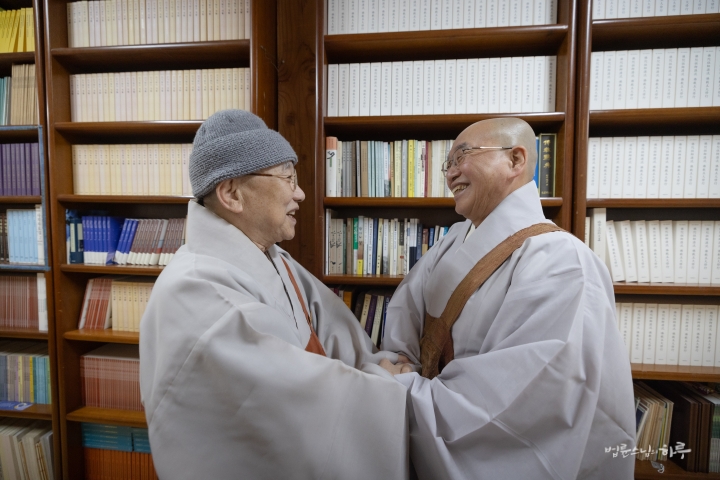
“Many monks from Daegakhoe wanted to attend, but they couldn’t come because today is the beginning of the winter retreat. You should have chosen a better date.” (laughter)
“I’m sorry. We chose the wrong date. National Assembly members also contacted us saying they couldn’t attend much because yesterday was the first anniversary of the December 3 emergency martial law incident, and they had many overlapping schedules. Instead, when I went to the National Assembly yesterday to give a lecture, about 20 assembly members came to apologize for not being able to attend today’s event. Anyway, I’m truly grateful that you came representing Daegakhoe, which is leading the promotion of Master Yongseong’s Daegak ideology.”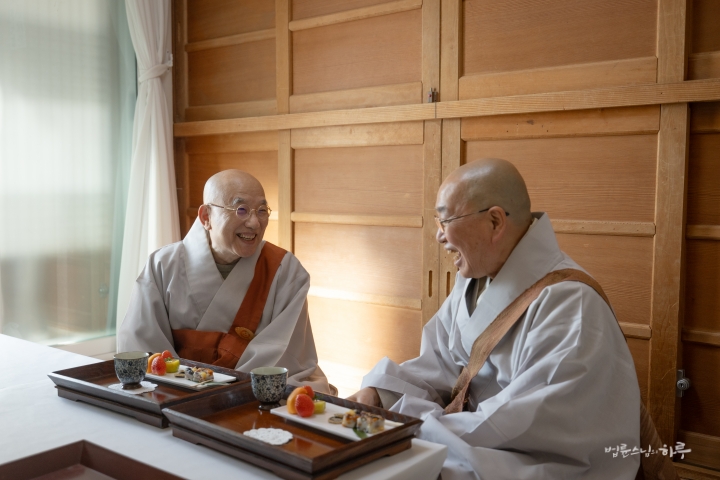
Shortly after, many local dignitaries and guests arrived, including Vice Minister Kang Yoon-jin of the Ministry of Patriots and Veterans Affairs who provided much support for building the memorial hall, Jeollabuk-do Governor Kim Kwan-young, Jangsu County Mayor Choi Hoon-soo, as well as Assembly members Min Byeong-deok and Park Hee-seung. Sunim guided all the attending guests to pay their respects to Venerable Bulsim Domun.
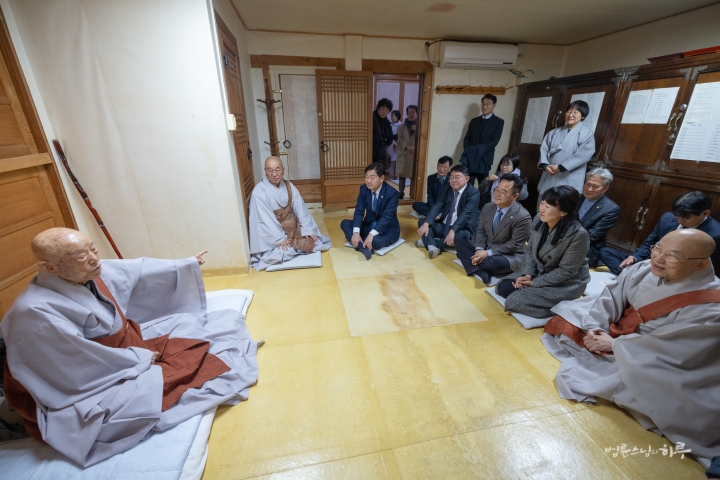
When the guests offered three prostrations, the Venerable Master welcomed them by chanting the Three Refuges in Pali.
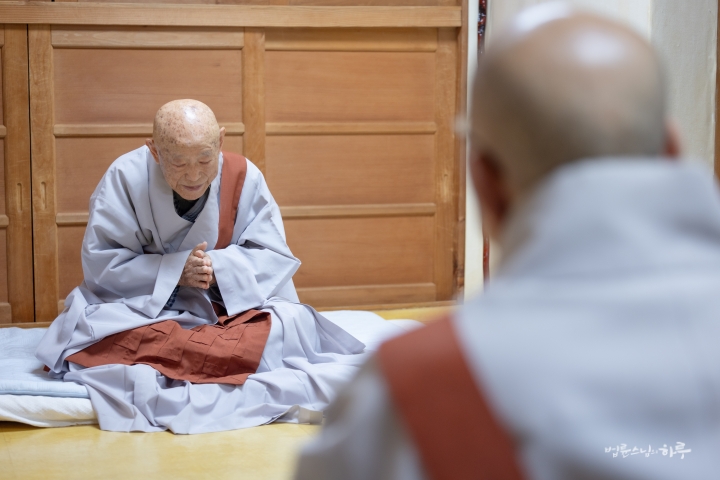
“Namo tassa bhagavato arahato sammāsambuddhassa. Thank you for coming despite your busy schedules.”
The Venerable Master explained in detail to the guests about the achievements left by Master Yongseong and the history of how his family donated all their wealth to support Master Yongseong’s independence movement.
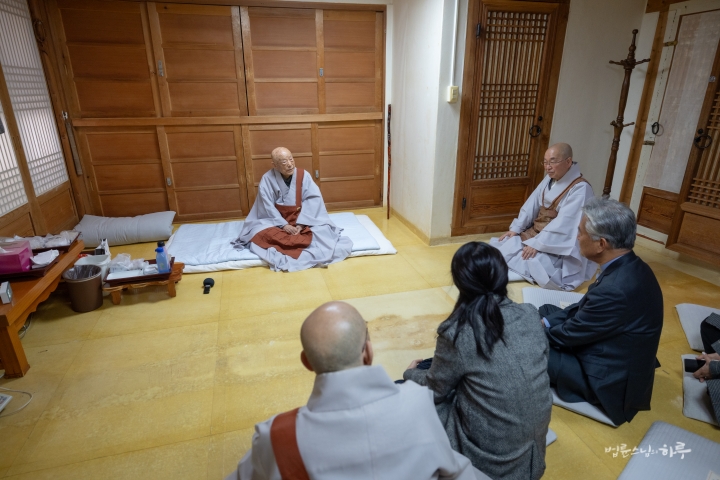
Unfortunately, the achievements and records of Master Yongseong were mostly lost due to severe Japanese oppression, with no materials remaining. Only the oral records of the independence movement and fundraising by the Lim clan – from Venerable Domun’s great-grandfather Lim Dong-su, grandfather Lim Jeong-jun, to father Lim Cheol-ho – and the oral records of the independence movement passed down from Master Yongseong to Master Dongheon to Master Domun remain in detail. Saddened by this, Master Domun spent his life upholding Master Baek Yongseong’s wishes and began collecting fragmented records while following Master Baek Yongseong’s footsteps. After hearing the explanation, Venerable Jangsan said with a smile.
“Venerable Master, you have good disciples who built a memorial hall and achieved what you intended.”
The Venerable Master also replied with a smile.
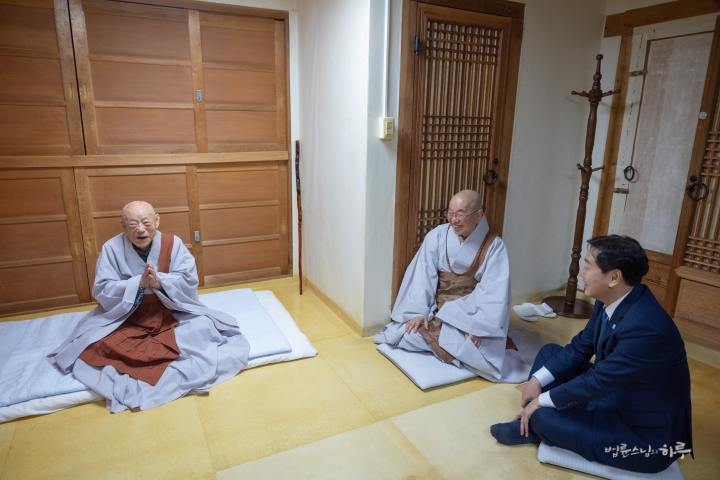
“My disciple suffers a lot because of me. When my teacher was the head monk at Bunhwangsa Temple, he saw Venerable Pomnyun, who was a high school student at the time, and instructed, ‘If Choe Je-u, the Great Divine Teacher Suun, was someone with vision looking ahead 100 years, that student has vision looking ahead 1,000 years, so hold onto him tightly and make him a monk.’ So while other monks voluntarily came to temples to become monks, Venerable Pomnyun was forced to leave home.”
The governor also expressed his gratitude, saying he was able to participate in meaningful work through the construction of the memorial hall.
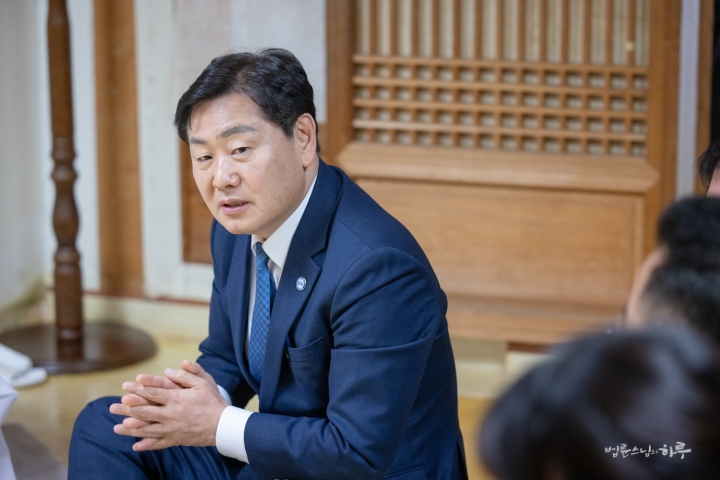
“Thanks to that, we’ve been able to carry on Master Yongseong’s wishes well, haven’t we? It was a great honor for us to participate in such meaningful work. Without the Venerable Master, we wouldn’t have known that Master Yongseong did such great work for the Republic of Korea. I’m grateful that we can at least build a memorial hall to inform the people about this.”
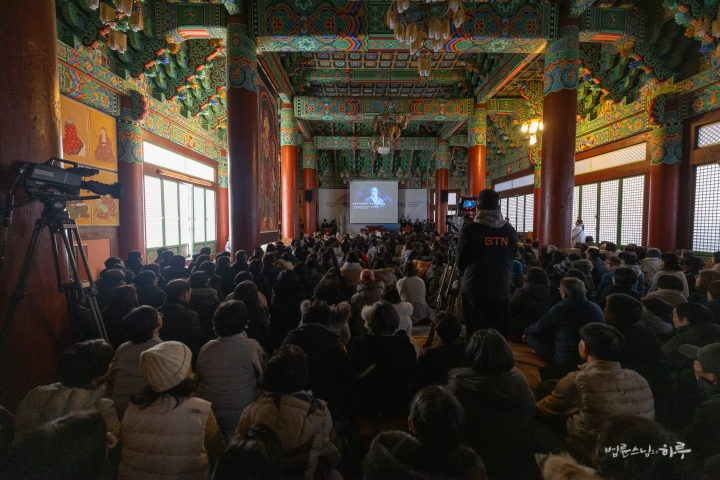
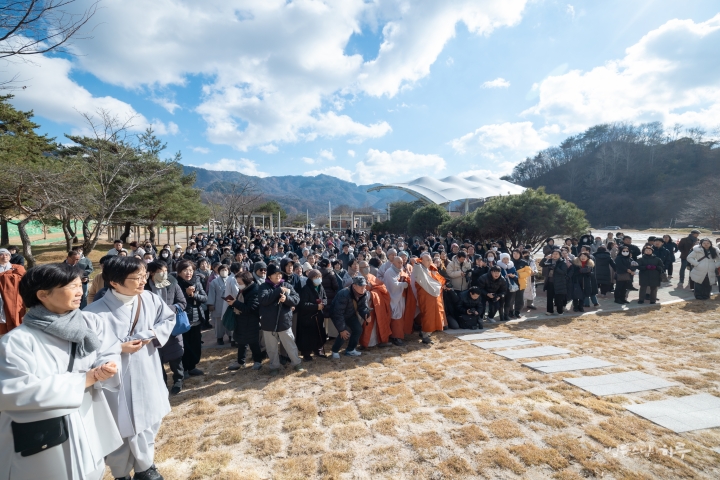
As they shared tea and conversation, it was time to begin the opening ceremony. Everyone headed together to the Yongseong Education Hall where the event was being held. Since the temperature had dropped to minus 10 degrees Celsius, the event was held indoors instead of outdoors.
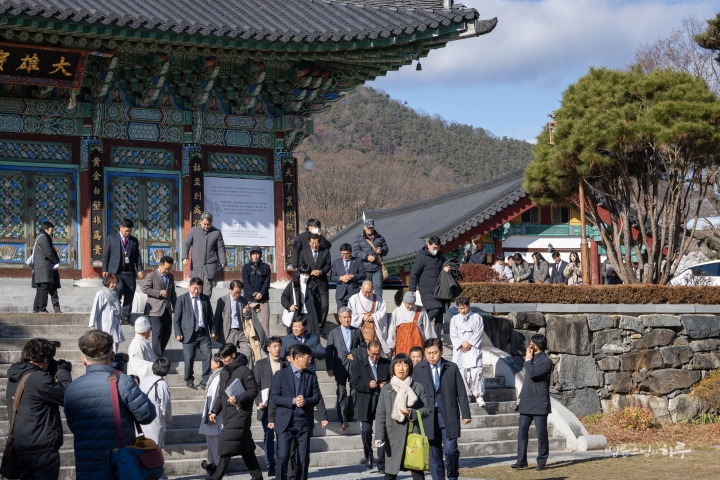
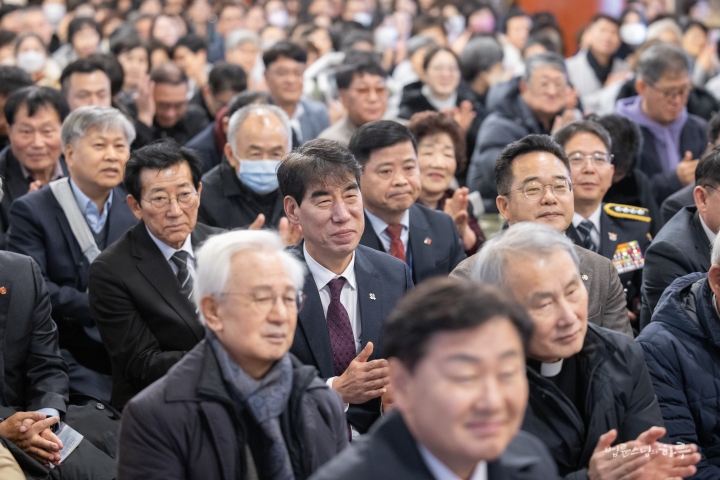
With about 400 people including guests seated, the opening ceremony of the Baek Yongseong Memorial Hall began at exactly 11 AM.
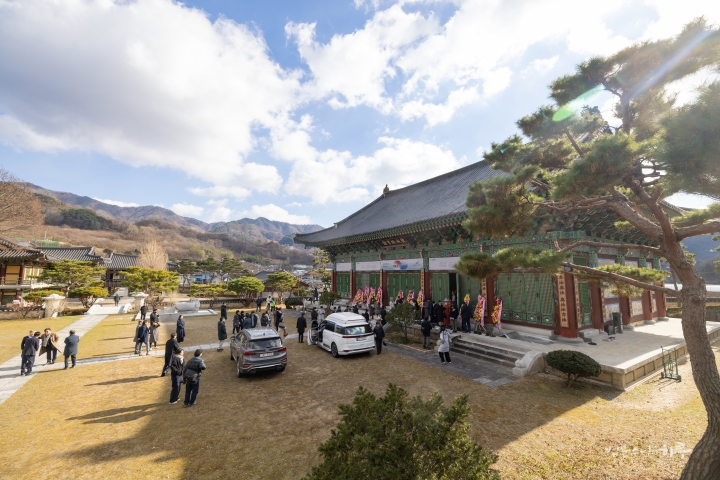
After reciting the Three Refuges and the Heart Sutra, they proceeded with the national ceremony, singing the national anthem, and a moment of silence for the fallen heroes.
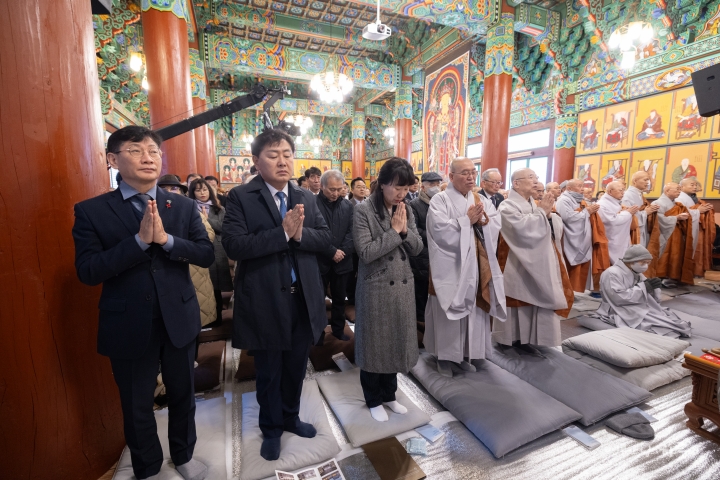
Next, they watched a video about the life of Master Yongseong, who opened a new path for Korean Buddhism and devoted his entire life to national independence.
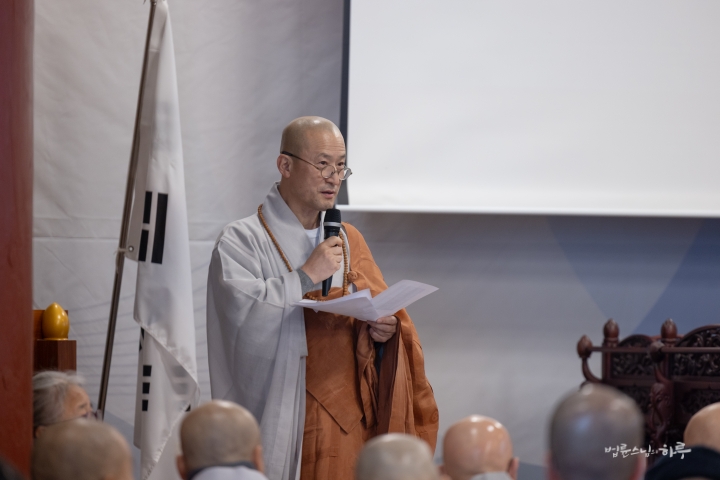
Next, Venerable Yusu, the head monk of Jukrim Jeongsa Temple, introduced the attending guests. About 100 guests were present to celebrate the birth of this new space, including Buddhist monks, religious elders, social elders, heads of various organizations, officials from Jeollabuk-do and Jangsu County, officials from the Ministry of Patriots and Veterans Affairs, and construction officials who worked hard on building the memorial hall.
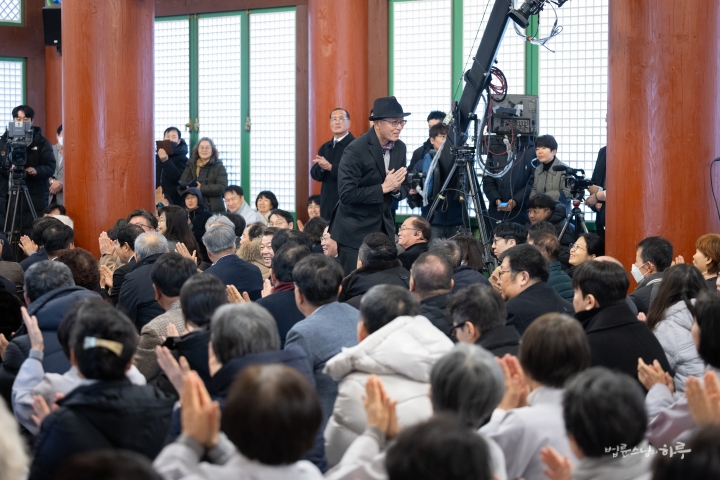
After welcoming the guests with loud applause, they watched a video report on the progress of the Baek Yongseong Memorial Hall construction project. The plan was submitted in 2018 and approved in 2020, with a total project cost of 7 billion won for a two-story building with a site area of 4,577㎡ and a total floor area of 994.78㎡, which opened today.
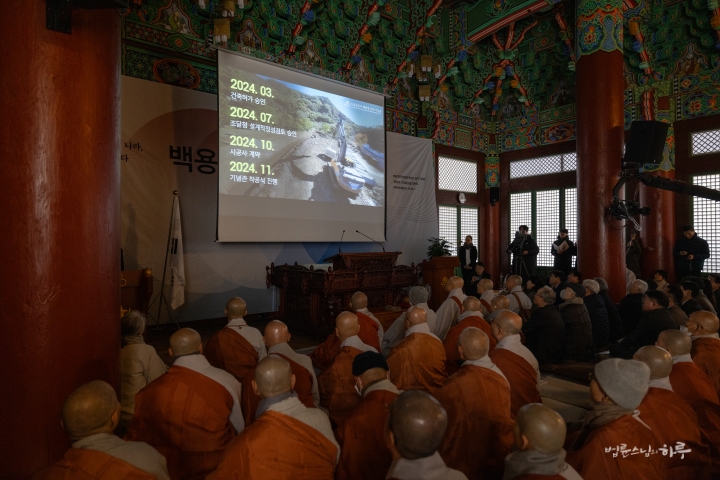
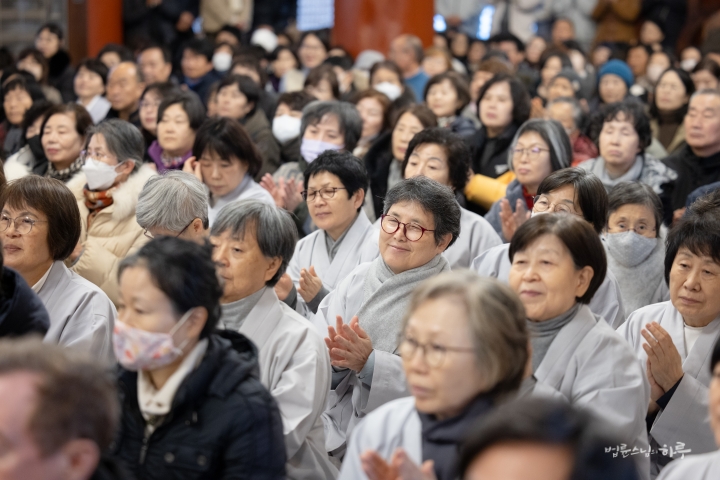
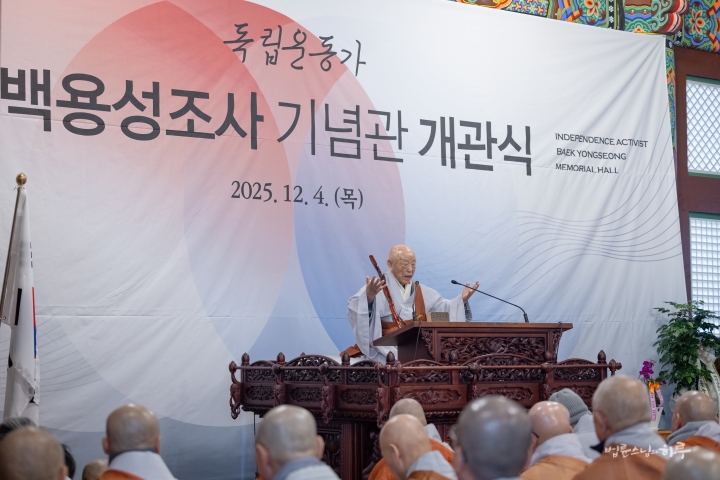
When the video ended, Venerable Pomnyun Sunim, Chairman of the Independence Fighter Baek Yongseong Memorial Foundation, gave welcoming remarks to the attending guests and audience.
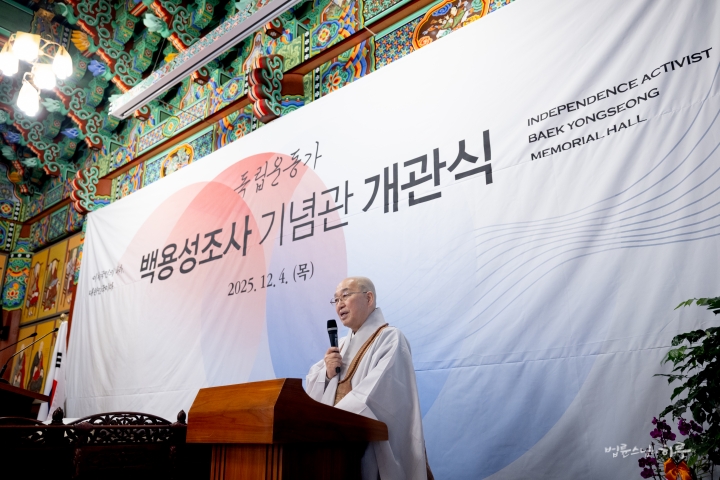
The Fruition of Venerable Bulsim Domun’s Vow, the First Step to Opening the Future
As you can see, this is Jukrim-ri, Beonam-myeon, Jangsu-gun, Jeollabuk-do Special Self-Governing Province, where Master Yongseong was born. Venerable Bulsim Domun found the Master’s birthplace where even traces had disappeared, founded Jukrim Jeongsa Temple,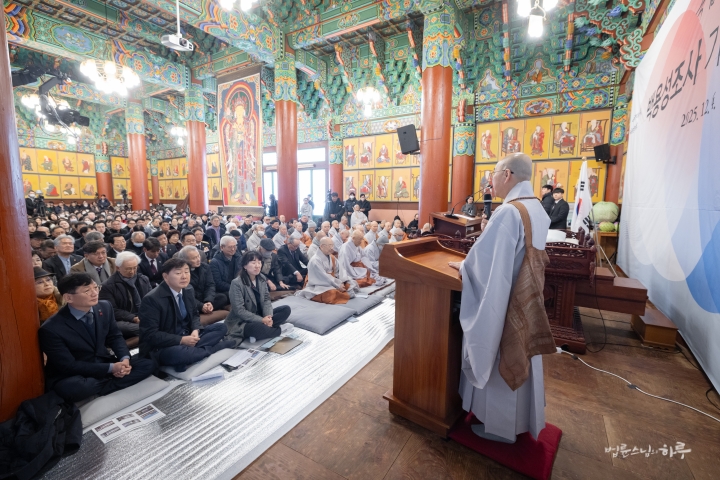
May Today Be a Day of Nurturing and Spreading Yongseong’s Seeds!
As I toured the memorial hall, I felt somewhat empty. This is probably due to generational differences. Since the younger generation prefers digital-centered exhibitions, the facility has been designed so that everything can be viewed through video. As a result, for our generation, there’s a sense of emptiness as if the space is somewhat vacant due to the lack of visible physical objects. When I mentioned this, I was told it was due to generational differences. (Laughter)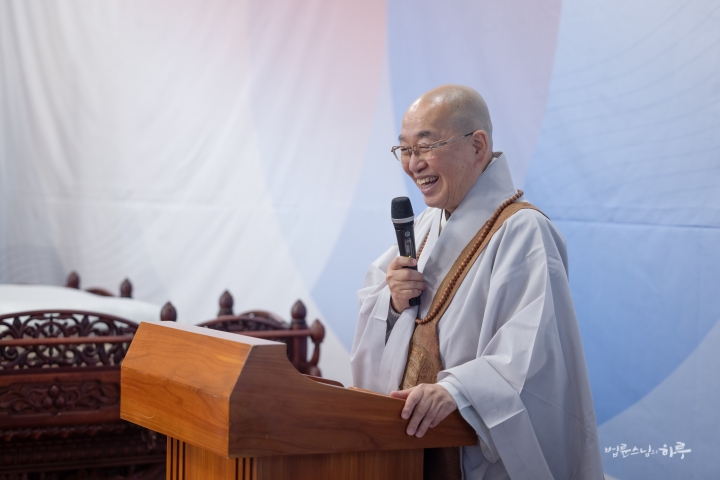
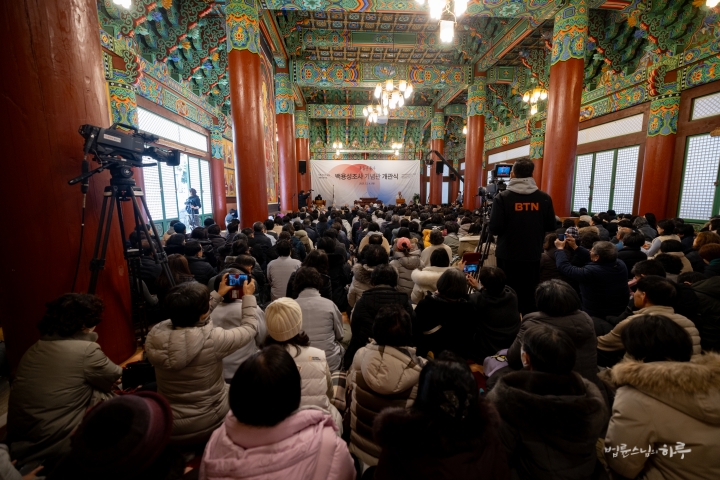
This Person Set Aside His Own Story and Dedicated His Life to Transmitting His Teacher’s Legacy
I ask for another round of applause to express our deep gratitude to Venerable Bulsim Domun, who has upheld Master Yongseong’s will throughout his ninety years of life and transmitted it to us, enabling us to undertake this Buddhist project. (Everyone applauds)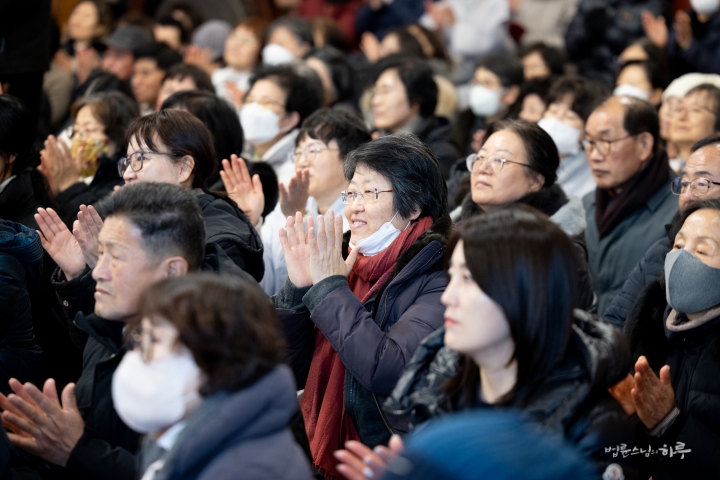
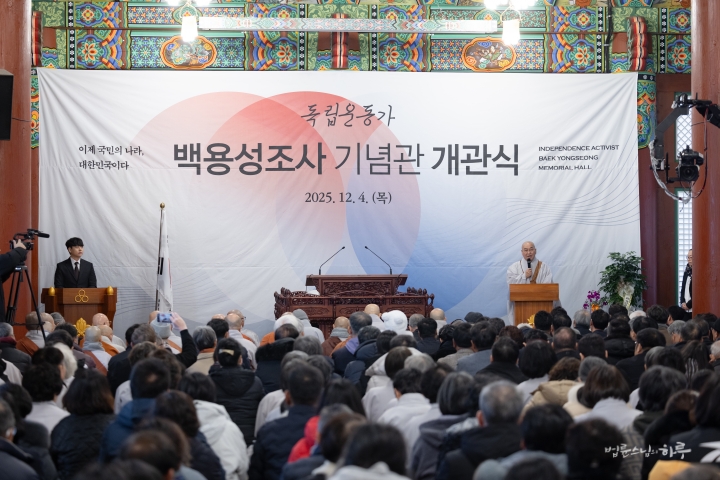
Next, County Governor Choi Hoon-sik, the administrative head of Jangsu where Venerable Yongseong was born, gave a welcoming speech.
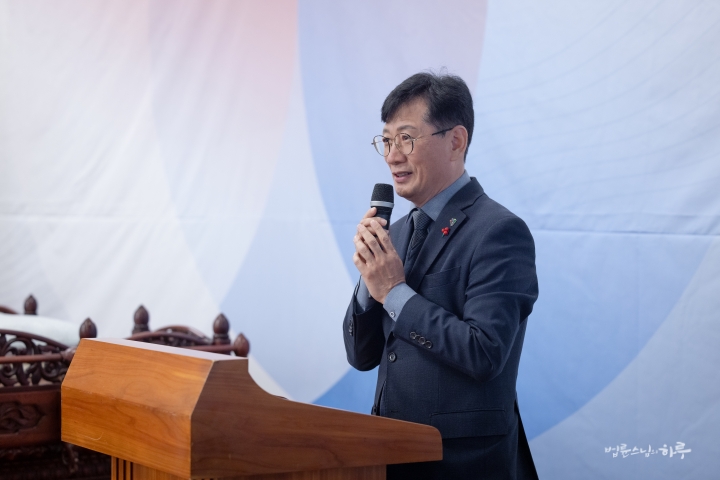
“To be honest, I didn’t know much about Venerable Yongseong. However, after hearing about Venerable Yongseong from Venerable Pomnyun Sunim five or six times, I realized that he was truly a great figure in our national history. I am especially proud that he was born in Jeolla Province, specifically here in Jangsu County. I now believe this is not just a matter for the Buddhist community, but something all Jangsu residents should participate in together. Jangsu County will actively cooperate with its residents to go beyond the memorial hall to build a training center and education hall, so that more people can visit this place and learn about Venerable Yongseong’s vision.”
Congratulatory speeches from the attending dignitaries followed. First, Venerable Jangsan, Chairman of Daegakhoe, gave a congratulatory speech.
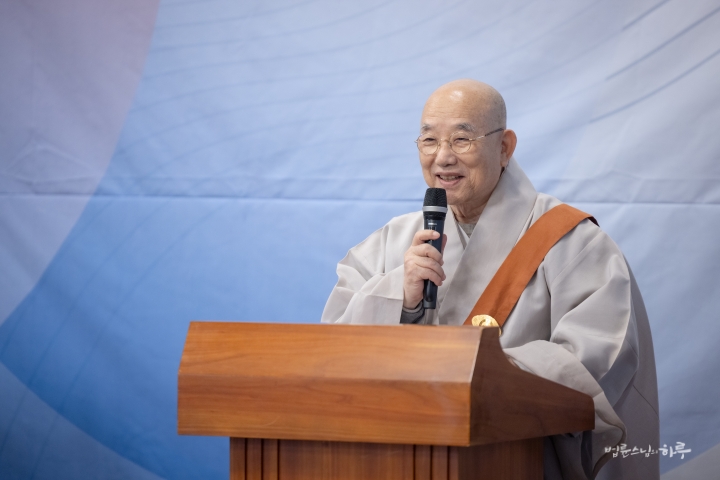
“I am grateful to everyone who has created today’s new history by establishing the Baek Yongseong Memorial Hall in this Mulbit Park, following the Great Master’s will. The Buddha’s teachings are not just for the faith and enlightenment of specific people. Just as King Sejong created Hangeul so that all people could easily learn and use it, Venerable Yongseong’s teachings and achievements should also be open to everyone. That is why the Baek Yongseong Memorial Hall is an essential space for all of us. This place will leave great teachings and resonance not only for local residents but also for future generations of Korea.”
Next, the Vice Minister of Patriots and Veterans Affairs gave a congratulatory speech. The Ministry of Patriots and Veterans Affairs provided significant financial support for the construction of this memorial hall.
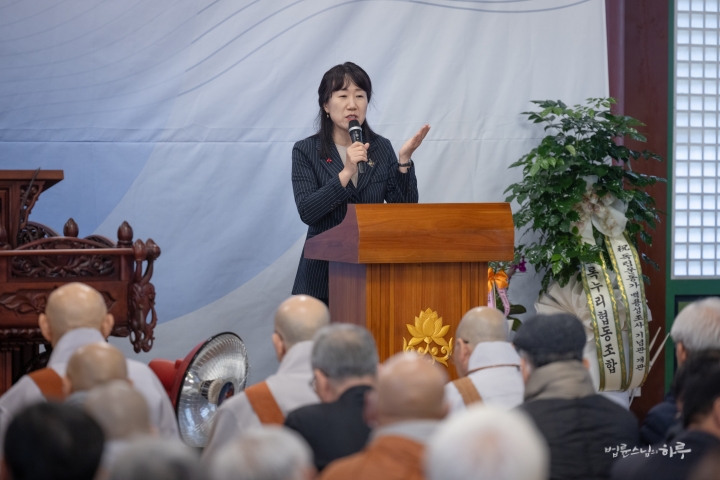
“This year marks the meaningful 80th anniversary of liberation. I think it is truly significant that the memorial hall for independence activist Venerable Baek Yongseong is opening in such a year. During the Japanese colonial period, not only Buddhism but also Christianity and Cheondogyo took the lead, and all religions including Won Buddhism and Catholicism united with one heart and one purpose for the country’s independence. To carry on that spirit today, I ask the elders present here and various religious communities including Buddhism to uphold the national spirit and inherit the spirit of the independence movement. The Ministry of Patriots and Veterans Affairs will also take the lead in inheriting that spirit and strengthening the Republic of Korea.”
Governor Kim Kwan-young of Jeollabuk-do Province, who is leading the development of this region where Jukrimjeongsa is located, then gave a congratulatory speech.
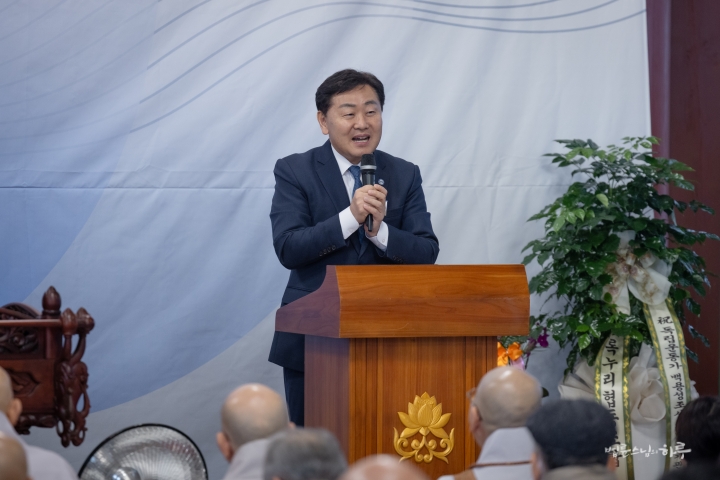
“Venerable Yongseong was someone who changed history. I believe it is our responsibility to inherit his spirit well and pass it on to our descendants. Venerable Yongseong is the pride of Jukrim-ri, the pride of Jangsu County, and the pride of Jeollabuk-do Province. I will work to create conditions and provide support by joining hands with more people so that Venerable Yongseong can become the pride of the Republic of Korea.”
Congratulatory speeches from various dignitaries continued.
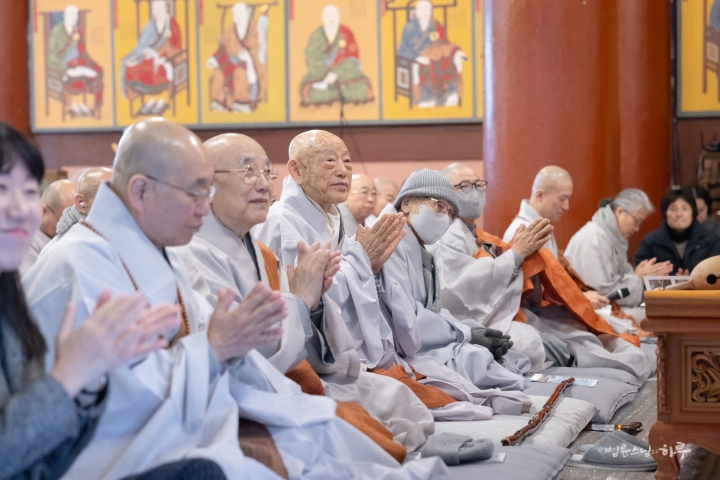
Former Cheondogyo Leader Park Nam-soo emphasized that Venerable Baek Yongseong’s participation in the March 1st Movement was a decisive event that established the legitimacy of the national movement, and highly praised the role of Great Master Bulsim Domun in revealing this history.
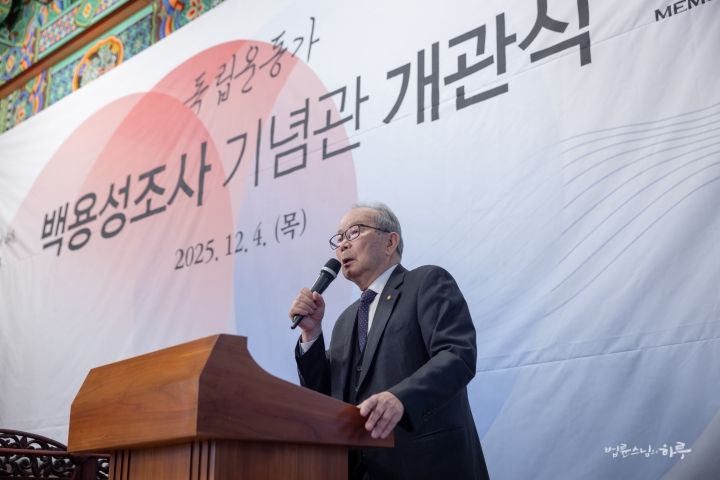
Former Anglican Bishop Park Kyung-jo shared that he learned about Venerable Yongseong through Venerable Pomnyun Sunim and Great Master Domun, and expressed that the spirit of Venerable Yongseong, who dreamed of a world where the people become the masters of the nation, remains an important guide today.
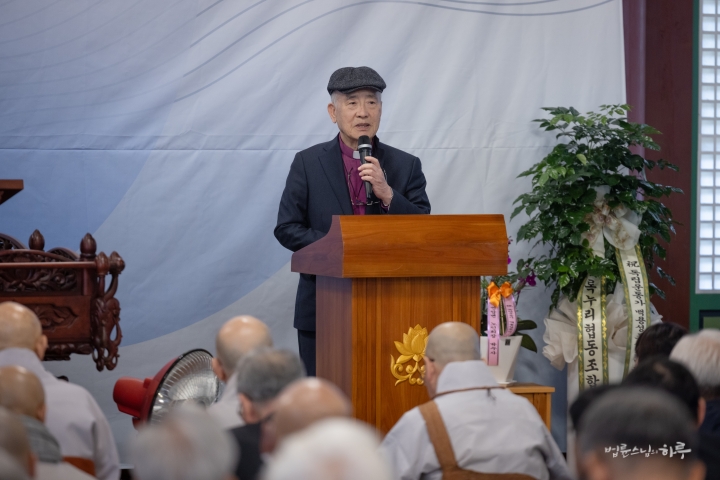
Writer Kim Hong-shin reflected that when considering the “what ifs” in history, it becomes clear that Venerable Baek Yongseong’s existence was the core that sustained the spirit of the Republic of Korea, and expressed gratitude to the monks and participants who have carried on his legacy.
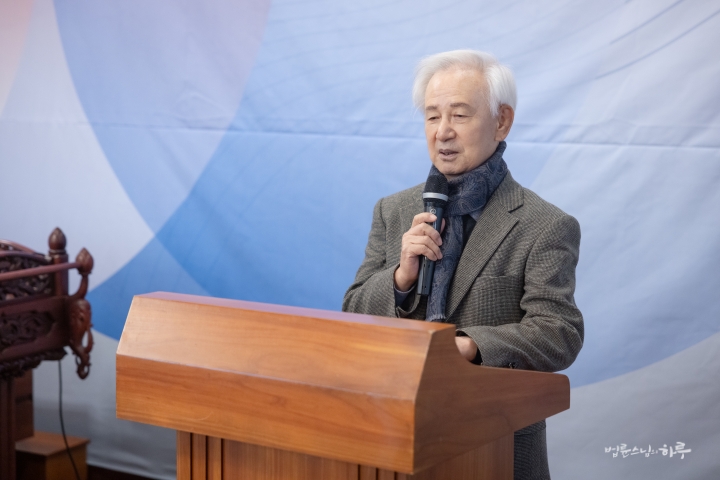
National Assembly member Park Hee-seung said that the footsteps left by Venerable Baek Yongseong, a native of Namwon, for the independence movement and national unity are a great source of pride for the region, and promised National Assembly-level support for the operation of the memorial hall and restoration of related historic sites.
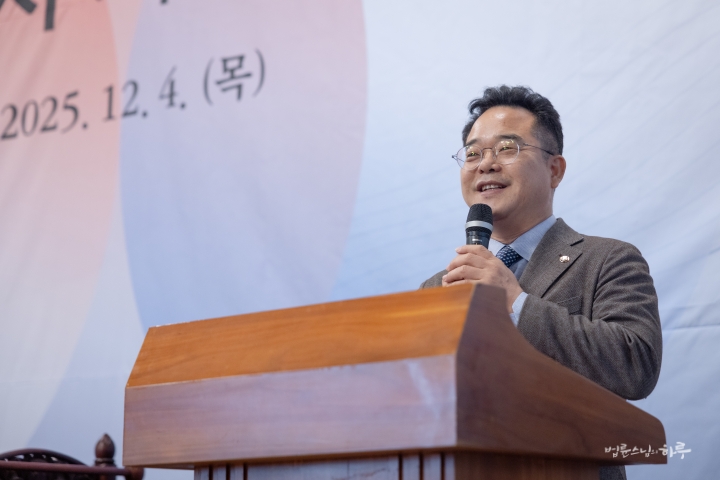
Finally, National Assembly member Min Byung-deok expressed regret that Venerable Yongseong’s contributions are not yet sufficiently known, and pledged that the National Assembly would take responsibility to ensure that the preservation of artifacts and organization of history could be carried out at the national level.
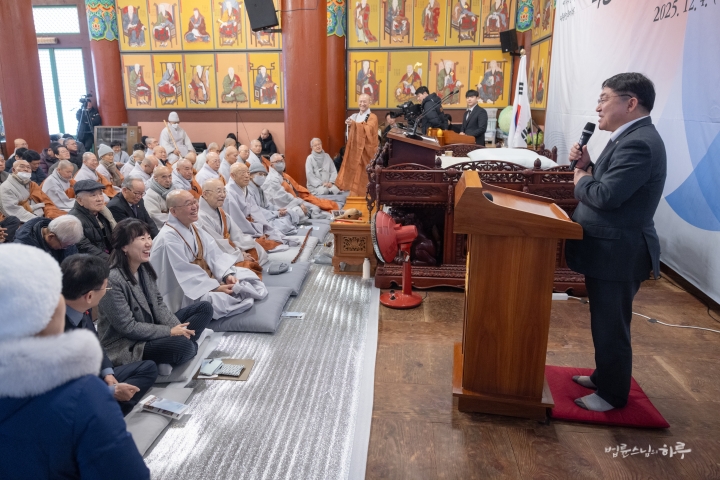
Leaders from various sectors expressed that our society must collectively inherit the teachings and spirit left by Venerable Yongseong, hoping that the opening of the memorial hall would become a new starting point. Listening to the congratulatory speeches from various dignitaries, we renewed our energy and confidence to powerfully begin the opening of the Independence Activist Baek Yongseong Memorial Hall.
The Jeonju Pansori Choir then gave a congratulatory performance. This traditional choir, which has beautifully reinterpreted our traditional pansori in a modern choral format, performed a newly interpreted version of “The Wilderness,” a representative work by anti-Japanese independence activist and poet Yi Yuksa.
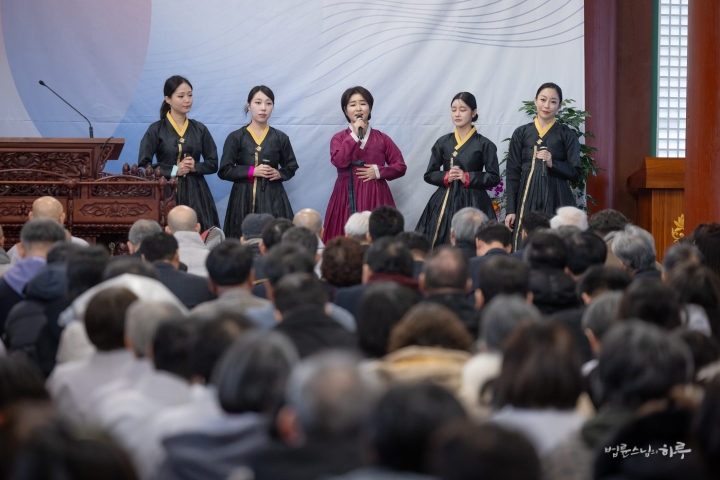
Listening to the lyrics that sang of hope while maintaining the nation’s spirit of independence and envisioning the coming liberation even in darkness and despair, we could once again reflect on the achievements and life of Venerable Yongseong.
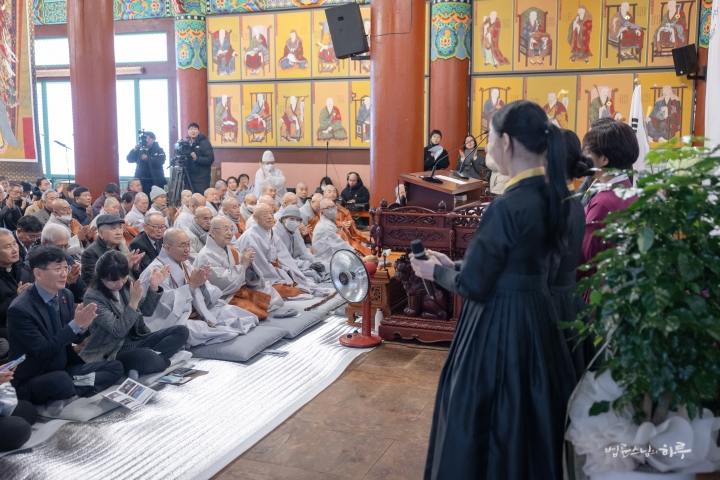
Next, a special program was held to reflect on the significance of today’s memorial hall opening with Venerable Bulsim Domun, who has inherited the Dharma lineage of Master Yongseong and has lived a life of practice and compassion throughout his life.
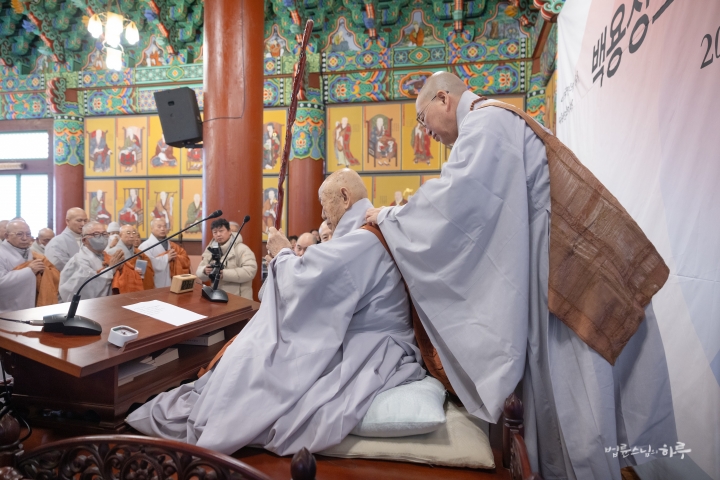
When the assembly requested a Dharma talk with three bows, the Venerable Master struck his staff three times before beginning his teaching.
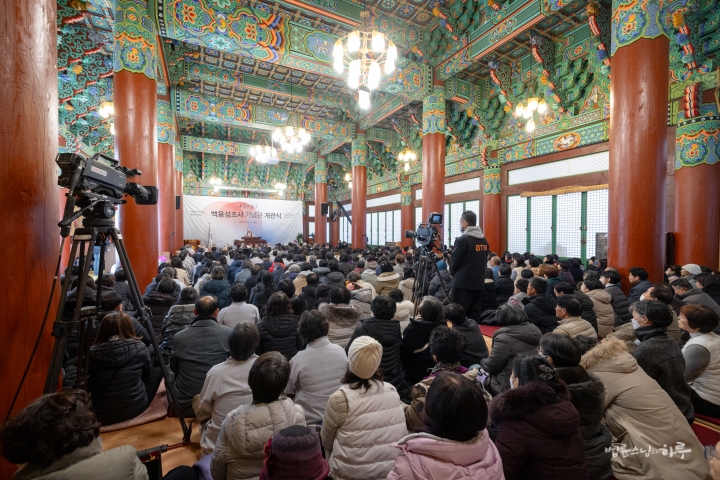
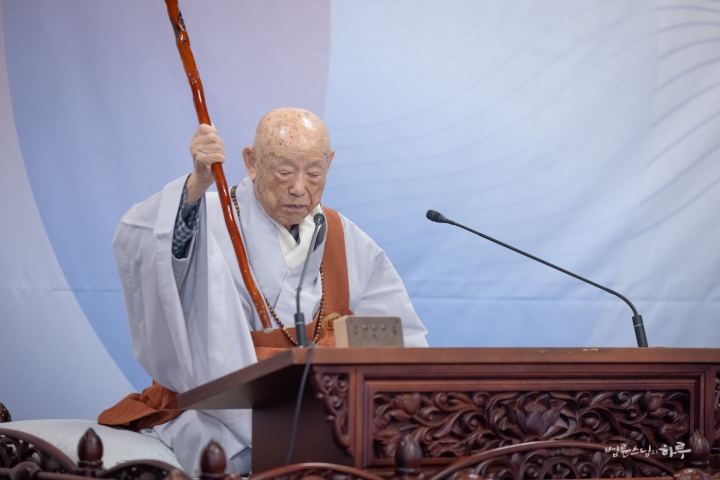
“Master Yongseong transcended the intellectual understanding composed of the six sense organs, attained the path of seeing, practiced the path of cultivation without being bound by emotions, opened true wisdom in the realm of the path beyond learning, attained enlightenment, and taught sentient beings as a great master. Let me recite Master Yongseong’s verse on attaining the path:
In the mountain of five aggregates, a traveler seeks the ox-nature (五蘊山中尋牛客)
Sitting alone in an empty hall, a single moon shines bright (獨坐虛堂一輪孤)
Square or round, long or short – whose path is this? (方圓長短誰是道)
A ball of flame burns up the great heaven (一團火炎燒大天)
‘In the five aggregates of body, thought, and mind, a traveler seeking the ox-nature of Buddha sits alone in an empty house where the round moon shines brightly. Square and round, long and short – whose path is this? A ball of flame from “What is this?” burns away the great heaven of afflictions.’
All people and humanity must uphold this enlightenment of Master Yongseong. I urge all of you to make this Mulbit Park become Master Yongseong’s Birth Park and a center for world Buddhist youth education. With this, I conclude my teaching.”
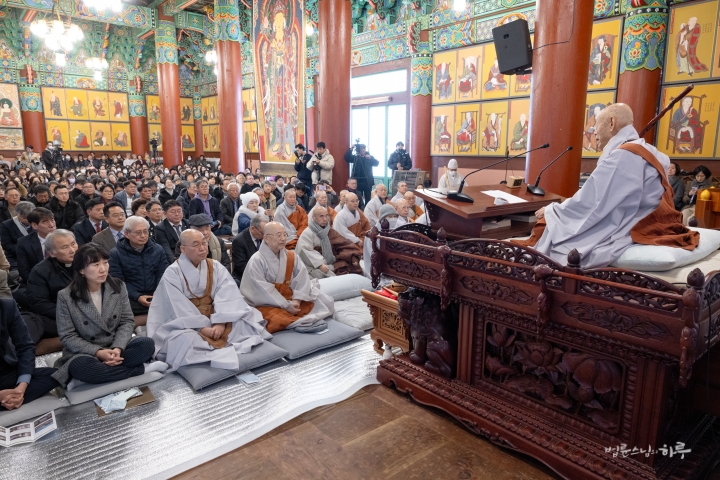
Engraving the Venerable Master’s words in their hearts, the assembly concluded the first part of the opening ceremony with the Four Great Vows.
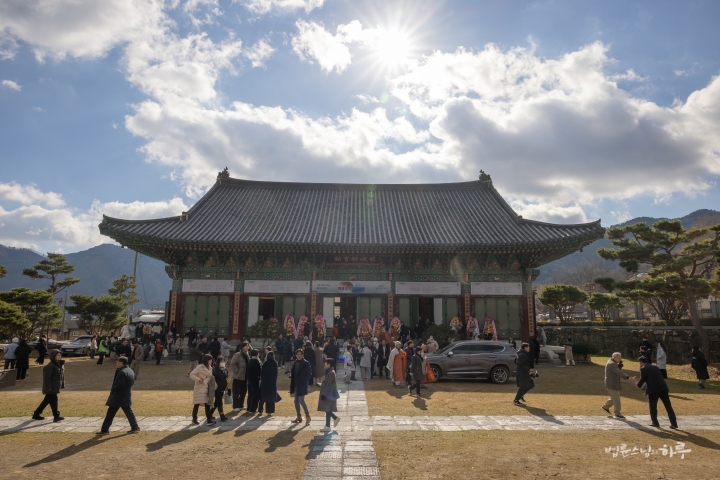
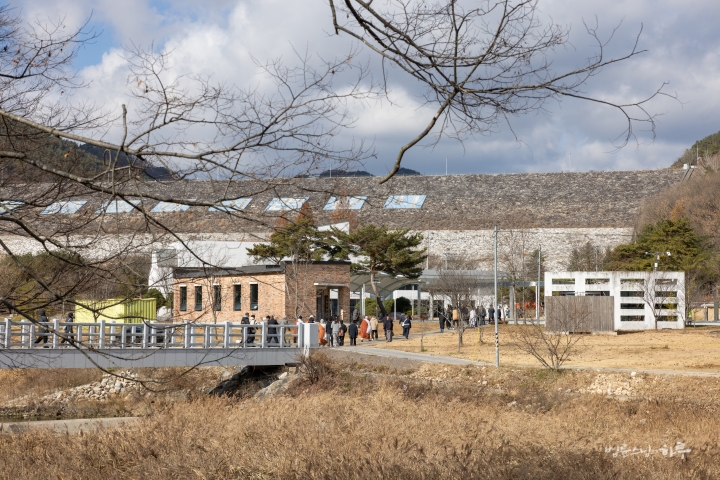
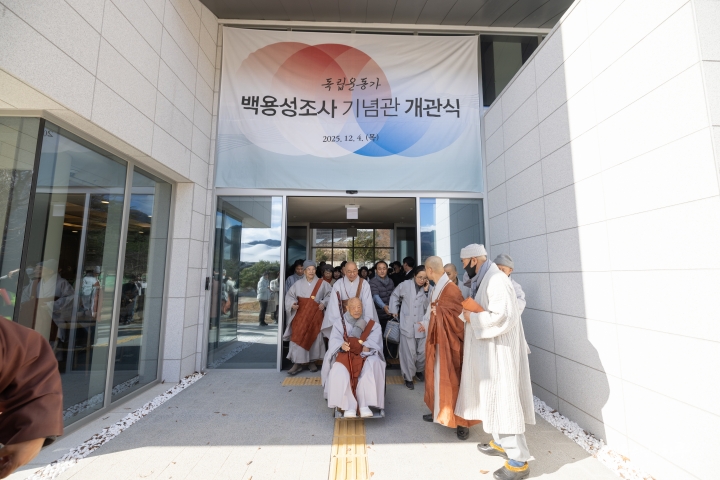
All guests and attendees moved to the newly constructed Baek Yongseong Memorial Hall for the plaque unveiling and ribbon-cutting ceremony. After departing from Jukrimjeongsa and crossing the bridge, the Baek Yongseong Memorial Hall appeared, nestled comfortably within the spacious Mulbit Park.
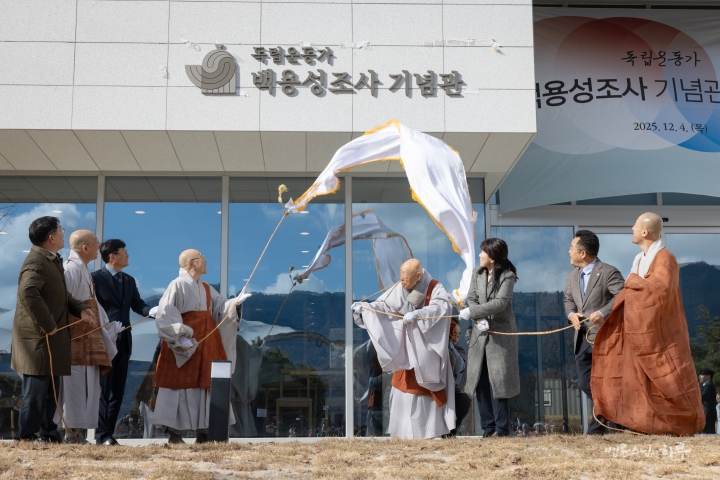
First, for the highlight of today’s opening event – the plaque unveiling ceremony – the distinguished guests came forward to the plaque. Venerable Bulsim Domun, Sunim, Venerable Yusu, Vice Minister Kang Yoon-jin of the Ministry of Patriots and Veterans Affairs, Jeonbuk Province Governor Kim Kwan-young, and Jangsu County Mayor Choi Hoon-sik took their positions on both sides as the 400 attendees began the countdown.
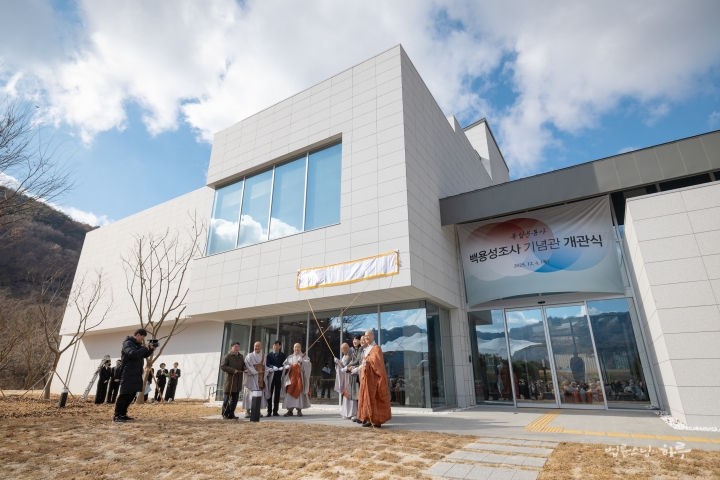
“One, two, three!”
Amid applause and cheers, the plaque reading “Independence Activist Baek Yongseong Memorial Hall” was revealed.
Next was the ribbon-cutting ceremony. Due to the large number of distinguished guests, the ribbon-cutting was conducted in two rounds. The first cutting was performed with the dignitaries who had just unveiled the plaque, Buddhist monks, religious elders, and social leaders.
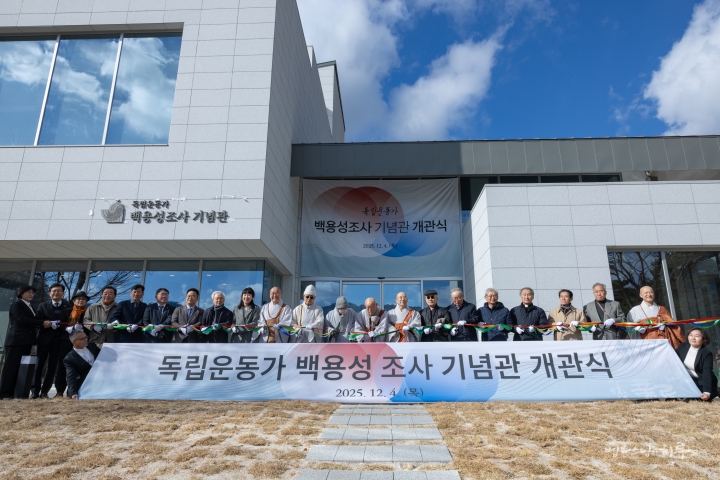
“One, two, three!”
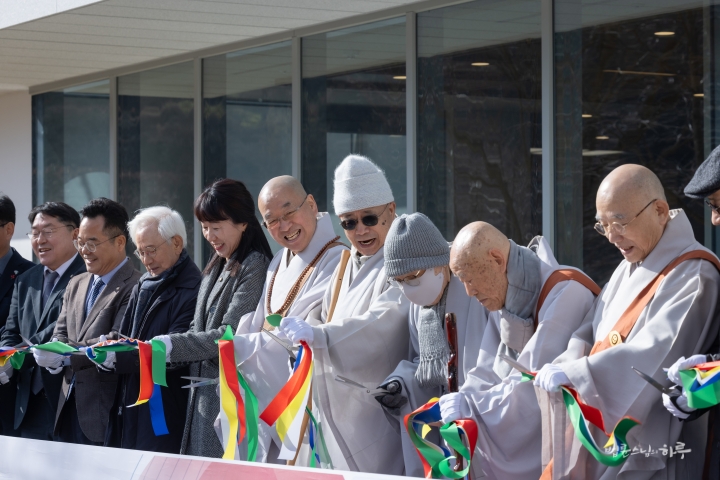
The second cutting was conducted with heads of various organizations, representatives from Jeonbuk Special Self-Governing Province and Jangsu County council members, and finally, the construction officials who worked hard on building the memorial hall.
“One, two, three!”
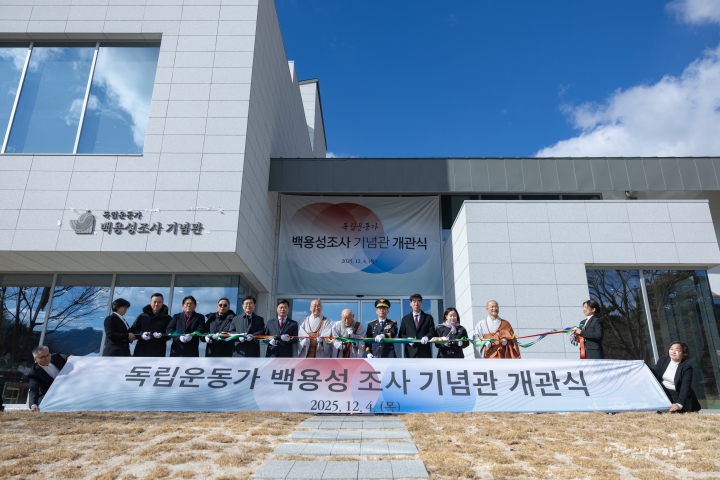
With this, the plaque unveiling and ribbon-cutting ceremony for the Independence Activist Baek Yongseong Memorial Hall was completed, followed immediately by a tour of the memorial hall.
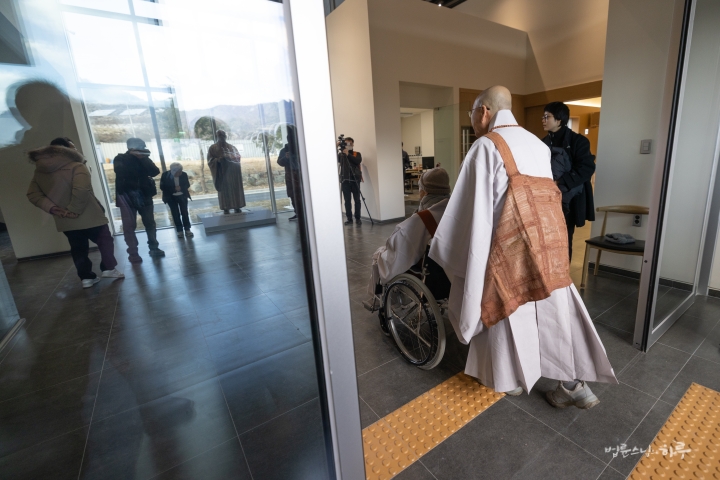
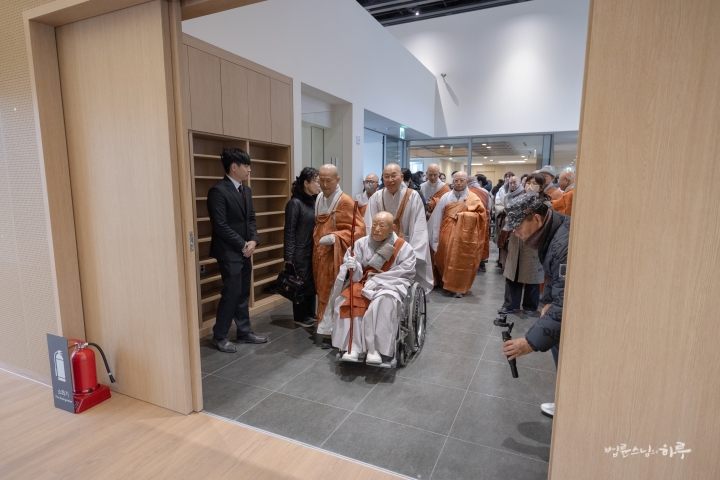
Sunim accompanied Venerable Bulsim Domun in a wheelchair as they toured the entire memorial hall from the first to the second floor.
Upon passing through the first-floor entrance, a statue of Master Yongseong was the first to greet visitors. Bold letters were clearly engraved at the base of the statue.
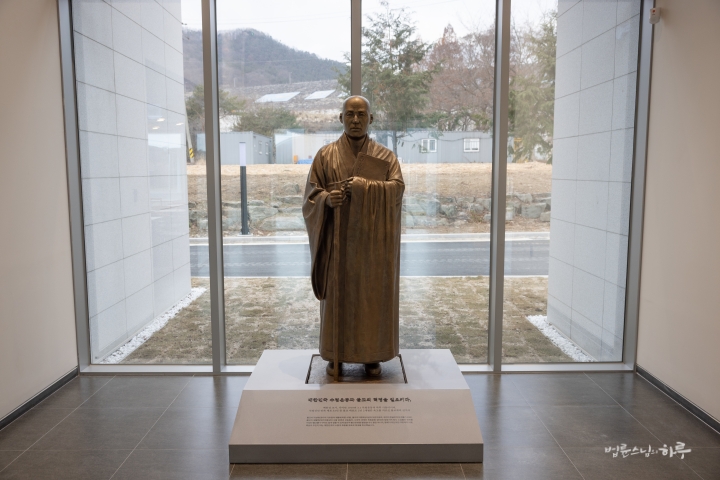
“Master Baek Yongseong, the behind-the-scenes pillar of the March 1st Independence Movement in 1919, Buddhist representative among the 33 national representatives of the Independence Declaration, who served 2 years and 2 months in prison – a great Buddhist teacher”
On both sides of the statue were an auditorium and a café. These multipurpose spaces host seminars and educational programs about Master Yongseong, and provide a comfortable place for visitors to rest.
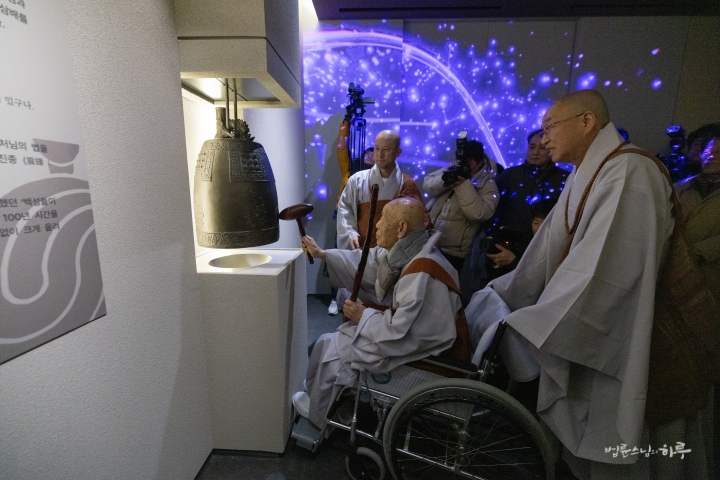
Upon reaching the second floor, the first thing displayed was a temple bell symbolizing “Jinjong,” Master Yongseong’s Dharma name, along with an introductory text marking the beginning of the exhibition. Venerable Domun personally struck the bell while chanting the bell verse.
“When hearing the bell sound, afflictions cease, wisdom grows, and bodhi arises…”
Past the bell, audiovisual materials documenting Master Yongseong’s achievements were displayed. At the entrance, a large photograph was prominently exhibited. Sunim personally pointed to the photo and explained.
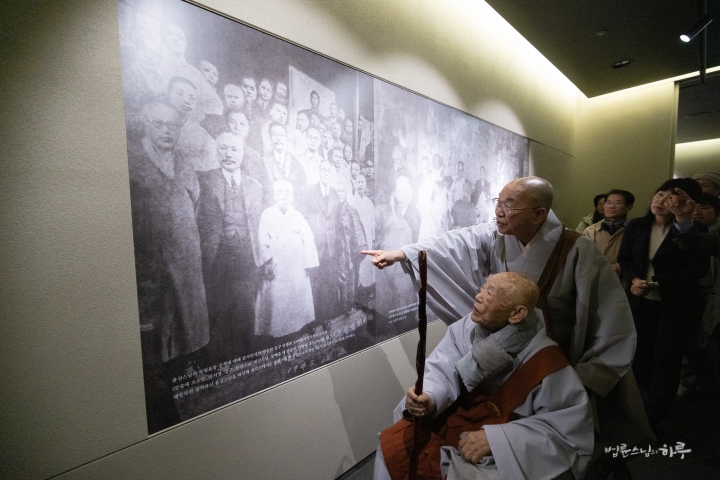
When this photo was published in a Buddhist newspaper on February 26, 2017, the testimonies about Master Baek Yongseong’s independence movement that had been passed down for 100 years, the oral accounts of his contributions to establishing the Provisional Government, and the fragmented records found by Venerable Domun were finally revealed as historical facts.
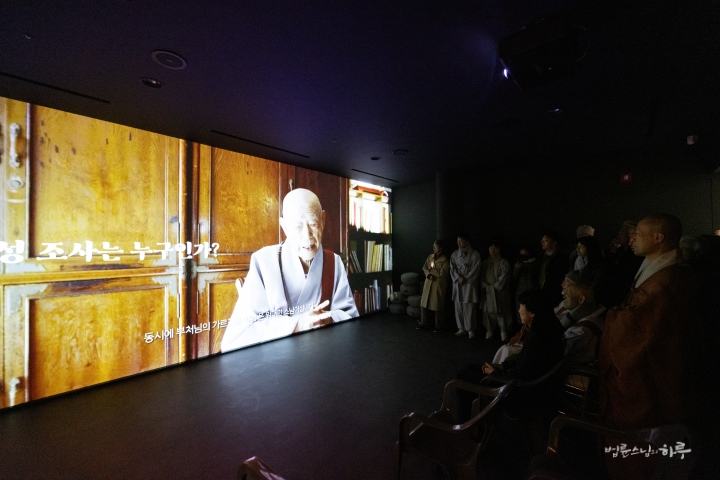
Entering the center of the hall, a video depicting Master Yongseong’s life was being shown. All attending guests watched the video quietly, holding their breath.
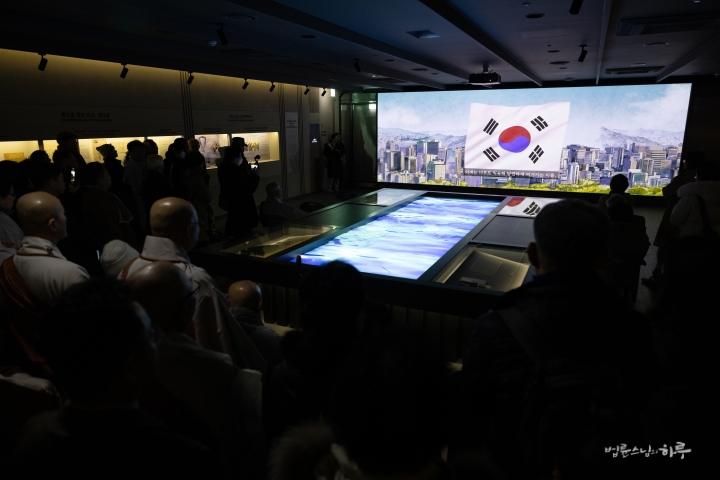
When the video ended, loud applause erupted. They then examined every corner of the exhibition hall.
The exhibition hall consisted of four sections, and Venerable Yusu provided detailed introductions to each space.
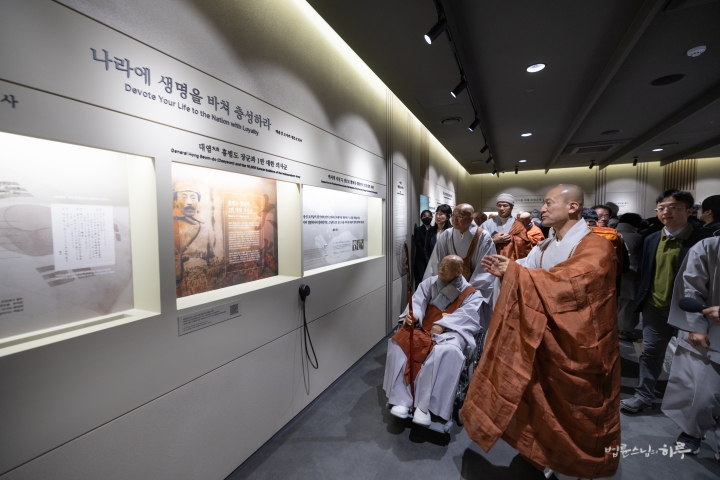
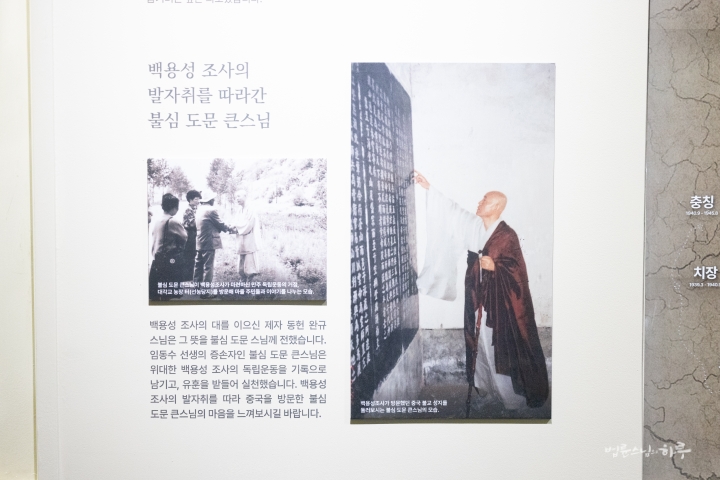
In the final section, a video interview with Venerable Bulsim Domun, who documented the independence movement, was being shown. This space was created to preserve the Venerable Master’s oral testimony in video form for future generations, even after he passes away. After touring the entire exhibition hall, the Venerable Master expressed his gratitude.
“You all worked hard. Thank you.”
After completing the exhibition hall tour, everyone headed to the living quarters together.
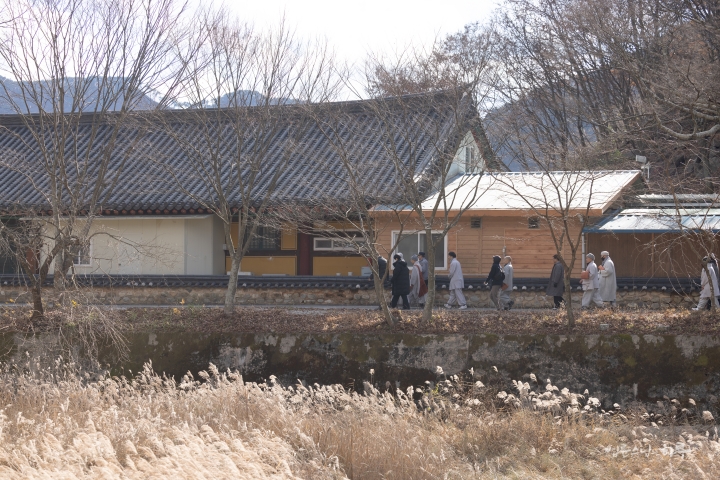
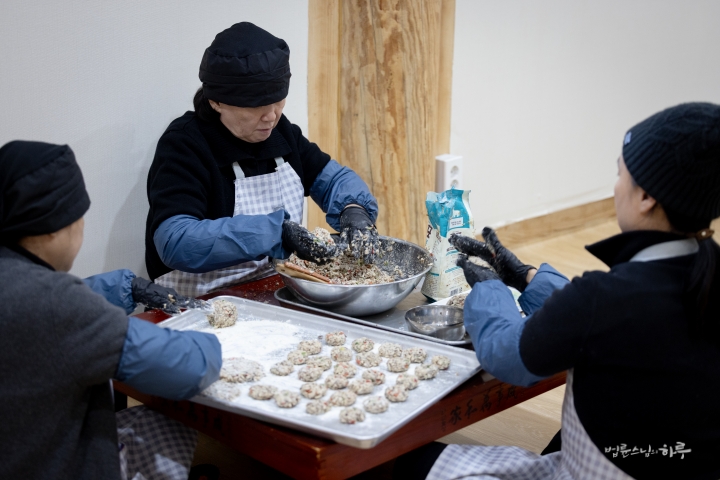
In the living quarters, lunch was prepared for 50 distinguished guests. Many volunteers from the Daejeon-Chungcheong and Gyeongnam branches of Jungto Society had carefully prepared the food.
Before the meal, Venerable Bulsim Domun recited the Small Heart Sutra.
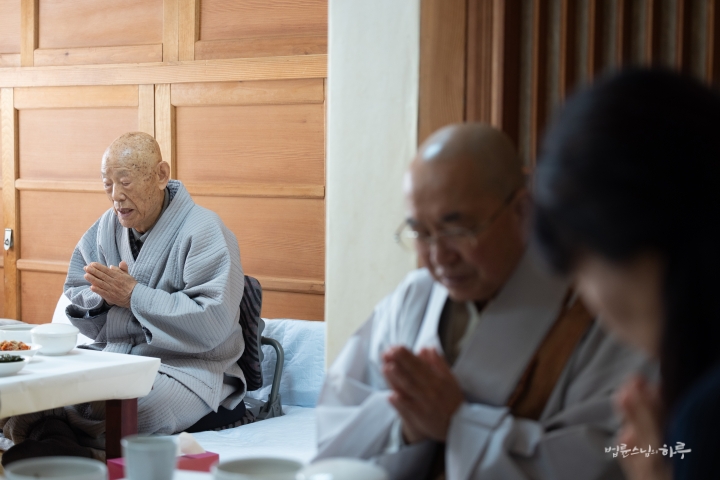
“Born in Kapilavastu, attained enlightenment in Magadha, taught the Dharma in Varanasi, entered nirvana in Kushinagar.”
After the Small Heart Sutra ended, everyone shared a meal and engaged in warm conversation. Sunim sat at the same table with officials from the Ministry of Patriots and Veterans Affairs, encouraging their efforts and expressing gratitude during the meal.
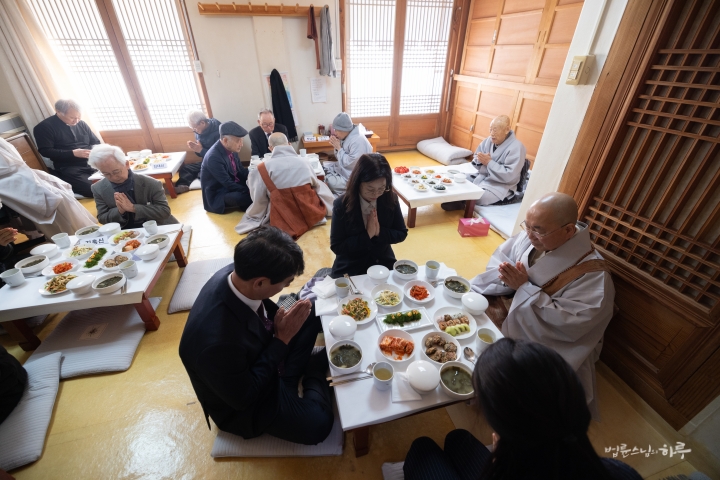
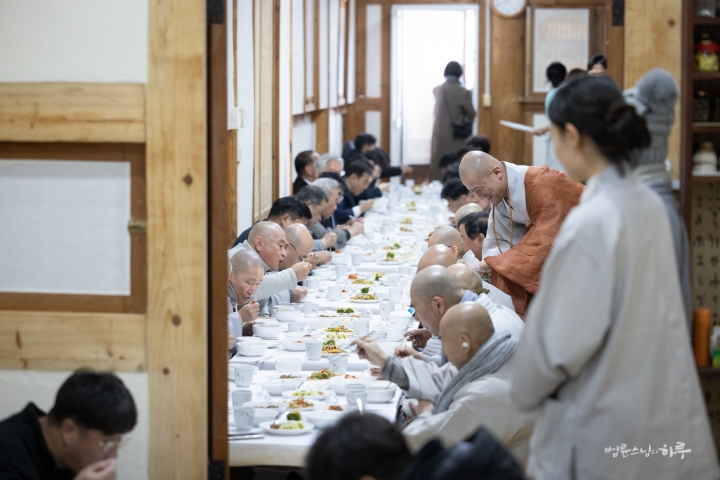
After finishing their meal, all the guests came to pay their respects to Venerable Bulsim Domun in turn before returning home.
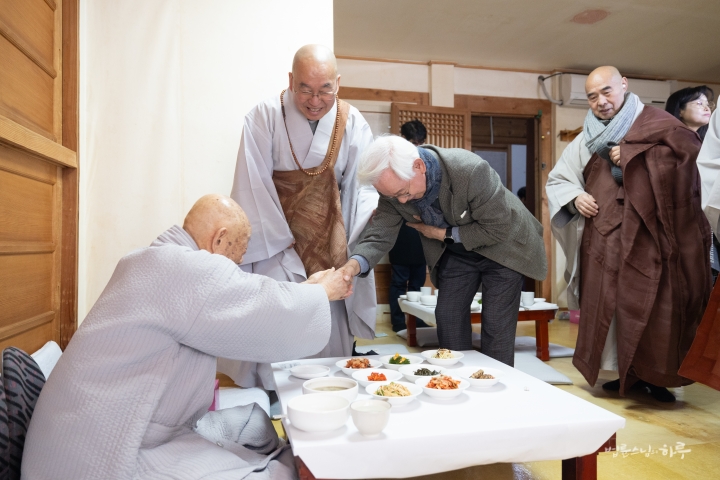
Sunim also paid his respects to the Venerable Master. The Venerable Master once again expressed his gratitude.
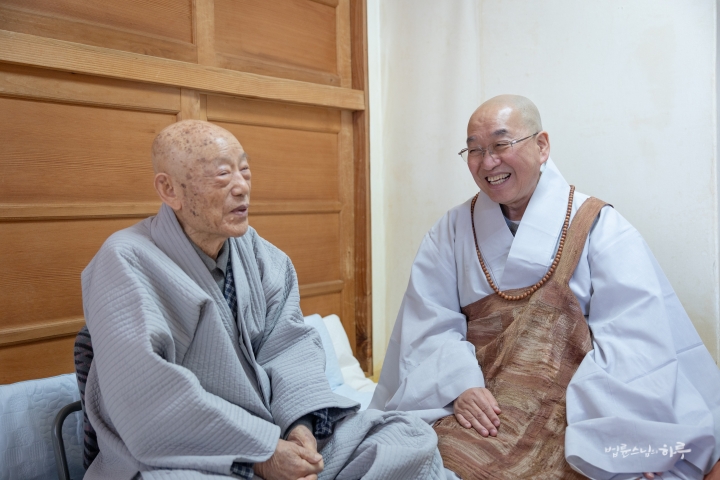
“If I hadn’t met Venerable Pomnyun, Master Yongseong’s legacy would have become nothing but bubbles. I’m so grateful that you’re carrying on his will like this. I always feel sorry that I only supported Venerable Pomnyun with half of the money from the land I bought to realize his legacy. It would have been better if I had given more.”
Sunim asked the Venerable Master to stay with them for a long time.
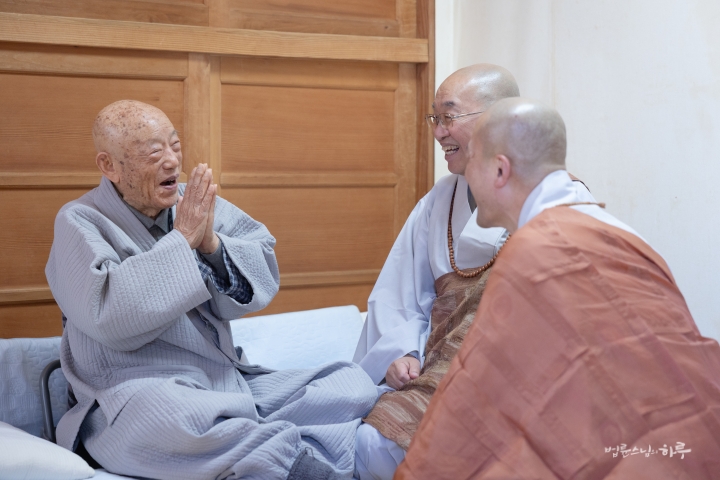
“Not at all. It’s because you bought that land back then that we can now realize his legacy. So you must see the restoration of Cheonryongsa Temple completed.”“Really? Then I’ll have to extend my life by another three years.”
The Venerable Master smiled and bid farewell with palms together.
After seeing off the Venerable Master leaving Jukrimjeongsa, Sunim ran toward the bus from Seoul. He boarded the bus that was about to depart and expressed his gratitude to the attending guests.
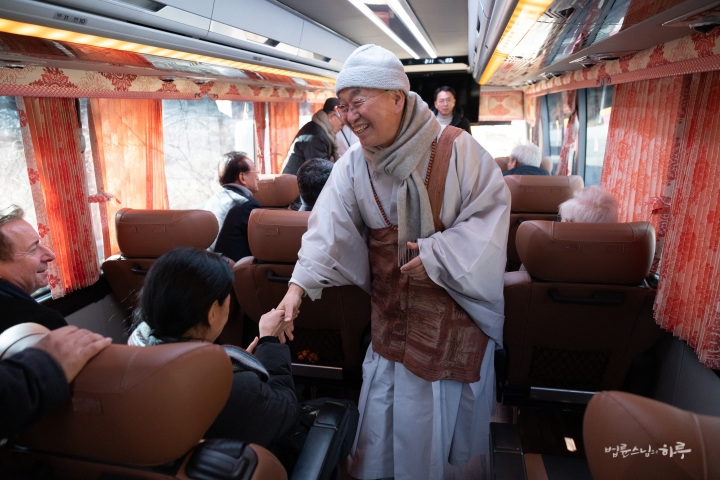
“It was a truly wonderful event. We’re grateful for the invitation.”
As the bus carrying the guests departed for Seoul, Sunim also got in a car and headed to Seoul.
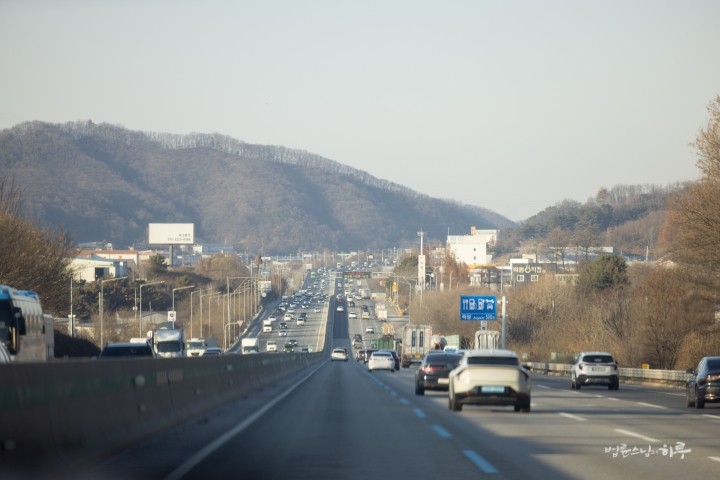
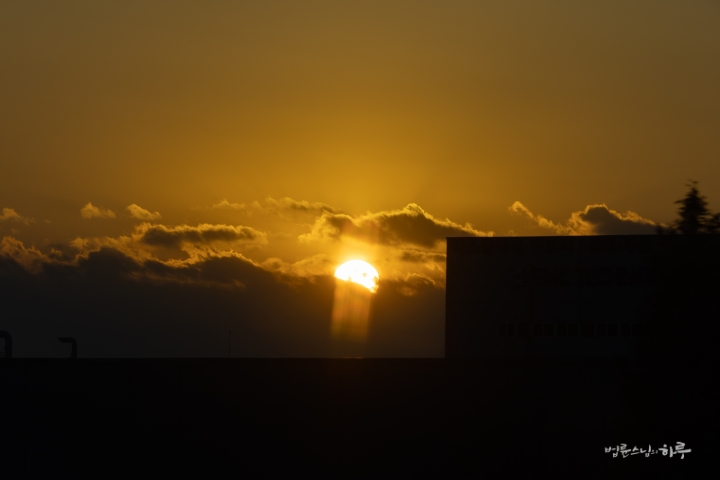
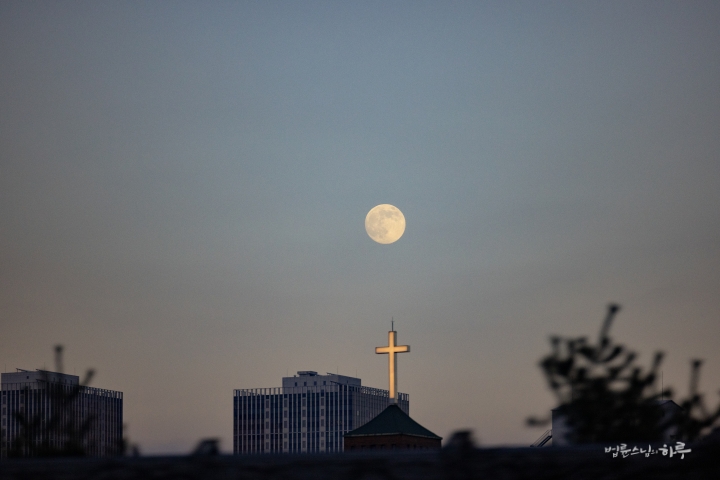
Departing from Jangsu Jukrimjeongsa at 2 PM, they drove on the highway for 3 hours and 30 minutes. During the drive, the sun set and the moon rose outside the window.
Today was the day for the annual year-end gathering of Peace Leadership Academy alumni
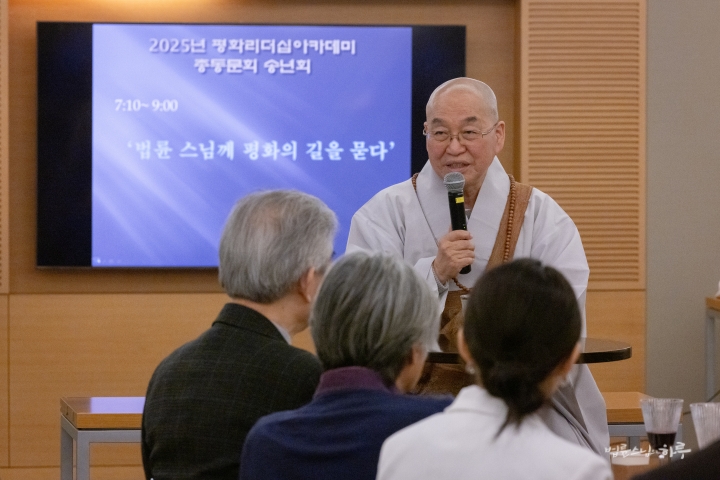
Beyond Suffering to Hope, Patience and Preparation for Peace
While it may seem hopeless in some ways, we have overcome countless difficulties throughout our history. Despite the massive massacres during the Donghak Revolution, the suffering under Japanese colonial rule, the pain of the Korean War followed by absolute poverty, and military dictatorship, we never lost hope. With the spirit of ‘Let’s live well too!’ we achieved economic growth, and with ‘Let’s live freely too!’ we fought and achieved democracy. The ‘miracle’ of the Republic of Korea was not obtained for free. Today’s Republic of Korea was created thanks to all of our efforts. No matter how difficult our current situation is, it’s better than the late Joseon period, better than the Japanese colonial period, and better than after the Korean War. Therefore, we don’t need to be too discouraged. In my opinion, rather than the situation being bad now, it seems that because we live too comfortably or have learned too much, we’ve developed a tendency to settle for the status quo, and that complacency eventually leads to resignation.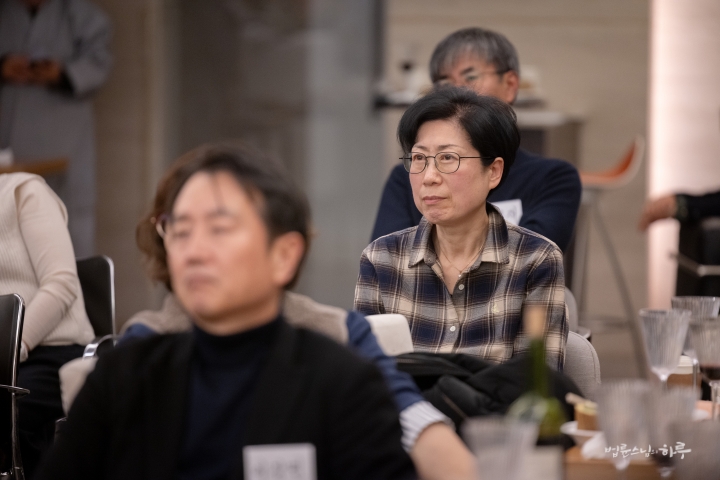
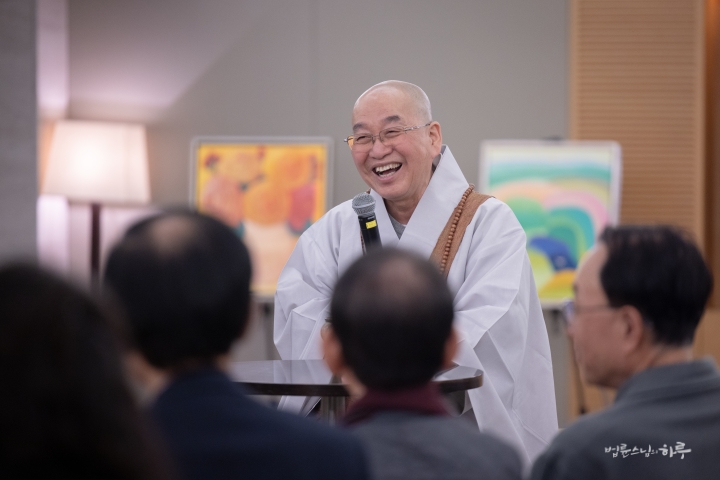
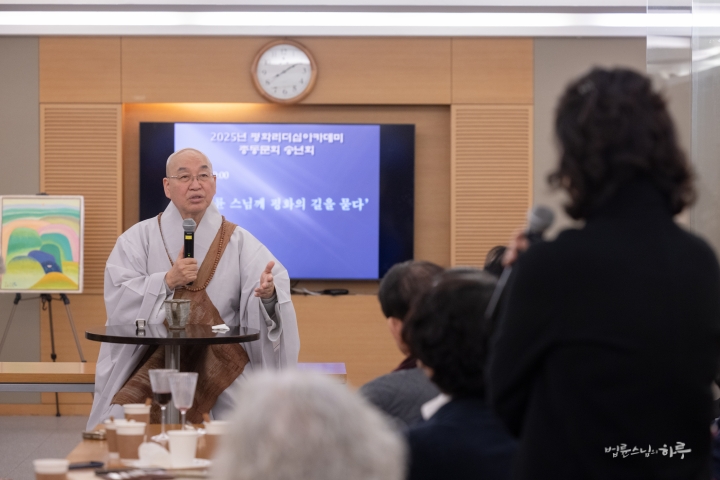
Following this, a Dharma Q&A session was held. Anyone could raise their hand and ask questions. For an hour, five people shared their concerns and had conversations with Sunim. One of them opened up about losing the will to live and feeling lethargic after losing a beloved sister.
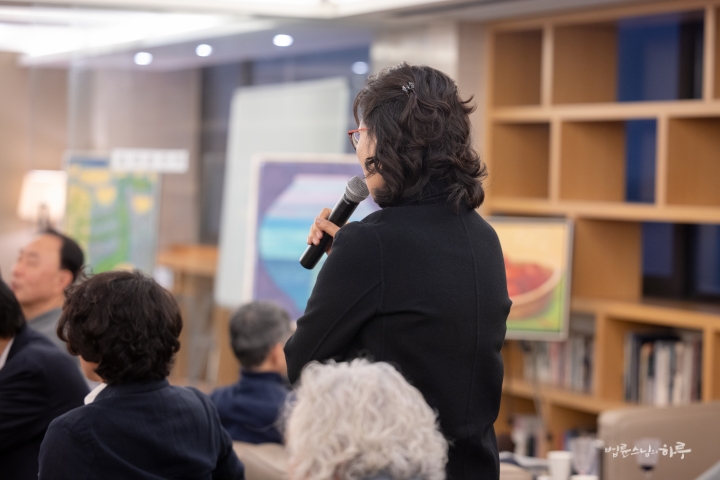
After Losing My Sister, My Heart Has Collapsed. How Can I Stand Up Again?
“I lost my sister last year. After she passed away, my disappointment was so overwhelming that I desperately wanted to let go of everything, and I even vowed, ‘I will never work again.’ I traveled and spent time trying to fill the emptiness, but I felt very hollow, and family circumstances made it even harder. The problem is that while I now think I should work again, I don’t have the same energy as before. So I wonder, ‘Do I lack desperation?’ On the other hand, since I’m 66 years old this year, I also think, ‘I worked so hard when I was young, shouldn’t I be able to live without working now?’ I can see with my eyes where I’m needed, but my heart won’t move. I don’t know how to resolve this situation. Sunim, please tell me how to solve this.”
“But I have so much inner conflict.”
“What kind of conflict?”“That work clearly needs my touch to succeed and develop properly, but on the other hand, I turn away thinking, ‘Ah, I don’t want to see it anymore.’ Then when I look again, thoughts like ‘What should I do about that?’ keep coming up regarding company matters. Although I’ve handed over much of the company to my son, I suddenly think about how my sister also lived so busily and then left so futilely, and my heart becomes complicated.”
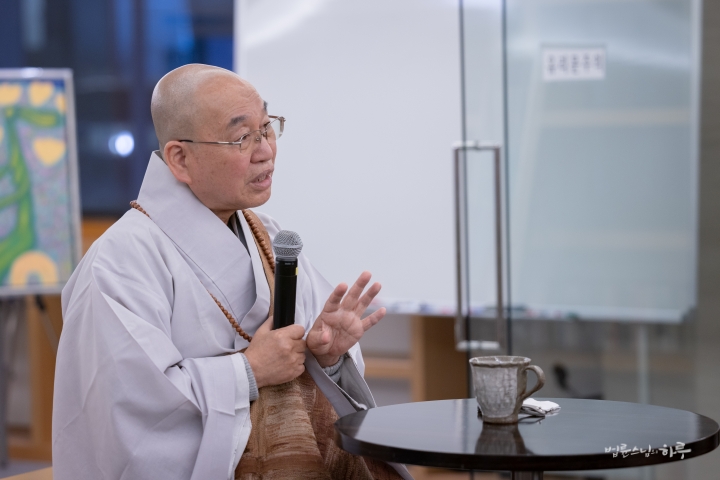
“That’s a matter of habit. The best thing is not to look at it. When you see it, old habits keep surfacing. So the best strategy is not to look at all.”“What should I do about the conflict between wanting to do it and not wanting to do it?”
“Do it when you want to, and don’t do it when you don’t want to. If you go back and forth between doing and not doing, eventually things will sort themselves out.”“Once you start work, it’s not something you can just do and not do like that.”
“I really don’t want to.”
“Then don’t do it. Your mindset is exactly like lying down and saying ‘I don’t want to get up, how can I get up?’ Then I say, ‘Just sleep.’ Go tomorrow and try your hand at the work. Once you try, you’ll either conclude ‘Ah, I shouldn’t do this’ or ‘I’m glad I did this’ and continue.”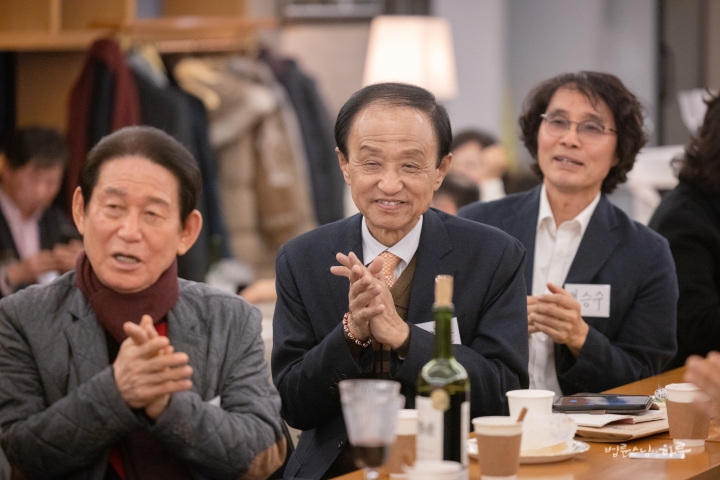
The last questioner asked Sunim for advice on the direction the Peace Leadership Academy Alumni Association should take.
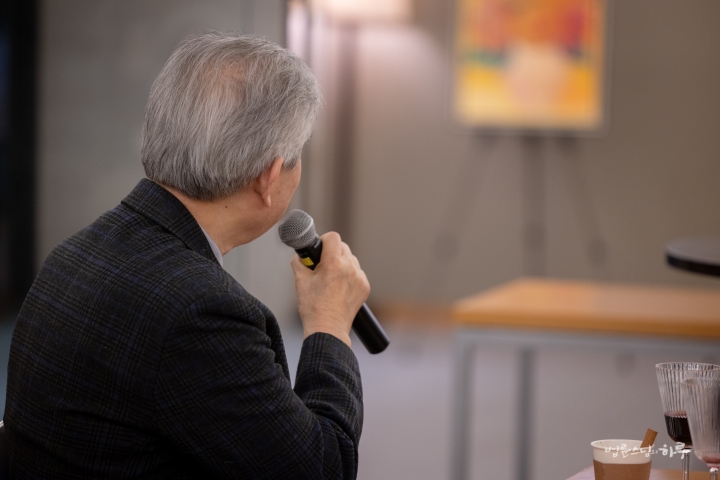
“Please share some good words so that our Peace Leadership Academy Alumni Association can become more substantial and develop in a good direction.”
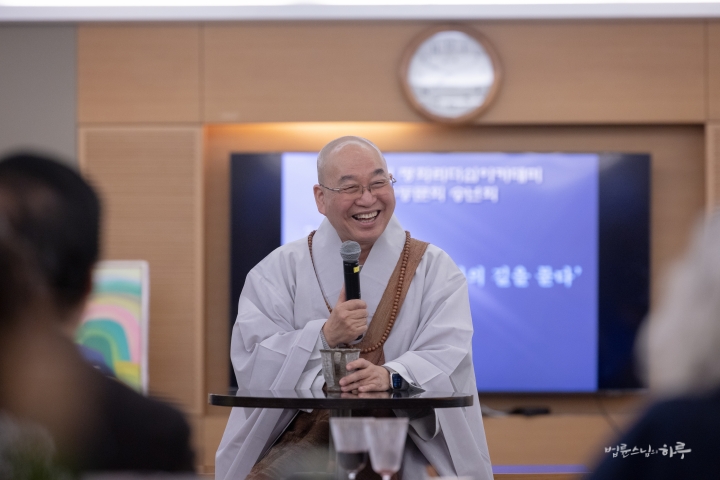
“Yes, thank you.”
The Peace Leadership Academy year-end party concluded with loud applause.
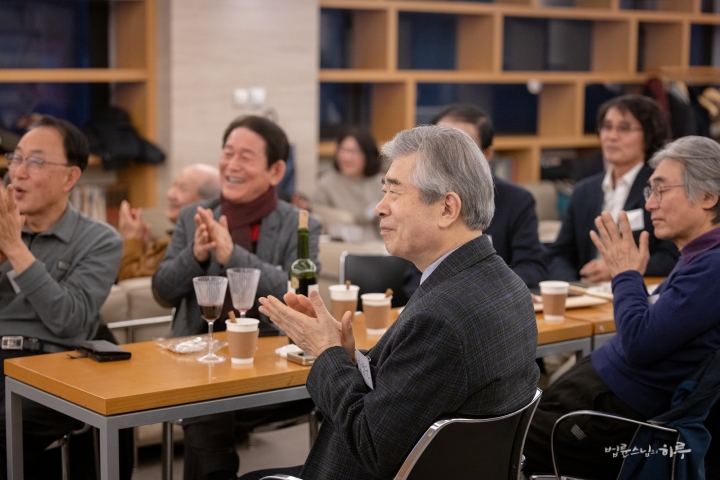
The alumni who had gathered after a long time took photos with Sunim by class year and all together.
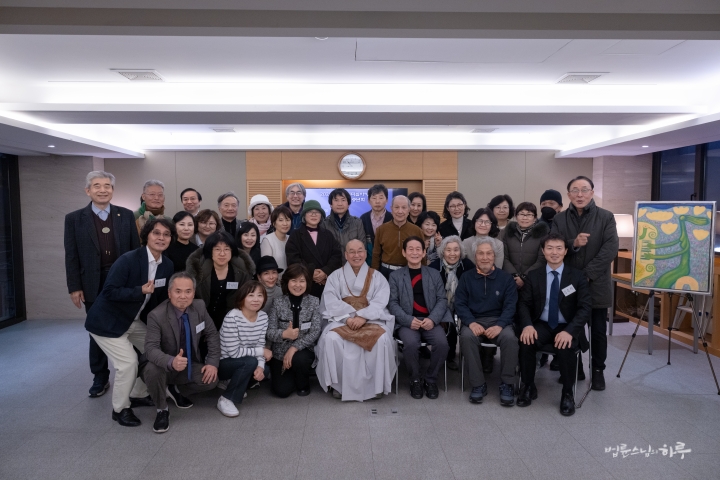
Everyone bid farewell to Sunim with gratitude as he left the venue.
“Thank you so much for making time despite your busy schedule, Sunim!”
Sunim got in the car and headed to Seoul Jungto Center.
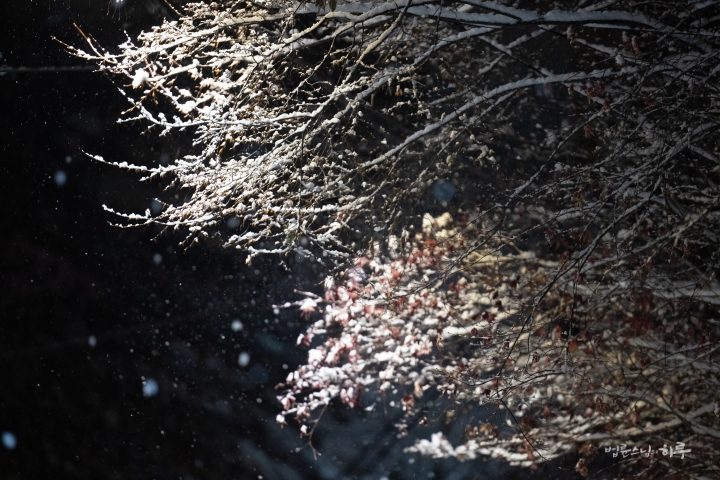
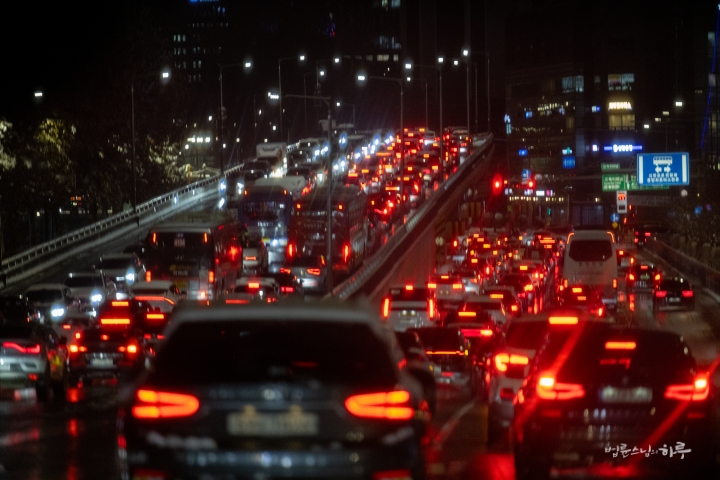
In the meantime, heavy snow had fallen, causing traffic jams on the roads. He arrived at Seoul Jungto Center at 10:30 PM and concluded the day’s activities.
Tomorrow, he will have back-to-back meetings with visitors to the Peace Foundation all day, and in the evening, he will conduct the Friday Dharma Q&A live broadcast.