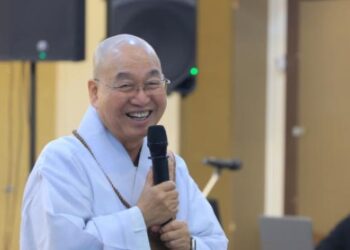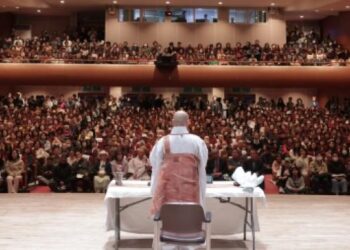

Apr 17, 2026. Opening Dharma Talk for the 6th Hwaeom Class Dharma Teacher Training, Busan Happy Dialogue
Hello. Today, there is an opening Dharma talk for the 6th Dharma Teacher Training at Dubuk Jungto Retreat Center in the morning, and a Happy Dialogue lecture in Busan in the evening.
After morning practice and meditation, Sunim edited manuscripts. At 8 AM, he conducted an online meeting from the broadcasting room at Dubuk Jungto Retreat Center with Korean Peninsula experts and NGO representatives in the United States on the topic of ‘Recent Developments in North Korea and Peace on the Korean Peninsula.’
After finishing the online meeting at 9:30 AM, Sunim gave the opening Dharma talk for the 6th Hwaeom Class Dharma Teacher Training in the main hall of Dubuk Jungto Retreat Center at 10 AM.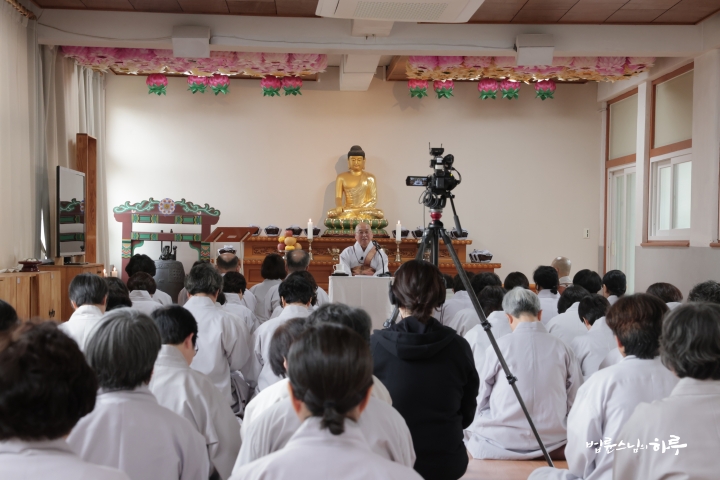
The 27 trainees of the 6th Hwaeom Class will begin their one-year training as Haengja (trainees) starting today to receive Dharma Teacher education.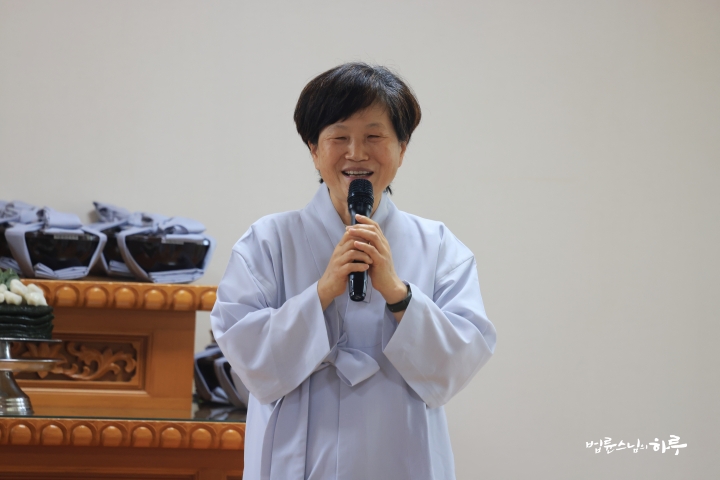
After the Three Refuges and Heart Sutra, Dharma Teacher Seonju, the head of the Dharma Teacher Group, gave welcoming remarks.
“Welcome. First, I congratulate and welcome you all. I’m especially happy to congratulate you as I’ve known many of you for a long time. This is a time to renew your mind from being a volunteer to becoming a Haengja again, perhaps starting everything anew with a fresh perspective.
Every time we have a Dharma Teacher training opening ceremony, I remember my own Haengja days. (Laughter) I was in my twenties then, and I started Jungto Society while living as a Haengja. Due to my lack of understanding and experience in practice, I criticized many fellow practitioners. (Laughter) However, I believe all of you have already overcome such issues through your volunteer activities. (Laughter) I hope this becomes a time for you to let go of all activities and purely observe yourself. I hope to see you again at the Dharma Teacher ordination ceremony in a year after you’ve refined yourselves together with fellow practitioners.”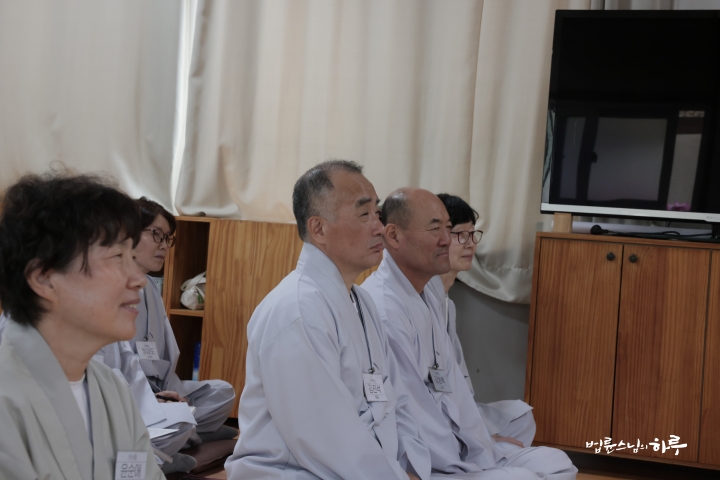
After Dharma Teacher Seonju’s warm welcoming remarks, the 6th Hwaeom Class Haengja requested the opening Dharma talk from the guiding Dharma Teacher with a request chant and three prostrations.
A Dharma Teacher Is Someone Who Plays the Role of a Teacher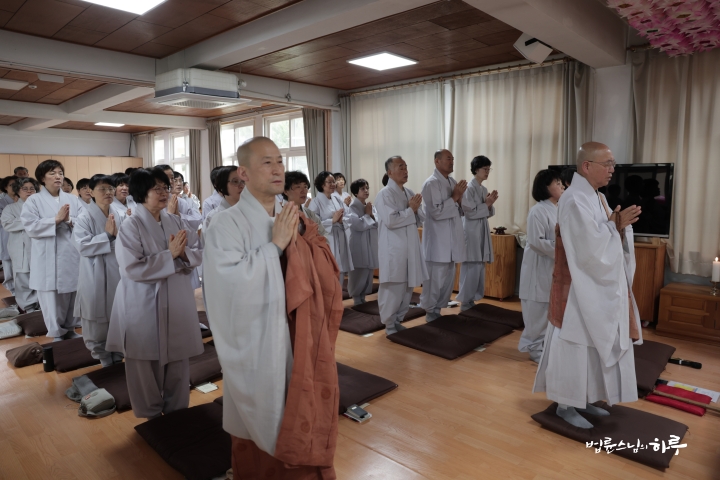
“When I am called a Dharma Teacher, I must at least play the role of a teacher. However, in Jungto Society, there is a precept that says ‘Do not teach.’ This means you should not criticize others’ practice as wrong. But someone needs to guide from a practice perspective. When someone with insufficient practice does this, it becomes criticism rather than practice guidance. That’s why initially only the guiding Dharma Teacher played this role. However, since the guiding Dharma Teacher cannot meet and guide everyone personally, we began appointing Dharma Teachers to act on behalf of the guiding Dharma Teacher. That’s why Dharma Teachers are now appointed in each division and branch to play the role of practice guidance on behalf of the guiding Dharma Teacher. This is why the Dharma Teacher Group is under the guiding Dharma Teacher. Fundamentally, they play a role similar to an extension of the guiding Dharma Teacher.
To become a Dharma Teacher, one must reach the level of a practitioner who is completely free from suffering. To reach the state of being free from suffering, one must attain the wisdom of insight into the emptiness of all phenomena. Even though one has realized that there is originally no suffering, if suffering arises momentarily due to being caught in delusion, one can be called a practitioner only when one immediately notices, turns back, and repents. When one realizes the principle of the emptiness of all phenomena, one comes to know that no person in this world can be called ‘my person,’ and no object can be called ‘mine.’ Therefore, to become a Dharma Teacher, one must let go of the worldly perspective of ‘I,’ ‘mine,’ and ‘I am right.’
From today, even when you return home and look at your family, although formally they are my husband, my son, my wife, you must already let go of worldly connections. You should not see your husband as ‘my husband’ but as one sentient being, one person. You should see your son not as ‘my son’ but as one person, and your wife not as ‘my wife’ but as one person. Even if the other person gets irritated with you, you should view it from the perspective of ‘Oh, that person must be having a hard time.’ You must change your perspective on family.
Clarifying the Perspective of Renunciation
Originally, to renounce the world, one must cut all worldly connections and enter a temple to live as a Haengja. However, the reason we can live at home is that through today’s opening ceremony, when you gain the practice perspective of becoming a Dharma Teacher, it is the same as cutting worldly connections. The moment you have the practice perspective of becoming a Dharma Teacher, even if you live together, you only play a role as one person without being attached to relationships. You live together because they need it, you play the family role because they need it, but you no longer have thoughts arising from relationships. You play the role of wife or husband because they need it, but thoughts arising from belonging relationships with that person must be cut off. Thoughts like ‘because he’s my son,’ ‘because she’s my mother,’ ‘because she’s my wife,’ ‘because he’s my husband,’ ‘because they’re my parents,’ ‘because they’re my children’ must be cut off. If this perspective is not clear, it cannot be called renunciation.
The same applies socially. Whether I was a company president, a principal, or whatever, the moment I renounce, I must let go of all social positions. If I am currently playing that role, I should think that I am temporarily playing that role like a bodhisattva manifesting because society needs that role. Just as an actor plays the role of a principal, husband, or wife when given a role, I am temporarily playing that role on that stage. Just because I temporarily played that role doesn’t mean I am a principal, husband, or wife.
Theravada Buddhism requires cutting all connections and leaving home to renounce. However, Mahayana Buddhism emphasizes freeing the mind from all connections rather than formally leaving home. The perspective on the precept of not killing is also slightly different. In Theravada Buddhism, if you don’t kill, you are considered to have kept the precept, but in Mahayana Buddhism, even having the desire to kill is considered breaking the precept. In Theravada, if it doesn’t manifest in action, the precept is not broken, but in Mahayana, even if it doesn’t manifest in action, if the three poisons of greed, anger, and ignorance arise in the mind, the precept is already broken. 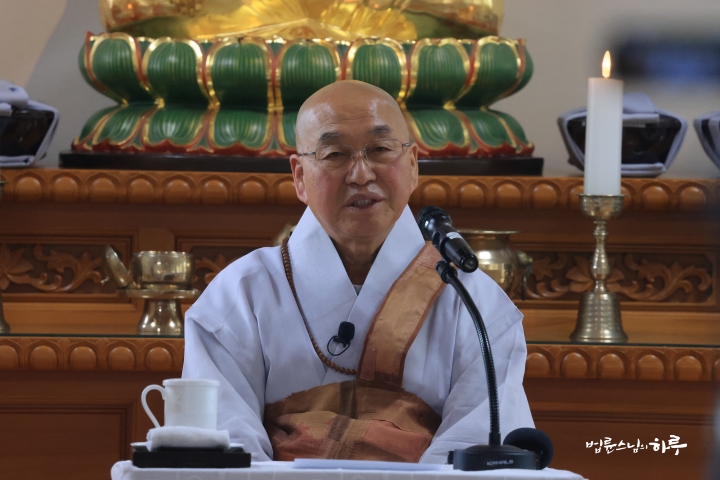
With the Mindset of a Monastic
Therefore, when we harbor greedy thoughts, angry thoughts, or ignorant thoughts, we are all breaking the precepts. This is why when we repent through prostrations, we repent not only for our physical actions but also for the karma created by our minds – because we follow the Mahayana precepts. Mahayana Buddhism does not place importance on whether one appears to live alone or married. What matters more is fulfilling the roles of husband or wife while not being bound by the relationship. Only when one is not bound by relationships can one be called a practitioner. This perspective must be clearly established.
Through today’s opening ceremony, even though your body remains in the secular world, you must live with the mindset of a monastic. Do not be swayed by what others say, and protect yourself like water droplets rolling off a lotus leaf. If you can maintain this perspective well, you can live as a monastic practitioner even while living among people. However, if meeting and interacting with people creates emotional attachments and obsessions, you have two options: either physically organize your relationships, cut ties and become a monastic, or simply live a secular life. You must choose between giving up being a practitioner or becoming a monastic who completely cuts off relationships. Therefore, for lay practitioners to maintain their duty as practitioners, they must have greater vow power and clearer perspective than monastic practitioners. Lay practitioners are not those who cannot become monastics. Monastic practice, which involves physically cutting off connections, can be easier. You can walk the path of a lay practitioner when you have a clear vow that you can live unwaveringly as a practitioner even in the secular world.
Mahayana Buddhism makes living among sentient beings and teaching them one’s own practice. Let me explain using the example of not being greedy. While Theravada Buddhism practices by not stealing others’ belongings, Mahayana Buddhism practices by cultivating a giving mind. When you cultivate a giving mind, the thought of stealing cannot arise. Mahayana doesn’t keep precepts by not lying but establishes vows by always speaking the truth. Therefore, Theravada emphasizes actions while Mahayana emphasizes vows. When saving a drowning person, Theravada cannot help without a pole, but Mahayana takes the pole without the owner’s permission to save the person first, then compensates for using the pole without permission. In other words, the Mahayana perspective is to do what needs to be done even if it means suffering loss or criticism. The Mahayana perspective is not just about avoiding breaking precepts oneself, but willingly helping others when they face difficulties. In this way, Mahayana and Theravada have slightly different perspectives on practice. 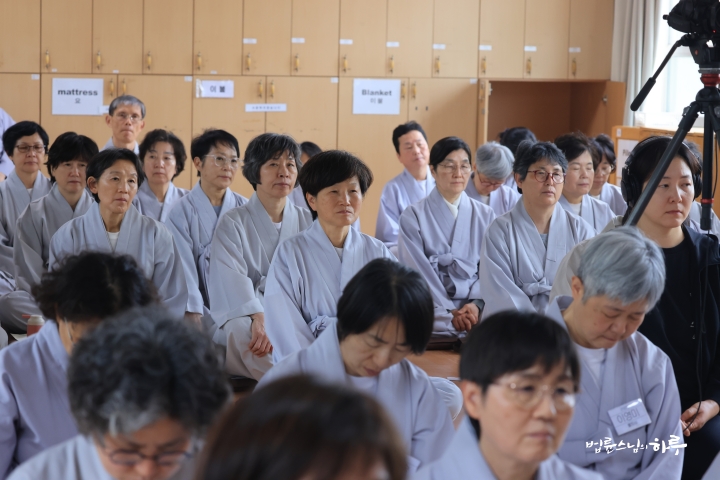
You are Mahayana practitioners, that is, those who walk the path of bodhisattvas, so you are permitted to practice while living at home and working. However, your mindset must be different from before becoming a Dharma Teacher. You must approach this as if a practitioner has been dispatched there to help those around them. You must carry out your work and family life with a compassionate heart toward others, not with a mind of competition, conflict, or expectation.
From today, you are practitioners who have severed ties with the secular world, taken refuge in the Buddha, and accepted the Buddha as your teacher. In practical terms, you should study while regarding the guiding Dharma Teacher and your assigned Dharma Teacher as your teachers. I hope you will live well as Haengja for this one year.
Mahayana Buddhism does not compose the Sangha only of monks but of bodhisattvas. Currently, Jungto Society’s Sangha is composed of Dharma-spreading Haengja, but more narrowly, Jungto Society’s Sangha will become the Dharma Teacher corps. Since you will become objects of refuge for the community, not only your visible words and actions but also your perspective on things must change. If until now you were evaluated by your administrative ability—whether you do things well or poorly—you must let go of that. What becomes important is whether you can become bodhisattvas who maintain a practice perspective and look upon the community with compassion. Please keep this in mind. I will conclude here, and now we will proceed with the ordination ceremony.”
After the opening Dharma talk ended, the ordination ceremony proceeded. Everyone rose from their seats and began the ordination ceremony following Sunim’s guidance.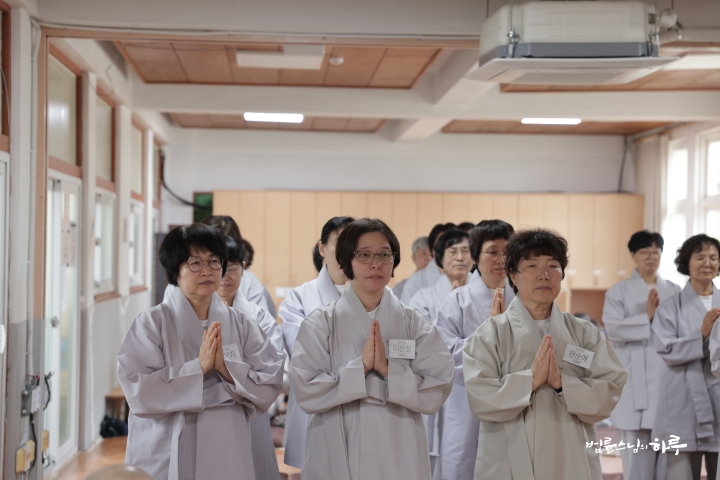
“First, you must sever all worldly karmic connections you have made until now and form relationships anew. First, by offering three prostrations to your parents here, you will sever the parent-child relationship and regard them as you would any elderly person. Let us offer three prostrations of gratitude for their kindness until now.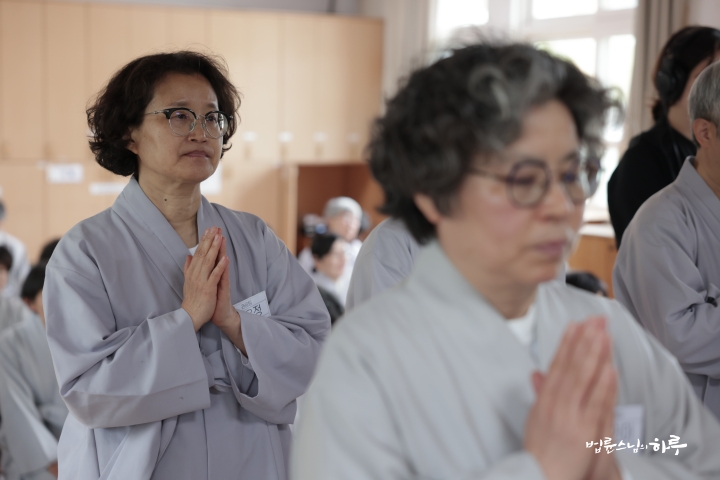
Second, let us offer three prostrations to sever the marital bond with the wife or husband with whom you have lived well as a married couple. Let us offer three prostrations saying, ‘Dear, thank you for everything. I will now live as a practitioner.’ 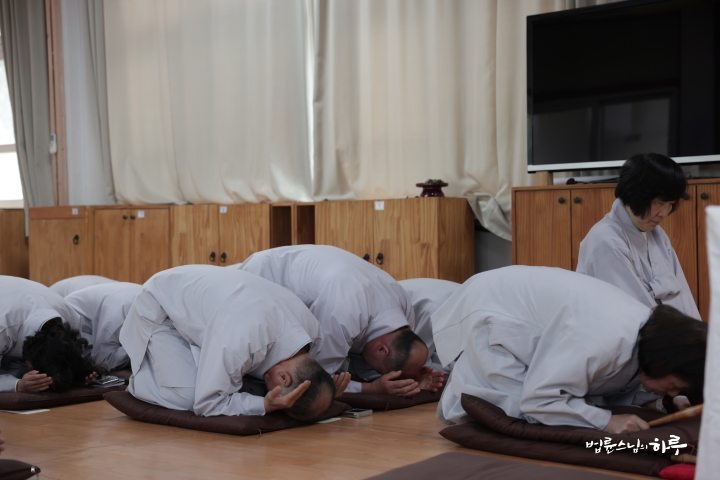
Third, you will also sever the connection with your children. Until now, whether you did well or poorly, you have cared for and raised your children. Now let them each live their own lives. I am a parent to all sentient beings, no longer just a parent to one son or daughter. Let us offer three prostrations to sever the connection with our children.
Finally, you will now sever connections with all relatives and friends. You will view all sentient beings equally without seeing anyone as special. Let us express gratitude to all people with whom I have formed connections in this world and sever those ties. 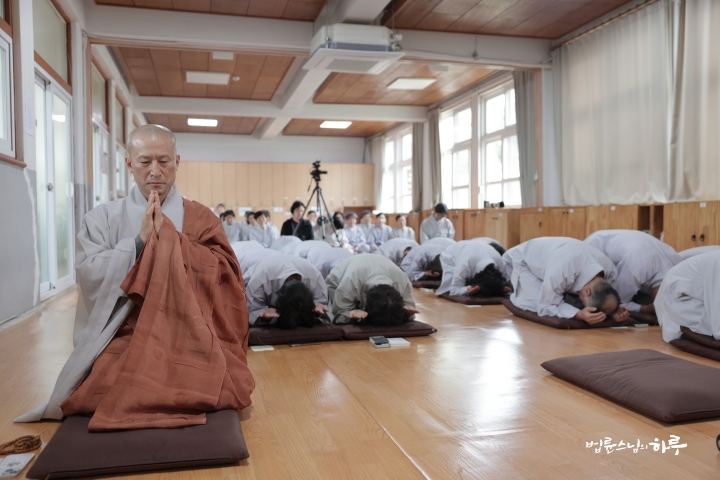
Now you have become free. You have become a practitioner. Now, cutting off all karmic connections and letting go of everything, I will serve only the Buddha, the great teacher of the three realms, as my sole teacher. Let us offer three prostrations to the Buddha. 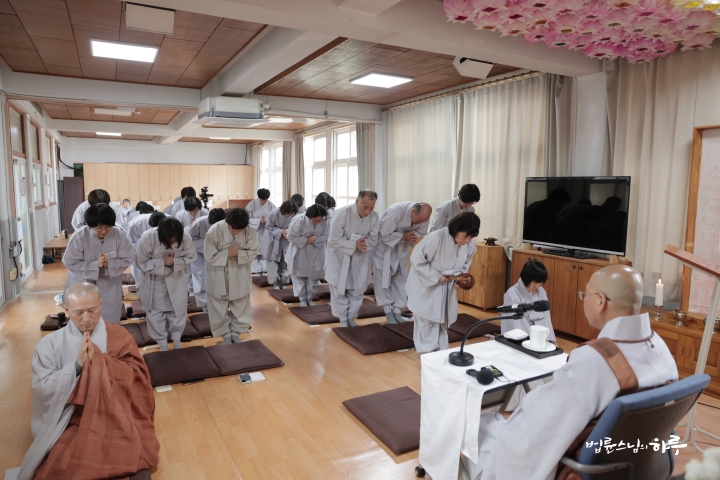
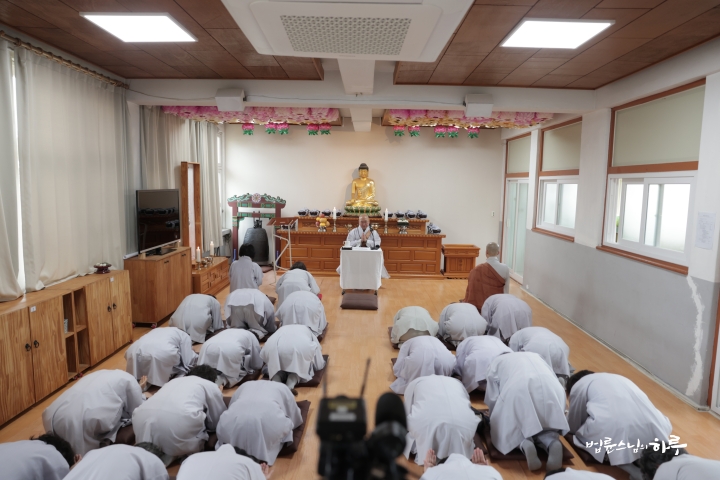
If I judge what is right or wrong about a teacher, even the Buddha cannot be my teacher. If I have no mind of judgment, even a passerby can become my teacher. A teacher doesn’t have to be excellent; they become a teacher when I serve them as one. Let us offer three prostrations to serve the guiding Dharma teacher as our teacher. 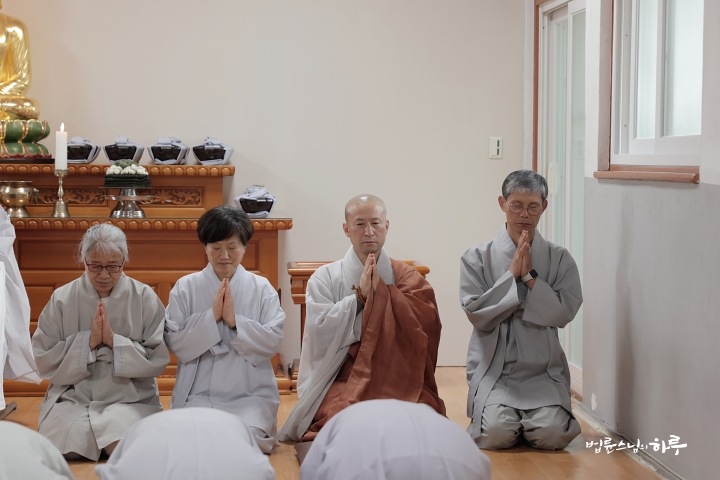
Since the guiding Dharma teacher cannot always be with you, we will divide into five groups and assign Dharma teachers to educate you. Let us offer three prostrations to serve the five Dharma teachers and the head of the Dharma teacher group as our teachers and practice diligently.” 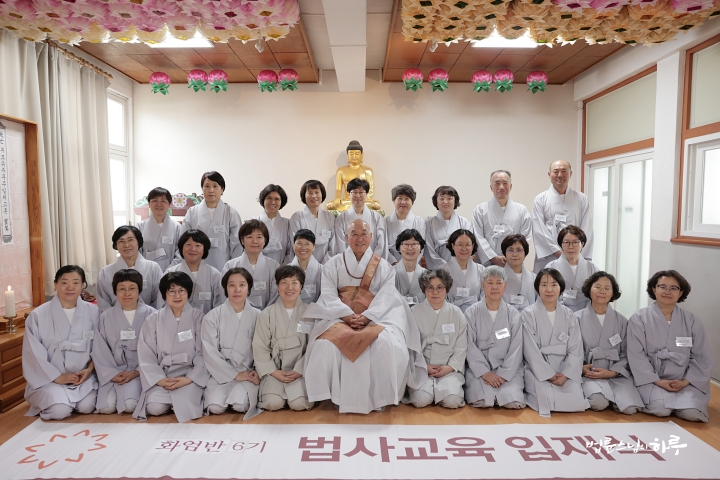
The haengja practitioners completed all the ceremonies well following Sunim’s guidance. They then recited the Four Great Vows and concluded the 6th Hwaeom Class Haengja Opening Ceremony with a group photo.

After the opening ceremony, Sunim immediately changed into work clothes and began working. The lettuce in the lettuce field had grown even greener and denser than yesterday. Sunim picked the outer leaves of the lettuce and harvested just enough for lunch.
After lunch and a short rest, Sunim prepared for tomorrow’s Peace Foundation researchers’ workshop. First, to check the accommodations, he inspected the rooms with Dharma Teacher Hyangjohn and arranged necessary items.
After taking a short rest, Sunim left for the Design Center around 5:30 PM for the “Happy Dialogue” lecture in Busan.
He arrived at the Busan Design Center at 7:00 PM.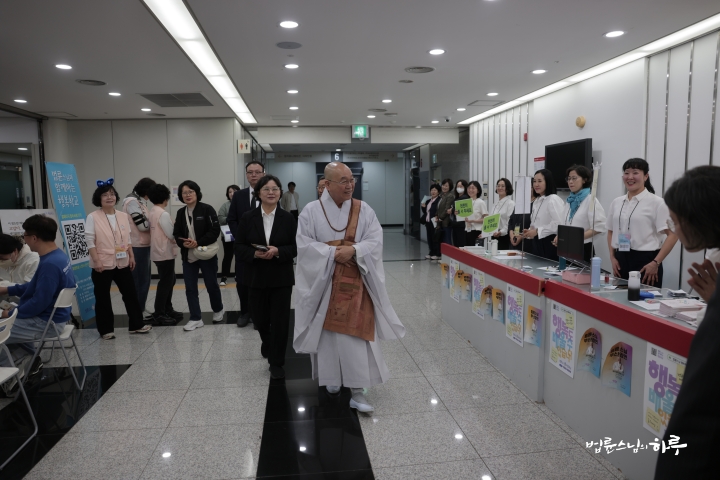
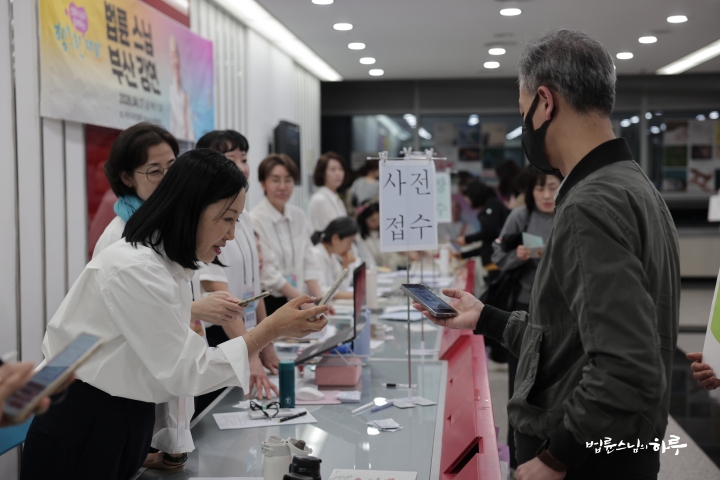
Sunim greeted the volunteers in the lobby and entered the speaker’s waiting room.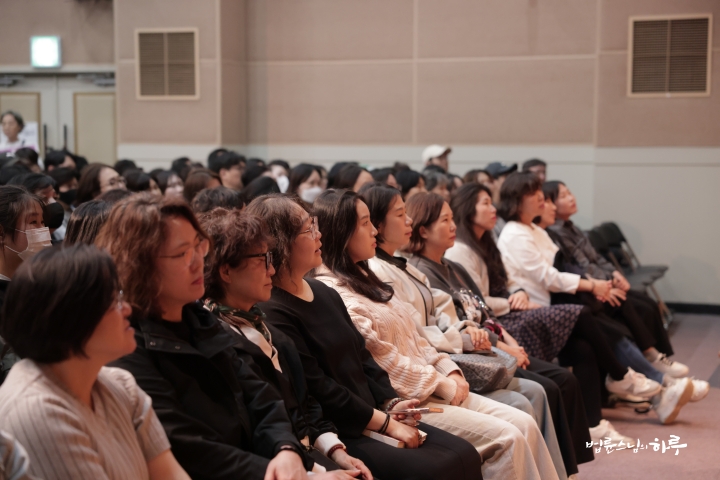
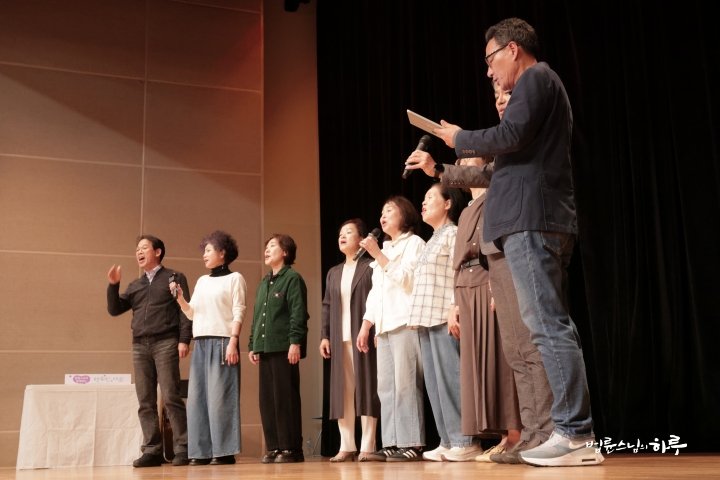
Before Sunim’s Dharma Q&A, there was an a cappella performance by the “Marine Muse Choir,” a performance group actively involved in local cultural revitalization and talent donation. As the performers and audience sang together, the initially awkward atmosphere seemed to ease a bit.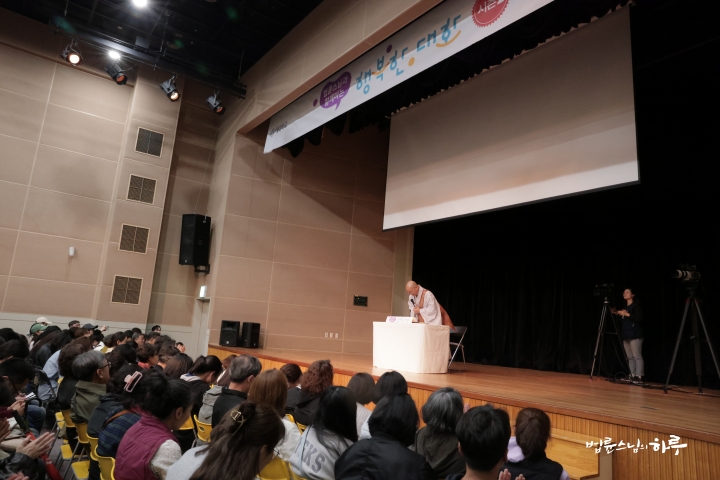
At 7:30 PM, the Dharma Q&A began with an introduction video of Sunim. All 550 seats were filled. Five pre-registered questioners and eight on-site questioners had conversations with Sunim. Among them, here is a question from a woman concerned about her high school daughter.
How Should I Deal with My Sensitive High School Daughter?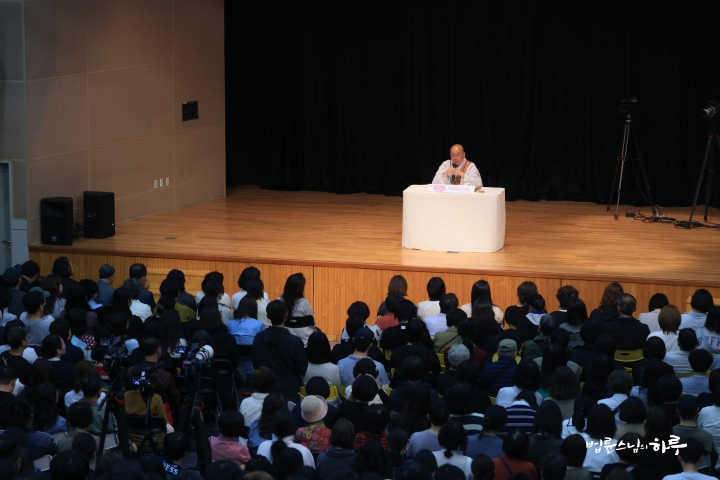
“Answer my questions. Who gave birth to this child?”
“I did.”
“Who raised her?”
“I did.”
“Then, who do you think she takes after?”
“I don’t think it’s me. (Audience laughs)”
“A mother dog gives birth to and raises puppies, but they don’t turn out to be cats. If I gave birth to her and raised her, she basically grew up under my influence. If a grandmother or nanny had raised her, she might have been influenced by them. But if that’s not the case, humans basically grow up by watching and learning. So this problem might have arisen because she takes after me. If so, it’s better to first reassure yourself by thinking, ‘I’m living well like this, aren’t I? So you’ll eventually live well too.’
Second, looking at your child’s symptoms, there’s a possibility she might have some mental health issues. So rather than scolding or trying to persuade her, you should first consult with a doctor and have her receive counseling or treatment at a hospital. If she has severe lethargy despite trying, she needs to be treated with a doctor’s help; she can’t manage it on her own. 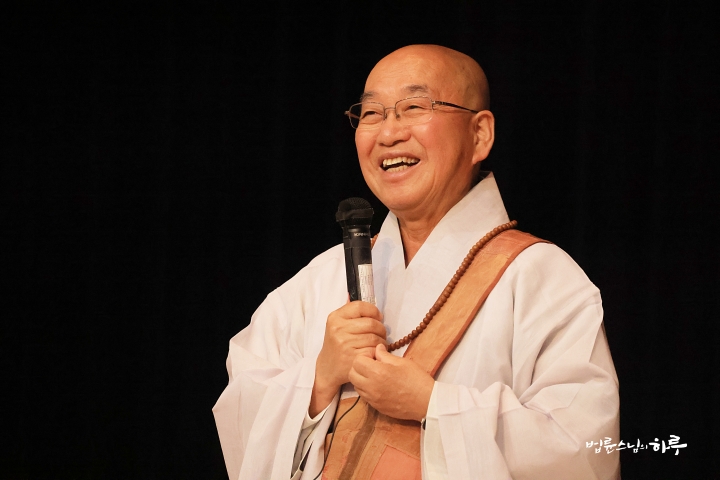
For example, if a diabetic patient’s blood sugar drops, can it be resolved by saying ‘Just tough it out with willpower’? Or if someone is injected with a substance that induces sexual arousal and told to ‘control your urges,’ would that person be able to resist? No, they wouldn’t. When there’s a physical abnormality causing certain substances to be overproduced or underproduced, self-control can become difficult. 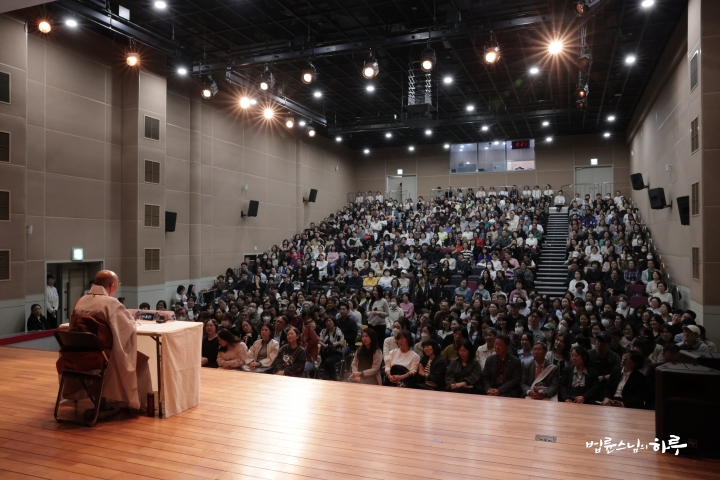
So it’s necessary to first examine the child’s health condition. You need to determine whether the child’s lethargy is depression or if they’re in this state due to some other illness.
There are generally two main causes for such problems. One stems from physical conditions, and the other from mental issues like upbringing environment or trauma. If it’s a physical cause, medication is necessary, but if it’s environmental or psychological, counseling or psychotherapy is needed. However, if you try to solve a problem that requires medical treatment through counseling alone, will it be effective? It won’t. This is why there are some issues with psychiatric treatment in our country. Only psychiatrists can prescribe medication, while counselors don’t have that authority. Problems that could be resolved relatively simply with medication might be addressed by counselors for months without much effect. Conversely, psychiatrists usually don’t have time for lengthy conversations with patients, so they typically have brief discussions and immediately prescribe medication. This leads to a medication-centered approach. As a result, we see overprescription of medication on one side and excessively prolonged counseling on the other. 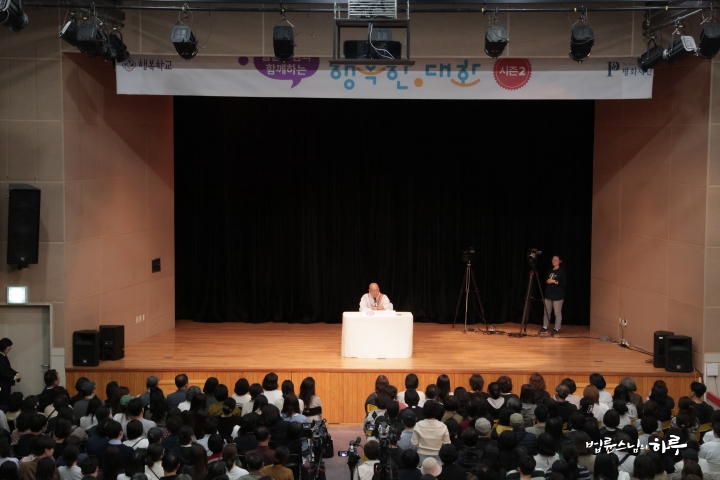
However, in foreign countries, psychiatrists and counselors work together as a team. The counselor first provides thorough counseling, and then the doctor reviews the results to decide whether to proceed with counseling therapy or medication.
So counselors talk with their clients, and if they determine that medication is needed first, they immediately refer them to a psychiatrist. When I listen to your stories, there are times when I tell you to go directly to a psychiatrist for a checkup. You also need to take your child to the hospital first to get checked.”
“We went to see a psychiatrist.”
“What did the psychiatrist say?”
“Yes, my child said she thinks she’s not smart or has ADHD, so we had her tested, but there was nothing wrong.”
“Don’t just go to one hospital; try another psychiatrist too. Mothers tend to look at their children with preconceptions. In other words, mothers tend to see their children thinking ‘there’s nothing wrong with my child,’ so a mother’s observation and judgment aren’t accurate. 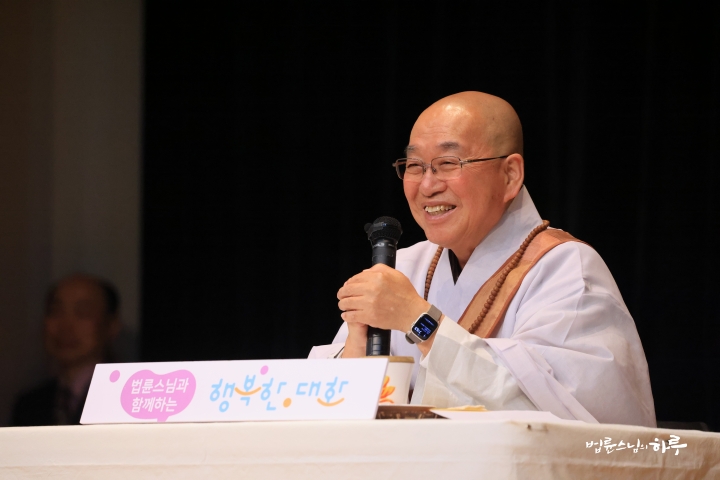
For example, can an alcoholic or drug addict overcome their addiction just by making resolutions or determinations? They can’t. They need to be isolated or receive help from a third party. Similarly, your child may be in a state where he needs help, so confirmation from a hospital is necessary. If it turns out to be a temperament or tendency, then you as the mother need to acknowledge and accept it. ‘Yes, I’m living well, so you’ll live well too.’ You need to let it be like this. When someone is a patient, there are things to help with, but when they’re not a patient, you don’t need to worry about it. For example, if young people suffer after breaking up in a relationship, this isn’t something you can help with. However, if it develops into depression or mental illness, you need to help them get treatment at a hospital. If not, you just need to leave them alone. After suffering for a while, they’ll come to their senses on their own. Since healing occurs naturally over time, there’s nothing to blame. By going through these experiences once or twice while meeting people, they learn on their own how to handle human relationships. Parents shouldn’t interfere with this learning process.
To summarize, first go to a psychiatrist for an examination and also consult with a psychological counselor. If you do this and find nothing wrong, that’s fortunate. After that, it would be good to understand it as your child’s tendency or characteristic and have the perspective that you need to care for your child based on this understanding. 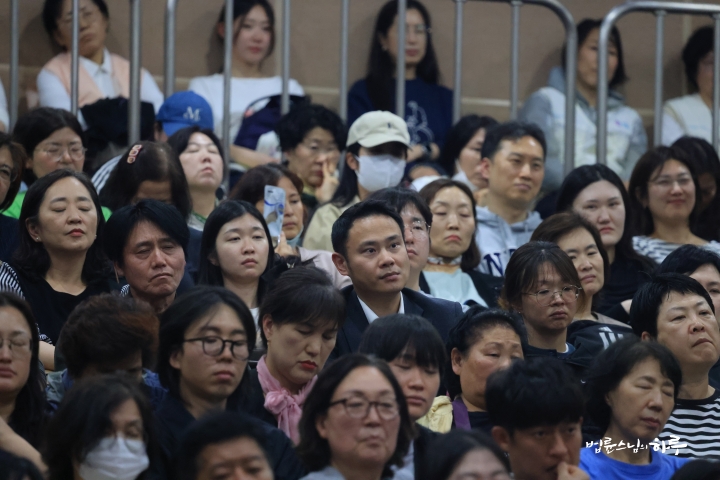
Don’t set a goal to ‘enlighten your child.’ Enlighten yourself instead. (Audience laughs)”
It’s not right to keep telling others to become enlightened when you haven’t achieved enlightenment yourself. It’s also dangerous to think that you can make others enlightened. I don’t think about enlightening you either. I’m simply having a conversation with you, and during that process, you may enlighten yourself at times. Enlightenment is self-realization. It’s something you realize on your own, not something someone else can do for you. Have many conversations with your child, but instead of telling them what to do, just listen. Through that process, the child might think to themselves, ‘Am I receiving these results because of the karma I’ve created?’ or ‘Am I being too greedy?’ But if the mother says, ‘You need to study to get good results! It’s foolish to expect good results without studying hard!’ the child cannot become enlightened. They just become discouraged. Like this, enlightenment happens when, during conversation, one starts to think about themselves – ‘Am I being stubborn?’ or ‘Am I being greedy?’ – that’s when they take a step toward enlightenment. Enlightenment without self-realization is impossible. You cannot help someone become enlightened. You can only create an atmosphere for it. I’m not enlightening you. Through our various conversations, you realize on your own, ‘Oh, it wasn’t a big deal after all.’ The highest enlightenment is knowing ‘It’s not a big deal.’ Since it’s not a big deal, there’s nothing to solve. This is the highest enlightenment.
A lower level of enlightenment is ‘Oh, I can do it this way.’ In other words, you’ve found your own solution. But after finding your own path, you mistakenly think ‘Sunim gave me the perfect answer.’ However, ‘I can do it this way’ is not the highest enlightenment because it requires effort to do so. But when you realize ‘It’s not a big deal,’ there’s nothing to do from the beginning.
Like this, you shouldn’t think about enlightening your child. Don’t try to change your child, but be able to listen carefully to your child’s story from an equal position. When you do this, an atmosphere is created where the child can become self-aware at some moment. Only then can enlightenment occur.”
“Thank you.”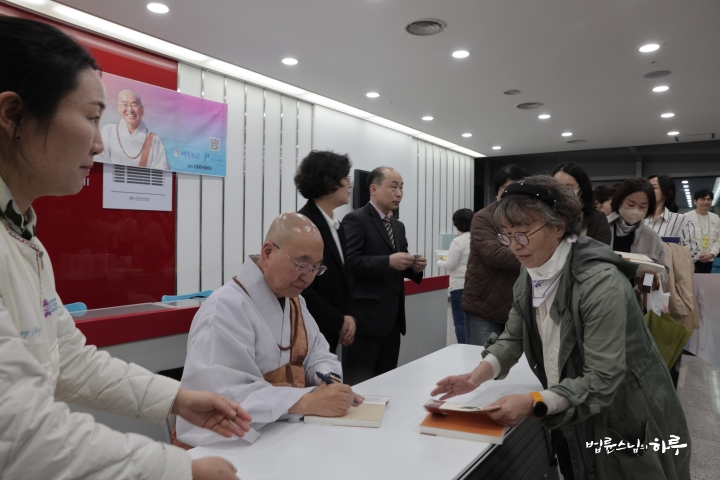
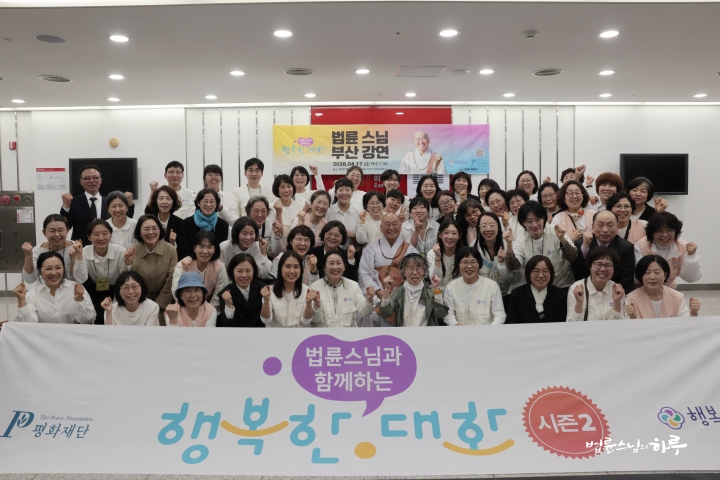
After finishing the Happy Dialogue, Sunim held a book signing session in the lobby and took photos with the volunteers who worked hard to organize today’s lecture.
It was 10:30 PM when he arrived at Dubuk. Sunim washed up and concluded his day’s activities.
Tomorrow, there will be a lecture in Tongyeong at 2 PM, and it’s the day when the Peace Foundation researchers begin their two-day, one-night workshop.