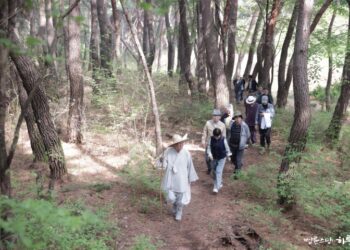

Apr 16, 2026 – Pruning Kalopanax Trees, Spring Outing with Dubuk Elders, Time with the Lay Sangha Dharma Teachers
Hello. Today is the day for a spring outing with the elders of Dubuk. Since Sunim needs to go on the spring outing with the elders starting at 8 AM, he completed his morning practice and meditation, then immediately changed into work clothes and began pruning the kalopanax tree branches around his house at 6 AM.
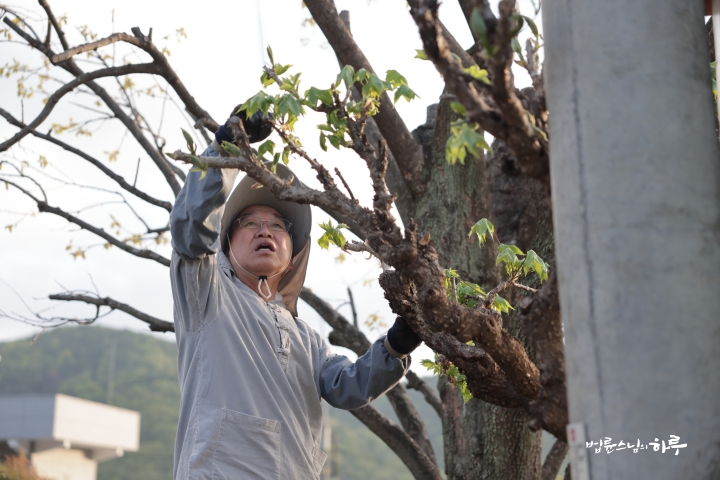
If kalopanax trees are not pruned at the right time, the branches grow only upward, making it difficult to harvest kalopanax shoots in spring and reducing the yield. Sunim climbed up a ladder and cleanly cut off the kalopanax branches that were growing too tall.
By pruning this way, the tree stops growing upward, and several new branches sprout from that spot. Then next year, the tree spreads out sideways in a lower shape, making it easier to pick kalopanax shoots and increasing the yield, so timely pruning is important.
“The grandmother next door did a really good job pruning her kalopanax trees. She’ll probably harvest five times more kalopanax shoots than us this year. (Laughter)”
Sunim cut thick branches with a chainsaw and trimmed smaller branches with large pruning shears, shaping the tree as he went.
“It would be nice to keep this branch, but if I do, it will extend into the village road and might inconvenience people passing by.”
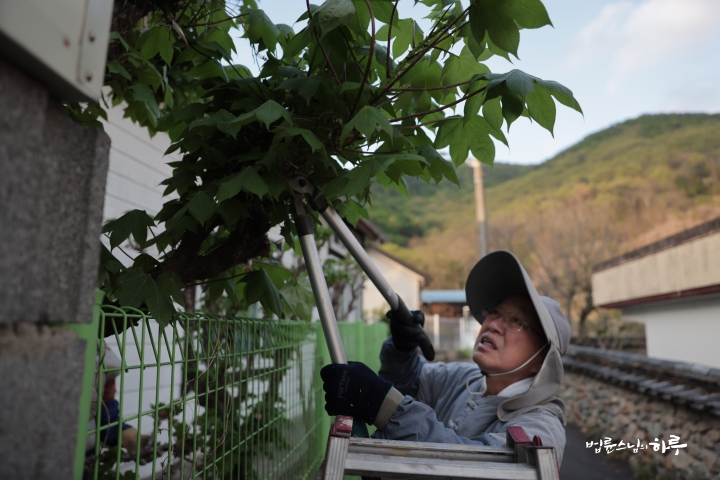
Sunim cut off all branches that might obstruct the paths used by village elders. As a result, the tree looked somewhat smaller, but it couldn’t be helped.
After spending a full hour pruning kalopanax trees, Sunim prepared to take the Dubuk elders on their spring outing.
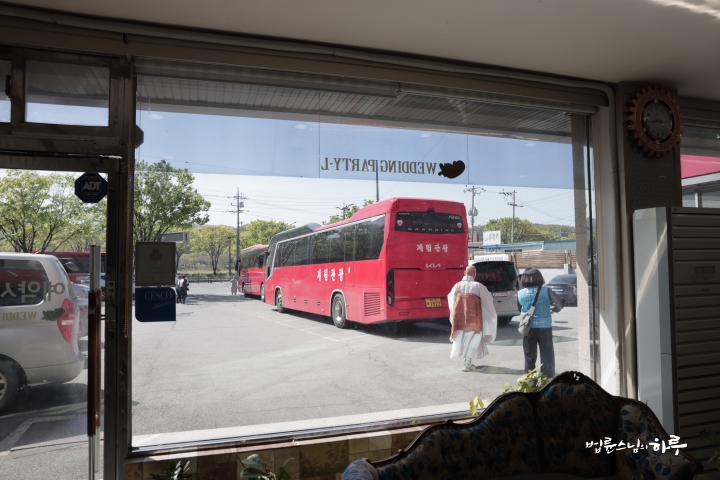
Starting around 7:20 AM, two buses made rounds to each village hall to pick up the elders. Volunteers from the Busan and Ulsan regions had already arrived at Dubuk Jungto Retreat Center early and were preparing to welcome the elders.
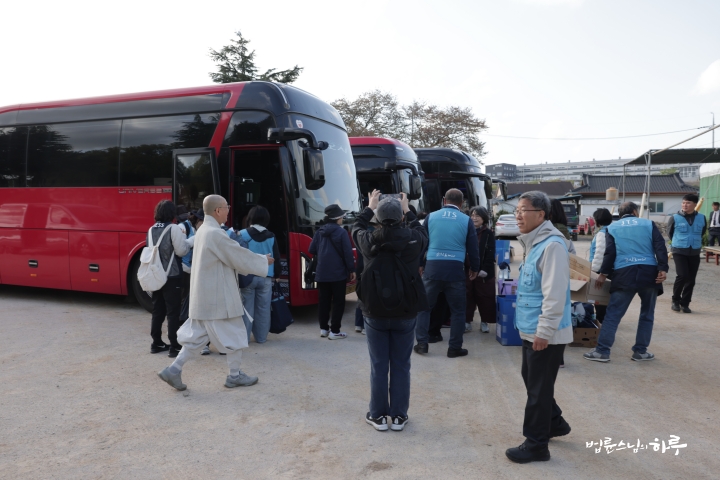
Elders living near the retreat center began walking in one by one around 7:40 AM. The elders, who usually wear work clothes while farming and staying at home, had neatly groomed their white hair today, applied a bit of hair oil and combed it, dressed in clean outerwear, and each carried a small backpack, having prepared in their own way for the outing.
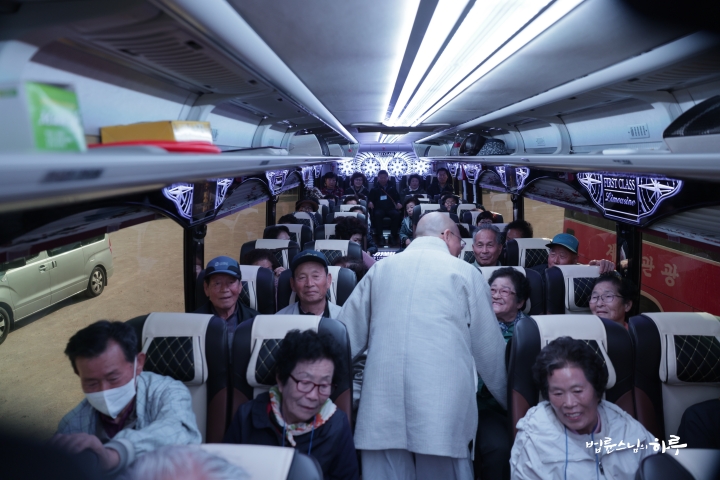
Around 7:50 AM, Sunim also arrived at the retreat center and went around to each vehicle to greet the village elders.
“Hello. Welcome. (Laughter)”
The elders each clasped Sunim’s hands in greeting.
“Sunim, thank you for taking care of us like this every year.”
About 150 village elders from 12 villages boarded three buses, and the spring outing began. The first destination was Bogyeongsa Temple in Pohang. As soon as Sunim finished greeting the elders, he departed first for Bogyeongsa Temple. He wanted to arrive early and survey the temple grounds before the elders arrived.
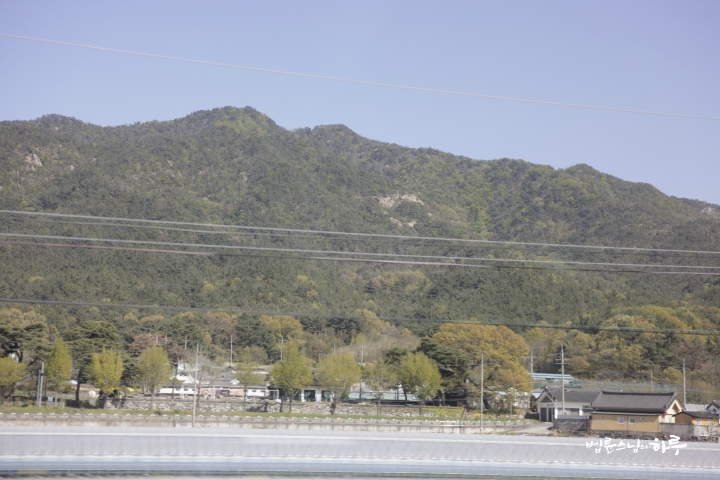
Arriving at Bogyeongsa Temple around 9:10 AM, Sunim got out of the car with just his walking stick and hat and began touring the grounds. Hearing that the elders would enter through the One Pillar Gate when the buses arrived, Sunim started his quick tour from there.
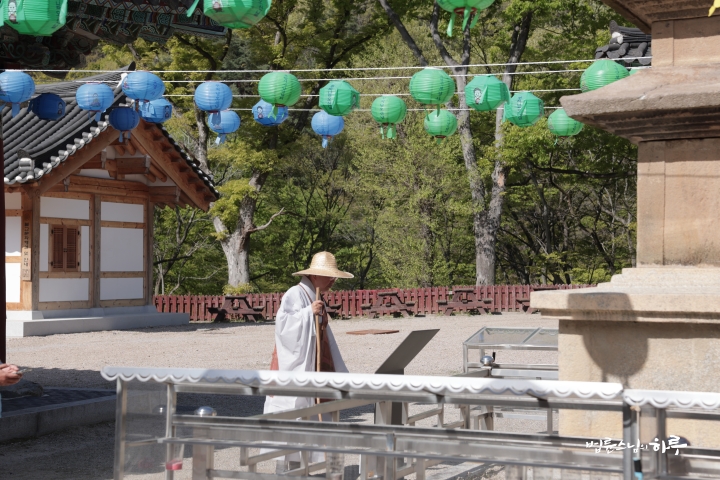
The Bogyeongsa Temple guide team leader, who knew Sunim was coming, welcomed him and explained about the temple grounds.
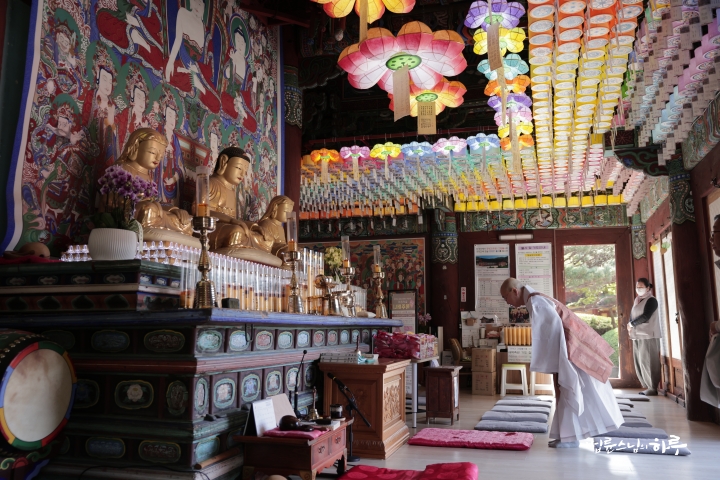
Sunim moved to the Main Buddha Hall to pay respects and check if there was enough space for all the elders to enter. It seemed too cramped for all the elders to enter. Fortunately, the direction of the sun and the lanterns installed in front of the Main Buddha Hall created shade, so it seemed suitable to gather the elders in the front courtyard for the temple visit and take a group photo.
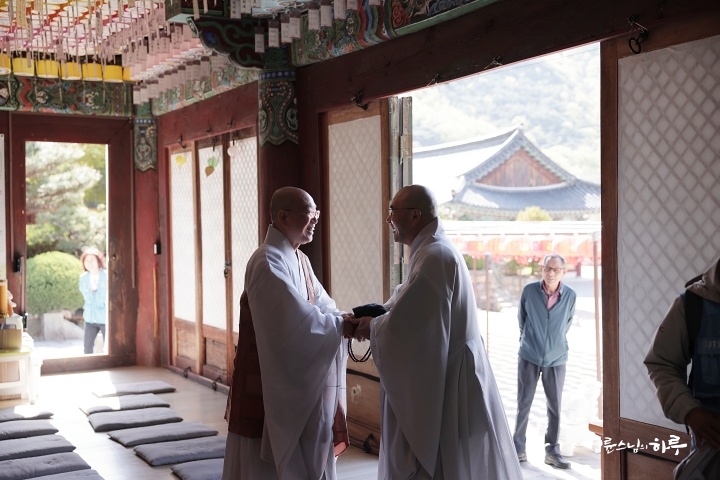
As he was leaving after paying respects at the Main Buddha Hall, the abbot of Bogyeongsa Temple, Venerable Tanwon, entered and greeted Sunim.
“Hello, Venerable Pomnyun Sunim. Did you make it okay?”
“Hello, Venerable. How have you been? Today is the day for a spring outing with the village elders, and we came to show them around Bogyeongsa Temple.”
“Yes, Sunim, I heard the news in advance. Welcome. Since you arrived early, would you like to have some tea?”
“No, thank you. I came early to look around and guide the elders through the temple grounds.”
“Then let me help you, Sunim.”
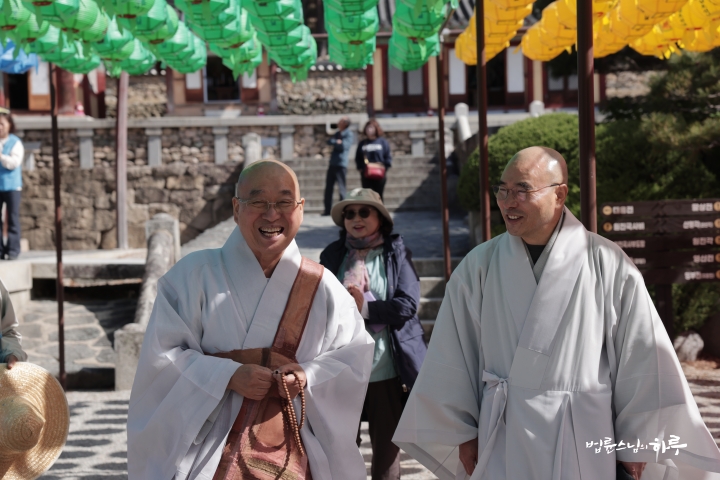
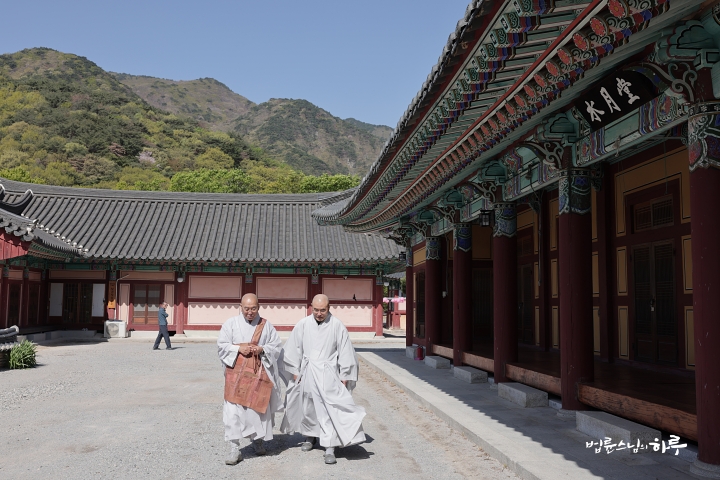
Sunim began touring the Bogyeongsa Temple grounds with Venerable Tanwon. Bogyeongsa Temple in spring was surrounded by mountains full of green and fresh light green. Thanks to the trees densely filling the mountains, the mountain ridges were soft and abundant, making it seem as if the temple grounds were embraced in the mountains’ arms.
“Sunim, what about lunch? Should the temple prepare something?”
“No, the elders came today to eat delicious food and have a good time. (Laughter) We need to prepare various foods abundantly for them, so I’ve already reserved a buffet restaurant in Gyeongju. We’ll give them time to sing, dance, and have fun. (Laughter)”
“As expected, Venerable Pomnyun Sunim thinks differently. (Laughter)”
“I converted a closed school into a retreat center and started volunteering for the elders there for the first time. Initially, I heard that rural elders enjoyed playing gateball, so I built a gateball court at the school. After building it, I found that the township office had a very well-equipped gateball court, so all the elders went there. (Laughter) Thinking it would be difficult for elders living in the countryside to go out for a bath, I installed bathing facilities in the school classrooms, but they chartered buses to go to hot springs for bathing. (Laughter) So the facilities prepared at the school became useless. That’s how much Korean society has changed. I didn’t really know what the elders wanted. (Laughter) Since then, twice a year, we’ve been running outing programs where we listen to the elders’ stories, eat delicious food, and get some fresh air. It’s already been 20 years. Before I knew it, I’ve become an elder myself. (Laughter)”
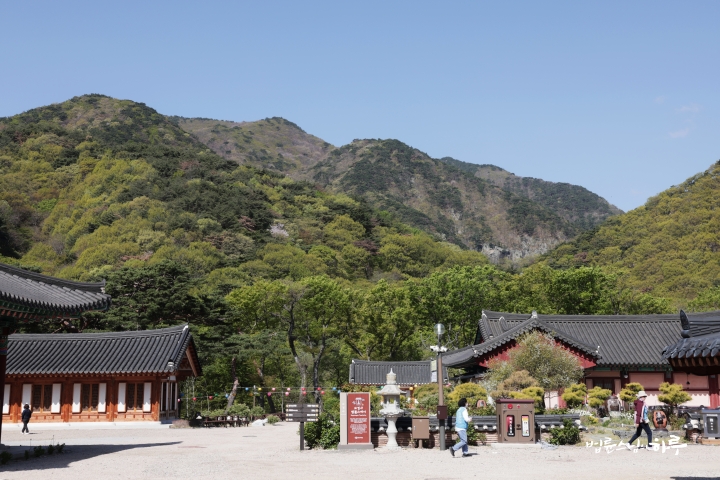
While taking in the peaceful and beautiful scenery of Bogyeongsa Temple, the elderly began entering the temple grounds. Sunim and Tanwon Sunim greeted the elderly at the Iljumun Gate and offered welcoming remarks.
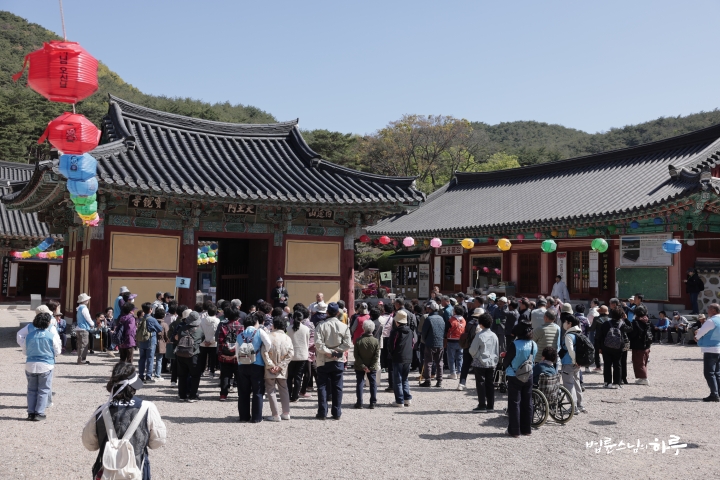
“You’ve come out for a spring outing today, and this is Bogyeongsa Temple. It was first built during the Silla Dynasty. The temple was rebuilt for the second time during the Goryeo Dynasty, and after the Japanese invasions, when the temple suffered significant damage, it was reconstructed for the third time during King Sukjong’s reign. From this wall to the area where major construction is currently underway, that’s all new construction. What we’ll be touring today are the old structures. Whether well-built or not, we’ll be looking at the old buildings (laughter). The mountain you see behind Bogyeongsa is Naeyeonsan Mountain. Naeyeonsan is famous for its beautiful valleys. But now that we’re all getting old, climbing mountains might be difficult for us (laughter).”
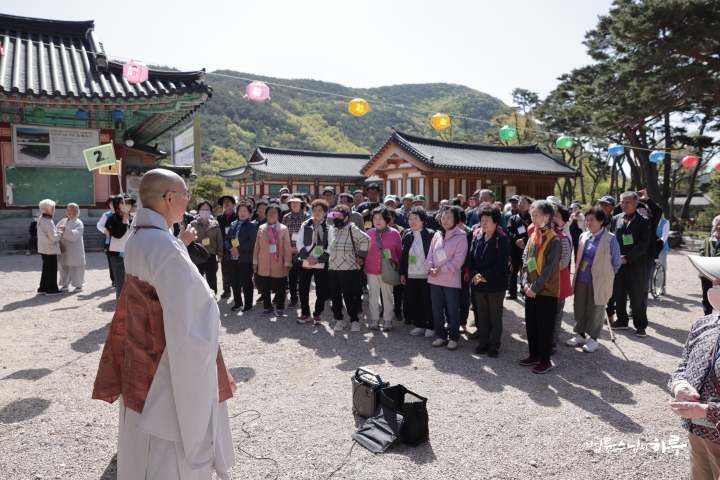
Sunim explained the path from the Iljumun Gate to the Main Hall and continued with information about the day’s schedule.
“We’ll go to the Main Hall to bow to the Buddha. While alive, don’t you want to be healthy? Though you might not want to live too long? (laughter) When I ask elderly people approaching 100 years old, they all say, ‘Why won’t I die?’ (laughter) Not being sick is what’s important. So when we go to the Dharma Hall, we’ll pray and bow to the Buddha for good health while we’re alive and for rebirth in the Pure Land when we pass away, then we’ll take a tour around the temple
And this year, I’m planning to take group photos in each village. Because every year when I go on these outings, there are too many people I don’t see anymore. So before the elderly pass away, I want to take a commemorative photo with the people from their village (laughter).
I heard everyone liked the restaurant we went to last year for lunch. So we’ll go eat in Gyeongju. Now let’s hear a greeting from the head monk of Bogyeongsa Temple.”
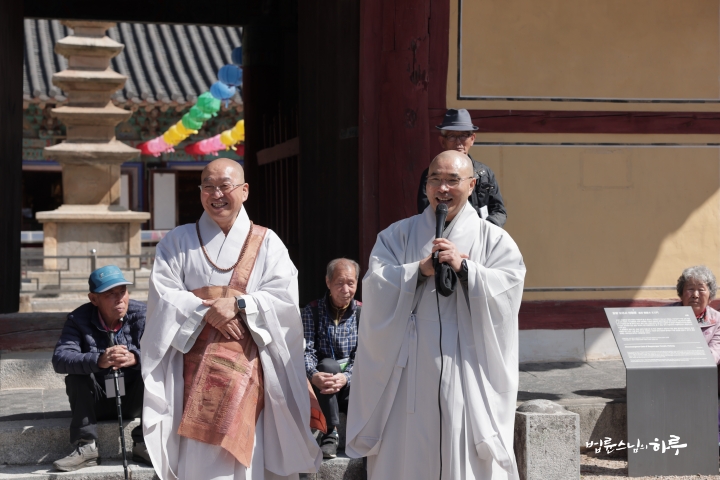
Tanwon Sunim’s greeting followed.
“Hello, elderly residents of Dubuk. I am Tanwon, the head monk of Bogyeongsa Temple. I was excited to hear that Venerable Pomnyun Sunim, whom I deeply respect, would be visiting Bogyeongsa today with all of you. It is truly an honor to meet Sunim like this. I had only seen Venerable Pomnyun Sunim from afar through TV or lectures, but this is my first time meeting him in person and having a conversation.
Today, before you all arrived, the Venerable Sunim arrived at Bogyeongsa first and walked around the grounds preparing for your visit. Watching this, I learned a great deal. Thank you sincerely for coming to Bogyeongsa. Naeyeonsan has wonderful energy. I hope you’ll receive healthy energy as you walk around and step on the ground here.”
Sunim continued speaking.
“After receiving the energy of Naeyeonsan, when we get to the restaurant, jump around and have fun (laughter). Now, let’s head to the Main Hall.”
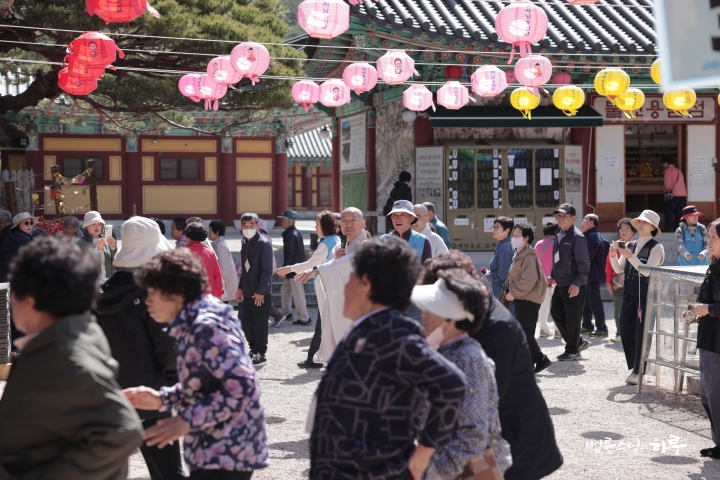
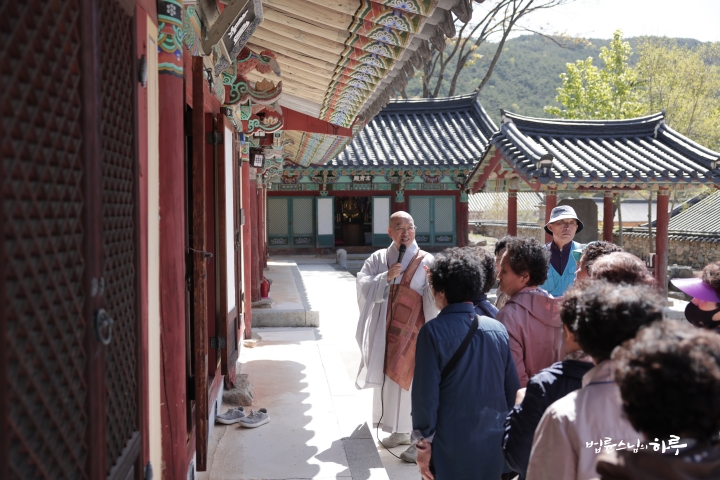
Sunim led the elderly to the Main Hall of Bogyeongsa Temple. As it happened, the noon service was being held, so Sunim joined the elderly in a brief meditation. After the meditation, Sunim offered prayers for the elderly to spend their remaining years peacefully without worries and in good health.
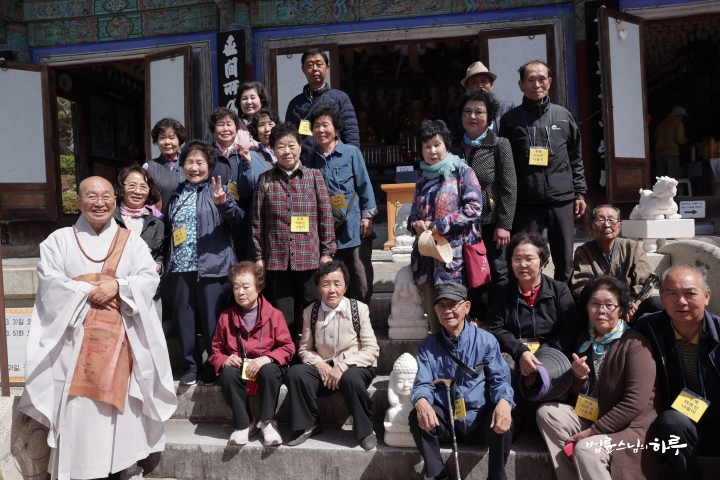
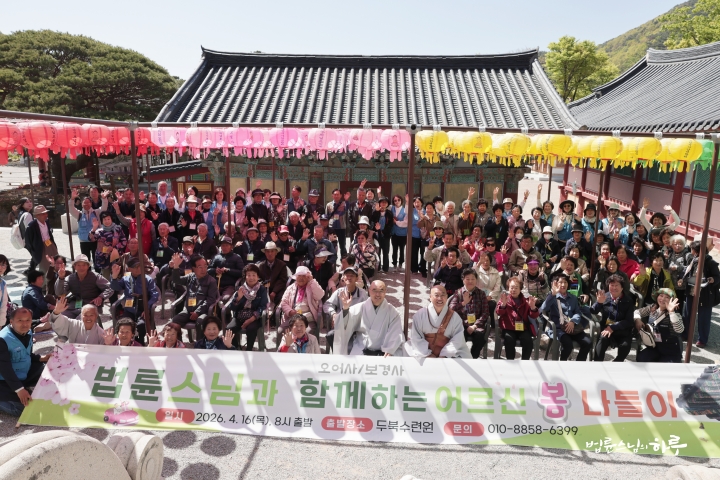
After the prayers and a tour of the temple grounds, group photos were taken in front of the Main Hall for each of the 12 villages.
“Now, let’s head down, stop by the restroom, and go have lunch.”
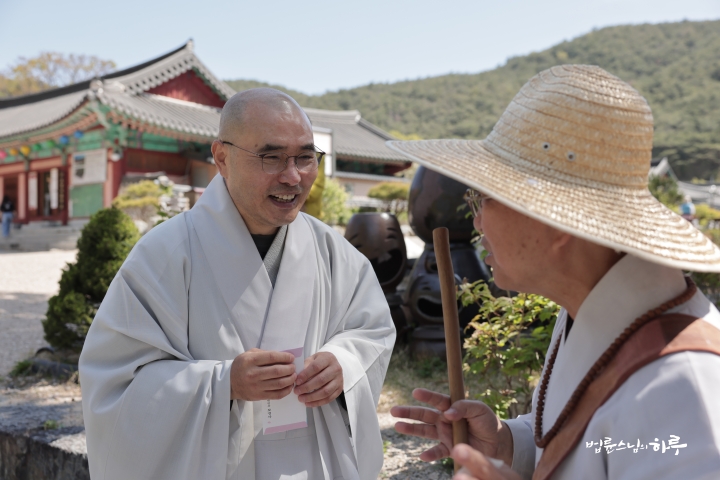
As Tanwon Sunim saw Sunim off, he offered a donation.
“Sunim, you’re doing such good work. I’d like to contribute a little.”
“No, thank you. You’ve allowed the elderly to visit and made sure they could tour comfortably. Thanks to you, we completed our schedule well. I should be the one making a donation to the temple.”
Sunim firmly declined Tanwon Sunim’s donation.
“Sunim, please come again anytime.”
“Yes, let’s meet again when there’s another opportunity.”
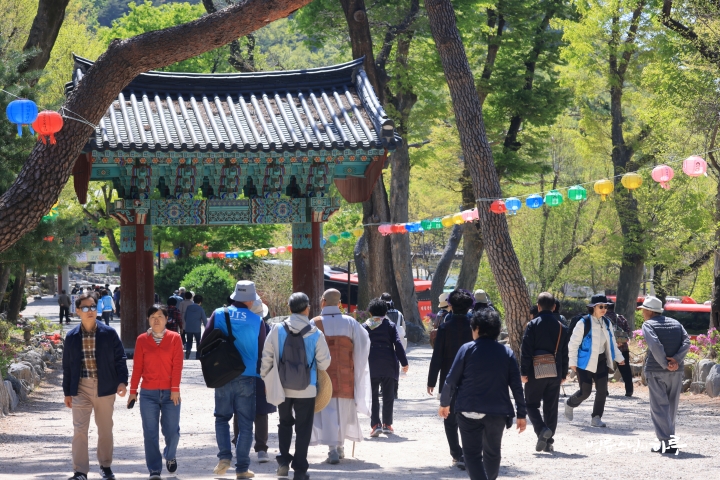
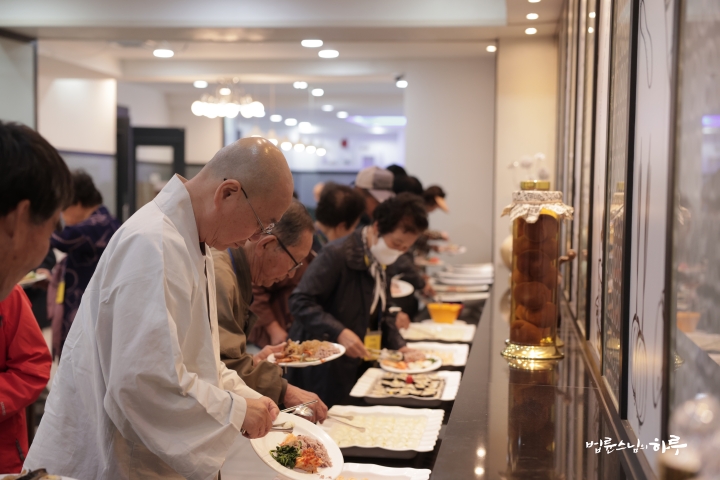
Sunim accompanied the elderly to Gyeongju. The meals were all prepared at the restaurant, and the elderly began eating as soon as they arrived.
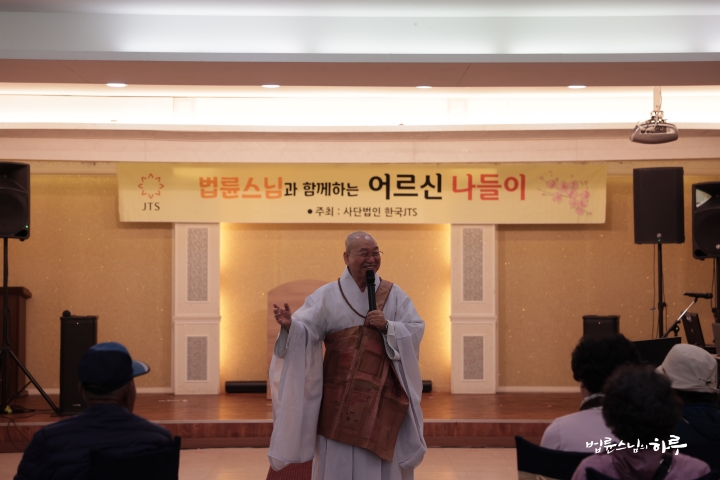
When the elderly finished their lunch, the atmosphere settled down somewhat.
“Did everyone enjoy their meal?”
“Yes”
“Good. Now, if anyone has worries or concerns these days, or if you have something you want to say or ask, please raise your hand and share. If there’s nothing special, we’ll sing songs and have fun before heading back. I thought I was healthy, but I’ve been continuously sick for the past few years. When I fix one thing, something else breaks down. So these days, I feel like I’m a car that should be scrapped but keeps getting repaired over and over (laughter). The day before yesterday, I went to Bongamsa Temple, and an elderly monk saw me and said, ‘Venerable Pomnyun Sunim, before 70, the mind leads the body, but after 70, you need to adjust your mind to your body. But you’re still dragging your body around according to your mind and overworking it.’ I got scolded (laughter). As we age, if we push too hard, things break down, right? So from now on, whatever you do, do it slowly and playfully. Understood? Now, let’s sing songs and have fun.”
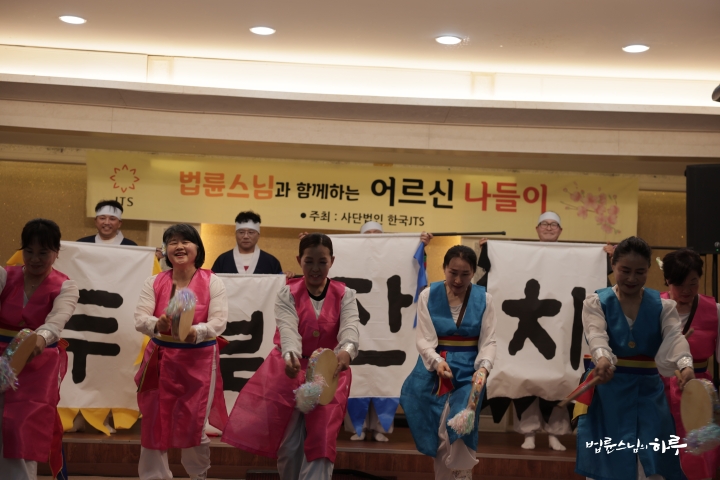
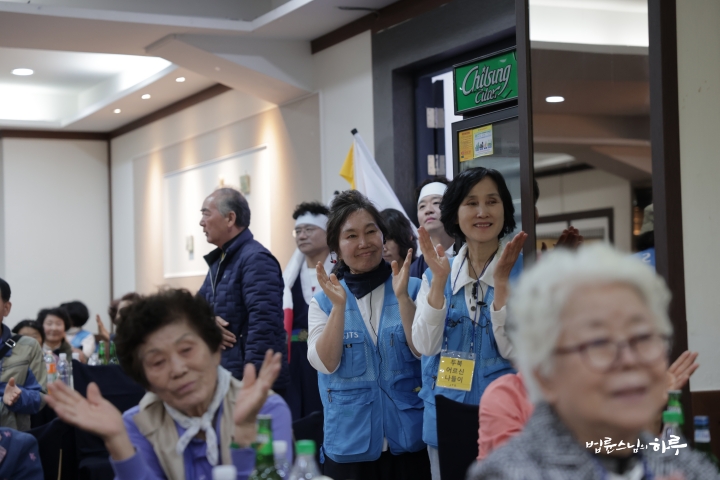
The senior citizens’ singing session began with an exciting performance by a cultural performance team formed around Lee Sujin (이수진), a member of the Daegu-Gyeongbuk branch.
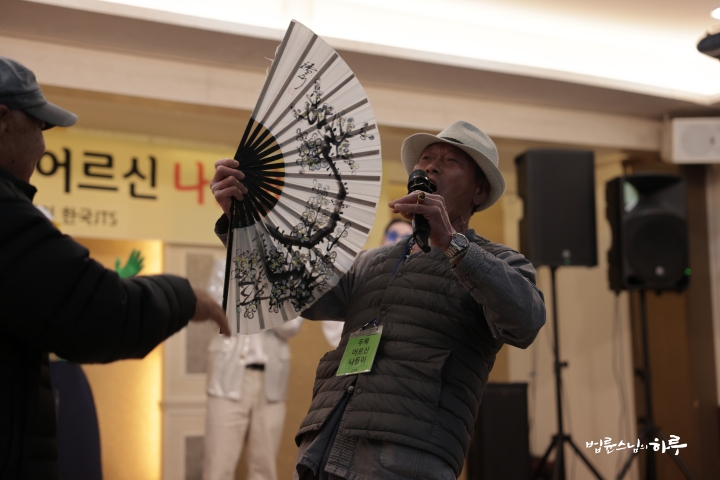
Following this, twelve performances were presented, with one person from each village. The rich melodies and lively dance moves, rivaling those of professional singers, made the singing contest even more enjoyable.
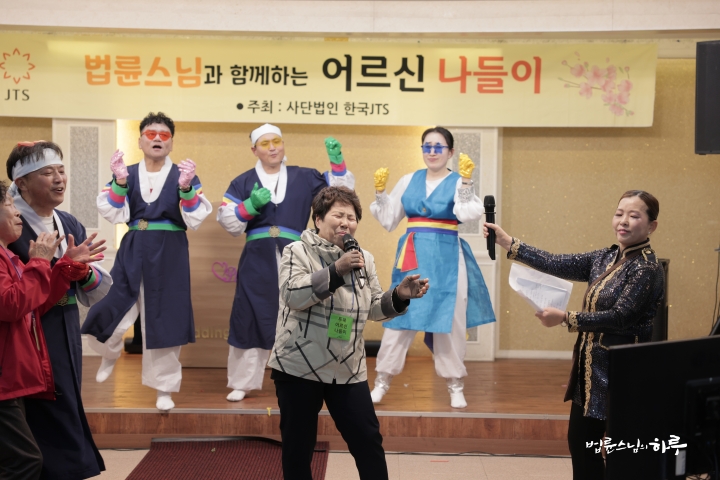
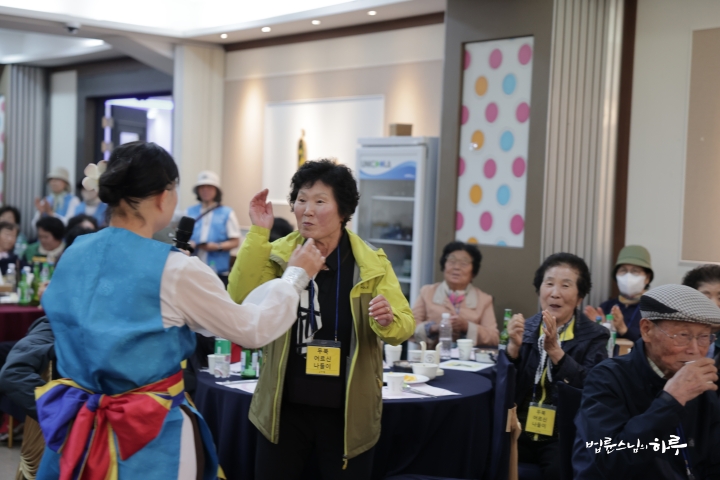
The elderly enjoyed the entertainment by holding hands with their neighborhood friends, dancing together, and singing along to songs they had never sung before.
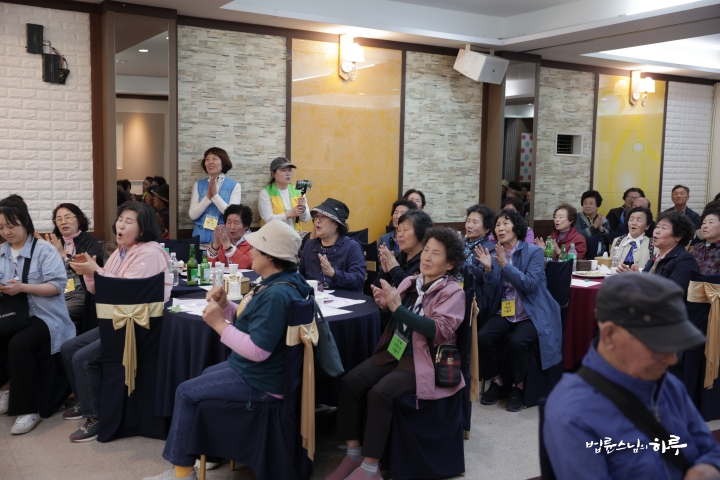
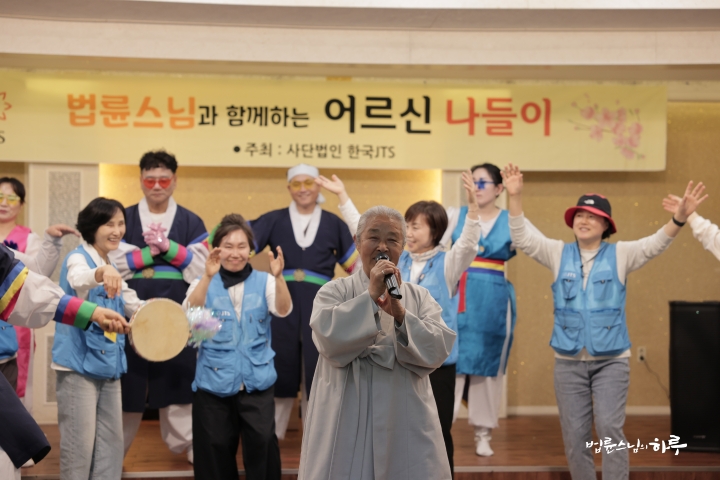
“Ya ya ya- What’s wrong with my age ♪ It’s the perfect age to love ♫ ♬ ? ?
One day, while looking at my reflection in the mirror by chance, I say ‘Time, get out of my way~♫ ♬ What’s wrong with my age? (…)”
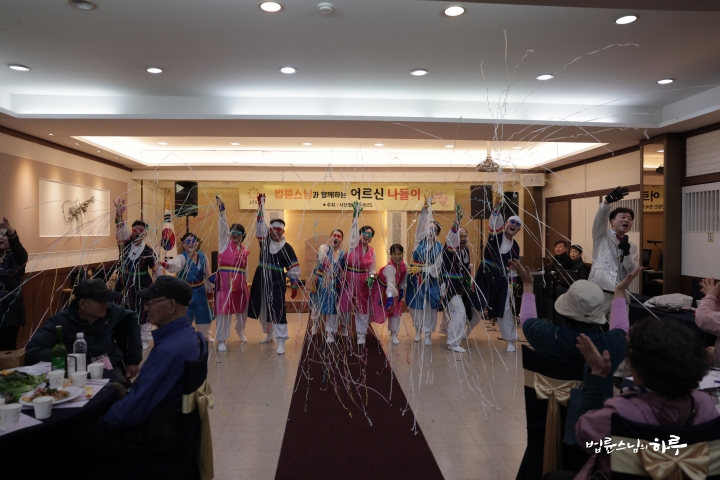
The singing session, which lasted nearly two hours, concluded with a performance by Jungto practitioners.
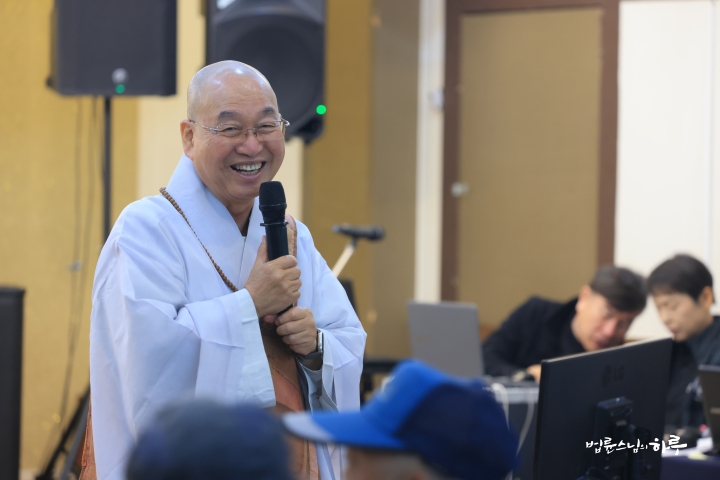
“Aren’t you grateful to the cultural performance teams who livened things up so you could have fun today? The elderly seem tired after all the fun (Laughter). We’ll wrap up here for today. Please always stay healthy and don’t overwork yourselves with farming in the countryside. Understood? When you get in the cars, we’ll take you back to your respective villages. See you in the fall. Thank you.”
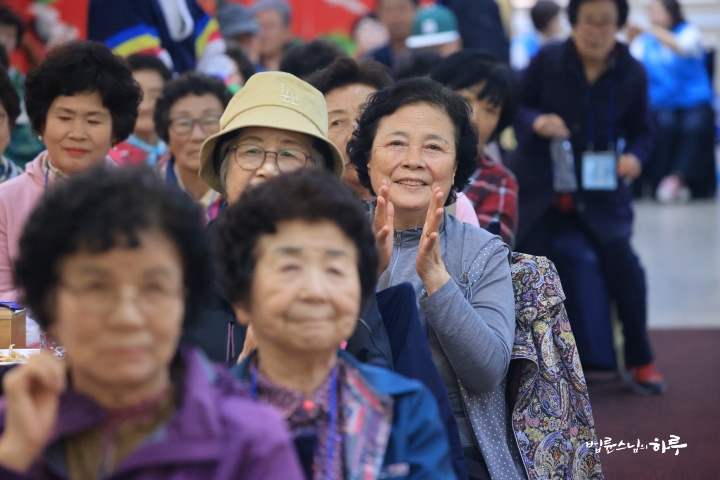
“Thank you, Sunim.”
“We had fun today and ate delicious food until we were full. Thank you.”
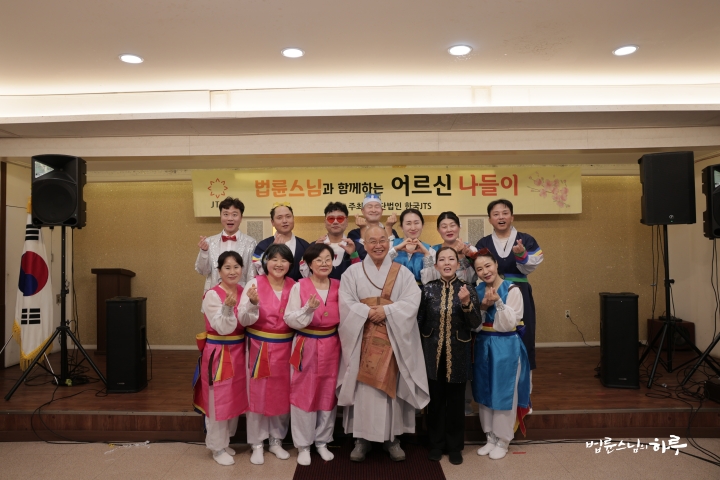
Sunim expressed his gratitude to the Busan-Ulsan Jungto members and the Daegu-Gyeongbuk cultural performance team who volunteered for today’s senior citizens’ outing, then moved to Dubuk.
Arriving at the retreat center around 3:30 PM, Sunim changed back into his work clothes and finished the tasks he couldn’t complete in the morning. He pulled weeds, removed lettuce seedlings, and harvested prickly ash from the prickly ash trees.
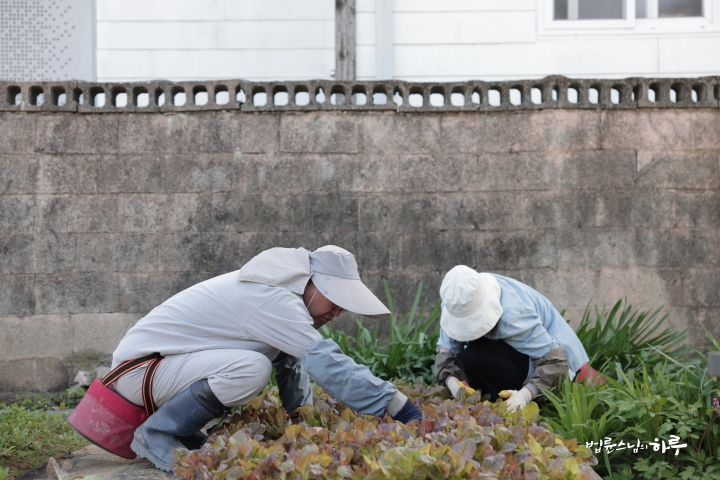
Once the vegetable garden was somewhat organized, Sunim finished the work. In the evening, he had dinner with the community Dharma Teachers, chatted with them, edited manuscripts, and rested.
Tomorrow morning, he will give an opening Dharma talk at the 6th Dharma Teacher Training opening ceremony, and in the evening, there will be a “Happy Dialogue” lecture in Busan.
Since there was no Dharma talk today, this post concludes with a Dharma Q&A from the recent “Happy Dialogue” lecture held in Daegu.
How Can I Be Less Attached and Less Miserable in Relationships?
“Listening to your story, you’re the type I find most difficult to deal with. (Laughter) Like gum that sticks tightly, like taffy that stretches endlessly. I prefer relationships that are crisp like rice crackers, but you have exactly the opposite temperament. Do you think young people these days like that kind of temperament or not?”
“They don’t like it.”
“That’s right. That’s why dating is difficult. And if I like someone first, do I become the one in control, or the one being led?”
“The one being led.”
“That’s right. If you continue like that, you’ll end up being led for your whole life. Just thinking about it sounds exhausting, doesn’t it? But living that way isn’t necessarily bad. When you really like someone, go all in, and when it doesn’t work out, quit. Like someone else. If that doesn’t work out either, quit again. To use a job analogy, there are regular employees who work at one company for a long time, but there are also day laborers and freelancers these days. When you feel like it, you contact them to work, and when you don’t, you rest. Meeting people is the same. There’s a way of meeting one person and continuing steadily, and there’s also a way of dating this person today, that person tomorrow. This isn’t bad.
Looking at your temperament, it would be fine if you changed partners every week. If you decide to change partners every week, when you date someone for two weeks, you’ll think, ‘We’ve been together for two whole weeks.’ If you date for three weeks, you’ll think, ‘We’ve been together for three whole weeks.’ But if you think, ‘I have to be with one person forever,’ then every time you break up, you’ll think, ‘It didn’t work out again. It didn’t work out again,’ and you’ll think you’ve failed every time.
About 30 years ago, I went to America. There I met someone who was the president of a Buddhist association. He mentioned he had a grown son, so I asked, ‘What about your wife?’ He said he was divorced. When I asked, ‘How long were you married?’ he said ten years. So I asked again, ‘Only ten years?’ and he replied, ‘Sunim, among my friends, I was married the longest.’ (Laughter)
Even 30 years ago, I couldn’t readily understand that statement. But how about nowadays? Our country has become a similar society. So it’s okay for you to have temporary relationships instead of permanent ones, according to your temperament. When you feel like it, date someone, and when it doesn’t work out, shake it off and move on. When you feel like it again, date someone else. In today’s world, this is also a way of living.
However, if you want to change your temperament itself, you should go to a psychiatrist and get tested. Because right now, your emotional ups and downs are quite severe. And your attachment is too strong. Through diagnosis, you can find out whether it’s just your personality or if it’s excessive enough to be considered an illness. If it’s diagnosed as an illness, you’ll need some treatment, and if it’s diagnosed as personality, you don’t need to fix it and can live according to your temperament.
The doctor might examine you and say, ‘This is just personality, so live as you are.’ Or they might say, ‘This requires some counseling or medication.’ Then you can take some medicine. It will be much more effective.
And there’s self-treatment. Treating yourself is called practice. But if it seems beyond the scope of self-treatment, you should go to the hospital for a diagnosis. Because if you’ve sprained your ankle, you can align it well and wrap it with a bandage, but if your leg is broken, you need to go to the hospital, take an X-ray, confirm it, and go through an adjustment process.
So in my view, if you want to fix yourself, you should first get examined at a hospital. Depending on whether your psychological anxiety is classified as personality or slightly as illness, you can treat it accordingly.
However, as things are now, you have to live as the one being led. If I like someone, I have no choice but to live like that. ‘This is my fate to live as the one being led.’ That’s how you accept it. Do you want to live that way or not?”
“I don’t want to live that way.”
“Right. Then even if you like it, you need to exercise some restraint now. I’m not saying you should dislike it, but you need to restrain yourself even when you like it. It doesn’t mean ‘loving is forbidden.’ It means you need to restrain yourself a bit because this kind of obsession brings suffering to you. ‘Ah, this is my nature.’ So ‘I need to exercise restraint!’ That’s how you should think. It would be good to have the perspective that restraint is needed, not that it’s bad.
First, what should you do at the hospital?”
“Get diagnosed!”
“That’s right. Get a diagnosis.
Are you offended?”
“It’s okay.” (Everyone laughs)
“It’s okay, right? I said get examined, not get treatment. For example, try taking a personality test. These days there are personality classification tests like MBTI. If your personality is classified as ‘a bit emotional,’ you have to live with that personality. In that case, you should live according to your temperament, more like temporary work than permanent employment. When meeting people too, don’t think about going all the way with one person, just date according to your personality. That’s not morally wrong. But what if it comes out as ‘slightly close to illness’? You can get some counseling or medication.
As I said earlier, you need to know that if I have this personality, I have to live as the one being led. If I like someone, I have no choice but to become the subordinate. If I like money, I have no choice but to become subordinate to money, and if I like popularity, I have no choice but to become a slave to popularity. When you’re attached like this, you become the subordinate. So if you want to live as the subordinate, just live as you are, and if you don’t want to live as the subordinate, you need to observe how your emotions flow. ‘Ah, I’m being attached again!’ When you become aware like this, you notice the big swings of emotion, and when you notice them, you can make the swings smaller. Then the side effects are reduced accordingly.
If you have more to say, go ahead.”
“At first, I thought I only acted this way with romantic partners. But I realized I’m also very attached to my mom. When mom goes somewhere, I ask where she’s going, and when we’re home together, I want to stay close to her constantly. So even now, you could say she’s my ‘mother bird’ in a way.”
“That’s why you need treatment. First, you’re suffering, and second, it’s hard for the other person. The other person doesn’t feel it as love but as annoying. If you continue to have this personality, if you date a man and get married, there’s a risk it could turn into ‘pathological jealousy.’ You’ll constantly interrogate your husband. Even if he comes home just a little late, ‘Where were you?’, ‘Who did you meet?’, ‘What did you do today?’ It might be nice at first, but over time, the other person will feel very constrained. Marriage, which should be about cooperation and freedom, becomes living under constraints. Constraining isn’t good, right? Young people in future society might feel this even more. So it would be good to go to the hospital and get checked.
This aspect of you shows that while your body has become an adult, your mind hasn’t become an adult yet. You’re still a minor. Because you’re trying to live by depending on others. Who treats you well? Does dad treat you well?”
“Mom does.”
“Does she still take good care of everything?”
“Yes.”
“It seems to be an illness caused by mom taking too good care of you. It’s from overprotection. You still have a childlike psychology. Children’s minds go back and forth. But now your mind needs to become an adult. Your body is an adult but your mind is a child, so this is an imbalance. I think it would be good to get checked at the hospital.”
“Yes. Thank you.”