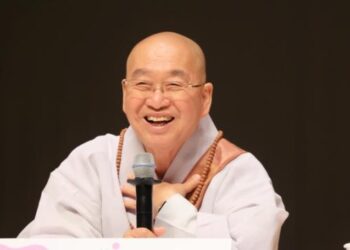

Apr 15, 2026. Weekly Dharma Assembly, Special Dharma Talk Commemorating the 33rd Anniversary of Silla Cultural Center
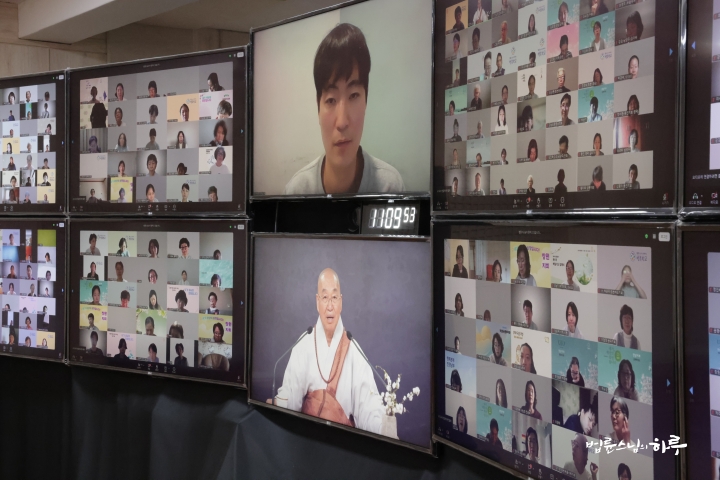
Hello. Today, there is a Weekly Dharma Assembly in the morning and a lecture at Silla Cultural Center in the evening. Sunim completed his morning practice and meditation, then edited manuscripts. At 10 AM, he moved to the broadcasting room at Dubuk Jungto Retreat Center for the Weekly Dharma Assembly broadcast.
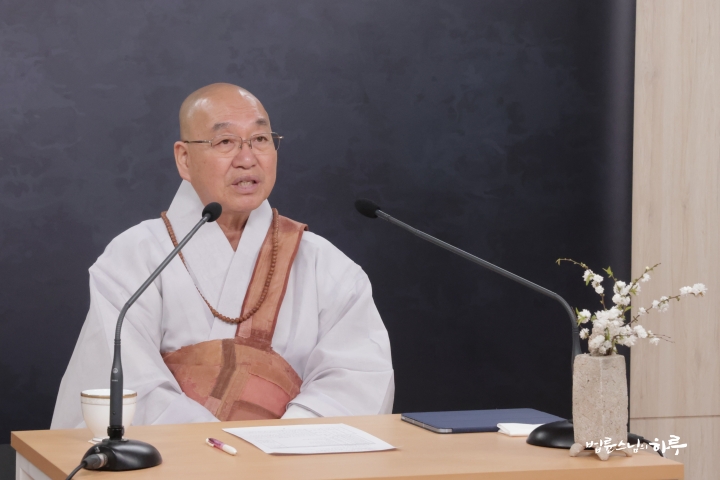
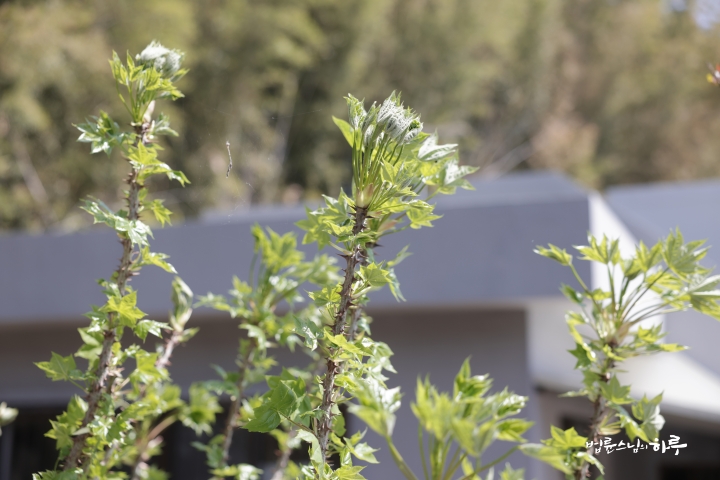
“Spring news is coming from all around. The cherry blossoms that were in full bloom last week are dropping their petals this week, creating a flower rain. Spring is a wonderful season when we can feel the changes in flowers by watching various blossoms bloom and fall one after another. For farmers, spring is also the time to begin farming in earnest, sowing seeds and planting seedlings.
Yesterday was the memorial day of the late Seoam Sunim, former Supreme Patriarch of the Jogye Order of Korean Buddhism, who was the founding advisor of Jungto Society and our teacher. I visited Bongamsa Temple in Mungyeong to pay my respects. In the evening, with the volunteer support of Daegu Happiness Movement Headquarters and Happy Citizens, I gave a ‘Happy Dialogue’ lecture at Kyungpook National University in Daegu. The event was successfully completed with about 1,800 people in attendance. Kyungpook National University, celebrating its 80th anniversary, provided the auditorium and parking facilities free of charge.
I am now meeting you from Dubuk Jungto Retreat Center. This place is also busy preparing for farming.
Voices of Conscience Amid the Power Struggle of War
Looking at the news these days, despite the declaration of a ceasefire in the Middle East, tensions and power struggles continue. Following Russia’s invasion of Ukraine, the United States invaded Iran, resulting in the world’s top two military powers invading smaller neighboring countries. Wars have broken out due to unilateral invasions by major powers. Additionally, Israel’s indiscriminate bombing of surrounding areas has created devastation close to genocide. Watching this situation, the world’s conscience seemed to remain in silence for a while.
It was a time to question the meaning of democracy and democratic forces, seeing conscience rendered powerless in the face of might. However, starting last week, voices saying “we can no longer remain silent” began to emerge from people around the world who respect democracy and freedom. Especially after the Pope at the Vatican strongly condemned war, saying “God does not bless any war,” voices of conscience are resonating again throughout the world. Several European countries, despite being NATO allies, are declaring their refusal to participate in or cooperate with America’s war of aggression. In our country too, the Israeli military’s inhumane acts against Palestinian residents have been raised as an issue, with ongoing debates surrounding statements emphasizing universal human rights. At the same time, public opinion calling for civic rallies to maintain peace without war is gradually spreading.
Actions achieved through force may seem successful at first, but in the long flow of time, they inevitably end in failure. Even looking at Hitler’s example, while many remained silent and tacitly approved his actions at the time, history ultimately defined him as a war criminal.
The same applies to the Japanese colonial period when our country suffered under 35 years of Japanese imperial colonial rule. Even in situations where people held their breath before guns and swords, the March 1st Independence Movement arose through the decisions of some courageous people, and the independence movement continued. Although we paid a heavy price, we ultimately achieved independence. Through subsequent democratization struggles, we have achieved today’s democracy. Freedom is not given automatically. We enjoy freedom as a result of someone’s courage and sacrifice.
However, as decades have passed since democratization, the perception that freedom is given automatically without any sacrifice has spread in our society, causing us to forget the preciousness of freedom. This is particularly difficult for younger generations to appreciate. We acutely realize the value of freedom and peace only when they are threatened. The Korean Peninsula remains in a state of tension with North and South Korea still confronting each other. With wars continuing in Europe and the Middle East, we cannot rule out the possibility that the center of conflict might shift to East Asia. Therefore, we must be even more vigilant and pay attention to peace on the Korean Peninsula.
The Need for Energy Conservation Amid Rising Oil Prices
Meanwhile, international oil prices are rising due to the Middle East war. The government is implementing temporary fuel tax reductions to ease the burden on citizens’ lives from sharp oil price increases. Within these policies, we are maintaining our existing consumption habits without fully recognizing the preciousness of energy. JTS continues various support efforts in several Asian countries including the Philippines, Cambodia, Sri Lanka, and India. However, due to rising international oil prices and material costs, the currently allocated budget is severely insufficient. The whole world is experiencing difficulties like this. Nevertheless, thanks to the government’s price stabilization policies in our country, these difficulties don’t feel very tangible, so energy use hasn’t decreased compared to before the Iran war.
Now is the time for all citizens to participate in energy conservation together. It would be good to walk short distances whenever possible, reduce personal car use, and slightly reduce electricity consumption. If we directly reflected international oil price increases like some European countries, it would naturally lead to conservation, but this would place a heavy burden on citizens’ lives, so the government is suppressing it. No matter how much the government emphasizes energy conservation, it’s difficult to put into practice unless citizens themselves have awareness. I hope Jungto Society members will actively participate in energy conservation with the perspective that the nation’s household is our own household.”
After finishing the Weekly Dharma Assembly dharma talk, Sunim went to the hospital for treatment around 11:30 AM. The doctor advised that while medication was necessary, rest was also needed, so Sunim rested in the afternoon after returning from the hospital.
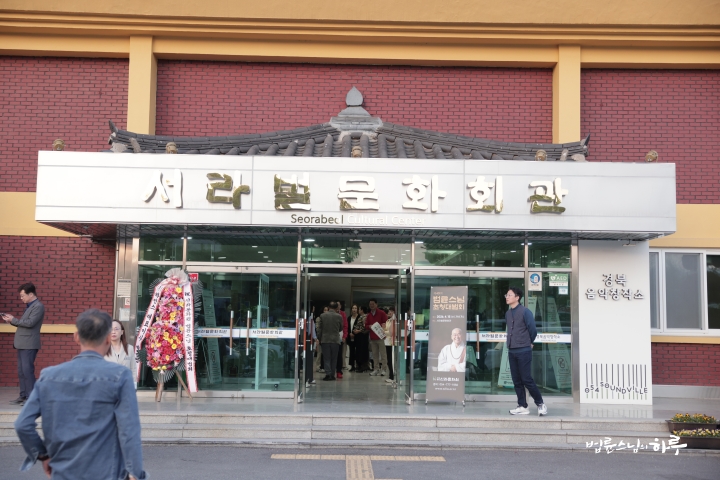
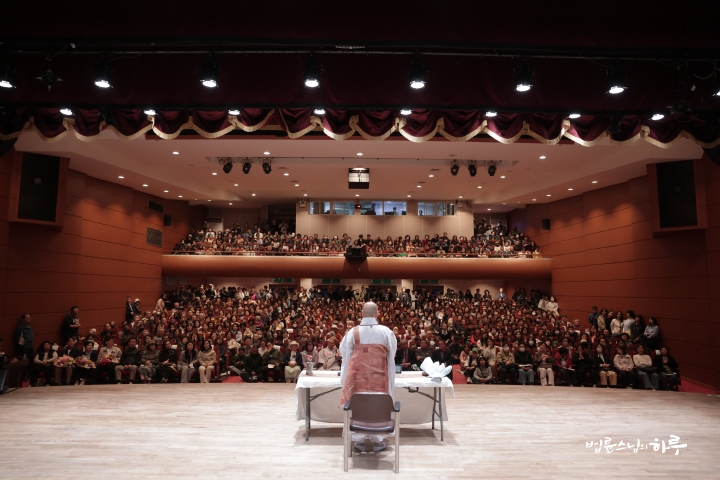
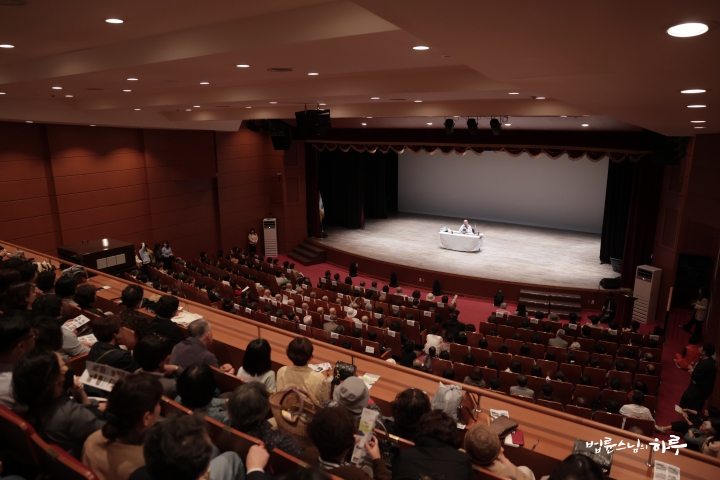
At 7 PM, Sunim attended as an invited speaker at a special dharma assembly commemorating the 33rd anniversary of Silla Cultural Center at Seorabeol Cultural Center in Gyeongju. The venue had about 500 seats, but today about 700 local residents came, causing a shortage of seats.
About 10 high school classmates who had arrived earlier were waiting for Sunim in the VIP room. When Sunim arrived, his friends stood up and warmly welcomed him.
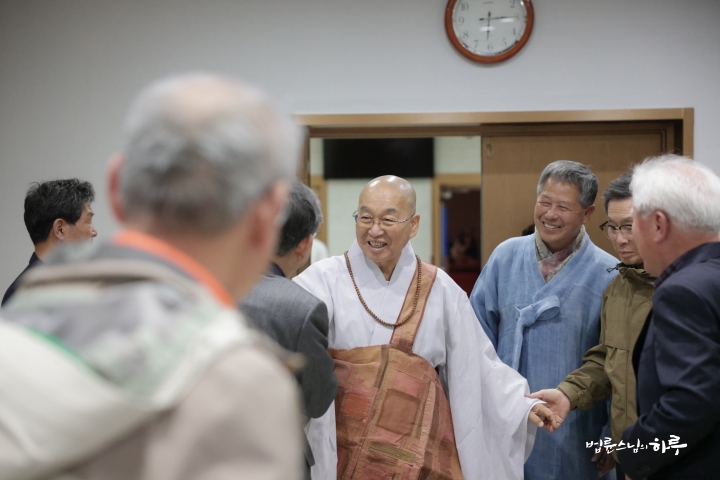
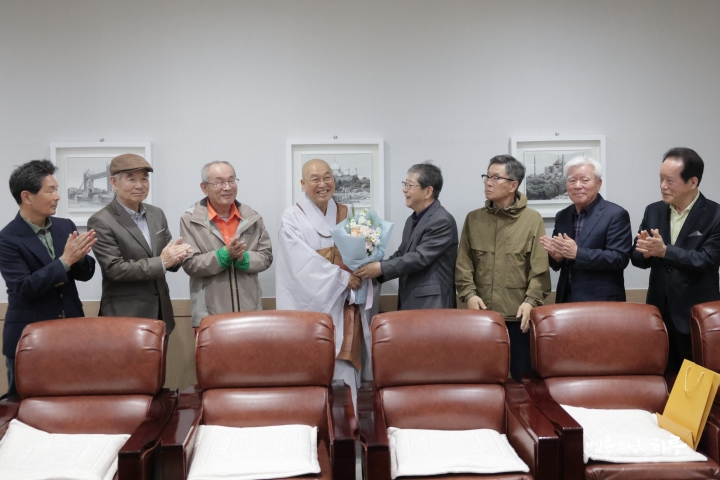
“Sunim, how have you been?”
“Sunim! Do you remember me?”
Each friend asked to shake hands with Sunim and greeted him. Sunim also exchanged warm greetings with bright smiles with friends he was meeting after 55 years. While he had met some friends occasionally, others he was meeting after such a long time that their faces were vague.
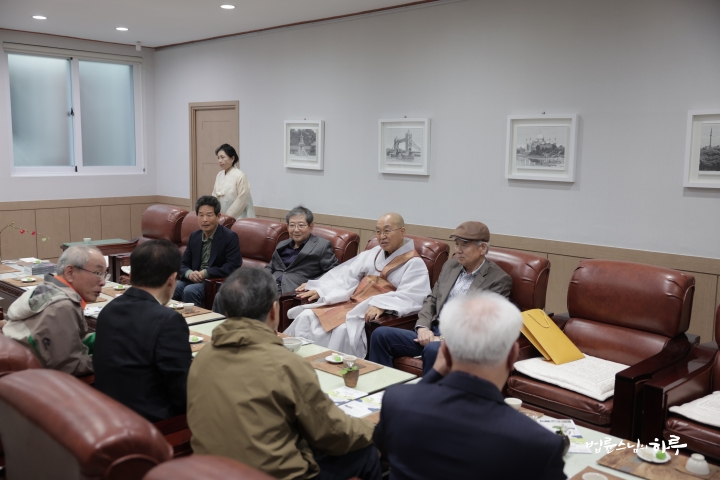
Though 55 years had passed, their bodies had aged and their faces were full of wrinkles, meeting high school friends brought back memories from those days vividly.
“When I meet people, I brag that my friend is Venerable Pomnyun Sunim! (laughter)”
Each friend proudly spoke of Sunim being their high school friend and shared updates about their lives.
Even while talking with friends, people continued to come to meet Sunim.
“I’m meeting my high school friends right now. These are friends I’m meeting after 55 years, so let’s greet each other in a moment.”
When Sunim explained to the arriving guests, his friends slowly began to wrap up.
“Let’s take a photo together and then make room. He has many people to meet (laughter).”
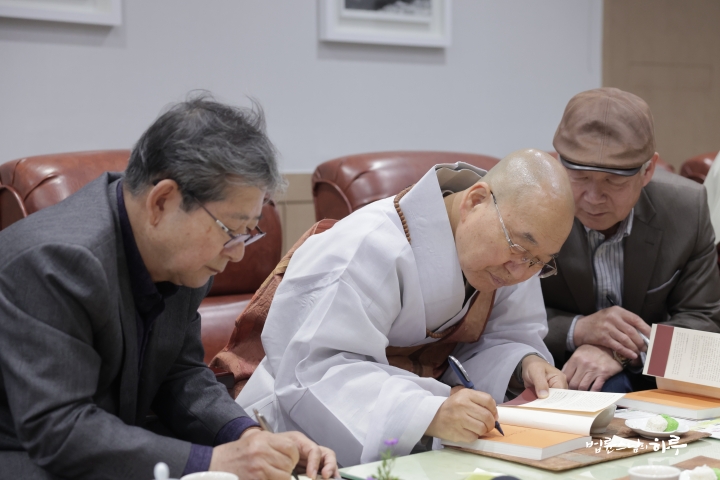
Sunim also took out books he had prepared for his friends and gave them as gifts.
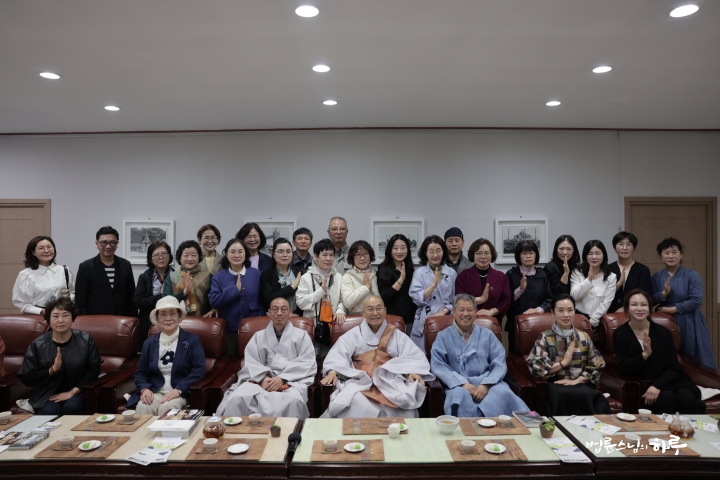
After his friends left, people from various groups came to greet Sunim. The mayor of Gyeongju, who is helping with the restoration of Cheollyongsa Temple, came to greet him, as did devotees from Bunhwangsa Temple where Sunim became a monk, and various local dignitaries from Gyeongju.
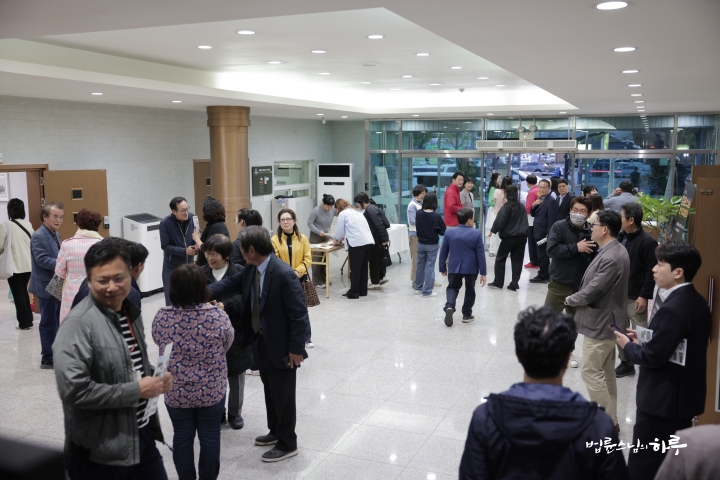
Outside the lecture hall, tea and rice cakes were continuously served to people. Today’s lecture hall had an atmosphere like a neighborhood festival.
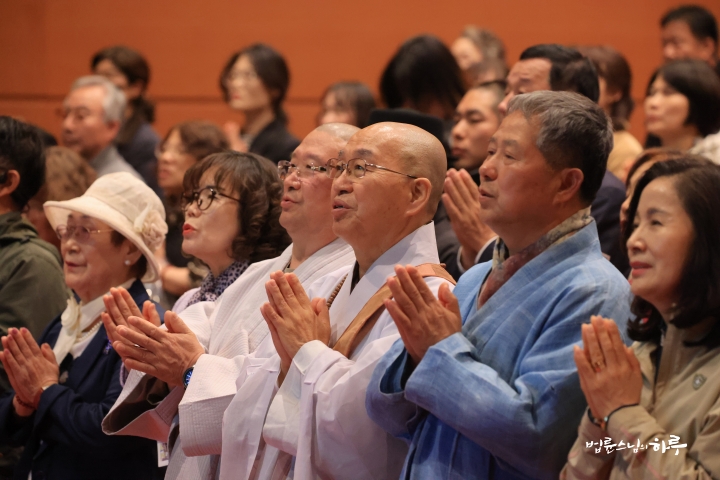
An hour quickly passed, and at 7 PM the special dharma assembly began. The assembly opened with the Three Refuges and salute to the national flag. Jin Byeong-gil, director of Silla Cultural Center who prepared today’s assembly, shared his thoughts on commemorating the 33rd anniversary.
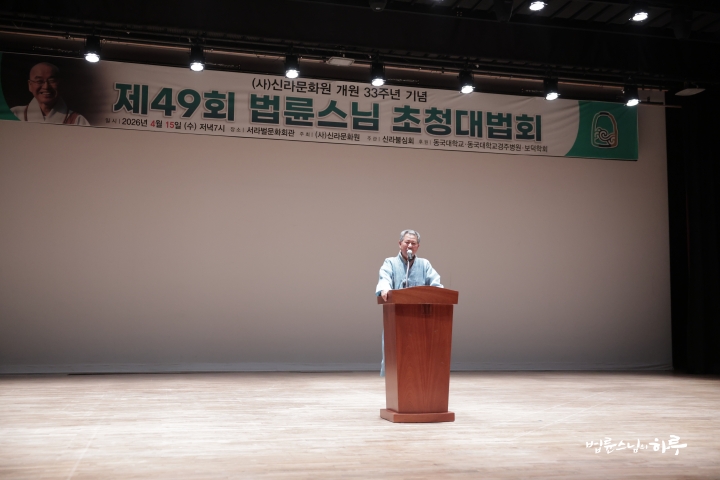
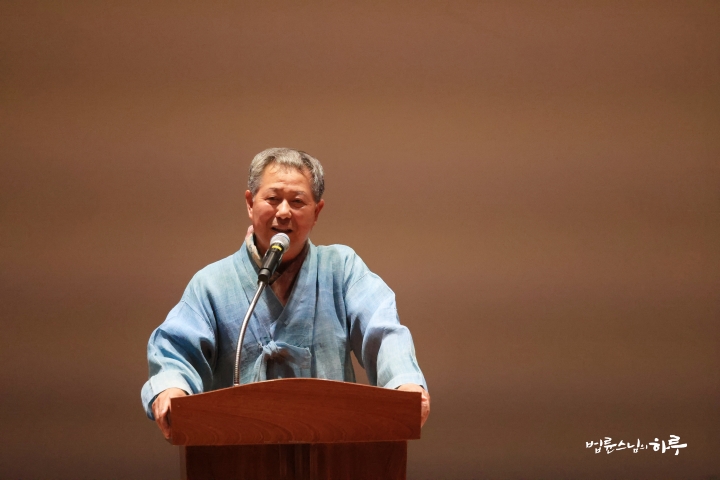
“When we opened Silla Cultural Center in March 1993, many people expressed concerns like ‘How many years will that last?’ and ‘What does Silla Cultural Center do?’ Looking back, all those concerns were actually interest. (laughter)
Before we knew it, Silla Cultural Center is commemorating its 33rd anniversary. During these 33 years, I learned a lot by participating in and supporting various events in Gyeongju, and it was a time when I could grow together with Silla Cultural Center.
I feel anew that the APEC (Asia-Pacific Economic Cooperation) summit held in Gyeongju last October became a turning point that greatly changed Gyeongju’s status. Going forward, Silla Cultural Center will continue to create a space that gives back to Gyeongju citizens and local residents with the support you’ve given us and the roots we’ve established in the region. Thank you.”
After Director Jin Byeong-gil’s greeting, Sunim’s dharma talk followed.
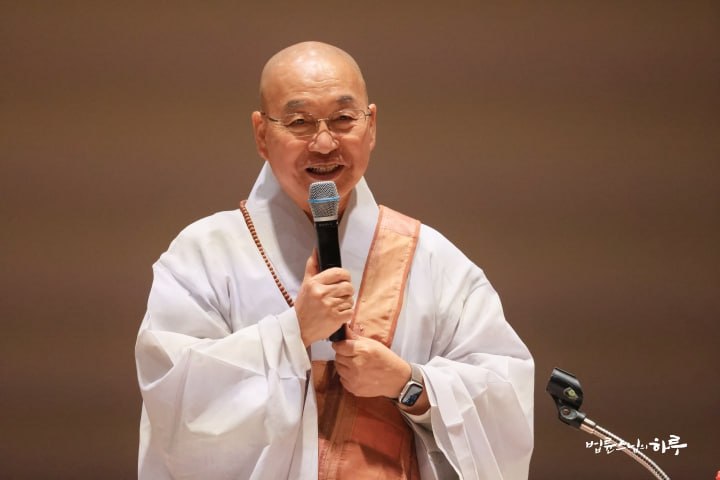
“In any city you go to, there are local organizations that love their region. While they may be well-known locally, only a few organizations are known nationwide. However, Silla Cultural Center is so well-known nationally that when I meet cultural ministry officials even in Seoul, there’s no one who doesn’t know about it. It’s a solid regional organization that steadily promotes Gyeongju’s local culture not only to Gyeongju citizens but to all Korean citizens and even overseas, and I think it’s an organization that beautifully cultivates Gyeongju.
Since Gyeongju is my hometown too, I met 11 classmates today after 55 years. I’m grateful that they didn’t forget and came to greet me. Also, many junior alumni from the Gyeongju Buddhist Student Association and monks from Heungnyunsa Temple have come.”
Sunim mentioned Wonhyo the Great, Choe Chi-won, and Buddhist Master Kim Ji-jang who were from Gyeongju, and talked about the influence of great figures from Gyeongju and the power of culture.
The Power of Culture That Gyeongju Possesses
“Not just historical sites and artifacts like pagodas and Buddha statues, but now the cultural power that has spiritual influence is very important. You all know about the Korean Wave, right? With the Korean Wave blowing, speaking Korean is trendy in any country. Their wish is to try Korean food, and their dream is to visit Korea once.
From what I see, the longing for Korea in Southeast and Southwest Asia is stronger than when we used to admire America, studying English, singing pop songs, and playing guitar. Korean food sells tremendously, just like hamburgers. But the disappointing thing is they only know tteokbokki, gimbap, bibimbap, and kimchi as Korean food.
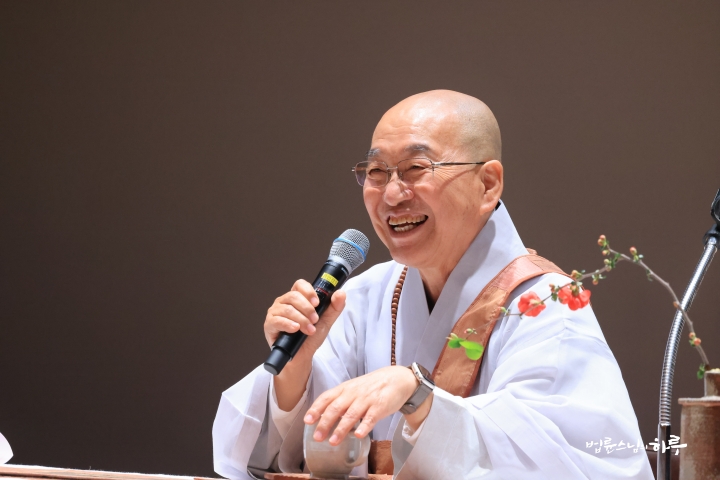
At the end of last March, I invited Americans and held a World Meditation Forum. Foreign participants tasted Korean temple food and said they didn’t know Korean food was so diverse and delicious. We were thinking of preparing bread or cheese in case they couldn’t adapt to Korean food, but the foreign participants said it wasn’t necessary. They said they would eat plenty of Korean food while in Korea. Cultural things like this go beyond simple money-making to become spiritual refuges.
Master Kim Ji-jang, who was Silla royalty and went to China to be revered as an incarnation of Ksitigarbha Bodhisattva, is revered as Ksitigarbha Bodhisattva in China and is a spiritual refuge for 1.4 billion Chinese people. Just like how Japanese people come and bow when certain relics are created in Baekje. If we cultivate the birthplace of Donghak thought well, it can become a sacred site of Korea’s indigenous democracy. I hope Gyeongju citizens can take pride in these aspects.
Rather than evaluating Gyeongju as having somewhat decent housing or transportation between Pohang and Ulsan these days, how we spread culture and being culturally superior is more important. Culture is always spiritually superior. People learning Taekwondo anywhere in the world shout ‘Hana! Dul!’ – all the counting is in Korean. At first they can’t understand ‘dollyeo chagi’ (roundhouse kick), but everyone learning Taekwondo greets in Korean style and uses Korean words. This is how powerful culture is.
I hope you take pride as citizens of Gyeongju, a city with such a treasure trove of culture. While I am proud to have been born in the Republic of Korea, I am also proud to have spent my childhood in Gyeongju and to have become a monk at Bunhwangsa Temple.
I would like to take this opportunity to once again express my gratitude to all of you who have always supported and cherished the Silla Cultural Center, helping it grow from a local NGO into one with a national reputation.”
Following the greeting, Sunim began the Q&A session with the audience. Among the various questions, this post introduces a conversation with a young man who returned to his hometown after his business failed.
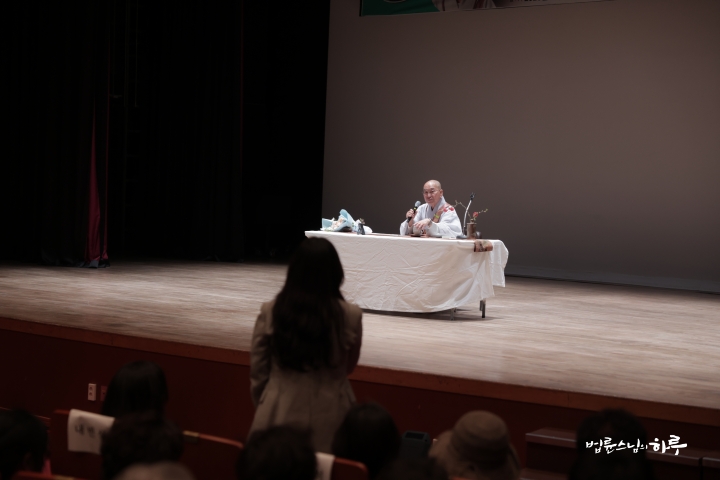
My Business Failed and I’m Afraid. How Can I Overcome This Fear?
“Hello. I ran a business in Seoul for about five years, but it failed, and now I’ve returned to my hometown. It was very difficult at first, but I’m feeling a bit better now. I need to get back on my feet, but I feel lost and overwhelmed. My biggest concern is that I’m worried and afraid that I might not get another opportunity to rise again. I’d like to ask what mindset I should have to overcome this.”
“What is mountain climbing?”
“Mountain climbing is going up a mountain.”
“Why do you climb mountains?”
“To see the summit.”
“Do you climb mountains to see the summit? Or do you climb to become healthy?”
“I think I’m climbing to see the summit right now.”
“Everyone here, do you all climb mountains to see the summit? Or to become healthy?”
“(Audience response) To become healthy.”
“See? You’re the problem.”
“Yes, you’re right.”
“We climb mountains to be healthy. When climbing, some people can reach the top and see the summit. Others turn back halfway. That’s still exercise. Some people just walk around the base of the mountain, and that’s also good for their health. If this weren’t true, we’d have to eliminate all the walking trails in Gyeongju. (Laughter) We climb mountains to be healthy.
But you think mountain climbing is about reaching the summit, so you consider reaching the top a success, turning back halfway a failure, and walking the trails as ‘not even having a chance.’ That’s where the fundamental problem lies.”
“Sunim, but I want to see the summit. Should I still have that mindset?”
If you want to see the summit, then see it. It’s your freedom to want to see the summit and to see it, but not seeing it doesn’t mean failure.”
“Thank you.” (Audience applause)
“Did you eat breakfast this morning?”
“Yes, I did.”
“Did you sleep last night?”
“Yes.”
“Did you come here naked? Or wearing clothes?”
“I came wearing clothes.”
“Did you walk here? Or come by car?”
“I came by car.”
“Then what’s the problem? You don’t fall into any of the six categories of ‘the least of these’ mentioned in the Bible that I talked about earlier. What did Jesus say? First, among the hungry – you’re not hungry, are you?”
“No.”
“You’re not thirsty either?”
“No.”
“You’re not naked either?”
“No.”
“You’re not sick either?”
“No.”
“You’re not a sojourner, meaning an immigrant?”
“No.”
“You’re not in prison?”
“No.”
“Then are you someone who should receive help? Or someone who should give help?”
“I think I should give help.”
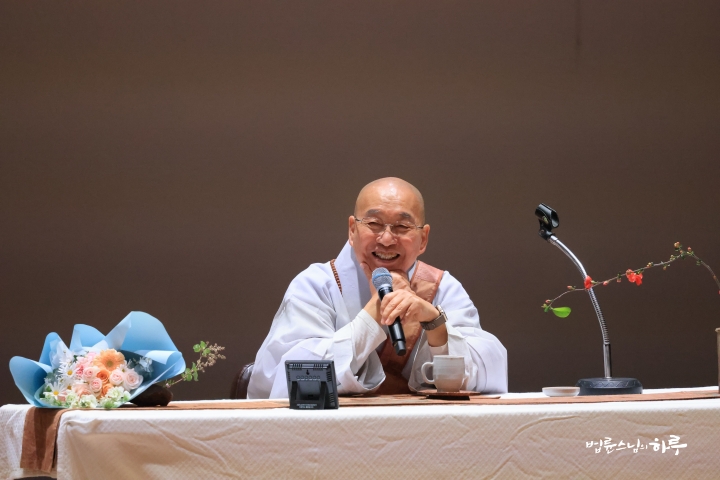
“So start going to church tomorrow. (Audience laughter) Go to church and follow Jesus’s teachings, and you’ll understand ‘This is the way to heaven.’ If I’m in the position of ‘the least of these,’ I have the right to receive help. But if I’m not in that position, I don’t have the right to receive help. Instead, I should become someone who gives help.
But because you’re greedy and think ‘reaching the summit is success,’ you’re bound to fail. If you can’t reach the summit, everything is a failure. I don’t think reaching the summit is success. We climb mountains for our health. When you’re young, if you can reach the summit, go ahead. But is it easier to reach the summit of a high mountain or a low mountain?”
“It’s easier to climb a low mountain.”
“Then climb a low mountain. But you’re trying to climb Seoraksan Mountain in flip-flops and shorts – that’s impossible. So if you want to climb casually in flip-flops, climb the hill behind your house. If you want to climb Seoraksan or other high mountains, you need to prepare properly.
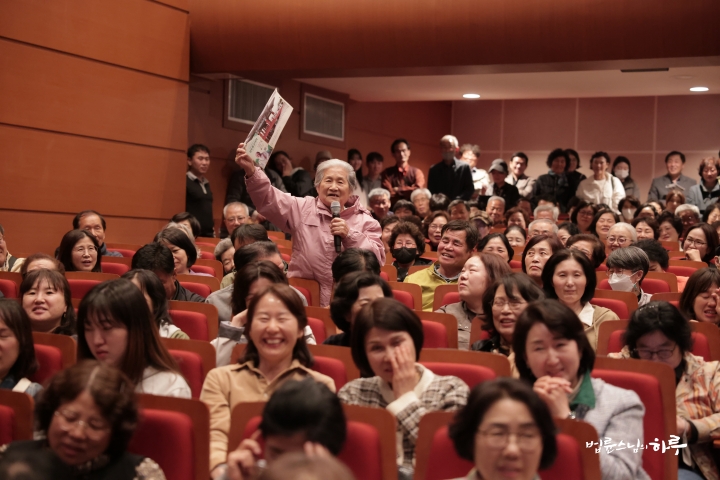
Don’t make reaching the summit your goal. There’s no problem even now. You’re eating and wearing clothes. But it’s okay to try a little more. Walking trails are nice, but you can think, ‘Should I try going to Namsan?’ If that works, ‘Should I try climbing Gowisan?’ If that works too, ‘Should I try Danseoksan?’ This is how you should lower your goals to create small successes. You need to create successes to believe in yourself. But if you set your goals too high, you’ll fail every time. Then you won’t trust yourself. You’ll think, ‘I’m an incapable person.’
So did you have to come to Gyeongju because you failed in Seoul? Even if you succeed in Seoul, you should come saying, ‘No, I want to live in my hometown Gyeongju.’ You should renounce like the Buddha who gave up his throne to become a monk. If you become a monk because you couldn’t become a king, you’re someone who failed in the secular world. So you should have pride that you abandoned Seoul and came to Gyeongju. Understood?”
“Yes, thank you.”
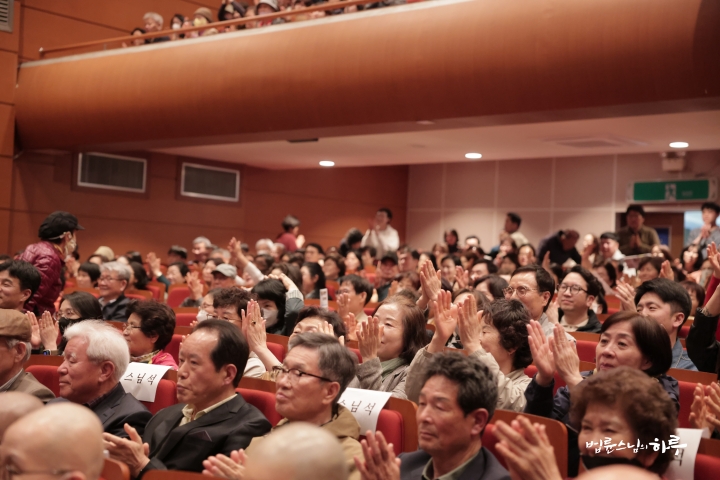
Today’s entire session was filled with on-site questions. Without anyone feeling awkward or embarrassed, everyone openly shared their life stories, and before we knew it, it was 9 PM. Although there were more people who wanted to have a dialogue with Sunim, the Q&A session had to end without accommodating everyone.
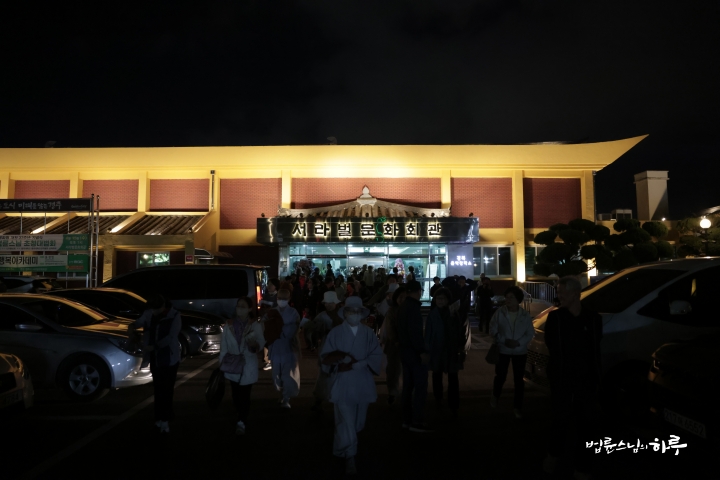
At the beginning of the lecture, there were concerns about Sunim’s throat condition, but fortunately, he completed the lecture without any major issues.
After the lecture, Sunim exchanged greetings with Director Jin Byeong-gil.
“Congratulations on your 33rd anniversary. You’ve worked hard all this time.”
“Sunim, thank you for coming to give a Dharma talk at today’s special assembly. People really enjoyed it. We’ll create another good opportunity to invite you again.”
After the assembly, Sunim moved to Dubuk Jungto Retreat Center.
“Both at the Daegu lecture and today, quite a lot of people came. Now that I’m getting older and my body is aging and not moving like it used to, people are seeking me out more and more from everywhere. It would have been nice if they had come when I was young. (Laughter)”
The practitioners accompanying him quietly laughed along with Sunim’s laughter. They arrived at Dubuk Jungto Retreat Center around 10 PM. Sunim had a late dinner and rested.
Tomorrow, he will do household chores in the early morning and attend the Dubuk Senior Citizens’ Festival starting at 8 AM.”