

April 11, 2026 – Day 3 of India Schedule
Hello. Today, Sunim spent his day at Sujata Academy.
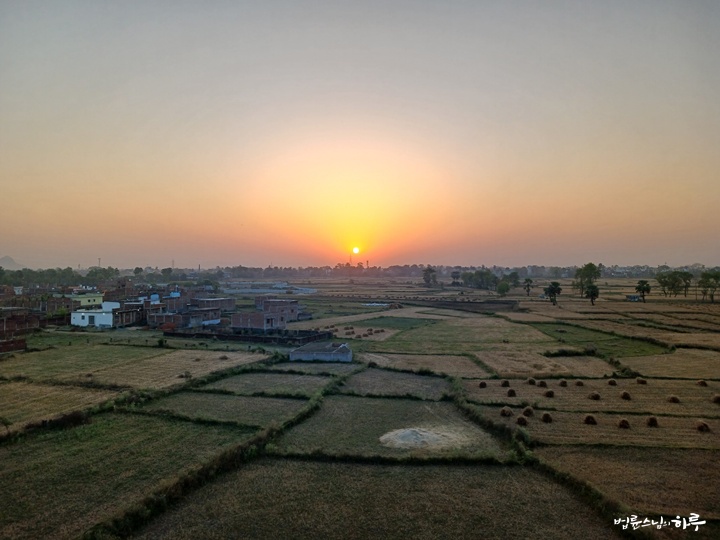
Sunim woke up early and began his day with dedication to practice and meditation. He passed through the bustling early morning market and arrived at Sujata Academy at 7:30 AM.
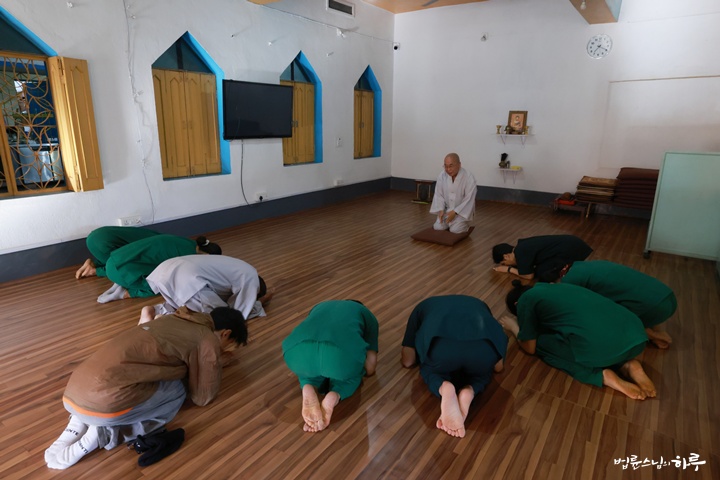
When Sunim arrived, members of the India lay Sangha greeted him with three prostrations. Sunim unpacked his belongings and had breakfast.
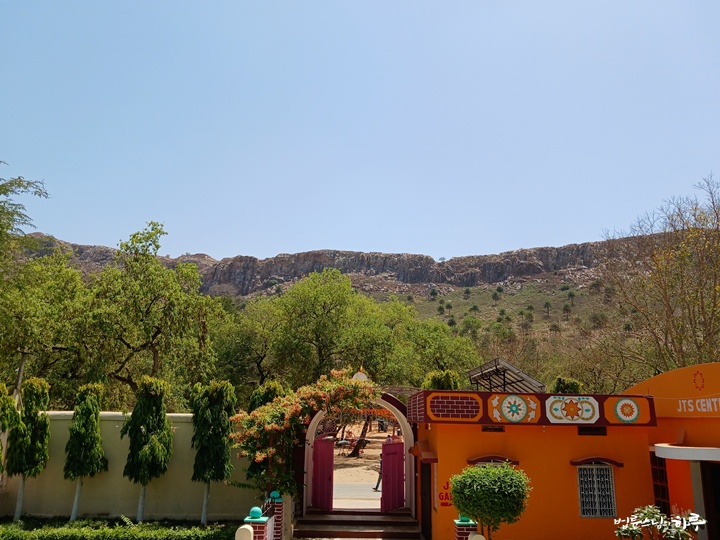
Before the sun became too hot, he took a walk around Jeonjeong-gaksan Mountain.
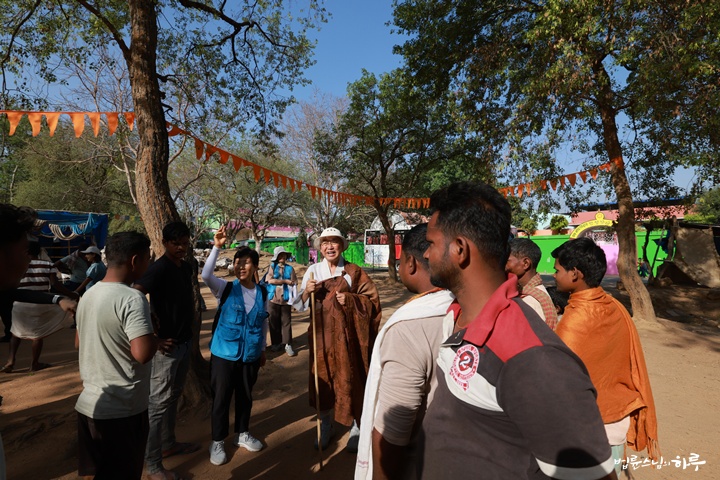
When Sunim arrived at the entrance to the Pragbodhi Mountain, young men working nearby gathered to greet him. The young men, somewhat shy, greeted Sunim respectfully.
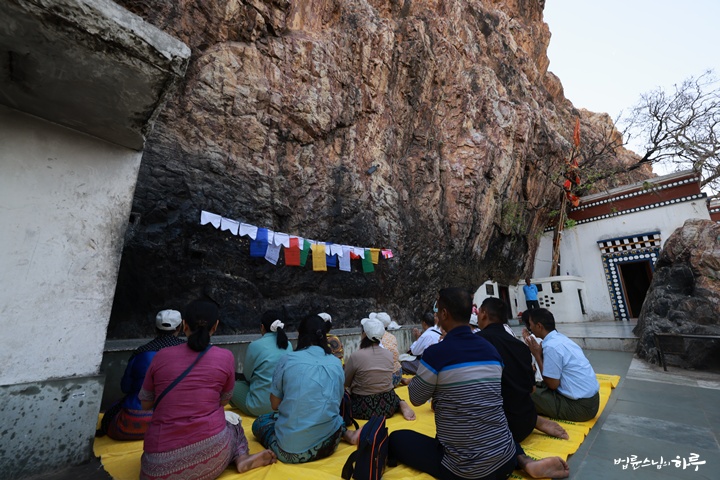
Sunim slowly made his way up the Pragbodhi Mountain and also visited Dungeshwari Cave. On the way up to Dungeshwari Cave, graduates who had studied at Sujata Academy recognized Sunim and greeted him. Some young men greeted him confidently, while others did so shyly.
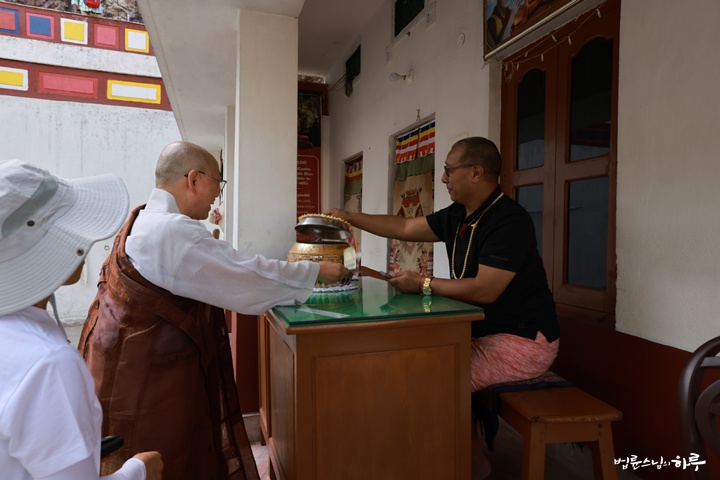
At Dungeshwari Cave, there is a place that serves warm tea to visitors. Sunim had a cup of tea there and gave a donation to the monk who manages Dungeshwari Cave. After climbing to the ridge and surveying the surroundings, he passed by ‘Gautama’s Spring’ and meditated briefly at the meditation site. He returned to Sujata Academy before the weather became even hotter.
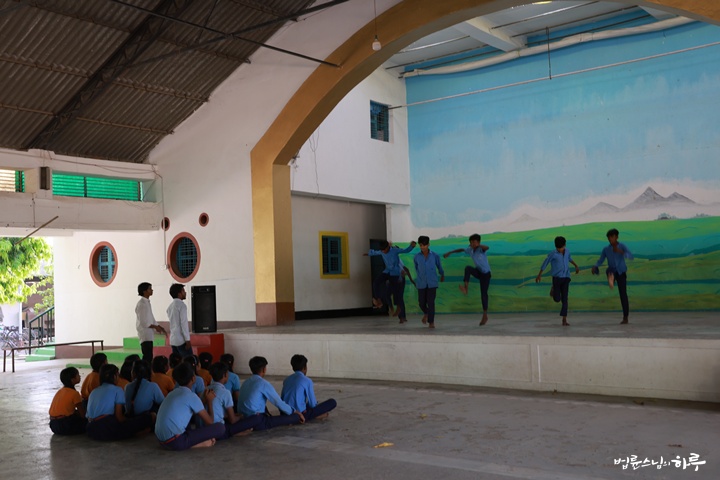
After lunch, Sunim visited middle school classrooms to observe classes in the afternoon and also observed dance classes being held at Pragbodhi Hall. The children’s passion for dancing surpassed that of K-pop idols.

Sunim spent the entire day at the Pragbodhi Mountain and Sujata Academy. In the evening, as the sun was setting, Indian staff members gathered in the office to greet Sunim.
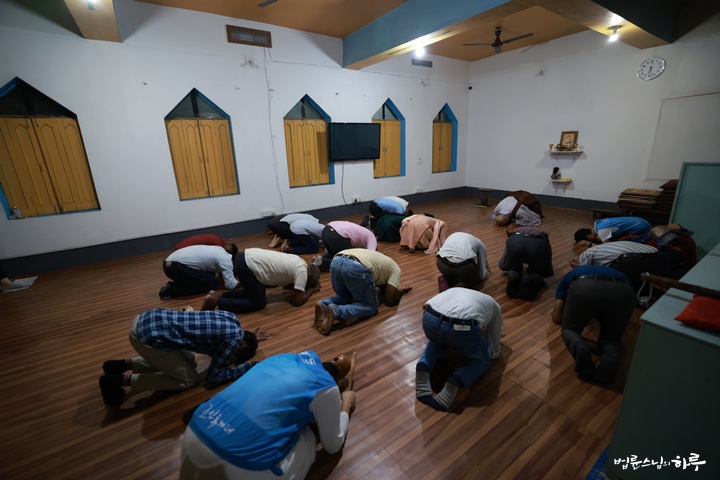
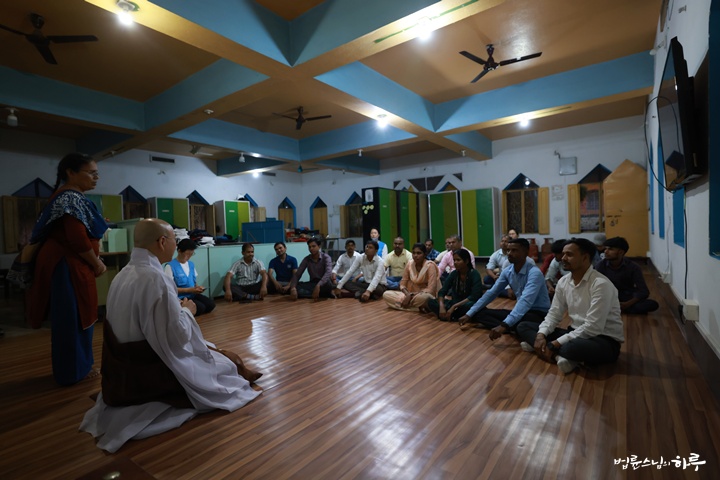
The Indian staff members offered three prostrations to Sunim. Sunim gave brief greetings and asked about their well-being. There was a staff member who lived in a village beyond Prakbodhi Mountain, and Sunim asked how he would get home after dark. The Indian staff member said he could get home with help from a colleague who has a motorcycle.
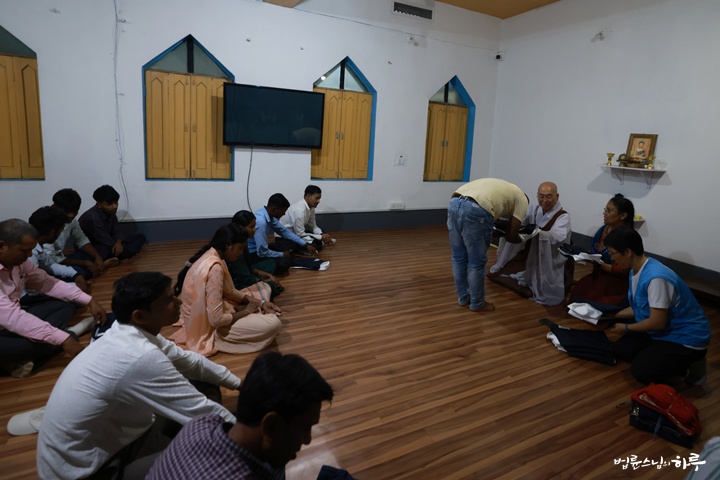
Sujata Academy provides uniforms to Indian staff members every Buddha’s Birthday. Since Sunim happened to be at Sujata Academy, he was able to personally give the prepared uniforms to each staff member. In the evening, Sunim attended to remaining work and edited manuscripts before concluding his day. Tomorrow, he will complete his final schedule in India and board a flight to Korea.
Since there was no Dharma talk today, this post concludes with content from a previous Dharma Q&A session.
I Want to Calm My Anxiety and Impatience and Live Well As the Head of My Family
“If you were single and living alone, you could decide to quit even a well-paying job to pursue your dream of being an actor. That’s because you would be responsible for the consequences of your decision.
However, you cannot make such a decision alone now. You must discuss it with your wife before proceeding. You shouldn’t be stubborn about it either. If you’re so insistent that your wife reluctantly says, ‘Fine, do whatever you want,’ this wouldn’t be a very good decision.
The Responsibility to Consult Each Other
So there are two paths.
One is if you really want to pursue acting, discuss with your wife about maintaining the household while she works and uses that income for living expenses. The other is to take a chance on acting, knowing that success could bring great rewards but failure could mean losing everything.
If your wife says, ‘Okay, I’ll handle raising the child and making a living, so if you really want to, I’ll give you a time limit to try,’ and you both agree, then I think it’s fine to proceed.
But if your wife responds, ‘I can’t manage alone. How can I work full-time while raising a child? It’s not possible,’ then you should give up acting.
When people get married, they must take responsibility for each other. The responsibility I’m talking about isn’t about being the head of the household. It’s about the responsibility to consult each other. If you can’t reach an agreement and your desire is stronger, then you should offer a divorce.
Getting married and then saying, ‘I’ll do whatever I want’ is quite an improper attitude. In such cases, if you really want to act but your partner needs someone different, you should think about giving them the opportunity to meet and live with someone else. You should give them a year or two to find someone, and then offer to divorce.
Promises are meant to be kept, but promises can also be broken, which is why they’re promises. The problem is that people make promises and then break them without properly terminating them.
The Difference Between Returning Precepts and Breaking Precepts
In Buddhism, when someone says, ‘I will focus on my practice life from now on. I won’t marry or look back at anything else and will keep the precepts,’ they make this promise and receive the kasaya (Buddhist robe). But if an urgent matter arises, like needing to care for parents, one can formally go to their teacher and say, ‘I cannot continue my practice life,’ remove the kasaya, return it, bow, and leave. This is a legitimate way to leave. This isn’t breaking precepts. It’s called ‘returning precepts’ (還戒). It means returning the precepts. Later, when time permits, one can receive the precepts again. This can be done up to seven times.
The problem arises when someone wears monastic robes without returning the precepts and engages in romantic relationships or breaks precepts. This becomes breaking precepts. In such cases, one cannot become a monastic again – they are expelled and removed from the order. They are not given another opportunity for monastic life.
Taking Responsibility for One’s Actions
People must know how to take responsibility for their actions. If you feel you absolutely cannot fulfill something, you should ask for understanding. Until the other party’s permission is granted and an agreement is reached, the previous promise remains valid. You cannot unilaterally quit and leave. Breaking a promise requires agreement and consent from the other party. Then, after a certain period, we can reunite or make a new contract. So you should be someone who keeps social contracts and promises. Only then are you a trustworthy person.
What I Want to Do vs. What I’m Good At
In life, there are things we want to do and things we’re good at.
Where does a higher salary come from? From work we’re good at, where our labor efficiency is high. So there are two paths. You can do what you’re good at to maintain your livelihood and pursue what you love as an amateur. You could be an amateur theater actor or take on supporting roles part-time.
It’s wrong to think that having a regular job means giving up acting. Because even delivering packages can be acting practice, right? (laughs) It is acting practice. Even farming is acting practice. Having various jobs in the world is all acting practice, not giving up acting. Life itself is all acting practice.
Shaving your head and living as a monk for three years? That’s also acting practice. As an actor, what if you later play a monk? You’d do well. You’d know better than the writer. Because you know it well, you could even make suggestions to the writer and help create the script. (laughs) Do you understand?
Acting isn’t just doing something at a fixed time in a specific place. Life itself, including married life, is acting. Someone who has experienced married life would be good at acting out marital conflicts and fights. (laughs)
If you had experience as a gangster when young and later played a gangster role as an actor, you’d do that well too. So don’t think of it as giving up acting. Instead, think of your social life as acting practice.
Starting Part-Time and Gradually Going Full-Time
Another option is to participate in various part-time activities, maintain your livelihood with them while doing what you love, and gradually transition to full-time work. In that case, you must be prepared for reduced income. If you’re alone, you just need to be prepared, but since you have a family, you need their consent. If you get their consent, it’s not something to worry about.
If I’m a singer but can’t make a living from singing alone, I can have another job to maintain my life while volunteering as an amateur at senior citizen parties. When you sing at such events and people give donations saying you’re better than a professional singer, and you’re called to perform here and there several times a month, the income gradually increases to about half your salary. Then you can reduce living expenses a bit and jump into it full-time. When you go full-time, your income source increases. You can’t always do everything you want in life.
Part-Time Work Only When Starting a Business
In traditional temples, monks mainly earn money by conducting memorial services and praying for blessings. But since we practice Buddhism without any blessing rituals, there was no source of income. We started by renting a small building space, but there was no income, only increasing expenses. A source of income is necessary to run a Dharma center. I was good at math. Using my experience tutoring children in math while in school, I did part-time work. With that money, I covered office maintenance costs and living expenses for activists. After 4-5 years, people gathered, we received some donations, and after a few years, activity expenses were covered internally. So I quit the part-time work. This might seem like straying from the monastic path, but it wasn’t done out of greed for money. It was using my talents legally at the starting point to operate and maintain the Dharma center. I’m also good at being a travel guide. In the early days, Sujata Academy was built entirely with money earned from guiding pilgrimage tours. Once the business is established and running on its own, what happens? Since it runs on its own, I no longer needed to guide tours, so I stopped. Looking at this, I didn’t give up acting or being a monk. I hope you can have this perspective.”
“Yes, Sunim. Thank you.”


Thanks a lot. And all of that stories help me to maintain my mind clam..