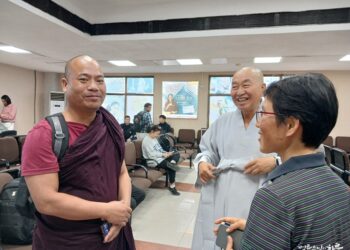

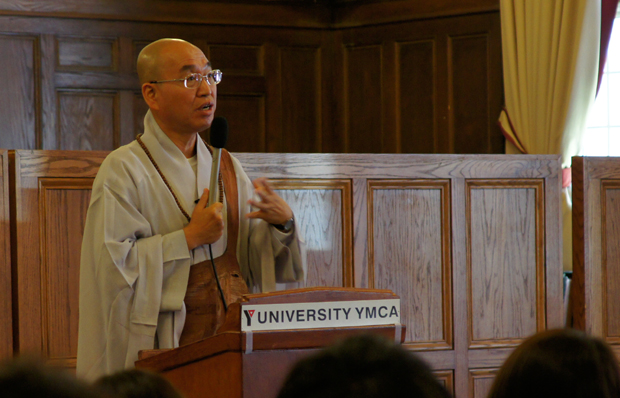
Hello. Today marks the 66th lecture of the World 100 Lectures Tour, held at the University of Illinois at Urbana-Champaign in Illinois.
Illinois, where today’s lecture is being held, has a population of approximately 12.41 million (2011 estimate), making it the most populous state in the Midwest and the fifth most populous in the entire United States. Most of the state’s population is concentrated in Chicago and its surrounding areas. Since Illinois is mostly plains, tornadoes appear regularly every year, and because there are almost no mountains or hills, it’s common for houses to be surrounded by trees as windbreaks. The state’s largest city is Chicago, the capital is Springfield, and the Urbana-Champaign area also has some recognition as it houses the University of Illinois campus, famous for electrical engineering, business, and law.

▲ True to its reputation as the region producing the most corn, vast cornfields stretched as far as the eye could see.
The state is famous as the political base for U.S. Presidents Abraham Lincoln, Ulysses S. Grant, and current President Barack Obama. It’s particularly significant for people of color – in the state where Lincoln, who was assassinated while dreaming of abolishing slavery and ending racial discrimination, Obama later built his political career and became America’s first Black president. Three of the six African American senators in U.S. history were elected from this state. While politically conservative overall, Chicago alone is notably progressive. The issue is that Illinois has a population of 12 million, with Chicago accounting for 9 million of that, ultimately making it a Democratic-leaning region.
The University of Illinois at Urbana-Champaign (UIUC for short), where today’s lecture is being held, is a state university in Illinois with the largest campus in the University of Illinois system. It’s located between two small rural cities, Urbana and Champaign, in central Illinois, about three hours south of Chicago. The Korean community, including international students, numbers about 4,000. The city has a population of about 230,000, which is why the school’s official name is the University of Illinois at Urbana-Champaign. It has about 40,000 students, with about 10,000 in graduate programs, and is known as one of America’s best state universities, with both graduate and undergraduate engineering programs ranking among the nation’s best.
After a simple breakfast provided by the inn at 7:30 AM, Sunim departed at 8:30 AM from Indianapolis, Indiana, to the University of Illinois at Urbana-Champaign where today’s lecture would be held. Sunim continued reviewing manuscripts throughout – during breaks yesterday, after returning to the inn following the lecture, and this morning before departing for the next location, never letting the manuscripts leave his hands.
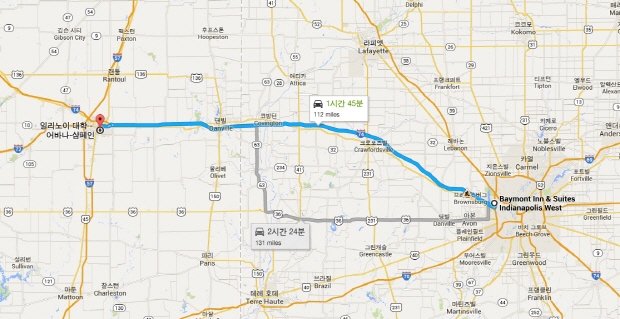
▲ This morning’s travel distance: Indianapolis → Urbana-Champaign, 112 miles (180km)
Though the drive to the school was two hours, due to a one-hour time difference, Sunim arrived at the school at 9:50 AM.

▲ Today’s lecture venue, the University YMCA at the University of Illinois. Can you see the two volunteers holding posters and providing directions at the entrance?
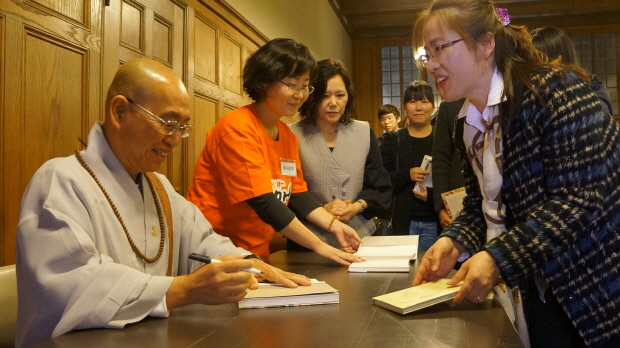
Upon arriving at the University of Illinois at Urbana-Champaign campus, Jung Ga-young, a student here who is also a 1000-Day Practice participant and Jungto practitioner, greeted Sunim warmly. Sunim worked on manuscript editing in the student lounge. Before the lecture, a book signing session was held for students who had purchased Sunim’s books and wanted them signed, allowing Sunim to greet the students.
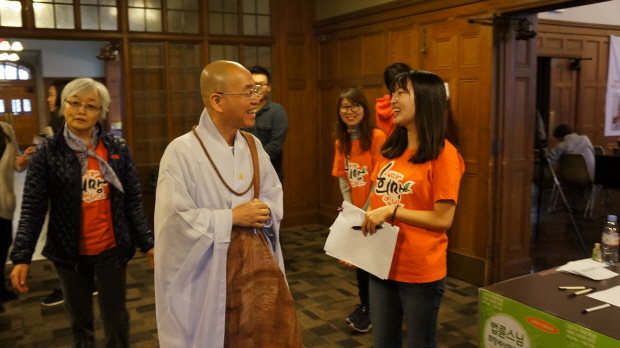
▲ Student Jung Ga-young warmly welcoming Sunim
Today’s lecture at the University of Illinois was held around 11 AM for students on the way to St. Louis.
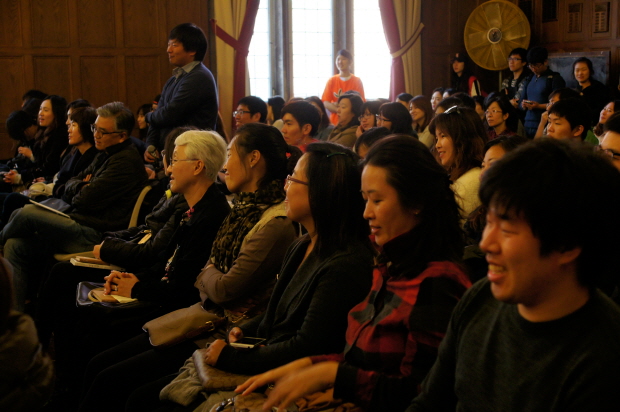
About 200 people filled the lecture hall, and the lecture continued until 1:20 PM. Many came not only from the University of Illinois but also from nearby Springfield and Purdue University in Indiana, filling the lecture hall with a warm atmosphere of welcome.
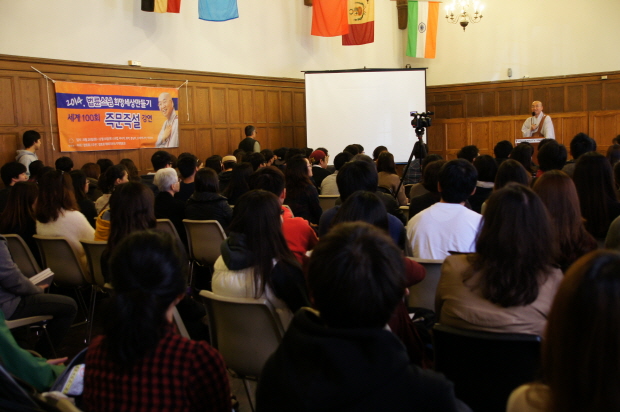
After the introduction video ended, Sunim took the podium amid loud applause. Sunim first asked for understanding about holding the lecture during daytime hours and began by explaining the purpose of the Dharma Q&A format.
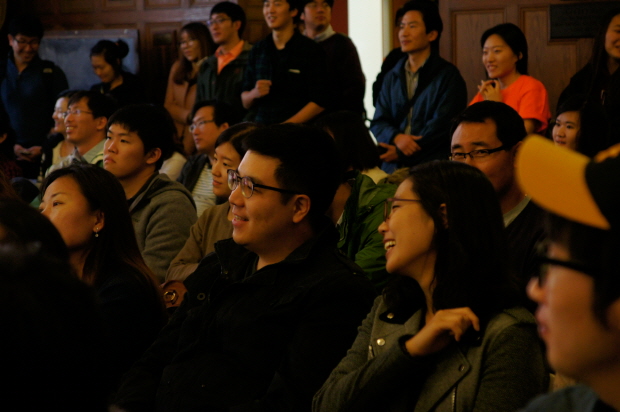
“I thought not many students would come since we scheduled the lecture during the day. Did you come out of class to attend? I gave a lecture here five years ago. We tried to schedule it for the evening, but it just wasn’t possible with the schedule. Since this is a school, we decided to try scheduling it during the day. I hope it didn’t interfere with your classes. Since you have classes every day, it’s okay to miss one day. (Audience laughter)
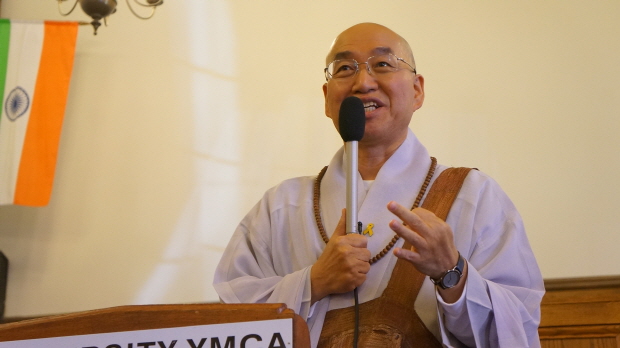
When your mind becomes a bit more at ease, your learning efficiency also improves, so today I’d like to set aside intellectual matters for a moment and have a dialogue about wisdom that helps us see the whole picture. In ‘Dharma Q&A,’ the word ‘seol’ (explanation) refers to words that help us move closer to truth through dialogue. It’s somewhat different from simply ‘answering.’ So Dharma Q&A isn’t about me answering your questions, but rather about helping us approach truth more closely through dialogue about your concerns. Now, anyone who has a question, please raise your hand.”
Sunim then began taking questions. A total of six people asked questions. These included: someone who had worked for 20 years after graduate school but now felt frustrated wondering if this was all they could do; someone who chose their college major according to their parents’ wishes and now felt doubtful about it, blaming their parents while wanting to pursue what they liked but feeling afraid; someone who had fought with a friend of 20 years over something trivial three months ago and still couldn’t reconcile; someone asking whether Buddha mentioned anything about a creator, whether it’s possible to clean up karma that continuously arises in daily life, and whether Buddha mentioned bearing everyone’s karma; and someone who had been living a stable life but felt empty when connections dispersed, wondering how to view connections. Sunim offered wise words for all these various questions.
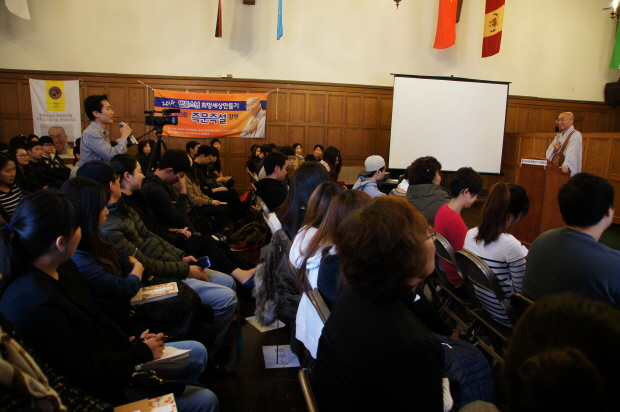
Today, I’ll share in detail the question and answer from someone struggling with their good intentions being met with mockery or contempt, as it provided many insights.
“I try to live pursuing good deeds, but I often hear that doing so is naive, shows ignorance of worldly affairs, or demonstrates poor grasp of reality. Sometimes when I treat people with good intentions, it comes back as mockery or contempt. I think I shouldn’t be hurt by this since I didn’t do it for them but because I wanted to, but in reality, it’s very difficult to control my feelings. I’d like to hear your advice.”
“That’s a bit vague. Could you tell me about a specific incident?”
“A money issue arose with my roommate. Regarding shared items, for instance, I paid rent and internet fees first out of consideration for others’ circumstances, intending to be reimbursed later, but when the time came, they said they couldn’t pay.”
“They say your attitude going to the bathroom is different from your attitude coming out. When borrowing money, they’re really grateful and say they’ll pay back in three days, but after borrowing, their attitude changes. So the lender has to go collect. Money is only yours when it’s in your hand – once it goes to the other person, it’s not your money anymore. Money originally has no owner, but it becomes mine when I hold it. But since I gave what was in my hand, I still think it’s mine, while the other person thinks it’s theirs because they’re holding it. That’s why they try to return it as late as possible. That’s human psychology. So money to be paid is delayed as much as possible, while money to be received we want quickly, but in reality, money to be paid must be given immediately while money to be received comes late. Not just you, but most people feel they always pay on time but never receive on time. This is normal human psychology.
You paid on their behalf when they said they had no money and asked you to cover it. But when you ask for it back, they feel like you’re asking for what’s theirs. So after experiencing this once and understanding human psychology, just don’t do it again with people who don’t keep promises. Repeating this relationship makes you a fool. This isn’t being kind – it’s being foolish. Being kind and being foolish are different. A kind person doesn’t harm others and helps others. But when doing good deeds, we always expect compensation. So when compensation doesn’t come, we feel very disappointed and resentful. So being kind doesn’t mean you won’t suffer. Kind people sometimes suffer more than evil people.
So you’re not playing the role of the master in your life. I’m not saying to be cunning. When investing in stocks, if you lose money once or twice, you should quit, but if you hold on stubbornly, you lose even your house. In such cases, this person lacks wisdom. You might be kind, but you could be called foolish. There’s no learning effect. I’m not saying to cheat others out of money, but if that’s the other person’s tendency, I need to take that into account. If you’re friends, you could say ‘Okay, if you don’t have money, I’ll pay,’ or after trying once or twice and it doesn’t work, there’s no need to get angry – just say ‘This time you pay for both of us. After you pay, I’ll give you my share.’ You need to be specific like this to find a solution. Tell me what other foolish things you’ve done. (Audience laughter)”
“When helping with something at their request, they later say ‘This isn’t the quality I wanted.'”
“Loving a woman is my feeling, right? But just because I love her, does she have to love me? It’s fine that I love her because that’s my feeling. But whether she loves me or not is her right. The reason you have conflicts is because you demand ‘I like you, so you should like me too.’ This isn’t love – it’s a transaction. You’re doing business between friends, and now you’re talking about taking some losses. So when you call it love, you shouldn’t do business. Even if I call a hundred times and they never call me once, I shouldn’t argue about it.
If you’re going to do business, do it smartly. Either don’t do business at all, or if you’re going to do business, do it smartly. But you’re doing business while calling it love, which is why you feel betrayed. You talk about friendship between friends while also saying your friend is bad. ‘I bought drinks three times, why haven’t you bought any?’ Not only is that friend who never bought drinks bad, but you’re also problematic. Why? Why count how many drinks were bought between friends? That’s not friendship – it’s a transaction. If you’re friends, stop the transactions; if you’re not friends and want to do business, then do business properly. But most of us do transactions while calling it love or friendship. That’s why we always count the frequency and amounts.
Looking at your psychology, what you’re doing isn’t so much good deeds as making investments. You give money first expecting to receive it back with interest. But now you’re suffering because not only is there no interest, you can’t even get your principal back, and others call you a fool.”
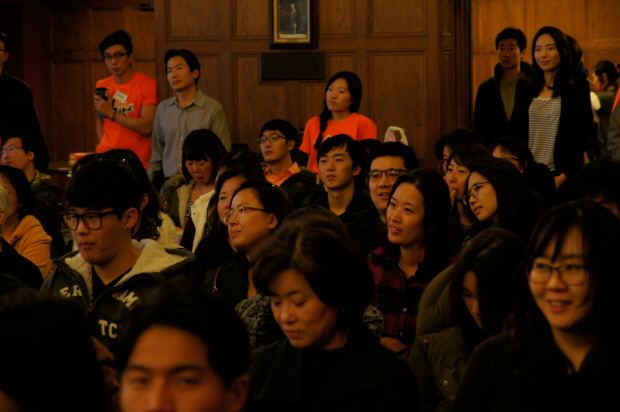
“I thought doing something even at a loss without expecting anything in return was goodwill, but are you saying that’s not goodwill? I didn’t expect anything in return, but I didn’t know I’d be cursed.”
“That’s also expecting something in return. True goodwill is giving without expecting anything. ‘Return’ doesn’t just mean money. When doing good deeds, what return do people usually expect? They expect praise. But when criticism comes instead of praise, you feel bad.”
“Even if not praise, I hoped they wouldn’t curse me.” (Audience laughter)
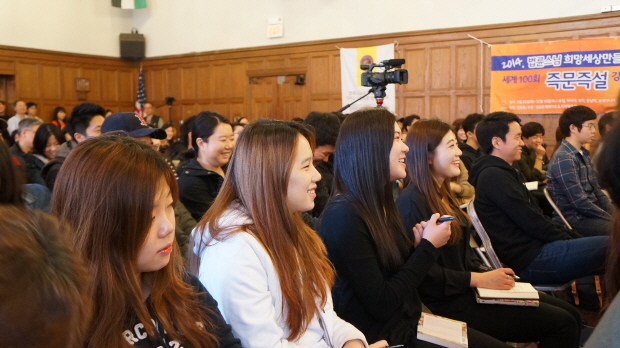
“That’s also my demand. Saying ‘even if you can’t praise me, at least don’t curse me’ is like saying ‘even if you can’t pay interest, at least return the principal.’ You’re doing business asking how they can not even return the principal. So this isn’t that person’s problem. You need to see this as your problem to solve it – if you see it as their problem, how can you fix everyone? You became roommates to live together, not to fix their personality. You might be kind on the outside, but you’re living in a world you’ve drawn. You see the world through the image drawn in your head, but this doesn’t match the real world, causing suffering. Don’t see the world through your drawn image – see and recognize the world as it is.”
“Listening to you, I realize I should have clearly drawn the line – business is business, goodwill is goodwill.”
“But in reality, unless they’re saints, all humans do transactions. They seem to show goodwill on the outside, but in their heads, they’re all doing transactions. You save someone drowning, but as soon as you pull them out, they say ‘give me my bundle’ and you feel bad. Then this is a transaction. What is true goodwill? Knowing they’ll definitely say ‘give me my bundle’ after being saved, but still saving them – that’s true goodwill. Why? Because even if I suffer losses, a dying life must be saved. ‘If I save a dying life, I’ll be blessed,’ ‘That person will be grateful to me’ – these are expectations of return. Saving a dying life is something that must be done even if criticism and loss come to me. That’s why we shouldn’t fear criticism. Don’t calculate profit and loss – if someone needs saving, save them. Help what needs helping even while accepting criticism.
Jesus said 2,000 years ago, ‘Love your enemies,’ and showed that example. So we too should aim for the attitude of ‘don’t expect returns when helping others’ like Jesus. Buddhist scriptures call it ‘giving without attachment,’ and the Bible says ‘don’t let your left hand know what your right hand is doing’ – the key isn’t doing it secretly but not expecting returns. When hands wash feet, they don’t expect returns from the feet. When washing your face, you don’t expect returns from your face. Like that, it’s doing it as your own work, not for someone else. This should be our goal. But all of us living in reality expect returns when we show even a little goodwill to others. Because we’ve lived dependent lives for too long. So you should always keep in mind that while I aim to be a saint, my friends are still ordinary people. Even if I show goodwill without expecting returns, I must accept that they show goodwill expecting returns. They’re not saints.
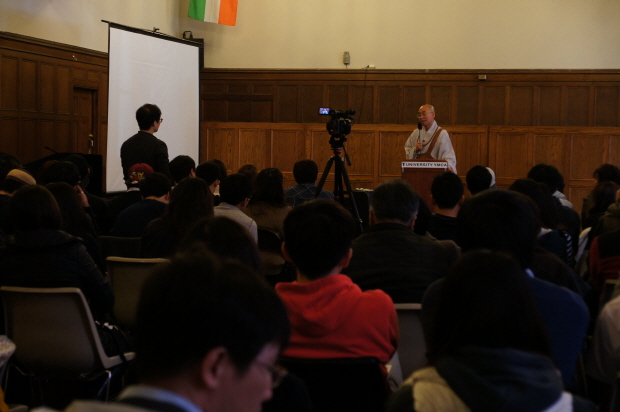
The reason you feel like you’re taking losses is because you’re imitating a saint without being one. Your head thinks saintly thoughts while your heart thinks worldly thoughts, so you say ‘I helped with good intentions’ but your heart expects returns, which is why you’re troubled now. When you look at yourself and realize ‘I’m suffering because I expected returns,’ that’s fine, but when you complain to friends not once but two or three times, they call you stupid. By complaining repeatedly, you make yourself more of a fool.”
“I understand.”
As the questioner smiled brightly, the audience gave warm applause. Sunim then added that understanding that others can be selfish just as I am selfish can reduce conflicts.
“Are people selfish or altruistic? They’re selfish. Then, knowing that selfishness is selfish is the truth. You all think that being altruistic is the truth, don’t you? That’s not the case. Truth is knowing facts as they are. Knowing that selfishness is selfish and knowing that foolishness is foolish is the truth. Knowing a dream is a dream is awakening. When I see myself and know ‘I am selfish,’ I come to understand that others must also be selfish, so I don’t criticize others for being selfish. Being selfish isn’t bad.
We differ in thousands upon thousands of ways, from room temperature preferences to how we season our food. When someone says they’re hot, you should turn on the air conditioner and adapt by wearing clothes even if you’re a bit cold. When someone says they’re cold, you should raise the temperature and adapt by taking off clothes. Both people need to be prepared to live together. To live together, you need to be willing to give up at least half of your rights. It’s best to accommodate the other person. Then there’s no conflict. But because this is difficult, living together is always hard.
We must acknowledge that people are different. Peace doesn’t come to the world by abandoning selfishness. When I’m selfish and know that others are also selfish, I can accept others’ selfishness. Asking someone ‘Why are you so selfish?’ is itself selfish. While human nature contains both altruism and selfishness, altruism lies deep in the unconscious while selfishness is in the upper layers. That’s why selfishness is mostly expressed outwardly in daily life. However, in extreme crises, human altruism emerges. So we shouldn’t insist that everyone become altruistic. We should acknowledge that all humans have selfishness, and when we understand that others have selfishness, there’s less conflict. It’s just a matter of how much I’ll accommodate the other person’s selfishness.”
After listening to Sunim’s complete answer, my mind feels clear and refreshed. It feels like turning on a light in a dark room and having everything become bright. After answering all six questions, Sunim concluded today’s lecture with these closing remarks.
“Look at things positively. Always be positive about your own existence. First, the most positive thing is that you’re alive right now, not dead. As soon as you open your eyes in the morning, try saying ‘I’m alive today too!’ When you do that, joy arises. When you live life on this foundation of positivity, you become happy. You can study now because you’re alive. Studying is always hard because you try too hard to do well. Don’t try too hard to do well. What you’re trying to do well isn’t studying—it’s getting good grades. If your ability is only 100 but you try to produce results of 150, you can only live in constant anxiety. If your ability is 100, getting results of 80 is doing well. When you lower expectations, satisfaction increases; when expectations are high, disappointment grows. No one is tormenting you. Yet you always carry life’s heavy burdens. The time when you can do nothing but eat and study isn’t that long in your entire life. I hope you spend this precious time happily.”
Following Sunim’s suggestion, the audience also repeated “I’m alive today too!” and burst into laughter. The 2-hour and 20-minute lecture had opened people’s closed hearts wide, like clothes getting wet in a drizzle without noticing.
Moving to the book signing area, Sunim signed books for those waiting and took commemorative photos together.
Sunim presented a signed copy of “Life Lessons” as a gift to Jung Ga-young, who served as the overall coordinator for today’s event, thanking her for her hard work.
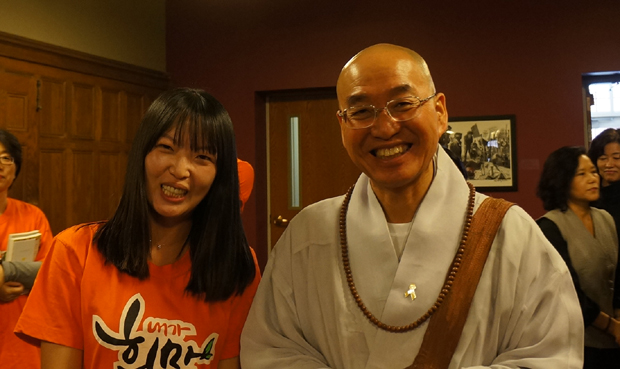
▲ Jung Ga-young, who coordinated today’s University of Illinois lecture
Today’s University of Illinois lecture was sponsored by the local Korean Buddhist Student Association, who prepared the event together with Jung Ga-young. Sunim also presented a signed book as a gift to Oh Seung-jin, president of the Buddhist Student Association, expressing his gratitude.
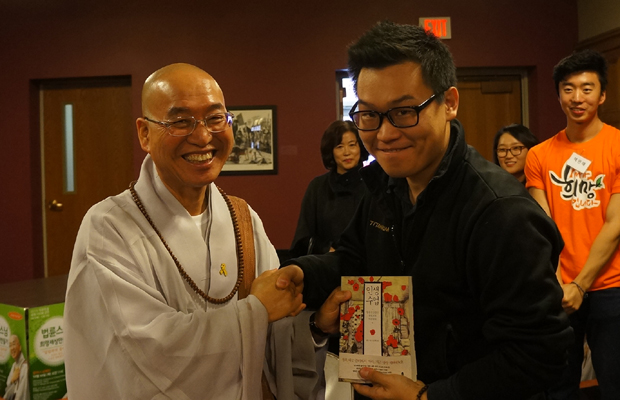
▲ Oh Seung-jin, President of the Korean Buddhist Student Association
Sunim also gave a signed book as a gift to Lee Dong-woo, a local Korean resident who provided much help in preparing the event.
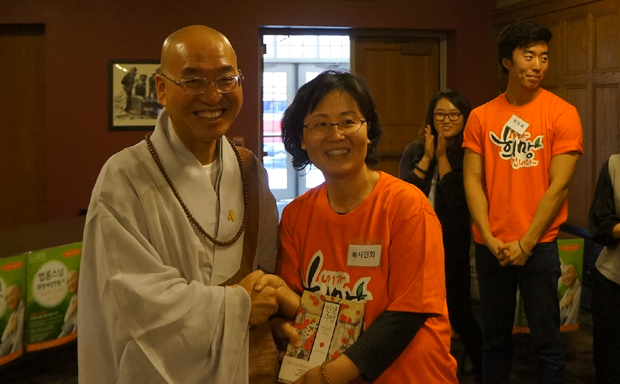
▲ Lee Dong-woo, who helped prepare the lecture and lives in Urbana-Champaign
Sunim then took a commemorative photo with all the volunteers who helped throughout the venue.
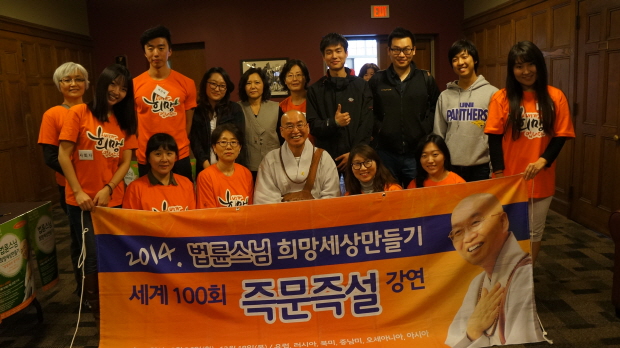
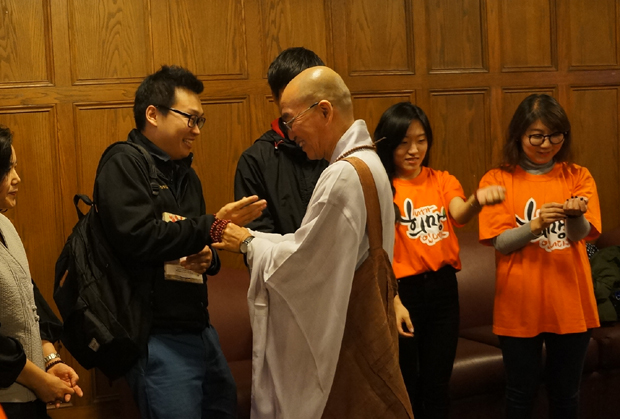
Sunim placed prayer beads brought from Korea as gifts on the wrists of all volunteers, encouraging them and thanking them for their hard work.
After cleaning up, the volunteers had a mindful sharing session with Dharma Teacher Myodeok. One young man who received the book “Youth Concert” from his grandfather and had been listening to Sunim’s Dharma talks on YouTube before learning about this lecture and volunteering said happily, “This was my first time hearing Sunim’s Dharma talk in person.” Another person who had recently participated in the Awakening Retreat said, “I was happy to see Sunim in person while praying daily, and even happier to be able to volunteer.” Two graduate students said, “We signed up to volunteer after seeing how enthusiastically the coordinator was promoting and working hard, and we were pleased with both the Dharma talk and seeing so many people attend.”
Jung Ga-young, who was responsible for preparing the lecture, was particularly delighted, saying, “Seeing the brightened faces of those who attended the lecture made me so happy and grateful. While I worried a lot preparing for the lecture, it was even more rewarding, happy, and wonderful.”
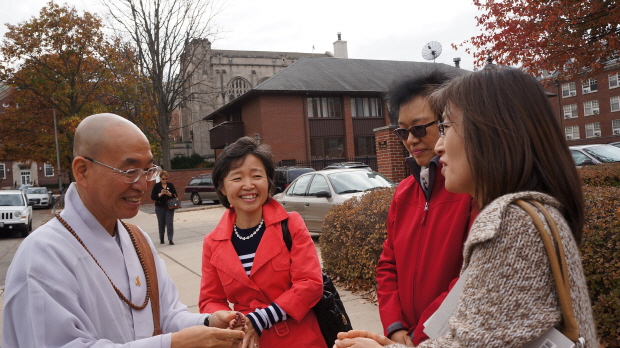
▲ Meeting people from Springfield in front of the lecture hall and giving them prayer beads as gifts
After leaving the lecture hall, Sunim had lunch in the car with triangle kimbap and pumpkin porridge prepared by the volunteers, then hurriedly departed at 2 PM for St. Louis, Missouri, for tonight’s lecture.
Thus, with the dedication and volunteer work of many people, the 66th lecture at the University of Illinois at Urbana-Champaign was successfully completed. The 67th lecture will be held shortly at 7 PM in St. Louis, Missouri. We’ll bring you news from St. Louis.
▼ Venerable Pomnyun Sunim’s 100 World Lectures, see past event coverag