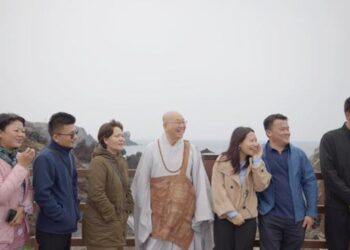

Apr 4, 2026 – Bhutanese Visitors Day 6 (Arrival in Seoul, Sharing Reflections), Moving to Dubuk
Hello. Sunim spent the sixth day with the Bhutanese visitors and then moved to Dubuk Jungto Retreat Center.
Sunim, the Bhutanese visitors, and JTS volunteers left their accommodation at 5 AM, loaded their luggage into the vehicles, and headed to Jeju Airport. It had been raining all night, and light rain continued into the early morning. Since the accommodation was near the beach, the sounds of wind, waves, and rain could be heard together in the early morning.
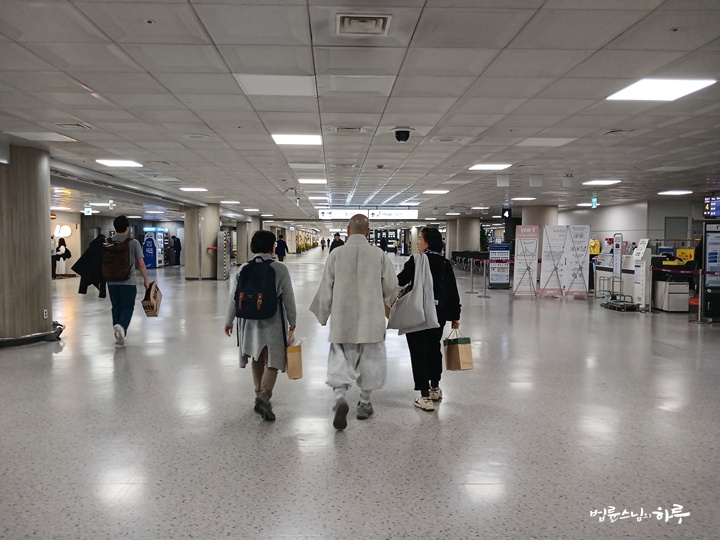
Upon arriving at the airport, the Bhutanese visitors immediately went to the counter to check in their luggage. The flight departure was delayed by 30 minutes.
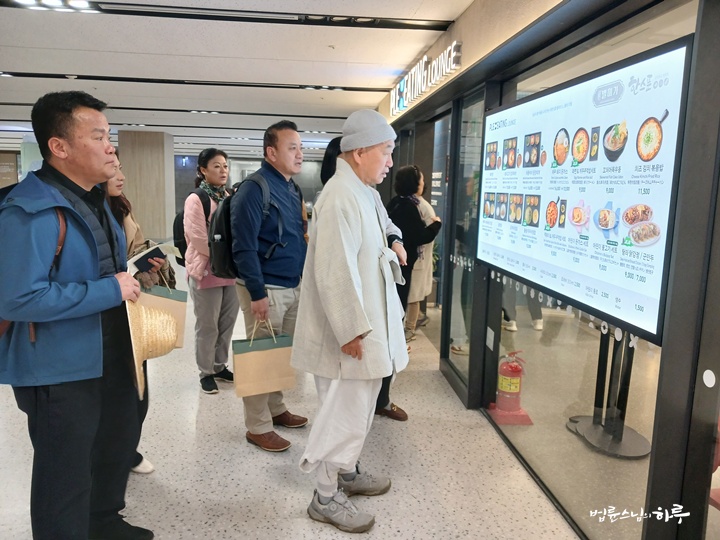
In the meantime, Sunim and the Bhutanese visitors had a simple breakfast of Korean snacks at the airport.
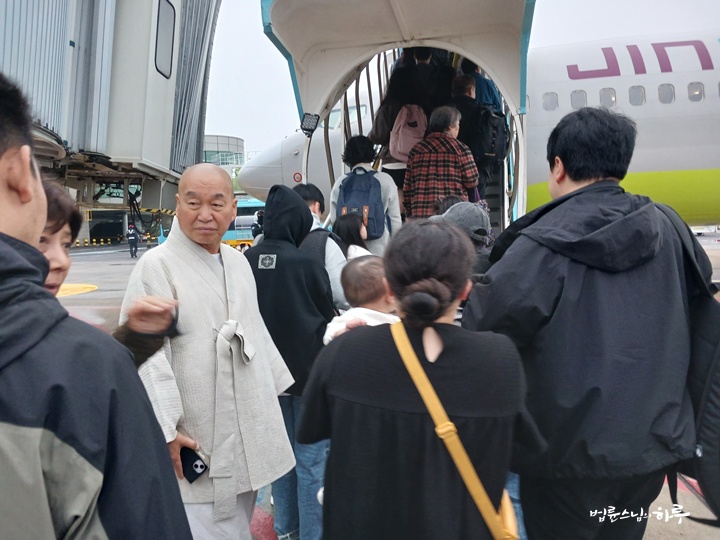
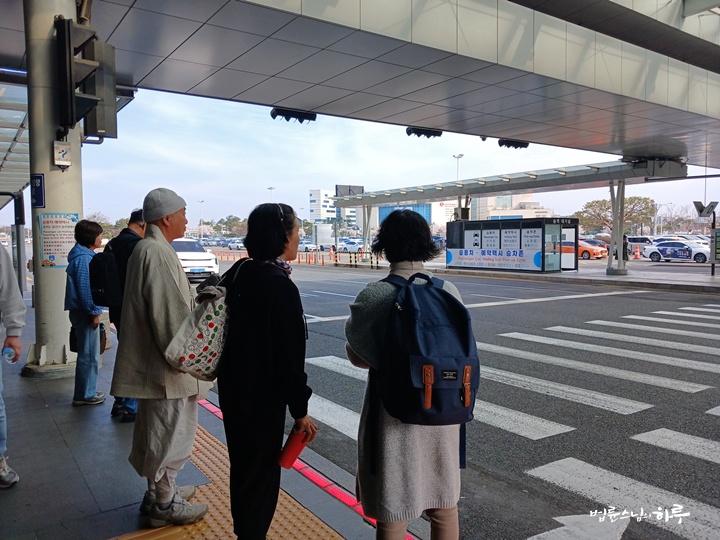
Today was the last day with the Bhutanese visitors. The original plan was to visit Jogyesa Temple first after arriving in Seoul and then have time to prepare gifts for their families. However, due to the flight delay, the schedule became tight, so the visit to Jogyesa was canceled. The Bhutanese visitors went to Myeongdong to prepare gifts for their families and arrived at the Jungto Social and Cultural Center around 1 PM.
Sunim returned from Incheon Airport to the Seoul Jungto Center in Seocho-dong and prepared gifts for the Bhutanese visitors. He then went down to the basement cafeteria to check the lunch menu for the Bhutanese visitors’ last meal. Bhutanese people tend to like spicy and salty food, but the meals so far had been rather bland. Sunim suggested including kimchi and tteokbokki in the menu.
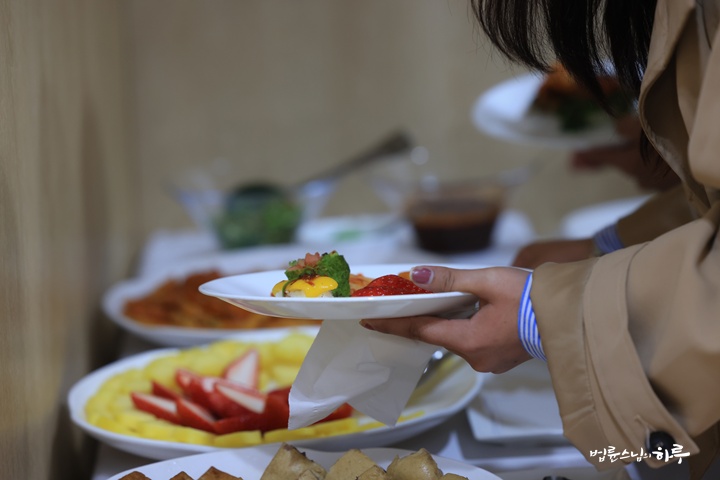
At 1 PM, the Bhutanese visitors who had gone to Myeongdong arrived at the center and gathered in the basement cafeteria. During the meal, Sunim mentioned that Myeongdong is the heart of Seoul and asked how their shopping went. He apologized that since Jungto Society promotes a “no shopping” movement, everyone was not very knowledgeable about shopping, and offered that those who needed more shopping could get necessary items from the recycling center on the 7th floor.
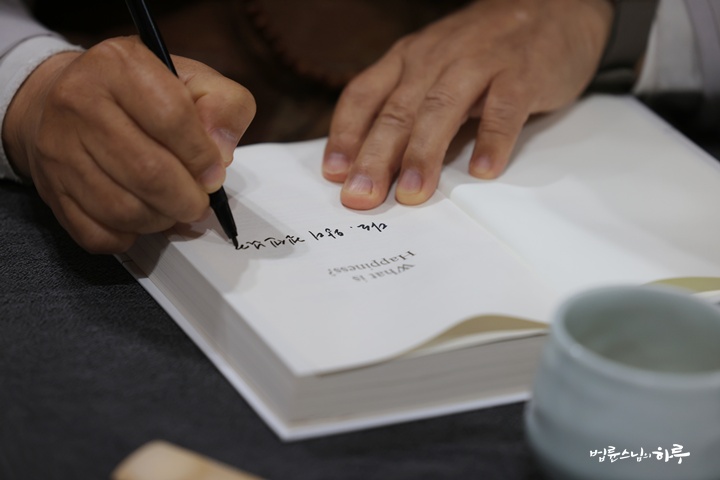
As the meal was coming to an end, Sunim gave each Bhutanese visitor a gift and signed his English book with each person’s name before presenting it. After packing their luggage for the airport, they agreed to meet in the 10th-floor conference room at 2:10 PM to wrap up the Bhutanese visitor program.
The visitors stopped by the “Sharing & Emptying shop” thrift shop on the 7th floor of the Jungto Social and Cultural Center. The well-organized items were donations from Jungto members. The Bhutanese visitors comfortably browsed the displayed clothes, tried them on, and looked in the mirror. They were happy to take sneakers, blankets, and clothes.
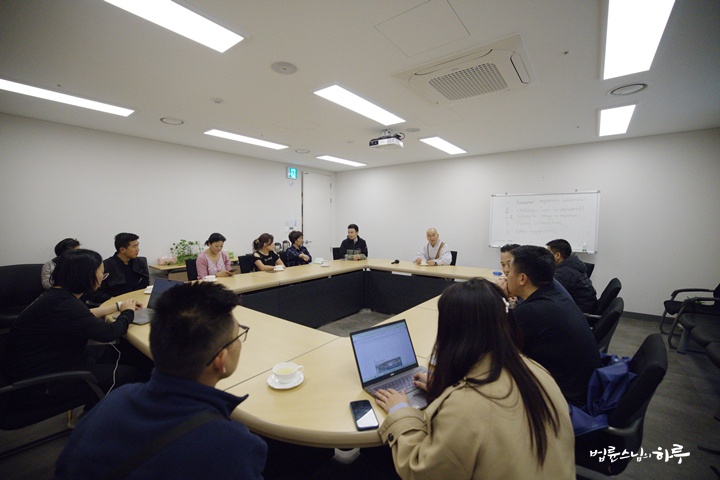
Around 2:20 PM, the Bhutanese visitors gathered in the 10th-floor conference room. Before the discussion, Sunim suggested topics for sharing reflections. The Bhutanese visitors took turns sharing their overall impressions of the six-day itinerary in Korea, what they liked, areas for improvement for future programs, and suggestions. Sunim listened attentively to all their stories.
While it would have been good to hear more reflections, the Bhutanese visitors had to leave for Incheon Airport, and Sunim had a meeting with foreign guests immediately after the discussion, so they had to finish within the time limit. After hearing Sunim’s closing remarks, the discussion ended.
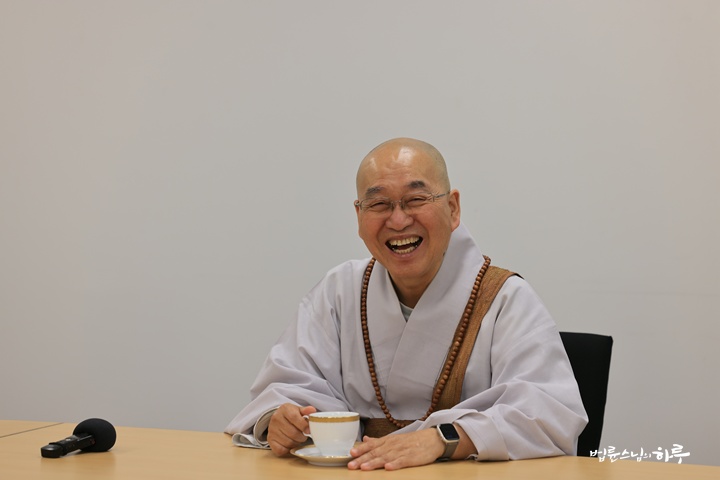
“When inviting you all, I initially hesitated about how to arrange the invitation. Cabinet ministers and governors are all busy, so the schedule needed to be short, while practitioners would need a longer schedule to learn properly. This time, considering the senior officials, we made the schedule short, which made the overall itinerary quite packed. When the schedule is short, the content should also be reduced, but trying to show you this and that made it even busier. Nevertheless, thank you for managing the tour well.
Three Stages of Sustainable Development in Bhutan
“The Bhutan project I’m currently envisioning can be divided into three stages.
First, we need to improve residents’ living conditions. Those without homes need houses built, existing homes need improvement, and living conditions must be enhanced. Second, we need to develop and improve production infrastructure so residents can live sustainably. This includes improving agricultural methods and developing fruit cultivation and livestock farming alongside agriculture. Furthermore, we need some processing industries like yogurt, dried foods, and simple processed foods. We also need systematic management of how to distribute and sell the produced goods. This is the secondary project we need to work on in the future. During the primary project, we should do some sampling of secondary projects. This way, when we move to secondary projects, we’ll have pilot projects to reference.
Third is supporting projects that the Bhutanese government should consider nationally. One of these is tourism, which appears to be an important industry for Bhutan. The key is how to create tourism infrastructure in preparation for increasing tourists. First, we need to maintain tourist site landscapes and create parks to make beautiful environments. Various infrastructure facilities like roads, parking lots, accommodations, and retail facilities must also be established. Second, since tourists consider food as important as sightseeing, diverse food development is necessary. Third, we need entertaining activities for tourists. However, when poorly managed, such entertainment elements can easily turn into corrupt activities. Bhutan should not allow this. We need to create wholesome entertainment. How can we combine healthy activities like meditation, traditional games, and nature-enjoying activities? These need to be designed more comprehensively. Among these, creating an environment to accommodate tourists is the first priority. I’ve only been to Thimphu and Punakha, but I felt the infrastructure was quite lacking. Your suggestion about the need for landscaping during this Korea visit is a good one. Even when building walls, there’s a difference between just building them straight and building them beautifully in various ways. Trees, flowers, and grass should harmonize without being too complicated.
When foreigners come to do landscaping, they tend to bring trees and flowers from their own countries to make it beautiful. Of course, foreign flowers might be pretty to Bhutanese people. But when foreign tourists come to Bhutan, it’s important to show them Bhutanese flowers, grass, and trees. So landscaping should be different for parks for Bhutanese residents versus parks for foreigners. Since many Bhutanese are abroad, domestic tourism within Bhutan will also increase in the future. We need to support tourism infrastructure for them as well.
Also, while traditional culture preservation mainly focuses on building preservation, traditional food, traditional clothing, traditional games, and traditional beliefs are also very important, so we need to comprehensively study how to harmonize these with traditional architecture. Once again, while it was good that you visited various places in Korea, I apologize for making it difficult with such a packed schedule. I’d like to talk more, but since you need to go to the airport and it’s the weekend with heavy traffic, let’s conclude all our activities here.”
The Bhutanese visitors hadn’t been able to see the rest area on the 2nd floor of the Jungto Social and Cultural Center due to their busy schedule.
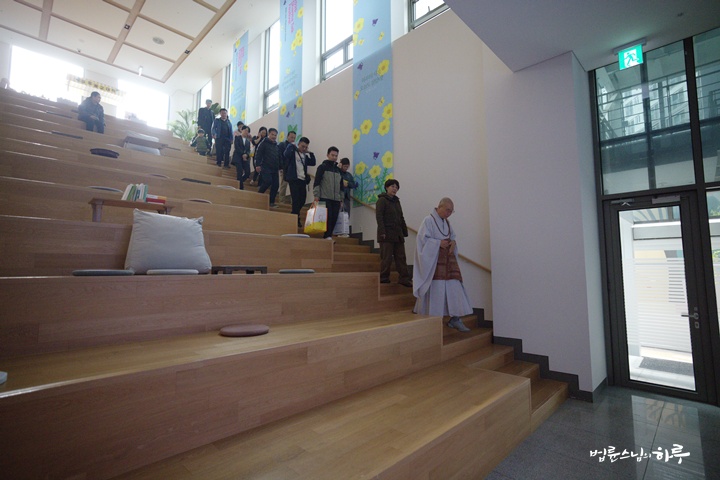
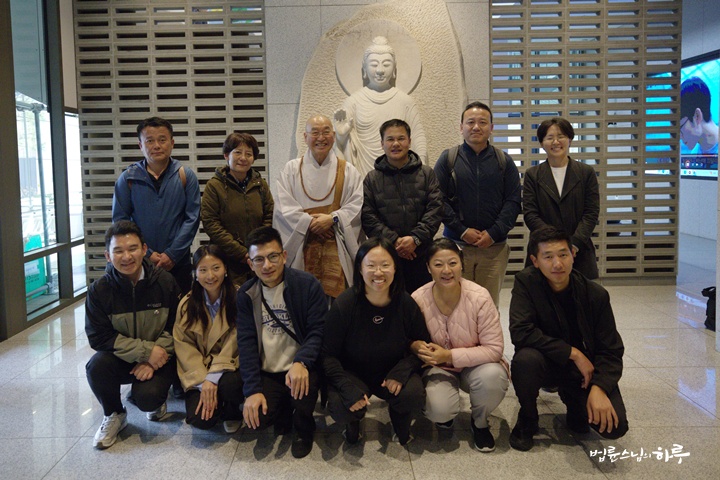
Finally, they toured the 2nd floor of the Jungto Social and Cultural Center and went down to the 1st floor for a commemorative photo.
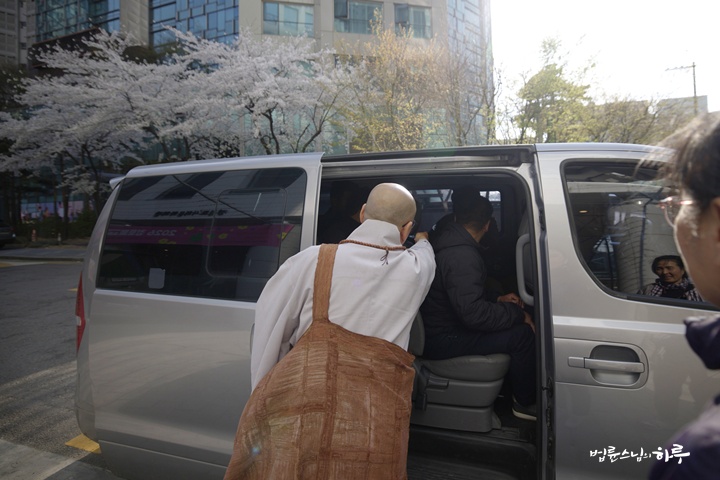
Sunim watched the Bhutanese visitors board the vehicle heading to Incheon Airport and waved goodbye.
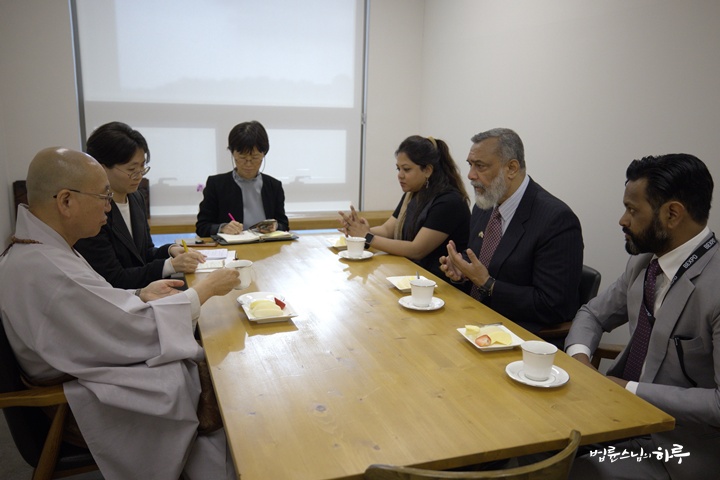
At 5 PM, Secretary General Abhijit Halder, Public Relations Director Amos Simon, and International Relations Director Portia Bernadine Conrad from the International Buddhist Confederation (IBC) visited the center. They were officially visiting Korea on behalf of IBC and came to the Jungto Social and Cultural Center to meet with Sunim after participating in the 2026 Seoul International Buddhist Expo.
First, they explained IBC’s activities and sought cooperation. Sunim suggested that while restoring Buddhist sites and temples is important for IBC’s work, it would also be good to establish many departments teaching Buddhist studies at India’s top universities, so that people worldwide, especially young people, would say they go to India to learn Buddhism.
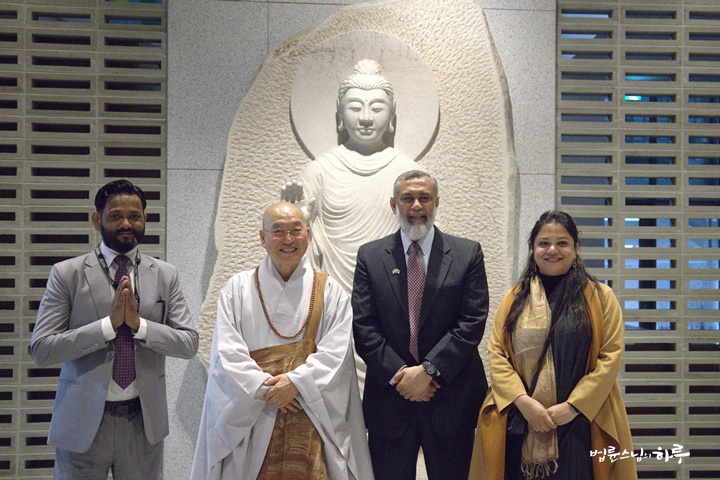
After about an hour of discussion, they took a commemorative photo in the 1st-floor lobby. They then moved to the Indian Embassy in Yongsan, while Sunim immediately headed to Dubuk Jungto Retreat Center. He arrived at Dubuk Jungto Retreat Center close to 10 PM, concluding the day’s activities.

Since there was no Dharma talk today, this post concludes with content from a previous Dharma Q&A.
How Can I Calm My Fluctuating Feelings Toward My Husband?
“Do you prefer it flat? Or going up and down?”
“I don’t want it to go up and down.”
“Is there a reason?”
“It’s difficult for me when it’s like that.”
“Let me give you an example. When you go hiking, do you always walk on flat ground?”
“When hiking, I know the mountain is steep and just go. But I don’t know how to express my feelings about my husband. Anyway, I’d like it to be more level now.”
“That’s because you have strong likes and dislikes. You really like some things but strongly dislike others. So when you see something you like, your mind rises steeply, and when you see something you dislike, it drops steeply. This is your karmic consciousness. Your karmic consciousness is reacting according to your husband’s appearance. Your husband’s actions are visible to your eyes, his voice is audible to your ears, his smell comes through your nose, his taste through your tongue, his touch through your skin, and your mind perceives these as thoughts and images. Through these six senses, your karmic consciousness reacts sensitively.
If your mind fluctuates like that, just think of it as the sound of a piano being played. Just be aware that as your husband presses various piano keys, your karmic consciousness rises and falls accordingly. You just need to listen to your mind singing like that. When singers perform, they need to hit some high notes and low notes to make it pleasant to listen to. If they sing too calmly, it’s easy to fall asleep.
Your Reaction Is Your Karmic Consciousness Responding
Also, you need to be clear that such reactions are your own issue, not your husband’s problem. It’s not that your husband has problems; it’s actually your karmic consciousness reacting that way. The more different people’s karmic consciousness are, the greater the fluctuation. You should know that wanting ‘the range to be large’ or ‘the range to be small’ is also likes and dislikes arising from your karmic consciousness.
Being caught up in likes and dislikes is not practice. Practice is being aware of your current state as it is. Proper practice is simply being aware of ‘this is my current state now’ as it is. Thinking ‘I wish my state were like this’ or ‘I wish it were like that’ means you have some intention. You could call it your ‘desire.’ However, practitioners must let go of all desires.
It’s the same with your feelings toward your husband. Stop wishing ‘I hope my husband would do this’ and just be aware of ‘my mind is reacting to my husband like this.’ Then the fluctuation will naturally subside. If the fluctuation increases, it proves that you’re currently losing your awareness. You’re reacting to your husband’s piano sounds. If you clearly maintain awareness of such feelings, the amplitude will gradually decrease. When it rises slightly, be aware: ‘Oh, it’s rising slightly!’ Then it will naturally come down. If it drops too much, be aware: ‘Oh, it’s dropping too much!’ Eventually, it will become level. If you continue practicing steadily like this, you can maintain an appropriate state even with some ups and downs.
Furthermore, if you can maintain awareness moment by moment, the amplitude becomes so subtle that it becomes difficult to notice the fluctuation. It may feel like there’s almost no reaction because it’s so subtle. Sometimes it becomes ambiguous whether your current feeling is slightly good or bad. You can’t say you feel good, nor can you say you feel bad. While there’s an analysis that says ‘the mind doesn’t react,’ more accurately, we could say ‘the reaction is so subtle that it’s as if there’s no fluctuation.’ The more complete your awareness, the more subtle the karmic consciousness’s reaction becomes; otherwise, it grows larger.
Simply deciding ‘I wish my mind wouldn’t fluctuate when it comes to my husband’ doesn’t change your karmic consciousness. Practice isn’t about intending ‘I wish I could attain enlightenment.’ True practice is maintaining moment-to-moment awareness and letting go of your desires. However, most of us practice with certain desires or intentions. It’s no different from someone attached to money striving to earn it, or someone attached to fame striving to reach a high position. Most people who claim to practice are actually striving with attachment to enlightenment. This kind of practice merely changes the object of attachment. It’s just falling into another attachment called enlightenment.
True Practice Is Letting Go of All Attachments and Desires
If someone practices diligently for 10 years but becomes discouraged because they haven’t attained enlightenment, just like a businessperson who becomes discouraged after working hard for 10 years without making money, then they too are attached to enlightenment in the name of practice. From the perspective of right practice, the two are no different. If a monk becomes discouraged thinking ‘I’ve been meditating in the meditation hall for 10 years but still haven’t attained enlightenment,’ or if a Jungto practitioner becomes discouraged thinking ‘I’ve been attending Jungto Society for 10 years but still haven’t attained enlightenment,’ both are merely attached to practice rather than practicing correctly. They’ve only practiced in name while becoming attached to another object. True practice is letting go of all attachments and desires. When attachments or desires arise, simply be aware of them – doing something intentionally is not practice. Just maintain awareness.
Striving is not practice. Yet most of us practice desperately, like someone blinded by money. Practice shouldn’t be done with a striving mind.
First, you need to observe how your mind reacts moment by moment. As you do this, the amplitude will naturally decrease. Second, you must always be aware that you are quite a sensitive person. It’s not that your husband or any external party has a problem – your mind is reacting very sensitively. People’s karmic consciousness doesn’t change as easily as we think. If I don’t become aware of my mind, my life will simply flow according to my karmic consciousness. That’s what we call living according to fate. But when you maintain awareness, an excited mind naturally settles down, and a depressed mind naturally returns. That’s why awareness is most important for practitioners.
“Yes, I understand. Thank you.”