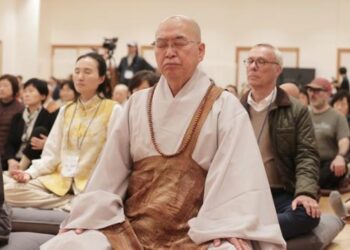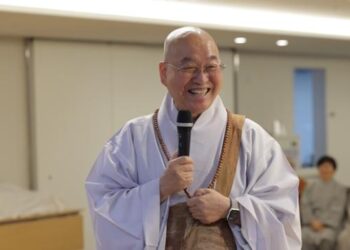

Mar 21, 2026 – World Meditation Forum Day 2
Hello. This morning, Sunim participated in the second day of the World Meditation Forum program, and in the afternoon, he had meetings with officials.
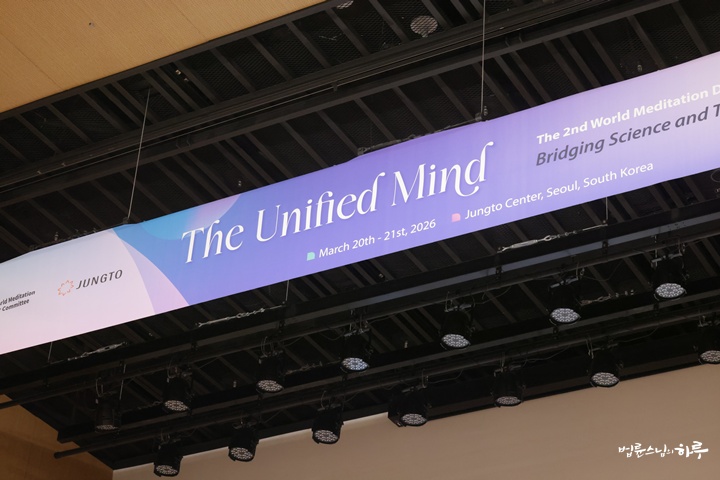
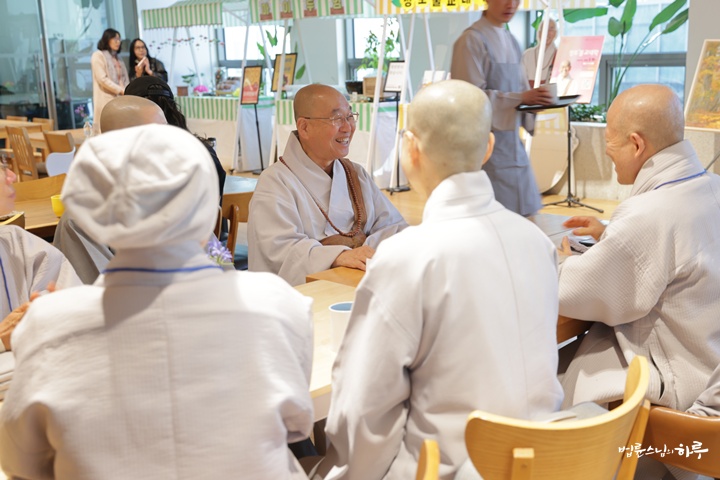
At 9 AM, distinguished guests and presenters began gathering at the lounge on the second floor of the Jungto Social and Cultural Center. Since today’s presentations focused on meditation and science, many people from meditation-related organizations attended. Sunim greeted the meditation leaders and introduced them to each other.
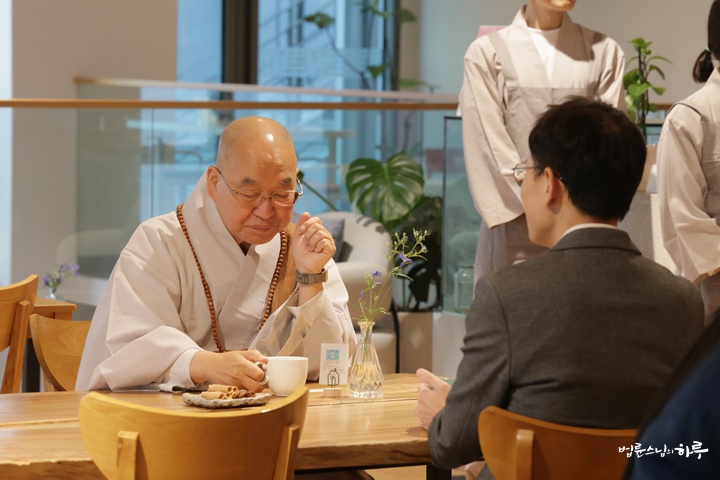
Dr. Jang Dong-seon (장동선), a neuroscientist and one of today’s presenters, came to the second-floor lounge to meet Sunim before his presentation.
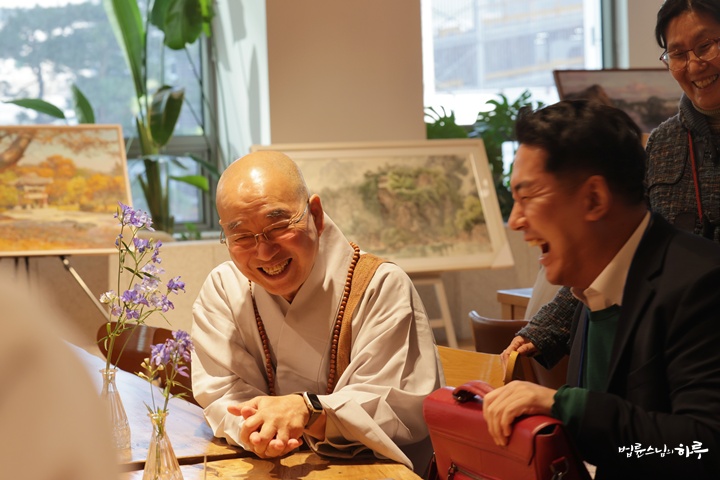
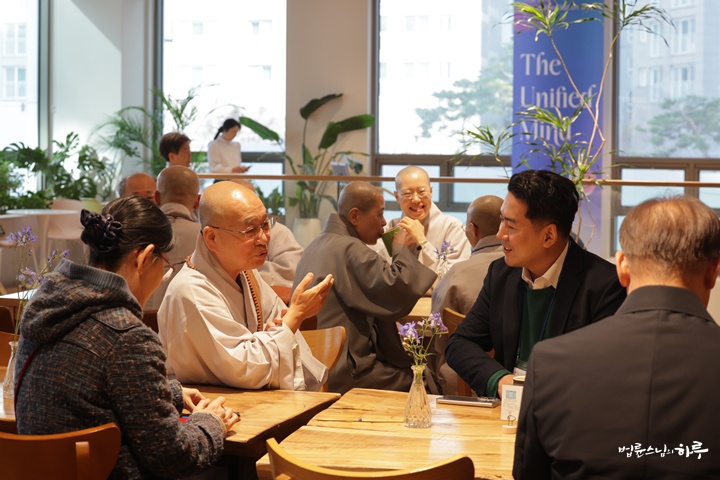
Sunim warmly welcomed Dr. Jang. Dr. Jang mentioned that he had met Sunim before. He had asked Sunim a question as a participant in a Dharma Q&A session in 2014. Sunim agreed to collaborate with Dr. Jang on meditation-related research in the future.
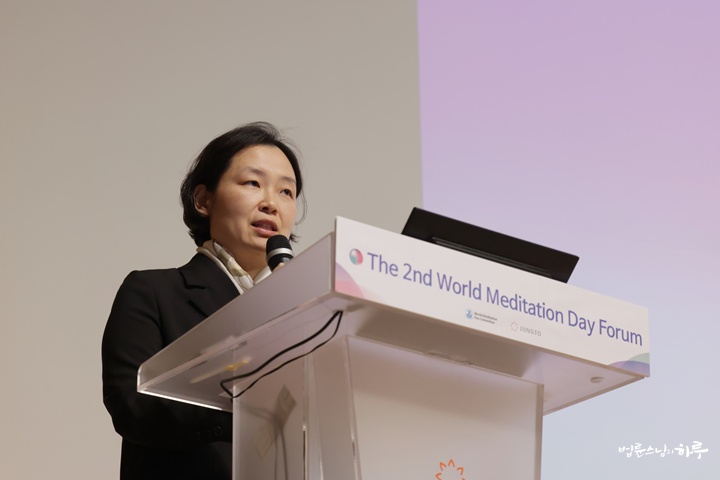
While greeting each other and having tea, it was soon time to go to the event venue. Sunim moved to the underground auditorium where the event was being held, along with the presenters and participants. As soon as everyone was seated, the event began.
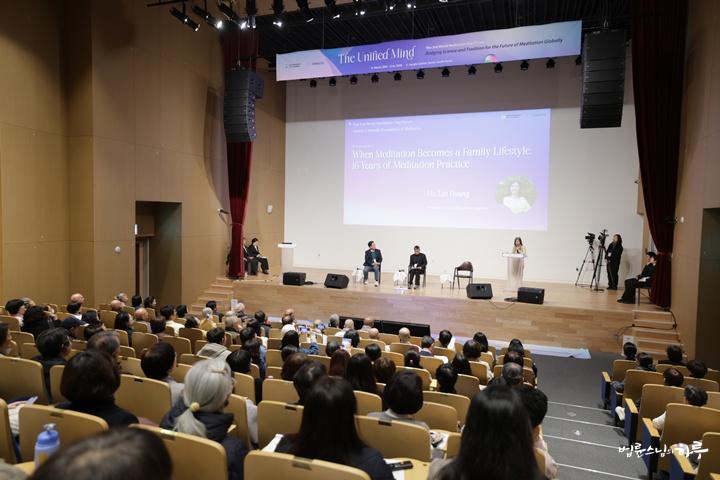
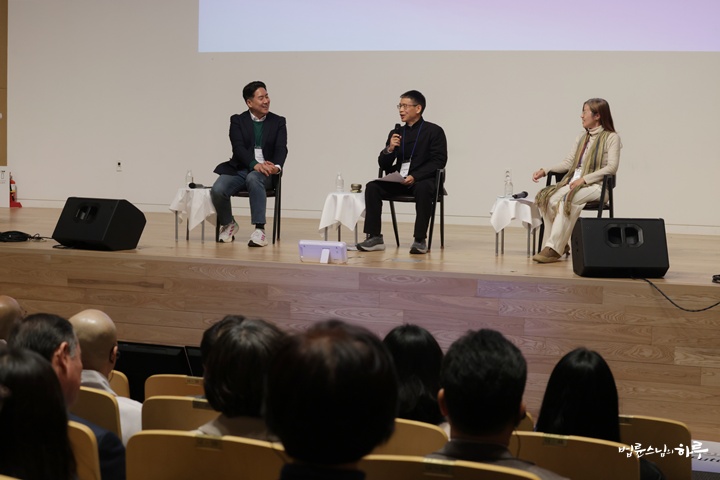
This morning’s session included both on-site and online presentations. Dr. Jang Dong-seon shared his perspective as a neuroscientist on the effects of meditation in an era of advanced AI and social media, and how meditation changes our brains. Another presenter, Ms. Lynn Huang, shared cases along with videos showing participants’ transformations from her 16 years of meditation practice.
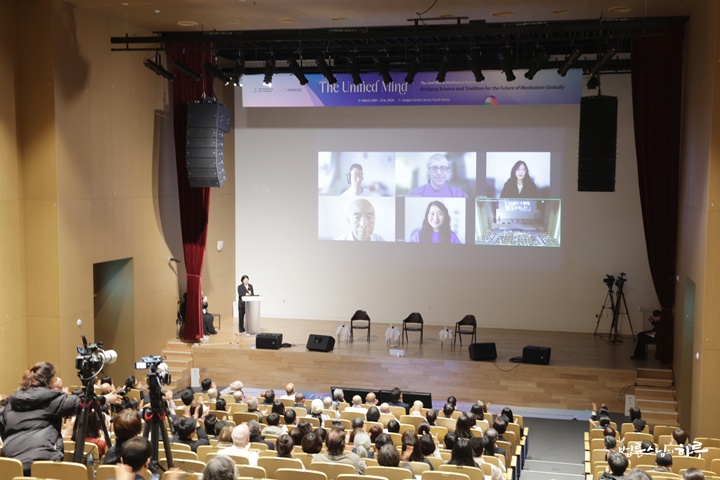
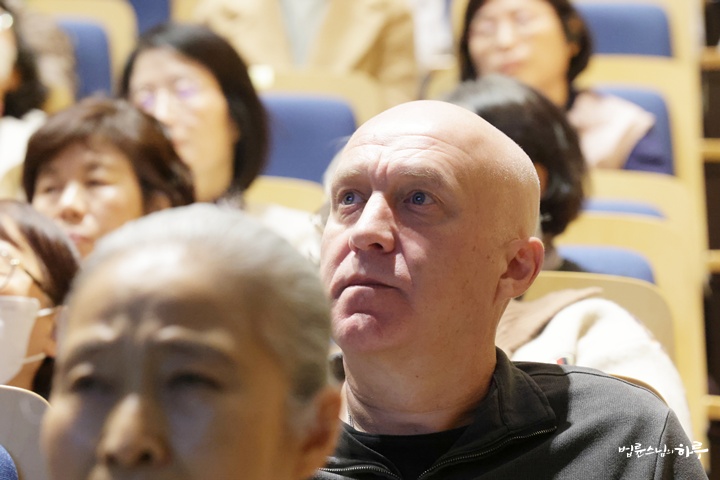
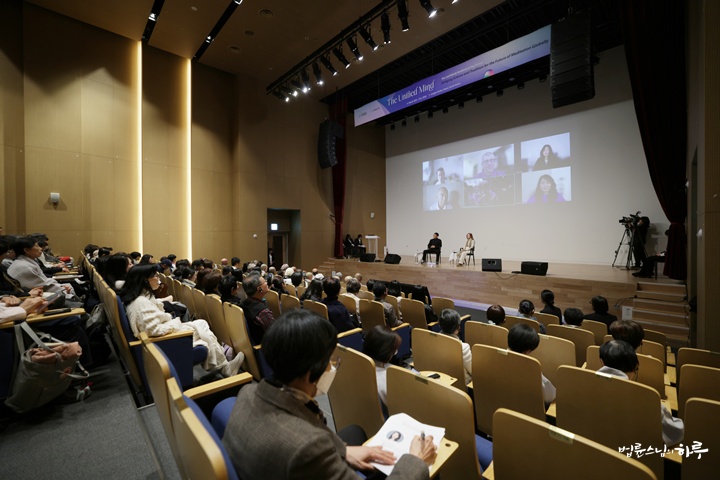
The online presentations then began. Five presenters from various countries gave presentations mainly focusing on scientific analysis of meditation effects, followed by a Q&A session with the audience. After the Q&A time with the audience, the morning session concluded.
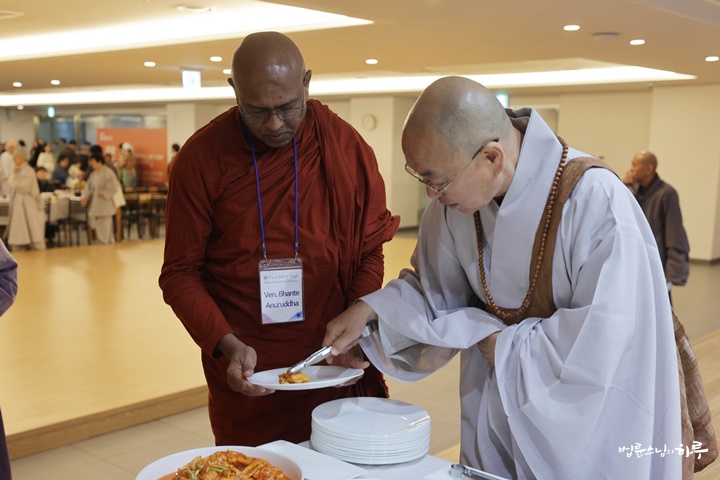
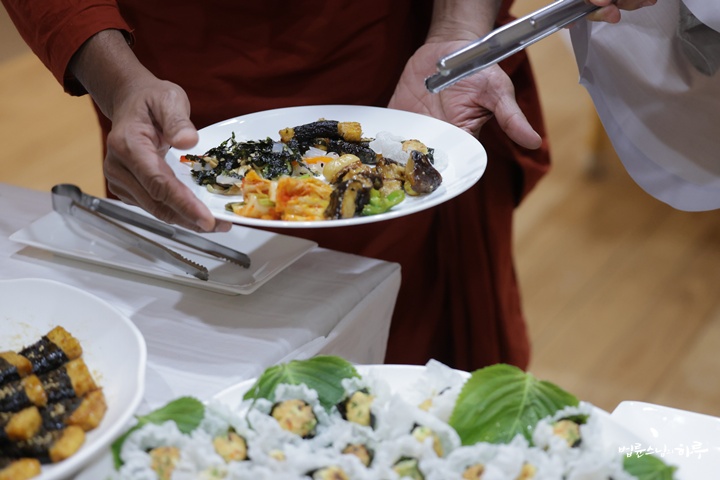
Sunim had lunch with foreign participants in the basement cafeteria. Sunim served food onto a Theravada monk’s plate, attending to him according to proper meal etiquette.
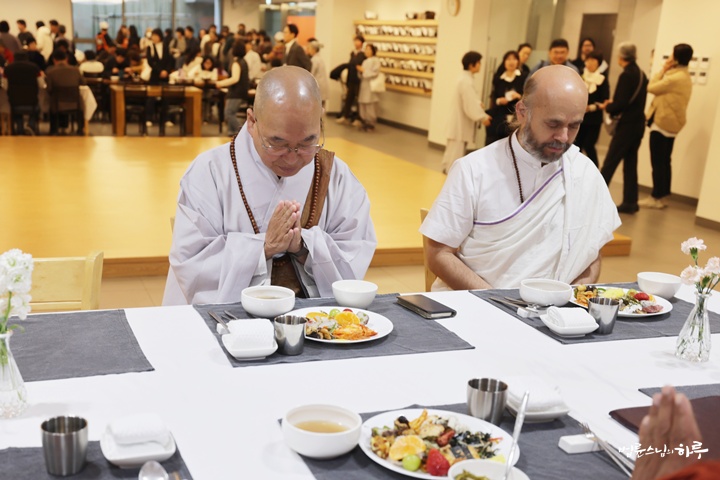
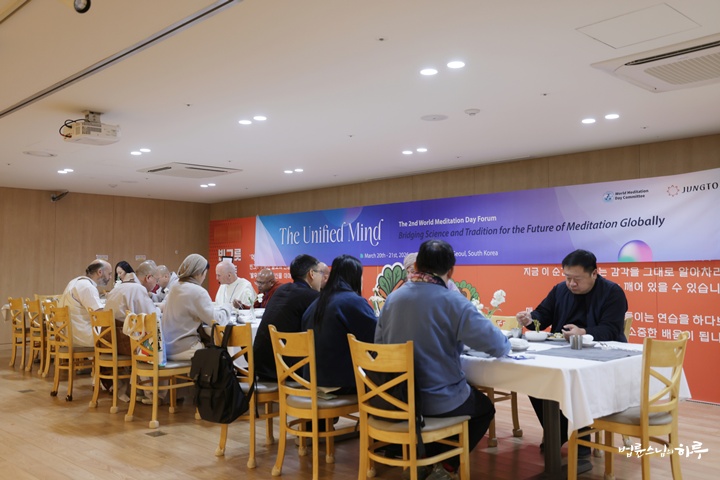
The basement cafeteria was filled with distinguished guests and participants.
After the meal had progressed somewhat, Sunim took the microphone and introduced the volunteers who had prepared this event to the distinguished guests.
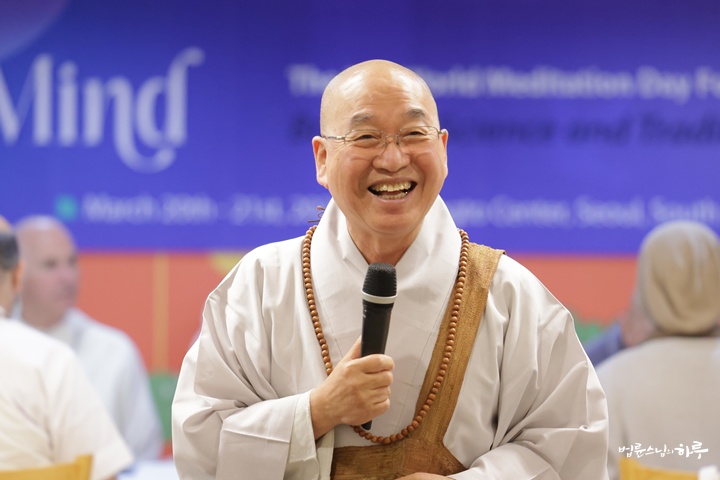
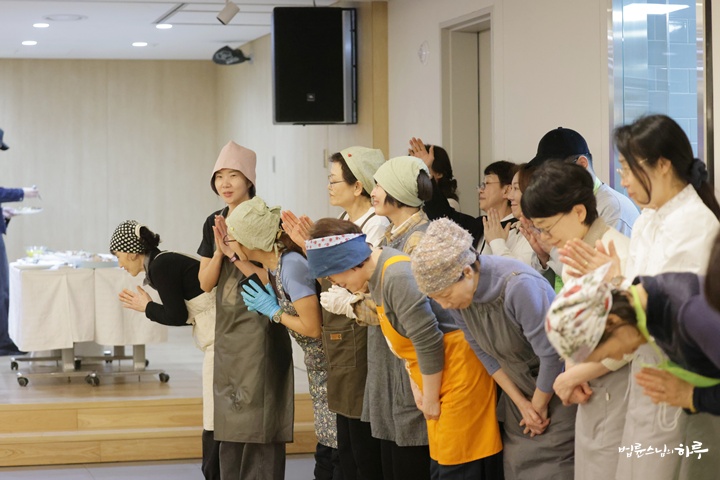
First, he expressed gratitude for the hard work of the kitchen volunteers who had prepared meals for two days. Much appreciative applause resounded. The distinguished guests also stood up to take photos together.
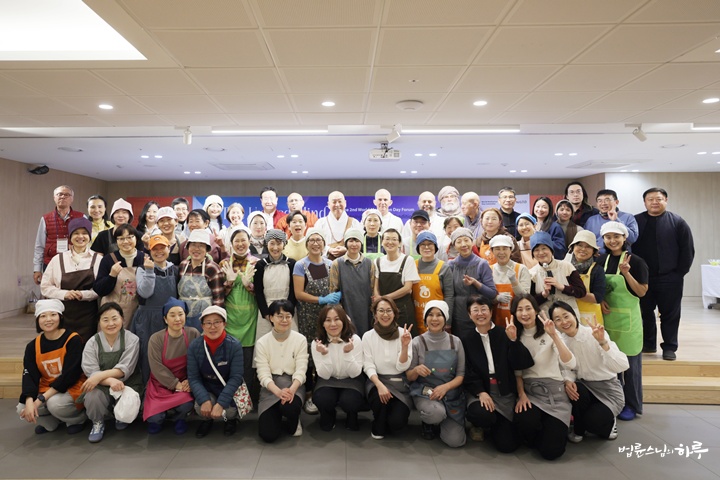
Next, he introduced those who had organized the event. He introduced and thanked the International Division and community volunteers who had handled event operations including guiding, organizing, filming, photography, hosting, interpreting, and reception, as well as airport pickup, transportation, accommodation, and hospitality for foreign participants. They then took photos together. These people had worked hard behind the scenes for the past month preparing for this event.
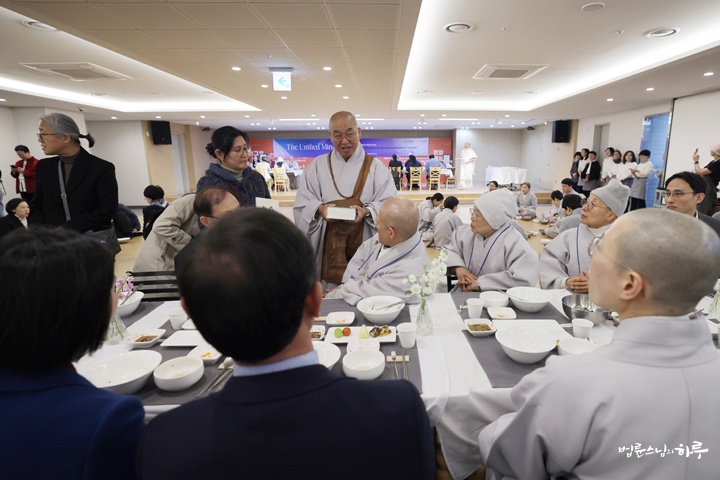
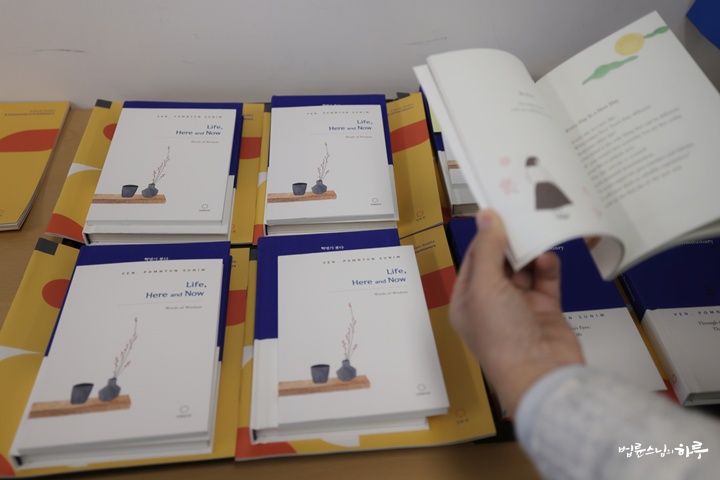
They also had time to present book gifts to the distinguished guests and exchange greetings.
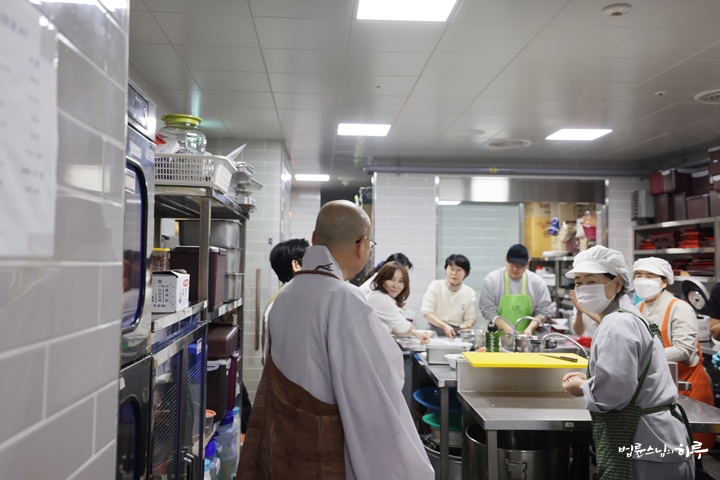
To express gratitude to the volunteers who prepared meals for this event, Sunim personally went to the kitchen to thank the volunteers who were working there.
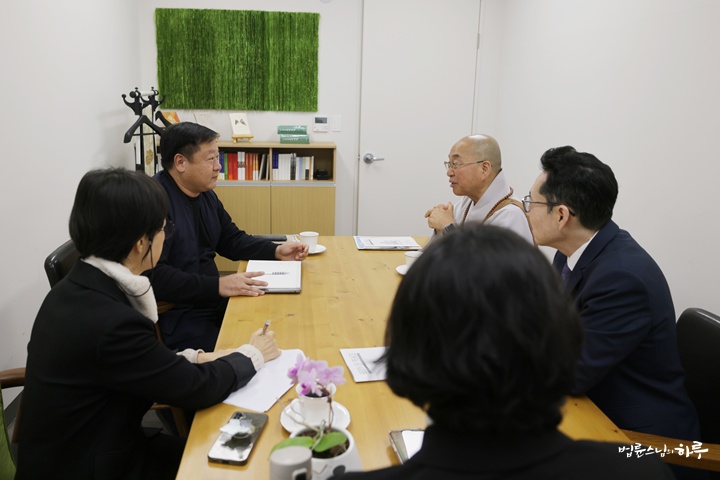
During the lunch break, Sunim met with Mr. Moo, Secretary General of INEB (International Network of Engaged Buddhists), who had moderated one session of this event, to discuss recent developments.
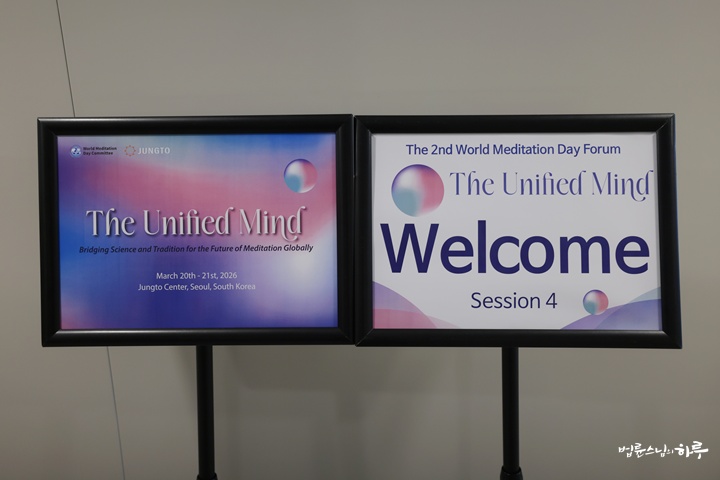
The final session of the World Meditation Forum was held privately from 1:30 PM. The last session was a workshop for WMDC (World Meditation Day Committee) members to discuss membership and ideas. It served as both a forum for gathering ideas needed to successfully carry out WMDC’s future endeavors and a venue for building membership.
The session was facilitated by Ms. Maggie Cheh, who oversees WMDC operations. It was conducted in groups. Sunim observed the discussion process from the back while receiving interpretation from a volunteer.
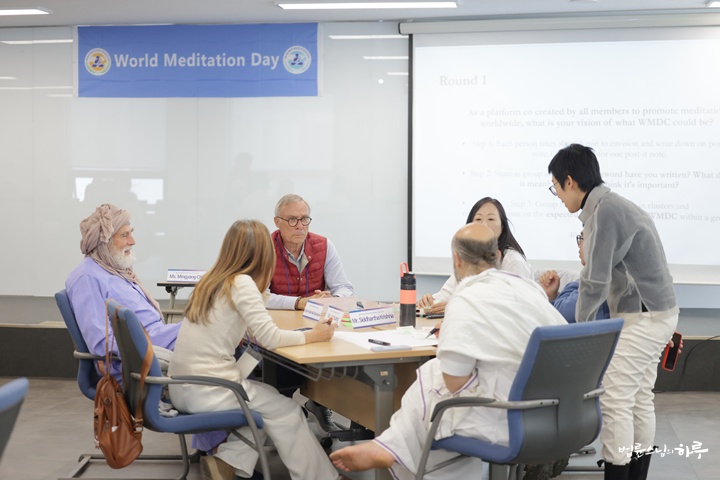
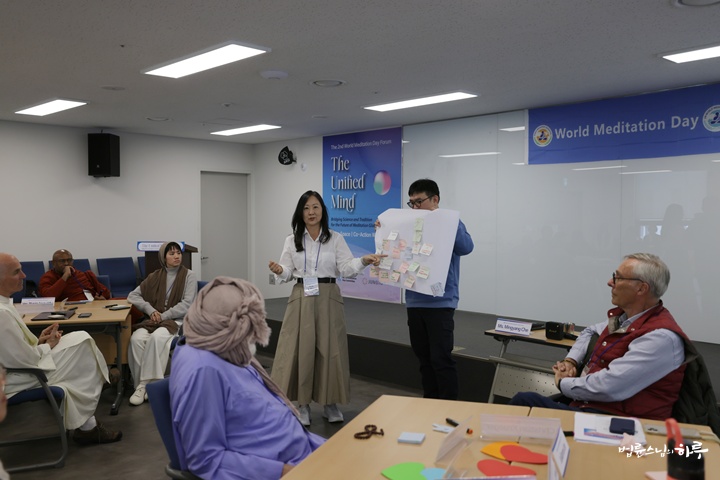
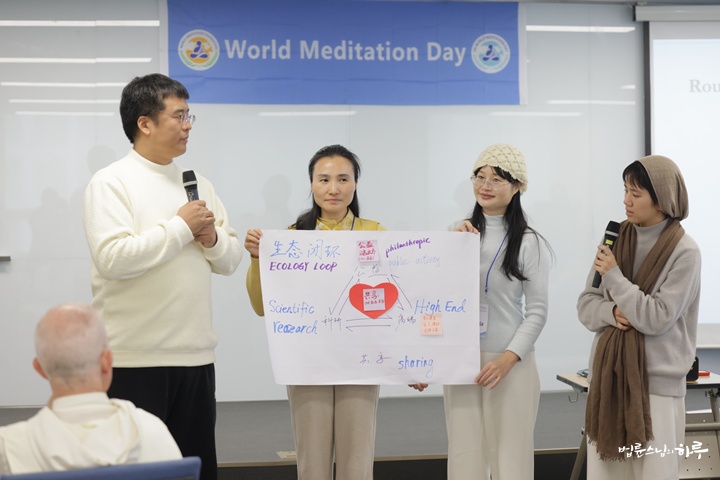
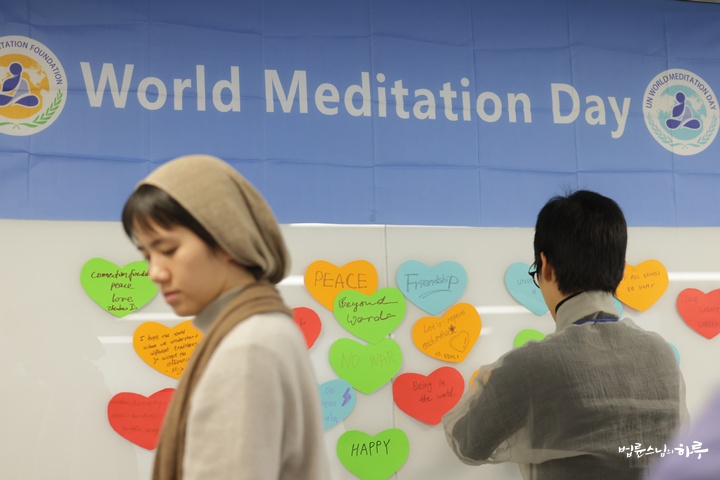
Various programs were conducted, and groups shared ideas and impressions. As the final part of the program, Ms. Maggie Cheh asked Sunim to give closing remarks.
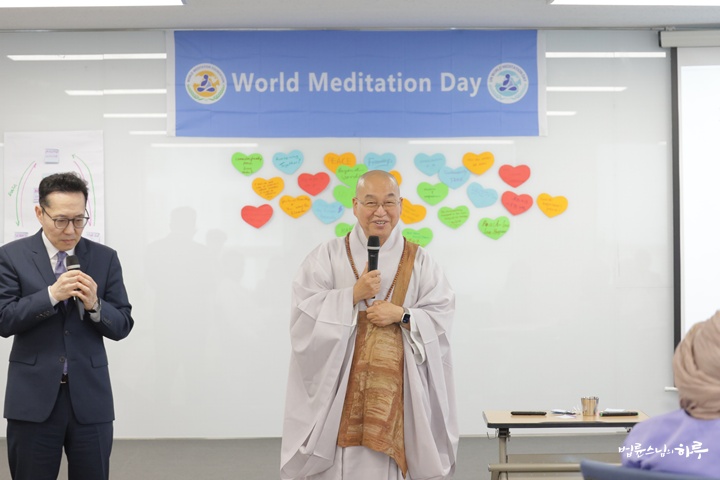
The Essence of Meditation Is Practice
“I couldn’t participate in the discussion because I don’t speak English. If I had known this would happen, I should have studied English harder when I was a student. I became a monk at a very young age, in my first year of high school. So I lived a life very disconnected from general academic studies. I ask for your understanding.
I believe the essence of meditation lies in ‘practice.’ Therefore, practice differs from religion or philosophy. I think most of humanity’s great teachers, like the Buddha or Jesus, were practitioners of their time. However, looking at human history so far, their teachings have been viewed within the categories of religion or philosophy, but not often from the perspective of practice. Accordingly, our perspective still seems to remain within the past viewpoints of religion or philosophy.
Religion is based on the mental function of ‘human faith.’ Looking at human history revealed so far, most early religious leaders were priests. Philosophy is based on the mental functions of ‘understanding and contemplation.’ Therefore, philosophy has mainly developed in the form of academic study.
Practice centers on ‘implementation.’ While the teachings of the sages were practices for cultivating character, historically they have been mainly included in the two domains of religion and philosophy, preventing ‘practice as an independent domain’ from being established. Therefore, on this World Meditation Day, I hope we can classify and position practice as an independent domain distinct from religion or philosophy.
In the earlier discussion, I heard that meditation can be divided into ‘transcendent’ and ‘healing’ domains. I also believe the healing effects of meditation are necessary for people. However, I think we should be cautious that too much focus on healing effects could lead to commercialization. We can already see many such phenomena. Also, I think we need to be wary of the transcendent aspect leaning too heavily toward mysticism. Mysticism carries the possibility of leading people into ignorance.
Wisdom and Compassion Are Needed Amid Chaos
Human civilization is currently facing certain limitations. Excessive consumerism is further fueling the climate crisis. The insistence that only oneself is right creates conflicts between communities and nations, escalating into violent warfare. Additionally, the development of technologies like artificial intelligence and robots heralds major social changes such as mass unemployment of workers. We are thus facing great chaos.
Until now, we have worked on the problem of how to produce because we lacked goods to use, and so our civilization has been built from the perspective of humans as laborers. In other words, problems always arose because we couldn’t produce enough for our needs. But now production is in surplus. As a result, marketing strategies have become about stimulating the human brain to make people buy things they don’t need for the sake of sales, rather than purchasing out of necessity. So we see advertisements and buy things thinking we need them, but then don’t use so many of them. This seems to continuously increase carbon dioxide emissions.
Another issue is that as artificial intelligence develops, we seem to be moving toward a stage where AI-equipped robots can sufficiently produce necessary goods without human production. We will be able to live without working. From the perspective of all civilization, this is an ideal society. But if we really live without working, what will that life be like? Wouldn’t it be like animals in nature becoming livestock that just eat feed? What kind of life will this be? How should humanity live? I think we are facing a major new challenge.
Can meditation really be an alternative to this? I think the transcendent realm of meditation means developing insight to create new alternatives for human civilization. This is not mysticism but enlightening wisdom that provides insight.
Additionally, countless people are becoming mentally and physically ill due to these rapid changes. Meditation seems necessary to heal this. Traditionally speaking, wisdom and compassion are needed. I hope we can take this as a task and research it together. So I would like to express my hope to you all that this ‘World Meditation Day Committee (WMDC)’ will become a new hope for human civilization and a hope for those who suffer. Thank you.”
(Applause from participants)
“Now, let’s meditate for a moment.”
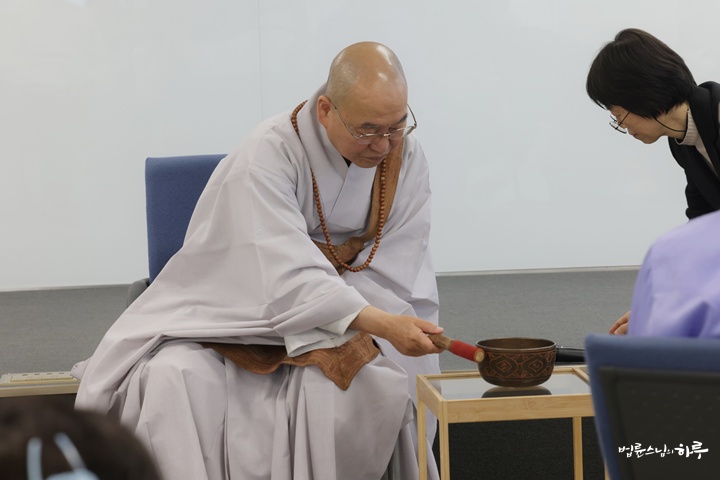
“I think the best meditation is returning to nature. Stop thinking and just breathe. Feel the breath.”
Sunim rang the meditation bell and meditated with the participants.
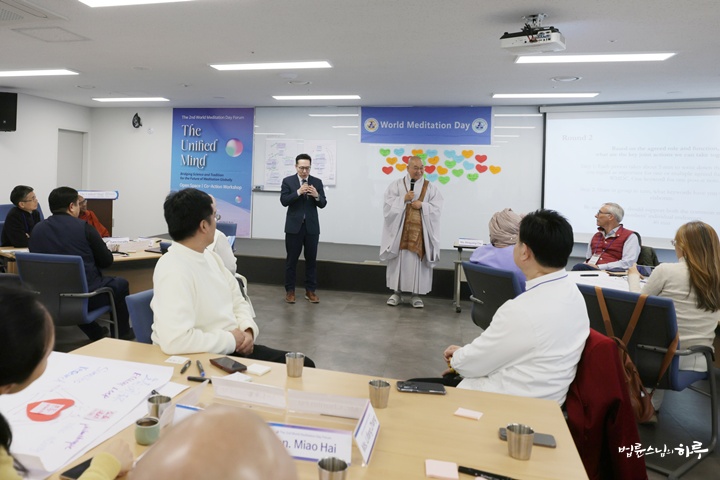
Sunim prepared small gifts for the presenters and foreign participants who visited Korea and the Jungto Social and Cultural Center for this event. He explained about the gifts.
“How was your stay here for one night and two days? Was it not uncomfortable?”
“No, we had a good time.”
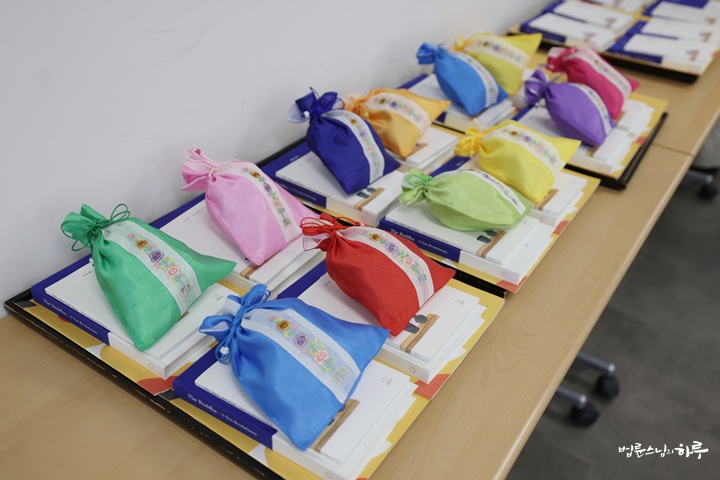
“We have prepared modest gifts. One type of gift is a bell, which in Korean is called ‘punggyeong’ (wind chime). It makes sound with the wind. It’s nice to hang under the eaves.
When you hear the sound of the wind chime, I hope you will think of three meanings. First, don’t just listen to human sounds, but listen to the sounds of nature. Second, don’t just listen to the voices of intellectuals and elites, but also listen to the voices of suffering people. Third, don’t just listen to others’ voices, but listen to the voice of your own conscience. These are the meanings it contains.
I’ll give one wind chime to each presenter. For the other participants, I’ll give you a book I wrote called ‘Buddha the Revolutionary.’
The title is ‘Buddha the Revolutionary’ because the Buddha brought about a revolution in values. When humans discriminated by class, he advocated equality. In a society that discriminated by gender, he allowed women to become monastics. Unfortunately, women’s ordination, which the Buddha permitted 2,600 years ago, disappeared from history after 500 years. So in Theravada, women’s ordination is not recognized. Allowing women’s ordination 2,600 years ago was a historic event of gender liberation. This book is about how the Buddha as a person came to have the revolutionary perspective of consciousness liberation.”
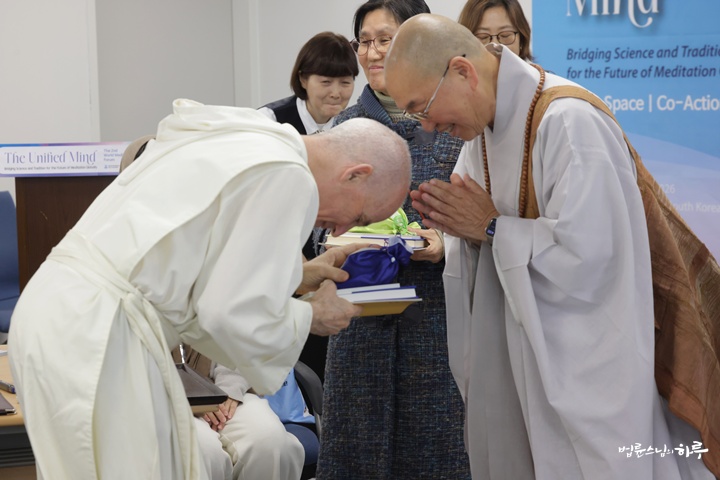
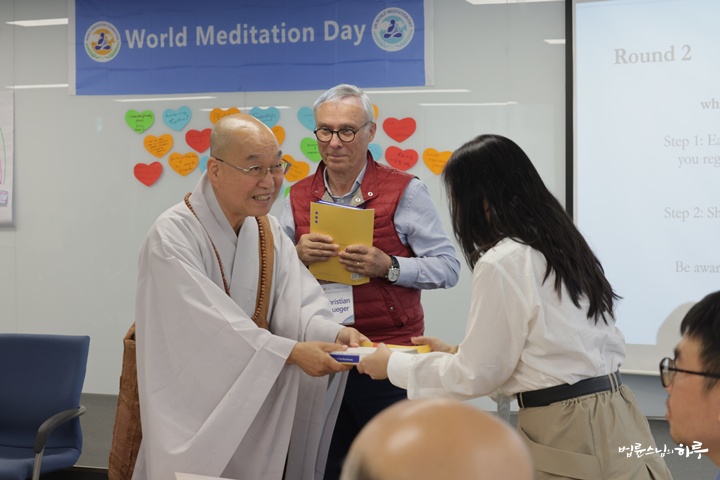
Sunim gave small gifts to the presenters and participants.
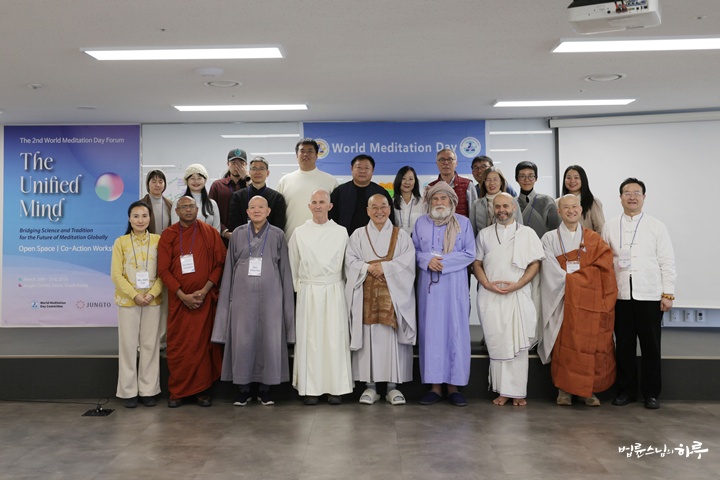
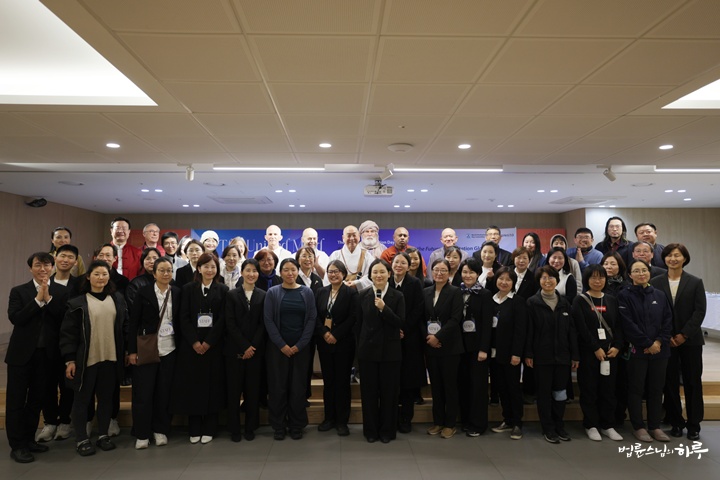
After all the programs ended, the event concluded with a group photo. The participants expressed their heartfelt gratitude for being together through deep embraces. They promised to meet again and wrapped up all the programs of the event.
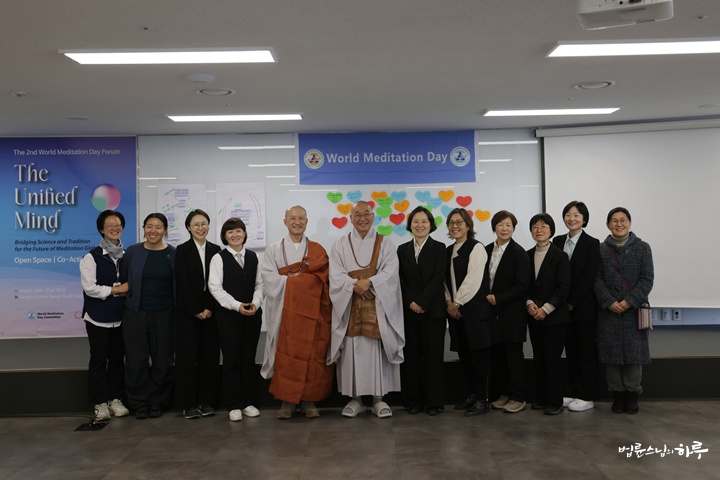
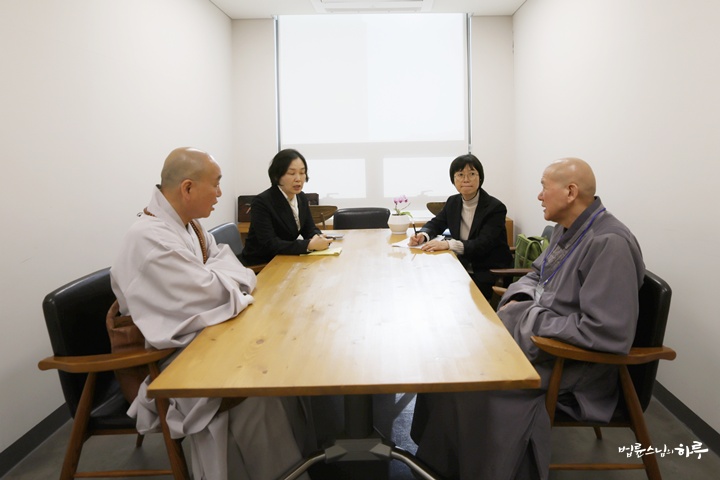
Sunim came to the reception room and had a conversation with Venerable Myohai, a representative of the WMDC (World Meditation Day Committee) who hosted this event. He asked about the reactions of the foreign presenters and attendees who participated in the event, and how Venerable Myohai evaluated it. He also added what areas should be improved if the event is held again in the future. The meeting with Venerable Myohai lasted about an hour.
After all the schedules in Seoul were completed, Sunim packed his belongings simply and departed for Dubuk Jungto Retreat Center around 6:30 PM. Sunim rested in the car during the journey. He arrived at Dubuk Jungto Retreat Center around 10 PM.
Tomorrow, he plans to survey the Gyeongju (경주) area and participate in farming work.
This post concludes with a Dharma Q&A from the last Weekly Dharma Assembly.
How Can I Become Free from Being Controlled by External Things?
“The sharper a knife is, the more efficient it is as a tool, but the higher the risk of cutting your hand, making it more dangerous. These days, tools like saws have become electric and cut automatically. If you get hurt using a regular saw, you might just get a small cut, but with power tools, the probability of serious injury is high – you could even lose a finger. In other words, the higher the efficiency, the greater the danger.
The same applies to living in the world. If someone helps me a lot in life and I’m happy because of it, we can’t just see it as good – we should think that it’s equally dangerous. If the person who was helping me suddenly disappears, I might feel lost about how to live. If someone always gives me rides and then that person disappears, it becomes very inconvenient. But if I drive myself, I can depend less on others and protect myself.
We say that having someone to depend on – God, Buddha, parents, wife or husband – means good conditions and happiness, but we must know that danger follows accordingly. If the object of dependence disappears, there’s a risk of experiencing great suffering as if the sky is falling one day. However, if you’re living without depending on anything, such sky-falling suffering cannot come. Even if something disappears, you’ll think it’s just a bit inconvenient and can be replaced with something else.
Therefore, leaving this world means not depending on the world. Not depending means not depending on wife or husband, money, status, or house. If you live alone in the forest eating tree fruits, you don’t depend on anything, so there’s little to fear or agonize over.
The Meaning of Leaving the Secular World
It’s important to know exactly what leaving the secular world means. If everyone left the secular world and lived alone in the mountains, there wouldn’t be much suffering, but realistically that doesn’t happen. Living in reality while helping and depending on each other has its benefits, but the danger when the object of dependence disappears is always lurking. That’s why when living married, you need an attitude of not depending too much on your husband and not depending too much on money. Usually in the world, people become excessively attached to people or money they can depend on. It would be nice if we could abandon all objects of dependence in the world, but if we can’t do that, we can at least reduce the degree of dependence. Then we can live without being constrained even while in the secular world.
Buddha’s teachings may seem to teach us to leave the world or abandon everything, but that’s not really the case. He teaches that if you can leave the world, do so, but even if you can’t, you can live freely by letting go of attachment. Therefore, even if you work at a job, if you don’t cling too much to the job, don’t cling too much to money even when earning it, and don’t cling too much to your partner even when dating, you can become freer from the world even while being in it.
I was told from a young age that I would die early, so while living diligently, I thought I might die around 40 or 50, but I haven’t died yet. So now living has become a bonus – an extra gift.
The Less You’re Concerned, the Freer Your Life
When you live as a bonus, life becomes somewhat free. Since I’m living as a bonus, I think it’s okay if I die tomorrow or the day after. But there’s no need to die on purpose or prepare for death every day. Since I’ve already lived enough, if I continue living, I’ll keep working, and if I die, there’s nothing to feel wronged about. Because I’m living as a bonus. Just as it’s nice if someone gives you a bonus but it’s fine if they don’t, saying we live as a bonus means we’ve let go of some attachment to the world. It means being a little less concerned about small worldly things. Even I have moments when I become concerned while living, but broadly speaking, I can say life is free because I’m less attached.
“Sunim, then should I understand that ‘enlightenment apart from the secular world cannot exist’ means that realistically we cannot completely abandon the secular world because we live in it?”
“That’s not what it means. All this anguish arises from our ignorance. Then the path to freedom from anguish is also bound to be where the anguish is. If there’s no anguish, there’s no need to find a path to freedom from anguish.
Buddha’s teachings were given because sentient beings are in anguish; if sentient beings weren’t suffering, there would be no reason for Buddha to teach. The same goes for Dharma Q&A. If you were all enlightened and had nothing to ask me, there would be no such thing as Dharma Q&A sessions. Looking broadly, all your worries are really nothing significant. Yet you’re suffering now because you’re attached to worldly matters. Because you’re suffering like this, I tell you that the cause of suffering is attachment, and you realize, ‘Ah! That’s right, it’s nothing!’ So the Way isn’t only in deep mountains away from the world. Right where there is anguish, there are teachings to escape from anguish.”
“So you’re saying that because there’s inside, there’s outside?”
“You don’t necessarily need to summarize it that way. When we say there’s a way to get up because you fell, you might ask whether you need to fall first. But that’s not it. It’s fortunate if you don’t fall, but it’s okay even if you do fall. Because you can get up. Then we can become free from thoughts like ‘I must fall’ or ‘I must not fall.’ Be careful not to fall, but falling doesn’t mean you’ve made a mistake. Because you know the way to get up when you fall.”
“Yes, thank you.”