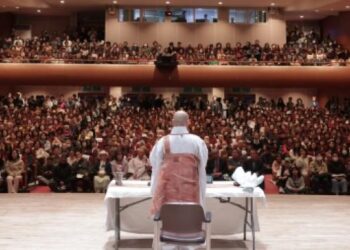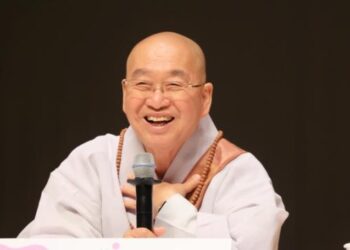

March 1, 2026. Special Dharma Assembly Commemorating the 107th Anniversary of the March 1st Independence Movement, Tongil Euibyung Assembly
Hello. Today is the day of the special Dharma assembly commemorating the 107th anniversary of the March 1st Independence Movement.
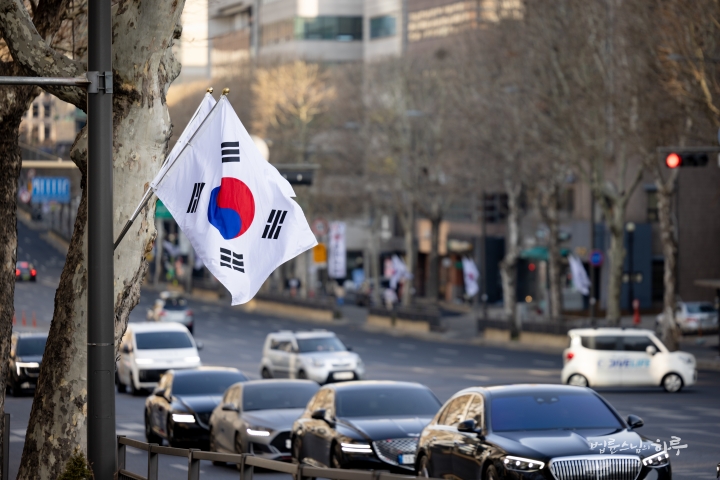
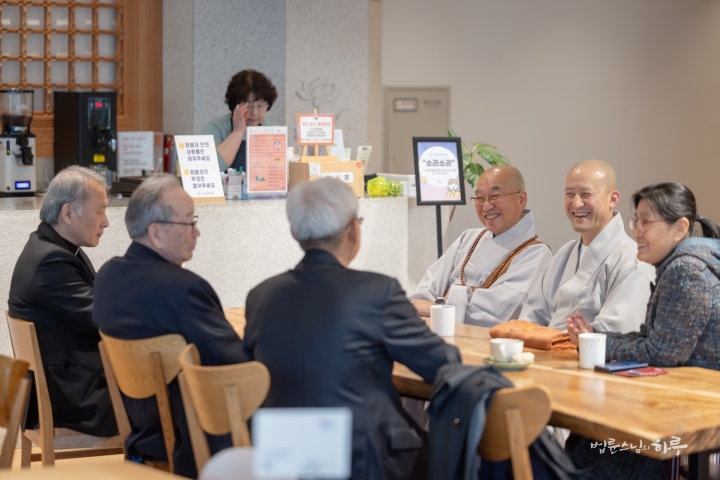
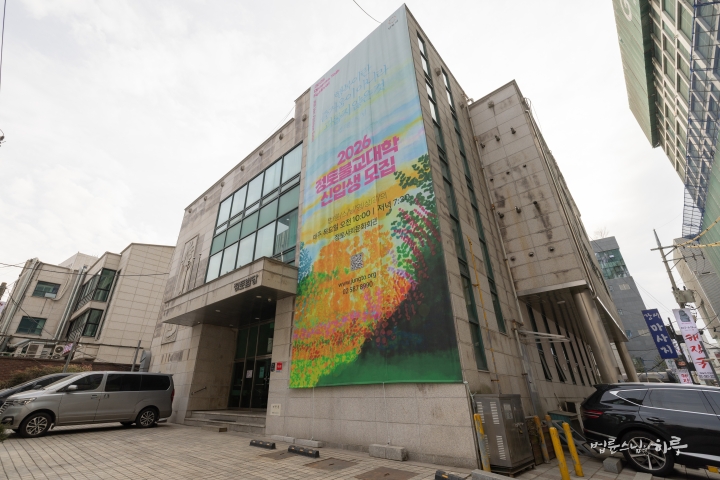
After completing morning practice and meditation, Sunim headed to the Jungto Social and Cultural Center (정토사회문화회관) at 9:30 AM. He met with senior religious leaders who were scheduled to give commemorative speeches today, exchanged warm greetings, and shared tea with them.
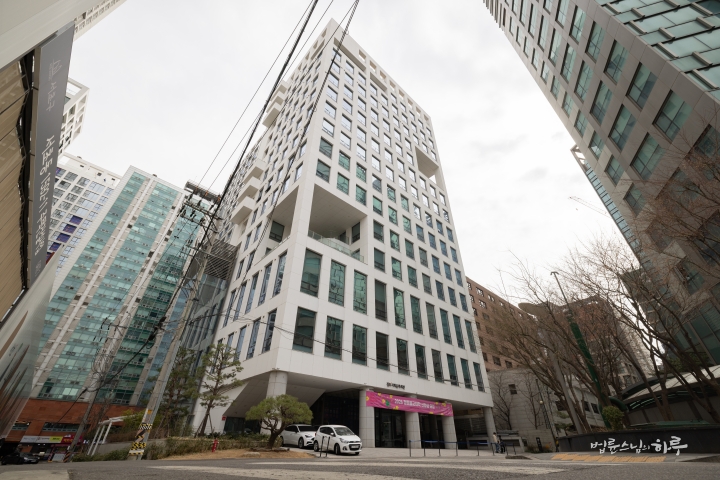
After tea, they moved together to the underground auditorium where the commemorative ceremony was to be held.
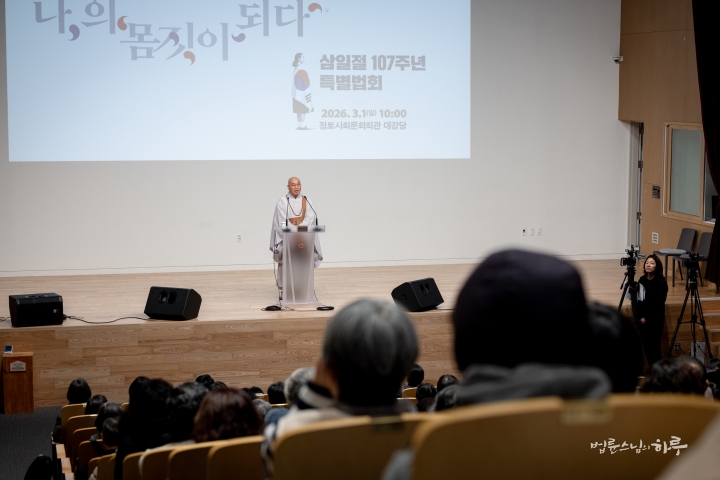
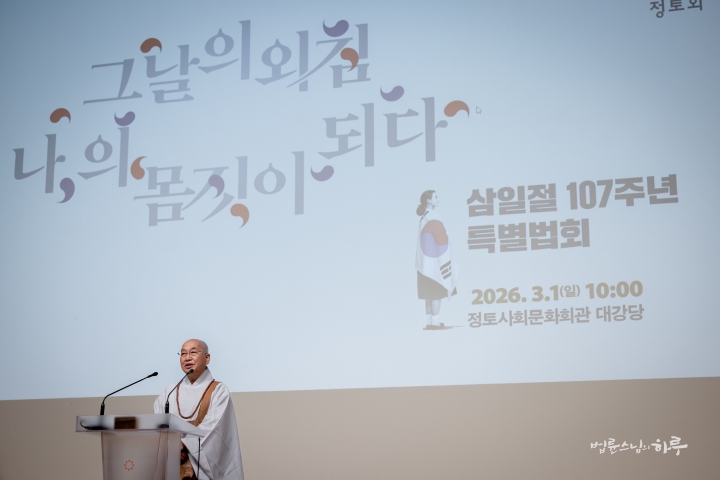
Today’s March 1st special Dharma assembly (삼일절 특별법회) was organized to remember that the Republic of Korea exists today thanks to the sacrifices and efforts of our ancestors. The event was designed not merely to remember the past as history, but to inherit that spirit and take action ourselves for peace. That’s why the slogan was set as ‘The Cry of That Day Becomes My Movement.’
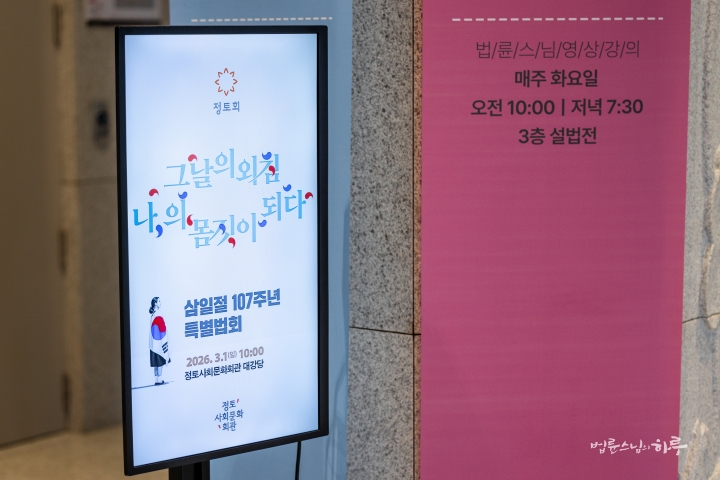
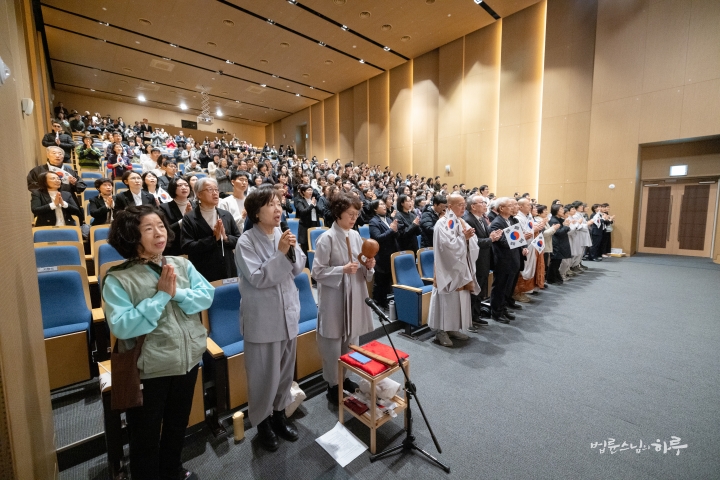
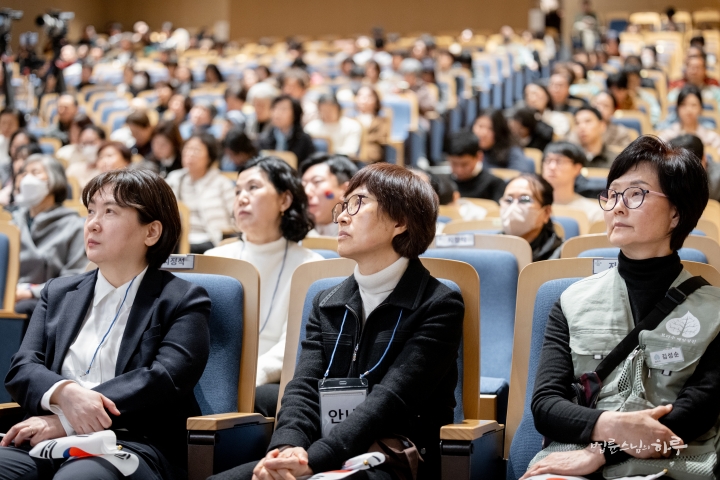
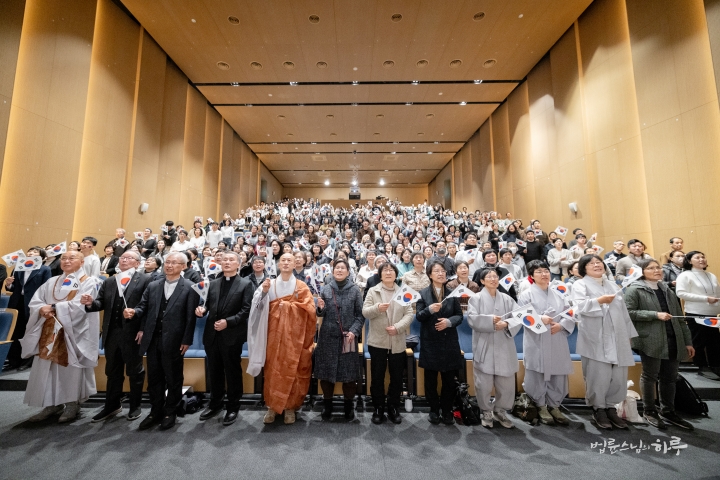
With about 300 people in attendance, the event began at exactly 10 AM. First, participants saluted the flag, sang the national anthem, and observed a moment of silence for the martyrs (순국선열), deeply remembering those who declared the great cause of Korean independence.
Next, thirty members of the Youth Division (청년지부) recreated the cries of March 1, 1919, through a theatrical performance.
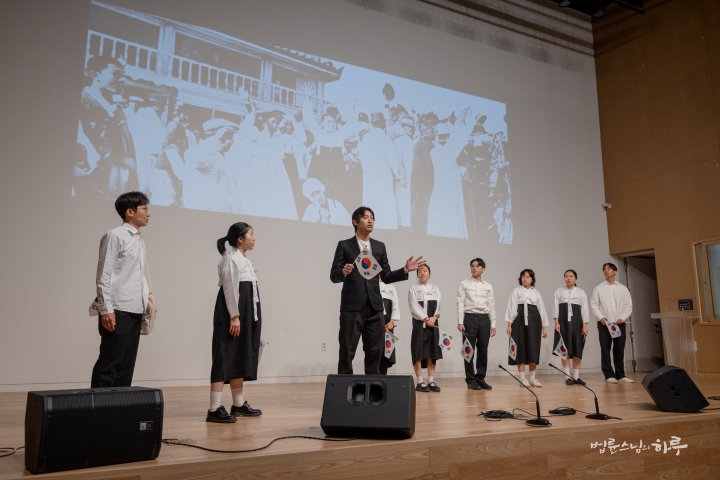
Like the youth of that day who cried out for independence in the streets and squares, they vividly conveyed those desperate voices on stage. Following the performance, the Declaration of Independence (독립선언문) was read aloud.
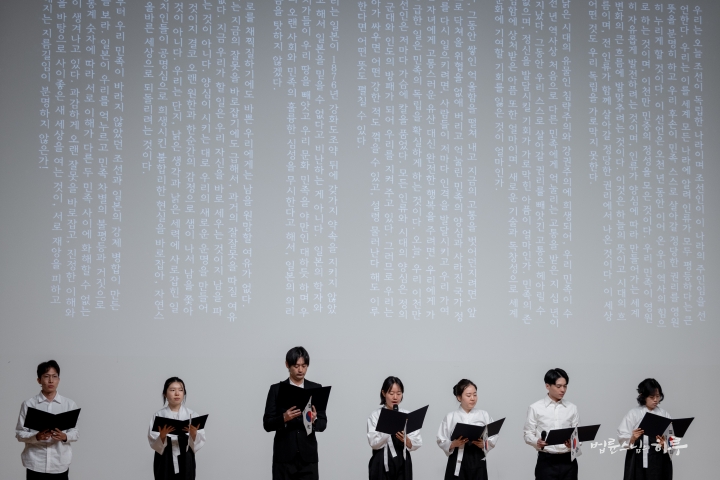
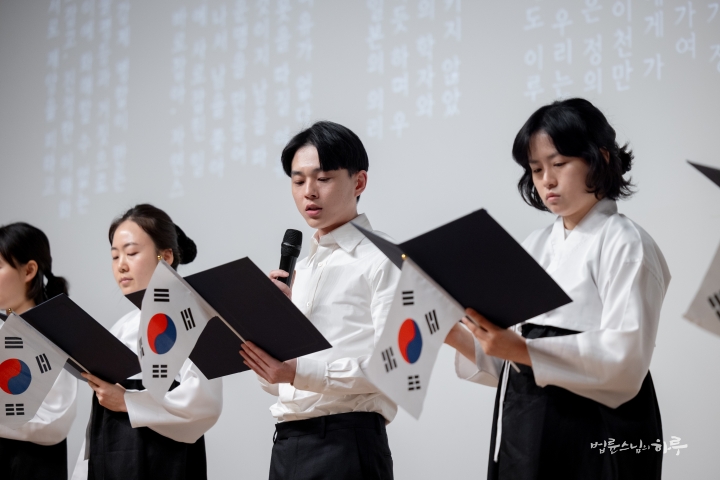
“We hereby declare that Korea is an independent state and that Koreans are a self-governing people. We proclaim this to the nations of the world in order to manifest the principle of human equality, and we proclaim it to our posterity in order to preserve forever our people’s just right to self-determination…”
Listening to the youth read the Declaration of Independence, participants could briefly enter into the breath of that day over 100 years ago.
Finally, a chorus of ‘My Country Korea’ followed. As one person’s candle flame began to spread to the side in rhythm, the stage lights also brightened.
With the strength of every step Korea has taken, let us rise ?
Let us bloom on this land where we live
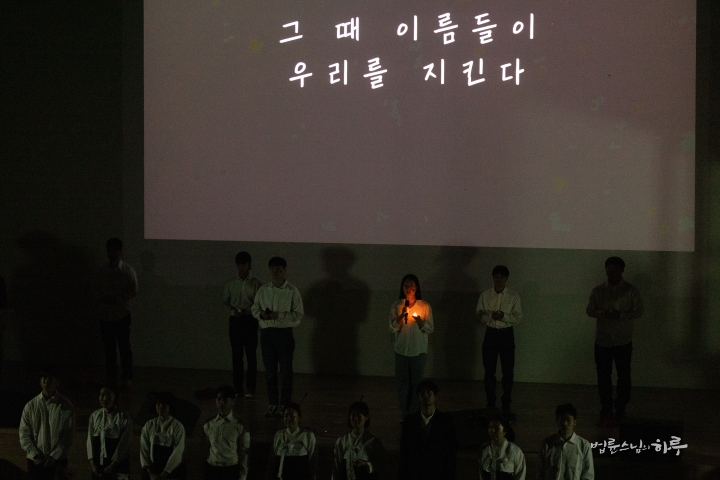
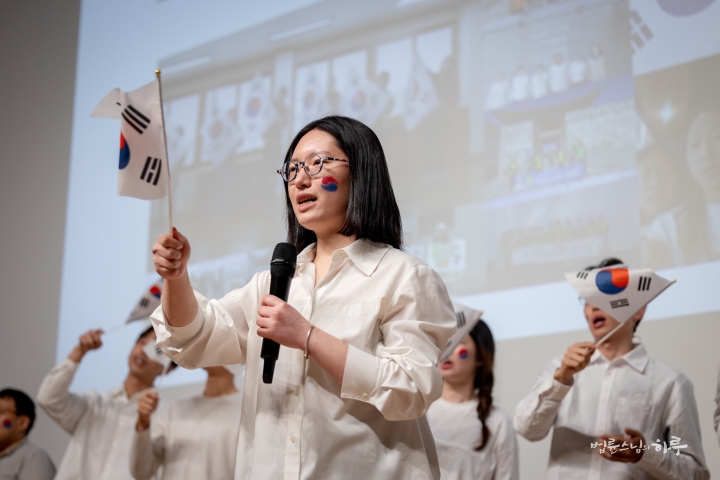
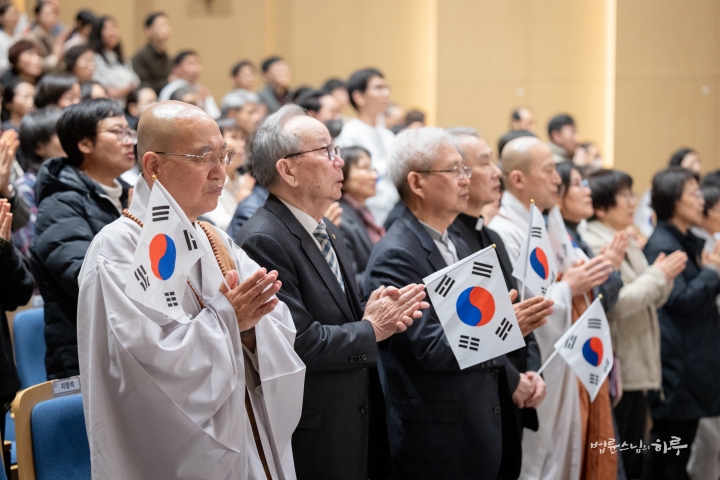
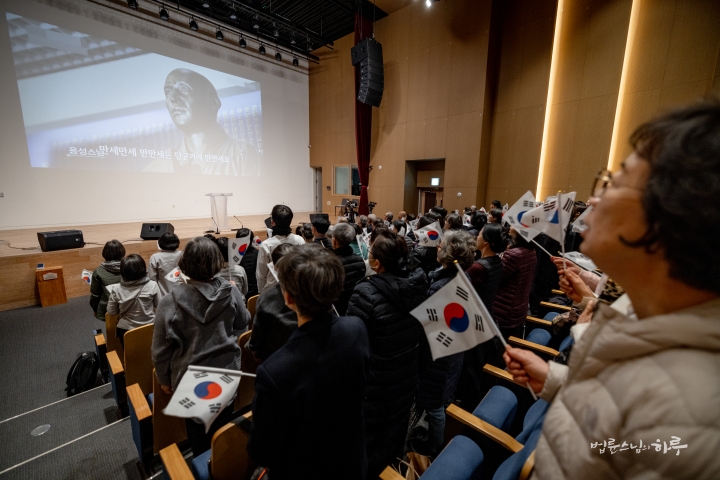
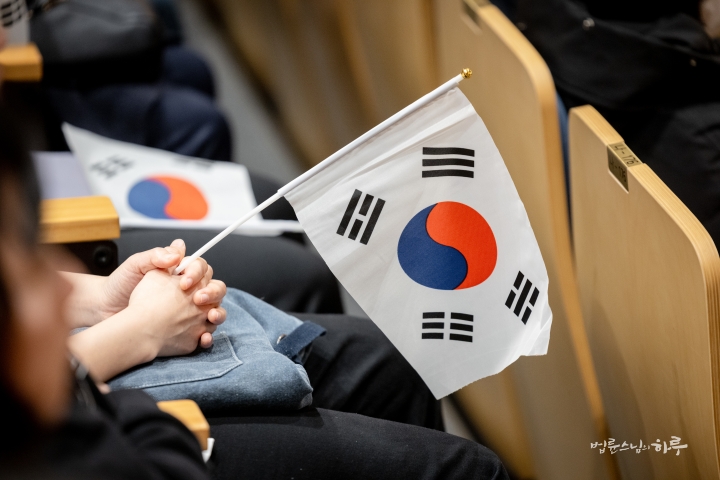
Youth in the audience also stood up, waving Korean flags (태극기) and singing together. Soon the entire audience united their voices as one.
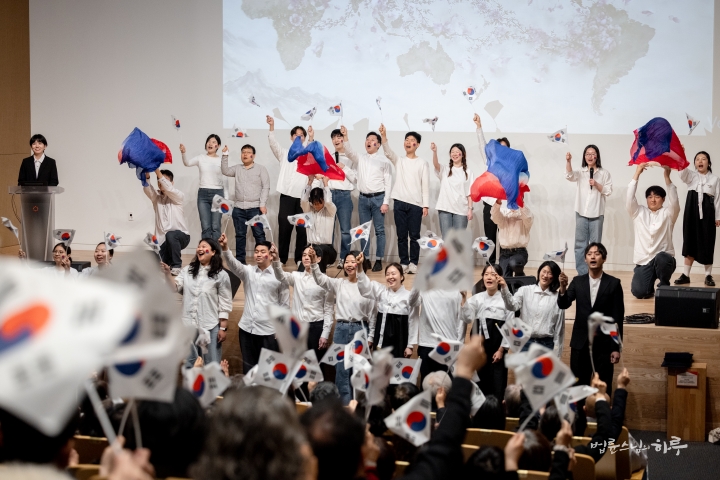
Next, all participants stood up holding Korean flags and shouted ‘Manse! (만세)’ three times.
“Long live Korean independence, Manse! (대한독립 만세), Long live the Republic of Korea, Manse! Long live peaceful reunification, Manse! “
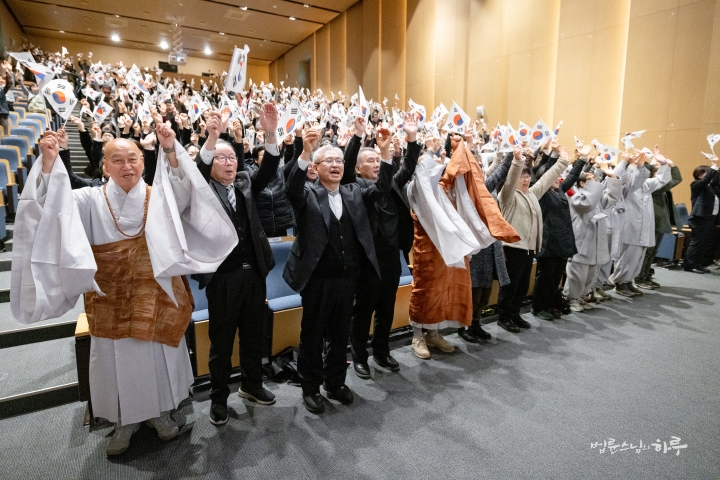
Hearts swelled as if the cries of that day were echoing once again. Those participating online also responded powerfully with ‘Manse!’ to the leader’s call. Gathering the passionate hearts that had shouted for independence, everyone sang the March 1st song together. On stage, a video was shown of 330 Jungto Society members waving flags and singing together from locations across the country and around the world.
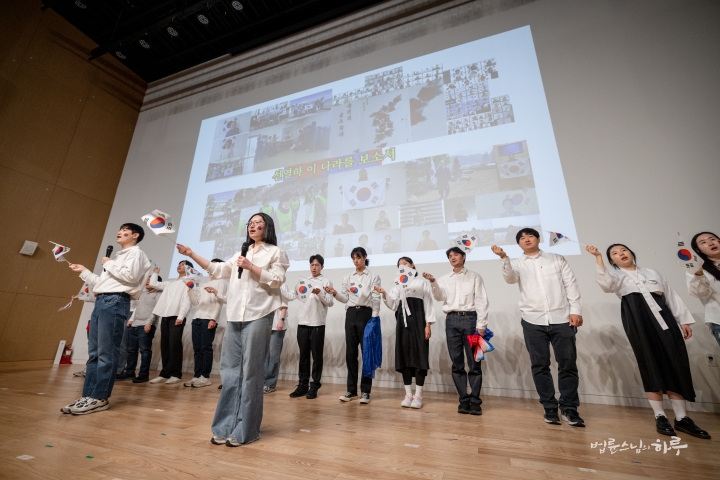
March 1st in the year of Gimi (기미년), at noon ♬
The cry for Korean independence burst forth like a tide
With Taegeukgi flags everywhere, thirty million became one
This day is our will, our life, our lesson
The Han River (한강) flows again, Mount Baekdu(백두산) stands tall
Martyrs, behold this nation
Compatriots, let us forever honor this day ♬
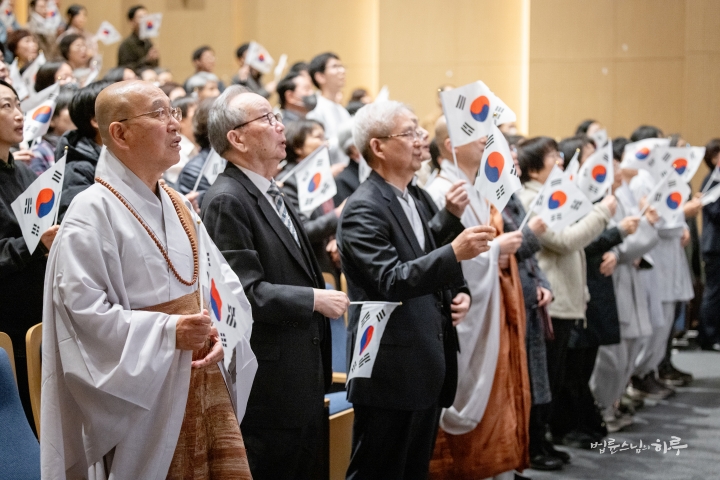
When the March 1st song ended, the audience gave enthusiastic applause to the Youth Division volunteers who had performed so passionately.
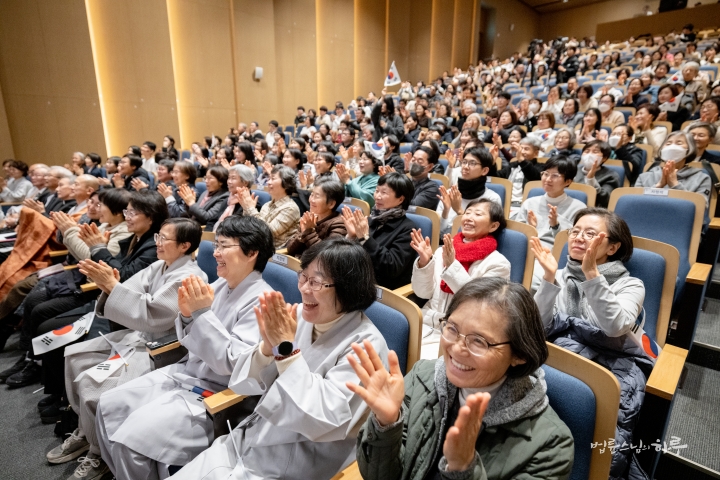
Carrying forward this energy, participants took time to reflect on the noble spirit of the March 1st Movement, which transcended religious boundaries to unite for our nation’s independence. First, they welcomed former Chondogyo(천도교) leader Park Nam-su (박 남수), who was at the center of the March 1st Movement and a driving force for national self-determination, to deliver a commemorative address.
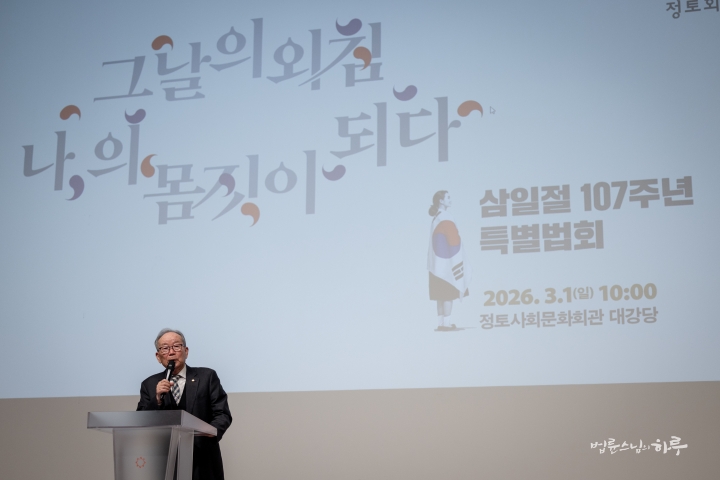
“107 years ago today, our ancestors rose up with bare hands against the guns and swords of imperialism to proclaim the meaning of freedom and peace. When Chondogyo, Buddhism, and Christianity joined hands, the cry for national self-determination could spread beyond the Korean Peninsula to all corners of the world. Then what should be the goal of the ‘Manse’ we shout today? It should be ‘Manse’ for nature, for peace, for a life of emptying and sharing. And we must not stop at shouting—we must act. I sincerely hope that this movement, like the March 1st Revolution 107 years ago, will become new history that influences across space and time…”
Next, they heard a congratulatory address from Won Buddhism teacher Kim Dae-seon (원불교 김대선), who spreads bright light throughout society with the spirit of mutual prosperity and harmony.
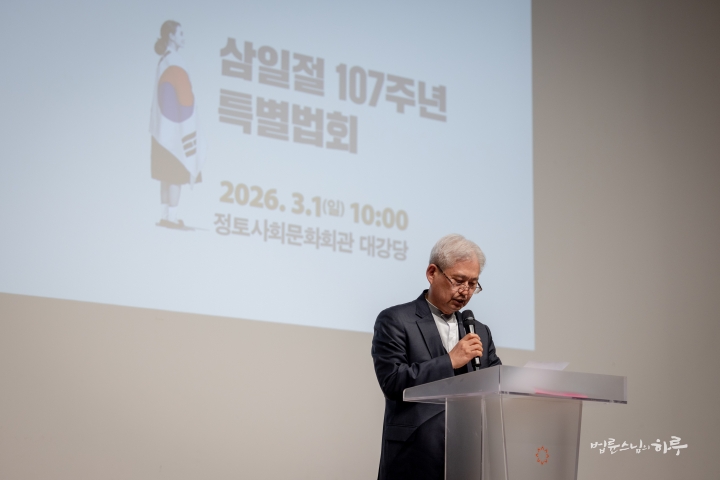
“The first sentence of the Declaration of Independence begins like this: ‘We hereby declare that Korea is an independent state and that Koreans are a self-governing people…’ This is the power of self-declaration, not independence given by others. In today’s era, often called the age of ‘every person for themselves,’ we must recover the boldness of being sovereigns who determine our community’s destiny ourselves. In the square of 1919, there was no religion, no class, no gender. Everyone held hands equally under the single value of independence. Independence is not completed by a single event. The process of creating better democracy than yesterday and passing on a peaceful Korean Peninsula that we need not be ashamed of to future generations—that peaceful reunification is the independence still in progress…”
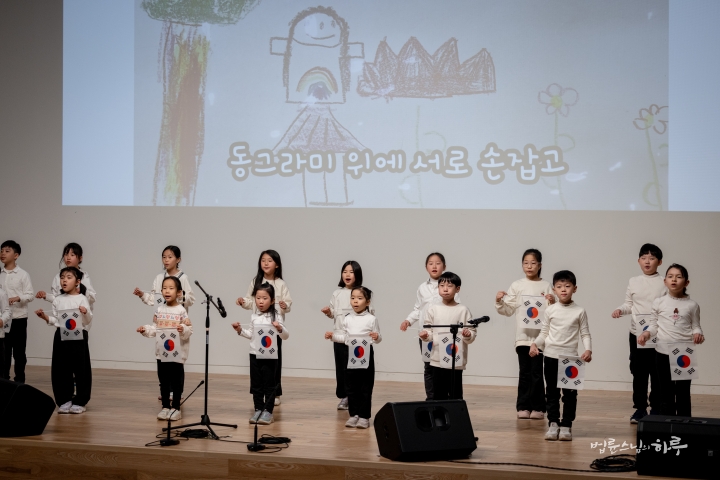
Next was a performance by the Jungto Society Children’s Choir. Composed of children of Parent Dharma Assembly members, the children’s choir has been loved by audiences every year at the March 1st event. Today they sang two songs: ‘Independence Army Song,’ containing the spirit of our people, and ‘Flower of True Peace,’ singing of the future we must cultivate.
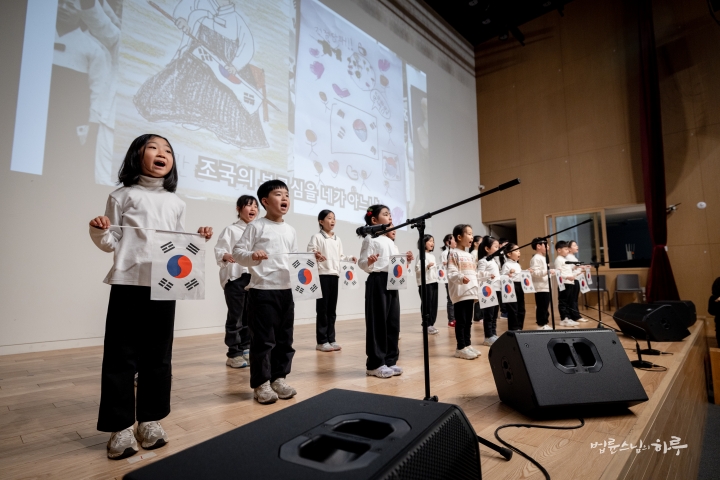
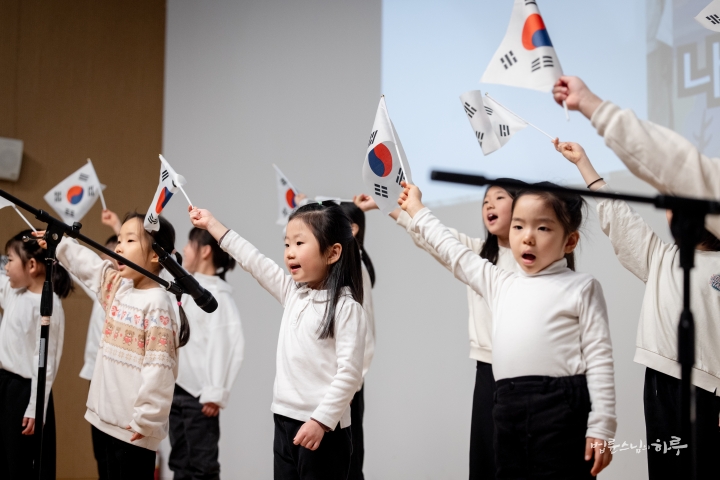
On the stage backdrop hung pictures the children had drawn themselves while dreaming of peace. The Independence Army Song (독립군가) and songs of peace (참평화의 꽃) sung in children’s voices had a different kind of resonance.
Next, they heard a commemorative address from Catholic priest Father Kim Hong-jin (김 홍진) of the Seoul Archdiocese, who has worked to heal society’s wounds and stand with the marginalized.
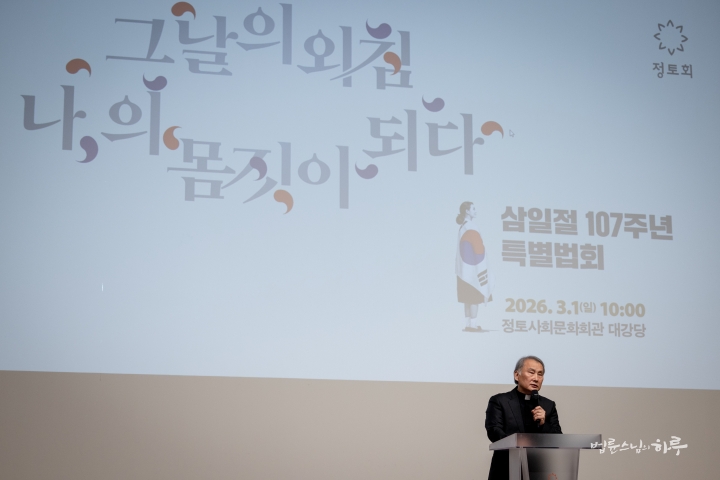
“Every year on this day, I feel infinitely small, ashamed, and sorry. I remember apologizing to all Jungto Society members two years ago at this venue for the shameful history of Catholicism. I feel I must say the same thing again today. For the shame of Catholicism in failing to respond to the call of our nation’s grand history, I take this opportunity to ask for forgiveness once again.”
Father Kim Hong-jin then read a statement issued by Archbishop Kim Hee-jung (김 희중), Chairman of the Catholic Bishops’ Conference of Korea, on the 100th anniversary of the March 1st Movement in 2019.
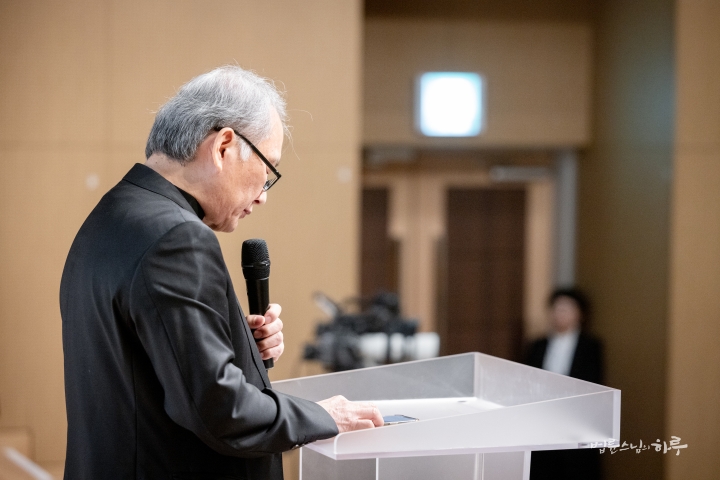
“At that time, the Catholic leadership, composed of foreign missionaries, prohibited believers from participating in the independence movement, citing the policy of separation of church and state despite the nation’s pain and suffering. Later, they even advised believers to participate in Japan’s war of aggression and worship at Shinto shrines. The Korean Catholic Church reflects on this wrongdoing with shame and repents. However, we wish to remember the Catholics who participated in the independence movement according to their individual conscience and justice despite the silence and sanctions of church leaders. Seeking to find and remember their footsteps is not to cover up past wrongs. It is to emulate those who fulfilled their role as light and salt without falling even amid the pain and frustration of the times…”
After finishing the reading, Father Kim Hong-jin added:
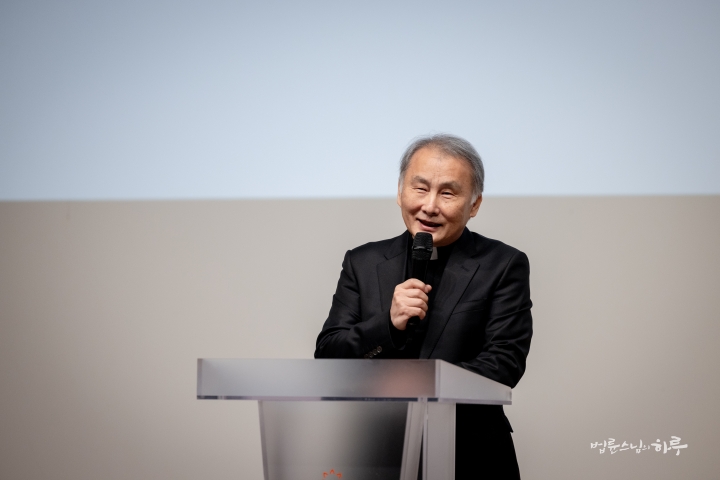
“On this day that should be called the March 1st Revolution, I hope that not only Jungto Society members but all who share this vision will steadily walk together toward the completion of the revolution.”
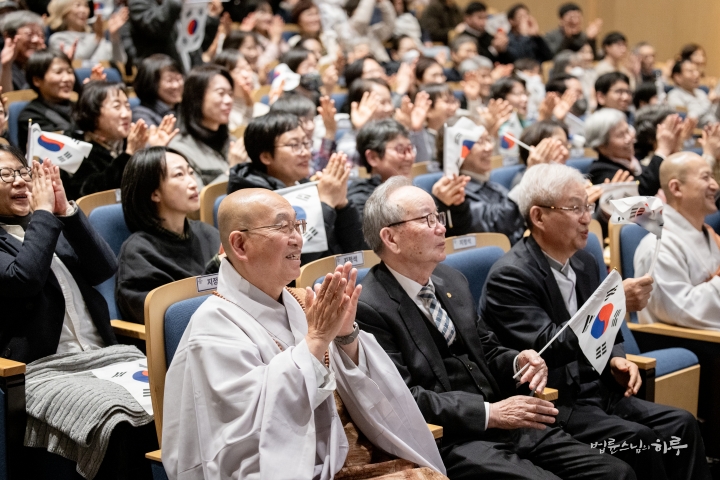
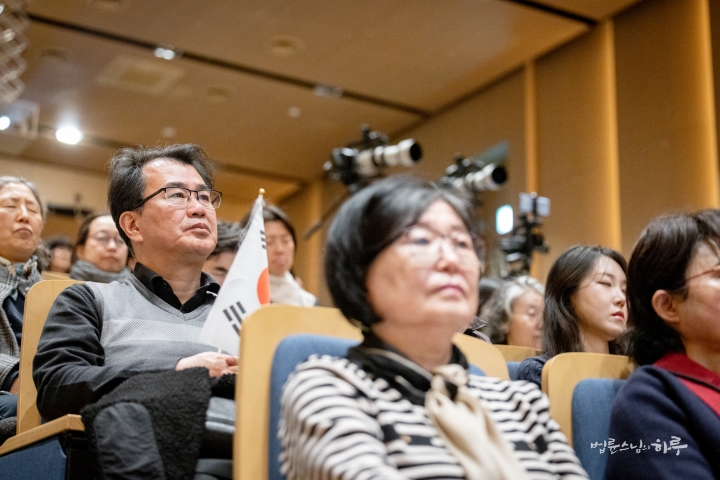
The audience once again deeply took to heart the messages of harmony and peace delivered by the three religious leaders.
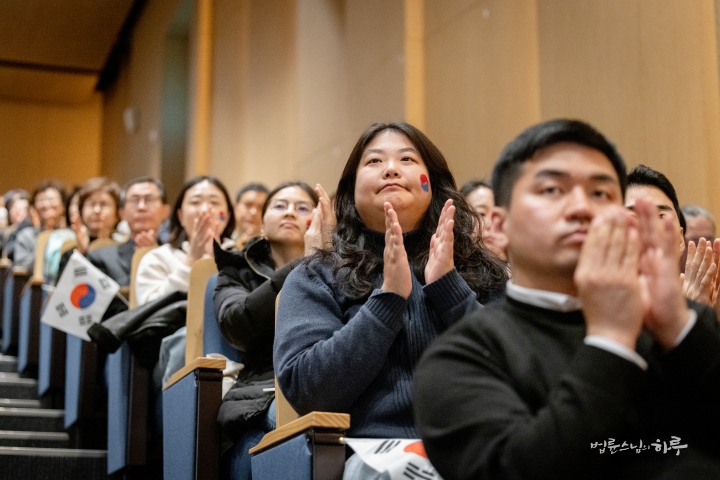
Next, everyone sang all three verses of ‘Song of All Koreans’ together. This song was written by Master Yongseong Jinjong (용성진종조사), who was one of the 33 representatives of the March 1st Independence Movement from the Buddhist community and a behind-the-scenes pillar of the movement. With over 300 people singing together, the auditorium was filled with powerful energy.
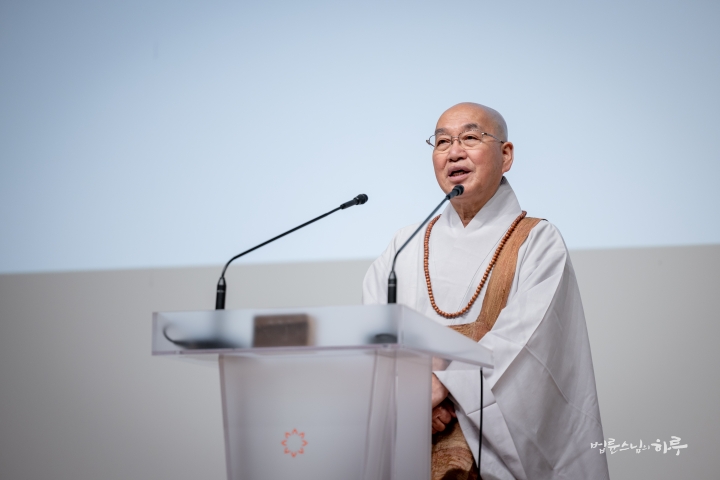
All participants then requested a March 1st commemorative Dharma talk from Sunim with three prostrations. On the 107th anniversary of March 1st, Sunim emphasized that in the current international situation reminiscent of the eve of a world war, we should revive the spirit of independence and peace from the March 1st Declaration of Independence, achieving national unity through inclusion rather than liquidation.
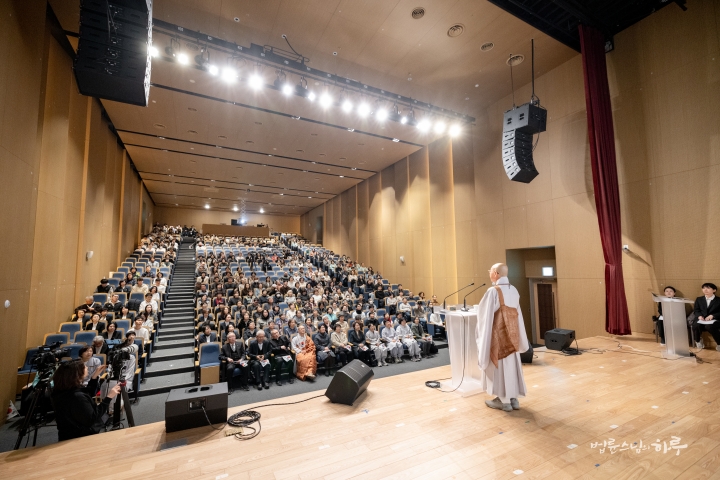
Reflecting on the Spirit of the March 1st Movement in Light of the US-Israel Invasion of Iran
“Today marks 107 years since the March 1st Declaration of Independence in the year of Gimi. As you may have seen in yesterday’s and today’s news, war has broken out as the United States and Israel invaded Iran without a declaration of war. Following Russia’s invasion of Ukraine, the United States, along with Israel, has invaded Iran. Looking at this situation, we can no longer say it’s impossible for China to invade Taiwan. The world now shows signs of moving toward the logic of power led by major powers. Looking at today’s reality on the 107th anniversary of the March 1st Declaration of Independence, it reminds us of the eve of World Wars I and II. At that time, major powers invaded neighboring countries as a prelude to gaining advantageous positions in competition, and as those invasions expanded, they eventually escalated into world wars. Today we are living in a situation where such dangers are increasingly heightened.
The March 1st Independence Declaration was made to inform the world of Japan’s unjust aggression and to declare that we are a sovereign people, while our country was taken away and we were oppressed by Japan’s unjust invasion. However, within the international order formed by the logic of great powers, the world remained silent about the actions of Japan, which had formed an alliance with Britain, the world’s strongest power at the time. This resembles how we remain silent today in the face of invasions by great powers. In this regard, our ancestors who made the March 1st Independence Declaration were truly great and showed tremendous courage. It might have been an action expected to fail, like throwing eggs at a rock. However, the March 1st Movement, regardless of its immediate success or failure, presented the direction we should take at a historical turning point. Because there was a movement that presented such a direction at that time, today’s Republic of Korea can proudly stand before both our people and the world. Without the March 1st Movement, the Republic of Korea would have had difficulty escaping the label of a country that received ‘given independence’ through Japan’s defeat and the Allied victory, and today’s Republic of Korea would not have been easily achieved. The March 1st Movement is that precious to today’s Republic of Korea. Furthermore, it can be said that they already looked ahead to the next hundred years—to today’s Republic of Korea—and set the direction and began their work.
The Republic of Korea realistically began with the establishment of the government of the Republic of Korea on August 15, 1948. However, the establishment of the Republic of Korea government was possible because the Provisional Government of the Republic of Korea was established in Shanghai, China in 1919. And the Provisional Government of the Republic of Korea was established based on the spirit of the March 1st Movement.
The March 1st Movement was not an event that suddenly occurred one day. Twenty-five years before that, in 1894, the Donghak Revolution (동학혁명) occurred and advanced to the point just before establishing a government, but it ended in failure when the incompetent Joseon Dynasty (조선 왕조) brought in Japanese and Qing troops to brutally massacre the Donghak revolutionary forces. That flow rose again as the March 1st Movement.
In a dynastic society, resisting the dynasty is defined as treason. Nevertheless, the entire nation could boldly participate in the Donghak Revolution because its starting point can be found in Donghak thought, declared 30 years earlier by Great Master Choe Je-u (최제우 대신사) : ‘Now the king is not the master of the country, but the people are the masters of the country, and humans are heaven itself.’ Of course, Western civilization had a significant influence on the formation of today’s Republic of Korea. However, the Republic of Korea is not a country formed solely by external influences. Democratic consciousness was already sprouting and growing within our nation, and it spread like wildfire, leading to the Donghak Revolution. The failure of the Donghak Revolution led to the March 1st Independence Movement, whose frustration led to the April 19 Revolution (4·19혁명), the Gwangju Uprising (광주항쟁) ,the June Struggle (6월항쟁), and the Candlelight Revolution, creating today’s Republic of Korea—a country where the people are the masters.
In this context, the March 1st Movement was not merely a movement to reclaim a lost nation, but a movement to build a new country where the people would be the masters. While the recovery of our lost nation was achieved through liberation, the work of building a new country continues to this day. In this process, we have not only achieved democracy where the people are sovereign, but have also grown from a nation mired in poverty and destitution to a prosperous country. Furthermore, we have moved beyond a culture of imitation that relied solely on foreign ideas and culture, creating a new culture based on our own heritage, which has led to today’s Korean Wave phenomenon.
History Made by the People: A New Beginning Toward the 100th Anniversary of Liberation
Thus, the March 1st Declaration of Independence already envisioned a new Republic of Korea. Despite the anger from losing our nation, our ancestors did not stop at merely reclaiming the country but sought to create a ‘new nation.’ The country our ancestors dreamed of was one that would firmly establish our sovereignty while achieving peace with neighboring nations. They aspired to a new nation that would achieve independence while also contributing to world peace.
At the time, there was criticism that the Declaration of Independence lacked passion or militancy for independence. However, looking back from today’s position where the Republic of Korea stands as a dignified member of the global community, we can see that the spirit of the March 1st Movement had already clearly presented the direction Korea should take.
The task remaining for us today is to establish peace so that war never occurs on this land again, and to peacefully reunify our divided homeland. In light of the spirit of the March 1st Declaration of Independence, the ‘new nation’ we must achieve is not merely a unified state where North and South become one. It must be a nation that overcomes division to become unified while simultaneously creating a new civilization where individuals are happy, the world is peaceful, and nature is beautifully preserved, even as humanity’s civilization faces its ultimate crisis.
Moreover, the process of moving toward unification itself must be peaceful. By recognizing and understanding each other’s differences, these differences should manifest as diversity rather than causes of conflict. However, looking at today’s social reality, the confrontation and conflict between North and South Korea are as sharp as any on earth, and the conflicts between political forces within South Korea are reminiscent of civil war. We engage in dialogue and cooperation with Japan, which ruled us for 36 years, while refusing dialogue with other parties within the same Republic of Korea. We speak of dialogue and cooperation with North Korea, with whom we fought a war, while refusing dialogue with other political forces within the same Korean parliament. This contradictory mindset becomes a major obstacle not only to domestic conflicts but also to resolving issues in inter-Korean and Korea-Japan relations.
In this era of US-China hegemonic competition, if Korea-Japan cooperation benefits both sides, we must set aside past grievances and cooperate toward the future. If inter-Korean cooperation is the path to maintaining peace within the global conflict structure, we must know how to forgive the past for future benefits rather than endlessly pursuing responsibility for war. For the Republic of Korea to advance to the next level, we need to move beyond liquidation-centered thinking like ‘liquidating pro-Japanese elements’ or ‘liquidating communism.’ Even if they did not contribute to independence, if they contributed to national development in the process of building the Republic of Korea, their contributions should also be recognized.
In the struggle for national independence and democracy, the value of righteous resistance is paramount. However, building and developing a new nation requires numerous talents, including economic experts, knowledge specialists, and technical professionals. Therefore, we need to view history more inclusively. From this perspective, we should achieve national unity, yet we continue to be divided, obsessed with purging and elimination.
Of course, it is most desirable to honestly acknowledge past mistakes and join in a new path. If they show such intentions, rather than endlessly dwelling on their errors, we should embrace them and open the path for participation so that we can work together to solve the new challenges ahead. Even if some individuals have points of criticism in the history of the independence movement, if they made meaningful contributions to the development of democracy and national progress afterward, we need a broader perspective that can acknowledge these facts as well.
Now we must envision and research what kind of country the Republic of Korea should be in 10, 20, or 30 years, and what kind of world we want to live in. For the past 80 years, we have generally followed the United States to get where we are today. However, in an era of intensifying U.S.-China hegemonic competition, or in an era where the United States becomes a ‘setting sun,’ we must deeply consider how to secure our autonomy while building Korea’s future together with people around the world. I hope that when Jungto Society prepares for March 1st Independence Movement Day, Liberation Day, and National Foundation Day (개천절) in the future, it will place this perspective at the center.
The people are the masters of the nation. If the government cannot do it, we can start from the private sector. The Donghak Revolution, the March 1st Movement, the April 19 Revolution, and the Candlelight Revolution were not led by the government. From this perspective, we must have a sense of ownership and continue to develop the Republic of Korea that our ancestors created under difficult conditions. Today’s commemoration theme, ‘The shouts of that day must manifest in our actions today,’ carries precisely this meaning. Although we begin small today with few people gathered, I hope we can start preparing now with an eye toward the 100th anniversary of liberation. Looking ahead to the 100th anniversary of liberation 19 years from now, I hope we can work together to create the future path for the Republic of Korea.”
With Sunim’s Dharma talk deeply engraved in their hearts, participants pledged to create peace on the Korean Peninsula through their actions. The special March 1st Independence Movement Day Dharma Assembly concluded with everyone reciting the Four Great Vows (사홍서원) together.
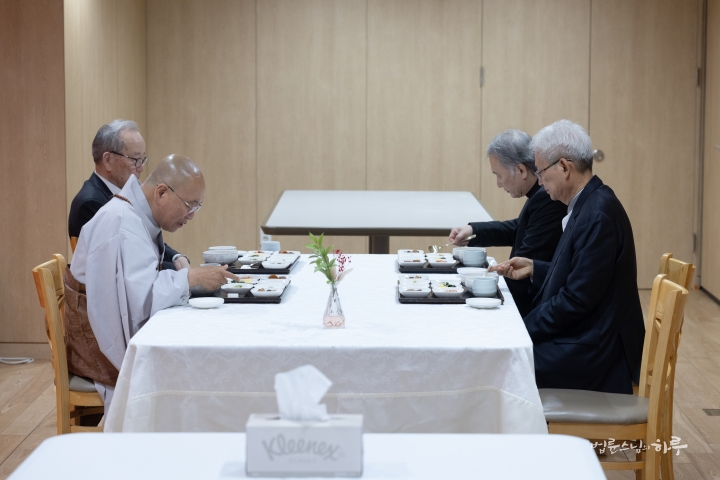
Sunim accompanied the religious leaders to the basement dining hall for lunch together. During the meal, they shared deep concerns about the escalating national division and the horrors of war.
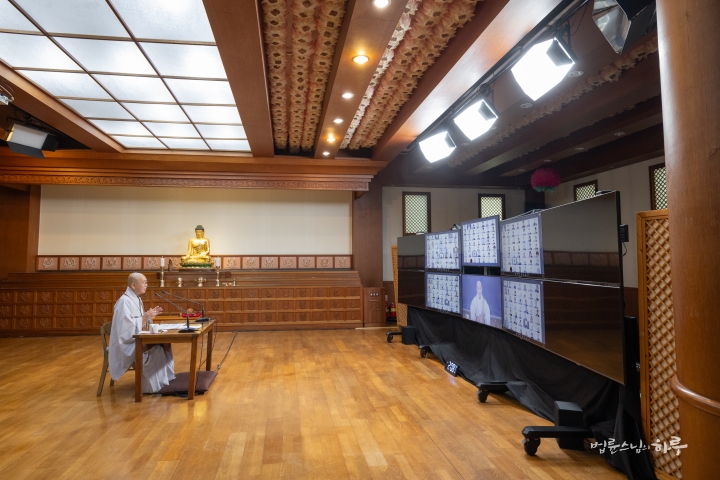
After expressing gratitude to the religious leaders who delivered commemorative speeches, Sunim headed to the broadcasting room at the Jungto Center to participate in the Tongil Euibyung Assembly (통일의병대회).
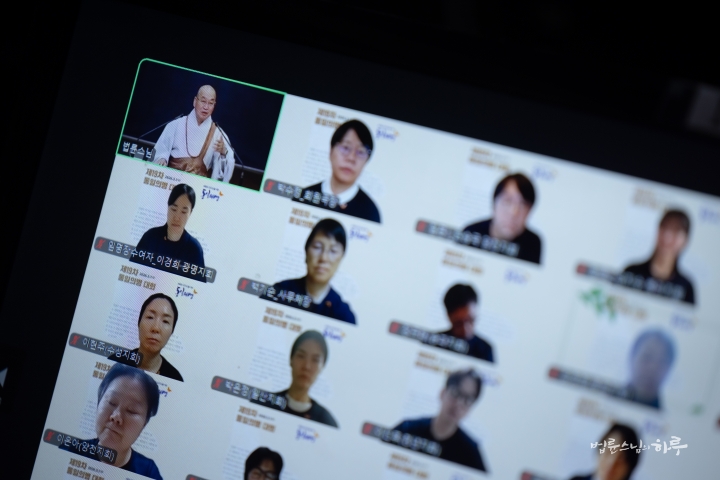
At 2 PM, Sunim participated online in the 19th Tongil Euibyung Assembly. About 130 prospective Tongil Euibyung members who had completed the introductory course joined the video conference, while senior Tongil Euibyung members connected via YouTube. The assembly began with everyone reciting the Words for Practice together.
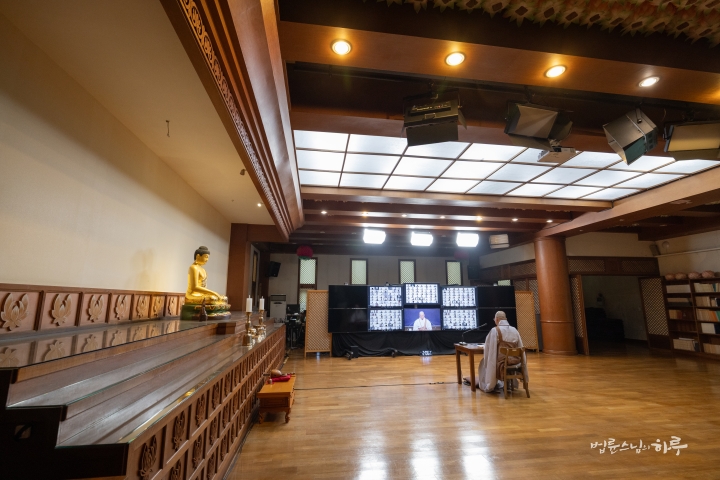
When the assembly requested a Dharma talk with three prostrations, Sunim revisited the founding purpose of Jungto Society and explained that the path of a Jungto Society member involves both practice and social engagement.
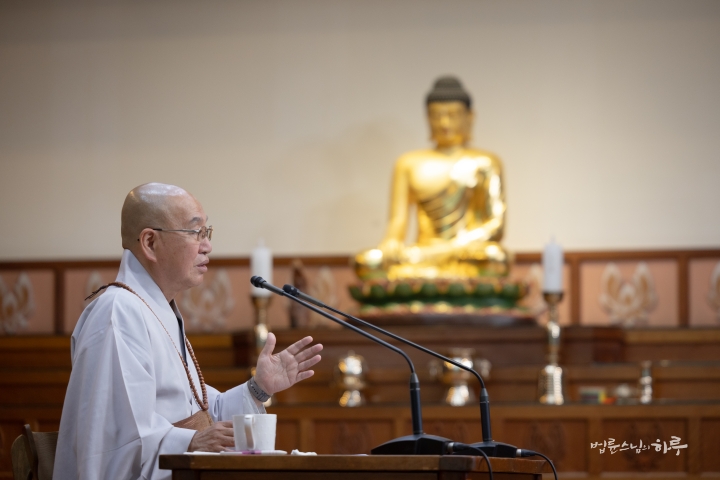
“Jungto Society is an organization centered on practice. That’s why we call Jungto Society a ‘community of practitioners (수행공동체).’ While Jungto Society is based on practice, we also engage in practical activities to address various challenges facing our society. The most important practical task of our time is to preserve peace on this land and overcome division to achieve unification. Therefore, from its founding, Jungto Society was established with two purposes: spreading the Buddha’s correct teachings through a practice movement and achieving peaceful unification, which is our national task.
Why We Must Engage in Social Practice, Not Just Personal Practice
However, since people may have different views on social engagement activities, even within Jungto Society there are those who actively participate in practice but feel burdened by social engagement activities. Conversely, there are those who are very interested in social engagement activities but are not particularly drawn to practice. Individual preferences and freedom of choice must be respected. If someone is only interested in environmental activism, we can introduce them to environmental organizations. If they’re only interested in unification movements, we can guide them to unification movement organizations. If they’re only interested in practice or meditation, we can direct them to practice-centered Buddhist organizations. However, those who wish to achieve personal transformation through practice while also participating in making our society more peaceful and just – such people can become members of Jungto Society. This doesn’t mean everyone must do this, but rather that Jungto Society was established with this perspective. Within Buddhism, this approach is called ‘Engaged Buddhism.’ Internationally, there are people in various countries engaged in such practical Buddhist activities, and there’s an organization called the ‘International Network of Engaged Buddhists (INEB :국제참여불교연대 )’ that connects them. Jungto Society participates in this network.
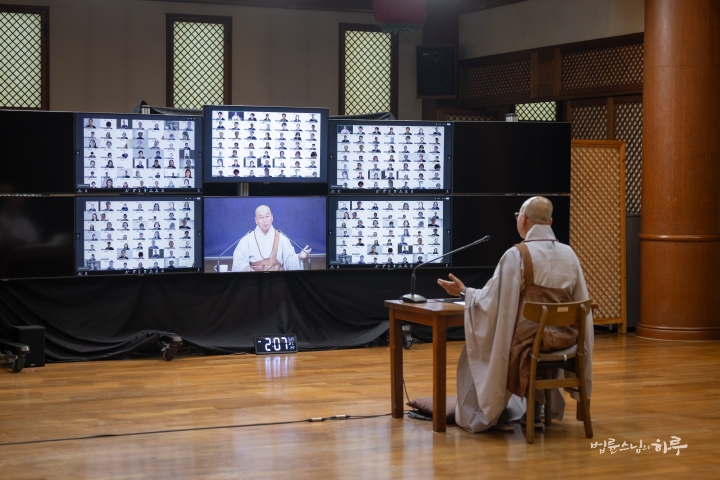
Therefore, to become a leading member of Jungto Society, one cannot focus solely on practice. Practice is naturally the foundation, the basis, and the ground. Beyond that, a consciousness for social transformation is necessary. This includes environmental awareness to prepare for the climate crisis era, recognition of peace and unification on the Korean Peninsula, social justice and gender equality, respect for human rights, and understanding of democracy. Additionally, national consciousness connected to the identity of the Republic of Korea is important. Of course, this applies to those with Korean nationality, while those without Korean nationality can understand the same principles based on their own country’s sense of community. However, if you are a member of Jungto Society and Korean, you should at least have the perspective of achieving peace and unification on the Korean Peninsula.
In that sense, you have now become ‘Tongil Euibyung (통일의병)‘ (Korean Minutemen for Peace and Unification). If someone says, ‘I’m not interested in Tongil Euibyung, I’m not interested in social issues, I just want to study Buddha’s teachings,’ then rather than being active as a Jungto Society member, it might be more suitable to pursue religious life as a Buddhist believer at Buddhist colleges in various temples. This is because Jungto Society states in its founding principles that ‘Jungto Society members are those who have proper Buddhist views and proper national historical consciousness.’ Therefore, to participate in Jungto Society, one must at least possess such historical and social consciousness.”
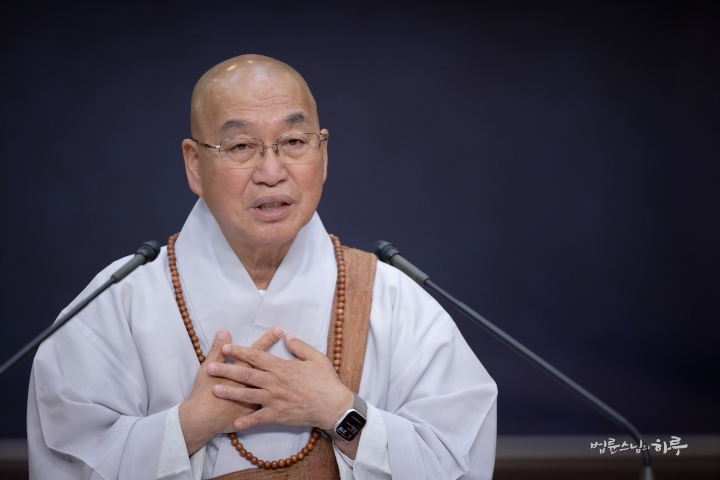
The prospective Korean Minutemen for Peace and Unification (KMPU) completed their leading member training and conducted five study sessions on Korean history to become official KMPU members. During the learning process, five participants pressed the hand-raising button to discuss their questions with Sunim.
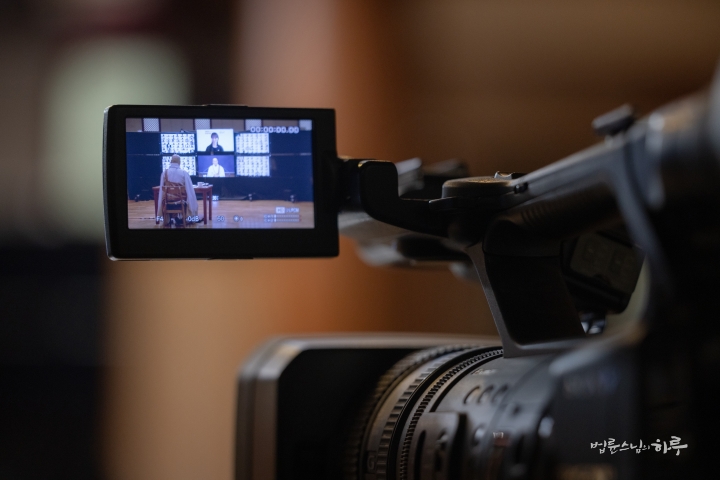
One participant, a teacher who is both a KMPU member and a practitioner, sought Sunim’s advice on how to view young people in a reality where students are becoming increasingly right-wing despite efforts to teach about unification and peace.
Why Should We Unify? How Should We View the Increasingly Right-Wing MZ Generation?
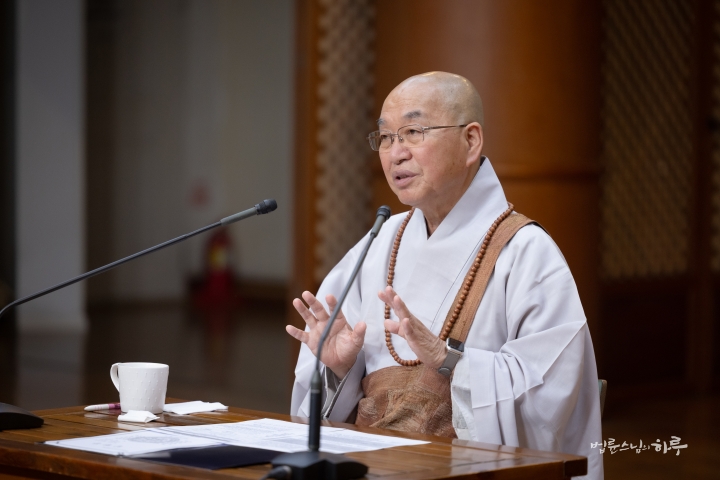
“If you try to teach students through indoctrination, it can backfire and create resistance. However, if you approach it through dialogue rather than indoctrination, there’s no need to worry too much. We are conveying facts, not trying to indoctrinate them with falsehoods. First, you need to examine at what points students are showing negative reactions.
If students are negative about North Korea, there are understandable reasons for this. Don’t today’s students react strongly when they hear that someone receives special treatment in college admissions or employment just because their father is a member of the National Assembly? Students with such sensibilities cannot view favorably a culture where someone becomes a successor simply because they are the leader’s daughter. While adults might think, ‘That’s how it can be in North Korea’ or ‘It was like that in the dynastic era, so it’s no big deal,’ we must first acknowledge that North Korea’s hereditary succession culture and China’s media control can appear very negative to young people.
So instead of scolding them with ‘Why do you view China or North Korea negatively?’, we need an attitude that accepts ‘That’s understandable.’ People’s perspectives differ based on the environment they grew up in. Just as dynastic-era perspectives differ from democratic-era perspectives, we must acknowledge each other’s differences. This doesn’t mean it’s right, but rather that from their position, it’s inevitable.
However, there’s something more important than that. Rather than dwelling on emotions about disliking North Korea’s political system, we must move forward to the question of ‘How can the South and North coexist peacefully?’ If you don’t take bitter medicine because you don’t like the taste, your illness won’t heal and you’ll be the only one who suffers. If healing is important, you must take the medicine even if it’s bitter. Similarly, even if you dislike North Korea’s political system, the conversation should continue in the direction of asking whether peace isn’t better than war.
At this point, teachers should not jump to the conclusion that ‘students are problematic because they are far-right.’ What they don’t know should be taught, and what they misunderstand should be corrected through dialogue. However, not all perspectives change at once – some things will gradually improve, while others may never change. Looking back at our own student days, didn’t we also appear problematic to our seniors? When we opposed the government, teachers would scold us saying ‘You’re just criticizing instead of studying,’ and we would think to ourselves ‘The teacher is a hypocrite.’ Whether then or now, trying to suppress with authority only leads to different talk behind closed doors.
The same applies to young children observing their parents from the democratization generation. When parents who advocate for democracy and labor struggles outside the home fight with each other and act dogmatically at home, children see this as hypocrisy. This creates resistance. Historically, there’s a tendency for children to become progressive when parents are conservative, and conservative when parents are progressive. Psychologists explain this phenomenon by saying that while democracy is discussed in theory, it’s not actually experienced in homes and schools.
That’s why it’s important to approach conversations with an understanding of the children’s perspectives. You shouldn’t try to change everything all at once. Instead of saying ‘You’re wrong, so change,’ try ‘Your point has merit. But what about looking at it this way?’ It’s necessary to slow down the tempo. And as much as the students change, I too must be willing to accept what needs to be accepted.
The same applies to unification. If we approach it with the premise that it’s ‘unconditionally good,’ it actually provokes resistance. While we don’t question the necessity of unification, the younger generation is different. They ask without hesitation, ‘Why should we unify? Won’t we just lose out if we live with North Koreans?’ It may sound disrespectful to our ears, but we can’t immediately label it as a shift to the right.”
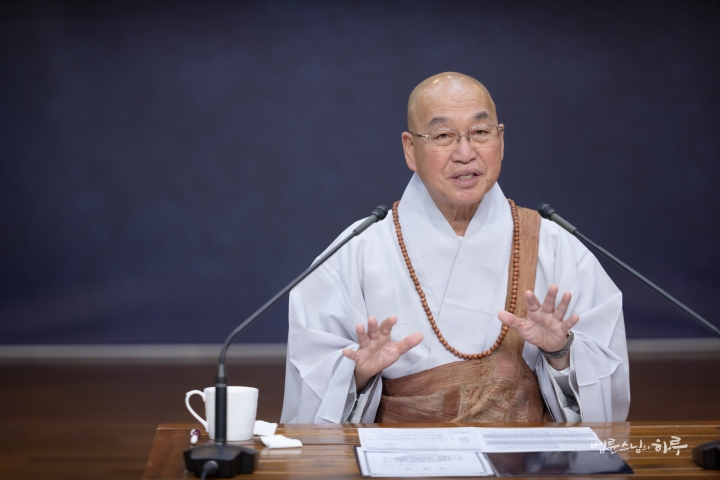
“Yes, rather than trying to teach, I’ll approach students with an attitude of ‘I can understand that perspective.'”
Questions continued to follow.
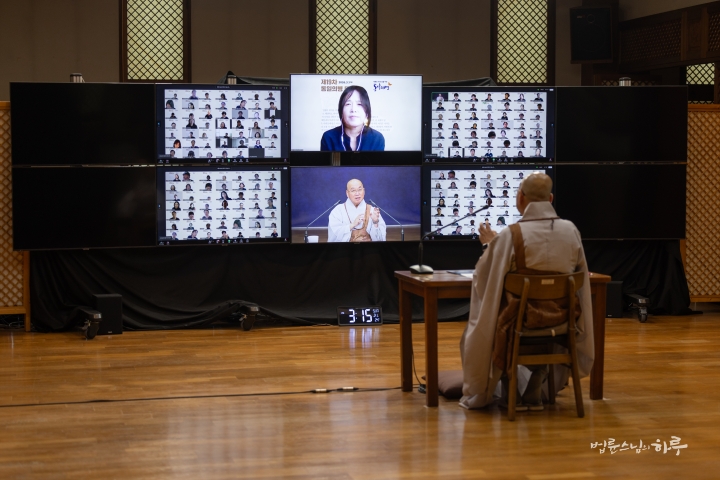
In the new Cold War structure where North and South Korea are divided into the US and China-Russia camps respectively, I’m troubled by emotional antipathy toward certain countries. How can I establish a vow for unification without being trapped in a one-sided view?
While history studies emphasize ‘we,’ Buddhism’s law of dependent origination speaks of the interconnection of all beings, creating a dilemma between these two perspectives. What viewpoint should the Tongil Euibyung adopt?
Through Sunim’s lectures, I’ve come to understand unification not as ‘unification of systems’ but as ‘integrated development of economy and culture.’ Can we then consider all Jungto Society activities as Tongil Euibyung activities?
Within Jungto Society, it’s not clear what the Tongil Euibyung specifically does, making the activities feel vague. What is the future direction and plan for the Tongil Euibyung?
After resolving all curiosities, participants watched a video capturing the history of Jungto Society’s Tongil Euibyung and the passionate moments of new Tongil Euibyung members studying Korean national history.
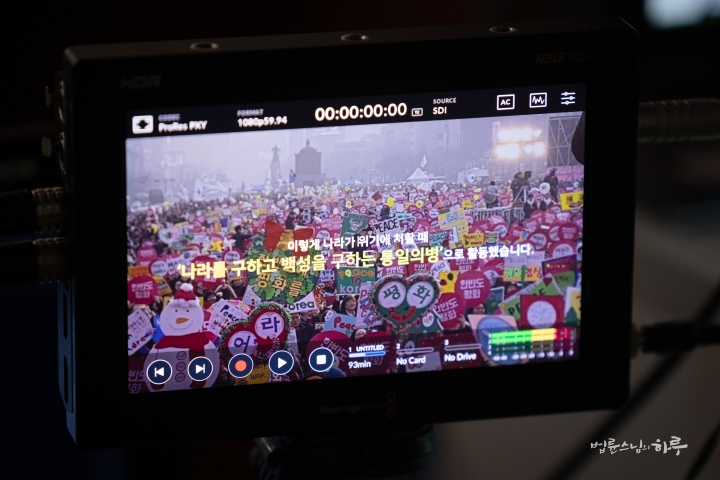
Next, the appointment ceremony for Tongil Euibyung was held. First, Sunim presented an appointment certificate to one representative of the new Tongil Euibyung members.
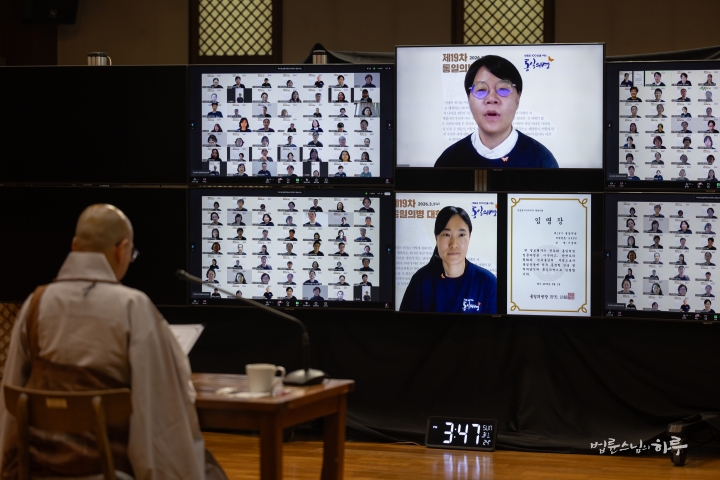
“This Jungto practitioner has completed the Tongil Euibyung introductory course and resolved to actively participate in the unification movement as a key player in peace on the Korean Peninsula and national unification, and is hereby appointed as a Tongil Euibyung.”
Sunim then presented appointment certificates to all new Tongil Euibyung members.
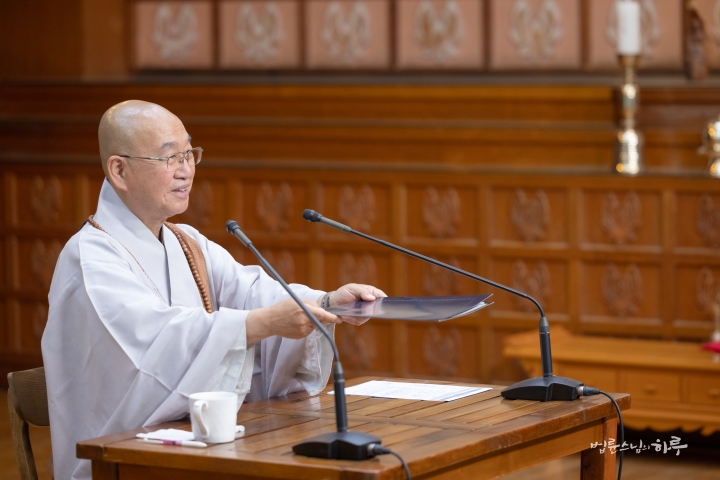
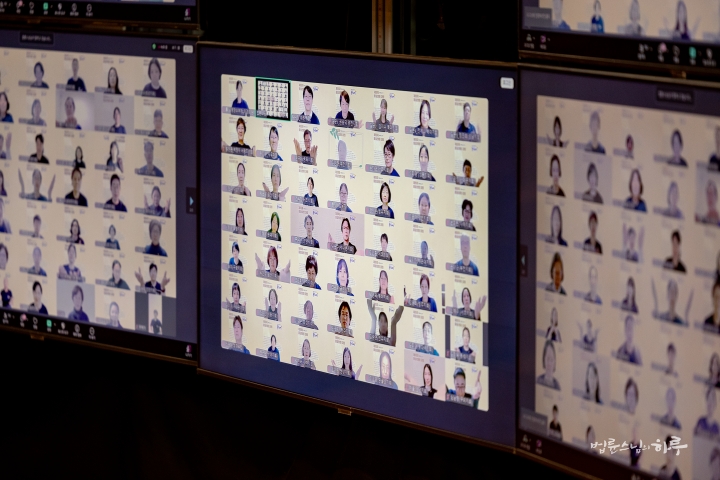
Senior Tongil Euibyung members welcomed them with enthusiastic applause. Sunim then offered a blessing for the new Tongil Euibyung members.
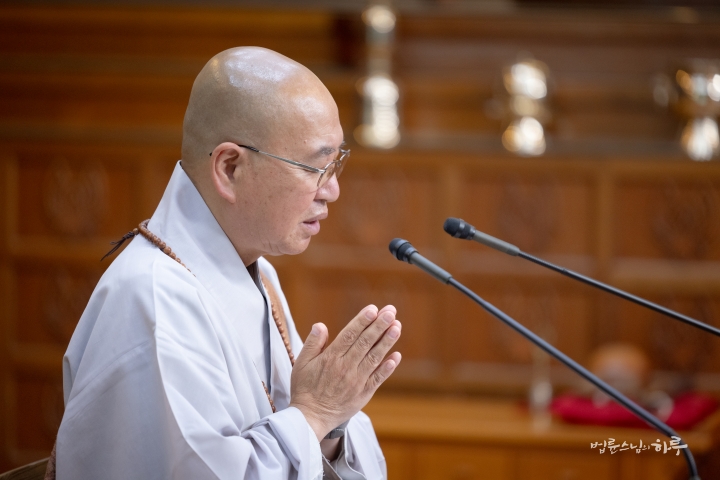
“Today at Jungto Society, 134 members who entered the 19th Tongil Euibyung received their appointment certificates. As citizens of the Republic of Korea, they have made a great vow to protect the country when it faces crisis and to share the burden when the people suffer. They will carry on the hope for peace that there should never be war on this land again, and prepare for unification while envisioning the day when our divided homeland becomes one. They pledge to take immediate action on any task that helps peace and unification, whenever and wherever. May our small devotion gather together so that the Republic of Korea, inheriting its long history and tradition, can greatly contribute to the peace and happiness not only of our people but of all humanity worldwide.”
Next, all Tongil Euibyung members gathered their will and recited the Tongil Euibyung pledge together.
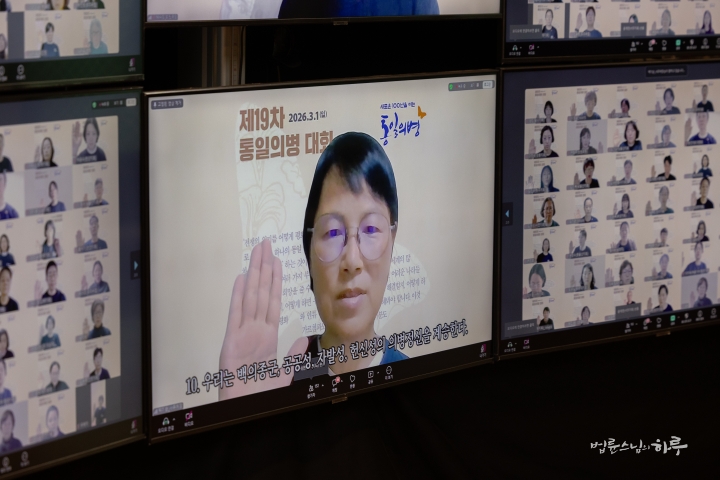
“One. We will establish a peace system on the Korean Peninsula where there will never be war again. Two. We will open the era of unification that will determine the next 100 years. Three. We will pursue an East Asian community that coexists with neighboring countries…”
Finally, after reciting the aspiration statement, the Tongil Euibyung Assembly concluded with everyone singing ‘Our Wish is Unification’ with united hearts for unification.
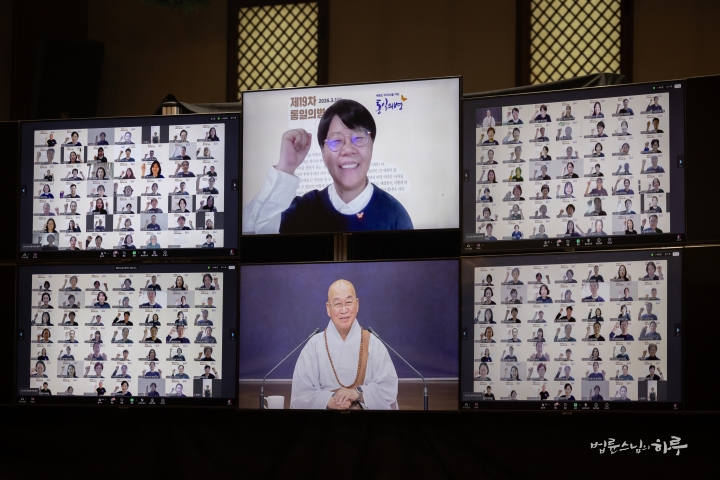
The new Tongil Euibyung members gathered in group video conference rooms to continue mindful sharing.
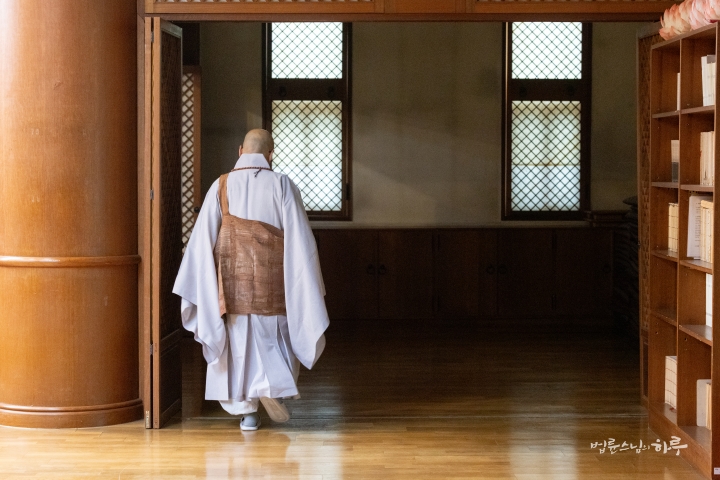
After finishing the live broadcast, Sunim immediately departed Seoul and headed to Dubuk Jungto Retreat Center (두북 수련원).
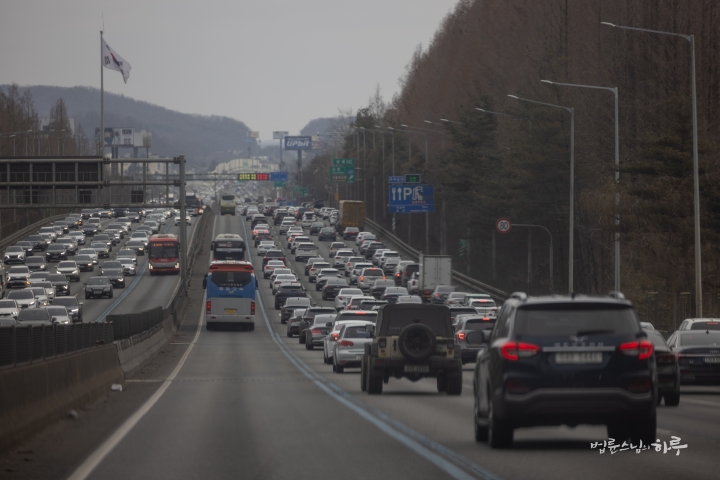
After a four-hour drive on the highway, Sunim arrived at Dubuk Jungto Retreat Center at 8 PM. After a late dinner, he attended to various tasks and manuscript editing before retiring for the night.
Tomorrow, Sunim will rest at Dubuk Jungto Retreat Center and visit the hospital in the afternoon for treatment of his back pain.