
Feb 18, 2026 Weekly Dharma Assembly
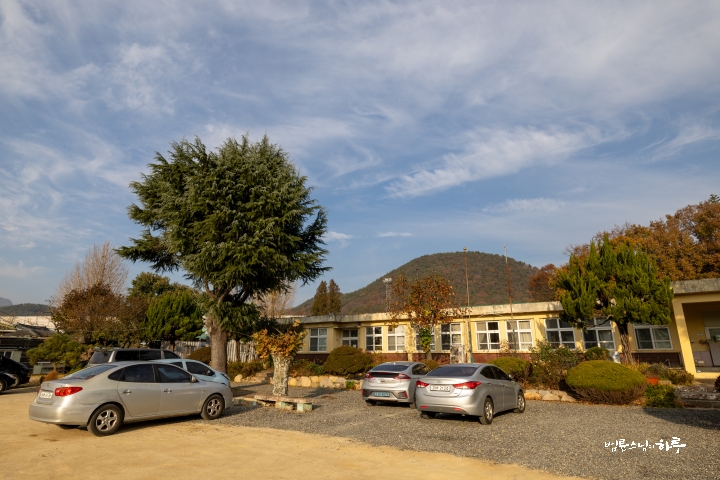
Hello. Today, Sunim began the morning at Dubuk Jungto Retreat Center (두북 수련원).
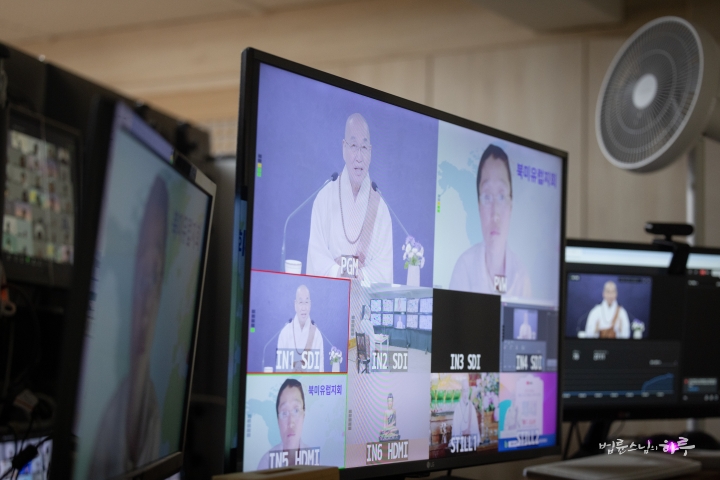
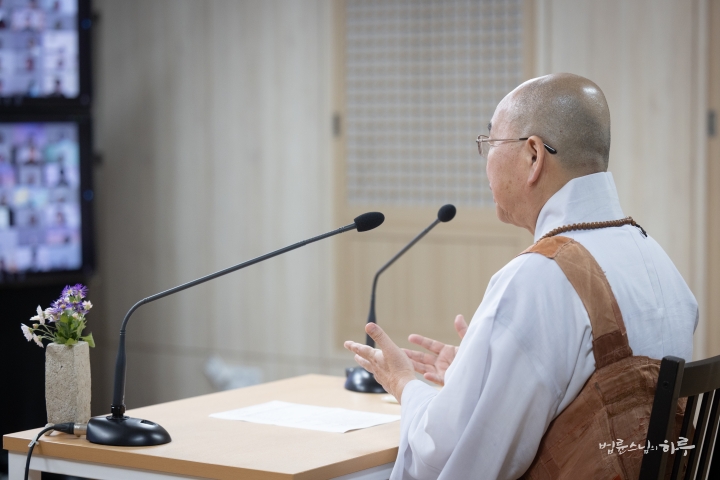
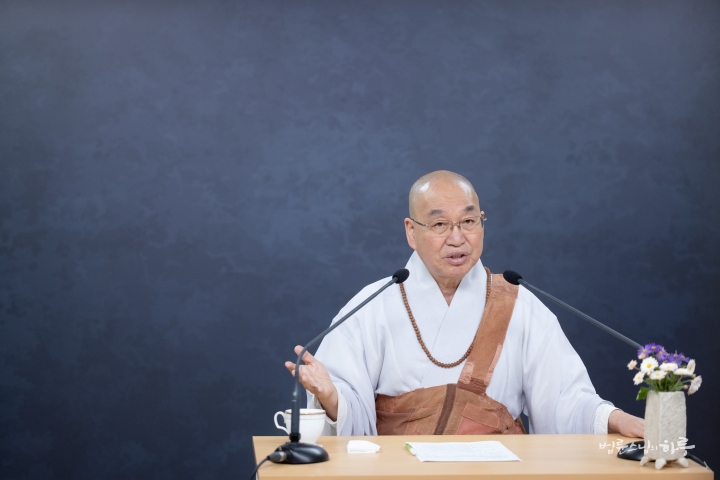
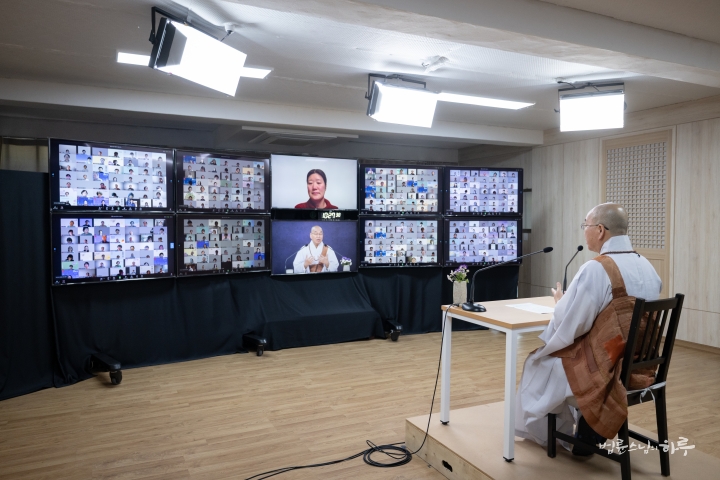
After morning practice and meditation, and proofreading manuscripts, Sunim conducted a live broadcast of the Weekly Dharma Assembly from the Dubuk Jungto Retreat Center broadcasting room for the first time in a while.
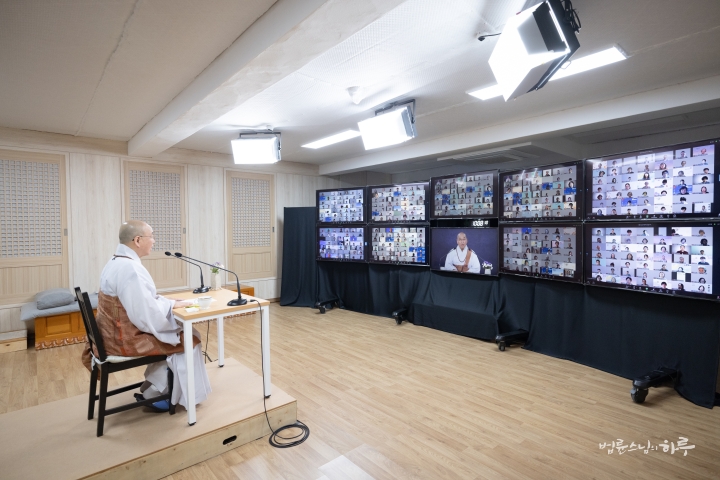
At exactly 10 AM, all Jungto Society members entered the video conference room. After reciting the Three Refuges (삼귀의) and the Heart Sutra (반야심경), the members requested a dharma talk from Sunim with three prostrations. Sunim began the dharma talk by first extending Lunar New Year greetings.
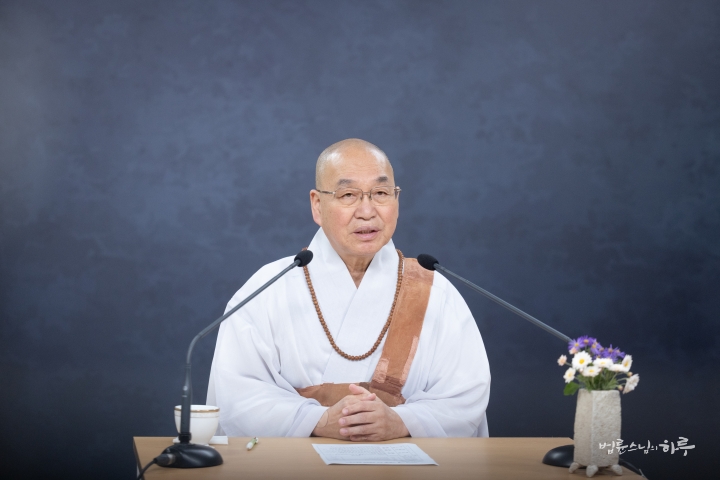
“I hope you had a good Lunar New Year. I imagine you spent the holiday meeting with family after a long time, performing ancestral rites to honor your ancestors, and sharing news with one another. However, even good things can become burdensome when taken to excess. When we try too hard to prepare an elaborate ancestral rite table, our bodies become exhausted from food preparation, and when we show excessive interest in family members we haven’t seen in a while, unexpected conflicts can arise. ‘Have you found a job?’, ‘Why aren’t you married yet?’, ‘Why are you educating your children that way?’ When interest becomes excessive like this, the joy is only momentary, and as time passes, it can turn into irritation and discomfort. That’s why we need to moderate not only negative emotions like anger, irritation, and hatred, but also positive emotions like love and goodwill as practitioners. Even good intentions can become a source of conflict and suffering when taken to excess.
The holiday break continues until today, and starting tomorrow, Jungto practitioners will enter a three-day Jeongcho (New Year’s) Prayer (정초 기도), setting their minds and making aspirations for a peaceful year ahead. No matter how busy you may be, I hope you will set aside your daily affairs for these three days and devote yourself sincerely to the prayer.”
Sunim then spoke about the self-sustaining operation plan for Sujata Academy in India and the global significance of Jungto Society’s activities.
“During this time, I visited Sujata Academy in India to inspect the overall operational status of the school, students, and hospital. This time, I also briefly toured all 15 villages in Dungeshwari to examine the current situation in each village.
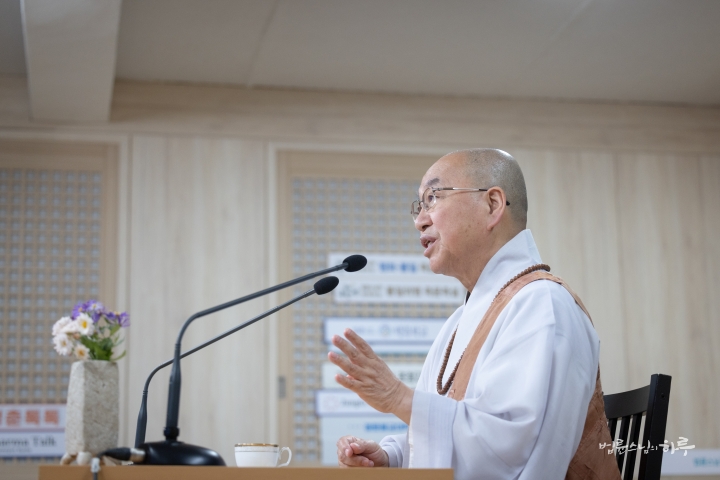
Currently, Sujata Academy is operated entirely with support from Korea. However, considering the rapid growth of the Indian economy, we need to start preparing now so that most of the financial resources needed for school operations can be secured within India itself in about 10 years.
India’s per capita GDP is still low. However, the total economic output has already reached the world’s 5th largest, and it is projected to become the world’s 3rd largest economy within three years. In terms of total output, it is already nearly three times the size of Korea’s economy, and this gap will grow even larger in 10 years.
When we were struggling in the past, the United States and Germany built and operated schools and hospitals in Korea. However, institutions like Yonsei University (연세대학교), Ewha Womans University (이화여자대학교), Sogang University (서강대학교), and St. Mary’s Hospital (성모병원) were initially established by foreigners but are now all operated with domestic resources and no longer depend on foreign support. India will inevitably follow the same path overall.
However, Dungeshwari is such an impoverished region that even 10 years may not be enough for it to become self-sufficient. If the school were in a city, it could be converted to a private school providing quality education and building a reputation as a good private school, with tuition covering the finances. But this region has very poor living conditions. If we convert to a private school, the benefits for poor children would be greatly reduced. So we must continue to maintain free education for the time being. Instead, we need to secure sponsors within India who sympathize with this purpose, or create a structure where the school foundation can generate certain financial income. With this direction in mind, I examined whether there is a way for the foundation to conduct profit-making businesses by separating school operations from the foundation. I also inspected with the idea of dividing the staff structure into teams to operate the school and hospital, teams for village development, and teams to operate the foundation.
A New Model for World Buddhism: Jungto Society’s Practice
Our Republic of Korea is a very developed country compared to many Asian nations. Although there are still many difficulties, it remains an affluent country. Yet the people living within it have many complaints. As economic growth stagnates and the wealth gap widens, the number of people whose lives are becoming increasingly difficult is growing.
In this situation, Jungto Society does not measure human happiness simply by economic aggregate. Yet we don’t ignore material things and remain focused only on pursuing peace of mind through practice. While exploring together how people should live in this rapidly changing era of climate crisis and artificial intelligence development, we are practically seeking new ways of life. In this respect, Jungto Society can be said to be taking a step forward in our society.
This time, I had the opportunity to engage in dialogue with Buddhist leaders from Thailand, Sri Lanka, and Malaysia. I received an unexpected request at that meeting.
‘There is currently a severe shortage of leaders to guide world Buddhism. We know you are very busy with Jungto Society work, but it would be good if you could spend 70 percent on Jungto Society work and dedicate 30 percent of your time to world Buddhism. Please play a role for world Buddhism beyond Jungto Society or Korean Buddhism.’
I just smiled when I heard that. I’m already struggling to handle all the Jungto Society work, and then I received such a proposal. While I was grateful for the request, it is by no means easy at present.
However, this request also shows how Jungto Society’s activities are being evaluated from the outside. If each Jungto Society member carries out their role a bit more responsibly, it won’t just stop at the development of Jungto Society. It could become a new model not only for Korean Buddhism but also for world Buddhism.
This is not because of my personal capabilities, but because looking at what Jungto Society has done so far, we are maintaining our practice principles well and steadily studying Buddhism, which is the Buddha’s teaching. We have also consistently engaged in various social practices including environmental action, helping neighbors in need, and peace activities. If these experiences and practices spread to various parts of the world, they could become a model that suggests a direction for the future of Buddhism. Furthermore, it will be a path that contributes to the development of humanity.”
Following this, two people who had submitted questions in advance took turns asking Sunim questions. One additional question was also taken on the spot. The first questioner shared concerns about potential career gaps and re-employment anxiety that might arise from following her husband overseas.
Worried About Career Gap If I Follow My Husband Overseas
Another concern is re-employment. I feel that Unreal Engine has limitations with self-study alone and requires experience in actual project environments to develop real skills. I’m afraid I’ll miss that opportunity with a three-year gap. During the COVID period when the industry was booming, finding employment was relatively easy, but I’ve heard the industry situation isn’t good now. I’m very concerned that the career gap might become a major obstacle to re-employment when we return to Korea in three years.”
“You seem to have many worries. But among the things we worry about, there are worries that make people think ‘That’s indeed worrying’ and worries that make them think ‘That’s not really worth worrying about.’ Let me give you an example. Say I live in a rental house and the deposit has increased. If I worry because I can’t raise more money and will be evicted, anyone would think ‘Ah, that’s certainly worrying.’ But conversely, if I’m renting out a house and want to receive a $150,000 deposit but worry because tenants aren’t coming, others would think ‘What a trivial worry.’ Both are worries, but from others’ perspective, they’d say ‘Why not just lower the price a bit?’
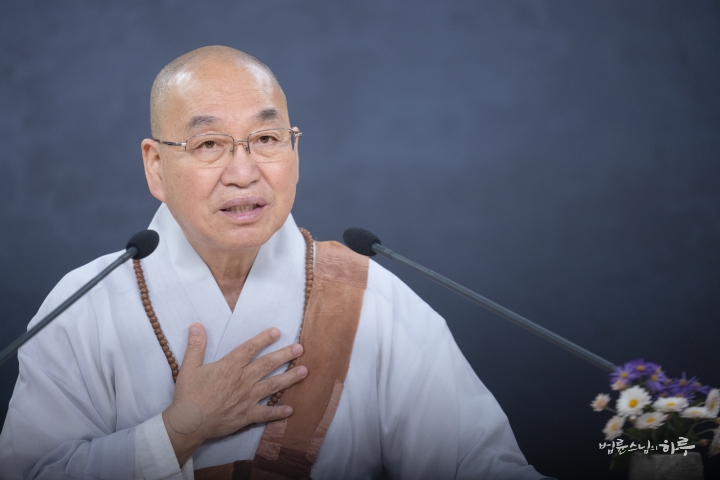
From the Buddha’s teaching perspective, there’s nothing to worry about, but even from a worldly perspective, there are things worth worrying about and things not worth worrying about. So which category does your worry fall into? From what I hear, it doesn’t seem like something you need to worry about. If you were living alone, quitting your job to become a freelancer and worrying about not making money, that would be worrying even from a worldly perspective. But when a husband is assigned overseas and the wife accompanies him, wives generally live well following their husbands. They receive extra allowances for living in difficult environments, housing is provided, and children’s education expenses are supported.
And in Southeast Asian regions like Vietnam or the Philippines, labor costs are still low. So people live with housekeepers and drivers. Expatriates from developed countries in developing countries belong to the very wealthy class in those countries. That’s why they’re called ‘madame.’ With housekeepers and drivers, you can live comfortably for several years without major concerns. This means you’re in a condition where you can live comfortably without earning money for the next few years.
So at times like this when you don’t need to earn money, don’t be too concerned about money and try various things. Unless you get caught up in entertainment or travel there, you’ll have lots of time. Since housekeepers do the housework and drivers do the driving, you’ll have lots of personal time. So if there’s something you want to do, it’s a very good condition to try freelancing. I don’t see this as something to worry about.
‘I want to learn more advanced skills but it’s difficult if I follow my husband’ – this is more regret than worry. And it’s a matter of choice. You need to choose whether to stay in Korea and learn the skills, or give up for now and follow your husband. It’s not something to just keep agonizing over, but something to decide based on what kind of life you want to live.
Choice means taking responsibility for what you choose and giving up the other option you didn’t choose. You shouldn’t have lingering attachments. If you follow your husband and spend three years there before returning to Korea, it’s natural that returning to work will be more difficult than if you had spent three years here. It’s natural because you rested without working, and that’s not something to worry about but to accept.
For example, say I raised a baby for three years and then returned to work. These days, career interruption is a social issue, so companies provide one year of paid leave and two years of unpaid leave while guaranteeing job security. Being able to return to work after three years is something to be grateful for, but looking at colleagues who got promoted while working and saying ‘I want the same promotion’ would be an excessive demand. If you worked, you receive compensation accordingly, and the gap created while raising a child is something you must bear. Wanting to benefit from everything is greed.
You seem to be greedy, wanting to have everything. You’re scheming to hold rice cakes in both hands. If you want to stay in Korea to study more and take care of your career even if your husband goes to Vietnam, you need to choose not to follow him. Conversely, if you’re not particularly working now and it seems good to go together, then go and enjoy without worry. When else will you experience ‘madame life’? Since you’ll have lots of time there, you can set a goal to try various freelance work. If you have plans for children, childcare would be good too. You need to think about how to use the given time. Approaching with greed only creates suffering without any benefit.”
“I decided to accompany him not because I expected special experiences abroad or so-called ‘madame life,’ but above all because I want to be with my husband. As a designer, I thought I could continue working as a freelancer, so I decided to follow him, but on the other hand, I’m worried about career gaps, and it feels wasteful to stop the studies I’ve accumulated. I’m concerned about whether I can do work that helps my career during the three years. I don’t want to just let time pass by. I want to build experiences and achievements that will contribute to my future career while staying in Vietnam, so I’m thinking about various directions to prepare.”
“What I mean by ‘madame life’ is that you’ll have lots of time. Since others will prepare meals and drive for you, you’ll have much more personal time than in Korea. Then you can study new things as much as you want. These days, you can learn plenty through the internet like YouTube, right? But if this and that feel difficult, I’m saying there’s no loss in at least enjoying a leisurely life like a madame. You just need to make good use of the given opportunity, not worry about it.
And isn’t it natural to have a career gap after being away for three years? Above all, if you’re married, it’s better for couples to live together. That’s more important than career gaps. Trying to get married, raise children, and avoid career gaps seems like excessive greed to me. You need to choose appropriately among them. I’m not telling you what to do or not do. I’m just saying to choose what’s possible.”
“Thank you. I understand well.”
Questions continued to follow.
After returning from the India pilgrimage, deep gratitude arose for everything I’ve lived in the Republic of Korea. How can I apply and maintain this gratitude in my future life?
On SNS, conflicts between Korean and Southeast Asian netizens over an incident at a K-pop concert escalated into racial discrimination debates, making me reflect on Korean society’s nationalism and discrimination issues. How do you view this phenomenon?
After answering all questions, it was past 11 o’clock. Sunim concluded the Weekly Dharma Assembly after urging all Jungto Society members to participate in the Jeongcho Prayer starting tomorrow.
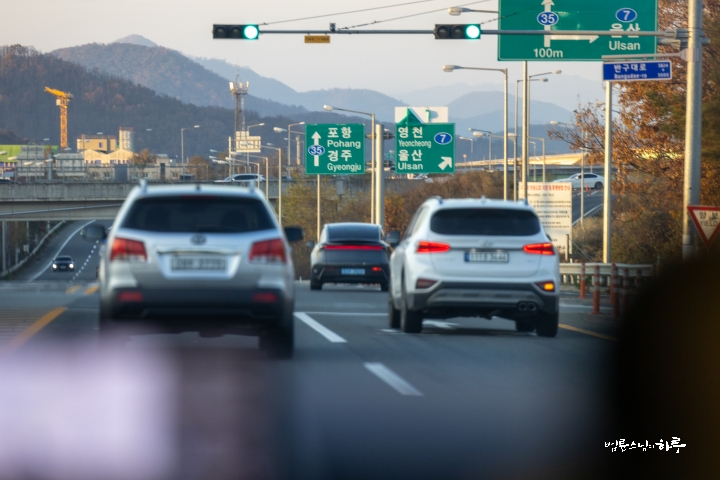
After the Dharma assembly concluded, Sunim visited his aunt who lives near Dubuk Jungto Retreat Center to offer New Year’s greetings. He then traveled to Gyeongju (경주) to meet with Venerable Beopsin (법신 스님), exchanged New Year’s greetings, and shared lunch together. After returning to Dubuk Jungto Retreat Center past 2 PM, Sunim received New Year’s greetings from his nephews and nieces from his lay family who live in Ulsan (울산). In the evening, he finished dinner early and retired for the night.
Tomorrow, to welcome the new year, Sunim will conduct the Jeongcho (New Year’s) Prayer Opening Ceremony Dharma assembly (정초기도 입재식 법회) via online live broadcast from the broadcasting room at Dubuk Jungto Retreat Center.