
Feb 5, 2026 – Day 13 of the India Pilgrimage, Sankasia
Hello. This is the thirteenth day of the India pilgrimage. Today, Sunim left Shravasti for Sankasia, paid respects at the Sankasia Stupa, and held a closing ceremony (회향식) to conclude the pilgrimage.
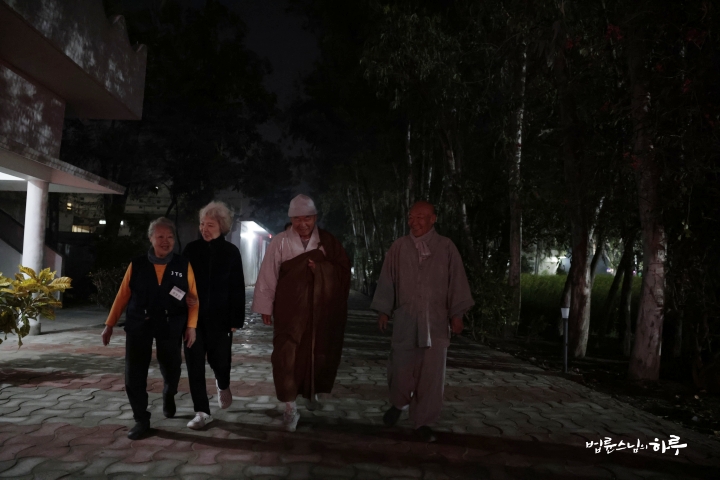
Starting at 1:20 AM, the bus drivers began starting their engines one by one. Sunim also woke up early, prepared for the journey, and left the accommodation. Venerable Daein (대인 스님), the abbot of Cheonchuk Monastery, Bodhisattva Jeokjohaeng (적조행 보살님), and the resident members of the temple came out to see them off.
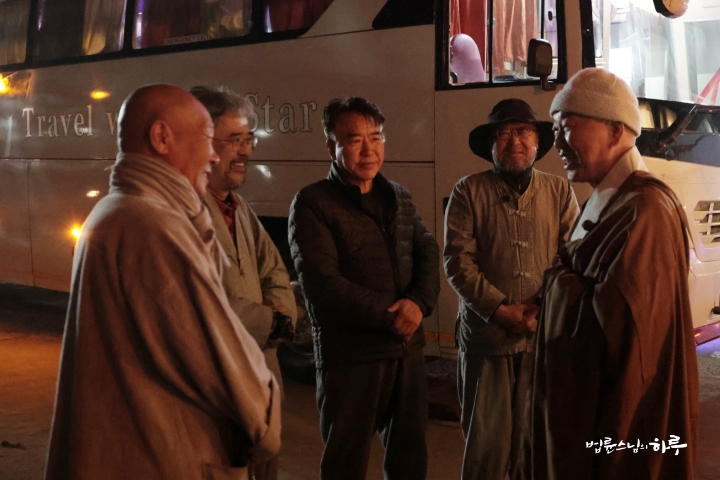
“Sunim, have a safe journey for the rest of your schedule.”
“Yes, Venerable. Thank you as always. Bodhisattva Jeokjohaeng, thank you for your hard work in managing the temple. I hope everyone stays healthy, and please contact me when you come to Korea.”
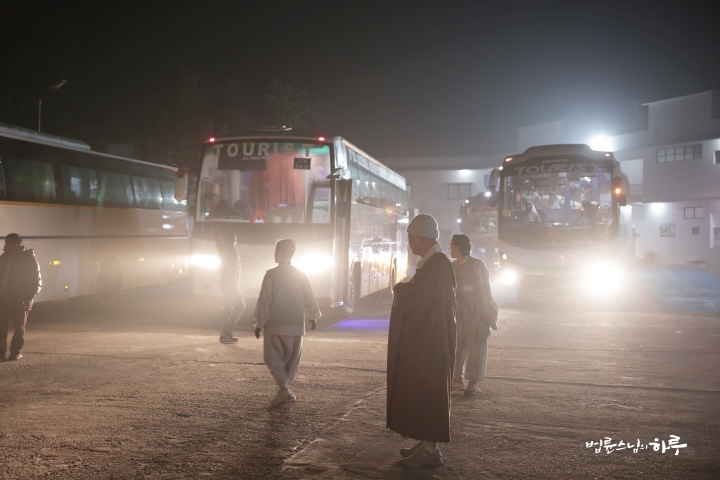
At 2:30 AM, they departed for Sankasia. When the lights went out, the pilgrimage group fell into a deep sleep. Sunim checked the travel route while looking at the map.
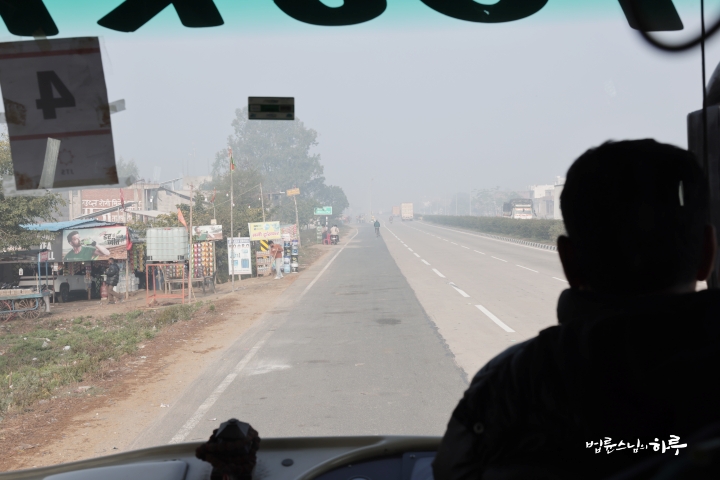
After traveling for about 7 hours and 30 minutes, they arrived at Sankasia at 10 AM. First, they visited Venerable Dhammapal’s temple. Originally, they planned to eat their packed breakfast at the Dhamma Center, but preparations for a welcome ceremony were in full swing there. To avoid causing any disruption, Sunim suggested eating their packed meals at Venerable Dhammapal’s temple. Venerable Dhammapal is from the Sakya clan and taught students during the early days of Sujata Academy. He later moved to Sankasia and has been staying there while building this temple.
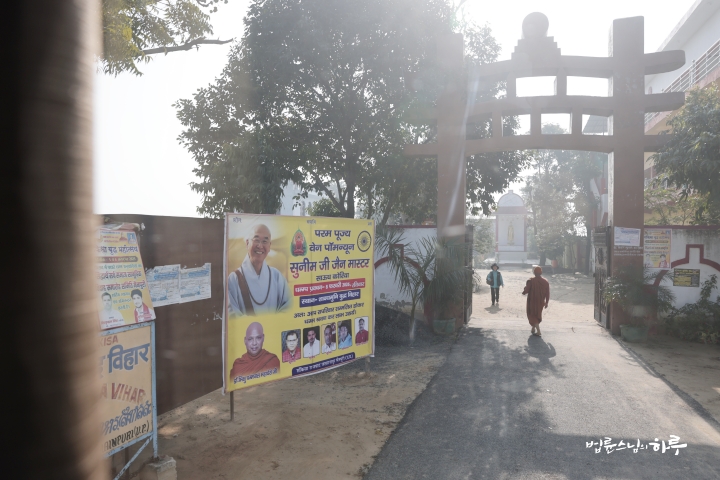
At the temple entrance, a large poster featuring Sunim’s photo was displayed. After paying respects at the main hall, Sunim warmly greeted Venerable Dhammapal.
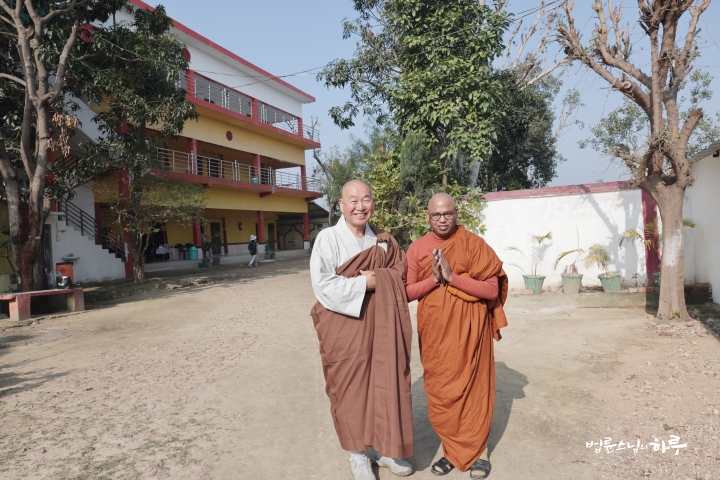
After eating breakfast with packed meals in the sunny courtyard, they headed to the Sankasia Stupa at 10:40 AM.
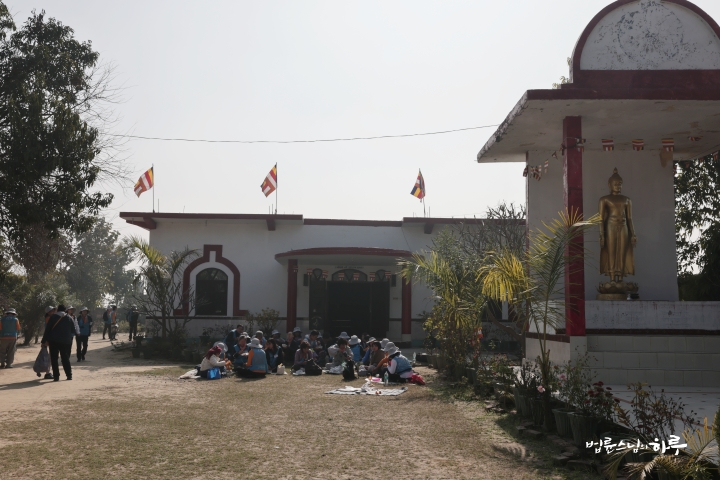
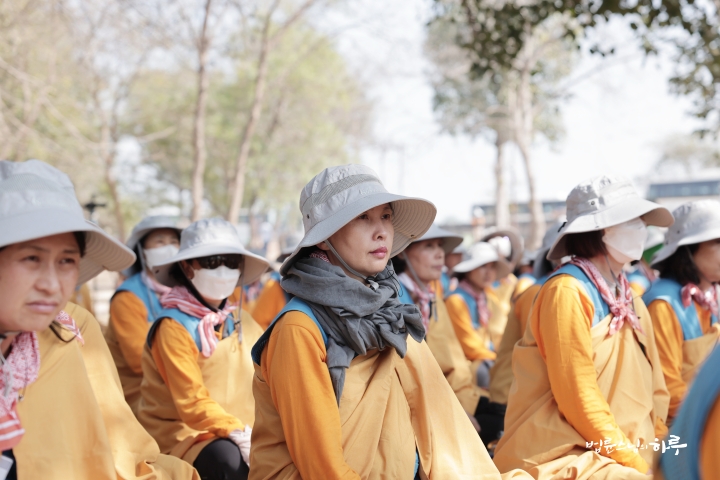
Sunim instructed the pilgrimage group to put on their kasayas in front of the stupa and began the circumambulation. At that moment, a practitioner approached and offered flowers to Sunim. Sunim silently accepted the flowers and continued walking slowly.
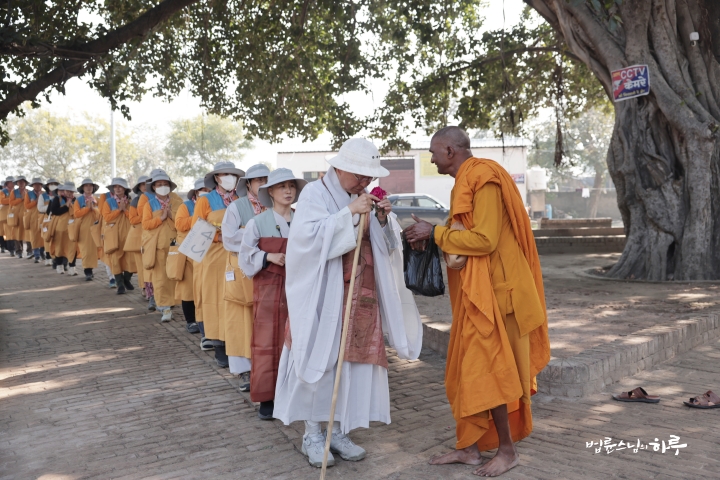
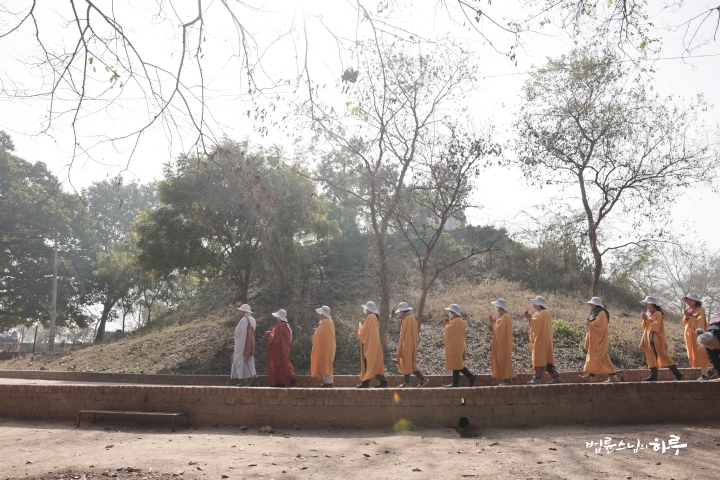
As buses arrived one after another, soon five hundred pilgrims surrounded and circumambulated the stupa. Sunim walked slowly so that all the pilgrims could circumambulate the stupa together.
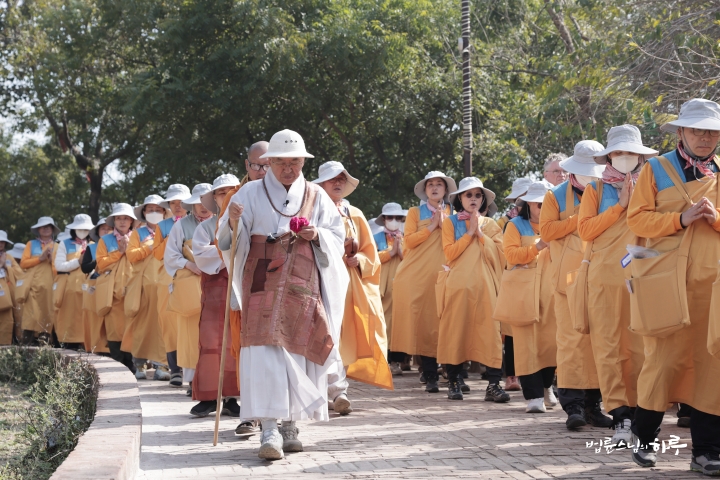
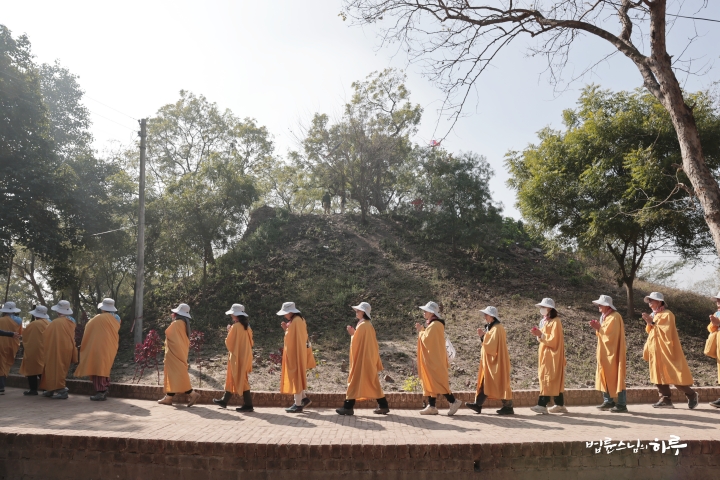
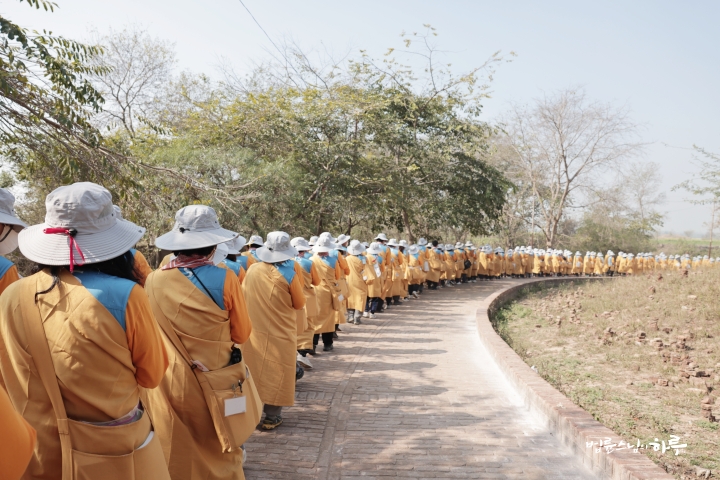
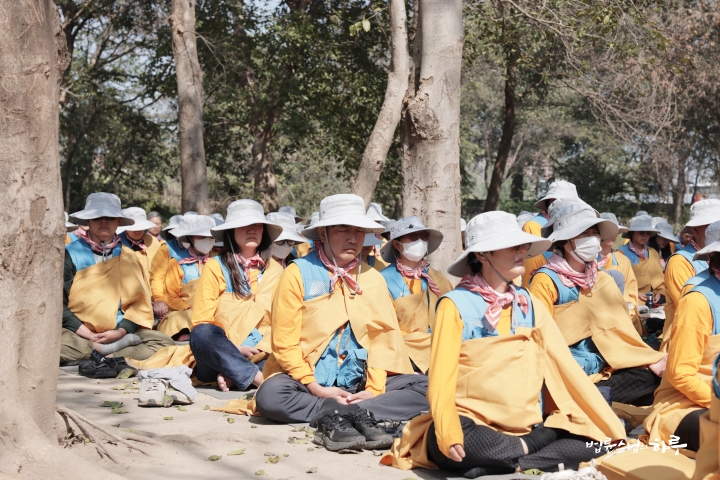
After completing the circumambulation, the pilgrimage group stood facing the stupa in the wide area in front of it. They offered prostrations and meditated briefly.
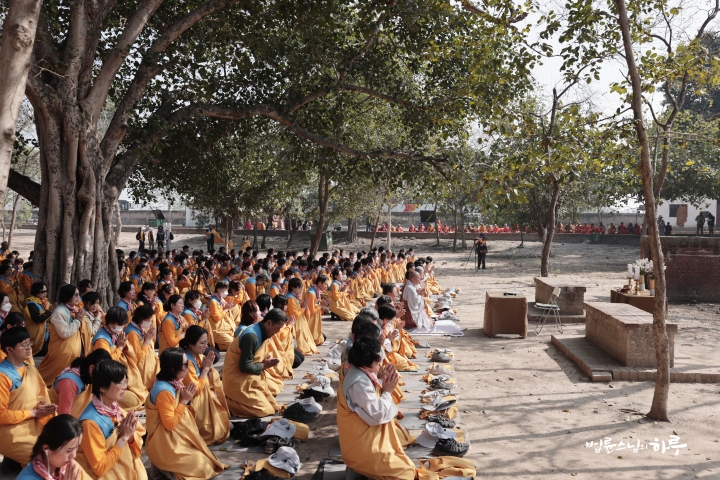
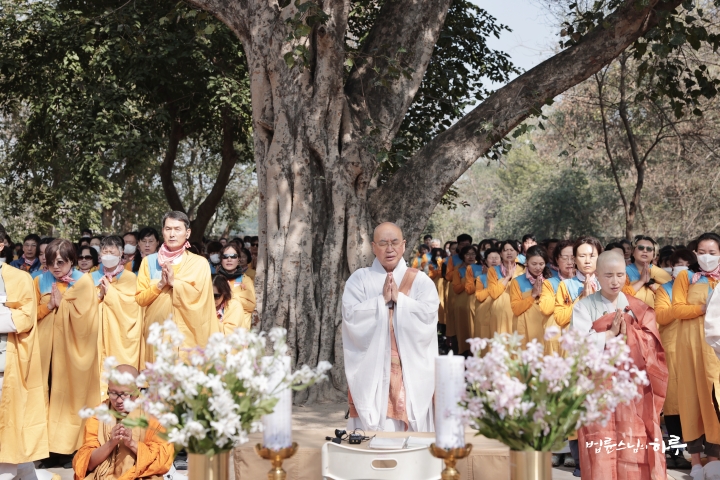
Sunim explained how Sankasia, which has relatively few stories compared to other sacred sites, came to be established as one of the eight great sacred sites, sharing the related legends and their significance.
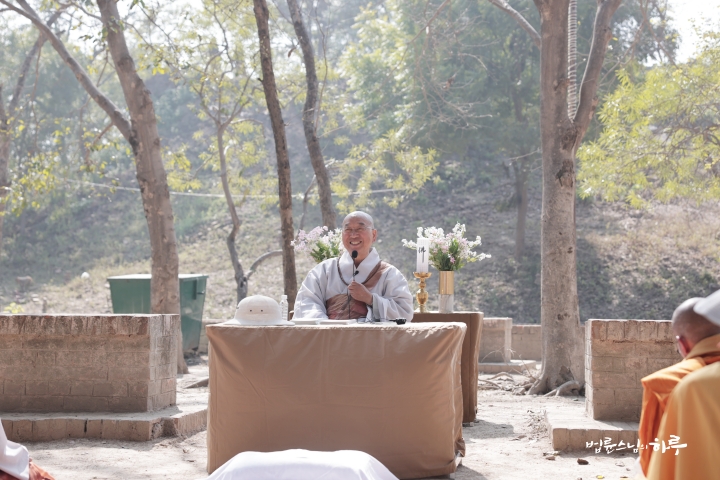
“Sankasia doesn’t have many stories directly related to the Buddha’s life. Looking at historical facts alone, I think Kosambi should perhaps be included as one of the eight great sacred sites rather than Sankasia. Even compared to places like Rajgir, Shravasti, or Vaishali, which are rich with Buddha’s stories, Kosambi has more stories in terms of quantity and could be considered more of a sacred site.
However, among the eight great sacred sites that have been historically recognized, Kosambi is not included, while Sankasia is. The four major sacred sites are where the Buddha was born, attained enlightenment, gave his first sermon, and entered parinirvana, so there’s no dispute about these. Among the remaining four sites, three are regions where the Buddha conducted extensive teaching activities and thus have many related stories. In contrast, Sankasia has relatively few stories.
Why Did Sankasia Become One of the Eight Great Sacred Sites Despite Having Few Stories?
According to records, the Buddha traveled even further west than Sankasia. Not as far as Delhi, but it appears he went a bit further northwest from here. However, apart from the legend of the Buddha ascending to Trayastrimsa Heaven (도리천) to teach his mother and then descending back here, there are hardly any other stories about Sankasia. Looking at this, it seems that the remaining four sacred sites were selected not based on historical facts, but rather centered on somewhat mythical and mystical phenomena.
Rajgir is known for the story of the angry elephant kneeling before the Buddha, Shravasti for the miracle of the Buddha manifesting a thousand forms, Vaishali for the story of monkeys offering honey to the Buddha, and Sankasia for the story of the Buddha ascending to Trayastrimsa Heaven and descending here. Looking at it this way, all four places seem to have been selected based on certain mystical phenomena.
Then why did the Buddha ascend to Trayastrimsa Heaven for his mother and descend here? We haven’t yet found clear historical evidence for this. Just as it’s unclear what basis the Twin Miracle story comes from, the same is true for the legend of Sankasia. However, we can make some educated guesses. Whether in India or Korea, there are cultures that respect parents and honor ancestors. In such cultures, leaving home to become a monastic practitioner could be seen as extremely unfilial from the parents’ perspective. No matter how great the Buddhist teachings are, there’s no excuse for causing pain to one’s parents. Especially in Confucian cultures that emphasize ancestor worship, leaving home was considered completely unfilial.
In comparison, while India had a culture of honoring ancestors, there was almost no culture that treated leaving home as unfilial. Nevertheless, from the perspective of practitioners who had left home, guilt toward their parents would have been difficult to avoid. In this sense, the Sankasia legend might have emerged to emphasize that the highest filial piety is not making parents comfortable in worldly life, but rather awakening them and liberating them from suffering.
In Buddhist teachings, the greatest filial piety a child can show to parents is to awaken them while they are alive. If the parents have already passed away, it would be to help their spirits escape from suffering through memorial services. This is why the story of Venerable Maudgalyayana rescuing his mother from hell is also transmitted.
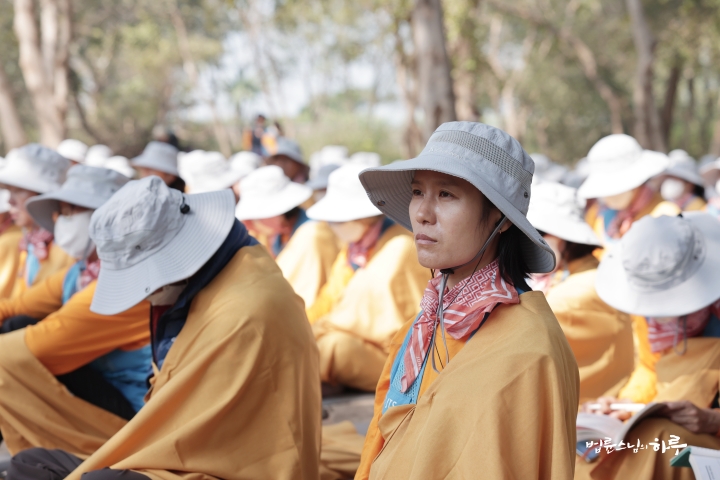
According to the scriptures, one year the Buddha ascended to the Tavatimsa Heaven (도리천) to awaken his mother and taught the Dharma there for three months. The Buddha would spend three months in retreat with the Sangha every year during the rainy season, but that year, no one saw the Buddha. No matter how much people searched and inquired, they could not find where the Buddha was, wondering if he was practicing alone somewhere.
So people went to ask Venerable Moggallana, who was foremost in supernatural powers. When he looked, the Buddha was not in the human world. Instead, when he looked into the heavenly realms, the Buddha was in the Tavatimsa Heaven. There, he was teaching the Dharma to his mother, Lady Maya.
The Sangha missed the Buddha so much and longed to see him that they asked Venerable Moggallana to find out when the Buddha would return. Venerable Moggallana used his supernatural powers to ascend to the Tavatimsa Heaven and find out when and where the Buddha would descend. The Buddha said he would descend outside the city of Sankassa on such and such a day at such and such a time.
When that day came, thousands of people prepared to welcome the Buddha. Indra, the most excellent among the gods, commanded other deities to lower a staircase from heaven to earth. The Buddha descended in the center of the staircase, with Brahma (대범천) standing on the right holding a fly whisk, and Indra (인드라천) on the left holding a parasol to shade him from the sun. Therefore, when you see a staircase-shaped image in sculptures, you can understand it as a sculpture symbolizing Sankassa. In early Buddhism, the Buddha was not depicted in human form, so only footprints were drawn on the stairs without human figures. Later, it was depicted with the Buddha descending the stairs and Brahma and Indra standing on either side.
The next part of the story is told slightly differently in various scriptures. Some scriptures mention that a bhikkhuni was the first to go out to meet him. When that bhikkhuni said, ‘Buddha, I was the first to come meet you,’ the Buddha replied, ‘No.’ When she looked around and saw no one else, she asked, ‘Then who was it?’ The Buddha then said, ‘It was Venerable Subhuti.’
Venerable Subhuti (수보리 존자) was practicing meditation on Vulture Peak (영축산)at that time. When he heard the news that the Buddha was coming, he was about to get up from his seat to go meet him, but at that moment, he clearly realized the truth that all phenomena are empty. So he sat back down in his place. Because Venerable Subhuti was the first to realize the truth that all dharmas are empty, he is said to be the first person to see the Tathagata. The saying ‘One who sees the Dharma sees the Tathagata’ originated from this. While various other stories have been passed down, the Nikaya scriptures state that Sariputta led the assembly to welcome the Buddha.
As you can see, this stupa is quite large. After Buddhism declined, a Brahmin from the area built a Hindu temple on top of the stupa. So this place is now owned by Hindus. However, many members of the Sakya clan live in this area. Recently, with the advent of modern education, they have come to realize that their ancestor was the Buddha, something they had not known before. Since then, there has been a significant movement among young Sakya people to convert to Buddhism. Although they have converted from Hinduism to Buddhism, they do not know much about the Dharma. Since proper education is not being provided to them, Jungto Society is preparing to build a Dharma center here. This is not meant to build a temple for Korean people. We are preparing the land to create a Dharma center where Indian people can receive Buddhist education and practice meditation. The groundbreaking ceremony was held a long time ago, but the building has not yet been constructed. (Laughter)
When I came here 30 years ago, there was a dispute over this stupa. The day the Buddha descended from heaven was the 15th day of the 9th lunar month, and on that day, tens of thousands of Sakya people gathered here. They were marching and demanding that the stupa be returned to them. At that time, I said this to the Sakya people:
‘The Buddha taught peace. As disciples of the Buddha, should we fight over a stupa? If you really need a stupa, I will build an identical one for you. So let’s not fight here, and let’s leave this place as a historical site.’
With this promise, we were able to defuse the dispute. My plan is to build a center for meditation on one side and erect a stupa on the other side to serve as a center of faith for the Sakya people.”
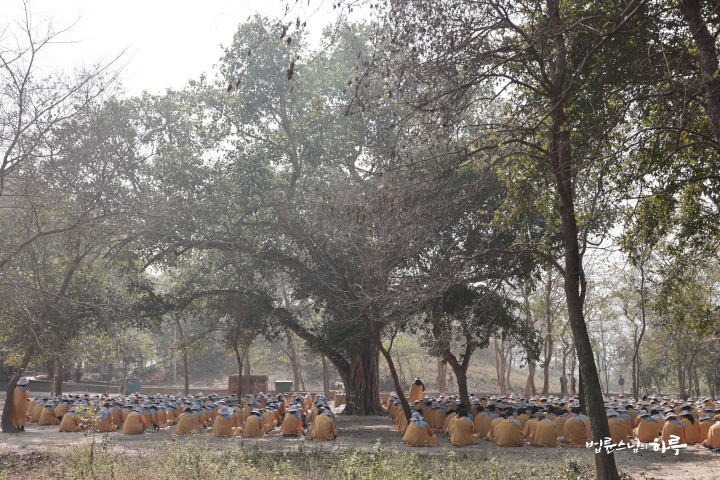
After completing the explanation of the sacred site, the pilgrimage group recited sutras. They then sang “A Mother’s Heart” and “Teacher’s Grace” in chorus. The pilgrims’ voices resonated softly, filling the sacred site. Several participants wiped away tears as they sang.
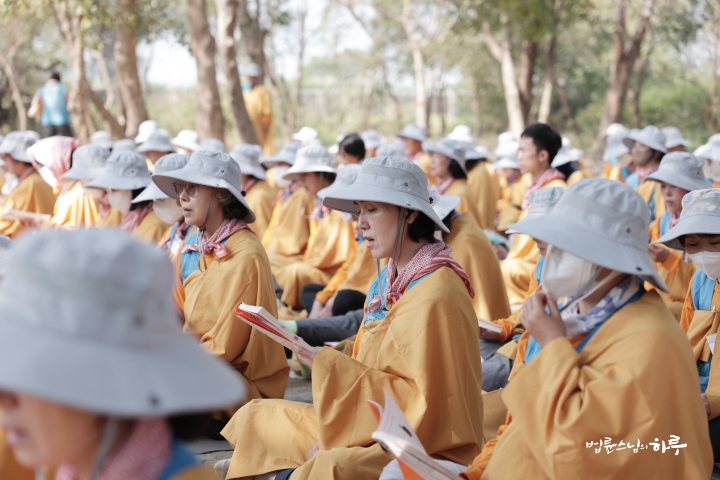
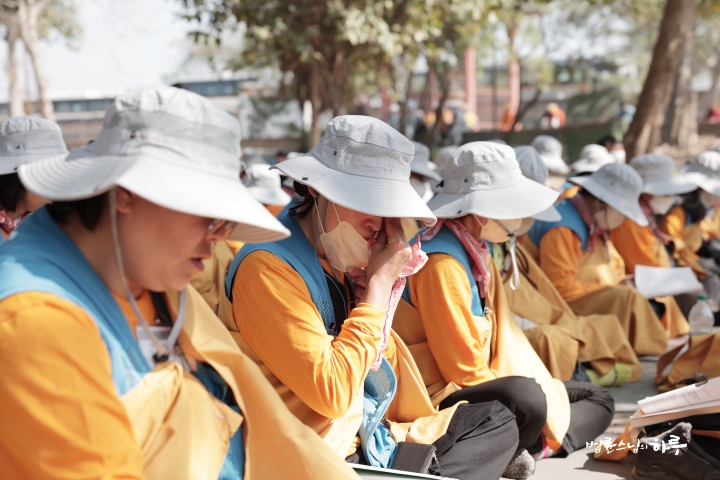
After reading the aspiration prayer (발원문), Sunim gave a Dharma talk.
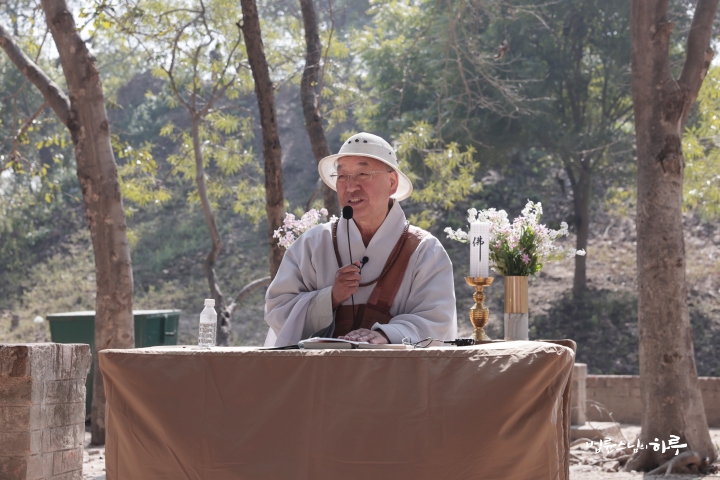
Sunim spoke about the Buddhist worldview embedded in the Sankasia legend and the meaning of renunciation.
“The legend passed down here in Sankasia appears to contain two intentions. First, it aims to persuade the public that renunciation is not an act of filial impiety toward one’s parents. Second, it seeks to symbolically demonstrate that the Buddha is a being greater than the gods, whom even the deities revere and serve. This understanding is well embodied in the Buddha’s epithets such as ‘There is none like the Buddha in heaven or on earth (천상천하 무여불 : 天上天下 無如佛),’ ‘I alone am the honored one in heaven and on earth (천상천하 유아독존 : 天上天下 唯我獨尊),’ and ‘Teacher of gods and humans (천인사 : 天人師).’ The practitioners of that time held precisely this sense of pride. The story that ‘when the Buddha descended from heaven, the gods stood in attendance to serve him’ symbolically illustrates this Buddhist worldview.
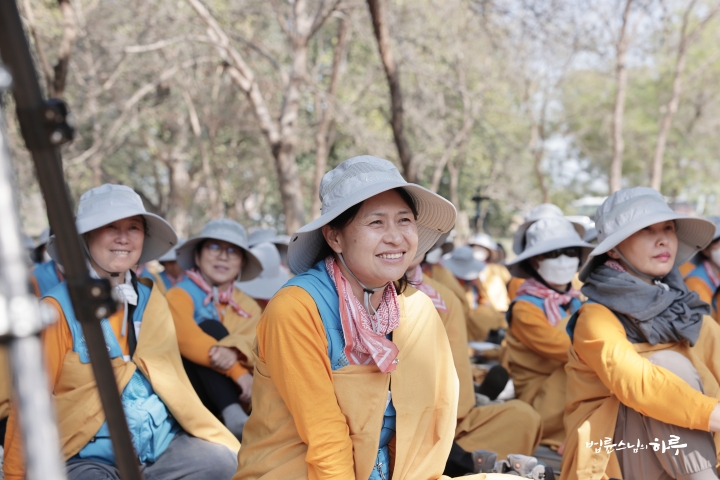
The Buddhist Worldview Conveyed by the Sankasia Legend
Many deities appear especially in the Avatamsaka Sutra (화엄경). This doesn’t mean that Buddhism worships some absolute deity, but rather refers to the concept of beings who protect and support the Dharma. In other words, it’s not that practitioners rely on and pray to deities, but that deities protect and support practitioners and the Dharma. In this respect, the deities spoken of in Buddhism are fundamentally different in nature from the absolute beings referred to as gods in general religions. While gods in general religions are absolute objects of reliance, deities in Buddhism can be characterized as guards who protect the Dharma. Sankasia can be said to be a meaningful place that well demonstrates this Buddhist worldview.
The traditional Indian worldview also believes that divinity dwells in all beings. They believe there are deities in trees, thinking that divinity is at work even when a single branch sways. There is also a distinction between sacredness and impurity in human hands, with the right hand considered sacred and the left hand impure. Therefore, when touching a child’s head, one must use the right hand, as they believe using the left hand brings impurity. The culture of using the left hand for cleaning oneself after using the toilet and the right hand for eating also stems from this concept. Korea has a similar culture regarding impurity. That’s why the right hand is called the ‘proper hand’ in Korean.
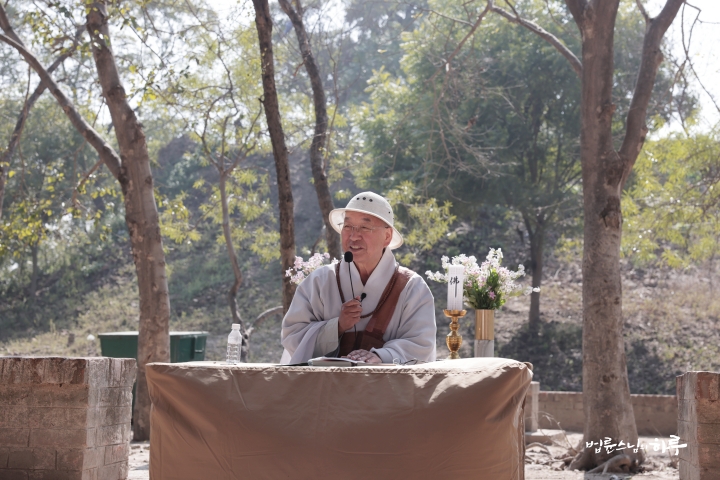
In this religious and cultural environment of India, the fact that the Buddha’s teachings survived and were able to educate people of that time can be considered almost miraculous. In fact, when conversing with young people in India, one sometimes receives questions like, “If people don’t reincarnate, is there any need to do good deeds?” Many understand the reason for doing good deeds as a means to receive blessings in the next life.
However, practitioners do not do good deeds to receive blessings. Virtuous actions in themselves bring peace of mind. Since this practice-oriented perspective is relatively weak in India, Buddhism has largely developed into a more faith-centered form.
Today, Hinduism is considered India’s traditional religion, but it contains many Buddhist ideas. This is because Hinduism was born as a new religion from Brahmanism, which had been influenced by Buddhism. This relationship is similar to Neo-Confucianism (주자학과), which was established as Confucianism accepted Buddhism while also constructing logic to counter it.
The reason this Sankasya legend arose was because it was judged difficult to spread the Buddha’s teachings to the Indian masses through enlightenment alone. This story should be seen as having emerged in the process of spreading Buddhism to the Indian people. Therefore, what matters is not whether it’s factually true, but rather the lesson this story teaches us.
You’ve received the precepts and are now on the 13th day of the pilgrimage. How has it been? If you found it manageable, how about shaving your head and becoming ordained? The scriptures tell the story of Lady Mahapajapati, Princess Yasodhara, and five hundred women who became ordained. If all of you were to shave your heads here today, with one hundred bhikkhus and four hundred bhikkhunis becoming ordained together, that would also become a great historical event of our time. Don’t you want to become such historical figures? (Laughter)
With this, we have successfully completed our pilgrimage following the Buddha’s footsteps to the eight great sacred sites. Let us engrave in our hearts that even the Buddha did not forget his mother’s grace, and now let’s meditate for a moment.”
After the Dharma talk ended, they meditated for 10 minutes.
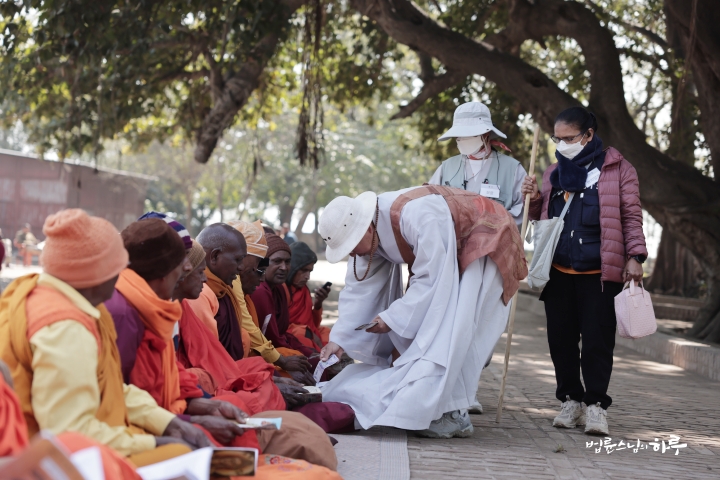
After completing the visit to Sankasya Stupa, it was past 1 PM. On the way out of the sacred site, practitioners wearing orange kasayas were sitting. Sunim gave offerings to each person and headed to the Dhamma Center for the closing ceremony.
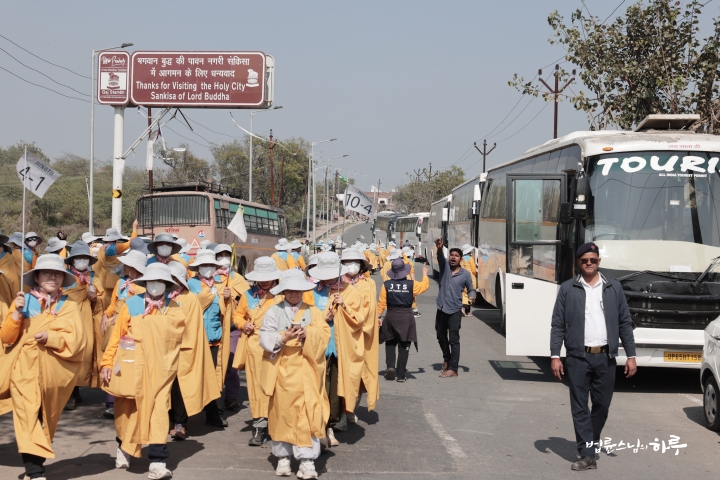
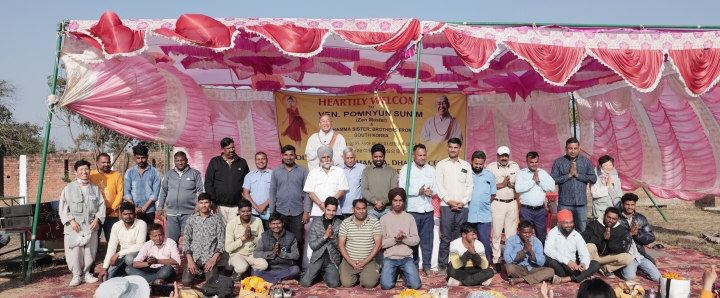
When they arrived at the Dhamma Center at 1:20 PM, members of the Sakya clan welcomed the pilgrimage group at the entrance with flower garlands.
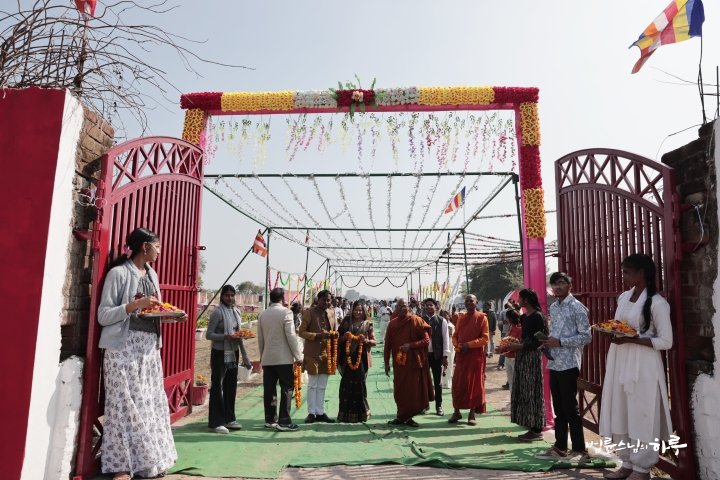
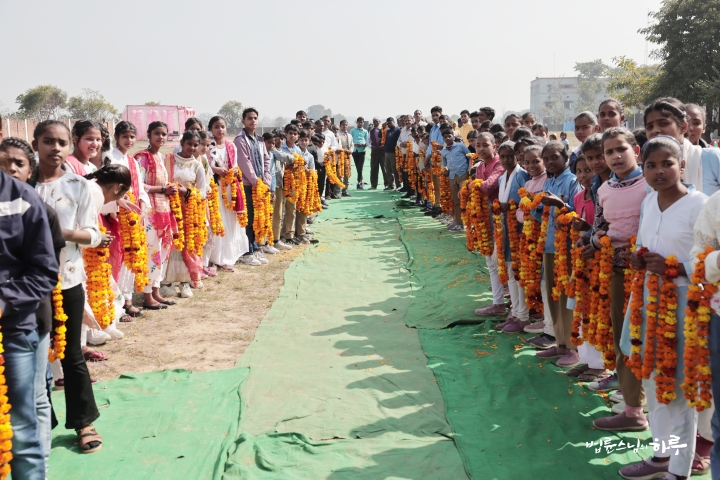
As Sunim entered first, the Sakya clan members welcomed him by placing flower garlands and scattering flower petals. The pilgrimage group also received flower garlands one by one as they entered the Dhamma Center.
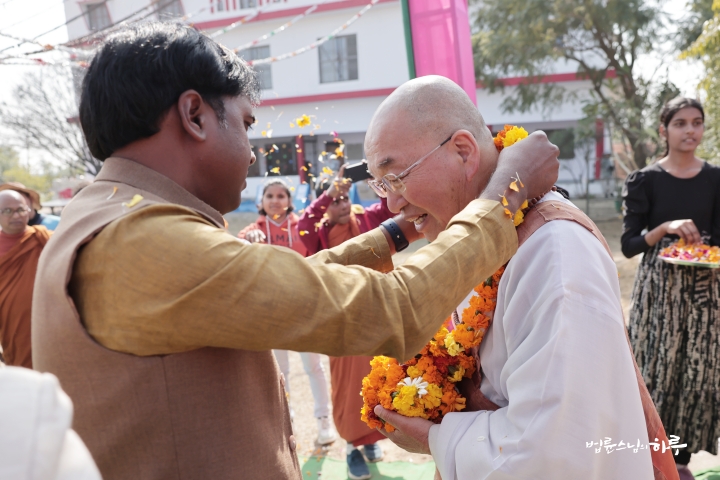
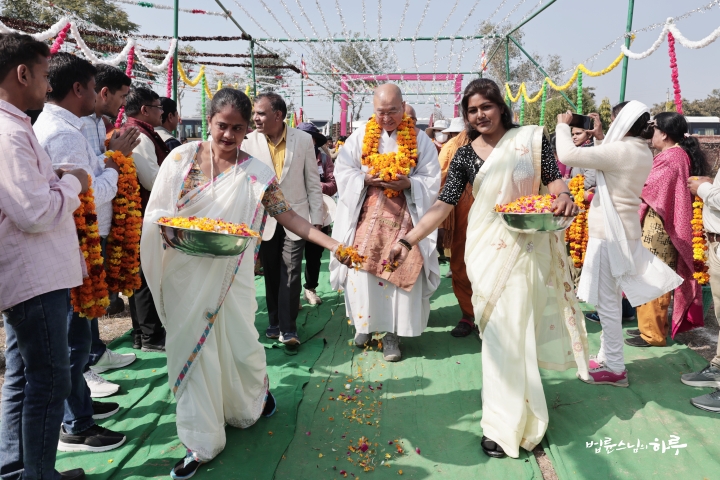
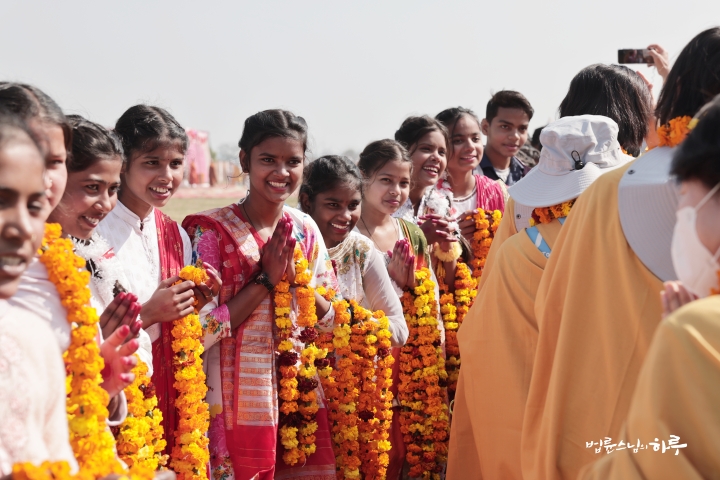
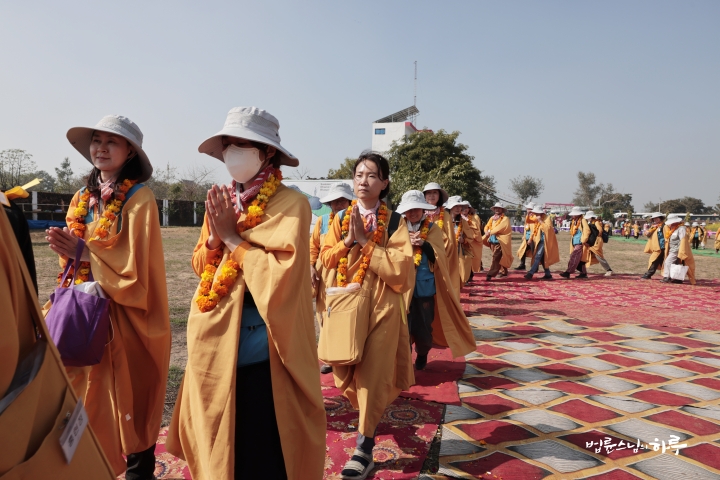
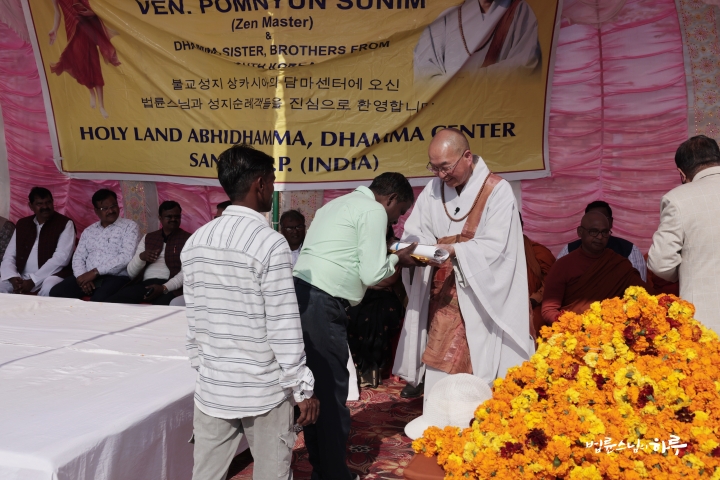
Once seated in front of the stage, the Sakya clan’s welcome ceremony began. About 200 Sakya clan members from various places including Kannauj, Etawah, Kanpur, Mainpuri, and Etah had gathered to welcome Sunim and the pilgrimage group. Those who had invited Sunim at last year’s 30,000-person Maurya clan Dharma assembly and the couple who had participated in the Kannauj Ashoka Pillar groundbreaking ceremony were also present. The Sakya clan members came forward one by one to place flower garlands on Sunim and take photos.
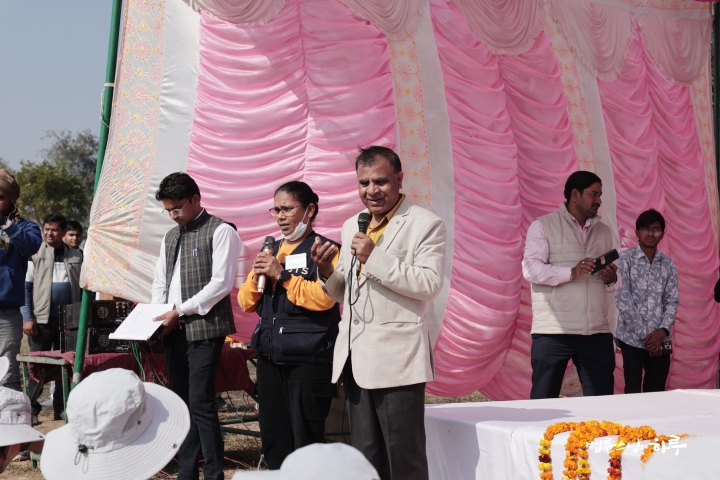
After the flower garland presentation ceremony, performances prepared by Sakya clan students followed.
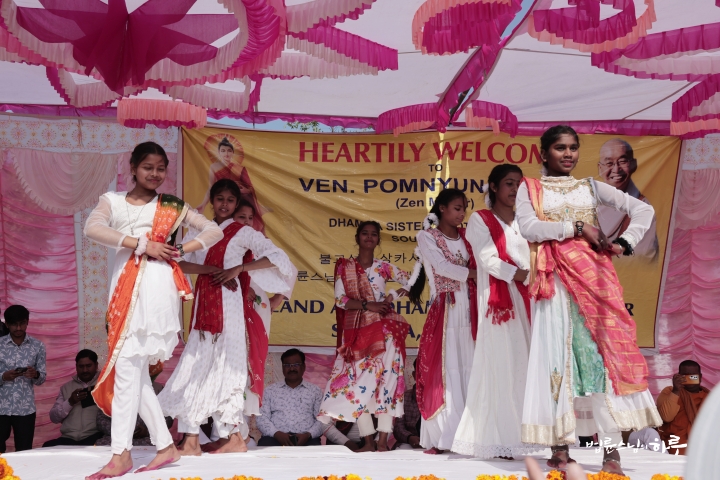
After the performance ended, Sunim expressed his gratitude to the Sakya clan.
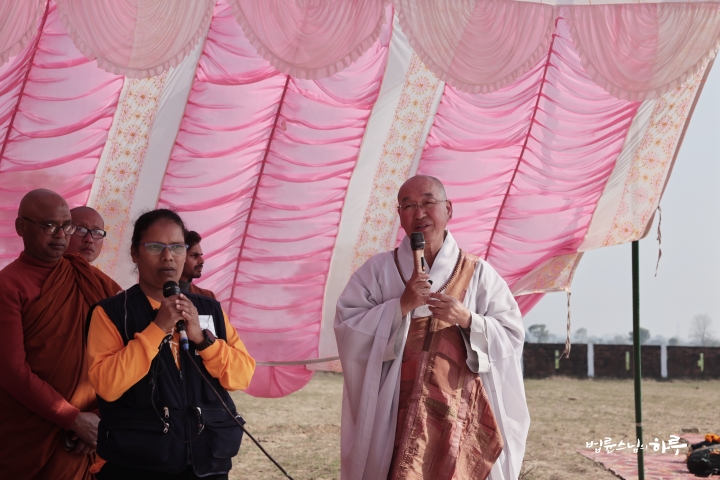
“Thank you to all the Sakya clan members who came to today’s welcome ceremony. The Buddha’s teachings cannot be approached materially or studied like an academic subject. Understanding, faith, and practice of the Dharma are important. Beyond being descendants of the Sakya clan, I hope you will contribute to the revival of Buddhism. Thank you.”
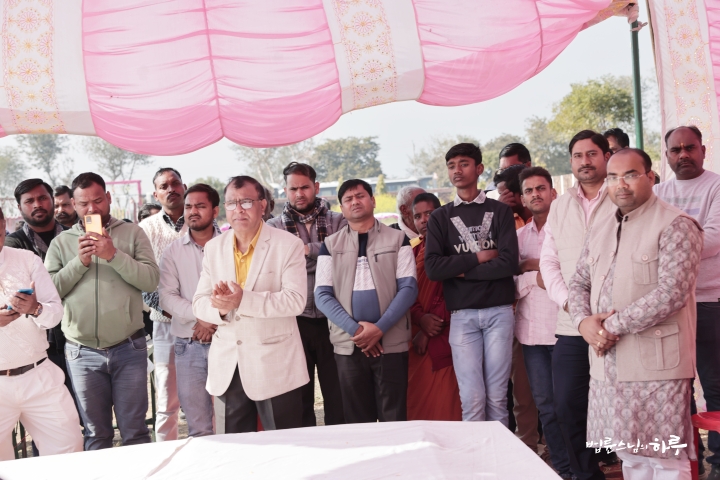
After the welcome ceremony, the 35th Sacred Sites Pilgrimage closing ceremony began at 2:35 PM. The pilgrimage group requested a Dharma talk from Sunim with the Three Refuges, Heart Sutra, and Dharma Request Chant (삼귀의, 반야심경, 청법가).
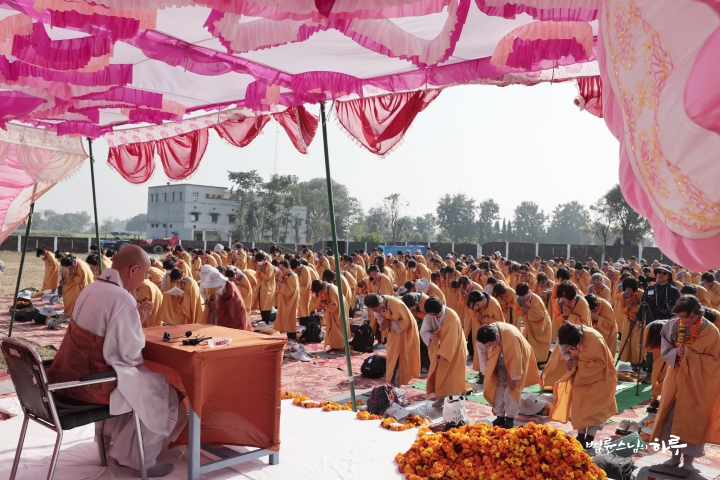
As Sunim concluded the pilgrimage, he spoke about the intention to build a Dhamma Center in Sankasya and revive Buddhism in India.
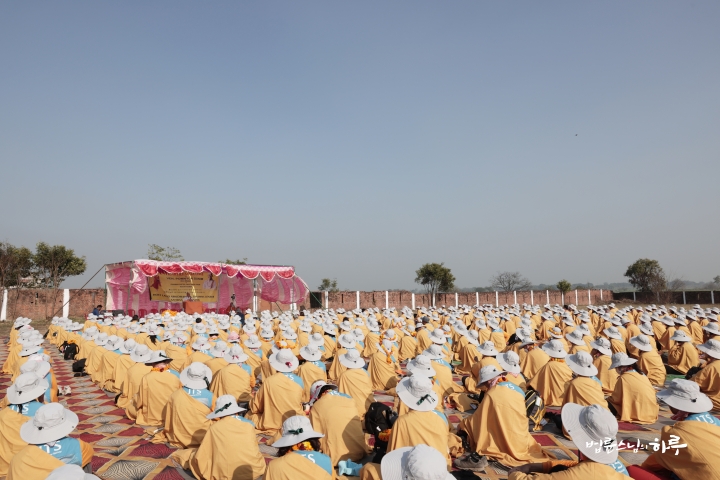
“There is someone who dedicated himself to this work before me. It was an elderly monk from Sri Lanka who gave precepts to the Sakya clan and initiated the Buddhist conversion movement here. When he first came here, he cared for the Sakya children with great devotion, but he was greatly disappointed when he saw them fighting with each other as they grew up. So I boldly promised him, ‘I will fulfill your wish before you die,’ but I ultimately couldn’t keep that promise. When there are no results from work one has devoted their entire life to since youth, anyone would be disappointed. Although we say practitioners have nothing to be disappointed about, I wanted him to know that his lifelong efforts coming from Sri Lanka to this place were not in vain before he passed away. However, I ultimately couldn’t achieve it. Even so, shouldn’t promises be kept even after a person has left this world?
Actually, I don’t have much interest in construction projects themselves. However, Cheongryongsa Temple (천룡사) is our senior master’s wish, so I’m rushing because I want to fulfill it before he passes away. Recently, when our senior master said, ‘I’m too old now, I should die,’ I replied, ‘Then we won’t do the Cheongryongsa construction. You must pass away after seeing it completed. You can’t die before then.’ He then said, ‘Well, I guess I’ll have to force myself to live a few more years.’
True practice means not being attached to success or failure. If you’ve made a vow, fulfilling it is secondary. Like cutting a pumpkin after drawing a sword, you just need to proceed with the work. This construction project is not simply about building a structure, but about planting ‘hope’ in the Sakya clan. When this project is completed, it will certainly open a different path for them. It will become an opportunity for them to unite with the hope that ‘we can do it too.’ That’s why we’re doing this work, not just to erect one more building here.
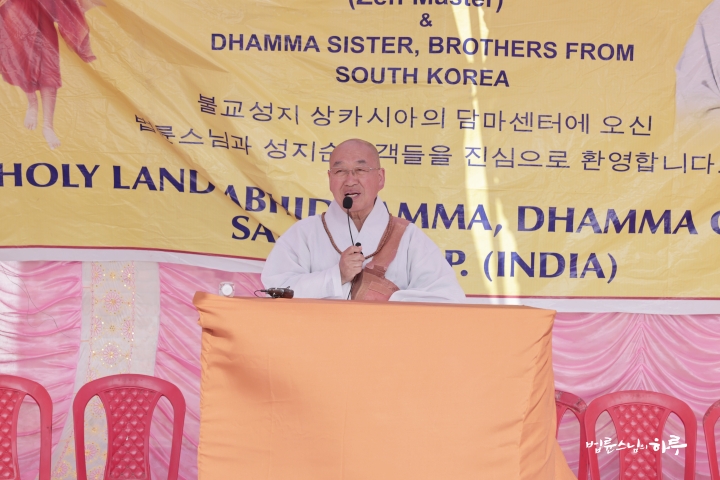
As India’s economy grows, Hindu temples are being built on a massive scale. Here too, as the economy revives, religious buildings are being constructed on a large scale, but we are not trying to compete with that. Neither size nor splendor is what matters. The real purpose of Buddhist construction projects is to use them as a medium for people to cooperate together, generate aspiration, and establish vows.
When you return here on pilgrimage in a few years, you will see changes different from what you see now. Yesterday, I heard that Buddhist practitioners visiting Cheonchuk Seonwon were moved to tears when comparing Sujata Academy from 18 years ago with its current state. I believe seeing how this place, which is now just empty land, transforms over the next few years will also be deeply moving.
How Can Buddhism Flourish Again in India?
There are several reasons why we go on pilgrimage. First is field study. By revisiting the Buddha’s teachings, touring historical sites, and understanding India’s culture and natural environment, we aim to deepen and correct our understanding of the Dharma. Beyond this, there is another important reason. India’s population is approximately 1.4 billion (14억) people. It is a country with as large a population as China. Even if you combine the populations of all 20-plus countries in the European Union, it only amounts to about 400 million people, yet India, as a single nation, has far more than that. Therefore, if India accepts the Dharma again through our propagation activities, it would have the same effect as spreading the Dharma throughout the world. Fortunately, the Indian government is also promoting Buddhism, so I hope this momentum can be utilized well to create an opportunity for Buddhism to rise again in India.
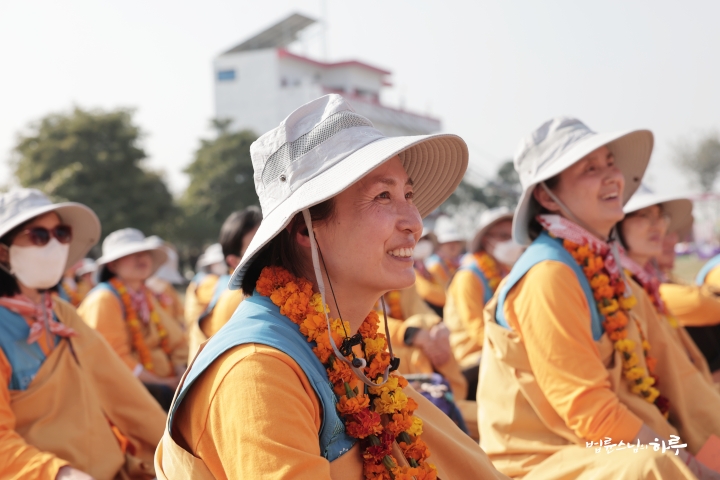
This is why legends and stories become important during times like these. You may have heard of the “Age of Dharma Decline (말법 시대).” According to tradition, the first 500 years after the Buddha’s passing is the period of solid liberation, when many people who hear the Dharma and practice attain liberation. The second 500 years is the period of solid meditation, when many practice meditation but few attain liberation. The third 500 years is when people study Buddhism diligently but few practice meditation. The fourth 500 years is when Buddhist construction projects are active but few study the Dharma. The fifth 500 years is the period of solid conflict, when people neither engage in Buddhist projects nor study, but only fight. After all these periods pass, there is a folk belief that Buddhism, which left India, will return to India again. Such stories can give great hope to Indian Buddhists. Perhaps someday a new era will come when the true Dharma is realized again in India or Buddhism experiences a revival.
However, in the current state, the revival of Indian Buddhism is likely to flow toward material, external revival like Chinese Buddhism. It’s easy to mistake building large temples, erecting magnificent pagodas, and conducting prayers for material benefits as Buddhist revival. Our operation of Sujata Academy is not simply about helping those in need. It also embodies the question: “If Buddhism is to be renewed, what form should that renewal take?” The renewal of Buddhism does not lie in large pagodas and splendid temples. It lies in alleviating people’s suffering and afflictions, giving hope to those in despair, and realizing equality where there is discrimination. Buddhism must be renewed in the direction of implementing the Buddha’s teachings. We must not speak of Buddhist revival by worldly standards.
To use a Go analogy, it’s like placing stones on the board here and there while designing our work with a view toward the future 150 years from now. That’s why I think to myself, “I need to be reborn in India five times,” as I do this work. Whether I will actually be reborn is unknown, but this shows how long-term my perspective is for this work. Right now, we have just placed one Go stone in a corner. This is not everything. I always keep in mind how to begin and design this work so that it can continue to grow and persist even as time passes.
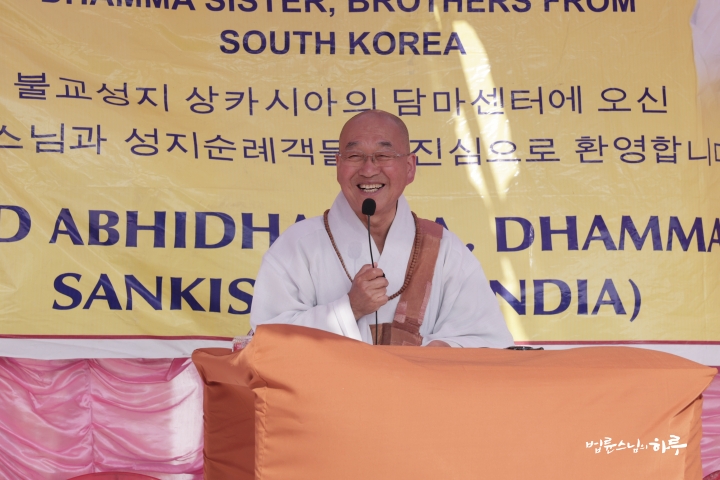
“If we look at it merely as a historical site, Sankasia is not particularly important among the Buddha’s eight great pilgrimage sites. However, many members of the Sakya clan, the Buddha’s relatives, live here. The fact that they are the Buddha’s relatives is not particularly important in itself. However, that connection can become a seed for their spiritual aspiration. If we touch upon that connection, there is a possibility that their hearts may be moved. While the statement ‘As members of the Sakya clan, shouldn’t you protect the Buddha’s teachings?’ may not resonate well with others, it does resonate with them. At that very point, we can see the possibility of creating new karmic connections.”
“Another important connection is with India’s young people. I previously gave a lecture in the Dharma Q&A format at places where India’s brightest minds gather, such as Delhi University and Jawaharlal Nehru University. After the lecture ended, when I asked, ‘This approach probably didn’t suit Indian people well, did it?’ a professor from the university responded:”
“‘No, on the contrary, it perfectly suits young Indians. Religious approaches no longer resonate with them either.'”
“All the connections we are creating now can be seen as groundwork for the Buddha’s teachings to flourish in the future. Building a Dhamma center in Sankasia and teaching the Sakya clan should be viewed as one of these efforts.”
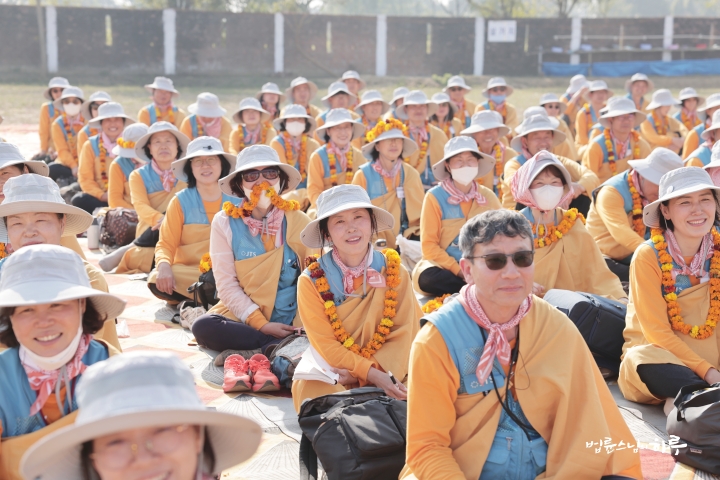
Sunim then shared how the experience of going on a pilgrimage together becomes an asset in life and spoke about the power to overcome a retreating mind and live actively.
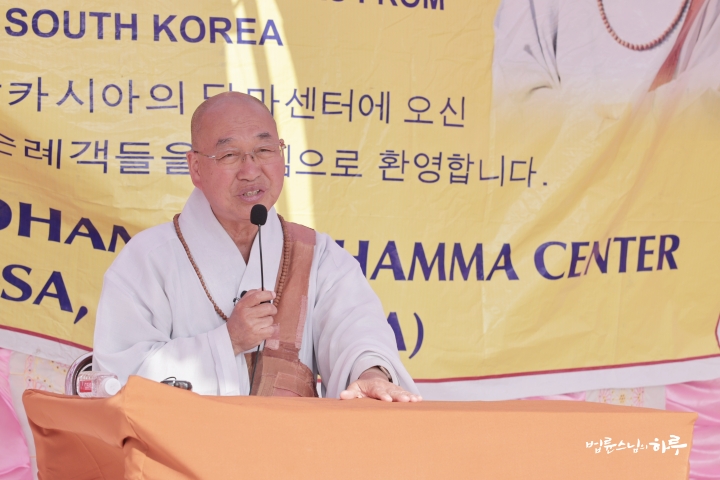
“There are various reasons for going on a pilgrimage. First, it provides an opportunity to inspire faith and certain aspirations in individuals. It also becomes an occasion for the entire Jungto Society to share common aspirations. Eating together for two weeks, even relieving ourselves face to face on the roadside – sharing such experiences is no ordinary connection. People don’t change based on just one single occasion. When these connections come together and help establish certain aspirations, and when you receive strength from them, you can just go ahead and do it when you decide to ‘Let’s do it!'”
What Should We Do When the Mind Keeps Wanting to Retreat?
“You all found it difficult at first, but now you’re adapting well even when plans keep changing, aren’t you? It’s difficult to have this kind of training in Korea. Through this training, we come to realize that we always have a retreating mind within us. This is called ‘regression (퇴굴심).’ It’s like thinking ‘I don’t want to,’ ‘I can’t,’ ‘What’s the point?’ We need to overcome this mindset. Whether something works out or not, we’ll see when we get there – what’s important is to have the attitude of ‘let’s just try.’ Instead of thinking ‘How can I wake up at 5 AM?’ just get up immediately. In Korea, you said it was hard to wake up at 5 AM, but here you’re waking up just fine at 2 AM. When you return to Korea, waking up at 5 AM for morning practice will be nothing. This is about experiencing what kind of changes occur when you have this proactive mindset of just trying things.”
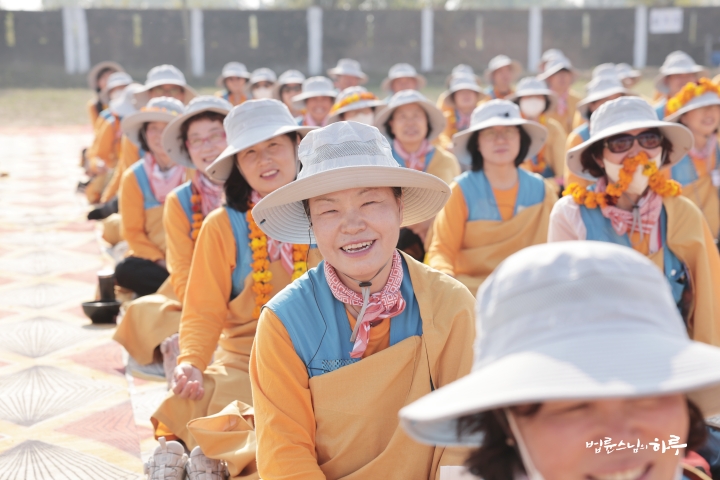
“Mind practice isn’t anything special. It’s about getting up, going, eating, resting, sitting even under the scorching sun, and just doing what needs to be done even when you don’t feel like it. This is called having a proactive mindset. I think you’ve probably practiced developing this proactive mindset the most during this pilgrimage. I believe this practice of cultivating a proactive mindset will remain as your greatest asset in life.”
“So even though you’ve gone through hardships during this pilgrimage, what matters is what you’ve gained from these hardships. If you end the pilgrimage thinking ‘I just suffered in dirty places,’ then you’ve only experienced loss. However, if you keep it as an experience of overcoming challenges, it becomes a great asset in your life. I hope this pilgrimage becomes such an asset for all of you. Don’t keep hesitating, don’t be sticky – live crisply. If you come all this way spending so much money and return without having such an experience, that’s your loss alone. With this, our pilgrimage has concluded well. Thank you all for your hard work.”
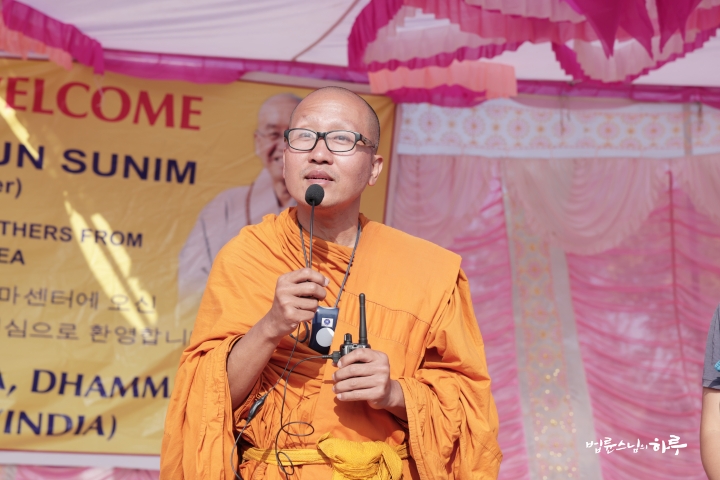
After finishing the Dharma talk, Sunim introduced a Thai monk who joined this pilgrimage.
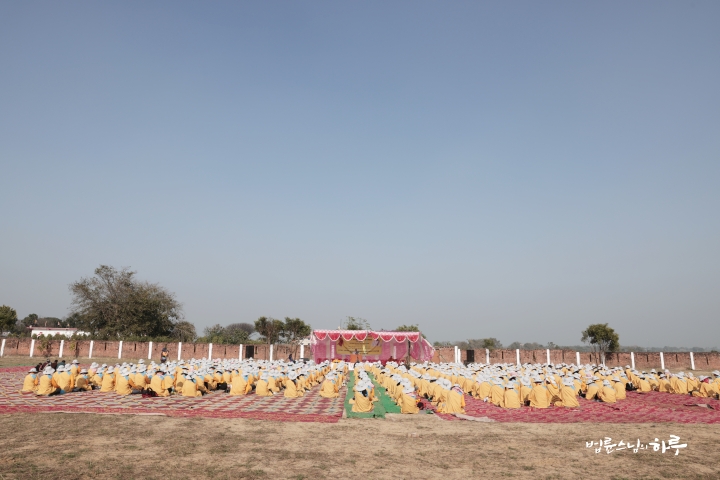
“A monk from Thailand joined us on this pilgrimage. In Thailand, monks originally hold a position equivalent to high status. He completed the pilgrimage under the same conditions as us without any complaints until the end. Until now, we treated him as a fellow pilgrim, but from now on, we will greet him as a monk. All pilgrims, please stand and offer three prostrations.”
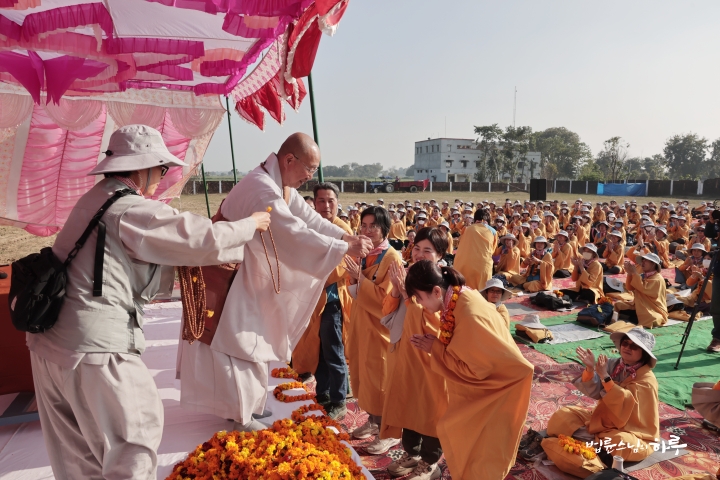
After offering three bows, Sunim presented prayer beads to the bus attendants who had worked hard during the pilgrimage. He also gave prayer beads to Congressman Min Byeong-deok ( 국회의원 민 병덕) and to a male lay practitioner who had donated winter coats to the bus drivers.
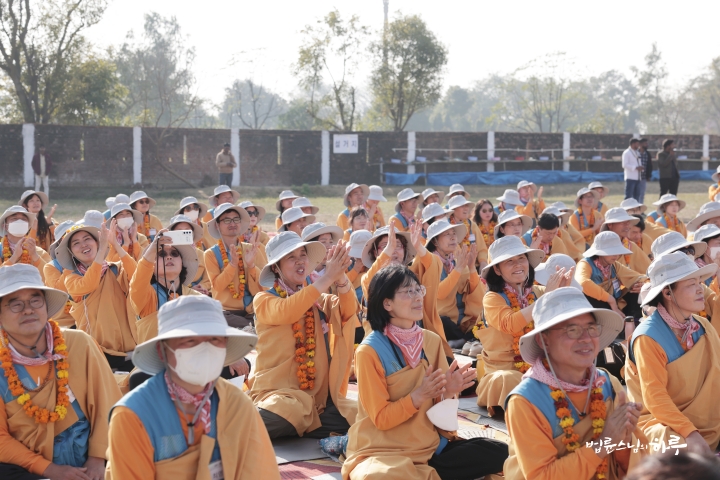
Sunim then introduced the group leaders, lead Dharma teachers, staff members, and medical volunteers one by one. The pilgrimage group expressed their gratitude with applause.
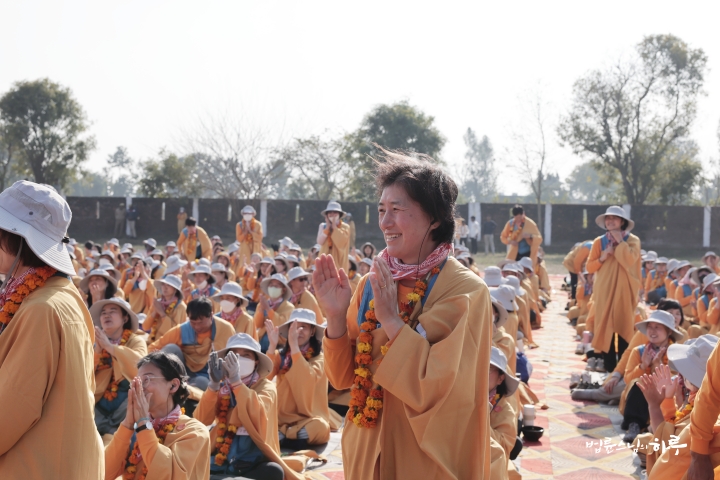
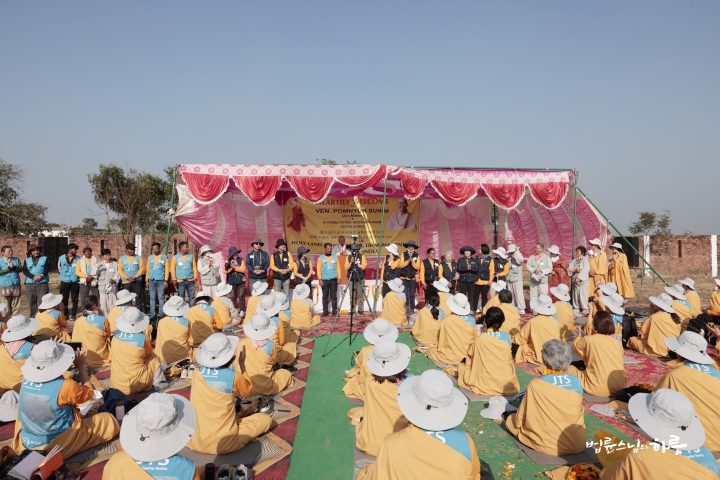
Finally, they expressed their thanks to the bus drivers who had driven safely despite the tight schedule of early morning departures and long-distance travel.
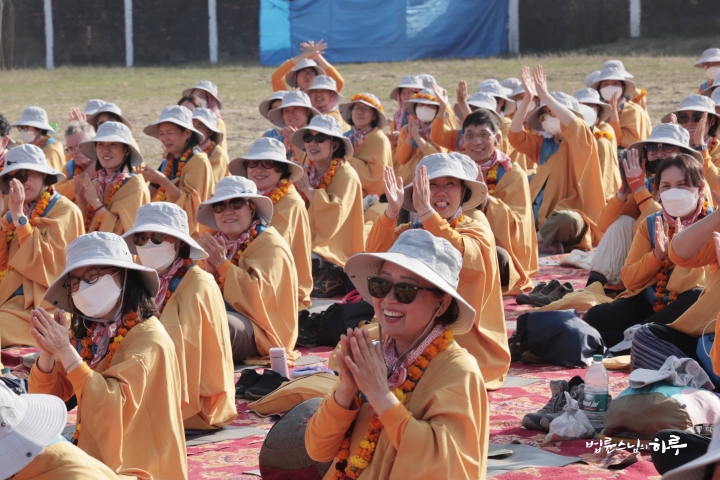
Following Sunim’s guidance, a ceremony was held to return the kasayas and bowls. The pilgrimage group first offered three bows while wearing their kasayas.
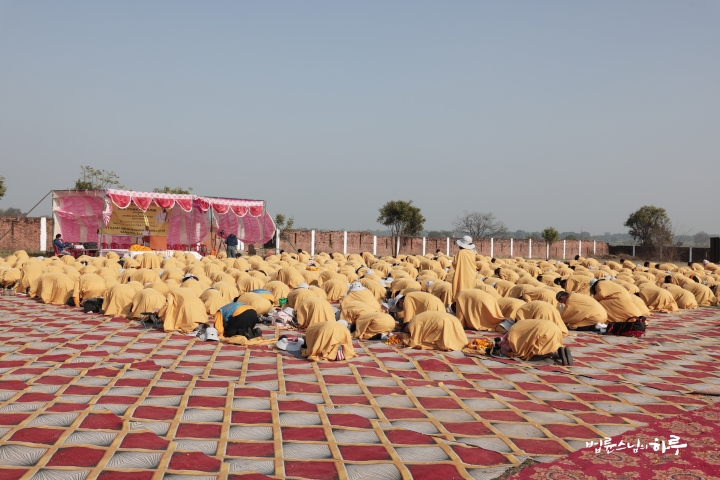
They then removed their kasayas, folded them neatly, and while kneeling, placed their bowls on top of the kasayas and held them at eye level. They repeated after Sunim:
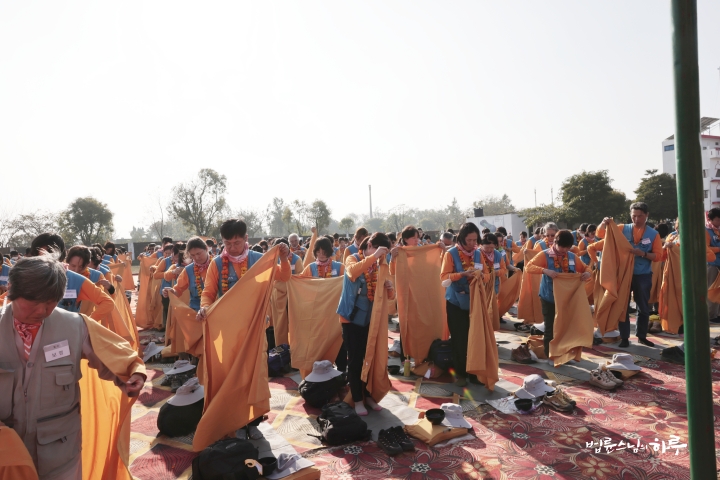
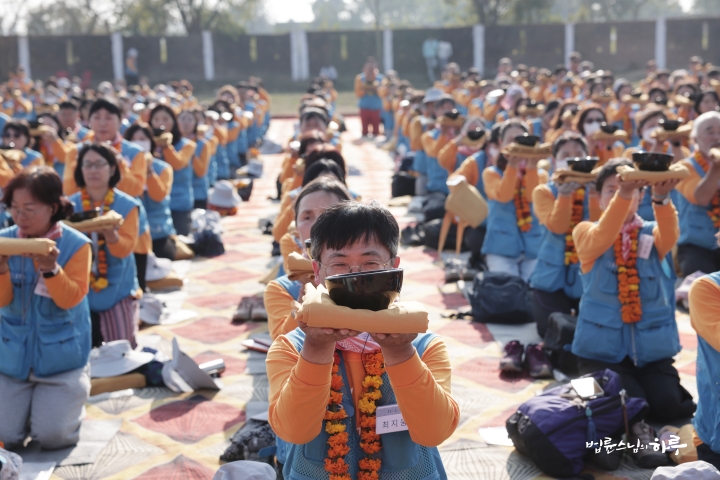
“Now, repeat after me. We offer our kasayas and bowls to the Buddha.”
“We offer our kasayas and bowls to the Buddha.”
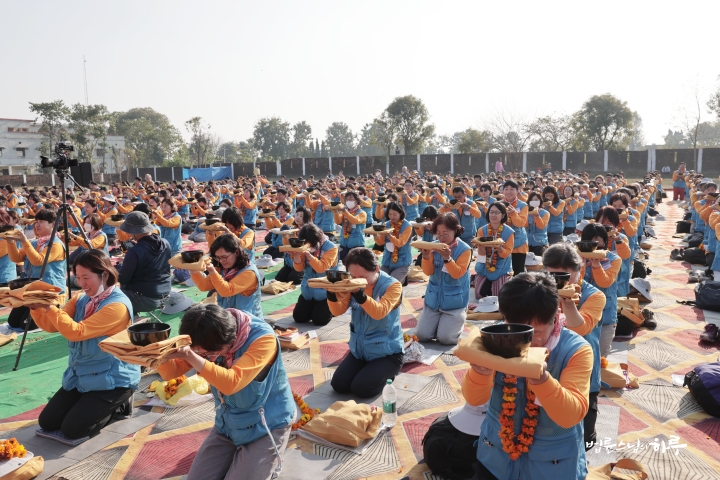
“We will take ordination again in the future.”
They concluded the return ceremony with three final bows. Sunim asked with a smile:
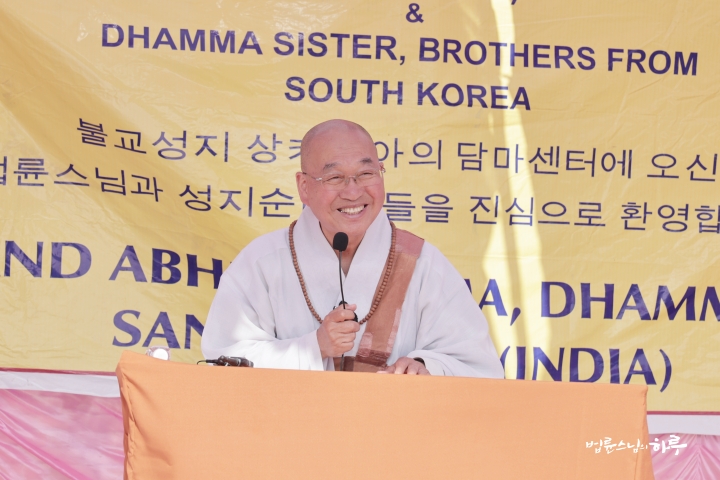
“Now, do you feel lighter?”
“Yes.” (Laughter)
“You should hide your feelings a little. (Laughter)”
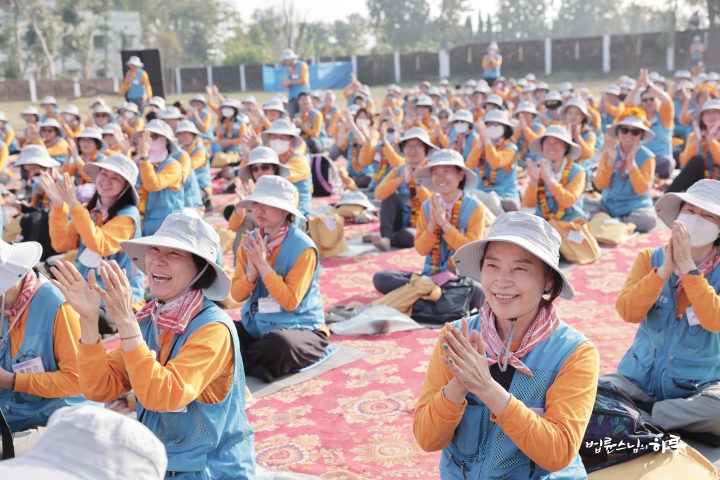
The 35th Pilgrimage Closing Ceremony concluded with the Four Great Vows.
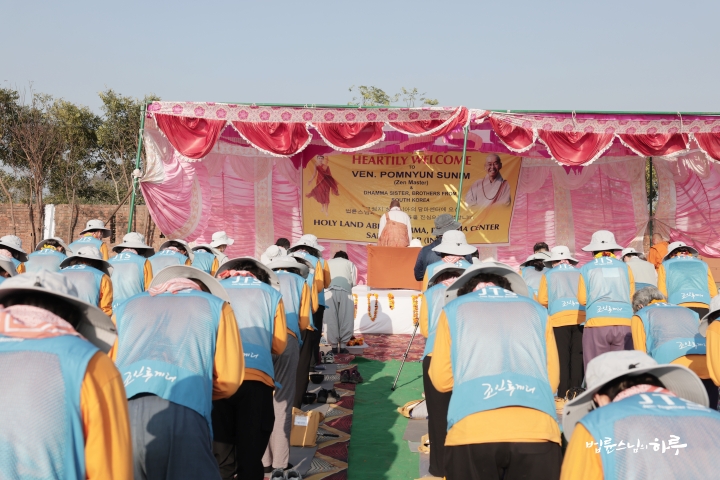
After the closing ceremony, at 4 PM, the pilgrimage group enjoyed a dinner carefully prepared by the Sakya clan. After the meal, Sunim exchanged greetings with the Sakya clan members who participated in the event and took commemorative photos.
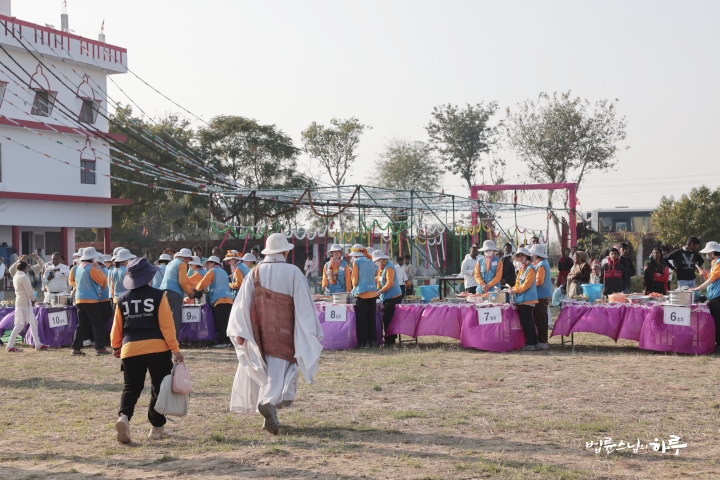
After finishing their meal, the pilgrimage members returned to their respective accommodations. Sunim thanked those who had prepared today’s meal before returning to his lodging.
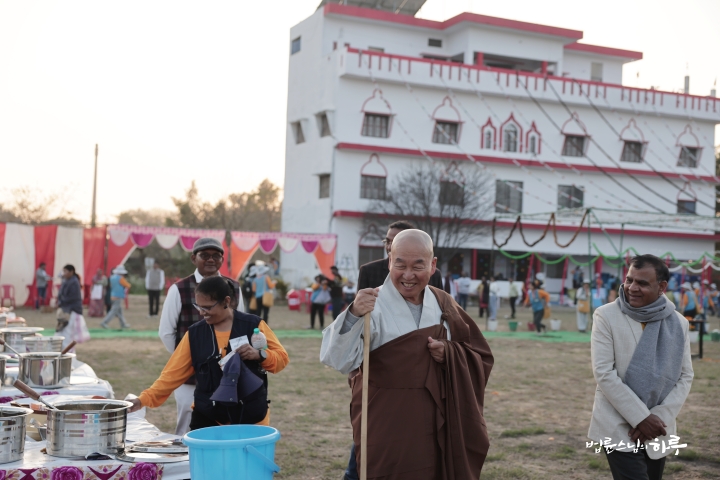
Tomorrow, the group will travel to Delhi to visit museums, conduct a Dharma Q&A broadcast, and hold a lecture for Korean residents living in Delhi.