
January 31, 2026 – Day 8 of the India Pilgrimage, Kushinagar
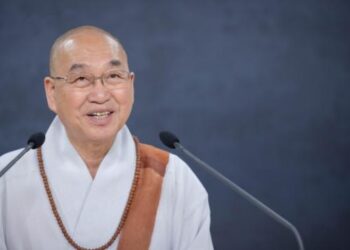
Hello. This is the eighth day of the India pilgrimage. Today, Sunim and the pilgrimage group left Vaishali and headed to Kushinagar. Following the Buddha’s final journey, they visited the Kesaria Stupa, Chunda’s offering site, and the Kakuta River where the Buddha took his last bath, before visiting the Parinirvana Temple (열반당) where the Buddha entered nirvana and Ramabhar Stupa (라마바르총) where the Buddha’s body was cremated.
Sunim woke up early to organize manuscripts and quietly prepared for departure. At 4:30 AM, once all pilgrims had boarded the vehicles, the buses left Vaishali and began traveling through the darkness. After driving about 40 kilometers, they arrived at Kesaria Stupa at 6:10 AM.
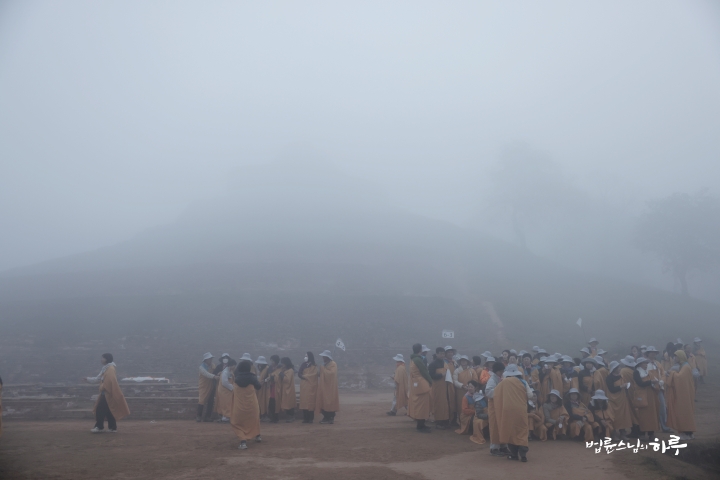
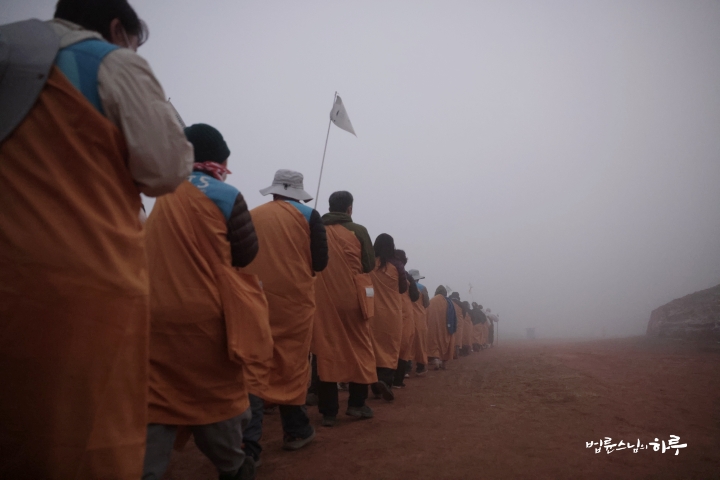
The area around the stupa was shrouded in darkness and thick fog, making it difficult to distinguish any shapes. Sunim and the pilgrimage group carefully moved step by step along the path through the fog where visibility was nearly zero.
After a while, the faint outline of the stupa slowly emerged through the fog.
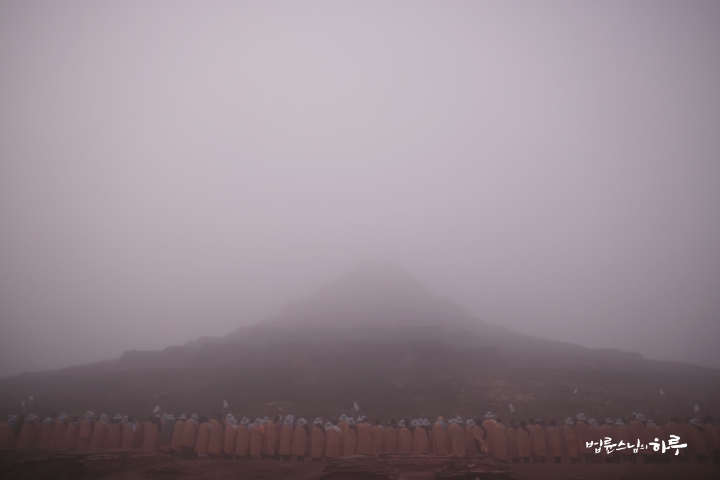
Upon reaching the stupa, Sunim and the pilgrimage group began circumambulating it with quiet chanting.
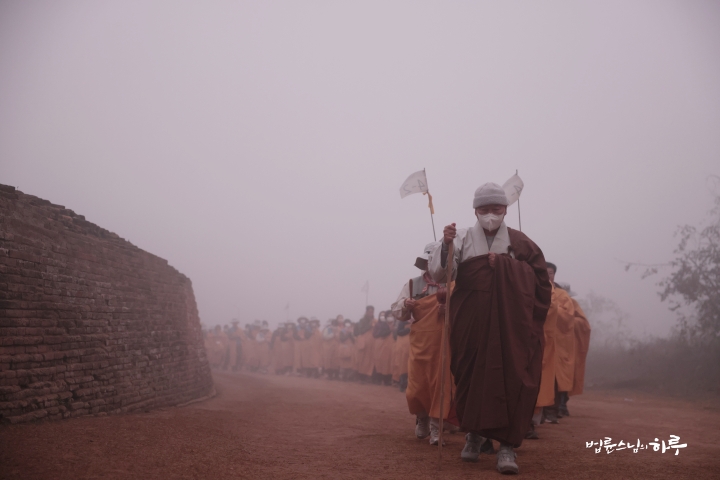
After completing the circumambulation, Sunim paused and began explaining while looking at the Kesaria Stupa.
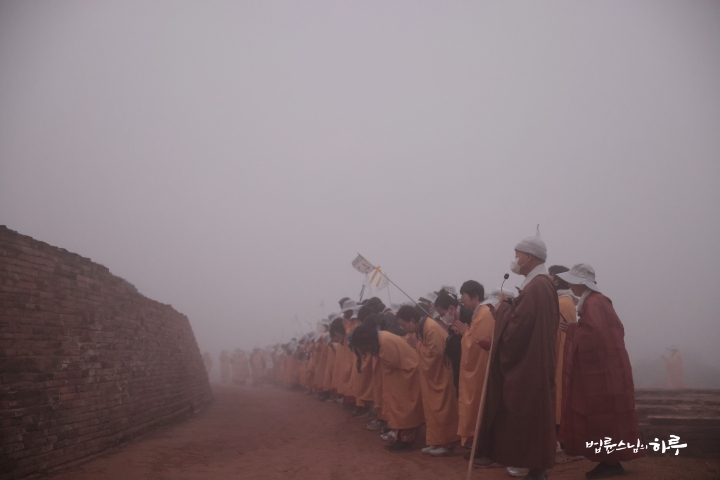
“The stupa you are looking at is the Kesaria Stupa. This is where the Buddha, after announcing his impending parinirvana and leaving Vaishali, gave his alms bowl as a farewell gift to the people of Vaishali who had followed him to the end. To commemorate this, the Licchavi clan of Vaishali brought the Buddha’s bowl here and built this stupa.
There is another theory as well. It is said that when the Buddha decided to renounce worldly life and left Kapilavastu, he passed through seven kingdoms, crossed the Anoma River, and arrived here where he shaved his head and entered the path of a practitioner. According to this theory, the stupa was built to commemorate the place where the Buddha became a renunciant. Looking at the scale of this stupa, the explanation that it commemorates his renunciation seems more convincing.” (laughter)
The pilgrimage group boarded the buses again and traveled for about two hours. At 8:40 AM, they arrived at Pava village, located at the entrance to Kushinagar.
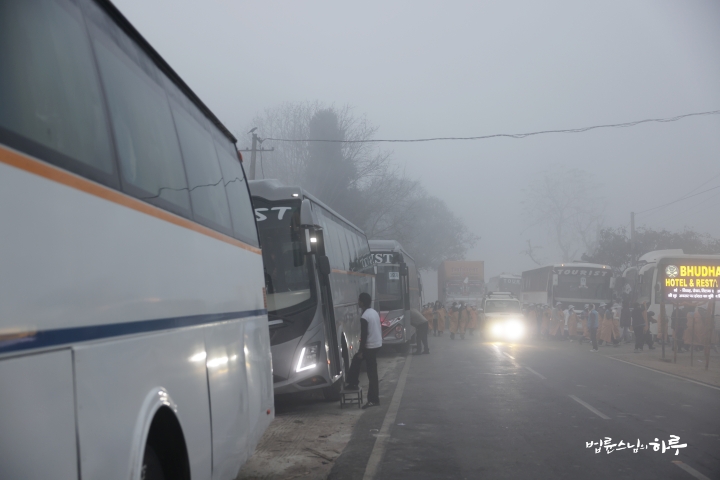
Chunda’s offering site was located deep inside the village. The pilgrimage group got off the bus, crossed a footbridge, and walked along narrow village alleys.
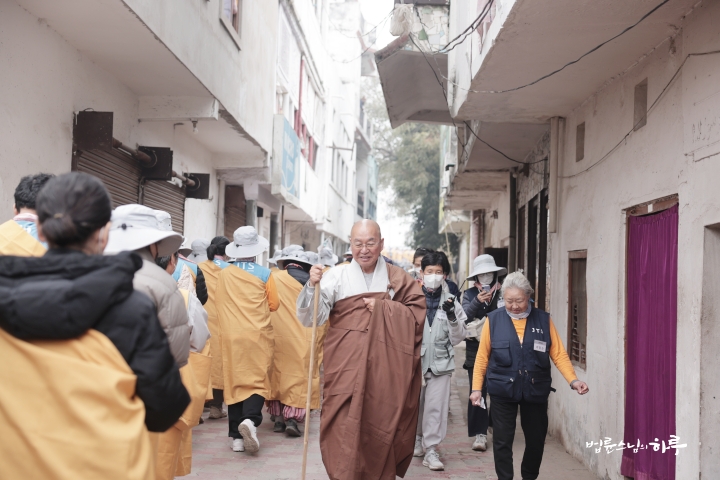
While walking, Sunim noticed a child’s bag with its zipper wide open. Sunim approached to close the zipper but found it was broken. He asked a Dharma teacher who was with them to secure the bag with a safety pin, then continued guiding the way.
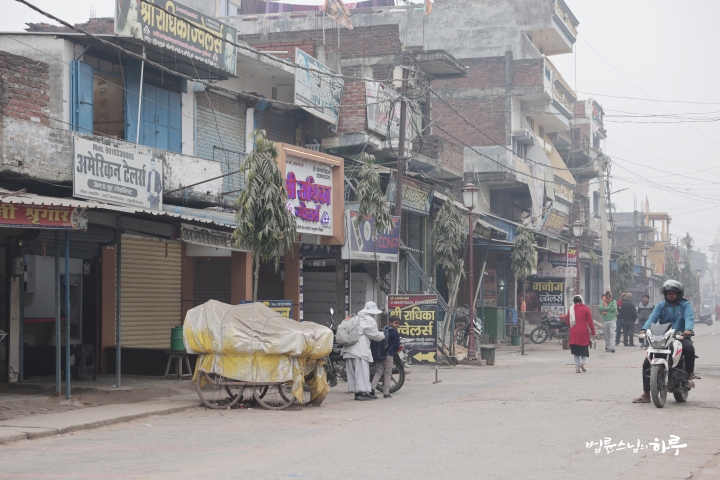
The area around Chunda’s offering site was somewhat disorderly compared to other sacred sites, and the maintenance was poor. Sunim quietly circumambulated the stupa with the pilgrimage group.
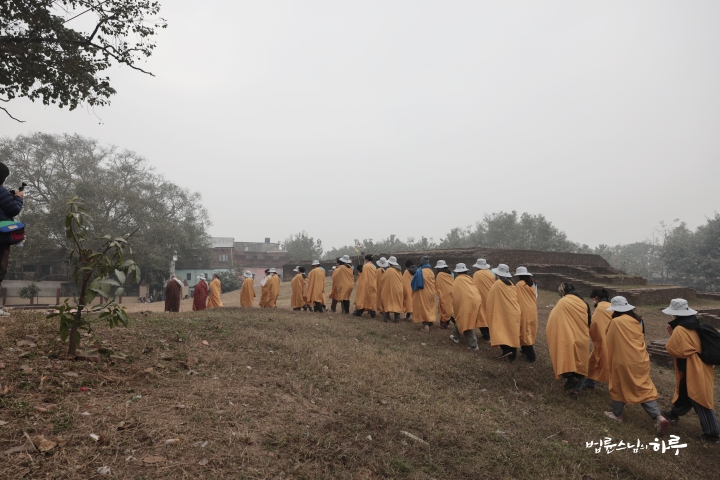
After completing the circumambulation, they settled in front of the stupa, and Sunim shared the story associated with this place.
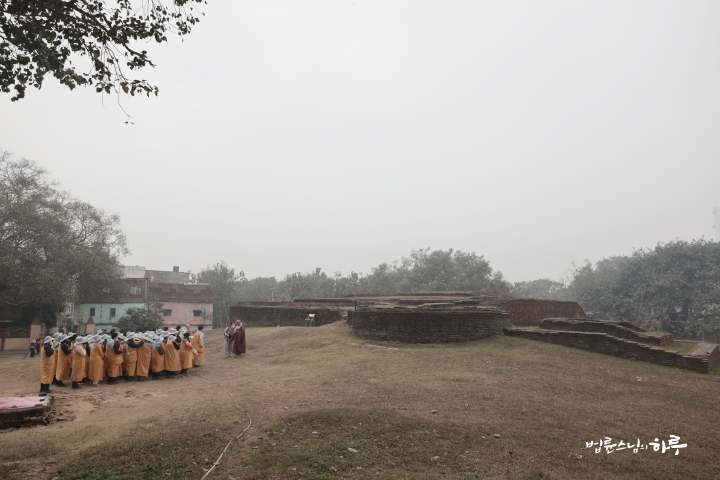
“The place where you have arrived is Chunda’s offering site (춘다의 공양터). At that time, Chunda, the son of a blacksmith, lived in this village. When he heard that the Buddha had come to his mango grove, he went to listen to the Dharma talk and was deeply moved. He requested to offer a meal, and the Buddha accepted his request. The Buddha, already in a weakened state, experienced severe abdominal pain and dehydration after eating the meal.
Nevertheless, the Buddha, concerned that Chunda might feel guilty, actually comforted him instead. The Buddha called Chunda and consoled him by saying, ‘The merit of offering a meal to the Tathagata just before enlightenment and just before entering parinirvana is equal.’ He then continued his final journey toward Kushinagar. Even at death’s door, he first considered Chunda’s feelings. In this respect, visiting Chunda’s offering site holds great significance.”
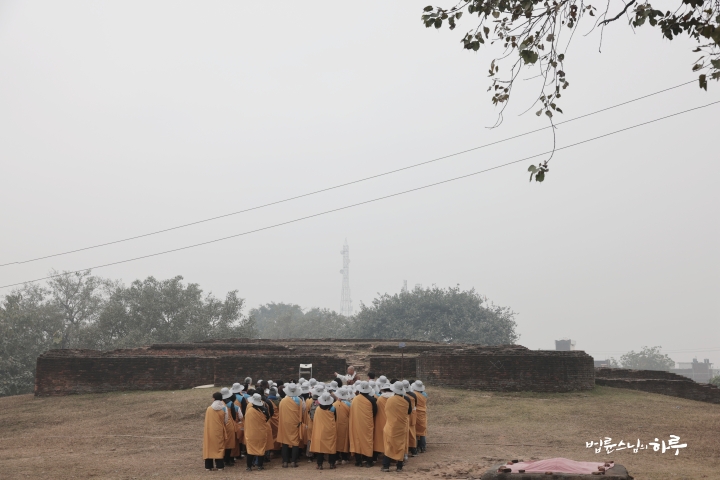
As the group was leaving Chunda’s offering site to move to the next destination, the police chief of Kushinagar and his team were waiting. Sunim greeted them.
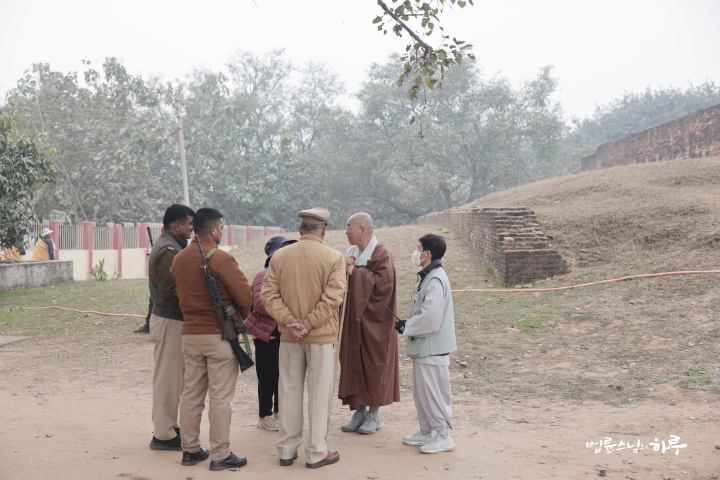
“I’m sorry to trouble you when you must have many other things to attend to.”
“Not at all. It’s an honor for us to serve you and the pilgrimage group. We will cooperate to ensure your pilgrimage goes smoothly.”
“Thank you.”
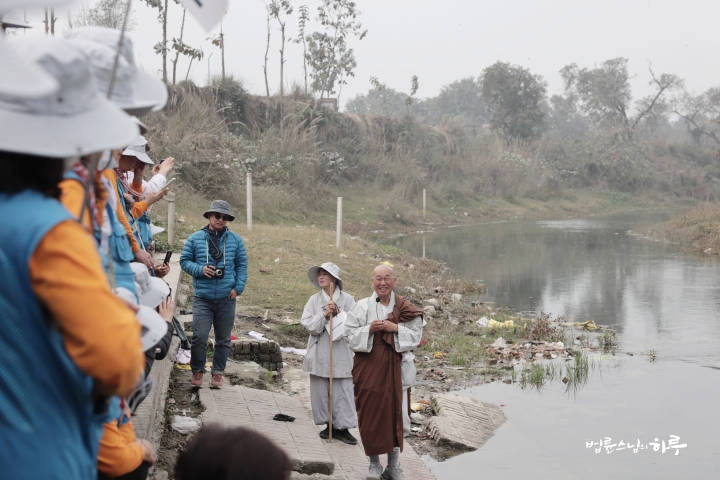
After exchanging greetings with the police, Sunim headed to the Kakuta River with the pilgrimage group. This river is known as the place where the Buddha last bathed and drank water.
Sunim went down to the riverbank, washed his face, wet his throat with the river water, and then spoke to the assembly.
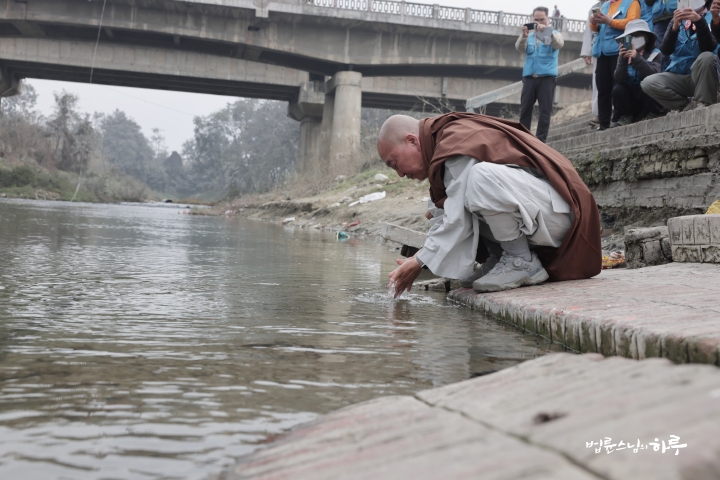
“Don’t follow my example and then complain about stomachaches later. (Laughter) Now, take your time to look at the river.”
Laughter spread along the riverbank once again at Sunim’s words.
At 10:15 AM, the pilgrimage group arrived at the Cambodian temple accommodation in Kushinagar and had breakfast. After the meal, Sunim approached the international members and asked.
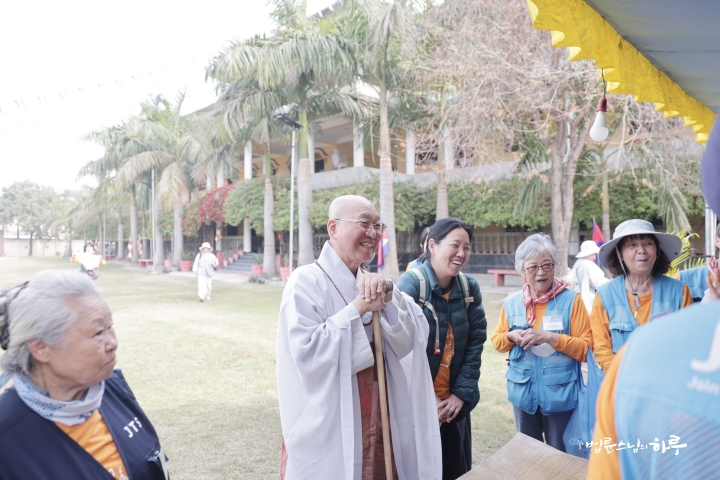
“What do the international members eat during the pilgrimage?”
The members answered with smiles.
“Rice! We’re eating the same food.”
“Can you keep up with the pilgrimage schedule?”
“It’s starting to get tough now. We think Koreans are really amazing. They seem like a different species.”
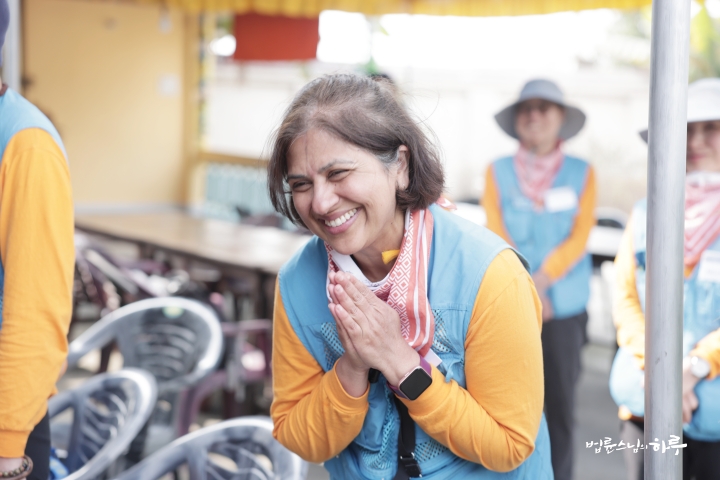
Sunim said with a smile.
“Not all Koreans are like that. They say there are three genders in the world: male, female, and Jungto Society female. Our Jungto Society women are truly remarkable.” (Laughter)
The international members nodded and responded with applause and laughter to Sunim’s story. Sunim was concerned that the pilgrimage schedule might be too demanding for the international participants. However, despite the unfamiliar environment and tight schedule, everyone had bright expressions. Seeing this, Sunim quietly smiled and moved on.
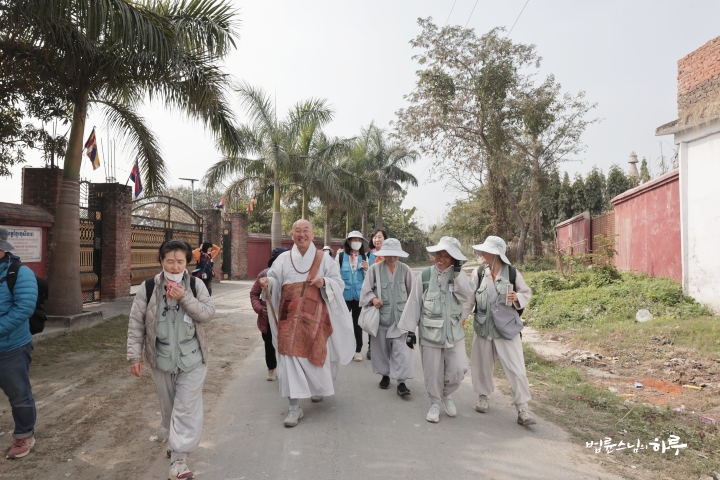
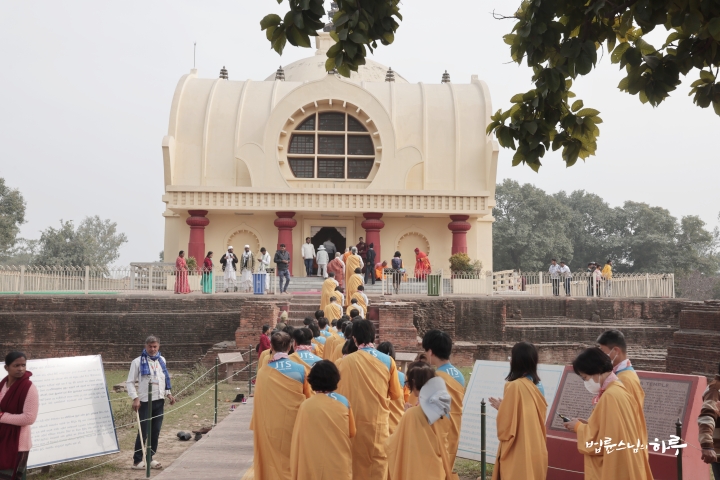
After finishing the meal, the pilgrimage group walked to the Parinirvana Temple (열반당). At 11:20 AM, they finally arrived at the Parinirvana Temple.
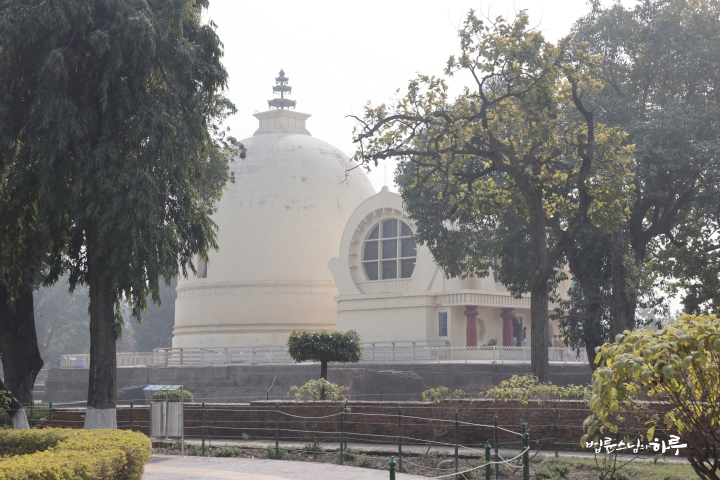
Sunim waited briefly for those who hadn’t arrived yet, and once everyone gathered, they chanted “Shakyamuni Buddha” while walking around the Parinirvana Temple in a single line.
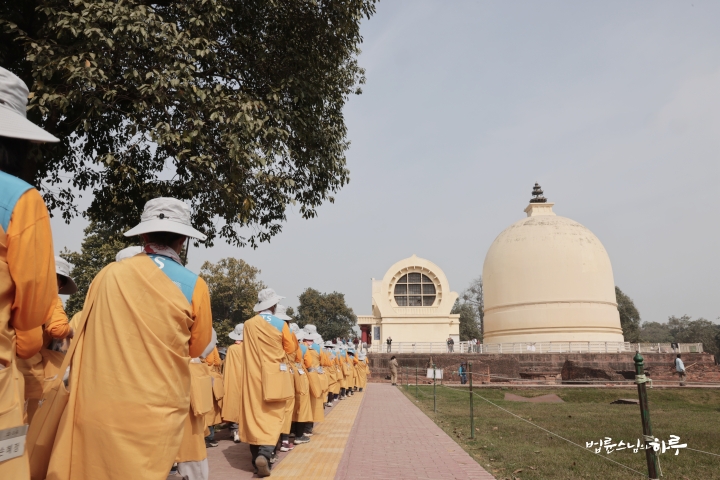
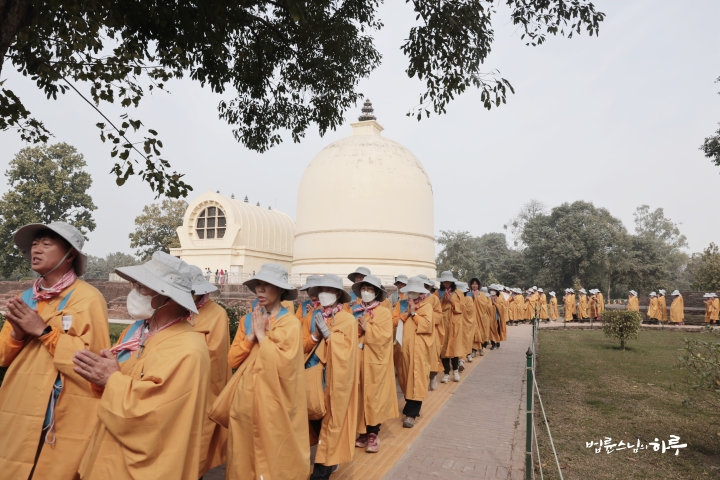
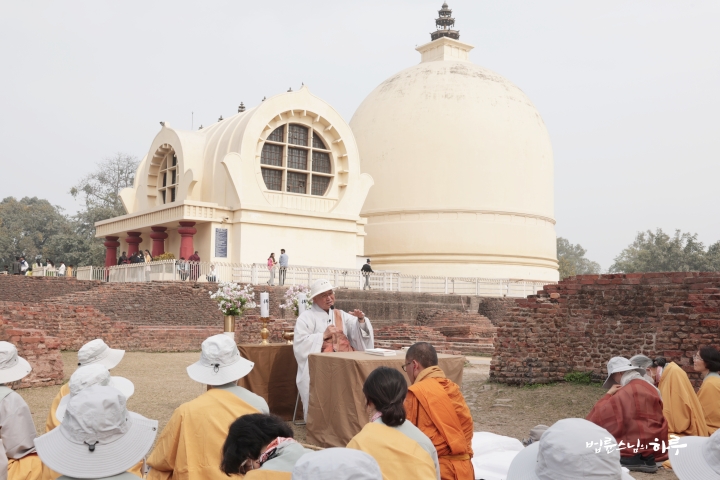
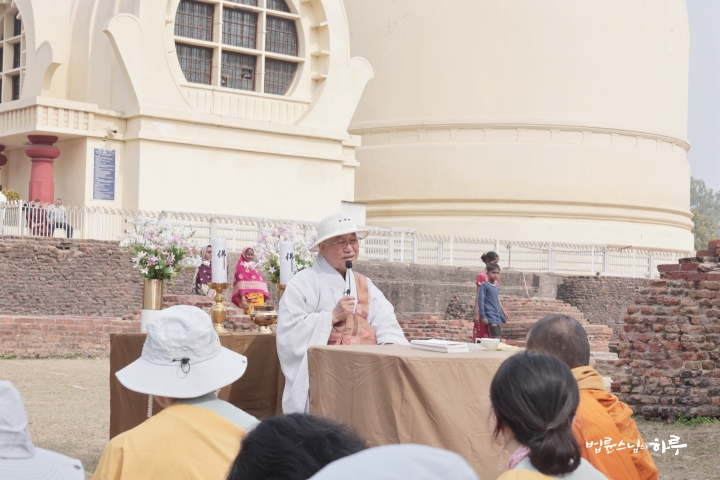
The staff who had arrived earlier had prepared a space in front of the Parinirvana Temple. Once all the pilgrims were seated, Sunim explained about Kushinagar.
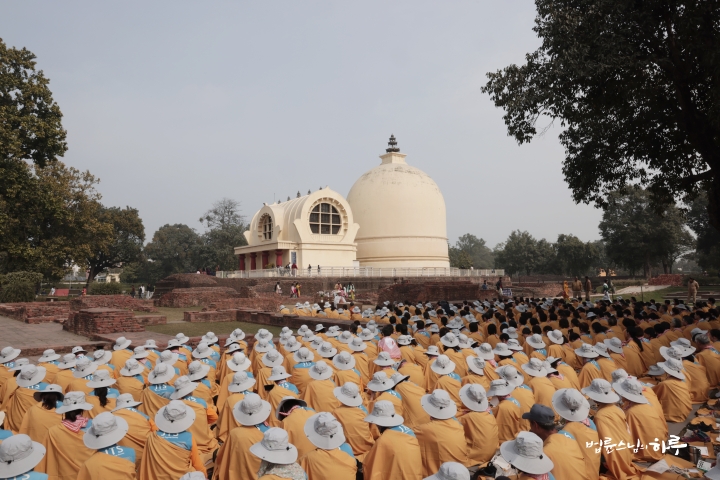
“This place where we have arrived is Kushinagar, where the Buddha entered parinirvana. Inside the building in front of you is enshrined the reclining Buddha statue. It depicts the Buddha’s appearance as he lay down at the time of his passing. Behind it is a stupa symbolizing this as the place of the Buddha’s parinirvana, and a bit further back is another stupa with only its foundation remaining, which is said to be Ananda’s stupa.
Under the Twin Sal Trees, Where the Buddha Lay for the Last Time
At the time of the Buddha, this place was filled with a forest of trees called ‘sala.’ In India, they call it ‘sal,’ and in the scriptures, it’s recorded as ‘sala.’ While bodhi trees and banyan trees spread out in a circle from a single trunk, creating wide shade like a zelkova tree, sal trees are narrow and grow straight upward. So when laying out a mat in a sal forest, it naturally goes between two trees. This is called ‘sala twin trees(사라쌍수).’ It means laying a mat between two sal trees. There are two sal trees standing in front of the Parinirvana Temple now – these are exactly such trees. Of course, at that time, it wasn’t just those two trees; such trees formed a forest, and the Buddha laid his mat between two of them and lay down to enter his final parinirvana.”
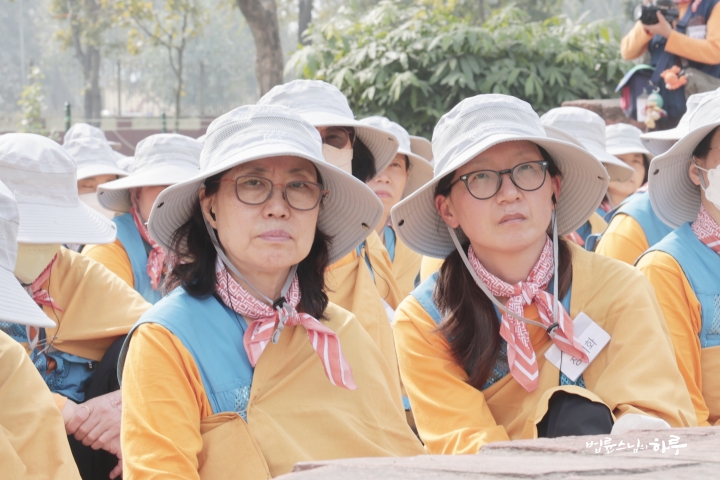
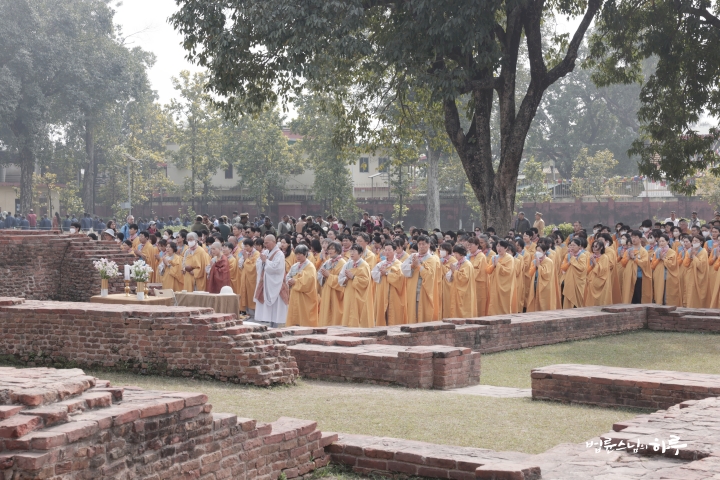
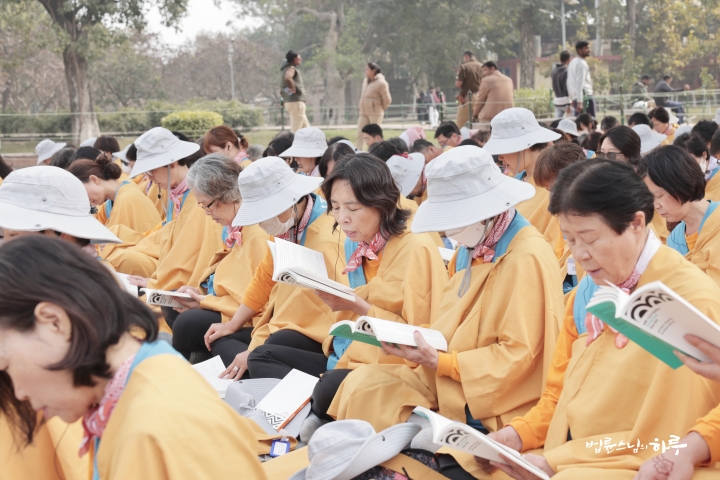
After the explanation, the pilgrimage group offered prostrations and chanted sutras together.
Before entering the Parinirvana Hall, Sunim quietly guided the pilgrimage group.
“We will now enter the Parinirvana Hall. The interior space is not large, but all 500 of us must enter together. Please be considerate of one another so that everyone can pay their respects, and when finding your place, please follow the guidance of the Dharma Teachers carefully. Now, let us enter the Parinirvana Hall.”
The pilgrimage group moved into the Parinirvana Hall while chanting “Shakyamuni Buddha.”
Upon entering, the majestic reclining statue of the Buddha in parinirvana appeared before their eyes. As the pilgrimage group gradually filled the interior space, the sound of the Shakyamuni Buddha chanting resonated louder and louder.
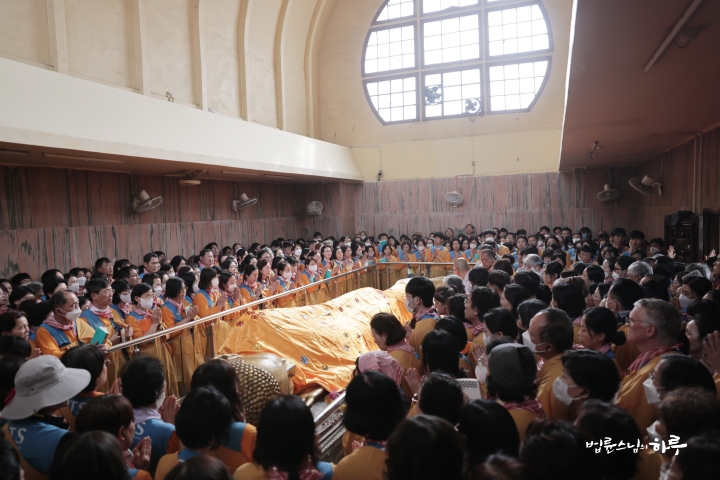
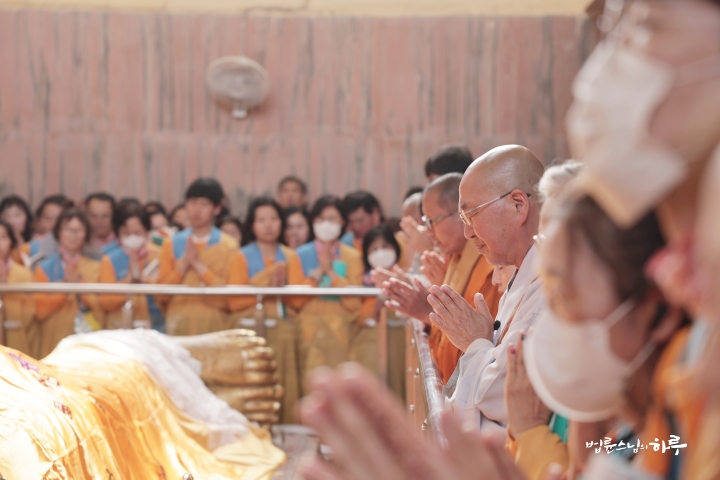
Soon the chanting stopped, and the 500 pilgrims offered prostrations before the parinirvana statue. Following the Buddha’s life step by step, they had now arrived at this place, standing before the parinirvana statue.
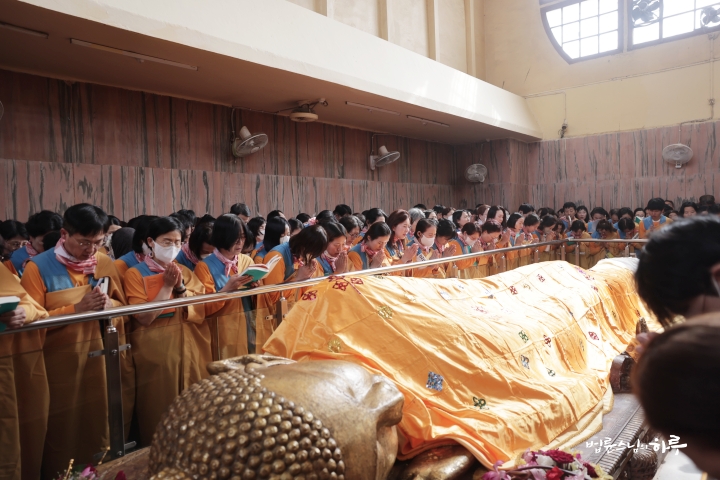
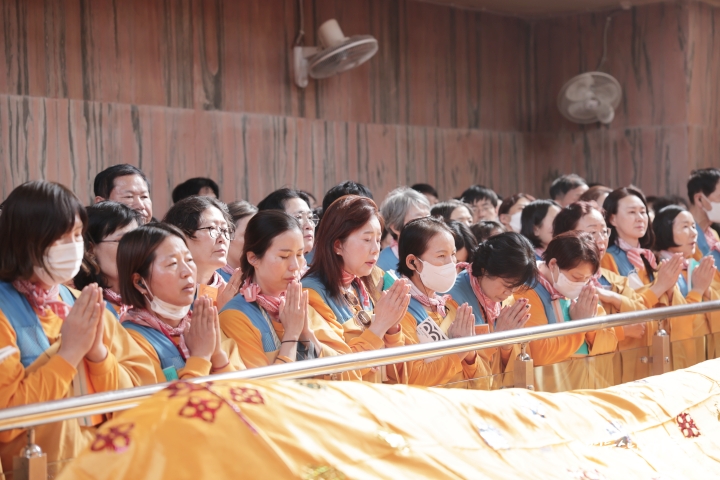
Each member of the pilgrimage group, holding their own deep emotions in their hearts, reverently offered prostrations and recited the aspiration prayer.
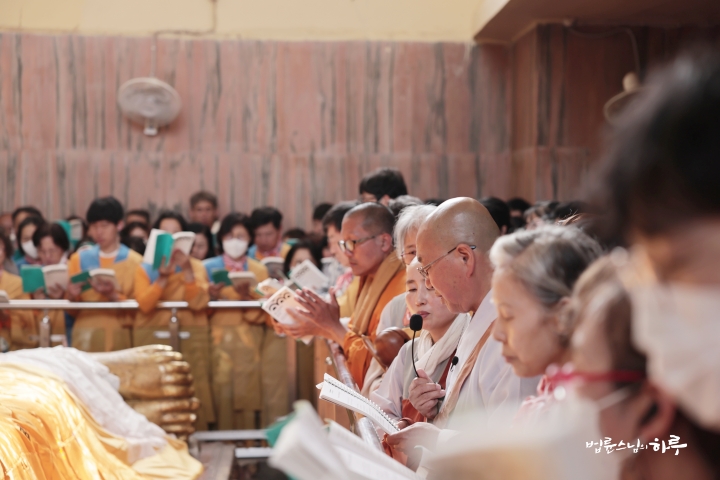
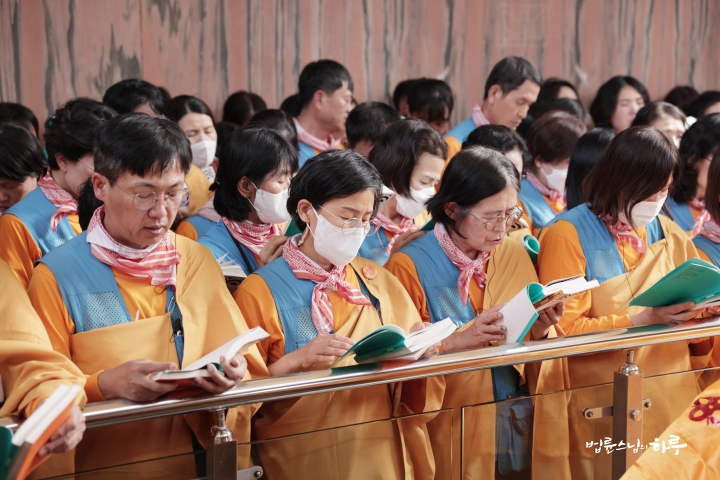
After completing their worship, they returned to their seats. Sunim’s Dharma talk continued.
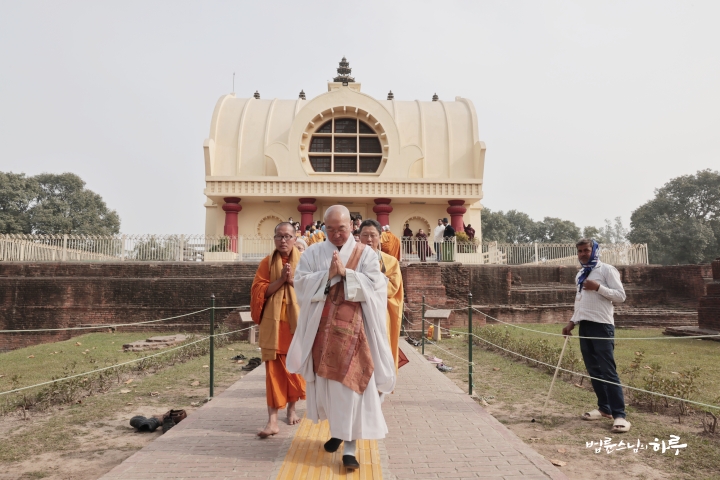
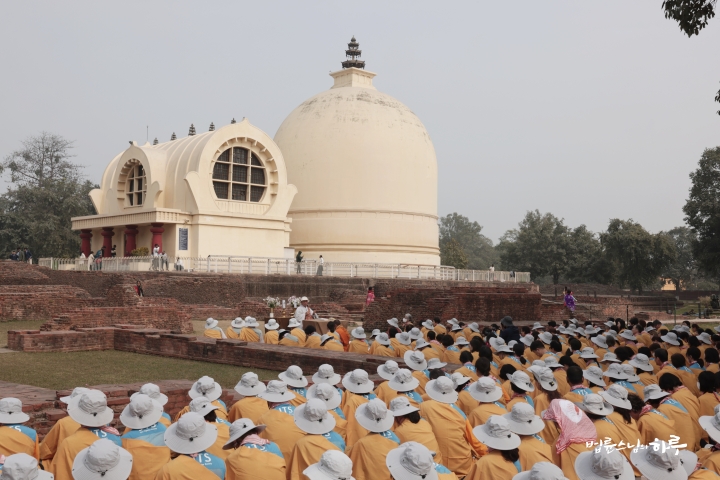
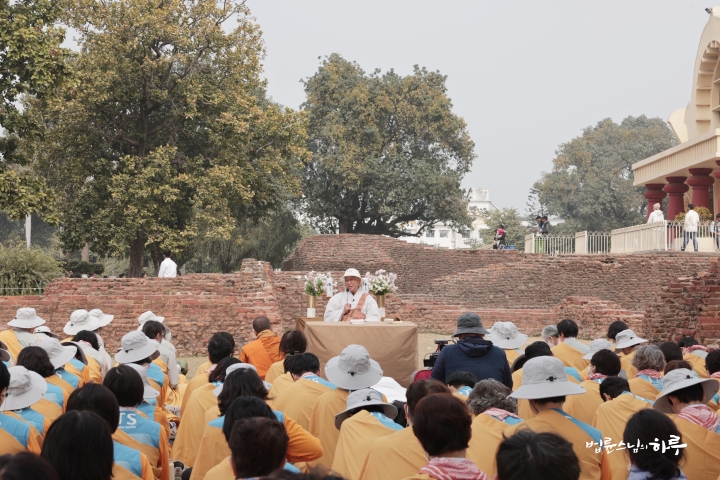
“The Buddha crossed the Kantaki River and passed through several villages before arriving at the village of Pava. He stayed briefly under a mango tree there, whose owner was Cunda, the son of a blacksmith. Blacksmiths belonged to the artisan class, and historically, artisans were generally of low social status. Considering this, we can assume that Cunda was also a poor person of low social standing.
Even today in India, many households grow several mango trees. This is similar to how households in southern Korea plant persimmon trees. When Cunda heard that the Buddha was staying under his mango tree, he immediately came to pay his respects. The moment he heard the Buddha’s Dharma talk, his heart opened. He requested to offer a meal to the Buddha and the Sangha the following morning.
That year was one of severe drought. Under such circumstances, it was practically impossible for the poor Cunda to offer a meal to hundreds of people. Indeed, when we examine other sutras recording that year, large-scale offerings to hundreds of people rarely appear. There was only the offering by Ambapali.
The Buddha accepted Cunda’s request to offer a meal. After Cunda left, Ananda told the Buddha that accepting the meal offering was not advisable, as Cunda did not have the means to provide it. The Buddha replied that Cunda would indeed be able to prepare the offering.
The Last Meal Before Entering Nirvana
The next morning, when the members of the Sangha heard the announcement that it was time for the meal, they went to Cunda’s house and found that the meal was indeed prepared. The scriptures describe the food as “hard and soft,” which naturally means there were both hard and soft foods.
In India, even today, when serving meals, the host distributes food in order. First, rice is served, then vegetables are added, and finally, a bean dish called dal is ladled out. However, among the offerings was a food called “sukaramaddava.” After receiving this food, the Buddha told Cunda not to give it to the other members of the Sangha but to bury it in the ground. He said it was food that no one could digest.
After finishing the meal, the Buddha gave a Dharma talk for Cunda. However, he later called Ananda and said his stomach hurt, and when he tried to continue the journey, he appeared to be experiencing severe pain. Unable to go far, he asked to rest for a while and then had diarrhea mixed with blood. In today’s terms, this corresponds to symptoms of acute food poisoning.
The cause appears to have been that food called sukaramaddava. “Sukara” means pig in the ancient language of this region. For this reason, some Western scholars speculate that it might have been pork. However, as mentioned earlier, that year was one of severe drought, making it practically difficult to offer pork as a communal meal. Therefore, exactly what kind of food sukaramaddava was has not yet been clearly determined.
According to stories I heard while traveling in the Bengal region, they call taro “maddava” there. If so, sukaramaddava might have been pig taro, that is, wild taro. Wild taro is a plant commonly found in tropical regions like India and is toxic, so it must be boiled and soaked in water to remove the toxins before eating. The food the Buddha ate likely had not had its toxins sufficiently removed. On the other hand, lower-class people like Cunda may have already adapted to such wild plants as they had been eating them regularly to survive.
Why Did the Buddha Console Chunda on His Deathbed?
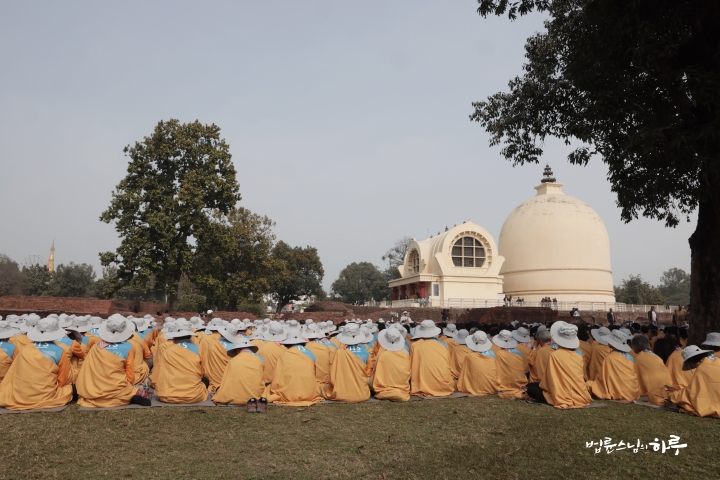
After suffering from such severe diarrhea, the Buddha lay down to rest. He then asked Ananda about Chunda’s well-being. Ananda reported that Chunda was deeply distressed, and that among the assembly, people were saying that Chunda’s offering had no merit. Though the practitioners expressed it politely rather than with outright criticism, they essentially meant that the Buddha had become critically ill because of Chunda’s offering. Chunda, who had offered the meal with utmost devotion, was suffering greatly from this unexpected turn of events.
The Buddha called Chunda to sit beside him and said to Ananda:
‘Ananda, do you know what offerings bring the greatest merit in this world? The offerings with the greatest merit are those made to the Tathagata. Among these, there are two offerings that bring the supreme merit. One is the last meal offered to the Tathagata before he attains supreme enlightenment, and the other is the last meal offered to the Tathagata before he enters parinirvana.’
The last meal the Buddha received before attaining supreme enlightenment was offered by Sujata. And the last meal before entering parinirvana was offered by Chunda. On the surface, it might appear that Chunda’s offering was connected to the Buddha’s death. However, from another perspective, Chunda was the person who offered the Buddha’s final meal before his parinirvana. These two viewpoints carry entirely different meanings. Through the Buddha’s words, Chunda was transformed from someone who might have been blamed into a person who had accumulated the greatest merit.
Normally, people would not eat food if they knew it was poisonous. Even if eaten unknowingly, they would typically vomit it out upon feeling ill. However, the Buddha alone could be said to have eaten poisoned food, approached death, yet still showed concern for and consoled the one who offered it, even elevating him to greatness. Sujata’s offering made Sujata great, while Chunda’s offering became an episode that revealed the Buddha’s magnificent character.
In Christianity, Judas, the disciple who betrayed Jesus, is strongly condemned. Chunda could have easily received similar criticism. However, in Buddhism, following the Buddha’s words, Chunda’s offering is honored as one of the most meritorious offerings. This is why, in later times, stupas were erected to commemorate this event, and the story of “Chunda’s offering” has been passed down through generations.
After the Buddha’s Passing, What Should We Rely On?
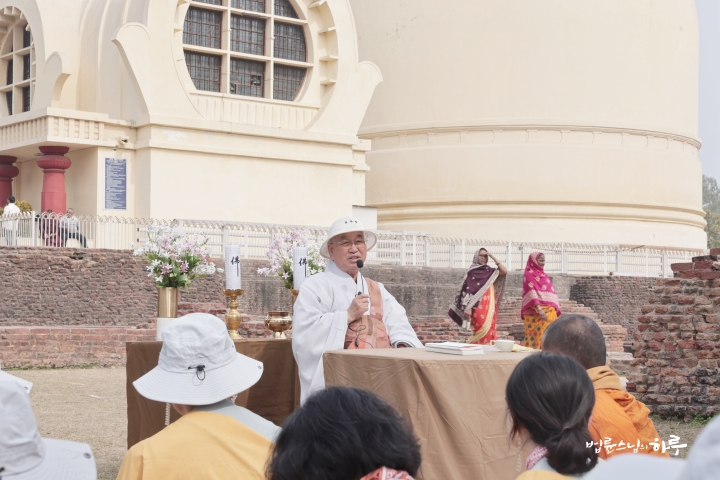
The Buddha had now laid down beneath the twin sal trees, preparing to enter parinirvana. At that moment, Ananda asked a question on behalf of the assembly.
‘We have always relied on the Buddha in our practice. But when the Buddha enters parinirvana, whom should we rely on?’
The Buddha replied:
‘Ananda, do not worry. In a world without the Tathagata, there are four things you should rely on. These are the Four Foundations of Mindfulness (사념처).’
The Four Foundations of Mindfulness are as follows. First is Kayanupassana (신념처 : 身念處), mindfulness of the body. This means observing the body as it truly is. The body is not sacred but something that will eventually decay, so it is not worth clinging to. In Chinese, this is called ‘contemplating the impurity of the body (관신부정).’ Second is Vedananupassana (수념처 : 受念處), mindfulness of feelings. When you observe feelings as they truly are, you realize they are suffering. This is called ‘contemplating feelings as suffering (관수시고).’ Third is Cittanupassana (심념처 : 心念處), mindfulness of mind. When you observe the mind, you see it constantly changes and fluctuates. This is called ‘contemplating the impermanence of mind (관심무상).’ Fourth is Dhammanupassana (법념처 : 法念處), mindfulness of mental objects. When you observe phenomena, you realize there is no substantial entity that can be called ‘self.’ This is called ‘contemplating the non-self nature of phenomena (관법무아).’ The practice that emerged from these insights is the Four Foundations of Mindfulness meditation, which forms the core of Vipassana. Ananda asked another question.
‘We have always practiced while thinking of the Buddha. When the Buddha is no longer with us, what should we think about?’
The Buddha replied:
‘Ananda, do not worry. In a world without the Tathagata, think of the four sacred sites (사성지).’
The four sacred sites are where the Buddha was born, where he attained enlightenment, where he first taught the Dharma, and where he entered parinirvana. This means constantly reflecting on what the Buddha was like when he was born, what he realized, what the core of his teachings was, and what he was like when he entered parinirvana. If you do not forget these, you can become a proper practitioner. This is also why we go on pilgrimages to sacred sites. Ananda continued with another question.
‘We have always practiced with the Buddha as our teacher. When the Buddha is no longer with us, whom should we take as our teacher?’
The Buddha replied:
‘Take my teachings, the sutras and the vinaya, as your teacher.’
He said that if you keep the precepts purely, even if you are far from the Buddha, it is as if you are always with him. But if you do not keep the precepts, even if you are beside the Buddha, you are no different from someone who does not know the Buddha. What matters is not the formality of building temples and making Buddha statues, but practicing the Buddha’s teachings in daily life. This is called ‘taking the precepts as your teacher (이계위사 : 以戒爲師).’
Time Is Fleeting, Practice Diligently
Venerable Ananda was worried about how to conduct the funeral after the Buddha entered parinirvana. So he asked the Buddha, ‘How should we conduct the funeral?’ The Buddha then said:
‘Ananda, practitioners should not worry about such things. The lay followers will handle it according to their customs.’
The Buddha’s funeral was conducted by the Malla clan here in Kushinagar according to their customs. At that time, caste was important in Malla society, and since the Buddha was from a royal family, he was cremated according to the funeral rites befitting royalty. This was not a Buddhist funeral, but rather the secular customs followed by the local people at the time when the Buddha entered parinirvana here. In other words, the Buddha did not consider the funeral format itself to be important. Thus, the Buddha said that even his own funeral was not something practitioners should concern themselves with. However, today, monks meticulously attend to even the funerals of lay followers. Realistically speaking, it is true that many temples operate on income from funerals and memorial services.
While this conversation was taking place, villagers began to gather one by one. Originally, they intended to pay their respects to the Buddha individually, but more people came than expected, so they were divided into groups of five or six by family to pay their respects and then leave. Even so, it was midnight before everyone had departed. After all the people had left, the Buddha appeared to be weakening in strength, like a lamp about to go out. Ananda said, ‘Let us withdraw now so that the Buddha may enter parinirvana peacefully.’ After the assembly withdrew, the Buddha lay quietly. Then an old man with a walking stick arrived. His name was Subhadra. Since he was a non-Buddhist, he said ‘I must meet Gautama’ instead of using the title Buddha.
‘I must meet Gautama.’
‘That is not possible.’
‘I must meet him.’
‘It is difficult now. He is about to take his last breath, so you must be quiet.’
‘No. I have something I must ask. If Gautama enters parinirvana, I will have no one to ask.’
This argument took place outside the door. Hearing this, the Buddha said to Ananda:
‘Ananda, do not worry. Let him in. He has not come to trouble me, but because he has something to ask.’
Subhadra came in and asked:
‘Gautama, there are countless teachers in this world. Some say this is right, while others say that is wrong. I cannot tell who is right and who is wrong. Do you know which of them is right and which is wrong? Are they all wrong? If so, what is the right path?’
Even though it was the Buddha’s final moments, he asked his questions at length. However, the Buddha answered:
‘Subhadra, I know them well. But it is not important now to debate their rights and wrongs. If there is greed, anger, and ignorance in a person’s mind, it does not matter what they say.’
Then the Buddha taught the Noble Eightfold Path(팔정도). Rather than judging what others say, the teaching was to make one’s own speech and actions right. Hearing these words, Subhadra immediately attained enlightenment. He joyfully requested ordination. However, the Sangha had rules at that time. When someone from another faith wanted to ordain, they could not receive precepts immediately but had to live with the community for three months and gain the consent of the assembly. Hearing this, Subhadra said:
‘Even if I had to wait three years instead of three months, I would gladly accept it.’
Thus he became the Buddha’s last disciple. The Buddha called the assembly again and said:
‘If you have any doubts, ask now. It will be useless to regret later after I enter nirvana, thinking “I should have asked then.” Ask anything now.’
But no one asked questions. The Buddha repeated this three times:
‘Ask comfortably, as a friend asks a friend. It will be useless to regret later.’
When there were still no questions, Ananda spoke on behalf of everyone:
‘Buddha, you have already taught many dharmas, and we have understood them. We have no more doubts, and all that remains is to practice diligently and realize them.’
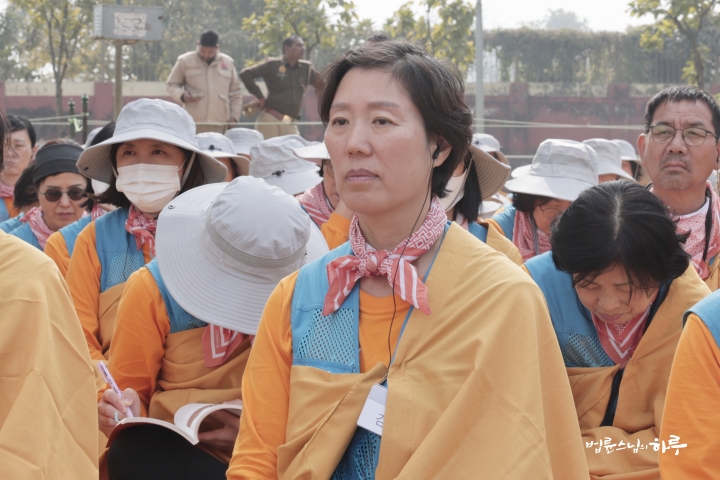
The Buddha left his final teaching:
‘Ananda, the Tathagata is not the physical body but the wisdom of enlightenment. Though the Tathagata’s body may leave you, the wisdom of enlightenment will remain with you forever. Time is fleeting. Practice diligently. Like water drops that pierce through rock.’
After leaving these words, the Buddha entered nirvana. His final appearance was not special; it was just an ordinary moment, no different from usual.”
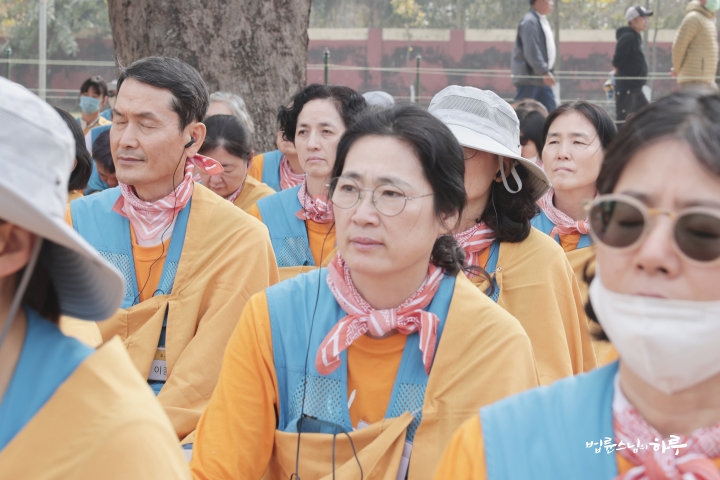
After the Dharma talk ended, the pilgrimage group had time to freely pay their respects inside the Parinirvana Temple. Some took photos, others quietly devoted themselves to practice in a corner, while still others approached the Parinirvana statue again to pay their respects with hands joined together.
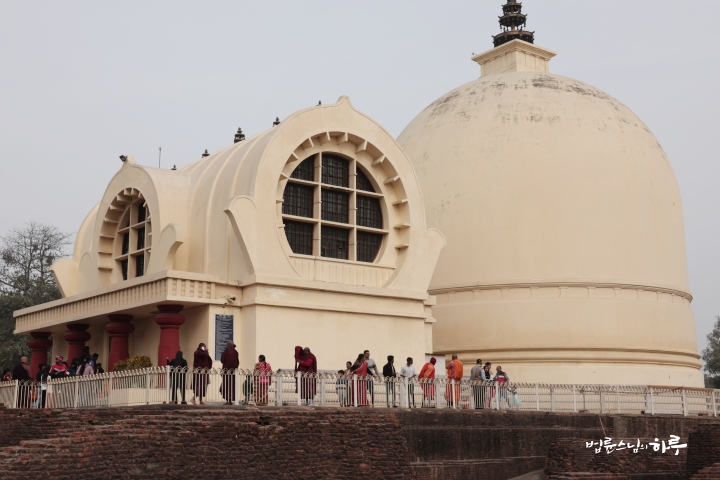
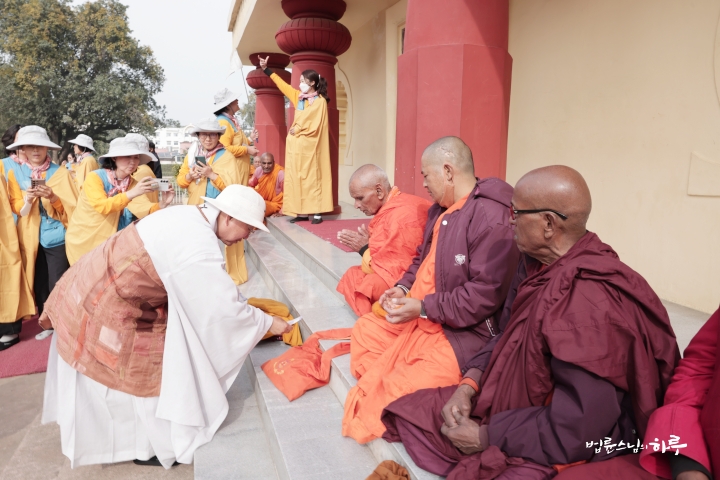
Sunim slowly walked around the grounds of the Parinirvana Temple and then quietly approached the practitioners who were practicing there to offer them donations.
After completing their visit to the Parinirvana Temple, they moved to Ramabhar Stupa at 2:30 PM. This was the site where the Buddha’s body was cremated.
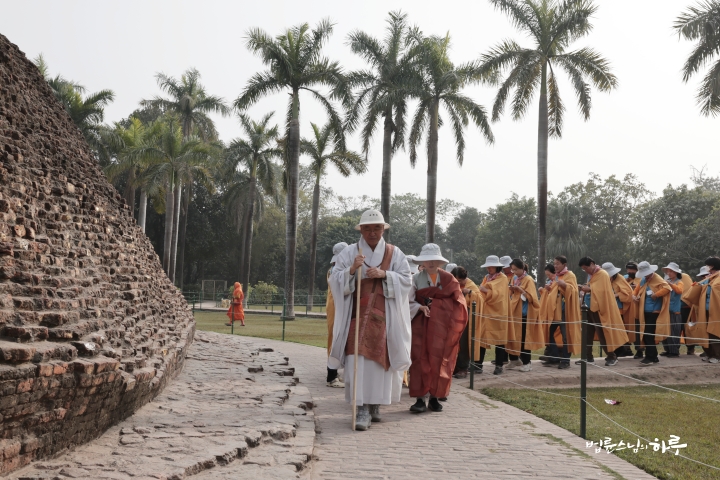
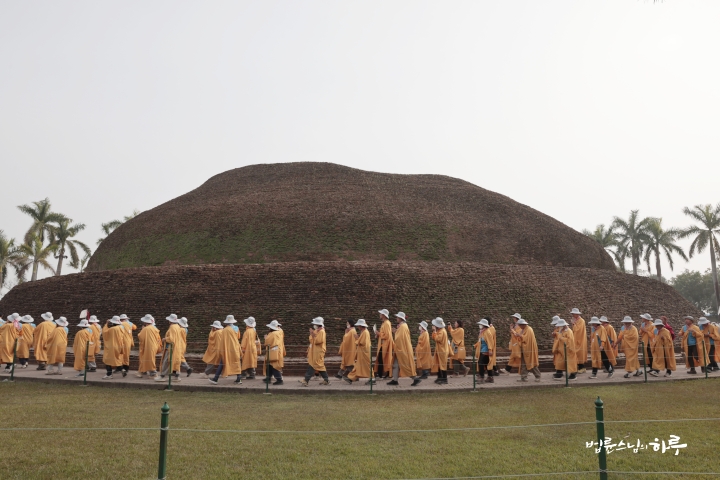
Once the pilgrimage group had all gathered in front of Ramabhar Stupa, Sunim explained how the Buddha’s relics were divided and preserved, and the meaning of peace contained in that choice.
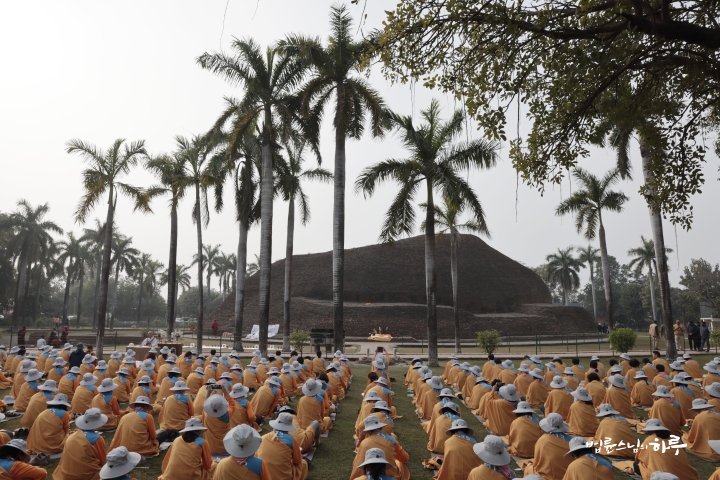
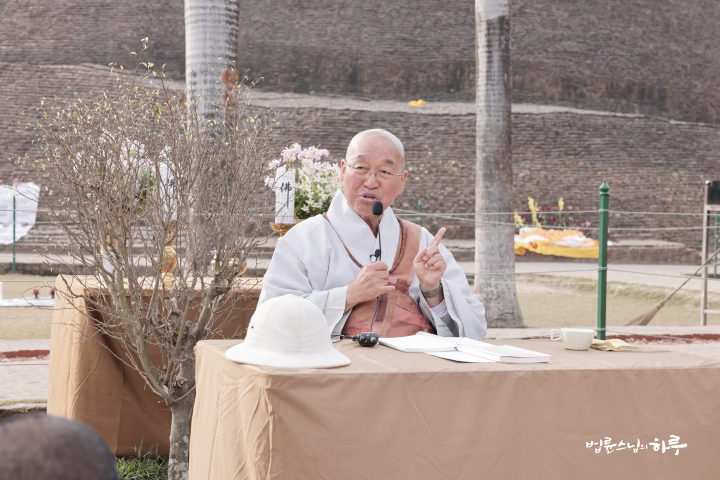
“The place where we have now arrived is called Ramabhar Stupa, also known as Ramabhar Sutpa. This is where the Buddha was cremated, the site where the Buddha’s funeral was held. According to the stories passed down, when the Buddha was cremated here, he burned completely clean without any soot, leaving only bones. Then water spontaneously sprang from the ground and extinguished all the funeral pyre, after which the remains were collected.
Conflict Over the Relics: Choosing Peace Instead of War
When news spread that the Buddha had entered parinirvana, various countries and tribes flocked here, wanting to take the Buddha’s relics to build memorial stupas in their own lands. The Shakya clan of Kapilavastu said, ‘The Buddha is of our clan, so we should enshrine them.’ The Koliya clan claimed, ‘The Buddha is our maternal grandson, so we should enshrine them.’ King Ajatashatru also insisted they should be enshrined in his country, and the Licchavi clan of Vaishali also came forward saying they should enshrine them. The Malla clan of Kushinagar here also claimed, ‘We who cremated the Buddha should enshrine them.’ As each party insisted on enshrining the relics, the dispute grew larger, even reaching the point where they were prepared to go to war. At that time, the Brahmin Dona stepped forward to persuade the people. ‘The Buddha spent his entire life teaching peace of mind and peace in the world. If you respect such a Buddha, it makes no sense to wage war to obtain his relics. I will divide them fairly into eight portions.’
The people agreed with his words, and the eight tribes each took a portion of the relics and built stupas in their own lands. The Brahmin Dona, believing that the one who divided the relics should not possess them, took the urn that had contained the relics instead and built a stupa. Later, another tribe arrived and took the ashes remaining from the Buddha’s cremation to build a stupa. In this way, ten original stupas were erected to honor the Buddha: eight relic stupas, one urn stupa, and one ash stupa.
The following is the story of what happened after the stupas were built. About 200 years after the Buddha’s parinirvana, King Ashoka unified India and became a disciple of the Buddha. He made pilgrimages following the Buddha’s footsteps and erected commemorative stupas at various locations. At this time, King Ashoka did not simply build stupas; to enshrine the Buddha’s traces, he dismantled seven of the eight original relic stupas, removed some of the relics from within, and enshrined them in the commemorative stupas.
However, he could not touch the Ramagrama relic stupa (랑그람 사리탑) built by the Koliya clan. According to tradition, a naga king who guarded this stupa appeared and refused to allow its destruction, saying, “I am taking good care of the Buddha’s relics. Could you care for them better than I?” The place we are visiting tomorrow is precisely this stupa. In my opinion, the Ramagrama relic stupa was situated on terrain surrounded by water like an island, making it difficult to access. Due to the terrain, there may have been many snakes, and for various reasons, people could not easily approach it. Stories spread that grave robbers who merely touched the stupa were struck by lightning and died or fell seriously ill and perished. This made people fearful of touching the stupa, and proper excavation never took place. It seems possible that someone intentionally created this atmosphere of fear to protect the stupa.
For these reasons, while there were originally eight relic stupas, relics were transferred from only seven of them to commemorative stupas, leaving one intact. Because of this background, in Theravada Buddhism, the relic stupa becomes the center when building a temple. The relic stupa is placed in the middle, with living quarters arranged around it. In contrast, in Mahayana Buddhism, the Buddha statue is central. Even if a stupa stands in the middle of a temple, the main hall housing the Buddha statue serves as the central space. However, in Theravada Buddhism, it is not the Buddha statue but the Buddha’s relic stupa that serves as the center of the monastery.”
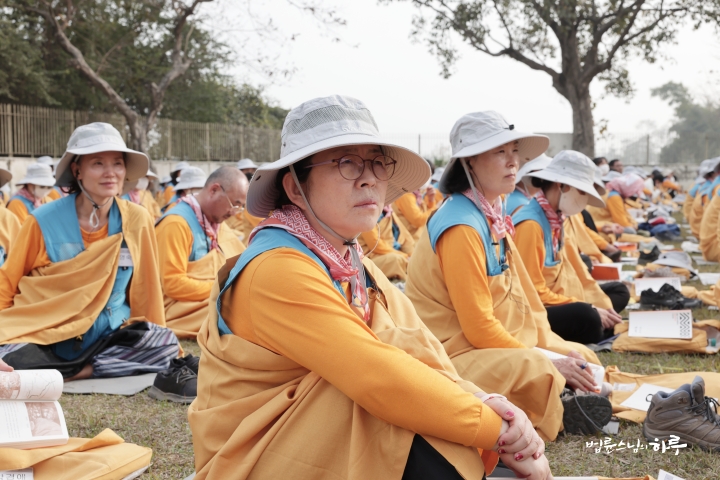
The pilgrimage group then held a memorial service for the deceased, remembering Jungto practitioners who had passed away in the past year as well as others with whom they had personal connections.
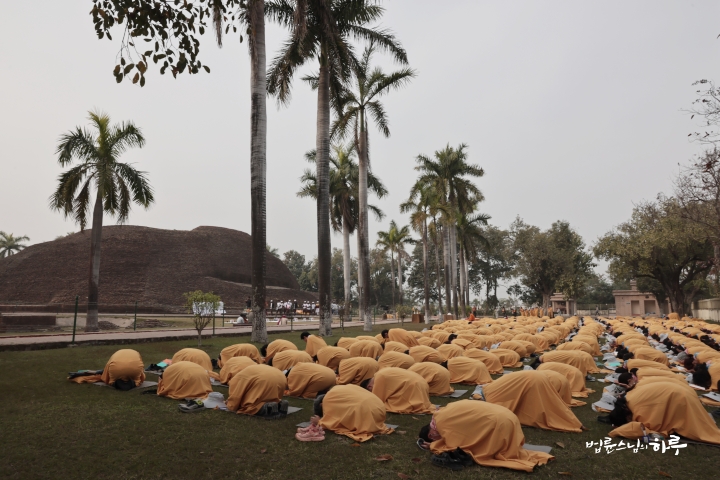
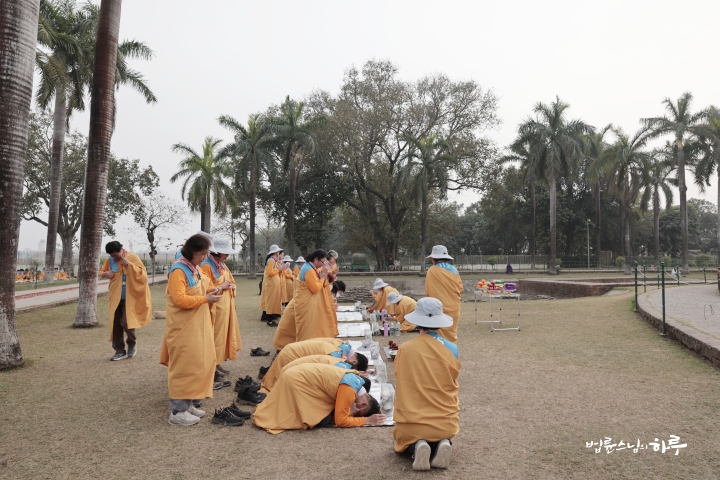
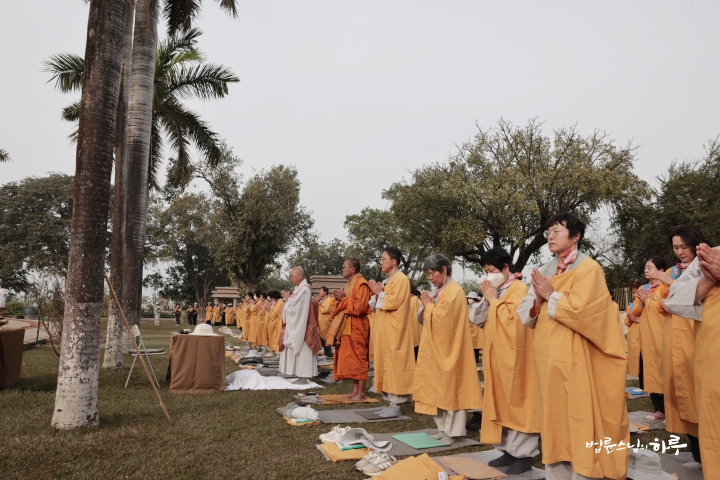
After completing the memorial service, everyone recited the Four Great Vows (사홍서원) together, concluding their visit to Ramabhar Stupa.
On the way back to the accommodation after the visit, Sunim spoke to the police officers who had escorted them to the entrance of the lodging.
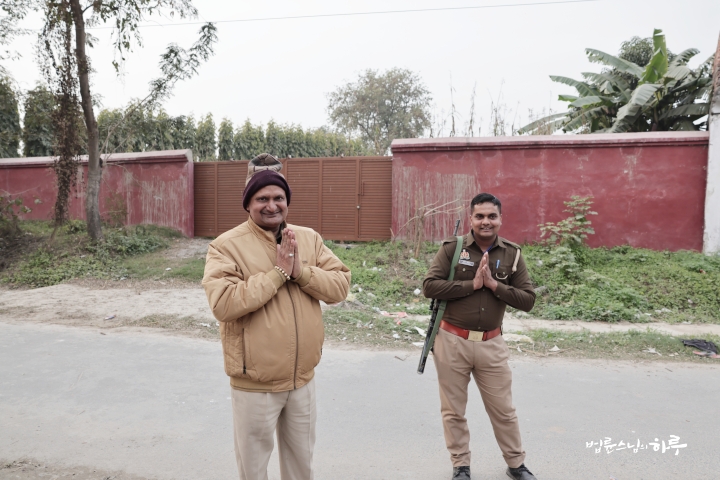
“Thank you for your hard work today. Please go in and rest now.”
“Yes, understood. I heard you’re going to Nepal tomorrow.”
“Yes, that’s right. We plan to leave at 2 AM. You don’t need to come out.”
“No, I’ll see you tomorrow morning. We’ll escort you to the border.”
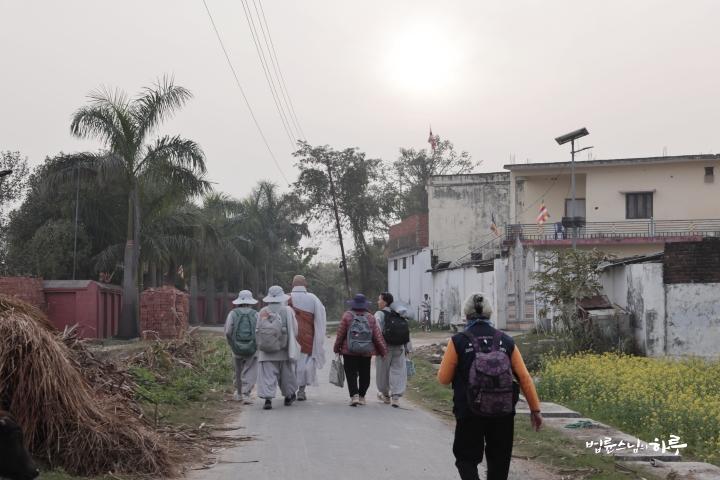
Sunim arrived at the accommodation at 5 PM, had dinner, edited manuscripts, and went to bed early.
Tomorrow, he will wake up at 2 AM and cross the border into Nepal at 6 AM. Passing through the place of parinirvana, the journey continues toward Lumbini, where the Buddha came into this world.