

Jan 22, 2026 – Departure from Korea, Arrival in India
Hello. Today is the day Sunim departs from Korea to India to guide the pilgrimage to Buddhist holy sites.
After completing morning practice and meditation, Sunim packed his luggage for India. Having just returned from humanitarian relief work in Indonesia yesterday, he begins another 27-day overseas schedule. At 9 a.m., he departed from Seoul Jungto Center and headed to Incheon Airport.


After arriving at the airport and completing departure procedures, Sunim worked in the lounge before departing from Incheon Airport at 12:05 p.m. for Delhi Airport. The plane was filled with participants of the Jungto Society India pilgrimage.

The direct flight took 9 hours. On the plane, Sunim reviewed the overseas schedule for the coming year.

The plane landed at Delhi Airport at 5:30 p.m. local time. After completing Indian immigration procedures, Sunim was the first among the pilgrims to exit the airport.
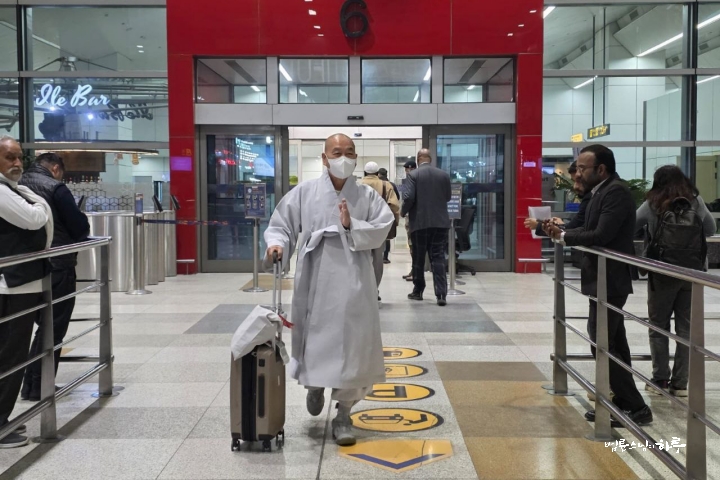
Dharma Teacher Bogwang (보광), Dharma Teacher Seonju (선주), Amitabh, Ajit, and Kim Seonhyeong (김 선형), who had arrived earlier to welcome the India pilgrimage participants, greeted Sunim.
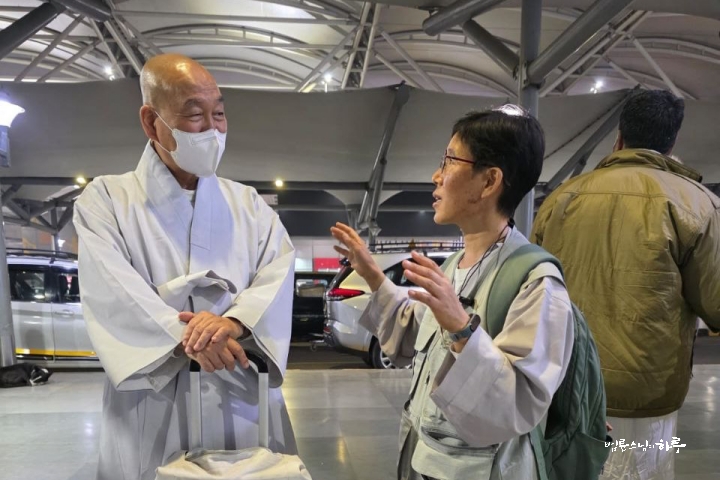
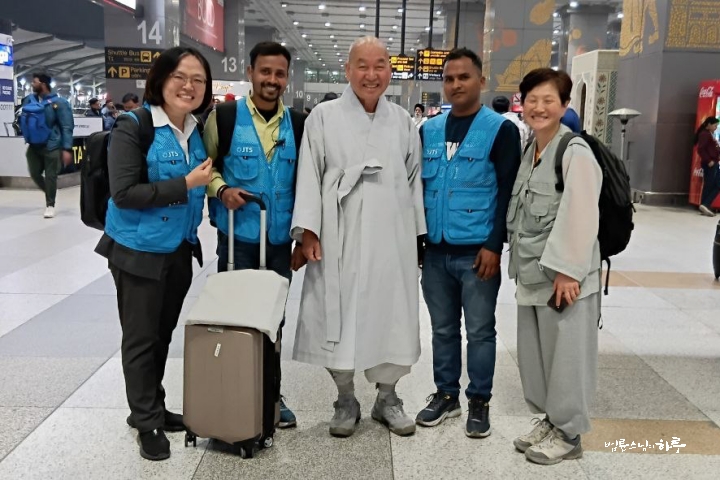
As Sunim was not feeling well, he took a commemorative photo with the India pilgrimage staff who came to greet him and immediately headed to his accommodation. The Dharma Teachers and staff would welcome the pilgrims.
Today marks the beginning of the India pilgrimage. Tonight, three buses will depart from Delhi Airport and travel for 17 hours to Varanasi. Tomorrow, five more buses will depart on the same schedule, and the remaining buses will join in Varanasi. This India pilgrimage will proceed with a total of 13 buses traveling together.
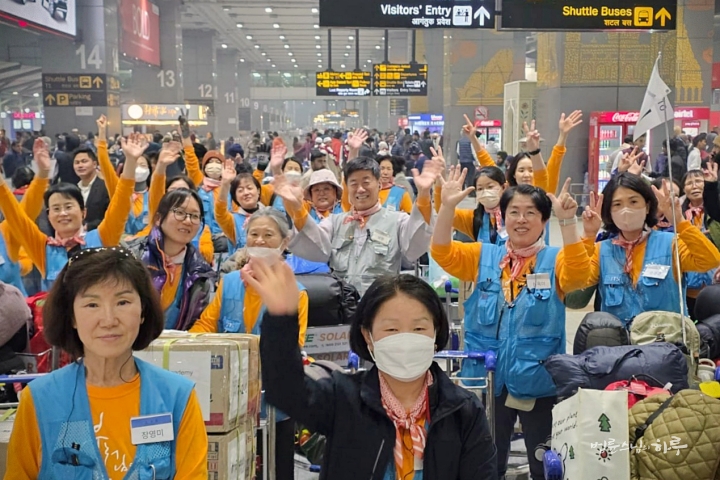
All the India pilgrimage participants exited the airport in an orderly yet cheerful manner. After neatly loading 100 boxes, including supplies to support Sujata Academy, onto the buses, they departed for Varanasi at 8 p.m.
Sunim arrived at the accommodation near the airport at 7:30 p.m. After drinking a cup of hot water at the accommodation, he worked on manuscript editing and concluded his day. Being tired from going directly to India after the emergency relief activities in Indonesia, he went to bed early tonight.
Tomorrow, he will move to Nehru University for consecutive meetings with Sanskrit department professors and Korean language department professors, give a Dharma Q&A lecture to Korean Studies students at Nehru University, conduct the Friday Dharma Q&A live broadcast online, and meet with Indian government officials in the evening.
Since there was no Dharma talk today, this post concludes with the dialogue between Sunim and a questioner from yesterday’s Weekly Dharma Assembly.

My Son Wants to Marry His Girlfriend Who Has Depression. Should I Try to Stop Him?
“It’s not easy for two people to marry and live together when one has depression or panic disorder. Yet your son says he’s willing to accept those difficulties. When people choose someone, there are various reasons. They might be attracted to their appearance, their talents might be outstanding, or they might have received great kindness in the relationship. Whatever the reason, if he has chosen to say, ‘Even though this person is experiencing mental difficulties, I will share those difficulties and live with them,’ there’s no way to stop it.”
“That’s why I’ve been thinking, ‘If they get married, it’s their business, so I shouldn’t interfere.’ But if they get married and have a child, I keep worrying because I’ve heard that a mother’s anxiety can be passed on to the child.”
“It could happen, or it might not. If she feels her panic disorder or depression is severe, she might choose not to have children at all, or she might have a child but decide ‘It wouldn’t be good for the child if I raise them myself’ and entrust the upbringing to a nanny. Or she might resolve ‘I shouldn’t pass on my mental difficulties to my child’ and actually overcome them herself. Of course, there’s also the possibility that she won’t be able to overcome them and might have a negative impact on the child. All these possibilities are open.
But just as I cannot prevent the two from marrying, I also cannot prevent the various situations that will unfold afterward. So if they say they won’t have children, that too must be accepted as one choice. Even if they have a child but want to entrust them to a nanny while they work, you shouldn’t say, ‘What are you talking about? You should raise your own child!’ That’s one approach, and if she says she’ll take medication and make efforts while raising the child, that’s also another approach. Even if there are difficulties in raising the child, those difficulties are something they must accept. They must accept in advance that they’re marrying because they love each other now, and if they don’t get along later, they might even separate.
In the past, parental consent was an important condition for marriage, so parents could make decisions. But now, parental approval is not a condition for adult children’s marriages. As a parent, you can express your opinion, but if the parties involved say they want to marry, there’s no way to stop them. This doesn’t mean giving up on what I can do, but rather that it wasn’t something I could be involved in from the beginning. If you unnecessarily intervene and speak up, only you will be hurt, the mother-son relationship will deteriorate, and things will eventually flow according to the choices of those involved. Therefore, while you don’t need to actively support it, you also don’t have the right to oppose it.
Who would have a child if there’s a predicted possibility of having a disabled child? However, even if we have a child with disabilities, we must ultimately raise that child and live our lives. Children with disabilities also grow up feeling their own happiness within their given conditions. Similarly, even if a mother experiencing mental difficulties might have somewhat negative effects on a child, that child will live their life as it forms because they grew up under such parents. That too is a life condition that must be accepted. Also, growing up with slight depression or panic disorder factors doesn’t necessarily mean developing mental illness. Depending on the environment, it can be sufficiently overcome, or conversely, it might develop, but all these possibilities must also be accepted as conditions of life.
That’s why when conflicts arise between the couple after marriage, the mother shouldn’t say, ‘See, what did I tell you?’ Instead, it’s better to say, ‘Didn’t you know about this situation from the beginning when you married? Even if it’s difficult, embrace each other well and live together.’ The same applies when conflicts deepen after having a child. If it was something that could have been anticipated, then rather than lecturing, it’s better to offer practical help like, ‘It must be very hard raising the child. I’ll watch them for you this weekend.’
In any case, it’s already their own lives. However, since it’s something that can be anticipated in advance, just find something that can be helpful within the range of what I can do. But saying ‘Then I’ll raise the child’ is not desirable. If that happens, the burden I have to bear becomes too great, and there’s no guarantee things will work out well. Moreover, if the results aren’t good, you might even be resented. So even if you want to help, you must always know how to step back and restrain yourself.
When you go to the flood-damaged sites in Indonesia, you want to help with everything out of sympathy to the point of tears. However, that’s their life, not mine. You must know how to restrain not only angry feelings but also the desire to help. Help with what you judge to be truly necessary, but also know how to watch them handle the rest on their own. For example, if residents clear debris themselves after being provided with tools they previously lacked, then you might think, ‘Seeing them work hard, let’s at least provide potato seeds for the farmland.’ You must adjust the scope and size of help in this way. If you act like you’ll do everything at once out of desire to help, it becomes unmanageable later. Eventually, you’ll be exhausted too, and the relationship might actually worsen with the other party saying you were all talk after promising to help.
Just as you must restrain the desire to curse when angry, an attitude of restraint is always necessary even when doing good deeds. This is because it’s better to minimize interference in others’ lives. So rather than stepping forward saying ‘I’ll raise the child,’ it’s better to approach it like, ‘Grandma will watch the child for about a day, so rest this Sunday.’ The same applies when you feel the child has been somewhat hurt by their mother. It’s sufficient to bring the child to grandma’s house on weekends and let them rest comfortably. Like this, it’s important to clearly know the scope of the role I can play and not cross that line.
People think that if a mother has mental problems, negative influences will definitely be passed on to the child, but that’s not necessarily true. Rather than being a matter of genetics, environmental influences from growing up under the mother often play a larger role. That’s why parents should make efforts to reduce those influences even a little, but if this is misunderstood to mean ‘People with mental difficulties shouldn’t have children,’ that becomes another misunderstanding.”
“Thank you. I understand.”