

Dec 1, 2025. Peace Foundation Interim Board Meeting, Leading Members’ Dharma Assembly
Hello. Today is the day of the Leading Members’ Dharma Assembly, where leading members of Jungto Society can resolve difficulties they face in their regular activities and establish a practice-oriented perspective.
Sunim departed from Dubuk Jungto Retreat Center at 3 AM and headed to Seoul. After a 3.5-hour drive, he arrived at Seoul Jungto Center at 6:30 AM.
After breakfast, Sunim headed to the Peace Foundation. He attended the Peace Foundation’s interim board meeting starting at 8 AM.

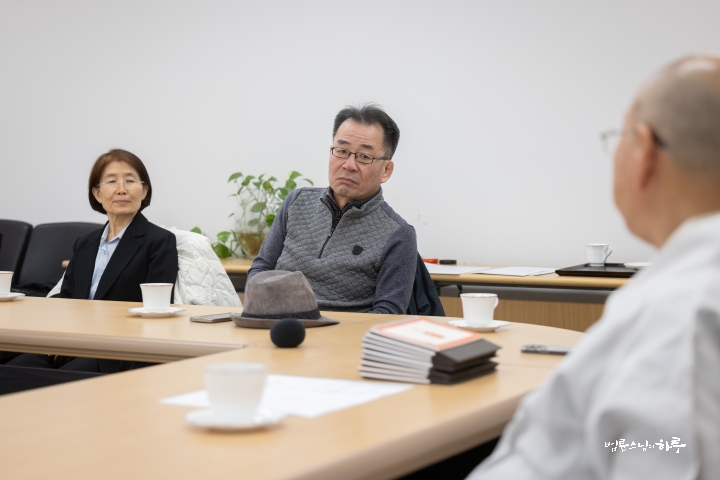
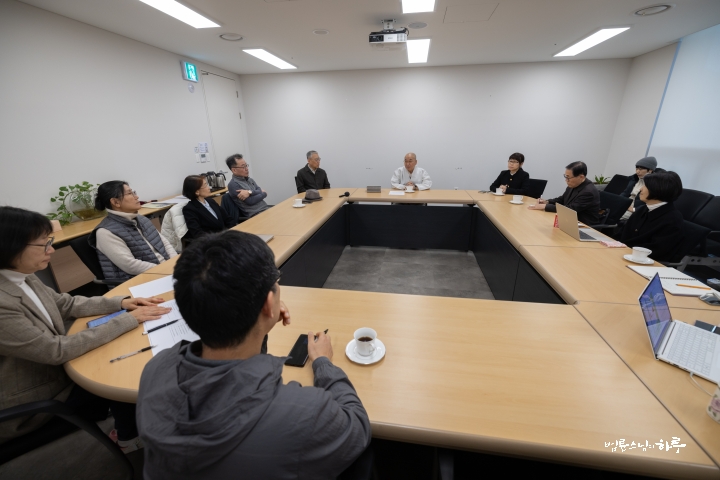
Today’s board meeting agenda was to elect new board members as the current board members’ terms had expired. First, the Peace Foundation secretariat recommended new board members. With no objections raised, the new board composition was unanimously approved.
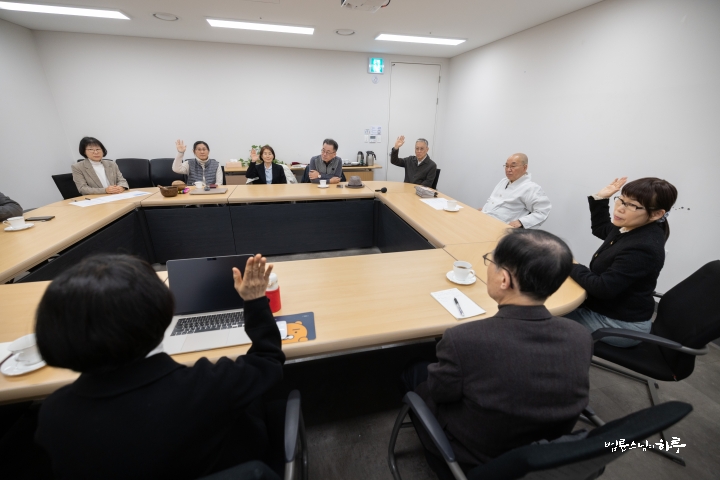
Sunim then gave his greetings and discussed how to improve peace issues on the Korean Peninsula, including recent inter-Korean relations, North Korea-Japan relations, and North Korea-US relations.
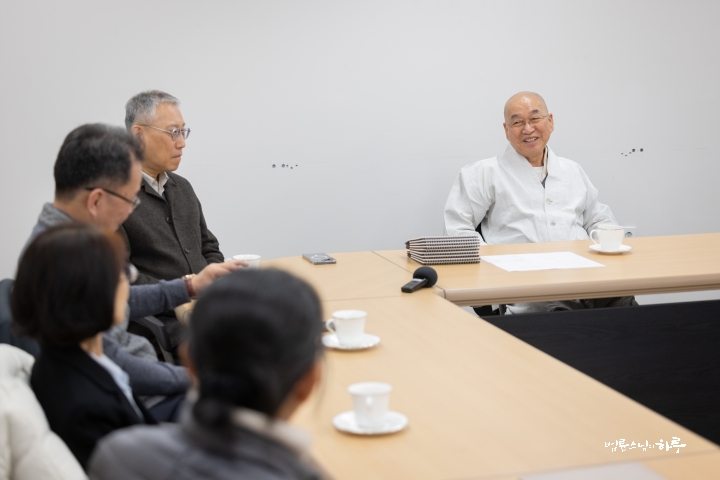
Now Is the Time to Focus on Peace Rather Than Unification
“The Peace Foundation has been working from the perspective of maintaining peace on the Korean Peninsula and achieving unification. However, the situation has changed somewhat recently. Unification becomes possible only when both sides mutually desire it. But now North Korea, which has always advocated for unification, has come forward saying they will not pursue unification. So for the time being, we need to observe the unification issue. I believe this is a time when we should focus more on maintaining peace on the Korean Peninsula rather than unification.
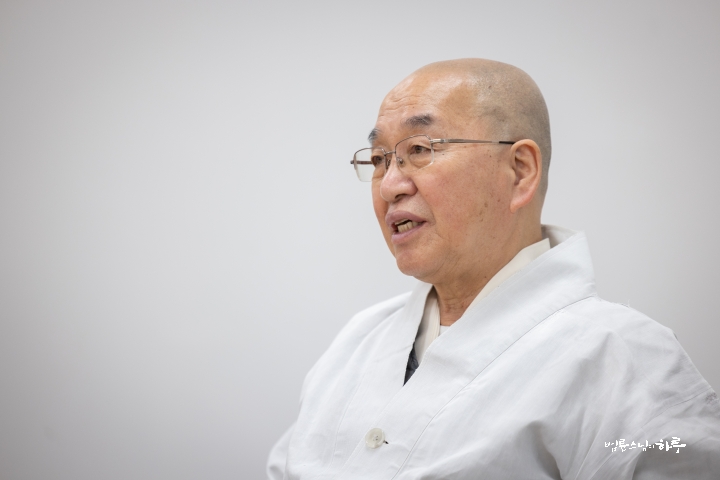
Recently, North Korea’s assertion of the ‘two-state theory’ has sparked much controversy. However, as positions can change when animosity subsides, I don’t think we need to hastily debate this issue. This doesn’t mean we should give up on unification, but rather that we should wait and see for a while. In the past, North Korea strongly advocated for unification while South Korea was rather passive. But now that North Korea is indicating they don’t want unification, I think we need to wait until their position becomes somewhat clearer.
Of course, unification could be pursued through coercive means. But that would increase the risk of war. However, if we aim for peaceful unification, we need to have patience and a waiting attitude. This isn’t about accepting the ‘two-state theory’ now, but rather about setting aside such debates for the moment and focusing first on maintaining peace on the Korean Peninsula.
The Path to Stability on the Korean Peninsula and Cooperation in Northeast Asia
To safeguard peace on the Korean Peninsula, three key tasks must be addressed first. First, relations between North Korea and the United States must be normalized through dialogue. Second, relations between North Korea and Japan must be restored through dialogue. Third, trust between South and North Korea must be rebuilt through dialogue. Only when these three tasks are resolved can Northeast Asia as a whole achieve a stable structure.
A few days ago, I visited Japan and met with senior politicians and government officials to convey the need for a swift restoration of North Korea-Japan relations. If Japan genuinely intends to resolve the abduction issue, it must first initiate dialogue with the North Korean government, the party directly involved. However, North Korea currently maintains that it will not engage in dialogue if the abduction issue is placed at the forefront. Therefore, an approach is needed where dialogue begins within the broader framework of normalizing North Korea-Japan relations, and then mutual demands are coordinated through behind-the-scenes negotiations.
Since North Korea prioritizes “security” for regime survival as its top national priority, there are differences from the values we consider important. Therefore, if we overemphasize only our position, dialogue itself cannot be established. To normalize relations, an attitude of dialogue that considers the other party’s position is necessary.
In East Asia, where tensions between the United States and China are currently escalating, the regions most likely to escalate into conflict are Taiwan and the Korean Peninsula. While the Taiwan issue is difficult for us to intervene in, the Korean Peninsula issue can be stabilized to some extent through cooperation between South Korea and Japan. From this perspective, while the abductee issue and North Korea’s nuclear issue are important, a broader vision that looks beyond these to the stability of East Asia as a whole is needed. In particular, to respond to China’s expanding influence, improving relations with North Korea is essential, even from the perspective of securing safety in the East Sea. This is why I conveyed to Japan’s senior politicians and government officials the need to view the situation from this broader framework.

“The stability of the Korean Peninsula is most important at this time. Whether it’s the two-state theory or discussions about unification, these issues should be set aside for now, and we should prioritize the stability of the Northeast Asian situation. I hope The Peace Foundation will continue to play its role based on this perspective.”
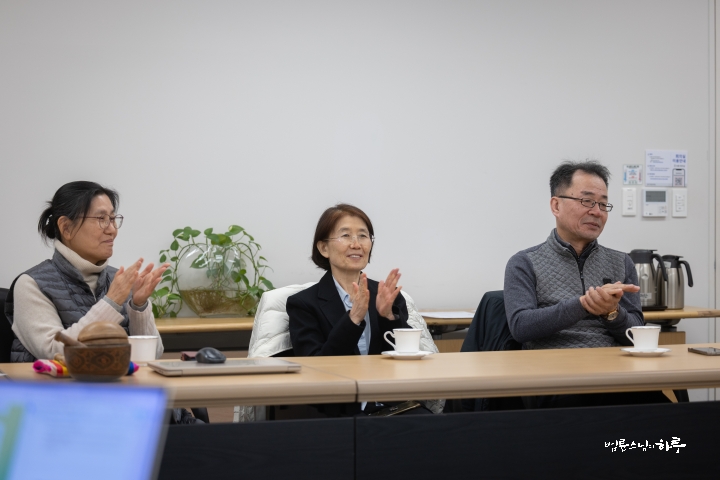
With Sunim’s closing remarks, the temporary board meeting of The Peace Foundation concluded with loud applause.
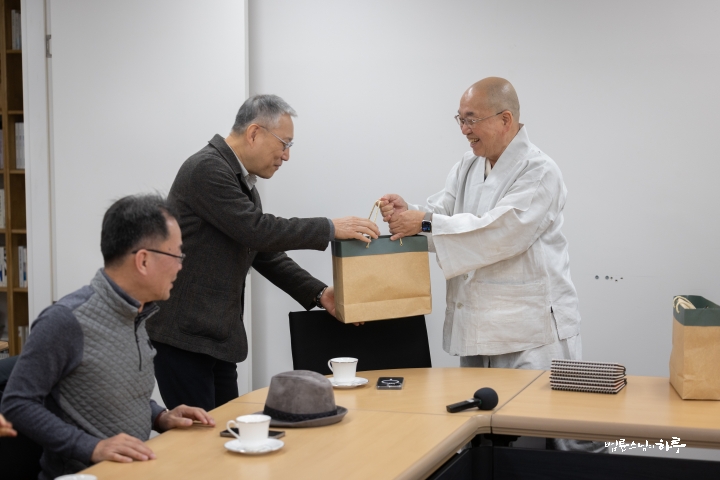
Sunim presented small gifts to the outgoing board members who had worked hard.
“Thank you for your hard work. I appreciate it.”
The newly appointed board members and the outgoing board members gathered together for a commemorative photo.
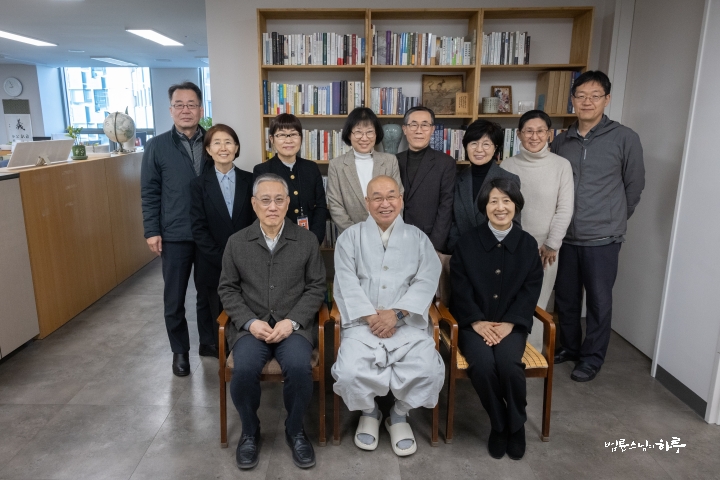
After expressing his gratitude to the board members who had taken time from their busy schedules, Sunim headed to the broadcasting room at the Jungto Center for the leading members’ Dharma assembly.
At 10 AM, the leading members’ Dharma assembly began with the recitation of the Three Refuges and the Heart Sutra. With all leading members present in the video conference room, they requested the Dharma talk with three prostrations.


Sunim announced that the 1000-Day Practice would conclude in two weeks and spoke about what mindset to maintain during the next three months before the next 1000-Day Practice begins.

“We have already reached December, the last month of the year. The First 1000-Day Practice of the Second 10,000-Day Practice now has only about two weeks remaining. The 1000-Day Practice Closing Ceremony will be held on December 14th. After the closing ceremony, we will have a period to evaluate the past 1000-Day Practice. From December 23rd to January 1st next year, we will have a family week for rest, and then on January 2nd, we will have the opening ceremony and resume our work. The completion period of the 1000-Day Practice is a total of three months. During this period, new officers will be elected and the direction of Jungto Society’s operations for the next three years will be determined. Then on March 15th, we will enter the Second 1000-Day Practice. These three months are not simply a rest period but a very important time to wrap up the past three years and prepare for the next three years. How we spend this period will determine how well the past thousand days are concluded and how well the next thousand days are prepared.”
Time of Completion, Preparing for the New Thousand Days
Jungto Society sets its activity periods based on ‘how the human mind generally works.’ When we first resolve to practice, this is called balsim (發心). Even if we resolve ‘I will practice diligently from today,’ it takes time to truly know ourselves. Some people may know themselves in just one day, while others may take ten days. However, generally speaking, it takes at least one hundred days to realize ‘Ah, this is who I am.’ That’s why Jungto Society uses 100-day prayer periods as the basic unit of prayer.
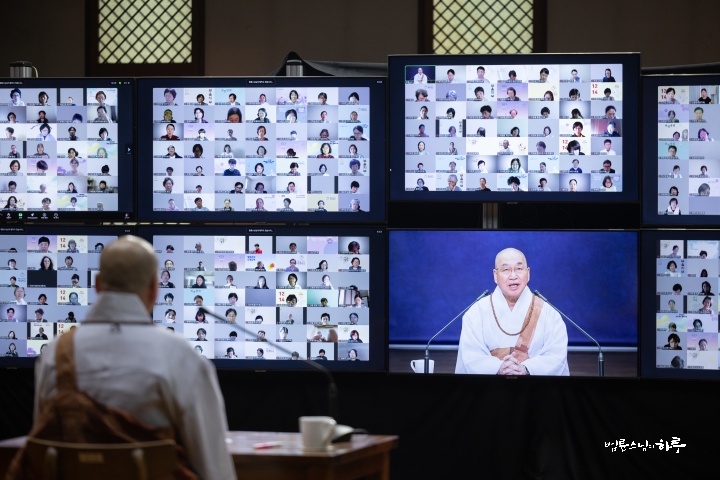
While it takes one hundred days to know oneself, it takes much longer to change what we have discovered about ourselves. Of course, there are people who resolve ‘I need to change myself’ and change immediately. However, most people need to practice steadily for about three years to bring about self-transformation. That’s why Jungto Society conducts practice in thousand-day units, called the 1000-Day Practice. This is precisely why we commonly use the term ‘1000-Day Practice.’ Since Jungto Society is a community of practitioners with the purpose of bringing about self-transformation, the ‘1000-Day Practice’ can be said to be the most important.
Furthermore, Jungto Society pursues not only self-transformation but also the transformation of the society we live in. To transform society, we need to make steady efforts for 10,000 days, which is why we also conduct the 10,000-Day Practice. In other words, the 1000-Day Practice is at the center of Jungto Society’s practice programs, with the 100-day prayer below it and the 10,000-Day Practice above it.
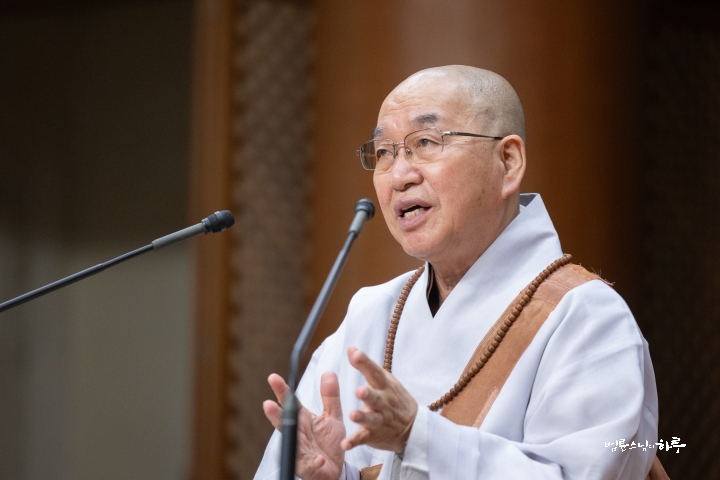
For the general public, participating in the 1000-Day Practice and dedicating themselves to practice for a thousand days is the most central task. Based on this, Jungto Society operates on a three-year cycle, or one thousand days, as a unit for starting and ending terms, initiating and concluding projects, and conducting evaluations. While projects are started and concluded annually, from a broader perspective, all projects are evaluated once every three years.
The same applies to rules. In Jungto Society, when creating or changing any rules, the standard is not one year but three years. This means that once a rule is established, for the next thousand days, members focus steadily on their own practice without blaming the rules. The intention is to persist for a thousand days and then evaluate, regardless of any difficulties that may arise along the way. Accordingly, the term of office for executives is also set at three years. When three years end, the next three years don’t immediately follow. Three years amount to approximately 1,090 days. Of these, a thousand days are dedicated to practice and activities, while the remaining 90 days are set aside as a period to reflect on past activities and prepare for the next phase. This period is what we call the ‘closing ceremony period.’
During these past three years, many of you have raised various issues. However, during the term, we have maintained the rules that were established for the full three years. Now, as we approach the closing ceremony, we must review the many issues that have been raised and make necessary changes after careful consideration. With such preparation, we will embark on a new three-year journey. During the closing ceremony period, it becomes easier to change rules. While during the term, rules could only be changed with the agreement of more than two-thirds of the assembly, during the closing ceremony period, if a majority of members desire it, changes can be made at the Gyeolsa Practitioner meeting. Therefore, I hope you will make good use of this period and generously offer many suggestions for the next three years.”

Sunim then clearly explained various matters that leading members should be aware of, including the attitude to adopt during the interim system and interim leader recommendation meetings during the closing period, the purpose and meaning of position rotation, and gathering opinions on reducing overwork among Jungto Society volunteers.
After the explanation, Sunim opened the floor for questions about any concerns or difficulties experienced during activities. Anyone could press the hand-raising button and ask Sunim questions. One person shared their concern about whether 108 prostrations and meditation could help a student with adult ADHD.
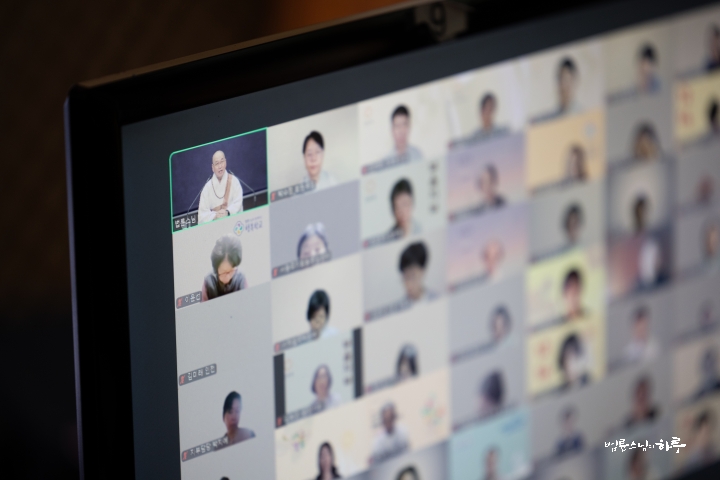
Would 108 Prostrations and Meditation Help a Student with ADHD?
“Meditation is not particularly helpful for those with mental instability or disorders. In such cases, sitting still can actually increase psychological instability, making it very difficult to remain seated. Meditation can be helpful as a form of rehabilitation therapy after urgent treatment has been completed to some degree. However, when the condition is actively progressing as it is now, it’s better to start with lower body exercises like prostrations or walking to channel energy downward and alleviate anxiety before beginning meditation. Sitting still can actually trigger more thoughts and amplify anxiety in some cases. While it helps some people, it can cause adverse effects in others. Therefore, you should observe the student’s tendencies – if meditation helps, they can continue, but it’s not appropriate to keep recommending meditation if it’s not effective. Even in medicine, we don’t recommend something to everyone just because it works for some. Doctors try different medications to find what works for each patient. Activities like walking a lot and doing 108 prostrations improve physical health while also greatly benefiting mental health.
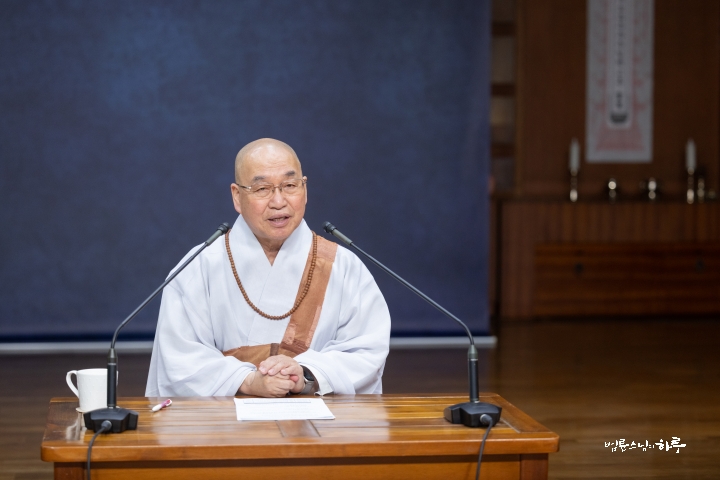
It would be good to guide other fellow practitioners not to be too concerned even if that student exhibits somewhat unusual behavior. It’s already something to be very grateful for that someone with difficulties has participated like this. Rather than feeling uncomfortable, it would be better to encourage other students to study together. However, if we focus too much on the student with the condition, other students may become uncomfortable, and if we emphasize only the discomfort of other students too much, it may result in people with conditions being unable to participate. If the symptoms are so severe that they significantly disrupt other students, they should be excluded from class, but if it’s only slightly uncomfortable, it’s better to ask for understanding from other students and allow them to participate together. This is because studying with normal people is more helpful for the patient. The problem is just that others cannot tolerate it. However, since we are practitioners, I think it would be fine if we guide them to make efforts to understand such aspects. If it’s determined that the symptoms are severe enough to disrupt the entire class, we must also consider other students’ right to education, so there might be a method of gathering just two or three such people separately for special classes.”
“Thank you. I understand well.”
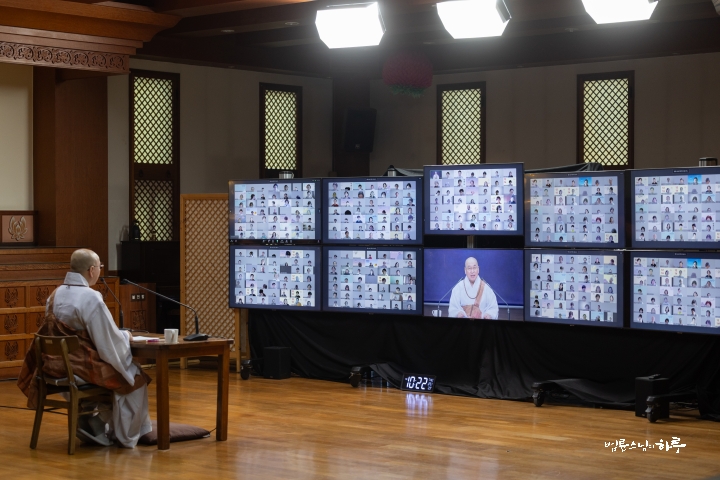
Questions continued one after another. After answering all questions, it was almost noon. After concluding the leading members’ assembly with the Four Great Vows, Sunim headed to the hospital for a regular checkup.
Since one of the coronary arteries in his heart is blocked and he is taking medication, today he had a carotid ultrasound examination at the internal medicine department and returned.
As the sun set, at 7:30 PM, the assembly began with all evening session leading members in attendance. The leading members recited the Three Refuges and the Heart Sutra, then requested a Dharma talk with three prostrations.

Like the morning assembly, Sunim spent an hour explaining in detail the official Jungto Society schedule from after the 1000-Day Practice Closing Ceremony until the next 1000-Day Practice Opening Ceremony, and what mindset to maintain while engaging in activities during this period.
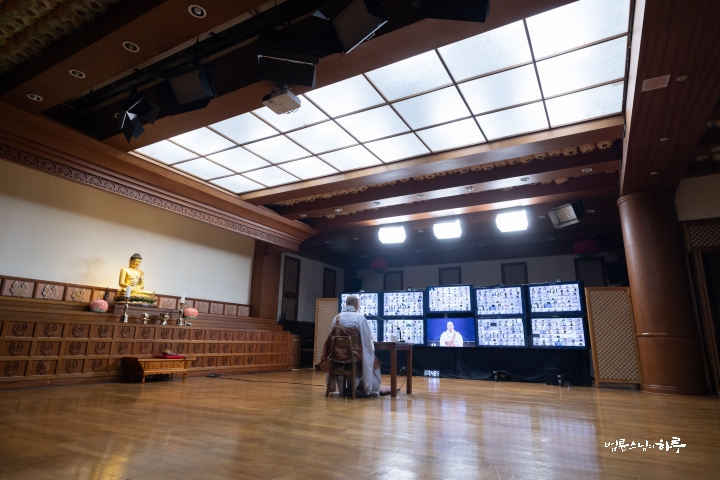
Toward the end of the assembly, he particularly introduced measures prepared by the 1000-Day Preparatory Committee to solve the problem of overwork among Jungto Society volunteers and requested that leading members also propose many opinions.

“The 1000-Day Preparatory Committee is currently discussing various problems that need to be improved. The biggest problem among them is that the workload of leading members is so heavy that it’s difficult to balance with work and family life. They’re being told at home that they’re neglecting family life, and at work they’re being evaluated as neglecting their professional duties. We discussed ways to reduce the workload a bit, but it’s not feasible for leading members to neither conduct Buddhist university programs nor take on executive positions. When we looked into where the workload is heaviest, it turns out there are simply too many ‘meetings.'”
Meeting Restructuring: Between Rights and Efficiency
The topic of reducing meetings has come up many times, but it hasn’t been easily corrected. So this time, we’ve decided to do a ‘meeting restructuring.’ Just as companies reduce staff through restructuring, we plan to reduce 50% of the meetings we currently have. We’ve set the principle of unconditionally reducing half of the meetings regardless of where we cut them, and the 1000-Day Preparatory Committee is now preparing to achieve that goal.
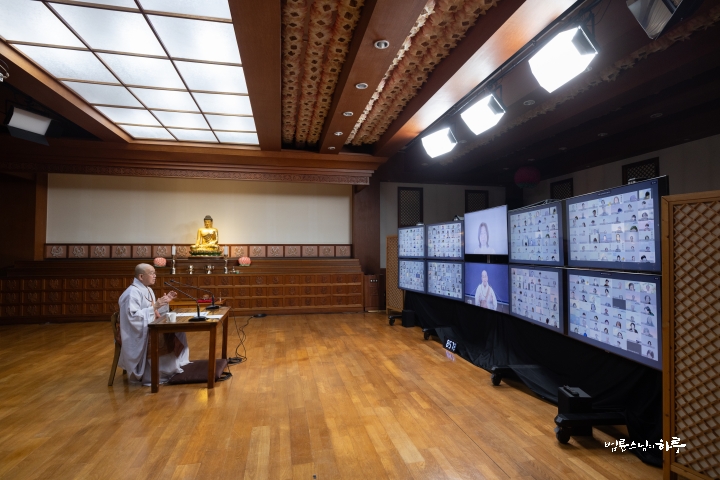
The problem is ‘which meetings should we reduce?’ While it’s true there are many meetings, when we actually try to reduce them, they all seem necessary. After all, these meetings were created because they were needed. So we have no choice but to forcibly reduce their frequency. We’re trying to reduce meetings even if it means imposing mandatory measures, such as changing monthly meetings to bimonthly, weekly meetings to biweekly, and daily meetings to every other day. So please actively participate and boldly propose things like ‘This meeting is really unnecessary,’ or ‘This meeting really needs to be eliminated.’
Normally, proposals need more than two-thirds approval to pass, so if just one-third oppose, changes don’t happen. However, during the 1000-Day Practice completion period, we can boldly change rules. This is because if it passes in the Gyeolsa Practitioners’ meeting, we can change it immediately. So please make many proposals during this opportunity. The biggest task right now is ‘how to restructure meetings?’ We need to discuss how to reduce meeting time and frequency, and how to run meetings effectively.
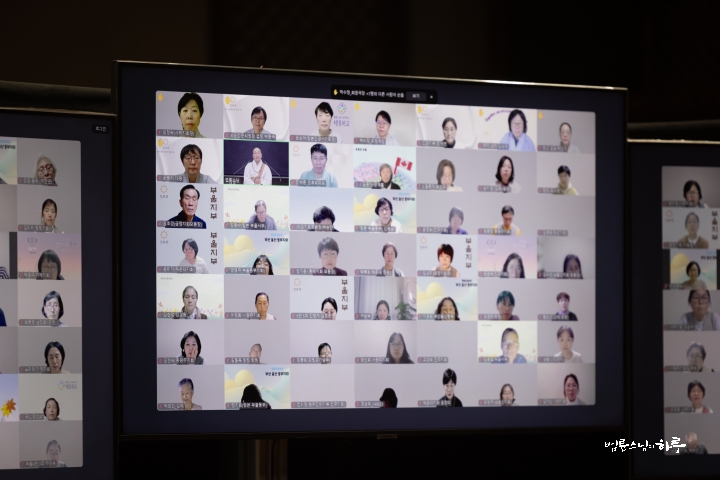
However, we need to think once again about the meaning of meetings. Meetings are the rights of our leading members. If meetings disappear, your rights disappear. In other words, you are giving up your rights yourself. If you want to maintain your rights, you must hold meetings even if it’s difficult. By participating in meetings, you gain decision-making power. The fact that meetings keep decreasing means that you are just accepting decisions already made by someone somewhere. This means your rights are being reduced accordingly. Considering this point, when the survey is conducted, you should express your opinions well.”
Following this, anyone could press the raise hand button and ask Sunim questions. As questions continued, the last questioner shared concerns with Sunim about the environmental impact of artificial intelligence and digital technology.
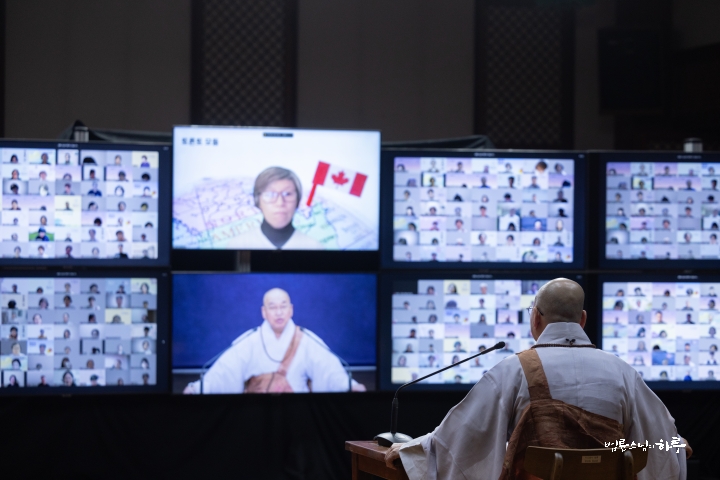
How Should We View the Enormous Energy Consumed by Artificial Intelligence?
“Yes, this is similar to how our body uses energy. The energy we get from eating food is divided into: first, kinetic energy used for lifting or moving heavy objects; second, thermal energy for maintaining body temperature; and third, energy used for thinking and analyzing data in our brain. Among these, the proportion of energy used by the brain is the highest compared to the volume or weight of the entire body. That’s why the amount of blood going from the heart to the head is nearly one-third of the total.
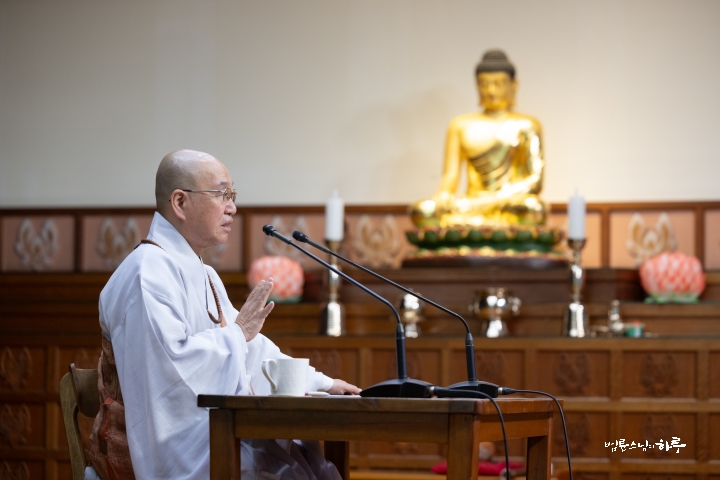
Digital energy use seems to follow a similar principle. When electricity is simply used as motive power, it actually uses little energy. However, when used as thermal energy for heating water, electric irons, or heaters, it consumes a tremendous amount of energy. In the case of electric cars, they can usually travel 300km to 500km, but when you turn on the heater, the driving distance drops significantly. This shows how much thermal energy is consumed. However, what consumes even more energy than this is data analysis.
Currently in Korea, when trying to build data centers, the problem arises that new nuclear or thermal power plants must be built for them. For example, if they want to build a data center in Yongin, but also need to build a power plant there, residents will oppose it. Otherwise, they need to build a power plant elsewhere and bring electricity from there, but then people oppose it because of the transmission towers. Thus, the problem actually occurs where data centers cannot be built even if desired due to electricity issues. While it’s good to save on other things, we must consider that indiscriminate use of data actually consumes enormous amounts of energy.
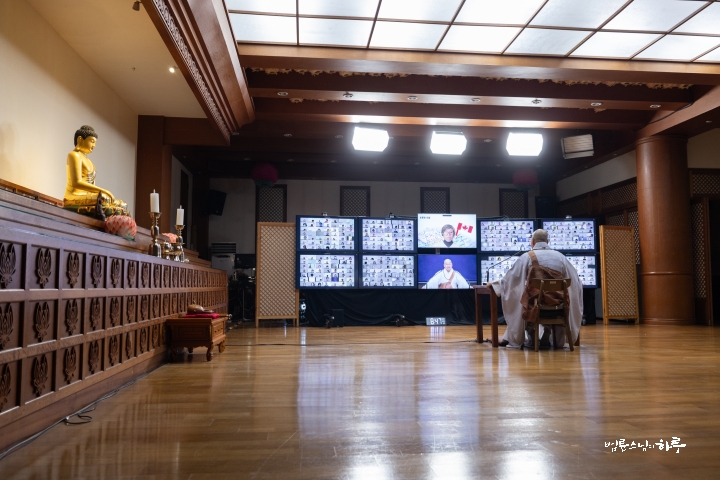
However, there are aspects where efficiency increases through the use of digital technology. For example, if we were to gather in one place for a meeting, everyone would have to drive their cars to get there. Compared to this, video conferencing uses less energy. Therefore, we cannot simply say, ‘Do you know how much energy video conferencing uses?’ We need to consider this point together.
Nevertheless, I hope we include in our energy education the awareness that using data requires an enormous amount of energy. People think they’re not using energy because they’re not turning on heaters or driving cars, but in fact, this also consumes tremendous energy. I hope the department in charge of environmental practices will review this suggestion. The second question seems to be raising the issue that it’s not right to send duplicate messages or spam-like messages while claiming to be engaged in environmental activism. I ask the Dharma School operations team to carefully review this matter.”
“Thank you.”

By the time the conversation ended, it was well past 9 PM. After concluding the live broadcast with the Four Great Vows, the leading members entered video conference rooms by group to have mindful sharing time. Sunim worked late on administrative tasks and proofreading manuscripts before going to bed.
Tomorrow morning, Sunim will have a dialogue with Sasanggye magazine, then participate in the 60th anniversary event of the Dialogue Culture Academy to discuss “The Climate Crisis and the Path of Love for Life.” In the afternoon, he will return to the Peace Foundation for meetings with guests, and in the evening, he will conduct this year’s final Happy Dialogue Dharma Q&A in Chuncheon.