Wouldn't I Be Gaslighted if I Just Go Along with What Others Want?
July 15, 2026. Weekly Dharma Assembly, Meeting with Daein Sunim
Hello. Today, Sunim held the Weekly Dharma Assembly in the morning and then traveled to Miryang (밀양) to meet with Daein Sunim (대인스님).
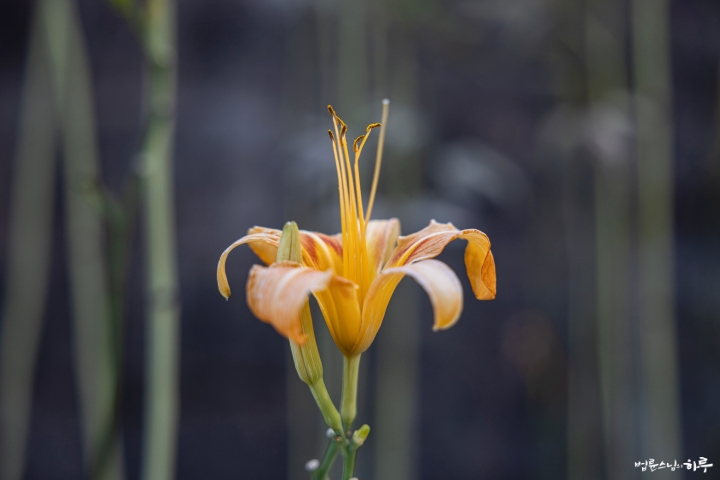
Sunim began the day with early morning practice and meditation. While waiting for the Haengjas, he watered the lawn and then moved to the dolmen area to work on making a flower bed.
"The flower bed is more or less complete, so today let's sort out the stones on the ground and level it. First, let's pick out the larger stones and gather them in piles, and later we'll dig into the ground and bury them."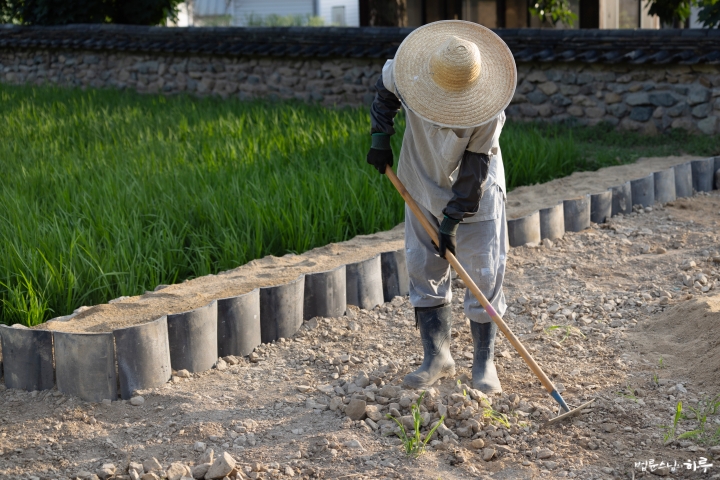
Sunim raked the ground and gathered the large stones. Since it had been hot since dawn, his whole body was soon drenched in sweat.
"This morning seems even hotter than yesterday."After sorting out a good number of stones, the morning work session came to an end.
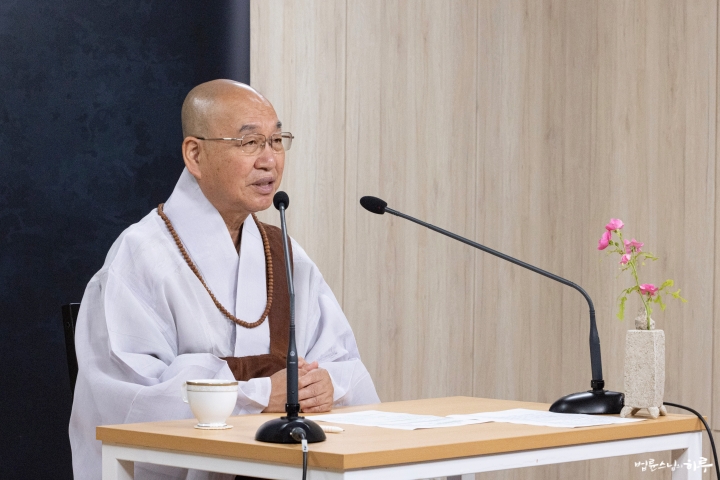
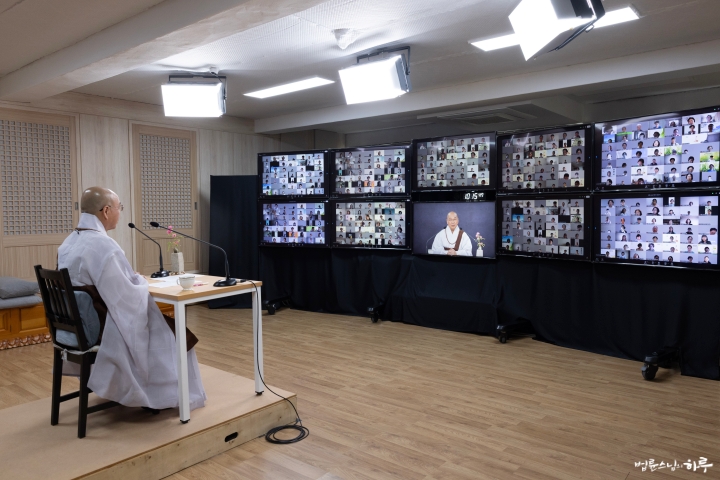
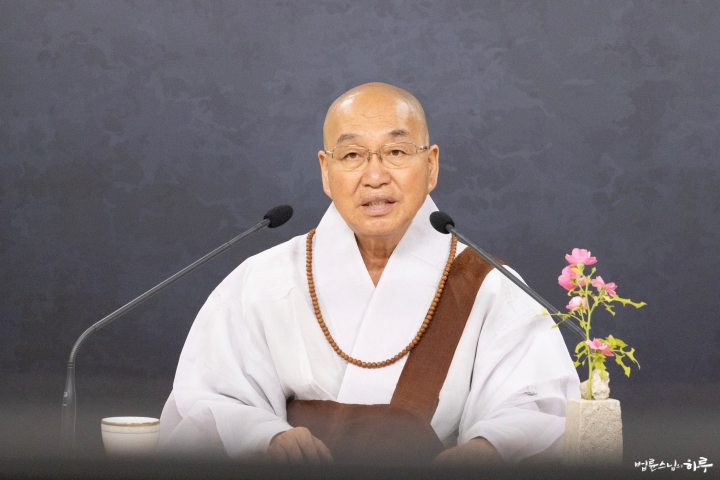
"We have the Weekly Dharma Assembly today, so let's finish early and go prepare for it."At 9:30 a.m., Sunim moved to the Dubuk Studio to hold the Weekly Dharma Assembly. With around 400 Jungto practitioners joining via Zoom, Sunim began the assembly with the week's greeting.
The Northeast Asian History Tour: Visiting Places Imbued with the Noble Sacrifice and Spirit of Our Ancestors Who Made Us Who We Are Today
After spending the retreat with our community members, I will be leaving for the Northeast Asian History Tour. This tour is a field program that explores 'how our ancestors founded our country and through what process it has become the Republic of Korea we know today.' Five thousand, three thousand, and two thousand years ago, the main stage of our ancestors' activities was Manchuria. So, the Northeast Asian History Tour involves exploring the Manchurian region of China and experiencing how our ancestors of those times lived, and feeling their spirit. The places where Hwanung Cheonwang (환웅천왕) founded Baedal (배달나라) or where Dangun (단군) established Joseon are in the border region between Manchuria and Inner Mongolia, but those places are difficult to reach and few remains are left. In comparison, the area around Mount Baekdu still has many remaining relics. So, we plan to visit Huanren(환인) and Ji'an(집안), the early capitals of Goguryeo (고구려), and also see General's Tomb (장군총) and the Gwanggaeto Stele (광개토대왕비). The current Manchurian region is where Balhae, the successor of Goguryeo, established its kingdom for about 200 years. So, we plan to visit the capital of Balhae, Sanggyeong Yongcheonbu(상경용천부), along with various other historical sites. In the past, we could travel as far as the Russian Maritime Province to explore the old sites of Balhae, but since the Russia-Ukraine war, travel to Russia is no longer free. So, this year, we won't be able to go as far as the Maritime Province, and will instead explore the Goguryeo and Balhae-era sites scattered across Liaoning(요녕성), Jilin(길림성), and Heilongjiang(흑룡강성) Provinces. Additionally, since the Manchurian region was the border area between China and Joseon during the Japanese colonial period, many of our ancestors crossed the Amnok and Duman Rivers (압록강, 두만강) to engage in independence movements in North Gando, West Gando, and the Maritime Province. While visiting the independence movement sites, we will take time to feel the sorrow and resistance of our people. Mount Baekdu, the symbol of our nation's spirit, and the Amnok and Duman Rivers that flow from it currently form the border between Korea and China. The Northeast Asian History Tour involves looking around all these places, reflecting on our past, and considering how we can maintain peaceful relations with China, North Korea, and Russia in the future and achieve mutual prosperity. This tour is not about touring Chinese history, but about visiting our own historical sites. Since it involves travel to border areas between China and North Korea, the Chinese government reacts sensitively. As a result, there are controls in various places and restrictions on travel, so it's not exactly a pleasant experience. (laughs) However, even if it's not a pleasant trip, it's a place we must visit at least once. Knowing history means knowing our roots, and drawing on past experiences helps us gain wisdom for the future. China is still not a place where travel is free. So, unlike the India Pilgrimage where 500 people can go at once, participation in this tour is limited. Currently, the Northeast Asian History Tour is being conducted with a limited number of participants. However, since travel to India is relatively free, about 500 people join the India Pilgrimage together. As Buddhists, I hope you'll visit the India Pilgrimage, and as Koreans, I hope you'll make the Northeast Asian History Tour at least once.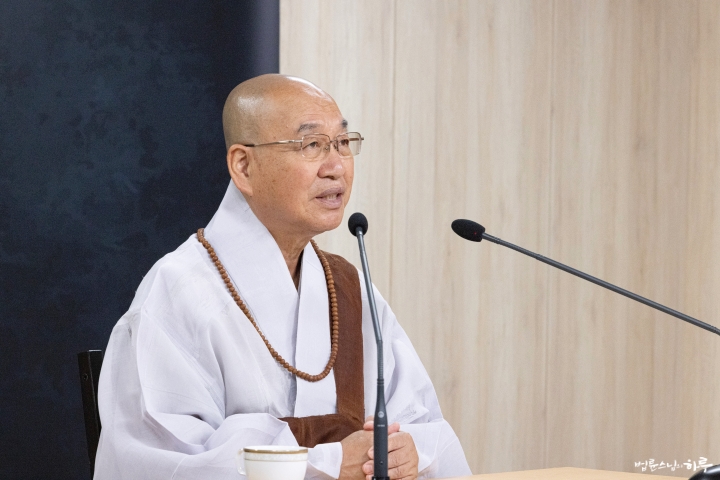
A Time to Prepare to Pass Down a Prosperous Republic of Korea to Our Descendants
We are currently in the Baekjung (백중) Prayer period. This Baekjung, we are praying with the theme of 'Knowing our history, knowing the grace of our ancestors, and having an attitude of repaying that grace.' As children, we must know our parents' grace, and we must recognize that the prosperity we enjoy today was built on the hardship and sacrifice of our ancestors. Therefore, even though our country is prospering, we shouldn't become giddy or self-indulgent, but instead should maintain a reverent attitude. I hope this Baekjung Prayer period will be a time for us to reflect on 'what we need to prepare in order to pass down a prosperous Republic of Korea to our descendants.'"After Sunim's keynote Dharma talk, questions from participants followed. Today, two people had submitted questions in advance. This post introduces one of them.
Wouldn't Letting Go of My Opinions and Thoughts Make Me Vulnerable to Gaslighting?
"From your perspective, you might misunderstand and think, 'If I let go of myself, don't I become a slave who just does what others tell me?' However, the stronger a person's ego and desires, the more easily they can be manipulated by others. This is because as soon as someone caters to them a little, they fall for it. Conversely, someone who is free from such things is very difficult to manipulate. Others may wonder, 'What can I use to control that person?' or 'What bait should I throw?' But no bait works on such a person. The way our minds work is similar to apps installed on a smartphone. In Buddhist terms, this concept of 'apps' is called karmic consciousness (업식, 業識), and in Indian, it's called karma. Depending on which apps are installed, each smartphone operates differently. For example, most people in the world like money, but among them, there are those who are especially attached to money. Most people enjoy eating, but there are those who are unusually fond of food. Everyone likes praise, but some are more strongly swayed by words or compliments. Like this, each person has something they especially like—in other words, their own karmic consciousness. If I'm someone who really loves money, I have a higher chance of falling for the bait of money. If someone proposes that I can make a lot of money through investment, I'm more likely to be tempted and fall for a scam. Also, if I have strong sexual desires, I would easily fall for a honey trap. Having strong karmic consciousness means firmly clinging to one's own thoughts, preferences, and perspectives, which makes one more susceptible to being manipulated by others. Let's look at an old story. During war, in order to defeat the enemy, they would identify the ruler's personality—if he liked women, they would send women; if he liked money, they would offer gold and treasures; if he liked praise, they would send eloquent speakers to manipulate his mind. This involves figuring out which part of the opponent's mind can be shaken and which desires can be fulfilled to control them. Socially, we only look at the result of gaslighting and say the perpetrator is bad, but psychologically, this relationship is established because the victim also has 'a karma of being captivated by certain things.' For example, let's say there's someone who is short on money and constantly dreams of striking it rich. A con artist approaches them and says they can earn tens of millions of won just by helping with a bank transfer or moving a small item. With a little thought, one could realize this is part of money laundering or drug trafficking. But when blinded by money, one cannot come to such realizations on one's own. It's because they took the bait thrown at the weakest part of their mind."Recently, the new term 'gaslighting,' which refers to psychological manipulation, has come into widespread use. It refers to speech or behavior aimed at subtly undermining another person's autonomy to bring them under one's influence. One day, I became confused about a passage in the Vow of a Jungto Practitioner: 'I will let go of myself, let go of what is mine, let go of my stubbornness, and become a bodhisattva who follows the needs of sentient beings.' Doesn't 'becoming a bodhisattva who follows the needs of sentient beings' mean losing my sense of autonomy? I'm wondering if this is truly a path to freedom for me."
As soon as the Weekly Dharma Assembly ended, Sunim traveled to Miryang to meet with Daein Sunim. Daein Sunim runs Cheonchuk Seonwon (천축선원) in Shravasti, India, and every year, whenever Jungto Society pilgrimage groups led by Sunim visit Shravasti, he devotedly prepares lodging and meals for them. Upon hearing that Daein Sunim, with whom he has maintained a long-standing connection, happened to be staying in Korea, Sunim gladly headed to Miryang.
At 12:20 p.m., Sunim arrived at 'Aranya (아란야)', Daein Sunim's residence in Miryang. Through the car window, Sunim could see Daein Sunim and Jeokjohaeng Bosalnim (적조행보살님) waiting by the roadside to greet him. Since Sunim had always met Daein Sunim and Jeokjohaeng Bosalnim in India, meeting them here in Korea was all the more delightful.
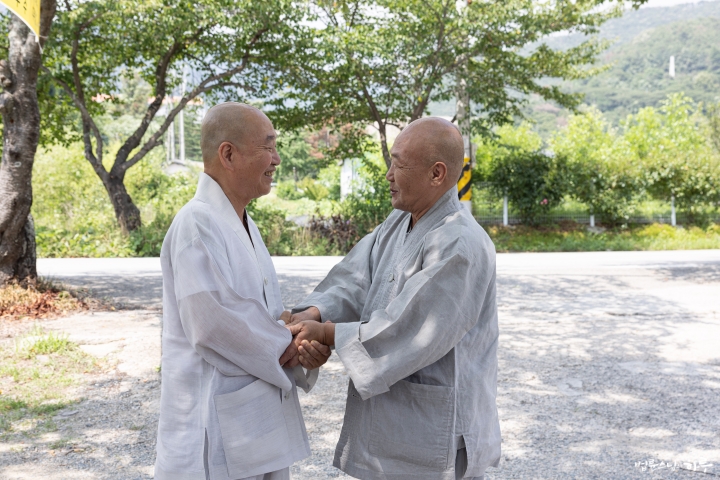
After getting out of the car and exchanging warm greetings, they went inside Aranya to have some tea.
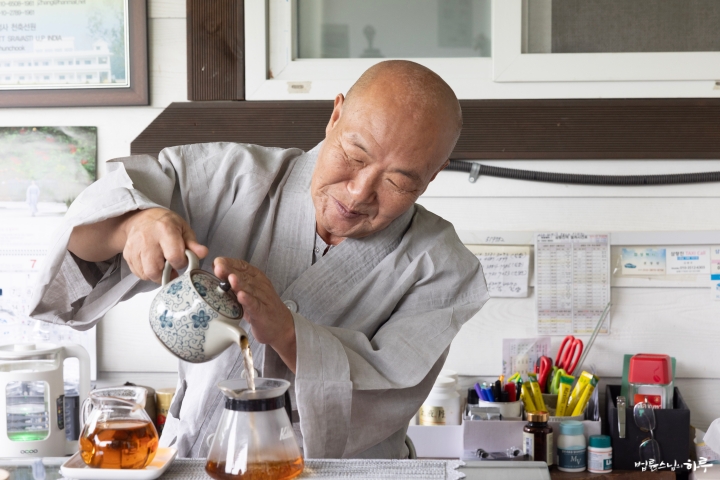
"I should have gone to see you, but I'm sorry to have made you come here."
"Not at all. I came thinking we could at least share a bowl of noodles together. (laughs)"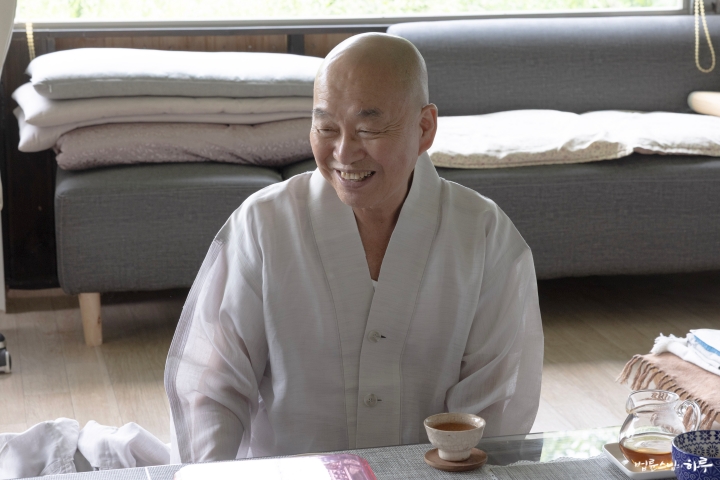
Jeokjohaeng Bosalnim mentioned that whenever Jungto Society pilgrimage groups visited Cheonchuk Seonwon, they had always been inconvenienced because there was no proper place to wash dishes after meals, and she showed photos of the newly built washing area. While talking for a while, lunchtime came around, so they moved to a noodle restaurant nearby.
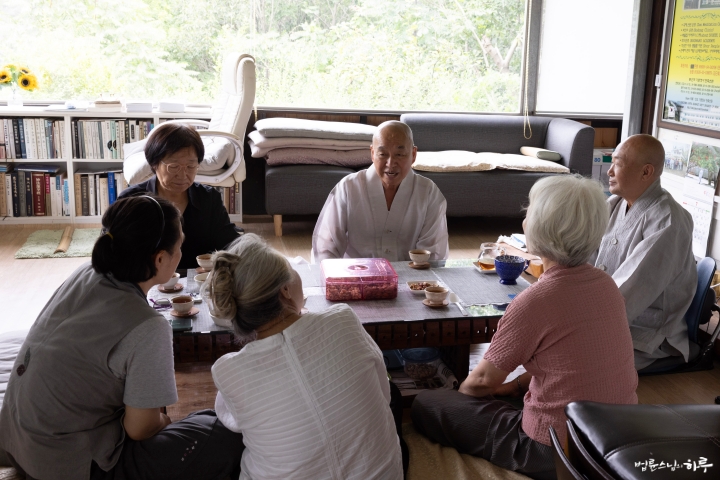
As they sat in the restaurant waiting for the food, Jeokjohaeng Bosalnim spoke about her daughter, who had recently graduated from the Jungto Dharma School. Her daughter, who lives in China and had briefly come back to Korea, was on a train heading to her in-laws' house, but upon hearing that Venerable Pomnyun Sunim was in Miryang, she got off the train and was now on her way here.
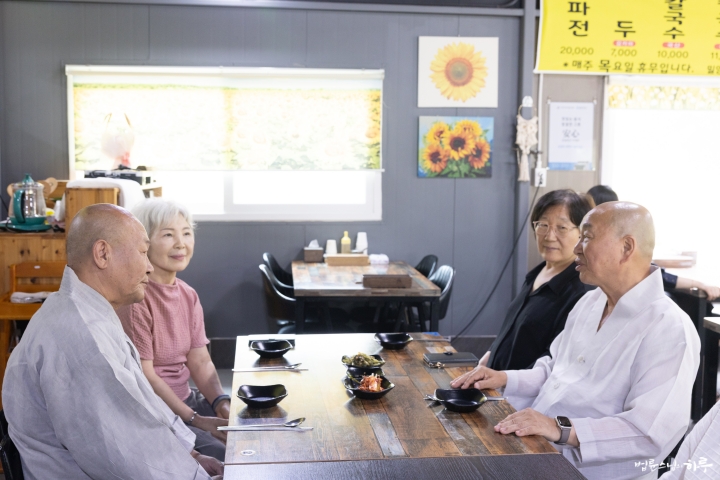
Soon, Jeokjohaeng Bosalnim's daughter arrived at the restaurant and greeted Sunim.
"Sunim, it's an honor to meet you like this."
"Thank you."Jeokjohaeng Bosalnim's daughter was very delighted to meet Sunim.
"Sunim, I have one question. What is the reason for doing mindful sharing during practice?"
"Mindful sharing is about sharing the state of your mind at this present moment. Saying, 'I really enjoyed Sunim's Dharma talk yesterday evening,' is not sharing your current mind but recalling yesterday's mind. That is not sharing your present mind. As you do mindful sharing, you gradually practice becoming aware of your current state of mind. If you are stubborn, you recognize, 'Ah, I am being stubborn.' If you are angry, you recognize, 'Ah, I am angry.' If you are aware of your own greed and anger, then even if someone says, 'You are greedy,' you can readily acknowledge, 'Yes, I do seem to be a bit greedy.' However, because we don't know our own state, when someone says, 'You are greedy,' we retort, 'What do you mean I'm greedy?' or 'You're the one who's more greedy.' But if I know myself, I can simply say, 'Yes, it might appear that way,' and let it go. There's no reason to feel bad. However, we tend to think that practitioners shouldn't get angry. When we suppress and repress our minds, thinking, 'How can a practitioner get angry?' practice becomes difficult and stressful.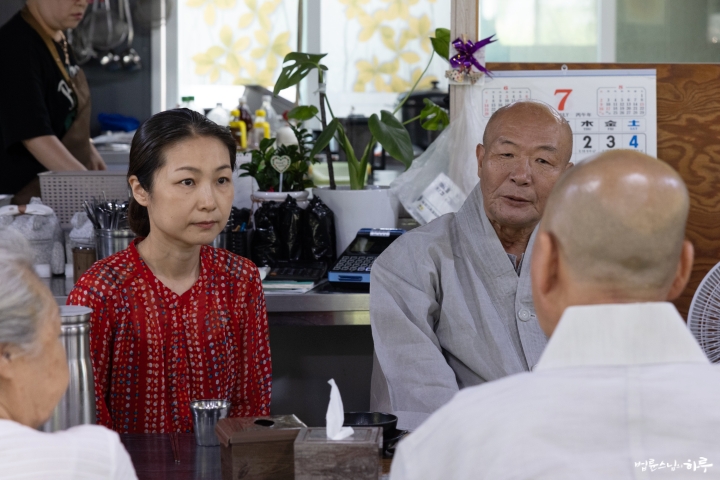
Sunim and the group left the restaurant, took photos together, and got in the car.
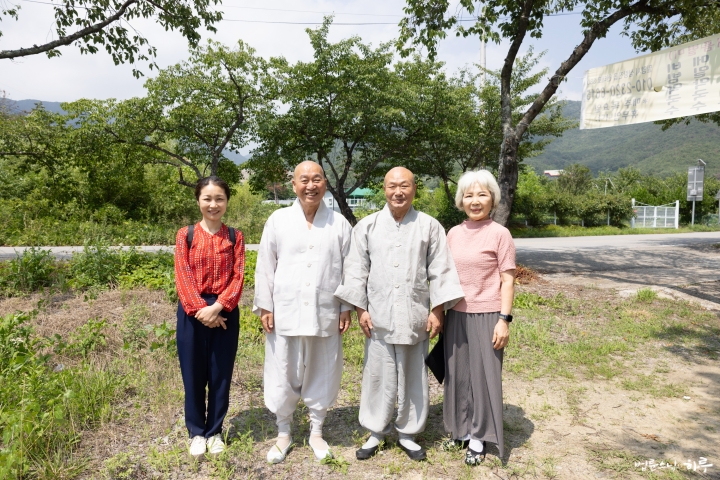
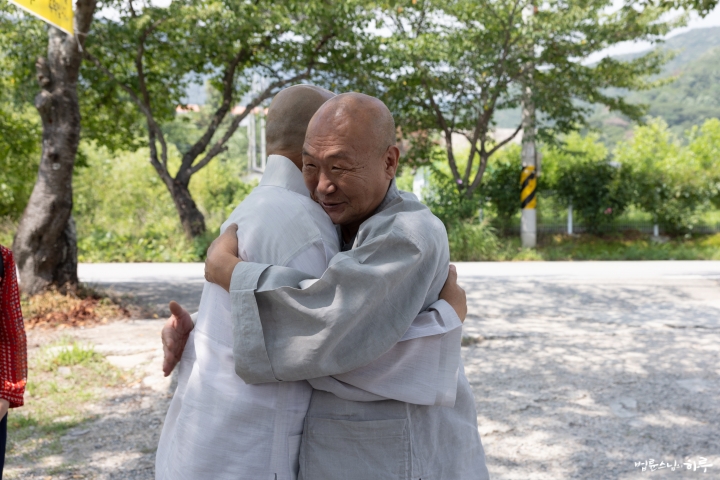
"Take care, Sunim."
"Yes, let's meet again in India."After exchanging farewells, they drove for an hour and returned to the Dubuk Jungto Retreat Center.
Sunim arrived at the Dubuk Jungto Retreat Center around 4 p.m. After a brief rest, at around 6 p.m., he moved to the training hall built three years ago and checked the outdoor sink and water facilities to see if they were suitable for installing tofu-making equipment.
Walking along the rice paddy paths, Sunim returned to the yard where the flower bed was being made.

Sunim worked with the Haengjas to level the ground.
"Let's finish the work for today. We've more or less completed making the yard and the flower bed. Now, we just need to plant the flowers and trees."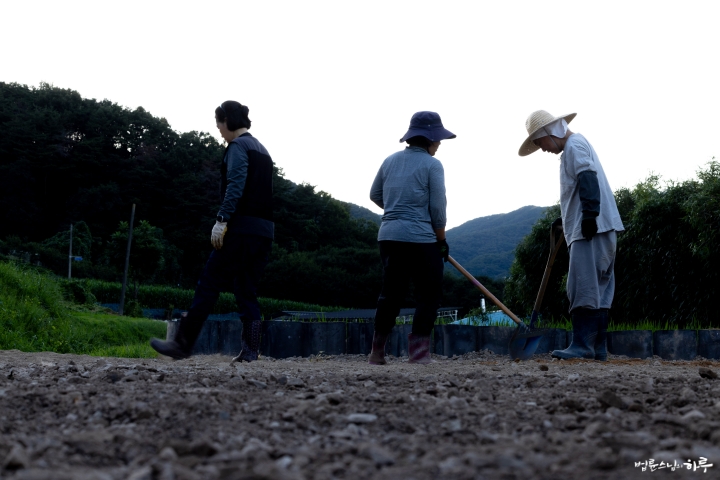
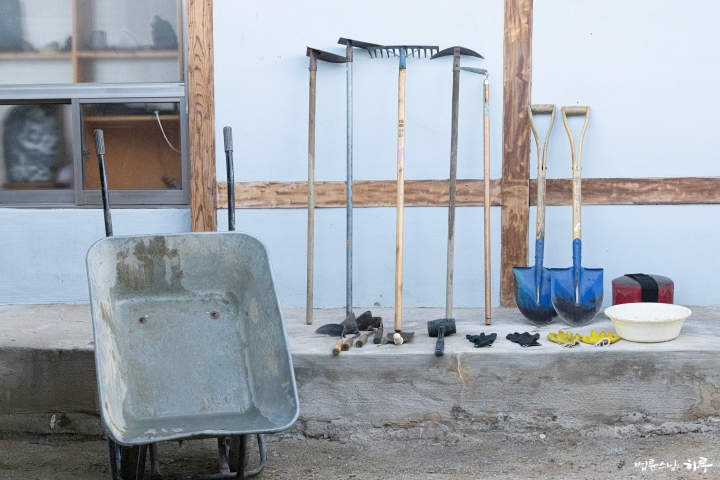
Sunim washed the work tools clean, set them out to dry, and wrapped up the day.
Tomorrow morning, Sunim will have a medical appointment at the hospital, and then he plans to visit an elderly female practitioner in Busan.