Even When I Achieve My Goals, I'm Not Happy. What Standard Should I Live By?
July 14, 2026. Making Tofu, Paying Respects to the Late Venerable Geunil
Hello. Today, Sunim made tofu and visited Gounsa Temple in Uiseong to pay his respects, as Venerable Geunil had entered Nirvana.
Today, Sunim's day began earlier than usual in the pre-dawn hours. Since Myodeok Dharma Teacher was going to Seoul by the 5 a.m. train, Sunim decided to make tofu to send along with her for the Seoul lay Sangha.
Yesterday afternoon, all preparations for making tofu had been completed, and at 2:40 a.m. today, everyone gathered in the kitchen to begin making tofu.
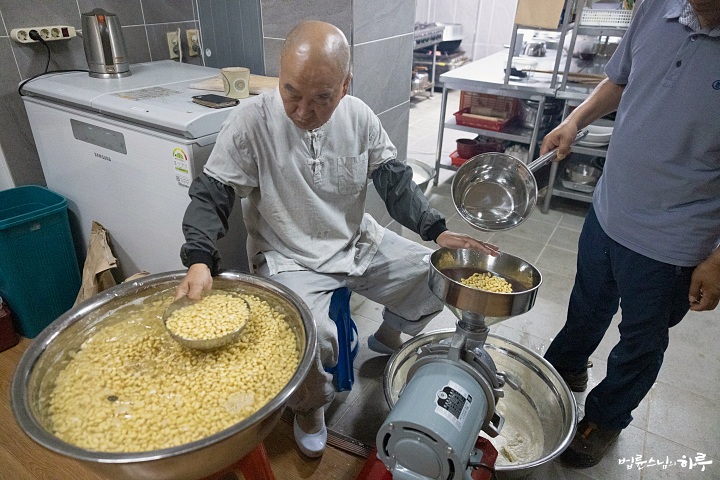
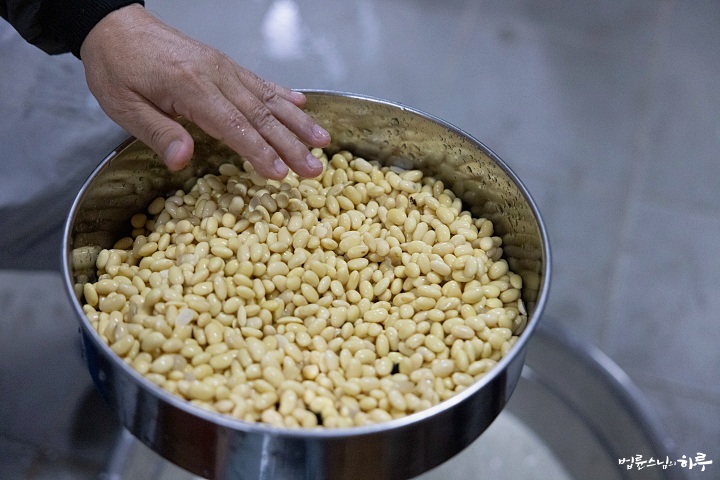
As with a few days earlier, 10 kg of soybeans had been properly soaked. Today, the plan was to make two batches of tofu. First, Sunim put the soaked beans into the grinding machine. The beans were quickly ground. Compared to last time, less water was used to grind the beans, making them thicker. Two large basins were filled with ground beans.
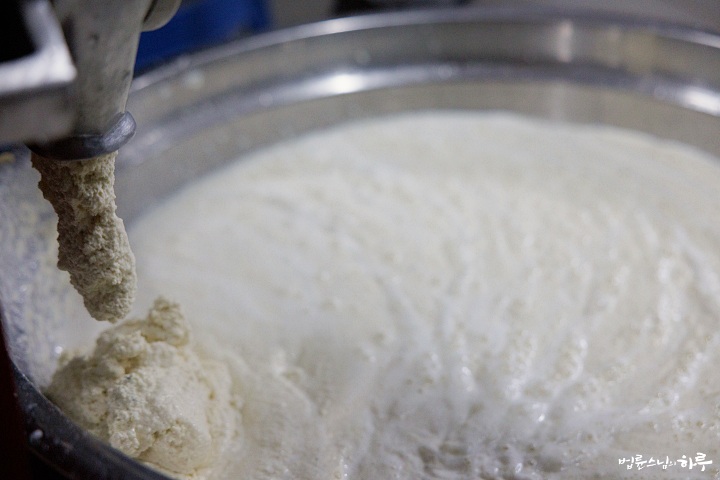
Sunim moved the first basin next to the stove and began boiling the ground beans in a large pot with hot water, stirring continuously. As the stirring continued, bubbles began to slowly rise. Since the pot could easily overflow in an instant, cold water was poured in three times while stirring continuously, and the soybean liquid was cooked well.
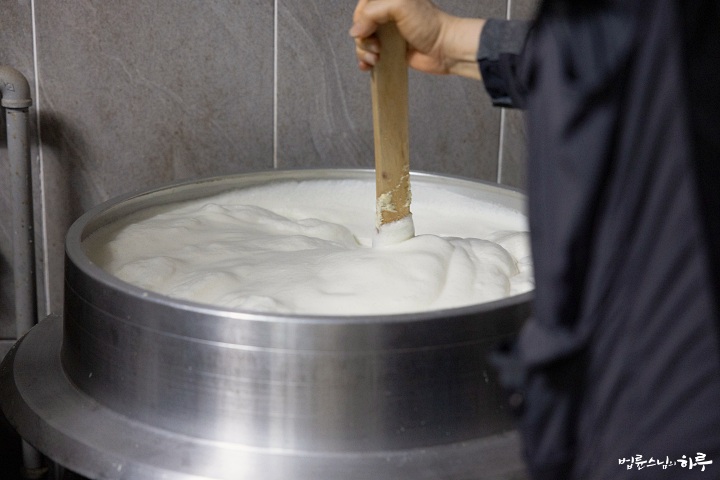
When making tofu a few days ago, squeezing the cooked beans by hand in a sack took a long time. So this time, a tofu dehydrator had been purchased in advance. Since the beans were hot enough to burn hands, Sunim put on rubber gloves and began working.
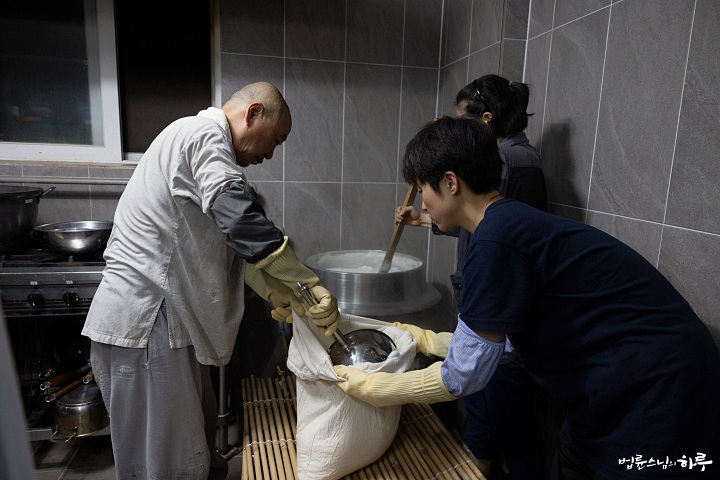
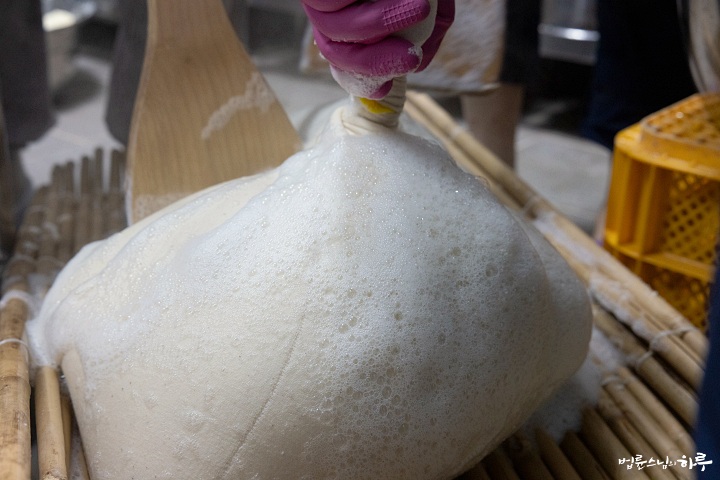
The hot cooked beans were placed in a sack and pressed once with a wooden spatula, and after some water had drained, the sack was placed in the dehydrator and spun. Compared to squeezing by hand, this saved a great deal of time. When the sack was opened, the soybean liquid had been well extracted, and the bean pulp had formed well. Sunim added brine to the soybean liquid and waited for the tofu to coagulate, but it didn't coagulate well. Sunim said,
"What could be the reason? Is it because there is too little brine? Or is it because the water is too hot?"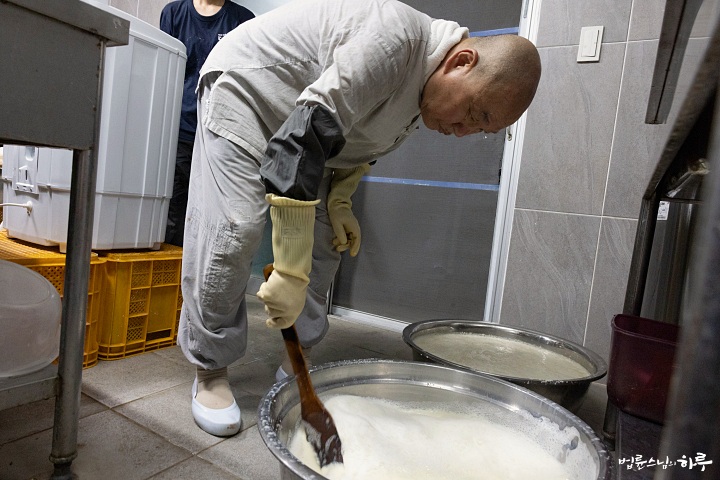
This time as well, tofu was made by adding a little vinegar in addition to the brine.
On the other side, the second basin was also boiled with the ground beans in the same way and placed in a sack to squeeze out the soybean liquid. As the dehydrator was spinning, there was a sudden popping sound, and when they looked, the cloth had burst inside the dehydrator, splattering bean pulp all over the kitchen. Fortunately, none of the Dharma Teachers who were working were hurt, but the kitchen became a mess.
"We need to clean it up well. Otherwise, Dubuk lay Sangha might not lend us the kitchen again."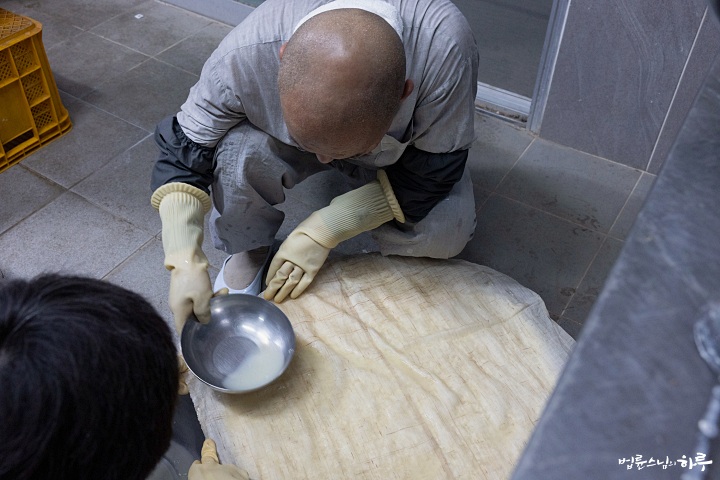
Sunim, sweating profusely, placed hemp cloth over the coagulated tofu and scooped out the water. After scooping out some water, he placed hemp cloth on the tofu mold and poured in the coagulated tofu.
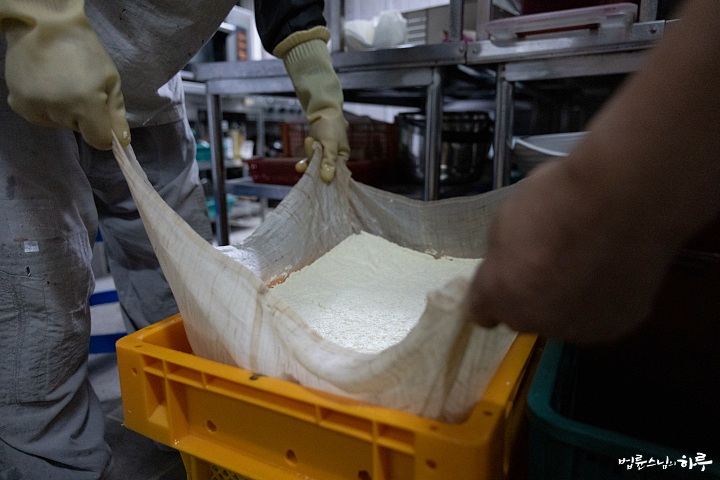
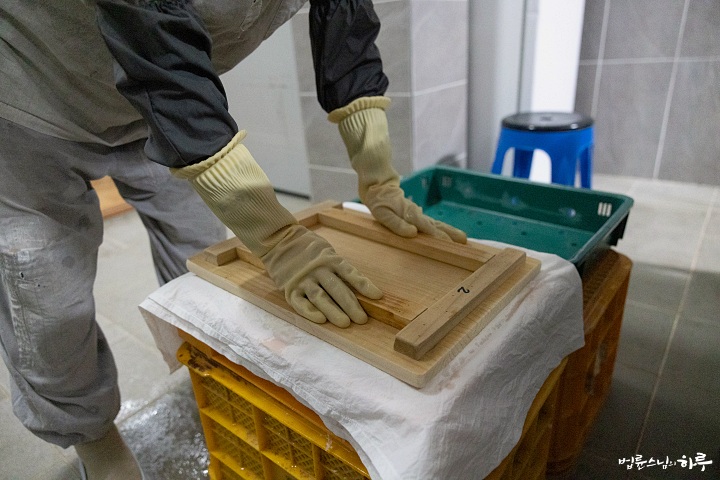
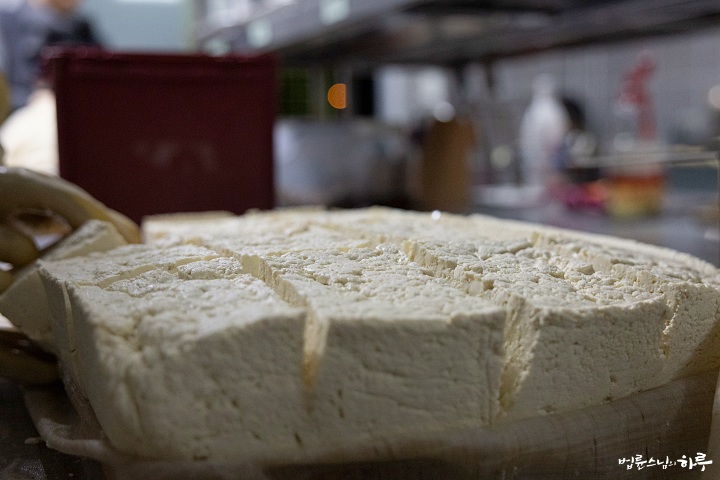
Once some water had drained, the cloth was covered and pressed down with something heavy, waiting for the tofu to firm up. When it was opened a while later, the tofu had turned out well.
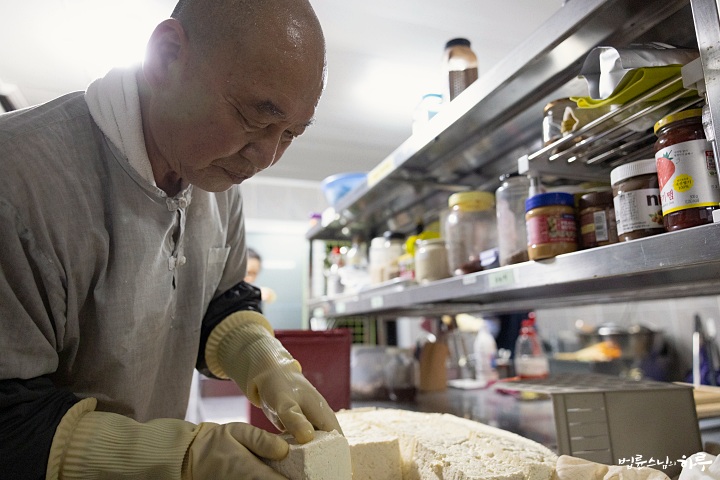
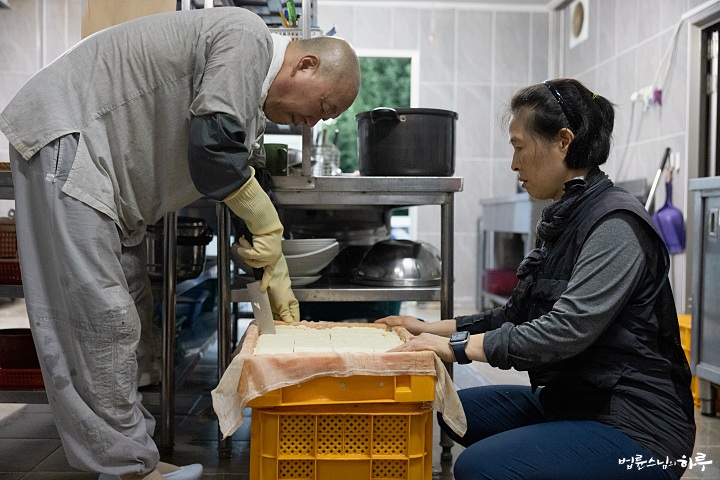
The tofu was cut and placed neatly in containers so it could be sent to Seoul. Myodeok Dharma Teacher was waiting to catch the train. Sunim said,
"This is tofu that Sunim made with his sweat. (Laughs) Please have the Seoul lay Sangha members taste it.""Yes, Sunim. Thank you."
The second batch of tofu also turned out well. The second batch was also cut nicely and divided into portions for the members to eat and portions to give as gifts.
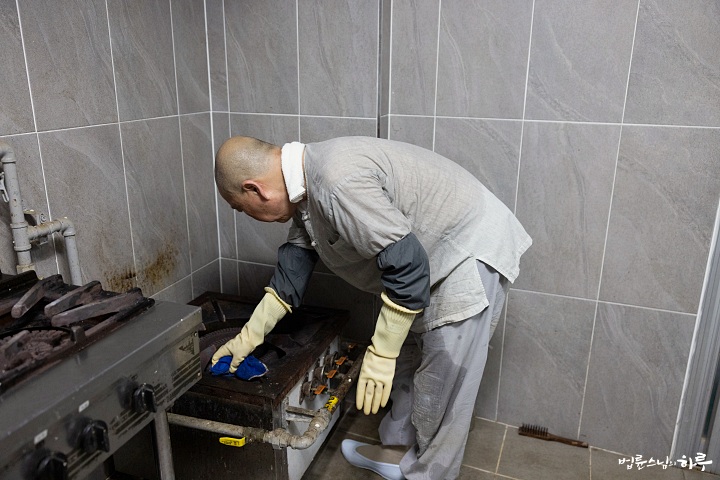
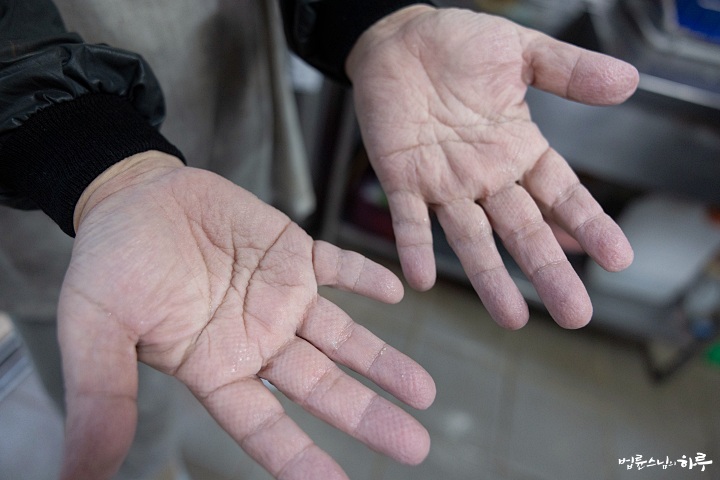
After finishing the work, Sunim cleaned up together with the Haengja trainees. The bean pulp that had splattered everywhere when the dehydrator burst was wiped up with rags. After finishing the cleanup, when Sunim took off his rubber gloves, his hands were swollen and puffy from being soaked in sweat for two and a half hours.
In the morning, Sunim rested and revised manuscripts.
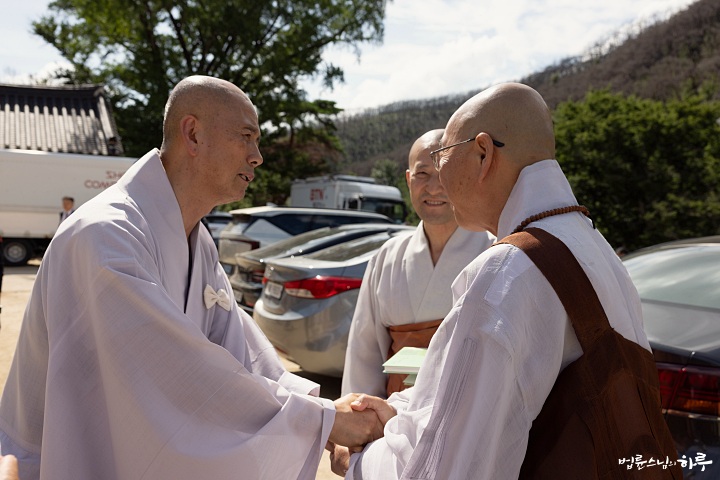
After having lunch at 12 noon, at 1 p.m. Sunim departed for Gounsa Temple in Uiseong to pay his respects, as Venerable Geunil, the head monk of Buseoksa Temple in Yeongju, had entered Nirvana. Stopping by Gyeongju, Sunim moved to Gounsa Temple together with Jin Byeong-gil, the director of the Silla Cultural Center. As Sunim conversed with Jin Byeong-gil, they arrived at Gounsa Temple at 3 p.m. Yusu Sunim had arrived earlier and greeted Sunim.
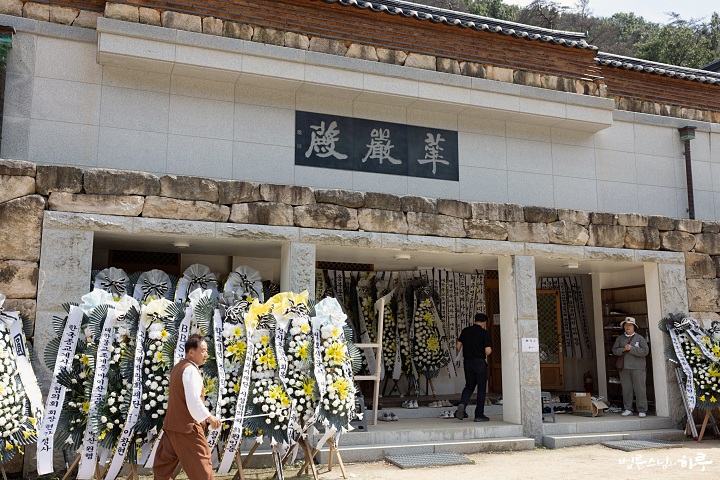
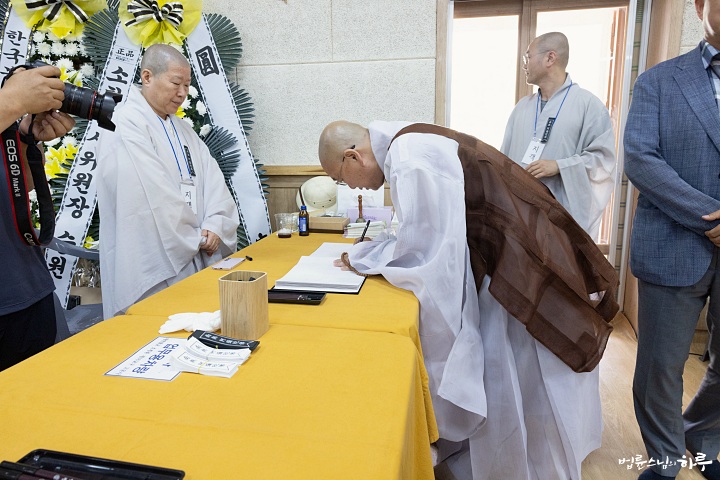
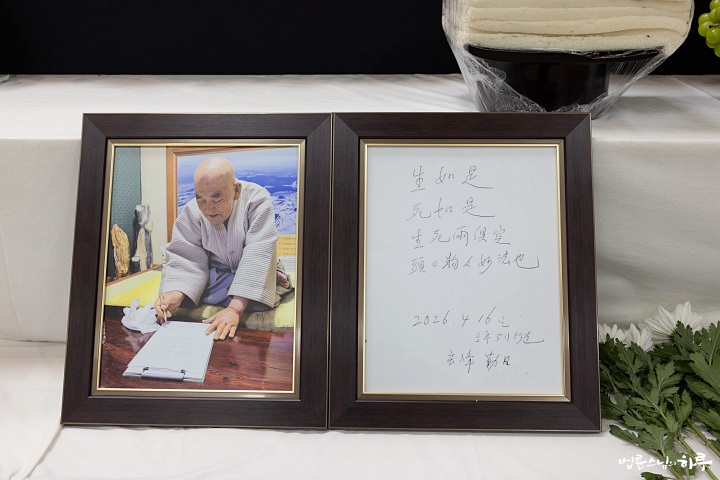
Sunim entered the memorial altar area, gave a condolence donation, offered flowers before the portrait of the late Venerable, and performed bows. He also bowed to and exchanged greetings with the disciple monks. He exchanged greetings with other monks who had come to visit the memorial altar as well.
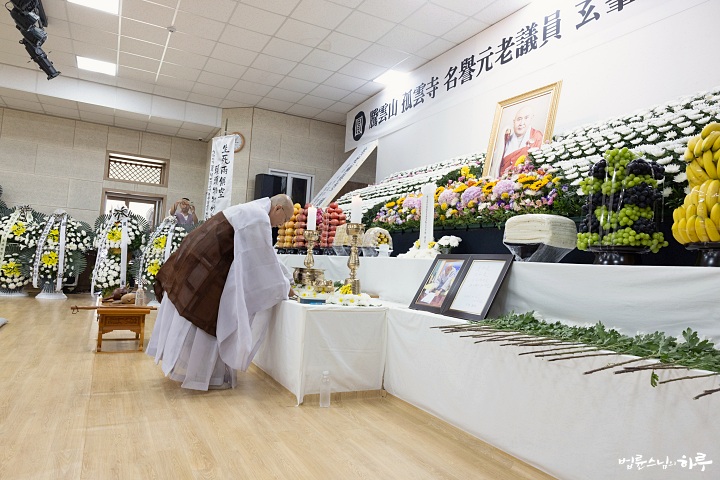
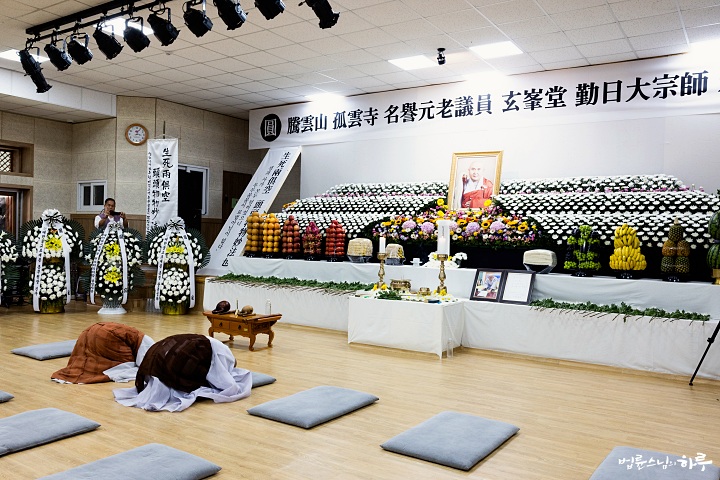
Hoseong Sunim, representative of the disciples, guided Sunim to the reception room and served tea. On the way to the reception room, the trees around Gounsa Temple were black and burnt from the wildfire in March last year.
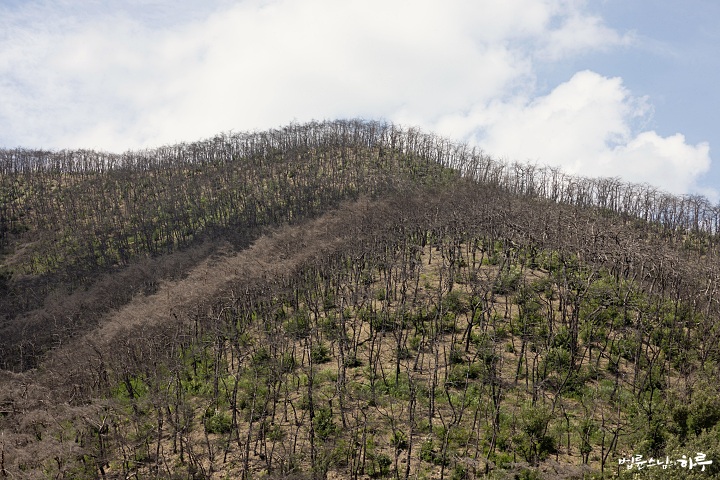
Hoseong Sunim, representative of the disciples, said,
"It was a disaster like no other. Many halls were destroyed, but fortunately the Temple Stay building didn't burn down, so we were able to set up this memorial altar for the late Venerable."
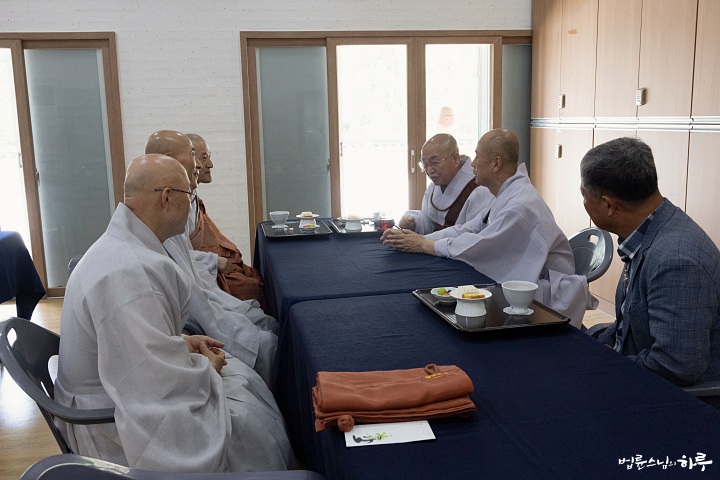
Sunim had a conversation over tea with Hoseong Sunim and Deungun Sunim, the abbot of Gounsa Temple.
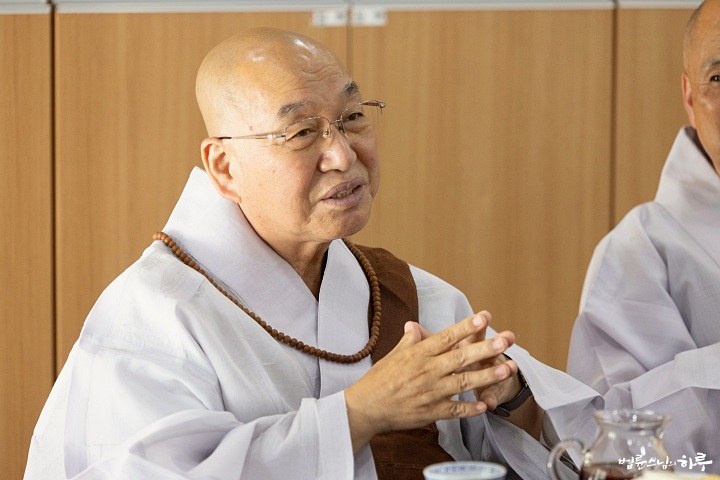
Sunim reminisced about the late Venerable and said,
"I had the connection of attending the World Buddhist Conference in Delhi, India, together with the late Venerable and having conversations with him.""Yes, I remember."
Hoseong Sunim spoke in tribute to the late Venerable Geunil.
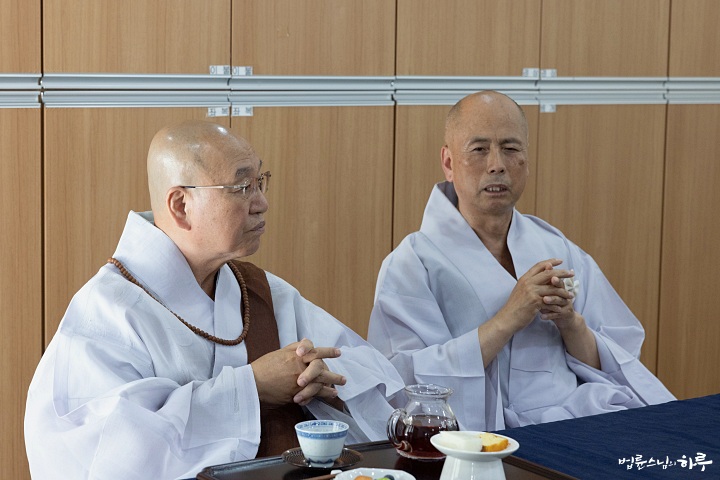
"Our late Venerable lived according to his vows. He practiced diligently, and wherever there was a place that wanted a Dharma talk, he went. Now that I think about the late Venerable having passed, I wonder how I should live... I thought I had been dedicating myself to practice, but I wonder how I should live, and I only think of the things I did wrong rather than the things I did well."
"You are a filial disciple. (Laughs)"After sharing stories about the elderly Venerable Domun and the late Venerable Seoam, who had already passed away, Sunim finished the tea conversation and got into the car as the monks saw him off.
As they drove out, they took a look around the grounds of Gounsa Temple. Many of the halls had burned down from the fire, leaving only their foundations. The bell pavilion where the bell is struck had also burned down, leaving only the bell sitting there alone. Fortunately, the main Buddha hall appeared to have been undamaged.
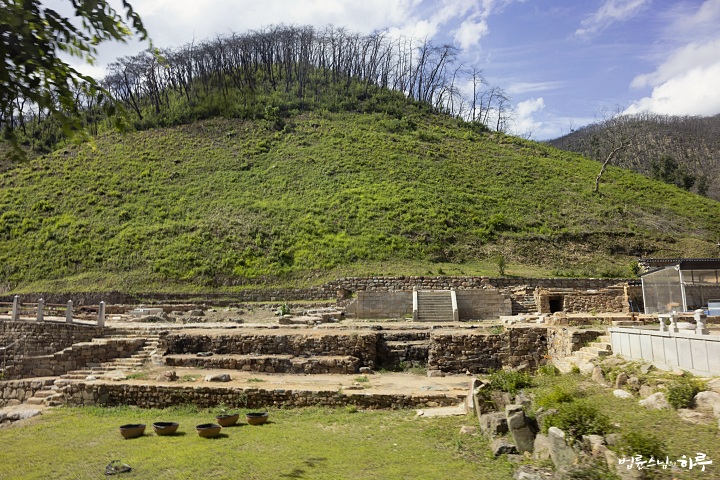
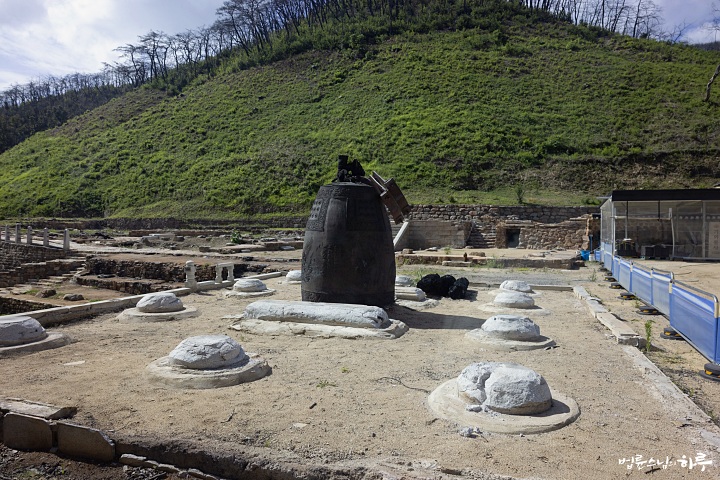
Leaving behind the sadness, they turned the car around and headed for Dubuk Jungto Retreat Center. As they passed Gyeongju, a few drops of rain began to fall.
"If it rains, we won't have to do the evening communal work. (Laughs)"However, when they arrived near Dubuk Jungto Retreat Center, not a single drop of rain had fallen there, as if the earlier rain had never happened.
"It rains everywhere else, but only in this area where Dubuk Jungto Retreat Center is located, it doesn't rain. This is a serious problem."Upon arriving at Dubuk Jungto Retreat Center, it was about 5:30 p.m. Sunim changed into his work clothes and began making a flower bed.
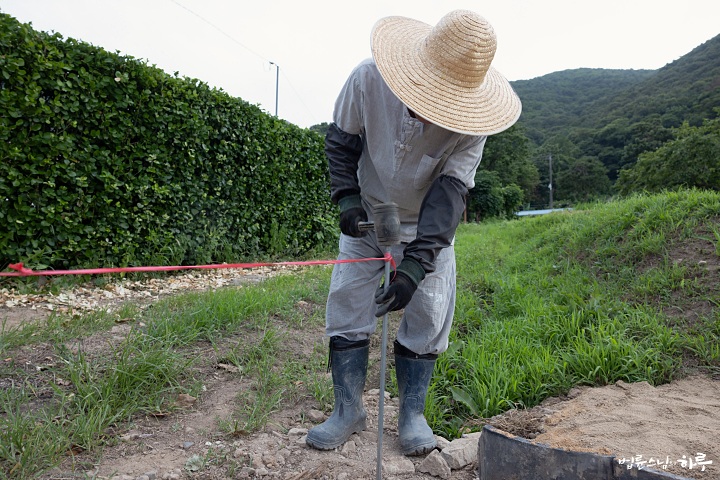
Today, they decided to make a flower bed at the entrance of the site using ridge roof tiles. A line was drawn and the tiles were laid out neatly in a row. Since there was no need to dig, and the tiles were simply placed on top of the ground, it didn't take very long. Sand was shoveled and sprinkled between the tiles, and it was leveled with a rake. Since the day was cloudy and not too hot, it was good weather for working.
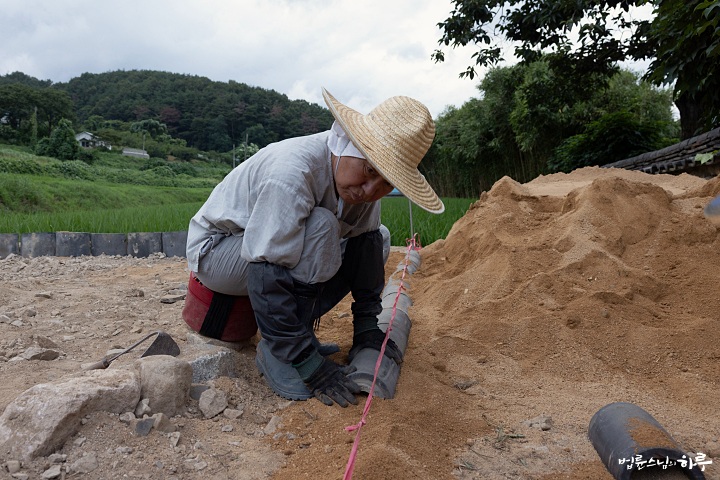
In front of the stones planted yesterday, a line was also drawn and tiles were placed. Since sand was poured first and then the tiles were placed, the work could be finished more easily. Here too, Sunim leveled the sand.
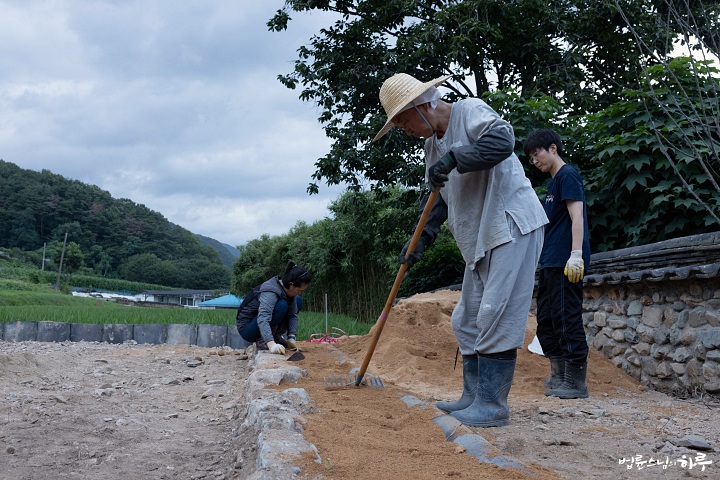
In no time, the flower bed had been arranged neatly. The days of sweating had paid off. Sunim finished the communal work by putting the tools away.
After having dinner, Sunim attended to work and rested. Tomorrow, he will hold the Weekly Dharma Assembly and meet with Daein Sunim from Cheonchuk Seon Center in Shravasti, India.
Since there was no Dharma talk today, this post concludes with a Dharma talk from last week's Friday Dharma Q&A.
Even When I Achieve My Goals, I'm Not Happy. What Standard Should I Live By?
"That's a good question. The standard of life is ultimately something you decide for yourself. I once saw the results of an international survey. It examined what people consider the conditions for happiness and what they value most in life. In countries like the United States, Europe, and Canada, people cited human relationships, including family, as the most important value. Next came their profession, and money came third or fourth. However, Korean people often cited money as the most important value, while family relationships often ranked around fourth. This can be said to be a characteristic of our society compared to the international community. Listening to people who have immigrated to Canada or the United States, most of them spend their weekends with their families. It's natural for a couple to take their children on outings or enjoy leisure time together. But in our country, when the weekend comes, the wife meets her friends, the husband has drinks with his friends, and the children hang out with their peers. Rather than spending time together as a family, relationships are often formed by generation or individually. In foreign countries, it's not easy to even call a friend on the weekend. This is because on weekends, everyone lives centered around family. Even when meeting people, they meet as families, and gatherings are also family-centered. This can be seen as a difference in sociocultural values. In our country, there's a culture of desperately earning money, and when we earn money, we gather with our own kind to spend it. Even when Koreans emigrate abroad, in places where many Koreans live, a culture of men gathering to drink often develops. Adults socialize with adults, and children play with children. So if you value the joys of life such as leisure or travel more than success or money, you can live that way in Korea too. However, in Korea, since your values differ from your friends, you may feel somewhat isolated. People might say, 'You're doing something pointless,' or view you as somewhat unusual. In countries like Australia or Canada, it's very natural to spend weekends with family. At work, when the set working hours end, exercising, taking walks, and spending time with family are all part of daily life. You can live that way in Korea too, but if you choose a life different from those around you, you might hesitate because you're worried about feeling isolated. The reason I'm telling you this is that there's no fixed answer about what's more important. The standard of life is ultimately something you decide for yourself. However, we can say that Korean society statistically has a strong culture of valuing money and success. It's not that other countries don't have such values, but they relatively consider them less important. We often hear through foreign news about people giving up a throne to choose love and marry, or in America, ministers resigning to devote themselves to caring for a sick spouse. But such cases are rare in Korea. Even when parents pass away or a spouse dies, staying steadfastly at work is often considered something to be very proud of. (Laughs) That's our culture. Some people like that kind of life. But we can't call such a person worldly or bad. If they want to live that way, what can we do? What we can call bad is behavior that harms others. Hitting or killing others, stealing others' belongings, committing fraud, sexual harassment, or causing trouble while drunk—these are wrong behaviors. Other than that, we can't say which life is better or worse. As long as you don't harm others, don't cause them loss, and don't torment them, you can live as you please. Animals in the forest each live in their own way—why should humans live worrying about others' opinions? Live as you please. Just don't engage in behavior that harms others. Such things constitute crimes."Recently, thanks to working hard at my company, I got promoted and my salary increased. Every time I achieved a goal, I thought, 'Now I'll be happy,' but that joy didn't last long. Before I knew it, I was running toward another goal. However, the time I spent walking forest paths while hiking, traveling, or learning new things has warmed my heart for a long time, even without any special achievements. I increasingly feel that happiness is more important than success. But society constantly tells me to aim higher. Going forward, what should I set as my standard of life so that I can live without wavering?"
"Yes."
"If, without any mental illness, you think, 'Getting promoted has no special meaning, and earning money has no special meaning. I feel much more fulfilled in life when helping others, taking walks, or hiking,' then you can change your life direction. But I've seen many cases where people made important decisions while suffering from mental illness and regretted it later. After quitting their jobs, they regret quitting, and when they get older, they regret having done pointless things when they could have earned more money in their youth. Since I've counseled many people, I hear these stories often. So it would be good to first check your mental health. If, with a clear mind, you judge, 'I'm not happy with the success-centered lifestyle of Korean society. I will live a more fulfilling and happy life,' then you can do so. But if these thoughts arise from losing motivation for everything due to problems like depression, you must first treat the illness. Changing jobs or leaving school in such a state is likely to lead to regret later. Once that's been checked, then you can choose for yourself by actually living it. I've mentioned this before, but there's a book called 'Hope for the Flowers.' In it, someone like you is compared this way. Caterpillars are climbing a mountain. They all try to climb the mountain, competing with each other. They climb by stepping on each other's backs. They thought there would be something at the top, but when they finally get up there, there's nothing. Now we too are running desperately. Most suffer because they can't reach that place, and the few who arrive with difficulty realize that there's nothing there. The Buddha also gave a similar analogy. All the animals in the forest were running in one direction. Other animals nearby were startled and asked, 'What's going on?' They replied, 'The ground is collapsing and the sky is falling.' Though skeptical, since all the animals in the forest were running, the other animals ran along too. As if getting ahead even a little was the way to survive, all the animals in the forest sprinted. Then suddenly, a great lion roared 'Roar!' and everyone stopped in surprise. The lion asked, 'Where are you going?' No one knew. When asked, 'Why are you running so desperately without even knowing why?' a deer answered, 'The cow was running, so I asked, and it said the sky was falling and the ground was collapsing, so I followed.' When the lion asked the cow, the cow said it had followed the pig, and the pig said it had followed the horse. Tracing back like this, the one who first started running was a rabbit. When asked why, the rabbit said it had been taking a nap under an oak tree when it suddenly heard a loud sound and jumped up in surprise and ran. The lion said, 'Let's go there and check,' and when they went together to check, it turned out that an acorn had fallen next to the sleeping rabbit's ear. The sound of the acorn falling had startled the rabbit into running, which led to the entire forest sprinting. The whole world is also sprinting in one direction, but no one knows why they're going. Everyone just thinks it's good to go fast, and no one asks why they're going. This has long been used as an analogy for people who sprint, thinking they must simply get ahead. The one who, like the lion, stopped that foolish sprinting, revealed the cause, and brought people to their senses is compared to the Buddha. Since you happened to ask this question today, this story came to mind. If with a clear mind you feel, 'Until now I lived thinking I would be happy if I achieved this, but having lived it, achieving it turned out to be nothing much. Now I should think about another path,' then that could be a new turning point in life. However, you do need to check whether such thoughts have arisen due to some mental illness. As the adults told you, they might say, 'You're thinking that way because you're crazy.' Actually, many people make important decisions while being obsessed with something and later regret it. Even if others say you're crazy, if you've chosen it with clear reasons and direction, you can steadily continue on without worrying about what others think. First, check whether your current thoughts are due to temporary emotions. If that's not the case, I'd say this experience could be a turning point that changes your life.""Yes, thank you, Sunim."