Why Should We Offer Prayers of Gratitude to Our Parents During Baekjung?
Jul 8, 2026. Baekjung Opening Ceremony, Tongdosa Temple, Medical Treatment
Hello. Today, Sunim gave the Baekjung opening Dharma talk, participated in the Ven. Jigong Hwasang enshrinement ceremony at Tongdosa Temple, and then received medical treatment.
Sunim began his day with morning practice and meditation.
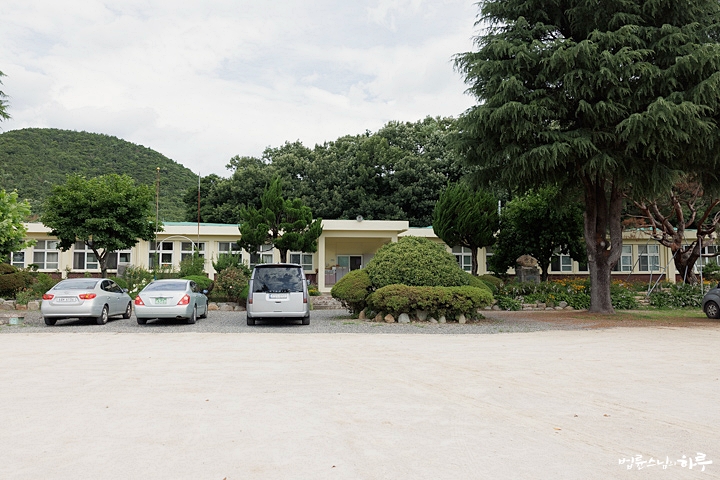
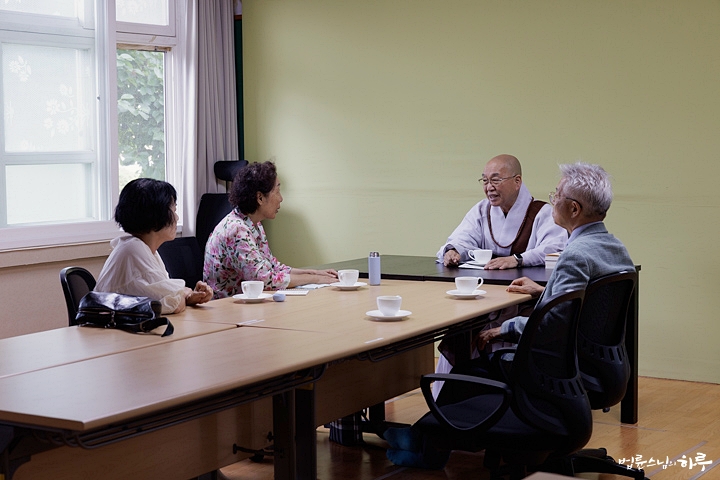
At 9 a.m., long-time Jungto Society volunteers from the Ulsan(울산) region came to Dubuk Jungto Retreat Center to meet Sunim. One of the volunteers requested a consultation, so Sunim sat down for a brief conversation.
After finishing the consultation, Sunim moved directly to the broadcasting room.
Today marks the beginning of the Baekjung Prayer, held 49 days before the Baekjung festival. At the main temples of Jungto Society across the country, memorial lanterns were set up to mark the opening day of the Baekjung Prayer.
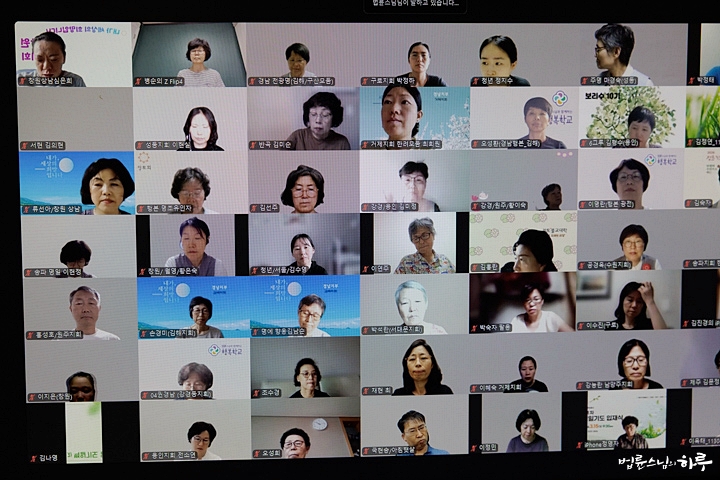
At 10 a.m., the Dharma assembly began. After the Three Refuges and the recitation of the Heart Sutra, everyone watched a video of the weekly news of Jungto practitioners. Then, the Sangha requested the Dharma from Sunim with the Dharma-requesting song and three bows. After a brief period of silent meditation, Sunim's Dharma talk began with the sound of the bamboo clapper.
"Hello, Jungto practitioners. It has already been ten days since the opening ceremony of the second 100-Day Practice. I hope you have all been practicing diligently every day."Sunim greeted everyone and then showed a video of last week's interfaith gathering and visit to Sri Lanka. The video captured Sunim's seven-day journey with religious leaders in Sri Lanka, where they explored paths of reconciliation and peace together.
Did you enjoy the video? We plan to continue supporting sustainable interfaith cooperation in Sri Lanka and to keep fostering exchanges between religious leaders in Korea and Sri Lanka. JTS has been supporting local communities in Sri Lanka, and we will continue our activities to develop the region and help those in need.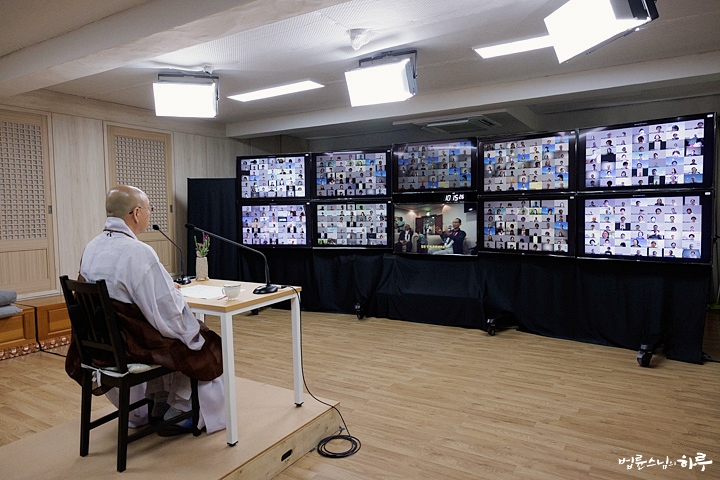
The Meaning of Baekjung (百中)
Today is the opening day of Baekjung (百中). The 15th day of the seventh lunar month is called Baekjung Festival (百中節) or Ullambana (盂蘭盆齋). The word 'Ullambana' comes from the Sanskrit word Ullambana, which means 'to set upright that which is hanging upside down'. What does 'hanging upside down' mean here? We are born into this world and strive greatly to become free and happy. We think that if we earn a lot of money, achieve high status, or do what we love, we will become happier and freer, so we work hard our entire lives. However, when we take stock of our lives, the results often differ from what we expected. To live, we kill others; to be full, we make others hungry; to become rich, we impoverish others; to raise our status, we trample on others; and to assert our opinions, we ignore others. Without realizing it, through these actions, the final accounting of our lives ends up being the opposite of what we intended—we fall into hell. It is truly foolish, yet no one lives with the intention of arriving at such an end. We simply lived desperately according to our own thoughts, our own desires, for our own benefit, and only for our own families. However, from the perspective of the entire universe, we have ended up harming others and destroying nature. We tried to live well in our own way, but as a result, we lived upside down; we tried to go to heaven, but we ended up falling into hell. 'Setting upright that which is hanging upside down' means saving sentient beings suffering in hell and bringing them to a world without suffering. This is called 'Cheondo (薦度),' the guidance of souls. How can we save sentient beings who have fallen into hell due to the karma they have created? We can save them through 'giving.' Because they had taken advantage of others and caused suffering in order to benefit themselves, by giving to others, they can resolve those grievances, extinguish the karma they have created, and be sent to a better world. That is why we do not use the character 'jesa (祭),' meaning to hold a memorial rite for the dead, but rather 'jae (齋),' meaning to give. By doing so, we set upright that which is upside down and save suffering sentient beings. This is called Baekjung (百中) or Cheondojae (薦度齋).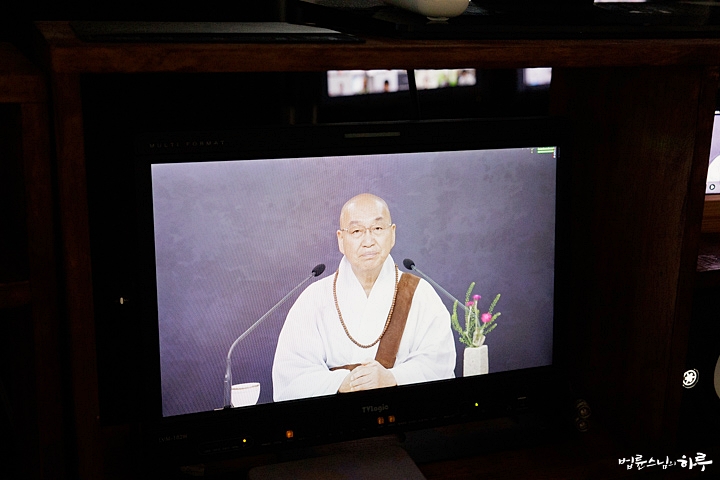
Why the Merit of Helping the Poorest Is the Greatest
There are two origins for why Baekjung falls on the 15th day of the seventh lunar month. One comes from the traditional society of India. The 15th day of the seventh month in our calendar is a day when Indians honor their ancestors. On that day, Indians prepare food and release it into rivers while praying for the peace of their ancestors' souls. The other origin comes from the Buddhist tradition. Around the 15th day of the seventh lunar month is when the rainy season ends in India. Normally, monastic practitioners move around every day while practicing, which is called 'yuhaeng (遊行),' or wandering. Because staying in one place creates attachment, they always wander from place to place while practicing. However, when the rainy season comes, it becomes difficult to move around because of the constant rain. So, from the 15th day of the fourth lunar month for three months, they stay in one place and practice, and this period is called 'ango (安居),' or retreat. However, when practicing while staying in one location, it becomes difficult to obtain food. When wandering, they can beg for alms in a different village each day, but when staying in one place, they must always seek food from the same village. From the perspective of those offering alms, providing food to practitioners for three months straight becomes a burden, and the amount of food offered inevitably decreases. So, by the time the three-month retreat came to an end, practitioners were often in a state of extreme hunger. For this reason, a belief arose that offering various foods to 100 hungry practitioners on the day the retreat ended would yield the greatest merit, and this custom continued as Baekjung.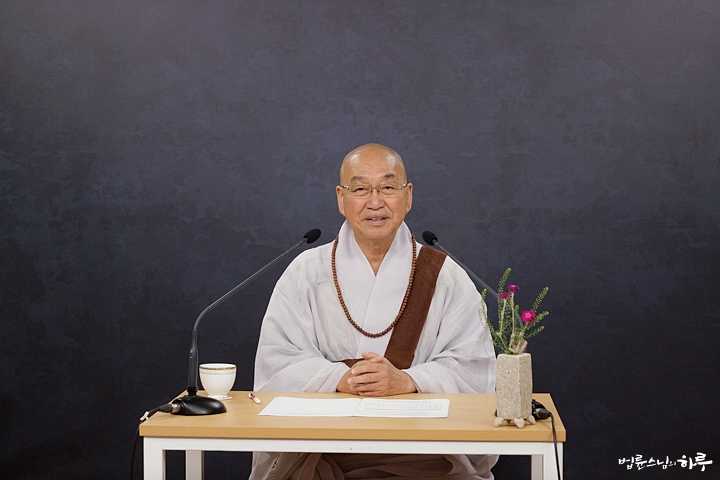
Honoring Ancestors with Sincere Intentions and Merit
An ango refers to monks staying in one place for three months to practice. Currently in Korea, because it is difficult to move around not only in summer but also in winter due to the cold, we have two retreats: the summer retreat (Ha-ango, 夏安居) and the winter retreat (Dong-ango, 冬安居). However, in India, they do not distinguish between summer and winter, but hold the rainy season retreat (Uango, 雨安居), staying in one place during the rainy season. On the day the rainy season ended—the day the rainy season retreat ended—offerings were made to the practitioners who had diligently practiced during the retreat. Anywhere from 50 to 100, and sometimes up to 500 practitioners gathered together to practice, so offering food to 100 (百) members of the Sangha (衆) was called Baekjung (百中), using the character for 'assembly (衆)' to form Baekjung (百衆). It was also called Baekjong (百種), meaning offering 100 kinds of food, but the name Baekjung is generally used. It means the day of offering food to 100 hungry practitioners. It was believed that offerings made on this day yielded the greatest merit, and that through this merit, many suffering sentient beings—those who had knowingly or unknowingly committed many sins—could be saved. The long-standing custom of Baekjung is based on this belief. Memorial rites are customs and traditions passed down through history. We honor our ancestors to soothe our longing and regret for those who have passed away, and with the hope that our sincerity and merit will be of help to them.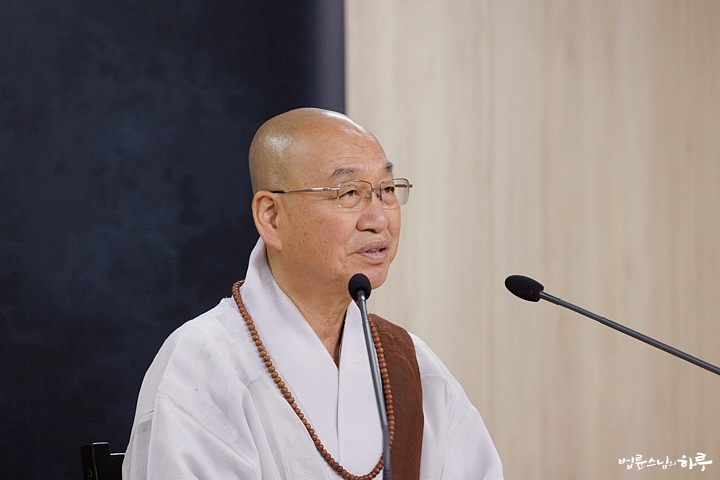
We Must Accumulate Merit Through Giving and Awaken from Ignorance Through Dharma Talks
When we perform Cheondo, first, we accumulate merit through giving, and second, we must awaken to our own faults and ignorance through Dharma talks. That is why 49-day memorial Dharma talks and Cheondo Dharma talks are given. I have shared various stories passed down about the origins of Baekjung, but the meaning of observing Baekjung today does not lie solely in the religious meaning of achieving Cheondo through these practices. For me to exist, my parents must have existed, and for my parents to have existed, my ancestors must have existed. Countless ancestors and patriotic spirits have sacrificed themselves for the Republic of Korea we have today. Personally, we live today thanks to the toil and grace of our families and ancestors; socially, we live thanks to the sacrifice and suffering of our nation's forefathers. So let us not forget their grace. In our history, there is the deep sorrow of countless people who were mercilessly killed for their country and people, who lost their lives to starvation, and who suffered from all kinds of discrimination. Resolving such sorrow is called 'Haewon (解冤),' the release of grievances. The best way to release that sorrow is to know gratitude. And when we know gratitude, we naturally develop a thankful heart. From birth until the age of three, unless the parents have a particular mental illness, they do not abuse their infants. However, occasionally we see news reports of parents who abuse their children. These are mostly very exceptional cases related to mental illness. Even among animals, cats or dogs sometimes bite their offspring to death, but this too is a rare occurrence caused by a kind of mental abnormality. Most animals, no matter how scarce food may be, sacrifice themselves to raise their offspring. Therefore, in the period when our mental faculties first form after birth, we receive the utmost care from our parents in all processes of seeing with our eyes, hearing with our ears, smelling with our noses, tasting with our tongues, feeling with our bodies, and thinking with our minds. That experience forms the deepest foundation of our humanity, which we can call conscience.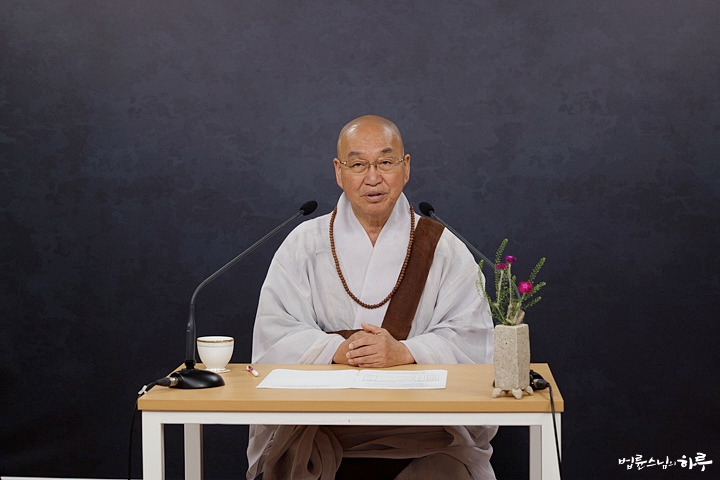
Generating a Grateful Heart Is the Process of Healing Wounds in Our Hearts
The Cheondo rite we perform at Baekjung is customarily a rite for our ancestors, but from a practice perspective, it can be said to be a process of healing the wounds in our hearts. The most important thing in that process is generating a grateful heart. When we do so, the deep wounds in our hearts are healed one by one. For this Baekjung prayer, I hope you focus on generating a grateful heart. Let us generate a heart of repaying kindness. Personally, I hope that each of you can heal some of the wounds you received from your parents. On the other hand, we also need to reflect on the wounds our people have received throughout history. Our people suffered under countless oppressions and invasions. We endured the Mongol invasions, the Imjin War, and the Manchu invasions, and went through the Donghak Peasant Revolution and the Japanese colonial period. We also suffered discrimination and abuse for being of low status or for being women. When we watch old historical films, we can see how much slaves were abused and how much women were discriminated against. Those wounds remain in the hearts of our people. We overcame all those difficulties and built a democratic nation where the people are the owners. We established an independent nation where we determine our own destiny, and transformed our country from a poor nation into one where we can live comfortably today. Today's pride is built on the toil of the ancestors who did not give up and struggled through suffering, and those who resisted, sacrificed, and dedicated themselves for justice and independence. So we must also generate a grateful heart toward our ancestors. We must not become arrogant. It is not because we are so wonderful that we live well like this today. Today, gender discrimination has greatly decreased, and educational opportunities have expanded significantly. Of course, there are still issues among young people today between those who were born to well-off parents and those who were not, due to economic disparities, but compared to the past, the improvements are beyond imagination. So we must personally be grateful to our parents and socially be grateful to our ancestors. Living a little more freely and happily on the foundation of that grace is the way to repay their labor. Also, during this Baekjung prayer, I hope we can pray together for the countless people who died bearing grievances throughout history. For those who were sacrificed in the Donghak Peasant Revolution, those who were sacrificed in the independence movement, those who were sacrificed in the Korean War, and those who were sacrificed in the democratization process—let us generate a Cheondo heart wishing them, 'May you rest in peace.' I hope you will join this Baekjung prayer with such a heart.
After the Dharma Talk, Sunim Traveled to Tongdosa Temple.
Today, the enshrinement ceremony of Ven. Jigong Hwasang was held at Tongdosa Temple. Ven. Jigong Hwasang was an eminent monk who came to Korea from India at the end of the Goryeo Dynasty. He nurtured many disciples, including Ven. Naong and Ven. Muhak, leaving a great influence on Korean Buddhism. In particular, he is said to have had a deep connection with Tongdosa Temple, as he is reported to have paid respects at the Diamond Precept Platform of Tongdosa and delivered Dharma talks there.
The enshrinement ceremony of Ven. Jigong Hwasang was prepared jointly by Ashish Bhabhe of India's International Centre for Cultural Studies (ICCS) and Tongdosa Temple, so Sunim decided to attend the event. However, since Sunim could not adjust his schedule due to the Baekjung opening Dharma talk today, he was unable to attend the entire event.
Around 11:40 a.m., Sunim arrived at Tongdosa Temple. The Dharma assembly at the Dharma Hall had already concluded, and participants were offering incense and paying respects to the portraits of the Three Masters and the newly enshrined statue at Samseonggak, so Sunim also paid his respects.
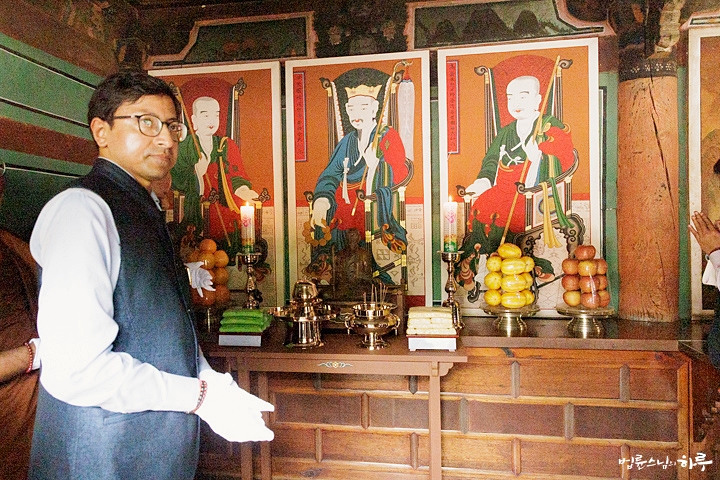
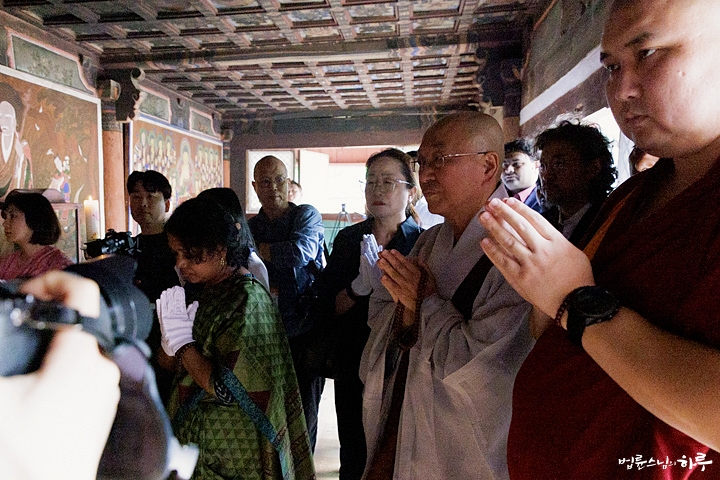
Then, together with the participants, Sunim circumambulated the pagoda enshrining the true relics of the Buddha and took a group photo together.
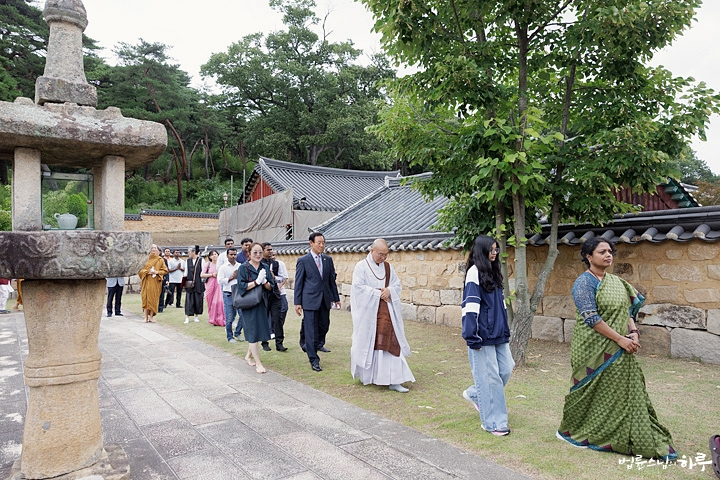
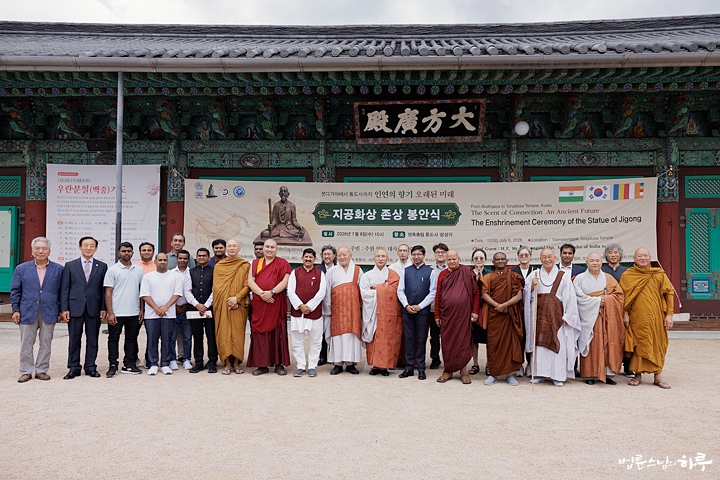
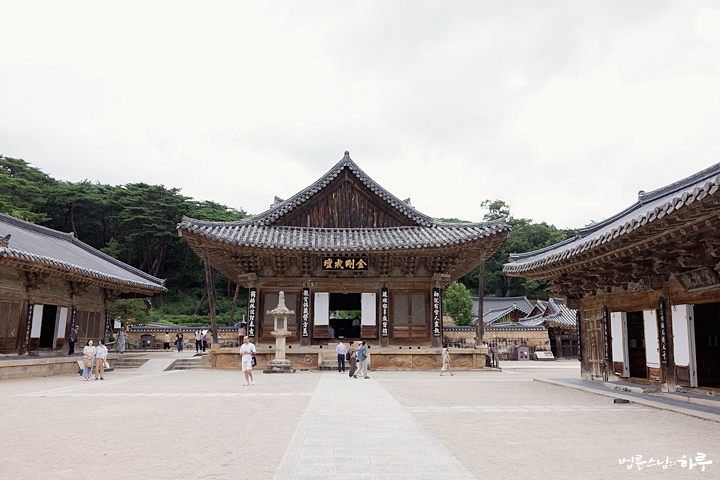
At mealtime, Sunim moved to the dining hall with the guests and had lunch together. After the meal, Sunim moved to the abbot's room and had a conversation over tea with Ashish Bhabhe and Ven. Buddhapala of Bunhwangsa Temple in Bodh Gaya, India.
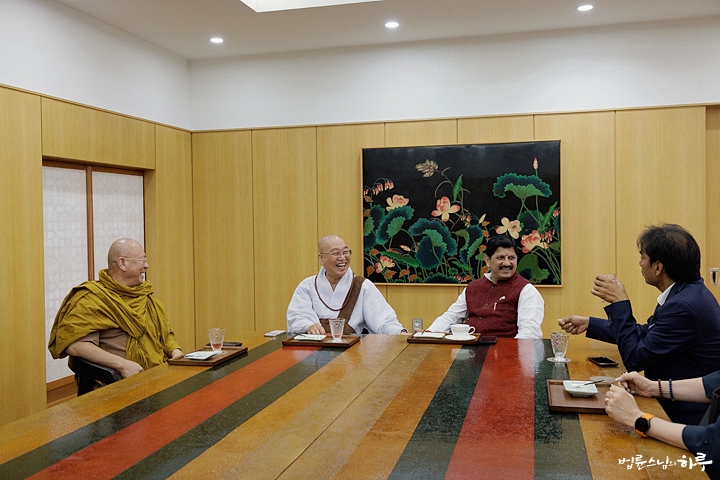
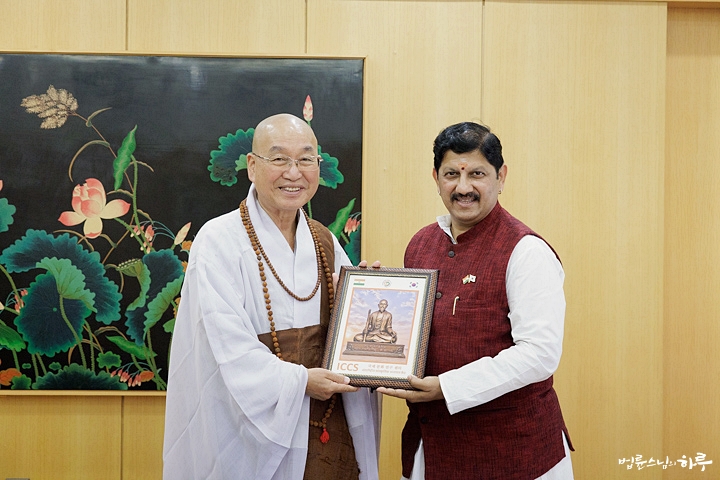
Ashish Bhabhe said he was recently interested in organic farming and native seed banks. He was curious about organic farming and seed banks in Korea. Ashish Bhabhe said that various regions of India have also accumulated diverse experiences in organic farming, and he expressed his wish to guide Sunim to sites in India. Sunim also introduced Hongdong Village in Hongseong, Chungcheongnam-do, Korea. They concluded the conversation by agreeing to visit sites where organic farming is being done well during Sunim's future visit to India. Ashish Bhabhe gave Sunim a gift he had prepared.
As Sunim was leaving after the conversation, many people at Tongdosa Temple recognized him and greeted him warmly. They said they had watched Sunim's YouTube channel and Dharma Teacher Pomnyun's Road: Sunim and Guests. Many people also wanted to take pictures with Sunim.
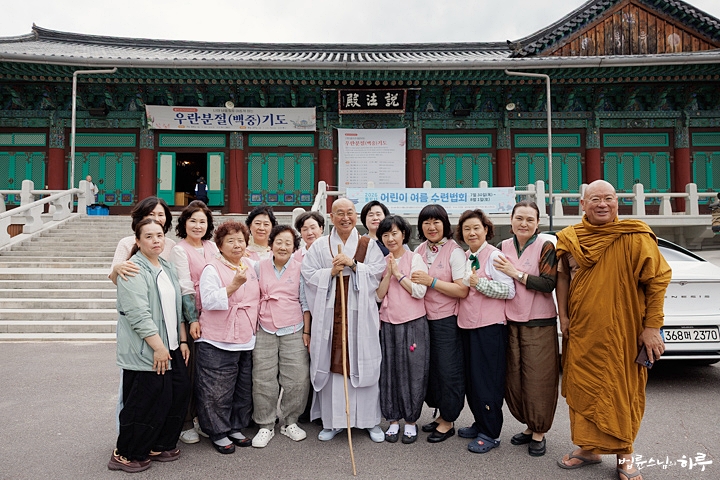
The Haengja who accompanied Sunim said,
"Sunim, you're the idol of Tongdosa Temple today." (laughs)
Ven. Buddhapala saw Sunim off to the parking lot. Since it had been a long time since Sunim and Ven. Buddhapala had met, they had a conversation catching up on what they had not been able to share.
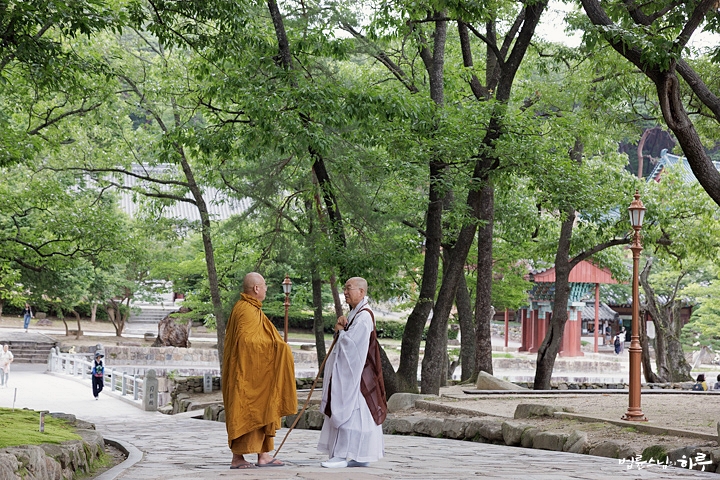
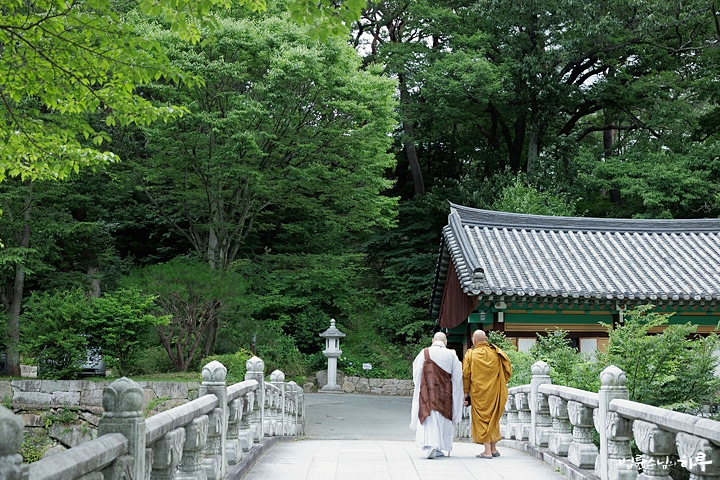
At 1:30 p.m., Sunim departed from Tongdosa Temple and went to a dental clinic in Busan(부산) for treatment.
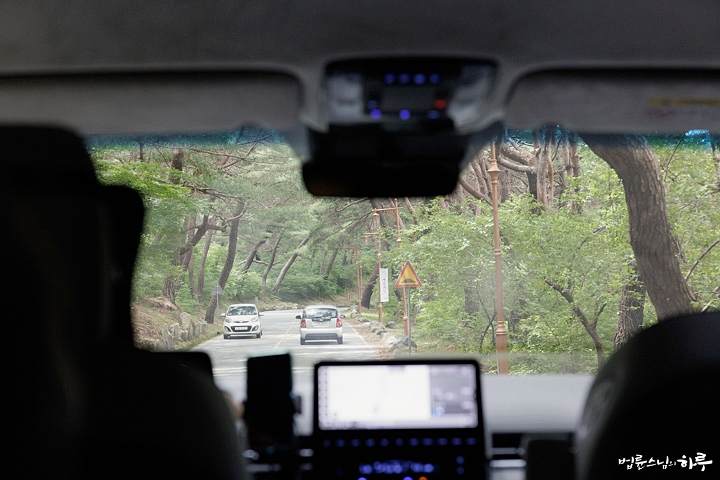
After the treatment, Sunim returned to Dubuk Jungto Retreat Center, and it was already 5 p.m.
After watering the lettuce and other crops, Sunim had dinner with the JTS Bhutan volunteers who came to visit him.
After dinner, Sunim rested.
Tomorrow, Sunim plans to plant perilla seeds with the Bhutan volunteers and attend to his work.