Would It Be Better to Leave This World Rather Than Burden My Family with My Rare Disease?
July 3, 2026. Day 4 of the Interfaith Sri Lanka Peace Pilgrimage (Jaffna, Mankulam)
Hello. Today, Sunim met with Hindu priests in Jaffna and distributed relief supplies in Mankulam.
After completing his early morning practice and meditation, Sunim left his lodging at 5:30 a.m. to take a morning walk. The sun had not yet risen, and the surroundings were still dark.
"There's Jaffna Fort nearby, so let's take a walk there. Looking at the map, it's an unusual star-shaped fort."After a five-minute ride in a tuk-tuk, the fortress came into view. However, since it was still too early and the ticket office had not yet opened, they could not enter the fort, so they decided to walk once around the outside. As they walked along the fortress walls, a cool breeze blew.
"It's a good thing we came early. The breeze is cool and pleasant. If it were midday, it would be too hot to look around."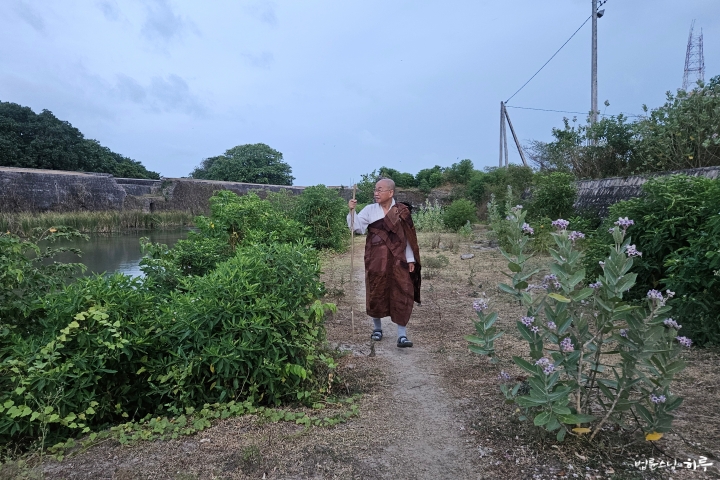
As they walked around the fort, Sunim explained.
"This fort has a moat, and another wall is built outside the moat, making it a double fortification. This kind of double fortress is a style mainly used when building forts on flat ground."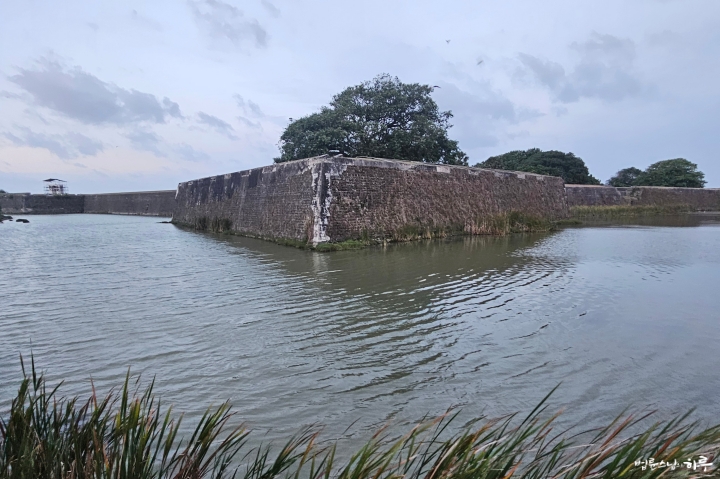
When they reached a corner of the fortress, Sunim continued.
"This is where the cannons were installed. Long ago, when Portugal waged war against the Kingdom of Kandy with the latest matchlock rifles and cannons, it happened to rain heavily that day, and all the gunpowder got soaked. Because of that, they were defeated by the Kandy army armed with bows."After walking slowly along the fortress for about 40 to 50 minutes, they returned to their lodging.
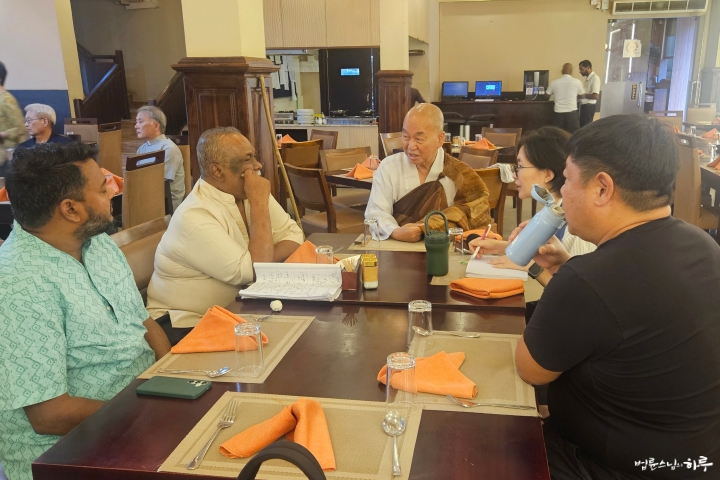
At 7 a.m., during breakfast, Sunim discussed cooperative projects in Sri Lanka with Mr. Harsha.
While discussing how to proceed with cooperative projects in Sri Lanka, they watched a video of Sunim's recent visit to Bhutan.
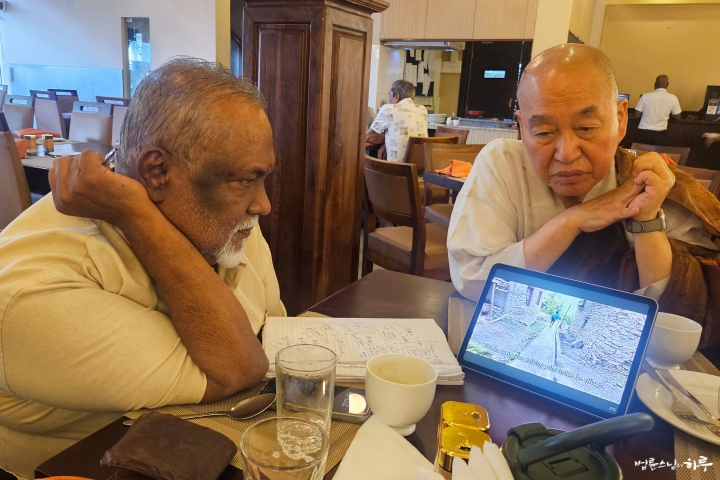
While watching the video, they agreed that village development should be planned and carried out by residents themselves. They discussed that when residents directly pave roads or install irrigation, water supply systems, and fences, the necessary materials should be supported, and a system should be established in which local governments or trusted NGOs manage the projects together.
They also discussed ways to support Dharmashakti, such as expanding exchanges between Korean and Sri Lankan religious leaders and creating reconciliation centers like the Harmony Center they had seen at the Islamic school a few days earlier.
At 8:30 a.m., they left their lodging and headed to Nallur Kandaswamy Devasthanam.
Nallur Kandaswamy Devasthanam is the representative Hindu temple in Jaffna, northern Sri Lanka, and the center of Tamil Hindu faith in Sri Lanka. If Anuradhapura, a Buddhist holy site, is the symbol of Sinhalese Buddhism, this temple can be called the spiritual center of the northern Tamil community. It is not merely a religious facility but a place that symbolizes the culture and identity of Sri Lankan Tamils.
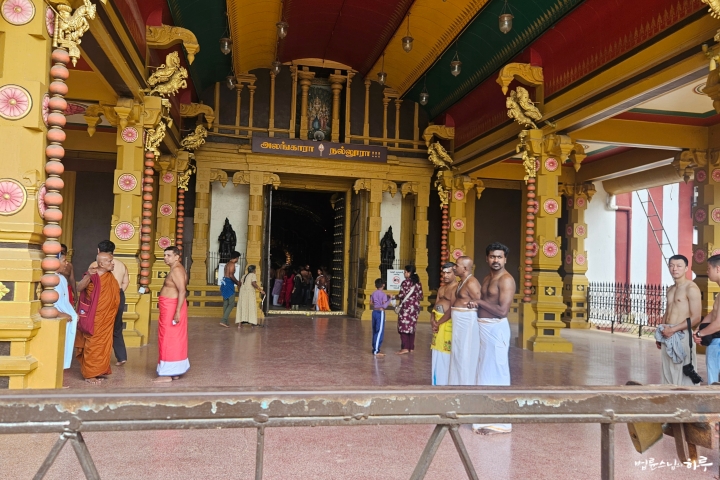
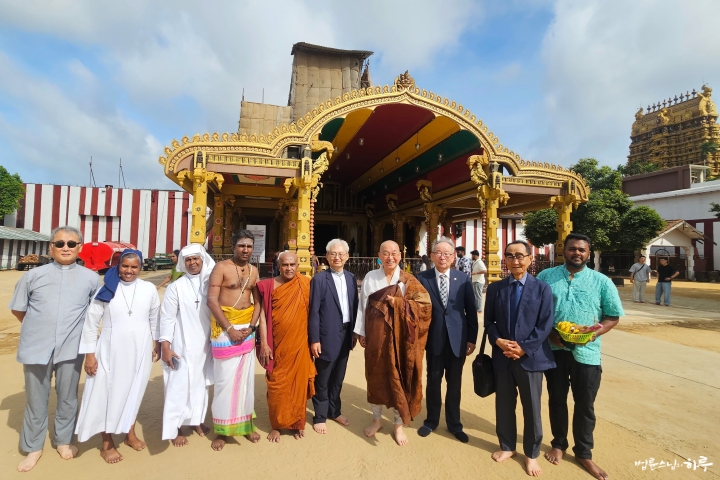
They arrived at the temple at 8:50 a.m., but there were strict rules about attire. All visitors except women had to remove their upper garments. Buddhist monastic kasaya robes were acceptable, but the attire of other religious leaders was not permitted, and even Sunim was told to remove any upper garment other than the kasaya. In the end, Sunim's group could not enter and, after taking a group photo outside, moved on to the next meeting location.
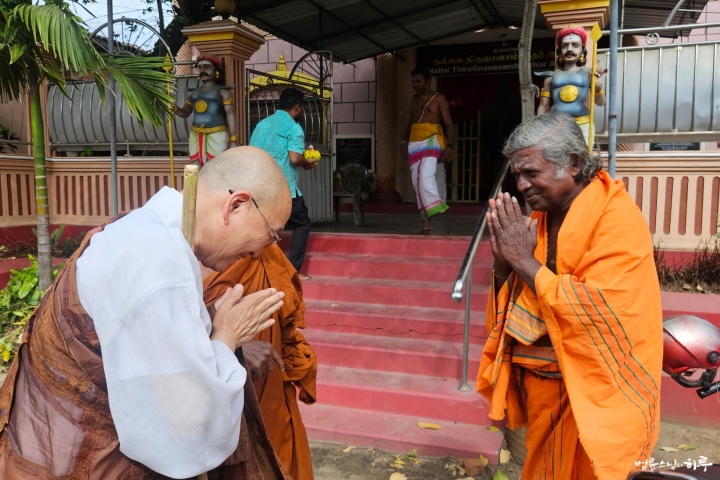
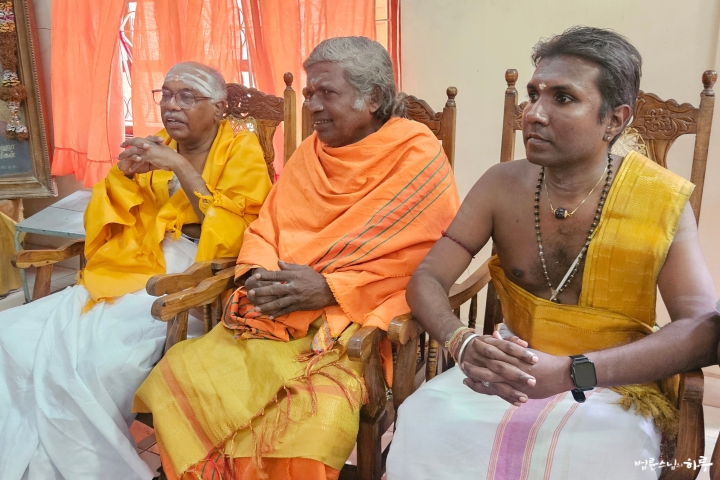
At 9:10 a.m., they met with Hindu leaders at Nallai ThiruGanasambanthar monastery.
Swami Aruthiru Murugan Adeenam, the acting head of the monastery, welcomed the participants and offered greetings.
This was followed by an explanation of the situation in the Jaffna region. Jaffna was the political and cultural center of the Tamil armed group LTTE during the Sri Lankan civil war, which lasted from 1983 to 2009, and suffered great damage as fierce battles between government forces and the LTTE were repeated. It was explained that during the war, the government placed land containing Hindu temples and holy sites under the control of the military and police, and that even after the war ended, considerable areas continued to remain under control. As a result, residents could not freely worship at the temples, nor could they engage in economic activities using the land, causing severe stagnation of the local economy.
Pastor Park Jong-hwa asked the swami a question.
"Does Sri Lanka have a caste system like the one in India?"
"Sri Lanka also has the same system, but because people believe that everyone is equal, it does not manifest violently, and it is operated relatively peacefully."
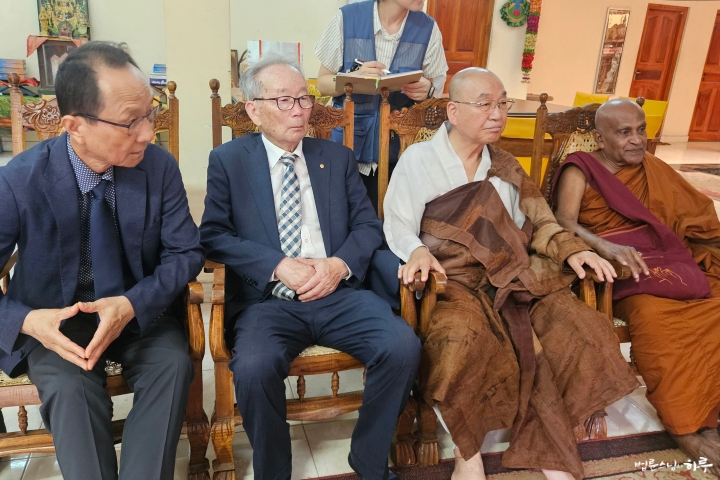
Sunim also asked a question.
"Why do men remove their upper garments to enter the Hindu temple we just visited? Is it tradition, or does it have religious meaning?""It is a custom based on long-standing tradition. Buddhist monastic kasaya robes are exceptionally permitted, but ordinary people—even presidents or prime ministers—must equally remove their upper garments, so the tradition is strictly observed."
Venerable Assaji spoke.
"During the last war, so many people left this place. About one million people migrated overseas or sought asylum. Even after the war ended, many still come back to their hometown once or twice a year to clean and maintain their houses. But in many cases, they cannot return to live here. I once gave a lecture to about 3,000 Tamils in the UK. Among them were people who had been criticized as 'those who did not fight for freedom but fled overseas.' So I said to them there: 'The true heroes are not the leaders nor the religious leaders. The ordinary people who lost their homes and were driven out to live under palm trees—they are the true heroes.' In fact, I have many stories to share because I was involved in various activities for mediation and reconciliation during this war."
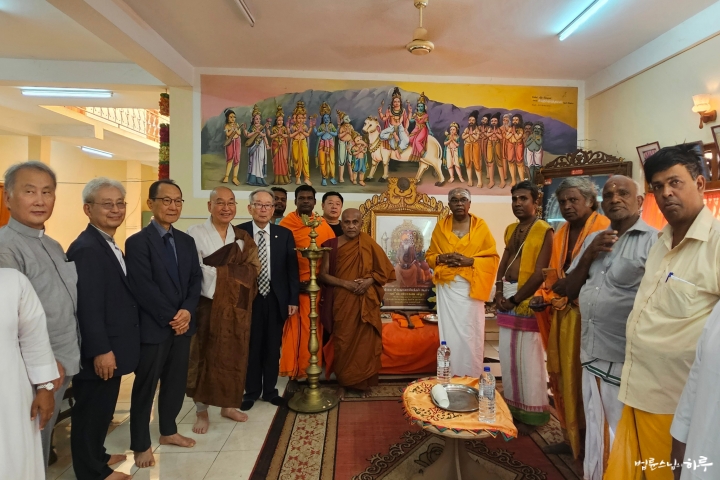
They moved to another location for another meeting.
At 10:20 a.m., Sunim and his group met with Hindu priests at Sivaguru Atheenam.
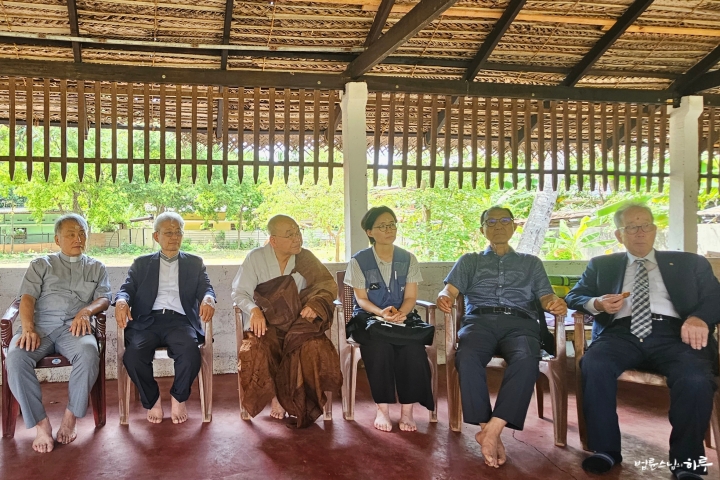
Sunim asked.
"What is it that the Tamil people want most right now? It probably differs from person to person, but for example, is it independence? Is it securing autonomy? Or is it the guarantee of equal rights without discrimination?""We want to preserve our culture and religious traditions. We want autonomy."
"We hope for a referendum. To know what the residents want."
"We want the temples and lands occupied by the military to be returned to us as soon as possible."
The chief Hindu priest said that what the northern Tamil residents want first and foremost is equal rights and substantive local autonomy. They explained that the war itself ultimately arose from a long-standing failure to guarantee political rights and autonomy. Although local autonomy was promised through the India-Sri Lanka Accord, in reality, authority over police and land was not transferred, so residents' grievances continued. The biggest issue they raised was the land problem. During the civil war, the military occupied residents' private lands and temple grounds for long periods, so they could not farm and their livelihoods collapsed as well. Recently, as some land has been returned to residents and roads and fisheries have been reopened, life has been improving little by little, but they said it is still insufficient.
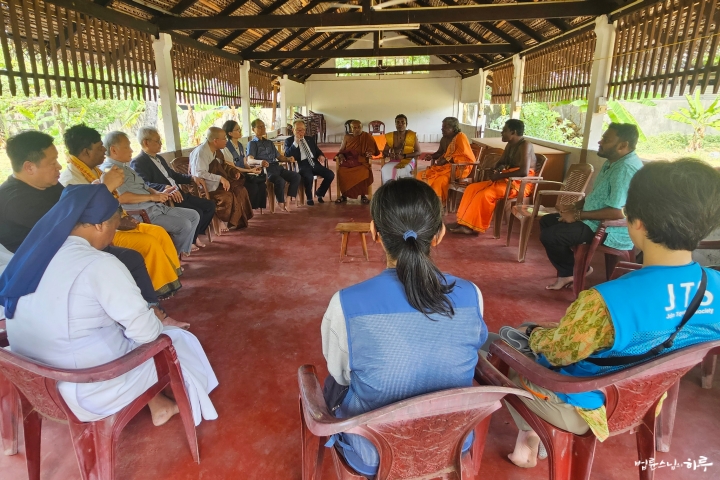
The priest expressed respect for Venerable Assaji.
"There is someone I especially want to introduce. Venerable Assaji is a Buddhist leader who, more than 30 years ago during the height of the civil war here, was the first to visit Jaffna for the sake of peace. To be honest, the Tamil residents of Jaffna generally do not trust Buddhist monks. This is because many believe that the Buddhist community sided with the government during the war. But Venerable Assaji is an exception. At that time, bullets were flying, bombs were exploding, and landmines were buried everywhere, so it was not easy for anyone to visit this place. Nevertheless, Venerable Assaji personally came to Jaffna and met with LTTE leaders, government officials, politicians, and local residents, beginning conversations for peace. Even before the government or political circles began discussing peace negotiations, Venerable Assaji was the one who came to the site first and led reconciliation and dialogue."
At 11:40 a.m., they moved to the All Ceylon Hindu Congress and received an introduction about the Hindu Congress.
The Hindu Congress is a representative body encompassing Hindu temples and social organizations throughout Sri Lanka, and they introduced themselves as inheritors of the ancient Saiva tradition rather than "Hindu." They said they believe in Shiva as the source of all beings, and that practicing love, peace, and prosperity is the core of their faith. They explained that the Saiva tradition holds respect for all religions and faiths as an important teaching, and that although each person's culture and tradition may differ, ultimately all move toward one truth. They also introduced the Hindu Congress not as an organization of priests alone, but as a federation that includes Hindu temples and various social organizations nationwide, playing the role of connecting religion and society.
After briefly praying in a Hindu ritual, they had lunch.
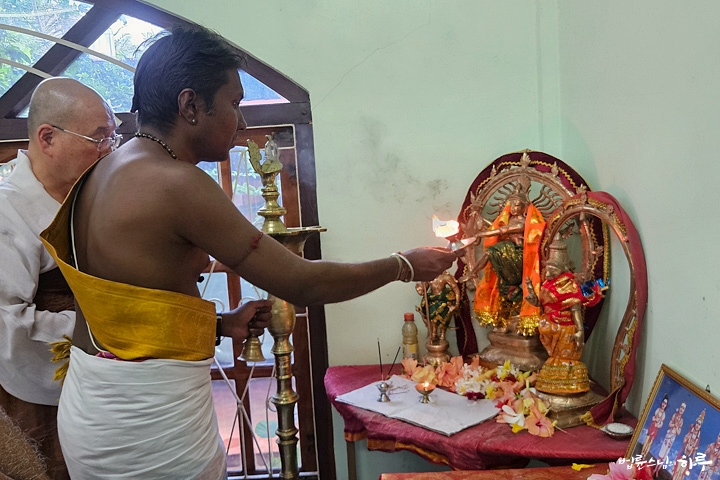
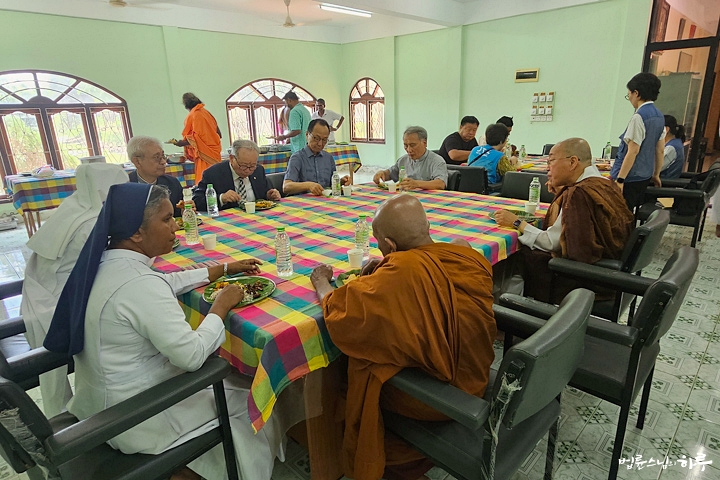
After finishing lunch, they boarded vehicles to travel to Mankulam.
Around 2 p.m., they arrived at the Good Shepherd in Mankulam.
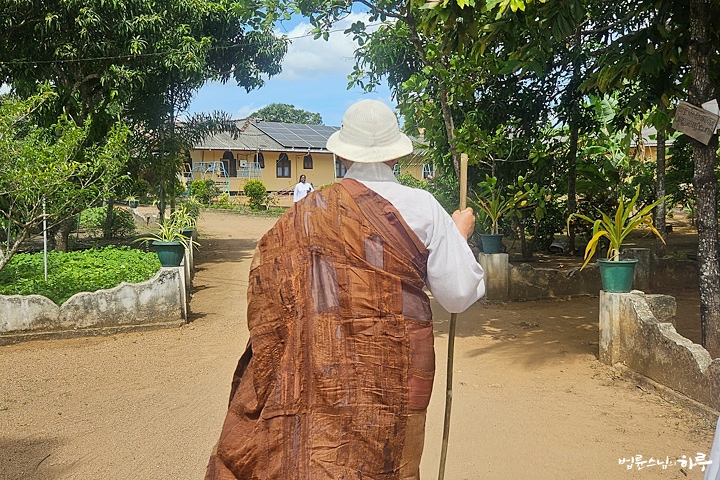
While preparing this program, Sunim had made one proposal to Dharmashakti. Since religious leaders from Korea were visiting Sri Lanka, he suggested that they should not simply meet and talk, but also engage in meaningful activities to help neighbors in need.
In response, the Good Shepherd sisters directly visited civil-war-affected areas and went from home to home surveying living conditions. They identified essential daily necessities for each household, established a distribution plan, and prepared and distributed the relief supplies.
The Good Shepherd is a Catholic women's religious congregation that has been active in Sri Lanka since 1869. It has continued various social welfare activities, including protecting women and children, supporting the poor and socially vulnerable, providing education and vocational training, protecting single mothers, victims of domestic violence, and human trafficking victims, and providing pastoral care and counseling in correctional facilities. Mankulam, where the distribution was carried out today, was said to be one of the areas where the fiercest battles took place during the Sri Lankan civil war. The scars of the long war still remained in the lives of the residents. People who had lost an eye, people who walked with crutches, and people who had lost an arm could be seen without difficulty.
Many Tamil residents who had lived in the south during the civil war fled north with nothing, and most families had lost family members in the war. It was said that, although a long time has passed, they are still living difficult lives without having fully rebuilt their livelihoods.
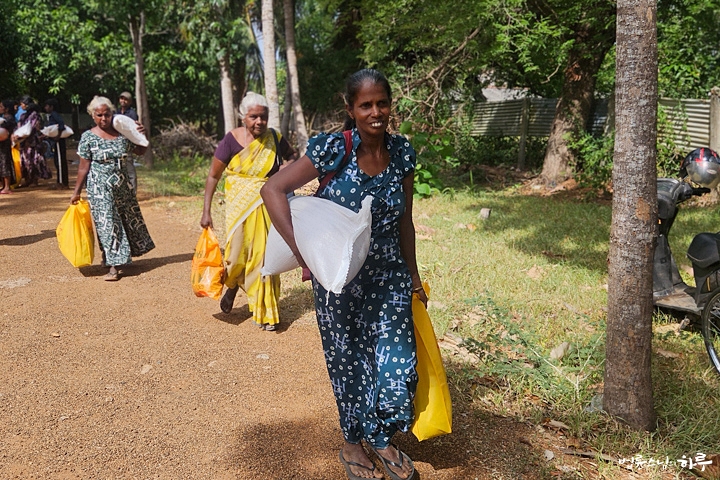
Starting at 2:30 p.m., Sunim and the religious leaders distributed relief supplies to 300 households in Mankulam. A total of 10 items (rice, flour, sugar, salt, soy meat, chickpeas, dal, dried chili peppers, black tea, and two boxes of matches) were distributed.
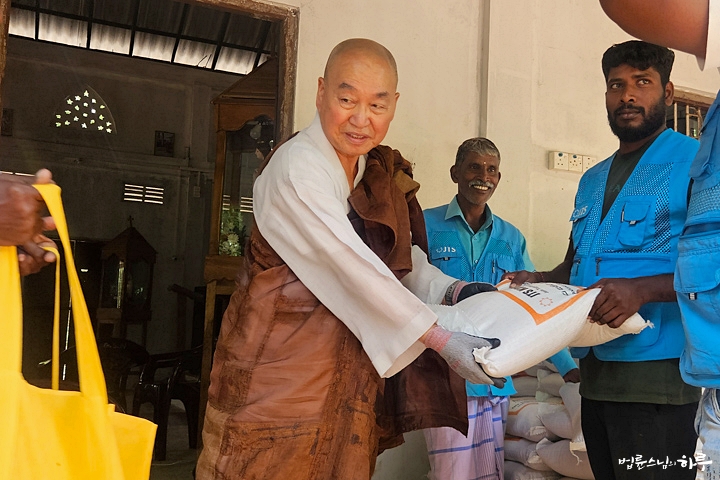
Sunim distributed the rice, while the pastor, the Cheondogyo leader, the Won Buddhist minister, and the priest each took charge of distributing one type of item.
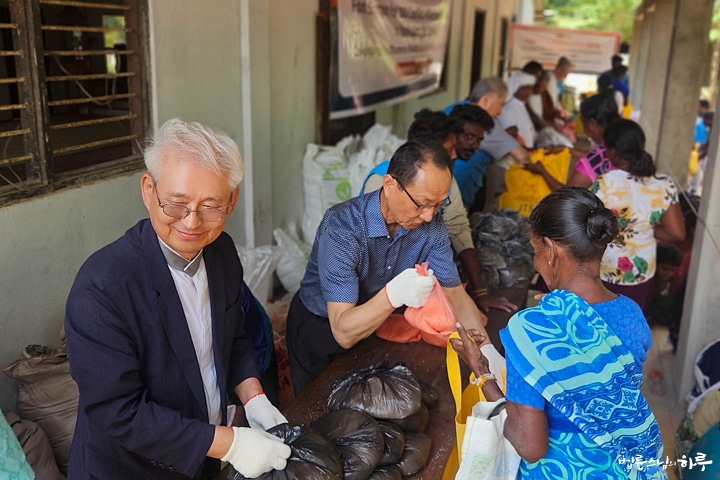
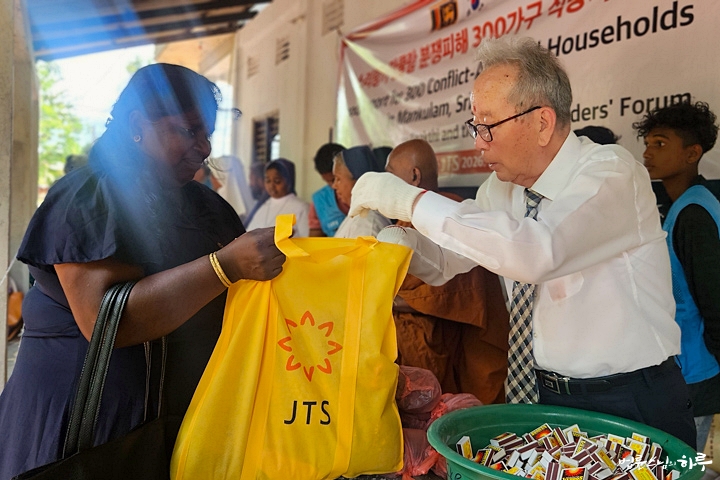
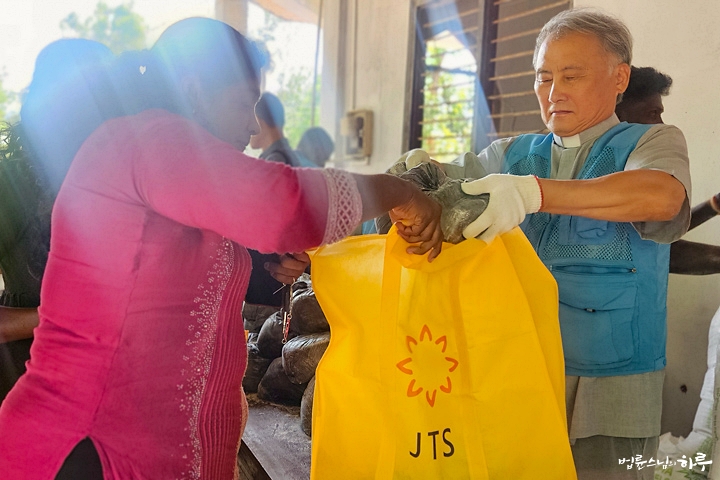
After distributing items to all 300 households, well over 50 minutes had passed.
The religious leaders each shared their impressions.
"It was rewarding work. There is nothing happier than sharing together. Coming to Sri Lanka, I've had such a happy experience."
"Flowers bloom out of happy hardship."
"Sharing gives grace, compassion, and love to everyone."
"Today was so moving. I was glad to be able to help. Thank you so much."
Venerable Assaji also shared a few words.
"The program was well prepared. Distribution is difficult work, but thanks to the religious leaders joining together, we were able to complete it well."
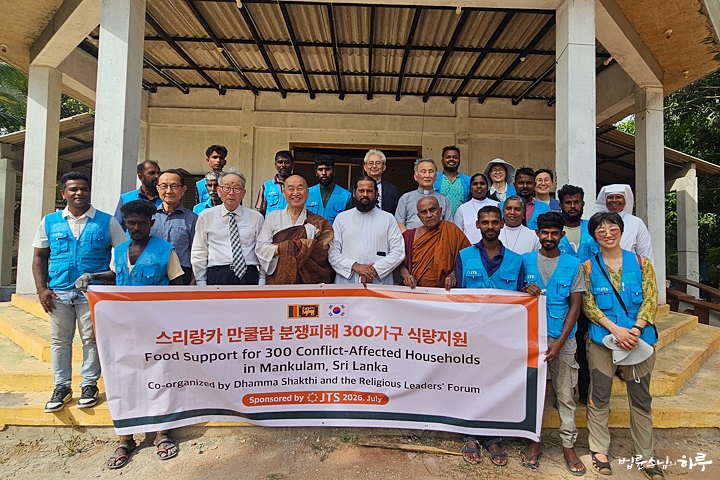
Sunim and the religious leaders took a brief rest, drinking tea and eating bananas prepared by the sisters.
At 3:40 p.m., everyone boarded the vehicles to travel to Dambulla, where they would be staying for the night.
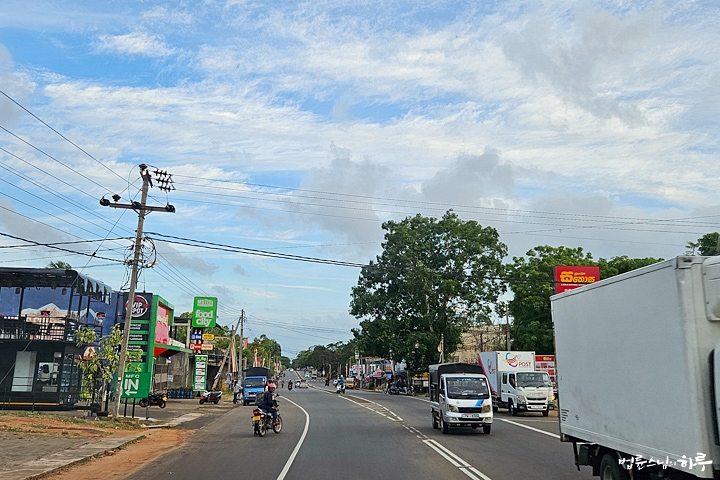
At 7:30 p.m., they arrived at the Dambulla lodging where they had stayed two days earlier and had dinner.
After dinner, Sunim revised his manuscript and rested.
Tomorrow, they plan to travel to Colombo to meet with Catholic and other Christian leaders and to hold a meeting between Dharmashakti and the Korean religious leaders.
Since there was no Dharma talk today, this post concludes with a Dharma Q&A from last April.
Would It Be Better to Leave This World Rather Than Burden My Family with My Rare Disease?
"Try asking your mother and family. Ask, 'Which causes you more harm—my being alive, or my being dead?' What do you think your mother would answer?""I am a person with a disability. I suffer from a rare, incurable disease. Because of my illness, I feel I am causing great harm to my family and parents. So I don't want to live. How can I die?"
"She would tell me to stay alive."
"Then, you think you are already harming your mother, but are you saying you want to harm her even more? Since you are causing less harm now, do you mean you want to cause definite, greater harm by dying? That's a mean-spirited thought.""It's because my husband and daughter have been deeply hurt because of me."
"What kind of hurt have they suffered?""Because of me, they have had to hear insults from others that they shouldn't have had to hear."
"Then ask your husband too. Ask him, 'Is it more comfortable for you if I die, or is it better for me to stay alive even if I'm a burden?' Don't decide on your own—ask the other person and then decide. If he says, 'It's better if you die,' then perhaps you could die. But since you are saying that you are harming others, let's think about it. For example, if I injured my leg and had to move around in a wheelchair, and others had to push that wheelchair, then it's true I would be a burden to them. In that case, I would ask, 'Is it better to be a burden like this, or is it better if I'm not here?' In that case, the other person would think that even if it's a little difficult, it's better for me to be alive. If you die, you will cause even greater harm to your family than while you are alive. Do you want to cause greater harm to your family?""No."
"But you are saying right now that you want to cause harm. You are thinking mean thoughts like, 'I'll die and drive a nail into your hearts before I go.' This is a wrong thought. When someone in the family commits suicide, it leaves a great wound in the hearts of the family. So it's better not to think that way. You can just live as long as you can live, and then die. Even if you don't deliberately die, won't you die someday anyway?""I will die, but I wish I could die a little sooner."
"You'll die anyway, so what's the point of dying quickly? If you die naturally, you won't cause great harm to your family, but if you take your own life, you will cause great harm to your family. Why is your heart so cruel? How can you keep thinking of hurting your family and leaving? Of course, when you die, you yourself might be at ease. I understand that part. But is it right to harm your family just for your own benefit? The harm you cause your family when you die is much greater than the harm you cause them while alive. So is it better to cause less harm, or to cause greater harm?""It's better to cause less harm."
"If you think so, then shouldn't you naturally live?""Yes, I understand. Thank you."