Mother's Repeated Requests for Money—How Much Should I Accept?
July 1, 2026. Day 2 of the Religious Leaders' Peace Pilgrimage to Sri Lanka (Malwatta Temple, Temple of the Tooth, Dambulla Cave Temple)
Hello. Today is the day to travel to the Kandy region and visit Malwatta Temple and the Temple of the Tooth.
Sunim began the day with early morning practice and meditation. At 5:30 AM, Sunim boarded the bus with the Korean religious leaders' delegation and the Sri Lankan Dharmashakthi religious leaders to travel to Kandy, the center of Sri Lankan Buddhist culture, located in the central highlands of Sri Lanka.
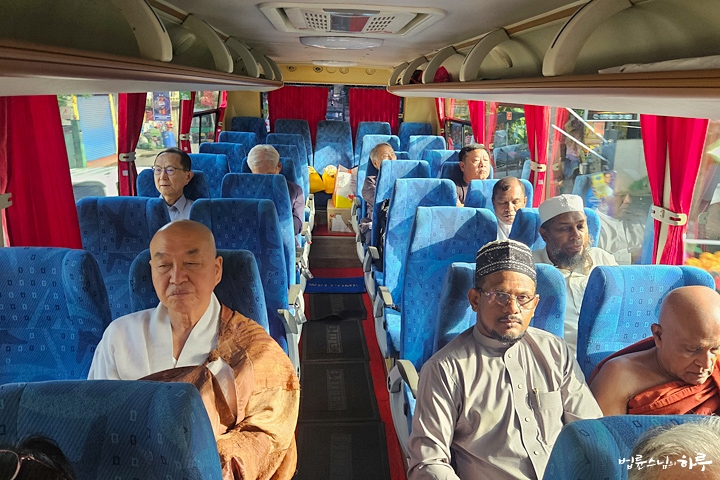
After about an hour and a half of travel, Sunim and the group had breakfast at a roadside restaurant.
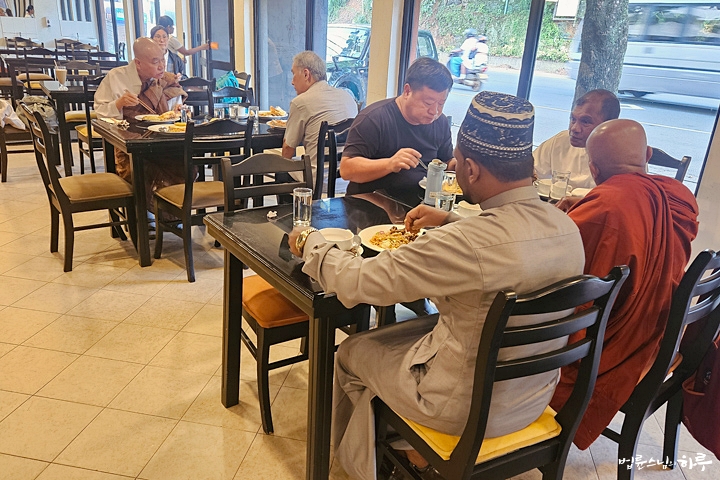
After the meal, they boarded the bus again and continued their journey.
At 9:30 AM, they arrived at their destination, Malwatta Temple in Kandy. Sunim and the group moved to the reception room to meet the Supreme Patriarch of the Malwatta Council of Elders, Venerable Thibbotuwave Sri Sumangala.
Venerable Thibbotuwave Sri Sumangala is the highest authority in Sri Lankan Buddhism, representing the Siam Nikaya, the largest and most historically significant of the three major Theravada sects in Sri Lanka. Beyond being merely a Buddhist leader, he serves as a spiritual pillar for the entire nation of Sri Lanka. He is such an influential figure that in times of national crisis or social conflict, political leaders, including the president, personally visit him to seek his advice.
Before meeting the Supreme Patriarch, Venerable Assaji briefly explained about the Sri Lankan Buddhist sects and the Supreme Patriarch.
"Sri Lankan Buddhism has three main sects: Siam Nikaya, Amarapura Nikaya, and Ramanna Nikaya. The Siam Nikaya received its Dharma lineage from Thailand, while the Amarapura Nikaya and Ramanna Nikaya received theirs from Myanmar. Since the Dharma lineage was once broken in Sri Lanka, it had to be re-established from Thailand and Myanmar. The person we will meet today is the Supreme Patriarch of the Siam Nikaya. He is also in charge of the Temple of the Tooth, where the Buddha's tooth relic is enshrined. After today's schedule, we will also go to pay our respects at the Temple of the Tooth."
Sunim bowed to greet the Supreme Patriarch and presented the gift he had prepared.
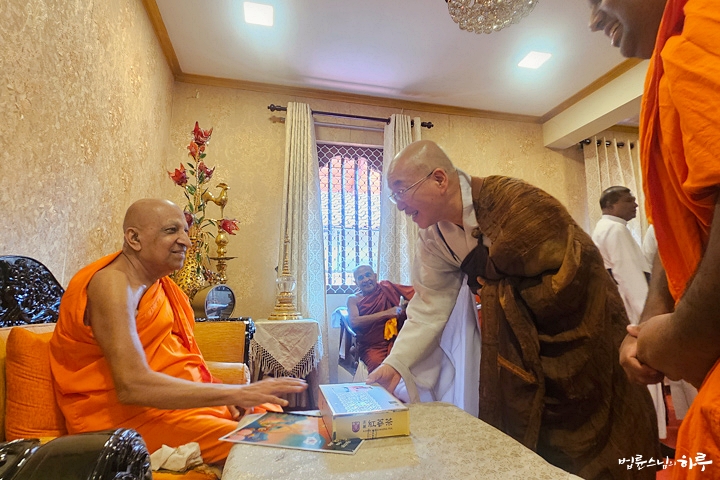
Venerable Assaji explained to the Supreme Patriarch about Sunim and the Korean religious leaders' gathering. He also introduced that Sunim had provided great assistance during last year's cyclone damage in Sri Lanka through JTS relief activities, and that JTS projects are currently underway in Sri Lanka as well.
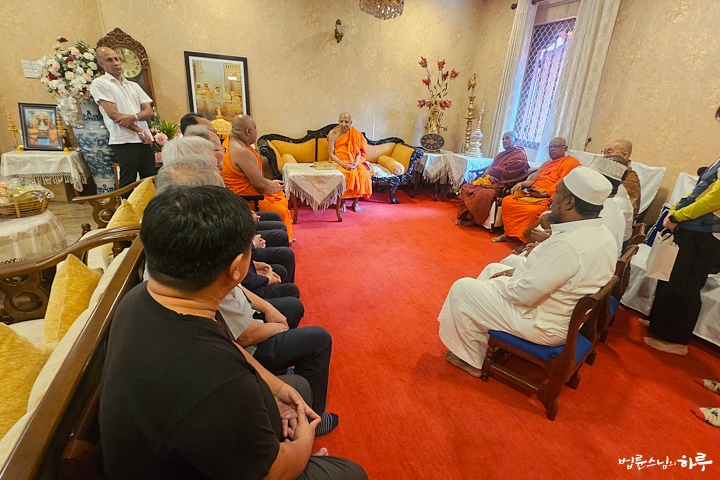
The Supreme Patriarch said:
"Our temple also works to build good relationships with the Tamil and Muslim communities in this region. Additionally, the nearby Silver Temple has paintings and sculptures symbolizing interfaith harmony. I sincerely support the activities you are doing for interfaith reconciliation and peace. If there is any help you need, I will support you anytime. Thank you so much for visiting, and I am truly delighted."
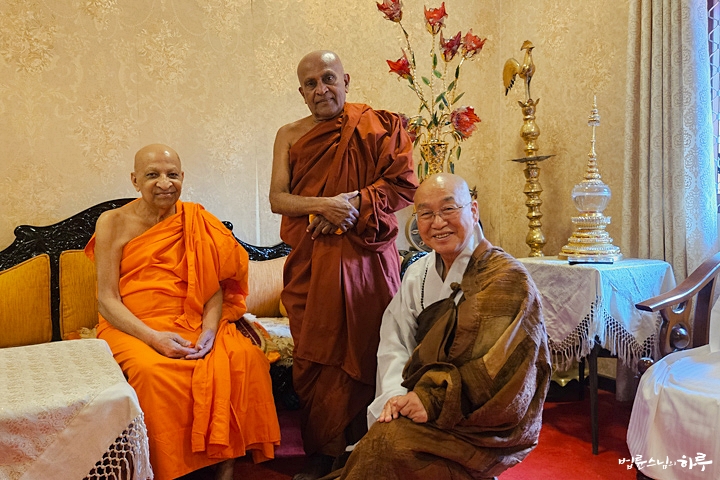
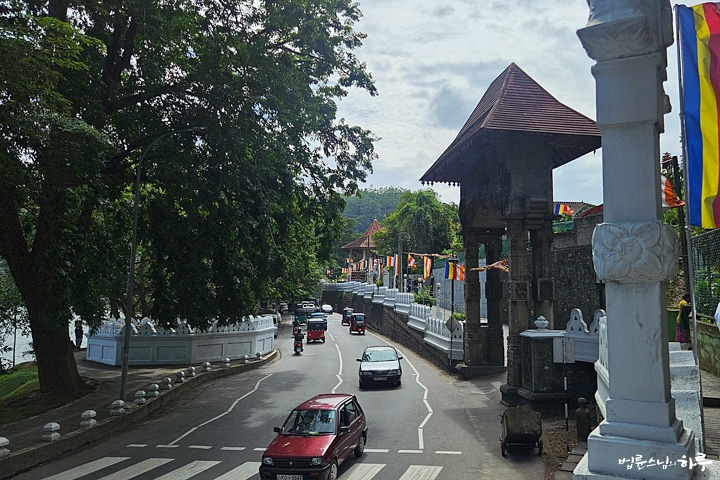
After taking photos with the Supreme Patriarch, Sunim and the group moved to the Temple of the Tooth, located not far from Malwatta Temple. On the way, they passed Kandy Lake, where they took a brief moment to take photos.
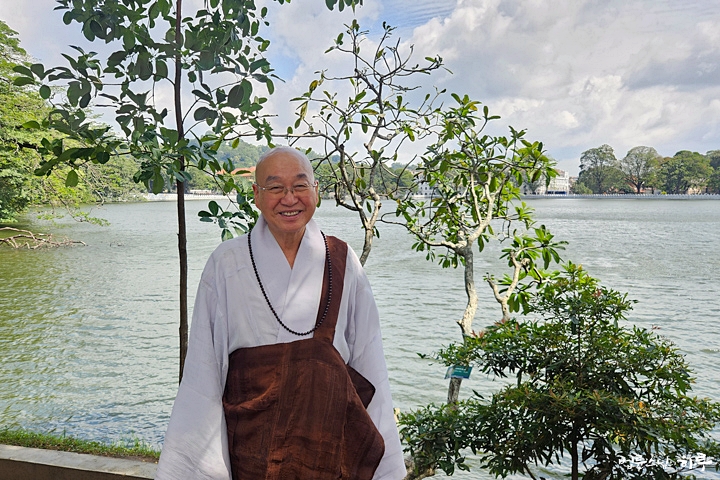
At 10:30 AM, Sunim and the group arrived at the Temple of the Sacred Tooth Relic (Sri Dalada Maligawa), a UNESCO World Heritage Site where the Buddha's sacred tooth relic is enshrined.
The Buddha's sacred tooth was preserved from the cremation process after the Buddha's parinirvana and was enshrined in the Kalinga Kingdom of India. In the 4th century, to escape war, Princess Hemamala and Prince Dantha are said to have hidden the sacred tooth in the princess's hair and brought it to Sri Lanka. Since then, the sacred tooth has been kept by successive kings and became a symbol of the legitimacy of royal authority, moving with each change of capital. After Kandy became the capital of the kingdom in the late 16th century, the current Temple of the Tooth was built, where the sacred tooth has been enshrined to this day.
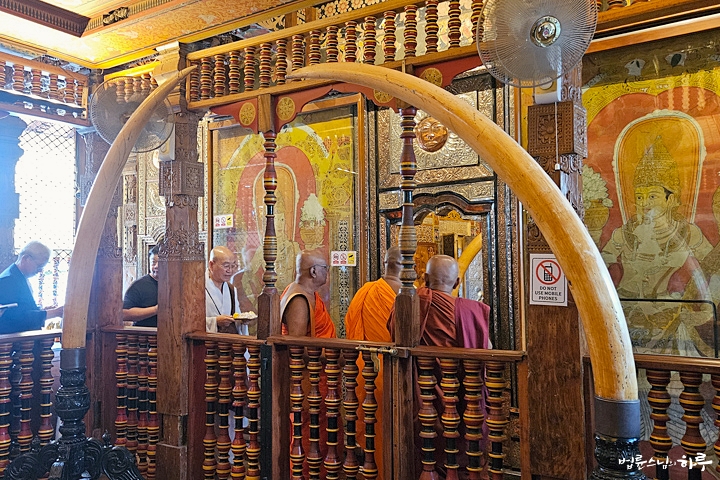
Beyond the Kandy Museum, the temple housing the sacred tooth was in the rear building. Many pilgrims had come to pay their respects to the Buddha's sacred tooth. The pilgrims lined up to offer flowers and pray.
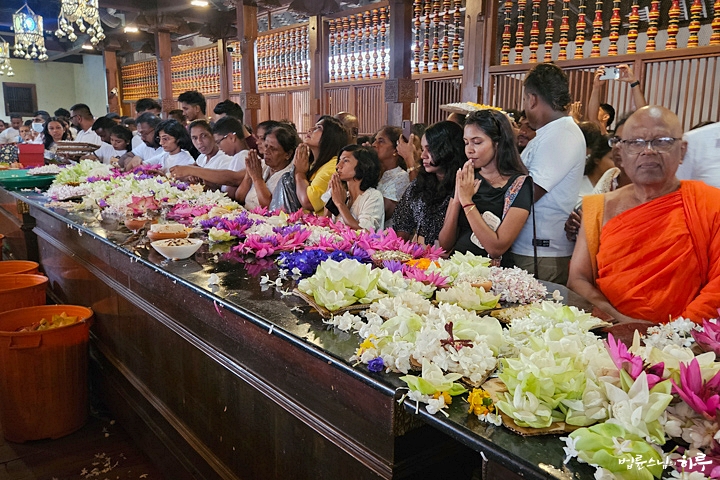
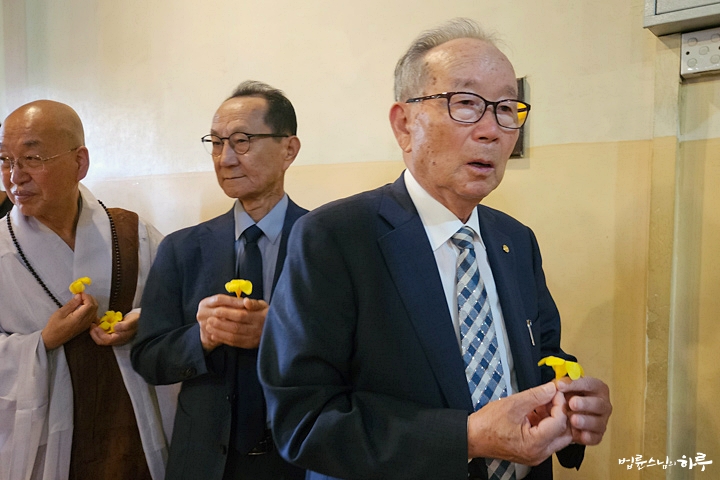
Sunim also obtained some small flowers and shared them with the group.
"Since we've come all this way, let's offer flowers."When one practitioner asked Head Minister Park Nam-soo (박남수) if he would also offer flowers, he replied:
"Since the Buddha attained enlightenment for the sake of this world, we are all his disciples, transcending religion."
Sunim and the group paid their respects to the Buddha's sacred tooth. As the sacred tooth was kept in a casket, they could not actually see the tooth itself.
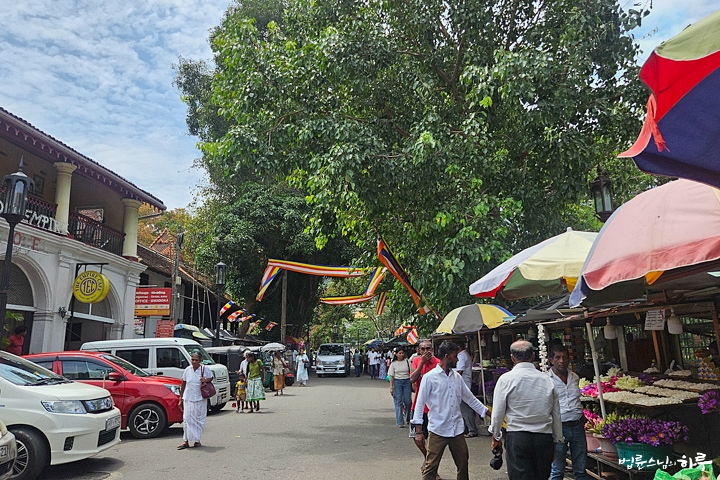
After paying their respects, they walked to a nearby restaurant for lunch, taking the opportunity for a stroll along the way.
After the meal, Venerable Assaji said:
"The meal has already been paid for."
It turned out that the restaurant owner was a Dharmashakthi member and also served as the Secretary-General of the Kandy Mosque Federation. The Kandy Mosque Federation is an organization that operates 390 Muslim mosques in Kandy Province.
Sunim said to Venerable Assaji:
"We came to see the Buddha's sacred tooth and visited the Buddhist order, so we should be receiving offerings from the Buddhist side. Why are we receiving offerings from the Muslim side? (Laughter) I'm joking. Thank you for the meal."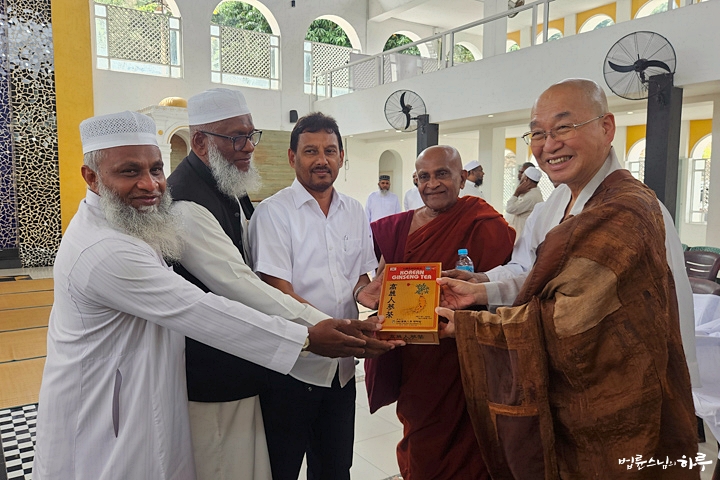
Sunim greeted the restaurant owner and presented a gift.
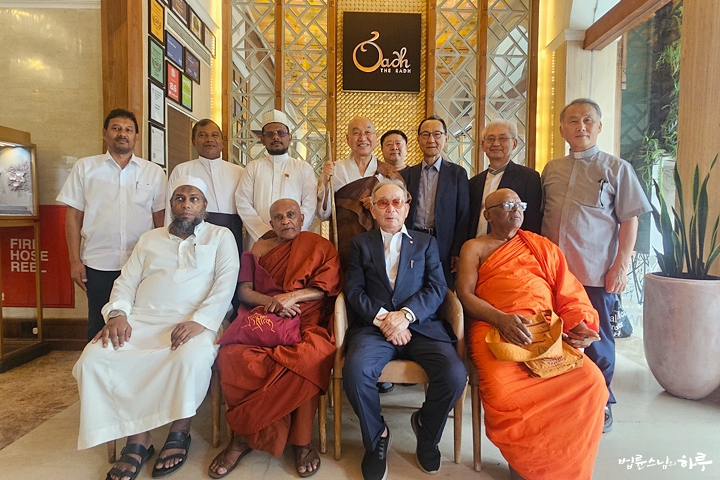
On the way to the next location, they briefly toured the Islamic Museum. Then, at 1:00 PM, Sunim and the group arrived at Rajitha Mosque and entered the Harmony Building, built in 2019. The Harmony Building was Sri Lanka's first building dedicated to promoting interfaith reconciliation and mutual understanding, a space created for people of different religious and cultural backgrounds to meet, exchange, resolve misunderstandings, and understand each other.
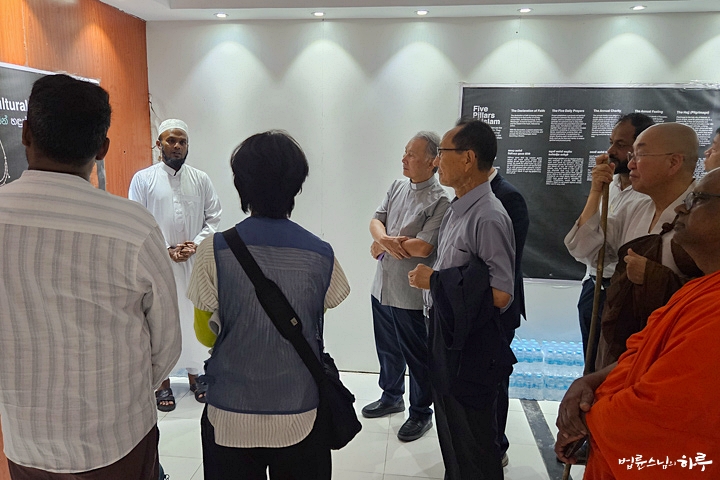
The guide said:
"People can grow closer when they understand each other. The purpose of this place is not to convert people from other religions or to teach a specific religion, but to reduce prejudice and misunderstanding about religion and to help people understand each other."
The exhibit also thoroughly explained the six articles of faith and five pillars that Muslims must observe, the cultural and social contributions Muslims have made to Sri Lankan society, and Madrasa, the Islamic educational institution.
Father Kim Hong-jin (김홍진) asked:
"If we can express Christianity in one word as 'love' and Buddhism as 'compassion,' what word can express Islam?"
"Peace."
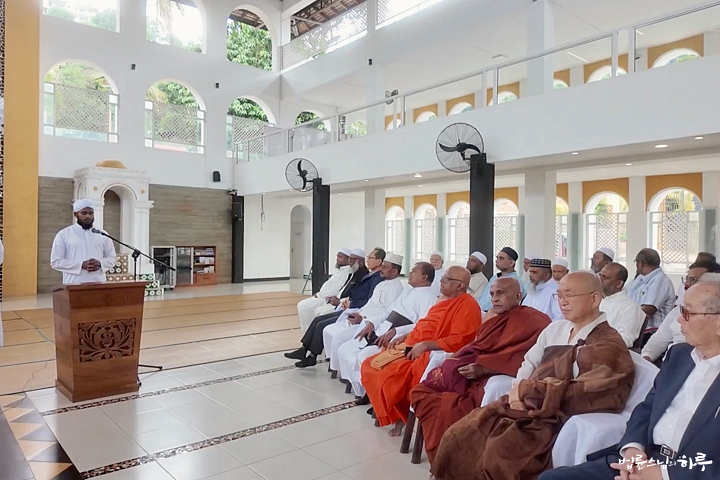
Seats were arranged in the center's hall for a short welcoming event for the Korean delegation. After an Arabic school student recited the Quran, the President of the Kandy Maulavi Federation gave a welcoming speech.
"Your visit today is a joyful day that should be recorded in gold. We welcome your visit. This Kandy region is a peaceful place where people of four different religions have lived together in harmony. Coexistence is the most important value in Kandy. Kandy is a very special place where diversity and coexistence flourish."
Pastor Park Jong-hwa (박종화) gave the response:
"We are truly grateful to have come to Sri Lanka in person and to meet with the various religious leaders here. There is one thing I came to realize very deeply during this visit. Of course, religion itself is very important. But I realized that people of faith are even more important than religion itself. For society to reconcile with each other and achieve peace, we religious people must take the lead first. So I have learned a great lesson: I hope that all our religions can closely cooperate with one another and become a 'wonderful collective of religious people' who create reconciliation and peace."
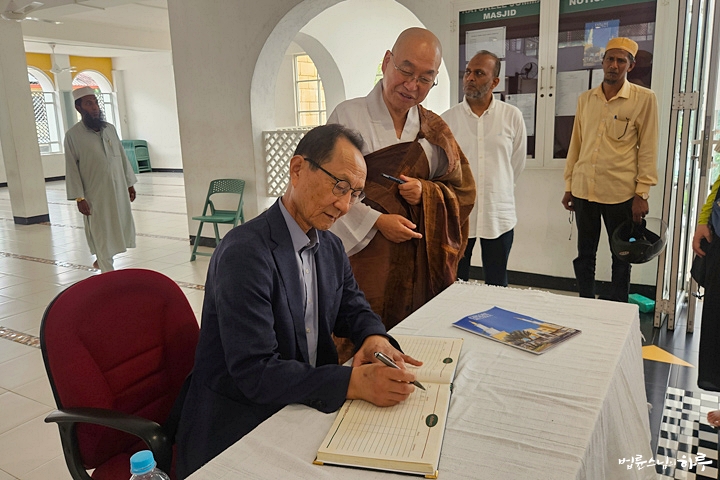
As the final part of the event, each religious leader wrote a message and signed the guestbook.
Sunim wrote: "Looking at the Muslims of Sri Lanka, they are young, courageous, and kind. Let us work together for peace in Sri Lanka, peace in Korea, and peace in the world."
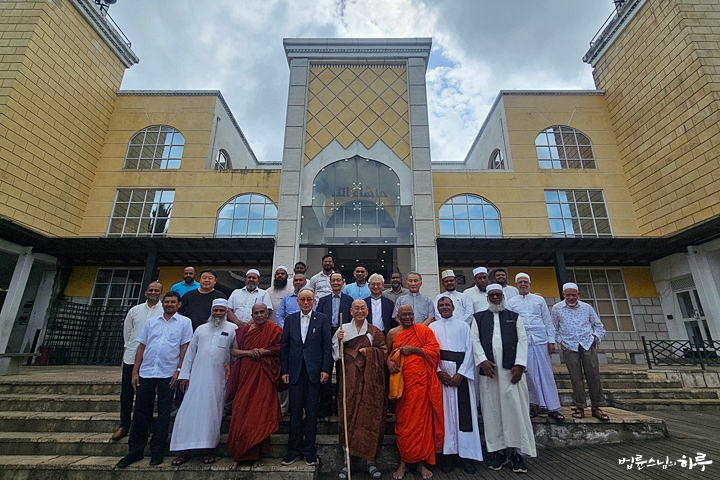
After taking a group photo, at nearly 2:00 PM, they boarded the vehicles to travel to Dambulla Cave Temple.
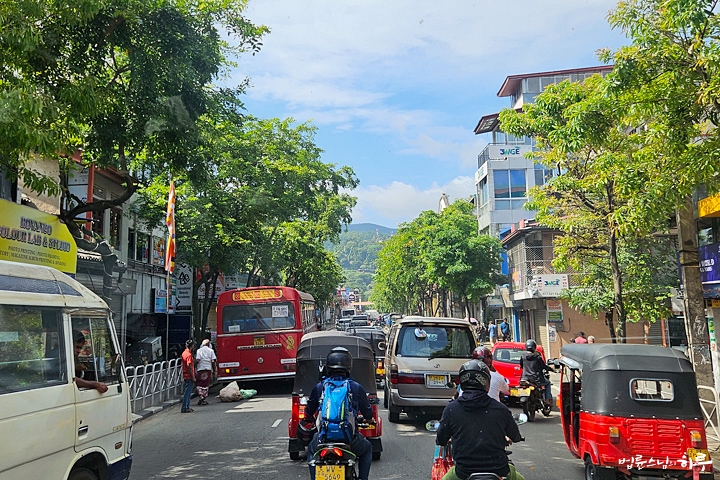
At 4:45 PM, they arrived at the entrance of Dambulla Cave Temple. Since the ticket office at Dambulla Temple was reported to close at 5:00 PM, everyone had been tense during the drive, but fortunately, the delegation arrived just in time to enter the temple.
Dambulla Cave Temple is Sri Lanka's largest rock cave temple, founded by King Valagamba in the 1st century BCE, and is a UNESCO World Heritage Site. It consists of five caves located on the mid-section of a massive rock mountain about 160 meters high. King Valagamba is said to have taken refuge for over ten years in these caves, where monks were practicing, to escape the Indian invasion. The monks practicing in the caves at that time risked danger to hide the king and protected him with great devotion for 14 years. After raising an army to drive out the invaders and reclaim the throne, the king, in gratitude for the monks' kindness, transformed the massive natural cave that had served as his refuge into a magnificent Buddhist temple and dedicated it to the monks.
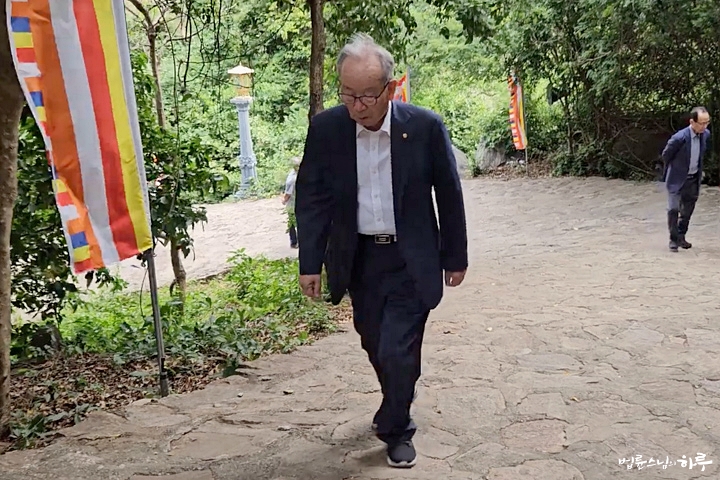
To reach the cave temple, one had to walk uphill for more than 15 minutes from the ticket office. Head Minister Park Nam-soo, the eldest in the group, led the way up the hill. Following behind, everyone walked up together, all breaking into a sweat.
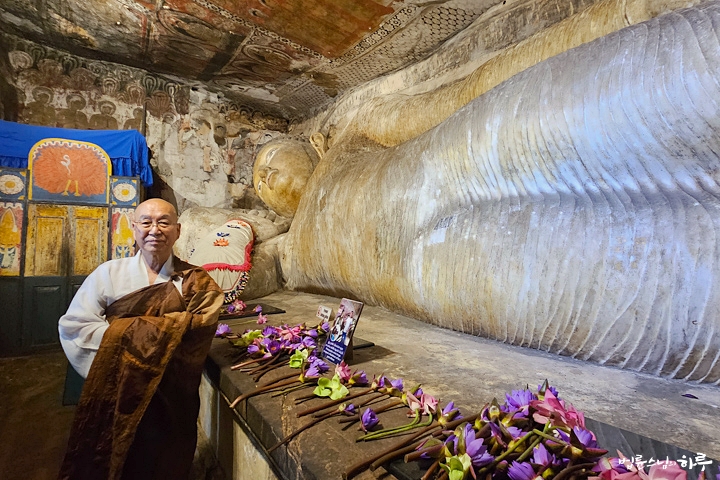
Upon entering the cave, a massive reclining Buddha statue was enshrined. Sunim explained about the reclining Buddha to the religious leaders.
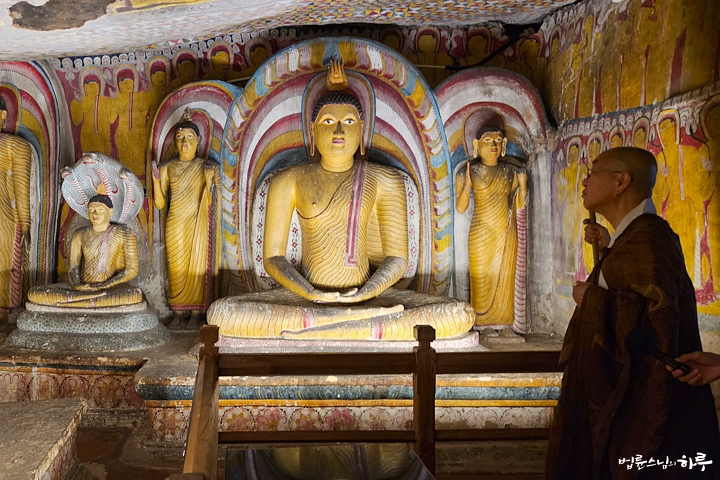
In addition, various Buddha statues and murals were well preserved.
When they came out of the cave, the breeze was refreshing. They all took a photo together.
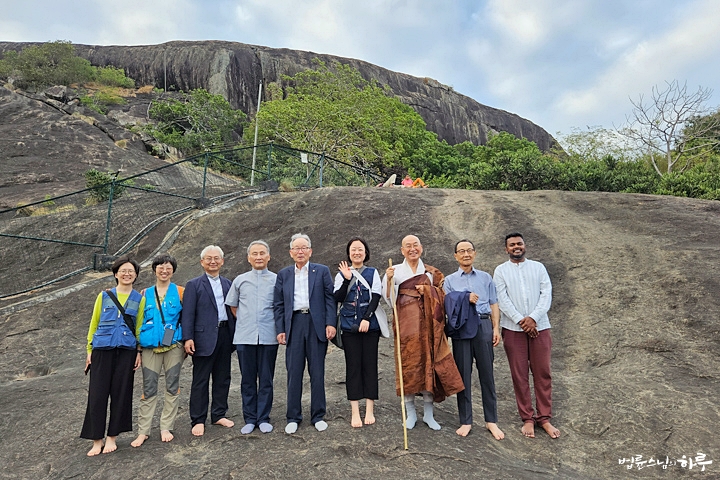
One practitioner said:
"The weather seems to be helping a lot so that the schedule isn't too exhausting for the elders. It's cooler than in Korea."
At 6:40 PM, they arrived at the lodging and had dinner.
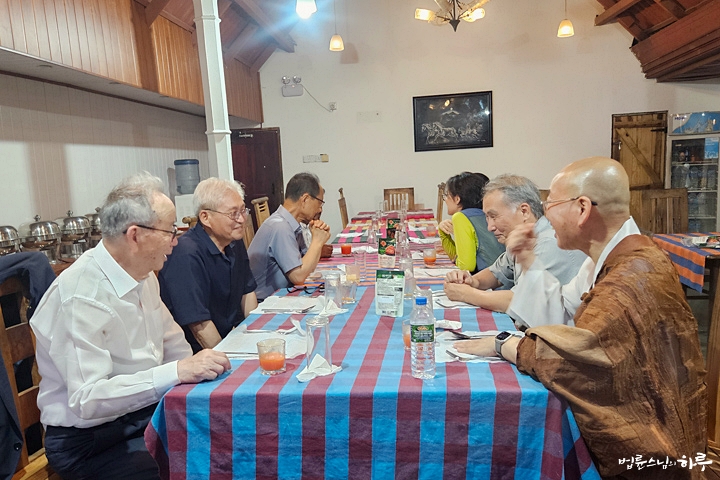
After dinner, Sunim proofread manuscripts and rested.
Tomorrow is the third day of the Sri Lanka itinerary, and they are scheduled to travel to Anuradhapura.
Since there was no Dharma talk today, this post concludes with a Dharma Q&A from last April.
Mother's Repeated Requests for Money—How Much Should I Accept?
"Are you over twenty years old now?""I've been troubled lately by my relationship with my mother. My mother only contacts me when she needs money. It's not just a small amount of pocket money—she asks to borrow anywhere from a few million won to as much as tens of millions of won. She says, 'I'll pay you back by next month,' but sometimes she returns it years later. As this has happened repeatedly, I've become mentally exhausted. It's not as if I have a lot of money, yet she keeps making these requests, so the burden has grown, and sometimes I refuse. When I do, my mother says harsh things like, 'You have no heart. Other people's daughters aren't like this.' Every time I hear those words, it's very difficult, and as these incidents have piled up, my self-esteem has plummeted. Now I even find myself thinking, 'Should I cut off my relationship with my mother?' I'm so troubled that I wanted to ask you, Sunim."
"I'm forty years old."
"Once you're over twenty, you're an adult. Adults have the right to make all their own decisions. You don't need your parents' permission to get married, and you don't need your parents' permission to become a monastic. If you want to give your mother money, give it; if you don't want to, don't. If you want to answer the phone, answer it; if you don't want to, don't. This is your right. Before the age of twenty, parents are guardians and children are under their protection. At that time, parents have a duty to protect their children, and children need to obtain their parents' permission when making important decisions. But now that relationship is over. It is now a relationship between two adults. Whatever choice you make, it is your freedom. Earlier, when discussing what to do when a child asks for something, I said, 'Don't scold them, but also don't give them everything they ask for,' right? Give if you want to give, and don't give if you don't want to, but don't scold them emotionally. It's the same with your mother. Whether you answer the phone when she calls is your freedom, and whether you give her money when she asks is your freedom. However, telling her, 'Don't call me,' or 'Don't ask me for money,' is interfering with your parent's life. Your mother has the freedom to call when she needs to, and the freedom to ask for money. So when your mother says, 'Please lend me some money,' just say 'Okay' and then don't give her any." (Laughter) If your mother says, 'You said you'd send it, why didn't you?' just say, 'I meant to send it, but I don't have the money.' Even if your mother curses at you, just listen. Why is that so difficult? You already know from your mother's personality that if you lend her money, it's difficult to get it back. So respond accordingly. But when you get worked up like this, is it your mother's problem or your problem?""It's my problem."
"Since it's your problem, you need to compensate for it with some money. The best approach is this: when your mother asks to borrow ten million won, a few days later say, 'Mom, no matter how hard I try, I can't come up with ten million won. Instead, I'll send you one million won,' and give her one million won. Is it better to lend ten million won and not get it back, or to give one million won? Giving one million won is better. So this is what I mean by needing wisdom. Instead of escalating conflict with your mother, respond realistically like this. You shouldn't tell your mother, 'Don't call me,' or 'Don't ask me to lend you money.' That is your mother's freedom. Phone calls are made when people need to make them. Everyone contacts others when they need something. Yet we complain, 'That person only contacts me when they need something.' Originally, that's how everyone does it. Some people gossip behind others' backs. Which is better for me—someone raising their hand during a Dharma talk and saying, 'Venerable Pomnyun Sunim, do you call that a Dharma talk?' or someone saying on their way home, 'What kind of Dharma talk is it when the Sunim just talks about raising children?' Which is better, gossiping behind someone's back or saying it to their face?""Gossiping behind their back is better."
"Gossiping behind someone's back is actually a form of showing courtesy to that person in their own way. So there's no need to criticize back-talk. Not saying something to someone's face but saying it behind their back can be that person's way of showing courtesy. There's no need to view it only negatively. Of course, it would be even better not to gossip at all. It would be better if your mother didn't ask to borrow money, but she says it because she needs to. However, that doesn't mean you have to grant every request. Give what you can give, and for what you can't give, just say, 'Mom, I'm sorry.' If she keeps calling, you don't have to answer, and if you do answer, you can say, 'I'll look into it,' and later say, 'I looked into it, but it's difficult.' You need to respond this way. If you react emotionally with, 'Why are you doing this to me?' it won't be resolved. If you keep getting angry, where does that impact go? It goes to your children. Because emotions are transferred. If the anger you receive from your mother isn't resolved, you'll get upset even when your child makes a small mistake. So you need to understand, 'That's just who my mother is,' and live by adjusting your distance accordingly. This is not unfilial. Abusing your parents, taking their money, hitting or cursing at them—that is unfilial. But not doing what you cannot do is not unfilial. There is a saying, 'Encourage good, punish evil (권선징악, 勸善懲惡).' Good is to be encouraged, and evil is to be stopped immediately. Bad deeds must be stopped, but good deeds can be done or not done. If you do good deeds, you are a good person, but not doing good deeds doesn't make you a bad person. So doing good is not an obligation but a choice. Conversely, evil deeds must be stopped. In Buddhism, we say 'Stop evil (지악, 止惡)' to immediately halt evil, and 'Cultivate good (수선, 修善)' to practice good consistently. So not doing a good deed does not make you unfilial. Serving your parents well makes you a filial child, but not serving your parents doesn't make you a bad person. However, abusing your parents or taking their money is unfilial and clearly wrong. In Confucianism, the concept of filial piety emphasized that just as parents raised their children, children have an obligation to serve their parents in return, which is where the term 'unfilial' comes from. But that is only one ethical perspective and can hardly be considered a law of nature. Looking at the natural ecosystem, it is natural for a mother to protect her offspring for a certain period. But have you ever seen an animal where the offspring cares for its aged parents? Once you become an adult, taking responsibility for your own life is the law of nature. So the elderly should not ask their children for anything. If I expect something from my child, that child becomes unfilial. Conversely, if I expect nothing from my children, all my children become filial. Filial and unfilial children are created by me. This is 'All things are created by the mind alone (일체유심조, 一切唯心造).' If I keep having expectations of my children, those children will feel unfilial to me.""Yes. Thank you."