I'm Afraid My Son Might Take His Own Life
Jun 30, 2026 – Day 1 of the Sri Lanka Peace Pilgrimage by the Interfaith Religious Leaders' Group
Hello. Today, Sunim arrived in Colombo, Sri Lanka, and met with Dharmashakti, an interfaith group of Sri Lankan religious leaders, to begin the first day of the Sri Lanka Peace Pilgrimage.
Sunim and his delegation boarded a flight from Incheon last night and, after traveling through the night, arrived at Bandaranaike International Airport in Colombo at 4:10 a.m. Dharmashakti, who had invited Sunim and the group, welcomed them with the airport's VIP service. As they disembarked from the plane, a staff member came out and escorted the group to the VIP lounge. The airport arranged to collect their luggage and load it into the vehicles.
When they arrived at the VIP lounge, familiar faces were waiting to greet them.
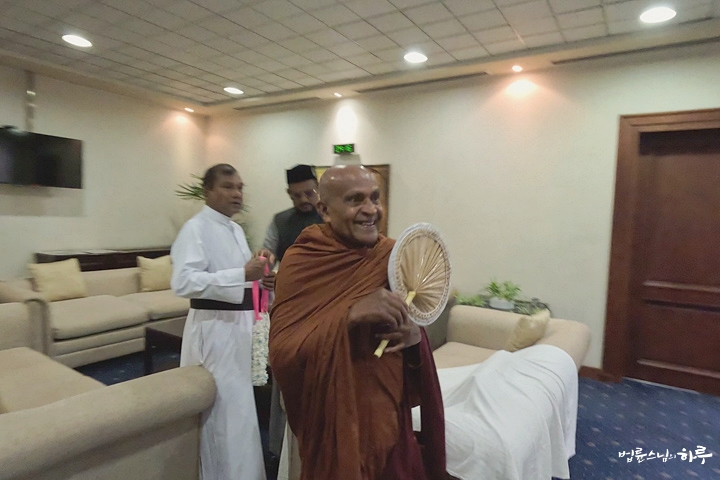
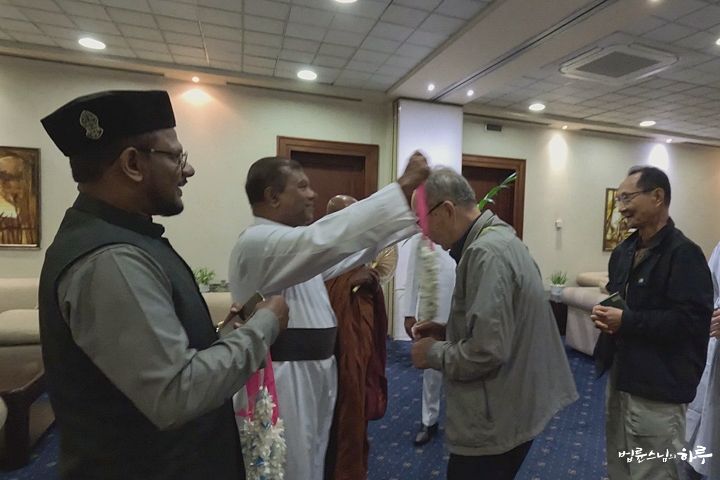
Venerable Assaji, Reverend Anura, and Imam Firdous, who had participated in the interfaith exchange in Korea last July, welcomed the group with wide smiles. They placed flower garlands around the neck of each member of the Korean delegation as a warm welcome.
"Welcome!"
"Thank you so much! (laughter)"Sunim was concerned that the Dharmashakti members had come to the airport so early in the morning, and said:
"You came out so early in the morning. You didn't need to come out at this hour….""You and we are brothers, so of course we had to come out. (laughter)"
"Bishop Park Kyung-jo of the Anglican Church deeply regretted that he couldn't join us due to his poor health."While waiting for the luggage, the group enjoyed Sri Lankan coffee and tea as they talked.
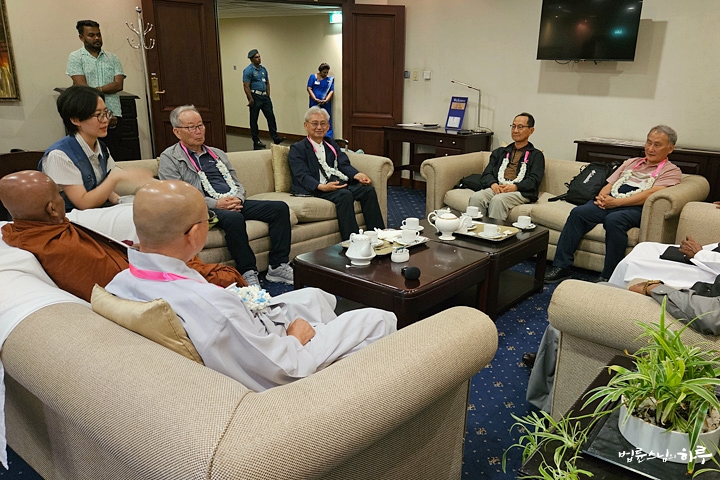
One of the religious leaders said:
"When the Sri Lankan religious leaders visited Korea last time, I was very surprised. I had thought that interfaith gatherings were something only we did, but I newly learned that Sri Lanka also has active interfaith cooperation."
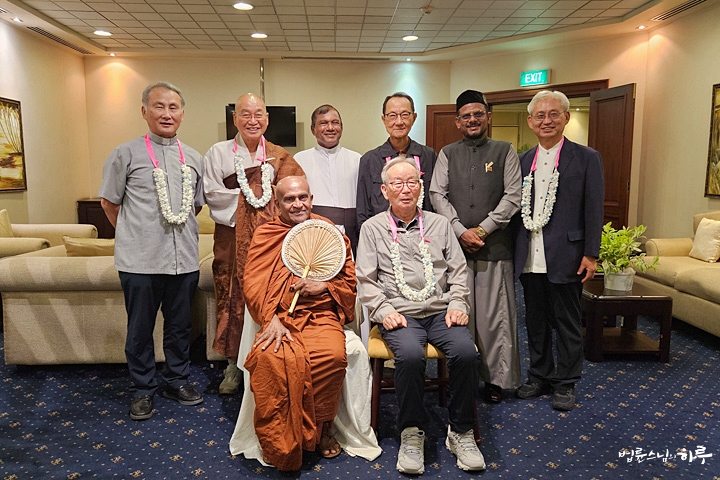
At 5:20 a.m., after taking a group photo, everyone boarded a bus and headed from the airport to the accommodations.
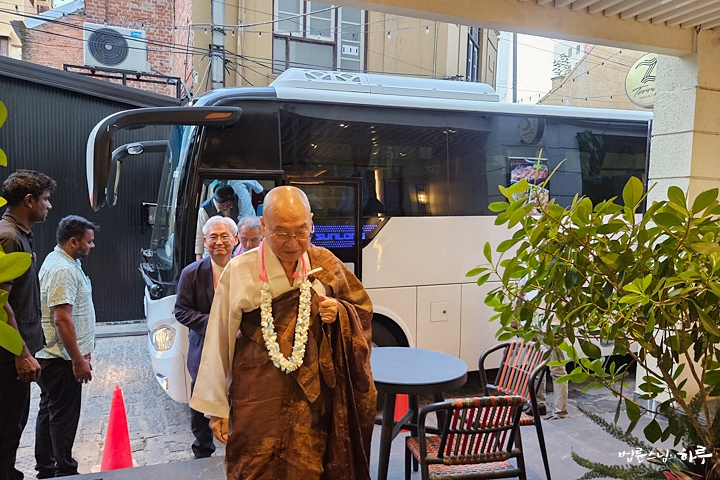
They arrived at the accommodations just before 6 a.m. After a light breakfast, considering that fatigue from the overnight flight might have accumulated, the morning schedule was postponed and everyone rested.
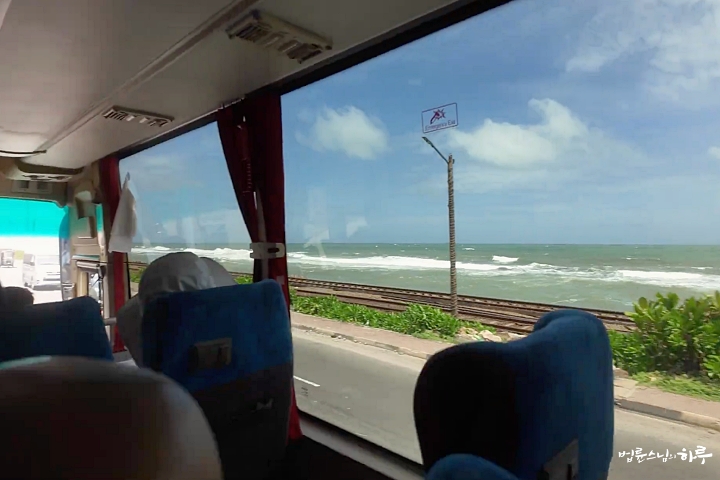
At 11:10 a.m., the group left the accommodations by bus and headed to the Department of Muslim Religious and Cultural Affairs.
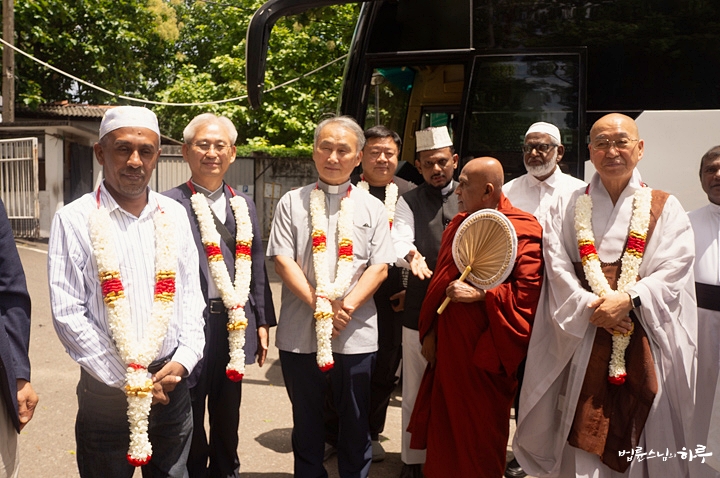
Upon arriving at the Department of Muslim Religious and Cultural Affairs, not only Muslim leaders but also representatives from each religion had gathered together to welcome the delegation.
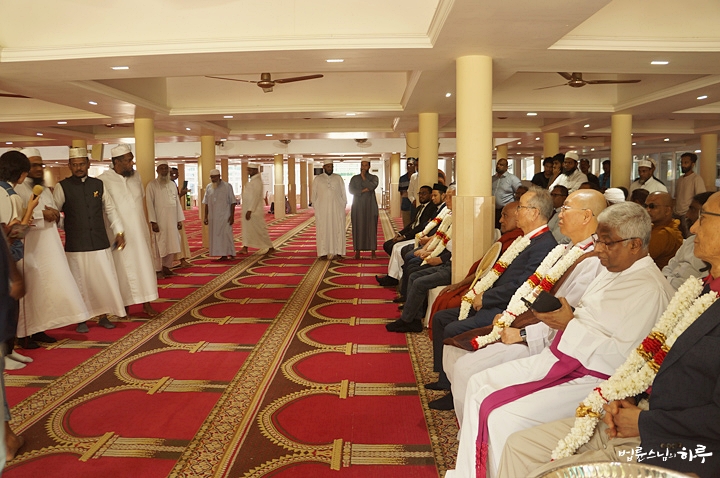
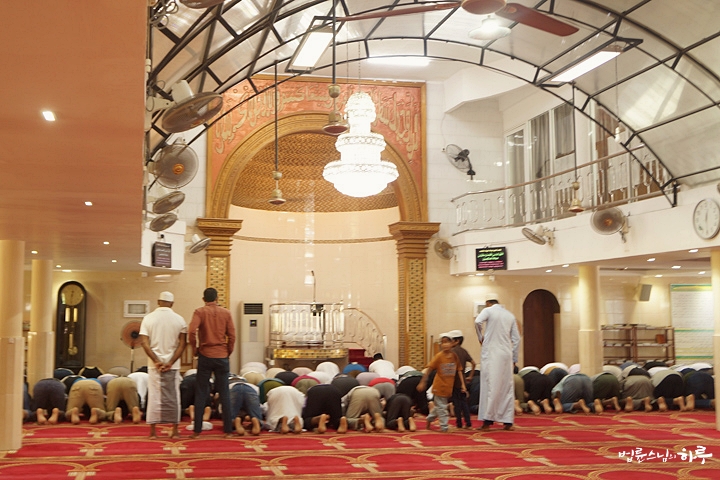
During the visit, when Muslim prayer time arrived, the delegation was invited to observe the prayer. Muslims pray five times a day, they explained. The prayer lasted 15 minutes.
Sunim said:
"In Korea, we don't have the opportunity to see this in person, so it is very meaningful to witness this prayer directly."While observing, two Sri Lankan bhikkhunis who had participated in the INEB Jungto Society tour in Korea came to greet Sunim. Sunim warmly greeted them and had a brief conversation.
After the prayer, lunch was served at 1 p.m. A quiet space had been separately prepared for the religious leaders from Korea.
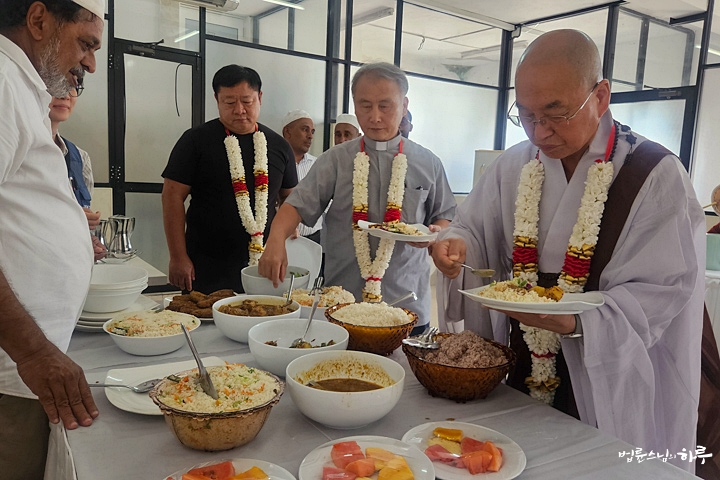
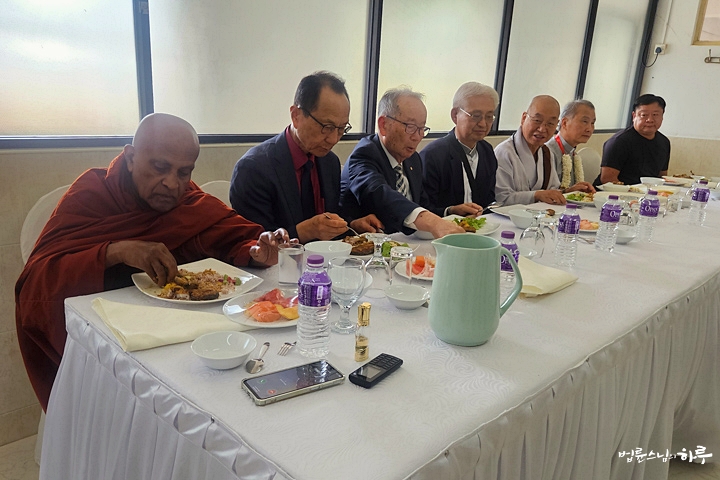
After lunch, from 1:30 p.m., there was an introduction to the Dharmashakti Executive Committee, followed by a dialogue.
The representative of Dharmashakti delivered a welcoming address.
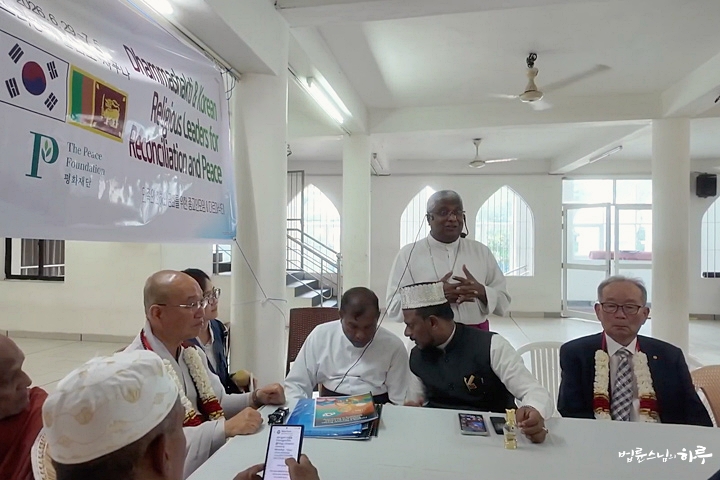
"It is a great honor for me to welcome you on behalf of all the religious leaders who are part of Dharmashakti. Last year, I met the religious leaders from Korea for the first time in Korea. I am very pleased to meet you all again here today. I hope that through this visit, you will have many new experiences that you haven't had before. The media often only reports when there are conflicts and disputes. But through this visit, you will not see such scenes, but rather witness firsthand how different religions actually live together. You will meet the Muslim community, the Hindu community, the Buddhist community, and the Christian community. Through this visit, I hope you will go beyond religious barriers and learn to understand one another. And I hope you will take home many good memories from Sri Lanka. Thank you."
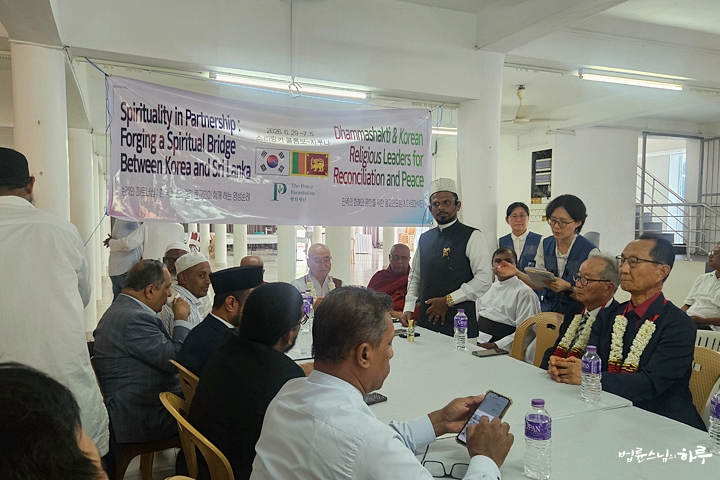
The Deputy Minister of Religious Affairs from the government also came out and delivered a welcoming address.
"Sri Lanka has made great efforts in recent years to develop interfaith relations. Over the past two years, not a single case of religious or ethnic conflict has been reported. The government is also continuously working to achieve harmony between religions and ethnic groups. We hope that through such meetings, peace and harmony will continue to expand in the future."
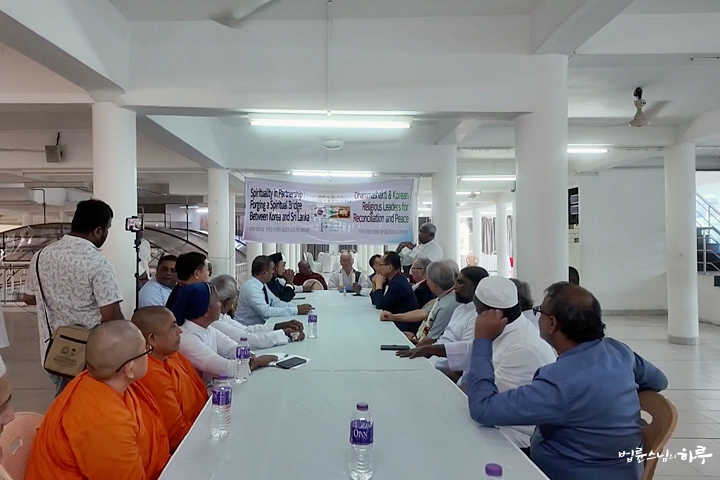
The Muslim representative also spoke.
"Sri Lanka is a country where about 21.7 million people live together. About 69% of the population is Buddhist, about 12.5% Hindu, about 10.5% Muslim, about 6.5% Catholic, and about 1.5% other Christians. We have lived together on this island for thousands of years. Of course, during that time we experienced colonial rule by several European countries. But we have preserved our religions, cultures, traditions, and brotherhood. Recently, the Buddhist Vesak festival and the Muslim Eid holiday fell around the same time, but we completed the celebrations without any significant conflict."
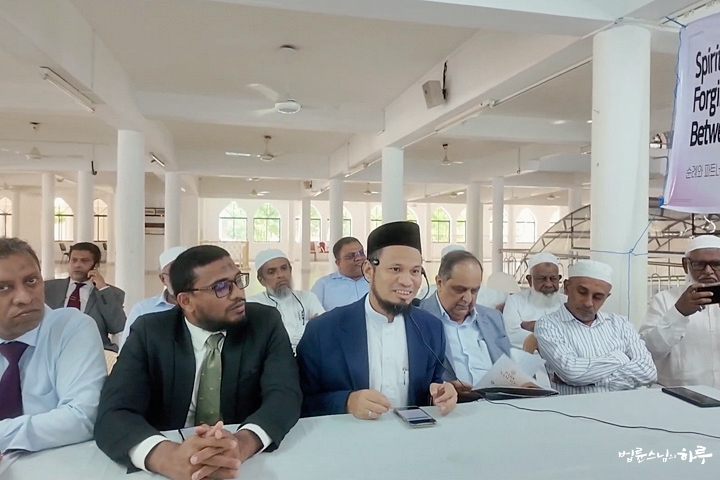
The conversation among the participants continued. It was impressive to hear that interfaith cooperation is actively taking place in Sri Lanka. It was also inspiring to hear that Buddhism, Islam, Hinduism, and Christianity coexist peacefully within one society. The discussion also covered a wide range of topics, including changes in religious demographics after the colonial period, overseas labor and migration, citizenship issues, and the Sunni-Shia conflict in the Middle East.
The conversation then moved on to the topic of religion and the economy. Sri Lankan religious leaders emphasized that interfaith harmony goes beyond a mere religious issue and is directly connected to the national economy. They said that social trust and peace must be the foundation for foreign investment and tourism to flourish, and for the economy to grow.
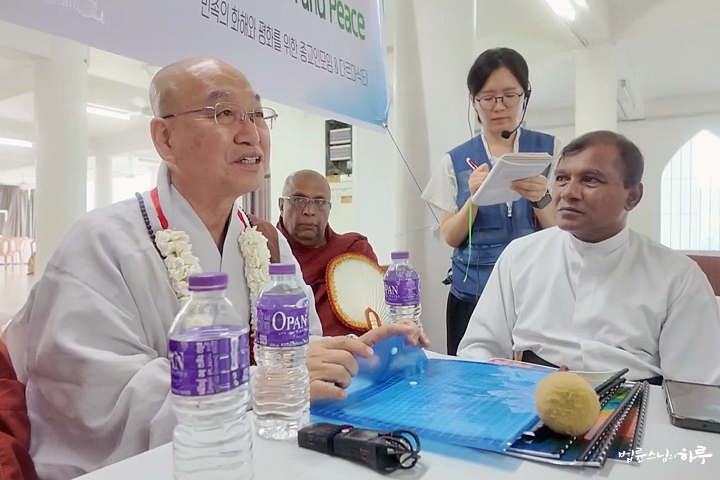
As the meeting drew to a close, Sunim introduced the Korean interfaith delegation and spoke.
Afterward, the group moved on to visit the YMBA.
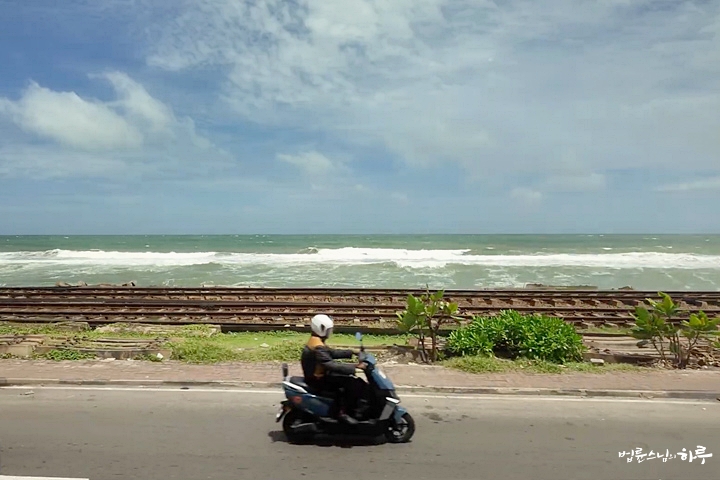
At 3:30 p.m., Sunim and the group arrived at the YMBA office. Mahendra Amarasekara, the president of YMBA, welcomed Sunim and the group.
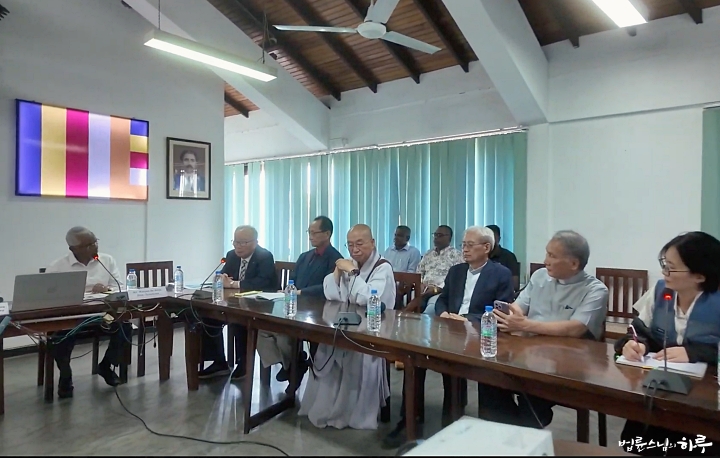
Sunim and the delegation moved to the conference room and took their seats. The delegation introduced themselves first.
"I am Park Nam-soo, former Cheondogyo Head, and a member of the Interfaith Religious Leaders' Group for National Reconciliation and Peace from the Republic of Korea."
"I am Park Jong-hwa."
"I am Venerable Pomnyun Sunim, and I am the Chairman of the Peace Foundation, which prepared this event.""Nice to meet you. I am Kim Dae-sun, a Kyomu (minister) of Won Buddhism. I am currently serving as the Standing Representative of URI Korea."
"I am Kim Hong-jin. I am a priest of the Seoul Archdiocese. It has been five years since I retired, and I am now farming in the countryside. (laughter)"
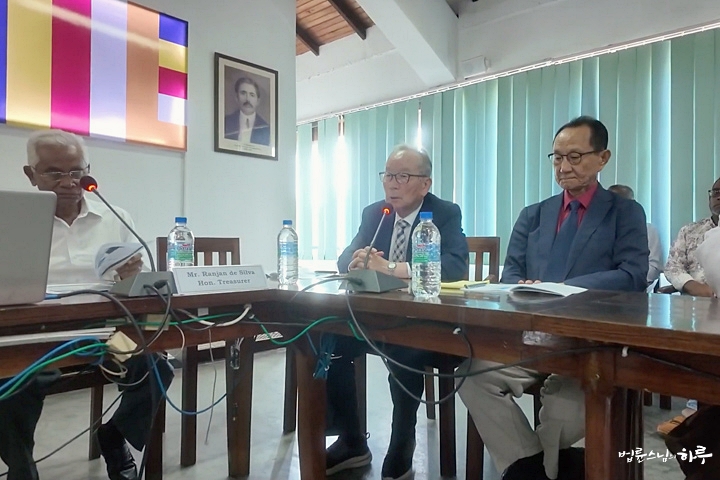
The YMBA members also introduced themselves, and then explained the history and activities of the YMBA.
The YMBA (Young Men's Buddhist Association) is a Sri Lankan Buddhist youth organization founded in 1898 during British colonial rule to preserve the Buddhist spirit and educate young people. It also played an important role in Sri Lanka's independence movement. Notably, although the first president was a Buddhist, the first secretary-general was a Catholic. From the very beginning, the organization has carried on a tradition of cooperation across religions. It later played a central role in the establishment of the Ceylon National Congress, and many of Sri Lanka's presidents and prime ministers came from the YMBA.
Today, the YMBA has grown beyond being a Buddhist youth organization to engage in various social contribution activities. It carries out diverse activities for the community, including scholarship programs, youth leadership training, teacher training, cultural and arts events, and drinking water supply projects. What was impressive was that it supports wherever help is needed regardless of religion or ethnicity, and steadily carries out projects even in Muslim regions and Tamil regions where Hindus mainly reside.
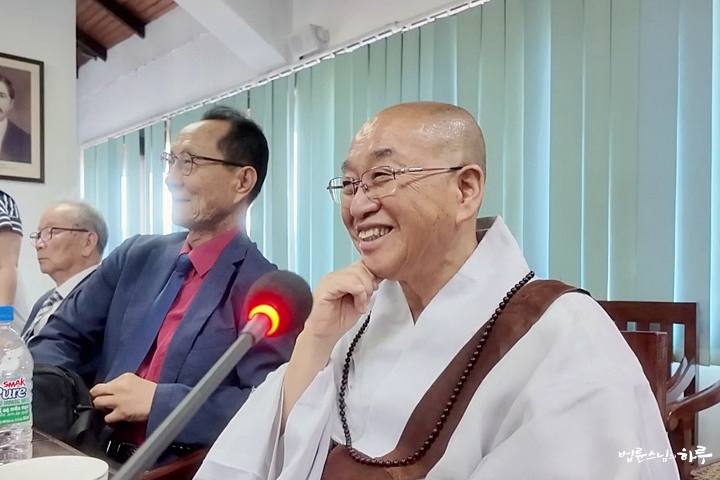
Sunim asked about the age range for YMBA membership, where older members go, and whether monks could also participate.
Sunim shared the Korean experience.
"In Korea, too, young people were at the center during the independence movement and democratization movement, but as society has become stable and aging, the power of the younger generation to bring about social change is not what it used to be."Sunim asked whether there was a similar trend in Sri Lanka. In response, YMBA said that while the way youth organizations stand at the forefront has weakened, when necessary, young people take to the streets and engage in social issues. They also mentioned that in 2022, many young people took to the streets and demanded change, and now the role of the younger generation is growing in social media and digital spaces.
Sunim asked again about the relationship between youth and the older generation, saying that generational differences are not merely a matter of age, but arise from differences in experience and technological environment. Therefore, the experience of the older generation is needed, and so is the new technology of the younger generation. When the two generations learn from each other and cooperate, religious organizations can also play a more vital role in society.
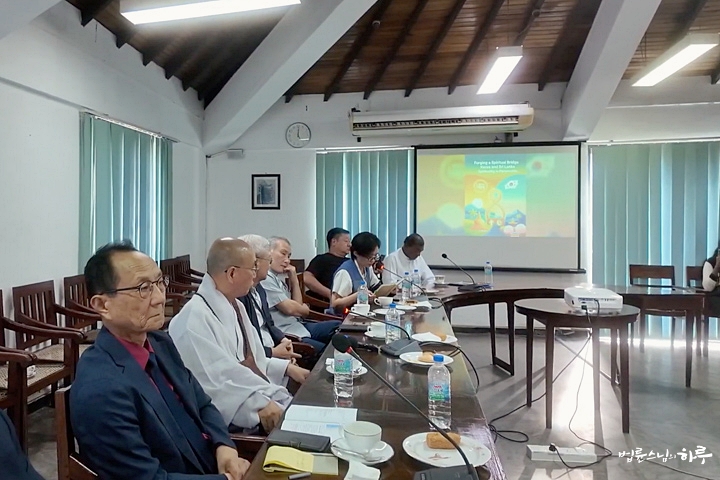
The Korean religious leaders also exchanged questions and answers.
▪ The YMBA was an organization that trained Buddhist youth and participated in policy. What is your current relationship with politics? What is your relationship with the political sphere—conflict or cooperation?
▪ You carry out many good projects. How do you raise your funds?
▪ Are you legally recognized as a non-profit organization (NPO) with tax exemption benefits for donations?
▪ In Korea, the generational gap between young people and the older generation is widening. Are there such generational differences or conflicts within the YMBA as well?
The YMBA also asked questions to the Korean delegation about things they were curious about.
▪ In Korea, exchanges between Buddhism, Protestantism, and Catholicism are visible, but what is the situation with Islam and Hinduism? Where do Islam and Hinduism stand in Korea, and how does interfaith exchange take place?
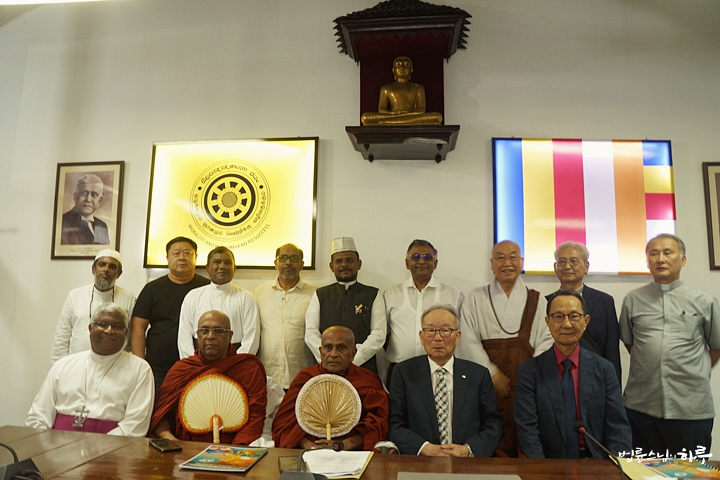
After taking a group photo together and exchanging gifts, today's visit schedule came to an end.
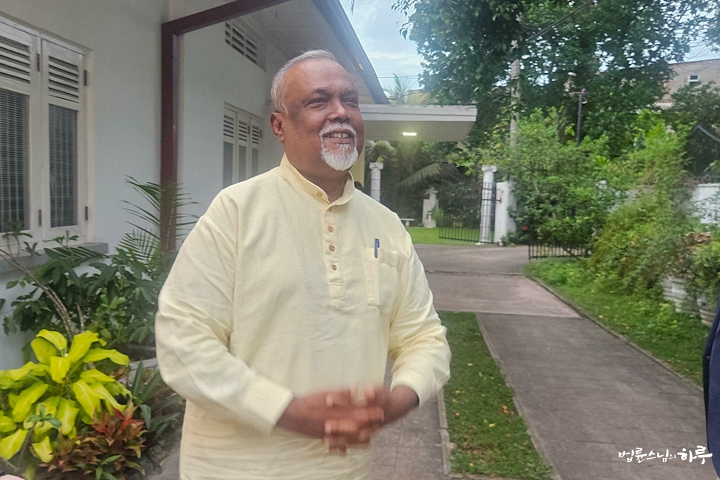
At 6:30 p.m., Harsha, the Chairman of INEB, invited Sunim and the delegation to dinner. Harsha had specially prepared vegan meals for the delegation. The group was able to taste Sri Lankan traditional foods, including rice noodles made from a special variety of rice used as medicine, and curries made from tropical crops.
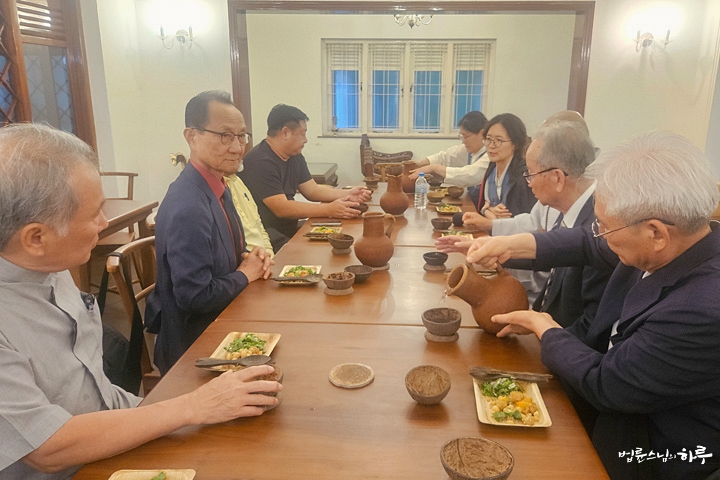
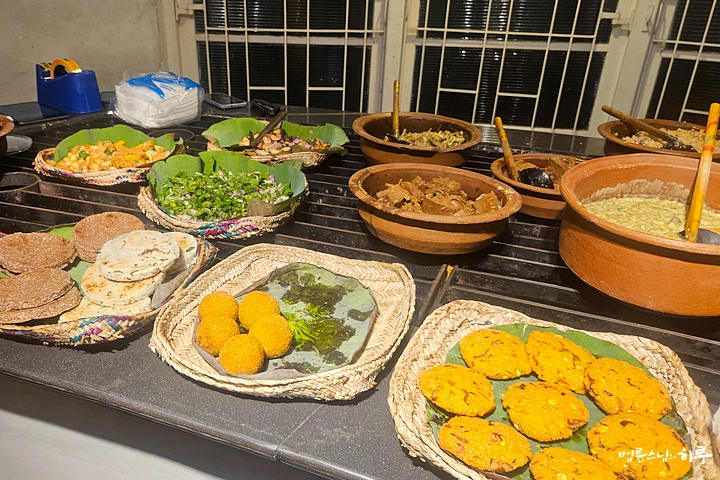
During the meal, the conversation naturally turned to environmental and peace issues. They talked about the polluted drinking water problem in Sri Lanka, and the role of the Korean religious community in peace in Southeast Asia and South Asia.
After the meal, the group returned to the accommodations just before 8:30 p.m. Sunim revised his manuscript and then rested.
Tomorrow, on Day 2 of the Sri Lanka schedule, Sunim and the delegation will travel to the region of Kandy to pay respects at the Malwatta Temple and the Temple of the Tooth, which houses the Buddha's tooth relic.
As there was no Dharma talk today, this post concludes with a Dharma Q&A that Sunim held during the Western Regional Branch Day last Sunday.
I'm Afraid My Son Might Take His Own Life
"We are practitioners. When practitioners encounter a situation, rather than simply being afraid, worried, or anxious, we must first examine what the cause is. Then we must respond accordingly. Looking at the current situation, your son wanted to go to University A, but his father told him to go to University B, so he went to a university he didn't want, eventually dropped out, and is now preparing for the entrance exam again. But instead of focusing on his studies, he keeps clashing with his father. However, this is only the surface phenomenon; the essence is your son's psychological anxiety. The conflict with his father and the university issue are just outward manifestations of your son's psychological anxiety. But if you keep focusing only on the university issue or the conflict with his father, you'll miss the essence. The key is to treat the psychological anxiety at the hospital; there's no need to keep placing the relationship with his father at the center of the problem. If your son were to make an extreme choice while quarreling with his father, you shouldn't think, 'He died because of his father.' You should see it as the result of not properly treating the illness of psychological anxiety. If there is less stimulation from the surroundings, his psychological anxiety may lessen. But that's not something you can control, is it? He might be startled by sudden rain or thunder, his symptoms might worsen from being in an unfamiliar environment during travel, or his father might shout and worsen the situation. So the relationship with his father is just one of many stimuli. Since you can't do anything about the other factors, you don't make an issue of them. But because you think you can change your husband, you keep making him the issue. Try thinking of your husband as one of the conditions you cannot change, like thunder and lightning. If you think, 'How can I change that person's temperament?' you'll see him as just one of many factors. You shouldn't think of your husband as the cause of the problem. The root is your son's psychological anxiety, and your husband is merely one of many stimuli. So what's important is how the medication is prescribed and taken consistently. Next, it helps to make the surrounding environment a bit more comfortable. If your son is in such a dangerous state that he might take his own life, studying is not what matters right now. Whether your husband nags or not is not the essential issue either. What's important is that he takes his medication well, exercises, and does a lot of lower-body exercise, whether that's bowing or walking. Whether he watches YouTube or has some other hobby—these aren't things to make a big issue of right now. There's no need to interfere with him watching YouTube while worrying, 'My child might die.' Rather, it's more important to let him focus on that so that his mind doesn't turn toward extreme choices. This is the perspective you need to have. So the most important things are: first, that your son is a patient; second, that he must receive treatment consistently. If, during treatment, he takes medication and sleeps all day, the dose might be a bit too strong. If he takes the medication but his psychological anxiety continues to be severe and conflicts with his father repeat, the dose might be insufficient. So you need to visit the hospital weekly, consult with the doctor, and adjust the type or dose of medication several times. After continuing treatment like this for about three months, you can then reassess and adjust. The decision to stop the medication should never be made by the patient alone. It must be made according to the doctor's judgment."I had many conflicts with my husband while raising our child. Perhaps as a consequence of that, my 21-year-old son is currently very psychologically unstable and holds strong hostility toward his father. Two years ago, my son couldn't attend the university he wanted to go to because his father opposed it, and he entered a university he didn't want. He eventually dropped out and is now in his third year of preparing for the college entrance exam. However, due to severe anxiety and smartphone addiction, he can't concentrate on his studies, and he expresses that stress as resentment and anger toward his father. Recently, he has been struggling so much that he has even mentioned taking his own life. Fortunately, I persuaded him, and he is now receiving psychiatric treatment. But my husband doesn't accept the situation at all. He only blames our son for being weak and me for being overprotective, without trying to understand our son. I feel as if I'm walking on thin ice every day, worried that my husband might provoke our son and something terrible might happen. I do daily repentance prayers with the mindset of willingly accepting the consequences of the karma I have created, but the fear of possibly losing my child keeps rushing over me. In this situation, from what perspective should I view my husband and my son so that I can get through this crisis well?"
"Yes, I understand. Thank you."
"The key point of what I'm saying is 'there's no need to worry.' Whether it's your son, your husband, your parents, or anyone else, worrying beyond what you can do doesn't solve anything. Do what you can, and beyond what you can do, just accept it. Let's say Sunim ran around doing everything he could so that war would not break out on the Korean Peninsula. But what if war still broke out? Then you would have to work to stop the war. If it still doesn't stop, you would have to treat the wounded, and when people die, you would have to hold funerals. That's just what life is like. It would be nice if there were another way, but the reality is not so. Yet people cling to things they cannot do and keep attaching to them, which is why suffering lingers. Do your best with what you can do, and if it still doesn't work out, accept it. And then move on to the next thing you can do."