In Dark Times, Someone Must Become a Candle.
Jun 28, 2026 – Opening Ceremony of the 2nd 100-Day Prayer of the 2nd 1000-Day Practice, Seoul-Jeju Branch Day
Hello. Today marks the beginning of the 2nd 100-Day Prayer within the 2nd 1000-Day Practice of Jungto Society's 2nd 10,000-Day Practice.
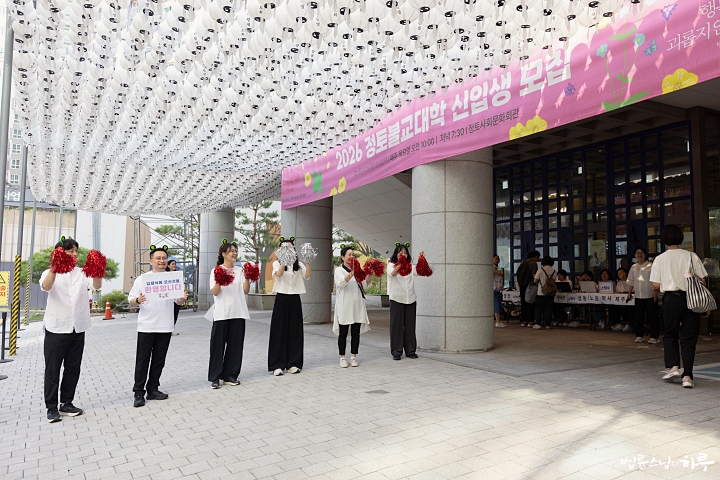
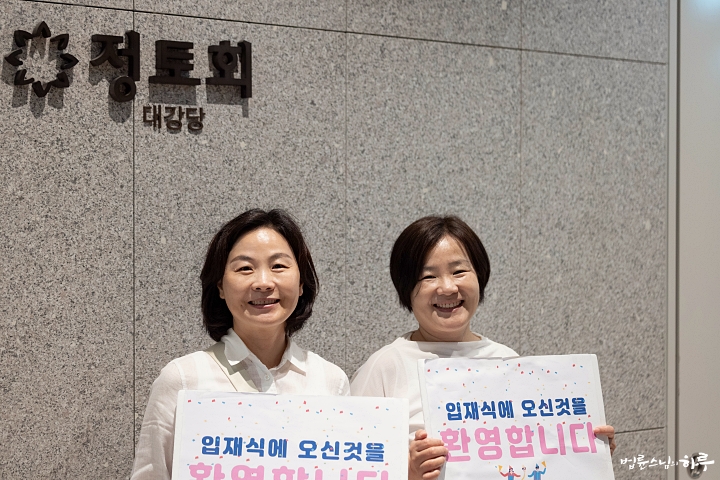
At the Jungto Social and Cultural Center, many volunteers had been busily preparing for the event since early morning. Sunim arrived at The Peace Foundation at 9 a.m. to revise his manuscript, then moved to the basement auditorium where the ceremony was held.
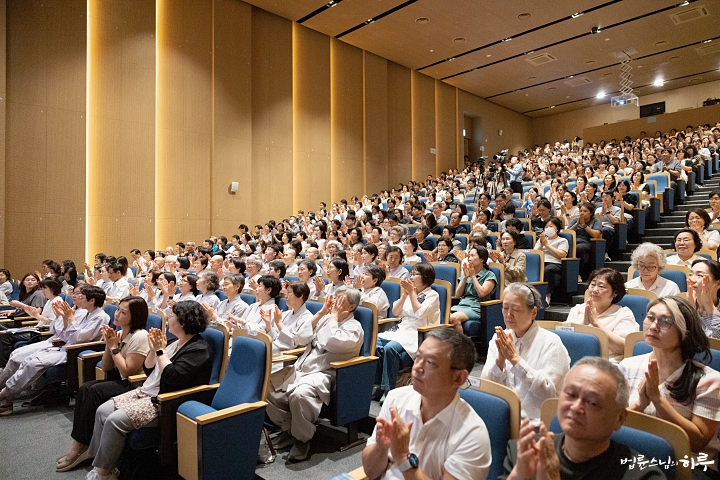
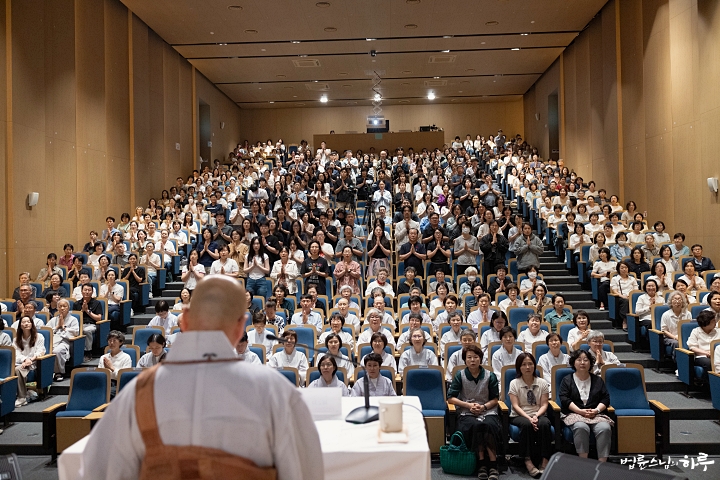
After the bell-ringing, ceremonial bow, and recitation of the Heart Sutra, the 2nd 100-Day Prayer Opening Ceremony began with a lively greeting from emcee Kim Byung-jo. The 2nd 10,000-Day Practice, which began with the great vow to overcome all suffering in this world and to realize pure minds, good friends, and a clean land right here on this earth, has now passed 1,000 days and 100 days, entering this 100-day period. With 8,018 participants attending the opening ceremony both in Korea and abroad, the ceremony was opened with great applause.
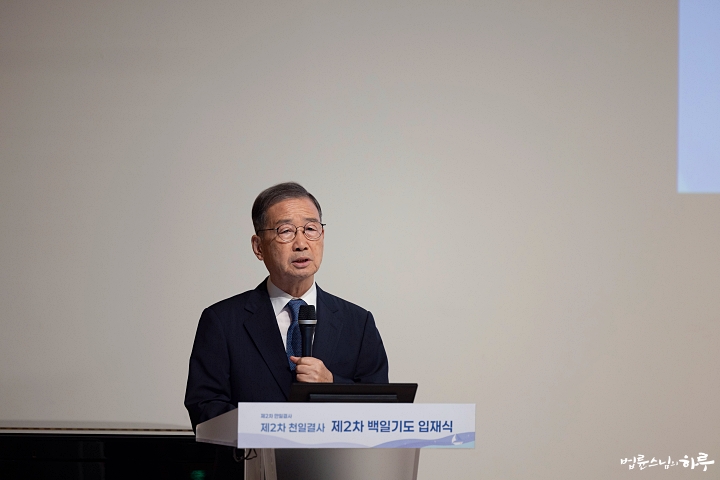
First, following a greeting from Yang Yun-deok, President of Jungto Society, everyone watched a video looking back on the past 100 days. The 20-minute video richly captured the many activities that had taken place around the world.
Next, everyone listened to a practice testimony from Jung Bo-seong of the Daejeon-Chungcheong Branch, who had practiced more diligently than anyone over the past 100 days.
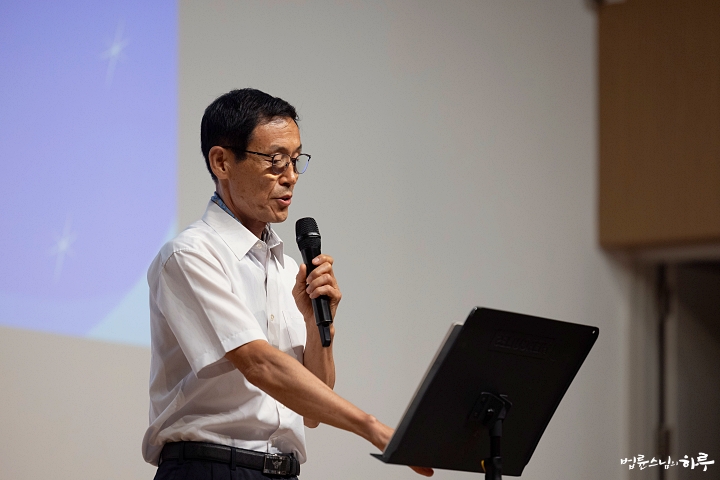
Before meeting Sunim in 2014, my mind was drifting without taking root. It was dark and stifling, like a sky covered with rain clouds. I didn't know how to live or where to go. Then one day, through a coworker's introduction, I listened to Sunim's Dharma Q&A. It felt as though the clouds had parted and a blue sky had appeared, brightening my mind. (Omitted) Only then did I begin to see my father's loneliness. He must have wanted to be understood and acknowledged too. My mother was too busy feeding her children to listen to my father. That's why he relied on religion. That could happen. He couldn't have lived any other way. When I came to understand my father as a human being, much of my resentment disappeared. The same was true of the guilt and pain I felt toward my mother. I began praying with gratitude to my parents. "Father, Mother, I am sorry. Thank you." The gratitude that had started in my head began, one day, to flow from my heart. (The rest is omitted)
The 1st 100-Day Prayer Closing Ceremony
Following this, the members of the Sangha requested and listened to Sunim's closing Dharma talk for the 1st 100-Day Prayer of the 2nd 1000-Day Practice.
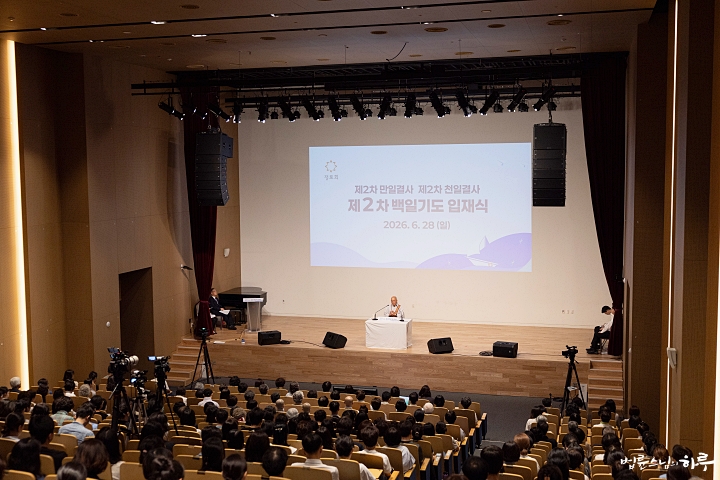
The Greatest Problems Humanity Will Face Over the Next 30 Years
First is the climate crisis. When we began the 1st 10,000-Day Practice, we also looked 30 years ahead and predicted, 'Environmental problems are not a serious issue now, but in 30 years, they will become humanity's greatest challenge.' We selected this as one of the core tasks we needed to address and act on together over the next 30 years. By the time we reached the 2nd 10,000-Day Practice, that prediction had become reality. Now we are facing a serious catastrophe known as the climate crisis, beyond simple environmental problems. Over the next 30 years, the climate crisis will become increasingly severe. Therefore, we must not only work to prevent the climate crisis or slow its progression, but also research and prepare together for how to live in response to the various disasters and calamities caused by the climate crisis.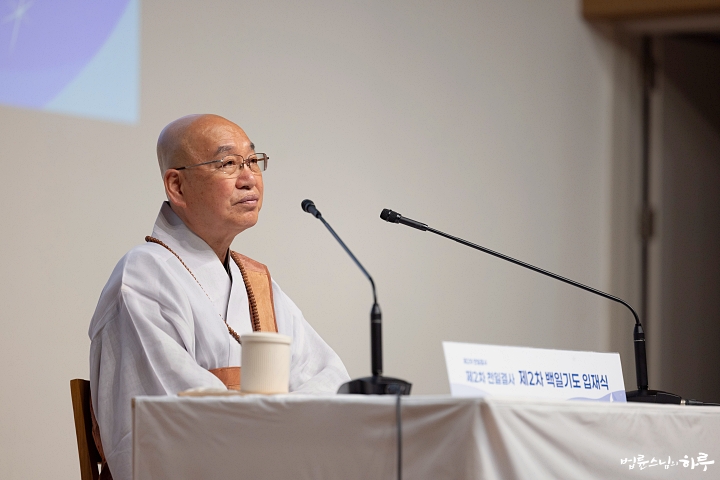
The Era of Artificial Intelligence and Growing Wealth Gap
Although the rate of absolute poverty has decreased over the past 30 years, relative poverty—that is, the wealth gap—has actually deepened further. Thirty years ago, the wealth and income of the top 20 percent exceeded the sum of the bottom 80 percent. After that, the top 10 percent surpassed the bottom 90 percent, and recently, the top 1 percent has reached a level equivalent to the bottom 99 percent. Currently, we are moving in a direction where the top 0.1 percent owns wealth comparable to the bottom 99.9 percent. One of the biggest causes of this rapid widening of the wealth gap is the advancement of cutting-edge technology. Especially as artificial intelligence technology rapidly spreads, this gap is likely to accelerate even further in the future. To mitigate the gap caused by technological advancement, politics and institutions must play a role in adjusting social balance. However, reality is not so. Neoliberalism puts forward the logic that 'one capable person feeds ten thousand people,' and considers it natural for individuals or companies that achieve enormous results through technology to receive corresponding income and wealth.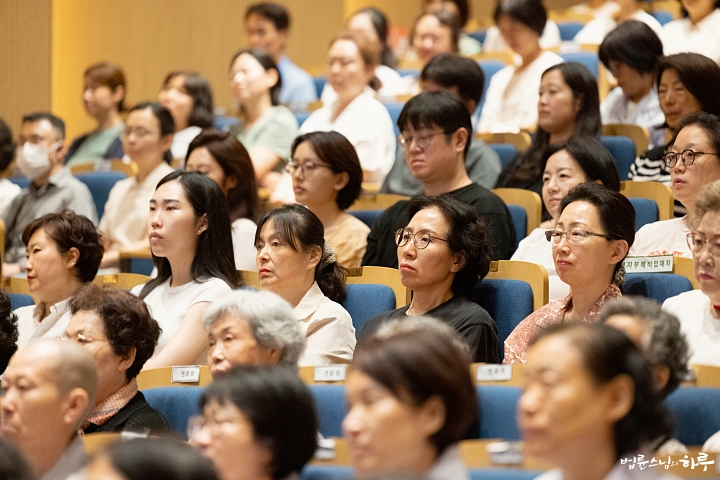
The U.S.-China Hegemonic Competition and the Crisis of Expanding War
The third issue is conflict between nations, namely the problem of war. Over the past 30 years, we have set peace as one of our three major tasks, and fortunately, the world has maintained peace based on international law since World War II. Of course, there have been regional disputes, but they have not expanded into wars on a global scale. So Jungto Society's peace movement has mainly focused on preventing war on the Korean Peninsula. The Korean Peninsula is one of the rare divided regions in the world where the Cold War system has not been completely resolved, and along with the Middle East, it was one of the places with the highest risk of military conflict. Therefore, we have carried out the peace movement with the determination that war must never occur on this land. Over the past 30 years, there have been local conflicts such as the Yeonpyeong Island shelling, but fortunately, they have not led to all-out war. However, conflicts over the next 30 years are very likely to unfold in a completely different pattern. As we can already see in the Ukraine war, Middle East conflicts, and the massacre in Gaza by Israel, armed conflicts and massacres are occurring all over the world. There is a very high possibility that such unexpected wars will spread worldwide. Before the U.S. and China, which are engaged in hegemonic competition, clash directly, conflicts will inevitably continue to occur in their peripheries. If the competition intensifies and a conflict arises in Taiwan, close to direct confrontation, there is a very high probability that conflict will subsequently arise on the Korean Peninsula as well. We must pay close attention to the background of Xi Jinping's recent visit to North Korea. Leaders from around the world visit China, so why did China's top leader have to visit North Korea? If you look carefully, you can see that the purpose was 'military cooperation.' The military alliance between North Korea and Russia was already unexpected from the perspective of North Korea's traditional Juche stance, but military cooperation between North Korea and China will pose a threat to Northeast Asian security greater than that of Korea-Japan military cooperation. So now, not only is the probability of war on the Korean Peninsula high, but the possibility of war expanding worldwide is also high. While the past 30 years was an era when peace was maintained without much effort from us, the next 30 years will see a high possibility of war even with our efforts, and we may also suffer direct damage. Thirty years ago, when we set the tasks of the 10,000-Day Practice, we were in the stage of predicting and preparing for the future. Now, those predictions have become reality. Therefore, in the next 30 years, the important task will be not so much how to prevent these crises, but rather how to reduce the damage that has already begun and how to live within it. This may seem like a passive response, but it is difficult to block the massive incoming waves with our strength alone. What is important is to minimize damage and find a way to protect our lives within it. For this reason, the tasks of the past 30 years continue in the 2nd 10,000-Day Practice. However, in the 2nd 10,000-Day Practice, environment, relief, and peace are no longer dealt with separately, but are integrated into a single task called 'social practice.'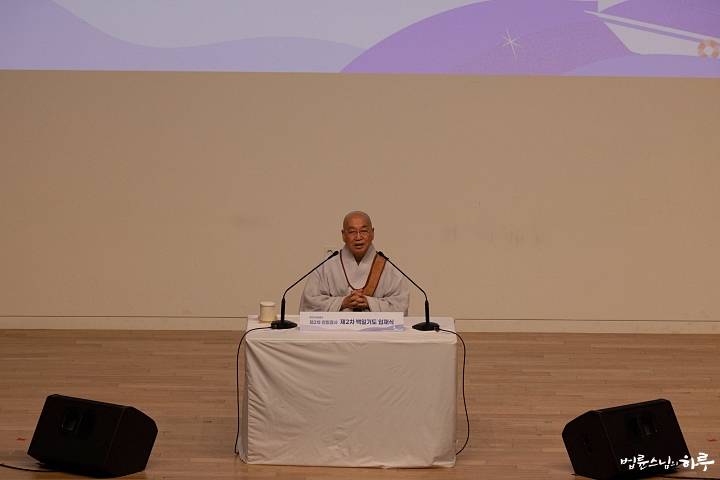
The Three Tasks of the 2nd 10,000-Day Practice: 'Practice, Spreading the Dharma, and Social Practice'
So what are the three tasks of the 2nd 10,000-Day Practice? First, whether the world is at war, whether the person next to us is starving, or whether human rights are being violated, we must protect the peace of our minds even within all this. If we say that because the world is like this, I can't help but be angry, can't help but resent, can't help but be sad, then we are merely beings tossed about by the world. No matter what the world is like, protecting ourselves within it and living without forgetting that I am the master of the world—this is practice. Practice is a task we must uphold even more firmly going forward. So the first task of the 2nd 10,000-Day Practice is practice. In the past, there was a social current of independence from colonialism, the fall of dictatorships and progress toward democratization, and the expansion of equality by eliminating discrimination. In such eras, social movements played a major role in advancing people's freedom and happiness. However, the situation is different now. Although democratization has been largely achieved and the economy has grown, even civil society and labor movements that led social change are losing their moral integrity. Now we have entered an era where no one can easily claim moral superiority. National leaders habitually lie and use harsh language, and even the religious community and civil society have not gained sufficient trust from the public. Even the progressive forces that should lead social change are not free from the criticism of 'double standards.' Social change is more urgent than ever, but it is hard to find groups with the moral authority to lead that change—this is today's reality. This is the greatest problem the future society faces. The more we are in such an era, the more those who want to change the world must first be healthy themselves. We can sufficiently understand the minds of people with resentment, blame, and victim mentality. However, just because a slave revolted and became king does not mean the slave class is liberated. It is merely the emergence of a new king; society remains unchanged. So the second task is spreading the Dharma. Social change is important, but first we need people who have transformed themselves through the Buddha's teachings. Only when such people gather and lead social change can moral integrity be secured. Those who participate in environmental movements must first live simply. Those who engage in relief work must be frugal. Those who participate in peace movements must have no anger in their hearts. Otherwise, no matter how good the words they speak, people will not trust them. Therefore, each person must first reflect on their own mind and become the master of their own life. On that foundation, more and more people must practice small environmental actions, share generously, and let go of anger. This is the reason we have set spreading the Dharma as our second task. Spreading the Dharma does not simply mean expanding the influence of Buddhism or growing Jungto Society's scale. To bring true peace to the world, such people must increase in number. Whether it is the Jungto Dharma School or the Happiness School, in any form, the purpose of spreading the Dharma is for those who correctly understand the Buddha's teachings and bring about self-transformation through practice to spread widely.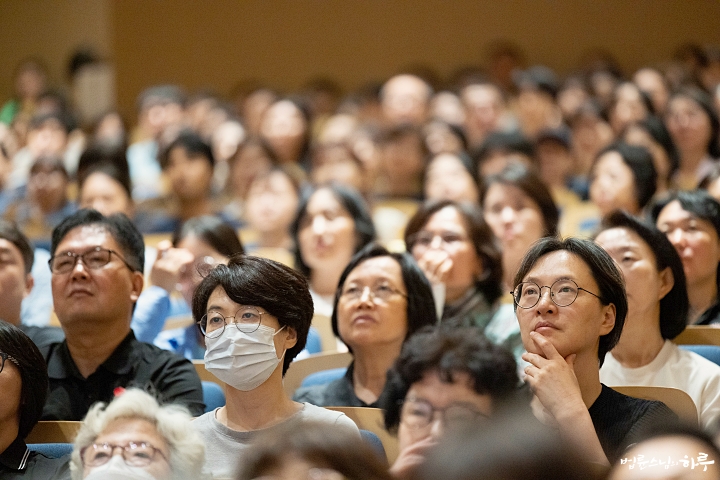
Becoming Someone Who Can Light a Candle in a Dark World
The starting point of all this is ultimately practice. Only when I do not lose my center can I go far, walk together, and have a positive influence on the world. Repeatedly living a life that is good today and bad tomorrow helps neither me nor the world. So through the 1000-Day Practice, we make promises to each other and steadily dedicate ourselves to practice, moving toward the goals we have set. It has been 100 days since the 2nd 1000-Day Practice began. The past 100 days can be said to have been a preparation period for setting a new direction. Now we have more clearly established the three tasks of practice, spreading the Dharma, and social practice, and are closing the first 100 days. Looking back, the past 100 days were a time of practice. However, the time ahead will be a time of full-fledged action. The darker the era, the more someone must become a candle. No matter how dark the world is, only when there is someone who says, 'I will be a candle in this place to brighten the world,' does dawn eventually come. The same is true in the practice of my life and in the world we live in. So let us reflect today on what was lacking in the past 100 days, supplement what is needed, willingly accept new ideas, and move forward into the 2nd 100 days of dedicated practice. Although it is hot summer weather, let us steadily continue our practice."The members of the Sangha engraved the closing Dharma talk in their minds and meditated briefly.
After a 20-minute break, Part 2 began with a performance by the Seoul-Jeju Branch.
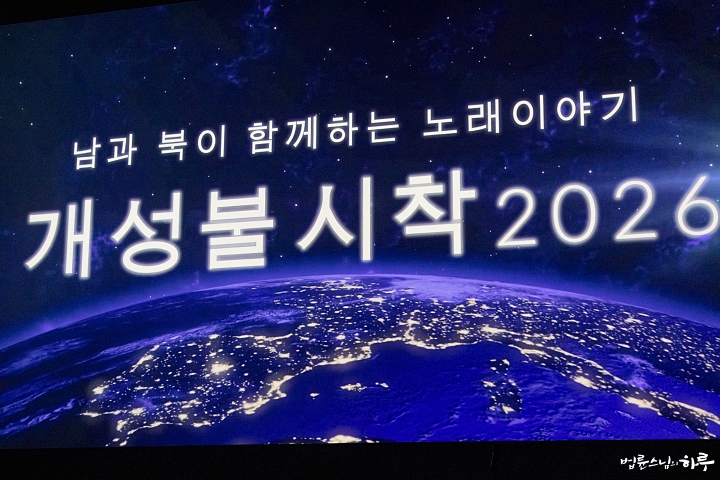
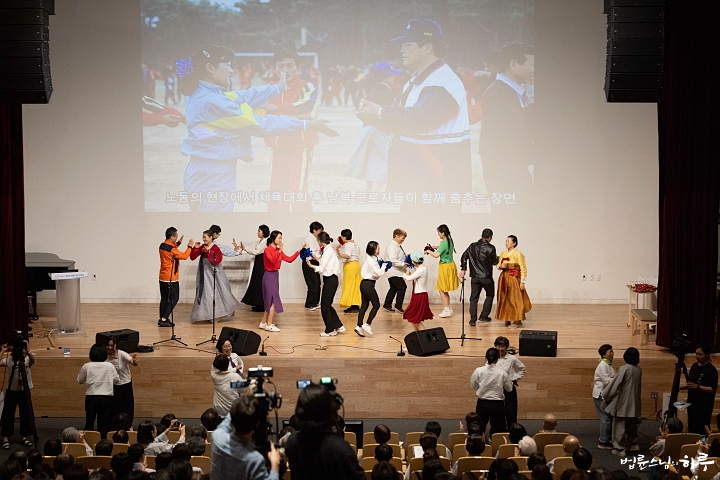
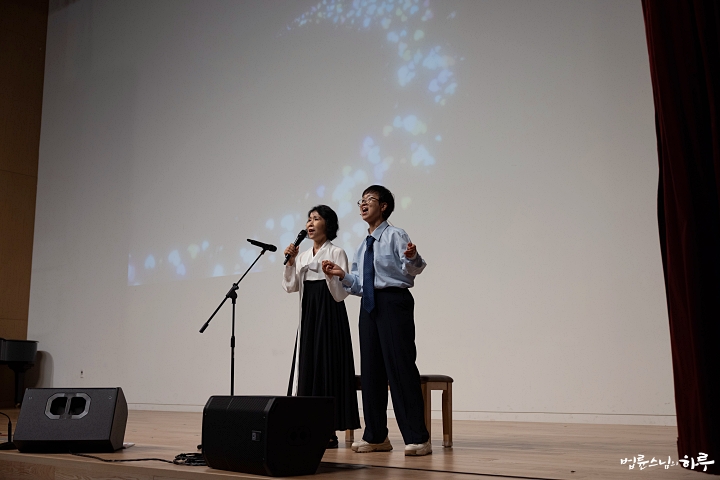
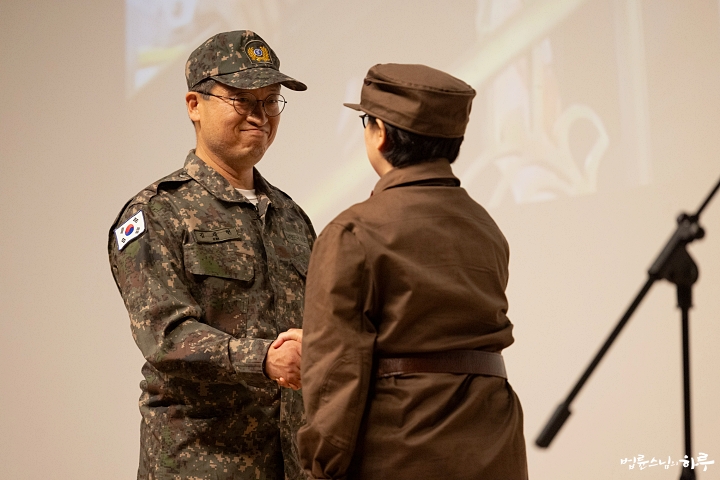
The performance was titled , a sad love story between a South Korean man and a North Korean woman who met at the Kaesong Industrial Complex. The story depicts a couple who had to part ways in front of a rigid inter-Korean relationship and an uncrossable divided border, despite their love, and who are eventually reunited through a peace treaty.
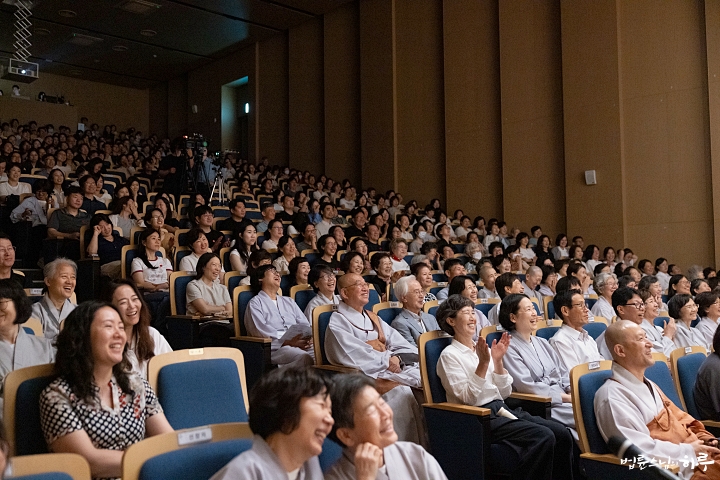
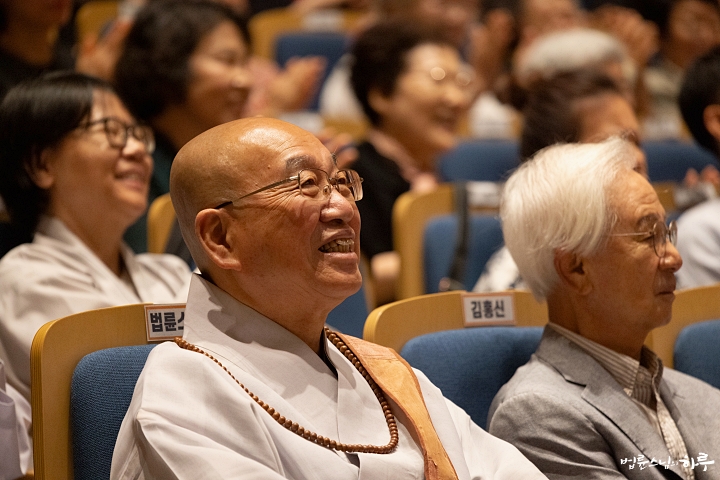
Next, starting a new 100 days, a commitment ceremony for prospective 1000-Day Practice participants was held. Today, 835 Jungto practitioners entered the 1000-Day Practice for the first time.
"Yes, I will practice every morning at 5 a.m."
......
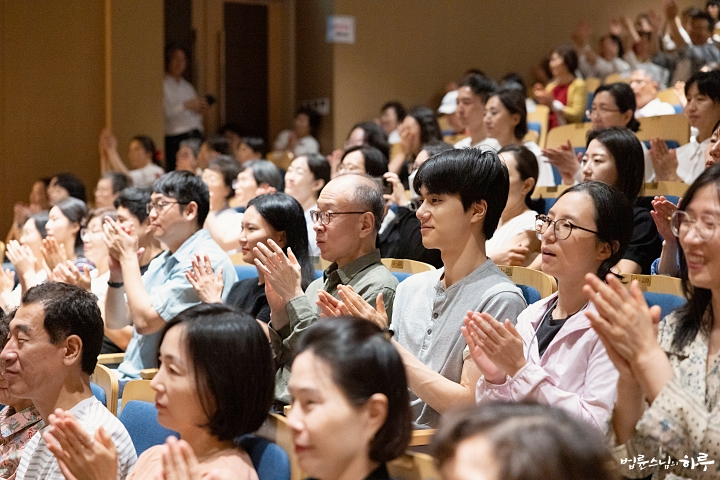
"You have now joined the 1000-Day Practice to realize pure minds, good friends, and a clean land, and will walk together as Jungto practitioners. I sincerely congratulate you."The existing 1000-Day Practice participants welcomed the prospective participants who had joined the path of practitioners with hearty applause.
Following this, Sunim offered a vow prayer for the prospective 1000-Day Practice participants and gave words of encouragement, concluding the commitment ceremony.
Opening Ceremony of the 2nd 100-Day Prayer
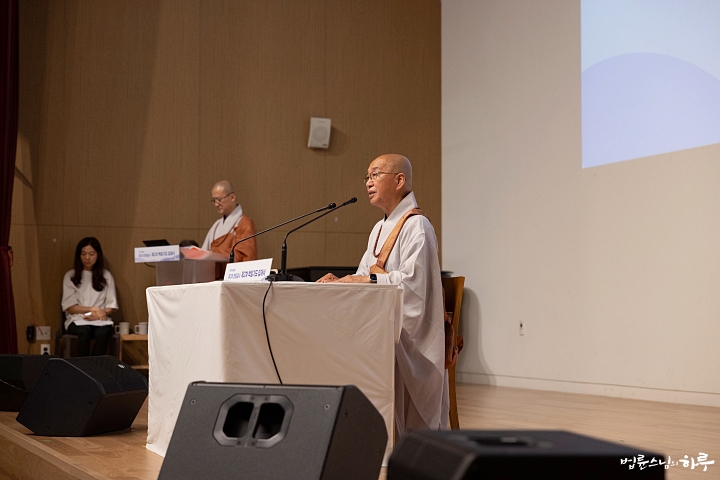
Next, beginning the 2nd 100-Day Prayer, everyone requested and listened to the opening Dharma talk from Sunim.
"Did you enjoy the performance by the Seoul-Jeju Branch? It's been a while since I saw a melodrama. (Laughter) It was a performance that evoked many emotions—somewhat old-fashioned yet very moving and sad. Kim Yoon-hee, who led the performance, came down from North Korea, entered Seoul National University, and completed her doctorate. I met her in the hallway before the performance, and she was wearing a black skirt and white jeogori. When I asked why she was dressed so plainly, she said, 'I'm the main character today.' Previously, she even learned the famous Choi Seung-hee dance from North Korea and performed it—she's a person full of passion. North Korea now defines inter-Korean relations as two hostile states, no longer uses terms like 'nation' or 'unification,' and has abolished all departments related to South Korea. For those who dream of unification, this can be called a very despairing time. Things may change again over time, but it is very meaningful that at such a time, this melodrama has kindled a spark of hope for unification in our hearts. Please give another round of applause to everyone who performed. (Applause)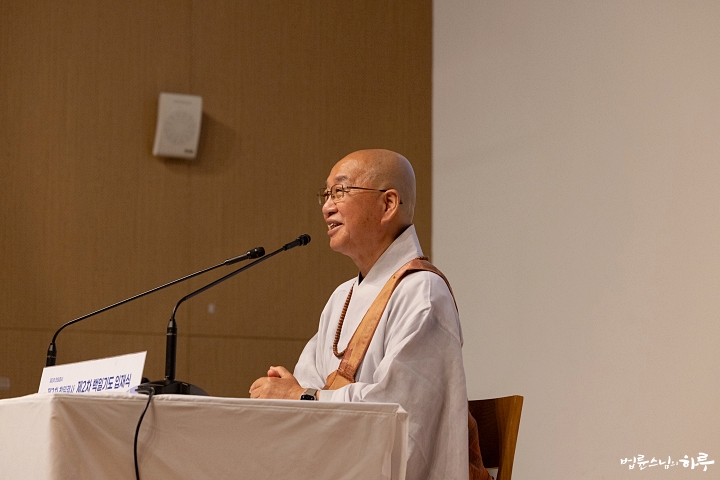
Small Acts of Sharing Become the World's Hope
It is only natural for a thirsty person to drink water. However, in this world there are people who cannot drink water even when they are thirsty, or who must walk dozens of miles to get a single sip of water. When I went to Pakistan two years ago, all the water the people there drank was muddy. When we dug a well and clean water came out, the children said, 'Wow, the water is white!' Those children had only seen yellow muddy water since they were born, so that's what they said. There are many people who cannot drink even a sip of such clean water. There are many who cannot eat even a simple meal, and many who cannot wear even a single proper piece of clothing. There are many children who don't even get the chance to attend elementary school, and many who end their lives without being reunited with family members they were separated from for decades. We struggle to fulfill our desires to become rich, attain high status, or own a big house. However, in the world, there are many people who lack even the minimum living conditions necessary for survival. Furthermore, there are people for whom even learning to read and count, getting medicine when sick, or finding clothes to cover themselves is not easy. For such people, even the small amount of money or goods we have can become great strength and hope when shared. Yet we do not do even such small things. We do not practice even small acts for others, but for ourselves, we have great desires and wait for a big break. And we complain and cry out that it does not come true. Looking only at ourselves, it may seem natural, but considered together, it is a very contradictory attitude. So let us reduce our own desires a little and work together so that other people can fulfill their basic survival needs and simple dreams. Let us share a little of what we have and do work that helps them. Perhaps the dreams of Jungto practitioners can be said to be very simple. What each one of us does is so small that it barely catches the eye, but when our strength is gathered together, it can be of great help to someone. So as the saying goes, 'mounds are made of grains of dust'—we are gathering small amounts of money to build houses, schools, and provide food. And we are also gathering even small amounts of time together to maintain and develop Jungto Society.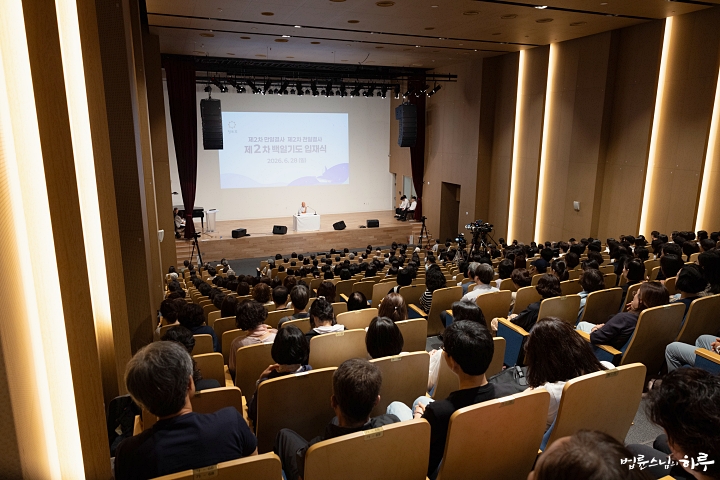
The Buddha's Teachings That Speak Common Sense
People say the world is very chaotic right now. However, looking at humanity's long history, the world we live in today is very peaceful, prosperous, and equal. Although there are still many problems even now, the period during which humanity has enjoyed this level of prosperity is not very long. Yet even under such conditions, we are always anxious, restless, full of worries and complaints, and sometimes lose our will to live. We already possess much, but pursue even more. Instead of thinking about sharing what we have, we lose sleep wondering how to get more. So we are saying, let us learn the Buddha's teachings. The Buddha's teachings are not something special. In some ways, they are quite common sense. 'See from multiple perspectives what you only saw from one angle,' 'See the whole rather than just the part,' 'Don't just see yourself, see the other person too,' 'Don't just see our country, see other countries too,' 'Don't just see men, see women too,' 'Don't just think of business owners, think of workers too'—it is asking us to see together. When we acknowledge those who are different from us and understand them with 'I can see how that could be true for them,' it not only helps them, but my anger and frustration also disappear, and I become at ease. Also, my relationship with the other person improves, and I become someone who is at least a little helpful to them. The principle is that we then feel a sense of fulfillment, gain self-esteem, and find meaning in life. It's not about going to paradise after death, becoming rich, or living long. Nor is it about deliberately living in poverty. People are originally meant to live by figuring things out on their own. Rabbits and insects all live by themselves, so why can't humans live on their own? The reason we keep grasping is because of ignorance and desire. When we recognize and let go of these, we stop grasping and can live calmly like other beings in nature. When we gain eyes to see the whole rather than just one side and come to understand others, we can live a life that is at least a little helpful to others. Such a life gives us the fulfillment of meaningful work and raises our self-esteem. So we become not someone who may or may not exist in this world, but someone who is at least a little needed by someone. Even if we live for just one day, let us try to live that way.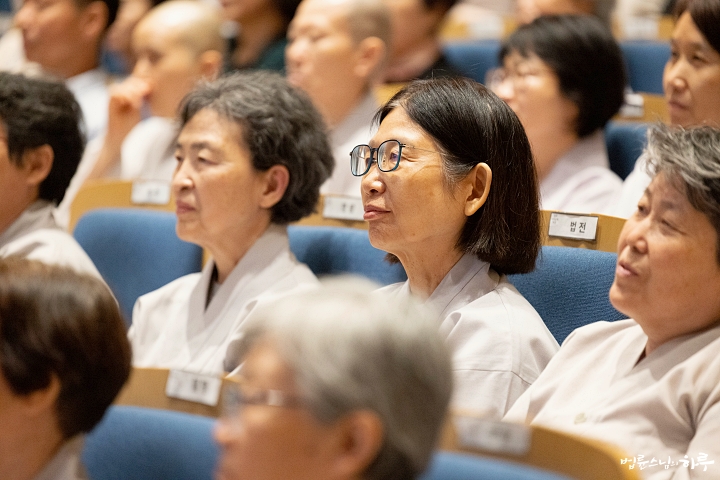
Returning to Practicing Together After the Transition to Online
To know yourself, at least 100 days of dedicated practice are needed; to bring about self-transformation, 1000 days of dedicated practice are needed; and to change the world, 10,000 days of dedicated practice are needed. So we meet every 100 days to check in, renew our commitment every 1000 days, and move forward together toward 10,000 days. We have now passed the first 100 days of the 2nd 1000-Day Practice and entered the second 100 days. Looking back on the 1st 1000-Day Practice, we reviewed what we had been doing, and during the past 100 days, we examined it more specifically. Originally, we established Dharma centers throughout the country and carried out activities. The intent was for Jungto practitioners to take root in their local areas and, together with local people, practice environmental action, help those in need, and engage in peace movements. So we continued the 1st 10,000-Day Practice with the goal of establishing a practice center in every town, township, and neighborhood, and reorganized Jungto Society into a community-based organizational structure. As face-to-face activities became difficult during the COVID-19 pandemic, we transitioned to online, and there were many benefits. Those who benefited most were members scattered around the world. In the past, to hear a Dharma talk, you had to apply in advance and receive a recording with great difficulty, but now you can listen in real time. It also became much more convenient for young people who are good at using the internet. However, there were also people who experienced difficulties with this change. Senior members who had been with Jungto Society since its early days, even those living nearby, found it difficult to access online. Online activities made it possible to provide more education, reduced travel time, and made it easier to review materials in advance, breathing new vitality into Jungto Society—this is also true. However, practice requires a process where the scent of each other passes back and forth, learning by watching senior fellow practitioners next to us. Online, it ends the moment you turn off the switch. Practice became like watching a moving film, and a limitation emerged where, increasingly, we understood with our heads but did not experience with our bodies. So entering the 2nd 1000-Day Practice, we supplemented this. The basic approach remains online, but we meet more often and increase practice activities to lighten our heavy bottoms. Also, since not everyone can gather in Seoul, we are setting the direction so that each branch first prepares spaces for group activities and local practice activities.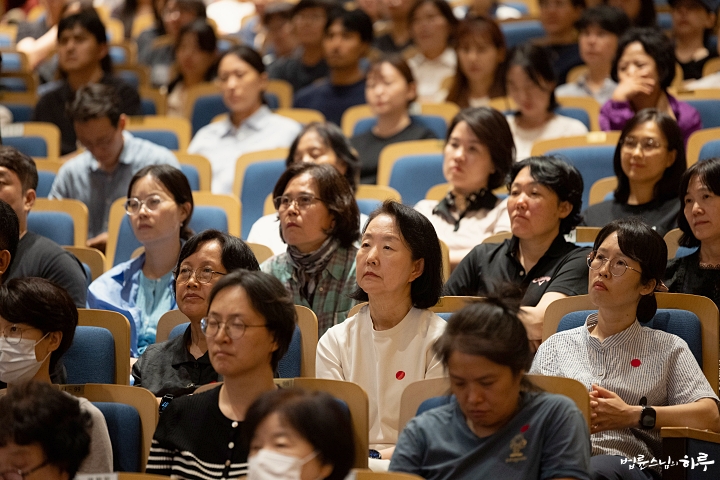
Directing the Power of the Republic of Korea Toward All Humanity
Our society today has many good points. Looking back over the past 10 years, the Republic of Korea's image has greatly improved worldwide. In particular, the Korean Wave has played the biggest role, and our technological capabilities, including cutting-edge technology and manufacturing technology, have also gained worldwide recognition. As a result, even as a divided South Korea alone, we have grown into a country ranking around the top 10 in the world, not greatly behind major countries. However, when we look at how effectively we are using this power we have for the entire human race, there are still many shortcomings. Because we have lived through difficult times for so long, the thought that we always need to receive help still remains, and our interest is concentrated only on solving our own problems. We have relatively little interest in people of other nations, other races, and even the problems of humanity as a whole.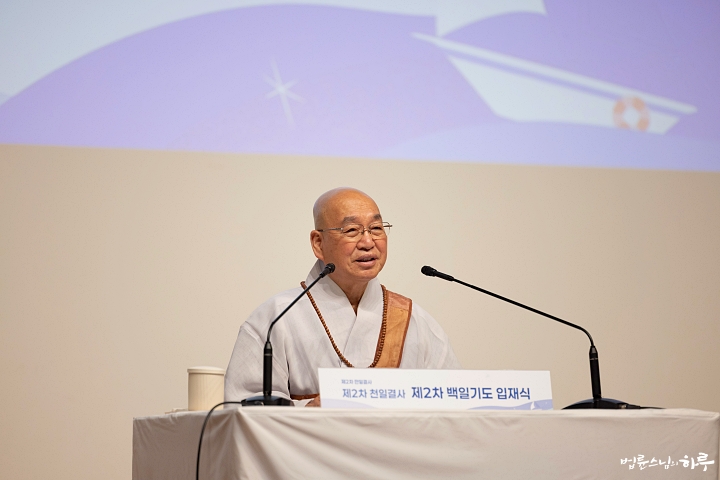
Small Acts of Practice Gather to Change the World
The other day, a professor from Seoul National University came to present at a Peace Foundation seminar. He arrived a little early and had a meal at the basement cafeteria, where he stood in line to eat and even did his own dishes. At the end of the seminar, he said that experience was the most impressive thing for him. There are many concerns about what we should do to solve the various problems our society faces today. Perhaps we should start with such small actions, shouldn't we? People talk a lot but often do not act on it themselves. If someone opposes dam construction and nuclear power generation but uses a lot of electricity and water themselves, it would be difficult to gain trust. So action is important. You might think, 'What in the world will change by doing this?' But such small actions accumulate one by one and become the force that changes the world. In that respect, I hope Jungto practitioners will have a little pride. This 100-day period is the hot season from July to September. When it's hot, you don't even want to do prostrations. You sweat just sitting still. Overcoming such reluctance is practice. I hope you will use the heat as a good practice topic, steadily devote yourselves to practice, and make this 100-day period one in which we more steadily carry out the tasks given to us."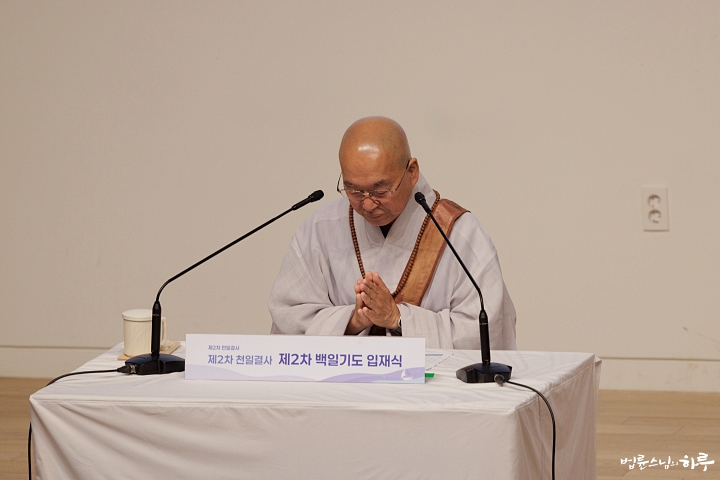
There was a presentation of a practice case from the head of the Jeju local chapter. The Jeju chapter was nurturing harmony among fellow practitioners and a sense of community through various practice activities tailored to the characteristics of each group, such as spring picnics and experiences in environment, sharing, and history. They were also beginning the three-year long-term project 'Walking, Sharing, Practicing' Olle Trail activities and 'World Peace Prayer,' practicing environmental protection and peace.
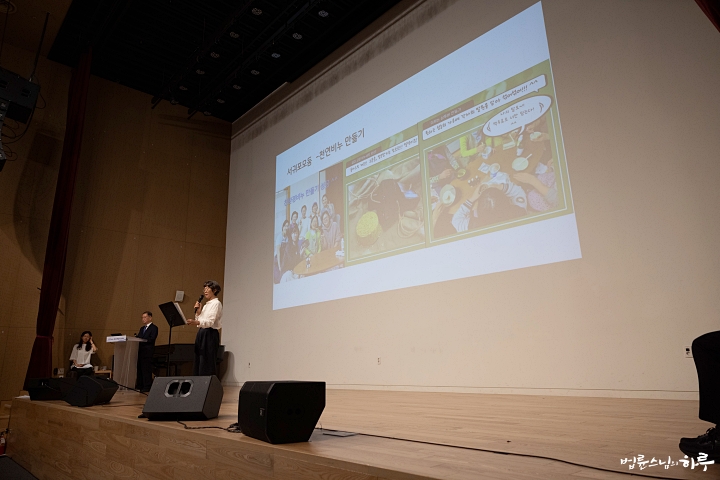
Next, the promises that all 1000-Day Practice participants should practice together were announced. Individuals decided to set their own personal practice tasks, try spreading the Dharma through the Happiness School, and conduct three group activities for social practice.
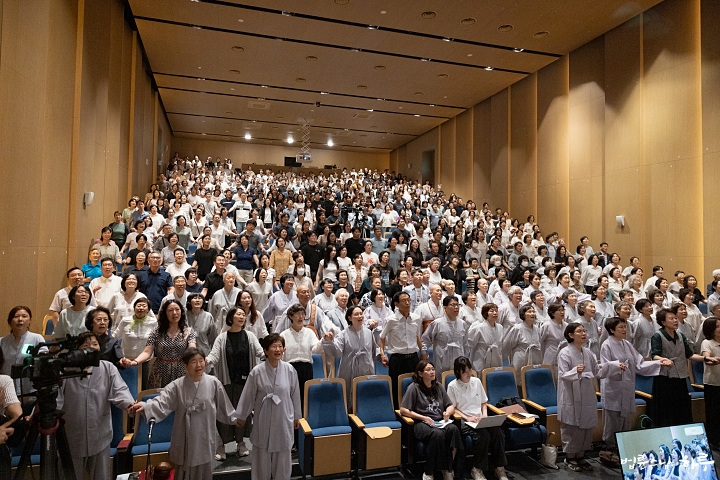
Following the closing greeting from Seonju Dharma Teacher, the head of the Dharma Teachers' Group, everyone promised to meet again at the next opening ceremony on October 4, sang the Four Great Vows and the Closing Song together, and concluded the Opening Ceremony of the 2nd 100-Day Prayer of the 2nd 1000-Day Practice.
After the opening ceremony, Sunim had a meal in the dining hall, attended briefly to some work, and then attended the Seoul-Jeju Branch Day event.
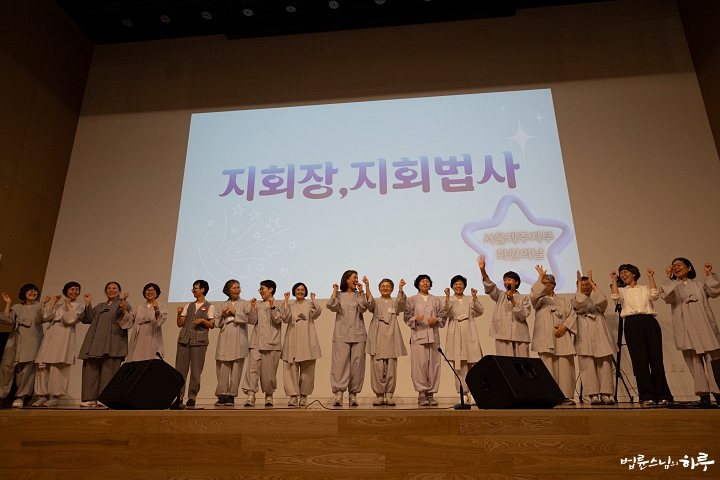
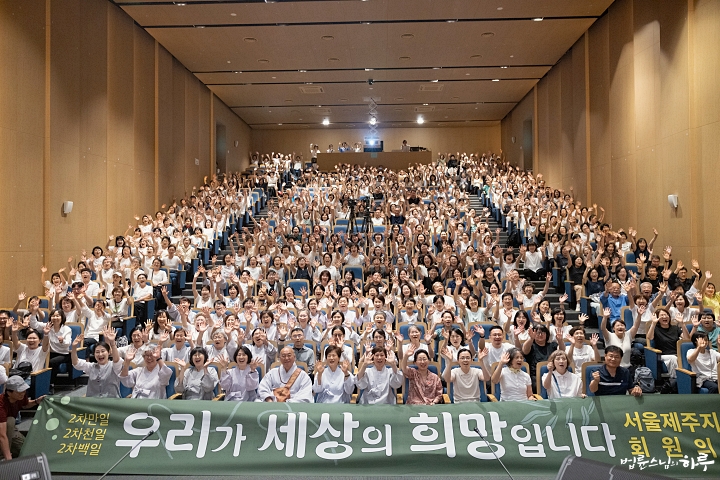
The Seoul-Jeju Branch consists of the Guro, Nowon, Seodaemun, Seongdong, Songpa, Yangcheon, and Jeju chapters. Today's event was a time for fellow practitioners of the Seoul-Jeju Branch to gather offline rather than online, share affection as fellow practitioners, and listen to Sunim's Dharma talk. The event continued with a greeting from the President of Jungto Society, an introduction of branch officers, and introductions of each chapter.
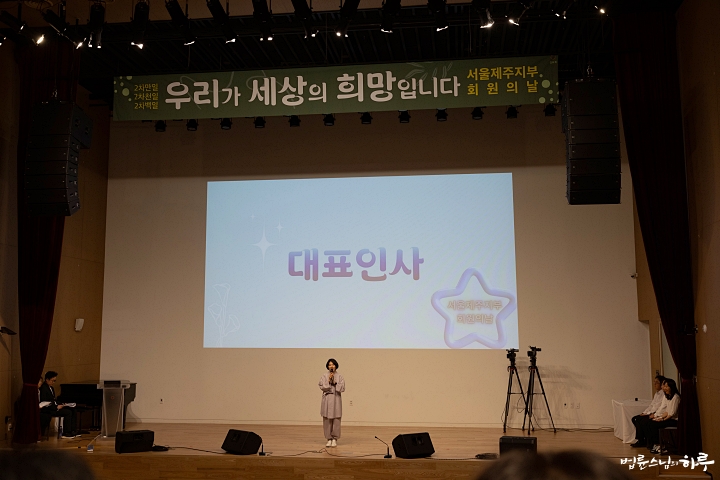
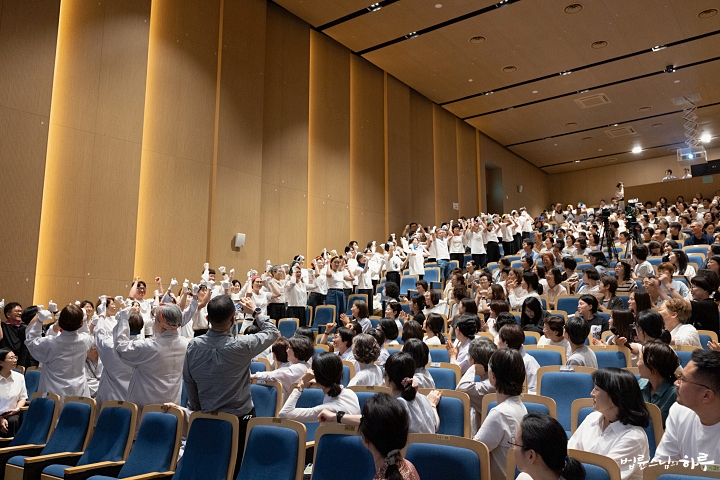
This was followed by a Dharma Q&A time with Sunim.
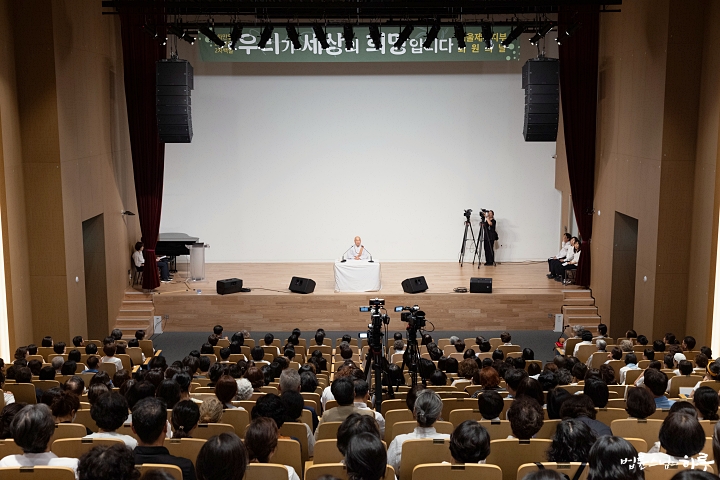
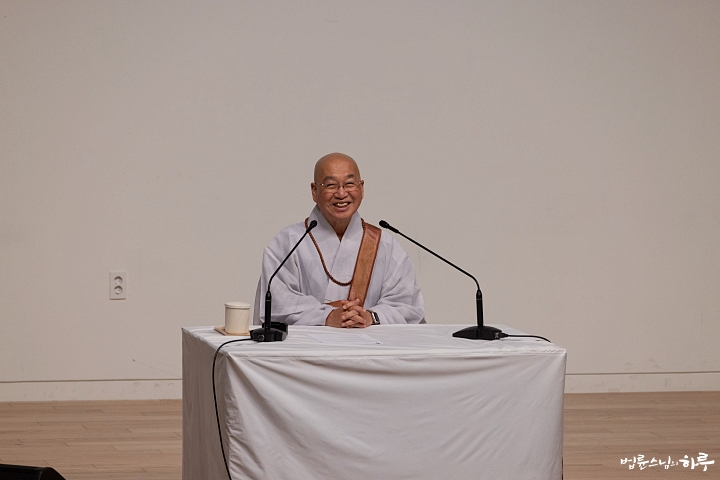
A total of 6 questioners asked Sunim questions during today's Dharma Q&A.
▪ When drowsiness or noise occurs during meditation, is it okay to artificially create comfortable conditions like resting or using earplugs to practice, or should we observe the discomfort as it is?
▪ I have doubts about whether the 'Stop Consumption' movement promoted as a group activity is practicable and sustainable. From what perspective should we view the situation where it conflicts with local government policies that encourage consumption to revitalize the region?
▪ I have a son taking the college entrance exam for the third time who suffers from extreme psychological anxiety and mentions extreme choices, and a husband who doesn't understand the situation and provokes him. I'm afraid I might lose my child.
▪ For the revitalization of the Jeju chapter, which faces difficulties securing venues, would it be appropriate to establish an offline base (space) combined with a multicultural project? Also, I'm curious about the future direction of multicultural projects.
▪ I participated in an investigation committee on prosecutorial power abuse and received a warning that I might become the subject of a political investigation. In this fearful situation, from what perspective should I view this work?
▪ I feel guilt about my mother-in-law's past decision to use a feeding tube. How should I view life-sustaining treatment, and what criteria should I establish for choosing increasingly advanced medical technology in the future?
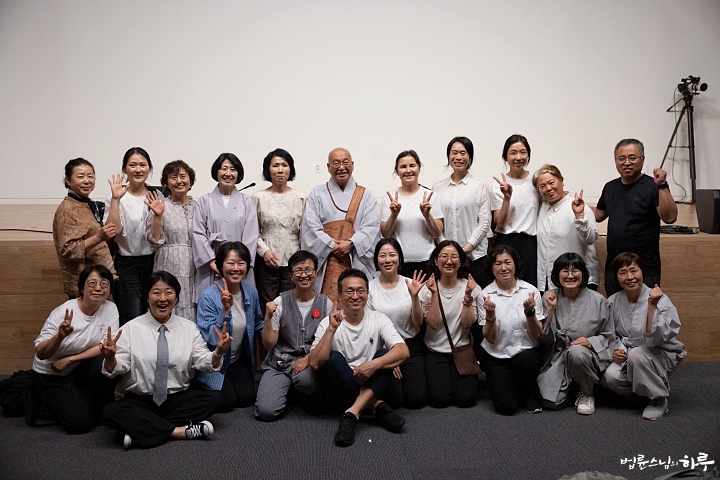
After the Dharma Q&A, everyone took a group photo together to conclude the Seoul-Jeju Branch Day event. Sunim took a photo with the performance team from the Seoul-Jeju Branch, who had moved everyone to tears with the performance at the morning's opening ceremony.
Before he knew it, it was 5:30 p.m. Sunim immediately moved to The Peace Foundation and held a meeting with Bhutanese volunteers who had entered Korea yesterday. They discussed for about an hour topics including revisions to the video on the first-year project results, additional support for drinking water and housing improvements in the Zhemgang region, redistribution of volunteer duties, and the project direction of the housing improvement project.
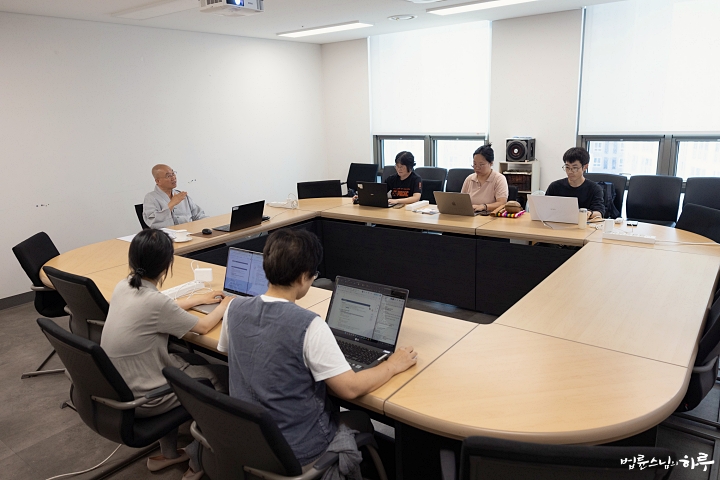
After the meeting, Sunim wrapped up the day and rested.
Tomorrow, there will be an English opening ceremony and a meeting, Kim Deok-ryong's book publication celebration, and a departure for Sri Lanka.