Venerable Yongseong Jinjong(용성진종조사) is One of the Founders Who Built the Republic of Korea
Jun 22, 2026 - Memorial Dharma Assembly for Venerable Yongseong's Birthday, Sangmudae Lecture
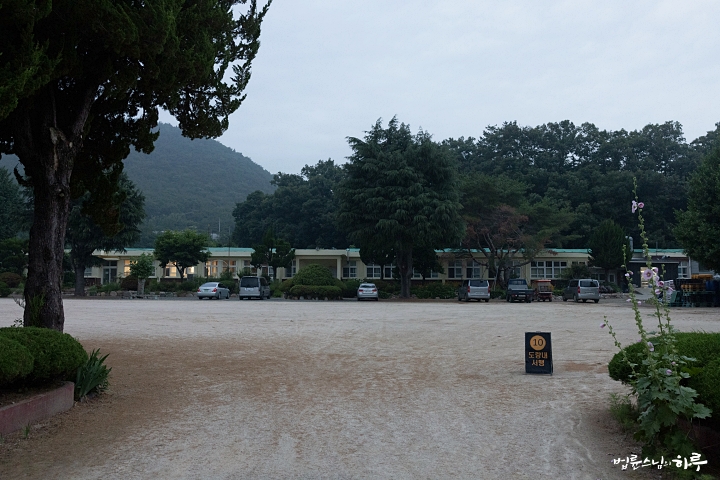
Hello. Today is the day when a memorial Dharma assembly commemorating the 162nd anniversary of the birth of Venerable Yongseong, an independence activist and the great reviver of modern Korean Buddhism, will be held at Jukrim Jeongsa(죽림정사) in Jangsu, followed by a lecture at Sangmudae.
Sunim began his day with early morning practice and meditation, and departed from Dubuk Jungto Retreat Center at 5:30 a.m. to attend the memorial Dharma assembly. Although it was summer, the weather was cloudy and chilly. In the car on the way, Sunim said:
"Have you ever heard of 'saetnal'(샛날)? In summer, when you're transplanting rice, there are days that feel as cold as winter. Those days were called 'saetnal.' Today is one of those days."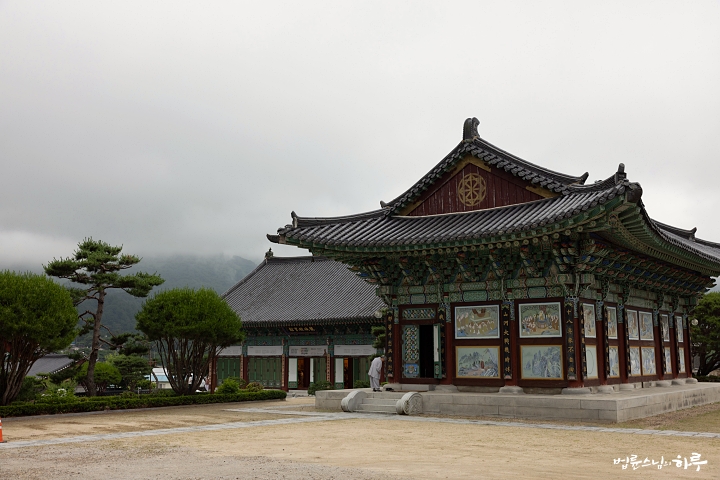
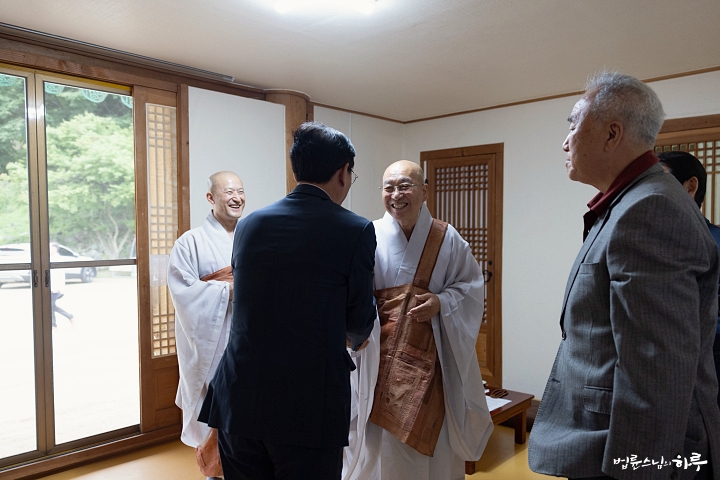
Before long, Sunim arrived at Jukrim Jeongsa. He sat down briefly to review the day's program in advance, and the parents of a Haengja who had ordained at the Jungto Society lay Sangha came to greet him. Sunim spent a moment in conversation with them.
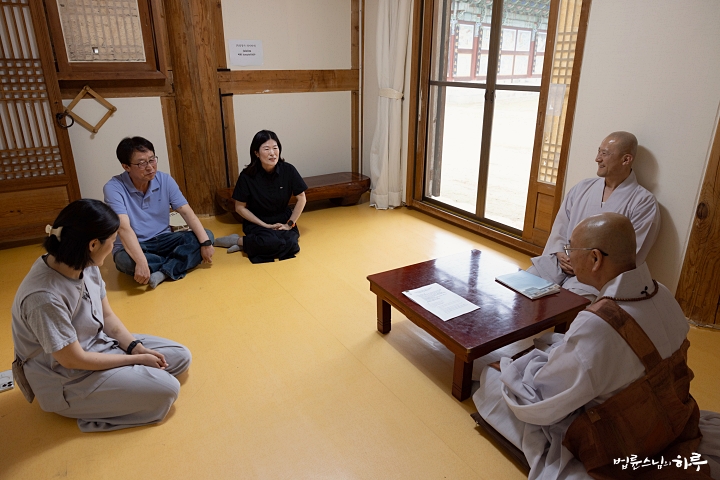
"Since it's what she loves to do, we can only watch over her. (laughter)"
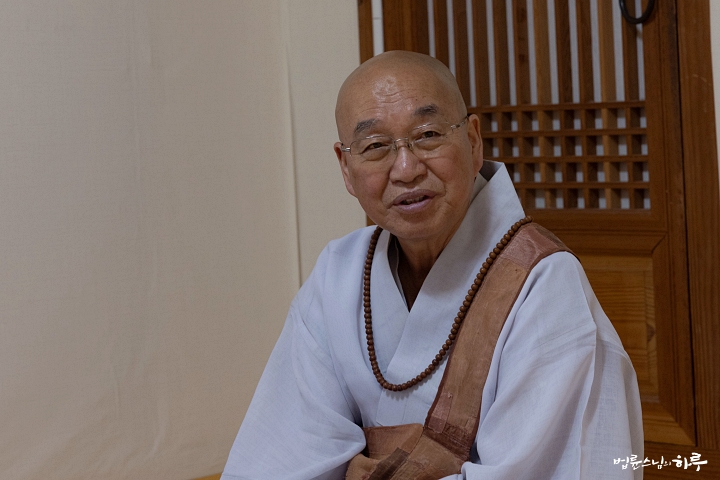
Sunim took photos with the Haengja's parents, and at 8:50 a.m. attended the tea ceremony honoring the successive patriarchs who transmitted the Dharma lamp.
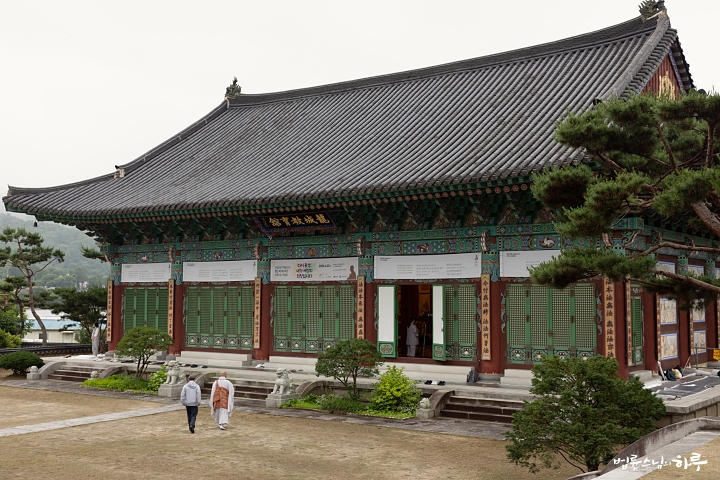
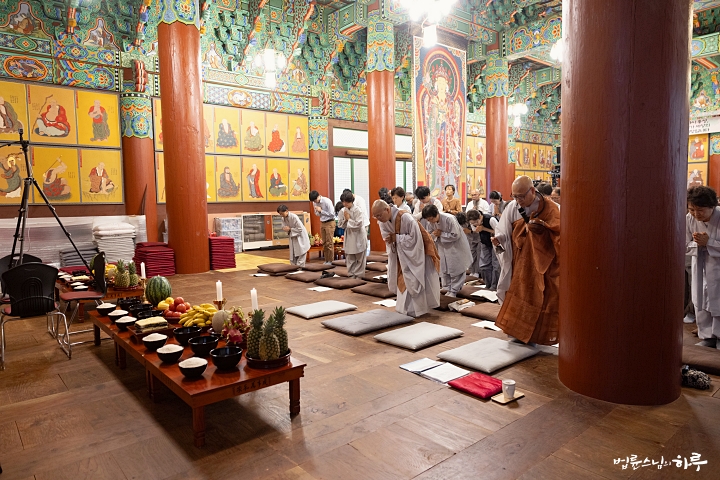
At 9:20 a.m., after the tea ceremony, Sunim briefly shared tea with the distinguished guests attending the memorial Dharma assembly. Jangsu County Mayor Choi Hoonsik (최훈식) and Ulsan City Council Member Lim Chaeoh (임채오), among others, came to greet Sunim.
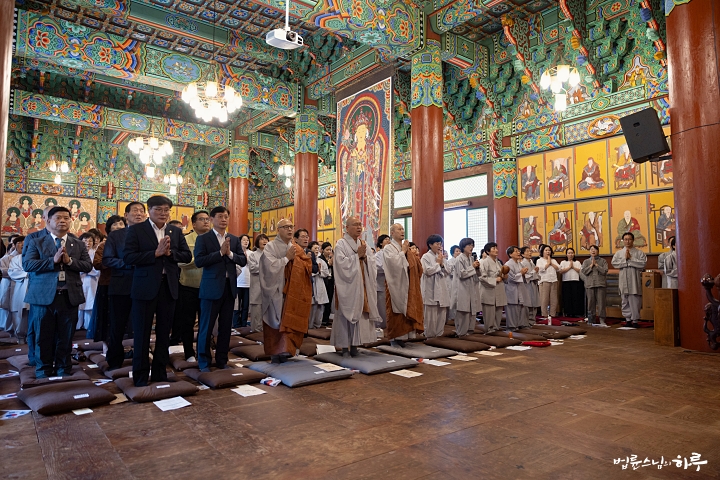
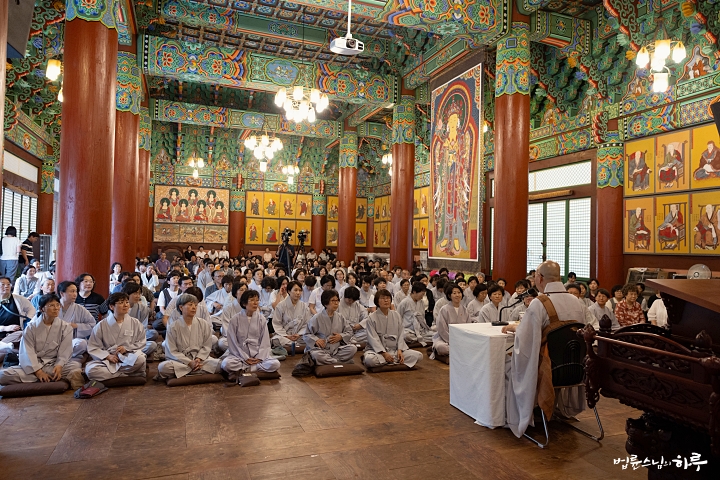
At 10 a.m., the memorial Dharma assembly for Venerable Yongseong's birthday began. About 350 members of the Sangha attended. Before the ceremony began, the assembly recited the Three Refuges and the Heart Sutra, observed the national ceremony, and held a moment of silence.
Next, two volunteers from the Special Youth Division read aloud the life record of Venerable Yongseong Jinjong.
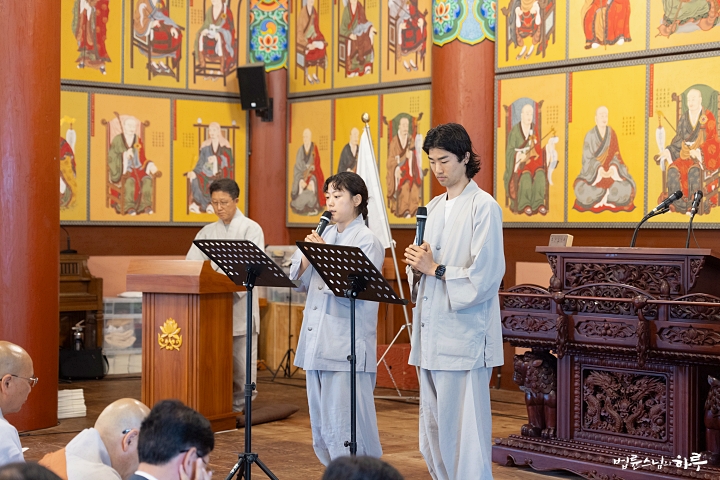
Following the introduction of distinguished guests by Yusu Sunim, Jangsu County Mayor Choi Hoonsik delivered a congratulatory address.
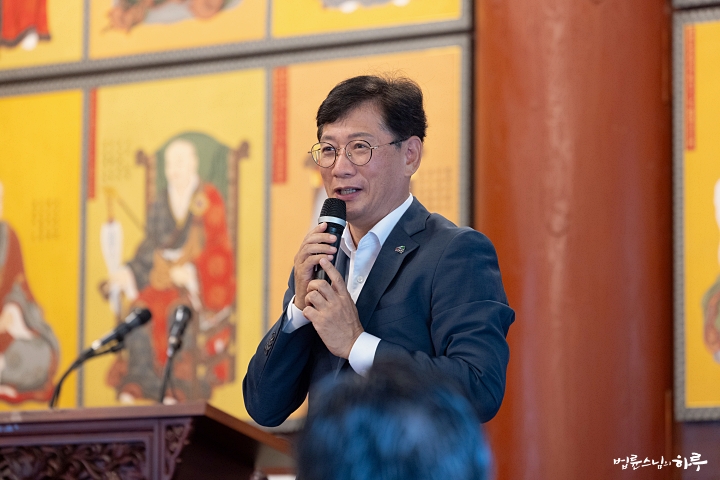
"I sincerely congratulate you on the 162nd anniversary memorial Dharma assembly of Venerable Baek Yongseong, the independence activist. I welcome the Jungto members who have visited our region. This is my fourth time attending the memorial assembly for Venerable Yongseong's birthday, and I feel that the more you know someone and the closer you get to them, the better they become—and I think Venerable Yongseong is one such person. I am proud that Venerable Yongseong was born in our region, and I am proud that I was born in Jangsu. Looking at Venerable Yongseong's life story, I think he walked the path that Korean Buddhism aspired to follow. He sacrificed himself for the independence movement and truly wished and acted for Korean Buddhism to go in the right direction."
Next, members of the Gyeongnam Branch performed a reading drama to commemorate the opening of the Baek Yongseong Memorial Hall and Venerable Yongseong's birthday, to honor his spirit of independence activism, and to portray the background and process of the March 1st Movement centered on Venerable Yongseong's footsteps.
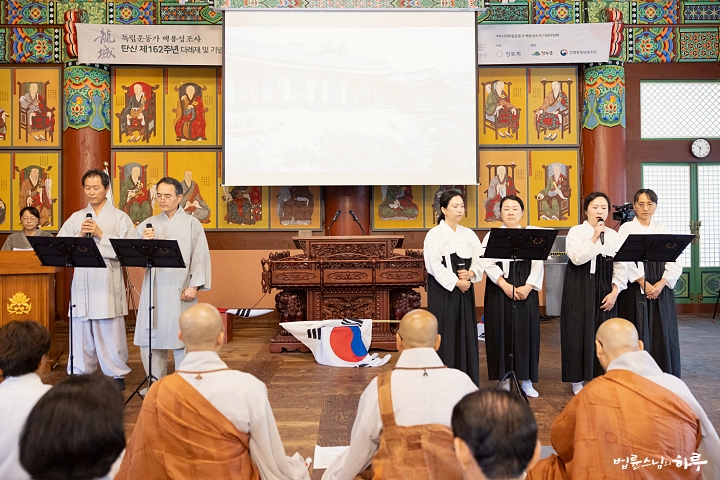
The audience was deeply immersed in the reading drama, which proceeded with powerful, resounding voices and dynamic energy. At the end, the entire assembly waved Taegeukgi flags and shouted together.
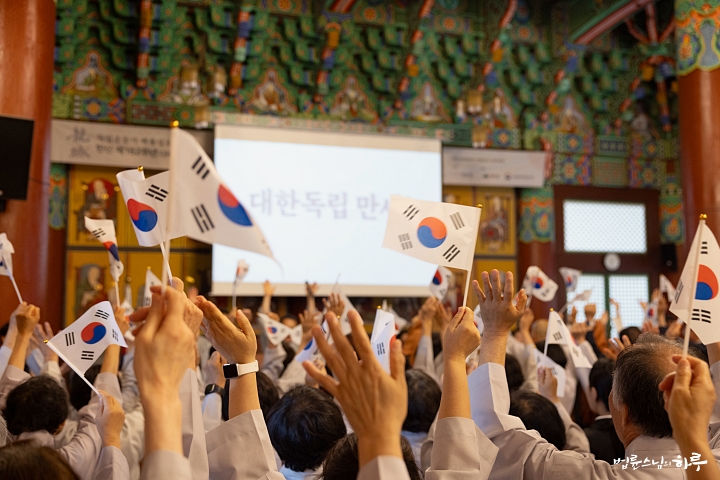
"Long live Korean independence!"
After the reading drama, Sunim and the assembly sang "Song of All the People" together. Then the assembly requested a special Dharma talk for Venerable Yongseong's birthday from Sunim with the Cheongbeopga (Song of Requesting the Dharma) and three bows.
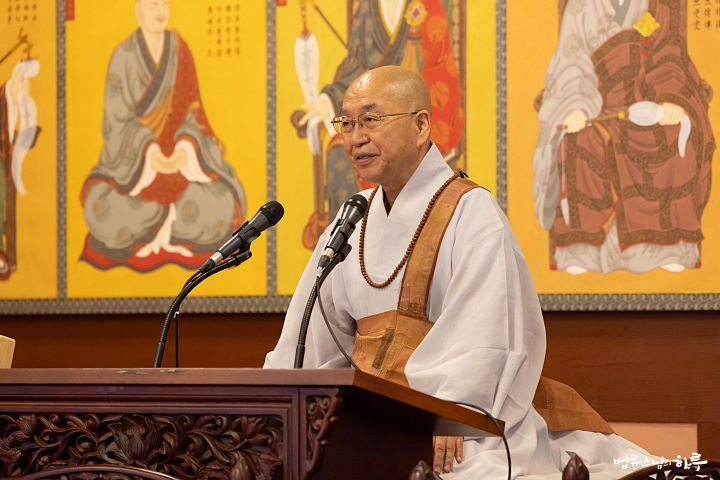
Venerable Yongseong Awakens an Era
"Today marks the 162nd anniversary of the birth of Venerable Yongseong Jinjong, the 68th patriarch of the Dharma entrusted by Shakyamuni Buddha. Today, in commemoration of Venerable Yongseong's birth, we have made offerings and paid our respects to the sixty-eight successive patriarchs who have passed down the Buddha's Dharma generation after generation, from the Buddha to Venerable Yongseong. Today is also a day for us to reflect on the path Venerable Yongseong walked and to think together and resolve how we will carry forward his vision.A New World Where the People Are the Masters of the Nation
Today, 162 years after Venerable Yongseong was born, we look back on that era. What kind of year was 1864, the year Venerable Yongseong was born? Throughout history, those who dreamed of a new world have divided human history into the Age of Heaven (Seoncheon) and the Age of Earth (Hucheon). The world we have lived in until now is the Age of Heaven, and the new world to come is the Age of Earth. What is the criterion for this division? The Age of Heaven is the era when the king is the master of the nation, and the Age of Earth is the era when the people are the masters of the nation. At that time, those who made such claims were persecuted or executed for "deceiving the world and misleading the people. In 1860, the great teacher Suun Choe Je-u(수운 최제우) attained a great awakening: 'A human being is heaven itself.' In the Age of Heaven, heaven was the master of the world, and the king was a being who ruled the world having received authority from heaven. That is why the king was called the Son of Heaven (Cheonja). But what if every person is heaven itself? It means that not only the king, but each and every person of the people, is heaven itself. This was a tremendous declaration. This ultimately meant that the people themselves are the masters of the nation. Naturally, when Choe Je-u made such claims, he was arrested. At first, since his claims had not yet been sufficiently systematized, he was soon released. Afterward, he left Gyeongju and took refuge in Namwon. At that time, Master Hyewol(혜월), the Joshil of Yongcheonsa Temple(용천사) in Namwon, hid Choe Je-u. Choe Je-u lived in seclusion at Eunjokdang(은적당), Master Hyewol, the Joshil quarters of a hermitage called Deokmilam(덕밀암) halfway up Gyoryong(교룡산) Mountain Fortress, where he organized his thoughts in writing. The important ideas of Donghak(동학) were written during this period. While Choe Je-u was the visible figure in opening the Hucheon world where the people become the masters, it can be said that the person who actually supported him in establishing his thoughts was Master Hyewol. Such thoughts could hardly spread in the world unless one was prepared to lay down one's life. Choe Je-u also returned to Gyeongju and preached the Dharma, foreseeing his own death. People gathered like clouds, and he was eventually arrested and martyred in 1864. That is the very year Venerable Yongseong was born. When Venerable Yongseong was fourteen, he went to study under Master Hyewol, the one who had hidden Choe Je-u. On the surface, it appears he only studied Buddhism, but who was his teacher? He was someone who had risked his life to support a person dreaming of the Hucheon Gaebyeok (Great Opening), so naturally Venerable Yongseong was influenced by him.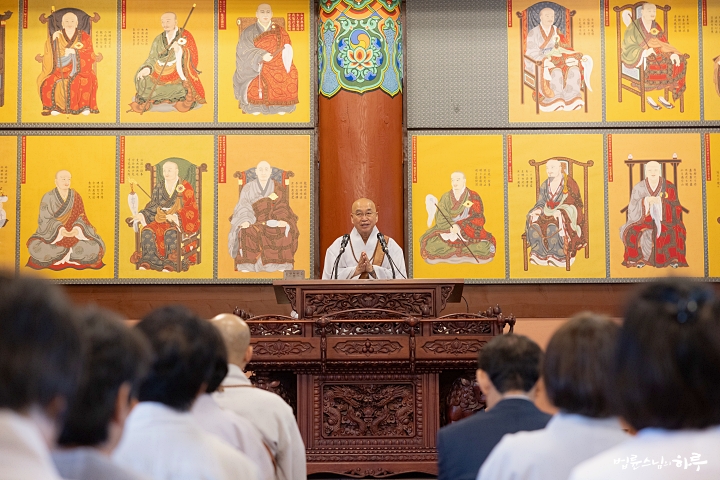
Establishing the Center of the Mind Through Practice
However, the teacher first taught that one must awaken one's own mind and establish ipji (立志)—the center of the mind. Only then can one move steadily forward without wavering, no matter how difficult the world may be. If one jumps into worldly affairs out of momentary passion and then gives up halfway, it is hard for oneself and brings great disappointment to those who shared the path. That is why he first led his students to establish the center of the mind through practice. Master Hyewol did not lose his life for hiding Choe Je-u, but he was stripped of his monastic credentials and effectively placed under house arrest, unable to leave. He was only allowed to travel to and from Silsangsa(실상사), which was the main temple (本寺) at the time. On the way from Deokmilam(덕밀암) to Silsangsa, one had to pass through Unbong(운봉), and each time, the host of a wealthy landlord's home where he stayed overnight was Lay Practitioner Im Dong-su(임동수). The great Master Bulsim Domun(불심 도문), who founded Jukrim Jeongsa, is a grand-disciple of Venerable Yongseong in the Dharma lineage and the great-grandson of Lay Practitioner Im Dong-su in family lineage. So it is not simply a teacher-disciple connection; the great-grandson of the family that supported Venerable Yongseong throughout his life and generously donated their vast fortune to the independence movement and the renewal of Buddhism is none other than the great Master Bulsim Domun. Venerable Yongseong's great achievements could not fully blossom due to the oppression of the Japanese colonial period. After national independence, his legacy should have been carried on, but unfortunately, most of his disciples took the path of pro-Japanese collaboration, so his legacy was not properly inherited within the Buddhist community. However, it was solely through the vow-power of the great Master Bulsim Domun that Venerable Yongseong's achievements were brought to light once again. Venerable Yongseong's thought contains not only Buddhist philosophy. It can be said that it embraces Buddhist philosophy, our nation's view of history, and the Gaebyeok (Great Opening) thought of dreaming of a new world where the people become the masters. Venerable Yongseong devoted his youth entirely to practice. However, at that time, the world was in an era of Seoseidongjeom (西勢東漸)—Western powers pushing into our country and seizing all kinds of privileges. It was also a time of great chaos when Japan and China competed for control over Joseon(조선, present-day Korea), and the Donghak Revolution broke out, resulting in the massacre of hundreds of thousands. Even in such an era, Venerable Yongseong was devoted solely to practice deep in the mountains. Then, finally, in 1905, our country was seized by Japan through the Eulsa Treaty(을사늑약). Officially, sovereignty was lost in 1910, but in reality, the country had effectively been lost in 1905. It was then that Venerable Yongseong finally came out into the world.The First Steps Toward the Independence Movement
The first thing Venerable Yongseong did was to prepare the foundation for what would later become the Provisional Government. Since the country had been taken by Japan, he believed a provisional government needed to be established overseas, and to this end, he disguised himself as if going on a pilgrimage and crossed into China, beginning to establish a base in Shanghai. This was in 1907. It was at the very time of the Hague Secret Emissary Affair. As Emperor Gojong continued to unofficially inform the world that 'we have never consented to Japanese rule,' Japan forcibly abdicated Gojong(고종) and installed his son Sunjong(순종). Then, in 1910, Japan coercively concluded the Japan-Korea Annexation Treaty. Joseon lost its diplomatic rights in 1905 and its sovereignty in 1910.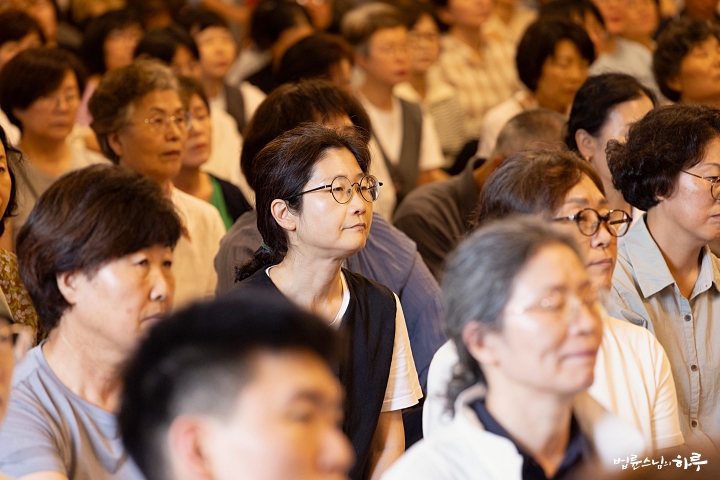
The Hidden Leaders of the March 1st Movement
Cheondogyo(천도교) had already been preparing for the independence movement independently. However, Venerable Yongseong proposed solidarity, saying, 'If Cheondogyo carries out the independence movement alone, it becomes a Cheondogyo independence movement, so it must become a national independence movement through solidarity with other religions.' Thus, the March 1st Movement is known as a joint effort of three religions—Cheondogyo, Christianity, and Buddhism—but in reality, Cheondogyo played the central role. Cheondogyo bore most of the costs and provided a large sum of money, amounting to thousands of won at the time, to draw Christian participation. In the process of forming solidarity with the Christian side, Han Yong-un(한용운) of Buddhism and Choe Rin(최린) of Cheondogyo played the role of connecting Lee Seung-hun(이승훈) of Christianity. As a result, after the March 1st Movement, Cheondogyo suffered such great damage that its very existence as a religious order was threatened. Buddhism, on the other hand, suffered relatively limited damage because individuals participated centered around Venerable Yongseong and Venerable Han Yong-un. Since the mainstream Buddhist community at that time was cooperating with Japan, there was no oppression at the order level. Christianity also did not suffer major damage at the denominational level because participation was led by some leaders and churches rather than the entire denomination. Catholicism did not participate at all, so it suffered no damage. Cheondogyo suffered great damage during the Donghak Revolution and again suffered enormous damage during the March 1st Movement. After that, it managed to continue with difficulty, but suffered another major blow when North and South were divided. At that time, Cheondogyo had 2 to 3 million followers, while Protestant Christianity had only about 200,000 followers, one-tenth of that. However, Protestant Christianity ran schools, and the students played a major role in spreading the March 1st Movement. I am not trying to discuss the history of the independence movement itself, but I want to say that we should not look only at what appears on the surface. At the center behind the scenes were Venerable Yongseong and Son Byeong-hui.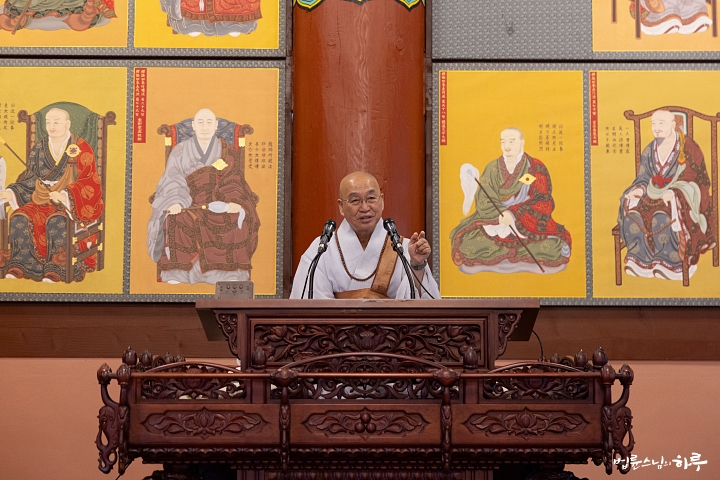
A Great Seed That Seemed Like Failure
In today's records of the democratization movement, it is similarly recorded as if people with titles like student council president led the movement. But in reality, it was possible because of the dedication and sacrifice of backstage organizations, wasn't it? How much more so during the independence movement, when being caught could cost one's life—how could clear evidence have been left behind? Venerable Yongseong lived through difficult times from birth until death. Therefore, many of the endeavors he undertook during his lifetime all seemed to have failed at the time. The national independence movement was not realized in his lifetime, and the Buddhist reform movement also appeared to have failed. However, it was precisely because of those failures that the Republic of Korea exists today, and based on the seeds he planted, today's Jungto Society movement, which popularizes Buddhism, has been able to continue.Envisioning an intellectual Buddhism
Master Bulsim Domun summarized Venerable Yongseong's lifelong achievements into three: the intellectualization of Buddhism, the popularization of Buddhism, and the practical application of Buddhism in daily life. First, what is the intellectualization of Buddhism? For more than 500 years during the Joseon Dynasty, Buddhism was continuously suppressed under the state's anti-Buddhist policy. Ordained monks were demoted to the lowest social class. They were socially despised, called 'jungnom' (monk-fellow) as if calling a servant. Because being ordained meant being treated like a slave, it was an environment in which young men could hardly enter monastic life. As a result, Buddhism completely lost its social leadership. Those who still had faith and visited temples were mainly women, who had little opportunity for social advancement, or people of common or lower status. Most of them could not read. Since they believed in Buddhism without properly understanding the Buddha's teachings, all they could do in the end was pray to the Buddha for blessings. Looking only at the act of praying for blessings, there seemed to be little difference between praying to mountain spirits or the Dragon King and praying to the Buddha. As a result, Buddhism gradually became indistinguishable from folk beliefs, and in Confucian society, Buddhism was looked down upon as superstition. Later, Christianity, which was newly introduced, also often viewed Buddhism as superstition. The world did not properly understand the noble thought that Buddhism possessed. So Venerable Yongseong wrote works such as 'Gwiwonjeongjong' (歸源正宗) and 'Gakhaeillyun' (覺海一輪), teaching that Buddhism is not simply a religion of praying for blessings, but a great teaching of attaining enlightenment to become a Buddha—a teaching that awakens the foolishness of one's mind and realizes wisdom. This is the intellectualization of Buddhism. Buddhism is a teaching for becoming a Buddha through practice. The methods of practice include Seon meditation, chanting the Buddha's name, mantra recitation, sutra study, and Buddhist services. That is why Venerable Yongseong advocated the Five Great Practices of Buddhism. The Buddha's original teaching is a great teaching that liberates today's sentient beings from countless sufferings.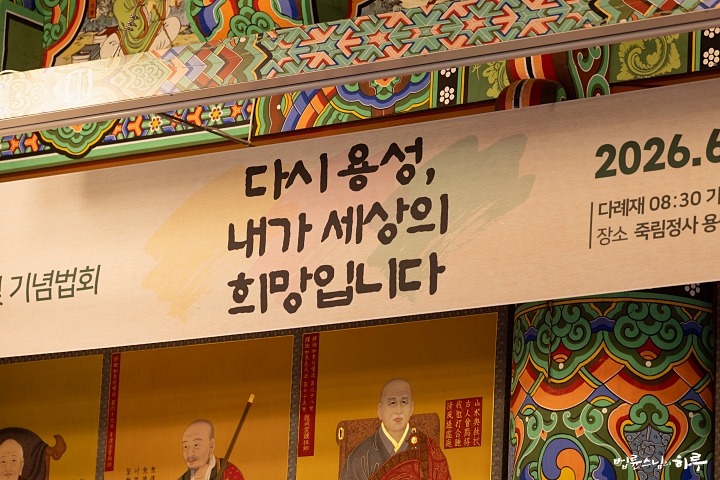
Buddhism Open to All: The Popularization of Buddhism
Second is the popularization of Buddhism. At that time, all Buddhist scriptures were in classical Chinese, but the common people did not know Chinese characters. So no matter how excellent the Dharma was, they could not understand its meaning. However, since people at that time could easily read Hangeul, Venerable Yongseong translated the scriptures into Hangeul(한글, the Korean alphabet). So women, ordinary people, and those who had not been ordained could know what the Buddha had said. He made it possible for anyone to take refuge in the Dharma and understand it. After King Sejong(세종) created Hangeul, Buddhist scriptures were extensively translated into Hangeul during the reign of King Sejo. Then, in the modern era, Venerable Yongseong translated the scriptures into Hangeul once again and widely disseminated them to the public. He also changed rituals like the Three Refuges and the Heart Sutra, which we recite today, into Hangeul, and made the ritual procedures more concise. This is called the popularization of Buddhism. Also, since it was a male-centered society at the time with severe discrimination against women, Venerable Yongseong established a Seon meditation hall for women. He also founded a children's Buddhist school and brought a pump organ into the Dharma hall so that everyone could sing Buddhist hymns together. Where did such changes come from? Through participating in the March 1st Movement, he interacted with pastors and other religious leaders, and during that process, he actively incorporated the good aspects into Buddhism as well. He made it so that the Dharma was not known only to a few monks, but so that anyone could learn, understand, and practice the Buddha's Dharma.Buddhism Entering the World: The Practical Application of Buddhism in Daily Life
The third is the practical application of Buddhism in daily life. Why did this expression arise? During the Joseon Dynasty, due to the anti-Buddhist policy, all temples within the capital were demolished, and only temples deep in the mountains were able to maintain their existence. The first temple that Venerable Yongseong established within the Four Great Gates of Seoul by purchasing a private house was Daegaksa. At that time, monks faced such great social discrimination that even their entry into the capital was restricted. Buddhism had been suppressed for so long. As a result, becoming a monk was equated with leaving the secular world. It was thought of as severing ties with the world and going into the mountains, and Buddhism, too, had long been firmly associated with the image of a religion of seclusion that left the secular world behind. However, it was different during the Silla(신라) and Goryeo(고려) periods. Temples were all located in the city centers, near the royal palaces. If you visit Gyeongju or Kaesong(개성), you will see that all the temples are in the city centers. Even the highest leaders such as Guksa (National Preceptor) and Wangsa (Royal Preceptor) were monks. At that time, monks were an important leadership class that led society. Buddhism is not about leaving the world but about participating in saving sentient beings from suffering and solving the problems the world faces. The most representative of these was national independence. When 20 million people were suffering under Japanese oppression, how could turning a blind eye to that problem be called practicing the Buddha's teachings? But at that time, the mainstream Buddhist community took an attitude of cooperating with Japanese rule. This was because, although Buddhism had been severely suppressed for 500 years during the Joseon Dynasty, with the arrival of Japanese rule, the social treatment of monks improved compared to before. Becoming an abbot raised one's social status, and opportunities for study in Japan were given. Also, according to the Japanese-style Buddhist system, monks were allowed to marry. So for some monks at the time, Japanese policies could even seem advantageous for the development of Buddhism. However, Venerable Yongseong opposed the marriage of monks and also opposed eating meat in temples. In other words, he opposed monks taking wives and eating meat (帶妻肉食) and resisted to the end the policy of changing Korean Buddhism into Japanese-style Buddhism. He not only resisted the Japanese for national independence but also opposed policies that, while outwardly appearing to favor Buddhism, actually sought to transform Korean Buddhism into a Japanese-style one. However, because of the precepts, monks could not directly take up arms and fight, so he primarily supported the independence movement.
Establishing Daegakgyo and Opening a New Buddhism
However, at that time, most existing Buddhist orders cooperated with the Japanese. In contrast, Venerable Yongseong did not cooperate, and some of his disciples also refused to follow that path to the end. That is how they came to participate in the March 1st Movement. After Venerable Yongseong established Daegaksa at 1 Bongik-dong(봉익동), Jongno-gu, Seoul, participated in the March 1st Independence Movement, and was imprisoned, the Japanese pressured his disciples, eventually making them sell the temple, divide the money among themselves, and scatter. Venerable Yongseong secured another site at 3 Bongik-dong, and this time he established not Daegaksa but Daegakgyo(대각교). Why did he change the name? Because the image of Buddhism at that time was so negative. The character 'Bul' (佛) in 'Bulgyo' (Buddhism) comes from the Indian word 'Buddha,' meaning 'one who has awakened.' Translated into our language, it means 'great awakening,' or 'Daegak' (大覺). So instead of the name Buddhism, he used the name Daegakgyo. As I mentioned earlier, there he opened a children's Buddhist school, translated scriptures into Hangeul, and undertook various reform movements to change rituals. Most people who studied Buddhism at Daegakgyo participated in the independence movement. After receiving the precepts, they jumped into the independence movement, like Yun Bong-gil(윤봉길). The Japanese designated Daegakgyo as a pseudo-religion—in today's terms, a cult—closed it down, and eventually dissolved it. Venerable Yongseong passed into Nirvana in 1940. It was during the height of the Pacific War. When he passed away, he had no proper place to spend his final days. He was a great teacher, and many of his disciples held positions as abbots of large temples such as Haeinsa(혜인사) and Beomeosa(범어사), but no temple was willing to take in Venerable Yongseong. They feared that hosting Venerable Yongseong might bring Japanese oppression. He could not find a place to stay at Beomeosa, Haeinsa, or Hwaeomsa(화엄사), and in the end, he passed away at the small Daegaksa in Bongik-dong, Jongno-gu, Seoul.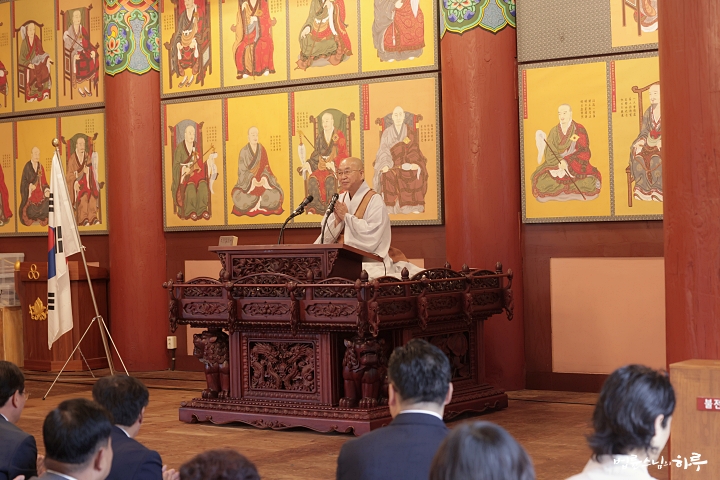
'We, the people of Korea, proud of a resplendent history and traditions dating from time immemorial, upholding the cause of the Provisional Government of the Republic of Korea born of the March First Independence Movement of 1919 and the democratic ideals of the April Nineteenth Uprising of 1960 against injustice…'
Yet there are people who deny the Constitution. This is not a matter of progressive versus conservative, nor a matter of a particular region or political orientation. It is a denial of the identity of the Republic of Korea. How can denying the spirit of the Constitution that defines what kind of nation the Republic of Korea is be an ideological issue or a regional issue?Venerable Yongseong Jinjong Is One of the Founders Who Built the Republic of Korea
During the March 1st Movement, most people did not shout 'Long live the independence of Daehan (Korea),' but rather 'Long live the independence of Joseon.' This was because, to the people at that time, our country was still Joseon. After Joseon lost the war and surrendered to the Qing dynasty following the Manchu Invasion of 1636, Joseon formally entered into a sovereign-subject relationship with Qing. However, when Qing was defeated by Japan in the First Sino-Japanese War of 1894, the Treaty of Shimonoseki, signed afterward, recognized Joseon as an independent nation. Accordingly, Emperor Gojong, wishing to inform the world that Joseon was no longer a vassal state of Qing, proclaimed the national title 'Daehan Empire' in 1897. However, Joseon, being weak among Russia, Japan, Qing, and the Western powers, could not become a fully independent nation. So even during the March 1st Movement, people shouted 'Long live the independence of Joseon,' and the expression 'Joseon Declaration of Independence' appears in the March 1st Movement declaration. Although the March 1st Movement ended in failure, the Provisional Government of the Republic of Korea, which inherited its spirit, declared the Republic of Korea—a nation where the people, not the king, are the masters. One of the important leaders of the March 1st Movement, which gave birth to this Provisional Government of the Republic of Korea, was none other than Venerable Yongseong Jinjong.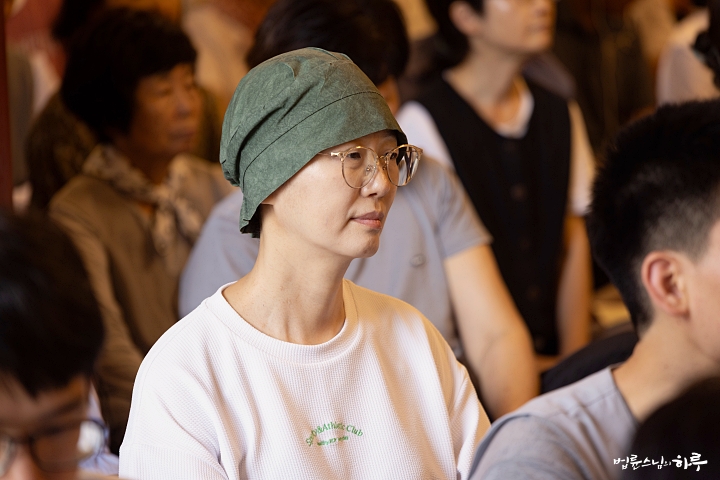
Dreaming of the Future Even in Difficult Times
That the national title would become Daehan Minguk (the Republic of Korea) and the national flag would become the Taegeukgi(태극기) seemed like an unattainable dream at that time. But because there were people who dreamed that dream, today's Republic of Korea exists. Just 50 years ago, we dreamed of going to America. But today, many people around the world dream of visiting Korea. Could people 100 years ago have ever imagined that the Korean Wave (Hallyu) would move the world today? We have built this Republic of Korea today. But that does not mean the Republic of Korea is complete. We are still divided and still face the risk of war. Compared to our strong national power, we have limited sovereignty in many areas, including military sovereignty and diplomatic rights. We can be proud that we have developed this far despite difficult conditions, but we have not yet achieved complete independence. We must not stop here; we must go one step further. Today, as we commemorate the 162nd anniversary of Venerable Baek Yongseong's birth, I hope we remember him not merely as an admirable monk, but as someone who dreamed of a new world even in those difficult times. I hope we reflect on the fact that, little by little, that dream is being realized today.Dreaming of Moving Forward Once Again, Beyond Conflict
We still bear unfinished tasks. We must build a Republic of Korea that can show that our ancestors' sacrifices were not in vain. We must build a nation where the ancestors watching from heaven and earth can say, 'My sacrifice was not in vain,' 'I have no regrets about my death whatsoever.' Today, the world is again facing a new era of upheaval—the U.S.-China hegemonic competition. In these difficult times, we must go beyond our domestic political conflicts and unite our strength to move further forward. I hope that today, the 162nd anniversary of Venerable Yongseong's birth, becomes an occasion to reflect together on his vision and to renew our pledge to the dream of a new Republic of Korea. Once again, I sincerely thank everyone who has joined us today."After completing the first part of the birthday memorial Dharma assembly, Sunim continued with a Dharma Q&A session with Jungto members. A total of seven questioners asked Sunim questions.
▪ I want to truly embody the teaching that I am the master of my own life.
▪ I have great ambition for work and the arrogant thought that I can do everything.
▪ For me, work was an escape from family life with an alcoholic husband, a lethargic and obese daughter, and an autistic son. After retirement, with what perspective should I live?
▪ My husband treats me carelessly according to his emotions. Every time, feelings of humiliation and fatigue combine, and I cannot regulate my emotions well.
▪ What is the difference between a life that follows causes and conditions and a life that follows desires?
▪ Although I have lived apart from my mother-in-law for 10 years, I still feel intimidated and tense when I see people with similar dispositions.
▪ There is someone in our group who dislikes me.
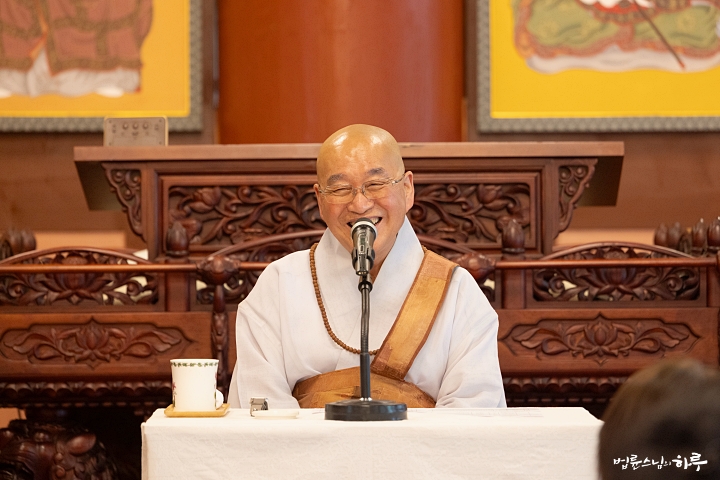
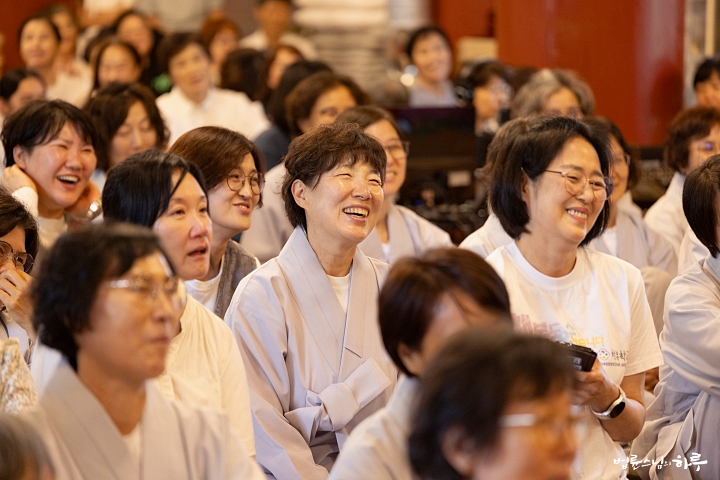
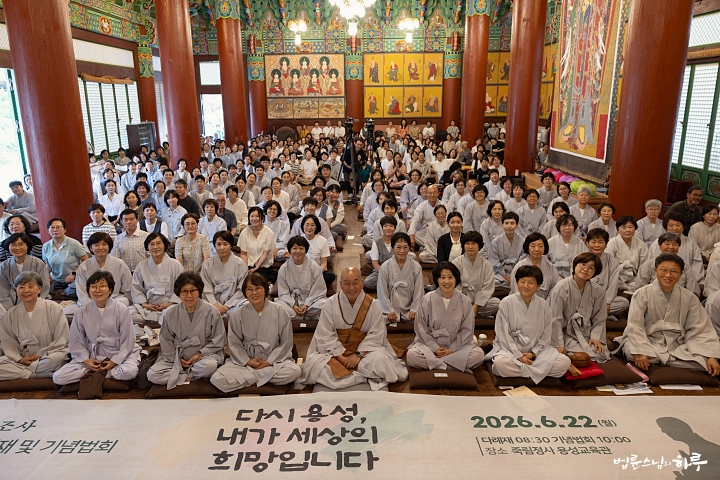
After the Dharma Q&A with all seven people was finished, Sunim and the assembly all shouted together and took a group photo, concluding today's memorial Dharma assembly schedule.
"I am the hope of the world."
Sunim had lunch at Jukrim Jeongsa prepared by the volunteers and quickly traveled to Jangseong County, Jeollanam-do, for his next engagement—a lecture at Sangmudae(상무대).
Sangmudae is a military education complex where the Republic of Korea Army's major education and training facilities are gathered. Sunim came to give a lecture at the request of the military chaplain. After arriving at Sangmudae, Sunim went through the entry procedures and moved inside the compound. He arrived 30 minutes before the lecture time and paid respects at the Main Buddha Hall of Mugaksa(무각사), the temple at Sangmudae. The temple was located at the highest point of Sangmudae.
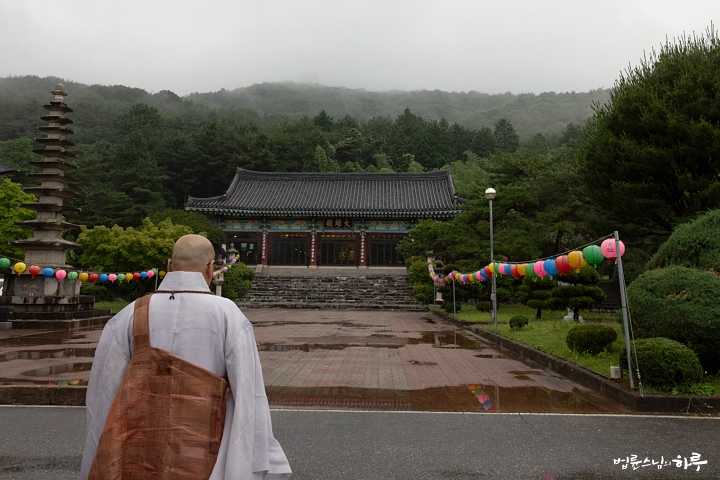
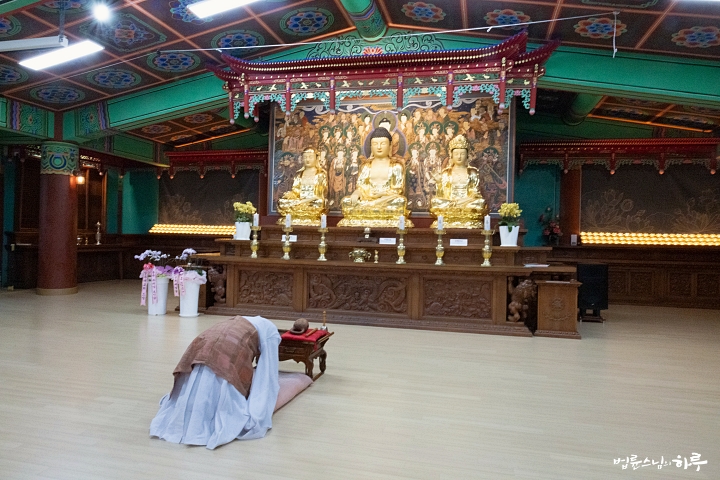
After completing his prayers, Sunim moved to Dongchungwan(동춘관), the lecture hall. About 500 audience members were waiting for Sunim. A video introducing Sunim was played first. After the video ended, Sunim took the stage to the audience's applause.
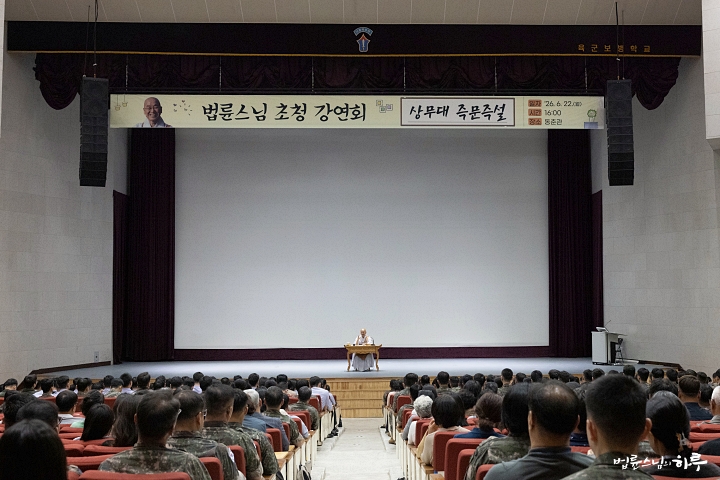
A total of eight questioners asked Sunim questions, and he gave Dharma talks in response.
▪ Recently, the thought of wanting to kill someone keeps suddenly rising in me, so I have been avoiding that person.
▪ My father passed away in March. His condition deteriorated just a week after entering a nursing hospital. I, who agreed to sending him to the hospital, feel guilty.
▪ I submitted a request for discharge from the military due to personal matters and work stress. Should I get discharged?
▪ Having lived in the metropolitan area, I am now in a situation where I have to settle in Jangseong. My child's educational environment has changed greatly, and I feel anxious as if only my child is falling behind.
▪ I am on poor terms with some of the section chiefs at school, and my heart feels uncomfortable every time I run into them. How can I become at ease and act naturally when I see them?
▪ Juggling wedding preparations, work, and studies, I feel great pressure that I must always do well. What is the difference between living diligently and attachment, and how can I lighten my heart?
▪ I chose my current major based on my grades, but I am not sure if this path is right for me. What should I do?
▪ My relationship with my parents was very distant when I was young. Now that I have grown older and more mature, I want to treat them well, but I worry that my parents might find it unfamiliar.
The stage where Sunim was seated had no speakers, so Sunim could not hear the questioners' questions well. So Sunim apologized that he could not hear well and asked the questioners to speak louder. In this way, Sunim listened attentively to the questioners' questions and continued the conversation.
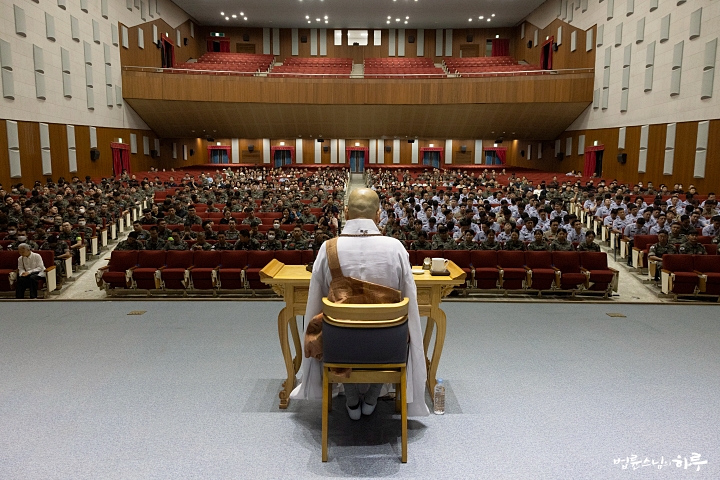
Of the eight questioners, this post introduces Sunim's Dharma talk in response to the question about wanting to restore a distant relationship with one's parents.
"When do we say communication is going well—when the other person listens well to what I say, or when I listen well to what the other person says? Good communication means I am listening well to what the other person is saying. In conversations with parents, what matters is not that I speak to my parents, but that I listen to what my parents say. Listen to their worries, their expectations of you, all kinds of stories. You don't need to feel pressured to respond. You can just respond with 'Oh, I see. Oh, is that so.' When you cannot meet your parents' expectations of you, you can simply say, 'I'm sorry.' Whatever they say, you can simply respond, 'I understand.' There's no need to try to persuade them, and if it's something you cannot do, just say, 'I'm sorry.' Then there will be no problem with communication at all. Conflict arises because you keep trying to persuade your parents with your own thoughts and try to change them. Parents are smarter than you. You haven't even gotten married yet, but your parents got married and raised you, so they have more ability and more experience than you. Trying to persuade such parents is not the right attitude. What matters is simply listening to their perspective. This doesn't mean doing everything they tell you to do. That would just make you a slave to your parents. It means understanding your parents' position and simply knowing, 'Oh, I see. They're worried about this. They have these expectations.' Acknowledging that your parents' position is understandable, you can simply respond with 'I understand' or 'Yes, I'll consider it,' and move on. That's how you can communicate with elders. There's no need to clash with them in disagreement.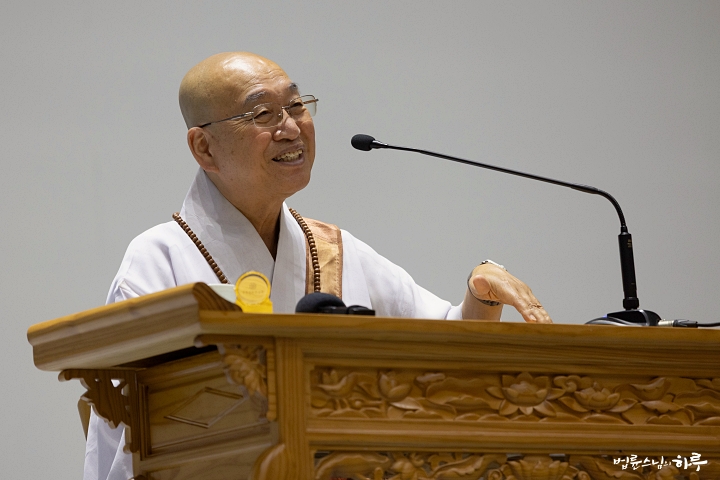
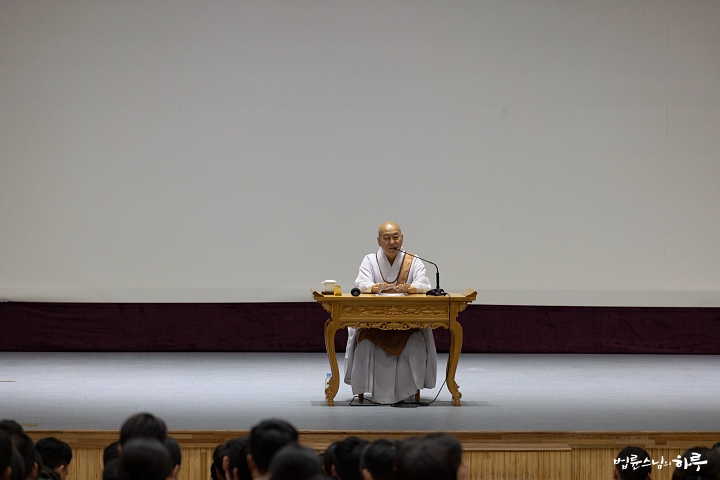
"Yes. Thank you."
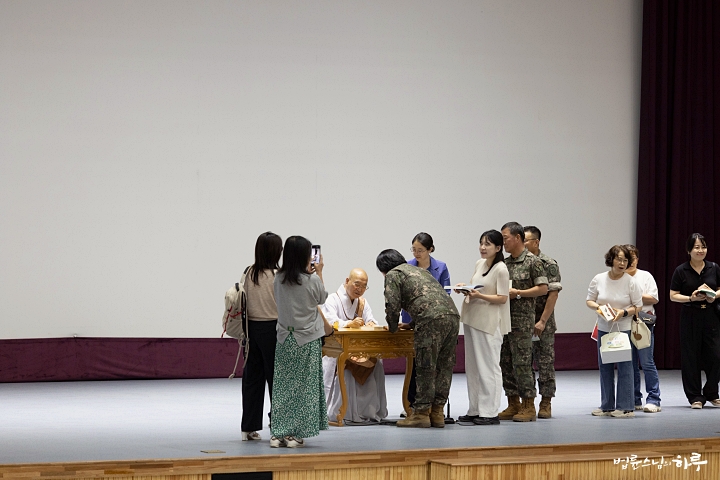
After the lecture, a book signing session was held for Sunim's books. The participants came up to the stage holding Sunim's books that they owned and received his signature. After the book signing, when Sunim stepped out of the lecture hall building, Jungto members from the Jeollanam-do region had gathered to greet him. Sunim briefly exchanged greetings with them.
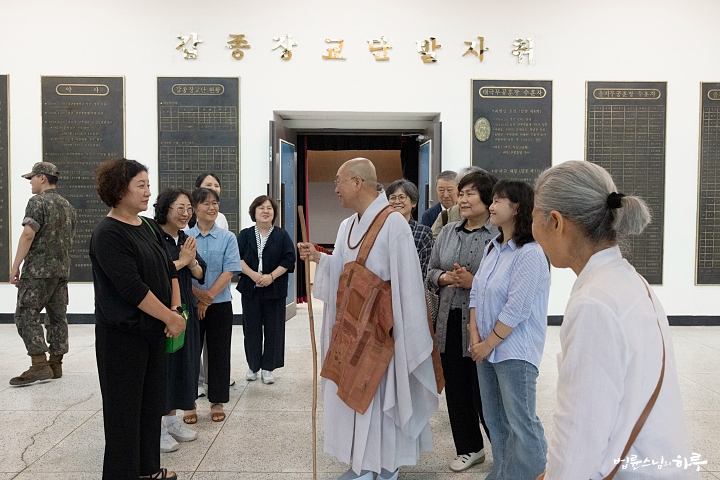
Around 6 p.m., Sunim shared tea at the residential quarters of Mugaksa with the military chaplain, the commander of the Mechanized Infantry School, the head of the Sangmudae Support Group, the president of Geumgang Association, and the general affairs officer of Geumgang Association.
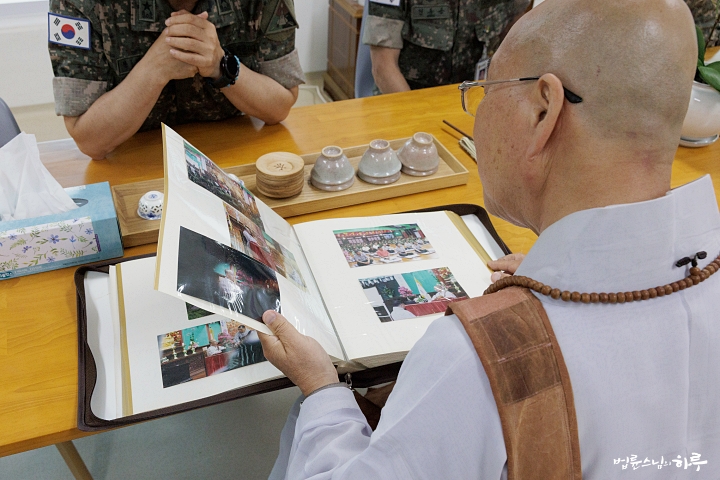
The military chaplain showed photos of Sunim giving a Dharma talk at Sangmudae 20 years ago. The old photos were kept in pristine condition in the photo album.
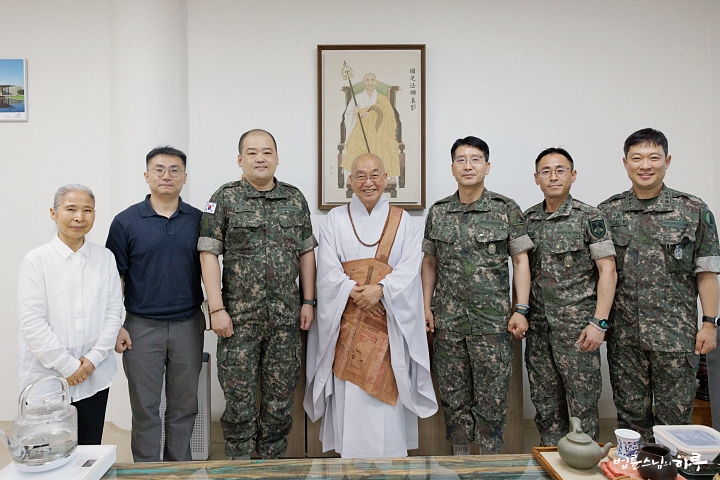
The military chaplain asked questions about the Bhutan project, so Sunim talked about how the Bhutan project began and its current progress. After presenting his book as a gift and concluding the tea conversation, Sunim got into the car. He arrived at Dubuk Jungto Retreat Center at 10 p.m. and took some rest.
Tomorrow, Sunim will receive medical treatment at the hospital and give a Happy Dialogue lecture in Cheongju(청주).