Why Should We Return to the Buddha's Fundamental Teachings?
Jun 20, 2026 – Day 8 of the INEB Schedule (Jungto Social and Cultural Center)
Hello. Today marked Day 8 of the INEB (International Network of Engaged Buddhists) Study Trip, with the closing program held at the Jungto Social and Cultural Center.
Sunim began his day with early morning practice and meditation. After breakfast, he joined the INEB delegation's program in the auditorium on the 9th floor of the Jungto Social and Cultural Center at 9 a.m.
The INEB delegation participated in the morning service at 4:30 a.m. held in the Dharma Hall on the 3rd floor of the Jungto Social and Cultural Center.
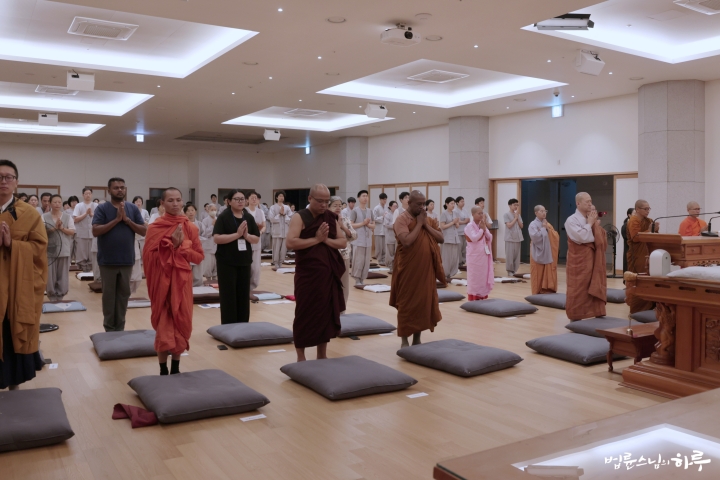
At 6:15 a.m., Barugongyang (formal Buddhist monastic meal) began in the basement level, with 72 people participating together.
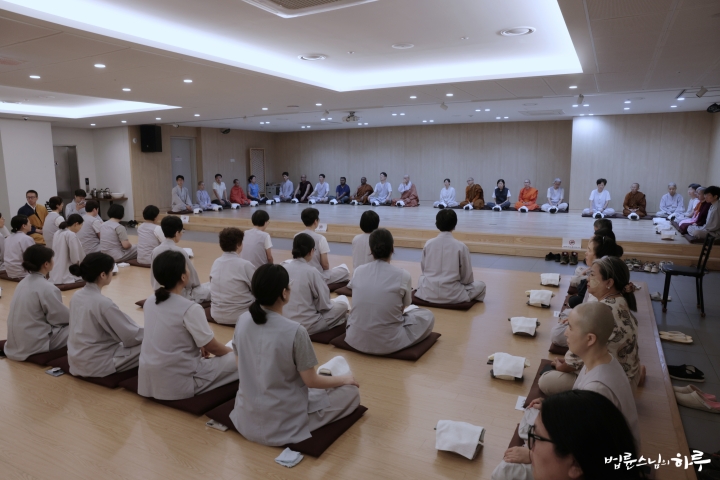
After the meal, the morning assembly began. Today is the final day of the INEB delegation program. Participants were scheduled to write their reflections from 8:30 a.m. after Barugongyang. Before that, Anchalee shared her reflections on behalf of the INEB delegation.
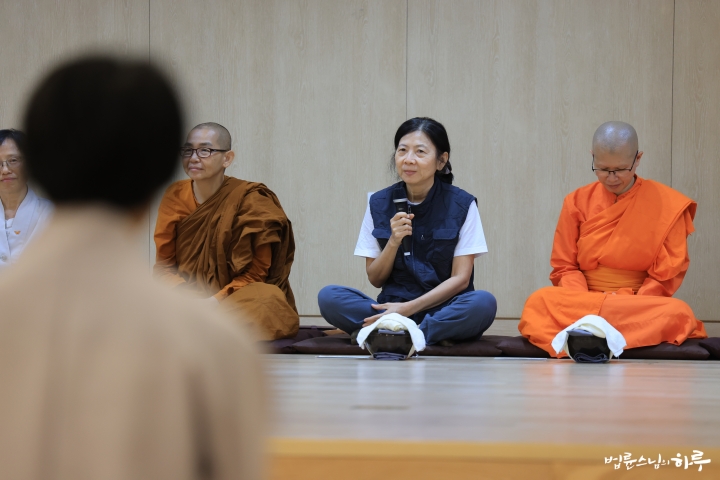
"Thank you. I apologize that we cannot share one by one in turn. It might take the whole day, because each person carries such a full and joyful heart. Before the INEB Study Trip began, I explained Jungto Society to the participants in advance. But words alone cannot fully describe it. Coming here and experiencing it directly is the best explanation. Venerable Yusu Sunim already spoke about the journey we had over the past week, so I will skip that. What we understood and learned was what the Buddha's teachings really are, how suffering arises structurally in various community contexts around the world, and how, as Buddhists, we can help society—as we learned when we visited Jukrimjeongsa. Through the Dharma lineage thangka at Jukrimjeongsa, we also saw how the teachings of Seon Buddhism were transmitted all the way here. With the inspiration and ideas we received through the INEB program—about what the world is like and how we can respond to its serious problems—we will be able to return to our countries and apply them in various activities. Beyond that, I also witnessed personal transformation in each participant. It is as if you gave us organic fertilizer, and we have received it well so that we can grow. During the INEB program, we felt the great effort of countless volunteers supporting us. We are deeply grateful, and we felt that everyone at Jungto Society is not just volunteering but engaging in volunteer activities as practice itself, which became a wonderful example for us. We give our deep gratitude to Venerable Pomnyun Sunim for holding this vision, and to the Buddha's teachings. We wish you good health, happiness, and success in everything you do on your path of practice. Thank you."
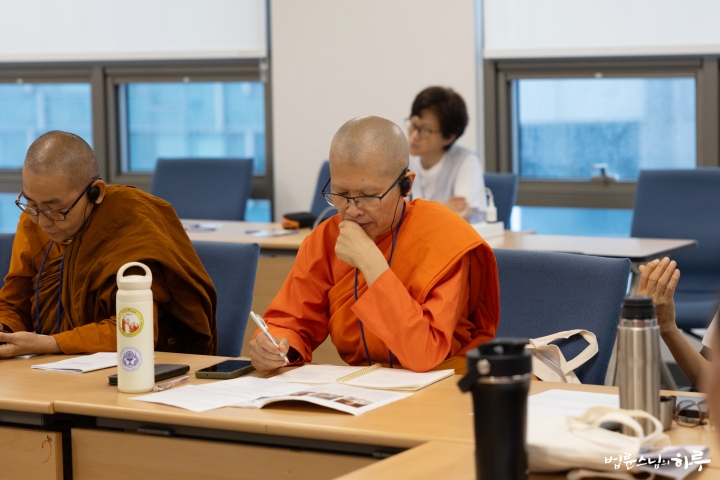
From 9 a.m., participants shared their reflections in the conference room on the 9th floor. Sunim joined them and listened to their reflections.
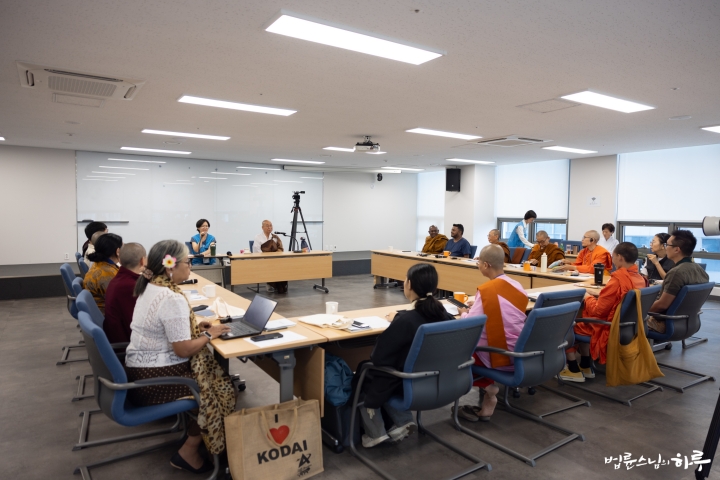
Since the reflections were given in English, Sunim listened through a Korean interpretation volunteer. The sharing was conducted by having each person reflect on and read what they had written in advance about their impressions and experiences over the past 8 days of the visit, ideas for further cooperation with Jungto Society or other participants and specific work plans, and how they would apply what they learned during this visit within their own organizations.
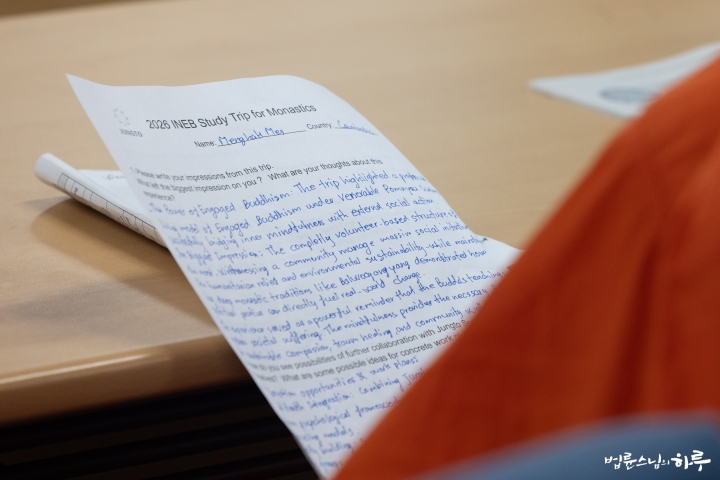
"This experience brought me truly wonderful ideas. JTS is like a big tree full of good fruit, and we have tasted that delicious fruit. Now I want to go back and plant those seeds in our land. Rather than starting only with knowledge, I will create a group that educates people while practicing the Buddha Dhamma frugally and humbly, just like Jungto Society. I especially want to share the culture of eating without leaving food waste, and live a transformed life through mindfulness and acceptance. Following Jungto Society's worldview of helping the poor beyond skin color and religion and spreading kindness through action, I will contribute to eliminating suffering so that all living beings can live in harmony."
"I was deeply moved seeing Jungto Society's countless volunteers. It was amazing to see them joyfully engaging in activities that became their own practice while helping others. Sunim's teachings are very simple and easy to understand, making them well-suited for daily life. By comparing the teachings of Mahayana and Theravada Buddhism, my understanding has broadened. I want to translate this accessible Buddha Dhamma into Thai, publish small booklets for children and the general public, and teach it to the Sangha. I will generously share the knowledge I have learned with my community."
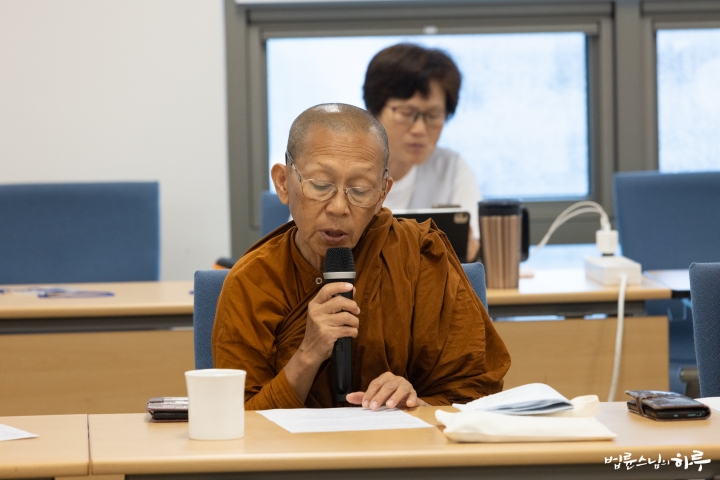
"Because of the mainstream culture or mistaken teachings we commonly follow, many people insist on incorrect practices, and those in positions of authority resist change because they do not want to lose their status. So I realized that having dialogue to distinguish what is the real Buddha Dhamma is both the most important and the most difficult task. This kind of direct experience is irreplaceable—it cannot be learned from books. I hope participants from different countries can meet periodically, even once every five years, to discuss our connection with Jungto Society and share our vision. If all the staff of our organization could come here and experience this, their thinking would change. Through our respective community networks, we will spread the Buddha Dhamma like waves, so that people can break free from laziness through wisdom and compassion and see the law of dependent origination."
"I received tremendous hospitality from the Jungto Society Sangha and was inspired. For the first time, I met a monk like Venerable Pomnyun Sunim who has the courage and compassion to speak directly and sharply. The discomforts in my heart were resolved through his Dharma talks, and I saw hope for the future of Buddhism. Indonesia faces great suffering due to inequality and social difficulties, but paradoxically, I believe it is fertile ground for Buddhism to grow. First, I will register for the online English Introduction to Buddhism program to continue my learning. After completing the first course, I want to create an official event where young Indonesian Buddhists and young Korean Buddhists can collaborate deeply. I will actively share with our Sangha and government how Korean Buddhism does not remain in individual meditation alone but cares for community, environmental protection, and agriculture together, and benchmark this model."
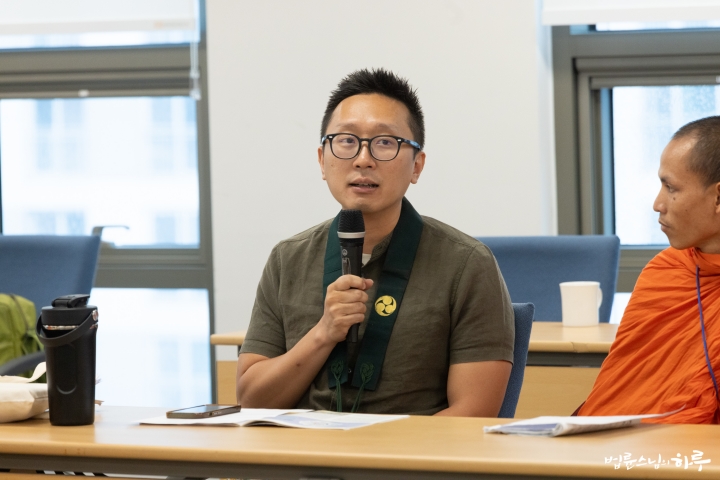
"I have always had respect for the support Jungto Society showed during the Mandalay earthquake in Myanmar, and coming here in person, I feel even deeper respect because the Buddha's teachings, practice, and mindfulness are harmoniously integrated everywhere. When I return to Myanmar, I want to develop a 'Mindful Leadership Program,' environmental conservation projects, and disaster support projects. In particular, I really want to translate Jungto Society's 'Happiness School' into Burmese and apply it. Within our organization, I will introduce the practice of expressing gratitude daily and combining meditation with meetings and volunteer work. When I return to my country, I will share this experience with my family and neighbors, and step by step, I will start with kind practices like community cleaning to make Buddhism easily accessible in modern society. I will also continue dialogue with the Myanmar participants who were previously invited."
"I saw that we should not wait until our practice becomes perfect, but should practice immediately while learning, and that we can start from small things. We may not be able to do big things right away, but I will start with small practices like basic education or helping children and the elderly. I will encourage young monastics to build a system like Jungto Society's in our bhikkhuni monastery and introduce Jungto Society to them. Even if only a few monastics participate, this dream will already make something different. Amid the conflicts and environmental problems of modern society, Buddhism must not just meditate in temples but must show 'the Buddha Dhamma in our hearts and hands' like Jungto Society. Even with limited resources, we will open our hearts in our own way, learn from other organizations, and slowly move forward for society."
The presentations contained concrete resolutions and plans for starting new initiatives in each person's place and way, based on what they learned through this visit to Jungto Society. Following this, Sunim gave a closing Dharma talk after listening to the participants' reflections.
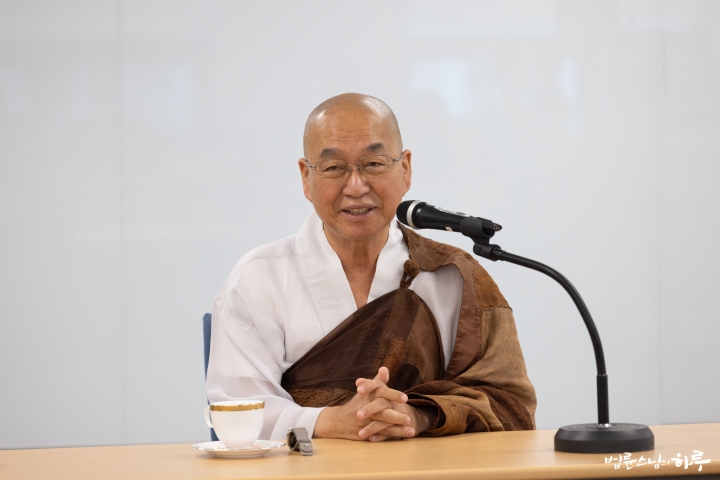
Sunim explained the process of how he became a monastic and participated in social movements, and how, although Buddhism already contains ideas such as democracy and equality, these had not been socialized. This led him to establish a Buddhist education institute to teach Buddhism to young people. He also explained that Jungto Society, up to today, has been a Buddhist movement started anew by the younger generation rather than by the religious establishment.
"We currently do not receive government subsidies, large corporate funding, or foreign funding. Jungto Society started by being self-reliant from the very beginning. That is why, rather than looking at Jungto Society as it is today, you should look more importantly at how Jungto Society started and how it has come this far."Sunim also shared the story of Patriarch Yongseong, who, during the late Joseon period when Buddhism was being suppressed, worked to revitalize and reintroduce Buddhism through its intellectualization, popularization, and integration into daily life. He also engaged in the independence movement, but his disciples did not carry on that independence movement. Sunim said that when pursuing something new like this, many difficulties follow and failures may occur, but someone else will inherit and continue that failed effort.
Sunim concluded his Dharma talk by saying that all of Jungto Society's activities come from the Buddha Dhamma and the power of practice based on it, and agreed to continue the conversation after lunch.
At 11:30 a.m., it was time for lunch, and everyone moved to the dining hall on the basement level.
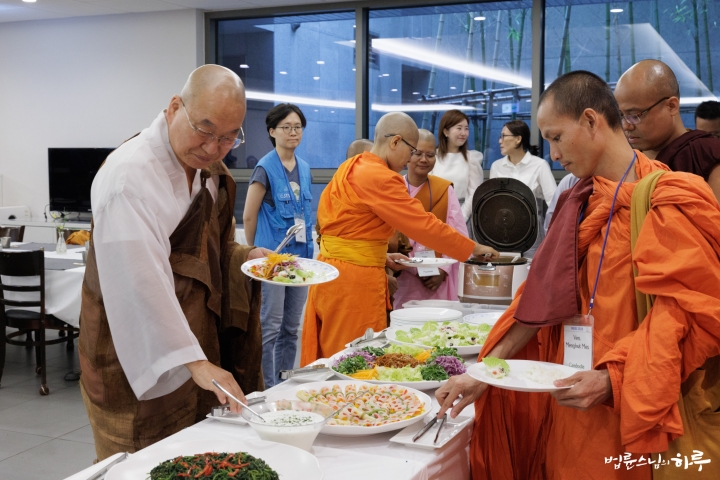
Today's lunch was prepared with care by volunteers from the Jungto Social and Cultural Center Special Division. After individual meal portions were served and volunteers came to the tables, the Southern Buddhist monks offered a blessing.
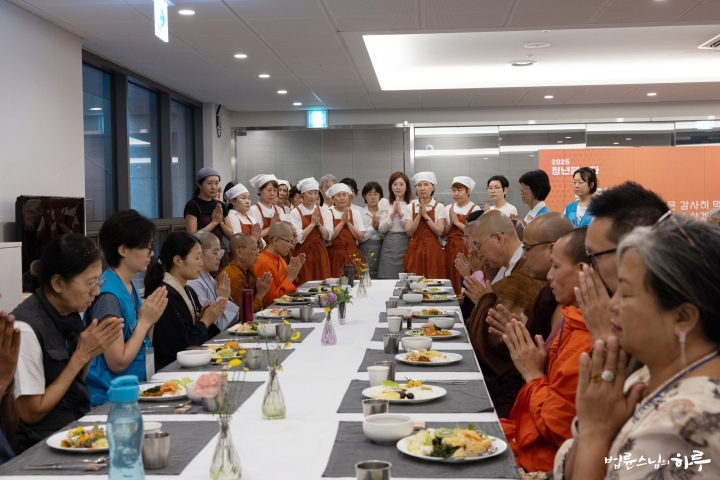
Sunim taught the participants the Korean meal offering verse.
"In a single drop of water dwells the grace of heaven and earth, in a single grain of rice dwells the toil of countless people, and in a single thread dwells the blood and sweat of the weaver. Drinking this water, eating this food, and wearing these clothes, I will diligently practice and become a person free from suffering, a free person, a bodhisattva who saves this world. Namu Bul, Namu Beop, Namu Seung (Homage to the Buddha, Homage to the Dharma, Homage to the Sangha)."After reciting the meal offering verse, everyone had lunch. After the meal, participants rested and agreed to meet again in the afternoon session. Sunim worked in the office until the next session began.
The afternoon session began at 1 p.m.
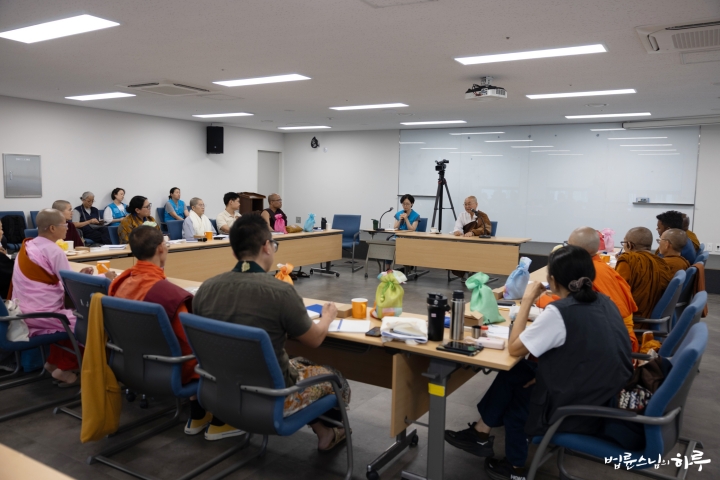
As the final program of the INEB schedule, this was a time to hear Sunim's closing words and the participants' future plans. After meditation, Sunim took the microphone and began speaking.
"Did you enjoy your lunch? For those from Theravada traditions, are you okay eating only vegetarian meals all this time? Aren't you feeling weak? (Laughter)""We were already vegetarian, so there is no problem."
"I was planning to give gifts after the session, but since Chisa from Japan has to leave right after this, I will give her gift first and then start the program. There are two gifts. One is a wind chime."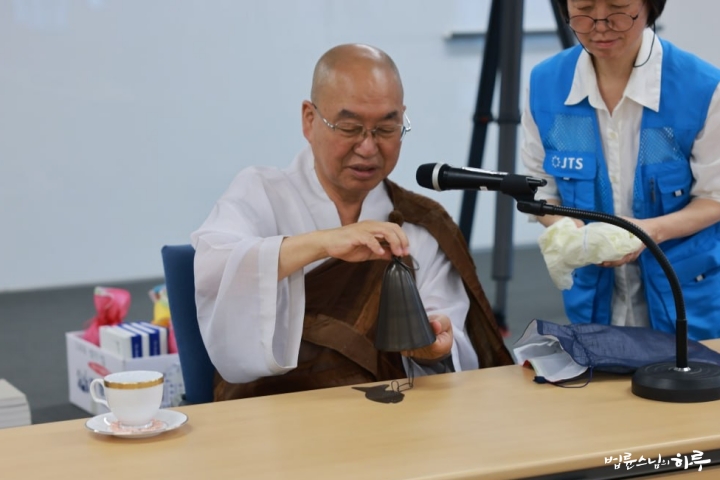
Sunim took the wind chime out of its pretty pouch, showed it, and let them hear its sound. The participants looked on with curiosity, saying "Wow~." Sunim explained the meaning of the wind chime.
"When the wind blows, it makes this sound. It is hung from the eaves. The wind chime has three meanings: 'Do not listen only to the voices of people, but also listen to the voice of nature. Do not listen only to the voices of leaders, but listen to the voices of the common people, the people of the world. Do not think only of yourself, but listen to what others have to say.' These are its meanings. The other gift is the English book . My first book was . People said that book was too thick, and there were requests for a summarized new version. When I wrote the book, I included scriptural sources because without them, people might think, 'Are you just interpreting it however you like?' So including references based on the sutras made the book thick. I received a request from EBS (Korea Educational Broadcasting System) to give a short lecture series on the life of the Buddha. This book was created based on 15 lectures of 20 minutes each on the human Buddha. Those who heard the lectures said, 'Wow, the Buddha was a revolutionary!' In a society with gender discrimination, he spoke of gender equality; in a place with class discrimination, he spoke of class equality; and he taught that liberation comes not from offering and worshipping gods, but from awakening to one's own ignorance. They said this is truly a revolution, so the title changed from Human Buddha to Revolutionary Buddha. If you want to study in more detail, you can refer to the thick book ."After explaining the gifts, Sunim took time to present them to all participants. Sunim made eye contact with each participant and presented them with a wind chime and the English book .
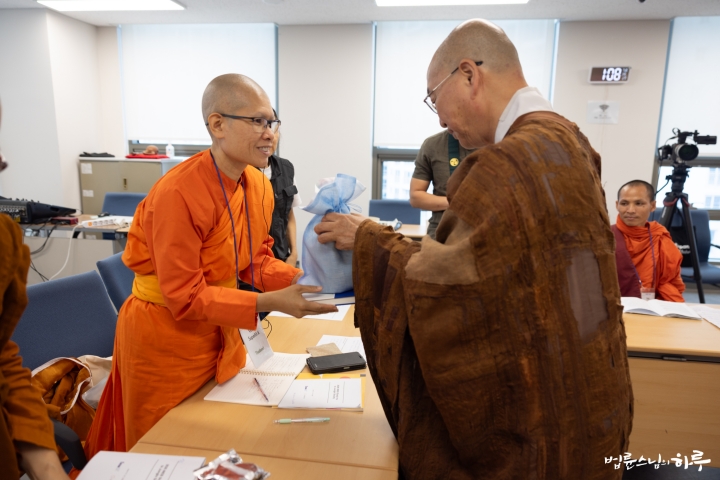
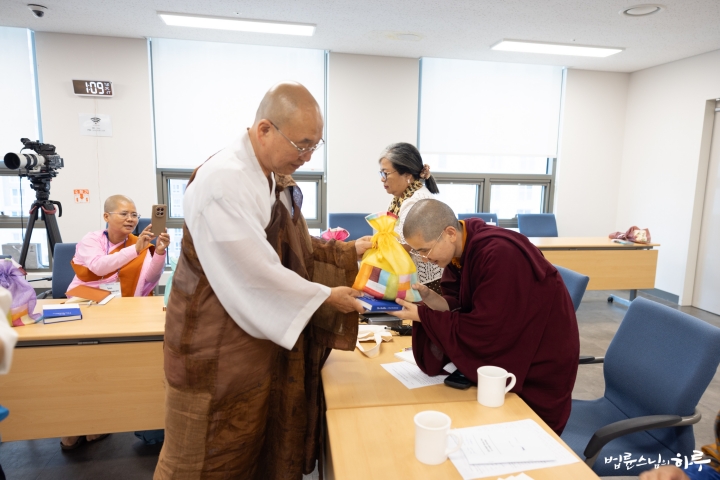
After receiving the gifts, the participants offered Sunim gifts they had personally prepared, with hearts full of gratitude. The participants explained what their gifts were and what they meant, and they took commemorative photos together.
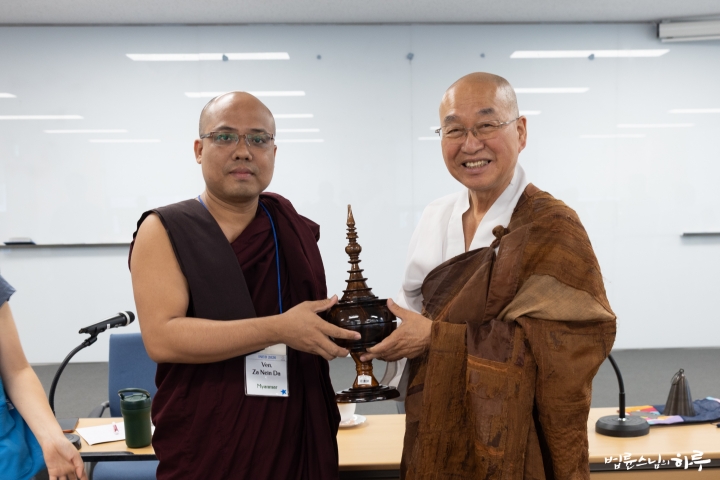
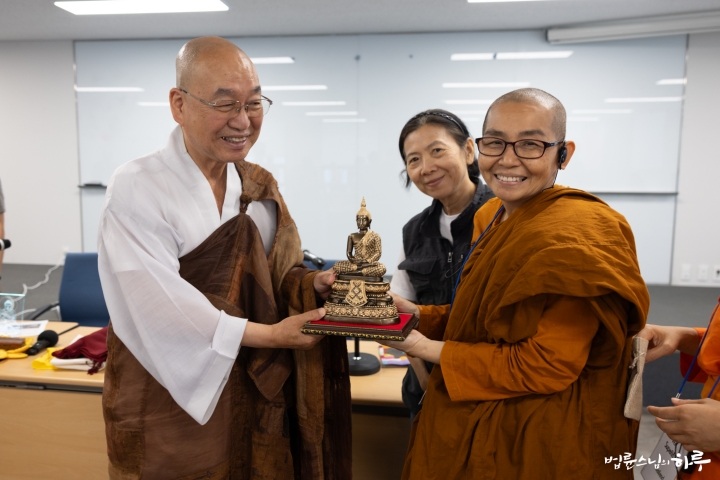
Venerable Zanainda from Myanmar gave Sunim a ritual offering vessel used for making offerings. Seeing this, Sunim made a joke.
"It looks like something to put relics in. (Laughter) Are you telling me to put my remains in here after I die? (Laughter)""Sunim, please don't die. Please live long."
The gift-giving time came to an end. Sunim took the microphone and spoke.
"Thank you for the gifts; I gratefully received them. In this session, I would like to talk about the Buddha Dhamma."Sunim went to the whiteboard and continued his explanation while writing. He explained the Buddha's birth, renunciation, practice, the temptation of Mara, and the process of awakening, and explained the content of the Buddha's enlightenment—the Middle Way and the law of dependent origination—through various examples. When explaining the Middle Way, he gave examples of the road to Seoul and of the Eastern and Western Mountains; when explaining dependent origination, he used examples such as car parts and water molecules. Then, explaining impermanence and non-self, he also explained how correctly understanding the Buddha's teachings and returning to them benefits us today.
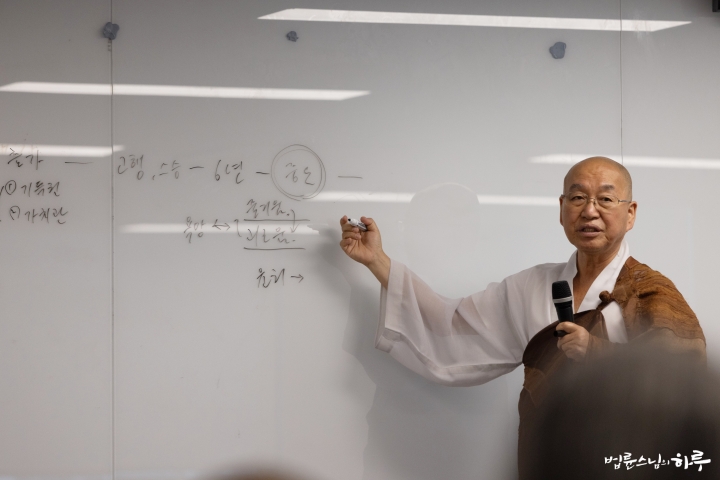
Why Should We Return to the Buddha's Fundamental Teachings?
"We need to correctly understand the Buddha's teachings on impermanence and non-self. In other words, we need to correctly understand the law of dependent origination (緣起法). The Buddha's law of dependent origination does not contradict any of the laws discovered by today's natural sciences, social sciences, or neuroscience. Modern science likewise shows that matter, life, and mind are interconnected and function together. When we realize this law of dependent origination, all suffering disappears. This is called 'nirvana (涅槃).' But if we do not realize dependent origination, we cannot escape suffering. This is called 'suffering (苦).' Therefore, impermanence, non-self, and nirvana are called the Three Marks of Awakening (三法印), and impermanence, suffering, and non-self are called the Three Marks of sentient beings. The teaching that one can reach nirvana by realizing this law of dependent origination, applied to the teaching of sentient beings, is the Four Noble Truths (四聖諦). 'There is suffering. The cause of suffering is attachment. When attachment is released, suffering disappears. To sustain the state of being free from suffering, one must be rightly awake to eight things.' This is the Noble Eightfold Path (八正道). As the Buddha's first sermon was the Four Noble Truths and the Noble Eightfold Path, these were used to teach sentient beings. Kondanna, who first attained awakening through the Buddha's teaching, was able to escape suffering by understanding this Dhamma. These terms were not directly spoken by the Buddha himself. What is important is that, when someone is suffering, the cause of that suffering must be investigated. When Jungto Society says we return to the Buddha's fundamental teachings, this is different from what fundamentalist religious people say. The Buddha's fundamental teachings are most useful in healing the various pains the world faces today, so we take those teachings as our foundation. At that time, many brahmins solved people's problems by saying things like, 'If someone faces a certain difficult problem, you simply need to recite a certain scripture.' But the Buddha did not solve problems in that way. He investigated the specific cause of each person's problem and guided them to escape suffering. How do today's monks live? Are they not living in exactly the same way the brahmins of the past did? When a devotee passes away, they recite scriptures; when a child is born, they offer blessings; when a building is constructed, they perform yet another ritual. Most monks today live in the same way as the brahmins of the past. This is very far from the Buddha's original teachings. We can say it has merely been transformed into one of various religious rituals. This does not mean religious rituals are unnecessary. Such religious rituals are needed in the world as a kind of custom and culture. In fact, even in the Buddha's time, many brahmins performed such religious rituals. However, if today's monks also live centered only on such religious rituals, they may not be very different from the brahmins of the past. In other words, it would not be entirely wrong to call today's monks 'New Brahmans.' (Laughter) Whatever religious rituals we may perform in our lives, our true vocation is that of a practitioner, so let us act while keeping the vocation of a practitioner. In other words, let us return to being practitioners who live by relying on the Buddha's original teachings."After Sunim's summary talk, a participant who had a question asked it.
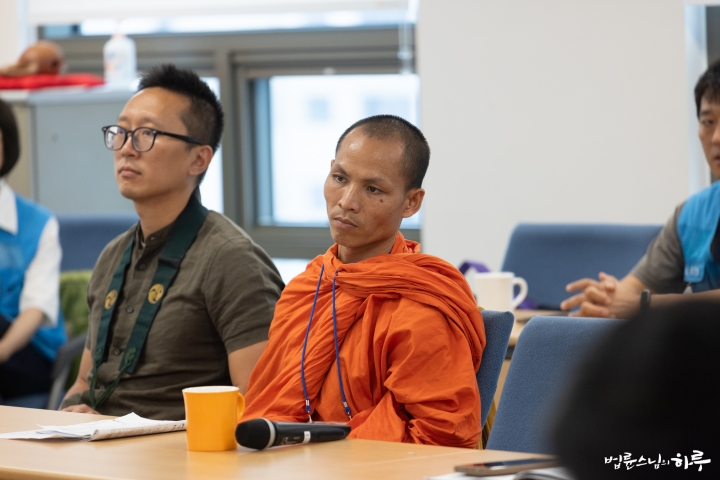
The Middle Way Is Not Something to Know but to Practice
"Understanding the Middle Way is very easy. But practicing it is very difficult. Explained in words, it is simple. The Middle Way means going straight without leaning to one side or the other. But when you actually try it, it is not easy. We tend to lean either this way or that way. When we visited Silsangsa Little School yesterday, did you see the tightrope walking? There was a rope in the yard. If someone asked how to walk on the rope, what could you say? You could say to balance your body, not leaning to this side or that side, and walk straight. The explanation is simple. But what happens when you actually try? You fall to this side. When you try not to fall to this side, you fall to the other side. Most people cannot even take one or two steps. Does that mean it is impossible? No. Anyone can do it, but not everyone can do it easily. It requires a lot of practice. You must fall countless times and get up again. This is what practice is. Because we tend to lean to one side, we must constantly try to maintain balance, and that is mindfulness. So in conclusion, knowing the Middle Way can happen suddenly, but practicing the Middle Way does not happen suddenly. Even the Buddha went through countless trial and error before realizing the Middle Way. He did not do it well from the start. He tried extreme asceticism and various practices, and after countless failures, he discovered the Middle Way. Following that path with diligence, he finally attained awakening. Later, when countless practitioners and religious people came to question him, he was unmoved by any question. This was because he had already experienced all of those issues himself. So whatever question someone asked, he could explain it in an easily understandable way according to that person's level and circumstances. Among the Buddha's ten epithets is one called 'Sekanhae (世間解, Knower of the World).' Among epithets such as Tathagata, Arhat, and Samyaksambuddha, one is Sekanhae. Because he thoroughly knew the principles of the world, no matter what question anyone asked, he could explain it in a way suited to that person. As I explained earlier with the diagram, if you know where Seoul is and you also know where the person asking is currently located, you can easily give them directions. Likewise, because the Buddha knew the minds of all sentient beings, he could give them appropriate teachings to help them escape their suffering. Then did everyone who heard the Buddha's teaching attain awakening? No. This is because, ultimately, you have to walk the path yourself. Just because you know the way does not mean you automatically arrive at your destination. It requires practice and implementation. But if a person refuses to go, what can be done?""You said that we can eliminate suffering through the Middle Way. Then, how can we actually practice the Middle Way?"
Sunim explained what needs to be done to help people understand the Middle Way and the law of dependent origination, which are the core content of the Buddha Dhamma.
When Explaining the Middle Way and Dependent Origination, Use the Other Person's Language
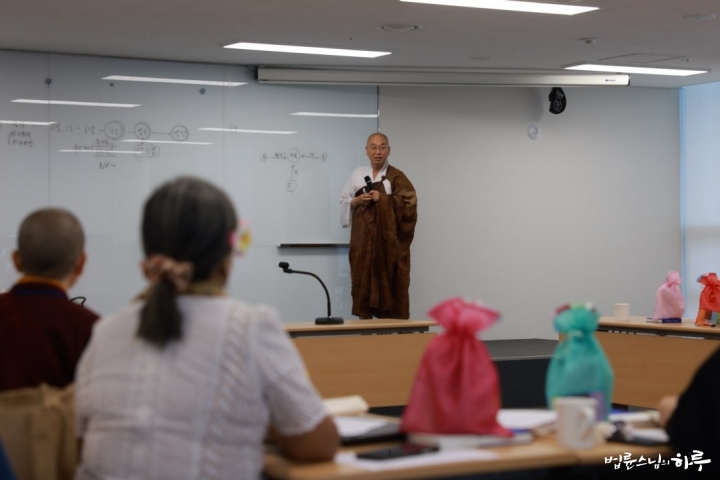
Then, citing the story of the finger pointing at the moon and the mathematical concept of vectors, Sunim explained that the Middle Way is also needed when teaching Buddhism.
Guiding Others to Adopt the Perspective of the Middle Way and Dependent Origination
"You must know what the current situation is and what the other person's thoughts and circumstances are. Only then can you suggest an appropriate direction. Knowing the situation clearly as it is, is wisdom. That is also understanding dependent origination. So teaching Buddhism to students is actually not difficult. Students have fewer fixed ideas. But teaching all of you is much more difficult. (Laughter) We must help elementary school students understand dependent origination (緣起) or the Middle Way (中道) in elementary school language, and middle school students in middle school language, so that they realize it for themselves. It is not important to teach the terms 'Middle Way' or 'dependent origination'; what is important is to guide them to view things from the perspective of the Middle Way and dependent origination."The first afternoon session ended. After a 15-minute break, the second session began. Sunim shared past experiences and emphasized the following once more.
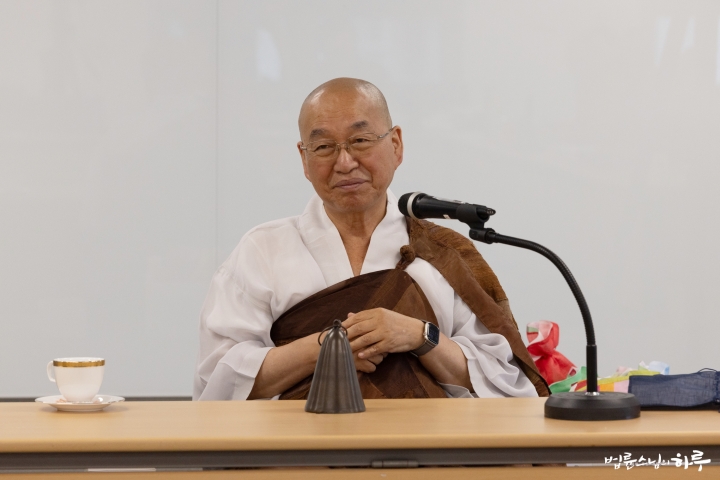
The participants took turns sharing their plans on the topic Sunim had given.
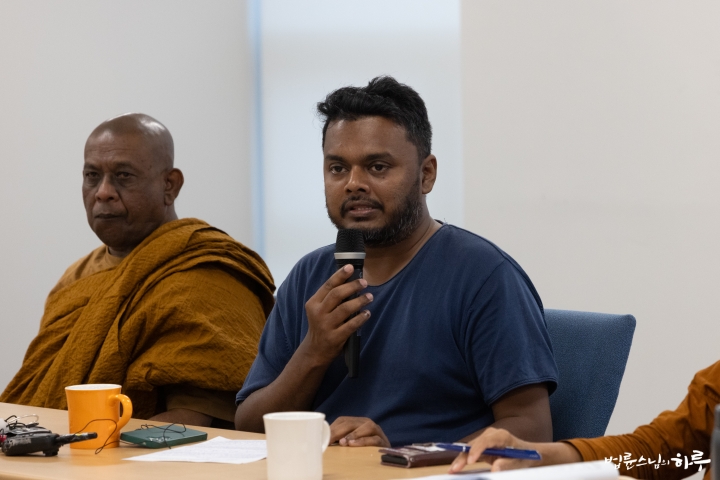
▪ We will support residents of marginalized communities and create a sustainable education system so that children do not have to give up on their studies.
▪ We will open temple facilities for village residents to use and operate an education center for novice monks who are outside the formal school system.
▪ We will create spaces where urban residents can connect with nature and learn about agriculture.
▪ We will strengthen the capabilities of female Buddhists and the bhikkhuni Sangha, support their growth, and spread the culture of women's ordination.
▪ We will establish educational programs in other regions such as Nepal so that nuns can learn and practice the teachings of the Buddha Dhamma.
▪ Together with about 20 youth volunteers, we will run programs to understand the Buddha Dhamma's teachings and put them into action and practice in daily life. - We plan to help about 200 urban marginalized people and children under the temple's care become self-reliant. We aim to build a center for self-reliance where they can practice and we can help them generate income.
▪ When lecturing at university, I will include content about 'Engaged Buddhism' and share what I learned and experienced in the INEB program with undergraduate and graduate students so it can be researched. Ultimately, I want to establish a Dhamma center.
After hearing the participants' plans, Sunim applauded and encouraged them.
"I listened well to your stories. Within three years, I will visit the places where you are active someday. If I don't die, that is. (Laughter) Until then, please practice diligently. Thank you."The participants concluded the program by offering Sunim three bows of gratitude. They then took commemorative photos.
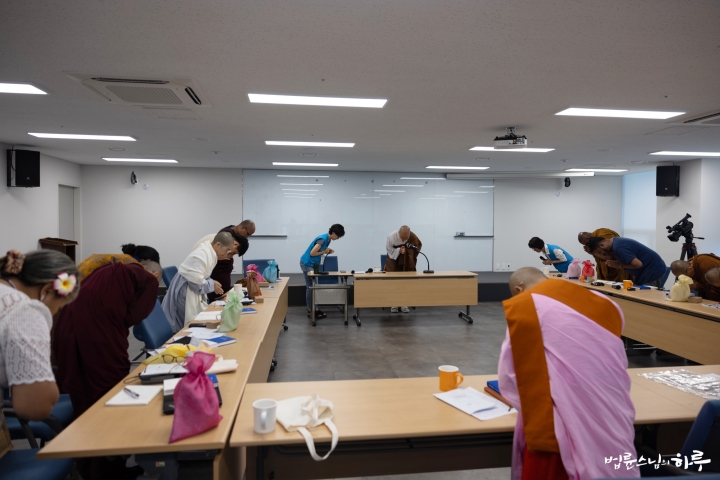
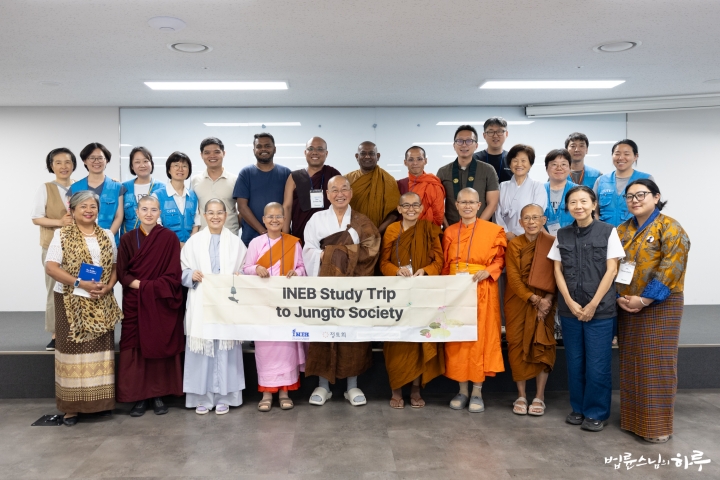
As soon as the photo session ended, the participants brought the books they had received as gifts and asked Sunim to sign them. The venue instantly turned into a book signing event.
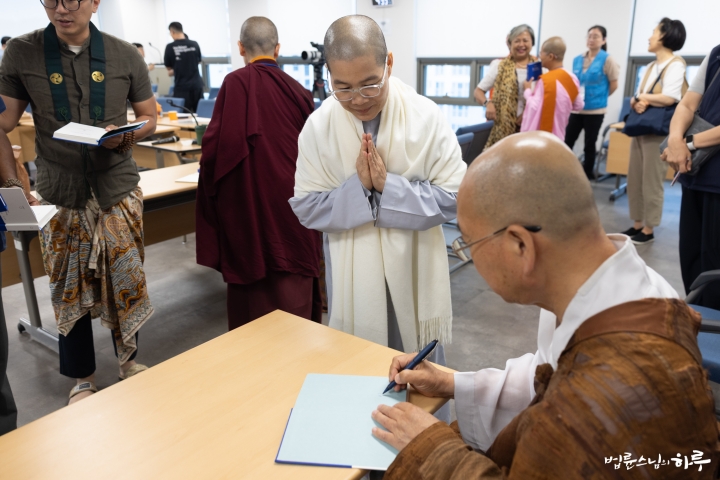
A participant from Myanmar offered Sunim thanks in the traditional Myanmar style. Taking off his shoes, kneeling, and placing his head on the floor, he bowed with a heart full of gratitude.
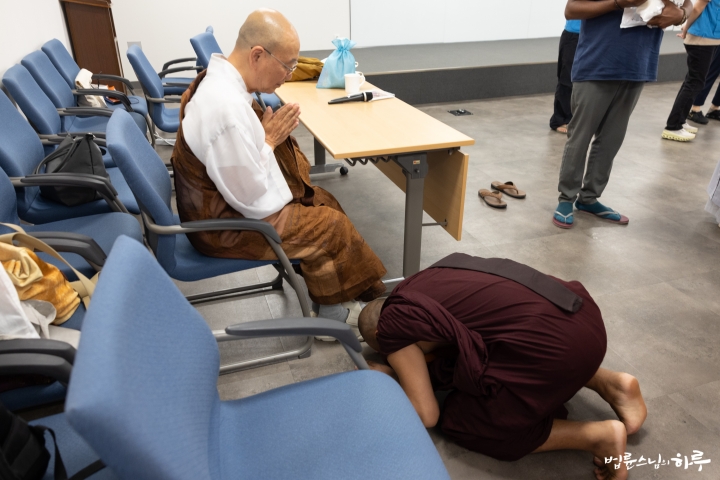
Then, all the participants one by one bowed to Sunim on the bare floor with hearts of gratitude and respect. Sunim blessed them by placing his hand on each head in the Bhutanese style. Sunim promised to meet again, allowed the participants ample time to bid farewell to one another, and left the auditorium.
Sunim went up to the office, briefly wrapped up his work, and prepared to leave for Dubuk. Around 5:30 p.m., he departed from Seoul Jungto Center for Dubuk Jungto Retreat Center. In the car, Sunim closed his eyes for a moment. He arrived at Dubuk Jungto Retreat Center only at 9 p.m. Sunim unpacked his things and ended the day.
Tomorrow, he plans to take a rest while attending to work.