Truth Does Not Come From Belief, but From the Verification of Facts.
Jun 18, 2026- Day 6 of the INEB Schedule (Silsangsa Temple)
Hello. Today marks the sixth day of the INEB (International Network of Engaged Buddhists) Study Trip, where Sunim and the participants spent the day touring Silsangsa Temple (실상사) and the Indramang Life Community (인드라망생명공동체).
Sunim began his day with morning practice and meditation. At 5 a.m., he departed from Dubuk Jungto Retreat Center and traveled to Silsangsa Temple in Namwon (남원), Jeollabuk-do (전라북도). During the drive, Sunim worked on proofreading a manuscript.
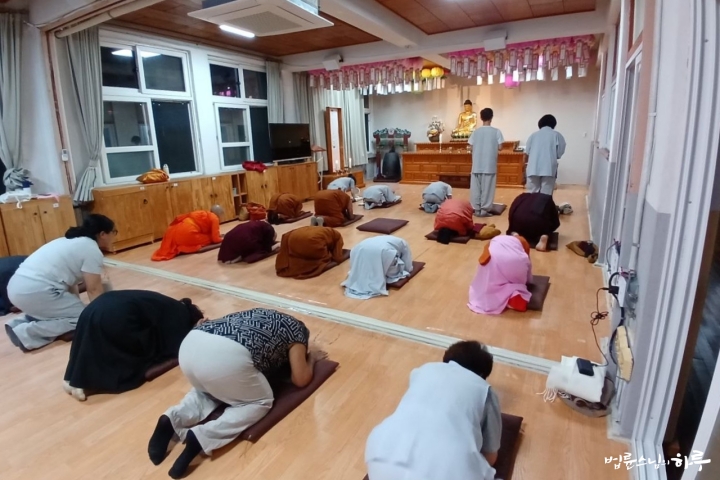
The INEB delegation slept at Dubuk Jungto Retreat Center, attended only the morning ceremony, and then boarded their vehicles to travel to Silsangsa Temple.
At 7 a.m., Sunim's vehicle arrived first, near Haetalgyo (해탈교), the bridge just before the entrance to Silsangsa Temple. The vehicles carrying the participants arrived a bit later, as they had stopped at a rest area to use the restrooms. Sunim, who had come directly without stopping, suggested waiting until all the other vehicles arrived so that the delegation could enter together, allowing the guide to give the orientation only once. Sunim put on his kasaya (Buddhist robe) and waited in the car until the three vehicles carrying the participants arrived at Haetalgyo.
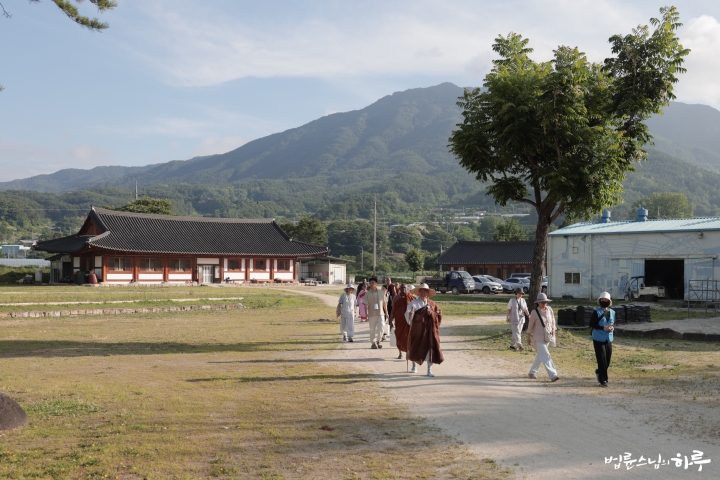
Once the vehicles arrived, the group crossed Haetalgyo and entered Silsangsa Temple. After parking the vehicles in the open lot in front of the dining hall (Yanghyedang, 양혜당), Sunim got out and headed toward the Main Buddha Hall (Daeungjeon, 대웅전).
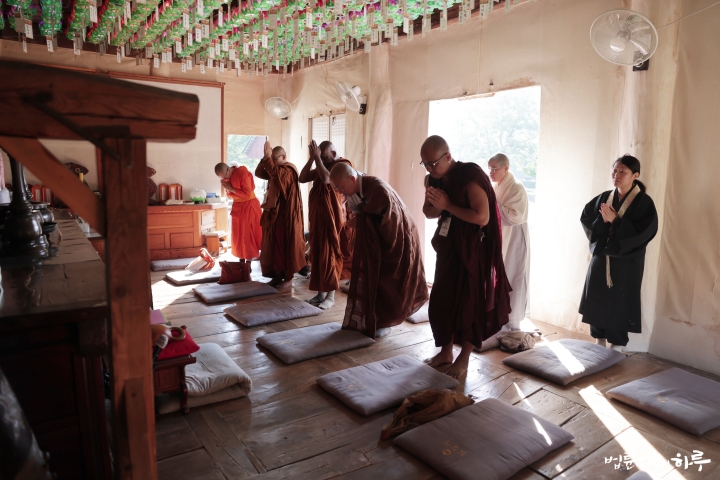
Sunim entered the Main Buddha Hall and paid his respects. The participants followed Sunim into the hall and paid their respects together.
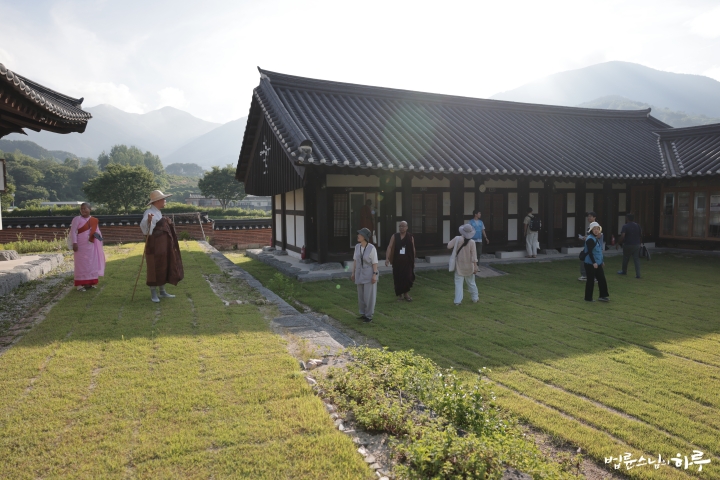
The participants were then shown to their lodging for the day (Hyuhyudang, 휴휴당). Each participant entered the room marked with their name and unpacked their belongings.
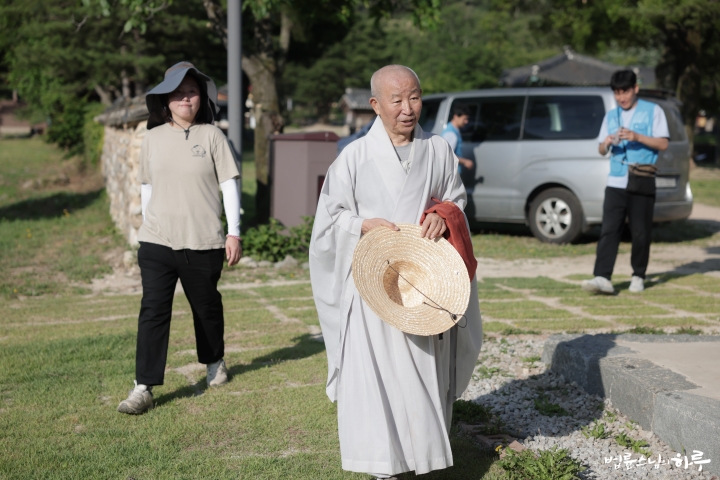
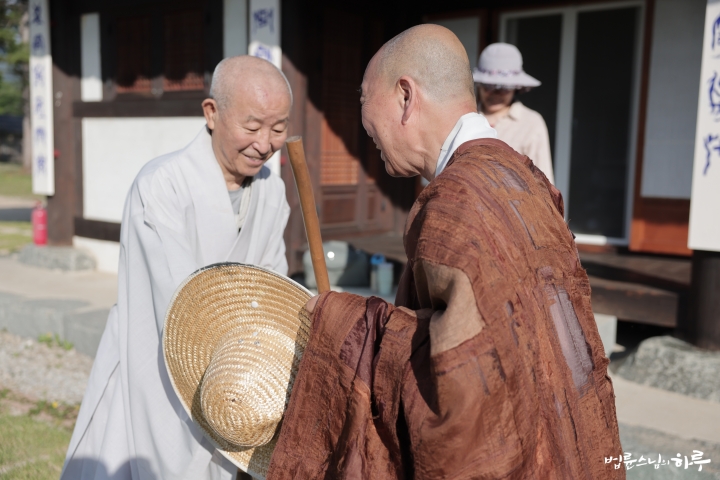
While the lodging arrangements were being made, Venerable Dobeop Sunim (도법스님)—the Josil (Senior Spiritual Mentor) of Silsangsa Temple of the Jogye Order of Korean Buddhism and the Guiding Dharma Teacher of the Indramang Life Community—approached Hyuhyudang from afar and greeted Sunim and the INEB delegation.
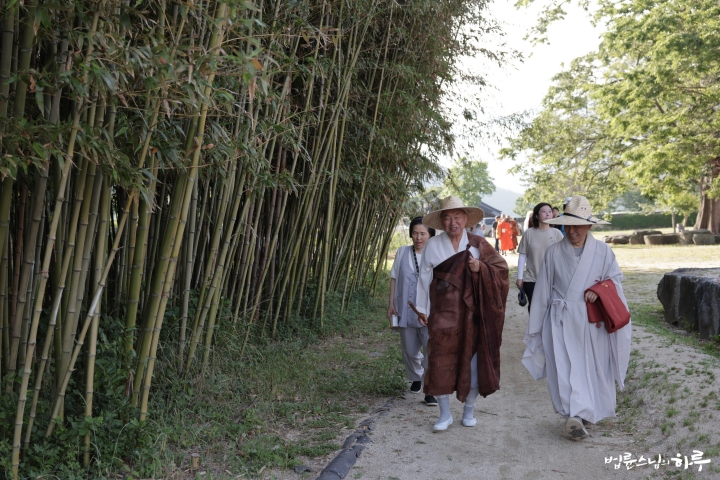
Venerable Dobeop Sunim personally guided the group to the dining hall for breakfast.
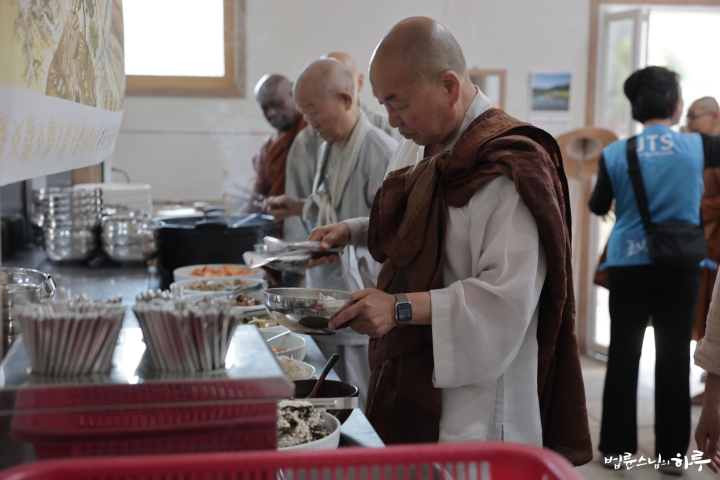
The first scheduled activity at Silsangsa Temple was breakfast at the dining hall. Silsangsa Temple had carefully prepared breakfast for the INEB delegation, who had been traveling since dawn. The participants served themselves as much as they wanted to eat, sat down at the tables, and ate. Each person washed their own dishes before leaving the dining hall. Until the tour of Silsangsa Temple began at 8:30 a.m., the participants took a walk around the temple grounds or rested.
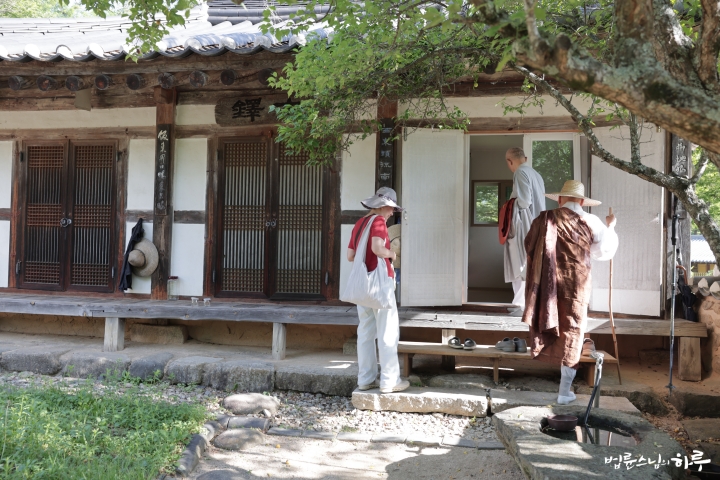
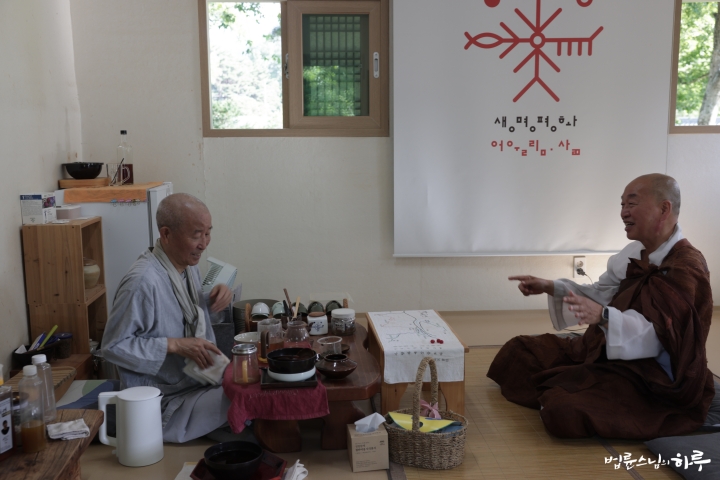
Sunim decided to spend the entire day with the participants. Before the Silsangsa Temple tour began, Sunim and Venerable Dobeop Sunim moved to another location to have tea and conversation.
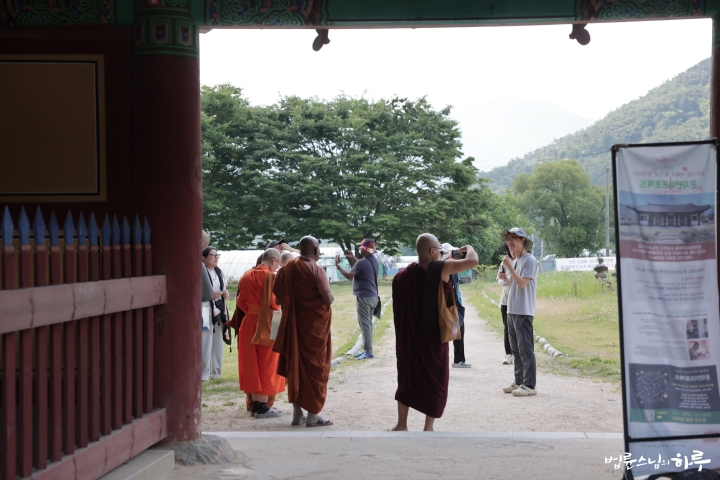
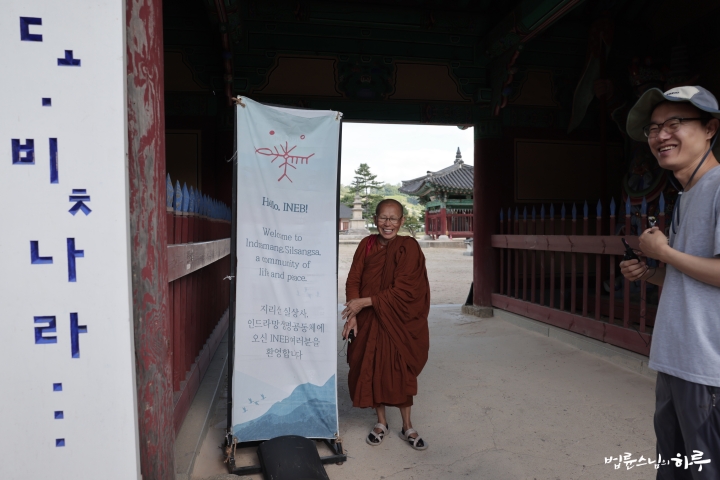
At 8:30 a.m., the tour of Silsangsa Temple began in front of Cheonwangmun (천왕문), the gate of the Four Heavenly Kings. Beomjeong (범정) from Silsangsa Temple gave explanations to the participants in English. Sunim also came to Cheonwangmun and began the tour together with the participants.
Cheonwangmun is the first gateway into Silsangsa Temple. The group moved from outside the temple into the grounds, touring the various facilities along the way.
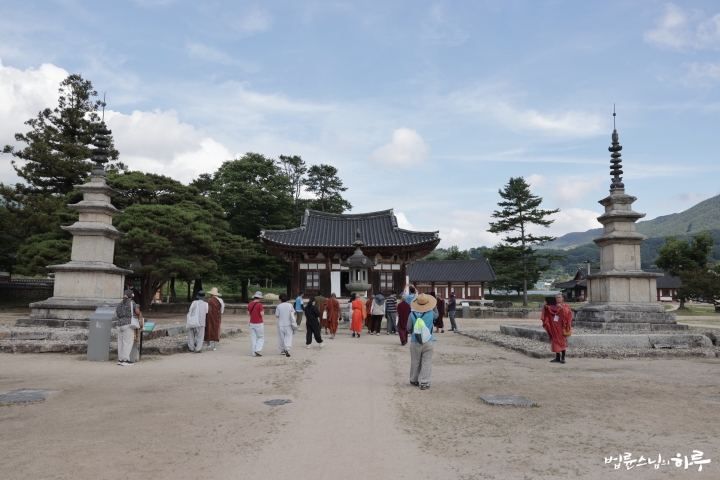
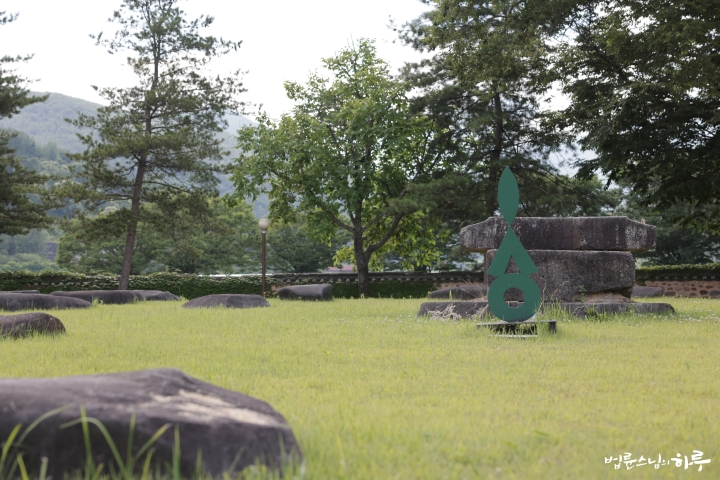
After passing through Cheonwangmun, the group viewed the East and West Three-Story Stone Pagodas and the stone lantern, then arrived at the site of the wooden pagoda within the temple grounds, where they listened to an explanation.
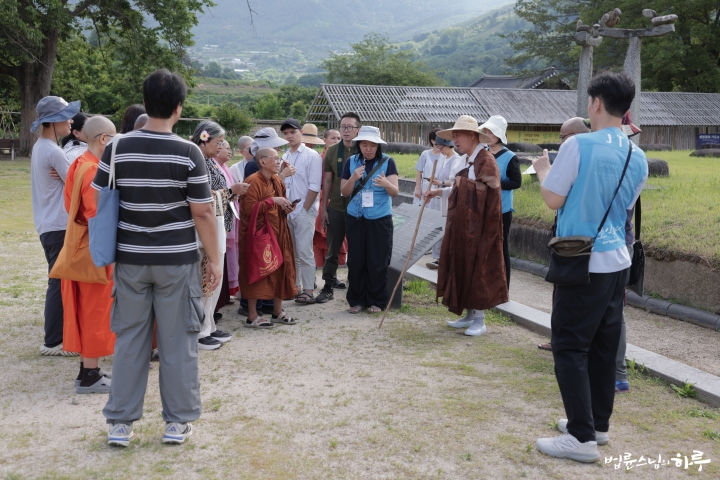
While listening to the explanation, Sunim added information that would be helpful for the participants to know. He explained that when Buddhist pagodas are erected in Korea, Buddhist sutras or relics are sometimes placed inside, and that the "Mugujeonggwang Daedaranigyeong" (무구정광대다라니경), the world's oldest woodblock-printed sutra, was discovered inside the Seokgatap (석가탑) pagoda at Bulguksa Temple. He also explained that the location where relics are stored differs between stone pagodas and wooden pagodas. Sunim pointed to the central foundation stone at the wooden pagoda site of Silsangsa Temple and explained that this was where the relics had been stored. The participants listened with great interest. With Sunim's added explanations, the wooden pagoda of Hwangnyongsa Temple (황룡사) was connected to the wooden pagoda of Silsangsa Temple, and the stone pagodas and wooden pagoda within Silsangsa Temple were linked, making the explanation much richer in content.
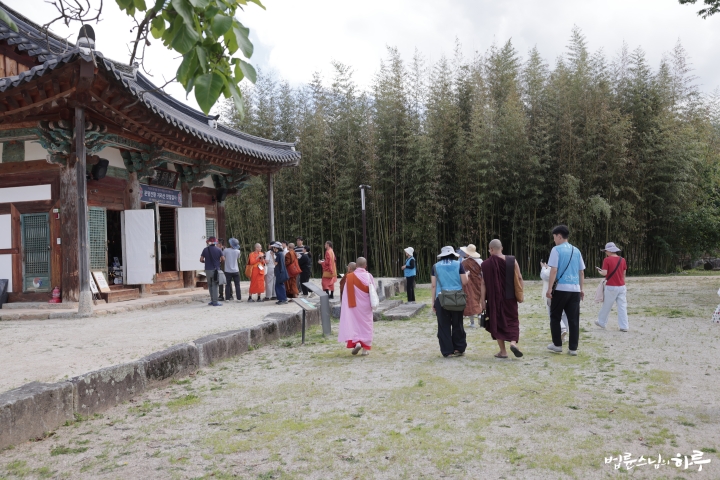
Next, the group headed to Yaksajeon (약사전), the Hall of the Medicine Buddha. Yaksajeon enshrined a seated iron Buddha statue.
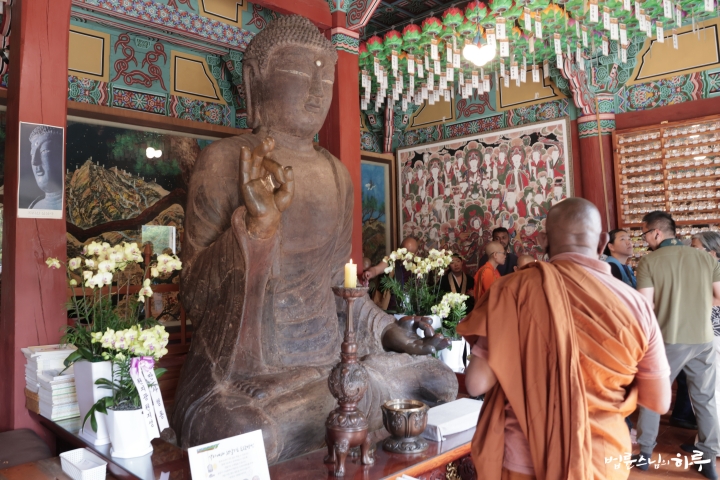
Sunim entered Yaksajeon, paid his respects, and examined the Buddha statue carefully.
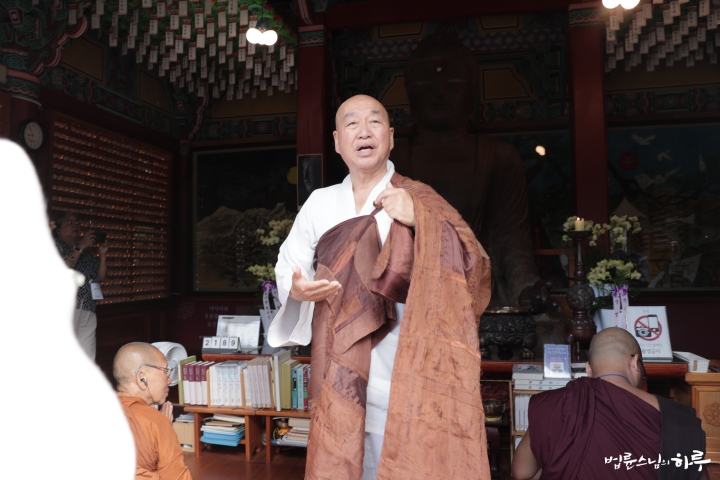
Upon inquiry, it was explained that because many people came to pray for the healing of the sick, the statue came to be regarded as the Medicine Buddha, and it is still called the Medicine Buddha of Silsangsa Temple to this day. The two hands of this statue had been damaged, so wooden hands were attached in their place. The original hands were displayed to the right of Yaksajeon.
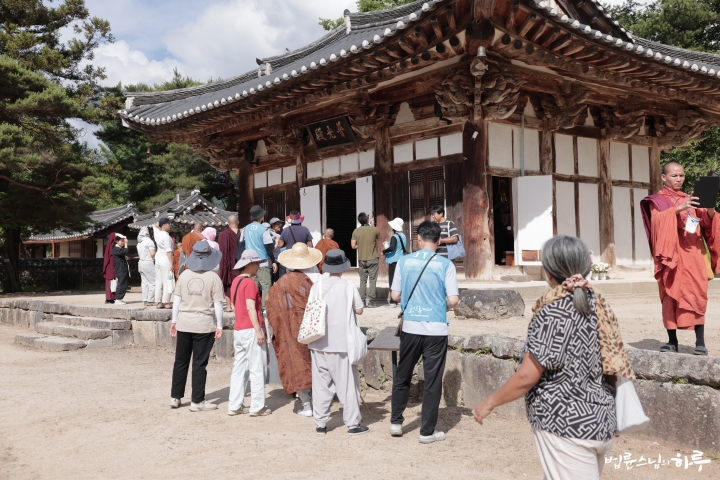
Next, the group headed to Bogwangjeon (보광전), the main Dharma hall of Silsangsa Temple. The principal Buddha statue enshrined in Bogwangjeon was created during the Joseon Dynasty. Sunim hunched his shoulders and then straightened his back to demonstrate the differences between Buddha statues.
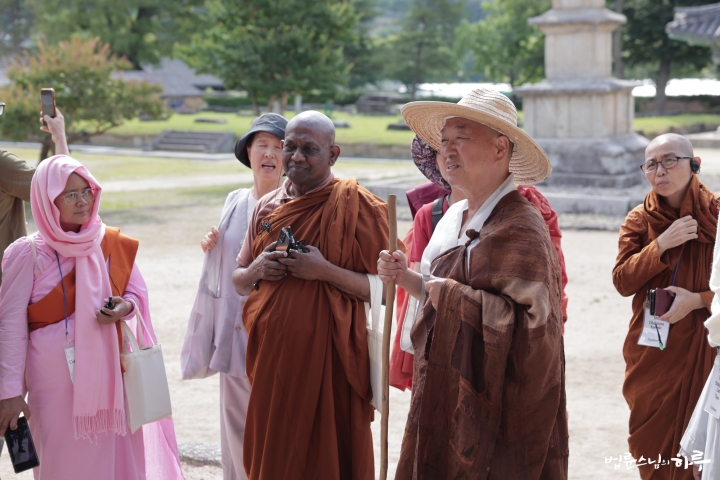
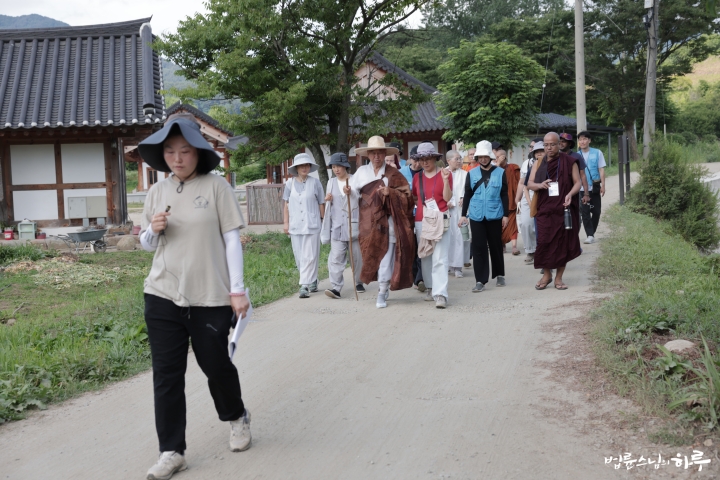
After leaving Bogwangjeon, the group passed by the dining hall and exited Silsangsa Temple.
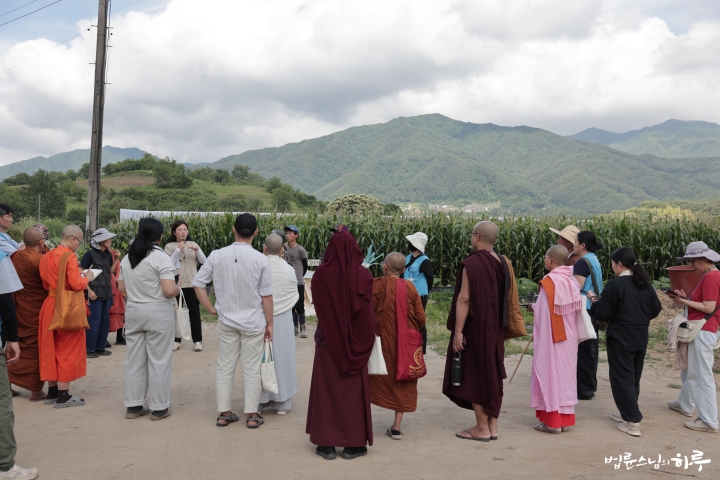
Right outside was the Silsangsa Temple Farm. The group came to the farm, saw the various crops being grown, and listened to an explanation. It was explained that the community members are currently practicing eco-friendly farming on about 23,140 square meters of paddy fields and 16,530 square meters of dry fields. The participants from Southeast Asia, curious about eco-friendly farming, asked the following questions:
▪ When do you plant and harvest rice? In Southeast Asia, we harvest rice twice a year. How many times a year do you harvest here?
▪ How do you make organic compost? Do you use compost made 100% here?
▪ If you use snails for farming, what happens to the snails after the rice is harvested? Do you eat the snails?
▪ If you use the snail farming method, how many snails do you put in the rice paddies?
Although there were many questions, full answers could not be given, as there was a morning schedule to follow. The participants boarded the vehicles and moved on to the next location.
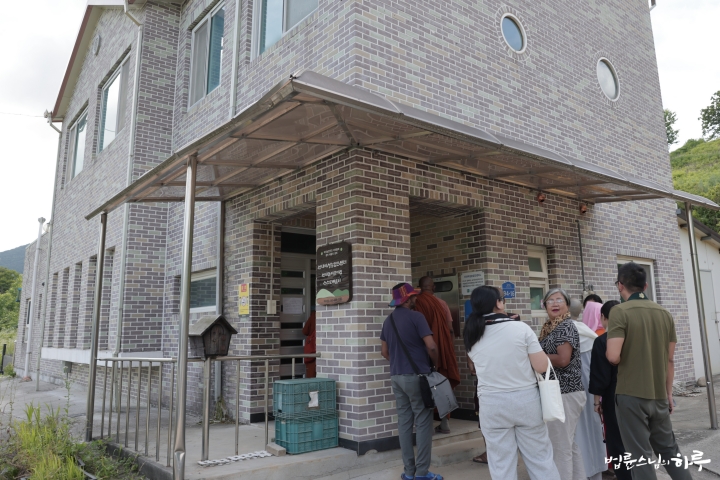
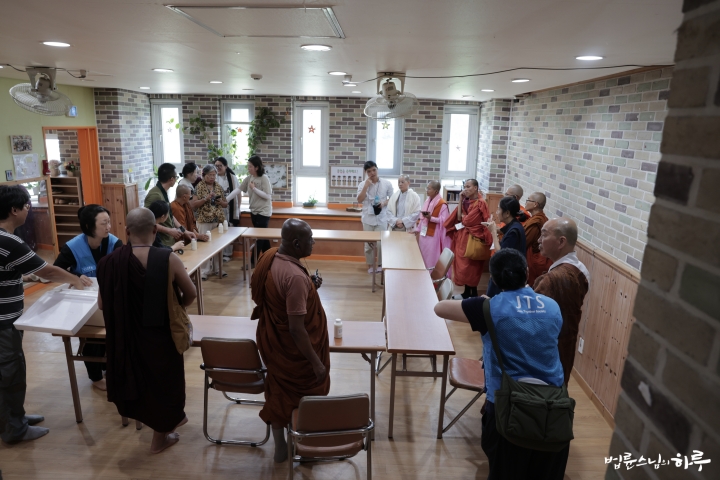
The group moved to the Sannae Women Farmers' Center (산내여성농업인센터), where they received explanations about the daycare, preschool, after-school programs, and how they are operated. Then they went up to the second floor to look around each space.
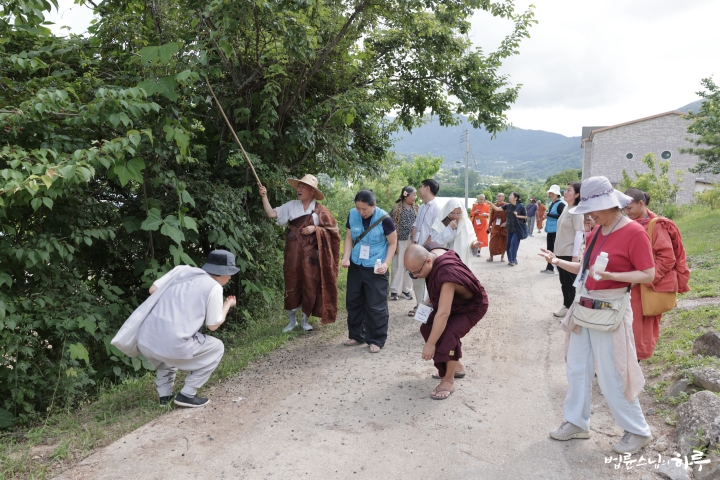
On the way from the center to the next building, there was a mulberry tree. When Sunim tapped the tree with his walking stick, ripe mulberries fell down with a thud. The participants each tasted a ripe mulberry as they moved to the next building.
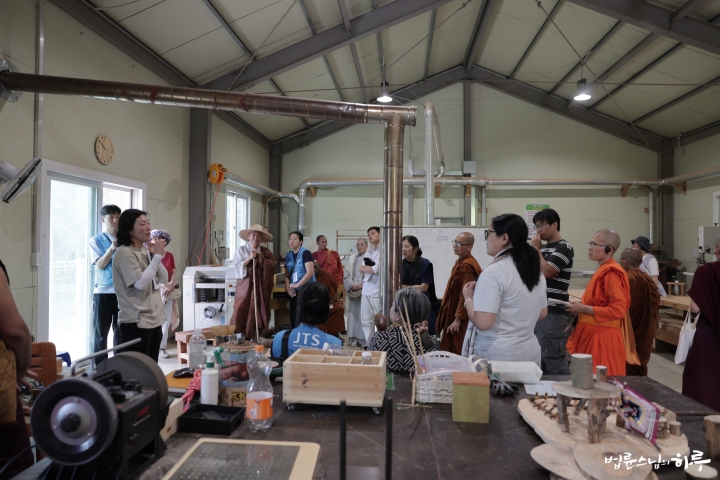
The woodworking shop is a place where villagers can learn woodworking skills and make household items they need. There were various tools available. It was explained that the tables and chairs at Silsangsa Seonjaejip (실상사 선재집) were also made here. After listening to the explanation, the participants looked around at the various tools and finished products in the woodworking shop before leaving.
Next, the group moved to "Silsangsa Small School" (실상사 작은학교), the first alternative middle school established by the Korean Buddhist community. In the vehicle on the way, Sunim shared his thoughts from his recent visits to Southeast Asia and Bhutan.
"When I visited places like Sri Lanka and Myanmar, I realized that villages need a place where tools can be lent out. They need places that lend out and manage tools—things like hammers and saws. In Bhutan too, the people who are called carpenters each have only one saw and one plane. They have fewer tools than an individual household in Korea. They need to build or repair houses, but since households have so few belongings, they have even fewer tools."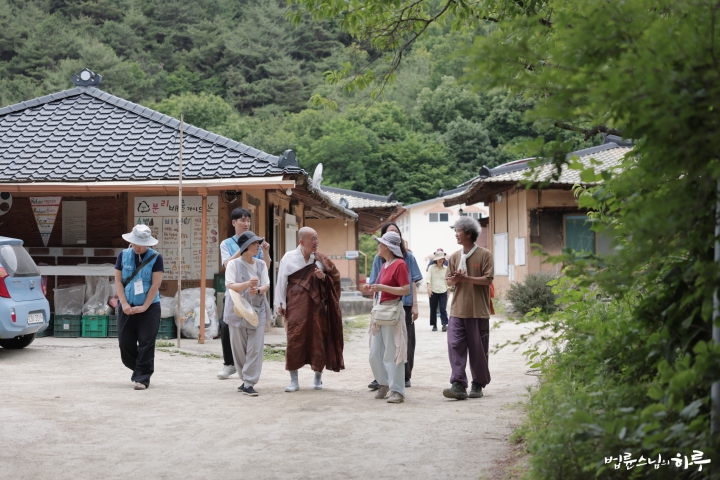
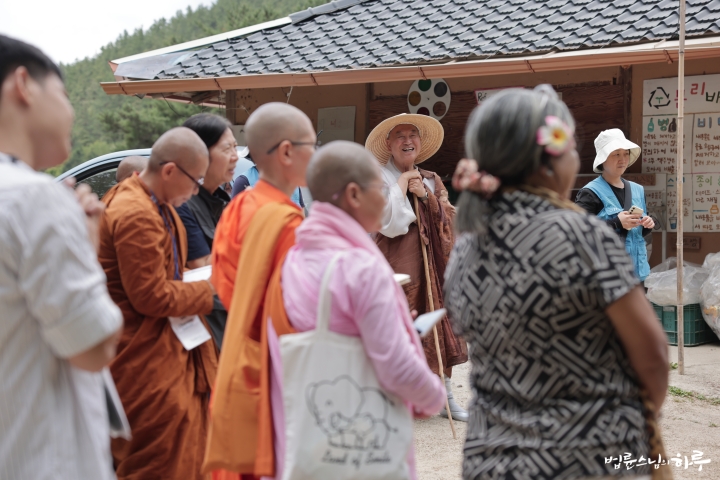
As the conversation continued, the group arrived at the Small School. Jieum (지음) and Nalgae (날개) gave explanations about the Small School in English. The group toured various places on campus, including the cafeteria, sports field, and auditorium, then left. After touring the school, the participants asked the following questions:
▪ How much are the school fees per year?
▪ Where do the students live? Is there a separate dormitory?
▪ Do graduates continue to live and work here? What career paths do they pursue?
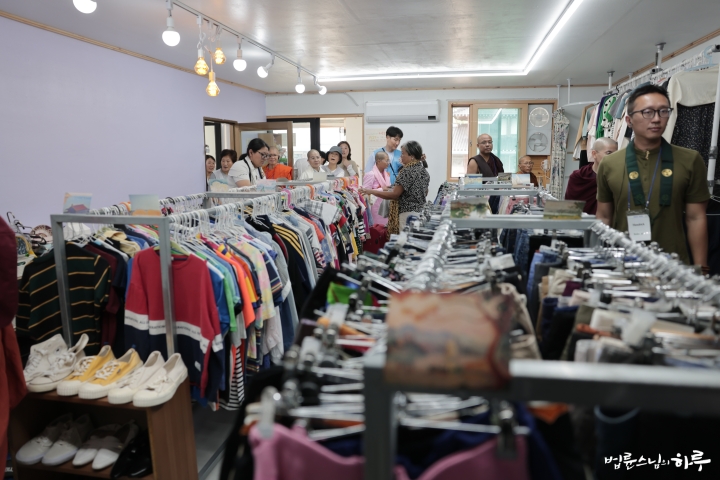
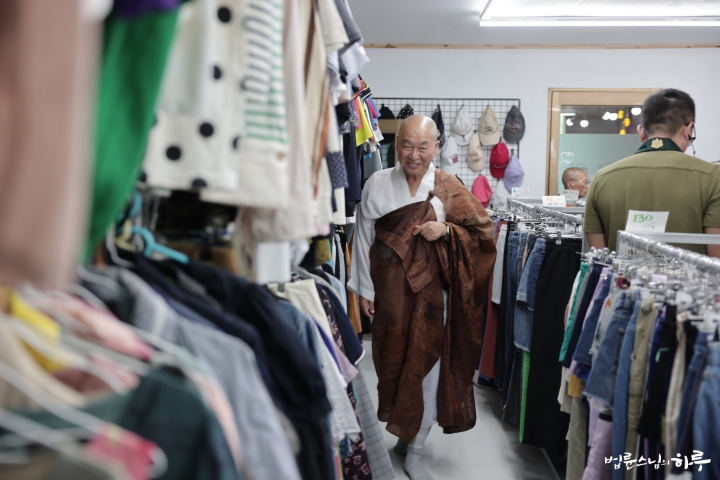
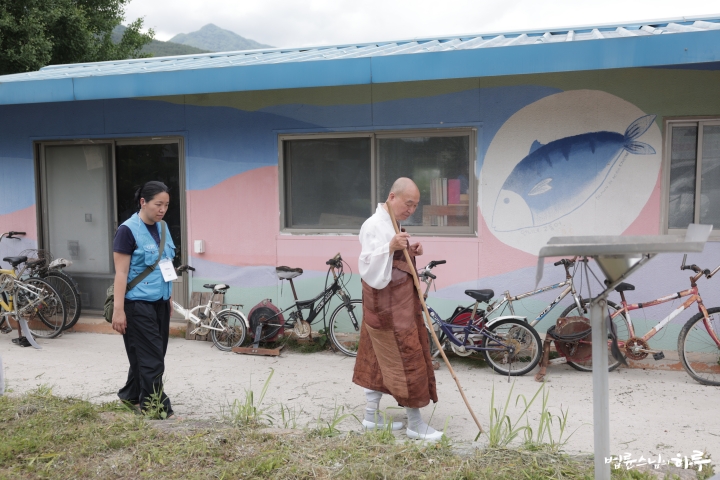
The next locations were "Hansalim" (한살림), which handles village community work; "Nanumkkot" (나눔꽃), which operates a reduce-reuse-recycle market; "Salimkkot" (살림꽃), which creates new products using reformable items; the village "Bicycle Workshop" (자전거 작업장), which repairs broken bicycles; and "Neutinamu" (느티나무), an eco-friendly store. The group visited each of these places, listened to explanations, and looked around.
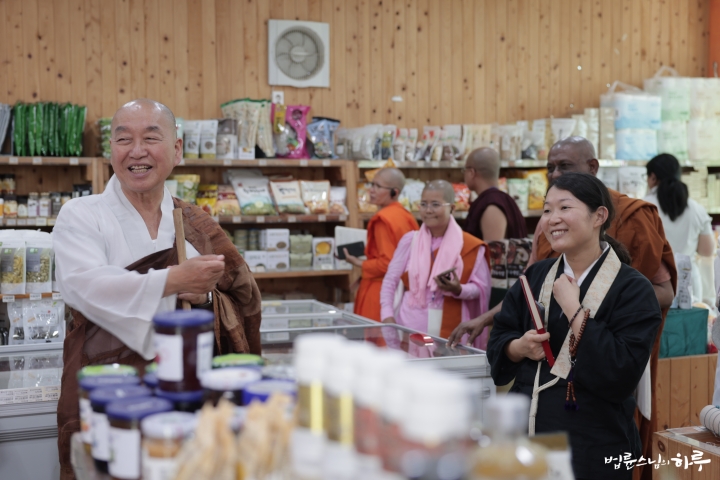
At the eco-friendly store, the participants browsed various items, and some purchased what they needed with the allowance Sunim had given them.
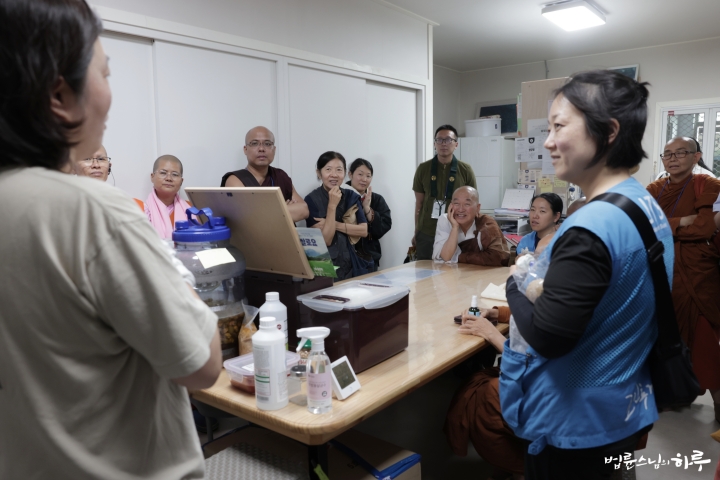
The last place visited was the Sumdanji Fermentation Research Center (숨단지발효연구소). Upon entering, the group listened to Jeong-eori (정어리) explain the background of how the center came to be established, the values it pursues, and its production, operation, and sales. Having already tasted the rice yogurt, the participants listened with even greater interest.
▪ Where is the rice yogurt sold? Where can people buy it?
▪ What does "Hansaengmyeong" (한생명, "One Life") mean?
After touring various places in the Sannae community centered around Silsangsa Temple, the group returned to Silsangsa Temple.
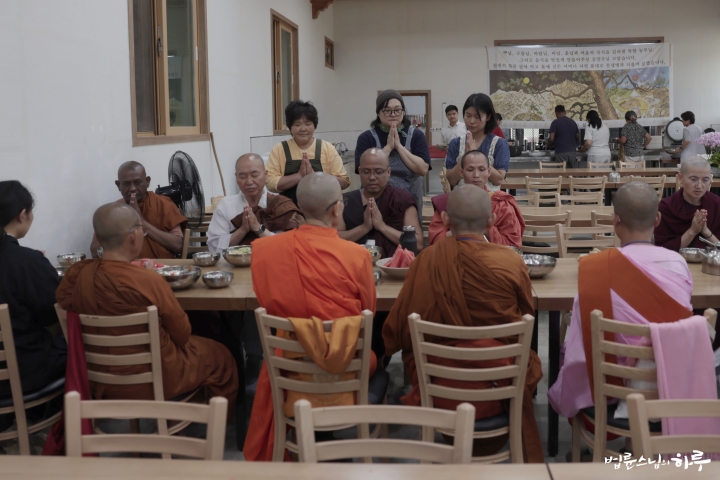
It was lunchtime, so the group went to the dining hall for lunch. The participants served themselves and all sat down at the tables. Sunim asked the volunteers who had prepared the meal to come briefly to the participants' table and invited the Southern Buddhist monks to offer a blessing. Words of blessing and gratitude followed. After lunch, each person washed their own dishes and left the dining hall. After lunch, until the next scheduled activity, the participants rested in their rooms or took walks around the temple grounds.
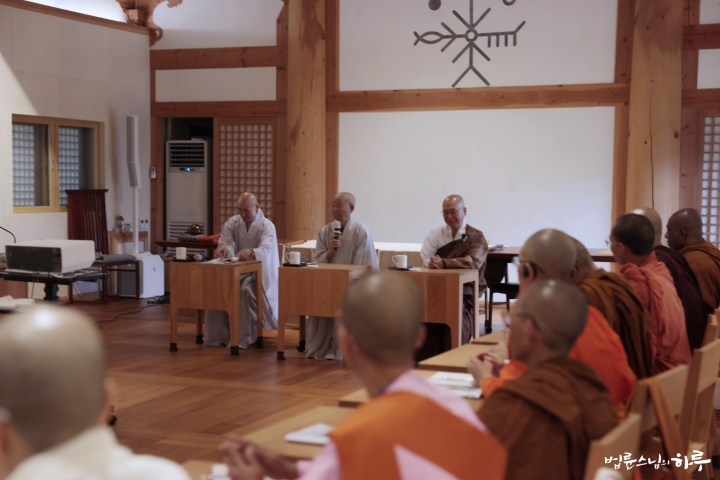
At 1:30 p.m., the group gathered at Silsangsa Seonjaejip. In addition to the INEB delegation, the Sunims living together at Silsangsa Temple, lay practitioners, Jungto Society staff, and members of the village community joined the gathering. After a welcome greeting from Venerable Unmun Sunim (운문스님), the abbot of Silsangsa Temple, Venerable Dobeop Sunim, the Josil, gave his greetings.
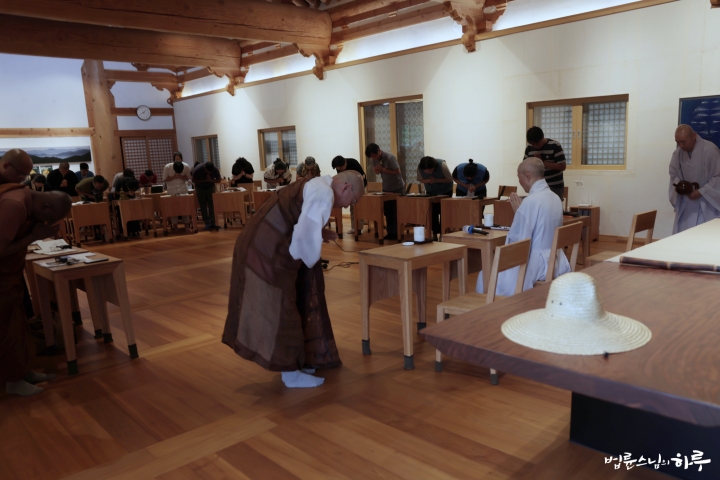
The members of the Sangha offered three bows of greeting to Venerable Dobeop Sunim. Although they would normally bow while seated, due to the seating arrangement and the inability to remove the desks and chairs, they offered three bows while standing.
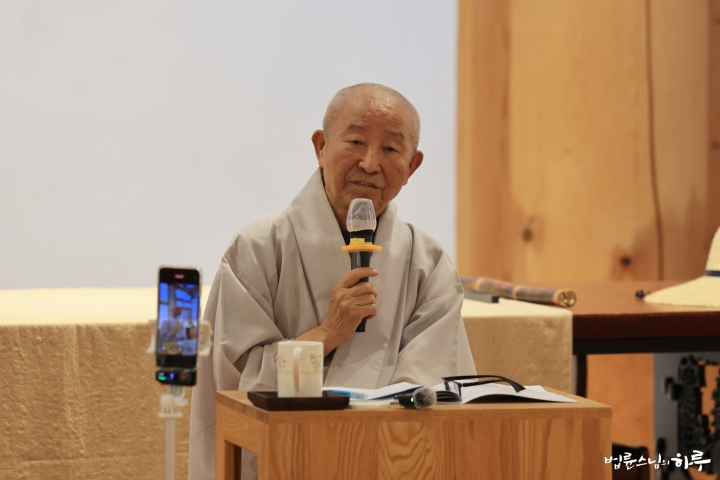
"Welcome. I am someone who has lived holding onto the Buddha's declaration of spreading the Dharma—'Go forth to spread the Dharma for the peace and happiness of all beings'—as a hwadu (meditation question). I came to live at Silsangsa Temple 30 years ago. Even then, I continued to ask the question and search for an answer: 'What should we do for the peace and happiness of all beings?'
At that time, I met many people of conscience from neighboring religions—Protestant pastors, Catholic priests, Won Buddhist teachers, and Cheondogyo followers. We had many conversations and reached deep mutual understanding. All living beings want to live safely. All living beings want peace. The religious people of this era gathered with the shared intention of working together to realize the peace and happiness of all living beings. That shared intention came together and we launched the Life Peace Movement.
The Indramang community movement currently taking place at Silsangsa Temple and the Silsangsa community activities have come this far from that beginning—the intention to help all beings live in peace and happiness. If you who are meeting us today share that same heart, I believe our meeting today will be beneficial for all of us. To realize the peace and happiness of all beings, let us all cultivate more generous hearts, bigger hearts, and freer hearts. I believe that is the path the Buddha walked, and the path we must walk. I sincerely hope that today's meeting will become an even better path for faithfully following the way of the Buddha. May today's connection shine beautifully as an even more wonderful connection. It is truly a pleasure and an honor to meet you all."
Next, Sunim gave his greetings.
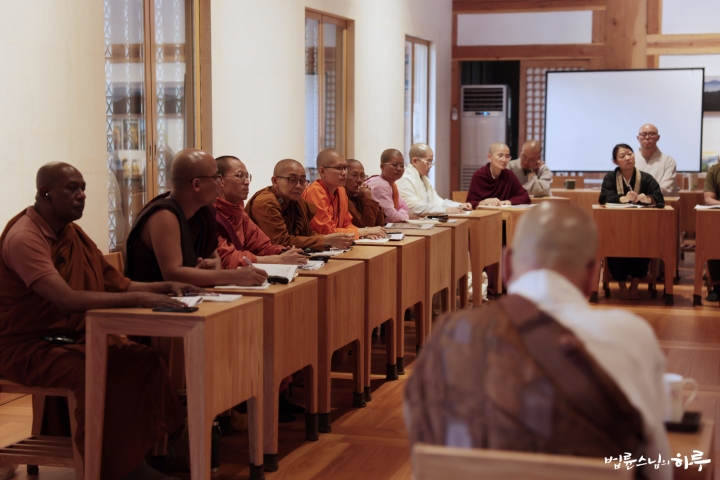
Sunim then briefly introduced the INEB Study Trip participants by country to the Silsangsa Temple community.
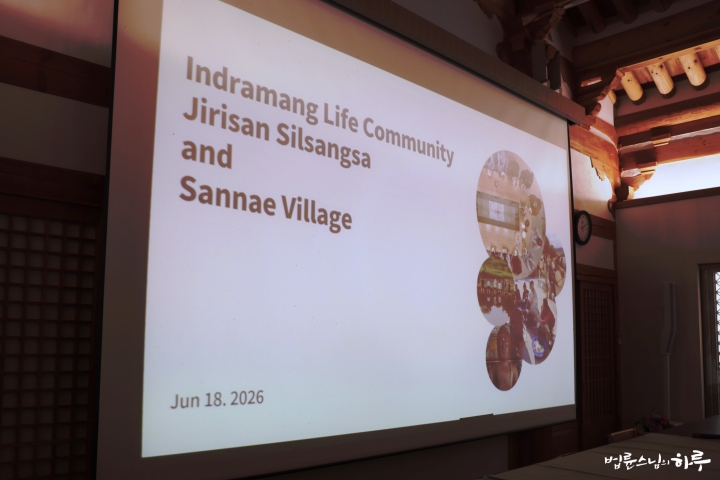
Following this, there was an English presentation about the Indramang Life Community. The presentation explained the history, philosophy, values, and operating methods through which Silsangsa Temple and the village community visited in the morning had been formed and were being run. Then questions from the participants followed.
▪ Venerable Dobeop Sunim, you mentioned working with people of other religions. What kind of activities are those people engaged in now?
▪ Are there other Indramang Life Communities in other parts of the world?
▪ It seems that monks' practice would be affected by working in contact with residents. Do the Sunims here work together with the villagers?
▪ Are there any bhikkhunis at Silsangsa Temple? I ask because you mentioned a community of the four assemblies.
▪ Are the people who live in this village from other regions, or were they born and raised here?
▪ We toured the Silsangsa Temple farm this morning. I understand that religious organizations in Korea cannot own farmland. Who owns the Silsangsa Temple farmland? Have there been any issues related to the farmland?
The group decided to take a 30-minute break before starting the next session.
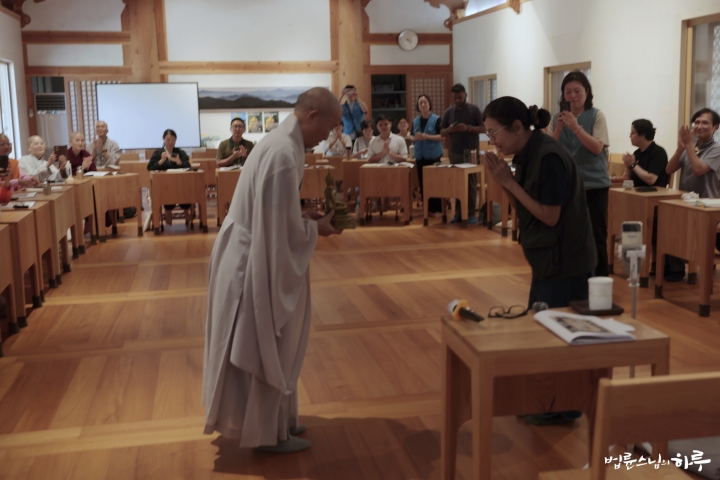
The second afternoon session was a time for conversation with Venerable Dobeop Sunim. Before starting, Anchalee presented Venerable Dobeop Sunim with a Buddha statue as a gift, expressing gratitude for preparing the Silsangsa Temple tour program and the meals.
Sunim gave a donation to the abbot of Silsangsa Temple and to Jeong-eori of Sumdanji Fermentation Research Center, who has graciously allowed visitors to taste the rice yogurt free of charge every time tour programs are held.
Venerable Dobeop Sunim sat in front of the microphone and began his talk. He spoke about why community, why village, and how we can follow the Buddha's path. After listening to Venerable Dobeop Sunim, the participants who had questions asked them.
▪ I try to remain spiritually connected through meditation and prayer, but war is happening outside. I am affected more strongly than by my efforts to stay awake. How can I overcome such difficulties in my practice?
▪ I would like to know about Venerable Dobeop Sunim's experience with the Life Peace Alms Pilgrimage. How did it start, and what results remain from it?
One member of the Silsangsa Temple community who was participating in the session asked the INEB participants three questions:
▪ I see that this community is solving the suffering of this era by building communities with people through education that transforms one's worldview. Since you have come from various countries, I am curious about what you diagnose as the cause of suffering and what kind of activities you are doing in your respective regions.
▪ The people who participate in the educational programs held here are in their 50s and 60s. Young people these days are said to be interested in Buddhism, but they seem more interested in consumption—meditation retreats and Buddhist-themed goods. If you have examples from your regions of young people understanding Buddhism and joining together, please share them.
▪ I understand that INEB has a Young Bodhisattva Program for young people. What kind of program is it?
The participants shared their experiences and ideas. They decided to take a break and then resume.
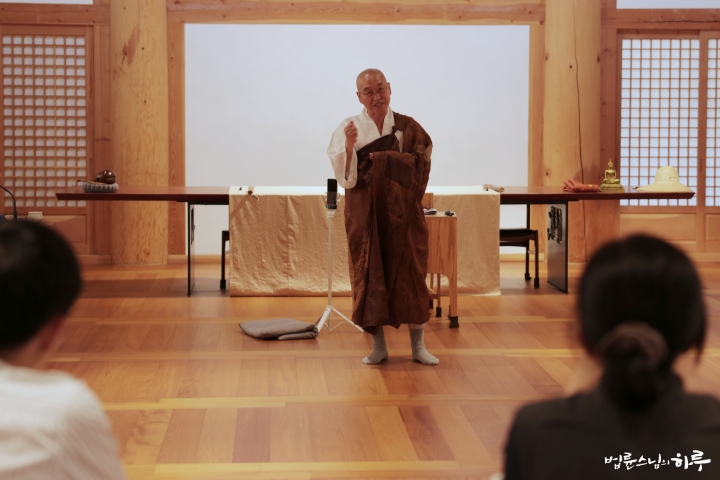
Before starting the next session, Sunim spoke to the participants.
"When you live a long time, everything becomes okay one way or the other, and you run out of things to say. So if you don't ask, you don't tend to speak. (Laughter) Venerable Dobeop Sunim has lived for nearly 80 years and is a senior elder of the Korean Buddhist community, so he has a great deal of experience. If you have questions, please ask many. Only when you ask do stories come out. (Laughter) We don't have much time left, so please ask many questions."After Sunim's suggestion to the INEB participants, they asked questions more freely and actively.
▪ In Bhutan, on the Buddha's Birthday, villagers gather at the village temple to prepare various foods and share them together. How does Silsangsa Temple here celebrate the Buddha's Birthday?
▪ It has been 36 years since Venerable Dobeop Sunim came to Silsangsa Temple. Have you faced any difficulties in your work over the years, and how have you overcome them?
▪ When a person dies and is reborn in the next life, is life passed from here to there?
▪ I am a participant from Indonesia. Buddhism is a minority religion in Indonesia. Having participated in the Silsangsa Temple tour program, I would like to invite Indonesian young people. Would that be possible?
▪ In Indonesia, there is also a problem of people avoiding having children. You said that birth is "suffering," but is not being born also "suffering"? I am curious about Venerable Dobeop Sunim's view.
▪ In Indonesia, there is Borobudur, the world's largest Buddhist temple and Buddhist heritage site. Indonesians don't really understand Borobudur. Could you come to Indonesia and teach the Avatamsaka Sutra?
As it was almost dinner time, the last questioner from Indonesia could only ask the question without receiving Venerable Dobeop Sunim's answer.
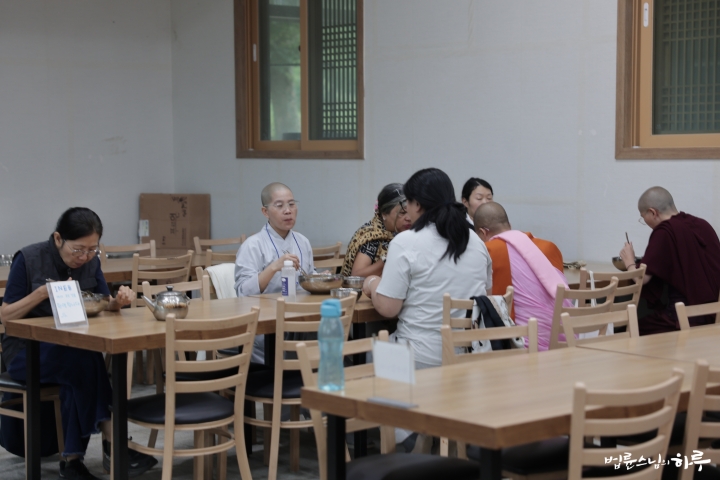
The group moved to another location for dinner.
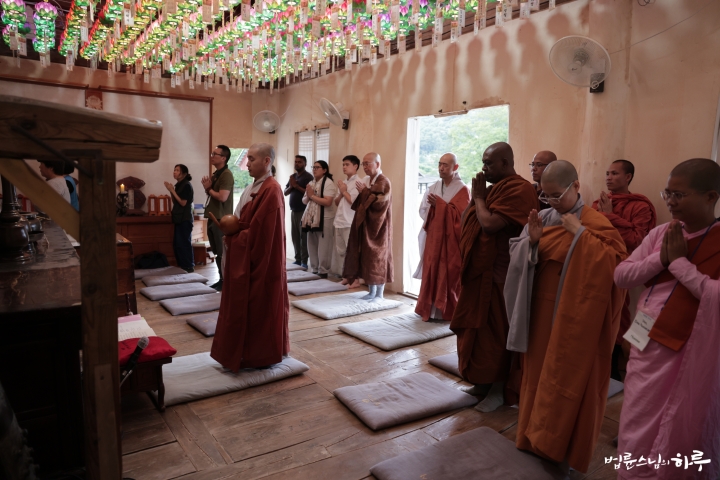
At 7 p.m., Sunim and the participants came to the Main Buddha Hall for the evening ceremony. They held the evening ceremony with the Korean ceremony text and the Korean Heart Sutra. Afterwards, they moved to Seonjaejip to continue with the evening session.
The evening session was a time to hear reflections on what the participants had experienced through the Silsangsa Temple program today. After reflections, if questions arose, answers were given. Since those who went first spoke a bit at length, the few who remained at the end shared their reflections briefly.
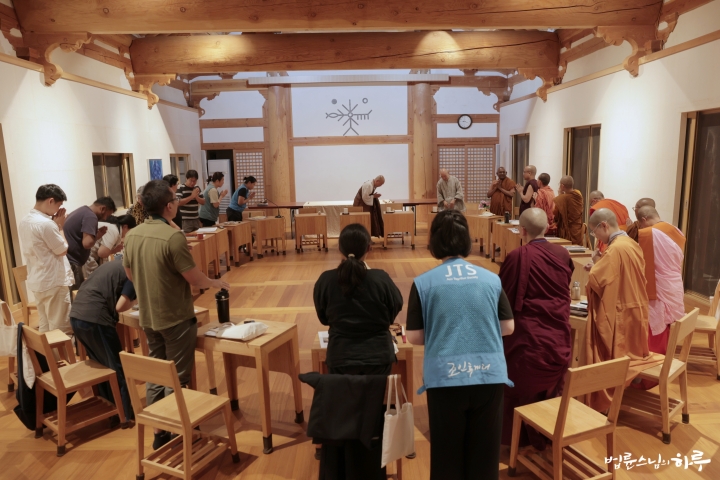
After hearing all the reflections, it was 9:30 p.m. Darkness had fallen over Silsangsa Temple. The participants returned to their lodging to end their day, and Sunim boarded a vehicle to travel to Seoul. Sunim closed his eyes for some rest in the car as it drove through the night. At 12:30 a.m., past midnight, Sunim arrived at Seoul Jungto Center, concluding his day's work.
Tomorrow is Day 7 of the INEB schedule. In the morning, Sunim will continue the INEB program with the participants by visiting the National Bhikkhuni Association Center. In the afternoon, he will attend to his work, and in the evening, he is scheduled to give a Dharma Q&A talk at Jungto Social and Cultural Center.
This post concludes with the conversation Sunim had at Dubuk Jungto Retreat Center on June 17.
Truth Does Not Come From Belief, but From the Verification of Facts.
"Rather than formal school studies, studying Buddhism seemed to open my eyes to the world. However, when I actually lived in a temple for a long time, I found that the Buddha's teachings did not match the reality of the monastery. When I learned the Buddha's teachings, the logic was as precise as science, but the reality of the temple consisted mostly of ceremonies for the deceased, such as memorial rites. As a result, my view of Buddhism as a religion gradually turned negative. When I began guiding a Buddhist student association, I excluded as much as possible the unscientific elements that could not be proven or verified, and dealt with relatively rational content. Then, in 1980, the new military junta in Korea staged a coup and seized power, and the massacre of citizens occurred in Gwangju. I was deeply shocked by these events. However, no one in the Buddhist community resisted, and they even avoided mentioning it. In October of that year, the new military junta forcibly arrested hundreds of monks under the pretext of purifying the Buddhist community. Even in such circumstances, the monks not only failed to resist for the sake of the Sangha, but said that those who had been arrested deserved to be arrested, and were instead busy fighting among themselves, using the situation as an opportunity. Some even cooperated with the new military junta in order to seize control of the Order. I thought it was possible that the Buddhist community might remain silent about the citizen massacre in Gwangju and turn away from the suffering of others. But when I realized that this was a group that did not know how to protest or assert its rights even when its own rights were being violated, I felt great disappointment. I no longer wanted to remain at the temple. So, although it was late, I decided to go to America with the thought of studying physics or astronomy to become a scientist. However, it seemed too wasteful to abandon, in a single moment, the Buddhism I had studied for over 10 years. At that time, a great question arose in me: 'What is Buddhism?' I wondered whether what I had been taught was really the Buddha's teaching, or merely a historical product, and what the Buddha had actually done to be said to have 'awakened' and 'attained nirvana.' Before giving up the path of a monk, I decided to look into what true Buddhism is by examining materials about the Buddha. I began reading the sutras again. Studying what the Buddha said is something many people have done. But I began to gather materials recording the Buddha's life and started exploring with the question, 'Who was the Buddha really?' Mahayana sutras are books containing content where the Buddha alone speaks at length, like novels. They lack historicity. But the Buddha's life has sociality and historicity. I could see how he viewed class discrimination and gender discrimination, how he responded to wars, and what attitudes he showed toward various worldly matters during the 45 years after his enlightenment. As I examined the Buddha's life, I came to think, 'Ah, there is a gap between the Buddhism I thought I knew and the life and teachings of the historical Buddha. Perhaps I have misunderstood Buddhism.' When I studied what I had liked about the Buddhist cosmology, it all turned out to be the traditional Indian cosmology. When I examined whether what I had known as Buddhist teachings were truly the Buddha's teachings or India's traditional thought and culture, much of it was India's traditional thought. So the question remained of how to distinguish, when Indian culture and traditional thought are mixed with the Buddha's teachings, between the two. Such distinctions can be sorted out to some extent by studying the cultural history of humanity. We must examine, one by one, why things were recorded in certain ways and what symbolic meanings those records carry. Then we must actually practice what we have learned. We need to verify whether the content of the sutras is indeed true and feasible, not just speak about it vaguely, but actually confirm it. Through personal experience, we must verify whether something is possible, and distinguish between what is impossible because of my own shortcomings and what was never true to begin with. I am not the only one with this kind of awareness. Those who started the early Mahayana Buddhism and those who first started Seon Buddhism had the same awareness. The core of this awareness, regardless of whether it is Theravada Buddhism, Mahayana Buddhism, or Seon Buddhism, is: 'How do we approach truth?' That is, examining how close something is to truth, both logically and scientifically. We must also verify whether it frees us from suffering. Because the goal of the Buddha's teaching is to attain nirvana. Furthermore, we must examine whether it is something applicable not only to a select few but to the majority of people as well. From this perspective, I gradually organized the Buddha's teachings. We must continuously hold the question 'What is Buddhadharma?' Throughout history, many pioneers held this awareness. Earlier, on my way here, I spoke about Master Wonhyo (원효), the greatest monk of Silla, whom the Chinese call a Bodhisattva. He can be called the Buddha born in Silla. Just as people in Bhutan believe Guru Rinpoche to be the second Buddha. Looking at Master Wonhyo's life, we can see that he had a deep awareness of Buddhist teachings within the society of his time. Likewise, in any era, truth does not come from belief but from the verification of facts.""From the beginning of the program, Sunim asked the question, 'What is Buddhadharma?' Listening to Sunim's explanations and teachings yesterday, I came to understand that Buddhadharma is 'what the Buddha reached is the Dharma.' This perspective gave me several insights worth discussing when I return to Japan. How were you able to reach this perspective? Did you realize it directly yourself, or did you come to know it through someone else's mention?"