Is There a Way to Lower South Korea's Suicide Rate?
Sharing from 2026 INEB Study Trip Participants on June 17
Is There a Way to Lower South Korea's Suicide Rate?
Jun 17, 2026 – Day 5 of INEB Schedule (Dubuk Jungto Retreat Center)
Hello. Today marks the fifth day of the INEB (International Network of Engaged Buddhists) Study Trip. Sunim and the participants spent the day at Dubuk Jungto Retreat Center and in Gyeongju.
Sunim began his day with early morning practice and meditation. After breakfast, he worked on proofreading manuscripts.
Meanwhile, the INEB participants woke at 4 a.m., held morning service in the main hall of the training center, and departed around 5 a.m. to travel to Dubuk Jungto Retreat Center.
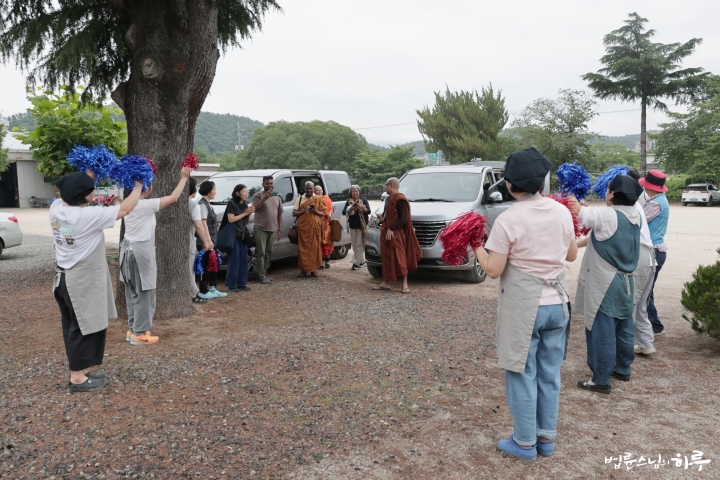
Two of the vehicles carrying the participants arrived on time. The volunteers from the Suseong Branch of the Daegu-Gyeongbuk Chapter, who had prepared today's meals for the participants, along with the members of Dubuk Jungto Retreat Center, warmly welcomed everyone by waving pom-poms.
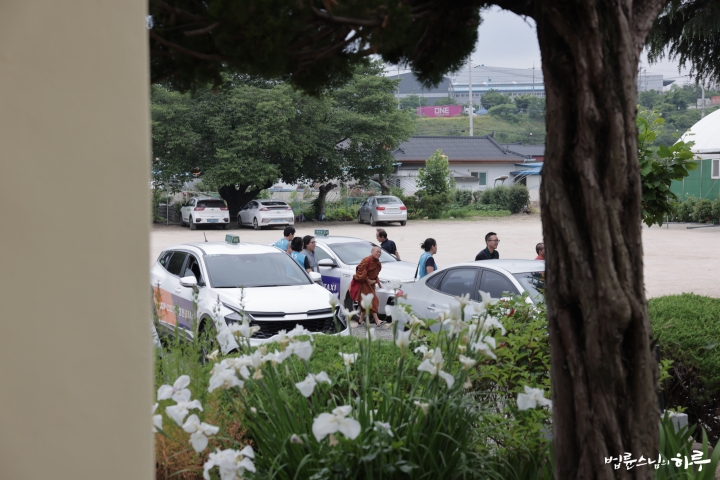
One vehicle had not yet arrived, and upon checking, it turned out that it had gotten a flat tire on the way and was stranded. The participants split into two taxis and arrived safely at Dubuk Jungto Retreat Center. The vehicle with the flat tire was towed to a service center, and after the tire was replaced, it made its way to Dubuk Jungto Retreat Center.
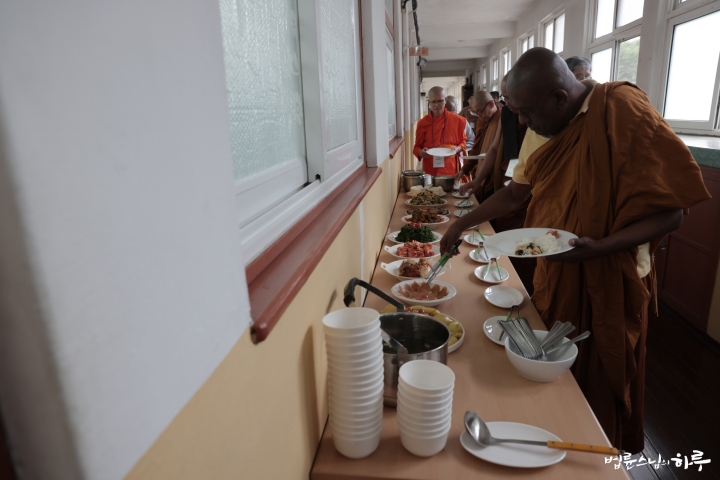
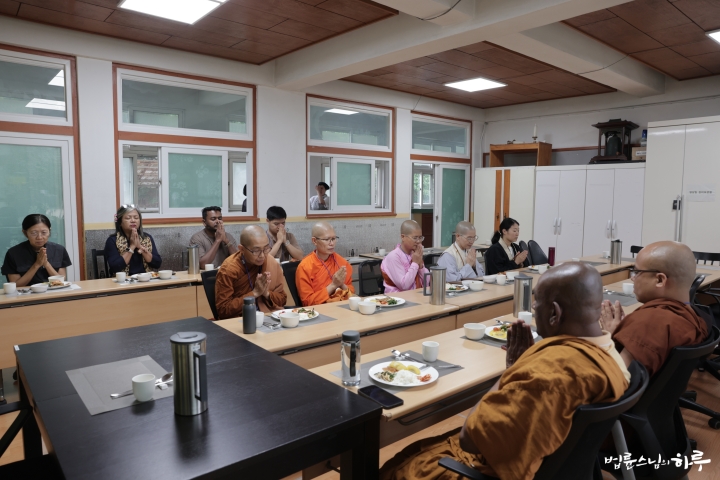
The participants were shown to their accommodations, unpacked, and then had breakfast.
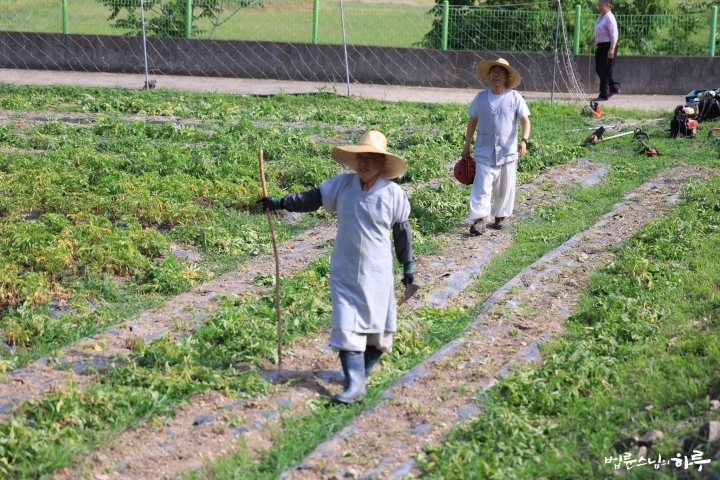
After breakfast, at 8:30 a.m., the participants moved to Dubuk Farm. Today, they would be digging up potatoes from the open field with Sunim. The participants prepared themselves at the field with cushion seats, gloves, hats, and hand hoes. Anchalee, who had used the cushion seats several times before, explained how to wear them. Meanwhile, Sunim also changed into work clothes and came to the potato field.
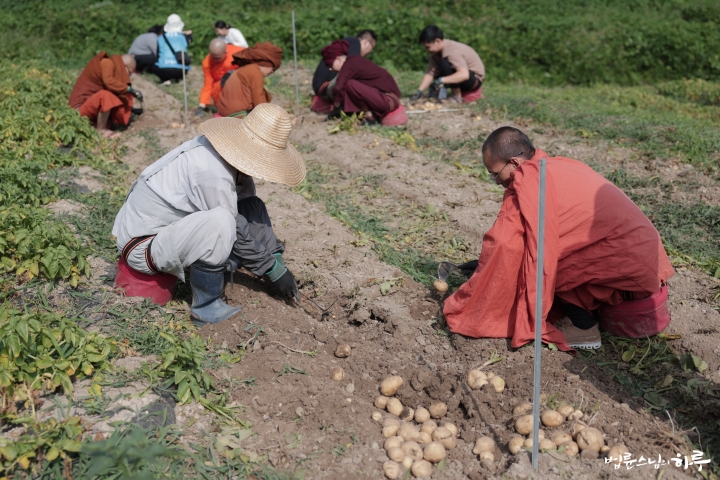
Pairing up, they positioned themselves at regular intervals along the ridges. Sunim demonstrated how to dig up the potatoes.
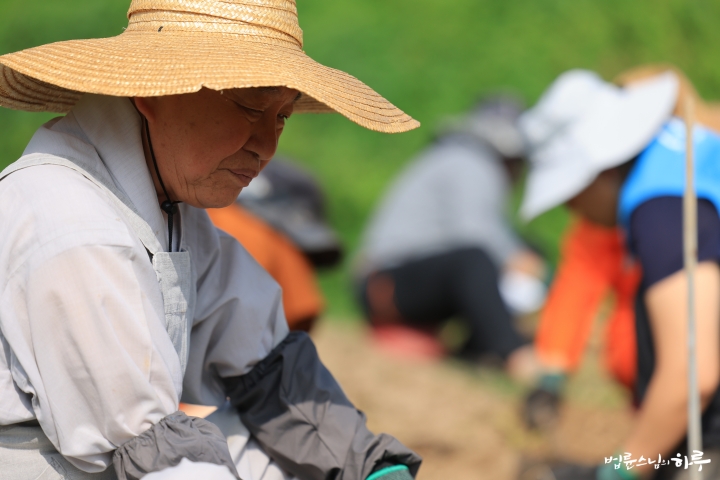
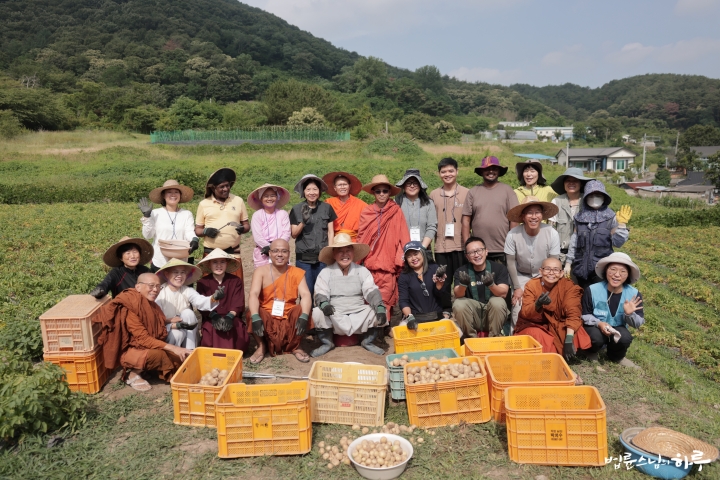
The task for today's communal work was to dig up all the potatoes hidden in the soil without damaging them. The INEB participants experienced digging potatoes while also taking photos. The harvested potatoes were sorted by size into large, medium, and small. Those that were damaged could not be used as gifts and were collected separately.
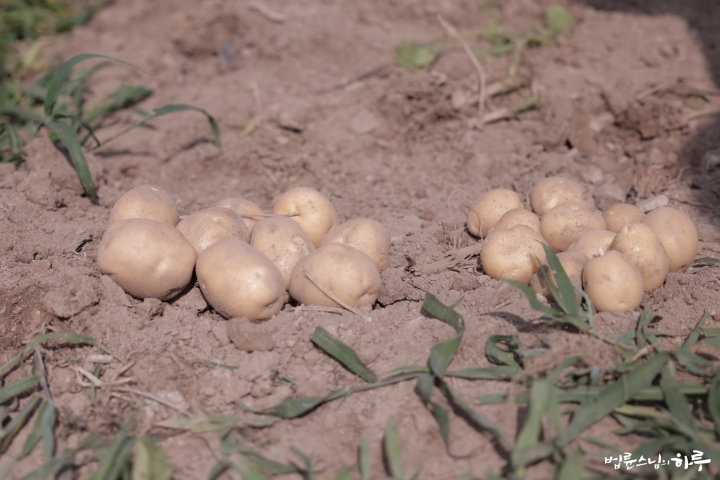
After Sunim finished digging up the potatoes on his assigned ridge, he moved to help others whose work was progressing more slowly. When the potato digging was completed, Sunim joined the participants in sorting the potatoes piled on the soil. After sorting was finished, they took a commemorative photo.
Today at 10 a.m., the live online Weekly Dharma Assembly was scheduled. Since they had to leave Dubuk Farm by 9:30 a.m., the participants moved quickly to tour the greenhouses at Dubuk Farm. They visited four greenhouse sections: the chili pepper section, the sesame section, and other sections growing various crops.
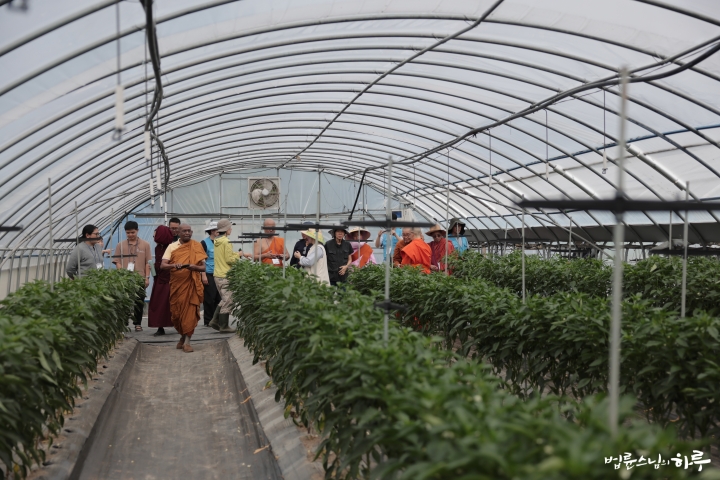
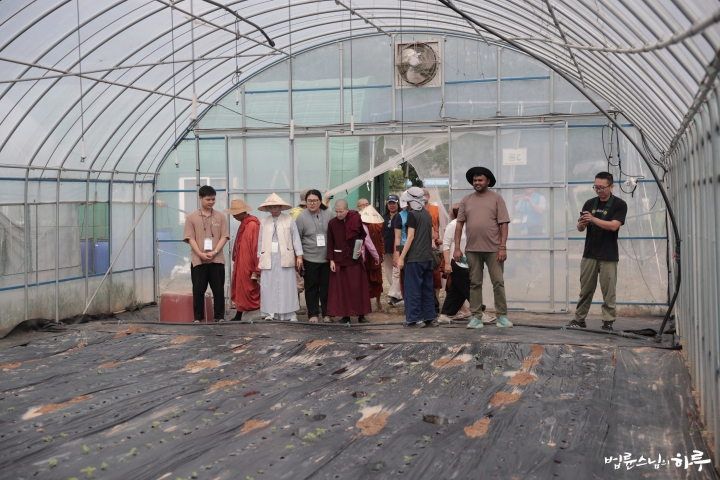
The chili pepper section had weed mats neatly laid out to prevent weeds from growing, and tiny sesame seedlings were just sprouting in the sesame section. The greenhouse section growing various crops contained vine plants like cucumbers and pumpkins along with tomatoes. After touring all the greenhouses, the participants boarded the vehicles and returned to Dubuk Jungto Retreat Center.
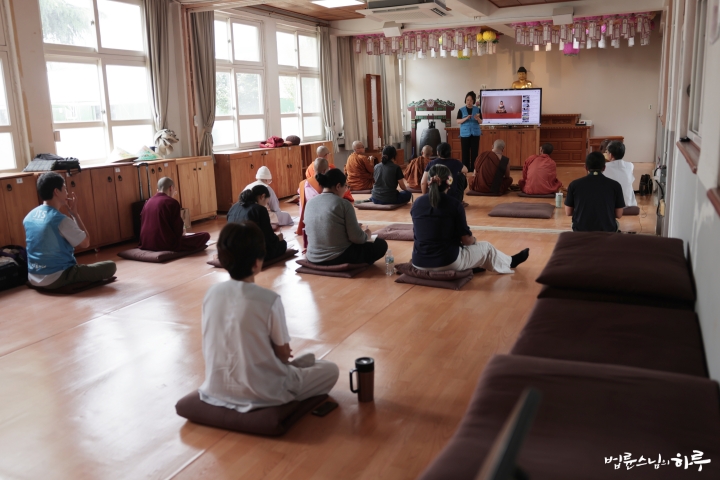
They watched the Weekly Dharma Assembly online from the Dharma hall.
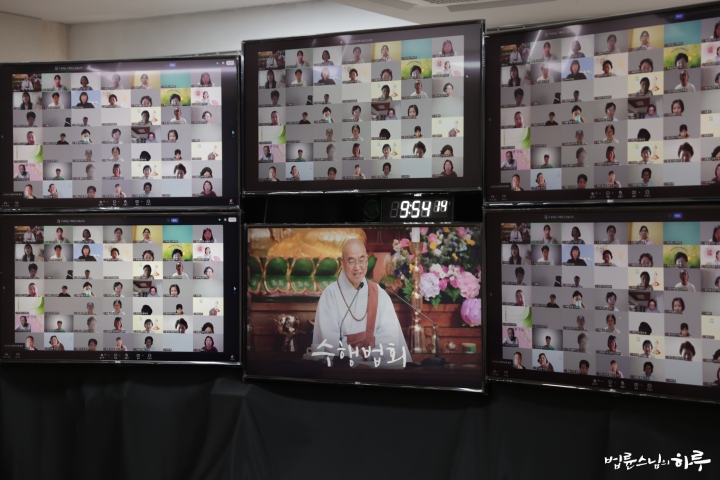
When the participants left the potato field, Sunim also came out, washed off the sweat, and put on his kasaya (Buddhist robe) and outer robe to come to the retreat center studio to give the Dharma talk for the Weekly Dharma Assembly.
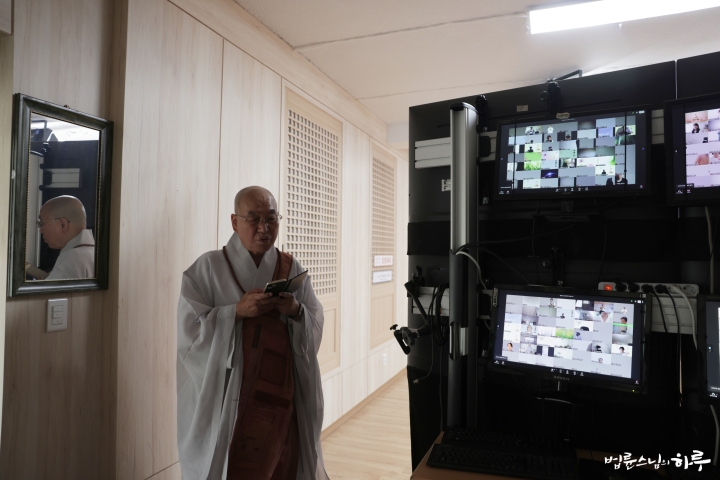
Until just before the assembly began, Sunim communicated about work matters, then sat down in front of the camera.
After conducting the rituals with the Three Refuges and the recitation of the Heart Sutra, the weekly news of Jungto practitioners was presented as a video. About 500 Jungto Society members were connected via Zoom, participating in the Weekly Dharma Assembly together. From June 2 to 13, Sunim had visited Bhutan to review the sustainable projects there. It had been a while since members had been able to see Sunim's activities through video. They could see that the Bhutan project was not simply about providing support, but a collaborative project being built together with the village people.
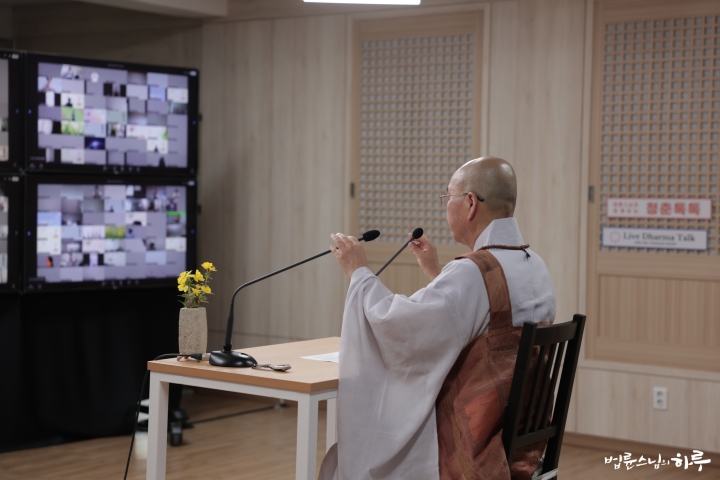
Sunim shared news from his Bhutan visit, updates on the current INEB delegation visit, and news about the volunteers working on replacing lanterns after Buddha's Birthday. Then came the Dharma Q&A session, where participants could ask Sunim questions about practice and activities, and have their perspective on practice examined. Three pre-registered questioners asked their questions.
▪ I am in my 20s and have been working as a civil servant for nine months. During COVID, my parents' business went bankrupt, putting our family in financial difficulty. I tried to avoid my colleagues at work because I didn't want them to find out about my situation, but this ended up causing problems. How should I move forward in this situation?
▪ I run a project providing cleaning fee support for the homes of isolated and reclusive youth. What kind of mindset should I have when helping young people in crisis?
▪ When I accepted that my husband and I are different, my anger disappeared. However, if my husband continues to be in conflict with me, is it possible to be in harmony with him?
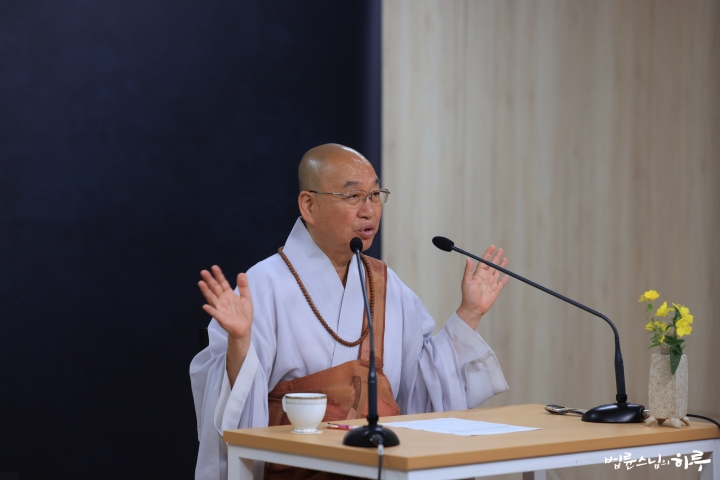
After the silent meditation, the assembly ended with announcements and the Four Great Vows.
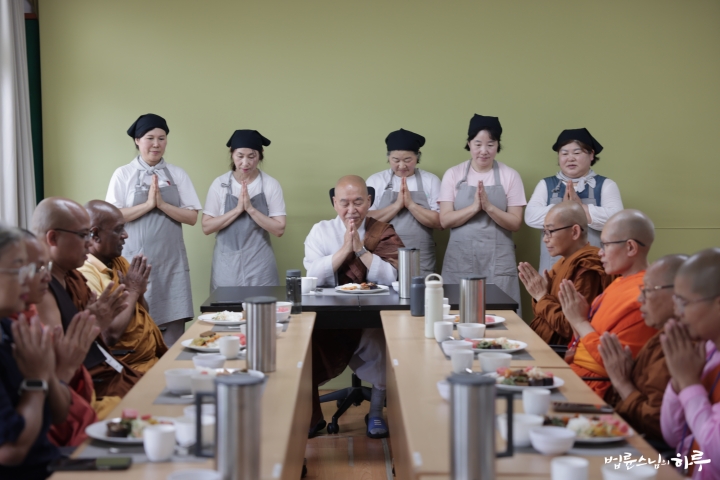
After the assembly, Sunim had lunch with the INEB delegation. The members of the Suseong Branch of the Daegu-Gyeongbuk Chapter had prepared the meal for the INEB participants at Dubuk Jungto Retreat Center. After the participants finished serving themselves and sat down, the volunteers came into the dining area, and the Southern Buddhist monks offered blessings and expressed their gratitude to the volunteers.
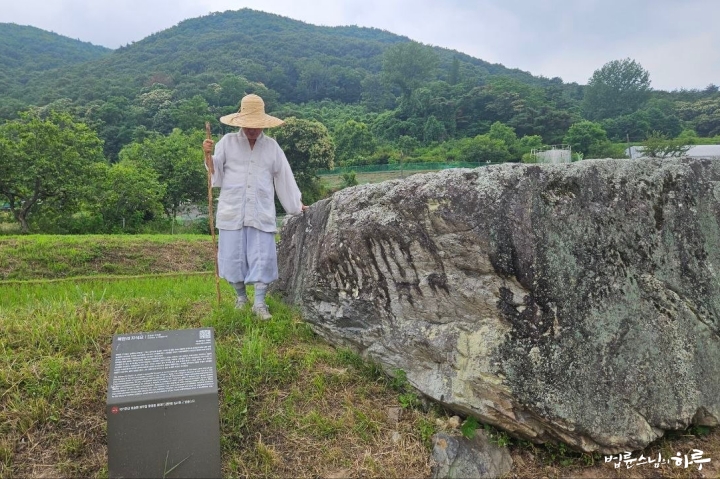
After lunch, Sunim took a brief moment to inspect the area around the dolmen behind the village together with Dharma Teacher Hyangjon. They surveyed the site to make it more convenient for visitors coming to see the dolmen and to plan a flower garden that would be pleasant to look at.
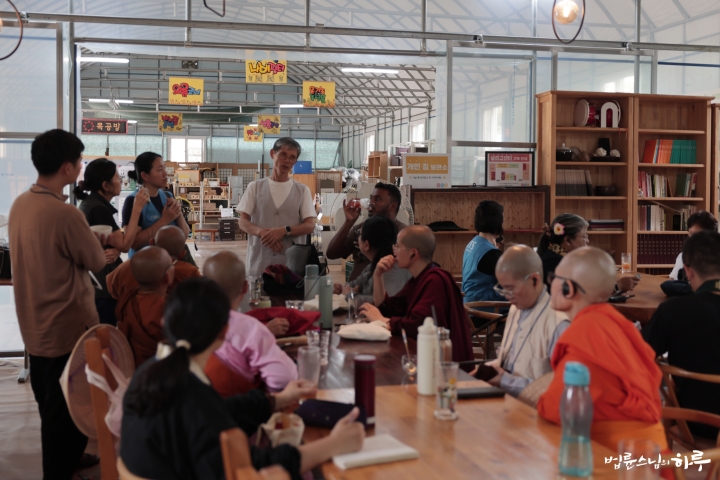
After finishing their meal, the participants toured Dubuk Jungto Retreat Center. They came to the cafe at the Salligo Center (살리고센터), received a cool drink each, and sat down. The grapefruit syrup made by a volunteer yesterday was very popular. Dharma Teacher Myodang explained about Dubuk Farm, the Salligo Center, and other aspects of Dubuk Jungto Retreat Center in general. He explained the scale of Dubuk Farm, the crops grown there, and how the Salligo Center operates. He also explained that the potatoes about to be harvested would be used as gifts and for "Potato Day." After listening to Dharma Teacher Myodang's explanation, the participants asked questions.
▪ How long does it take from planting potatoes to harvesting?
▪ Are there other crops grown organically at Dubuk Farm? What are they?
▪ Do you also grow rice using snails (apple snail farming)? Are no chemicals used in the fields and rice paddies around Dubuk Farm?
▪ How are the items at the Salligo Center supplied and how is it operated?
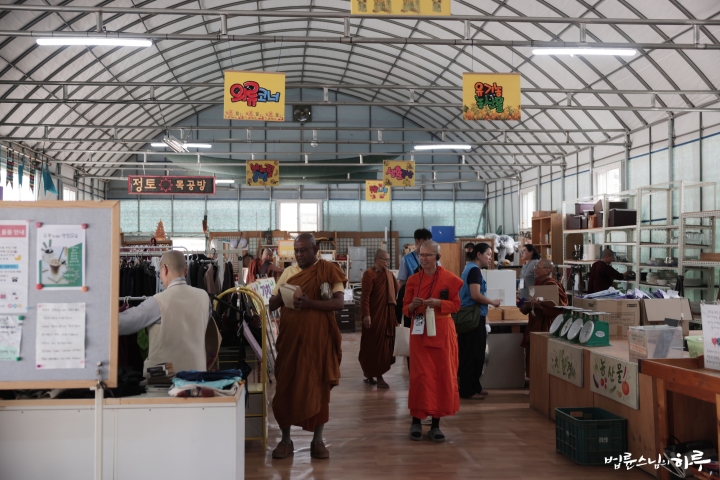
The participants browsed the various items at the Salligo Center and voluntarily donated for items they needed before taking them. The recycled handmade soap made at the Salligo Center was particularly popular.
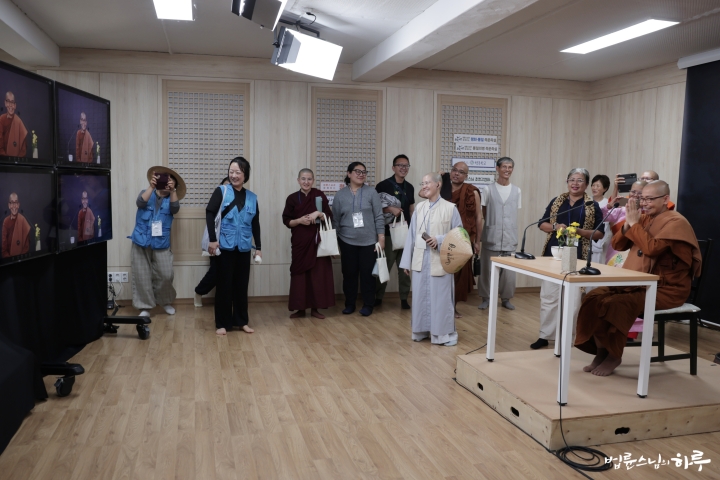
They moved to the Dubuk Jungto Retreat Center studio, where Sunim primarily does online broadcasts. Since the participants had watched Sunim's Weekly Dharma Assembly online this morning, their interest was high. The participants took turns sitting in front of the camera and taking photos, fascinated and entertained by seeing themselves on the monitor.
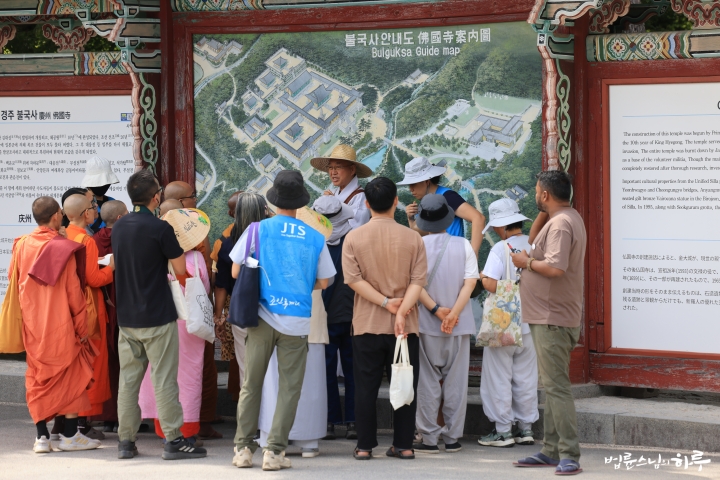
Around 1:40 p.m., the vehicle carrying the participants departed Dubuk Jungto Retreat Center and headed to the front of the Iljumun Gate (일주문) at the entrance of Bulguksa Temple (불국사). Upon arriving at Bulguksa, before entering, Sunim began explaining the history of the founding of Bulguksa Temple to the INEB delegation. The participants listened to Sunim's explanation through transceivers.
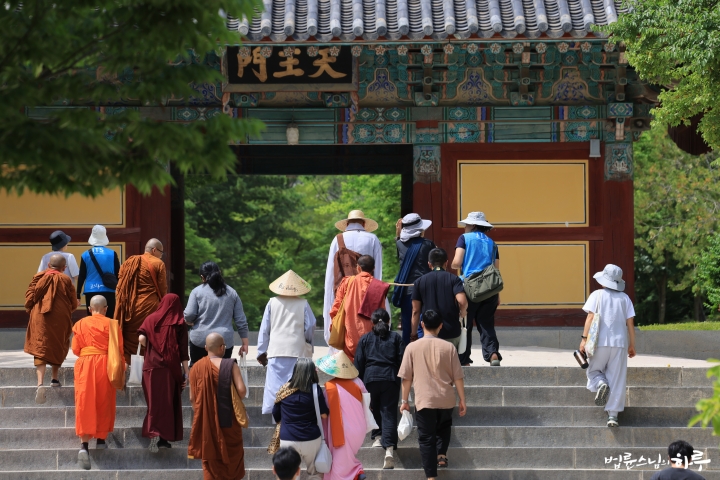
Sunim passed through the Iljumun Gate and the Cheonwangmun Gate (천왕문) with the INEB delegation. After walking a little past Cheonwangmun Gate, a wide open space unfolded before them along with the magnificent view of Baegungyo (백운교) and Cheongungyo (청운교) bridges.
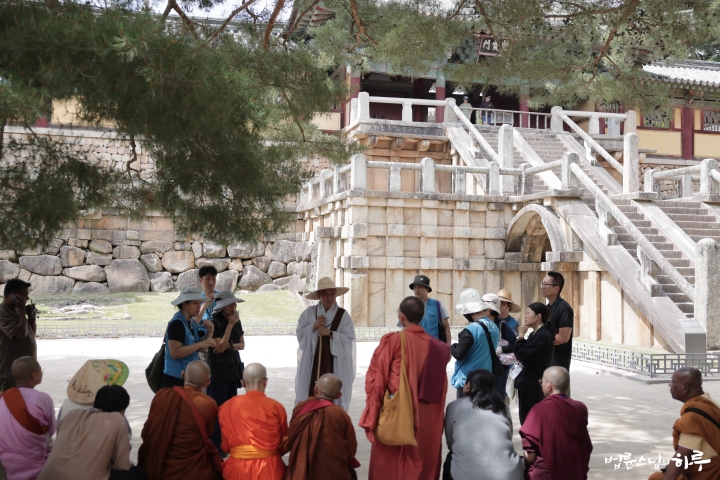
They settled under the shade of a tree where they could view Baegungyo and Cheongungyo bridges head-on, and Sunim explained the architectural structure of Bulguksa Temple.
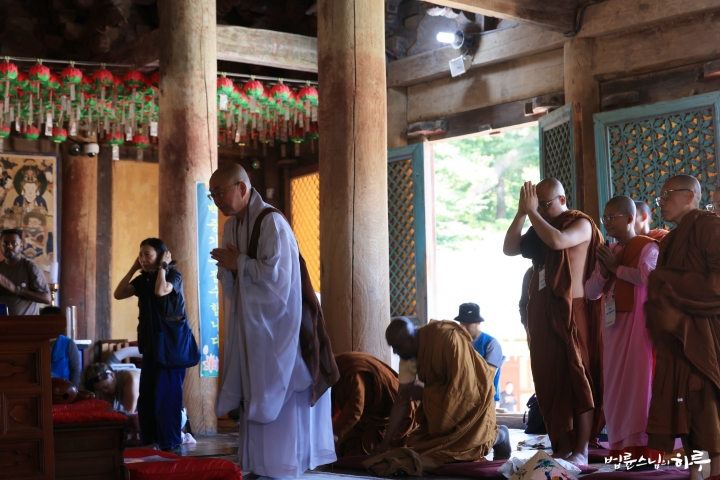
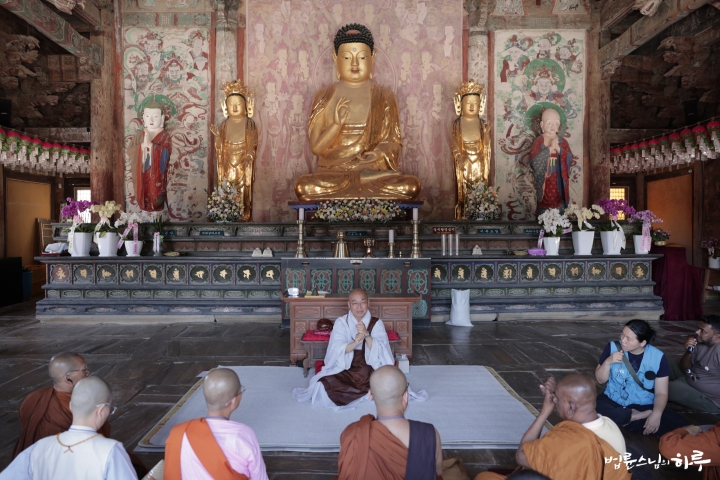
They then proceeded to the Daeungjeon (대웅전) Main Hall. Upon entering Daeungjeon, they paid their respects. Sunim explained the hand gestures of the Buddha to the participants who were looking at the Buddha statue in Daeungjeon.
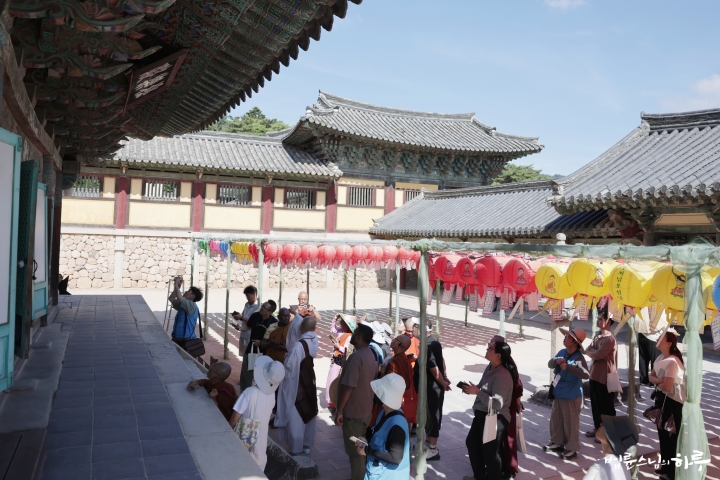
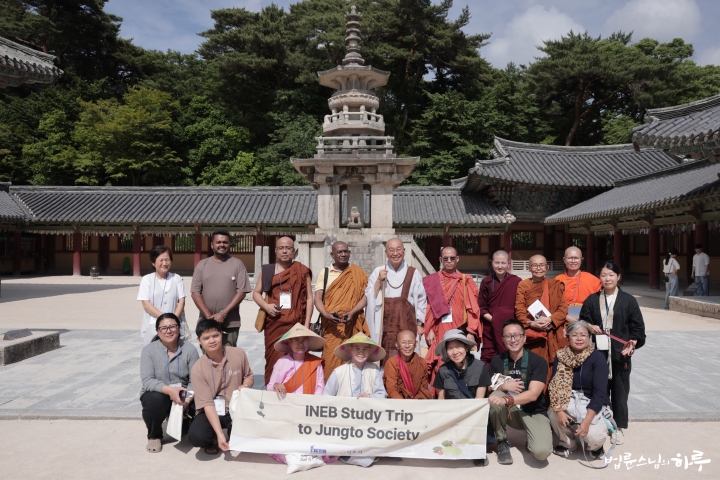
After leaving Daeungjeon, Sunim guided them around the Dabotap (다보탑) and Seokgatap (석가탑) pagodas, then through Museoljeon (무설전), Gwaneumjeon (관음전), and Birojeon (비로전) halls, and around Nahanjeon (나한전) and Geungnakjeon (극락전) halls before leaving Bulguksa.
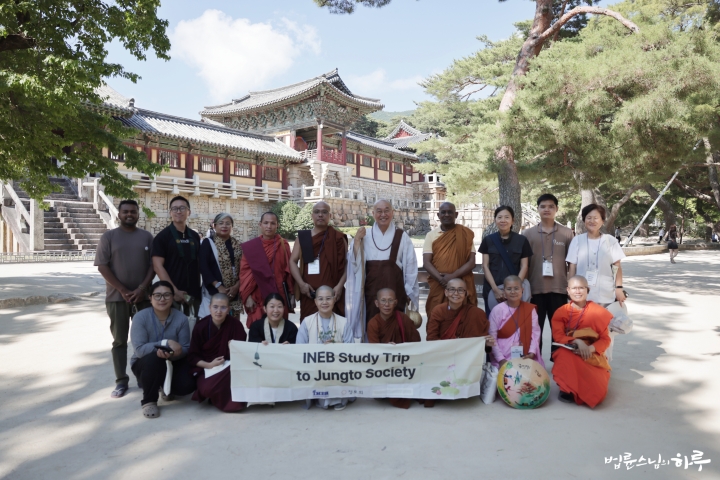
Today there were fewer people than usual within the grounds of Bulguksa, so they were able to tour leisurely in a quiet atmosphere.
After about two hours of touring Bulguksa, the participants boarded the vehicles and headed to downtown Gyeongju. Sunim also boarded the vehicle and had them take the route through Bomun Tourist Complex in Gyeongju, explaining historical sites such as the Hwangnyongsa (황룡사) Nine-Story Pagoda, the Hwangnyongsa Temple Site, and Bunhwangsa (분황사) Temple.
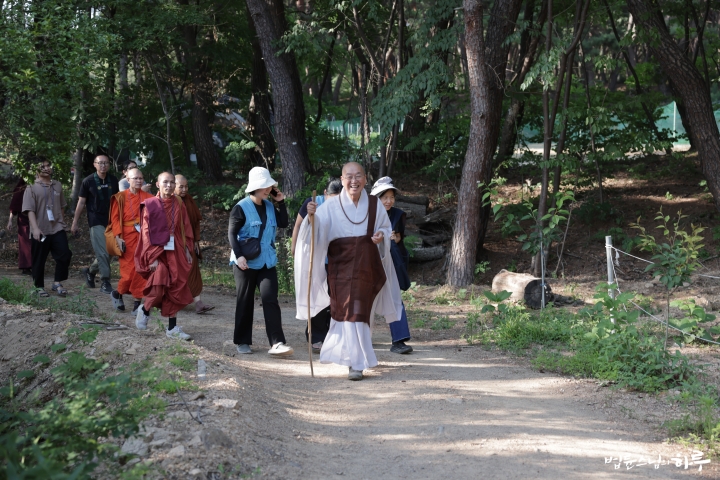
On the way back to the retreat center, they stopped briefly at Samneung (삼릉) for a walk.
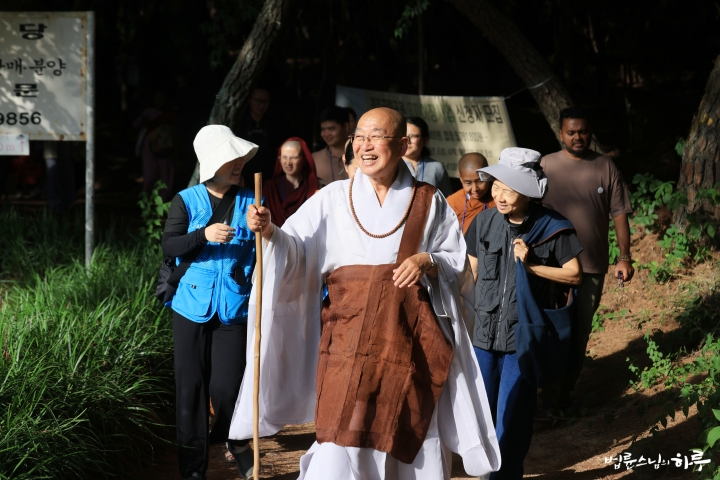
The sun was setting and a cool breeze was blowing. The participants walked along paths of trees and earth. After the walk, they returned to Dubuk Jungto Retreat Center.
Around 6 p.m., they had dinner. They held evening service at 7 p.m., and immediately at 7:30 p.m., they had a time with Sunim.
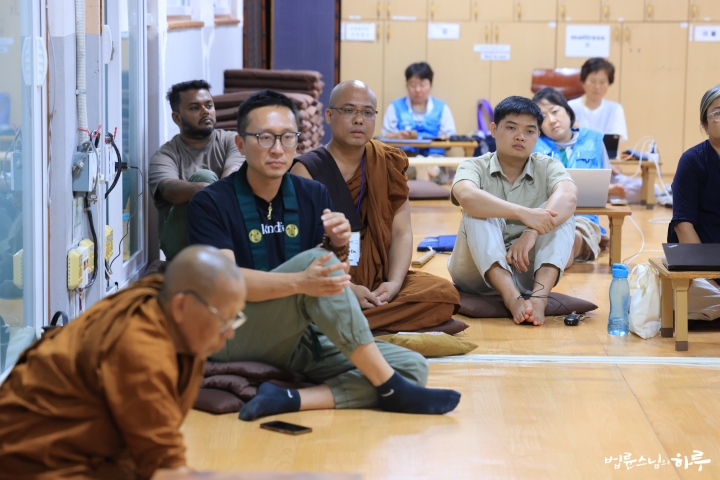
Before the conversation time began, a video was shown of Sunim's field visit to Bhutan in 2024 for sustainable development. When the video ended, applause broke out.
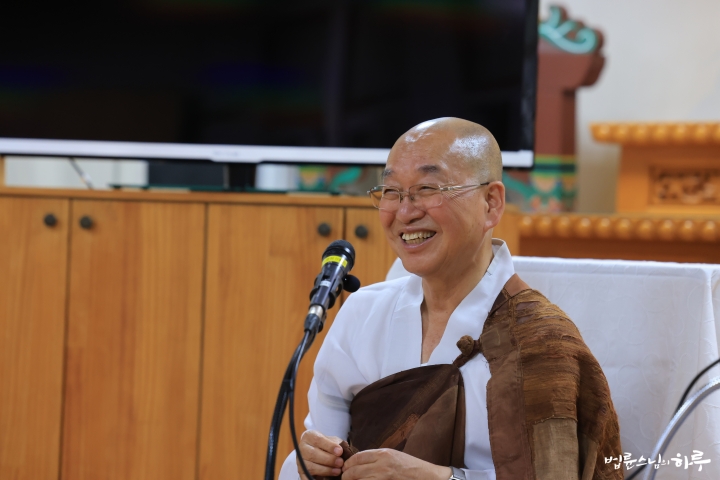
To sit even closer to the participants while talking, Sunim did not sit at the prepared table but arranged a single-person floor desk and sat there. Although he opened the evening session by talking about public bathhouses to help questioners feel comfortable asking questions, the participants from Southern Buddhist countries, which have no public bathhouse culture, did not understand Sunim's story and there was no reaction. Sunim waited so the participants could ask questions at their ease.
Participants who had prepared questions began to ask them one by one.
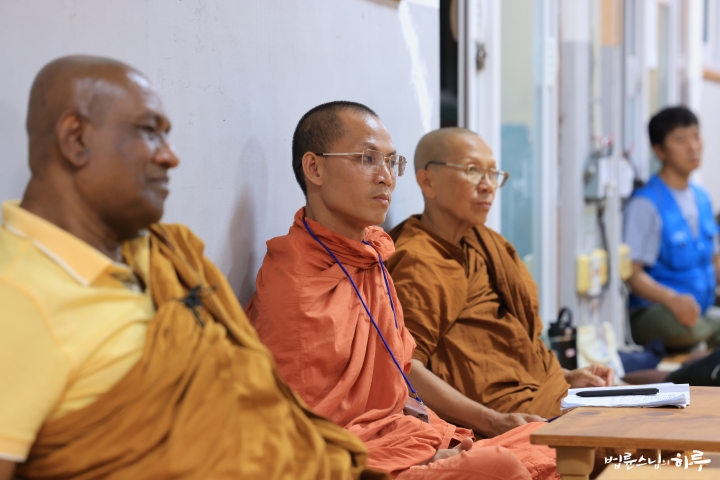
▪ From the start of the program, Sunim posed the question, "What is Buddhadhamma?" After listening to Sunim's explanations and teachings yesterday, I came to understand that Buddhadhamma is "the Dhamma that the Buddha reached." This perspective gave me many points to discuss when I return to Japan. How did Sunim arrive at this perspective? Did Sunim realize it directly, or did Sunim come to know it through someone else's mention?
▪ South Korea is prosperous, but its suicide rate is high—14,000 people annually, 29 per 100,000 people, the highest in the world. With such high GDP, why is the suicide rate so high? Is Jungto Society preparing any suicide prevention programs? I'm not sure what form it would take, but I suggest the idea of running something like a 24-hour suicide prevention channel.
▪ Do monks in South Korea also have voting rights?
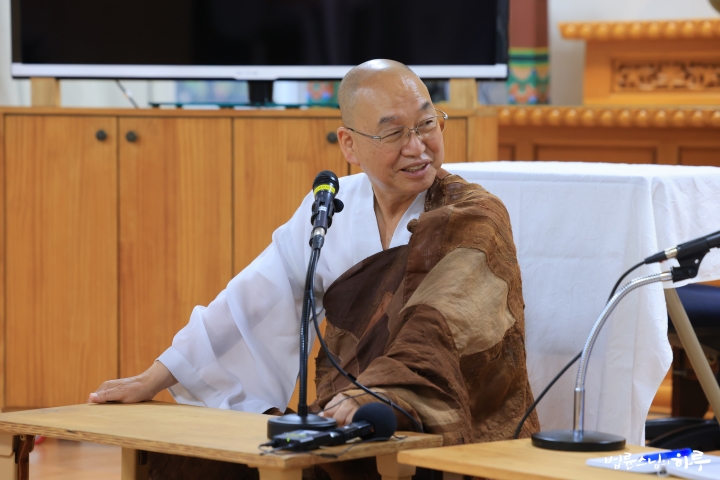
As the questions slowed down, Sunim made a suggestion.
"If there's something you want to know or have questions about, please write them down and submit them. I'll allocate time based on the number of questions."The conversation with Sunim ended around 9:20 p.m. The participants then proceeded with sharing in groups. Sunim left the Dharma hall and briefly discussed tomorrow's departure time for Silsangsa Temple and matters to check regarding farming, then concluded the day's schedule.
Tomorrow is Day 6 of the INEB schedule. They will travel to Silsangsa Temple and spend the entire day there participating in the INEB program.
This post concludes with the conversation about South Korea's suicide rate that was asked to Sunim today, and a brief introduction to the INEB participants' sharing of their thoughts on today.
"As the economy grows, the suicide rate in society as a whole tends to rise. This is a phenomenon seen worldwide. Of course there are exceptions, but on average, this is true. However, in South Korea, the degree is exceptionally high. One reason is that economic growth occurred over a very short period. As a result, competition is extremely intense. There's even an expression, 'going to academy with a baby bottle in their mouth.' Educational competition is so fierce from a young age that children are sent to academies as soon as they are born. Parents send their children to English academies, piano academies, and various other academies. As a result, a small number of exceptional talents emerge. However, in the process, many students are under enormous stress. Whether in school or in society, all of South Korean society is competitive. This can be seen as one of the reasons why South Korea's suicide rate is high. Also, the parents of today's young people are the generation that experienced women's equality and democratization in South Korea. Women assert equality, while men cannot easily break free from the male-centered habits formed during their upbringing, leading to many marital conflicts. The children growing up in between experience much mental difficulty. These various factors work together so that the mental health of young people is poor. There is much depression and anxiety. This is also one of the --reasons why South Korea's suicide rate is high. In South Korea, there is an atmosphere where those who fall behind in fierce competition are regarded as failures. At this morning's Dharma assembly, a 26-year-old young person poured out his suffering. He was born into a poor family and became a civil servant, but he wanted to hide his family circumstances from his colleagues. When that fact became known, he was having a very hard time. There are many cases where people cannot endure such failures whether in studies, business, or marriage and take their own lives. The reason I began giving Dharma Q&A talks publicly is also related to such social issues. At KAIST (Korea Advanced Institute of Science and Technology), known for accepting Korea's top talents, there was an incident in 2011 where a graduate student took his own life. At the time, there was analysis suggesting that it was the result of focusing excessively only on academic performance rather than examining the suffering and difficulties students faced. We all share responsibility for such incidents. So I went to universities and held Dharma Q&A sessions, creating a space where students could comfortably talk about anything. Students mainly talk about their concerns with studies and relationships, while graduated young people discuss issues like employment and marriage, working through their anguish through conversation. If you go to South Korean universities now, on average, two or three out of every ten students suffer from depression and anxiety severe enough to require psychiatric treatment. A similar phenomenon appears in Japan. In Japan, there are said to be hundreds of thousands of young people called 'hikikomori' who shut themselves in their rooms and don't come out. Some of them don't even clean, they order food, don't throw out the disposable items, and let them pile up for months. They live by turning their entire home into a trash dump. Since these problems are mostly related to mental illness, early detection and early treatment are most important. For physical health, we deploy nutritionists, doctors, and nurses by region and school. However, experts to counsel and treat mental difficulties are not properly deployed. Currently, many school teachers resign because they cannot handle such students. Therefore, schools should be staffed not only with nutritionists for physical health but also with specialists handling mental issues. Specialists need to quickly detect students' mental issues and consult with parents to ensure they can receive hospital treatment. But now, since this problem is being handled at the level of parents and homeroom teachers, conflicts arise. There have been cases where parents, fearing that unfavorable information might be recorded on their child's school record, instead blame the homeroom teacher, eventually driving the teacher to suicide. That's why I have continuously been proposing improvements to the school system to the Ministry of Education. First, the current system where every teacher is assigned the same number of students must be changed. If there is one teacher for every twenty regular students, then for students experiencing mental difficulties, one teacher should be assigned for every two students or even one. Second, when a student causes a problem during class, the homeroom teacher should not try to solve it directly; instead, a professional counseling teacher should counsel the parent and student and, if necessary, connect them to hospital treatment. In addition, psychiatrists or qualified psychological counselors should be deployed in each region. If they continuously monitor residents' mental health and connect them to necessary treatment, our society's suicide rate could be greatly reduced. However, in South Korea, there are not yet politicians with such awareness who are trying to change the system. They know there is a problem, but efforts to change the system are insufficient. What I can do is to continue meeting with politicians and education superintendents and talking about how the system in our society should be changed. People say that Jungto Society provides good counseling. However, this is not a fundamental solution. I believe that Jungto Society's wide propagation of Buddhadhamma helps to solve South Korea's suicide problem. The Dharma Q&A and Happiness School were also created to socially address the suicide issue that the questioner mentioned. Many people, whenever they meet me, say, 'I was about to die, but thanks to Sunim, I'm alive,' or 'I was going to divorce, but after listening to Sunim's Dharma talk, I didn't.' Those I met at Bulguksa today also tried to express their gratitude to me. Then I sometimes joke. 'Just with your mouth?' (laughter) Do you understand what I mean? I'm joking that they should not just be grateful with their mouth, but should do something whether donating or volunteering. Actually, some people hear that and say, 'Oh! That's really true,' and end up giving or volunteering. In conclusion, Jungto Society is also doing work to address the problems of South Korean society now. We just don't do it under the name 'suicide prevention.' On one hand, we open the Jungto Dharma School, Happiness School, and the Awakening Retreat to help people experiencing mental difficulties, and on the other hand, we continuously propose to education superintendents and politicians to change the social system.""Unfortunately, South Korea has the highest suicide rate in the world. The number of suicides annually reaches 14,000, which means 29 out of every 100,000 people die by suicide. This level of suicide rate is the kind of figure you'd expect to see in countries at war or politically unstable, so why is the suicide rate so high in South Korea, which has a high GDP and is wealthy? I'm also curious whether Jungto Society is preparing a suicide prevention program. If not, how about setting up a 24-hour suicide prevention contact channel? If my suggestion could save even one person, that would be a blessing for me as well."
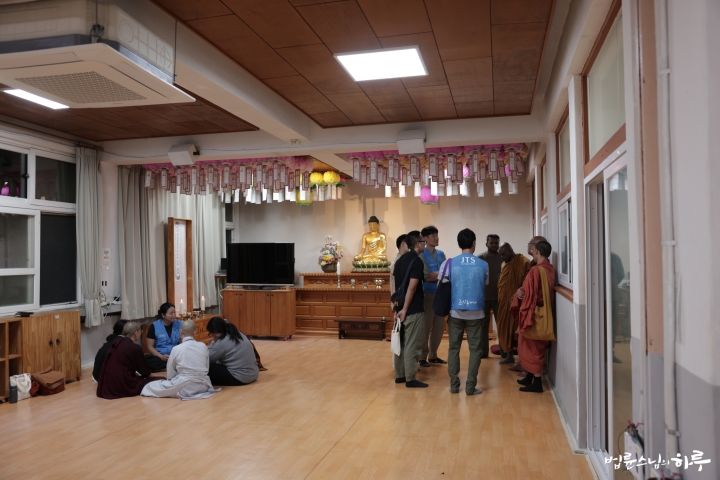
"Today I was truly happy. I especially enjoyed going to the field and doing farm work. We dug potatoes, and there were some very small potatoes. We were told they were small because of insufficient water. It's the same with people. Learning Buddhadhamma can make us happier and reduce the suffering and pain in our lives. I learned this while harvesting potatoes."
"It was a wonderful day. The breeze was cool, and it was nice to have light conversations while walking. However, Sunim's teachings were profound. I came to understand that this is what Buddhadhamma should be... it must be realized with the heart. It was a day when we could learn Buddhadhamma transcending culture, country, and language."
"At the greenhouse, a bee kept following me. It probably followed me because of the color of the kasaya I was wearing. Today was a happy and wonderful day. I enjoyed farming. However, Theravada monks cannot farm. While visiting Bulguksa, I felt that there are different cultures and different religious aspects. However, even within those differences, there were similarities, and I felt connected through those common points."
"I learned a lot through the conversation with Venerable Pomnyun Sunim. The point that 'In the Buddha's time, society had a caste system, but the Sangha had no caste. But now it is the opposite' was a very important point. The conversation about South Korea's suicide rate was also impressive."
"I was happy and grateful that the volunteers at Dubuk Jungto Retreat Center welcomed us by waving pom-poms. The food was really delicious. The potato salad in particular was fantastic. I am grateful to the volunteers."
"It seems that Venerable Pomnyun Sunim has everything. He lives in a good country and seems to have many good people around him. If wealthy people said they wanted to help Sunim, he would probably grant their wishes, but he seems humble. He clearly tells us what needs to be supplemented or corrected as a practitioner. At the Mungyeong Jungto Retreat Center, during the morning assembly after the Barugongyang (formal Buddhist monastic meal), he gave detailed guidance on how a practitioner should walk and about the rinse water not being clear during the meal. I think a good leader is one who accurately tells you what is wrong and what needs to be corrected. And I can feel that Sunim treats everyone equally and respects everyone."
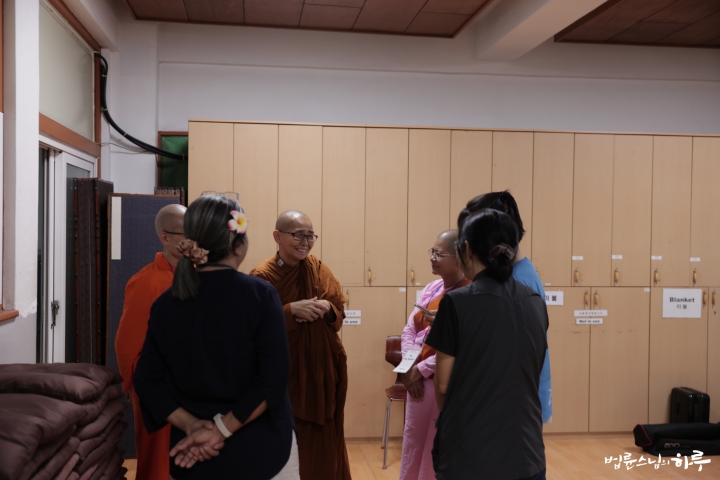
"As for Sunim's teaching, it came to me very clearly, and my mind became at ease. However, I feel that there remains an area of practice that I must develop more deeply going forward."
"Right now I am very tired physically, but mentally I am in a very clear and refreshed state. This is because I was greatly inspired by Sunim's tremendous efforts for a better society. We come from different backgrounds and traditions, but when meeting Sunim, I did not feel the sense of unfamiliarity that comes from being a person from an entirely different tradition; rather, he felt as familiar as if he were my own original teacher."
"When I first participated in JTS activities, since Venerable Pomnyun Sunim is a world-renowned leader, I must admit I felt that things were a bit serious and solemn. But as the days went by, being with Sunim became so comfortable. Despite being a world-renowned leader, he approaches and communicates with everyone equally and warmly. I am grateful that he has given such good energy to my life, and I sincerely thank JTS and Venerable Pomnyun Sunim."