Is Eating Eggs Considered Vegetarian?
Jun 16, 2026 - Day 4 of the INEB Schedule (Mungyeong Jungto Retreat Center, Jungto Education and Training Center)
Hello. Today marks the fourth day of the INEB (International Network of Engaged Buddhists) study trip. Sunim spent the day with the INEB delegation, discussing Jungto Society's practice, dharma propagation, and social engagement activities.
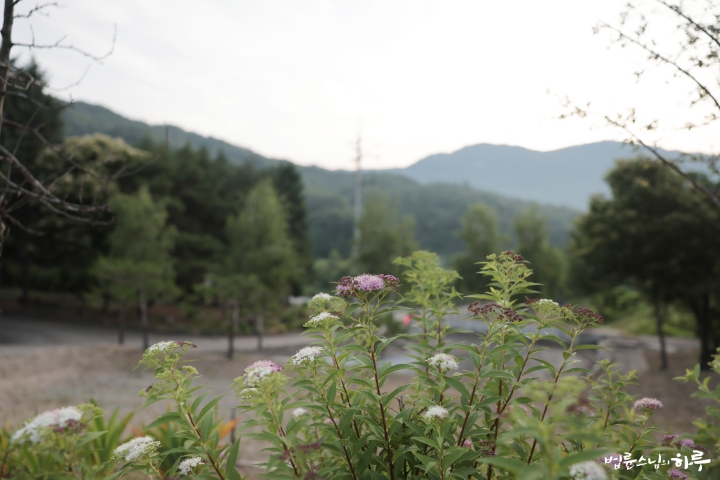
After waking at the Meditation Center of the Mungyeong Jungto Retreat Center, Sunim began the day with morning practice and meditation.
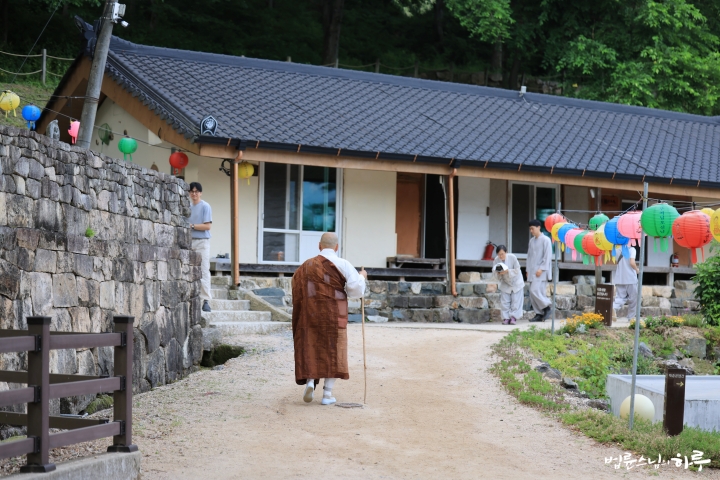
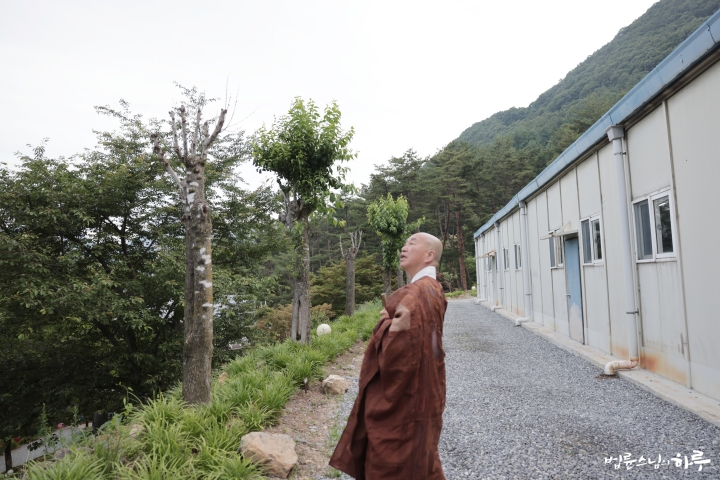
At 6 a.m., Sunim made his way to the main hall for Barugongyang (formal Buddhist monastic meal). While walking along the path beside the main hall, Sunim examined the trees that had been pruned. Some of them had died.
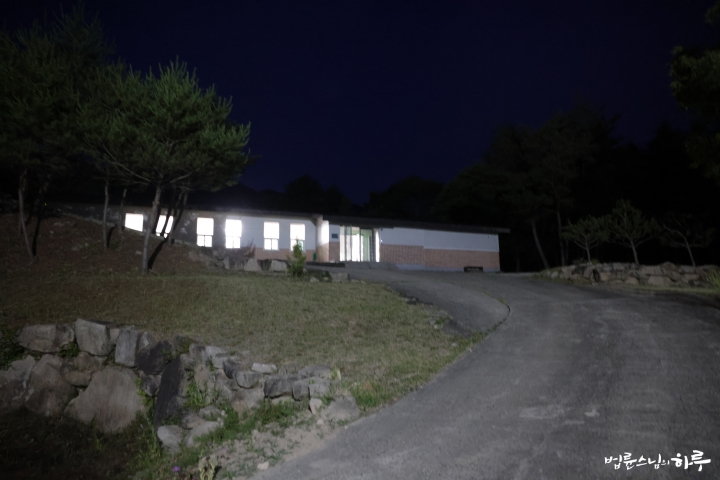
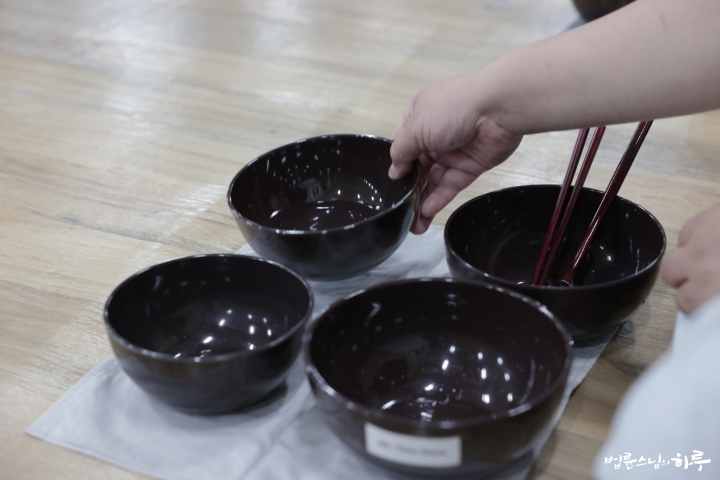
Sunim entered the main hall of the Mungyeong Retreat Center and took his seat for Barugongyang. Until the three strikes of the bamboo clapper signaled the start of the meal, Sunim quietly meditated in his seat.
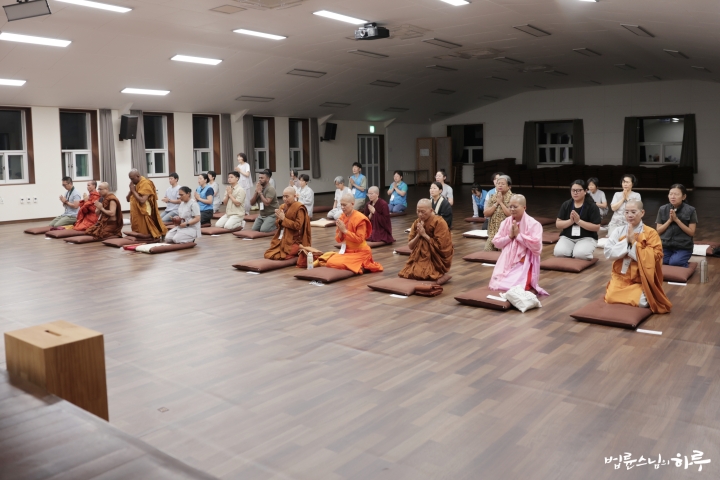
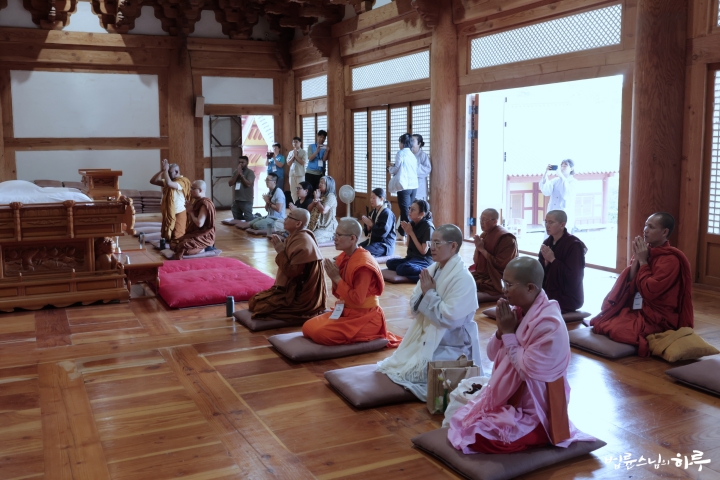
The INEB delegation had stayed overnight at the Seonyudong Jungto Education and Training Center and held a morning service in the center's main hall. After the service, they boarded vehicles to travel to the main hall of the Mungyeong Retreat Center for Barugongyang. Along the stairway leading from the main hall to the Daewoongjeon (Main Buddha Hall), colorful five-colored lotus lanterns were hung. The practitioners of the Mungyeong community had carefully prepared everything, including the bowls and food, for the Barugongyang with the INEB delegation.
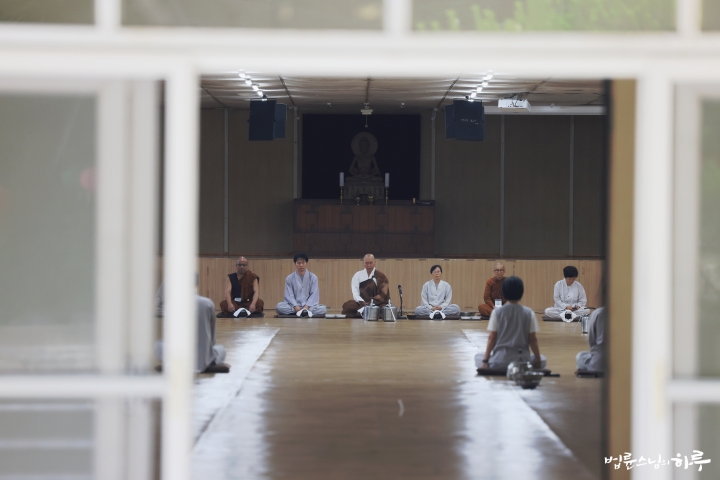
At 6:10 a.m., the sound of the moktak wooden instrument rang out from the kitchen, announcing the time for Barugongyang. Everyone at the retreat center gathered in the main hall for the meal. The INEB delegation had also arrived early and taken their seats.
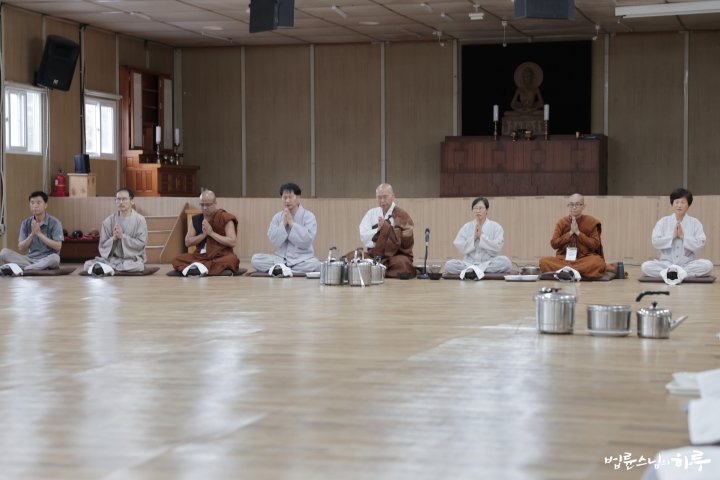
"Tak! Tak! Tak!"
The three strikes of the bamboo clapper marked the beginning of Barugongyang.
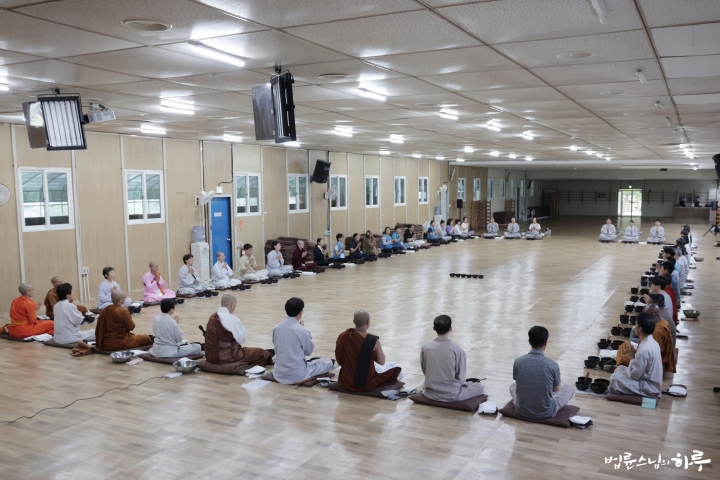
"Born in Kapilavastu~ Attained enlightenment in Magadha~ Taught the Dharma in Varanasi~ Entered Nirvana in Kushinagar~"
The meal proceeded in silence. After the meal, it was time for the morning assembly.
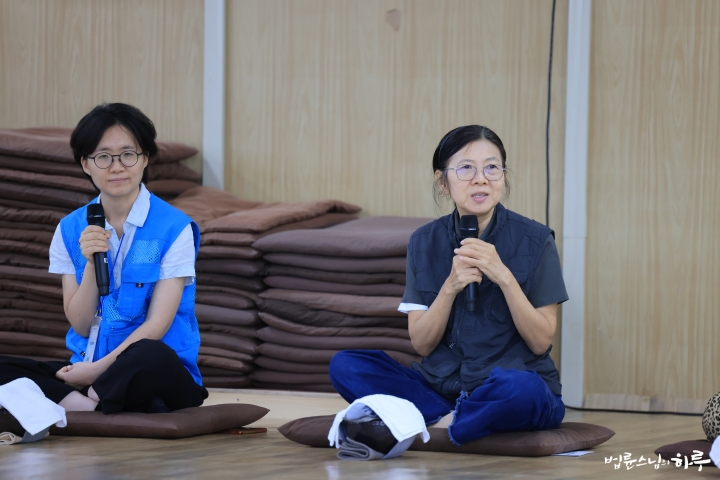
Anchalee from the INEB delegation introduced the participants and greeted the members of the Mungyeong Retreat Center. She explained that nine monastics and seven lay activists were participating in this INEB program, and provided detailed introductions of the monastics—where they came from and what activities they were primarily engaged in. She then expressed gratitude to those who had welcomed them.
"We have come once again this year to learn from Venerable Pomnyun Sunim and Jungto Society. Thank you, Venerable Pomnyun Sunim and all members of Jungto Society, for arranging this opportunity for learning, as well as the heartfelt meals and accommodations every year."
After Anchalee's greeting, the members of the Sangha asked Sunim to share a few words.
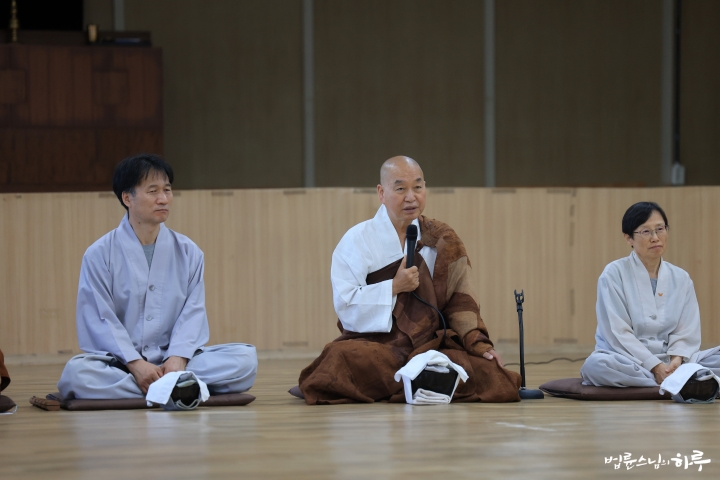
After Barugongyang, Sunim went down to the Meditation Center below the retreat center.
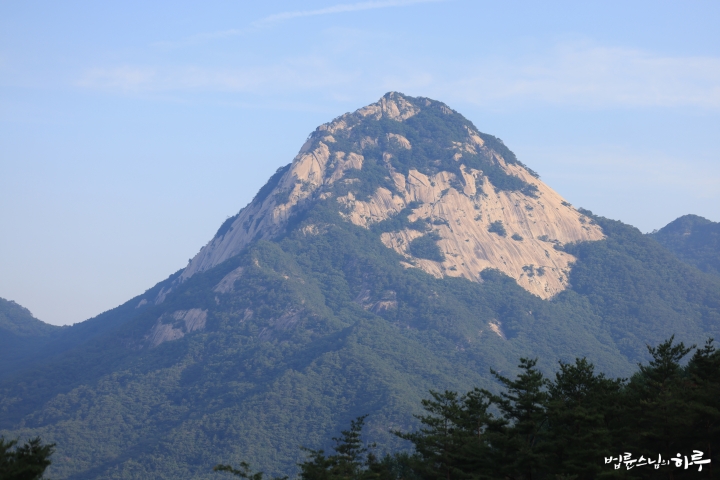
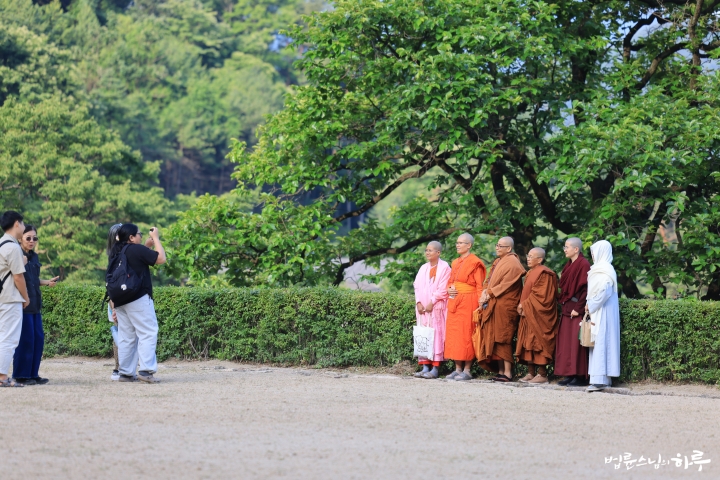
The INEB delegation made their way to Yeoraewon, located above the retreat center, to tour the Mungyeong Retreat Center grounds. The participants took photos with Mount Huiyang and the Seoam persimmon tree visible from Yeoraewon as the backdrop.
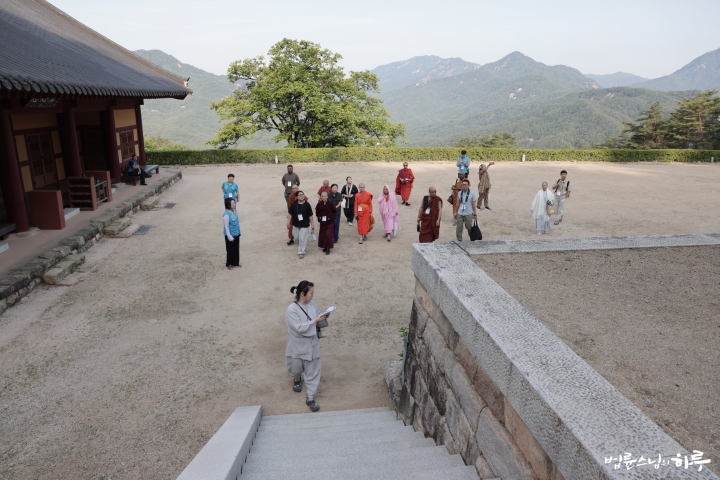
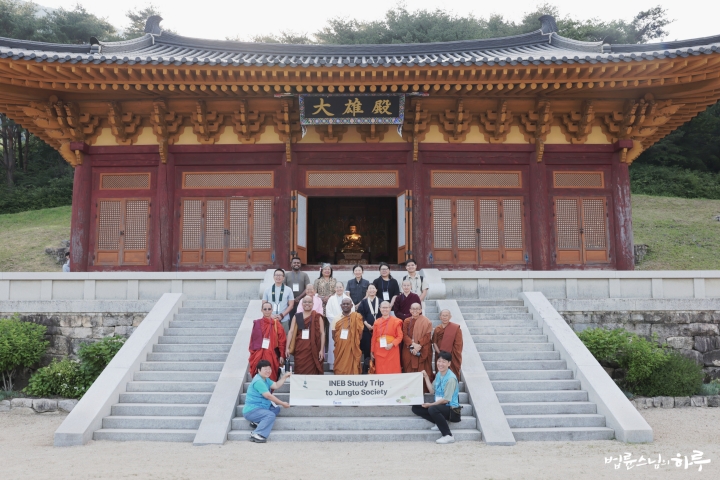
The participants toured Yeoraewon, Daewoongjeon, the pine forest restroom, the Seoam persimmon tree, Baekhwaam, the retreat office, and the meditation hall, then walked down to the Meditation Center. Having visited Bongamsa Temple the day before, they were especially delighted to see the persimmon tree associated with Master Seoam, and took commemorative photos with the persimmon tree and Mount Huiyang in the background.
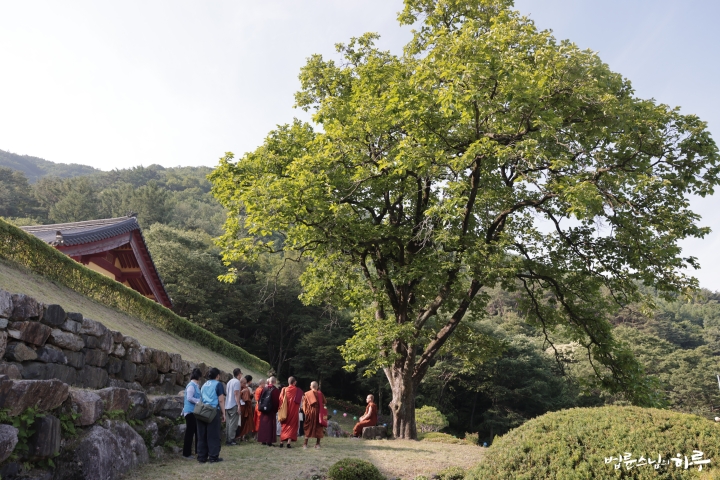
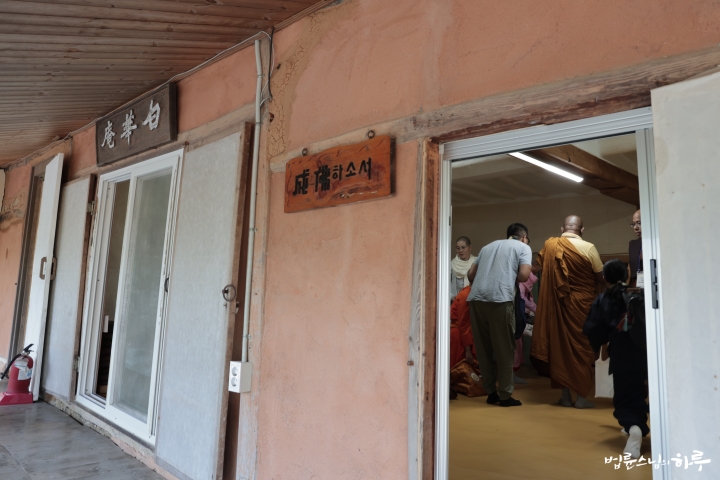
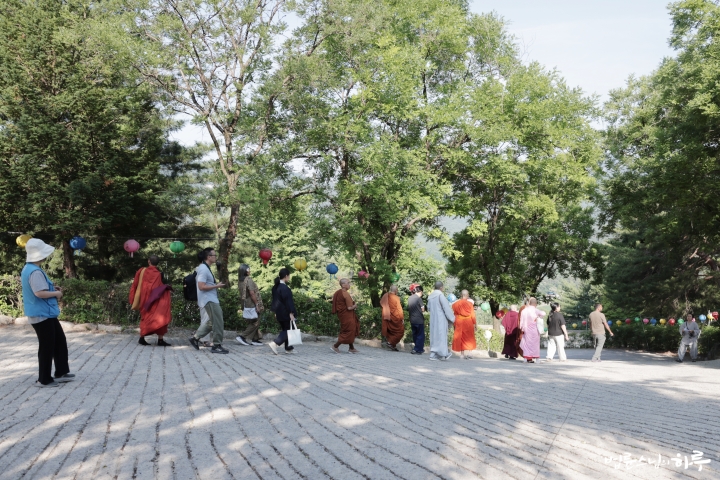
After touring the Mungyeong Retreat Center grounds and taking a break, the participants began the first morning session at 9:30 a.m. They first watched a video about the history of Sujata Academy. Then, Dharma Teacher Sunju began a presentation on the theme "Jungto Society Members and Dharma Propagation."
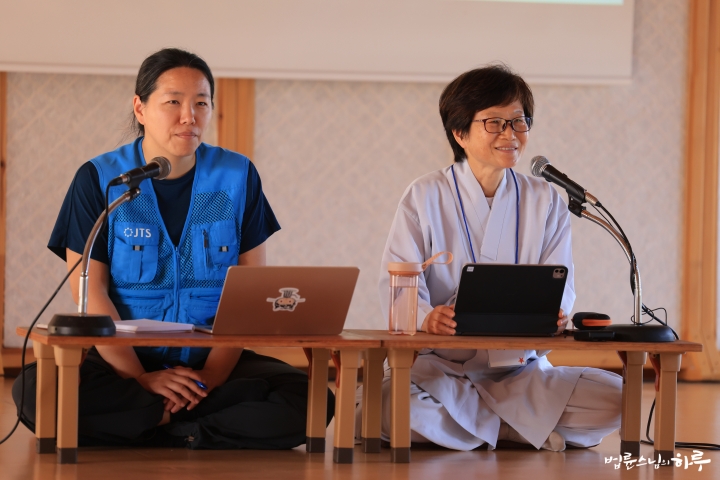
"Today, I will explain how individual practitioners active in Jungto Society engage in their practice.
When you become a member of Jungto Society, there are three core activities you must engage in: practice, giving, and volunteering. Practice means attending the Weekly Dharma Assembly, doing 1000-Day Practice prayer every morning, and participating in the education and retreats I mentioned yesterday. Volunteering refers to all activities within Jungto Society. Giving includes donations for those in need, as well as donations for the operation of Jungto Society."
Dharma Teacher Sunju clearly explained everything from the concepts of practice, giving, and volunteering to the organizational structure and activities of Jungto Society. After the time with Dharma Teacher Sunju concluded, there was a break.
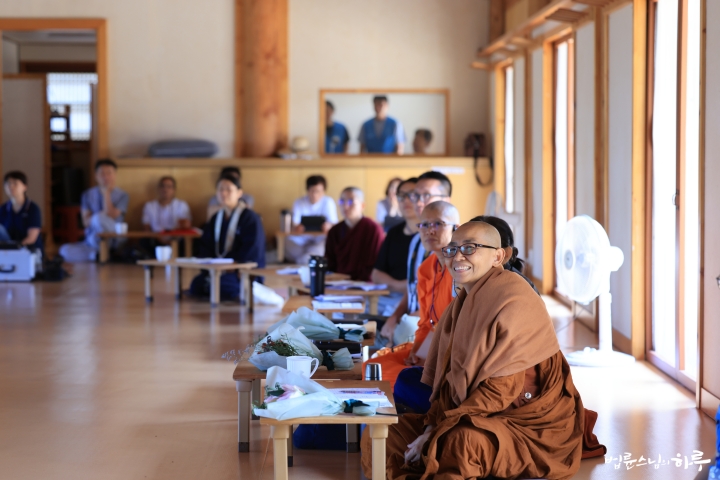
The second morning session was with Dharma Teacher Myosu. Before starting, the participants watched a video about JTS's school construction project in Syria. After watching the video about Sunim and JTS activities, which restored a learning space for children by building a school on land that had been nearly barren due to the earthquake, the participants became deeply moved, and some had tears in their eyes. When the video ended, the participants spontaneously broke into applause.
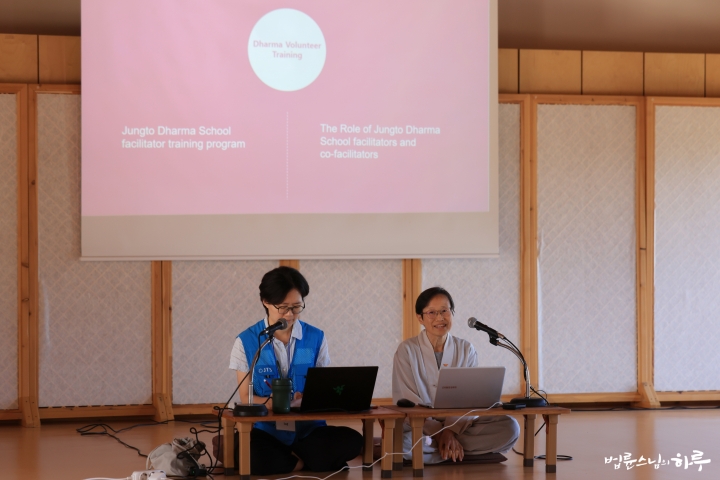
Dharma Teacher Myosu then presented on "Jungto Society's Dharma Propagation Activities" and shared case studies.
"Jungto Society's dharma propagation activities can be largely divided into two areas. One is the part where leading members operate and conduct basic education programs such as the Jungto Dharma School and Happiness School, through which people become Jungto Society members and develop their identity as practitioners by experiencing the Dharma through education and retreats. The other is reaching the general public through media such as publications, broadcasting, social media, YouTube, podcasts, and lectures."
After Dharma Teacher Myosu's presentation, the participants asked questions.
▪ What is the ratio of Korean to foreign subscribers on the YouTube channel?
▪ What criteria do you use when selecting content to share with the public through publications or multimedia?
▪ There seem to be many volunteers. I'm curious about the volunteer management system.
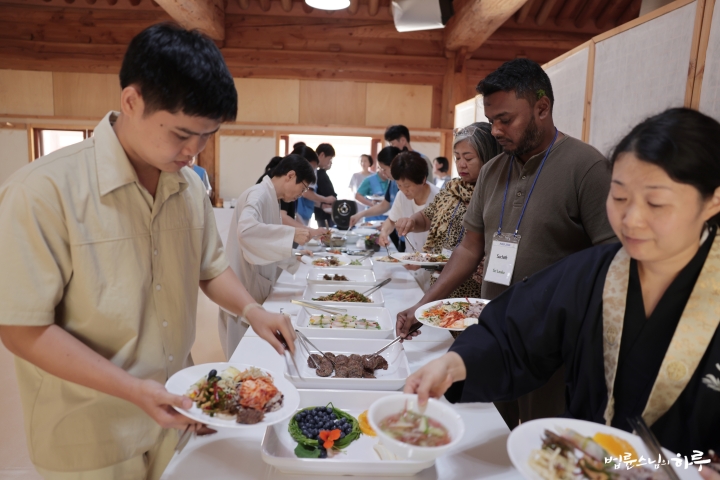
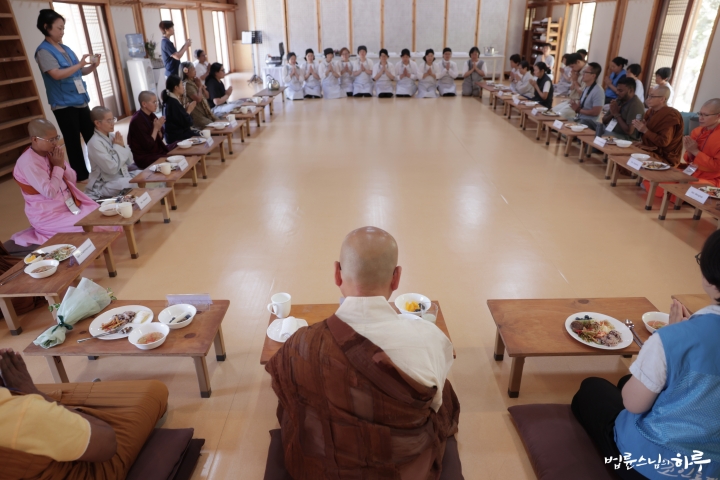
After the Q&A session, it was already lunchtime. The participants enjoyed a meal carefully prepared by volunteers from the Daejeon Chungcheong Branch. After serving themselves and taking their seats, the volunteers also came and knelt down to receive blessings from the Theravada monks.
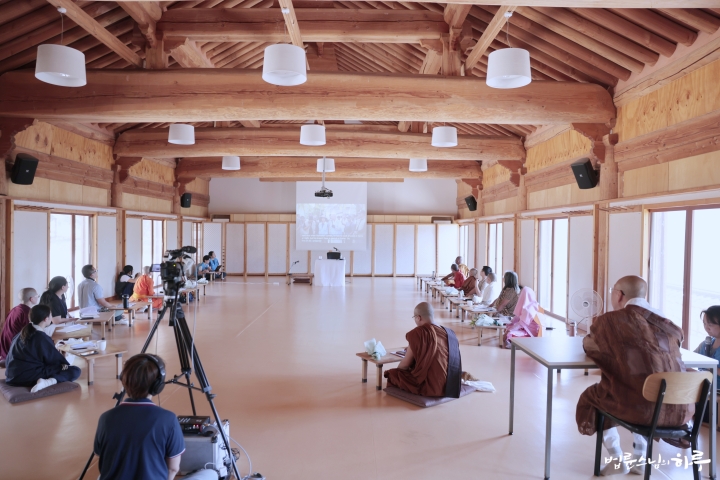
The afternoon session began at 1:30 p.m. The first part of the afternoon session was time with Sunim.
"In this session, I will first take questions about Jungto Society's organization, operation, and dharma propagation that the two Dharma Teachers presented on this morning. If there are no specific questions related to those topics, feel free to ask anything."Suchith, an activist from Sri Lanka, raised his hand.
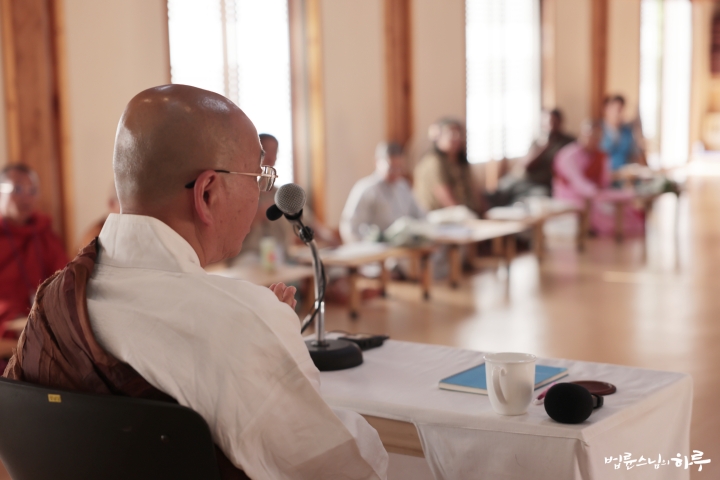
What Should Guide Our Judgment—Precepts or the Middle Way?
"First, you need to understand why such a precept came into being. When we sing or dance, our minds become slightly elated. That is, pleasure arises. But when such pleasure arises, suffering inevitably follows. So we remain trapped in the cycle of samsara—pleasure and suffering. Our practice aims at liberation (解脫) from this cycle of pleasure and pain. Therefore, we should not pursue pleasures that excite the mind. This is the original meaning of the precept 'do not dance or sing.' Today, not all songs excite the mind. On the contrary, there is music that calms the mind, and there are dances that bring greater peace of mind. In such cases, formally it may appear to violate the precept, but in substance it does not. Even if you don't dance or sing yourself, if you watch others dance and sing and your mind becomes excited, that itself is a violation of the precept. So we must use the original spirit behind the precept as our standard. In a changing society, overly formal aspects need some adjustment. But that doesn't mean we should think, 'Since the world has changed, a little dancing and singing is unavoidable.' Pursuing pleasure in that way is still a violation of the precept. When we mingle with the public, we may inevitably end up violating precepts and pursuing pleasure. In such cases, we must repent. Whether morning or evening, while repenting, we must become aware of the fact that we have violated a precept. This doesn't mean we are guilty of a sin; it means recognizing, 'Ah, my mind is currently excited.' We should neither be bound by mere form nor lose sight of the original spirit. Practicing according to that spirit is the Middle Way.""I would like to ask about deciding whether to flexibly follow the Middle Way according to the situation, or to strictly adhere to the precepts. When we observe the precepts, we make conscious decisions—'I will keep it' or 'I won't keep it'—from a state of awareness. I'm curious about the relationship between observing the Middle Way and strictly guarding the precepts. For example, with the precept 'do not dance or sing,' does observing the Middle Way mean we can think 'there are circumstances, so a little is acceptable,' or should we say 'because I observe the precepts, it's not allowed under any circumstances'?"
Next, Venerable Menhak from Cambodia asked a question.
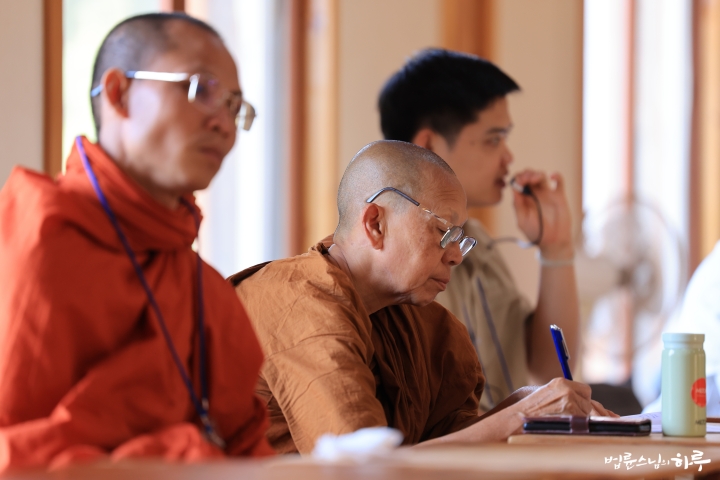
Is Eating Eggs Considered Vegetarian?
"The question I want to ask might be seen as a sophisticated one, or as a childlike one. It's a matter of debate in our country. Sunim, is eating eggs considered vegetarian?"
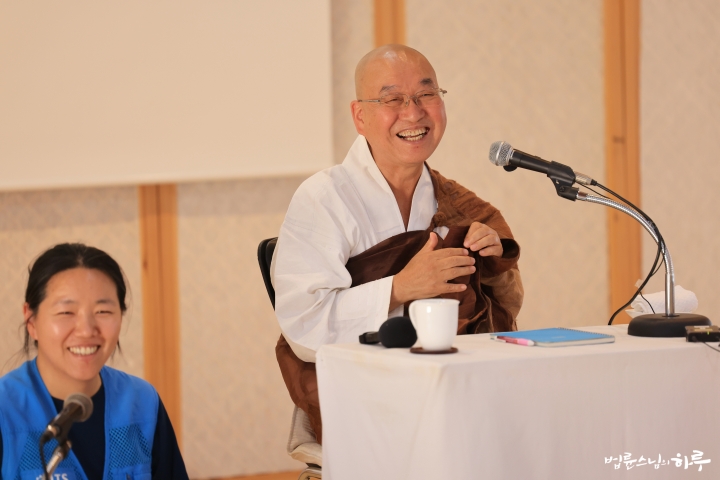
"Yes, I understand fully. Thank you for explaining logically and giving examples. I think I can explain this well when I return to my country."
"We are vegetarian. This is a Mahayana Buddhist tradition, not a matter of precepts. However, if we visit a Theravada Buddhist temple, whether we eat vegetarian or eat meat there becomes a matter of personal choice. So at Jungto Society, we follow the Mahayana tradition and eat vegetarian, at least within the temple grounds. However, when invited by someone or when going to a restaurant, we don't strictly forbid it. It is left to personal choice. For example, when you eat at a highway rest area, what you eat is up to each individual. I actually wanted to treat you to some spicy food or delicious seafood. But since our accommodations are all within practice centers, that's realistically difficult now. We uphold both traditions and precepts, but traditions can be modified to some extent according to reality. Traditions are culture, not Dharma. So we must distinguish between what must absolutely be observed as precepts and what can be changed according to circumstances as traditions."After hearing Sunim's response, Venerable Menhak, the questioner, said:
"Sunim, I have gained guidance today that I can share with people when I return to Cambodia and address the debate on whether eggs should be considered vegetarian. Thank you."
Venerable Menhak expressed his gratitude to Sunim with a bright expression.
In addition to the questions introduced above, the following questions were also raised:
▪ The energy you have to do so many activities is remarkable. What perspective should I maintain to practice the Bodhisattva path like you?
▪ Having seen and experienced various activities of Jungto Society firsthand, I feel it is a comfortable and good organization. However, the outside world is not so. How do you guide Jungto Society members to overcome or balance the difference between the harshness of society and the comfort of Jungto Society?
▪ Sunim, isn't it because you accumulated much merit in past lives that you are living such a noble life in this life?
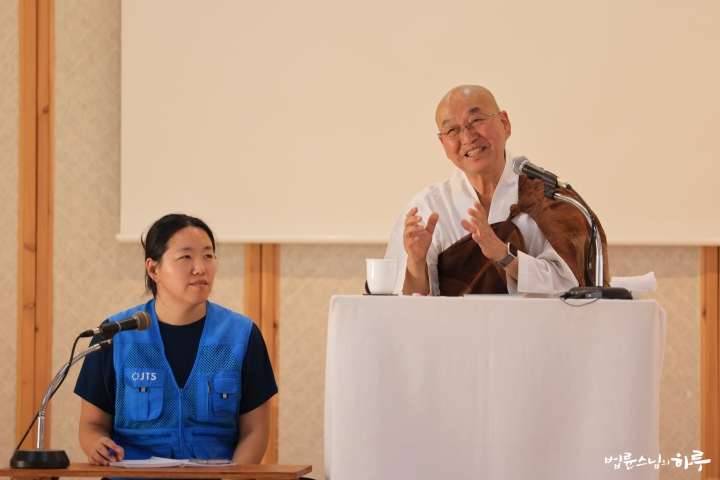
The atmosphere of the INEB delegation, which had mainly been asking about Jungto Society's operations and philosophy, was gradually expanding to questions about establishing personal perspectives on practice and activity. For the parts where participants had concerns or unclear perspectives in their practice, activities, and daily life, Sunim took a more essential approach and answered them clearly and in detail. Even within the packed schedule, the participants showed focused attention during their time with Sunim without becoming distracted.
At 5 p.m., it was time for dinner. The participants had become accustomed to taking only as much as they would eat, and after emptying their plates and bowls, wiping them clean with pieces of kimchi. After about 30 minutes of dining, they packed up and boarded vehicles. Before the evening service, they decided to take a walk with Sunim. The walking course followed a path connecting Hakcheonjeong (鶴泉亭) to the Seonyudong Jungto Education and Training Center. Sunim also prepared his walking attire and walking stick and went to Hakcheonjeong. In the car on the way to Hakcheonjeong, Sunim reviewed a video about "Bhutan Visit Activities" to be shown at the Weekly Dharma Assembly and communicated with the person in charge.
After traveling by vehicle from the Mungyeong Retreat Center to the parking lot leading to Hakcheonjeong, they arrived at the entrance and walked toward the valley. The participants, who had been sitting all day, were busy taking photos when they saw nature. Sunim waited on a wide rock for all the participants to gather.
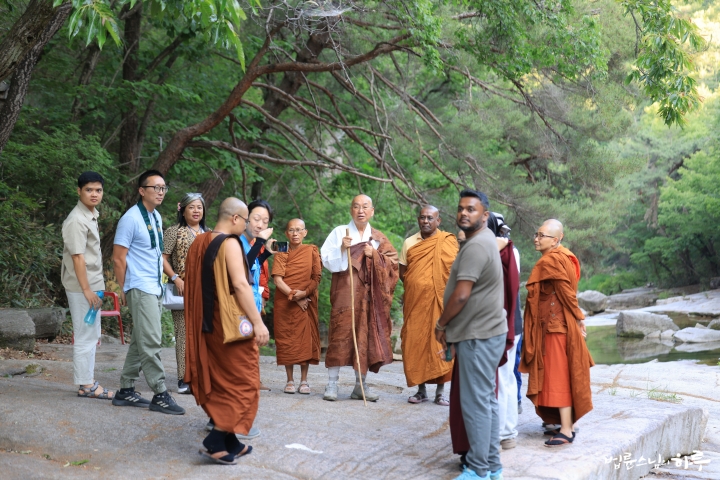
Once the participants gathered, Sunim explained about the walking location.
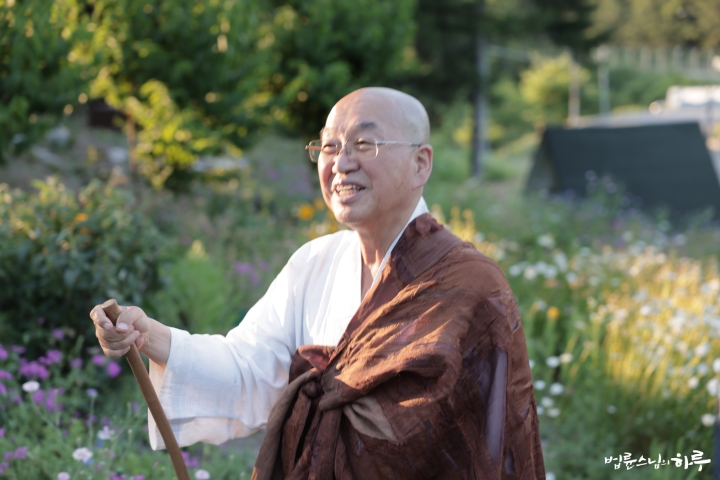
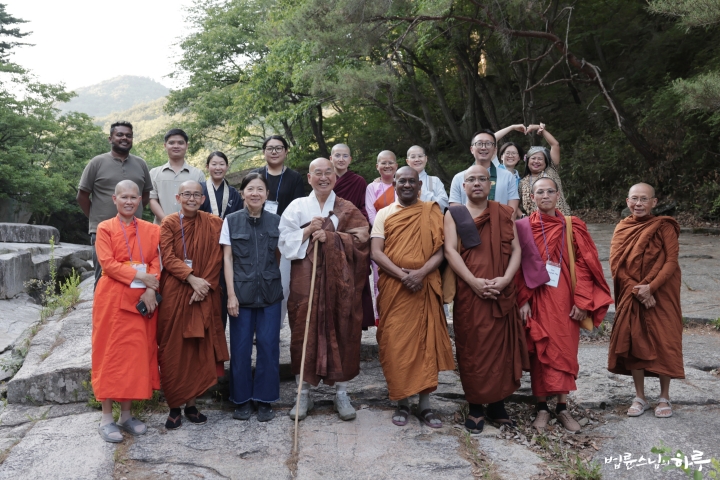
Before starting the walk, Sunim explained the names of places and their meanings. He also showed where the pavilion was located. They took commemorative photos at Hakcheonjeong and then began the walk in earnest.
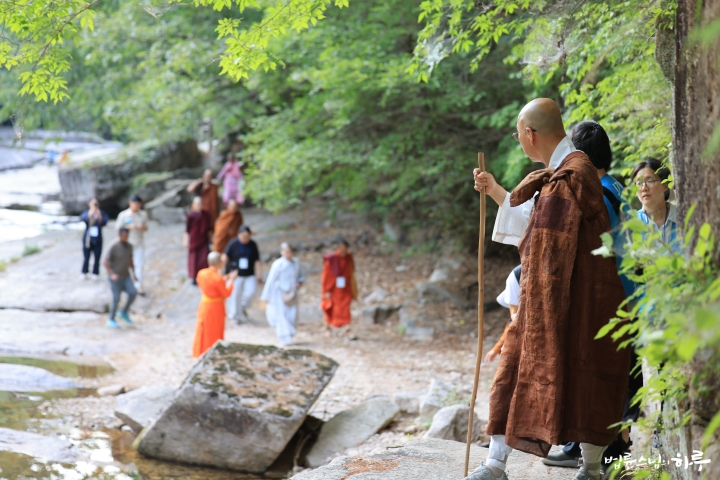
Venerable Bodhananda from Sri Lanka, whose situation made walking difficult, decided to only take photos and then travel by vehicle to the training center. The other participants followed Sunim and walked from Hakcheonjeong to the training center.
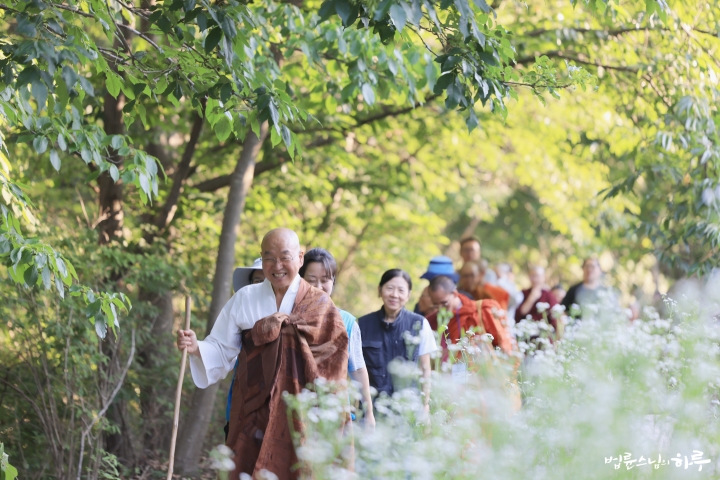
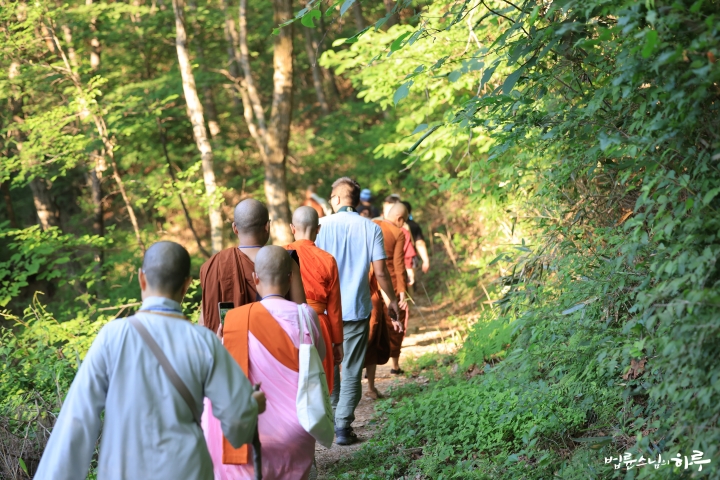
In Seonyudong Valley, there were wide flat rocks scattered here and there, and refreshing stream water was flowing. Where a cluster of wildflowers was growing, the participants admired their beauty, taking selfies and photos of each other.
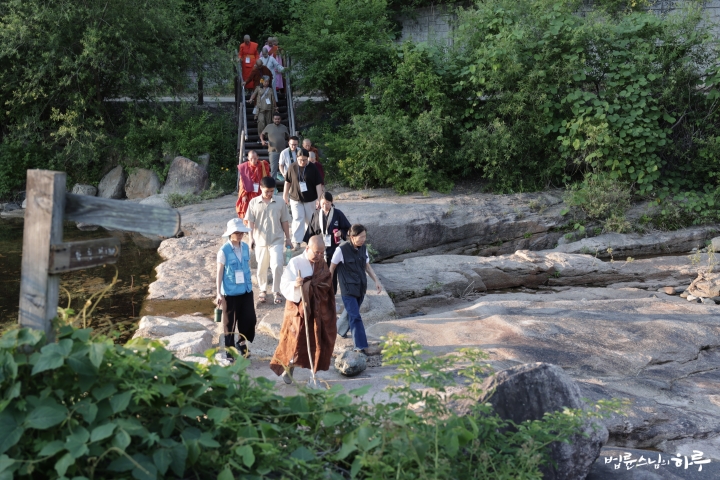
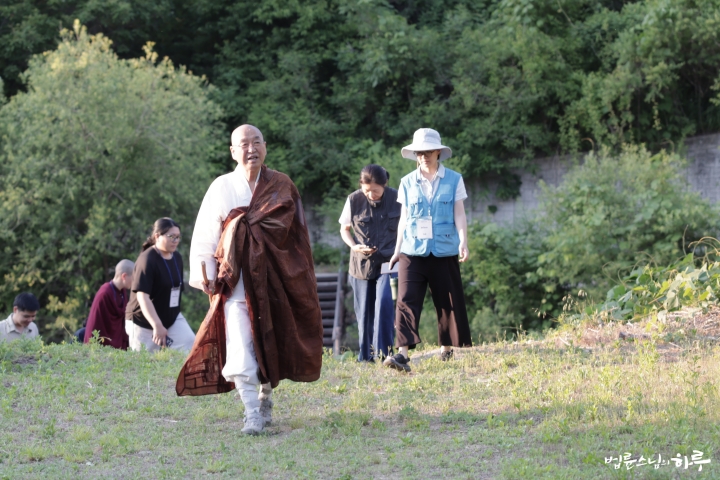
On the path leading into the training center, the flower beds were well-tended with blossoms. The participants enjoyed viewing the flowers as they walked up to the training center building. Upon arriving at the training center, the Dharma Teachers had prepared refreshing drinks made with marigold syrup. After each participant drank a cup, they returned to their accommodations to freshen up.
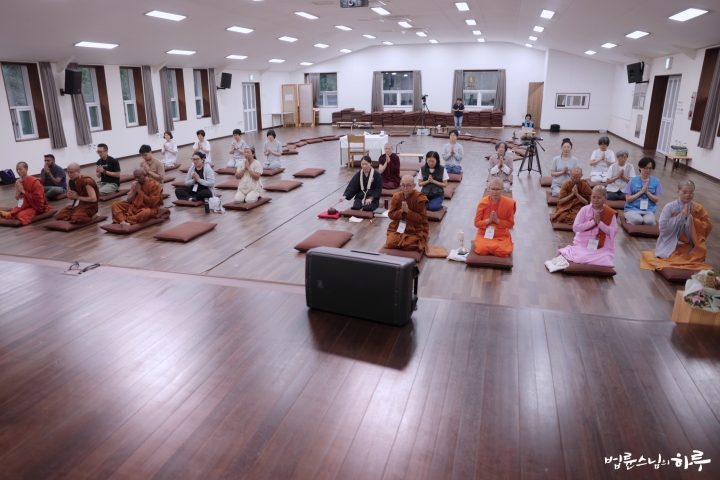
At 7:30 p.m., the participants gathered in the training center's main hall for evening service. Today, Japanese participant Rev. Kacho led the service in the Pure Land Buddhism style.
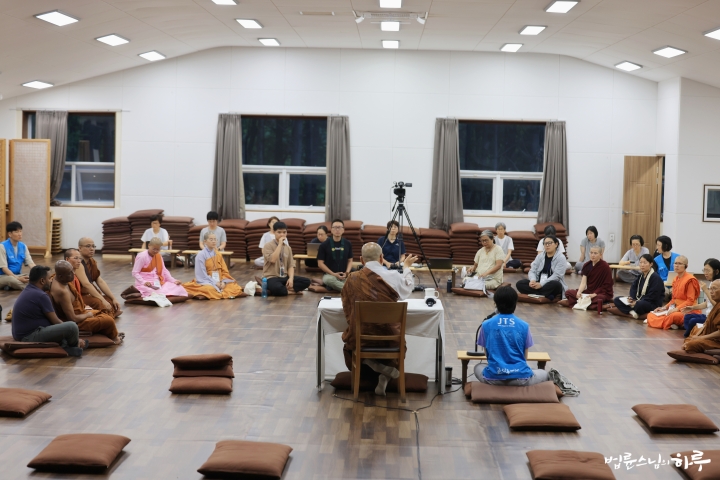
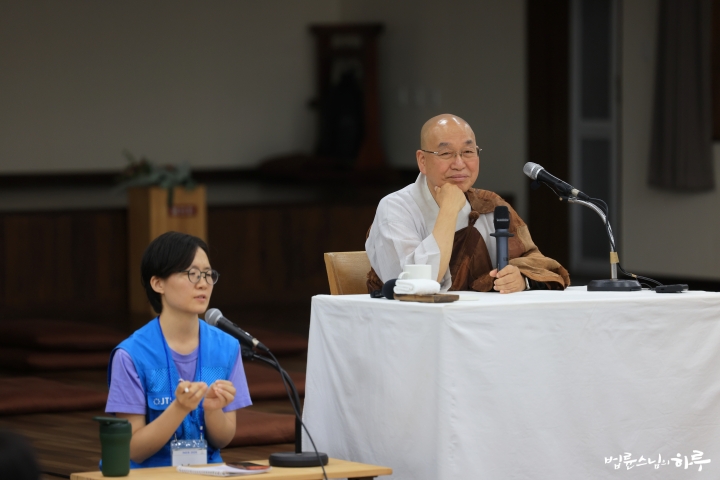
Afterward, they watched a video about Pakistan emergency relief activities and began a conversation with Sunim. Sunim explained the background and circumstances of how the Pakistan emergency relief came about.
Sunim had a conversation time with the participants. The participants shared their concerns.
▪ Do you have any advice or Dharma Q&A for teenagers facing unexpected pregnancy and abortion crises? In the village where I live, drug addiction and youth problems are serious. Does Jungto Society engage in activities related to such issues, and if so, what advice could you offer?
▪ How can we help the poor attain enlightenment?
▪ I respect Jungto Society's global activities. I'd like to know about Korea's poverty situation and poverty rate—what is the situation in Korea?
While asking these questions, the participants shared their concerns about the situations in which they were active. They also shared their experiences and discussed what they could do. They shared that they had been supporting about 10,000 people who had abused drugs for 40 years, and although some had relapsed, they continued to support drug abusers, especially providing support and education for pregnant drug abusers, and could connect those in need to help. One bhikkhuni shared her experience from 15 years ago of doing medical service, persuading mothers who were going to have abortions for various reasons to give birth, and raising the children that were born. Starting from asking questions, they shared what help they could offer. Some questioners asked Sunim questions, and other participants shared their own experiences.
As they shared with one another, it became past 9 p.m. Sunim explained tomorrow's schedule. Tomorrow, after waking up, they would head to the Dubuk Jungto Retreat Center. The Dubuk Retreat Center is the elementary school Sunim attended, which closed due to declining enrollment, then was leased and used as a JTS warehouse, and now has become a retreat center serving as a practice site for Jungto Society where Jungto members come to volunteer and community members live. Sunim explained in advance that it is not accommodation for retreats like the training center, but a space that used to be a closed school. He also announced in advance that tomorrow, after waking up and doing the morning service, they would move from the Mungyeong Training Center to the Dubuk Retreat Center, tour the farm, recycling center, and studio, and then visit Bulguksa, a traditional Korean temple.
As they talked, it became time to wrap up. The participants conducted group sharing and concluded the day's program.
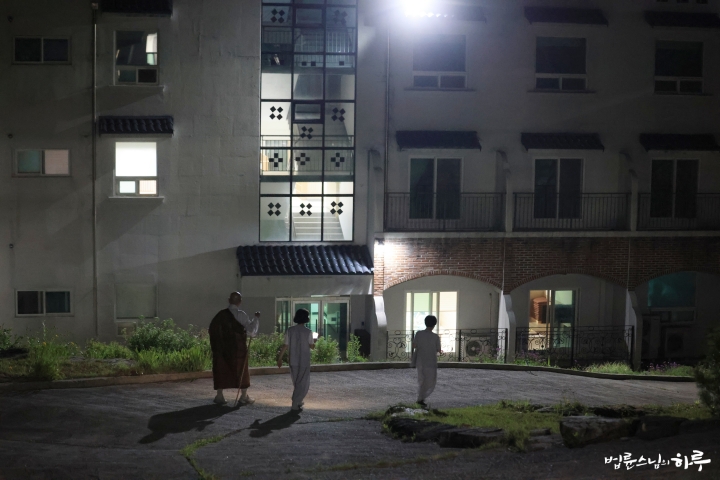
After finishing his time with the participants, Sunim packed his bags and boarded the vehicle. At 9:30 p.m., he left the training center and headed to the Dubuk Retreat Center. In the car, Sunim watched the final episode of SBS <Pomnyun Road - Sunim and Guests> and briefly closed his eyes for a rest. At 11:30 p.m., he arrived at the Dubuk Retreat Center.
Tomorrow will be Day 5 of the INEB schedule. The participants will dig potatoes at the Dubuk farm, hold a Weekly Dharma Assembly in the morning, visit Bulguksa Temple in the afternoon, and have a conversation time with the participants in the evening.
This post concludes with the participants' sharing from today.
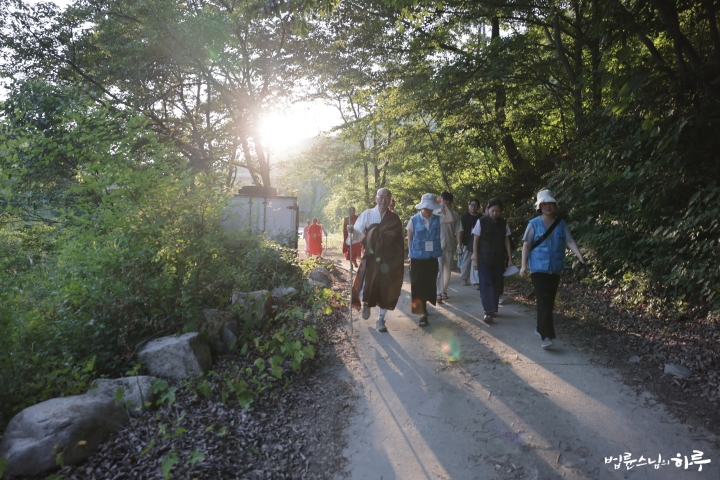
"I truly consider this a great blessing. Venerable Pomnyun Sunim shares so much with us. Sunim is like a good fruit tree—it's up to us to decide what we pick and what we can pick. A leader must treat everyone equally, and Sunim eats the same food as us at mealtimes. That is my goal as well. Our society is different from Korea and may not change easily, but I will start changing myself. We must have a compassionate and kind heart, and I could see that in Sunim and likewise in the members. I think one cannot become a Jungto Society member without a kind heart."
"Compared to other days, today was a day with a lot of physical activity. Walking like this cleared my mind and provided fresh stimulation. The time spent walking for a long time with friends from various countries and Venerable Pomnyun Sunim will be an unforgettable memory for me."
"Venerable Pomnyun Sunim's answers are always so clear that even I can easily understand them. Even though I don't know Buddhist terminology well, Sunim used many examples from daily life, which greatly helped my understanding. Today was my second day experiencing Barugongyang, and I'm gradually becoming captivated by its charm. I think the idea of finishing all the food without leaving any leftovers is truly beautiful. I plan to do this even after returning home. It also reduces the use of chemical detergents when washing dishes. It was a deeply inspiring experience for me."
"Watching the video of Venerable Pomnyun Sunim's activities today brought me peace of mind. I saw the true face of Buddhism in Sunim's actions and was deeply moved. When I later went for a walk, I saw the beautiful scenery stretching behind the mountains—scenery I had never seen in Myanmar, but it felt strangely familiar. It was truly a wonderful experience."
"I was deeply impressed by EcoBuddha. At first, hearing only the name, I thought it was related to economics, but I learned it was a concept connecting Buddhism with the environment. I found it fascinating to learn how Buddhism cares for the earth, the environment, and human beings."
"Today, I focused more on practicing mindfulness and accepting everything as it is."
"Watching Sunim personally inspect and check construction sites, carry loads, and do physical labor, I could see Sunim's true nature. This is because it's not a show for the cameras but a practice lived out in daily life. That's why it greatly inspires us."