When AI Eliminates Labor, Where Should We Find the Meaning of Life?
Jun 13, 2026 - Day 12 in Bhutan (Cabinet Ministers Meeting), Departure from Bhutan
"
Hello. Today is the day Sunim concludes all his work in Bhutan and returns to Korea.
Sunim began the day with early morning practice and meditation. After an early breakfast prepared with great care by Tashi, he started a meeting at 6:30 AM.
Tashi said:
"Sunim, did you sleep well?"
"You are welcome to come and use this accommodation anytime, Sunim."
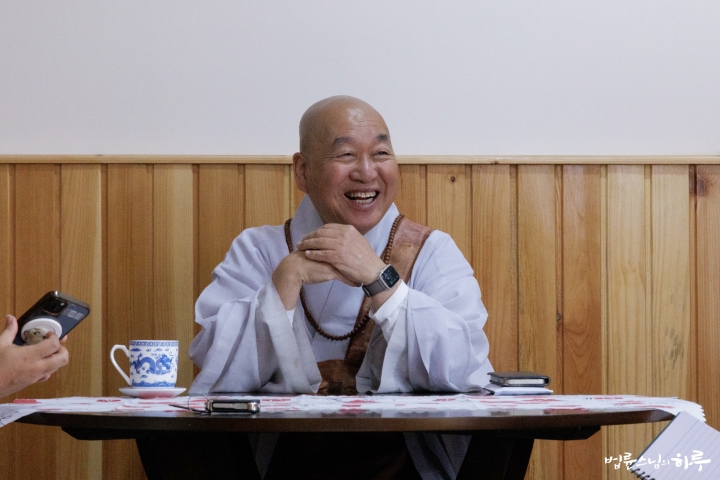
Sunim shared with Tashi what he had observed during his visits to the Zhemgang and Trongsa regions over the past 11 days.
"During this visit, I went to 112 out of a total of 225 project sites. The majority of the projects are taking place in Zhemgang Dzongkhag, with particularly many poor people living in four gewogs in the southern part of Zhemgang. For the housing improvement project, 94 new houses are being built and 36 are being repaired. Among them, I inspected 49 and 19 sites respectively. Visiting the sites directly, I found that most of the households applying for housing repairs were installing kitchens and bathrooms. Some villages were also paving parts of footpaths or roads. Among unpaved roads, the sharp curves and steep slopes that turn muddy when it rains are particularly dangerous. Since vehicles have difficulty navigating such places, the residents themselves are repairing village roads. Typically, road repair projects are limited to 100 meters at a time to prevent residents from being overburdened by communal labor. Road paving is underway at 22 sites, and I visited 9 of them. For footpath paving, 10 sites had applied and 7 had been completed. The drinking water improvement project had applications from 29 sites, and 6 had been completed. Since my health has not been good lately, there were some places I could not visit because the water tanks were located too high up the mountains or too far away to walk to.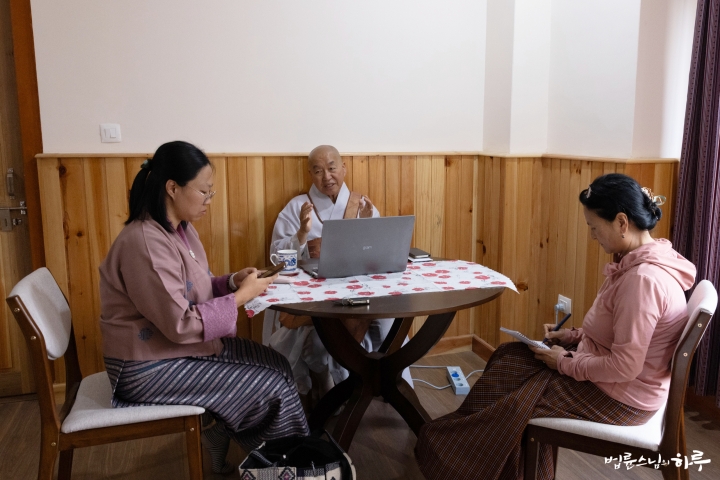
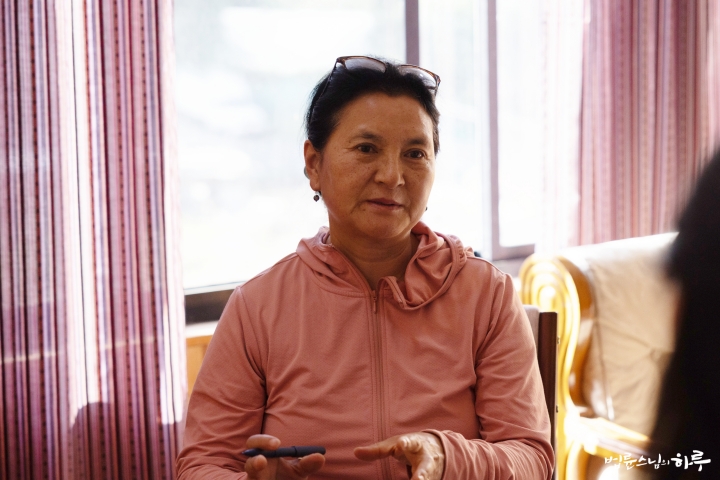
Tashi has been watching from the very beginning since Sunim's visit to Bhutan in 2023, when the concept of sustainable projects was established and operations were launched. Throughout the report on Sunim's specific activities, Tashi listened attentively with a serious expression and warm smile. Her trust and respect for Sunim were evident.
At 8:00 AM, Sunim left the accommodation to meet with Dasho Karma Tshiteem in downtown Thimphu. Dasho Karma Tshiteem is the former Chairman of the Royal Civil Service Commission (RCSC) of Bhutan and former Chairman of the Gross National Happiness (GNH) Commission.
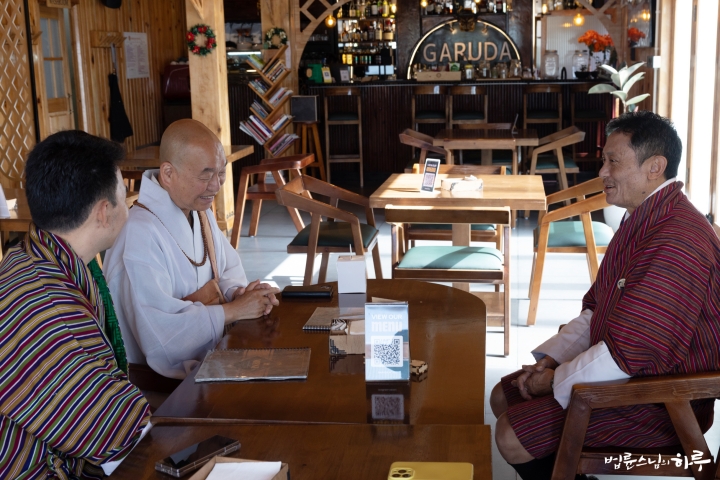
Every time Sunim visits Bhutan, he meets with Dasho Karma Tshiteem to share project progress and discuss future directions. Today's meeting was the first in eight months since last November.
"Thank you for making time on the weekend.""I'm always happy to meet with you, Sunim. (laughter)"
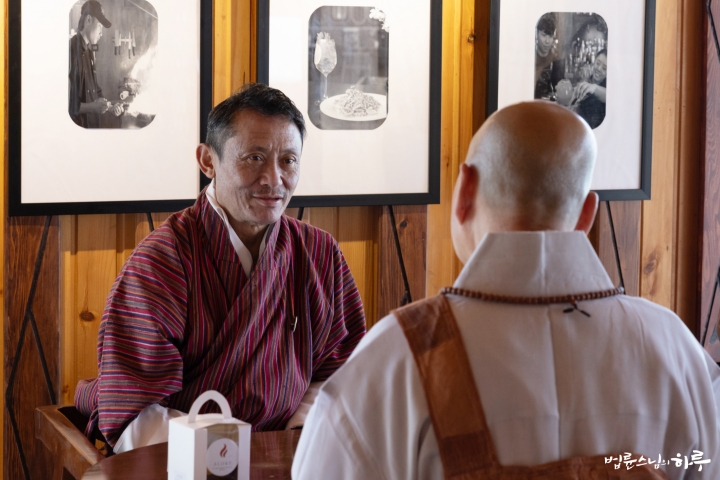
As he had shared with Tashi, Sunim also gave Dasho Karma Tshiteem a detailed report on his 11-day visits to the Zhemgang and Trongsa regions.
After listening to Sunim, Dasho Tshiteem said:
"From the villagers' perspective, the very fact that you, Sunim, travel to such remote, poor, and small villages to meet with residents, offer advice, and acknowledge their difficulties must be a great source of strength and motivation. Isn't that the greatest advantage of this project?"
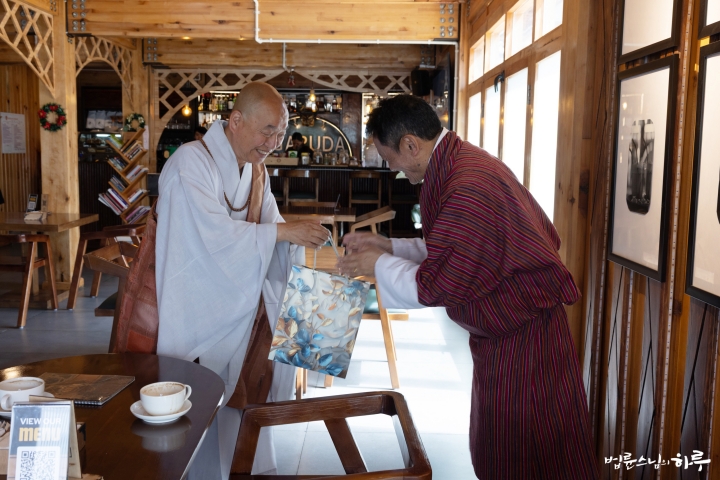
After the meeting, Sunim presented Dasho Karma Tshiteem with a book he had brought from Korea. As they parted, Sunim said:
"Thank you for understanding and supporting the sustainable project."At 9:30 AM, Sunim moved to another location for a meeting with officials from Bhutan's central government. As he entered the meeting venue, the Cabinet Secretary, who is the chief person in charge of the sustainable development project in Bhutan, and the Deputy Secretary of the Royal Office of His Majesty, who assists the King, warmly welcomed Sunim.
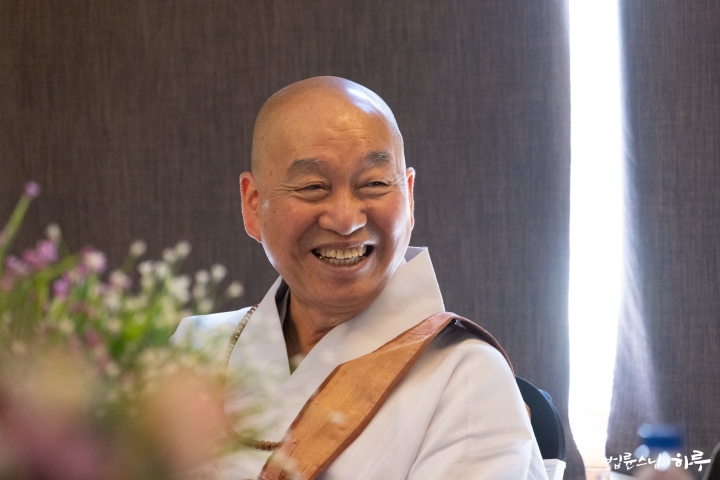
"Not at all, Sunim. The schedule in Korea was wonderful."
Sunim shared with the Cabinet Secretary and the Deputy Secretary detailed reports on what he had inspected during his visits to the Zhemgang and Trongsa regions.
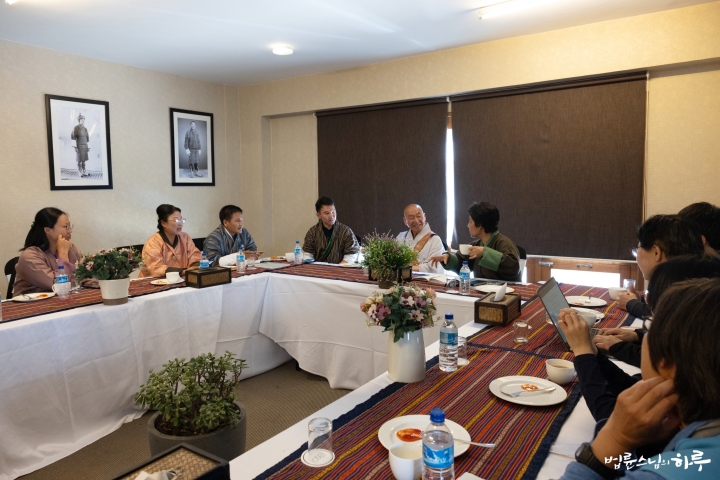
In addition, Sunim explained the inspection points for each project and suggested necessary improvements going forward.
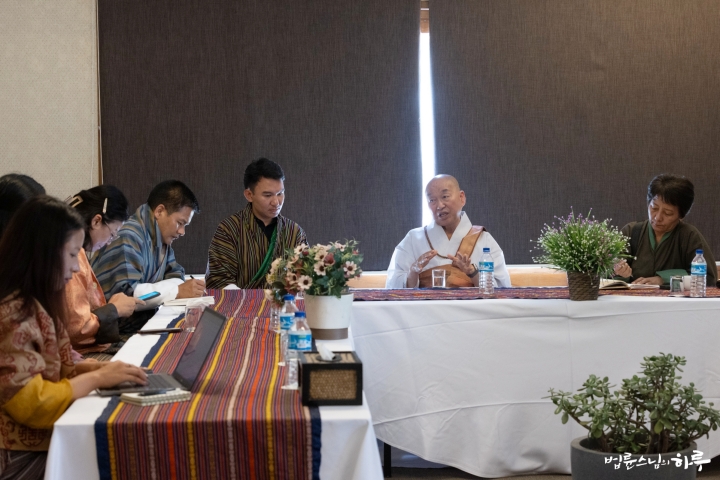
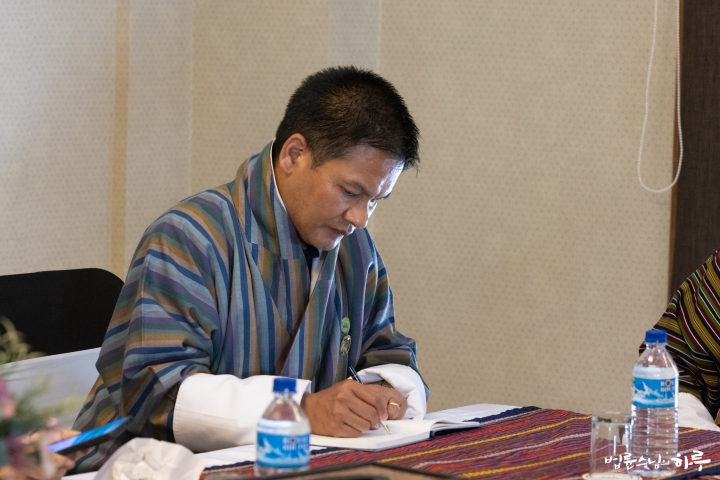
In addition, Sunim talked in detail about the points he had inspected regarding drinking water, footpaths, road repairs, and school projects. The Cabinet Secretary and Deputy Secretary of the Bhutanese government listened attentively to Sunim's explanations and took careful notes.
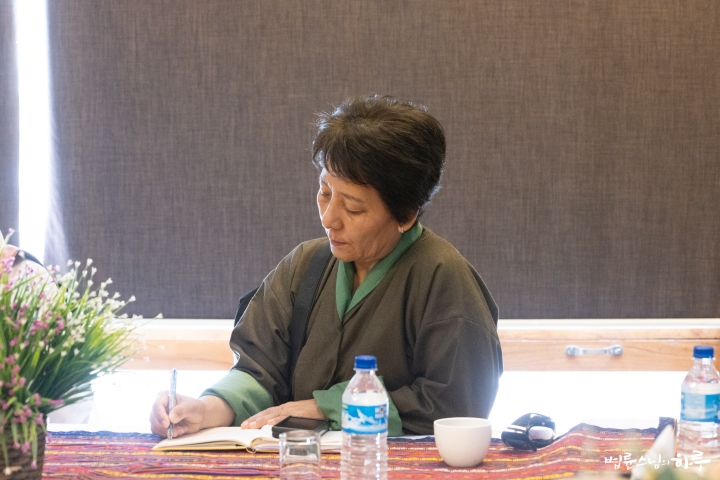
The Cabinet Secretary said:
"Sunim, thank you very much. We will carefully look into the matters you mentioned."
Then Sunim continued:
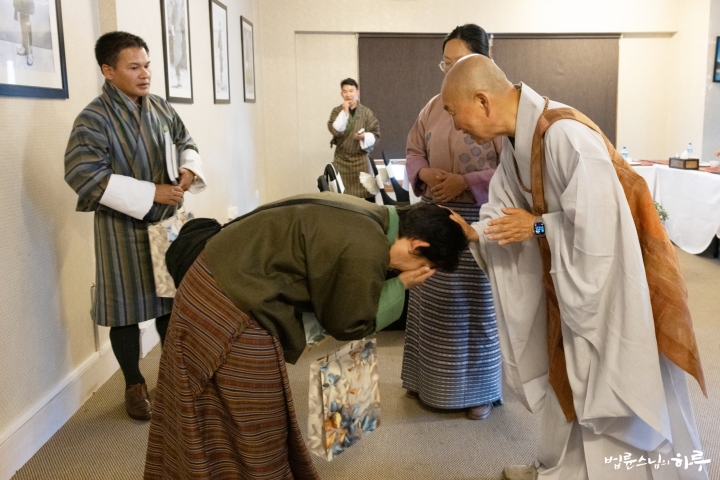
"My visits to each village are not for the purpose of supervision. They are to acknowledge how much people are struggling to live well in difficult environments. Even when villagers sweat and toil to carry out projects, no one recognizes their efforts. At the very least, I felt I needed to visit the villages and encourage them by saying, 'You must have worked hard. You've done well.' While conducting field inspections, I also see what difficulties the villagers face, and improvements need to be made where necessary. Only then can I make decisions even when receiving written reports on the Bhutan project situation from Korea. I can only know the details by visiting the sites this way; otherwise, it's not easy to properly understand the project sites."Sunim has been personally visiting one village after another, seeing and feeling people's difficulties, offering solutions, and extending a helping hand. As a result of examining not only the circumstances of each village but also of each household, Sunim knew the situation of every corner of Bhutan better than anyone else. As the meeting concluded, Sunim presented the two officials with the gifts he had prepared.
The Cabinet Secretariat prepared lunch for Sunim and his group.
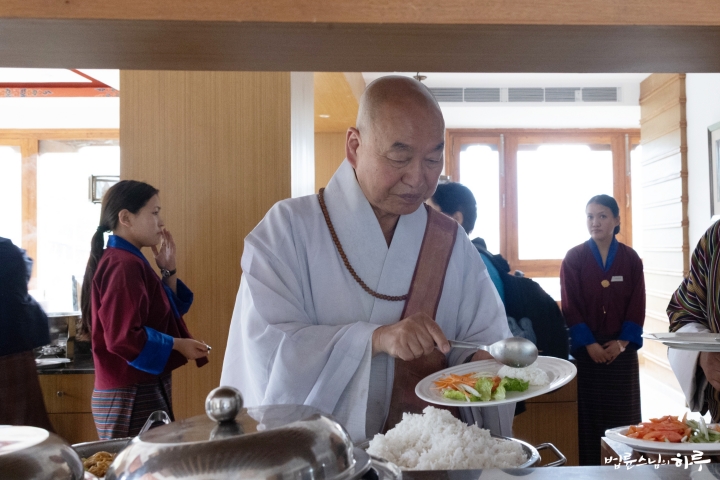
After finishing lunch, Sunim stopped by Tashi's house again and had a conversation about the "Gelephu Mindfulness City," a mega-development project the King is pursuing for Bhutan's future. As they talked, it was soon time to head to the airport, and they departed in haste.
The Bhutan JTS volunteers, who had accompanied Sunim to inspect every project site over the past 12 days, now had to say goodbye to him. They had faced and resolved both big and small incidents, energetically conducting site inspections and completing activity reports despite the packed schedule. Before Sunim boarded the vehicle to the airport, the volunteers greeted him with palms together in a half-bow.
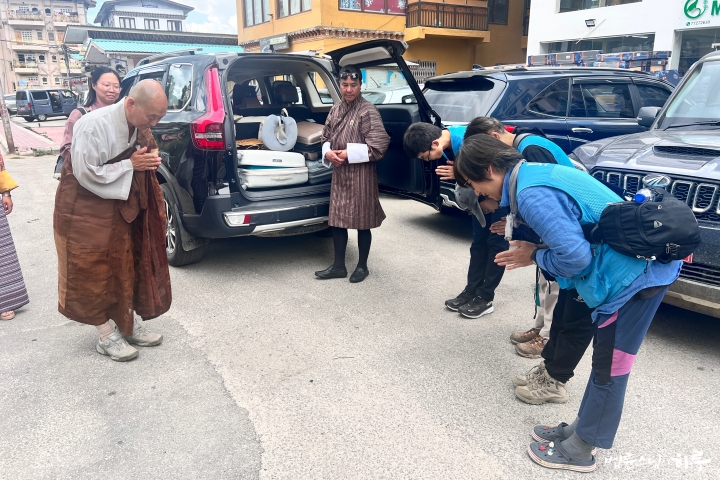
"Goodbye, Sunim. We'll see you in Korea."
"Thank you all for your hard work."Sunim waved goodbye to the Bhutanese volunteers with a bright smile. Upon arriving at Paro International Airport, Sunim completed the check-in procedures and headed to the departure area.
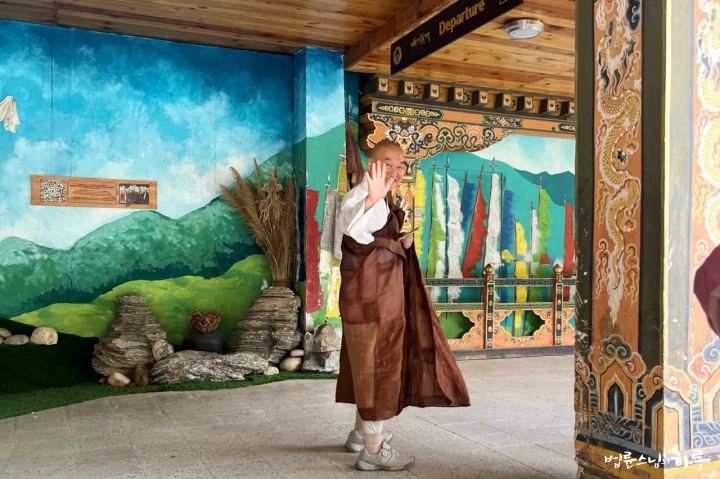
Sunim boarded the 4:20 PM flight (Bhutan local time) and headed to Bangkok.
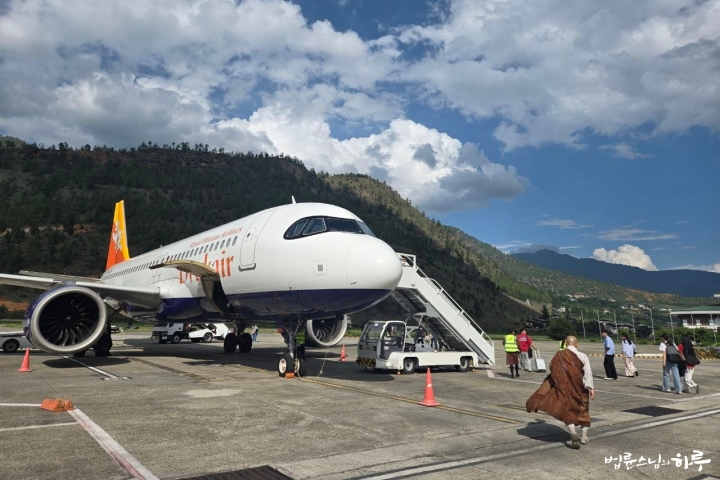
Arriving in Bangkok at 8:20 PM local time, he is scheduled to board the next flight departing at 11:20 PM to Incheon (인천) International Airport. Hwang So-yeon (황 소연) and her husband came to Bangkok airport to help Sunim with his connecting flight. While waiting for the next flight in Bangkok, Sunim proofread manuscripts and handled administrative work. After boarding the flight to Incheon, Sunim rested while flying through the night.
2026 INEB Study Trip Begins
Meanwhile, while Sunim was traveling from Bhutan via Bangkok to Incheon International Airport, the 2026 INEB (국제참여불교연대, International Network of Engaged Buddhists) Jungto Society study program began at the Jungto Social and Cultural Center (정토사회문화회관) in Korea. From June 13 to June 21, over the course of 9 days and 8 nights, 16 participants from 8 countries will gather to learn about, discuss, and exchange ideas on the thought and activities of Venerable Pomnyun Sunim and Jungto Society.
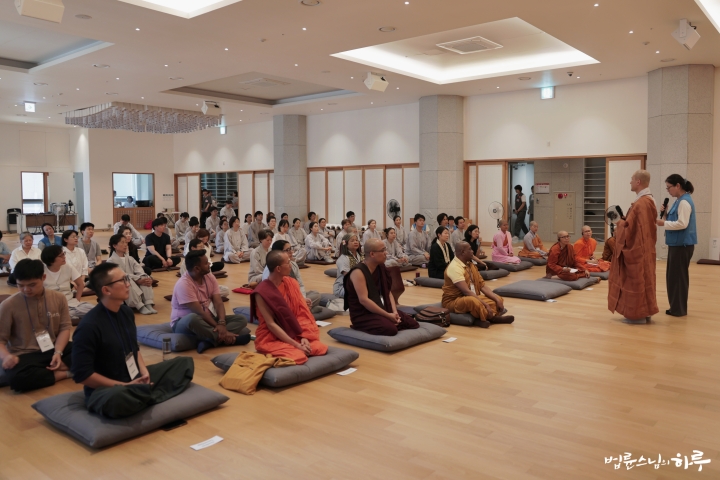
At 3:00 PM on June 13, a welcome ceremony for INEB participants was held in the Dharma Hall at the Seoul Jungto Social and Cultural Center. The ceremony began with introductions of the participants and a welcome address by Yusu Sunim (유수 스님), followed by a welcome song by young volunteer Nam Sujeong (남 수정). After that, bags, materials, notepads, and toothbrush sets to be used during the program were handed out to participants along with roses as a symbol of welcome.
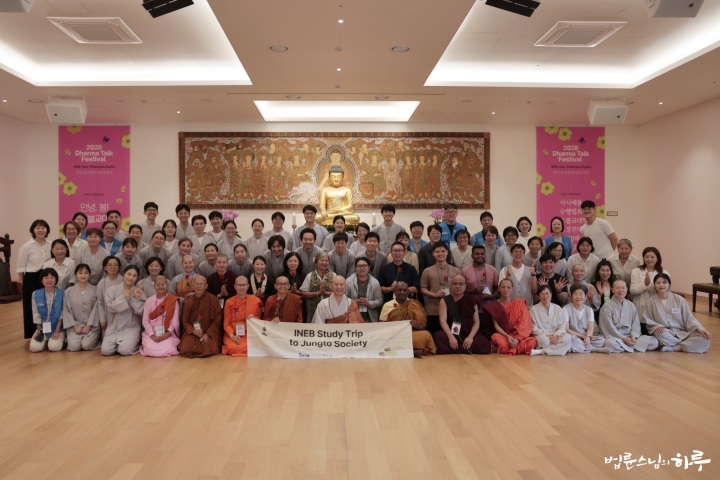
The simple yet warm welcome ceremony concluded with a group photo, and participants received guidance on the overall schedule and daily life through the orientation that followed. At 5:30 PM, they had dinner together, and at 7:00 PM, they held evening prayer service in the Dharma Hall. Afterward, the participants took time to rest and recover from their journey.
Tomorrow, after arriving at Incheon International Airport, Sunim will join the participants for the INEB program at the Jungto Social and Cultural Center. Starting tomorrow, we will share news about the INEB program.
Since there was no Dharma talk today, this post concludes with one of the Dharma Q&A conversations Sunim had with Korean residents in Bhutan yesterday.
When AI Eliminates Labor, Where Should We Find the Meaning of Life?
"Rather than finding meaning in life through labor, modern people can be said to find meaning in life through consumption. People are working themselves to death just to be able to consume. From now on, even if people set consumption as their goal, rather than placing consumption itself at the center, they should find meaning in life through the process of labor toward that goal. In other words, process should become more important than results. However, if everything moves toward automated production in the future, only a small number of people will do creative work, while the majority may work only partially or not at all. In that case, it's possible that the state will provide minimum living expenses in the form of basic income. This means we could become a society where, with basic income, people can live without major difficulties even with a little less than they have now. If people no longer engage in productive labor, where will they find meaning in life then? From the perspective of past values, a life where one can live without working might seem like arriving in the Pure Land. We may soon reach a society close to the ideal that humans have dreamed of. But we need to consider whether this is truly an ideal society or, on the contrary, a disaster that will bring tremendous confusion. For example, the main exercise for animals is running around to find food. In the past, labor itself was exercise for humans too; there was almost no concept of exercising separately. However, as the structure of production and consumption changed, we have entered an era where we must exercise separately for our health. Animals in their natural state don't exercise for health. Running around for survival is itself exercise. Just as we now have to exercise separately, an era may come when we have to seek meaning in life separately. Similarly, we need to newly organize where we will place the meaning of life going forward. Whether we place meaning in eating three meals a day, or in other values beyond that. If these issues are not sorted out, many people may face the risk of falling into apathy. They will face various forms of addiction crises, whether drug addiction or gaming addiction. If an era comes when we must live by regulating ourselves without labor, meditation could be one alternative. However, simply meditating doesn't solve all problems; rather, meditation can be one alternative. It teaches us how to remain peacefully calm without doing anything. People think they must constantly move, no matter what they do. They find it difficult to stay still. They don't know how to be at ease while staying still. So they always try to do something—watch TV, smoke, drink, or play games. It seems this is because culture and activities that allow people to be at peace while staying still have not yet developed sufficiently. So while meditation is one way to discipline oneself and calm the mind, I think volunteer service done without expecting any reward is even better. From a Buddhist perspective, this can be said to be walking the path of the Bodhisattva. The concerns you raise may seem hopeless from today's values. But from the perspective of practice, it's not necessarily so. On the contrary, if we become a society that values the environment and human worth more, even without engaging in production activities, it could become a better society. If our values are clear, the slower the economy grows, the better. When growth stops, we damage the global environment less, and people have more time for volunteer activities. Conversely, if there are too many opportunities to make money everywhere, everyone will go to make money, and there may be no one left to volunteer.""I really enjoy watching science YouTube channels. Many professors who appear on those channels say that in the near future, when generative AI takes over much of the work, the way people find meaning in life through labor will also change significantly. I think so too. In my view, Bhutan may change at a slower pace, but Korea is changing so rapidly that many people will likely experience psychological anxiety during the transition period. So I think that the Mindful City being developed in the Gelephu region could provide a space for people seeking changes in perception or new meanings in life. Right now, people seem overly focused on labor, but where should we find meaning in life going forward?"
"Then in a society with guaranteed basic income, will there be fewer people who need help?"
"Not exactly. If human difficulties were resolved through practice, that would be an ideal society. However, even in a society with guaranteed basic income, income gaps can still exist, so difficulties can also remain. For example, in Korean society today, people think you need to earn about 3 million won per month to make ends meet at a minimum. But if only the poorest receive a basic income of 3 million won while everyone else earns hundreds of millions of won, another problem arises. Even though the lowest class won't starve and may escape absolute poverty, they will eventually fail to find satisfaction due to the relative deprivation that comes from income gaps. From the Bhutanese perspective, it's hard to understand why young Koreans suffer from a lack of jobs and even commit suicide. This is because in Korea, you can earn about 2 million won per month working anywhere. Yet Korean youth today are tremendously angry. This is because after graduating from college, working at a job, saving up salary to buy a house or get married has become virtually impossible without inheriting wealth from parents. If they had experience living in places with worse conditions than Korea, they might view Korean society differently, but current Korean youth may, in some ways, feel even more bleak about the future than Bhutanese youth. In particular, there is fierce dissatisfaction and resistance against the surge in real estate prices. As a result, young people are increasingly falling into superstitious thinking. So many young people believe that going to a certain mountain will bring them good luck that the mountains are bursting at the seams. This is because they feel the future is completely uncertain through the conventional means they learned in school. So they come to think that the only way is to make a lot of money by buying coins or hitting a jackpot by investing in particular stocks. They think that their success or failure depends entirely on luck. So they keep searching for things that might bring them luck. From a mental perspective, this state is worse than the superstitious practices uneducated people used to engage in in the old days. It's not just praying for one's son to do well like in the past, but a psychology that wants only a windfall or a huge fortune. To escape from this state, it's good to come to places like this and do volunteer work. Through volunteering, people realize, 'It's okay to live like this.' We need to ask ourselves whether it's better to live a life sweating through volunteer work, or a life sitting in a room just watching Netflix and playing games. Is sitting still and only playing games really a healthy life? It's necessary to come to places like this for volunteer work and personally experience things—going to the mountains and fields, farming, helping to build houses. They need to realize this through their own experience, not because someone teaches them with words. That's why we need to send young people outside as much as possible.""