We Got Here Through Many Lessons and Experiences.
June 12, 2026 – Day 11 in Bhutan (Inspecting Gewogs in Langthel and Tangsibji, Trongsa District)
Hello. This is the 11th day of the Bhutan field visit. Today's schedule included on-site inspections of Nubi Gewog and Tangsibji Gewog in Trongsa District, followed by traveling to Thimphu for a meeting with Dasho Passang Dorji.
Sunim began the day with early morning practice and meditation. After breakfast at 6 a.m., prepared by the Bhutanese volunteers, Sunim met the district governor's party at 7 a.m. and began the on-site inspection of Nubi Gewog. On the way to the site, there was a house nearby whose roof had been repaired, so the group decided to stop and look around.
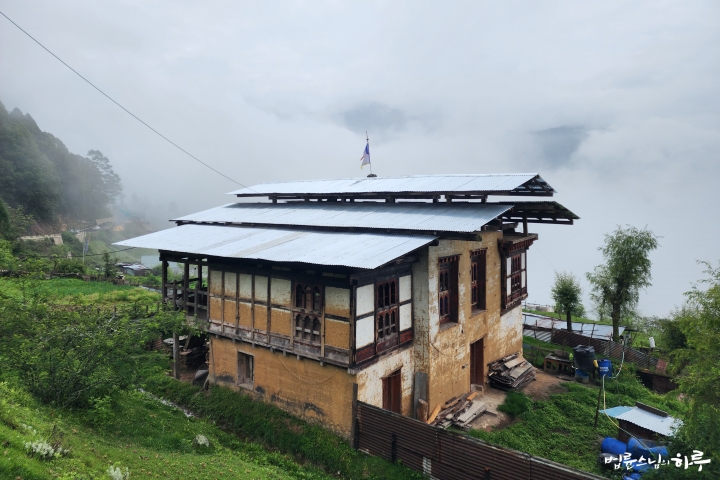
Three sisters who are deaf live together in this house. The roof had become very old, causing leaks and collapse, but since most of the family members had disabilities, it was difficult for the homeowner alone to undertake roof repairs. The Tshogpa, who was well aware of the family's situation, applied to the JTS housing improvement project, and the villagers joined together to build a new roof for the family. After hearing the story, Sunim expressed gratitude to the Tshogpa and the villagers, and gave the homeowner a wrist mala as a gift.
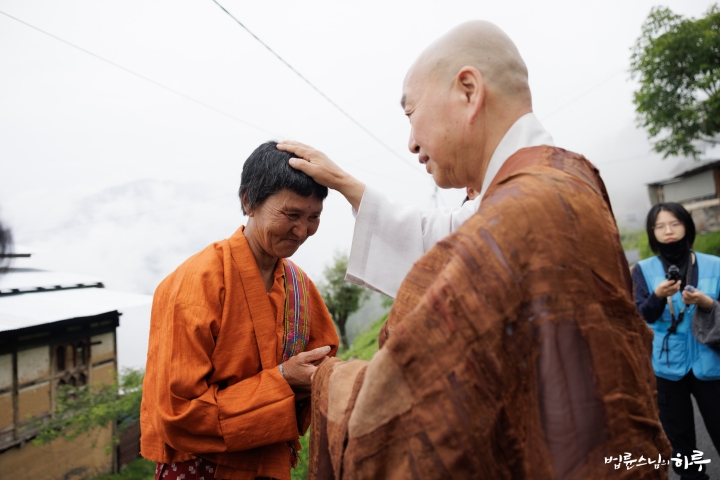
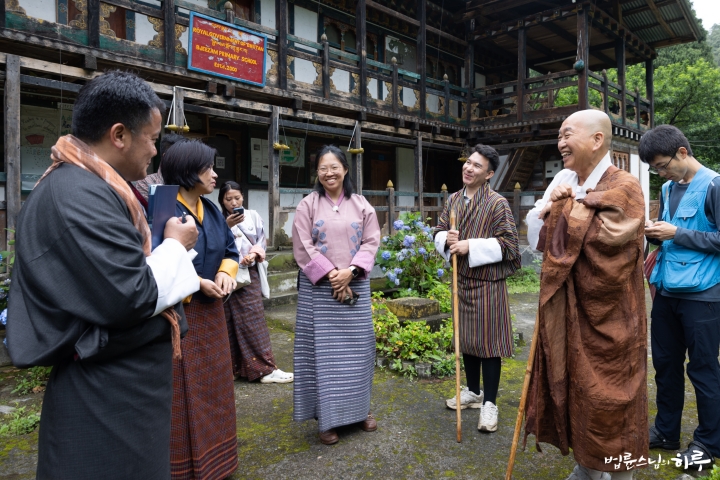
On the way to Bji-Sengm-Bji Gewog, the Trongsa district governor asked Sunim to look at a closed-down school building and consider how it might be used. The school had closed earlier this year due to a decline in student numbers and was currently under the management of the district government. However, no suitable plan had been found for utilizing the building, so the governor said he was deliberating on its future use.
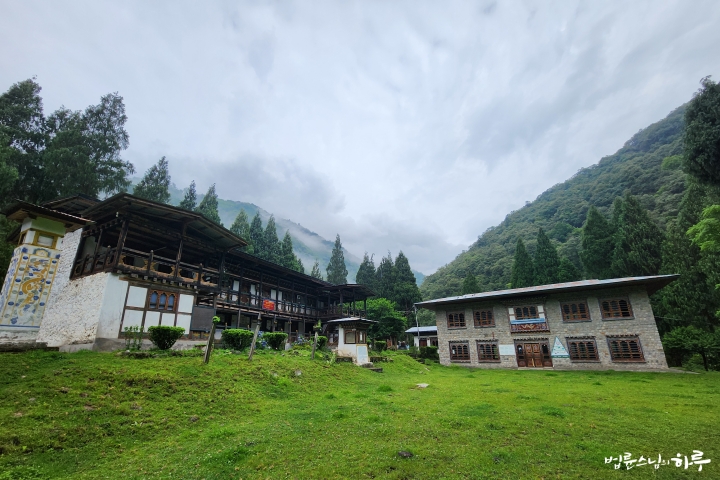
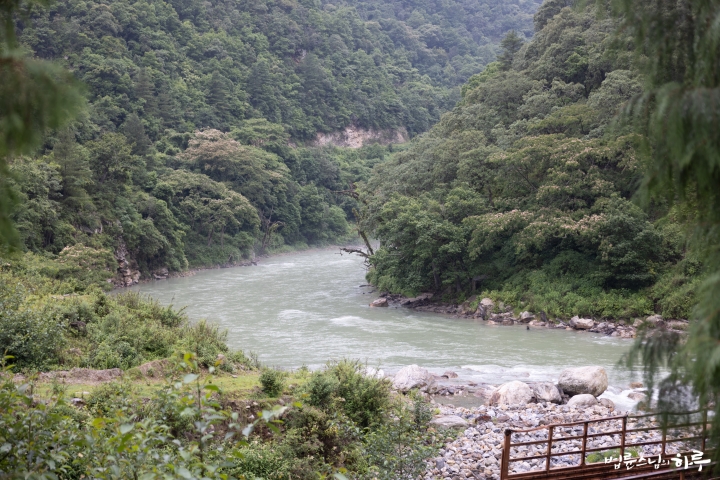
Sunim and the governor toured the closed Jijam Primary School building. There were several buildings, including classrooms and teachers' quarters, and a large valley flowed in front of the school, making the scenery very beautiful. Since the school had only recently closed, the facilities had not deteriorated, and it seemed they could be used right away without major renovations.
The governor said:
"Although the school is closed, it's still in good condition. I'm worried that if it's left like this, it will soon fall into disrepair, Sunim."
Sunim smiled and said to the JTS volunteers:
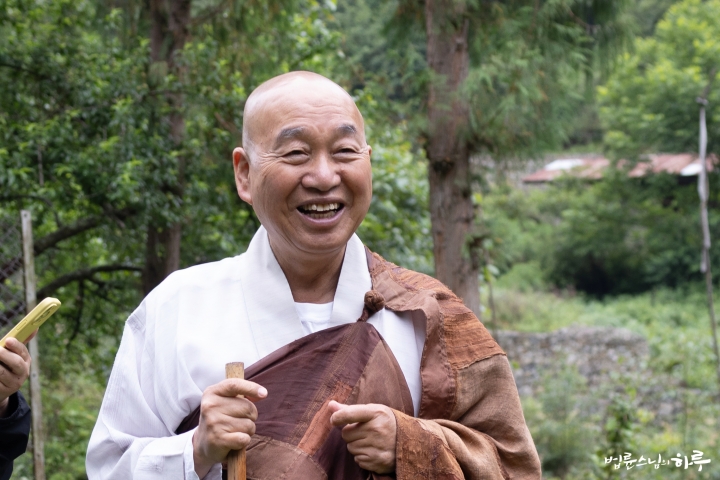
Everyone at the site burst into laughter at Sunim’s completely unexpected idea. Sunim decided to consider further how to use the closed school together with the governor, and then moved to the location of the fence completion ceremony at Bji-Sengm-Bji Chiwog.
Upon arriving at Bji-Sengm-Bji Gewog and inspecting the fence the villagers had built, it was found that the barbed wire was loosely strung and the posts were not properly secured.
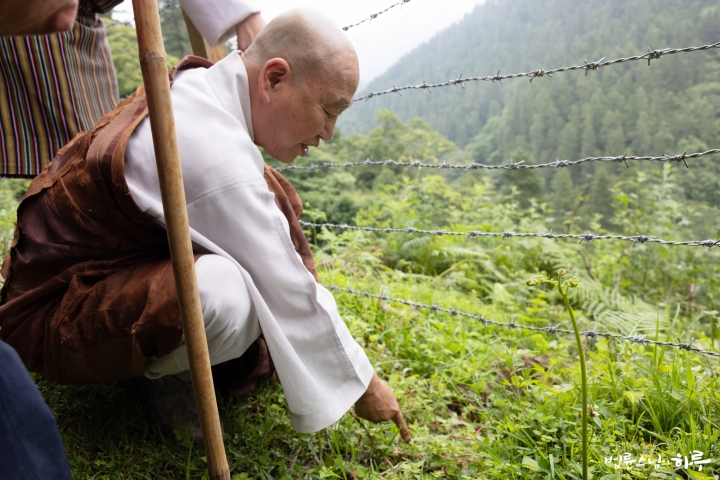
"No. The fence was installed a month ago. The villagers divided the work into sections, and this section was assigned to an elderly woman with little strength, so it ended up loose. (laughter)"
Although the finished product was somewhat lacking compared to professional work, it was a moment that confirmed the fence had been built through the combined efforts of all the villagers — men and women, young and old. Sunim expressed gratitude for the villagers' hard work and held a completion ceremony to celebrate the finished fence.
"I hope that, with the protection of the mountain god, this village will no longer suffer damage from wild animals."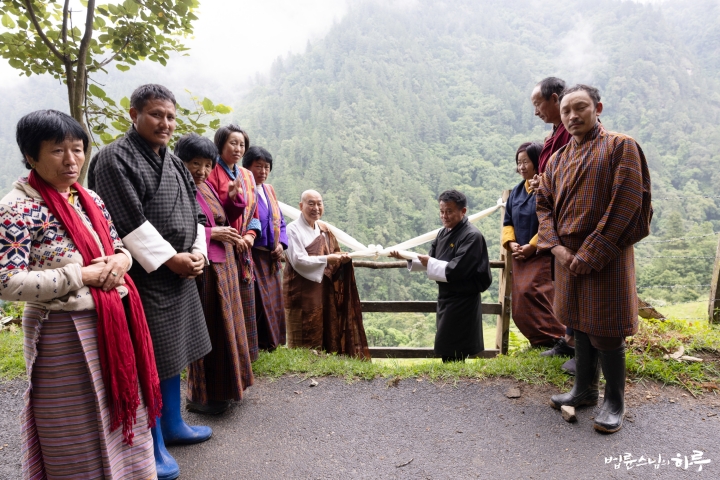
The villagers offered Sunim rice that they had grown themselves. Sunim gratefully accepted the villagers' sincere offering and then returned the rice to the villagers. He explained it in the Bhutanese way so that everyone could easily understand:
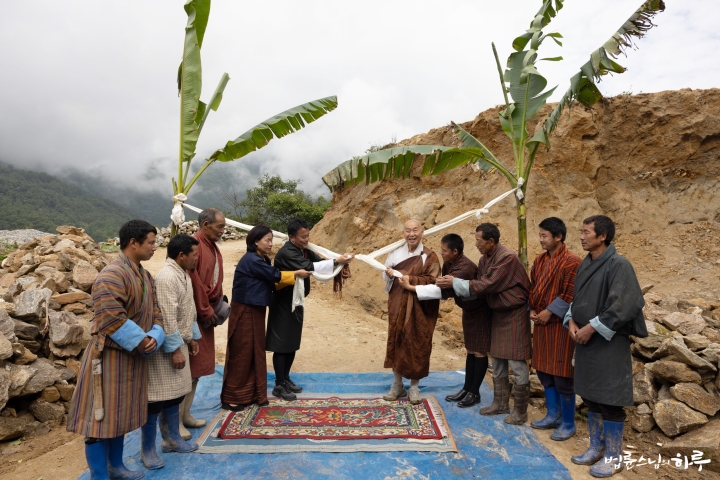
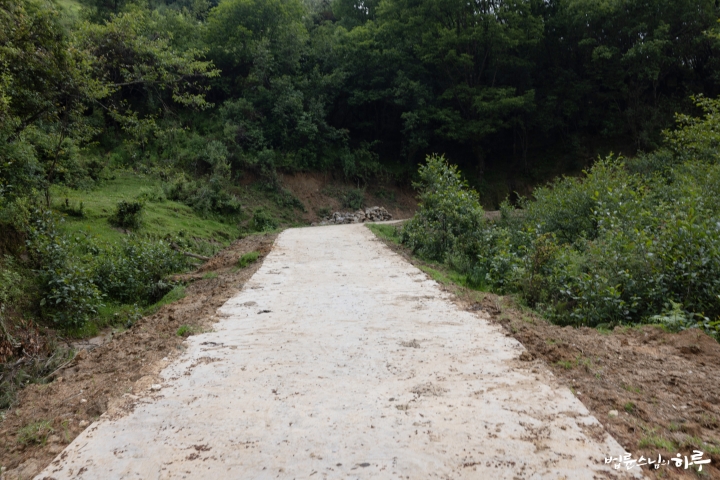
"Since this is rice that has been blessed by Sunim, you will be healthy when you eat it. The offering has already been well received by me."At 8:30 a.m., Sunim moved to the third inspection site, Simphu-Daba Gewog. Upon arriving at Simphu-Daba Gewog, the residents were waiting for Sunim on a 100-meter road that they had paved themselves. Sunim first held a completion ceremony with the governor and the residents.
After the ceremony, Sunim inspected the road.
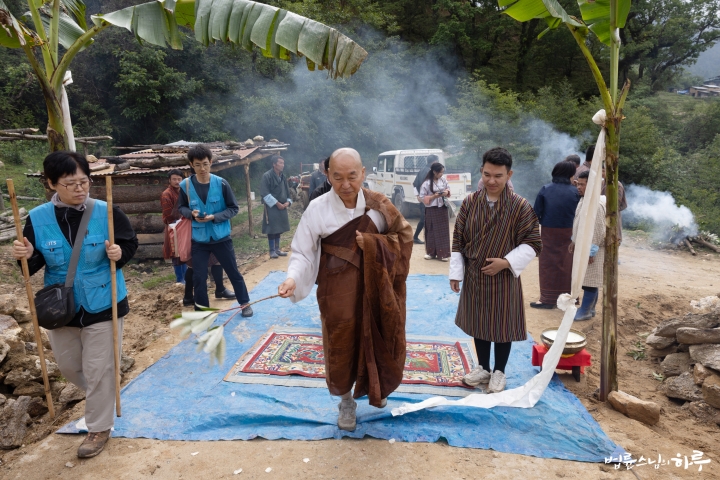
The Tshogpa said:
"Sunim, there are still more sections where cars need to pass. May we proceed with additional road construction?"
"Building village infrastructure such as roads, electricity, and water supply is actually the government's responsibility. But because the government has so many things to do, it takes a long time for support to reach small villages like this. From your perspective, this is the entrance to the village and a road you use frequently, but because it's a steep dirt road, vehicles had difficulty going up and down. So you can understand it this way: before the government formally builds the road, you came together to temporarily improve the village environment. JTS cannot support paving all the roads in the village."Sunim asked the villagers:
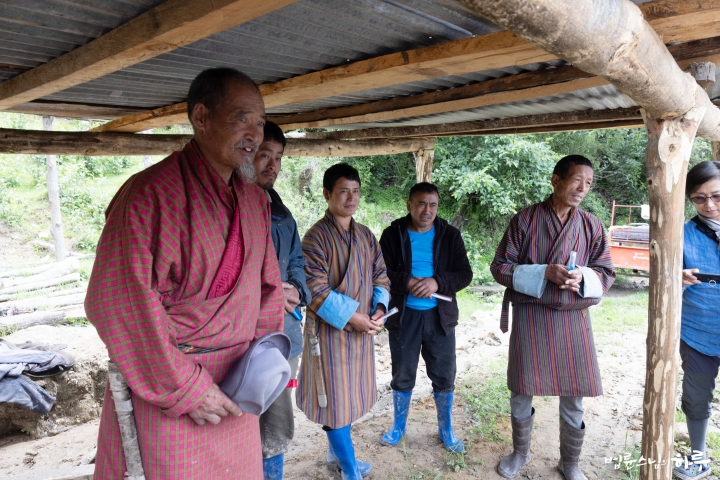
"No."
"The Tshogpa says you want to do more construction, but if it's too hard, you don't have to. Does everyone want to do it?""Yes. The additional section we're requesting is actually a place that needs improvement."
"Are you really going to do it? Are you doing it because you want to? Or are you being forced?""We're doing it because we want to. (laughter)"
After a brief conversation with the villagers, Sunim gave each resident a wrist mala as a completion ceremony gift and offered a blessing.
"I hope that no accidents will occur to the vehicles and people using this road. I hope that great merit will come to all those who worked hard to build this road. I hope you live healthy lives, free from disaster and disease. The merit of building a road where there was none is very great."Next, Sunim moved to Bemjee Gewog to inspect a road repair section.
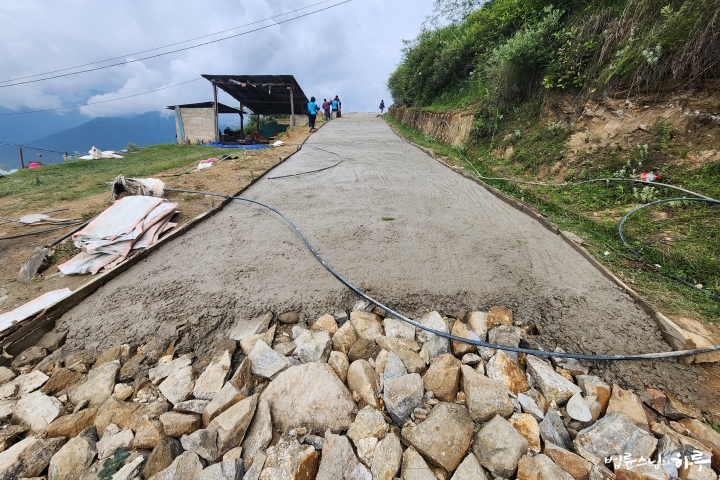
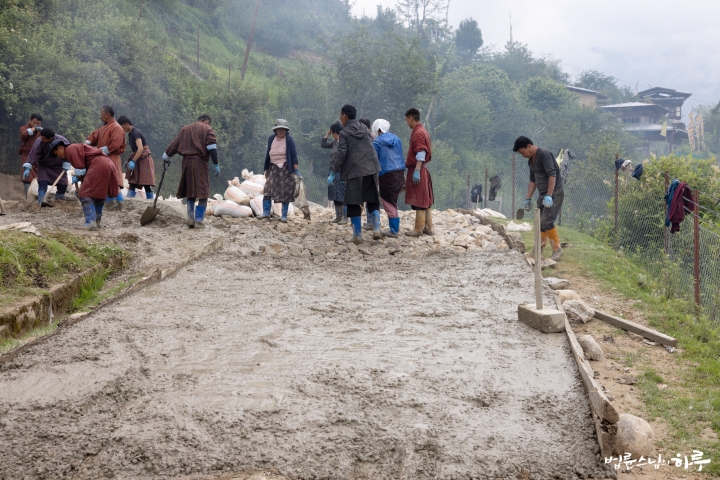
The villagers were carrying out the construction, and Sunim encouraged them and gave each one a wrist mala as a gift.
Sunim then moved to the nearby Bemjee Primary School.
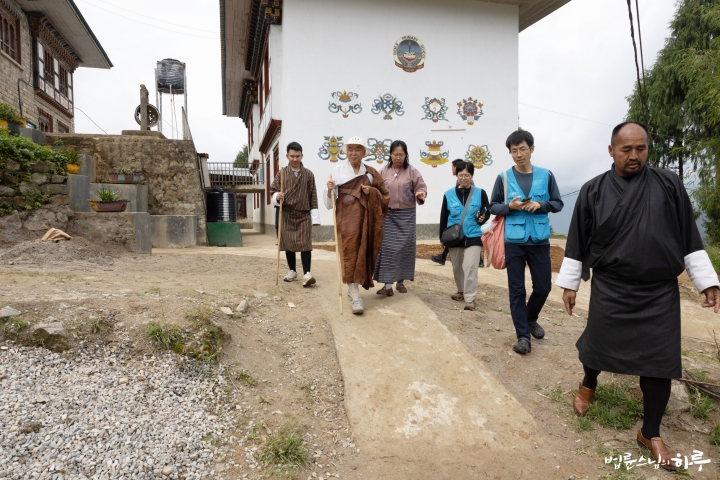
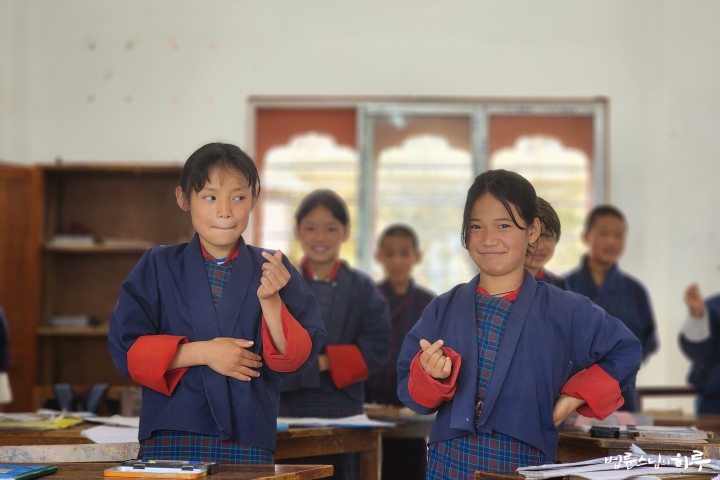
Bemjee Primary School has 114 students, and because bears and leopards had been entering the school grounds, window repairs were absolutely necessary. They were able to apply to the JTS project this time, and walkways for the students within the school grounds were built and the dormitory windows were repaired.
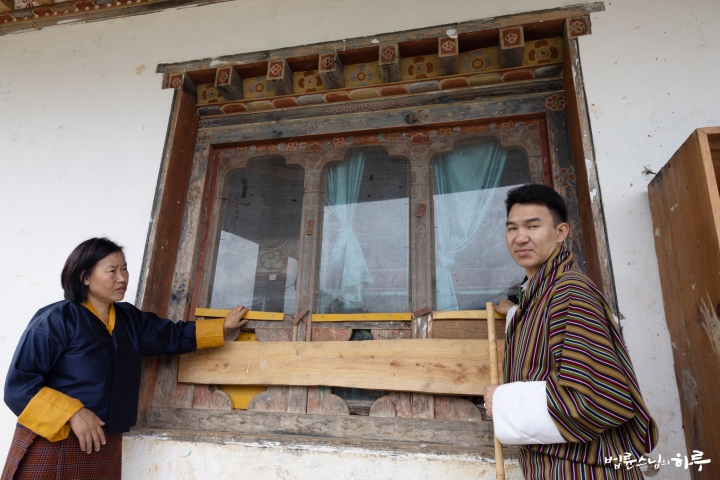
Upon inspecting the construction, there were some shortcomings with the walkway. Sunim discussed this with the principal and the Bhutanese volunteers and arranged for additional cement to be provided so that the walkway construction could be completed. The school had prepared tea for Sunim's party, but today the schedule was tight since they had to travel to Thimphu after finishing the inspection.
"I'm sorry that we have to leave without having the tea you prepared. While looking around the school, I noticed that the door to the girls' dormitory bathroom is rotting. Please apply to the JTS project to have it repaired."Sunim apologized to the teachers for not being able to have a tea conversation and, to the very end, carefully attended to the small details that needed repair.
Next, Sunim moved to Tangsibji Gewog, the last site of this Bhutan field visit. He inspected the agricultural irrigation channel and road repair site at Tangsibji Chiwog in Tangsibji Gewog. Rice seedlings had been planted in the terraced paddies, creating a green landscape, and water was flowing well through the newly built irrigation channel.
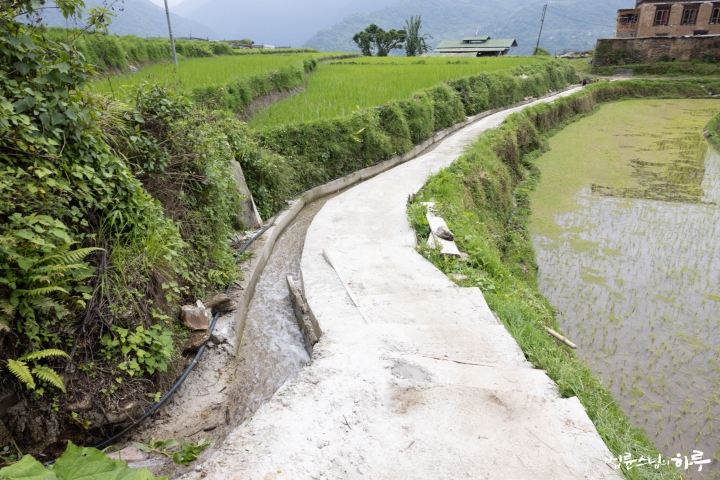
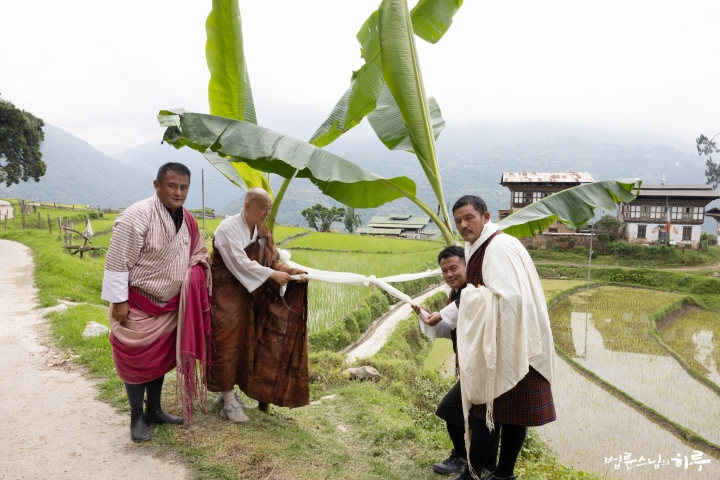
The agricultural irrigation channel and walkway construction had been completed well, but the road repair work had not yet begun. Sunim went to the site himself to take a look.
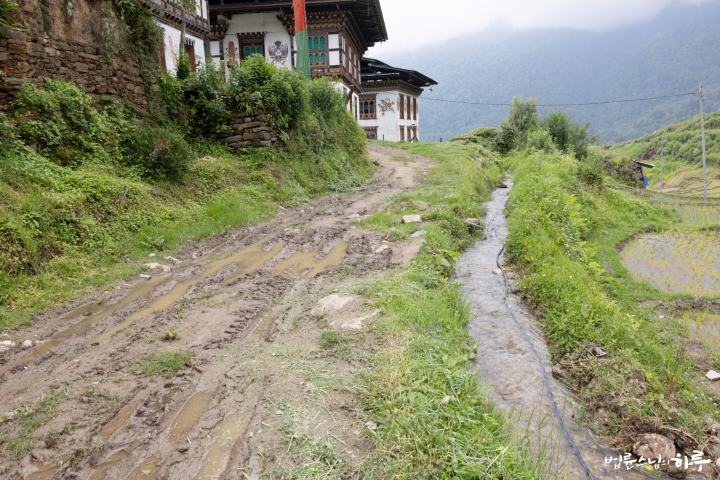
Although the ground was muddy, the slope wasn't too steep, so Sunim asked whether it would be enough to lay gravel to finish it, and confirmed again with the villagers what this road was used for.
"Is this the road you use to go to the temple?""No. It's a road to the temple, but it's also used to go to the rice paddies, so if it's paved, we can use a power tiller."
"Then laying only stones won't be enough. You'll need to lay stones and pour cement. The work will be hard — can you handle it?""Yes! We can do it."
"Then since this is a road within the village, you can pave the road and have it serve as a walkway at the same time."With Tangsibji Chiwog as the last stop, the field visits in Trongsa District were all completed. Sunim presented a gift to the planning officer of the Trongsa District Government, who had been working hard on-site managing multiple projects simultaneously.
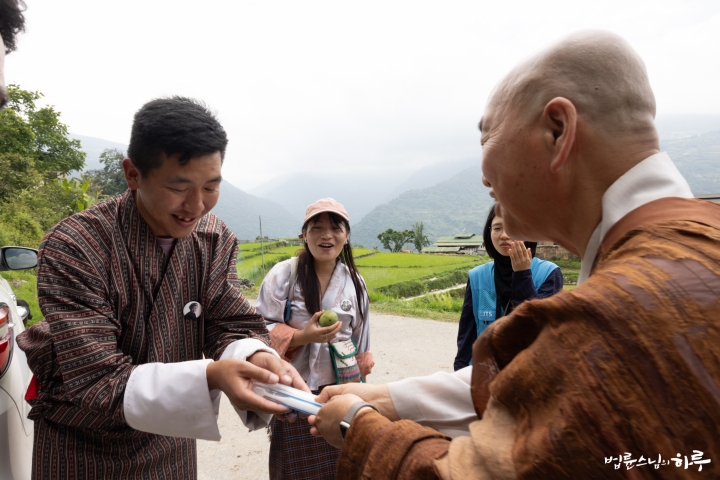
Over the past 11 days since arriving in Bhutan on June 2, Sunim had completed inspections of all 108 sites where JTS projects had been carried out . Sunim then departed Trongsa with the Bhutanese volunteers and headed for Thimphu for the next part of the schedule.
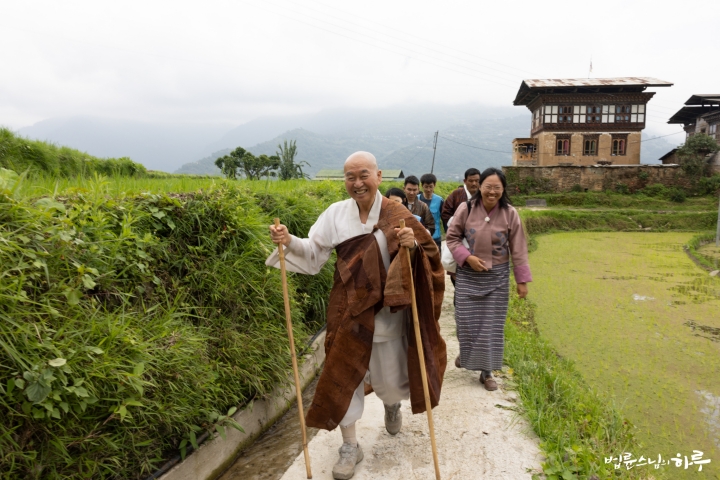
On the way to Thimphu, Sunim had lunch with the Trongsa district governor. At lunch, Sunim took the opportunity to introduce the JTS volunteers to the governor.
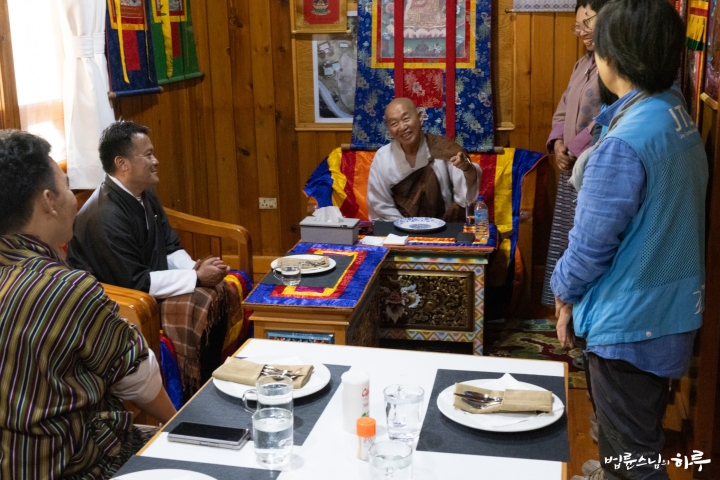
The Trongsa district governor said:
"I've always met them coming and going, but today is the first time I learned who is in charge of what role. (laughter) Thank you for carrying out the JTS project in Trongsa."
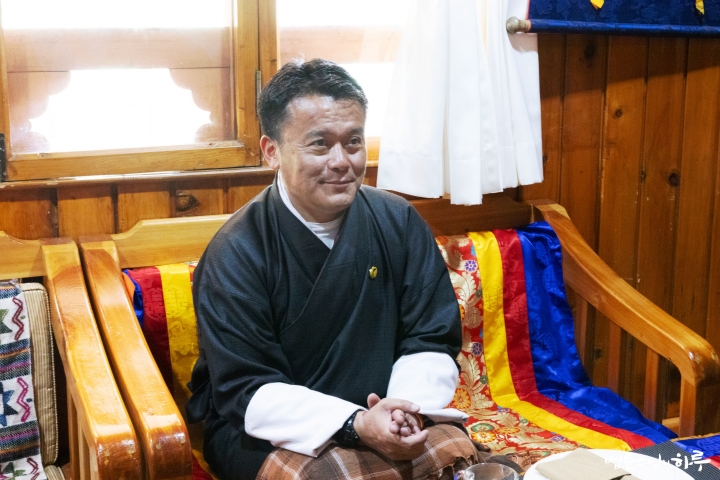
Sunim also discussed with the governor possible new uses for the closed Jijam Primary School visited that morning.
"It could be used as a producers' cooperative for the residents, or the district government could use it as a training facility for civil servants. Another idea is to turn it into a rest area along the Zhemgang–Trongsa route, where crafts and tea from the Zhemgang–Trongsa region could be displayed. It would be nice if it could be a space where tourists can use the restroom, take a break, view the exhibits, and have tea.""Sunim, your suggestion is also a good one. However, there are already two or three similar spaces near Trongsa. My thought is — how about making it a center that JTS volunteers can use as a base when working in Trongsa, while the local residents also use it together? When residents use it, it could serve as a space for processing produce they grow themselves, a place to learn new farming methods such as greenhouse cultivation, or a place to learn skills such as woodworking."
Continuing the conversation, Sunim and the governor also discussed the potential for specialty products and processed goods from the gewogs near Jijam Primary School. After the conversation, Sunim, the Trongsa district governor, and the Bhutanese volunteers headed once again for Thimphu.
At 4 p.m., they arrived at Dochula Pass, at an altitude of 3,000 meters.
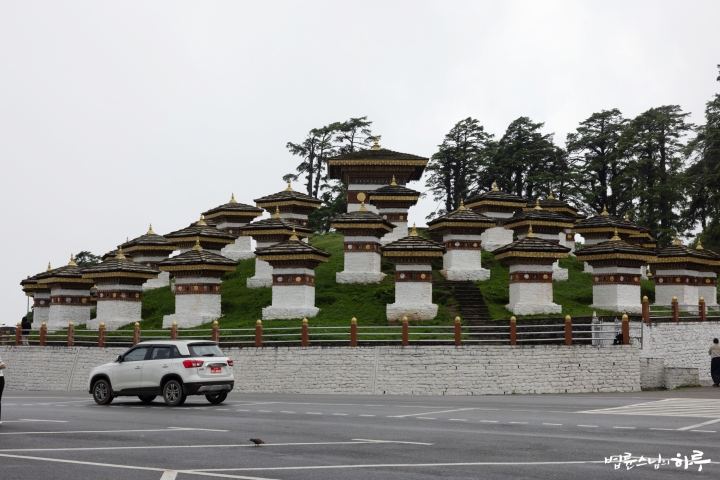
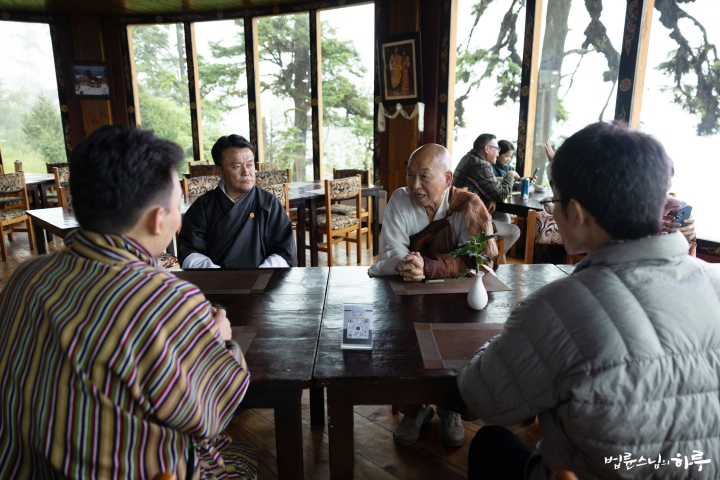
After the long car ride, they took a short break, using the restroom and having tea.
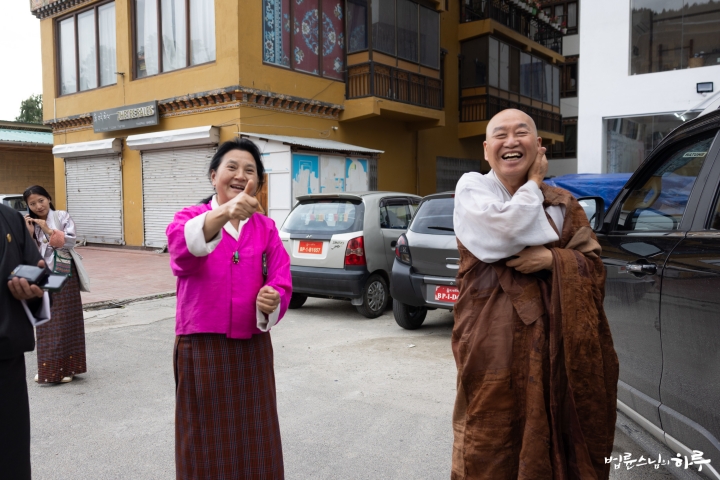
At 5 p.m., they arrived in Thimphu. Tashi, the Secretary General of the Bhikkhuni Foundation, came out to welcome Sunim. Sunim warmly greeted Tashi after a long time.
Tashi mentioned that she had a new house in Thimphu and invited Sunim's party to stay for the night. Sunim gratefully accepted the invitation, and after dropping off the luggage at the lodging, moved to the next meeting place — Dasho Passang Dorji's residence.
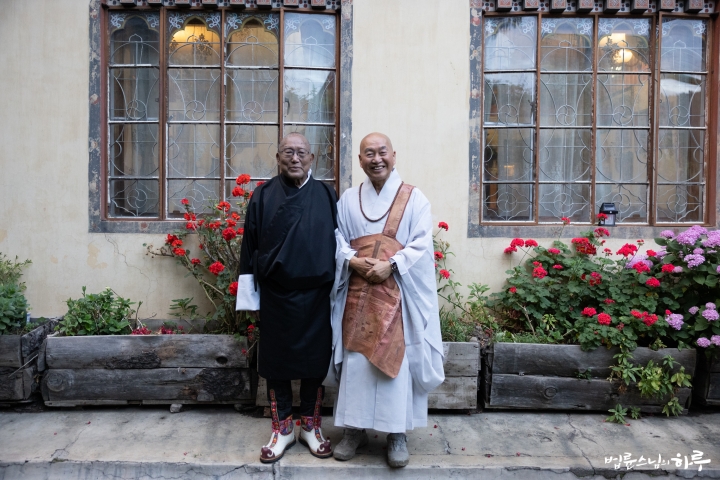
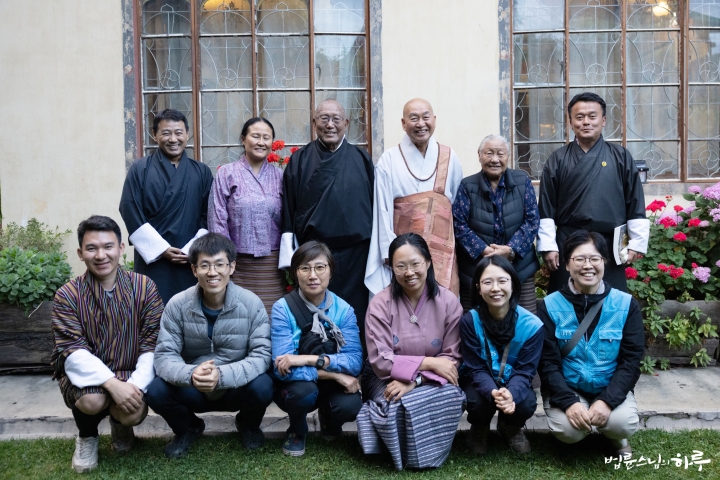
At 5:50 p.m., they arrived at Dasho Passang Dorji's house. Pasang Dorji is someone who formed a connection with Sunim when they met during Sunim’s pilgrimage to India two years ago. A former Speaker of the National Assembly turned politician, he is also currently helping his children run a large building materials business, which has allowed him to help with purchasing barbed wire at a low price when villages built fences.
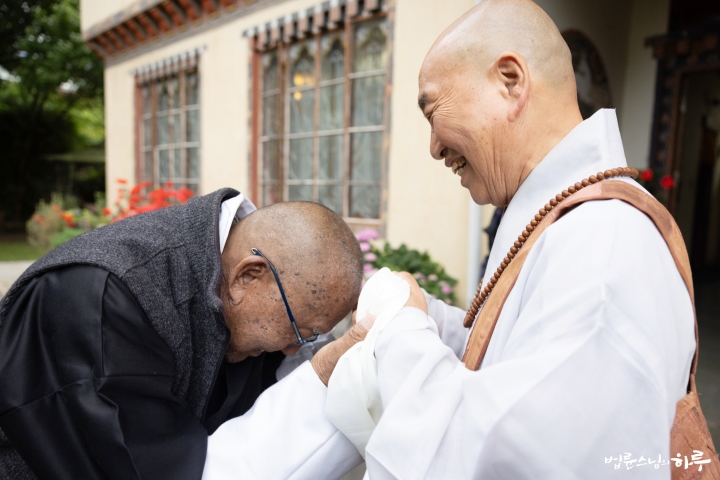
Passang Dorji came out in front of his house himself to warmly welcome Sunim.
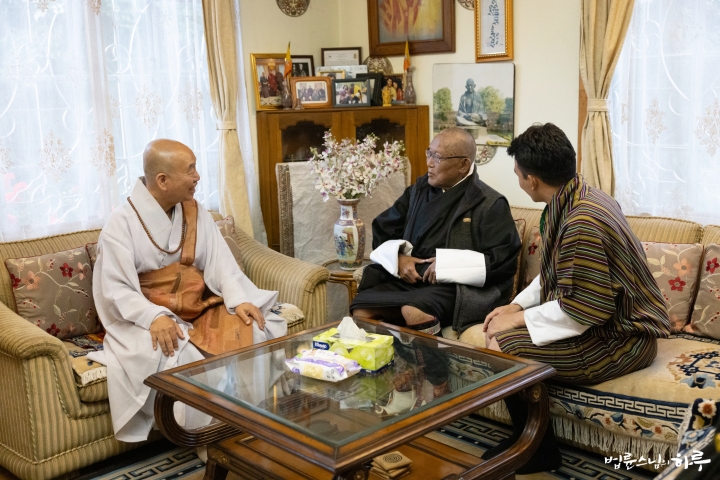
Sunim gave Passang Dorji, who had been helping with the project, a detailed update on the fence construction status confirmed at the inspection sites.
"Since what you're doing is for Bhutan, there's no reason for me not to help. You're working so hard for Bhutan — I'll help anytime. Please tell me whatever you need."
"Actually, a lot of roofing materials are being used on-site. But the company you introduced us to only handles premium materials, so we're having difficulty purchasing materials. We need to find ordinary-grade roofing materials in large quantities at a low price — could you look into this for us?""Yes, since I know this field very well, I know where and how to source them. All the materials I supply to you are provided at cost, so it's practically the same as offering a donation. (laughter)"
A Bhutanese volunteer added:
"Sunim, in reality, with the recent rise in oil prices, transportation costs have gone up the most, but he has supported the JTS projects by keeping not only material prices but also transportation costs low."
Sunim heard the volunteer's story and said:
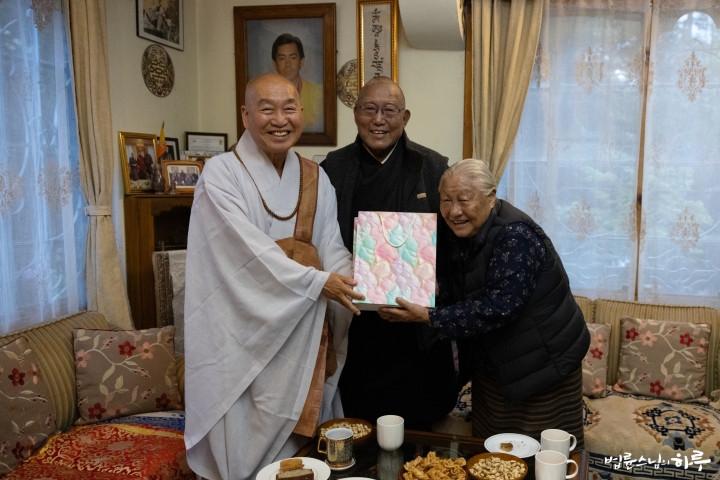
"You're keeping the transportation costs low too? But for it to truly be a donation, you shouldn't just break even — it should actually be a slight loss. (laughter)"After hearing Sunim's words, Passang Dorji said that since he had to pay taxes and employee salaries, taking a loss would be difficult, but he would continue providing materials at cost. Sunim joked, "A man shouldn't go back on his word," and everyone at the scene burst into laughter once again. Passang Dorji wanted to treat Sunim's party to dinner, but Sunim politely declined as he had another appointment. After presenting a gift and taking a commemorative photo, they left Passang Dorji's house at 6:45 p.m.
Sunim headed to Sanmaru Restaurant, a Korean restaurant, for dinner. Having heard that many Koreans were recently living in Bhutan, Sunim invited the Korean residents in Thimphu to dinner.
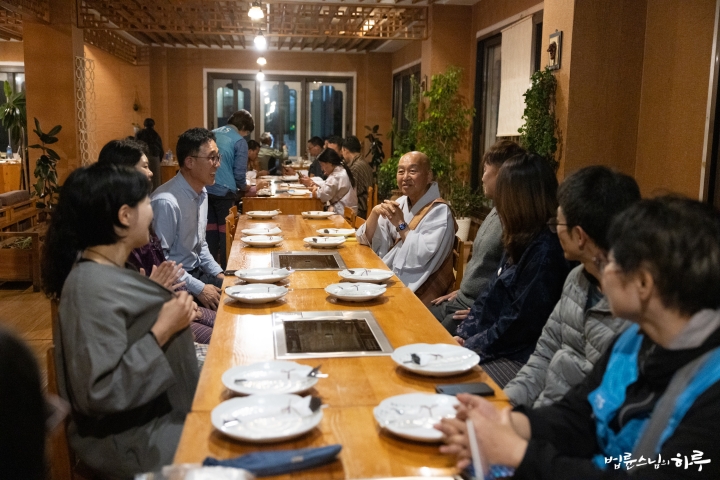
At 7 p.m., the Bhutanese guests invited by Sunim and the Korean residents were gathered together at Sanmaru Restaurant. The Bhutanese guests included the Trongsa district governor and those handling JTS-related work in the government cabinet office. The Korean guests included five KOICA volunteers, the head coach of the Bhutan national football team, and four football players currently playing in the Bhutan football league.
Sunim treated everyone to Korean food. The owner of Sanmaru Restaurant happily prepared the meal, saying it was the first time so many Koreans had gathered since COVID-19.
The KOICA volunteers said they had been watching the program "Sunim and the Guests" airing on SBS right up until coming to the restaurant. Everyone marveled at having Sunim, whom they had been watching on screen, sitting right in front of them, and one of them said they had been following Sunim's Bhutan field visits well by reading "A Day in the Life of Sunim." The Korean residents shared their recent news. The KOICA volunteers said they were currently engaged in volunteer activities in Bhutan in various fields such as Korean language education and media education, and the head coach of the Bhutan national team shared the news that they had finished third in a South Asian football tournament. Sunim also shared with the Korean residents the story of how the Bhutan project began and his thoughts on this trip.
The conversation naturally led to a Dharma Q&A session with the Korean residents. They asked about their personal concerns: whether there were conflicts with local residents in carrying out the Bhutan project, the meaning of life in the AI era, what they could do for unhappy people around them, and so on.
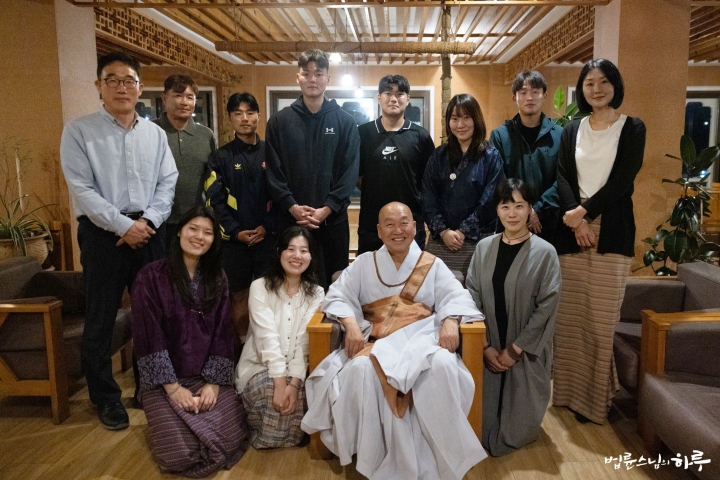
After finishing dinner and conversation, Sunim took commemorative photos with the guests and concluded the day's schedule.
Sunim returned to his lodging, organized his belongings, did some manuscript editing, and then rested. Tomorrow is the last day in Thimphu, Bhutan, with two scheduled meetings before departing the country.
This post concludes with one of the Dharma Q&A conversations Sunim had with the Korean residents today.
We Got Here Through Many Lessons and Experiences.
"That's not something that can be solved with words. You can only leave them be. When an opportunity arises, you can tell them about practice programs like 'the Awakening Retreat,' or introduce programs for young people like the 'Seonjae Youth Program.' Participating in these programs can change their mindset a little. Or traveling to remote places abroad, like the Indian countryside, can also help. The program 'Sunim and the Guests,' which recently started airing, is actually not the kind of content typically covered by entertainment programs. It only borrows the entertainment format — you could say it's actually an educational program. (laughter) If such content were covered in regular entertainment shows, viewers might find it boring. I use simple language there, but if you listen carefully, the topics are actually quite weighty.""Sunim, you said that the life we are living here is important, and I also think this kind of life is really important and I'm so happy myself. But it seems that many people living in Korea are not like this. Actually, when I talk to people my age, it seems like there's some kind of wall and they're afraid to even step out. What can I say to people like this?"
"I really liked that program because you said so many things that helped me reflect on myself."
"Yes. We have to keep creating new methods. We need to use creativity and continue experimenting. The Bhutan project right now is not being done from the perspective of simply helping needy people, like an ordinary foreign aid project. It's not just a wealthy country helping a poor country. The most important perspective is: 'How will a country like the Republic of Korea build relationships with a country like Bhutan?' In a way, the Bhutan project can be another way of healing the people of Korea. It's very difficult to persuade a drug addict to quit. An addict perceives life with drugs as better than life without drugs. But from society's perspective, no matter how good a drug may be, it can never be better than not using drugs at all. Likewise, no matter how good a cigarette may be, it can never be better for your health than not smoking. Yet smokers talk among themselves about which cigarettes are good. I've heard from tea lovers that there are teas that cost 30 million won per cake. Some go abroad to buy them in person, and some gather at tea houses to enjoy them together. It's the same with people who like alcohol or coffee. Someone once bragged about coffee made from beans eaten and excreted by some cat. People who like bicycles talk about bicycles that cost tens of millions of won each. All of this can be called being obsessed with something. In practice terms, you could call it 'attachment' or 'being captivated.' Once you are caught up in something, it's difficult to make judgments outside of that value system. It's the same with people obsessed with luxury goods or jewelry. If you let go of attachment and discard your fixed notions, nothing is particularly special. But to an addicted person, no words seem to get through. It's like how no matter how much you tell someone talking in their sleep to wake up, they can't hear you. Whether the Earth is round or flat can be confirmed at once by going outside it. But to someone who has never been outside the Earth, no matter how scientifically you prove it, it only sounds like knowledge — it's hard for them to accept it in their heart. Even after it was scientifically proven that the Earth revolves around the Sun, you can see from history how long it took humanity to accept that fact. Even when you understand it intellectually, it's difficult to discard existing notions or habits. Even as we conduct the Bhutan project, we must not approach it with the perspective of 'we who are well off are helping the locals who lack things.' The knowledge and experience they have accumulated are simply different from the technology and experience we have. They simply lack knowledge or experience of the technology that we have brought. They just have less experience handling cement than we do — they are not inferior beings. So we must not get angry or frustrated when the locals don't do work well. For example, when building a retaining wall with cement and stones, you have to lay a stone, apply cement on top, and then stack another stone on top of that for it to be sturdy and long-lasting. But when I looked around this time, in most cases, they had just smeared cement on the sides. If you do that, it will collapse quickly. If that method is too difficult, they should at least set up boards on the side and work that way, but they have built houses out of mud their whole lives and have never handled cement. So when paving roads with cement, problems like that came up here and there. From my inspections, there were many such cases. Sometimes there's cement smeared on sinks or toilets to the point where their original white color isn't visible. But the workers have no awareness of this as a problem. When working, they should cover things well to prevent cement from sticking, or if it does stick, they should wipe it clean — but they don't have that concept at all. They haven't done anything wrong. So I taught them, 'Look, this is how you should do it.' Because they have never used sinks before, the sinks were installed too high — out of reach for the women, who are shorter. I had them try operating it and adjust it to 80 centimeters. It's a continuous experiment. Since I visited 108 places in 10 days, on busy days I visit eight places a day, and I say the same thing at every house I visit. Originally, they lived in homes built by erecting wooden pillars and laying boards across them, so they never thought about things like moisture. But when building with cement and cutting into the ground like this, when it rains, water falls from above and moisture also rises from the cut surface. The workers have no experience, so they can't think of these things. So I tell them, 'Don't cut it like this — a technician should erect pillars and level it.' But even when I tell them, it doesn't always work. There are houses that have done it and houses that haven't. And when I tell them, some people fix it next time and some don't. Then I have to go again and say it once more. This is what I go around inspecting sites for. If all these people did their work well, there would be no need for me to come. I come precisely because they can't do it well. So is there anything to get angry about?""Don't you find it frustrating?"
"If I think only from my own perspective, sometimes it can be a bit frustrating. I might think, 'Why are they doing that?' but if the Buddha were to see me, he would probably say, 'Oh, you sentient being!' (laughter) So at the very least, it's not something to get angry about. Saying it two or three times doesn't make it work either. Things you don't know don't get done immediately just because you do them two or three times. We got here through many lessons and experiences too — we weren't like this from the start. People sometimes ask me, 'Sunim, how do you know about barbed wire, cement, and all kinds of things just by looking?' It's because our generation lived doing such work. From middle school, we put up barbed wire, and during the Saemaul Movement we went out for community labor and worked with cement — there's nothing we haven't done. In a way, you could say we were born into poor families and suffered in our youth, but looking back now, we received enormous learning when we were young. Since we received comprehensive learning from a young age, when I go to rural villages in Bhutan, I know everything. I didn't learn how to lay an irrigation channel, how to put up wire mesh, or how to install water supply at school. These are things I saw and heard from a young age as our society was going through changes like the present. It's a blessing. I built up much merit in past lives, so I was born into a poor family in this life and received good early learning, which is how I became like this. (laughter) This is a good thing. The common belief that if you accumulate much merit in past lives you'll be born wealthy, and if you commit sins you'll be born as a woman, is a mistaken value system."